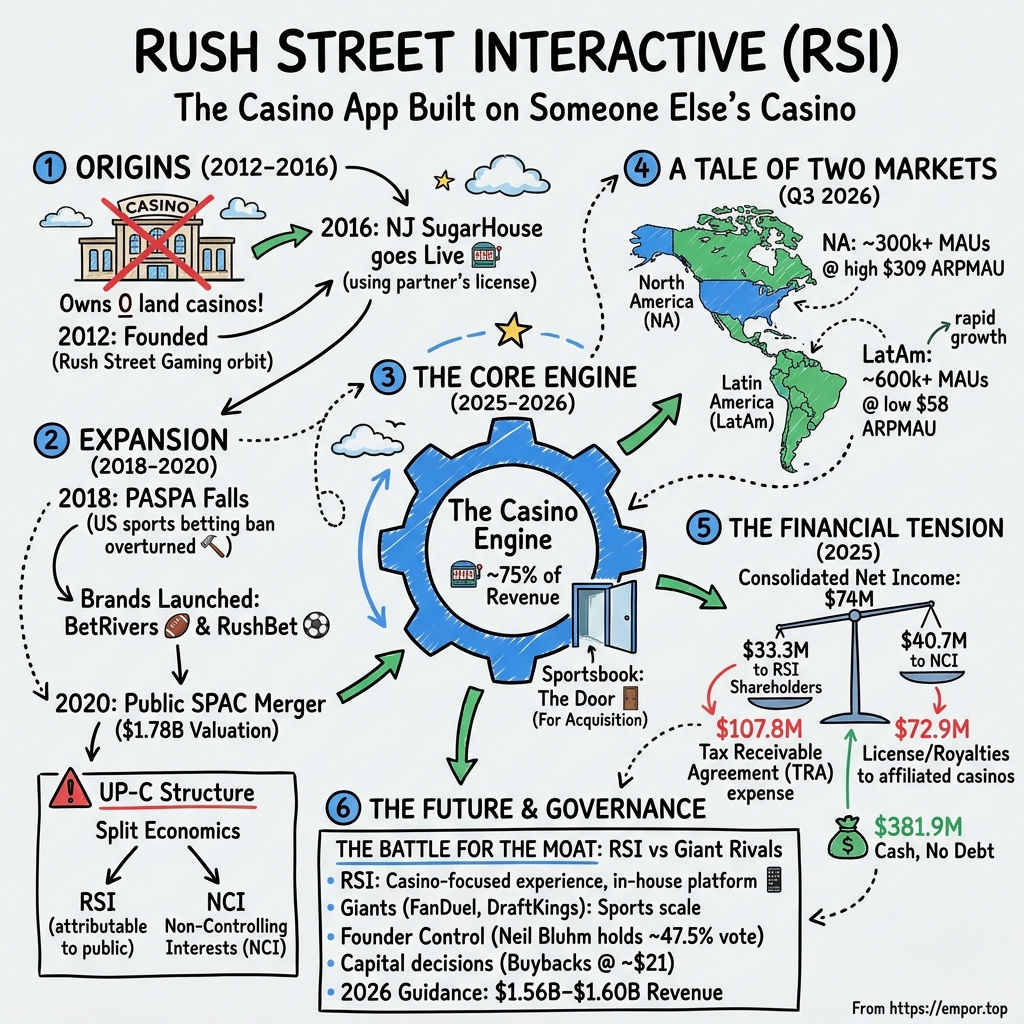
Rush Street Interactive: The Casino App Built on Someone Else's Casino
I. Nine Hundred Thousand Players, Two Very Different Businesses
Picture an ordinary month in the late summer of 2026. In a suburb outside Detroit, someone sits on the couch, opens the BetRivers app and spins a blackjack hand between innings of a ballgame. In Bogotá, someone else opens RushBet on a phone to put a few thousand pesos on a Colombian league match. Neither of them is thinking about gaming licenses, partnership units or tax receivable agreements. They are thinking about the next card and the next goal.
Add up everyone like them and you get the figure that opened Rush Street Interactive's third-quarter report: 907,881 monthly active users across its apps in an average month of the quarter.1 That is a crowd larger than the population of most American cities, playing games on software that a Chicago company built and runs. Revenue for the quarter was a record $385.9 million, up 39% from a year earlier.1
Look a little closer, and the crowd splits in two. About 607,000 of those players were in Latin America, and only about 300,000 were in the United States and Canada.1 Latin America had twice the users. But each North American player brought in about $309 of revenue a month, against about $58 for each Latin American player.1 Put those numbers together and the picture flips. The smaller North American crowd generated roughly seven of every ten dollars RSI earned in the quarter, and the larger Latin American crowd generated the other three. Two businesses share one app platform and one set of financial statements, but they have very different economics.
There is a second puzzle, hiding in the company's name. Rush Street Interactive sounds like the digital arm of a casino company, and in a sense it began as exactly that. Yet the listed company owns no consolidated land-based casino. The Rivers casinos in Pittsburgh, Philadelphia, Des Plaines and Schenectady belong to affiliates controlled by RSI's founders and sit outside its financial statements; RSI pays royalties to those affiliates for the use of their gaming licenses.2 The casino in the story is often somebody else's casino. The app is RSI's.
That leads to a third puzzle, about who owns what. The company traded on the New York Stock Exchange is a holding company. Its real business sits in a partnership, Rush Street Interactive, LP, which the public company controls and consolidates but does not wholly own.2 In 2025 the whole enterprise reported $74.0 million of net income, but only $33.3 million of that was attributed to the listed company. The rest belonged to the founders and early owners who still hold partnership units directly.2
The revenue mix makes clear what kind of company this is. Online casino produced about three-quarters of third-quarter revenue, and sports betting most of the rest.3 Management has a simple line for it: the casino is the engine of profit. The sportsbook, with its television tie-ins and its big Sunday crowds, is mainly how new players come in.
So the story of RSI comes down to four questions. The first is whether a casino-focused operator can hold its ground against far larger rivals such as FanDuel and DraftKings, which have more money for promotions and more national brand recognition. The second is whether the fast-growing Latin American user base can ever earn something like North American economics, or whether it will stay a large crowd that pays little. The third is whether the corporate structure, with its partnership units, non-controlling interests and tax agreements, hides how much the public shareholder actually earns. The fourth is whether a founder group that still controls about half the votes is allocating capital in the interest of outside owners.
Answering those questions means going back to the beginning: to a set of casino relationships that gave RSI its first route into a market, to the online casino engine it built on top of them, and to the gap between a crowd of users, a consolidated profit and the earnings that belong to the people who buy the stock. That beginning lies with a Chicago real-estate developer who decided late in his career that casinos were his next act.
 Subscribe on LinkedIn
II. A Casino Operator Builds an Online Company
Neil Bluhm did not come to gambling young. He made his name and fortune in Chicago real estate, building offices, hotels and shopping centers, before turning to casino development in the 2000s.4 With Greg Carlin, he built Rush Street Gaming, the company behind the Rivers casino brand, and won some of the most contested licenses in the American Northeast and Midwest.4 Getting a casino license in a state like Pennsylvania meant years of hearings, community politics and regulatory scrutiny. It also meant something valuable once won: one of a small number of legal permits to offer gambling in that market.
In 2012 Bluhm, Carlin and Richard Schwartz formed Rush Street Interactive.2 Schwartz was the operator of the group, a gaming executive who had spent years inside the Rush Street casino world before taking on the digital project.4 The timing was deliberate. Online gambling in America was illegal almost everywhere, but a handful of states had begun to explore it. The founders could see the outline of a future in which a casino license might also carry the right to run a website and an app.
That future arrived in New Jersey first. In September 2016, PlaySugarHouse went live as a real-money online casino in the state, operating under an Atlantic City casino partner's license, because New Jersey requires every online operator to be tied to a licensed land-based casino.25 It was RSI's first real-money site in the United States. It was also, in hindsight, the company's founding lesson: in regulated American gambling, the online operator usually needs a landlord. The license sits with a physical casino, and the app operator pays for access to it.
What RSI inherited from the land-based world and what it had to build for itself became clear in those first years. The inheritance was real. Rush Street Gaming knew how to deal with regulators, how to run a compliance department, how to handle anti-money-laundering checks and how to manage a player loyalty program. It owned casinos in states that would later legalize online play, which gave RSI a route into those states through a related party rather than a stranger. In 2018, RSI's revenue was only $18.2 million; by 2019 it had grown to $63.7 million, as online casino play and sports betting spread across more states.6
But the parts that would decide RSI's fate were the ones no casino could hand over. A website is not a slot floor. A customer who walks into a Rivers casino has driven there, parked and committed an evening; a customer on a phone can switch to another app in four seconds. RSI had to build its own player-account system, its own bonus engine, its own fraud controls, its own payment flows and its own sense of what keeps a player coming back. The company says it built a proprietary online gaming platform to run these functions, rather than renting a turnkey system from a supplier.2 That choice made it a technology company with a gaming license problem, rather than a casino company with a website.
The listed company consolidates the online partnership, while the founders' land-based casinos sit outside it.2 Their license royalties are a cost to RSI and income to those casino affiliates.2 Anyone reading "casino" in the company's name and expecting a slice of Rivers Casino Philadelphia gets nothing of the sort.
So by 2017 RSI had a foothold, a small online casino business and an unusual parent relationship. What it did not have was a national market. Most states still banned online casino play, and a federal law, the Professional and Amateur Sports Protection Act of 1992, barred sports betting almost everywhere outside Nevada. Then, in May 2018, the Supreme Court struck that law down, and the map of American gambling changed overnight.2 Suddenly a regional operator with a working platform and a set of casino relationships could imagine competing in dozens of states, provided it could secure licenses, partners and customers faster than everyone else rushing for the same doors.
III. PASPA Falls; The Race Becomes About Licenses, Apps and Attention
The Supreme Court ruling did not legalize sports betting. It handed the decision to the states, and the states took it one at a time. That turned the American market into a patchwork: one law in New Jersey, another in Pennsylvania, another in Illinois, each with its own tax rate, license fee, number of permitted operators and rules about who needed to partner with whom. For an online operator, every new state was a new negotiation.
For RSI, this structure played to its inheritance. In states where online licenses were tied to land-based casinos, having a family of casinos meant a ready-made partner. The Rivers properties in Pennsylvania gave RSI access to that state; Rivers Casino Des Plaines gave it a route into Illinois.2 Elsewhere it struck agreements with unrelated casinos, tribes or license holders. RSI paired its existing online casino with new sportsbook launches, so that the same customer account could bet on a football game and then play slots afterwards.
The brands followed the map. In the Northeast, PlaySugarHouse carried the early online casino. BetRivers became the main U.S. brand, tied by name to the Rivers casinos and carried into states where the Rivers name meant nothing at all.2 South of the border, RSI launched RushBet in Colombia, one of the first Latin American countries to regulate online gambling fully, and later carried it into Mexico and Peru.2 The pattern says something about the business. An app brand can travel anywhere a phone can go. A license cannot. In every new place, RSI had to win the legal right to operate before the brand could do any work.
There was also a part of the product RSI chose not to build. Since 2018, the Swedish company Kambi has supplied RSI's core sportsbook platform and trading services: the systems that set odds, manage risk and settle wagers across thousands of events.7 RSI wraps its own account management, promotions and casino cross-sell around Kambi's engine. In August 2024 the two companies extended the relationship in a multiyear deal.7 The arrangement made sense for a company of RSI's size. Building a world-class odds engine from scratch costs a great deal and takes years. But it also meant that the sportsbook, the product most visible on television, rested partly on a supplier that also served other operators.
It helps to think about early entry the way investors often get it wrong. The popular story is that the first operators into each state gained a lasting advantage: they collected customers before rivals arrived, and those customers stayed. RSI's own history tests that story. It launched real-money U.S. operations in 2016, before most rivals, and it was among the first sportsbooks in several states after 2018.2 Yet the American sports-betting market ended up dominated by two companies that were, at the time, mostly daily fantasy sports businesses. FanDuel and DraftKings arrived with millions of fantasy players, big marketing budgets and national brands, and the head start did not stop them.
The reason is that a head start in an app market is not the same as a moat. Customers can download several apps at no cost, and many do, chasing whichever offers the best odds or the richest sign-up bonus. Being first taught RSI how to run regulated operations, how to work with state regulators and how to integrate payment and identity checks. Those are real capabilities. But they did not lock customers in, and they did not stop better-funded rivals from catching up. Online casino, where players tend to stay with a product they like and where marketing works differently, became the more important battlefield for RSI.
All this set the stage for RSI's next decision: going public. On July 27, 2020, dMY Technology Group, a special purpose acquisition company, agreed to merge with RSI.8 The deal valued the business at about $1.78 billion, which the sponsors presented as about 5.6 times RSI's projected 2021 revenue of $320 million.8 It was a bet placed in the most enthusiastic year for SPACs and online gambling stocks in memory, when investors paid generously for any company with a credible claim to the American betting boom.
That multiple carried a set of assumptions. It assumed that revenue would keep compounding as states legalized, that RSI could keep its share as larger rivals spent heavily, and that marketing costs would eventually fall as a share of revenue. Some of those assumptions proved right. RSI's revenue went on to grow far beyond the forecast. But the investors who bought in also discovered that owning shares in RSI was not the same as owning the whole online business. The structure of the deal made sure of that.
IV. The SPAC Made RSI Public—but Left the Economics Split
The merger closed in December 2020, and RSI began trading as a public company.2 For the founders, the transaction did several things at once. It raised money to fund expansion. It gave the business a listed share that could be used to pay employees and buy companies. And it let the original owners stay invested without selling out or triggering large tax bills. The tool that made all three possible is a structure called an Up-C.
An Up-C works like a house with two front doors. Behind both doors is the same operating partnership, Rush Street Interactive, LP. Public investors come in through the first door: they buy Class A shares in Rush Street Interactive, Inc., which owns a slice of the partnership. The founders and early owners came in through the second door: they kept partnership units directly and received Class V shares in the listed company. Those Class V shares carry votes but no economic rights.2 They exist so that the people who own partnership units directly also have a say in the listed company that controls the partnership.
Over time, the two doors can merge. A partnership unit holder can exchange units for Class A shares, and when that happens, the matching Class V shares are cancelled.2 Each exchange increases the public company's share of the partnership, increases the number of Class A shares in circulation and shifts some voting power from the Class V side to the Class A side. These exchanges are not dilution in the usual sense, because the public company also gains a larger share of the partnership. But they change who owns the publicly traded shares, how many shares trade and how much of the consolidated profit is attributed to the listed company.
That leads to the distinction that runs through the rest of this story. In 2025, only $33.3 million of net income was attributed to RSI's shareholders; the remainder belonged to non-controlling interests.2 In other words, an investor who looked at the headline profit and divided it by the number of Class A shares would be counting money that belongs to someone else. Consolidated figures show how the business is doing. The attributed figures show what the listed shares earn.
The public life of the company began with a stumble. In April 2021, after the Securities and Exchange Commission's staff issued a statement on how SPACs should account for warrants, RSI restated its 2020 financial statements to treat its warrants as liabilities rather than equity, and disclosed a material weakness in its internal control over financial reporting.9 It was an industry-wide problem rather than a scandal unique to RSI. Hundreds of SPAC-era companies made the same correction that spring. The S-1 filed earlier in 2021 had also disclosed a $9.0 million under-accrual of royalty expense owed to affiliated casinos in the third quarter of 2020, an error corrected before the company's first annual report as a public company.6 Management later said it had remediated the weaknesses, and the auditor's 2025 report concluded that internal controls over financial reporting were effective.2 On the record, the early lapses look like the growing pains of a newly public company rather than a pattern. But they are worth remembering when the story turns to the related-party royalties that still flow to the founders' casinos.
The tax receivable agreement is the last piece of the structure, and it is the most often misunderstood. When partnership units are exchanged for Class A shares, the public company can gain tax benefits, chiefly larger tax deductions from stepping up the value of the partnership's assets. Under the agreement, RSI pays the exchanging holders 85% of the cash tax savings it actually realizes, and keeps the remaining 15%.2 That is a common feature of Up-C companies. It means much of the tax value created by exchanges flows back to the founders and early owners rather than to public shareholders.
For several years after the listing, this agreement mattered little because RSI was not profitable enough to use the tax benefits. In 2025 it suddenly mattered a great deal. As RSI's profits rose, the company concluded that it was now likely to use the tax benefits it had been carrying, and recorded both a large tax benefit and a matching rise in what it expects to owe under the agreement. The change in the TRA liability produced a $107.8 million expense in 2025, enough to push pretax income to a loss even though operating income was strong.2
That raises a question an outside shareholder should keep in mind. The TRA is not a sign of bad business performance. It is a contractual promise to share tax savings, and it grows precisely because the business is doing better. But it is real money. When RSI eventually pays it, the cash goes to the legacy holders, not to Class A shareholders, and it reduces the cash the listed company keeps from its own tax savings. The investor who values RSI on consolidated profit, without separating the non-controlling interests and the TRA obligation, will overstate what the listed shares are entitled to.
The SPAC, in short, bought RSI its capital and its stock market listing at the cost of complexity. The founders kept their economics in the partnership and much of the voting control through Class V shares, while public investors got a holding company with a claim on part of the business. None of that matters to the player spinning blackjack in Michigan. All of it matters to anyone trying to work out what the business is worth to the people who buy its shares. To answer that question, it is necessary to understand what the business actually earns from that player.
V. The Casino Is the Engine; the Sportsbook Is the Door
On the evening of October 28, 2026, Richard Schwartz got on a conference call to walk analysts through the best quarter in RSI's history. Revenue was up 39% year over year, adjusted EBITDA was up 73% and North American monthly active users had hit a record.1 But he returned to the same point: online casino remained the engine of profitability.3 For a business that most Americans know through sportsbook commercials, that is worth dwelling on.
Start with how a wager makes money. A player deposits $100 into a BetRivers account and plays slots. Over an evening, the player might stake $1,000 in total, as wins are fed back into new spins, and end the night with $90. The $10 difference, the amount the house kept, is called gross gaming revenue. RSI then subtracts the bonuses and free plays it gave the player to keep them engaged, and what remains is the net gaming revenue it reports.2 Sports betting works the same way, except that the house keeps a margin on each bet through the odds rather than through a fixed mathematical edge in the game.
That revenue is not the profit. Out of each dollar, RSI pays gaming taxes to the state, which in some states take more than half of gross gaming revenue for online casino and in others far less. It pays payment processors to move money in and out. It pays the casino or license holder whose permit it operates under. It pays game studios for slot content and Kambi for sportsbook services. And it spends on promotions and marketing to win and keep players. The wager is the raw material; what reaches the bottom line depends on how much of it each of those parties takes.
The mix of what RSI sells is unusually concentrated. In 2025, online casino and online sports betting together produced $1,127.5 million of the company's $1,134.4 million of revenue.2 Retail sportsbooks, which RSI runs inside some land-based casinos, contributed only about $2.0 million, and social gaming, its free-to-play products, about $4.9 million.2 In practice, RSI is a company with two product lines: online casino and online sportsbook, run on one account platform and sold under a few brands.
Why does casino matter so much? Part of the answer is the math. Casino games carry a predictable house edge over many plays. If a slot game returns 95% of stakes to players over time, the house keeps about 5%, and with enough play, that 5% is close to a law of nature. A sportsbook is different. Its margin depends on how games turn out. A run of favorites winning, or a Super Bowl that goes the bettors' way, can cut a quarter's revenue sharply. The casino engine turns over steadily; the sportsbook lurches with the sports calendar.
Another part of the answer is the customer. A sportsbook player is drawn in by big events and big promotions, and is often loyal mainly to the best price on the next bet. A casino player who likes the feel of an app, the selection of games and the speed of payouts may play several times a week, year-round, without needing an NFL Sunday to bring them back. That is why RSI's leadership has framed the sportsbook as a way to bring in new customers who can then be introduced to the casino. The sportsbook is the door; the casino is the room the company wants customers to stay in.
The cost structure shows how expensive the business is to run. In 2025, costs of revenue were about $742 million, roughly 65% of revenue.2 That bucket includes gaming taxes, payment processing, royalties to market-access partners, content fees and similar costs that rise more or less with each wager. Sales and marketing came to $164.7 million, roughly another 15% of revenue.2 After general and administrative expenses, depreciation and other costs, operating income came to $87.4 million, a margin of a little under 8%.2 For every $100 a player loses to RSI, about $65 goes straight back out to taxes, processors, partners and content, roughly $15 goes to marketing, and RSI keeps something under $8 as operating profit.
That margin is thin, but it is moving in the right direction, and the reason is operating leverage. The costs of building and running the platform, the compliance teams and the corporate staff do not rise at the same pace as wagers. Each additional dollar of revenue therefore carries more profit than the last, as long as the company does not have to spend proportionally more to win it. In the third quarter of 2026, adjusted marketing expenses fell to 14.2% of revenue, and adjusted EBITDA rose almost twice as fast as revenue.1 That is what operating leverage looks like in a digital gambling company. It also depends on things the company does not control: tax rates, competitors' promotions and how much players lose each quarter.
The regional numbers show the same business running at two speeds. In the third quarter, North American monthly active users rose 34% year over year, and each one generated an average of $309 a month.1 Latin American users rose 46%, but each one generated only $58 a month.1 Total active users rose about 42%.1 North America is the profit pool: fewer players who each spend far more, mostly on casino games in states that allow them. Latin America is the growth pool: more players, faster growth and much less money per head.
This is where the affiliate relationship sits inside the economics. In 2025, RSI paid $72.9 million in royalties to affiliated casinos, up from $49.6 million two years earlier.2 That was about 6.4% of revenue, and nearly a tenth of costs of revenue.2 The agreements generally calculate royalties as a percentage of RSI's revenue in the relevant market, minus certain reimbursable costs, in exchange for RSI's right to operate under the affiliates' gaming licenses.2 The affiliates are controlled by interests associated with RSI's founders, so this is a related-party payment, and RSI's affiliates also owed it $19.9 million at the end of 2025.2
How should an outside investor judge that payment? Every online operator in a state that ties online licenses to physical casinos has to pay someone for access, whether it is a casino, a tribe or a sports franchise. Paying a related party is not automatically worse than paying a stranger. But it raises a question that RSI's filings cannot fully answer: whether the terms are what an arm's-length counterparty would accept. The company has a written policy for approving related-party transactions, and its board includes independent directors.4 It does not publish a comparison between affiliate royalty rates and the rates it pays unaffiliated license holders, which is the evidence that would settle the question.
There are also commitments beyond the affiliates. At the end of 2025, RSI owed $32.1 million in future minimum payments related to licenses and market access, part of $80.8 million of total commitments that also included marketing contracts.2 Some market-access agreements require extra payments if the fees RSI generates fall short of contractual minimums.2 These sums are not large relative to the company's cash. They matter because they show that some of RSI's market access is a fixed cost, not a share of whatever revenue the market eventually produces. A new state that underdelivers still has to be paid for.
Put it together and the business looks like this. RSI owns the player relationship, the app, the account platform and the promotional engine. It rents the legal right to operate in many markets, the odds engine for its sportsbook and much of its game content. That is a bargain with real advantages. RSI can grow without spending billions on casino buildings, and it can enter a new market with software rather than concrete. But the bargain has a cost. A large share of every dollar goes to counterparties, and some of those counterparties hold licenses whose terms and renewals RSI does not control. Owning the player matters only if the player stays. That is the question the competitive battle has to answer.
VI. A Fourth-Place Casino App Tries to Make Product the Moat
In August 2026, Richard Schwartz took the stage at Oppenheimer's technology and internet conference with a claim a smaller company rarely gets to make. RSI, he said, was now the fourth-largest online casino operator in the United States, and had gained share for four quarters running.10 The company's investor presentation made a similar claim, putting RSI among the top four U.S. online casino operators in the states where it competes.11 For a company that most people outside the industry have never heard of, that is a striking position.
It is worth understanding who RSI is competing against, because the field is crowded and unequal. FanDuel, owned by Flutter, and DraftKings dominate American sports betting. Across the jurisdictions that report handle by brand, the two together took roughly 69% of sportsbook wagers in the first nine months of 2026.12 BetMGM, the joint venture of MGM Resorts and Entain, is a major force in online casino. Caesars has a huge loyalty program and national casino footprint. Fanatics arrived with a sports-merchandise database and deep pockets. Most of these rivals can spend more on advertising and promotions in a single quarter than RSI earns in a year.
That scale matters in sports betting in particular. A national television ad campaign costs the same whether a company has 1 million or 10 million customers, so the biggest operators can spread it over more players. The bigger players can also offer more generous sign-up bonuses, because they expect to earn more from each customer over time. RSI does not try to match every one of those bets. It runs a casino-first strategy instead, aimed at the part of the market where product and engagement may matter more than headline promotions.
The company's best case for why that works goes like this. Its online casino app is designed around casino players rather than bolted onto a sportsbook. Its in-house player-account management system lets it run its own loyalty programs, personalized offers and responsible-gaming tools, rather than relying on a vendor's generic features. Its data lets it figure out which players to reward and how, and cross-sell sports bettors into casino games. If all of that works, RSI can keep players coming back without having to win every promotional bidding war. Management describes its unit economics as industry-leading.11
The trouble with that claim is not that it is false. It is that the evidence the company publishes cannot show whether it is true. The strongest test of a product moat in an app business is retention: whether players acquired in a given quarter are still playing a year later, and how much they spend over their lifetime compared with the cost of acquiring them. RSI does not publish cohort retention curves, customer-acquisition cost or lifetime value in a form that would let an outsider compare them with rivals'.2 It publishes monthly active users and average revenue per user, which show the size and spend of the active crowd but not whether it is the same crowd from one year to the next.
Then there is customer behavior. Gambling customers are notorious for multi-homing, meaning they keep several apps on their phones and use whichever has the best offer that day. Switching costs are low: a player can open an account at a new operator in minutes and has every reason to do so if a rival offers a deposit match. Bonus-driven activity often fades once the bonus is used. That is why acquisition spending in this industry can look like a treadmill: the operator pays to acquire players, the players drift, and the operator pays again. A genuine product advantage would show up as lower churn and lower acquisition costs per retained player. RSI's reported marketing efficiency is consistent with that story, but it does not prove it on its own, because marketing as a share of revenue also falls as a company grows into markets it already serves.
Technology tells a similar mixed story. RSI does own its player platform, which is a real asset. It means the company controls how its app looks and feels, how bonuses are delivered and how player data is used. But on the sports side, Kambi remains a constraint under the multiyear extension signed in 2024.7 RSI can customize around Kambi, but a sportsbook whose prices come from the same supplier as other operators' cannot easily differentiate on prices or markets. That is one reason RSI's competitive weight sits on casino rather than sports.
Taking stock with standard frameworks gives a clear but limited picture. Regulation and market access create real barriers to entry: a new operator cannot simply launch in Pennsylvania or Michigan without a license and a partner. RSI's brand and growing scale in online casino may help retention at the margin. But the evidence for strong switching costs is thin, and there is no sign that RSI has a uniquely low-cost position. Its costs of revenue are dominated by taxes and fees that its rivals also pay. In the framework Hamilton Helmer calls the seven powers, RSI's strongest claim is to a weak form of what he calls cornered resource, through its licenses and market-access relationships, plus a still-developing form of process power in its casino product. Neither is yet proven at the scale needed to protect profit margins against much larger rivals.
There is also a gap between the company's own share claim and what it publishes. The fourth-place ranking and the four quarters of share gains come from management, based on state data in the jurisdictions where RSI competes.10 That is a meaningful claim, because state gaming revenue is reported publicly and can be checked. But "share in our states" is not "national share," and RSI does not operate in every regulated online casino state. The more useful takeaway is narrower: in the states where it competes, RSI appears to be winning casino players faster than the market as a whole. Whether it is doing so profitably over a full customer lifecycle is what the company does not show.
Michigan is a good place to watch. On the third-quarter call, management acknowledged that competition in the state was intensifying as private operators pushed harder.3 Michigan is one of RSI's most important casino markets, and it is a state where the big brands and newer entrants are all present. If RSI can keep gaining share there while holding marketing costs steady, that will be strong evidence for its product claim. If it has to spend more to stand still, the claim will narrow.
The verdict on the moat, then, is a narrowed one. RSI has credible signs of product traction, especially in online casino, and its share gains in its states are real if management's state data are accurate. But the moat remains only partly demonstrated, because the data that would prove it are not published. The test to watch is simple to state: does North American online casino share keep rising while marketing stays efficient and revenue per user holds? Meanwhile, more than half of RSI's players live in a part of the world where the casino-first strategy faces a different problem entirely.
VII. Latin America Has the Users; Now It Needs to Prove Their Value
The second quarter of 2026 was a party in Latin America. The FIFA World Cup, held across the United States, Mexico and Canada, put football on every screen from Bogotá to Lima, and millions of fans who had never bet online suddenly wanted to. RSI's Latin American monthly active users reached about 653,000 in the quarter.13 Then the tournament ended. In the third quarter, the number fell back to about 607,000, still up 46% from a year earlier but down sequentially.1 Some of the World Cup crowd stayed. Some went home.
That rise and partial fall is the Latin American story in miniature. RSI's international business began in Colombia, where regulators created one of the first fully regulated online gambling markets in the region. RushBet became RSI's brand there and later in Mexico and Peru.2 What started as a small adjunct to the U.S. business is now a large and growing part of it. Latin American revenue roughly doubled from $79.3 million in 2023 to $154.9 million in 2025.2 By the third quarter of 2026, using the company's own user counts and revenue per user, the region was contributing roughly a quarter or more of quarterly revenue, compared with about one-seventh for full-year 2025.
So Latin America is not a novelty. It is financially material, and it is growing faster than North America. The question is whether its growth is the same kind of growth. The per-user gap remained stark.1 Part of the gap reflects lower incomes and smaller average bets. Part reflects a product mix that leans more heavily toward sports betting, which earns less per player than casino. And part reflects currencies: RSI reports in dollars, and its Latin American revenue is earned in Colombian, Mexican and Peruvian currencies that can swing in value.2
Management's framing of the World Cup is optimistic. On the third-quarter call, the company said that many of the new customers who joined during the tournament had tried multiple products, including casino games, which suggests they might be stickier than one-time bettors.3 That is plausible, and it is the right strategy for a casino-led operator. But a large event cohort is not yet proof of durable retention. The best test is what those players do in the quarters after the tournament, without the World Cup to bring them back and without the sign-up promotions that may have drawn them in. A drop from 653,000 to 607,000 is consistent with a meaningful chunk staying. It is also consistent with an ongoing slide. The next two quarters will tell which.
Latin America also brings regulatory risk of a sharper kind than most U.S. states. Colombia showed what that looks like in 2025. The government, citing a fiscal emergency, imposed a value-added tax on deposits into online betting accounts, changing the economics of every operator in the market almost overnight.14 RSI had to rethink its promotions and operating plans in Colombia. Then the country's Constitutional Court struck the measure down.14 The episode ended better than it might have, but it showed that the rules in RSI's largest international market can change abruptly, through executive action rather than the slower legislative process American operators are used to.
The same caution shows up in RSI's attitude to Brazil, the region's biggest prize. Brazil regulated online betting recently and has a huge population of football fans, which makes it the obvious place for any Latin American operator to want to be. When analysts asked about Brazil on the third-quarter call, Schwartz described the regulatory outlook as uncertain and said any entry would have to make sense on a risk-adjusted basis.3 It was a measured answer, and a sensible one. It also confirmed that RSI's Latin American growth, for now, has to come from deeper penetration of markets it already serves rather than a big new country.
Currency adds a further layer. RSI's Latin American exposure is mainly to the Colombian peso, the Mexican peso and the Peruvian sol, and the company does not hedge foreign-exchange risk beyond matching local revenues and costs.2 In 2025, currency moves happened to increase RSI's cash balances by about $17 million, mostly because the Colombian peso strengthened, after reducing them by about $9 million the year before.2 Markets with non-dollar currencies produced less than a fifth of revenue in 2024 and 2025, but with Latin America growing faster than North America, that share is rising, and so is the exposure.2
So Latin America is best understood as a separate investment case inside RSI, not an automatic extension of U.S. economics. It has the users. It has the growth. It has proven it can scale. What it has not proven is that its players will become more valuable over time, rather than staying a large crowd that brings in modest revenue per head. The test that matters is regional revenue and repeat play by cohort, measured after launch promotions fade and major sports events recede. That test will play out over the coming year. Meanwhile, the combined business has done something that seemed distant when it went public: it has started to make money.
VIII. Profit Arrives; Tax and Ownership Make It Harder to Read
The 2025 income statement looks like a riddle. At the bottom it shows $74.0 million of consolidated net income, the best year in RSI's history.2 A few lines above, it shows a pretax loss of about $11 million.2 How can a company lose money before tax and then make money after it? The answer is that 2025 was the year the accounting for RSI's structure caught up with its success. Untangling it is the only way to see how much the operating business has actually improved.
Start with the part that is not complicated. RSI's revenue grew from $691 million in 2023 to $1.134 billion in 2025, an increase of more than 60% in two years.2 Over the same period, operating income moved from a loss of $51.6 million to a profit of $87.4 million.2 That is a swing of almost $140 million in operating profit on roughly $440 million of additional revenue, which means about a third of every new revenue dollar fell through to operating profit. That is the operating leverage described earlier, showing up in the actual results. The 2024 year sat in between, with modest operating profit, as the business crossed from losses to gains.2
Below the operating line, two big accounting items collided. The first was a tax benefit of $85.1 million.2 For years, RSI had accumulated tax assets, mainly from the step-up in asset values created when partnership units were exchanged, but it had not recognized them on its balance sheet because it was not clear the company would earn enough to use them. In 2025, with profits rising, the company concluded that it was now likely to use them, released the reserve and booked the benefit. The second was the $107.8 million TRA expense: because RSI now expected to use those tax benefits, it also expected to make payments to legacy holders under the agreement.2 The TRA expense dragged pretax income into a loss; the tax benefit lifted net income back into profit.
Neither item says much about whether the business is getting better. Both are consequences of it getting better. But together they make 2025 GAAP net income a poor shorthand for recurring earnings. An investor who took the $74 million as a normal year's profit would be counting a one-time tax benefit and ignoring that a good part of it is owed to someone else.
Then comes the ownership split. Of the $74.0 million, $40.7 million was attributed to non-controlling interests and $33.3 million to RSI's shareholders.2 That split is itself complicated by where the tax items sit. The tax benefit and the TRA expense largely belong to the public holding company rather than the partnership, because it is the holding company that pays taxes on its share of the partnership's income and owes the TRA payments. So the split for 2025 does not simply follow ownership percentages, and it will not look the same in a normal year. The important point is the direction: a large share of what the business earns belongs to the founders' partnership units, not to Class A shareholders.
Cash flow tells a cleaner story. Operating cash flow was negative $5.9 million in 2023, then $106.4 million in 2024 and $165.0 million in 2025.2 Cash generation is running well ahead of reported profit, which is usually a reassuring sign. In 2025 the gap reflected non-cash items: depreciation and amortization, share-based compensation, and the tax and TRA items, which largely offset each other in cash terms because neither involved cash changing hands that year.2
There is a catch. RSI capitalizes much of what it spends on developing its software platform, recording it as an asset on the balance sheet instead of an expense on the income statement. That spending shows up in investing cash flow, not operating cash flow. In 2025, internally developed software was the largest single investing outflow, and total investing cash outflow was $37.0 million, including gaming licenses and other intangibles.2 So operating cash flow alone overstates the cash RSI has left after the platform reinvestment its business needs. A fairer measure subtracts the software spending, which still leaves a sizeable cash surplus.
What the company does not show is how much it spends on research and development overall, or how its headcount has changed.2 For a business whose whole argument is that its product is better, that is a notable gap. It means an outside investor cannot tell whether margins are improving because the business is scaling or because the company is underinvesting in the product it says is its moat.
The balance sheet, at least, is simple. At the end of September 2026, RSI had $381.9 million of cash and cash equivalents, not counting customer deposits held separately, and no third-party debt.15 Management says it expects to keep funding operations without borrowing.15 Interest on that cash produced $9.3 million in 2025.2 For a company whose regulators require large cash reserves and whose market conditions can change on a court ruling, that cushion is a genuine strength. It gives RSI room to invest, to buy back shares or to absorb a shock. Which of those it chooses is the subject of the next part of the story, and it leads straight back to the people who control the company.
IX. Founders Still Hold the Votes; Investors Get a Say
On May 5, 2026, trusts associated with Neil Bluhm, Richard Schwartz and Mattias Stetz, RSI's chief operating officer, agreed to sell 10 million Class A shares to the public at $26 a share, with an option for underwriters to buy another 1.5 million.1617 The proceeds went to the sellers, not to the company.16 A few months later, RSI itself was buying its own shares, at prices just under $21.3 The founders had sold at $26 and the company was buying at about $21. It is the kind of sequence that tells an outside shareholder a lot about how control and capital allocation work at RSI, and it repays a closer look.
Begin with who runs the company. Richard Schwartz has been chief executive since 2021.4 He is the operator who built the online business from its New Jersey start, a gaming executive who prefers product and customer data to bold rhetoric. Kyle Sauers has been chief financial officer since 2020 and became president as well in October 2025.4 Neil Bluhm chairs the board.4 It is a team that has been in place through the listing, the early losses and the turn to profit, which gives continuity. It also means the people who made the big decisions of the last six years are the same people being judged on them.
The pay numbers need some care to read. The 2026 proxy reported Schwartz's total compensation at $6.95 million for 2025.4 But "compensation actually paid," a measure that captures changes in the value of equity awards, was $30.1 million, and the proxy reported that equity awards vesting for the CEO in 2025 were worth about $43.8 million.4 Those larger figures are not cash. They reflect the rise in RSI's share price applied to stock awards granted earlier. The rise in the share price lifted executive wealth sharply, as it was designed to. Whether it rewarded the right things depends on whether the share-price gains reflected durable value creation. In the 2025 vote on executive pay, about 99% of votes cast supported the company's approach.4
The control picture is where outside shareholders have the least say. As of April 2026, Neil Bluhm held about 47.5% of the company's total voting power, mostly through Class V shares tied to his partnership units.4 Together, directors and executive officers controlled about 52.5% of the votes.4 RSI uses the New York Stock Exchange's controlled-company exemption, which means it does not need a majority of independent directors. Five of its 11 directors were deemed independent, and its compensation and nominating committees were not fully independent.4 An independent lead director provides some counterweight, as does the related-party approval policy.
Outside shareholders made their views known at the June 2026 annual meeting. Bluhm received about 151 million votes in favor of his re-election as a director and about 52 million withheld.18 That is roughly one in four votes cast. Since insiders control around half of all votes, the share of withheld votes among the shares insiders do not control was considerably higher. Niccolo de Masi, a director who came to the board through the dMY merger,4 also faced a substantial withheld vote,18 while the independent nominees received much stronger support.18 Withheld votes cannot unseat a director at a controlled company. But they are a clear signal, from investors who have no other lever, that a meaningful part of the outside shareholder base is uneasy with board oversight.
Against that, the record on delivery is good. RSI exceeded the high end of its guidance for both revenue and adjusted EBITDA in 2025.14 In the second quarter of 2026 it raised its full-year guidance, and in the third quarter it reaffirmed it.131 For a company in an industry known for missing forecasts, that is a strong recent record of setting targets it then meets. It is the best evidence that management's operating judgment is sound.
Capital allocation is where the record is harder to judge. The company's acquisitions have been small. In 2022 it paid about $5.8 million for Run It Once Poker, a poker platform and training brand, and about $4.7 million for Rush Street Productions, a related media business.19 Together they were tiny compared with the core business, and poker and social gaming revenue remains minor. There is not enough comparable transaction data to judge whether RSI overpaid. What can be said is that these deals have not made a visible difference to the company's economics, for good or ill.
Buybacks are the larger question. RSI repurchased about $7.6 million of Class A shares in 2025 and none in 2024.2 In 2026 the pace picked up: about $14 million in the third quarter and another $11 million after the quarter ended, at prices just under $21 a share.3 Buying at $21 is cheaper than the $26 the founders sold at, which, if the business is worth more than the market price, would be a better deal for the shareholders who remain. But the sequence still raises a fair question. If insiders thought $26 was a good price to sell, what tells the company that $21 is a good price to buy? There may be good answers, such as estate planning, diversification or a change in the business outlook. The company has not laid out a return threshold that would let an outside shareholder judge.
That leaves the question an engaged long-term owner would most want management to answer. Given that financial flexibility, RSI has several uses for its money: buying back shares, spending more on product and software, paying for market access in new states, or entering a new country. How does it choose among them, and what return does each have to clear? The answer matters because the case for RSI rests on the claim that its product and its markets deserve more investment, and the company has not yet shown outside shareholders how it ranks one use against another.
X. Analysis & Bear vs. Bull Case
The third-quarter call on October 28, 2026 had two moods. In the prepared remarks, management was confident: revenue up 39% year over year, adjusted EBITDA up 73%, marketing down to 14.2% of revenue and guidance reaffirmed at $1.56 billion to $1.60 billion of revenue and $245 million to $265 million of adjusted EBITDA for the year.1 In the Q&A, the analysts pressed on the weak spots: slowing growth across the industry, sharper competition in Michigan and the future of Brazil.3 That pairing of confidence and doubt is the honest shape of the RSI debate.
The bull case, at its strongest, is concrete. RSI has a casino-focused product that management says is gaining share in the states where it competes, and the reported numbers back that up in direction if not in detail.10 Its active-user base is growing more than 40% a year.1 Its marketing costs are falling as a share of revenue, which is what operating leverage should look like.1 It has no debt and a large cash balance.15 And it has options: every new American state that legalizes online casino, and every Latin American market that matures, is a place where it already has a platform ready to deploy. If the bull case is right, RSI is a mid-sized operator that has found the profitable corner of an industry dominated by giants.
The bear case is just as concrete. FanDuel and DraftKings have far greater scale in sports betting.12 Customers can multi-home at no cost. Marketing can rise faster than durable player value if rivals decide to spend heavily on casino players. Market access is not owned: a meaningful share of revenue goes to affiliates and license holders on terms that RSI does not fully control.2 Latin American users are growing quickly, but their revenue per head is less than a fifth of North America's and their rules can change abruptly, as Colombia showed.114 And the reported profits that look so impressive are, for the listed equity, smaller than they seem, after non-controlling interests and the TRA.
Michael Porter's five forces framework helps sort these claims. The threat of new entrants is moderated by licensing: a new operator cannot easily enter a regulated state without a license and a partner, though deep-pocketed entrants with existing customer databases, such as Fanatics, have shown it can be done. Buyer power is high, not because any single player is large, but because players can switch at almost no cost and shop for promotions. Supplier power is real: gaming content studios, Kambi, payment processors and, above all, license holders all take a share of every wager, and some of those license holders are related parties.27 Rivalry is intense, especially in sports betting, where promotional spending is the main weapon. And the threat of substitutes is rising.
That last force deserves a moment. Prediction markets, which let users trade contracts on the outcome of events under federal commodity rules rather than state gaming law, have grown quickly in the United States and could compete for sports-betting activity while avoiding some state taxes and restrictions. For RSI, the exposure is real but smaller than for sportsbook-led rivals, because most of its revenue comes from online casino, which prediction markets do not directly replicate. If prediction markets erode sports betting, RSI's door narrows more than its engine.
The seven-powers framework points to the same narrow verdict: RSI's licenses and developing casino product are real advantages, but neither is yet proven durable enough to protect margins against a determined, better-funded rival.
Latin America adds growth, but its lower economics and regulatory risks remain distinct from the U.S. profit engine.
Three numbers capture whether the bull or bear case is winning. The first is North American online casino share and active-user growth: active users there rose 34% year over year in the third quarter, a record.1 The second is revenue per user alongside marketing as a share of revenue: North American ARPMAU of $309 with adjusted marketing at 14.2% of revenue, both moving in the right direction.1 The third is cash from operations after software investment, which reached $165 million before that reinvestment in 2025.2 If those three hold or improve, the bull case strengthens. If any one deteriorates, the case narrows.
Capital allocation remains an accountability test: RSI has not explained how it ranks buybacks against software, market access and new-market launches.
Valuation needs the same discipline. The listed equity's claim is smaller than consolidated earnings suggest, and the TRA adds another obligation.2
So the verdict threshold is clear. Sustained North American casino share gains, stable acquisition efficiency and improving Latin American monetization would strengthen the thesis. Falling cohorts, rising promotional intensity or another abrupt tax intervention would weaken it. RSI has a credible growth case in casino-led markets, backed by operating leverage and reported share gains. It does not yet have a proven moat. And the structure through which public investors own it makes every reported profit a little smaller than it looks. Those are the facts. What they teach is a different question.
XI. Business & Investing Lessons
Go back to New Jersey in September 2016, when PlaySugarHouse went live on a casino partner's license. The founders could not have built the app without that license, and they could not have kept the players without the app. Everything that followed came out of that one arrangement, and it holds the first lesson.
A license can open the door; the product has to keep the player. RSI's early access came from casino relationships, many of them with its founders' own properties. That access got it into new markets. But access is only the first step. Once a player is on the app, the license does nothing to keep them there. RSI's whole bet since then has been that a casino-first product can do what a license cannot, and the evidence for that bet is still only partly in. For founders building in regulated industries, the lesson is that permits buy time, not customers. For investors, it is that the license and the product deserve separate valuations, and the product's value can be measured only in retention data the company has yet to publish.
A growing platform is not the same as a complete stack. RSI owns the customer-facing parts of its platform, and that ownership is a real strength. But its business still depends on outside providers and license holders. Every one of those dependencies is reasonable on its own. Together, they mean RSI's margins are shaped by the terms it negotiates with others. Owning the front end of a business, the part the customer sees, is powerful. It is not the same as owning the whole thing.
Consolidated profit is not always the shareholder's profit. RSI's 2025 results showed how much the headline can obscure. For investors in any Up-C company, the lesson is to start with the attributable line and the TRA, and only then look at the headline.
The best test of discipline is where the next dollar goes. RSI has a debt-free balance sheet, a stream of operating cash and an owner group that controls the vote. It bought back shares after insiders sold, kept paying related-party royalties for license access and continued to invest in software it does not fully detail. None of these decisions alone says much. Together, they are the record by which outside shareholders will judge whether control serves them. The company that can explain why its next dollar goes where it goes, and show the returns, earns the trust that voting power alone cannot buy.
XII. Epilogue
On the night this story was written, RSI stands about six weeks from the end of its 2026 financial year. It has record North American users, a new launch in the Canadian province of Alberta, and full-year guidance it has already reaffirmed once.3 On paper, it is the most successful year in the company's history. In practice, almost every question that matters is still open.
The first test will come with the fourth-quarter and full-year results early in 2027. The guidance implies fourth-quarter revenue of roughly $410 million to $450 million, given the $1.150 billion already earned in the first nine months.151 Hitting that range would extend a run of delivered guidance that now stretches through 2025 and 2026. But the more important number will be below the operating line: whether operating income and cash flow keep pace with adjusted EBITDA once the TRA and tax effects are separated out. A year in which adjusted EBITDA reaches the guided $245 million to $265 million but operating cash after software spending lags would tell investors that the adjusted numbers are flattering the cash story.
The second test is Michigan and the other core casino states. Management acknowledged rising private-entrant competition in Michigan on the third-quarter call.3 If RSI's North American casino share keeps rising there despite that pressure, the product claim strengthens considerably. If share flattens, or if marketing has to rise to hold it, the claim narrows to something more modest: a good operator in a crowded field, rather than a product with a durable edge.
The third test is the World Cup cohort in Latin America. The 607,308 Latin American users of the third quarter include many who arrived for a tournament that is now over.1 The fourth quarter and the first half of 2027 will show how many stay, and whether their revenue per head rises as they move from sports bets into casino games, as management hopes. If they do, Latin America begins to look like a second engine. If they drift away, it remains a large crowd that pays little.
The fourth test is regulatory, and it is the hardest to predict. State legislatures in the United States are weighing whether to legalize online casino, which would open new markets for RSI's casino-first product, and some are weighing higher taxes on existing operators. In Latin America, Colombia has already shown how quickly rules can change, and Brazil remains an open question. Alberta's early ramp will show whether RSI can win a new market without overpaying. Each decision could add or subtract a meaningful share of RSI's future revenue.
The last test is the one that runs through all the others: management credibility. The next guidance update, and the way executives answer hard questions about buybacks, competition and the structure, will be evidence, not just forecasts. A team that sets realistic targets, explains misses and shows outside shareholders the returns on their capital will earn more trust. One that leans on adjusted figures and avoids the hard questions will not.
The next chapters turn on conversion, not launch announcements. Whether users stay, whether marketing efficiency survives slower markets and whether operating cash follows adjusted EBITDA will decide the story. RSI has built a business that grows. It has not yet proved it is one that lasts.
XIII. Outro
Return to the couch outside Detroit and the phone in Bogotá. Two people open an app built by a Chicago company, and neither of them thinks about the license behind it.
That is what makes RSI unlike a conventional casino company. Rush Street Interactive built a casino without building the casino; now it has to prove the house belongs to its shareholders.
References
-
Third Quarter 2026 Results — Rush Street Interactive, SEC, 2026-10-28 ↩↩↩↩↩↩↩↩↩↩↩↩↩↩↩↩↩↩↩↩
-
2025 Form 10-K — Rush Street Interactive, Inc., SEC, 2026-02-18 ↩↩↩↩↩↩↩↩↩↩↩↩↩↩↩↩↩↩↩↩↩↩↩↩↩↩↩↩↩↩↩↩↩↩↩↩↩↩↩↩↩↩↩↩↩↩↩↩↩↩↩↩↩↩↩↩↩
-
Q3 2026 Earnings Call Transcript — The Motley Fool, 2026-10-29 ↩↩↩↩↩↩↩↩↩↩
-
2026 Definitive Proxy Statement — Rush Street Interactive, SEC, 2026-04-13 ↩↩↩↩↩↩↩↩↩↩↩↩↩↩
-
Internet Gaming and Sportsbook Revenue Summary — New Jersey Division of Gaming Enforcement, 2025 ↩
-
2021 S-1 Registration Statement — Rush Street Interactive, SEC, 2021-02-05 ↩↩
-
Kambi and Rush Street Interactive Extend Sportsbook Partnership — Kambi, 2024-08-28 ↩↩↩↩
-
Business Combination Agreement and Merger Details — dMY Technology Group, SEC, 2020-07-27 ↩↩
-
2021 Form 10-K/A, Material Weakness and Remediation — Rush Street Interactive, SEC, 2021 ↩
-
Oppenheimer Technology, Internet & Communications Conference Transcript — Stock Analysis, 2026 ↩↩↩
-
Third Quarter 2026 Investor Presentation — Rush Street Interactive, 2026-10-28 ↩↩
-
Commercial Gaming Revenue Tracker — American Gaming Association, 2026-11-20 ↩↩
-
Q2 2026 Results and Guidance — Rush Street Interactive, SEC, 2026-07-29 ↩↩
-
Q4 2025 Earnings Call Transcript — Equibles, 2026-02-17 ↩↩↩↩
-
Third Quarter 2026 Form 10-Q — Rush Street Interactive, SEC, 2026-10-29 ↩↩↩↩
-
Secondary Offering Pricing Filing — Rush Street Interactive, SEC, 2026-05-05 ↩↩
-
Underwriting Agreement for Secondary Offering — Rush Street Interactive, Inc., SEC, 2026-05-05 ↩
-
2026 Annual Meeting Voting Results — Rush Street Interactive, SEC, 2026-06-03 ↩↩↩
-
2022 Form 10-K, RSP Acquisition Note — Rush Street Interactive, SEC, 2023-02-23 ↩
 LinkedIn
 WhatsApp
 Reddit
 Hacker News
 Email
 Kindle
 RSS Feed
 Spotify
 Apple Podcasts
 Amazon Music
 Audible
 YouTube