Rogers Corporation: The Materials Architect Behind the Circuit and the Crash
I. The $5.2 Billion Phone Call from Wilmington
On the first day of November 2022, a deal that had been signed a year earlier, financed, and cleared by almost every regulator that mattered simply ran out of time. DuPont de Nemours announced that it had terminated its agreement to buy Rogers Corporation for $277 a share in cash, because China's State Administration for Market Regulation, 国家市场监督管理总局 SAMR, had not given its approval before the agreement's final deadline.1 There was no rejection letter to argue with and no remedy to negotiate. Beijing never said no. It simply never said yes, and when the clock ran out, DuPont walked.
The price of walking was $162.5 million, wired to Rogers as a termination fee.1 In almost any other story, that would be a happy ending. For Rogers it was a consolation prize attached to a disaster. The deal had valued the company at about $5.2 billion,2 and shareholders who had spent a year treating $277 as a near-certainty suddenly owned a standalone specialty materials maker again. The stock collapsed on the news.3 Over the following years, the drop from peak to trough would reach about 69%, one of the worst drawdowns in the company's long life as a public company.4
The break fee was real money, but it disguised what was happening underneath. In the year DuPont walked away, Rogers earned about $144 million in operating profit on record sales of roughly $971 million.4 Two years later, operating profit had fallen to about $25 million.4 The cash windfall arrived just as the business beneath it went into the coldest stretch its two main end markets, wireless infrastructure and electric vehicles, had seen in a generation. Customers had overbought during the pandemic, and they spent 2023 and 2024 working through their warehouses instead of placing orders.
So this is the story of what happens when a company prepares to be absorbed and then has to remember how to be independent. It raises three questions that run through every chapter that follows. The first is whether closing factories can bring back mid-teens operating margins when volume is not growing. The second is whether the $67.3 million write-off of the German ceramics business called curamik was a one-off accounting clean-up or an admission that Rogers has permanently lost share in electric-vehicle power electronics.4 The third is whether a company that sells more to China than to the United States can stay out of the crossfire of a technology cold war that has already cost it one exit.
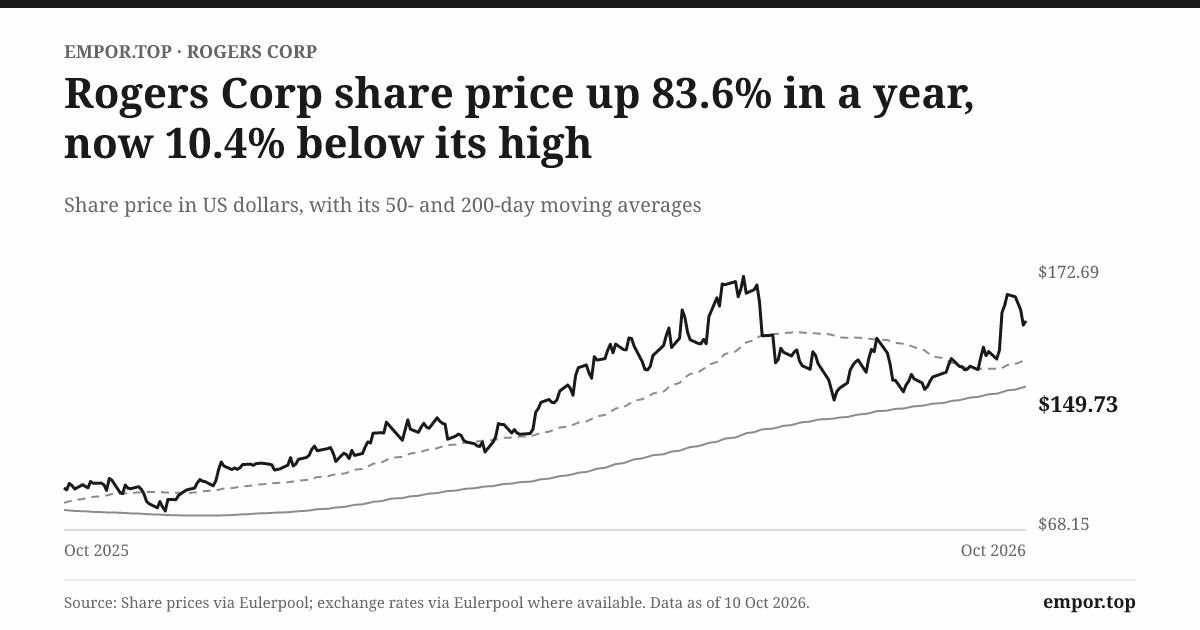
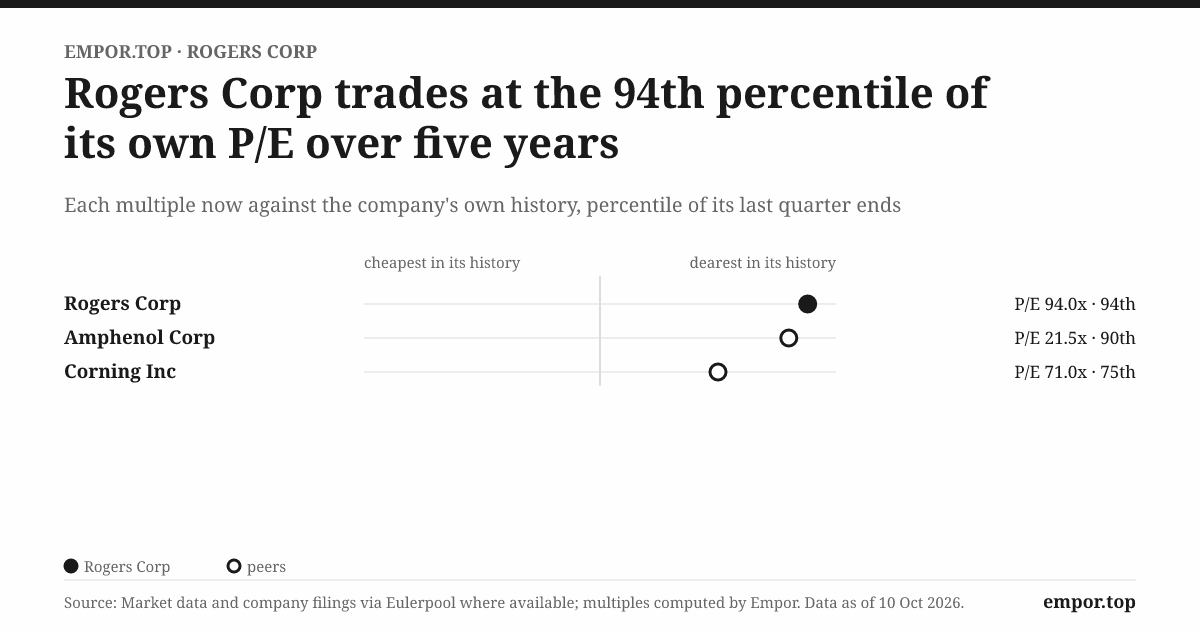
Tonight Rogers looks very different from the company DuPont tried to buy. It owes its banks nothing and holds about $211 million in cash and short-term investments.5 Its stock trades at $149.73, about 94 times trailing earnings, a number that looks absurd until one sees how far accounting profit has fallen.4 And it is run by Ali El-Haj, a turnaround operator who arrived as a consultant, became interim chief executive when the board fired his predecessor, and was made permanent in May 2026.6 To understand why Rogers was worth $5.2 billion to DuPont, and why it has struggled since, the story has to start in a Connecticut mill town almost two centuries earlier.
 Subscribe on LinkedIn
II. Paperboard to PTFE: Two Centuries of Substrate Survival (1832–2010)
In 1832, Andrew Jackson was president, the railroad was a novelty, and in Manchester, Connecticut, Peter Rogers began making paperboard.7 The company that grew out of that mill has outlived almost every industry it once served. It is also, by its own telling, one of the oldest publicly traded companies in the United States.7 That is less a piece of trivia than a clue about the company's character. Rogers has survived not by building things people recognise, but by making the material other people's products are built on.
For most of its first century, that meant pressed fibre and board. As electricity spread through American factories and homes, Rogers learned to make insulating boards and papers for transformers and electrical equipment, alongside more humble goods such as the stiffeners used in shoes. The common thread was physical chemistry: how fibres, resins and fillers behave under heat, pressure and electrical stress. That skill turned out to be transferable in a way the products themselves were not.
After the Second World War, Rogers followed that skill into polymers. Its PORON microcellular urethane foams became a standard material for gaskets, seals and cushioning, the soft layer that keeps dust out of a device and absorbs the shock when it hits the floor.7 Then came the move that defines the modern company. Rogers began making circuit laminates from polytetrafluoroethylene, PTFE, the slippery polymer most people know as Teflon, under brand names such as RT/duroid, for military radar and aerospace communications.7
It is worth pausing on why that mattered, because the whole investment case still turns on it. An ordinary circuit board is a sandwich of fibreglass and epoxy with copper on top, and for everyday electronics it works fine. At microwave frequencies, though, the board stops being a passive platform and starts eating the signal. A good analogy is a highway: at low speeds, a rough surface is a nuisance; at very high speeds, it shakes the car apart. High-frequency signals behave the same way, losing energy and drifting in timing as they pass through a poor material. PTFE and ceramic-filled composites are the smooth, tightly controlled road surfaces that keep a radar pulse or a cellular signal intact. Engineers specify them by their dielectric properties, and they do not change those specifications lightly.
That turned out to be a very good business to be in when cellular networks arrived. As carriers moved from analog phones through the 2G, 3G and 4G generations, every base station needed power amplifiers, and those amplifiers needed boards that could carry high-frequency signals without loss. Rogers' RO4000 family of ceramic-filled hydrocarbon laminates became a de facto standard for that job, valued because it offered PTFE-like performance while being easier for ordinary circuit shops to process.7 The company had found a niche where performance mattered more than price, where a design once specified tended to stay specified, and where competitors needed years to prove they could match it.
Through all of this, Rogers ran its balance sheet conservatively, borrowing for acquisitions and then paying the debt down rather than leaving leverage in place.4 It never paid a dividend in the dozen years for which full figures are available, preferring to keep its capital inside the business.4 The habit would matter enormously after 2022, when the company had to absorb a series of shocks with no parent to lean on.
By 2010, Rogers was a respected but modest specialty materials maker, admired by radio-frequency engineers and largely invisible to everyone else. Its fortunes rose and fell with the build-out cycles of telecom carriers and the phone makers that bought its foams. The next chief executive looked at that dependence and decided the company needed a second engine.
III. The Bruce Hoechner Era and the $400 Million Power Bet (2011–2021)
When Bruce Hoechner took over as chief executive in 2011, he inherited a company whose fate was tied to two customer groups he could not control: handset makers and telecom carriers.8 Both were notoriously cyclical, and both had the habit of squeezing suppliers as products matured. Hoechner's answer was to look for a market that would grow for a decade regardless of what Apple or Verizon did that year. He found it in the coming electrification of the car.
The vehicle for that bet was curamik Electronics, a German maker of ceramic substrates based in Eschenbach in Bavaria, which Rogers bought for about €116 million.8 To understand what curamik made, think about what happens inside an electric car's inverter, the box that turns battery power into the alternating current that drives the motor. Huge currents pass through tiny semiconductor chips, and those chips get extremely hot. They sit on ceramic plates bonded to thick copper, known as direct bonded copper, DBC, or, in a tougher version, active metal brazed, AMB, substrates. The ceramic insulates electrically while carrying heat away, a bit like a cast-iron pan that conducts heat beautifully but will not shock the cook. As carmakers moved to silicon carbide chips running at higher voltages, the thermal demands on these substrates only grew.
Hoechner reorganised the company around two main segments: Advanced Electronics Solutions, which housed circuit materials and the new power substrates, and Elastomeric Material Solutions, which housed the foams and silicones.8 Then he rode two waves at once. The 5G build-out, with its dense antenna arrays known as massive MIMO, pulled through high-frequency laminates, while the first years of the electric-vehicle boom pulled through ceramics and busbars. Revenue rose from about $610 million in 2014 to roughly $971 million in 2022, and the best years delivered operating margins in the mid-teens, peaking near 16% in 2017.4
On paper, this looked like a textbook diversification. In practice, the curamik bet contained a structural weakness that would take a decade to surface. Ceramic substrates are a manufacturing business more than a formulation business. Once the basic process is understood, the winner is often whoever can build the most automated capacity at the lowest cost of labour and power. Rogers had bought a high-cost German operation, and while it expanded capacity, competitors in China and Japan were building rival plants with cheaper electricity and lower wages. The very thing that made the market attractive, its growth, also guaranteed that it would attract capital from everywhere. This is the weakness that eventually forced the goodwill write-off.
None of that was visible in 2021. Rogers' record profits and its unusual combination of radio-frequency and thermal know-how caught the eye of DuPont's chief executive, Ed Breen, a dealmaker who had spent years breaking up and rebuilding the chemical giant around specialty products. Breen saw Rogers as a missing piece in DuPont's electronics portfolio, and in November 2021 the two companies agreed a deal at $277 a share in cash.1 For Hoechner, it looked like the perfect capstone to a decade of reinvention. For Rogers shareholders, it looked like a premium exit at the top of the cycle. Both assumptions rested on a regulator in Beijing.
IV. The Chinese Deadlock and the Broken Merger (2021–2022)
As October 2022 drew to a close, executives in Wilmington, Delaware and Chandler, Arizona were waiting on a decision that never came. The merger had to close by a contractual deadline, and the one approval still missing was China's.1 SAMR, the agency responsible for reviewing mergers that touch the Chinese market, had the power to approve the deal, attach conditions to it, or block it.9 It chose a fourth option. It did nothing, and let the calendar decide.
That silence is the most important fact in modern Rogers history, and it is worth thinking about why it happened. Rogers was not a household name or a strategic asset in the obvious sense. But it was deeply embedded in China. In 2025, China alone accounted for about 31% of its sales, more than the United States, and the company runs major manufacturing in Suzhou.4 Its high-frequency laminates go into Chinese telecom infrastructure and its materials into Chinese cars and electronics. For a regulator weighing whether an American chemicals conglomerate should control a supplier of that kind, there was plenty to consider, and the review was taking place against the backdrop of tightening US controls on semiconductor exports to China in late 2022.
Rogers and DuPont never received a public explanation, and Beijing did not publish one.2 It would therefore be speculation to say exactly why SAMR stalled. The pattern, though, was familiar. Chinese merger review had become, in the years of rising US-China tension, a lever that could slow or kill American deals without any formal finding. Rogers, a mid-cap company that had never thought of itself as geopolitically interesting, discovered that its customer base made it so.
DuPont chose not to extend the agreement again, paid the $162.5 million termination fee and moved on.1 Rogers' shares, which had traded close to the offer price, fell sharply that day as the market priced the company as a standalone business heading into a downturn.3 Hoechner, who had already been planning to retire, handed over to his successor at the start of 2023.8
The verdict on this chapter is uncomfortable for anyone who thinks geographic diversification is a hedge. Rogers sold all over the world, but its largest single market was also the one jurisdiction with the power to block its exit, and that same market remains essential to the business today. The company, left to run alone, was entering a hard cyclical slump, and to understand why that slump hit so violently, it is worth opening the factory doors and looking at how Rogers actually makes its money.
V. The Anatomy of the Engine: How Rogers Actually Makes Money
Picture a cleanroom in the Suzhou Industrial Park. Ceramic-filled powders and resins are blended, spread into sheets, laminated under heat and pressure, and clad in thin copper foil. Every batch is tested for how much it slows and absorbs a signal, because a customer building a 77-gigahertz automotive radar needs the board to behave identically next year to the way it behaves today. That consistency is what Rogers sells. Everything else in its economics follows from how it gets paid for it.
The business has two halves. Advanced Electronics Solutions, about 55% of 2025 sales, makes the circuit materials, the RO4000 and RO3000 families used in radar, satellite links and, increasingly, in AI servers, along with the ceramic power substrates and copper busbars inherited from the curamik bet.4 Its gross margin in 2025 was just under 30%.4 Elastomeric Material Solutions, about 43% of sales, makes PORON urethanes and BISCO silicones that cushion phones, seal car interiors and sit between the cells of electric-vehicle batteries to absorb swelling and stop heat spreading.4 It earned a gross margin of about 34%.4 The foam business, often treated as the boring sibling, has consistently been the more profitable of the two.
The commercial model is simple and, in a downturn, unforgiving. Rogers sells physical products against purchase orders under framework supply agreements that set prices and terms but do not oblige customers to buy any minimum volume.4 About three-quarters of revenue is recognised when goods ship, and the remaining quarter is recognised over time because it comes from custom materials made to a specification that have no other use.4 There is no subscription, no licensing and nothing recurring by contract. The stickiness is all in the engineering, not in the paperwork.
Customer concentration looks reassuringly low at first glance. Rogers sells to about 2,800 customers and none accounted for more than a tenth of sales in any of the last three years.4 But that headline conceals concentration at the program level. When a large wireless infrastructure program finished in 2024, it left a hole in 2025 revenue, and the automotive battery supply chain spent much of the same period working off excess stock.4 The company does not disclose what share of revenue comes from its top five or top ten customers. Credit quality, at least, has held up: the allowance for bad debts covers about 1% of trade receivables, and Rogers recorded no write-offs of unbilled contract assets over the past three years.4
Here is the trap at the heart of the model. Making laminates and foams requires expensive plants, presses and ovens, and those costs do not shrink when orders do. When volumes fall, the same fixed costs are spread across fewer square metres of material, so each unit costs more to make. A modest decline in volume therefore produces an outsized fall in profit, because the lost revenue drops almost directly to the bottom line. That is exactly what happened as sales fell from about $971 million in 2022 to about $830 million in 2024: operating margin fell from about 15% to about 3%.4 A business with real pricing power on specified products can still look like a commodity producer when its factories run half empty.
So the engine is good, but it is geared. Rogers can charge well for materials that engineers trust, yet it cannot make customers buy more of them, and it carries the cost of its factories whether or not they are busy. That gearing is the key to the next chapter, in which a new chief executive inherited the plants, the downturn and, very quickly, an activist.
VI. Colin Gouveia, Starboard Value, and the German Write-Down (2023–2025)
Colin Gouveia took over as chief executive on January 1, 2023, an insider who had run the company's elastomer business and who now inherited something nobody had planned for: a company that had expected to become a DuPont division and instead had to set its own strategy in a falling market.8 Within weeks, he had company. In February 2023, Starboard Value, the activist fund led by Jeff Smith, disclosed a stake of about 6.5% in a Schedule 13D filing.10 Starboard's playbook is well known: buy into an underperforming company, argue for cost cuts, better capital allocation and board change, and press until management delivers or is replaced.11
The timing was brutal. Telecom carriers had largely finished their 5G spending, consumer electronics demand had slumped after the pandemic spike, and electric-vehicle supply chains were drowning in inventory. Revenue fell from about $908 million in 2023 to roughly $811 million in 2025.4 Because of operating gearing, the profit damage was far worse than the sales decline: operating margin slid to about 3% in 2024.4 Management explained the weakness largely in terms of customer destocking and weak end markets, which was true as far as it went. The harder question was how much of the decline was the cycle and how much was Rogers losing share in power substrates.
Starboard's pressure produced visible results. Rogers began buying back stock, first about $20 million in 2024 and then about $52 million in 2025, and started cutting costs.4 What it did not produce, under Gouveia, was a recovery in earnings. And the gap between pay and results became hard to ignore. Gouveia received about $7.0 million in total compensation in 2023, $6.9 million in 2024 and $7.4 million in 2025, more than $21 million altogether.12 Over the same years, net profit fell from about $116 million in 2022 to a loss of almost $62 million in 2025.4 Shareholders were paying a growth-company chief executive's wage for a company that was shrinking.
The reckoning came in the second quarter of 2025. Rogers wrote off the entire goodwill attached to the curamik business, a non-cash impairment of $67.3 million, and the value of its long-lived assets in Germany fell from about $136 million to about $77 million.4 An impairment is an accounting admission that a business will no longer earn what its owner once expected. In this case, the trigger was weaker projections for electric-vehicle power module demand and the competitive pressure from lower-cost Asian substrate makers.4 The quarter's operating loss was about $68 million.4 Rogers' auditors, PricewaterhouseCoopers, flagged the curamik goodwill test as one of two critical audit matters in the 2025 audit, alongside asbestos liabilities, but found no material weakness in internal controls.4
A few weeks later, on July 12, 2025, the board removed Gouveia without cause. He received about $1.7 million in severance and accelerated equity.12 His replacement was Ali El-Haj, an outside operational adviser whom the company had brought in as a consultant only months earlier.13 El-Haj became interim chief executive the same day.13
The verdict on the Gouveia years is mixed but leans negative. He took over at a terrible moment, and no chief executive could have stopped customers destocking. But the company spent two and a half years explaining weakness rather than resizing for it, the power-substrate business lost ground to cheaper competitors, and it took an activist and a goodwill write-off to force decisive action. The question for El-Haj was whether he could do what his predecessor had not: shrink the cost base fast enough that the factories could make money at today's volumes.
VII. The Ali El-Haj Restructuring: Consolidating the Footprint (2025–2026)
Late in 2025, Ali El-Haj put his plan in front of the board, and it read like a list of things Rogers had been reluctant to do for years. The plant in Evergem, Belgium would close. The curamik operations in Eschenbach would be cut back. The Innovation Center in Burlington, Massachusetts, the company's corporate research hub, would shut. And roughly 300 jobs would go, taking headcount from about 3,300 in 2023 to about 3,000 by the end of 2025.4 El-Haj's background is in operations and turnarounds rather than materials science, and his plan reflected it. It was about utilisation, footprint and cost per unit, not new products.
The board liked what it saw. In May 2026 it made El-Haj permanent president, chief executive and director, with a $750,000 base salary, a bonus targeted at his full salary, and an initial equity grant worth $5.0 million.6 The structure tilted his pay toward the share price, a direct contrast with the Gouveia years, when the cheques kept arriving whatever the results. Other senior departures followed, including the head of global operations in 2025 and the chief administrative officer in March 2026.12
The plan's first effect was on cash. Capital spending fell from about $56 million in 2024, nearly 7% of sales, to about $30 million in 2025 and only about $11 million in the first half of 2026, under 3% of sales.45 Research and development spending fell too, by almost a fifth in 2025 to about $28 million, or 3.5% of sales, from 4.2% the year before.4 Restructuring the curamik footprint was expected to cost a further $12 million to $20 million in cash through 2026.4 Earlier, the company had also unwound its two 50%-owned joint ventures with the Japanese foam maker INOAC, receiving about $8 million in net cash and booking a small gain in 2024, which simplified the structure without moving the needle much.4
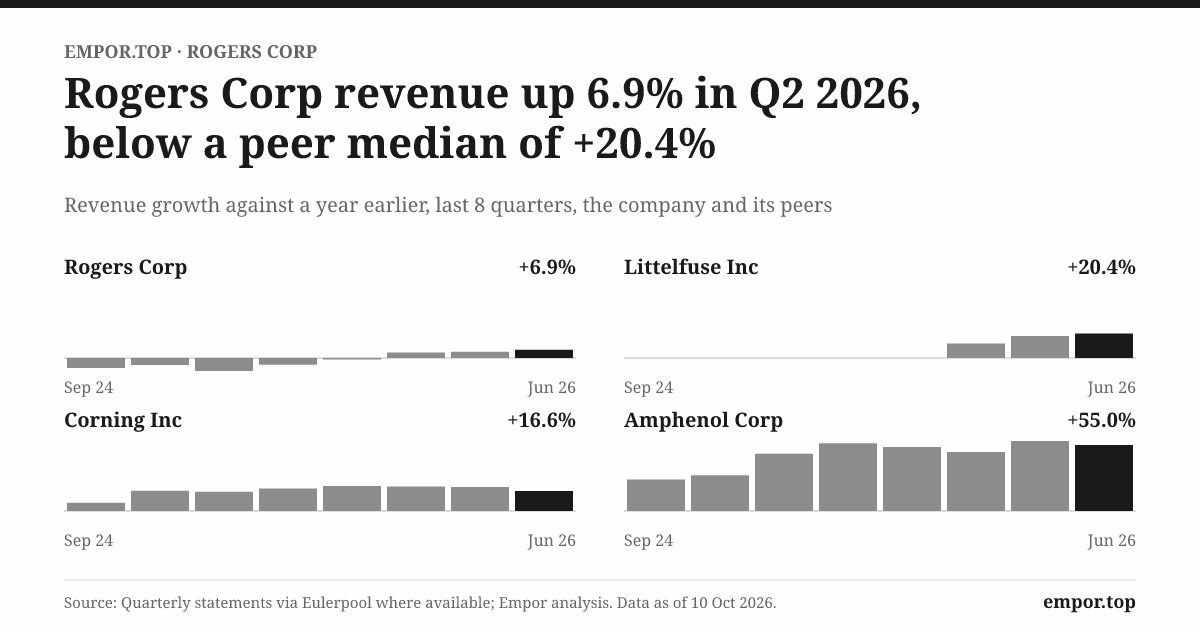
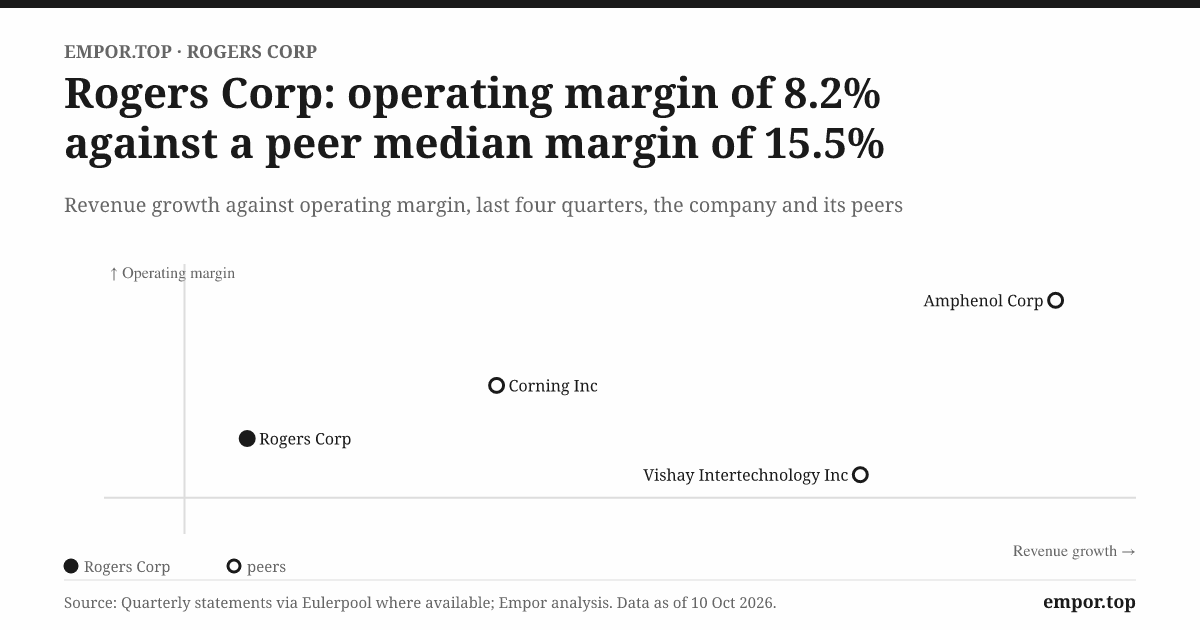
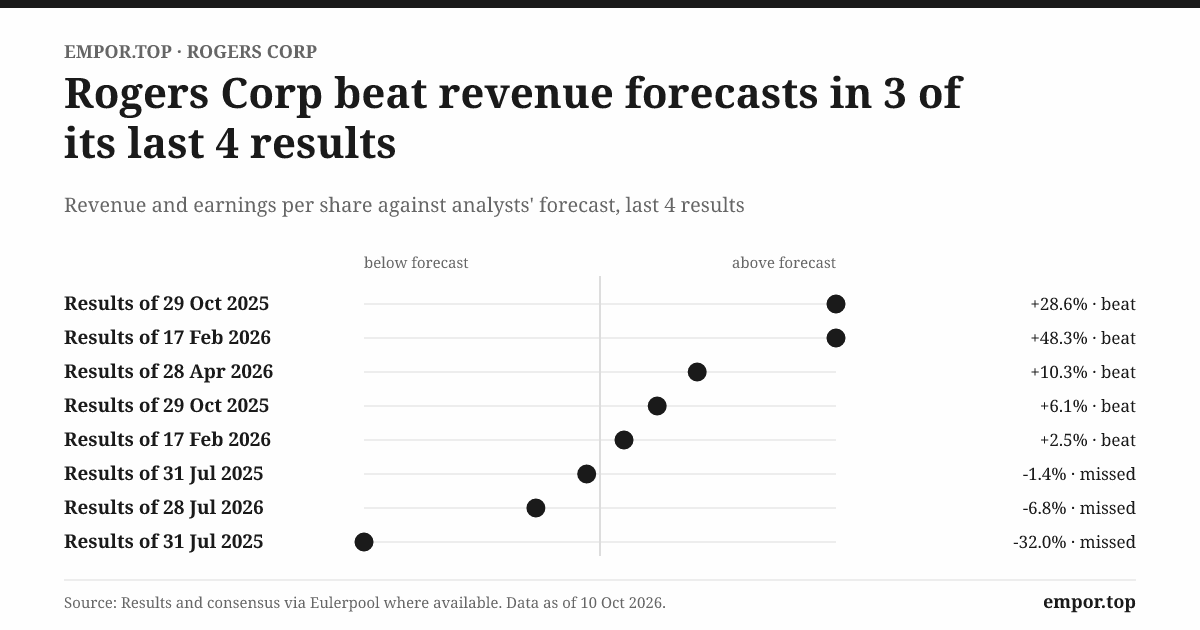
The early evidence on profit is encouraging. In the second quarter of 2026, revenue rose about 7% from a year earlier to roughly $217 million, the third straight quarter of year-on-year growth, and operating profit reached $20.0 million, a margin of about 9%.514 A year earlier, the same quarter had shown a large loss because of the curamik write-off; more usefully, the margin compares with about 5% in the same quarter of 2024, before most of the cuts.4 That is what operating leverage looks like on the way up: a modest revenue recovery on a smaller cost base produces a much larger rise in profit.
But the claim that the cuts will restore mid-teens margins has to be tested against what it is cutting. A materials company's advantage lives in its formulations and in its relationships with customer engineers who co-design new products with it. Closing the Burlington research centre and lowering R&D intensity will help margins now, while its cost to future competitiveness will not show up for years, if at all. Part of the recovery is also simply the cycle turning; the quarter-by-quarter improvement began before the full savings could have arrived. The fairest conclusion is that the restructuring is working on cost, and that it is too early to know whether it has preserved the technical edge that lets Rogers charge for its materials. What made it possible to do all this without stress, though, was a balance sheet that the market tends to overlook.
VIII. The Balance Sheet Fortress and the Activist Exit
On January 22, 2026, Starboard Value's holding in Rogers slipped below 5%, and the fund filed an amendment to its Schedule 13D the following day saying so.15 There was no farewell letter. After three years of pressure, a change of chief executive and a share buyback programme, the activist had quietly reduced its position. The exit invites a question that confuses many people looking at Rogers for the first time: how can a company with no bank debt and a pile of cash trade at 94 times earnings?
Start with the debt, because the headline figure misleads. Standard data services show Rogers with about $22 million of borrowings at the end of 2025.4 None of that is bank debt. It is the value of operating leases, mostly rented buildings and equipment, that accounting rules now put on the balance sheet.4 Rogers has drawn nothing on its $450 million revolving credit facility, which runs to March 2028, and it has no public bonds.45 Against roughly $9 million in finance lease obligations, it held about $197 million of cash at the end of 2025 and about $211 million in cash and short-term investments by June 2026.45 It does not need a credit rating because it does not borrow in public markets, and its bank covenants are nowhere close to binding.4
Next, the cash. Over the twelve years from 2014 to 2025, Rogers generated about $1.4 billion in operating cash flow, roughly twice its cumulative net profit.4 The gap is mainly depreciation, which reduces reported profit without costing cash, plus the effect of working capital being released in downturns. The 2025 numbers show the mechanism clearly. The company reported a net loss of almost $62 million but generated about $101 million of operating cash, because the curamik write-off cost nothing in cash and the company also turned about $23 million of inventory back into money.4 For investors, that means reported earnings understate the company's resilience: Rogers was never bleeding cash, even in its worst accounting year.
The one long-tailed liability is asbestos. Rogers made products containing encapsulated asbestos until the late 1980s and still faces lawsuits from people who say they were harmed. At the end of 2025, it had 442 pending claims, down from 523 a year earlier, and an actuarial liability of about $57 million projected all the way to 2064.4 Most of that is covered by insurers expected to pay: Rogers records about $53 million in probable insurance recoveries, leaving net exposure of under $5 million.4 It is a perpetual administrative nuisance and a judgement-heavy accounting estimate, which is why it is a critical audit matter, but it is not a threat to solvency.
What about capital returns? Rogers has paid no dividend in the period covered, and it has returned money only through buybacks, which cut the share count from about 18.6 million at the end of 2023 to about 17.8 million two years later.4 With Starboard gone, the register is dominated by large index and long-only investors: BlackRock owns about 15%, Vanguard about 12%, Capital Research about 8.5% and Norges Bank about 7%.12 Shareholders backed the board decisively at the May 2026 annual meeting, approving executive pay with about 97% support.16
That brings the story back to the 94 times multiple. Trailing twelve-month earnings were only about $29 million, depressed by restructuring and the after-effects of the write-off, so the price-to-earnings ratio is high mainly because the earnings denominator is small.4 Measured against cash flow, the picture is calmer: free cash flow of roughly $71 million a year gives a free cash flow yield of about 4%, and the enterprise is valued at about three times sales.4 The market is not paying 94 times for current profits. It is paying for a return of margins toward historical levels. Whether that is justified depends on something the balance sheet cannot answer: whether Rogers still has an edge competitors cannot copy.
IX. Competitive Moats, Powers, and Historical Falsifications
Imagine an engineering review at a large automotive supplier. The team is designing a next-generation 77-gigahertz radar module, and procurement wants to know whether the Rogers RO4350B laminate in the current design can be swapped for a cheaper alternative from an Asian supplier. The engineers' answer is not about the price per sheet. Changing the substrate changes how the radar's antenna behaves, which means retesting the sensor, revalidating it with the carmaker and repeating safety qualifications, a process that can take years. The saving on the board is real; the cost of the delay and the risk of a field failure are larger. That conversation, repeated across radar, aerospace and defence programs, is the core of Rogers' moat.
Seen through Hamilton Helmer's 7 Powers framework, Rogers has two genuine powers and several it lacks. The strongest is switching costs in high-frequency materials. Once a laminate is designed into a radar or a satellite link, replacing it is expensive and slow, and the record supports this: Rogers' high-frequency business has kept its customers through repeated cycles. The second is process power: decades of accumulated, hard-to-write-down knowledge about filler dispersion, porosity control and how polymers age under heat, which shows up in the reliability engineers pay for in PORON and BISCO foams as much as in laminates. What Rogers does not have is scale economies or network economies. Its manufacturing is batch-based, its competitors include large Asian producers with lower power and labour costs, and nothing about one customer's purchase makes the product more valuable to another. It has no cornered resource either; its raw materials, copper foil, ceramic powders and resins, are available to others.
Michael Porter's five forces tell a similar story. Buyers are powerful, because Rogers sells to large automotive tier-one suppliers and electronics manufacturers who negotiate hard and multi-source wherever they can. Supplier power is moderate: copper and specialty chemicals are inputs Rogers hedges but cannot dictate. New entrants struggle in high-frequency PTFE laminates, where qualification time is a barrier, but the threat is much higher in ceramic power substrates, where the product is closer to a manufactured commodity and capacity can be built with enough capital. Peers such as Isola, AGC and the Chinese laminate maker 生益科技 Shengyi Technology compete across parts of the portfolio, and the Chinese suppliers in particular have local customers and government support that a US company cannot match.
Now test the investment claims that most often attach to Rogers against its own record. The first is that Rogers is a structural electric-vehicle growth story. Between 2022 and 2025, revenue fell by about 6% a year, and the company wrote off all the goodwill in the very business meant to capture that growth.4 That does not mean Rogers has no exposure to electrification; its foams in battery packs and its radar laminates in driver-assistance systems still benefit from the shift in cars. But the evidence rejects the larger claim that Rogers would dominate EV power electronics, and narrows it to a cyclical exposure to radar and battery materials. What would confirm the revised claim is stable growth in those product lines without further impairments in Europe.
The second claim is that proprietary formulations protect margins across the business. The record narrows this too. Gross margins in electronics slipped from about 31% in 2023 to under 30% in 2025, and in elastomers from about 37.5% to about 34%.4 Some of that is the under-used factory problem rather than price cuts, but the fall in elastomers is notable because that business has the strongest formulation story. Pricing power is real where switching costs are high, in custom radar and aerospace laminates; it is weak in standard power substrates, where Asian competitors have broken prices.
The third claim is that acquisitions create value. The curamik purchase is the best test the company's history offers, and it failed the test: the business is now carried with no goodwill, its German asset base has been marked down by over 40%, and it still requires restructuring cash.4 One acquisition is not a whole record, but it was the biggest strategic bet of the Hoechner era, and it argues for caution about any future bolt-on deal funded from the cash pile.
The overall verdict is that Rogers has a narrow but real moat. It sits in high-frequency materials and specialty foams, protected by qualification time and process knowledge, and it does not extend to the ceramic substrates once sold as the company's growth engine. The question that follows is what lessons that story carries for anyone who builds or owns businesses like this one.
X. Playbook: Business & Investing Lessons
The first lesson comes from the morning DuPont walked away. Rogers received $162.5 million in cash, but the year it had spent preparing to be absorbed had a cost no termination fee could cover: strategy on hold, leadership on its way out, and an organisation that had stopped making long-term decisions just as its markets turned down. A break fee compensates a company for a lost deal. It does nothing for the business that was frozen while waiting for it. The lesson for boards is that a pending sale is itself an operating risk, and that the plan for failure needs to be as concrete as the plan for closing. A breakup fee is not a business strategy.
The second lesson lives in Eschenbach. The theory behind curamik was that qualification creates a moat: automotive customers take years to approve a new substrate, so once in, a supplier stays in. That was true right up to the moment low-cost competitors finished their own qualifications, after which the customer's long approval cycle stopped protecting Rogers and started protecting whoever was cheapest. Qualification delays the competition; it does not abolish it. A moat that depends on how long it takes a rival to pass a test is a head start, not a fortress.
The third lesson is the quiet one. Over three years, Rogers absorbed a failed merger, an activist campaign, a chief executive's dismissal and a $67 million write-off, and it did so without issuing shares, breaching a covenant or worrying about its lenders, because it had no debt to worry about. Many cyclical companies have to make the same decisions with a banker in the room. Rogers made them with time on its side. Net cash buys the patience a turnaround needs, which leverage always takes away.
The fourth lesson comes from Beijing. Rogers looked geographically diversified, with sales spread across Asia, Europe and the Americas. Yet China, its largest market, which also accounted for most of its cash tax payments in 2025, was the one country able to stop its sale.4 Diversity of revenue on a pie chart is not the same thing as diversity of political risk. Selling to everyone is not the same as being safe from anyone.
The fifth lesson is still unfolding. Closing the Burlington Innovation Center and cutting R&D intensity helped deliver the margin recovery that shareholders demanded. But Rogers' edge has always been chemistry that others found hard to copy, and that edge is renewed only by spending on the next formulation. The bill for a research cut arrives long after the savings are booked, and usually lands on a different chief executive.
XI. The Bear vs. Bull Stress Test
Picture an analyst at an equity research desk with two numbers side by side. One is Rogers' price-to-earnings ratio of 94, a figure that would normally mark a stock as dangerously overvalued. The other is its free cash flow yield of about 4% and an enterprise value of about three times sales, figures that look more like a reasonable industrial business at a cyclical low.4 Both are correct. The task is to decide which one tells the truth about the future.
The bull case starts with the cost base. If Belgium's closure, the Eschenbach restructuring and the smaller workforce have permanently lowered fixed costs, then even modest revenue growth will push margins up quickly, because each extra dollar of sales carries less overhead. The second quarter of 2026, with an operating margin above 9% on only slightly higher sales, is the evidence bulls point to.5 They add that cash flow has been resilient through the downturn, that the share count is shrinking, and that two demand drivers, radar sensors in cars and high-speed materials in AI servers, could return the electronics business to growth. Finally, they note that a company with over $200 million in cash and a $450 million unused credit line can buy a business cheaply in a downturn without asking shareholders for money.5
The bear case starts with China. With about 31% of sales there, Rogers is exposed both to US export controls and to Chinese customers choosing domestic suppliers, and the failed DuPont deal showed that Beijing is willing to use the company as leverage.4 Encouragingly, sales to China actually rose slightly in each of the past three years, to about $251 million in 2025, which suggests Chinese customers are not yet abandoning Rogers.4 But that is a single data point in a relationship that could change by decree. Bears also argue that cheaper Asian ceramic substrates will keep electronics margins below historical peaks, that cutting R&D to about 3.4% of sales hands rivals such as Shengyi time to close the technology gap, and that with Starboard gone, nobody large is pushing management to keep returning cash.5
Testing the two cases against each other, the most important point is that the bull case depends on margins and the bear case on markets. The cost savings are largely in management's control and are already showing up. The external risks, China policy and Asian competition, are not, and the company's history shows they can arrive suddenly. On balance, Rogers is neither a broken business nor a compounder. It is a geared bet on margin recovery in a narrow but defensible niche, priced today for that recovery to happen.
Three measures will reveal which version wins. The first is gross margin: a return toward the mid-30s, against about 30% in electronics and 34% in elastomers in 2025, would show that the footprint changes have restored the economics.4 The second is China's share of revenue, which held around 31% in 2025; a fall below the high twenties without an offsetting gain elsewhere would be an early warning.4 The third is free cash flow, which has run at about $71 million a year for three years; sustained figures above $75 million, alongside continuing buybacks, would indicate that the improvement is real and shared with shareholders.4
XII. Epilogue
Tonight, Rogers' shares close at $149.73, giving the company a market value of about $2.7 billion.4 That is about 10% below their 52-week high and almost twice their 52-week low of about $76, a reminder of how violently sentiment has swung over the past year.4 It is also still about 46% below the $277 DuPont agreed to pay four years ago, the number that haunts anyone who held the stock in the autumn of 2022.
The next moments that will decide the central questions are close. The third-quarter results, due in the coming weeks, and the full-year figures early in 2027 will show whether the margin improvement of the second quarter was a high-water mark or a new floor. If gross margins hold above 30% and operating margins keep climbing, the case that factory closures alone can restore profitability will gain real weight. If margins slip back as soon as volumes soften, it will become clear that the cycle, rather than the restructuring, did most of the work. The 2026 annual report will also show whether any further impairments were needed in Europe, the clearest test of whether the curamik write-off was the end of the story.
China will decide the second question, and on its own timetable. Any widening of US export controls, or a push by Chinese carmakers and telecom firms to replace foreign materials with domestic ones, would hit the Suzhou plants directly. Rogers' sales to China have so far proved resilient, but the company knows better than most how quickly a quiet regulator can change its fortunes.
The third question belongs to Ali El-Haj and his board. With the activist gone and a cash pile that keeps growing, they must choose between buying back more stock, making acquisitions, or reinvesting in the research they have cut. Each choice says something different about what kind of company Rogers wants to be: a cash-returning niche producer, a consolidator, or a technology leader. The tension that remains is that a company which has survived nearly two centuries by reinventing itself must now prove that cutting costs can substitute for the growth it once promised.
XIII. Outro
In 1832, the product of Peter Rogers' mill was pressed board, stiff and unremarkable, made for machines that have long since vanished.7 Today the company's most valuable products are still pressed sheets, only now they carry radar waves that tell a car where a pedestrian is, and signals that travel between satellites and the ground. The materials have changed beyond recognition. The business has not: Rogers still makes the unseen layer that other people's technology stands on.
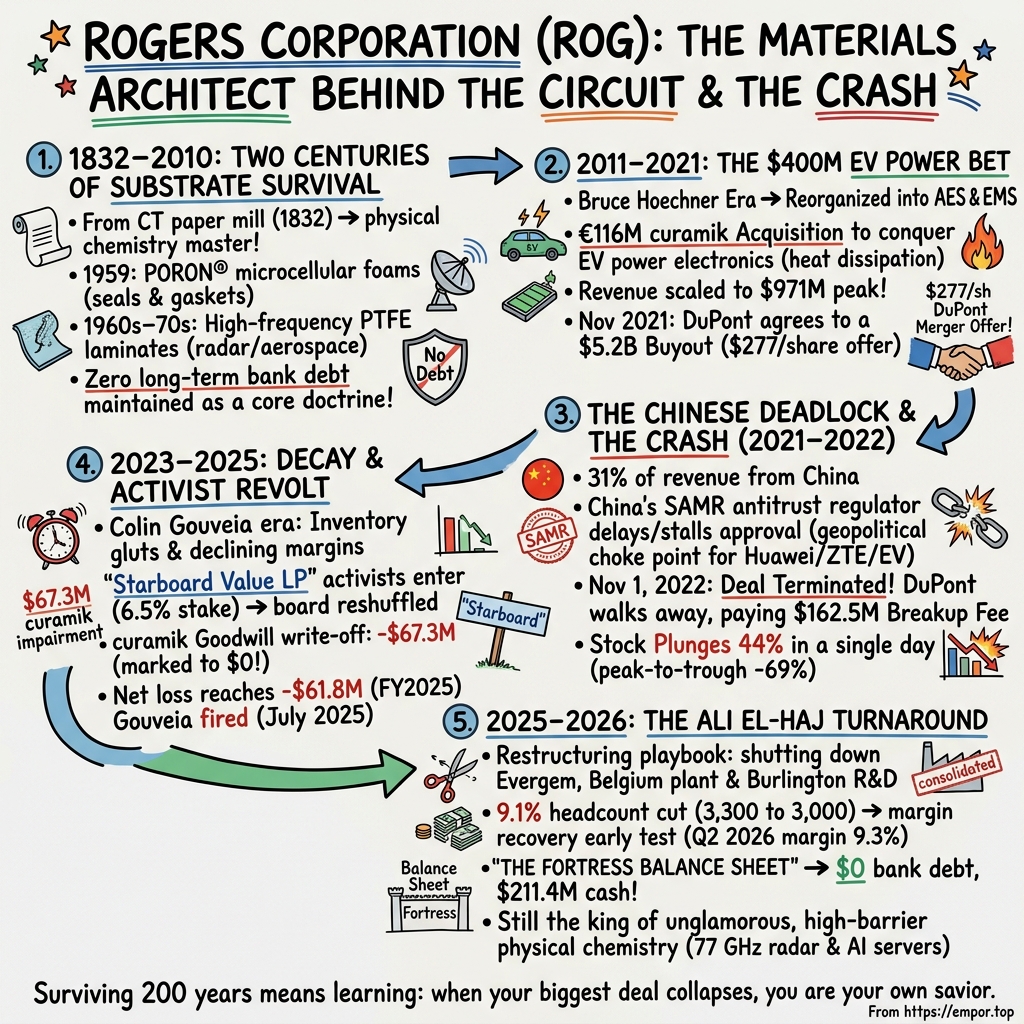
The DuPont deal is dead, the activist has sold down, and the executive suite has been cleared and refilled. What is left is a company with no debt, a narrow but real technical edge, and a new chief executive who has to prove that a leaner Rogers can earn what the bigger one could not. The world's most advanced electronics still depend on the humble chemistry of the substrate beneath them, and Rogers has learned, at a cost of $277 a share, that when your biggest deal collapses, the only one coming to save you is yourself.
References
-
DuPont Terminates Planned Acquisition of Rogers Corporation — DuPont Newsroom, 2022-11-01 ↩↩↩↩↩
-
DuPont Scraps $5.2 Billion Rogers Deal Over China Regulatory Clearance — Reuters, 2022-11-01 ↩↩
-
Rogers Corp Plunges After DuPont Abandons $5.2 Billion Buyout — Bloomberg, 2022-11-01 ↩↩
-
Rogers Corporation Form 10-K for the Fiscal Year Ended December 31, 2025 — SEC EDGAR, 2026-02-19 ↩↩↩↩↩↩↩↩↩↩↩↩↩↩↩↩↩↩↩↩↩↩↩↩↩↩↩↩↩↩↩↩↩↩↩↩↩↩↩↩↩↩↩↩↩↩↩↩↩↩↩↩↩↩↩↩↩
-
Rogers Corporation Form 10-Q for the Quarterly Period Ended June 30, 2026 — SEC EDGAR, 2026-07-29 ↩↩↩↩↩↩↩↩
-
Rogers Corporation Form 8-K: Appointment of President, CEO and Director Ali El-Haj — SEC EDGAR, 2026-05-19 ↩↩
-
Rogers Corporation Investor Relations Landing Page — Rogers Corp, 2026-10-10 ↩↩↩↩↩↩
-
Rogers Corporation Form 10-K for the Fiscal Year Ended December 31, 2023 — SEC EDGAR, 2024-02-27 ↩↩↩↩↩
-
State Administration for Market Regulation (SAMR) Merger Review Portal — SAMR PRC, 2022-11-01 ↩
-
Starboard Value LP Schedule 13D (Rogers Corporation) — SEC EDGAR, 2023-02-06 ↩
-
Starboard Value Builds Stake in Materials Maker Rogers Corp — Wall Street Journal, 2023-02-06 ↩
-
Rogers Corporation Definitive Proxy Statement Form DEF 14A — SEC EDGAR, 2026-03-24 ↩↩↩↩
-
Rogers Corporation Form 8-K: CEO Leadership Transition — SEC EDGAR, 2025-07-14 ↩↩
-
Rogers Corporation Form 8-K: Q2 2026 Financial Results and Operating Update — SEC EDGAR, 2026-07-28 ↩
-
Starboard Value LP Schedule 13D/A Amendment No. 3 (Rogers Corporation) — SEC EDGAR, 2026-01-23 ↩
-
Rogers Corporation Form 8-K: Results of 2026 Annual Meeting of Shareholders — SEC EDGAR, 2026-05-07 ↩
 LinkedIn
 WhatsApp
 Reddit
 Hacker News
 Email
Email Kindle
 RSS Feed
 Spotify
 Apple Podcasts
 Amazon Music
 Audible
 YouTube