Transocean Ltd.: The Kings of Extreme Engineering at the Ocean Floor
I. Introduction & Episode Roadmap
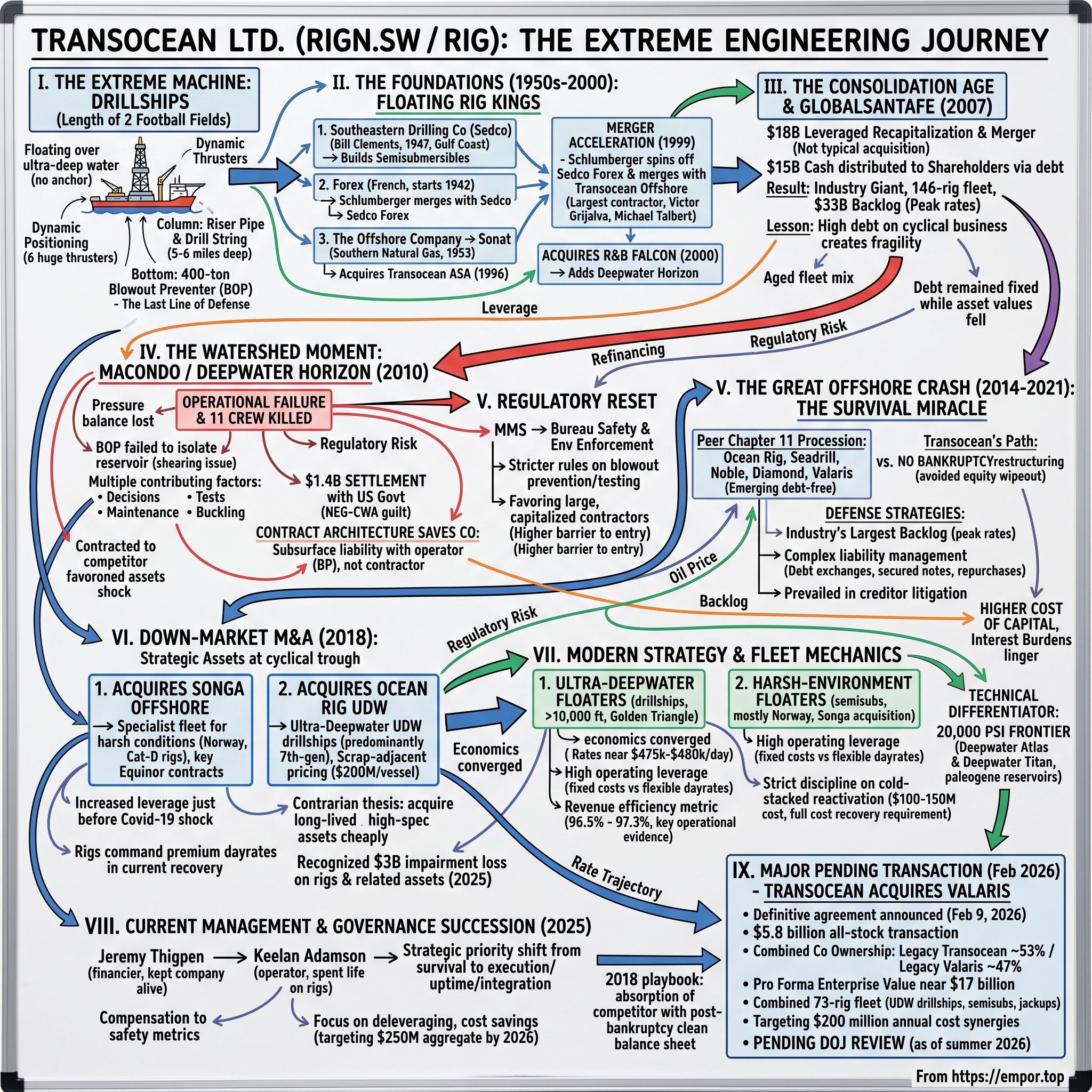
Picture a steel island the length of two football fields, floating over water so deep that if you dropped the Empire State Building into it, the spire would still be a mile from the surface. There is no anchor. Instead, six thrusters the size of small houses fire continuously, nudging the hull against wind, waves, and current, holding it within a few feet of a target the size of a dinner plate on the seafloor. Down that column of water runs a steel riser pipe, and inside it, a drill string boring another five or six miles into rock that has not seen daylight in sixty million years. At the bottom of the riser sits a blowout preventer — a 400-ton stack of hydraulic rams whose only job is to be the last thing standing between a pressurized hydrocarbon reservoir and the open ocean.
That is a Transocean drillship. Only about three dozen vessels globally are equipped for such ultra-deepwater conditions, and Transocean Ltd. operates the largest fleet of high-specification rigs in this category.
The economics are as demanding as the engineering. In the first quarter of 2026, Transocean's fleet earned an average of roughly $475,600 per rig per day, with its ultra-deepwater ships averaging about $480,700 and its harsh-environment semisubmersibles averaging about $463,800 — figures management described as the highest daily revenue in more than a decade.[^1]3 The company ended the quarter with $7.1 billion in contracted backlog, representing committed customer work stretching years into the future.[^1]
A Swiss address, a Houston soul
Transocean is legally incorporated in Switzerland, with its principal administrative offices in Houston, and its shares trade on both the SIX Swiss Exchange under RIGN and the New York Stock Exchange under RIG.12 This corporate structure is a legacy of the 2000s, when several U.S. oilfield service providers redomiciled offshore — first to the Cayman Islands and later to Switzerland — to lower their effective tax rates and establish a neutral corporate base for contracts with national oil companies across South America, Europe, and Africa. The structural implications remain significant: Swiss corporate governance grants shareholders direct authority over dividends, share repurchases, and capital issuance, requiring formal shareholder votes for major capital-structure decisions rather than simple board resolutions.
The paradox
Here is the strategic tension that defines Transocean as an equity investment. On the asset side, it holds a market-leading position: long-standing customer relationships, two high-specification drillships designed for ultra-deepwater operations, and a fleet capable of drilling high-pressure reservoirs in the Gulf of Mexico. On the liability side, Transocean avoided bankruptcy during the market crash when nearly every major peer filed — paying for that survival with a heavy, long-term debt burden.
Between 2014 and 2021, offshore drilling experienced one of the most severe downturns in modern capital markets history. Ensco/Rowan (which became Valaris), Noble, Diamond Offshore, Seadrill, and Ocean Rig all underwent Chapter 11 bankruptcy restructurings, wiping out legacy equity holders and emerging with significantly reduced debt loads. Valaris, for instance, completed its restructuring in 2021 with essentially no net debt.[^14] Transocean did not file for bankruptcy. Instead, it managed its balance sheet through debt exchanges, asset mortgages, repurchases, and legal challenges — emerging into the subsequent market upcycle carrying billions in legacy debt.
The deleveraging progress is measurable. Total debt fell to $5.686 billion at the end of 2025 — down $1.258 billion, or 18%, in a single year — and declined further to $5.137 billion by the end of March 2026, marking a $1.597 billion year-over-year reduction.[^4][^1] However, annual interest expense remains a major fixed cash commitment that does not adjust when market dayrates soften. This defines the core risk-reward trade-off for investors: Transocean's existing shareholders avoided an equity wipeout, but they hold equity in a business burdened by substantial interest obligations.
What changed in February 2026
Any analysis of Transocean in 2026 must evaluate a major pending transaction. On February 9, 2026, Transocean and Valaris announced a definitive agreement under which Transocean would acquire Valaris in an all-stock transaction valued at roughly $5.8 billion. The exchange ratio of 15.235 Transocean shares per Valaris share would leave legacy Transocean shareholders owning approximately 53% of the combined company and legacy Valaris shareholders owning 47%, creating a combined entity with a pro forma enterprise value near $17 billion.1 The deal would create a 73-rig fleet spanning 33 ultra-deepwater drillships, nine semisubmersibles, and 31 modern jackups, while targeting more than $200 million in annual cost synergies.1 As of the summer of 2026, the transaction remained pending under regulatory review by the U.S. Department of Justice.3
In effect, the company that avoided the prior restructuring wave is now seeking to consolidate the industry by absorbing a competitor whose post-bankruptcy balance sheet had previously represented a key comparative advantage over Transocean.
This analysis examines how a shallow-marsh drilling operator founded in 1947 developed into a primary global deepwater contractor, how it managed severe financial distress, and what key metrics investors must analyze to evaluate its ongoing balance-sheet recovery.
 Subscribe on LinkedIn
II. Deepwater Foundations: Sedco, Sonat, & The Birth of Floating Rig Kings (1950s–2000)
In 1947, Bill Clements — decades before serving as governor of Texas — founded Southeastern Drilling Company to operate in the shallow marsh waters of the Gulf Coast.4 It was a modest operation: stationing a barge in a few feet of brackish water, drilling a hole, and moving to the next site. Nothing in those early operations foreshadowed that its corporate successors would eventually drill beneath thousands of feet of open water.
Yet those early marsh drillers established a key industry precedent. While onshore and offshore drilling appear similar — both using a derrick, drill string, and bit — they are fundamentally different businesses.
Why floating drilling is a different animal
A land rig represents a modest capital investment. It can be dismantled and trucked to a new location in days, competes on price with dozens of near-identical units, and carries minimal relocation risk for its owner. By contrast, a modern ultra-deepwater drillship costs between $600 million and $1 billion to construct and requires roughly three years in a shipyard. It cannot be repurposed or moved over land, and ocean mobilization takes weeks while incurring millions of dollars in fuel and transit costs.
That structural asymmetry dictates the sector's financial dynamics. Because floating rigs are capital-intensive and immobile, customers — primarily supermajors and national oil companies — must commit years in advance, typically signing multi-year firm contracts at fixed daily rates before a vessel arrives on site. Because these assets have three-decade operational lifespans and cannot be cheaply retired, structural supply overhangs linger long after demand weakens. Furthermore, given the harsh offshore environment, technical barriers to entry extend beyond capital to deep engineering expertise: maintaining dynamic positioning and drilling integrity under extreme ocean conditions where mechanical or operational failures carry severe risks.
Transocean's predecessor companies developed this operational expertise across successive decades.
The ancestral lineage
Three distinct corporate lineages converged to form the modern enterprise.
The first was SEDCO. Clements' marsh drilling business expanded into deeper waters during the 1960s by building semisubmersibles — rigs stabilized by submerged pontoons rather than traditional ship hulls, providing superior wave resistance in heavy seas. Schlumberger acquired SEDCO in 1984.4
The second was French in origin. Forex began in 1942 as a French onshore drilling contractor before launching an offshore joint venture, Neptune, which Schlumberger fully acquired in 1972. In 1985, Schlumberger combined its drilling operations into Sedco Forex.4
The third stemmed from American gas utility capital. Southern Natural Gas acquired DeLong-McDermott in 1953, forming The Offshore Company. Spun off in 1993 as Sonat Offshore, the company pursued a targeted deepwater strategy and acquired Norway's Transocean ASA in 1996 — inheriting the fleet and the name that eventually stick.4
Industry consolidation accelerated at the end of the decade. On July 19, 1999, Schlumberger agreed to spin off Sedco Forex and merge it with Transocean Offshore in a transaction valued at roughly $3.2 billion.5 Schlumberger shareholders received a 52% stake in the combined entity and Transocean holders 48%. The resulting company — Transocean Sedco Forex — operated 75 drilling rigs, including seven under construction, making it the largest offshore drilling contractor in the world.5 Victor Grijalva of Schlumberger served as chairman, while Transocean's J. Michael Talbert became president and CEO.5
A year later, the company completed an all-stock acquisition of R&B Falcon valued at over $9 billion — an entity created by Reading & Bates' 1997 merger with Falcon Drilling.4 R&B Falcon added major deepwater assets, including a semisubmersible then under construction that would later be named Deepwater Horizon.
What the lineage bought
By 2001, four decades of consolidation had assembled a rare concentration of floating drilling experience inside a single organization. While fleets can be purchased, institutional memory in specialized deepwater operations — such as managing emergency riser disconnects during severe weather or maintaining dynamic positioning over pressurized wells — takes decades to build.
However, this dealmaking history left a second, more consequential legacy: a corporate strategy dependent on serial, debt-financed expansion. Prior leadership teams had consistently grown through acquisition. By 2007, at the peak of an unprecedented energy bull market, that appetite for scale encountered a balance sheet with massive borrowing capacity.
III. The Consolidation Age & The $18B GlobalSantaFe Megamerger (2007)
By the summer of 2007, offshore drilling had become a primary focus of the global energy sector. Brent crude oil was climbing toward a peak near $140 per barrel reached the following year. Petrobras had confirmed the immense scale of Brazil's pre-salt discoveries — vast hydrocarbon reservoirs buried beneath a two-kilometer salt layer in water thousands of feet deep. Deepwater operations were expanding across West Africa, while the Gulf of Mexico's lower tertiary play was being unlocked. In roughly five years, deepwater drilling had evolved from a speculative technical frontier into a central component of supermajor strategy.
At the same time, offshore drilling contractors faced an unusual corporate finance situation: their balance sheets carried remarkably little debt.
The most leveraged handshake in offshore history
On July 23, 2007, Transocean and GlobalSantaFe announced an agreement to combine.6 The transaction was structured not as a conventional acquisition, but as a merger paired with a massive leveraged recapitalization. Transocean shareholders received $33.03 in cash plus roughly 0.70 shares of the combined entity for each share held, while GlobalSantaFe shareholders received $22.46 in cash plus roughly 0.48 shares.6 In total, the transaction distributed approximately $15 billion in cash to the two shareholder groups, funded through a bridge loan arranged by Goldman Sachs and Lehman Brothers.6 The merger closed on November 27, 2007, with the combined enterprise retaining the Transocean name and its RIG ticker symbol.6
The transaction created an industry giant with approximately 20,000 employees, a 146-rig global fleet, and roughly $33 billion in contract backlog.6 Transocean shares rose 6.3% to $116.89 on the announcement.6
The underlying financial rationale was explicit. As an analyst noted to Forbes at the time, the offshore drilling sector carried less than $5 billion in net debt against roughly $100 billion in total market capitalization, leaving substantial room for balance-sheet leverage.6 Management planned to allocate the combined enterprise's first two years of free cash flow toward paying down the debt.6
Reading the deal twenty years later
A closer examination reveals a critical distinction that standard industry narratives often miss. The common characterization that Transocean simply overpaid for GlobalSantaFe misinterprets the transaction's financial mechanics. Transocean did not primarily transfer value to an external seller; it distributed cash directly to its own shareholders, funding the payout with debt secured against a highly cyclical business at the peak of an upcycle.
Overpaying for an asset leaves a company holding the underlying asset. A leveraged recapitalization, by contrast, leaves the firm with fixed debt obligations while handing cash to shareholders who can immediately sell their stakes.
Three major consequences followed.
First, the asset mix aged rapidly. GlobalSantaFe's fleet was heavily weighted toward jackups and mid-water floaters — well-suited for market needs in 2007, but increasingly obsolete after 2014 as customer demand concentrated in sixth- and seventh-generation ultra-deepwater units. Transocean acquired legacy fleet capacity just as the technology frontier moved deeper.
Second, the backlog that justified the transaction was tied to peak-cycle dayrates. While a $33 billion contract backlog provided substantial revenue visibility, contract backlog naturally depletes. As those high-margin legacy contracts expired, replacement contracts were secured in a severely depressed dayrate environment.
Third, while asset valuations fell sharply in subsequent downturns, the debt obligations remained fixed. The capital structure established in 2007 created a long-term debt burden that Transocean would spend nearly two decades working to reduce.
The broader lesson for investors is not that industry consolidation lacked industrial logic. Consolidating high-specification floater capacity was operationally sound, and similar logic underpins the pending Valaris acquisition in 2026. Rather, the lesson concerns capital structure: financing a cyclical, capital-intensive business with heavy fixed debt at the top of a cycle introduces long-term financial fragility. Every subsequent chapter of Transocean's corporate trajectory stems in part from that choice.
Financial fragility, however, requires an operational trigger. Transocean's arrived less than three years later in the Gulf of Mexico.
IV. The Watershed Moment: Macondo / Deepwater Horizon (2010)
At around 9:45 p.m. on April 20, 2010, a group of executives from BP and Transocean was touring the Deepwater Horizon, a semisubmersible drilling rig working BP's Macondo prospect roughly 50 miles off the Louisiana coast. The visit was, in part, a celebration: the rig had completed seven years without a lost-time incident. The well below was nearly finished, and the crew was in the middle of temporarily abandoning it so that a production vessel could return later.
Within minutes, gas and mud surged up the riser pipe onto the drill floor, igniting a series of explosions. Eleven crew members were killed. Two days later, the Deepwater Horizon sank, and oil began flowing from the seafloor in what became the largest marine oil spill in United States history.7
What actually failed
To evaluate how this event reshaped the offshore sector, it is necessary to examine the operational mechanics intended to prevent a blowout.
Offshore drilling requires a continuous pressure balance. The hydrocarbon reservoir exerts upward pressure, which is counteracted by the weight of heavy drilling fluid, or mud, pushed down the wellbore. If that pressure balance is lost — whether by displacing mud with lighter seawater prematurely, misinterpreting pressure tests, or failing to detect early hydrocarbon influx — the reservoir breaches containment. Natural gas expands rapidly as it rises, transforming a initial kick into a high-velocity blowout within seconds.
The primary mechanical defense is the blowout preventer, a multi-story assembly of hydraulic valves and rams positioned on the seafloor. Some rams seal the space around the drill pipe, while the blind shear ram is engineered to cut through the steel pipe and seal the wellbore completely. At Macondo, well control failed, and the blowout preventer did not isolate the reservoir. Subsequent official investigations identified multiple contributing factors: operational decisions during temporary abandonment, errors in interpreting negative pressure tests, mechanical maintenance and configuration issues, and drill pipe buckling inside the stack that prevented the shear ram from sealing the wellbore cleanly.
Legal responsibility was split among several corporate entities. BP operated the block, owned the lease, and controlled the well design. Transocean owned the rig and employed the primary crew. Halliburton supplied the cementing services. In the ensuing litigation, each party sought to attribute primary fault to the others.
The legal partition that saved the company
On January 3, 2013, Transocean resolved its primary criminal and civil claims with the U.S. federal government. A Transocean subsidiary pleaded guilty to a misdemeanor violation of the Clean Water Act for negligent discharge of oil, paying a $400 million criminal fine. Separately, the company agreed to pay $1 billion in civil penalties, with 80% allocated to Gulf restoration projects under the RESTORE Act — totaling $1.4 billion in penalties alongside court-mandated safety and environmental compliance protocols.7
A $1.4 billion settlement represented a significant financial outlay, yet it proved manageable relative to Transocean's capital structure due to the standard risk-allocation framework of offshore drilling contracts.
Commercial drilling agreements partition liability by physical and operational domain. The drilling contractor assumes responsibility for its personnel, vessel, and equipment above the mudline. The lease operator retains liability for subsurface risks beneath the seafloor — including the reservoir, formation integrity, and escaped hydrocarbons — and typically indemnifies the contractor against pollution originating from the wellbore. Federal court decisions largely upheld Transocean's contractual indemnity for subsurface pollution, leaving BP responsible for the tens of billions of dollars in primary cleanup and environmental damage claims.
For equity investors, this structure highlights a key operational feature of the offshore drilling industry: the contractor supplies the rig and specialized crew, but does not absorb reservoir-level environmental liabilities. This contractual boundary enabled Transocean to absorb the legal consequences of the Macondo disaster without filing for bankruptcy.
The regulatory reset
The regulatory framework across the offshore sector shifted significantly following Macondo. In the United States, federal authorities dissolved the Minerals Management Service and transferred oversight to the Bureau of Safety and Environmental Enforcement. Federal regulators issued stricter well-control rules, mandating enhanced blowout preventer testing, redundant shear rams, independent third-party equipment certification, and continuous onshore monitoring of real-time drilling data.
These mandates increased baseline operating expenses across the Gulf of Mexico. While this raised compliance costs, it also established higher operational barriers to entry, favoring large, capitalized contractors with integrated safety management systems over smaller fleet operators.
Operationally, Transocean incorporated safety metrics directly into its corporate governance and executive compensation structures. In 2025, the company reported a total recordable incident rate of 0.19 injuries per 200,000 worker hours — an internal record below its 0.20 target that directly influences its annual cash bonus pool.8 Sixteen years after the event, major operators including Chevron, Shell, Equinor, and Petrobras continue to award Transocean multi-year deepwater contracts, reflecting sustained commercial utilization of its fleet.
While Transocean preserved its commercial standing and operational fleet, the broader offshore drilling industry soon entered a prolonged downturn driven by a collapse in global oil prices.
V. The Great Offshore Crash & The Survival Miracle (2014–2021)
If Macondo was an operational crisis, the downturn that began in late 2014 threatened the structural viability of deepwater drilling.
Brent crude fell from above $100 a barrel in mid-2014 to below $30 by January 2016. While a global supply dispute triggered the sharp drop, the underlying driver was the rapid growth of U.S. shale — a fundamentally different asset class. A shale well required a few million dollars, took weeks to drill, and generated returns in months. By contrast, a deepwater project required billions in upfront capital and five to seven years from discovery to first production, forcing corporate boards to underwrite oil price assumptions a decade into the future. As oil companies slashed capital expenditure, long-cycle offshore projects were deferred or canceled first.
Compounding the demand collapse was a severe supply overhang. Dozens of high-specification, sixth- and seventh-generation drillships ordered during the 2010–2014 boom — many by speculative owners without foundation contracts — were delivered from Asian shipyards into a market with virtually no demand.
The mechanics of a collapse
Dayrates for high-specification floaters, which had exceeded $600,000 during the peak of the market, fell near or below daily operating costs. When dayrates fail to cover crewing and maintenance, contractors face a capital-allocation dilemma. Warm stacking — maintaining a reduced crew and keeping systems operational — consumes cash continually but enables rapid redeployment. Cold stacking — powering down the vessel, removing crew, and mothballing equipment — minimizes ongoing cash drain but incurs substantial reactivation expense and technical delay later.
Across the global fleet, hundreds of floating rigs were cold-stacked or sent to shipbreakers. Rigs constructed for $600 million were routinely sold at scrap value.
The bankruptcy procession
Faced with unsustainable debt service, most major offshore drilling contractors sought Chapter 11 bankruptcy protection. Ocean Rig, Seadrill, Noble, and Diamond Offshore all restructured in court. Ensco and Rowan, following their merger into Valaris, also filed for Chapter 11 and completed a financial restructuring in 2021 that eliminated virtually all of the company's net debt.[^14]
The restructuring process followed a consistent path across the sector: legacy equity holders were largely erased, debt was converted into equity, and reorganized contractors emerged with significantly reduced debt burdens and lower asset book values. From a balance-sheet perspective, these restructurings positioned the reorganized companies with clean capital structures for the next market cycle.
The company that wouldn't file
Transocean pursued a different path under Chief Executive Officer Jeremy Thigpen, who took the helm in 2015 following an executive career at National Oilwell Varco.9
The company's primary defense was its contract backlog. Transocean entered the downturn holding the industry's largest backlog of firm customer commitments, much of it secured at peak dayrates with major operators such as Petrobras, Shell, and Chevron. This backlog provided essential cash flow, allowing Transocean to service fixed debt while competitors were forced to reprice fleets into a depressed spot market.
Management used this runway to execute complex balance-sheet liability management. Transocean repurchased discounted unsecured debt in the open market, pledged unencumbered high-specification drillships as collateral to raise new secured debt, and executed exchange offers to swap unsecured debt for structurally senior debt. The most significant transaction occurred on September 11, 2020, when Transocean issued $687 million of 11.50% senior guaranteed notes due January 2027 in exchange for approximately $1.5 billion of existing debt obligations — reducing principal debt by roughly $826 million, lowering annual interest expense by about $32 million, and generating a $355 million gain on debt extinguishment.[^12]
The 11.50% coupon reflected the high borrowing cost required to maintain solvency outside of judicial bankruptcy.
The creditor war
These liability management transactions faced fierce opposition from existing bondholders. A creditor group led by Whitebox Advisors and PIMCO, which controlled at least half of certain priority guaranteed notes, filed suit alleging the exchange constituted an event of default by pledging assets previously designated as unencumbered collateral.[^12]
Transocean ultimately prevailed in litigation, but the legal challenge underscored the friction inherent in its survival strategy. Rather than an orderly refinancing, out-of-court survival required distressed debt exchanges and contested priming transactions executed while the company's debt traded at steep discounts.
The structural trade-off
This strategy produced a distinct structural trade-off for equity holders.
On one side, legacy shareholders avoided total equity dilution. Equity holders from 2014 retained their ownership stake in the enterprise, whereas equity holders in peer companies that filed for Chapter 11 saw their holdings eliminated.
On the other side, Transocean assumed a higher cost of capital and persistent interest burdens. The company incurred approximately $132 million in interest expense in the fourth quarter of 2025 alone, even after multi-year debt reductions.[^4] Consequently, while reorganized peers such as Noble and Valaris entered the post-2021 market recovery with clean balance sheets capable of supporting fleet upgrades and direct shareholder returns, Transocean remained obligated to direct operating cash flow toward principal reduction and interest coverage.
Evaluating this strategy depends on shareholder perspective. While a Chapter 11 reorganization would have wiped out pre-petition equity holders, it might have yielded a less leveraged corporate structure for new investors entering the subsequent upcycle. By prioritizing out-of-court restructuring, management preserved incumbent equity at the cost of long-term debt drag that continues to shape Transocean's risk profile.
Even while managing these debt obligations during the downturn, Transocean continued to acquire strategic assets.
VI. Down-Market M&A: Songa Offshore & Ocean Rig Benchmarked (2018)
In 2017, with offshore rig valuations near multi-decade lows, bond prices distressed, and peer bankruptcies multiplying across the sector, conventional strategy dictated strict cash conservation. Transocean instead spent 2018 acquiring two competitors.
The underlying rationale reflected a classic contrarian thesis: acquire long-lived, high-specification assets at a deep cyclical trough when transaction prices represent a small fraction of shipyard replacement costs. The execution risk was equally stark: overextending liquidity or misjudging the length of the downturn could threaten the company's survival.
Deal one: buying Norway
The first transaction closed on January 30, 2018, when Transocean acquired approximately 97.5% of Songa Offshore SE on a fully diluted basis, taking full ownership through a compulsory acquisition under Cypriot law by the end of the first quarter.10[^15] The consideration was structured in newly issued Transocean shares and exchangeable bonds rather than cash — a deliberate structure designed to preserve liquidity during a period of severe market stress.11
Songa provided a specialized fleet purpose-built for a defensible market: the Norwegian Continental Shelf. Its four "Cat-D" semisubmersibles were engineered in partnership with Equinor for year-round operation in the harsh environments of the North Sea and Norwegian Sea, where extreme winter weather prohibits conventional vessel operations. Crucially, these rigs brought long-term firm contracts with Equinor.
Following the transaction, Transocean's fleet reached 39 mobile offshore drilling units: 26 ultra-deepwater floaters, seven harsh-environment floaters, two deepwater floaters, four midwater floaters, and three ultra-deepwater drillships under construction.10
The strategic value lay in market structure rather than simple unit count. Norway is a tightly controlled market with stringent regulatory standards, specific labor rules, and demanding technical requirements. Rigs qualified for Norwegian operations constitute a distinct sub-market with high barriers to entry. By acquiring Songa, Transocean secured a leading position in this specialized segment, gaining contracted cash flows that remained resilient throughout the industry downturn.
Deal two: buying the future fleet at scrap-adjacent prices
The second transaction was larger and carried greater financial risk. Announced on September 4, 2018, and completed on December 5, Transocean acquired Ocean Rig UDW in a transaction valued at approximately $2.7 billion including net debt, paying $12.75 in cash plus 1.6128 Transocean shares for each Ocean Rig share — an implied value of $32.28 per share.[^17]12
The acquisition added a concentrated fleet of deepwater assets: nine high-specification ultra-deepwater drillships, two harsh-environment semisubmersibles, and two additional ultra-deepwater drillships then under construction in South Korean shipyards.12
Evaluated against replacement costs, the transaction economics were compelling. Acquiring 13 ultra-deepwater hulls — predominantly modern seventh-generation units — for $2.7 billion including debt implied a valuation of roughly $200 million per vessel, a substantial discount to the $600 million or more required to construct a new drillship.
Where the skeptics were right
However, asset quality and financial solvency operate on different timelines, and market skepticism proved well-founded.
The cash component of the purchase price and the assumed debt increased Transocean's leverage just as another market shock approached. Fourteen months after the Ocean Rig acquisition closed, the COVID-19 pandemic drove global crude prices to historic lows and further depressed offshore drilling demand. The added debt load exacerbated an acute liquidity squeeze, forcing management to execute the contested distressed debt exchanges of 2020.
A secondary cost materialized over subsequent years. Low-cost asset acquisition generates value only if the underlying vessels eventually generate operational returns. In 2025, Transocean recognized an aggregate impairment loss of $3.036 billion, net of tax, on nine rigs and related assets, contributing to a full-year net loss of $2.915 billion.[^4] While some impaired units were older legacy vessels, the magnitude of the charge illustrated that a meaningful portion of the fleet accumulated through decades of M&A was ultimately written down or retired rather than returned to service.
The long-term assessment of the 2018 strategy remains divided. Operationally, acquiring seventh-generation drillships and harsh-environment rigs positioned Transocean with the exact asset class commanding premium dayrates in the current recovery. Financially, the cash and debt required for the Ocean Rig acquisition brought the company dangerously close to insolvency during the 2020 downturn. That balance-sheet stress appears to have reshaped subsequent strategy: the pending 2026 Valaris acquisition was structured as an all-stock transaction.
Evaluating the ultimate financial value of these assets requires examining how floating drilling revenue and operating margins are generated.
VII. Modern Strategy & Fleet Mechanics: Floatables, Dayrates, & 20k PSI Frontier
There is a moment on every drillship that captures the whole business model. The vessel arrives on location, the dynamic positioning system takes control, and the operator's representative signs off that the rig is "on rate." From that instant, the meter runs. Whether the crew is drilling ahead at full speed or waiting on a part, the customer pays the same daily rate — provided the rig is available and functioning. Break down, and the meter stops.
That single mechanism explains nearly everything about how Transocean makes money, and it is why one operating statistic matters more than almost any other.
The two businesses inside one company
Transocean is really two franchises sharing a balance sheet.
The larger is ultra-deepwater floaters — drillships that hold position by thruster rather than anchor, working in water depths beyond 10,000 feet and drilling total depths that can exceed 35,000 feet. Geographically, this business lives in the "Golden Triangle": Brazil, where Petrobras is the dominant counterparty; the U.S. Gulf of Mexico, where the customers are supermajors and large independents; and West Africa. At the end of 2025 the fleet comprised 20 ultra-deepwater drillships and seven harsh-environment semisubmersibles.[^4]
The smaller but structurally attractive franchise is harsh-environment floaters — the semisubmersibles inherited largely from the Songa transaction, working principally offshore Norway. These vessels command rates comparable to the best drillships despite operating in shallower water, because the qualifying bar is so high.
The economics of the two have converged. In the first quarter of 2026, ultra-deepwater units averaged roughly $480,700 per day and harsh-environment units roughly $463,800 — a spread of under $17,000, which tells you the Norwegian market is every bit as tight as the deepwater market.[^1]
Operating leverage, explained without a spreadsheet
Here is the concept that determines whether Transocean equity compounds or evaporates.
Running a high-specification floater costs roughly the same amount every day regardless of what the customer pays. Crew of 150 to 200 people rotating on and off. Fuel. Maintenance. Certification. Spares. Insurance. Call it somewhere in the range of $150,000 to $200,000 a day for an active unit — a cost base that barely flexes.
Now watch what happens as the dayrate moves. At $250,000 a day, the vessel throws off perhaps $75,000 of daily cash margin — real money, but barely enough to cover its share of corporate overhead and interest. At $500,000 a day, that margin is closer to $320,000. The top line doubled; the cash margin quadrupled.
This is why offshore drilling equities behave the way they do. A 30% move in dayrates is a 100%-plus move in cash flow. Layer fixed interest expense on top of fixed operating cost and the effect compounds again — which is precisely why Transocean, carrying more debt than its restructured peers, is the highest-beta expression of the deepwater cycle. It also runs in reverse, violently, and did so for seven years.
The company's reported results show the mechanism working in the favorable direction. Full-year 2025 contract drilling revenues rose 13% to $3.965 billion while adjusted EBITDA rose 19% to $1.37 billion, expanding the margin from 32.5% to 34.6%.[^4] By the first quarter of 2026, revenues reached $1.08 billion with adjusted EBITDA of $440 million — a margin above 40%.[^1] Roughly $175 million of incremental year-over-year revenue converted into a nine-point margin expansion. That is operating leverage in plain sight.
Revenue efficiency: the metric that separates operators
Because customers pay by the day, the difference between a well-run rig and a poorly-run one shows up as revenue efficiency — the percentage of contractual dayrate the company actually collects after downtime deductions.
Transocean reported 96.5% fleet-wide revenue efficiency for 2025, up from 94.5%, and 97.3% in the first quarter of 2026 against 95.5% a year earlier.[^4][^1] On the fourth-quarter call, management highlighted uptime of nearly 98%, describing it as the best on record.13
Two percentage points sounds trivial. On a fleet earning around $475,000 a day across roughly two dozen working units, two points of efficiency is worth well over $50 million a year of pure-margin revenue. More importantly, it is the operational evidence behind the claim that Transocean's scale and experience constitute a genuine advantage rather than a slogan. Customers pay premium rates for rigs that don't stop, and this is the number that proves whether they're getting them.
The reactivation question
Transocean still owns cold-stacked units. Waking one up is a major capital project. On the first-quarter 2026 call, management put the cost at $100 million to $150 million per rig with a 12 to 15 month timeline, and stated plainly that it would only reactivate against contracts providing full cost recovery — not on speculative demand.3
Chief Operating Officer Roderick Mackenzie was specific about the threshold when pressed by a Morgan Stanley analyst: even with average award duration running near 480 days, roughly double the prior year, that was not yet sufficient, and reactivation would require close to 100% market utilization with visibility into forward programs.3
This is the single most important discipline question in the sector, and it deserves scrutiny rather than applause. Cold-stacked capacity is the industry's overhang. If contractors reactivate into strength, they cap their own pricing. If they hold the line, rates keep climbing. Every driller currently says it is disciplined. What makes Transocean's claim testable is that it has now repeated the same numeric threshold — full cost recovery, roughly $100-150 million, 12-15 months — across consecutive calls without loosening it. Investors should watch for the first reactivation announced without those conditions attached. That would be the tell.
The 20,000 psi frontier
The genuine technological differentiator in Transocean's fleet is a pressure rating.
Conventional deepwater equipment is built to 15,000 psi. But some of the most valuable remaining oil in the Gulf of Mexico sits in Paleogene reservoirs — ancient, deeply buried rock where pressures exceed what standard blowout preventers, risers, and wellheads can safely contain. For decades those barrels were technically stranded. Anchor, Shenandoah, and similar fields were known; they simply could not be developed safely.
Transocean built the ships that changed that. The Deepwater Atlas was delivered in June 2022 as the world's first eighth-generation drillship, and the Deepwater Titan followed in December 2022 as the first unit delivered with two 20,000 psi blowout preventer systems along with matching well control, riser, and piping.14[^21] Titan went to work for Chevron under a five-year contract valued at $830 million.[^22] Atlas went to Beacon Offshore for the Shenandoah development, on a phased structure whose dayrate stepped up materially once the vessel was outfitted with its 20,000 psi equipment.14 Chevron began production from Anchor, the first project to apply 20,000 psi technology in the deepwater Gulf, and initiated waterflood operations there in 2024.15
Why does this matter competitively? Because it is close to a genuine cornered resource. A 20,000 psi-capable drillship cannot be improvised — it requires purpose-built pressure containment, immense hoisting capacity, and crews certified on equipment that only exists on a handful of vessels. For an operator with a Paleogene development, the addressable supply of rigs is not "the global floater fleet." It is a list you can count on one hand. That is a structurally different negotiation than bidding out a conventional well.
The honest caveat: the addressable market is correspondingly narrow. Only a limited number of fields require this capability. The 20,000 psi ships are a high-margin niche and a technology showcase — not a franchise that reprices the whole fleet.
The competitive board
The industry that emerged from the bankruptcy wave is far more concentrated than the one that entered it. Noble Corporation completed its acquisition of Diamond Offshore in September 2024.[^24] Seadrill consolidated post-restructuring. And Transocean is attempting to absorb Valaris.
Concentration among a handful of owners of active high-specification floaters is the structural argument for rate discipline: with few enough players, no one gains from undercutting, because everyone's marginal rig comes back at once. It is a real dynamic. It is also unproven across a full cycle — the same industry made exactly the opposite choice in 2013 and 2014.
Which brings the story to the people currently making these decisions, and how they respond when analysts push.
VIII. Current Management, Governance, & Investor Q&A Stress Test
On February 18, 2025, Transocean announced that Keelan Adamson, then President and Chief Operating Officer, would become President and CEO during the second quarter of that year, with Jeremy Thigpen moving to Executive Chair of the Board subject to shareholder approval at the 2025 annual general meeting, and long-serving Chair Chad Deaton becoming Lead Independent Director.9
The succession was notable for what it was not: a rupture. There was no activist campaign, no crisis, no external hire. It was a planned handoff from the financier who kept the company alive to the operator who had spent his entire adult life on its rigs.
Two very different résumés
Jeremy Thigpen arrived in 2015 from National Oilwell Varco, where he had been chief financial officer.9 He inherited a company facing the worst market in its history, and his tenure was defined by capital-structure warfare — the exchanges, the discounted repurchases, the secured financings, the litigation with creditors, and the two contrarian acquisitions of 2018. Whatever one concludes about the merits of avoiding Chapter 11, executing that strategy for seven years without a filing required a specific and unusual skill set. Thigpen's continued presence as Executive Chair matters, because he will be the architect of the Valaris integration's financial structure.
Keelan Adamson is the opposite profile. He joined Transocean in 1995, worked his way up from drill floor roles through regional operational leadership, and became President and COO in February 2022.9 Deaton's framing at the time of the announcement was that Adamson had "helped to shape the foundation of the company" across three decades.9
The handoff itself carries a signal about strategic priority. Companies appoint financiers when the problem is the balance sheet and operators when the problem is execution. The transition suggests the board believes the survival phase is over and the value now sits in uptime, reactivation discipline, and integrating an acquisition — a thesis investors should test against actual results rather than accept on faith.
Chief Financial Officer Thad Vayda leads the finance organization, with the stated focus on deleveraging, extending maturities, and converting EBITDA into free cash flow.16
What management is paid to do
Incentive design reveals priorities. Transocean's compensation program embeds environmental and safety objectives directly in the annual cash bonus, with occupational safety measured through the total recordable incident rate discussed earlier, alongside financial and operational performance measures.8
The observable behavioral shift is the more useful evidence. Between 2015 and 2018, this management team levered up to buy assets. From 2022 onward, it has done the reverse: retiring approximately $1.3 billion of debt principal during 2025 alone and cutting roughly $90 million of annualized interest expense, then early-retiring the $358 million of 8.375% Deepwater Titan notes due 2028 on March 20, 2026, which reduced interest to maturity by nearly $40 million.[^4][^1] Alongside that, the company has been executing a cost program targeting more than $250 million of aggregate savings through 2026 against a 2024 baseline, of which roughly $100 million was removed in 2025 with about $150 million targeted for 2026.13
That is a coherent, verifiable record of doing what was promised. It does not settle whether the Valaris transaction represents a return to the 2018 playbook — but the all-stock structure, which adds no incremental leverage, is a meaningful difference in kind.
The live version of the story
Earnings calls are where narratives get tested, and Transocean's recent ones reward close reading.
On the first-quarter 2026 call, management's central claim was that the market is tightening faster than previously expected: deepwater utilization approaching 100% by 2027, upgraded from prior guidance of around 90%; 80 rig-years awarded across 61 fixtures year-to-date per S&P Petrodata; and offshore capital expenditure projected to reach roughly $100 billion annually by 2030, with the offshore share of total operator spending rising from about 13% toward nearly 30% by 2028.3 Backing that up were specific fixtures: a three-year Norway contract for the Transocean Barron at $450,000 per day with options extending to 2034, and three Petrobras extensions in Brazil totaling approximately $1 billion.3
The Petrobras exchange with Barclays' Eddie Kim was the most revealing moment of the call. Management explained that it had deliberately committed its sixth-generation units to three-year terms while holding the seventh-generation Deepwater Aquila to a single year — the intent being to re-price the premium asset into an expected tighter market and capture a $50,000 to $70,000 daily premium.3 That is a concrete, falsifiable statement of strategy. Either the Aquila re-fixes materially higher in 2027 or it does not, and investors will be able to check.
Where analysts pushed hardest:
Regulatory risk on the merger. Clarksons' Fredrik Stene pressed on the DOJ second request. Adamson's response — that it is "part of the process" to understand post-close competitive dynamics, that conversations have been "productive," and that the timeline is unchanged — is exactly what a management team says when a deal is proceeding normally, and also exactly what it says when it isn't.3 The company and Valaris committed not to certify substantial compliance before July 31, 2026, and not to close until 60 days after certification unless the waiting period ends earlier. Regulatory clearances had been obtained in Saudi Arabia and Trinidad and Tobago, and CFIUS approval was received in June 2026.3 The DOJ review is the genuine open item, and it is a legitimate overhang: combining the largest and one of the largest floater fleets invites scrutiny.
Reactivation economics. The recurring question across calls is whether stated discipline survives contact with a hot market, and whether the $100-150 million estimate holds against supply-chain inflation.
Leverage. Management disclosed net debt to EBITDA of 3.1x on a trailing twelve-month basis, and projected approximately 3.3x by year-end 2026 — a rise, reflecting the mechanics of a pending combination and 2026 revenue guidance of $3.8 to $3.95 billion against 2025's $3.965 billion.3[^4] Management has separately indicated it expects leverage near 1.5x within 24 months of closing the Valaris transaction.13 That is a large gap between the near-term trajectory and the promised destination, and it deserves tracking rather than trust.
The activist stress test
What would a skeptical investor attack?
The interest burden. Even after material deleveraging, interest expense ran at $132 million in the fourth quarter of 2025 — annualizing to roughly half a billion dollars.[^4] Against 2026 free cash flow generation building on 2025's $626 million, debt service consumes a large share of what the fleet produces.[^4]
The impairment record. A $3.036 billion write-down in a single year, following decades of acquisitions, is a legitimate indictment of long-run capital allocation.[^4] The rigs being written off were bought, in many cases, with shareholder money at prices that assumed a cycle that never returned. That history is directly relevant to underwriting the Valaris deal.
Backlog quality and concentration. $7.1 billion of backlog with an implied average dayrate above $450,000 is genuine visibility.[^1] But it is concentrated in a handful of counterparties, with heavy exposure to Petrobras — and Petrobras has a documented history of renegotiating terms with contractors when its own priorities shift. On the Q4 2025 call, analysts specifically probed ongoing Petrobras "blend-and-extend" negotiations.13 Backlog is a contract, not cash.
The synergy claim. More than $200 million of cost synergies from the Valaris combination sits on top of an existing $250 million cost program.113 Stacked cost-reduction targets are where optimistic arithmetic tends to accumulate. The verifiable test will be whether combined-company operating and maintenance expense actually declines against the sum of the standalone run-rates.
Whatever conclusion one reaches, it must sit inside a broader frame about what kind of business this is.
IX. Playbook: Business & Investing Lessons
1. Operating leverage cuts both ways, and financial leverage sharpens both edges.
The same cost structure that turns a 30% dayrate increase into more than a doubling of cash flow turns a 30% decrease into a solvency question. Transocean has demonstrated both directions within a decade. The generalizable lesson is that in businesses with high fixed operating costs, capital structure is not a financing detail — it is the primary determinant of whether equity survives to participate in a recovery. Companies with this cost profile require conservative balance sheets precisely because their operations already supply all the leverage an investor needs.
2. Out-of-court survival preserves equity by mortgaging the future.
Avoiding bankruptcy is not free. It converts a single equity wipeout into a multi-year structural drag: higher debt coupons, restrictive collateral packages, and years of cash flow directed toward principal reduction while competitors allocate capital to fleet modernization and shareholder returns. Evaluating a company that avoided judicial restructuring requires quantifying the cost of that survival — and asking whether the residual balance sheet permits the firm to compete on strategy rather than mere solvency.
3. In commodity industries, look for specifications that cannot be commoditized.
A standard drillship functions as a commodity: any of three dozen vessels can drill a conventional well, making price the primary deciding variable. A 20,000 psi unit does not. When the addressable asset pool for a project shrinks from dozens to a handful, the commercial negotiation changes entirely. In any capital-intensive sector, investors should search for sub-segments where physical specifications, regulatory qualifications, or specialized operational expertise narrow the usable supply. That is where pricing power resides. However, that advantage must be sized realistically: a technical niche enhances margins, but rarely creates a company-wide moat.
4. Oligopoly discipline remains a hypothesis until tested in a downturn.
The core bullish thesis for offshore drilling rests on the claim that a consolidated industry will exercise restraint when reactivating stacked capacity. That thesis is plausible, but it is also what cyclical industries routinely assert during market recoveries. Testing this claim requires looking past executive commentary to evaluate the strictness of contractual hurdles attached to reactivation decisions — and observing how operators react when dayrates soften. Capital discipline observed only during a rising market has not been verified.
5. Contract architecture can outweigh operational excellence.
The primary reason Transocean survived the Macondo disaster was not its safety protocols or technical expertise, but the industry's standard allocation of subsurface liability to the field operator. Investors evaluating asset-heavy service businesses should examine contractual risk-transfer provisions before analyzing financial statements. Pushing existential tail risk onto a counterparty is often the single line item that separates a difficult quarter from a corporate bankruptcy.
X. Strategic Position, Risk Radar, & Bull vs. Bear View
Porter's Five Forces, applied honestly
Supplier power: low to medium. Shipyards in South Korea and Singapore hold minimal pricing leverage because speculative newbuild ordering has effectively ceased. Supplier bargaining power concentrates instead in specialized equipment chains — blowout preventer components, subsea control systems, and the specialized technical labor required for vessel reactivations and major overhauls. That equipment bottleneck is where reactivation cost inflation materializes.
Buyer power: medium, and currently declining. The customer base is concentrated among major oil companies and state producers, including Petrobras, Equinor, Chevron, and Shell. Concentrated buyers typically dictate commercial terms. That leverage has been temporarily blunted by equipment scarcity: with deepwater fleet utilization approaching the high-90% range under management's projections and contract durations extending, operators face a genuine deficit of available, high-specification units.3 This dynamic remains cyclical rather than structural and will revert when market supply expands.
Competitive rivalry: medium, and structurally reduced. Wave after wave of industry consolidation has eliminated several independent drillers. Competition now unfolds less through headline rate undercutting and more through nuanced contract terms, mobilization expense sharing, and a contractor's willingness to accept operational white space between campaigns.
Threat of substitutes: low in the medium term. The practical substitute for deepwater production is shale development, but the two fulfill different strategic roles in energy portfolios. Deepwater projects deliver multi-decade production plateaus from vast offshore reservoirs; shale offers rapid, fast-declining production cycles. Major producers require both assets. Long-term substitution risk stems from shifts in broader global oil demand rather than competing extraction technologies.
Threat of new entrants: extremely low. Capital requirements present an insurmountable barrier. Constructing a modern ultra-deepwater drillship requires roughly $1 billion and three years of shipyard construction, with bank financing virtually unavailable for uncontracted speculative builds following severe lender losses during the last downturn. This barrier represents the strongest structural force supporting Transocean's position and underpins the core thesis that rig supply cannot rapidly respond to rising prices.
Helmer's 7 Powers: which ones actually apply
Scale economies — partially present. As the operator of the world's largest floater fleet, Transocean can strategically position spare parts across key basins, distribute engineering and regulatory overhead across more active units, and rotate crews efficiently between adjacent rigs. Strong fleet-wide revenue efficiency provides empirical support for these operational advantages. Conversely, scale failed to prevent multi-billion-dollar asset write-downs, while peers such as Noble and Seadrill deliver comparable operational uptime with smaller active fleets.
Cornered resource — present but narrow. Dual 20,000 psi well-control systems and the specialized crews trained to operate them constitute a technical asset that competitors cannot quickly replicate. However, the total addressable market for these extreme-pressure fields remains relatively small.
Switching costs — real but modest. Mid-campaign switching costs are substantial: crews become accustomed to specific well architectures, equipment is customized for the operator's geology, and changing drillers mid-well introduces severe operational risk. Between multi-year campaigns, however, those switching costs largely disappear, providing a customer retention advantage during contract renewals rather than a permanent lock-in.
Notably absent: Network effects, counter-positioning, brand equity, and proprietary process power are absent in any meaningful form. Transocean is a scale operator holding a high-specification technical niche within a consolidated, cyclical industry. That provides a defensible market presence, but not a compounding competitive moat.
Myth versus reality
Myth: Transocean is a leveraged wreck that only survives because oil prices are elevated. Reality: Deleveraging has been substantial and verifiable. Total debt declined materially across 2025 and the first quarter of 2026, free cash flow remained positive, and trailing net leverage stood at 3.1 times EBITDA.[^4][^1]3 The balance sheet represents an ongoing strategic constraint rather than an immediate solvency crisis.
Myth: The contract backlog guarantees cash flow. Reality: Backlog represents committed contract revenue, not cash collected in advance. Realizing that value depends on operational execution, rig uptime, and counterparty stability. Ongoing "blend-and-extend" contract discussions with major customers like Petrobras demonstrate that backlog terms remain subject to commercial adjustments.13
Myth: 20,000 psi technology transforms overall company economics. Reality: Extreme-pressure systems command premium dayrates on a small subset of drillships serving a niche category of high-pressure reservoirs. The technology provides strategic differentiation and incremental high-margin cash flow, but it does not reprice the broader fleet.
Myth: The Valaris acquisition is a completed transaction. Reality: As of mid-2026, the transaction remained subject to an active second request review by the U.S. Department of Justice under a formal timing agreement that deferred the earliest potential closing into the second half of the year.3
The current risk radar
Oil price and sanctioning risk. The transmission mechanism from commodity prices to rig demand is delayed but decisive. A sustained drop in crude prices leads operators to defer final investment decisions on deepwater developments, reducing floater demand 12 to 24 months later. Management acknowledged on its first-quarter 2026 call that active contract fixtures reflect oil price expectations set six to nine months earlier, making current dayrates a lagging operational indicator.3
Execution and reactivation risk. If vessel reactivation costs exceed management's target range of $100 million to $150 million per rig, or if shipyard timelines extend beyond 12 to 15 months, the financial return on returning cold-stacked units to service deteriorates rapidly.3
Refinancing and cost of capital. Retiring high-coupon debt ahead of schedule reduces financial risk incrementally each quarter. However, any debt maturity that must be refinanced during a cyclical downturn would reprice at steep interest rates set by credit markets with long memories of offshore defaults.
Regulatory and merger risk. The Department of Justice review represents a major near-term regulatory variable. A prolonged antitrust inquiry, mandatory asset divestitures, or deal termination would fundamentally alter the company's consolidation strategy.3
Customer and geographic concentration. Heavy operational concentration in Brazil ties a substantial share of future cash flows to the capital budget and contracting decisions of a single state-influenced producer. Regulatory posture and permitting decisions in the U.S. Gulf of Mexico present a second geographic variable.
Accounting judgment. Rig carrying values warrant ongoing scrutiny. Book values rely on long-term projections of future dayrates and fleet utilization, meaning the same positive assumptions underpinning the equity narrative also support asset valuations. The $3.036 billion asset impairment in 2025 demonstrated how rapidly those accounting assessments can reprice.[^4]
Three KPIs that actually matter
1. Average daily revenue combined with revenue efficiency. Together, these metrics evaluate pricing power and operational execution — measuring both the dayrates contracted across the fleet and the percentage of that revenue successfully collected after downtime.[^1]
2. Total firm contract backlog. Backlog provides medium-term revenue visibility and serves as the clearest leading indicator of fleet demand. Investors should track both the total backlog figure and the rate at which new multi-year contracts are added.[^1]
3. Net debt to adjusted EBITDA, alongside free cash flow. This ratio tracks balance-sheet deleveraging. Management's explicit leverage targets — both standalone and post-merger — make this metric the most direct test of financial execution.313
Bull case
The bull thesis rests on a structural deficit in global deepwater drilling capacity that cannot be resolved through new vessel construction for at least three years. If floater utilization approaches the high-90% range, operator offshore spending expands as projected, and consolidated rig owners maintain strict reactivation discipline, leading-edge dayrates will continue climbing against a fixed operational cost structure.3 Operating leverage amplifies that rate expansion into substantial cash flow growth. Because Transocean carries greater debt than its restructured peers, its equity retains higher sensitivity to expanding operating margins. Combined with anticipated cost synergies from the Valaris transaction and a commitment to debt reduction, the bull case envisions a sustained cyclical recovery permanently repairing the balance sheet.113
Bear case
The bear thesis does not require a severe market crash — a leveling off in deepwater demand is sufficient. If dayrate growth halts, revenue flattens while the company remains obligated to service roughly half a billion dollars in annual interest expense alongside the fixed maintenance costs of an aging fleet.[^4] Under those conditions, free cash flow becomes dedicated to debt service rather than generating equity value. Merging with Valaris introduces integration risks alongside regulatory hurdles, expanding the combined fleet to 73 vessels and re-entering the jackup market after years of operating exclusively as a floater specialist.1 Meanwhile, lower-leverage peers like Noble and Seadrill retain the financial flexibility to invest through soft market conditions that would strain Transocean's balance sheet. In a downside scenario where falling oil prices delay deepwater project approvals for two years, Transocean would face recurring debt maturities with limited financial flexibility.
The strategic trade-off facing investors remains unchanged since 2007: an exceptional fleet of high-specification offshore assets paired with a capital structure that leaves minimal margin for operational or market error.
XI. Epilogue & Closing Thoughts
There is a distinct category of corporate survivor that emerges from an industry collapse looking less like a champion than a veteran — leaner, carrying heavy obligations that restructured competitors do not, but still operational as the market recovers.
Transocean is that company. It absorbed the largest marine oil spill in U.S. history and remained solvent because its contracts shielded it from subsurface liability. It watched major peers enter Chapter 11 bankruptcy and chose a different path, preserving equity ownership through expensive debt exchanges and asset-backed borrowing. It spent the bottom of the cycle acquiring deepwater assets that now command premium dayrates — while writing off billions of dollars in legacy equipment that proved obsolete. And it brought into service the industry's first two 20,000 psi drillships engineered for extreme-pressure Gulf of Mexico reservoirs.
What Transocean has not yet demonstrated is that the market recovery will endure long enough to complete its financial repair. Its debt reduction is ongoing but incomplete. Its contract backlog is substantial but heavily concentrated. And while deepwater fleet utilization is tightening, current contract fixtures reflect operator commitments made months earlier.
Three primary variables will determine the company's trajectory over the next two years.
The first is the dayrate trajectory on upcoming contract renewals, particularly in Brazil and the Gulf of Mexico. Management has created a clear benchmark by placing a premium seventh-generation drillship on a short-term contract specifically to re-price the vessel higher upon renewal. That upcoming contract fixture will serve as a direct test of deepwater pricing power.
The second is the regulatory outcome of the proposed Valaris transaction. Whether antitrust authorities clear the deal, and under what conditions, will determine the combined company's scale, fleet mix, and balance-sheet leverage. Approval without major divestitures would establish the largest offshore drilling contractor globally, while a blocked or restricted transaction would leave Transocean operating under its existing capital structure.
The third is the pace of balance-sheet deleveraging. A substantial gap remains between near-term debt ratios and the lower leverage targets management projects following a deal close. Whether Transocean can reduce debt on schedule remains a central metric for equity investors.
Transocean's technical capabilities are established. The enterprise can operate a high-specification drillship in thousands of feet of water to reach deeply buried subsea reservoirs. The central question for investors remains financial: whether the company's cash flow can reduce its legacy debt burden before the current offshore cycle cools.
References
-
Transocean to Acquire Valaris — Transocean Ltd., 2026-02-09 ↩↩↩↩↩↩
-
Transocean Ltd. Investor Relations Portal — Transocean Ltd. ↩
-
Transocean (RIG) Q1 2026 Earnings Call Transcript — The Motley Fool, 2026-05-05 ↩↩↩↩↩↩↩↩↩↩↩↩↩↩↩↩↩↩
-
History of Transocean Sedco Forex Inc. — International Directory of Company Histories / FundingUniverse ↩↩↩↩↩
-
Sedco Forex Offshore to merge with Transocean — Oil & Gas Journal, 1999-07-19 ↩↩↩
-
Transocean and GlobalSantaFe's Slick Union — Forbes, 2007-07-23 ↩↩↩↩↩↩↩↩
-
Transocean Settlement — U.S. Environmental Protection Agency, 2013-01-03 ↩↩
-
Transocean Ltd. 2026 Annual General Meeting Proxy Statement and 2025 Annual Report — U.S. Securities and Exchange Commission / Transocean Ltd. ↩↩
-
Transocean Ltd. Announces CEO Succession Plan — Transocean Ltd., 2025-02-18 ↩↩↩↩↩
-
Transocean Ltd. Closes the Acquisition of Songa Offshore SE — Transocean Ltd., 2018-01-30 ↩↩
-
Transocean Ltd. SEC Filings and Regulatory Disclosure — U.S. Securities and Exchange Commission ↩
-
Transocean Ltd. Closes the Acquisition of Ocean Rig UDW Inc. — Transocean Ltd., 2018-12-05 ↩↩
-
Earnings Call Transcript: Transocean Q4 2025 — Investing.com, 2026-02-20 ↩↩↩↩↩↩↩↩
-
Deepwater Atlas Delivered to Transocean as World's First 8th Generation Drillship — Offshore Engineer (OEDigital), 2022-06-28 ↩↩
-
Chevron Starts Waterflood Project at Anchor in U.S. Gulf of Mexico — Chevron Corporation, 2024-08-12 ↩
 LinkedIn
 WhatsApp
 Reddit
 Hacker News
 Email
Email Kindle
 RSS Feed
 Spotify
 Apple Podcasts
 Amazon Music
 Audible
 YouTube