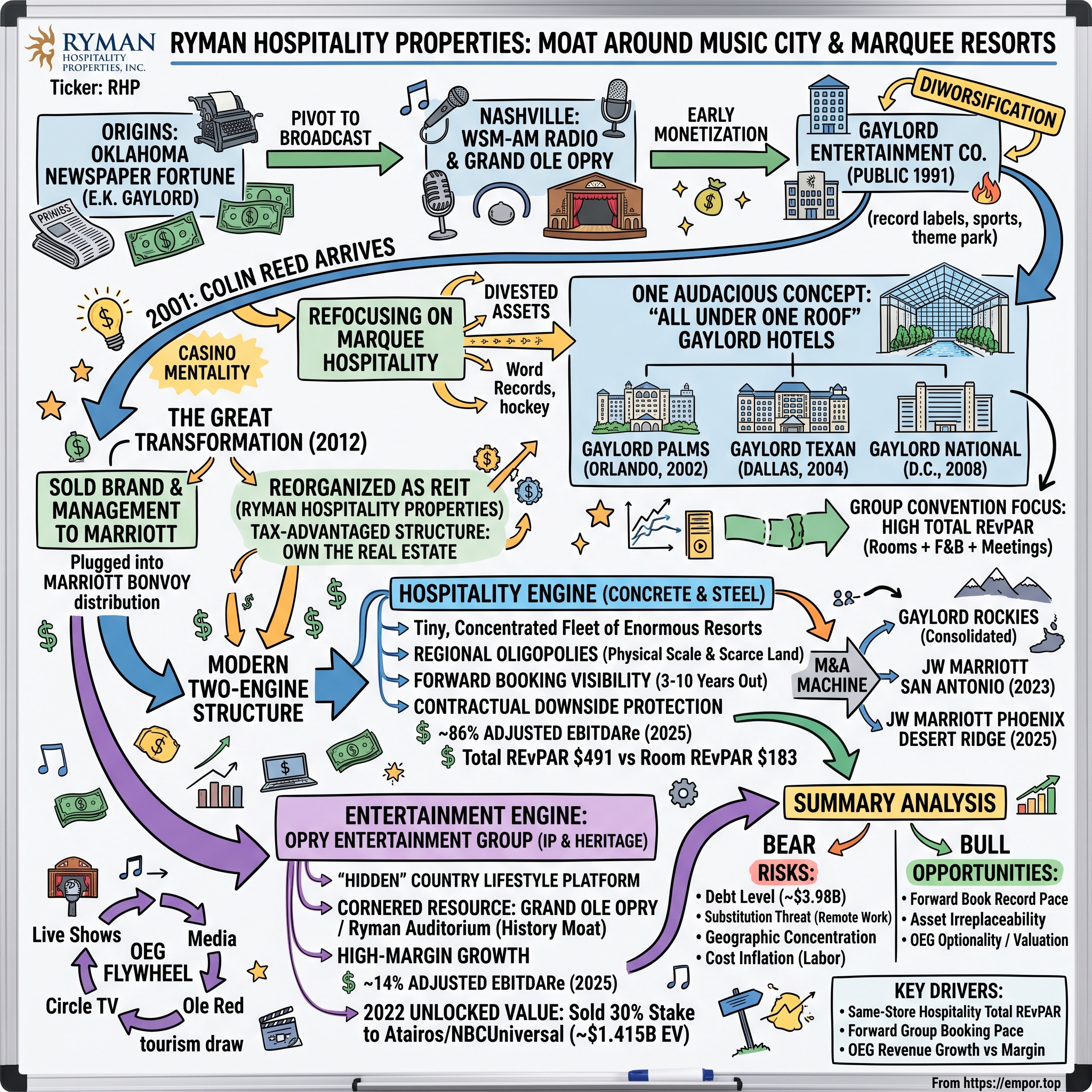
Ryman Hospitality Properties: The Moat Around Music City and Marquee Resorts
I. Introduction & Episode Roadmap
Step inside the Gaylord Opryland Resort in Nashville on any given Tuesday and you will lose your sense of scale. Nine acres of climate-controlled glass atrium arch overhead, enclosing a quarter-mile of indoor river you can ride on a flatboat, tropical gardens thick enough to swallow a wedding party, waterfalls, and cascading balconies of guest rooms rising into an artificial sky. Somewhere in the complex, a five-thousand-person insurance-industry convention is breaking for lunch; in another wing, a corporate sales kickoff is loading into a ballroom the size of a football field; and a few miles away, under a very different roof, a fiddle player is warming up on the circle of oak flooring cut from the stage of the old Ryman Auditorium — the "Mother Church of Country Music" — for that night's broadcast of the Grand Ole Opry, the longest-running radio program in American history.
These two experiences — the industrial-scale convention machine and the century-old cultural shrine — belong to the same company. That is the puzzle worth sitting with. How did a Depression-era newspaper fortune out of Oklahoma City metastasize into a roughly $12 billion enterprise that simultaneously owns a near-monopoly on America's largest glass-atrium convention resorts and the single most irreplaceable brand in country music? And why do those two businesses, which seem to have nothing to do with each other, live under one roof at all?
Ryman Hospitality Properties, listed on the NYSE under the ticker RHP, is technically a real estate investment trust — a REIT. But calling it a hotel REIT is like calling Berkshire Hathaway a textile company. It is really a specialized capital-allocation vehicle running two very different engines. The first is the hospitality engine: a tiny, concentrated fleet of enormous group-convention resorts, asset-heavy monsters that most hotel investors would never dare to build. In 2025 this engine produced roughly $714 million of Adjusted EBITDAre — about 86% of the company's consolidated total.1 The second is the entertainment engine, branded Opry Entertainment Group, a high-margin country-music lifestyle and media platform that contributed roughly $115 million, or about 14%.1 One engine is concrete and steel; the other is intellectual property and cultural heritage. The company's entire modern history is the story of learning what each is worth, and how to own each in the smartest possible structure.
A word on posture before we begin. It is easy, telling this story, to slip into the register of a fan — the buildings are genuinely impressive, the Opry is genuinely beloved, and the financial engineering is genuinely clever. But an impressive asset and a good investment are not the same thing, and the purpose here is to separate what has been proven from what management merely asserts. RHP's leadership makes a confident case that its moats are durable, its acquisitions disciplined, and its dual-engine structure optimal. Some of those claims are well supported by evidence — the replacement-cost barrier and the forward booking book are real and measurable. Others rest on judgments about the future — the permanence of in-person conventions, the wisdom of paying full multiples in a high-rate world — that remain open. Throughout, the aim is to ask what would have to be true for the bulls to be right, and what evidence would prove them wrong.
This article walks the full arc. We start with the Gaylord dynasty and the Nashville land grab that assembled the Opry and the original Opryland empire. We watch a former casino executive named Colin Reed arrive in 2001, dismantle a sprawling media conglomerate, and rebuild it around a single audacious hotel concept. We dissect the 2012 masterstroke — selling the brand to Marriott while converting the whole company into a tax-advantaged REIT — that is arguably the most consequential financial decision in the company's history. We interrogate the economics of why a five-thousand-person convention pays a premium to stay locked inside one building. We follow the modern M&A machine as it consolidates the premium group-resort landscape from Denver to San Antonio to Phoenix. We size up the "hidden" Opry platform and the clever deal that put a number on it. And we stress-test the whole edifice the way a skeptical long-term investor should — including the activist who has spent years arguing the two engines should be pulled apart. Let's begin where the money did: with newspaper ink.
 Subscribe on LinkedIn
II. The Origins of Gaylord: From Newspaper Wealth to the Grand Ole Opry
The fortune that would one day build indoor rivers started with a printing press. Edward King Gaylord — E.K. to everyone — arrived in the Oklahoma Territory near the turn of the twentieth century and took control of The Daily Oklahoman, the newspaper that would become the anchor of the Oklahoma Publishing Company. E.K. was a proto-media baron of the classic American mold: relentless, conservative, and possessed of an almost unnerving longevity. He ran his newspaper empire for the better part of seven decades, generating the kind of steady, unglamorous cash flow that a family could compound quietly across the middle of the century. Newspaper monopolies in mid-sized cities were, in their day, extraordinary businesses — local advertising near-monopolies with pricing power and captive readership. That cash bought radio stations, then television stations, and slowly turned a publishing house into a diversified media concern.
To understand the temperament that seeded this empire, it helps to understand E.K. Gaylord himself. He was a man of Victorian habits and iron routine who reportedly kept working into his second century — he lived to 101 and remained engaged with the business almost to the end. His was the archetypal mid-century media fortune: a dominant regional newspaper throwing off reliable cash, reinvested patiently into the emerging technologies of the day. In the 1920s and 1930s that meant radio; by mid-century it meant television. The pattern is worth naming because it recurs throughout this story — a family that generated boring, dependable cash flow from an entrenched local monopoly and then used it to buy into the next platform. The discipline of the newspaper business, where every edition had to balance costs against advertising to the penny, instilled a respect for cash generation that would echo, generations later, in the way RHP's modern managers obsess over the cash each guest produces.
The pivot that matters most to this story, though, was not in Oklahoma but in Tennessee. The Gaylord company's broadcasting arm came to control WSM-AM, the 50,000-watt Nashville radio station whose clear-channel signal carried across much of the country after dark. WSM had done something in the 1920s that would echo for a century: it launched a live barn-dance radio program that, almost by accident, acquired the name the Grand Ole Opry. Over the following decades the Opry became the beating heart of country music — the stage where careers were made, the show that defined the genre's canon. Its longtime home, the Ryman Auditorium, a former tabernacle with famously unforgiving pews and famously perfect acoustics, earned the nickname the Mother Church of Country Music. When the Gaylord organization gathered up WSM, the Opry, and the Ryman, it was not buying a radio asset. It was buying custody of a cultural institution — though it would take the company decades to fully understand what that custody was worth.
The Grand Ole Opry's staying power is itself a lesson in the durability of cultural institutions. Where television networks and record labels rose and fell, the Opry simply persisted — decade after decade, a live variety show broadcast into the dark over WSM's clear-channel signal, which after sunset could reach listeners across dozens of states because federal rules protected a handful of stations from interference on their frequencies. For a farming family in rural Arkansas or Missouri in the 1940s, WSM on a Saturday night was a window into a shared national culture, and the Opry was its centerpiece. That accumulated emotional equity — the sense that the Opry belongs to its audience — is the kind of asset that no amount of marketing spend can create from scratch, and it is the reason the brand still carries weight a century on.
Under Edward L. Gaylord, E.K.'s son, the company made the leap from broadcasting the Opry to monetizing the tourism it created. Nashville in the early 1970s was on the cusp of becoming a destination, and the Gaylords moved to capture the visitors the Opry brand pulled in. They opened Opryland USA, a country-music-themed amusement park, in 1972, and then, recognizing that theme-park guests needed somewhere to sleep and conventions needed somewhere to meet, they opened the Opryland Hotel in 1977. That hotel — the seed of everything RHP would later become — was built on a simple insight the company would spend the next fifty years scaling up: put entertainment, lodging, and meeting space under one roof near a powerful cultural draw, and you can keep guests, and their wallets, inside your walls.
In 1991, Gaylord Entertainment Company went public, arriving on the market as exactly the kind of business that looks impressive and confuses investors in equal measure: a sprawling, unfocused conglomerate of newspapers-adjacent media, cable networks, music assets, broadcasting, a theme park, and a growing hotel. It was a collection of good pieces with no unifying logic — the sort of structure that a later generation of managers would learn to distrust as "diworsification," the value-destroying habit of bolting unrelated businesses together under one holding company.
Then came the decision that still stings in Nashville. In 1997, management closed the beloved Opryland USA theme park — and paved much of it over to build Opry Mills, a massive outlet shopping mall. To the local community, it was a betrayal: a cherished cultural landmark bulldozed for retail square footage. To the company's future, it was something more revealing. The move was an admission, whether management framed it that way or not, that Gaylord did not actually know how to win in the amusement-park business, and that the real estate under the park was worth more as high-traffic commercial development feeding the hotel and convention complex next door. It severed a community asset, but it forced a reckoning that would define everything after: Gaylord was not, at its core, an entertainment operator. It was a real estate and lodging business that happened to own some entertainment. It would take an outsider to say that out loud — and to act on it.
III. The Colin Reed Era: Refocusing on Marquee Hospitality (2001–2011)
The outsider arrived in 2001, and he did not come from media. Colin Reed came from the casino floor. A British-born finance executive, Reed had built his career in the hard-nosed, cash-obsessed world of gaming and lodging — first at Promus, then as a senior operating and financial executive at Harrah's Entertainment, one of the most analytically ruthless companies in American hospitality. Casino operators live and die by a single discipline: understanding, down to the square foot and the hour, how much cash a captive guest generates while inside your building. Reed brought that mentality to Nashville, and what he saw when he looked at Gaylord Entertainment was a company drowning in distractions.
It is worth pausing on what the Harrah's school of thought actually teaches, because it shaped everything Reed did in Nashville. Harrah's, in Reed's era, was pioneering the idea that a hospitality business is fundamentally a data-and-yield business: every square foot of floor, every guest interaction, every hour of a customer's visit can be measured for the cash it generates and optimized accordingly. Casinos figured out long before hotels did that the goal is not to fill rooms but to maximize the total spend of the guest while they are inside your building — the room being merely the anchor that keeps them there. Reed carried that lens intact into a company that, for all its cultural charm, had never really applied it. Where the Gaylords saw a beloved theme park and a treasured radio show, Reed saw an under-optimized machine for capturing captive spending. That was not cynicism; it was clarity. And clarity, in a conglomerate, usually means subtraction.
The portfolio he inherited read like an estate sale. Gaylord owned a stake in the Nashville Predators NHL hockey franchise. It owned Word Records, a Christian-music label. It held music catalogs, cable interests, and various media odds and ends — assets that had nothing to do with running enormous hotels and everything to do with a family conglomerate's accumulated enthusiasms. Reed's diagnosis was blunt and, in retrospect, exactly right: this was a business with one genuinely special asset — the ability to design, build, and operate gigantic self-contained convention resorts — buried under a pile of things that diluted returns and confused investors.
So he started cutting. Through the 2000s, Reed executed a methodical divestiture campaign, selling the sports stake, the record label, the media pieces, and the miscellany, and funneling the proceeds and management attention toward a single concept: Gaylord Hotels. The idea was to take the Opryland formula — a massive hotel with a signature glass atrium, hundreds of thousands of square feet of meeting space, restaurants, bars, and entertainment all sealed under one roof — and stamp it into new markets chosen for their convention appeal and airport access. The strategy had a memorable internal slogan: "all under one roof." A group of five thousand people could fly in, check in, meet, eat, drink, network, and party for four days without their attendees ever needing a taxi.
Reed built three of them in six years. Gaylord Palms opened near Orlando, Florida, in 2002, planting a flag in the nation's single busiest convention and leisure market. Gaylord Texan opened on the shores of Lake Grapevine between Dallas and Fort Worth in 2004, wrapped around a Texas-themed atrium and positioned minutes from one of the country's largest airports. And Gaylord National opened on the banks of the Potomac at National Harbor, just outside Washington, D.C., in 2008 — the largest and most expensive of the three, a bet on the bottomless demand of trade associations, government contractors, and lobbying groups that congregate around the capital.
The economics underneath this expansion are the whole point, and they are worth slowing down to explain, because they are genuinely different from those of an ordinary hotel. A normal hotel makes most of its money selling rooms; food, beverage, and extras are a modest garnish. A Gaylord resort inverts that. When a corporation or a trade association books its annual meeting into one of these buildings, the room rate is almost the least of what the resort collects. The group also buys thousands of banquet meals, open bars, coffee breaks, plated galas, audiovisual production, exhibit-hall space, and parking — high-margin categories a leisure traveler never touches. The captivity is the product. Because there is nowhere else to go — no walkable strip of competing restaurants, no rival ballroom down the block — the resort captures a share of attendee spending that a conventional hotel can only dream of. Reed understood that he was not really selling rooms. He was selling a self-contained, monetizable environment, and charging a premium for the convenience of never having to leave it.
The glass atrium at the center of each resort deserves a word, because it is not mere decoration — it is the physical embodiment of the strategy. By enclosing gardens, water features, and restaurants inside a vast climate-controlled dome, Gaylord created an environment that is pleasant year-round regardless of the weather outside, and, more importantly, that gives guests a reason never to leave. The atrium is a psychological device as much as an architectural one: it makes the interior feel like a destination in itself, so that the walk from the guest room to the ballroom passes bars, cafés, and shops rather than a bland corridor. Every one of those touchpoints is an opportunity to capture another few dollars of spend. It is the same principle a casino uses when it routes foot traffic past the slot machines — except here the currency is banquet tabs and cocktail rounds rather than chips. The building is engineered to monetize the very act of staying inside it.
By the end of the decade, Reed had transformed Gaylord from a confused conglomerate into a focused, if capital-hungry, operator of trophy convention resorts. But the transformation had a structural flaw that Reed, the ex-Harrah's finance man, could see plainly. Building a billion-dollar resort every few years as a conventional, taxable corporation was a punishing way to compound capital. The company was paying full corporate income tax on its lodging profits, its stock traded at a discount to the value of its real estate, and each new project strained the balance sheet. Reed had refocused the business. Now he needed to rebuild the machine underneath it — and the solution he reached for in 2012 would change the company's name.
IV. The Great Transformation: The 2012 REIT Conversion & Marriott Masterstroke
By 2011, Colin Reed was staring at a wall built out of the tax code. Gaylord Entertainment was, in the technical sense, a C-corporation: it paid corporate income tax on its earnings, and then its shareholders paid tax again on dividends. For a company whose assets were, at bottom, enormous pieces of income-producing real estate, that double-taxation was pure friction. Meanwhile, the market persistently valued the stock below what a buyer would pay for the underlying hotels. And the growth model — pouring a billion dollars of after-tax corporate cash into each new resort — was slow and self-limiting. Reed needed to break through the wall, and in May 2012 he unveiled a two-part maneuver of unusual elegance.
The first move was to sell the crown jewels — or at least, what looked like the crown jewels. Gaylord agreed to sell the "Gaylord Hotels" brand and the rights to manage its hotels to Marriott International for $210 million in cash, a transaction that closed on October 1, 2012.3 To a casual observer this looked like surrender: the company was handing its own name and the day-to-day running of its resorts to a competitor. The second move explained the logic. Simultaneously, Gaylord Entertainment merged into a newly formed entity and reorganized as a real estate investment trust, taking a new name drawn from that hallowed old auditorium — Ryman Hospitality Properties — and beginning to trade under the ticker RHP.3 Shareholders approved the conversion overwhelmingly, and the REIT election took effect for tax purposes on January 1, 2013.3
Understanding why this was brilliant requires understanding what a REIT is and why it has rules. A REIT is a corporate structure that pays little to no federal corporate income tax, on one condition: it must distribute the large majority of its taxable income to shareholders as dividends, and it must confine itself largely to owning real estate and collecting rent, not operating businesses. That last constraint is the catch. A REIT is not really supposed to run a hotel — checking guests in, staffing kitchens, booking conventions. It is supposed to own the building. So to slot a hotel empire into a REIT wrapper, someone else has to operate the hotels. That someone became Marriott.
Now the three-way logic snaps into focus. By converting, RHP eliminated the corporate-level income tax that had been quietly bleeding its lodging profits — an enormous, permanent boost to the cash available for dividends and reinvestment. By selling the brand and management to Marriott, it satisfied the REIT rules and simultaneously acquired something it could never have built alone: distribution. Marriott plugged the Gaylord resorts into a global reservations system, a worldwide sales force calling on corporate and association planners, and one of the largest loyalty programs on earth — the machine now known as Marriott Bonvoy, with well over a hundred million members funneling business toward Marriott-managed properties. For a resort that depends on filling ten thousand room-nights at a time, that distribution engine dramatically lowered the cost of finding customers.
The REIT conversion also placed RHP inside a broader industry migration that is worth understanding. Across the 2000s and 2010s, a wave of hotel companies split themselves into two: an asset-owning REIT that holds the real estate, and a "brand" or "management" company that runs the properties for fees. The logic driving all of them was the same recognition RHP acted on — that owning buildings and operating them are different businesses with different economics, different capital needs, and different natural owners. Real estate wants patient, tax-efficient, dividend-oriented capital; brand management wants an asset-light, high-return-on-capital fee stream. Stapling the two together in one taxable corporation tends to make neither the market's ideal version of itself. What made RHP's version of the split unusually clean was that it did not spin off its own management company into the public markets to fend for itself; it simply sold the operating role to Marriott, the largest and most sophisticated operator in the world, and pocketed the distribution benefits as part of the bargain.
And crucially, RHP gave up remarkably little in exchange. Marriott operates the hotels for a management fee — a base fee plus an incentive fee tied to performance — but RHP retained 100% ownership of the real estate and the overwhelming majority of the economics. The company had, in effect, separated the two things that had been tangled together for decades: the ownership of irreplaceable physical assets, which it kept, and the operation of those assets, which it delegated to a best-in-class specialist. Reed had turned himself from a hotel operator into something closer to a landlord and capital allocator — a person whose job was now to own the right buildings, finance them cheaply, and let a world-class operator run them.
There is a skeptical footnote worth logging here, because the arrangement is not free. Delegating operations to Marriott means RHP does not fully control its own labor costs, its own service standards, or the incentive fees it pays, and it means the guest ultimately experiences a Marriott-run product in an RHP-owned box. The interests are aligned but not identical; a manager paid partly on revenue and an owner focused on long-run asset value can quietly diverge on how hard to push rates, how much to spend on renovations, or how to staff in a downturn. That tension is structural and permanent. But in 2012, with a discounted stock, a punitive tax structure, and a growth model running out of room, Reed judged the trade worth it — and the fifteen years since have largely vindicated the call. With the structure rebuilt, the question became whether the underlying business was as good as the engineering around it. It was time to look under the hood of the resorts themselves.
V. The Core Engine: The Unrivaled Economics of Large-Scale Group Hospitality
Consider a single, mundane-sounding number that captures why these resorts are strange and special: total revenue per available room. In the lodging industry, the standard yardstick is RevPAR — revenue per available room — which measures only the money a hotel earns from selling the room itself. But RHP's operators track a broader figure, Total RevPAR, which sweeps in everything the property earns per room: the banquets, the bars, the spa, the golf, the parking, the meeting space. In 2025, RHP's hospitality portfolio generated a Total RevPAR of roughly $491 against a room-only RevPAR of about $183.1 Read that again. For every dollar these resorts earned renting a bed, they earned nearly two more dollars selling everything else. At a typical urban business hotel, that ratio is a fraction of what it is here. This single spread is the mathematical signature of the "all under one roof" model — proof that the building is monetizing the attendee, not merely the room.
To appreciate how unusual RHP's portfolio is, compare it to its peers. The pure-play lodging REITs that analysts reach for as comparisons — Host Hotels & Resorts and Park Hotels & Resorts — own dozens of properties each. Host holds a portfolio of roughly seventy luxury and upper-upscale hotels scattered across major markets. RHP, by contrast, owns a literal handful of buildings. Its Gaylord resorts and its recently acquired JW Marriott properties together comprise only a few properties, but they are giants: RHP's average hotel runs well over 1,800 rooms, a scale at which most of Host's individual hotels look like boutiques. This is concentration as strategy. RHP is not trying to own a little bit of everything; it is trying to own the small number of buildings in America that can host a five-thousand-person convention entirely indoors — and to own essentially all of them.
The trade-off embedded in that concentration is real and cuts both ways, and an investor should hold both edges at once. A diversified owner like Host spreads its risk across many properties, markets, and demand segments, so no single hotel's stumble threatens the whole. RHP does the opposite: it bets that a few extraordinary, hard-to-replicate assets will outperform a broad portfolio of ordinary ones, accepting that any single property carries outsized weight. In good times, concentration in scarce, high-barrier assets is a source of superior returns and pricing power. In a localized shock — a natural disaster, a regional demand collapse, a labor dispute at one flagship — the same concentration becomes a liability with nowhere to hide. Whether one prefers RHP's model or Host's is ultimately a question about how much one trusts the durability of the specific moat RHP has built. The two are not better or worse in the abstract; they are different bets on the value of scarcity versus the value of diversification.
That concentration is defensible because of two of the classic competitive advantages catalogued in Hamilton Helmer's 7 Powers framework. The first is scale economies — but of an unusual, physical kind. A modern convention resort of this size, with a signature glass atrium, cannot be conjured cheaply. Replacing one today would cost well over a billion and a half dollars, and that assumes you could even find the land: a parcel large enough to hold two thousand rooms and hundreds of thousands of square feet of meeting space, situated near a major hub airport, in a city that wants the convention traffic. Those parcels are vanishingly scarce and getting scarcer. The result is a set of regional oligopolies. In each of its markets, an RHP resort faces essentially no threat of a rival building something equivalent next door, because the economics of doing so are prohibitive. The barrier is the building itself.
The second power is switching costs, and here you have to think like a corporate meeting planner. Imagine you are responsible for your industry association's annual convention: five thousand attendees, a keynote, forty breakout sessions, an exhibit hall, a gala dinner, all of it executed flawlessly on specific dates, with your professional reputation riding on whether the coffee is hot and the ballroom is set correctly. Once you have run that event successfully at a Gaylord resort — once you know the staff can handle the load, the audiovisual works, the catering scales — the incentive to gamble on an unproven venue is almost nil. The downside of a botched conference (a furious membership, a lost job) dwarfs whatever modest savings a competitor might offer. That asymmetry locks planners into venues that have earned their trust, and it is why groups return to the same resorts year after year.
There is a subtler mechanic inside the group model that reinforces its resilience: the contracts themselves. When an association books a convention years out, it typically signs an agreement with room-block commitments, attrition clauses, and cancellation penalties. In plain terms, the group promises to fill a certain number of rooms and to spend a certain amount on food and functions; if it falls short, it owes the resort money anyway. This transforms what looks like ordinary hotel demand into something closer to a contracted revenue stream with downside protection. It is not a bond — a group can still walk away and eat the penalty in a genuine crisis, as many did during the pandemic — but in normal times it means RHP is not simply hoping travelers show up next weekend. It is collecting on commitments made years earlier by counterparties with their own reputations on the line. That contractual spine is part of why the business can plan, and spend, with a confidence that transient-dependent hotels cannot muster.
The other half of the mix is the leisure and transient guest — the family visiting Nashville, the individual traveler filling rooms around the edges of the group blocks. RHP's operators actively manage the balance between the two: group business provides the predictable base, while higher-rated transient demand is layered on top to push overall rates up when the calendar allows. This yield-management dance, run by Marriott's revenue systems, is where a lot of the incremental profit hides. When group demand is strong enough to fill most of the house, the operator can hold out for premium transient rates on the remaining rooms rather than discounting to fill them. It is an unglamorous, spreadsheet-driven discipline, and it is a meaningful part of why the same physical buildings can produce materially different profits depending on how skillfully the booking calendar is orchestrated.
The most powerful economic feature of the group model, though, is time. Large conventions are not booked weeks in advance like a leisure getaway; they are booked years in advance — commonly three to ten years out. This gives RHP something almost no consumer-facing business enjoys: extraordinary forward visibility. Management can look at its "book of business" and see, with real confidence, how many room-nights are already contractually committed for 2027, 2028, and beyond. At the end of 2025, the company reported it had booked nearly three million future group room-nights in its same-store portfolio during the year, at an estimated average daily rate of roughly $292 — a record, and about 3.5% higher than the prior year's forward bookings.1 That long booking cycle acts as a shock absorber. When leisure travel wobbles in a recession, RHP still has years of group business locked on the books — a buffer that ordinary hotels, exposed to next weekend's demand, simply do not have.
Now put numbers to the whole engine. In fiscal 2025, RHP's hospitality segment generated revenue of about $2.14 billion and Adjusted EBITDAre of roughly $714 million, up 7.3% and 4.4% respectively.1 Strip out the newly acquired Phoenix resort to compare like-for-like, and the same-store hospitality business produced about $2.05 billion of revenue and $695 million of EBITDAre — still growing, if more modestly, on a portfolio that was already running near its historical occupancy of 68.7%.1 The analytical read is nuanced and worth stating plainly: the core is a genuinely superior asset class — high absolute margins, deep forward visibility, formidable barriers to entry — but it is also mature. Same-store growth in the low single digits tells you this is not a business that compounds volume quickly; it grows by pushing rate, adding high-margin spend per attendee, and, increasingly, by buying more buildings. Which is exactly what management spent the second half of the decade doing.
VI. Capital Deployment & Portfolio Expansion: Rockies, San Antonio, & Phoenix (2018–2025)
If the 2012 REIT conversion was RHP's structural masterstroke, the years that followed were a demonstration of something harder to teach: capital-allocation discipline. And the template for it was written in the Colorado high plains, at a resort the company did not initially own outright. Gaylord Rockies, a two-story-atrium behemoth near Denver International Airport, was developed as a joint venture, and RHP came into it holding only a minority interest — a roughly 35% development stake — while partners including Ares Management and the specialist developer RIDA Development carried much of the construction risk. This was deliberate. Rather than shoulder the full cost and uncertainty of building a billion-dollar resort from scratch, RHP took a smaller position during the risky development phase, then watched to see whether the property would stabilize into the reliable cash producer the model predicted.
It did. And so RHP did what a disciplined allocator does when a bet pays off: it pressed. The company bought out its joint-venture partners in stages — increasing its stake as the resort proved itself — until it owned essentially all of Gaylord Rockies and the developable land around it. The logic was elegant: let others share the greenfield risk, prove the asset, then consolidate ownership once the uncertainty has been resolved and the cash flows are visible. It was a way of buying a stabilized trophy without paying the full stabilized price up front.
Then the pandemic hit, and it reshaped the strategy. It is hard to overstate how directly COVID-19 attacked the specific thing RHP does. A leisure hotel could limp along on a trickle of drive-to travelers; a convention resort whose entire economic model is gathering five thousand people into a ballroom had, for a period in 2020, essentially zero business. Groups that had booked years in advance postponed or canceled en masse, and the very contractual commitments that make the model resilient in normal downturns proved only partial protection against a once-in-a-century shutdown. The company drew on liquidity, deferred spending, and waited. What made the episode instructive rather than fatal was the shape of the recovery: because groups had merely postponed rather than abandoned their events, and because the multi-year booking calendar could be rescheduled rather than rebuilt from zero, demand came back in a wave as restrictions lifted — and it came back with pent-up intensity, as organizations that had spent two years on video calls rediscovered the value of meeting in person. COVID-19 was, for a moment, an almost existential threat to a company whose entire business is gathering thousands of people indoors. Conventions vanished overnight. But the crisis also seeded RHP's next phase, because it battered asset values and eventually put premier group resorts on the market at prices a patient, well-capitalized buyer could pounce on. Reed's team pivoted from building to buying — and specifically to buying established, non-Gaylord group resorts that fit the profile: huge, meeting-focused, high Total RevPAR, hard to replicate.
The first big strike came in June 2023, when RHP acquired the JW Marriott San Antonio Hill Country Resort & Spa from Blackstone's non-traded REIT, BREIT, for $800 million.[^3] What made the deal notable was not just the trophy — a sprawling Texas Hill Country resort with two golf courses and enormous meeting space — but the price relative to earnings. RHP paid roughly 12.6 times the resort's trailing Adjusted EBITDAre.[^3] Two years later, in June 2025, it ran the play again, closing on the JW Marriott Phoenix Desert Ridge Resort & Spa for $865 million, bought from Trinity Investments (which had itself paid about $602 million for the property in 2019).2 The Phoenix resort — 950 rooms, some 243,000 square feet of meeting space, a 28,000-square-foot spa, a golf complex, and a sprawling water park — went for about 12.7 times trailing Adjusted EBITDAre.2
The financing of these deals is as revealing as the price. A REIT cannot simply retain years of earnings to build a war chest, so growth of this magnitude has to be funded through some combination of new debt, equity issuance, and asset-level capital recycling — including, as we saw, the cash raised by selling a slice of OEG. Each acquisition of $800 million or more is therefore a balance-sheet decision as much as a strategic one, and it tightens the link between the company's appetite for expansion and its cost of capital. When borrowing is cheap, buying stabilized resorts at a low-teens multiple is straightforwardly accretive; when borrowing is expensive, the same multiple can become a much closer call, because the incremental interest on the debt used to buy the asset eats into the very earnings the asset produces. Management's willingness to pay nearly identical multiples in 2023 and 2025 — through a period of materially higher interest rates — is thus a slightly more aggressive posture than the headline numbers suggest, and a fair thing for a skeptic to probe.
Why do those twin multiples — 12.6x and 12.7x — matter enough to dwell on? Because they reveal the discipline. Here is the comparison management was implicitly making. To build a resort of comparable quality from the ground up today would require paying replacement cost — land, materials, labor, years of construction risk, and a stretch of unprofitable ramp-up — that pencils out to something well north of 15 times the earnings the finished building would eventually produce. Buying a stabilized, proven resort at under 13 times earnings is therefore cheaper than creating one, and it comes with an operating history, an existing book of group business, and no construction risk. When management pays roughly the same disciplined multiple twice, two years apart, in two different markets, it is signaling a genuine framework rather than opportunistic dealmaking — a stated ceiling on what a premier group asset is worth, and a willingness to walk if the price runs past it.
That said, an independent observer should keep two counterweights in mind. First, "accretive versus building" is only compelling if the alternative — building — is something you actually want to do; a disciplined multiple on an acquisition still adds hundreds of millions in debt-funded assets to a balance sheet that already carries roughly $4 billion of borrowings. Second, both San Antonio and Phoenix are JW Marriott–branded resorts, not Gaylord-atrium properties, which means RHP is broadening its definition of "group resort" beyond the specific glass-atrium format that gave it its regional monopolies. That is probably wise diversification, but it slightly dilutes the purity of the moat that made the original portfolio so defensible. The acquisitions grew the empire; whether they widened or narrowed the competitive advantage is a genuinely open question. And notably, this expansion was partly financed by unlocking value from the other engine entirely — the one that had been hiding in plain sight in Nashville.
VII. The "Hidden" Country Lifestyle Platform: Opry Entertainment Group (OEG)
Walk out of the convention machine and into the other half of the company, and the mood changes completely. Here there are no atriums or exhibit halls — there is a semicircle of worn oak flooring, cut from the stage of the Ryman Auditorium and installed at the center of the Grand Ole Opry House, so that every performer who steps into "the circle" is literally standing on the same wood as the legends who came before. This is Opry Entertainment Group, and it is the strangest, and in some ways the most valuable, asset RHP owns. It bundles together the Grand Ole Opry itself, the Ryman Auditorium, the historic WSM-AM radio station, the Circle TV network devoted to country lifestyle programming, and the Ole Red chain of entertainment-and-dining venues developed in partnership with the country star Blake Shelton.
To describe OEG in the language of competitive strategy, it is the purest example of what Hamilton Helmer calls a cornered resource — control of a coveted asset that competitors simply cannot obtain at any price. You can build a bigger stadium, sign a hotter star, launch a slicker streaming service. You cannot build a second Grand Ole Opry. There is exactly one, with a hundred years of accumulated legitimacy as the institution that certifies who belongs in the country-music canon. That heritage is not for sale and cannot be replicated with capital, which is precisely what makes it a moat. Where the hotels are protected by the prohibitive cost of construction, OEG is protected by the impossibility of manufacturing history.
For most of RHP's life as a REIT, though, this cultural treasure sat inside the company essentially unpriced — a rounding error next to the hotels, its true value invisible to a market that saw only a lodging REIT. Management changed that in 2022 with a deal that was, in its own quiet way, as clever as the Marriott maneuver a decade earlier. RHP sold a 30% minority stake in OEG to a partnership of Atairos and NBCUniversal for $296 million, a transaction that implied a total enterprise value for OEG of about $1.415 billion.[^5] In a single stroke, the company accomplished three things. It put a large, third-party-validated price tag on an asset the stock market had been ignoring. It brought in NBCUniversal — a media powerhouse with distribution muscle — as a strategic partner to help scale the platform. And it raised nearly $300 million of cash without diluting RHP's real estate equity or taking on more debt, liquidity that helped fund the acquisition spree in San Antonio and beyond.
It is worth dwelling on why the Grand Ole Opry, specifically, functions as a cornered resource rather than just a strong brand, because the distinction matters for how durable the advantage is. A strong brand can be eroded by a better competitor, a scandal, or a shift in taste — think of once-dominant consumer names that faded. A cornered resource is different: it is a unique asset whose value derives from its very singularity and its history, which competitors cannot acquire regardless of how much they spend. The Opry's authority comes precisely from the fact that it has been the Opry, continuously, for a century — that the artists who played it in the 1950s and the artists who play it today stand on literally the same circle of stage. That continuity cannot be bought or manufactured; a well-funded rival could build a grander venue and book bigger stars, and it still would not be the Opry. The moat is time itself, and time is the one input capital cannot buy.
There was a companion move in the same period that deepened the platform's Nashville footprint: in June 2022, RHP completed the acquisition of Block 21, the mixed-use complex in downtown Austin that houses the Moody Theater — home of the Austin City Limits live-music franchise — extending OEG's live-entertainment reach into a second music city.[^6] Piece by piece, RHP was assembling not just a collection of venues but a country-lifestyle media flywheel: live shows feed the TV network, the network feeds the radio brand, the brands feed tourism, and the tourism feeds the enormous Gaylord Opryland resort a few miles away.
The individual pieces of OEG each play a distinct role in the flywheel, and they are worth distinguishing. The Grand Ole Opry and the Ryman Auditorium are the crown jewels — live venues whose ticket sales and reputation anchor the whole platform. WSM-AM is the century-old broadcast voice, a heritage asset that lends authenticity. Circle, the country-lifestyle television and streaming effort launched with a media partner, is the attempt to extend the brand into the living rooms of a national audience — the riskiest and most capital-hungry piece, competing in the brutally difficult economics of modern television. And Ole Red, the venue-and-dining concept built with Blake Shelton, is the consumer-facing expansion play: bars and entertainment complexes stamped with a country-music identity, rolled out in tourist-heavy cities to convert the brand's cultural cachet into food, drink, and merchandise revenue. Some of these are proven; others are bets. The honest framing is that OEG is part irreplaceable heritage and part growth experiment, and the two should not be valued the same way.
The financials have started to show why management is so attached to this segment. In fiscal 2025, OEG generated revenue of about $434 million, up a striking 26.8% year over year, with Adjusted EBITDAre of roughly $115 million, up 8.3%.1 Two things stand out in that pairing. The first is the growth rate: at more than 26%, OEG is expanding several times faster than the mature hotel core, which is the whole reason it matters disproportionately to the equity story despite being only ~14% of EBITDA. The second, though, is the gap between revenue growth (26.8%) and profit growth (8.3%) — a divergence an analyst should not gloss over. It suggests OEG's rapid top-line expansion is being driven partly by lower-margin activity or by investment spending ahead of profits, meaning the segment's margins compressed even as it grew. That is not necessarily bad — building a lifestyle platform costs money up front — but it is a reminder that "high-margin cultural IP" is a description that must be continually re-earned, not assumed. The real strategic value of OEG may be less about its own EBITDA line and more about its role as a national marketing funnel, pulling country-music tourists toward Nashville and, not coincidentally, toward RHP's single largest resort. Which raises the question a certain kind of investor has been asking loudly for years: if OEG is really worth a high-growth media multiple, why leave it trapped inside a hotel landlord?
VIII. Current Management, Capital Allocation & Activist Stress Test
The man who now has to answer that question is not Colin Reed. In January 2023, after more than two decades running the company, Reed handed the chief executive title to Mark Fioravanti, who had spent the previous eleven years as RHP's chief financial officer before stepping up to president and then CEO.4 Reed did not leave; he moved into the role of executive chairman, keeping his hands on OEG's strategic direction and long-term capital deployment while ceding day-to-day command.4 The transition was notable for how undramatic it was — an internal, long-telegraphed handoff from a finance-trained lieutenant of eleven years' standing, rather than an outside splash. For a company whose entire modern identity rests on capital-allocation discipline, promoting the CFO who had helped engineer that discipline was a statement of continuity.
The board around this management deserves a mention, because RHP's governance carries some of the flavor of its Nashville roots. Directors have included figures with deep ties to the region and to hospitality and finance, and the company has retained a chairman — Reed — who remains actively engaged in strategy rather than fading into a ceremonial role. This arrangement, an executive chairman working alongside a promoted-from-within CEO, is one that governance purists sometimes eye warily: it can blur accountability and concentrate influence in a single long-serving figure. In RHP's case the counterargument is that Reed's continued involvement preserves institutional knowledge about a genuinely unusual business — one where the difference between a good acquisition and a bad one turns on hard-won judgment about group demand and replacement cost that is not easily transferred. The structure is a bet that continuity of judgment outweighs the tidiness of a clean separation between chairman and chief executive.
Continuity, though, cuts both ways. A skeptic would note that a leadership team this stable, this internally promoted, and this long-tenured can also become a team that stops questioning its own assumptions. So the more useful test is behavioral: does management do what it says? On the evidence, its record of target-setting has been credible. On the fourth-quarter 2025 call, Fioravanti described the year's results as landing "near the top end of our most recent guidance ranges," and the company backed that language with concrete commitments — declaring $4.65 per share of dividends for 2025, up 4.5%, and guiding to a minimum of $4.80 per share for 2026.1 Putting a hard floor under next year's dividend is the kind of specific, falsifiable promise that a management team confident in its forward book of business can make and a bluffer cannot.
The alignment question — does management have skin in the game — has a clear answer in Colin Reed's case. Reed remains one of RHP's most significant individual shareholders; SEC filings in 2026 showed him holding on the order of 900,000-plus shares, a stake worth well into the tens of millions of dollars.5 Fioravanti, as a career executive rather than a founder, holds a smaller but still meaningful position of roughly half a percent of the company. This is not founder-level ownership, but for a REIT it represents real personal exposure to the same long-term outcomes shareholders care about — and Reed in particular has a long history of being a visible, committed owner rather than a mere option-grant recipient.
A governance-minded observer would also note the texture of insider behavior over time, which tends to reveal more than any proxy statement. Reed's continued large holding is not a legacy position he has been quietly trimming; the record of his transactions shows an executive who has remained meaningfully invested in the company he rebuilt, even after handing over the CEO title. That matters because the sharpest version of the activist critique — that entrenched, long-tenured management protects a suboptimal structure to preserve its own comfort — is harder to sustain against a chairman whose personal wealth rises and falls with the same share price the critics want to see unlocked. Skin in the game does not guarantee good decisions, but it does align the decision-maker's incentives with the outcome, and it raises the personal cost of complacency.
Which brings us to the stress test the company cannot escape: the activist case. For years, the value investor Mario Gabelli and his firm GAMCO Investors, a long-standing RHP shareholder, have pressed a pointed argument — that OEG's high-multiple entertainment and media intellectual property is trapped, and therefore undervalued, inside an asset-heavy lodging REIT. The logic is straightforward and hard to dismiss. Media and live-entertainment businesses trade at richer valuations than hotel real estate; by stapling a fast-growing cultural platform to a slow-growing pile of concrete, RHP may be forcing the market to value its best asset at its worst asset's multiple. Spin OEG off, the argument goes, and the sum of the parts would be worth meaningfully more than the whole.
Management's defense is layered, and it is worth taking seriously rather than dismissing. First, structure: OEG is housed in a taxable REIT subsidiary, a vehicle that lets a REIT own an operating business like an entertainment company while preserving the parent's tax-advantaged status — meaning RHP already captures much of the benefit of owning OEG without the tax penalty a clumsy separation might trigger. Second, and more persuasively, management points to the 2022 Atairos/NBCUniversal transaction as proof it can crystallize OEG's value directly, without the cost, complexity, and tax leakage of a full spin-off. It found a way to sell a slice of OEG at a rich private valuation while keeping control and the strategic flywheel intact. The honest independent verdict is that both sides have a point: Gabelli is right that the public market probably does not give RHP full credit for OEG, but management is also right that it has a demonstrated, lower-risk toolkit for surfacing that value on its own timetable. The disagreement is not really about whether OEG is valuable — everyone agrees it is — but about who should decide when and how to monetize it. As long as management keeps finding ways to prove the value without a messy breakup, it retains the benefit of the doubt. The moment growth stalls and the discount widens, expect the activist pressure to return with force.
IX. The Playbook, Powers, & Bear vs. Bull Analysis
Zoom out, and the Ryman story resolves into a set of repeatable lessons — a playbook that explains how a newspaper fortune became a convention-and-country-music juggernaut. The first lesson is the value of ruthless refocusing: Colin Reed's willingness to sell the hockey stake, the record label, and the media miscellany taught that a conglomerate trading at a discount can often be worth more in pieces pointed at a single high-moat niche. The second is the asset-right pivot: knowing when to own the irreplaceable real estate and delegate the operating grind to a world-class specialist like Marriott, separating what you must control from what you can outsource. The third is disciplined M&A over ego: buying proven resorts at a consistent ~12.6-to-12.7-times-earnings ceiling rather than overpaying for trophies or indulging the developer's temptation to build monuments. Taken together, these are the habits of a capital allocator, not a hotelier — which is exactly what RHP has become.
Run the business through Porter's Five Forces and Helmer's 7 Powers, and the moat holds up under scrutiny, with caveats. The threat of new entrants is genuinely low — the cornered-resource nature of OEG and the prohibitive replacement cost and land scarcity of the resorts are real, durable barriers, not marketing claims. Buyer power is moderated by switching costs and long booking cycles that lock groups in for years. Supplier power is where the picture gets less comfortable: RHP's most important "supplier" is labor, and hospitality is brutally labor-intensive. The threat of substitutes is the sharpest strategic risk — not another convention resort, but the possibility that video conferencing and distributed work permanently shrink the number of five-thousand-person in-person gatherings. And rivalry is muted precisely because RHP has concentrated itself into markets where few rivals can follow. On balance, the competitive position is strong; the question marks are about the demand for the category, not RHP's position within it.
The bear case — the "why this could break" — is concrete and deserves respect. Start with the balance sheet: RHP carried roughly $3.98 billion of total debt at the end of 2025.1 A REIT is legally required to pay out most of its income, which means it cannot easily retain earnings to pay down debt; it perpetually refinances. In a world of higher-for-longer interest rates, rolling those maturities at richer coupons directly squeezes the cash flow available for dividends, and the "minimum $4.80" dividend promise depends on that refinancing math staying manageable. The second risk is geographic and asset concentration: the Gaylord Opryland complex in Nashville remains the single largest cash generator, and a localized catastrophe there would be severe — a tail risk that is not hypothetical, given the 2010 Nashville floods that inundated the resort and shut it for months. A company with only a handful of buildings has, by definition, less diversification than one with seventy. The third is cost inflation: because Marriott operates the hotels, RHP does not fully control the wage and staffing costs that determine its margins, and a sustained bout of service-sector labor inflation compresses profitability in a way the owner can only partly influence.
The substitution threat deserves a closer look, because it is the one risk that could quietly hollow out the moat rather than announce itself in a single bad quarter. The bear's fear is not that a rival builds a better convention resort — that is nearly impossible, as we have seen — but that the underlying demand for large in-person gatherings structurally declines as video conferencing improves and distributed work becomes the norm. This is a genuine long-term question, and an honest analysis cannot dismiss it. The counter-evidence, though, is behavioral: the strong rebound in group bookings after the pandemic suggests that when organizations were given a natural experiment in replacing conventions with video, a large share concluded that the in-person version delivers something the screen cannot — the serendipitous hallway conversation, the relationship built over a dinner, the sheer signaling value of showing up. The very technology that was supposed to kill the convention may have instead proven its worth by contrast. But this is a thesis that must be continually re-tested against the booking data, not assumed; a slow, multi-year erosion in group demand would be the single development most damaging to the entire RHP story, and it would be visible in the forward booking pace long before it showed up in reported earnings.
The bull case — the "why this wins from here" — rests on evidence rather than hope, though it is not airtight. The strongest pillar is the forward book: the record volume of multi-year group bookings gives RHP visibility into demand that almost no consumer business enjoys, and it suggests that the post-pandemic return to in-person conventions is not a rebound but a durable preference among corporations and associations that concluded, after the remote-work experiment, that face-to-face collaboration is worth paying for. If that judgment holds, the substitution threat that most worries the bears is smaller than it looks. The second pillar is the irreplaceability of the assets — the buildings that cannot be rebuilt and the cultural brand that cannot be manufactured. And the third is OEG's optionality: a fast-growing platform with a proven, on-demand path to value crystallization, sitting inside the company as a source of upside the hotel core does not need to generate on its own.
There is one more dimension the bull case leans on that deserves scrutiny rather than applause: the dividend. As a REIT, RHP is structurally a distribution machine, and its willingness to raise the payout — declaring $4.65 per share in 2025 and guiding to at least $4.80 for 2026 — is often cited as evidence of management's confidence.1 But a dividend guarantee is only as good as the cash flow and refinancing environment behind it, and the same forward booking visibility that lets management commit to a payout floor could, in a genuine demand shock, force an uncomfortable choice between defending the dividend and defending the balance sheet. The company navigated exactly that tension during the pandemic, when the distribution was suspended and later restored. A rising dividend is a signal worth respecting, but it is a promise made against a future the company can see unusually well — not one it controls. The discipline that makes the promise credible is the same discipline that would have to break it if the group-demand thesis ever failed.
For a long-term investor trying to hold all of this in view, the noise reduces to a small number of things genuinely worth watching. The first is same-store hospitality Total RevPAR — the single metric that captures whether the "all under one roof" machine is still extracting more spending per attendee, and the clearest early signal of pricing power or its erosion. The second is the forward group booking pace — the volume and average rate of room-nights booked for future years, which is the leading indicator of demand and the reason the business can see around corners. The third, for those who care about the OEG debate, is OEG's revenue growth versus its margin — whether the entertainment engine can keep growing fast and convert that growth into profit, or whether the two remain in tension. Track those three, and you are watching the real business rather than the quarterly weather. Everything else — the refinancings, the acquisitions, the activist noise — is a variation on the same underlying question this whole story has circled: whether owning the few buildings and the one brand that cannot be replaced is a good enough business to compound through whatever the next cycle throws at it.
References
-
Ryman Hospitality Properties, Inc. Reports Fourth Quarter and Full Year 2025 Results — GlobeNewswire, 2026-02-23 ↩↩↩↩↩↩↩↩↩↩
-
Ryman Hospitality Properties Closes Acquisition of JW Marriott Phoenix Desert Ridge Resort & Spa for $865 Million — Nasdaq / GlobeNewswire, 2025-06-10 ↩↩
-
Gaylord Entertainment Completes REIT Conversion and Sale of Gaylord Hotels Brand and Management to Marriott (Form 8-K, Exhibit 99.1) — U.S. Securities and Exchange Commission, 2012-10-01 ↩↩↩
-
After 21 Years, Colin Reed Will Step Down as CEO of Ryman Hospitality Properties, Inc. — Williamson Source, 2022 ↩↩
-
Colin V. Reed Statement of Changes in Beneficial Ownership (Form 4) — U.S. Securities and Exchange Commission, 2026-03-16 ↩
 LinkedIn
 WhatsApp
 Reddit
 Hacker News
 Email
Email Kindle
 RSS Feed
 Spotify
 Apple Podcasts
 Amazon Music
 Audible
 YouTube