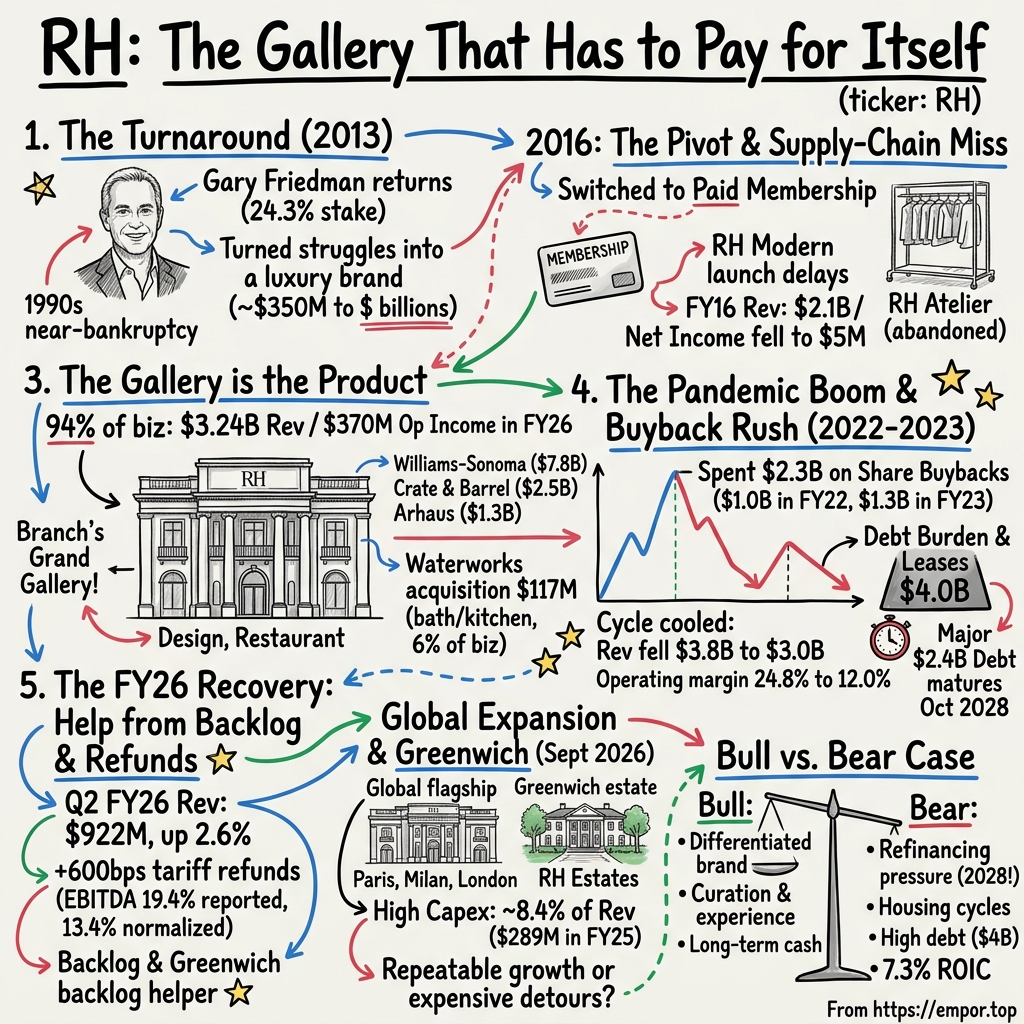
RH: The Gallery That Has to Pay for Itself
The room opens in Greenwich
On September 18, 2026, RH announced the opening of RH Estates, The Gallery on Greenwich Avenue, in Greenwich, Connecticut.1 Greenwich Avenue is one of the most expensive shopping streets in one of the richest towns in America, and RH had chosen it for a first: the first freestanding gallery for RH Estates, the company's newest and most expensive line, and the concept's North American debut after earlier showings in Milan and London.1 A second freestanding Estates gallery, on Melrose Avenue in Los Angeles, was already announced for 2027.1 If one wanted a single image of what Gary Friedman has spent a quarter of a century building, this was it: a furniture store designed so that nobody would think of it as a furniture store.
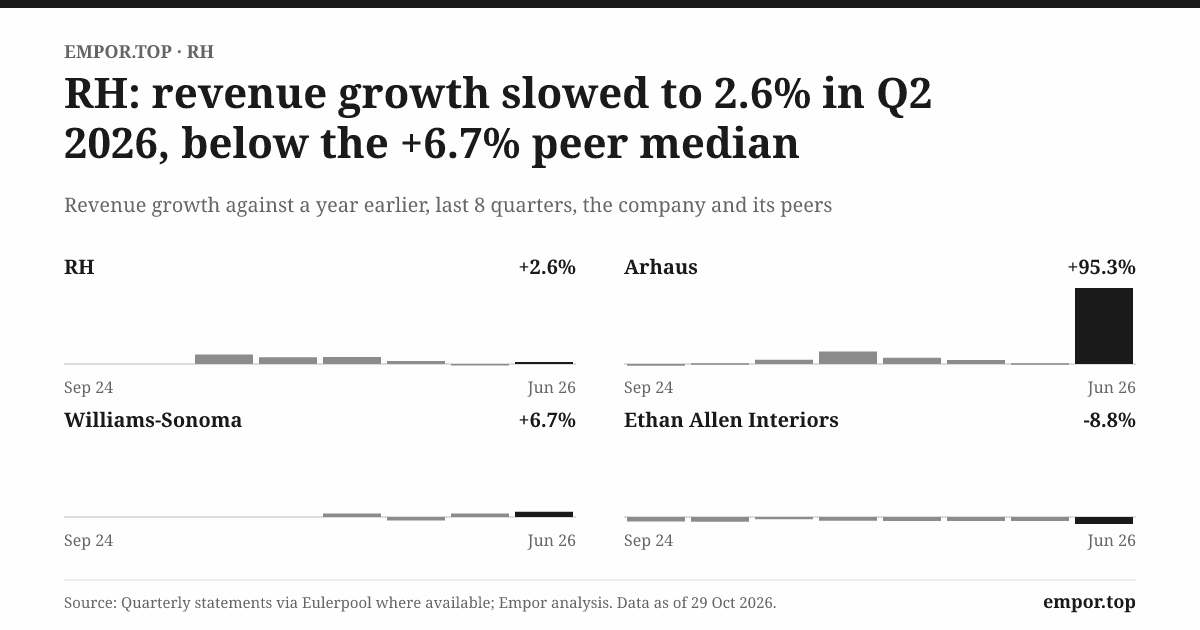
Eight days earlier, the same company had published a very different kind of document. RH's second-quarter shareholder letter, released on September 10, reported revenue of about $922 million for the three months to August 1, up 2.6% from a year before.2 Management noted, accurately, that this beat the top of its own guidance. Then came the margin. Adjusted EBITDA, the measure RH puts at the centre of its results, came to 19.4% of revenue.2 That looked respectable for a company whose shares had been hammered. But six percentage points of that figure came from a single item: about $55 million of refunds on tariffs that the United States government had collected under the International Emergency Economic Powers Act and was now paying back.23 Strip the refunds out, as RH itself did in a line it labelled "normalized", and the margin was 13.4%.2 A year earlier, without any such help, the comparable adjusted figure had been 20.6%.2
Hold those two documents side by side and the shape of the RH story appears. On one side is a showroom on Greenwich Avenue, the latest expression of a strategy that treats the building itself as the product's most persuasive salesperson. On the other is a quarter in which the cleanest measure of profitability was roughly a third lower than a year before, and in which the headline was propped up by money the government had taken away and then given back.
That contrast frames the question this story will try to answer. Can RH turn its gallery-led luxury brand into durable growth and cash, or are its newest results being carried by temporary benefits and delayed orders? There are really three questions folded inside it. The first is whether the experience is a defensible way to win customers, or an expensive bet on real estate and on one man's taste. The second is whether the recovery that management describes can persist once the tariff refunds and the catch-up of delayed orders roll off. The third is the one creditors care about: whether cash can fund the strategy and still deal with roughly $2.4 billion of term loans that fall due on October 20, 2028.43
Before going further, it helps to be precise about what RH is. It is an independent company listed on the New York Stock Exchange, with no parent and no private-equity owner.4 Its economics are overwhelmingly the core RH business, the galleries, Sourcebooks, website, trade and contract sales of furniture and decor. Waterworks, the bath and kitchen brand it bought in 2016, is a smaller separate segment. And the Aspen real-estate projects that sometimes appear in RH's story are mostly held through joint ventures RH does not control, so they are carried as investments rather than consolidated into revenue.4
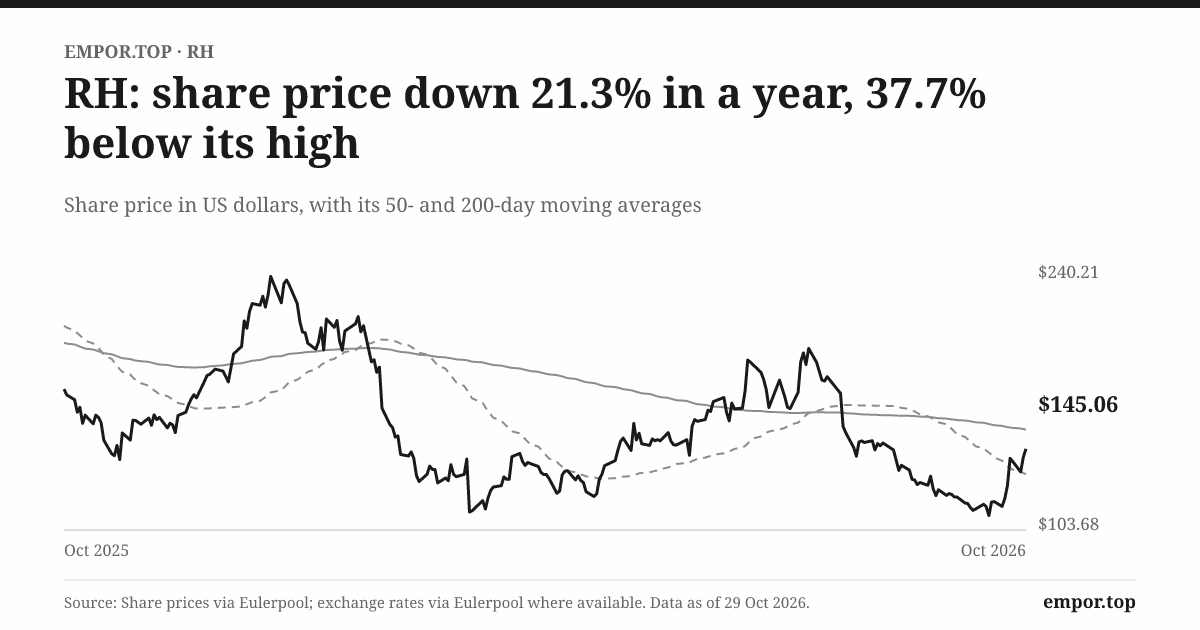
At the end of October 2026, the stock trades around $145, about 38% below its 52-week high, giving the company a market value of about $2.7 billion and an enterprise value, once debt and leases are added, of roughly $6.7 billion. Even after that fall, investors are paying about 22 times trailing earnings. That is not a price for a broken business. It is a price that assumes the gallery in Greenwich, and the ones in Paris, Milan and London before it, will eventually pay for themselves. To understand whether that is likely, the story has to start with the man who designed the rooms.
 Subscribe on LinkedIn
A turnaround built around one person
When Gary Friedman arrived at Restoration Hardware in April 2001, he was walking away from one of the best jobs in American home retail. He had spent 14 years at Williams-Sonoma, finishing as president and chief operating officer and running the Williams-Sonoma, Pottery Barn and West Elm brands; before that he had spent eleven years at the Gap.5 Instead of staying, he took over a business that RH's own proxy statement now describes as "a $350 million mall-based retail business on the verge of bankruptcy."5
Restoration Hardware in 2001 sold quirky hardware, nostalgic gadgets and a modest line of furniture out of mall stores. It had no clear identity and not much money. Friedman's instinct, visible in everything he did afterward, was to go up-market and get bigger: larger furniture, heavier materials, a darker and more architectural aesthetic, and catalogs that grew into books. It was a merchant's turnaround more than a financier's, and it was built on the conviction that taste could be scaled if one person controlled enough of it.
That conviction came with a personal style that the company has never tried to hide. Friedman writes RH's shareholder letters himself, in a voice part manifesto and part sermon. He quotes Helen Keller and talks about turning "a Company into a Cause."6 He says vision "doesn't come from listening to focus groups, or outside consultants."6 Admirers see an artist-merchant in the tradition of the great department-store founders. Critics see a chief executive whose strategy, governance and company identity have become hard to separate from his own judgment.
The record supports both readings, and the turbulent summer of 2012 is where they collided. The company, then privately owned, was preparing to return to the stock market. In August 2012, Friedman stepped down from his executive roles after a board inquiry into his conduct, which was widely reported at the time to concern a personal relationship with an employee.7 He stayed close to the business as chairman emeritus, while Carlos Alberini ran the company as sole chief executive.8 Restoration Hardware completed its initial public offering later in 2012 with Friedman outside the executive suite.5
The separation did not last a year. On July 3, 2013, the company announced that Friedman would return as co-chief executive and chairman of the board, effective immediately, sharing the top job with Alberini.8 Michael Chu, the departing chairman, praised Friedman's "unique vision, creativity and passion."8 The episode matters for governance not because of the details of the inquiry, which the company has never made central to its disclosures, but because of what the reappointment revealed. The board looked at the alternative and concluded that the business it was running was, in practice, Friedman's business.
The same press release contained a second announcement, and in hindsight it is the more telling one. RH said it had acquired exclusive rights to a concept previously called Hierarchy and would develop it as RH Atelier, a luxury line of apparel, accessories, footwear and jewelry, based in New York with its own catalog.8 Friedman said it would "position the Company for continued long term growth."8 RH Atelier never became a commercial line. By the company's 2018 annual report, the formats it listed were Design Galleries, legacy galleries, an RH Modern gallery, Baby & Child galleries, Waterworks showrooms and outlets; there was no apparel store among them.9 The fashion business announced on the day of the founder's return simply disappeared from the story.
That is not a scandal. Plenty of good companies try things that fail. It is, however, a useful piece of evidence about how RH works. The same person who could see that a struggling mall chain could become a luxury interiors brand could also see a luxury fashion house hiding inside it, and the board had no structure that would make those two visions earn their place differently.
Friedman's grip has only tightened since. RH's 2026 proxy shows him owning 24.3% of the company, including options exercisable within 60 days, which makes him by far the largest shareholder; Fidelity's FMR was next at 14.7%, followed by BlackRock at 7.0%.5 His reported pay is almost an afterthought. For three consecutive fiscal years, his summary compensation was about $1.26 million, essentially a $1.25 million salary, with no new stock or option awards in those years.5 His wealth moves with the share price, not with his paycheque. That alignment is real, and it is the strongest argument for trusting his instincts with shareholders' money.
It is not, however, the same thing as accountability. A chief executive who owns roughly a quarter of the company has enormous influence over the board that is meant to oversee him, and the board RH has built reflects that. Six of its nine directors are classified as independent, and one of those six is Carlos Alberini, the former co-chief executive, whom the board considers independent but chose not to place on the committees that must be fully independent.5 The two other non-independent directors besides Friedman include Eri Chaya, president of Waterworks and co-chief creative and merchandising officer, whose reported fiscal 2025 compensation of about $10.8 million dwarfed the chief executive's.5 At the June 2026 annual meeting, say-on-pay passed easily, with roughly 12.4 million votes for and about 0.6 million against.10
So the management test for this story is set. RH is a company where a powerful founder-style chief executive, with a quarter of the equity, decides how much to invest in galleries, new brand extensions and buybacks. That arrangement built something genuinely unusual. The question running through every later chapter is whether the promises it makes about margins, cash, repurchases and returns on new locations line up with what actually happened. The first real test came three years after Friedman's return, when he tried to remake the company's entire relationship with its customers at the same moment he launched a new brand.
A new membership model meets a supply-chain miss
By early 2016 RH had a problem that every premium retailer eventually confronts: it had trained its customers to wait for a sale. Furniture retail in America runs on a calendar of promotions: Presidents' Day, Memorial Day and Labor Day. Shoppers who know the calendar rarely pay full price. For a company trying to become a luxury brand, that habit was corrosive. Discounting cheapened the brand, scrambled demand into lumpy promotional spikes, and made the business harder to run.
So RH did something that sounded either brilliant or reckless. It abolished most of its promotions and replaced them with a paid membership. For a $100 annual fee, customers received a standing discount across the assortment.611 Friedman told analysts in March 2016 that "the vast majority of our revenues are driven by customers who spend more than $500 with RH," and that the fee was "set to maximize conversion."11 The logic was simple. A customer about to spend several thousand dollars on a sofa would gladly pay $100 to save hundreds, and in doing so would tie themselves to RH for a year.
The accounting made the first year painful. The membership fee was recognized month by month over the year, while the discounts hit every sale immediately. RH collected about $30 million of membership fees in fiscal 2016, but about $15.5 million of that was still deferred at year end and would only show up in the next year's results.6 Members also enjoyed a deeper discount than the old promotional cadence had offered. By the end of the year RH had about 300,000 members, and management said early renewal trends were encouraging.6
At the same time, RH was launching RH Modern, a new line of cleaner, more contemporary furniture aimed at urban and younger buyers, which Friedman predicted would "quickly become a billion-dollar brand."6 The launch went badly wrong. The line had been rushed to market, suppliers missed tight deadlines, and some customers waited months for their orders.11 RH spent about $20 million in the first half of the year on customer accommodations and expedited shipping to keep those customers whole, of which about $16 million came straight off revenue.6 Fourth-quarter 2015 results had already missed analysts' estimates on revenue and earnings, with Friedman promising that the inventory and shipping problems would be fixed by the second quarter of 2016.11
Then RH piled two more decisions on top. It marked down inventory aggressively to slash the number of products it carried, so that it could avoid building a new furniture distribution centre planned for 2017. And it pushed the mailing of its main RH Interiors Sourcebook from spring to fall, which moved revenue out of the year.6 Karen Boone, then chief financial officer, later summed up the four "temporal" factors, the RH Modern accommodations, membership accounting, inventory clearance and Sourcebook timing, as costing about 260 basis points of margin.6
The result was a year that RH itself called "disappointing" from a short-term financial perspective.6 Revenue for fiscal 2016 was about $2.14 billion, up only 1%, and almost all of that growth came from buying Waterworks; comparable brand revenues fell 7%.6 Net income collapsed to about $5 million, from about $91 million the year before.9 The operating margin halved to about 4%.
Friedman's framing was defiant. He called 2016 a year of "Transformation and Transition," spoke of a team "that has the courage to march into hell, as we did last year, for a heavenly cause," and declared that RH was building "a brand with no peer" and "a customer experience that cannot be replicated online."6 Rhetoric aside, the next eighteen months showed that some of the bets worked. In fiscal 2017 RH closed furniture fulfilment centres in Los Angeles and Dallas, removing about 1.75 million square feet of space and, by its own estimate, saving more than $20 million a year, and it began bringing home delivery in-house in key markets.9 Inventory days, which had been around 190 to 200 days of cost in the middle of the decade, fell to roughly 120 to 130 days by 2018 and 2019. Operating margin climbed back to about 10% in fiscal 2018 and 14% in fiscal 2019. The membership model survived and became part of how RH sells. That was a real operating achievement, and it should be credited as one.
But the same period also produced counterexamples that matter for the present day. RH Contemporary Art, a gallery-and-art business launched alongside the furniture brand, was folded into the wider RH platform in the fourth quarter of fiscal 2016; RH said it no longer ran it as a separate division and booked restructuring-related costs.9 RH Atelier never reached customers as a business. And RH Modern, the line that was supposed to become a billion-dollar brand, has never been reported as a separate line, so investors have no way to check whether that prediction came true. These were small next to the core business. Their lesson is not that RH's adjacencies always fail. It is that the platform has a record of commercializing some lifestyle categories well, and some not at all, and the difference was rarely visible on launch day.
What survived from 2016 was the strongest idea of the period. If RH could control the product, the catalog, the design service and the physical setting together, it might offer something no website listing a sofa could match. Friedman stated it plainly: RH had "total control of our content from product to presentation."6 That claim is the foundation of the whole investment case. It deserves to be tested against the economics of the industry and the competitors who sell the same sofas.
The gallery is the product
Walk into a modern RH gallery and the first thing that strikes most visitors is that nobody seems to be selling anything. There are courtyards, staircases, chandeliers and terraces. There may be a restaurant on the roof, a wine bar or a coffee bar. The furniture is arranged as if somebody lives there. In its March 2017 presentation, RH set out the ambition explicitly: to "create some of the most inspiring and immersive physical retail experiences in the world" and to introduce "an integrated hospitality experience that activates all of the senses and drives significant traffic to our Galleries."6 At the time the proof point was a single gallery at the Three Arts Club in Chicago, whose food and beverage RH described as successful; it then planned cafés, wine vaults and coffee bars in four of the five galleries it would open that year.6
The plan for 2017 alone named five new galleries: Toronto's Yorkdale, CityPlace in Palm Beach, the Meatpacking District in New York, Green Hills in Nashville and the Northwest historic district of Portland.6 Over the following years, RH's real-estate strategy became one of fewer, larger buildings. In early 2018 it operated 83 galleries, 47 of them older, smaller "legacy" stores; by February 2024 the count was 70 galleries plus 14 Waterworks showrooms.912 The fleet shrank in number while the square footage per location grew, which is the physical expression of a bet that one spectacular destination can do the work of several ordinary shops.
The same 2017 presentation also set a long-range ambition that is worth holding against the record: $4 billion to $5 billion of North American revenue, with mid-teens operating margins.6 The margin half of that promise was met within three years. The revenue half has not been. RH's total revenue, including Europe and Waterworks, peaked at about $3.8 billion in the pandemic year of fiscal 2021 and stood at about $3.4 billion in fiscal 2025.4 Nine years on, the gallery model has proven it can lift profitability; it has not yet proven it can carry the business to the scale its architect described.
The idea is that the room sells the product. A customer who has eaten lunch in a gallery, wandered through ten styled rooms and sat on the sofa, and then been handed to an in-house designer, is far more likely to commission a whole room than one scrolling a website. RH added "Design Ateliers" and many more interior designers to its galleries in 2016, and described the goal as moving "beyond creating and selling products to conceptualizing and selling spaces."6
It helps to be clear about how money actually changes hands. RH earns its revenue overwhelmingly by selling merchandise, and it records each sale when the customer takes control of the product, usually on delivery.4 The galleries, the Sourcebooks, the website, the Trade programme for interior designers, the Contract business for hotels and developers, the outlets and the restaurants are all channels that bring a sale about. Custom orders typically require a 50% deposit, and membership fees are initially held as deferred revenue and recognized month by month over the membership year; deposits and gift cards remain deferred revenue until RH has delivered what it promised.4 RH does not disclose what share of revenue the membership fees represent. Despite the membership, then, this is not a subscription business. It is a transaction business, and its revenue rises and falls with how many affluent households decide to furnish a home in a given year.
The segment figures confirm where the economics sit. In fiscal 2025, the year that ended in January 2026, the RH segment produced about $3.24 billion of revenue and about $370 million of segment adjusted operating income, roughly 94% of the company's revenue and segment profit.13 Waterworks contributed about $198 million of revenue and $22 million of segment profit.13 The real-estate activity is not large enough to be a reportable segment of its own. Whatever is true about RH's competitive advantage is true of the core RH galleries and the business they drive.
Scale gives a first measure of that advantage. RH's revenue of about $3.4 billion makes it one of the largest pure-play premium furniture brands in the United States. But it is not the biggest player in its own neighbourhood. Williams-Sonoma, Friedman's old employer, reported roughly $7.7 billion of revenue in its fiscal year ended February 2, 2025, spread across Pottery Barn, West Elm, Williams-Sonoma and several smaller brands.14 Williams-Sonoma's own 2025 investor presentation put Crate & Barrel at around $2.5 billion of revenue and Arhaus at about $1.3 billion.15 Those are company-reported figures from different fiscal calendars, not market shares, and they cover businesses that range from mid-market to premium. But they make one thing plain. RH is a large, distinctive specialist inside a fragmented industry, with at least one competitor that has more than twice its revenue and a long head start in e-commerce.
Use Michael Porter's five forces to test the gallery model, and the picture becomes more nuanced than either the bulls or the bears tend to admit. Rivalry is intense but fragmented: independent design showrooms, regional high-end furniture stores and boutiques compete alongside national chains and online sellers. RH itself argues that most of its share gains come from those fragmented local players.16 Buyers have abundant alternatives, and nothing in RH's disclosures shows high switching costs; a member who stops paying $100 a year loses a discount, not a system. Suppliers have meaningful leverage where sourcing is concentrated. New entrants can open a furniture shop easily enough, but reproducing a network of multi-storey galleries with restaurants, a library of thick Sourcebooks, an in-house design service and a coherent brand takes years and a great deal of capital. Substitutes, mainly online discovery and cheaper look-alikes, compete for attention rather than replacing the physical product.
That framing points toward a specific kind of moat. RH's advantage is best described as brand, curation and a costly-to-copy physical experience. It is not proven customer lock-in. The company does not publish customer retention, repeat-purchase rates, price realization or its share of the furnishings market, and the membership figures it once shared are no longer a headline metric. The claim that RH has "a brand with no peer," which management has repeated in one form or another since at least 2017, is a claim about taste. It is not, by itself, evidence of economic advantage.6
The supply side shows where that advantage is vulnerable. In fiscal 2025, about 76% of RH's purchases by dollar value came from just 28 vendors, and a single vendor accounted for 14%.4 About 69% of products were sourced from Asia, including about 39% from Vietnam and 13% from China.4 That concentration is the hidden cost of a curated aesthetic. A brand built on a distinctive look tends to rely on a small number of factories capable of producing it at scale. When tariffs arrive, as they did in force in 2025, those factories cannot be swapped out overnight, and the business is exposed in a way that a broad-line retailer with thousands of interchangeable suppliers is not.
Technology is a quieter question. Generative AI design tools and online visualization can help a shopper picture a room, and online marketplaces make it easy to compare prices for similar-looking furniture. Neither replaces a $10,000 sofa or a designer who measures the living room. The more plausible risk is that digital discovery erodes the gallery's role as the first place a customer goes to imagine a room, so that the expensive building has to work harder to earn each visit. RH has not published data on how many of its sales originate in a gallery visit, so that risk cannot be measured from outside.
The standard of proof for the gallery thesis follows. Market-share claims and anecdotes about high-performing locations matter, and RH offers both. But the evidence that would really show whether experience turns into economic advantage is sales and return on invested capital, gallery by gallery, as each location matures. RH does not publish that. Its newest and largest gallery bets, abroad and in Estates, will be judged without it. Before getting there, it is worth looking at the one place RH tried to buy its way into a new room of the house rather than build its way there.
Waterworks stayed small; the real-estate relationships did not disappear
On April 12, 2016, in the middle of the membership upheaval and the RH Modern delays, RH signed an agreement to buy Waterworks, the maker and retailer of high-end bath and kitchen fixtures, for about $117 million in cash, subject to working-capital adjustments.17 The announcement promised that the deal would create "the First Fully Integrated Luxury Home Platform in the World."17 Waterworks' chief executive, Peter Sallick, and its president, Ralph Bennett, agreed to keep continuing equity interests, which RH said would give them added incentive to grow the business.17
The strategic logic was easy to see. Bathrooms and kitchens are the highest-value rooms in a renovation, and RH sold almost nothing for them. Buying a respected trade brand gave RH a foothold with architects and interior designers and filled a gap that a company "selling spaces" could not ignore. Friedman later described the deal as positioning RH as "the only luxury brand addressing every room of the home."6
What happened next is more sobering. Within about eighteen months of closing, RH booked a $33.7 million goodwill impairment on Waterworks in the fourth quarter of fiscal 2017, citing lower expected revenue and EBITDA in its long-range plan, a strategic review and missed revenue and operating-income targets.9 In plain terms, RH wrote down more than a quarter of what it had paid, because the business was not growing as its new owner had expected.
Since then, Waterworks has been steady rather than transformative. Over the three most recent fiscal years, its revenue hovered between about $193 million and $198 million, and its segment adjusted operating income edged down from about $24 million to about $22 million.13 That is a viable, profitable business earning roughly an 11% segment margin. It is also a business that has not grown in three years and remains about 6% of group revenue. The filings do not give an EBITDA figure for Waterworks at the time of purchase, and there is no clean set of comparable transactions to benchmark the price, so nobody outside RH can say with confidence whether it overpaid. What the record does show is an early impairment, a flat revenue line, and a unit too small to change the group's economics. Waterworks narrows the "every room of the home" claim to a smaller version: RH owns a premium bath brand, but it has not turned it into a growth engine.
The more intricate relationships around RH sit in property. Galleries are huge, architecturally ambitious buildings, and RH often develops them through joint arrangements rather than simply signing a lease. Its fiscal 2025 annual report describes a set of "Member LLCs," gallery-related real-estate entities, seven of which RH consolidates, and a separate set of Aspen joint ventures that RH does not control and accounts for under the equity method.4 The development partner in the Member LLCs is affiliated with the managing member of the Aspen ventures.4 RH also carried a finance-lease asset of about $33 million for a gallery leased from a landlord affiliated with that managing member, and small notes receivable from the managing member or its affiliates, about $1.2 million at the end of fiscal 2025, down from $3.7 million a year earlier.4
None of this is quantified as a large share of RH's revenue or costs, and the filings do not describe royalties or management fees. It merits disclosure-level scrutiny rather than alarm: a recurring partner on both sides of several property arrangements is the kind of relationship investors should keep watching, particularly when it touches the capital RH is putting into buildings.
The Aspen ventures matter for another reason, which is cash. RH's equity-method investment in them stood at about $115 million at January 31, 2026.4 In May 2026 the ventures were restructured, and RH received a $50 million distribution, of which about $42 million was treated as a return of the capital RH had contributed.2 RH counted that $42 million in the "cash generation" figure it highlighted for the second quarter.2 That is legitimate cash in RH's bank account. It is not retail revenue, and it cannot recur in the same form once the capital has been returned. Distinguishing between those two kinds of money will matter a great deal later in this story.
Waterworks, in the end, is a contained decision. It cost about $117 million before adjustments; it disappointed early, and it now earns a modest, steady profit. The capital decision that truly reshaped RH's balance sheet was much larger, and it was not an acquisition at all.
The buyback worked until the cycle turned
The irony of RH's most aggressive capital decisions is that they began in the same speech that promised discipline. In March 2017, Friedman declared that 2017 would be "the year of Execution, Architecture, and Cash." He promised "a relentless focus on maximizing cash flow" and said RH would slow its gallery openings to three to five a year to improve returns.6 In the same presentation, the finance team disclosed that the board had authorized a $300 million share repurchase, and that RH had already bought back about 4.9 million shares.6 By the end of fiscal 2017, RH had completed repurchase programmes totalling $1 billion.9
That was an astonishing sum for a company that had just earned about $5 million in a year. The buyback was funded partly with borrowing, and it showed up immediately in the balance sheet: shareholders' equity, about $920 million in January 2017, was slightly negative by January 2018.9 The bet paid off spectacularly, at least for those who held on. RH's operating margin rose from about 4% in fiscal 2016 to about 14% by fiscal 2019, comfortably reaching the "mid-teens operating margins" management had promised in 2017, and the much-reduced share count magnified the effect on earnings per share.6
Then came the pandemic. Locked-down, wealthy households redirected money from travel and restaurants to their homes, and RH was perfectly positioned. Revenue jumped about 32% in fiscal 2021 to roughly $3.8 billion, and the operating margin reached about 24.8%, a level few furniture retailers have ever seen. RH used the moment to raise money. In October 2021 it signed a $2.0 billion term loan maturing in October 2028, and in May 2022 it added another $500 million on the same terms.12 Cash on the balance sheet briefly exceeded $2 billion.
What RH did with that cash is the decisive capital-allocation story of the past decade. In fiscal 2022 the board expanded the repurchase authorization to $2.45 billion.12 RH bought about 3.7 million shares that year at an average of roughly $269, about $1.0 billion in total, and another 3.9 million shares in fiscal 2023 at an average of about $321, roughly $1.3 billion.12 It also repurchased about $237 million of convertible notes and unwound related warrants.12 By March 2024, RH had about 18.3 million shares outstanding, less than half the diluted count of early 2017.126 On a per-share basis, Friedman had shrunk the company to fit his conviction.
The trouble was timing. The demand that had pushed margins to record levels was borrowed from the future. As consumers turned back to travel and mortgage rates rose, home sales collapsed, and big-ticket furniture with them. RH itself pointed to the post-pandemic shift in spending toward travel and leisure, and to higher interest and mortgage rates.12 Revenue fell from about $3.8 billion in fiscal 2021 to about $3.0 billion in fiscal 2023. Operating margin halved, from about 24.8% to about 12%. And the shares RH had repurchased at an average above $300 in fiscal 2023 traded, at the end of October 2026, around $145.
The balance sheet absorbed the consequences. Shareholders' equity turned negative, at about minus $297 million, by the end of fiscal 2023. It recovered to about $61 million at the end of fiscal 2025 and about $120 million by August 2026, but that recovery came from retained earnings, not from paying down what the buybacks had added.3 Debt did not shrink. A widely quoted figure puts RH's "borrowings" at about $4.0 billion, but that includes leases. The cleaner split is roughly $2.4 billion of term loans and other borrowings, plus about $1.56 billion of operating and finance lease liabilities, which are the fixed claims of RH's landlords.4
The refinancing clock is now the central fact of RH's credit story. At August 1, 2026, term-loan principal was about $2.39 billion, split between roughly $1.9 billion at an interest rate of about 6.35% and about $481 million at about 7.0%.2 Those loans float with short-term rates, are secured by substantially all of RH's assets, and mature on October 20, 2028.42 RH's asset-based revolving credit facility, extended in 2025 to July 2030, had been fully repaid by the second quarter.24 The revolver's fixed-charge covenant only bites if availability falls below a threshold, and RH was compliant at January 31, 2026.4 The immediate liquidity position is adequate. The problem is the size of the 2028 maturity relative to the cash the business generates.
A simple worked relationship shows the pressure. In fiscal 2025 RH earned about $387 million of operating profit, and paid about $225 million of net interest.4 Interest, in other words, absorbed nearly 60% of operating profit. That is the price of the buybacks: a large share of every dollar the galleries earn goes to lenders before it can reach shareholders or fund new galleries.
The cash record is more encouraging, but needs careful reading. Over the twelve years from fiscal 2014 to fiscal 2025, RH generated about $3.7 billion of operating cash flow against about $2.4 billion of net profit, a conversion rate of about 155%. Much of that gap reflects genuine non-cash charges such as depreciation and lease costs. But it also reflects working capital swinging back and forth. In fiscal 2024 inventory rose by about $269 million as RH stocked up ahead of tariffs and new collections, and operating cash flow collapsed to about $17 million.4 In fiscal 2025 the reverse happened: inventory fell by about $214 million and customer deposits rose by about $41 million, helping operating cash flow jump to about $452 million and free cash flow to about $252 million.4 Inventory can release cash once. It cannot do so every year.
The buybacks, then, did what they were designed to do. They concentrated ownership and magnified per-share earnings in the good years. But measured against the later earnings and cash profile, they were aggressive. They were made near the top of a cycle, at prices far above where the stock now trades, and they left RH with a decade-long overhang of debt and a maturity wall that arrives in two years. The record argues for a stricter test before any return to large repurchases: free cash flow after gallery investment and after meaningful debt reduction. With $201 million still authorized at the end of fiscal 2025, the option remains open.4 Moody's, which downgraded RH in April 2025, warned that further buybacks would weigh on the rating.18
That leaves an operating question that links the balance sheet to the strategy. If RH is spending heavily on galleries and international openings now, how soon can those locations produce enough cash to reduce refinancing pressure? The answer starts with the current recovery, and with how much of it is real.
A forecast gets a second life from refunds and delayed orders
On the evening of April 2, 2025, RH was reporting its fourth-quarter results when the White House announced sweeping new tariffs. As the call went on, RH's share price fell sharply after hours, and Friedman was caught on the call reacting to the decline in real time.19 It was a vivid moment, and an accurate one. For a company that sources most of its products in Asia, tariffs went straight to the cost of goods. The next eighteen months would be spent trying to explain how much of RH's performance was demand, and how much was the tariff weather.
The early news was good. In the first quarter of fiscal 2025 revenue rose 12% to about $814 million, and RH said it would cut China's share of its receipts from 16% in that quarter to about 2% by the fourth quarter, with vendors absorbing a meaningful part of the cost and more upholstery production moving to its factory in North Carolina.20 Friedman said RH had delivered despite "the polarizing impact of tariff uncertainty and the worst housing market in almost 50 years."20 Management guided to revenue growth of 10% to 13% for the year and an adjusted EBITDA margin of 20% to 21%.20
That forecast eroded quarter by quarter. By December 2025, after the third quarter, RH's full-year outlook had become revenue growth of 9.0% to 9.2% and an adjusted EBITDA margin of 17.6% to 18.0%.16 Third-quarter adjusted operating margin came in at 11.6%, below the 12.5% guidance midpoint; RH blamed higher-than-forecast tariff costs on older special and back orders delivered in the quarter, and higher expenses tied to opening its Paris gallery.16 Those were specific explanations, which is to RH's credit. But the year closed weaker still. Fourth-quarter revenue grew under 4%, against guidance of 7% to 8%, and fiscal 2025 revenue growth landed at about 8.1%, below even the lowered December range.164 Across ten months, the revenue forecast moved down from a midpoint above 11% to an outcome around 8%, and the margin forecast moved down by roughly three points.
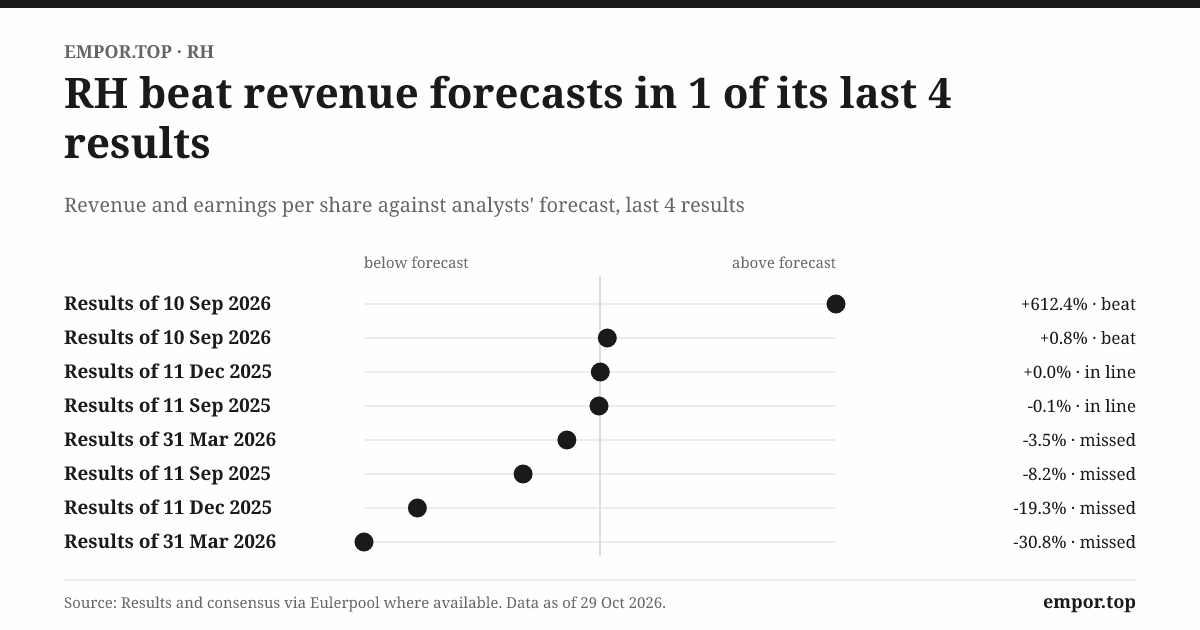
Friedman's tone during this stretch was combative. In the third-quarter letter, after acknowledging the margin miss, he wrote that RH found it "fascinating that the market chooses to reward companies that set remarkably low expectations."16 There is a real argument buried in that line: ambitious guidance is a choice, and some investors prefer it. But an investor assessing credibility has to note what actually happened. Over 2025, RH set high expectations and then missed them. Management's explanations were concrete, but the pattern was overpromising.
Fiscal 2026 began badly. First-quarter revenue fell about 1.7% to roughly $800 million, and adjusted EBITDA margin dropped to about 7%, from about 13% a year before.21 RH reported a net loss of about $14 million, even with a favorable credit-card interchange settlement of about $32 million.213 Management's explanation was that tariffs had forced it to resource many products, and that backorders and special orders were about $75 million higher than a year earlier as a result, costing roughly $45 million of first-quarter revenue.21 In other words, customers had ordered, but RH could not yet deliver.
That explanation underpins the whole fiscal 2026 forecast. In June, RH told investors that second-half growth would reach about 12% from a roughly flat first half, and broke that bridge into three pieces: about 4.5 points from reducing the backlog, about 2.5 points from new stores, and about 5 points from new concepts, mainly RH Estates.21 In September, after the second quarter, it gave a sharper version. Third-quarter revenue would grow 5% to 6%, with 2.5 points from backlog reduction and 2 points from Estates. Fourth-quarter revenue would grow about 16% to 21%, with 6.5 points from backlog and 8 points from Estates.2
Read that fourth-quarter bridge carefully, because it reveals how much of RH's expected growth is something other than ordinary current demand. At the midpoint of the range, roughly 18.5% growth, backlog conversion and RH Estates together account for about 14.5 points. Backlog conversion is real revenue, but it is revenue from orders already taken; it shifts sales from one period to another rather than adding new customers. Estates is genuinely new, but it is a launch, and launch revenue includes the stocking of galleries and the first wave of orders from a mailing. Neither is clean evidence of a broad recovery in the core business.
The margin bridge needs the same treatment. In the second quarter, about $55 million of tariff refunds reduced cost of goods sold, adding about six points to adjusted EBITDA margin.2 Another roughly $14 million of the refunds reduced the cost of inventory still on hand and would flow through earnings in the third and fourth quarters.2 RH also said it planned to use about $50 million of the refund money to offset unplanned cost increases from a sustained oil-price spike linked to conflict in the Middle East, leaving about $19 million that would actually benefit full-year earnings.2 That nuance is important and somewhat counterintuitive. The refunds inflated the second quarter's margin, but over the year, most of them are expected to be consumed by higher costs elsewhere. A reader who looks only at the 19.4% headline would misjudge both the quarter and the year.
Underneath both the refunds and the backlog lies the most revealing comparison in the second-quarter letter. Selling, general and administrative expenses rose to about 36.5% of revenue, from about 31.2% a year earlier.2 That five-point jump in overhead is the cost of the international galleries, the Estates launch and the pre-opening expenses that come with both. It explains why the normalized margin, at 13.4%, was so far below the prior year's 20.6%.2 The gross margin was holding up; the company's cost base was growing faster than its sales.
RH's full-year outlook after the second quarter was revenue growth of 5.5% to 7.0% and an adjusted EBITDA margin of 15.0% to 16.2%, including about 340 basis points of drag from international pre-opening and start-up costs.2 Compared with June, the revenue range narrowed and the margin range rose slightly, helped by the $19 million tariff benefit. But the international drag in that guidance had widened, from about 270 basis points in June to about 340.212 The investments, in other words, were costing more than management had expected three months earlier.
There is one more clue in the second-quarter balance sheet, and it cuts in RH's favour. Deferred revenue and customer deposits, the money customers had paid for orders not yet delivered, rose to about $402 million at August 1, 2026, from about $339 million at the end of January, while inventory fell from about $819 million to about $773 million.2 Rising deposits mean customers are committing money ahead of delivery, which supports management's claim that the backlog is real demand rather than wishful accounting. Falling inventory means RH is not building stock to manufacture a recovery. Neither figure proves that the core business is growing, but both are consistent with orders that exist and will be delivered.
The strong case deserves its place. RH's revenue grew about 8% in fiscal 2025 in what Friedman called the worst housing market in nearly half a century, and the company claimed, in its third-quarter letter, to be gaining share from independent showrooms, regional high-end stores and national brands alike.16 Second-quarter revenue beat guidance and accelerated from the first quarter.2 If those claims hold, a business that grows during a housing slump should grow faster when the slump ends.
But claims of share gains need proof that RH does not fully provide, and the recent pattern is that headline figures have needed adjustment. The improvement from the weak base of fiscal 2023 is real. The evidence for a clean, self-sustaining rebound is not yet in. What would settle it is several quarters of revenue growth and margins after the tariff refunds, the backlog catch-up and the inventory effects have all passed through the numbers. Until then, the most expensive part of the strategy, the global flagships and Estates, is being built on a recovery that is still partly borrowed from timing.
Three global flagships, one very large promise
RH Paris opened in September 2025. Milan followed. And on June 27, 2026, RH London, "The Gallery in Mayfair," opened at 7 Burlington Gardens, in the heart of Mayfair's art and luxury district.2 Three global flagships, in three of Europe's major design capitals, all opened within ten months.2 Friedman called London "the amplifier of brand recognition across Europe and the Middle East."2 For a company that only nine years earlier had said it would explore global opportunities "once we've perfected our platform in North America," it was a sweeping statement of ambition.6
The strategy RH pursues now is the gallery model at its most expansive. Each flagship combines a vast showroom, an in-house design studio, hospitality, and the full range of Sourcebooks, with RH increasingly describing its goal as selling spaces and even entire homes rather than furniture. RH Estates sits on top of that. Launched with a 268-page Sourcebook mailed from late June to mid-July 2026, it gathers RH's most expensive work, bespoke furniture, couture upholstery made to custom sizes with the customer's own fabric, and an exclusive programme for architects and designers.221 The company says Estates products carry an average price about 45% above RH's existing assortment, and management says the line has the potential to double the brand's total addressable market.2
Both bets are material, for different reasons. Estates is material to the near-term outlook because management attributes about 8 percentage points of expected fourth-quarter growth to it.2 If Estates disappoints, so does the forecast. The international galleries are material because of their cost and the role management assigns them in RH's future.
That cost is substantial. In fiscal 2025, RH's capital expenditure was about $200 million, roughly 6% of revenue.4 But RH also funds landlord-owned buildings under construction, so its own "adjusted" capital expenditure, which includes those assets net of tenant allowances, was about $289 million, more than 8% of revenue.4 For 2026, RH expects adjusted capital spending of about $240 million to $260 million.2 On top of that, the international expansion is weighing directly on profit: the 340-basis-point drag on 2026 adjusted EBITDA margin translates, on about $3.6 billion of expected revenue, into well over $100 million of pre-opening and start-up costs.2 Management expects that drag to fall from about 450 basis points in the first half of 2026 to about 250 in the second half, and from about 340 basis points for the full year to about 150 in 2027.2
The workforce tells the same story from a different angle. RH had about 7,230 team members at the end of January 2026, up from about 6,340 a year earlier, an increase of about 14%, while revenue grew about 8%.4 Headcount growing faster than sales is normal when a company is opening large new buildings and launching a new brand. It is also exactly the pattern that has to reverse if the investments are to pay.
What evidence is there that they will? RH offers some. Within eight weeks of opening, London's design pipeline, the value of design projects under discussion with clients, reached almost $7 million, which management said rivalled its strongest American galleries in Newport Beach and New York.2 That is an encouraging signal of interest. It is not revenue, and it is certainly not profit. RH does not publish separate sales or margins for Paris, Milan or London, nor gallery-level returns for any location.2
RH's earlier experiments had mixed results, while hospitality and the large design galleries themselves clearly took root. The lesson is not that the international galleries will fail. It is that an opening, a pipeline figure or a glowing review is evidence of a launch, not of a business. The record narrows the claim: RH has proven it can build spectacular rooms and attract attention, but it has not yet shown that the European flagships or Estates will earn returns that justify their cost.
There is also a funding link to watch. RH guided in September to a 2026 total of $300 million to $400 million for "free cash flow, asset sales and equity method distributions."2 That single range blends three very different kinds of money. Free cash flow comes from running the business. Asset sales come from selling property, sometimes the very galleries RH has built. Equity-method distributions include items such as the $42 million return of capital from the Aspen restructuring.2 Only the first is recurring. A company can fund an expansion phase with property proceeds, and many retailers have done so. But property proceeds are not the same thing as store-level returns, and they cannot be repeated indefinitely.
The watch items for this chapter are therefore concrete. Revenue per mature gallery, if RH ever discloses it. International sales and margin once the pre-opening costs roll off, which management says should happen substantially in 2027. And normalized free cash flow after capital spending, excluding refunds, settlements and property sales. If those numbers improve together, the flagships will have proven the vision. If they do not, the vision will have been financed by the balance sheet. That trade-off is what the market price of RH now has to weigh.
Analysis & Bear vs. Bull Case
Consider RH's share price as a verdict delivered in real time. At about $145 at the end of October 2026, the stock sits roughly 38% below its 52-week high of about $233 and not far above its 52-week low of about $111. Over the past five years, it has fallen as much as 73% from peak to trough, and its one-year volatility was above 60%. Those are the trading statistics of a company the market has not made up its mind about.
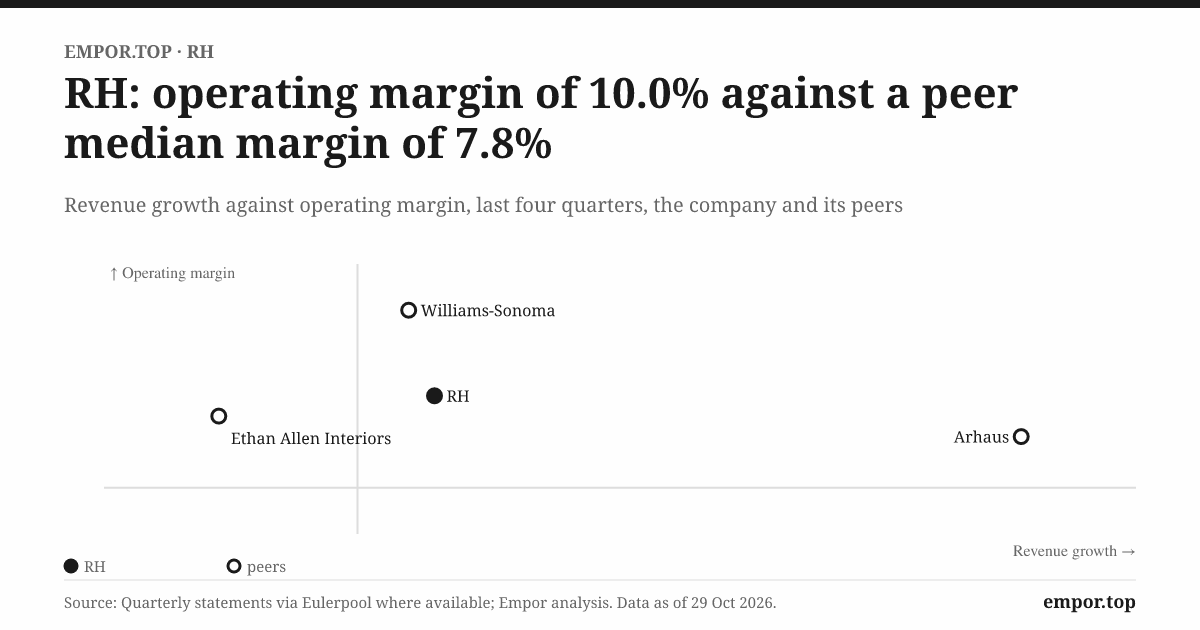
And yet, at that price, RH is not cheap on conventional measures. It trades at about 22 times trailing earnings, 12.4 times enterprise value to EBITDA, and about two times enterprise value to sales. Return on invested capital, at about 7.3% in fiscal 2025, was roughly in line with or below the cost of the money RH borrows. Operating margin was about 11.3%, less than half its pandemic peak. The free-cash-flow yield, at about 8.7%, looks attractive, but it rests on a year in which inventory released more than $200 million. On EV-to-EBITDA, RH traded in early October around 12.5 times, below its own ten-year median of about 15.3 times, while Williams-Sonoma traded around 15.4 times, well above its own ten-year median of about 9.4 times.2223 In other words, the market has re-rated Williams-Sonoma upward and RH downward over the past decade. That is a judgement on predictability as much as on growth.
What does that price appear to assume? Roughly, that RH's margins will recover a good part of the distance toward their pre-pandemic level of the mid-teens, and that the new galleries will begin to contribute rather than drain. The multiple leaves little room for the international expansion or Estates to disappoint.
The bull case is best made in RH's own economics. RH has a differentiated aesthetic and a brand that commands premium prices. Its galleries combine product, design services and hospitality in a way that online-only retailers cannot replicate. Its management has delivered on ambitious margin targets before.6 Its long record of positive operating cash also supports the case. If the housing market turns, if tariffs settle, and if the backlog and Estates contribute as forecast, operating leverage could lift margins quickly, with each extra dollar of revenue landing on a heavy fixed-cost base already paid for.
The bear case is more concrete about the near term. Over the three years to January 2026, revenue shrank by about 1.4% a year and net profit by about 38% a year. Return on invested capital, at about 7%, is modest for a business with a premium brand. Interest remains a substantial claim on operating profit. Recent cash flow benefited from a large inventory release, and the second quarter's margin included tariff refunds. The strategy now depends on a set of new investments whose economics are undisclosed and which are financed partly by property and investment sales, ahead of a refinancing that cannot be deferred past October 2028.
Hamilton Helmer's seven powers offer a cleaner way to judge where the moat really sits. Branding is RH's clearest power: customers pay more for an RH sofa than for a functionally similar one because of what the name signals, and that premium has survived a decade of up-and-down cycles. Cornered resource is arguably present in a softer form, through the gallery locations and the in-house creative team, but RH's dependence on a handful of external vendors weakens it. Scale economies exist, through Sourcebook printing and distribution, but Williams-Sonoma operates at twice RH's revenue and enjoys at least as many. Switching costs and network effects are essentially absent. Counter-positioning was once strong, when RH abandoned promotions while competitors kept discounting, but that move has been visible for a decade and is no longer novel. Process power exists in the integrated design and delivery system RH built after 2016, though it is hard to verify from outside. On balance, RH has one strong power, brand, plus a costly-to-copy physical presence. That is a meaningful moat, but a narrower and more cyclical one than "a brand with no peer" implies.
Porter's forces reinforce the point: RH faces intense rivalry and abundant alternatives, while its concentrated supply base creates vulnerability.4
The principal risks work through specific mechanisms. Housing turnover and mortgage rates drive big-ticket furniture demand, because people furnish homes when they move into them; a slow housing market therefore suppresses RH's sales regardless of brand strength. Tariffs and sourcing shifts squeeze margins and, as 2025 and 2026 showed, can delay deliveries and push revenue into later quarters. The gallery expansion raises fixed costs, which magnifies both upside and downside. Floating-rate debt and the 2028 maturity raise the consequence of a slow recovery: if refinancing has to happen in a weak market, the terms could be considerably harsher.
The credit view should be read in its date context. Moody's downgrade and warning about further buybacks remain relevant.18 Since then, RH has extended its revolving credit facility to 2030, recovered its operating cash flow, and reduced net debt to about 4.3 times trailing adjusted EBITDA by its own measure in the first quarter of fiscal 2026.421 Those improvements help. None of them removes the 2028 term-loan maturity.
An activist looking at RH would likely press on four points. First, disclosure: a company asking investors to fund three European flagships and a new luxury brand should publish gallery-level sales and returns, at least for mature locations. Second, capital allocation: with $201 million of buyback authority remaining and a maturity wall approaching, the board should state plainly that free cash flow will go to debt reduction first.4 Third, governance: the board should demonstrate independent oversight of the capital plan.5 Fourth, the property relationships deserve fuller disclosure.4
Three measures would change the view in either direction. The first is revenue growth excluding the backlog conversion and new-gallery and Estates contributions, which RH itself quantifies in its guidance; in the third quarter, the three contributors management named, backlog, Estates and new galleries, added up to essentially all of the 5% to 6% guided growth, implying an existing business that was roughly flat, and that is the reading to watch.2 The second is operating margin excluding refunds, settlements and one-off items, which fell sharply in the second quarter.2 The third is free cash flow after capital spending, alongside net debt and any buybacks; fiscal 2025's free cash flow was flattered by inventory release, and net debt was about $2.26 billion at August 1, 2026.24
Credibility, finally, can be judged by comparing promises with outcomes. In 2017, management delivered on its mid-teens margin target, though its cash-discipline promise sat alongside $1 billion in buybacks. In 2025, management guided to revenue growth of 10% to 13% and delivered about 8%.204 Its explanations of misses have been specific, naming tariffs on older orders and Paris opening costs, which is better than vagueness. But its forecasts have repeatedly needed revision, and the numbers that would most directly prove the gallery thesis remain unpublished. The bull case is credible. The bear case is better documented.
Playbook: Business & Investing Lessons
Go back to March 28, 2017. Friedman stood before investors after the worst year of his tenure and promised "the year of Execution, Architecture, and Cash," a slower pace of three to five gallery openings a year, and a business that would "internally fund our growth."6 Some of that promise came true. RH built a better supply chain, its margins reached the mid-teens, and its galleries became among the most admired retail spaces in America. Some of it did not: within the year RH had spent $1 billion on its own shares, and five years later it spent another $2.3 billion more at prices well above where they trade today. Both halves of that record carry lessons.
The first lesson is that a room can be an advertisement, but it still has to sell. RH's galleries are extraordinary marketing, and the core RH segment, with about $3.2 billion of revenue and $370 million of profit, shows that the format can make money at scale.13 But the gallery is a fixed cost that has to be paid every month, through rain, recession and housing slumps. The question for any company that turns its stores into destinations is not whether people visit. It is whether each new space reaches the productivity of the ones before it. RH has never published that answer, and a brand that sells experience should be the first to want to prove it pays.
The second lesson is that a great brand does not make every adjacent category a great business. RH Atelier, announced on the day of Friedman's return, never sold a shirt. RH Contemporary Art lasted a short while before being folded back in. Waterworks was impaired within two years of purchase.9 Each of these was launched with the same confidence that now surrounds RH Estates and the European flagships. Founders often believe that the brand is the product; customers usually buy the product first and the brand second. The lesson for investors is to judge each extension on its own unit economics, and to discount the conviction with which it is announced.
The third lesson is that cash released from inventory is a bridge, not a business model. RH's fiscal 2025 cash recovery, with operating cash flow rising from almost nothing to about $452 million, owed a great deal to running down inventory that had been built up the year before.4 That cash was real and valuable, and it was used sensibly to reduce borrowing. But a company that relies on working-capital swings and property distributions to fund its growth is borrowing from its own future. The test of a cash engine is the cash it produces when inventory is flat.
The fourth lesson is that a buyback is only disciplined when the balance sheet can survive the next season. RH's repurchases at an average above $300 a share in fiscal 2023 looked bold then and look expensive now, with the shares near $145.12 They turned shareholders' equity negative and left a $2.4 billion maturity in October 2028. The wider lesson for any cyclical business is simple. Buy back stock with the money left after the downturn, not the money made at the peak.
Running through all four is the man at the centre. Friedman's conviction built RH's differentiated format; the same conviction underwrote the adjacencies, the buybacks and the global expansion that now need financial proof. The lesson for investors is not to bet against founders with vision. It is to measure the whole system, brand, inventory, property, debt and cash, rather than admire the showroom alone.
Epilogue
Tonight, on October 29, 2026, RH stands at the point where its biggest bets begin to be counted. Paris, Milan and London are open. The Greenwich gallery is open. The Estates Sourcebook has been in customers' hands for three months. The third quarter of fiscal 2026 closes around the end of October, and RH's next shareholder letter, due in December, will show whether management's forecast for 5% to 6% revenue growth and a 12.5% to 13.5% adjusted EBITDA margin held up.2
The decisive evidence is close enough to measure, and it will arrive in a particular order. The first moment is that December letter. If revenue growth lands in range and RH shows that the backlog and Estates contributed roughly as forecast, the second-half bridge becomes more credible. If revenue misses again, the market will read it as confirmation that underlying demand remains weak once timing effects are removed. The second moment is the fourth quarter, the one in which management expects growth of 16% to 21% and an adjusted EBITDA margin of roughly 20% to 23%.2 That is the most ambitious forecast RH has made in years. Meeting it would show that Estates can carry real weight. Missing it widely would raise hard questions about how the international and Estates programmes are being judged internally.
The third moment is 2027 itself. Management has said the international drag on margin should fall from about 340 basis points to about 150, adjusted capital spending should fall to about $175 million to $200 million, and gallery opening costs should drop from about $48 million to about $18 million.2 If those things happen, RH's free cash flow should rise meaningfully without help from inventory or property sales. That is the year in which the gallery strategy has to start paying for itself, and the year in which RH will have to show lenders a credible plan for the term loans due in October 2028.
Investors should watch underlying growth, the international margin drag and gallery economics, alongside free cash flow after capital spending and investment distributions, and any return to share repurchases as refinancing approaches. Several relevant measures remain undisclosed, including gallery-level returns, customer retention and the share of revenue that comes from recurring membership fees.
The tension that remains is the one that has defined RH for twenty-five years. It is a company built on the belief that one person's vision can create value others cannot see. Sometimes that belief has been spectacularly right. Sometimes it has been expensively wrong. The next eighteen months will show which kind of bet the global galleries turn out to be.
Outro
Picture Greenwich Avenue again: the new gallery on one of the most expensive shopping streets in America, a home-furnishings store staged as a destination, designed to make a visitor forget that everything inside has a price tag. It is a remarkable achievement of taste and ambition, and few retailers anywhere would have dared to build it.
But somewhere behind the chandeliers sits a far more ordinary machine: a supply chain concentrated among a few dozen vendors, with most products sourced in Asia, a delivery fleet, a pile of inventory, a stack of leases and a $2.4 billion loan due in two years. RH has made the showroom itself part of the brand, which is what makes it unlike any other retailer in this story. The unresolved question is whether that showroom can become a repeatable return, or whether it will remain, as it has been at its best and its worst, a beautiful room that one man believed in before anyone else did.
References
-
RH Unveils RH Estates, The Gallery on Greenwich Avenue — RH, 2026-09-18 ↩↩↩
-
Second Quarter Fiscal 2026 Shareholder Letter — RH, 2026-09-10 ↩↩↩↩↩↩↩↩↩↩↩↩↩↩↩↩↩↩↩↩↩↩↩↩↩↩↩↩↩↩↩↩↩↩↩↩↩↩↩
-
RH Second Quarter Fiscal 2026 Form 10-Q — SEC, 2026-09-10 ↩↩↩↩
-
RH Fiscal 2025 Form 10-K — SEC, 2026-03-31 ↩↩↩↩↩↩↩↩↩↩↩↩↩↩↩↩↩↩↩↩↩↩↩↩↩↩↩↩↩↩↩
-
RH Fourth Quarter and Fiscal 2016 Earnings Presentation Transcript — RH, 2017-03-28 ↩↩↩↩↩↩↩↩↩↩↩↩↩↩↩↩↩↩↩↩↩↩↩↩↩↩↩
-
Restoration Hardware Chief Resigns After Inquiry — Los Angeles Times, 2012-08-17 ↩
-
Gary Friedman Reappointed Co-CEO and Chairman; RH Atelier Announcement — RH / SEC, 2013-07-03 ↩↩↩↩↩
-
Restoration Hardware Stumbles on Inventory Snafus, Tighter Pursestrings — Retail Dive, 2016-03-30 ↩↩↩↩
-
RH Fiscal 2025 Form 10-K, Segment Information — SEC, 2026-03-31 ↩↩↩↩
-
Williams-Sonoma Investor Presentation — Williams-Sonoma, 2025-03-19 ↩
-
Third Quarter Fiscal 2025 Shareholder Letter — RH / SEC, 2025-12-11 ↩↩↩↩↩↩
-
Moody's Downgrades RH's Credit Rating — Investing.com, 2025-04-22 ↩↩
-
"Oh sh—": RH CEO Reacts Live to Stock Tanking on Tariffs, Poor Earnings — Associated Press, 2025-04-04 ↩
-
RH's Sales Soar Despite Tariff Impact, Slow Housing Market — Inside Retail US, 2025-06-13 ↩↩↩↩
-
First Quarter Fiscal 2026 Shareholder Letter — RH / SEC, 2026-06-11 ↩↩↩↩↩↩↩
-
Williams-Sonoma EV-to-EBITDA Valuation History — GuruFocus ↩
 LinkedIn
 WhatsApp
 Reddit
 Hacker News
 Email
 Kindle
 RSS Feed
 Spotify
 Apple Podcasts
 Amazon Music
 Audible
 YouTube