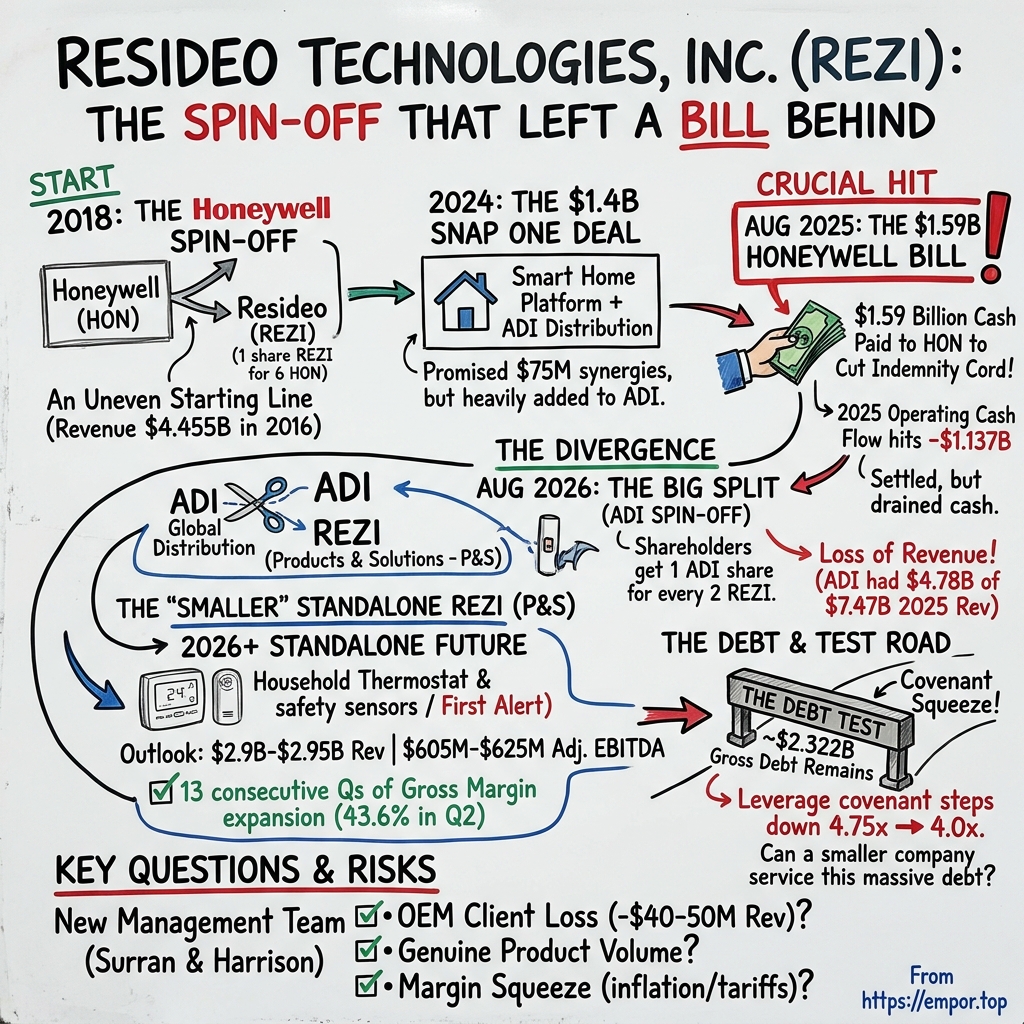
Resideo Technologies, Inc.: The Spin-Off That Left a Bill Behind
I. The Company That Spun Off Its Own Future
On August 3, 2026, a Resideo shareholder who owned two shares went to bed holding one company and woke up holding two. Overnight, one share of ADI Global Distribution had appeared in the account for every two Resideo shares, and ADI had begun trading on the New York Stock Exchange under its own ticker, ADIG.1 For anyone who had followed the company since its birth, the moment had a strange symmetry. Resideo itself had arrived in brokerage accounts in exactly this way, eight years earlier, as a gift from Honeywell to Honeywell's shareholders. Now the child was doing to itself what the parent had done to it.
There was a second symmetry, less elegant. The year before it handed ADI to its own shareholders, Resideo had written Honeywell a cheque for $1.59 billion.2 It was not a purchase. Nothing new arrived in return. The payment ended an agreement, signed at the 2018 separation, under which Resideo had spent years reimbursing its former parent for old environmental liabilities. So the company that left Honeywell carrying a bill paid that bill off in one enormous lump, and then, months later, gave away the larger of its two businesses.
That sequence frames the question this story is trying to answer. Was Resideo separating two businesses that each had more room to grow apart than together? Or was it making a smaller company carry a heavier financial test? Both readings are possible, and the evidence for deciding between them is only beginning to arrive.
Start with what the company is not. Resideo has not been a Honeywell subsidiary since October 29, 2018, when it began trading after Honeywell distributed one Resideo share for every six Honeywell shares.3 Honeywell still matters, because it licenses the brand on the front of many Resideo thermostats, but it does not own the company or control its board. This is an independent public company with an unusually tangled family tree.
Now consider what the company used to be. In 2025, Resideo reported $7.472 billion of revenue, and $4.784 billion of it came from ADI, the distribution business that just left.2 In other words, roughly two out of every three dollars that flowed through the old income statement belonged to a business that is no longer part of the company. On profit the picture was less lopsided, because distribution is a thinner-margin activity than making products: ADI produced $212 million of the $767 million in segment operating income.2 That is still more than a quarter of the operating earnings now walking out the door with the shares.
Every historical number in this story therefore carries an invisible asterisk. The 2025 annual report and even the second-quarter 2026 results still include ADI. Those figures describe a company that no longer exists in that form. What remains is the business Resideo calls Products & Solutions, or P&S: the maker of thermostats, sensors, smoke and carbon-monoxide alarms, security panels and water-leak detectors. When management laid out its first standalone outlook in August 2026, it guided to $2.9 billion to $2.95 billion of revenue for 2026 and $605 million to $625 million of adjusted EBITDA.4 That is the denominator against which the remaining debt, the remaining obligations and the remaining ambitions will now be measured.
Four questions will steer everything that follows. The first is whether P&S can grow and protect its margins without a distribution arm beside it. The second is whether a company of this smaller size can service its debt as the leverage limits in its credit agreement tighten. The third is how much of its growth comes from people actually buying more of its products, as opposed to acquisitions and price increases. And the fourth is whether the links that remain to Honeywell and ADI are now manageable rather than burdensome.
None of those questions can be answered from a press release about a spin-off. A separation gives a business a clearer identity, but it does not by itself make the business more valuable. To understand what the new Resideo inherited, and what it now has to prove, it helps to go back to the long revenue chart that the old company liked to show, and to notice how uneven its starting line really was.
 Subscribe on LinkedIn
II. Ten Years of Growth, One Very Uneven Starting Line
Picture the chart. A line climbs from $4.455 billion of revenue in 2016 to $7.472 billion in 2025, a gain of roughly two-thirds in a decade, with only one modest dip along the way.52 It is the kind of chart that fits neatly on an investor-day slide. It is also, on closer inspection, a picture of several different companies stitched together.
The first number on that chart does not belong to a public company at all. In 2016 and 2017, the businesses that became Resideo were still divisions inside Honeywell, and their results were carved out after the fact into combined financial statements for the spin-off.5 Those carve-out statements are useful history, but they are not a record of a management team running an independent company with its own cost structure, its own balance sheet and its own capital allocation. Corporate overheads were allocated rather than incurred, and the businesses had no debt of their own. The like-for-like public-company record only really begins in 2019, the first full year after the distribution.
From there the line climbed through the pandemic housing boom. Revenue rose from about $5.0 billion in 2019 to about $6.4 billion in 2022, dipped slightly in 2023 and then jumped again.672 The surge of 2021, when people stuck at home poured money into their houses, is visible as a step change. So is the 2024 acquisition of Snap One, discussed later. A decade of growth, then, but a decade that mixes a housing cycle, a pandemic and a sizeable acquisition. That is not the same thing as a clean organic growth record.
If revenue is a patchwork, reported net income is worse as a guide. In 2017, the business posted a $394 million loss; in 2018, a $405 million profit.5 Neither swing had much to do with how many thermostats were sold. Both years were heavily affected by the 2017 US tax reform and the accounting that followed it. Then in 2025, Resideo reported a $527 million net loss.2 Again, the cause was not the operating business. It was the indemnity termination, an expense that hit the income statement in a single year. Anyone who took the bottom line at face value across this decade would have concluded that the company swung wildly between disaster and prosperity. The truth is duller and more useful: the operating business moved gradually while legal and tax events whipsawed the reported profit.
The most recent year deserves a closer look, because it is the one most likely to be used as a base rate. Revenue grew 10.5% in 2025, well above the company's recent pace. But when Resideo broke the $711 million increase into its parts, the bulk came from places other than new demand.2 About $446 million, almost two-thirds of the gain, came from Snap One, which had only been owned for half of the prior year. Another $193 million came from price and mix, meaning customers paid more or bought richer products. Currency added $32 million. Volume, the simple measure of whether more units were sold, contributed only $47 million.2 Strip out the acquisition and the price increases, and underlying unit growth was closer to one percent than ten.
That is not a damning finding. Price increases that stick are a kind of evidence too, and acquisitions can be good uses of capital. But it means the headline growth rate of 2025 is not a clean signal of how much the world wants Resideo's products. It is mostly a signal of what Resideo bought and what it charged.
Inside the consolidated numbers, the two businesses were moving in opposite directions. P&S operating income rose from $446 million in 2023 to $555 million in 2025, a gain of about a quarter in two years, while ADI's operating income slipped from $238 million to $212 million even as Snap One made it much bigger.2 One business was getting more profitable on a roughly stable revenue base. The other was getting larger but less profitable.
The 2024 numbers show how P&S did it. That year its revenue actually fell 4%, to about $2.56 billion, largely because of a divestiture, and was only slightly positive once that and currency were stripped out.8 Yet its gross margin jumped 240 basis points to 41.0%, and its adjusted EBITDA margin climbed from 21.0% to 23.8%.8 In other words, the profit gains of the P&S business came first from making each sale more profitable, not from selling much more. Cost discipline, pricing and a richer mix did the work while unit demand idled. That is a respectable achievement, but it is also the kind of improvement that eventually runs out of room unless volume follows. Viewed that way, the logic of the separation becomes easier to see: the product business had been improving quietly inside a consolidated story dominated by distribution.
So the relevant starting point for the new Resideo is not the decade-long chart. It is the 2023 to 2025 record of P&S, a business with about $2.7 billion of revenue in 2025 and rising margins. That record has one obvious limitation. It was achieved while P&S sat inside a larger company that shared overheads, purchasing scale and a distribution partner under the same roof. The standalone version of that record has yet to be written. To judge whether it can be, one has to understand what P&S actually sells, and what happens at the moment a contractor reaches for one of its boxes.
III. What the Contractor Buys When the Thermostat Clicks
A heating contractor pulls into a suburban driveway on a cold morning. The homeowner's furnace has died, or perhaps the old thermostat has simply stopped responding. In the van are a few replacement units. The contractor chooses one, wires it to the wall, programs it, and leaves. The homeowner pays an invoice that bundles the hardware with the labour. Somewhere down the chain, a sale lands on Resideo's books.
That small scene is the heart of the P&S business, and it reveals both its strength and its limit. The strength is that a professional is choosing the product, often without the homeowner caring much about the brand on the box, which means relationships with contractors and distributors matter more than consumer advertising. The limit is that once the thermostat is on the wall, the transaction is largely over. Resideo has been paid for a physical product. Whether that thermostat brings any more money to Resideo next year is a much harder question.
P&S had $2.688 billion of revenue in 2025.2 Its product family spans heating, ventilation and air-conditioning controls, the thermostats and zoning equipment that tell a furnace or heat pump what to do, together with sensors, combustion components for boiler and furnace makers, residential safety devices, security panels and water products such as leak detectors and valves.2 Much of this is sold under the Honeywell Home brand, licensed from Resideo's former parent, and the company also owns the First Alert brand of smoke and carbon-monoxide alarms that many Americans have screwed into a hallway ceiling.9
The route to market runs through intermediaries. Contractors, installers, security dealers and integrators recommend and fit the products. Distributors stock them. Retailers sell them to do-it-yourself buyers. Original equipment manufacturers, the companies that make furnaces, boilers and security systems, design Resideo's components into their own machines.2 Resideo describes a network of more than 110,000 professional contractors and more than 3,000 distributors.9 Each of those parties influences which product gets chosen when a home is built, a system is replaced or a device fails.
What the accounting tells us about this transaction is quite plain. Resideo recognizes most of its revenue at a point in time, when control of the product passes to the customer; revenue recognized over time, the signature of subscriptions and service contracts, was not material in 2025.2 In plain English, this is a company that ships boxes and books the sale when the box leaves. That is not a criticism. Plenty of excellent businesses work exactly this way. But it rules out one tempting story.
The tempting story is that millions of connected devices sitting in homes amount to a recurring revenue stream, something like a software subscription with a thermostat attached. Resideo does point to millions of customers using its connected devices.9 Yet the company does not publish per-unit prices, contract lengths, minimum purchase commitments or the share of P&S revenue that recurs.2 Without those numbers, the installed base is a potential asset, not a measured one. It may make replacement more likely to stay with the same brand, and it may support future services, but the filings do not quantify either effect. The honest description is a product business with a large footprint, not a subscription business in disguise.
One balance-sheet detail reinforces the point. At the end of 2025, Resideo carried $41 million of contract liabilities, the money customers pay in advance for things not yet delivered, and that balance related primarily to ADI.2 If P&S had a meaningful base of prepaid subscriptions, it would show up here. It does not.
Where the business does show its seriousness is in research and development. Consolidated R&D was $167 million in 2025, up sharply from $111 million the year before, and $128 million of it was spent in P&S.2 On the second-quarter 2026 call, management described P&S R&D as about 5% of segment revenue.10 That ratio sits on a different denominator from the consolidated figure, which looked tiny at about 2% of revenue because it was diluted by ADI's large, low-R&D distribution sales. Measured against the business that actually designs products, the investment is respectable for a hardware maker, though not lavish.
There is also a margin clue that says something about what the contractor is paying for. In the second quarter of 2026, P&S earned a 43.6% gross margin.10 For a manufacturer of physical devices, that is a healthy figure: it means that after paying for the materials, labour and factory overhead in a thermostat, more than 40 cents of every revenue dollar remains to cover research, selling, administration and profit. Distribution businesses typically earn about half that, which ADI's own margins in the low 20s confirmed.11 The product business is where the economic value in the old Resideo was concentrated.
Yet a high gross margin raises its own question. Is it the reward for a brand and a specification position that contractors will not easily abandon, or is it the product of a few favourable years for pricing and costs? That depends on whether the contractor in the driveway has any real reason to keep choosing Resideo, and on what happens when a customer decides it would rather make the product itself.
IV. A Brand at the Counter, a Customer Moving In-House
On the second-quarter call in August 2026, analysts heard two things about the same customer in the same breath. A large OEM security customer, unnamed, was vertically integrating, which in practical terms meant it would start making for itself some of what it used to buy from Resideo. Management expected the change to reduce second-half 2026 revenue by $40 million to $50 million compared with the year before.10 And management described the relationship as healthy, adding that the business involved was not strategic and was already reflected in its medium-term targets.10
Both statements can be true. A customer can value a supplier and still decide that a component is important enough, or simple enough, to bring in-house. But the episode is the sharpest real-world test of the claim at the centre of any bullish Resideo story: that its brands, channels and product qualification give it a position customers cannot easily walk away from. Here was a customer walking away from part of it.
Start with the competitive setting. In residential climate controls, Resideo's thermostats compete with products sold by large HVAC companies such as Carrier, Johnson Controls and Emerson, and with smart-home brands such as Google Nest and ecobee. Honeywell, meanwhile, keeps its commercial building-automation business, a different market from the residential controls Resideo sells under licence. Those large companies are not like-for-like competitors across the board. Their scale lives mostly in commercial buildings and whole HVAC systems, while the contest with Resideo plays out in a narrower set of residential products: the thermostat on the wall, the safety alarm on the ceiling, the security panel by the door.
How large is Resideo's share of those niches? The company does not publish comparable market-share figures for its product categories, and neither do most competitors in a consistent way. Any confident statement that Resideo "leads" a given category would therefore be borrowing authority it does not have. What can be said is narrower: it is a large, established supplier with recognizable brands in several residential product categories, selling through every major professional and retail channel.
The channel is where the moat argument usually rests. That network, by the company's count, is large.9 Contractors develop habits. They learn one product's wiring, its app and its quirks, and they would rather not relearn them on someone's freezing doorstep. Distributors stock what contractors ask for. That habit loop is a genuine mechanism. But a habit is only a moat if it can be measured holding up when tested, and Resideo does not disclose customer retention rates, repeat-purchase rates, bid-win rates or the concentration of revenue among its largest customers.2 The size of the network is evidence of reach. It is not, on its own, evidence of loyalty.
The affirmative evidence is in the margins. By the second quarter of 2026, P&S had expanded its gross margin year over year for 13 consecutive quarters.10 Three-plus years of steady improvement, through a housing slowdown, tariff turbulence and an acquisition-heavy period at the parent level, is not nothing. It suggests the business has been able to manage costs, push through price when needed and shift its mix toward better products.
But it is worth decomposing that record margin before treating it as proof of pricing power. Management said the second-quarter growth came primarily from volume, across substantially all channels and product families, and highlighted retail sales of combination smoke and carbon-monoxide detectors, new thermostats and its Elite Pro line in HVAC distribution.10 The 43.6% gross margin, up 70 basis points, benefited from manufacturing and supply-chain efficiencies and from tariff refunds, while product mix detracted.10 Strikingly, management said pricing was not a contributor to the quarter's margin gain.10 Some of the improvement, then, came from a one-off refund of tariffs previously paid, which management did not expect to repeat in a significant way for the rest of 2026.10
The weak spots in the same quarter were telling. OEM security revenue fell slightly and the security distribution channel was flat.10 Those are precisely the areas where the vertically integrating customer sits. Management said the hit would be heaviest in the third quarter, somewhat smaller in the fourth, and should plateau by the second quarter of 2027.10 The $40 million to $50 million is unnamed but concrete, and against a quarterly revenue base of around $700 million it is material enough to absorb much of a quarter's growth.
The prior quarter's call adds a cautionary note about channel dynamics. In May 2026, P&S revenue rose 9%, but about 2 points came from currency and about 3 points from four extra days in the quarter, while growth came from both price and volume.11 Management was candid that retail had been helped by weather and regulatory changes.11 In other words, even a strong quarter came with tailwinds that would not necessarily recur.
So where does the moat claim land? The record does not reject it. Brand recognition, product qualification with OEMs and contractors, and broad channel reach are plausible advantages, and 13 quarters of margin expansion are the best evidence in their favour. But the record narrows the claim. The vertical integration episode shows that at least one large customer did not regard Resideo's products as irreplaceable, and the absence of retention or share data means the stronger version, durable switching costs, remains unproven. The test that matters is whether P&S can hold its margin when housing is weak, a large customer is insourcing and input costs are rising, all at once. That combination is exactly what the second half of 2026 is delivering.
Before turning to that test, though, the story has to account for the biggest bet the old management team made, a bet that went the other way from P&S and has now left with ADI.
V. Snap One: The Deal That Put the Smart Home Inside ADI
In April 2024, Resideo announced that it would pay $10.75 a share in cash for Snap One, a deal valued at about $1.4 billion including Snap One's net debt.12 It was the largest acquisition in Resideo's short history, and it came with a pitch that sounded almost inevitable once heard.
Snap One sold smart-home and audiovisual products to professional integrators, the specialist installers who wire home theatres, whole-house audio, lighting control and networks into high-end houses. Its crown jewel was Control4, a proprietary platform that ties those systems together. Proprietary products made up about two-thirds of its 2023 sales.12 ADI, meanwhile, was a wholesale distributor with 195 stocking locations selling security, fire, audiovisual and networking products to professional installers.12 Put them together, the argument went, and ADI would gain higher-margin proprietary products to push through its branches, while Snap One's products would reach many more integrators. Jay Geldmacher, then chief executive, called the two businesses "highly complementary."12
The financing was as consequential as the acquisition. Alongside committed debt and cash on hand, Resideo raised $500 million by selling perpetual convertible preferred stock to Clayton, Dubilier & Rice, the private equity firm, carrying a 7% dividend and convertible at $26.92 a share, with two board seats attached.12 That brought a large, sophisticated, concentrated holder into the company's capital structure, a fact that will matter again when this story reaches governance.
Management also offered the market a piece of arithmetic. The price, it said, represented 7.4 times Snap One's trailing adjusted EBITDA, after adjusting for Resideo's projected synergies, and those synergies were targeted at $75 million of annual run-rate savings by the third year.1213 That is a reasonable multiple for a distribution-plus-products business, and it made the deal sound disciplined.
It is worth working through what that number actually assumes, because the answer changes how the deal looks. If $1.4 billion is 7.4 times EBITDA including synergies, the implied EBITDA is roughly $190 million. Take out the full $75 million of synergies that had not yet been achieved, and Snap One's own trailing EBITDA would be roughly $115 million. Divide the price by that, and the multiple paid for the business as it stood was closer to 12 times. These are approximations derived from the company's own figures, but the direction is unmistakable: the headline 7.4x was a forecast of what the business would earn after integration, not what Resideo was paying for what existed.
That is not unusual in acquisitions. Buyers routinely justify prices with synergies. But it does mean that the returns from Snap One depended heavily on promises being kept. So were they?
The early evidence was encouraging. By the end of 2024, Resideo reported about $17 million of run-rate synergies achieved, ahead of plan.8 That is a respectable first step, roughly a quarter of the way to the target within months of closing. But "run-rate" is a measure of annualized savings put in place, not of savings actually realized over a year, and $17 million is a long way from $75 million. The deal's economics would be settled in later years, not in the first one.
Snap One's economic weight within the old Resideo was large. After closing in mid-2024, it contributed $553 million of revenue that year, and it was a major contributor to 2025 growth as a full year of ownership flowed through.82 Yet ADI's operating income fell from $238 million in 2023 to $212 million in 2025, even as Snap One made the segment substantially larger.2 Part of that decline reflects amortization of acquired intangibles and integration costs, the accounting residue of any large deal. Part may reflect weak high-end residential audiovisual demand, which management said in May 2026 remained soft, describing high-end residential AV as about a fifth of ADI's business.11 Whatever the mix of causes, the acquisition had not yet visibly lifted ADI's segment profit by the time ADI left.
Was Resideo overpaid? The materials do not support a categorical verdict. The purchase-price allocation and the stated multiple are public, but a clean comparison against peer transactions and a mature standalone earnings record for the acquired business are not. What can be said is that the deal's headline multiple leaned on synergies that were, at the time of the last disclosed update, still mostly in the future.
For today's Resideo shareholder, the more important fact is that Snap One is no longer theirs in the same way. The acquired business was folded into ADI, and ADI now trades separately.1 Its future results, good or bad, belong to ADIG. Resideo shareholders received ADI shares, so they participate if they kept them, but Snap One is not a growth asset of the continuing P&S business. What it does remain is a test of the old management team's capital allocation, and some of its financing cost has not left with it: part of the debt raised in that era remains on Resideo's balance sheet.
Snap One was not the company's first attempt to buy its way into a smarter home. It was the biggest, but it followed several smaller experiments, and their fate is a useful guide to how far ambition converted into revenue.
VI. The Smart-Home Bets Before Snap One
In May 2019, barely seven months after Resideo began trading, its first chief executive, Mike Nefkens, announced the acquisition of energy-efficiency technology and the team behind it from a company called Whisker Labs. The technology built a thermodynamic model of a home to forecast heating and cooling run time, so homeowners could cut energy use without feeling colder or hotter. Nefkens said the move was about "making our smart-home products even smarter while saving homeowners money on their energy bills."14 The purchase price was not disclosed.
It fit a pattern. In the company's first year of independence, it bought small technology assets, including technology from Buoy Labs for water monitoring and LifeWhere for predictive maintenance of home systems, each aimed at the same broad ambition: to turn a box on the wall into an intelligent, connected service.6 These were modest bets. None was large enough to move the company's financials on its own. Their purpose was to add capability.
Capability is not the same thing as commercialization, and the later record shows the difference. In 2023, Resideo divested Genesis, a cable and wire business associated with $105 million of 2023 revenue.15 And in 2025, it sold Resideo Grid Services, its energy demand-response business, for $77 million, booking a $52 million gain.2 Grid Services was the kind of business that had seemed central to the connected-home thesis: thermostats in millions of homes, coordinated to reduce load on the electrical grid during peak demand, with utilities paying for the service. It had the right story. It ended up being sold.
The exits do not prove that the core controls business failed, and they should not be stretched that far. Genesis was a wire-and-cable product line rather than a smart-home bet, and pruning a portfolio can be a sign of discipline rather than defeat. The Grid Services sale produced a gain, so it was not a write-off. But together the record weakens any broad claim that every smart-home adjacency Resideo touched became a durable business. Some were folded in, some were sold, and the company does not report standalone revenue or returns for the small 2019 acquisitions.
That history matters because the current P&S story leans on new products. Management is launching a new smoke and carbon-monoxide detector platform in the second half of 2026, along with new video surveillance and intrusion products, and it has talked up its integrated security platform.10 Those are relevant to the core business, unlike some of the earlier adjacencies. But launches, technical integration and positive early signals are not revenue. The useful question for each new product is the one that the 2019 acquisitions never fully answered in public: did it produce sustained revenue, margin or customer retention that can be measured?
Current investment levels provide a baseline for that judgement. P&S spent $62 million on capital expenditure in 2025, alongside its R&D investment.2 Management is also reviewing its manufacturing footprint, and has closed or is closing facilities in Tianjin, China, and Latrobe, Pennsylvania, while consolidating product platforms.10 Those are signs of a business reshaping how it builds things. Post-spin, the ratios of R&D and capex to revenue will need to be tracked on a standalone basis, because the consolidated numbers of the past mixed a product company with a distributor.
The thread that connects these small bets to the big one is a management habit of reaching outward for growth, through acquisitions and adjacencies, while the core product business improved more quietly. Yet the largest single cash decision in Resideo's history was not an acquisition at all. It was the payment that bought its way out of its own birth certificate.
VII. The $1.59 Billion Price of Cutting the Cord
In August 2025, Resideo paid Honeywell $1.59 billion in cash.2 For a company whose entire operating income that year was about $607 million, it was a staggering sum, more than two and a half years of operating profit sent out the door in one transaction. And it bought, in a narrow sense, nothing at all. No factory, no brand, no customers. What it bought was the end of an obligation.
To understand why a company would do that, one has to go back to the terms of the 2018 separation. When Honeywell spun off Resideo, it kept certain environmental liabilities relating to old sites, many of them tied to the conglomerate's long industrial history. But it did not keep the cost. Under an indemnification agreement, Resideo was required to reimburse Honeywell for 90% of payments on specified environmental claims, subject to an annual cap of $140 million, and the arrangement could run until 2043.3 That is the bill of the title. Resideo was born independent in law but carried a quarter-century claim on its cash flows by a former parent.
The burden was real and rising. Resideo's indemnification expense was $178 million in 2023 and $211 million in 2024.2 Those annual payments, near the cap, were money that could not go to R&D, debt reduction or shareholders. They also complicated every valuation conversation, because an investor had to estimate the present value of a long-dated, uncertain liability whose size depended on environmental remediation costs at sites Resideo did not control.
So in 2025, management chose certainty. The payment ended the agreement. In the year it was made, Resideo recorded $972 million of indemnification expense.2 Why was the cash payment so much larger than the expense? Because Resideo had already been carrying an accrued liability for the indemnity on its balance sheet, built up over years of expected payments, and the settlement extinguished both that recorded obligation and all the future payments that had not yet been accrued. The expense was the gap between what Resideo had already booked and what it paid. The cash, by contrast, was the whole thing.
Follow that cash through the accounts and the year looks alarming at first glance. Operating cash flow fell from $440 million in 2023 to negative $1.137 billion in 2025.2 A reader who saw only that line might conclude that the business had collapsed. It had not. Operating income was $607 million in the same year.2 The Honeywell payment, classified within operating cash flows, dominates the result.
There were other clues in the reconciliation that matter for judging the underlying business. Working capital absorbed cash: inventory consumed $92 million, receivables $29 million and accrued liabilities another $107 million.2 On the other side, depreciation and amortization added back $195 million and stock-based compensation $57 million, non-cash expenses that reduce reported profit without draining the bank account.2 Strip out the Honeywell payment, and operating cash flow would have been in the mid-hundreds of millions, roughly comparable to prior years, though still weighed down by working capital. That makes 2025 a year with a giant one-off item sitting on top of a fairly ordinary operating year, not a new normal for cash conversion.
The settlement also left a fingerprint on the next year's adjusted numbers, and it is worth noticing. In the first quarter of 2026, Resideo's adjusted EBITDA rose 28% to $215 million, but that included a $35 million benefit from the terminated indemnification agreement.11 Put simply, the money no longer owed to Honeywell each quarter now showed up as higher earnings. That is legitimate, since the cost really has gone away, but it means part of the year-over-year improvement in 2026 was bought with the 2025 cheque rather than earned from selling more products. In the second quarter, adjusted EBITDA rose 19%, helped this time by $27 million of tariff refunds, most of them at ADI.10 Two quarters in a row, then, the headline earnings growth carried a specific, non-repeating boost. Neither was hidden; both were disclosed. But a reader comparing 2026 earnings growth with the past should subtract them before drawing conclusions about the underlying business.
Was the settlement a good decision? It bought certainty and simplicity, and it removed an obligation that would have otherwise followed the post-spin P&S business around for nearly two more decades. It also cost a great deal of cash at once, much of it funded with borrowed money, which is why the debt story that follows is so pressing. A fair verdict is that Resideo traded a long, uncertain annuity for a large, certain lump sum, and that the trade's value depends on the discount rate one applies to the obligations it extinguished, a number the company did not publish in a form that would let outsiders replicate it.
What remains of the Honeywell relationship is smaller and more ordinary. Resideo holds a 40-year licence to the Honeywell Home trademark, paying a royalty of 1.5% of net revenue on licensed products.2 Fees were $16 million in 2025, down from $18 million in each of the two prior years.2 The company does not disclose the sales base the royalty applies to, so the fee cannot be expressed as a share of total revenue. If the rate applied uniformly, simple arithmetic would put licensed-product sales somewhere around a billion dollars, but that is an inference, not a disclosed figure. What can be said confidently is that the licence keeps a meaningful part of the product line wearing a former parent's name for decades to come.
One more thread closed in 2026. A separate tax-matters agreement with Honeywell carried an $88 million obligation at the end of 2025. In June 2026, it was terminated for a one-time payment of $11.6 million.216 That was a far cheaper exit than the face amount, and it removed the last significant financial obligation to the former parent.
The rest of the contingent-liability picture is unremarkable by comparison. Resideo carries a $22 million environmental remediation accrual for its own sites, unchanged from the prior year.2 Its auditor issued an unqualified opinion on the 2025 financial statements and internal controls, with no material weakness reported.2 Ordinary-course disputes over commercial, product-liability, employment and intellectual-property matters are described in general terms, and management does not regard them as material.2 The great legacy liability has been settled. What it left behind was not a lawsuit but a balance sheet, and that balance sheet now belongs to a much smaller company.
VIII. The Smaller Company Still Has a Large Debt Test
On the day of the spin, money moved in a carefully choreographed circle. ADI had raised its own debt before separation, including $400 million of notes due 2034 that were issued while ADI was still part of the Resideo family.17 Those proceeds had been held in escrow. When the spin closed, the notes went with ADI. ADI then paid Resideo a one-time cash dividend of $900 million, and Resideo used every dollar of it to repay term loans.1 In a single day, the remaining company shed both a liability it no longer owned and a large chunk of a liability it did.
The before-and-after picture needs careful reconciliation, because different numbers float around for different dates. At the end of 2025, Resideo had $3.231 billion of borrowings: about $2.3 billion of term loans plus $900 million across two bond issues.2 By July 4, 2026, the last balance sheet before the spin, gross debt had risen to $3.622 billion, but that figure included the $400 million of ADI notes that were about to leave.17 After the spin and the $900 million paydown, roughly $1.422 billion of term loans remained, alongside the $300 million of 4% notes due 2029 and $600 million of 6.5% notes due 2032.12 That is approximately $2.322 billion of gross debt. These are borrowings only; lease liabilities sit separately on the balance sheet.
Management expected a further roughly $200 million term-loan repayment by the end of the third quarter, after a post-closing cash adjustment between the two companies.1 If that happened as planned, gross debt would fall to roughly $2.1 billion.
Now place that debt against the business that has to carry it. Management's standalone 2026 outlook calls for $605 million to $625 million of adjusted EBITDA, a figure that includes about $80 million of allocated corporate costs.10 At the midpoint of about $615 million, $2.32 billion of gross debt is roughly 3.8 times EBITDA. After the expected additional repayment, the ratio drops to around 3.4 times. Both companies said in May that they were targeting about 3 times gross leverage, with deleveraging a near-term priority.11 So the new Resideo begins somewhat above its own target, with a stated plan to work down.
The interest bill is the other half of the arithmetic. The two bond issues alone, $300 million at 4% and $600 million at 6.5%, cost roughly $51 million a year in coupons.2 The term loans carry floating rates, so their cost moves with short-term interest rates, and the post-spin interest expense for the standalone company has not yet been reported. What is clear is the direction of the pressure: second-quarter cash interest was already about $20 million higher than a year earlier.10 Every $100 million of term loans repaid removes a slice of that floating-rate exposure, which is why the use of the ADI dividend for debt reduction, rather than buybacks or acquisitions, was the conservative choice.
The credit agreement sets the hard boundaries. An amendment signed in June 2026 set a maximum leverage covenant of 4.75 times for the first two post-spin test quarters, stepping down to 4.5 times, then 4.25 times, then 4.0 times over subsequent two-quarter periods, with minimum interest coverage of 2.5 times.1817 Covenant leverage is calculated according to the agreement's own definitions, which typically net out some cash and allow adjustments to EBITDA, so it will not match the simple ratios above. But the shape is clear: the company started with a generous runway of covenant relief, and that runway narrows with every test period.
Is the cushion comfortable? At July 4, the $500 million revolving credit facility was undrawn, and Resideo said it was in compliance with its covenants.17 That compliance was measured on the pre-spin company, with ADI's earnings still included. It is not a standalone cushion calculation. As of late October 2026, the post-spin leverage ratio and covenant headroom against standalone EBITDA have not been reported. The single most important number for the credit story is therefore still in the future.
The cash position at the last reported date is also easy to misread. At July 4, cash, cash equivalents and restricted cash totalled $949 million, but that included the $400 million of ADI note proceeds held in escrow, which left with ADI.19 Pre-spin liquidity figures, in other words, overstate what the standalone company holds. Cash generation was also already under pressure: second-quarter operating cash flow was $148 million, down from $200 million a year earlier, mainly because of about $45 million of separation-related payments and about $20 million of higher cash interest.10
The rating agencies' view adds context, but dated context. In April 2024, S&P affirmed Resideo at BB+, one notch below investment grade, and revised its outlook to negative, citing acquisition-driven adjusted leverage in the mid-3x range, above its 3x downside threshold, while regarding liquidity as adequate.20 That assessment predates the Snap One integration, the Honeywell settlement and the ADI spin. It tells us that the agency was already uneasy about leverage when the company was larger. What it thinks about the smaller company is a question the next rating rationale will answer.
The company has also equipped itself with flexibility. In August 2026, it filed an automatic shelf registration that would allow possible future offerings of debt, common or preferred stock or other securities by the company or selling holders.21 A shelf is a tool, not an event, and no specific offering has been announced. But a skeptical investor will note that the option to raise equity exists if deleveraging through cash flow proves slower than planned.
The debt test, then, comes down to a few disclosures still to come: the post-spin net leverage ratio, interest coverage, covenant headroom, confirmation of the additional term-loan repayment and the first standalone quarter's actual adjusted EBITDA. Those numbers will be reported by a management team that has been in place for only a few months, and that team is the subject of the next chapter.
IX. The New Management Team Inherits the Old Scorecard
When the ADI distribution closed on August 3, 2026, Jay Geldmacher retired as Resideo's president and chief executive and moved into an executive advisor role.1 The same day, Tom Surran became president, chief executive and a director, and the board also named him principal financial officer, because the chief financial officer, Michael Carlet, left with the distribution.1 For four weeks, the chief executive of a newly separated, levered public company was also its top finance officer. On September 1, Shane Harrison arrived as CFO.22
Geldmacher had been the company's second CEO. He was appointed in May 2020, after Mike Nefkens, the founding chief executive, announced in late 2019 that he would step down.23 Geldmacher came from Electro Rent, a Platinum Equity portfolio company, and before that had led Artesyn Embedded Technologies.23 His arrival package showed how much the board was prepared to pay for an experienced operator after the founding chief executive's exit: a $900,000 salary, a target bonus of 150% of salary, a $2 million sign-on bonus that he would have to repay if he left within two years, and a pro-rated long-term incentive award worth about $3.1 million at target.23 He took over in the first months of the pandemic, just before the housing boom lifted demand for nearly everything Resideo sold. Over six years he oversaw the pandemic boom, the margin rebuild in P&S, the Snap One deal, the Honeywell settlement and the decision to separate ADI.10 That is a lot of history. But the job now is not to grade Geldmacher's tenure. It is to understand which of his decisions the new team inherits: the debt, the CD&R preferred, the Honeywell licence and a P&S business with a record of rising margins.
Tom Surran is not a newcomer to the business he now runs. He was named president of P&S in December 2023, after serving as chief operating officer of FLIR Systems, the thermal-imaging company, where he oversaw engineering, manufacturing, logistics and sales, and before that as general manager of FLIR's Raymarine marine-electronics unit.24 At Raymarine, he was credited with shortening new-product development from multi-year timelines to under a year.24 That background is a clue to his style: an operator focused on product cadence and manufacturing discipline rather than a dealmaker. The 13 quarters of P&S gross-margin expansion overlap substantially with his tenure as segment president, and the factory closures and platform consolidation under way are of a piece with that operating focus.10
Shane Harrison brings a different toolkit. Before Resideo, he was CFO of NRC Health, a publicly traded healthcare analytics company, and previously held senior finance, investor-relations and corporate-development roles at PowerSchool and NAVEX Global.22 Notably, he also served at FLIR, as head of corporate development and investor relations, corporate treasurer and interim CFO.22 So the new Resideo is led by two FLIR alumni, an operator and a capital-markets finance executive who have worked in the same company before. Surran said he expected to work with Harrison on growth, margins and cash generation.22 That is the right list. Whether they deliver it is the open question.
The pay record of the departing regime needs to be read with care. Geldmacher's reported total compensation fell to $2.714 million in 2025, from about $15 million in each of the two prior years.25 It would be tempting to tie that drop to the $527 million net loss, but the loss was driven largely by the indemnity settlement, a strategic decision rather than an operating failure, and 2025 was a transition year with incentive treatment the proxy describes as linked to the planned succession.25 Carlet's 2025 total of $4.682 million was up sharply from $1.345 million, but only because 2024 covered part of his year.25 Neither figure is a clean test of pay for performance. The more useful exercise is to track whether the new team's incentives reward the measures that matter for the standalone business, such as organic growth, margin, cash flow and debt reduction, as the proxy's performance measures evolve.
Ownership adds another layer. In the 2026 proxy, CD&R's common stock and as-converted preferred amounted to about 19.7% of voting power, the largest single position.25 BlackRock held about 13%, Vanguard about 10% and Dimensional about 5%.25 At the spin, 150,000 of CD&R's preferred shares were exchanged for ADI preferred and retired, leaving 350,000 Resideo preferred shares outstanding.1 CD&R therefore now sits on both sides of the separation, with a smaller stake in Resideo and a new stake in ADI. A sponsor with board representation and a 7% preferred coupon is neither a threat nor a guarantee, but it is a concentrated, sophisticated voice in any future capital decision.
The June 2026 annual meeting gives a governance baseline. Say-on-pay passed with 148.0 million votes for and 4.9 million against.26 The highest opposition to any director was about 9.1 million votes against.26 A shareholder proposal to allow action by written consent drew 36.3 million votes in favour against 116.6 million opposed.26 Those numbers do not describe a revolt. They describe a shareholder base broadly content with the board, with a meaningful minority wanting more shareholder power.
Credibility for the new team is therefore an open record. The second-quarter outlook gave specific standalone targets for the full year and the third quarter.10 The useful test over the next several quarters is simple to state: do actual results land within those ranges, and when they miss, does management explain the miss through measurable drivers such as volume, price, input costs or the OEM customer, rather than through general appeals to the macro environment? The second-quarter call offers an early sign. Asked whether P&S could deliver a 14th straight quarter of gross-margin expansion, management declined to commit.10 That refusal is not bad news. It is the kind of guidance discipline that makes later claims easier to trust.
The scorecard the new team inherits, then, has columns already filled in: a margin record, a debt load and an outlook. What it does not yet have is the standalone result. To weigh how that result might come out, the bull and bear cases have to be argued in full.
X. Analysis & Bear vs. Bull Case
The same August 2026 earnings release that reported a record P&S gross margin also carried a warning. Memory chips, metals, printed circuit boards, semiconductors and shipping were all rising in cost faster than expected, and management said the largest gross-margin pressure would come in the third quarter, with pricing only partly offsetting it because customers require notice before price changes take effect.10 The same call described the OEM customer's insourcing. A record and a warning in the same document is a fair summary of where the investment case stands.
Why it could win, and why it may not
The bull case starts with a business that has been getting better. P&S grew revenue 4% in the second quarter, to $695 million, and management attributed the growth mainly to volume across substantially all channels and product families.10 Its margin record is strong. The standalone outlook implies an EBITDA margin of about 21%.4 Resideo owns or licenses recognizable residential brands, sells through every major channel and is launching products in its core categories. Add a cleaner corporate story, freed from the Honeywell indemnity and the ADI complexity, and a bull can argue the company is now a focused residential-controls business with a path to deleverage and improve returns.
The bear case starts with what is missing. No published retention, share or switching-cost data proves the moat. Management expects the OEM customer's insourcing to weigh on revenue into the second quarter of 2027.10 Input-cost inflation is running ahead of price increases. Management does not expect tariff refunds to provide a meaningful lift for the rest of 2026.10 The US residential housing market remains soft, and management expects HVAC growth in the second half, but "not large growth."10 And the debt load, at about 3.8 times standalone EBITDA before the expected repayment, leaves less room for error in a cyclical product business than the bull case assumes.
Industry structure helps explain which case has more weight. Buyers in this market have real power. Contractors and installers can specify any of several established controls vendors or smart-home brands, distributors can stock alternatives, retailers allocate shelf space, and OEMs, as the insourcing episode showed, can make components themselves. Resideo does not disclose customer concentration, but the fact that a single unnamed customer's decision moves second-half revenue by roughly 3% of the annual base shows that some buyers are large enough to matter. On the supply side, Resideo depends on memory chips, semiconductors, metals and circuit boards, commodities whose prices it does not set; it does not disclose supplier concentration percentages, but the 2026 cost surge and its earlier assurances in May that memory costs would not be material show how quickly supplier power can change the margin picture.1110 Substitutes exist in the form of smart thermostats and integrated security systems from technology companies, and the threat of new entrants is moderated by the need for product certification, contractor relationships and distribution, but not eliminated. Rivalry among established players is steady rather than ferocious, which is part of why margins have been able to rise.
Through Hamilton Helmer's lens of durable competitive power, Resideo's strongest candidate is branding combined with a cornered position in the professional channel: the Honeywell Home name and First Alert are known to contractors and consumers, and a contractor who trusts a product line has reason to keep using it. A weaker form of switching cost exists in contractor familiarity and in OEM design-ins, where a component is engineered into another company's product. Scale economies are modest relative to far larger industrial competitors. Network effects are largely absent; a thermostat does not become more valuable because a neighbour owns one. Process power, in the form of manufacturing discipline, may be emerging under the current operating leadership, as the margin record suggests, but it is the kind of advantage competitors can copy over time. Put together, the record supports a business with real but bounded advantages: brand and channel position that earn healthy margins, without the evidence of lock-in that would make those margins secure through a downturn.
Two small details sharpen this. The Honeywell Home brand, a large part of the branding advantage, is licensed rather than owned.2 And the new products are strategically sensible, but earlier smart-home bets had mixed results. Launches should be counted when they produce volume, margin and repeat orders, not before.
The numbers that will settle it
The financial strength test cannot be run on the old figures. Year-end 2025 cash of $661 million and the July 2026 cash balance both include ADI and, in July's case, escrowed ADI note proceeds.219 The only liquidity, interest coverage and free cash flow numbers that matter now are standalone ones, and management has said it will provide earnings-per-share and operating cash flow guidance with the third-quarter report.10
The two most recent calls form a useful listening guide. In May, management sounded confident that pricing would offset cost increases and said memory costs and Section 232 tariffs were not expected to be material in 2026.11 By August, management said input costs were rising faster than expected, pricing was only partly offsetting them, and the largest margin pressure was expected in the third quarter.10 That is a meaningful shift in three months. It is not evasive; management named the specific inputs and the timing. But it does show how quickly the margin story can turn, and it means the August outlook already embeds a judgement about how much of that pressure P&S can absorb.
Three measures carry most of the signal. The first is organic P&S revenue growth, split into volume, price and mix, and currency; second-quarter growth was primarily volume-led, against a 2025 consolidated picture in which volume contributed only a small slice of growth.102 The second is whether P&S can preserve its record gross margin as input costs rise and tariff refunds fade.10 The third is post-spin net leverage and covenant headroom, still unreported for the standalone company and most consequential if margins slip.
A skeptical investor would push one more point. The separation clarifies the business, but clarity is not value creation. A focused company is worth more only if its returns cover its cost of capital and its reinvestment needs. The question to ask is whether P&S, at roughly $615 million of EBITDA and $2.1 billion to $2.3 billion of debt, generates enough free cash flow to pay interest, fund R&D and capex, and reduce leverage meaningfully, without assuming the market will award it a higher valuation multiple simply for being simpler.
On valuation, the announced EBITDA outlook is the natural starting denominator, but it is a forecast, and the historical multiples of the old Resideo describe a company with a distribution business attached. Comparisons with the company's own history or with residential-controls peers will only become meaningful after the first full standalone results and a confirmed post-spin net debt figure. Until then, any multiple is a ratio of one estimate to another. And those standalone results, together with the lessons of how Resideo got here, are where the story turns next.
XI. Playbook: Business & Investing Lessons
Resideo's history offers an unusual sequence: a company born by spin-off, spending years paying its former parent, then cutting that cord at great cost, then spinning off a business of its own. Each step teaches something that applies well beyond thermostats.
The first lesson comes from the Honeywell indemnity. The separation left Resideo with a long-running environmental obligation, which it later settled for $1.59 billion.32 A spin-off gives you a ticker; it does not guarantee a clean balance sheet. For investors, the practical lesson is to read the separation agreements before reading the business plan, because a parent designing a spin-off decides what the child inherits, and it does not always send its best wishes with the inheritance.
The second lesson sits in the OEM customer moving work in-house. The insourcing episode showed the limits of Resideo's channel advantage, with a $40 million to $50 million revenue impact in half a year.10 A channel is an advantage only while the customer keeps choosing you. For founders, the lesson is that distribution reach is not loyalty; for investors, reach without retention data is a claim, not a moat.
The third lesson belongs to Snap One. The deal's headline multiple depended on unachieved synergies, of which about $17 million of the $75 million target was in place by year-end.128 Without them, the price was closer to 12 times. Synergies are a forecast until they show up in the margin. The lesson for anyone evaluating an acquisition is to compute the price on what exists, then treat synergies as a bonus with its own probability, rather than letting them shrink the headline multiple before a single dollar is saved.
The fourth lesson is about measurement. The split cut the revenue base sharply, while leaving the product business to carry the debt.24 A smaller company needs a smaller-company scorecard. That sounds obvious, but it is a trap that catches investors after every separation: historical cash flows, margins and leverage ratios that include the departed business keep circulating in screens and summaries for quarters afterwards. The only scorecard that counts now is the one P&S fills in on its own.
XII. Epilogue
Tonight, late in October 2026, the new Resideo is a company with an outlook but without a standalone report. Its first full quarterly results as a separated company are due within weeks. Management has told the market to expect third-quarter revenue of $705 million to $730 million and adjusted EBITDA of $145 million to $155 million.10 It has also said the third quarter is where two of its biggest headwinds land hardest: the OEM customer's insourcing and the input-cost surge.10 So the first standalone quarter will arrive at what management has itself described as the toughest point of the year. That is a useful kind of test. If the numbers land within range despite the pressure, the guidance gains credibility. If they fall short, the explanation will reveal a great deal about the new management team.
The debt story has its own milestones. Management expected a further term-loan repayment by the end of the third quarter after the post-closing cash adjustment with ADI.1 Confirmation of that payment, and the first post-spin leverage and interest-coverage figures, will turn the debt question from an estimate into a measurement. The covenant schedule will tighten over the coming years.18 A company comfortably below 3.5 times would have room to invest and absorb a soft housing market. A company close to the covenant line would have far less freedom, and the shelf registration filed in August would start to look less like a formality and more like an option.21
The operating milestones are just as specific. Investors will want to see whether revenue growth stays volume-led after the OEM insourcing takes hold, and whether management continues to break out volume, price and mix. They will watch whether gross margin holds near its record as tariff refunds fade and memory and metals costs rise, and whether price increases eventually catch up with inflation. They will look for evidence that the new smoke and carbon-monoxide platform and the security products are generating real orders, not just launch events.
And the remaining ties will finally become visible as ordinary disclosures. The first standalone reports will show what the Honeywell Home royalty costs, how much P&S sells to ADI as an external customer against management's expectation of about $175 million for 2026, what transition-services arrangements cost, and whether any intercompany balances linger.10 Those are small numbers relative to the debt, but they measure whether the separation is complete in practice as well as in law.
Each outcome maps onto the story's central questions. Growth that is volume-led, margins that hold through the cost spike and leverage that falls toward 3 times would strengthen the case for a focused residential-controls company. Margin slippage, more lost OEM revenue or thin covenant headroom would narrow it, and leave a smaller, cyclical product company carrying debt sized partly for a business it no longer owns. Neither outcome has arrived. The company has told investors what it expects; within weeks it begins to show what it can actually do.
XIII. Outro
Go back to the two distributions. In 2018, Honeywell's shareholders received one Resideo share for every six they owned, and with each share came a promise to pay part of Honeywell's old environmental bills.3 In 2026, Resideo's shareholders received one ADI share for every two they owned, and the larger of Resideo's two businesses left with it.1 Between those two moments, the company paid $1.59 billion to make the first promise go away, and borrowed heavily to do much of it.2 It is a family tree in which the inheritance travelled one way and the bills travelled the other.
What remains is easy to picture: a thermostat on a wall in a suburban hallway, put there by a contractor who reached into a van on a cold morning. It is ordinary hardware. But for Resideo, it carries an unusually heavy load: the business left behind must now pay for the obligations the company chose to keep.
References
-
ADI Spin-Completion Form 8-K — Resideo Technologies, Inc., 2026-08-04 ↩↩↩↩↩↩↩↩↩↩
-
2025 Form 10-K — Resideo Technologies, Inc., 2026-02-24 ↩↩↩↩↩↩↩↩↩↩↩↩↩↩↩↩↩↩↩↩↩↩↩↩↩↩↩↩↩↩↩↩↩↩↩↩↩↩↩↩↩↩↩
-
Resideo Announces Record Second Quarter 2026 Financial Results, Initiates Standalone 2026 Outlook — Resideo, 2026-08-12 ↩↩↩
-
Resideo Announces Full Year and Fourth Quarter 2024 Financial Results and Initiates 2025 Outlook — Resideo, 2025 ↩↩↩↩↩
-
Resideo Q2 2026 Earnings Call Transcript — The Motley Fool, 2026-08-19 ↩↩↩↩↩↩↩↩↩↩↩↩↩↩↩↩↩↩↩↩↩↩↩↩↩↩↩↩↩↩↩↩↩↩↩
-
Resideo Q1 2026 Earnings Call Transcript — The Motley Fool, 2026-05-13 ↩↩↩↩↩↩↩↩
-
Resideo to Acquire Snap One to Expand Presence in Smart Living Products and Distribution — Resideo, 2024-04-15 ↩↩↩↩↩↩↩
-
Resideo Acquires Responsive Energy Efficiency Technology — Resideo, 2019-05-21 ↩
-
Tax Matters Agreement Termination Form 8-K — Resideo Technologies, Inc., 2026-06-24 ↩
-
2026 Form 10-Q (quarter ended July 4, 2026) — Resideo Technologies, Inc., 2026-08-12 ↩↩↩↩
-
Credit Agreement Amendment Form 8-K — Resideo Technologies, Inc., 2026-06-24 ↩↩
-
Q2 2026 Earnings Release (Exhibit 99) — Resideo Technologies, Inc., 2026-08-12 ↩↩
-
Research Update: Resideo Technologies Inc. Outlook Revised to Negative — S&P Global Ratings, 2024-04-23 ↩
-
Form S-3 Shelf Prospectus — Resideo Technologies, Inc., 2026-08-07 ↩↩
-
Resideo Appoints Shane Harrison as Chief Financial Officer — Resideo, 2026-08-12 ↩↩↩↩
-
Form 8-K: Appointment of Jay Geldmacher as President and CEO — Resideo Technologies, Inc., 2020-05-19 ↩↩↩
-
President of Resideo's Products & Solutions Business Appointed — Security Journal Americas, 2023-12-06 ↩↩
-
2026 Proxy Statement — Resideo Technologies, Inc., 2026-04-22 ↩↩↩↩↩
-
2026 Annual Meeting Results Form 8-K — Resideo Technologies, Inc., 2026-06-05 ↩↩↩
 LinkedIn
 WhatsApp
 Reddit
 Hacker News
 Email
 Kindle
 RSS Feed
 Spotify
 Apple Podcasts
 Amazon Music
 Audible
 YouTube