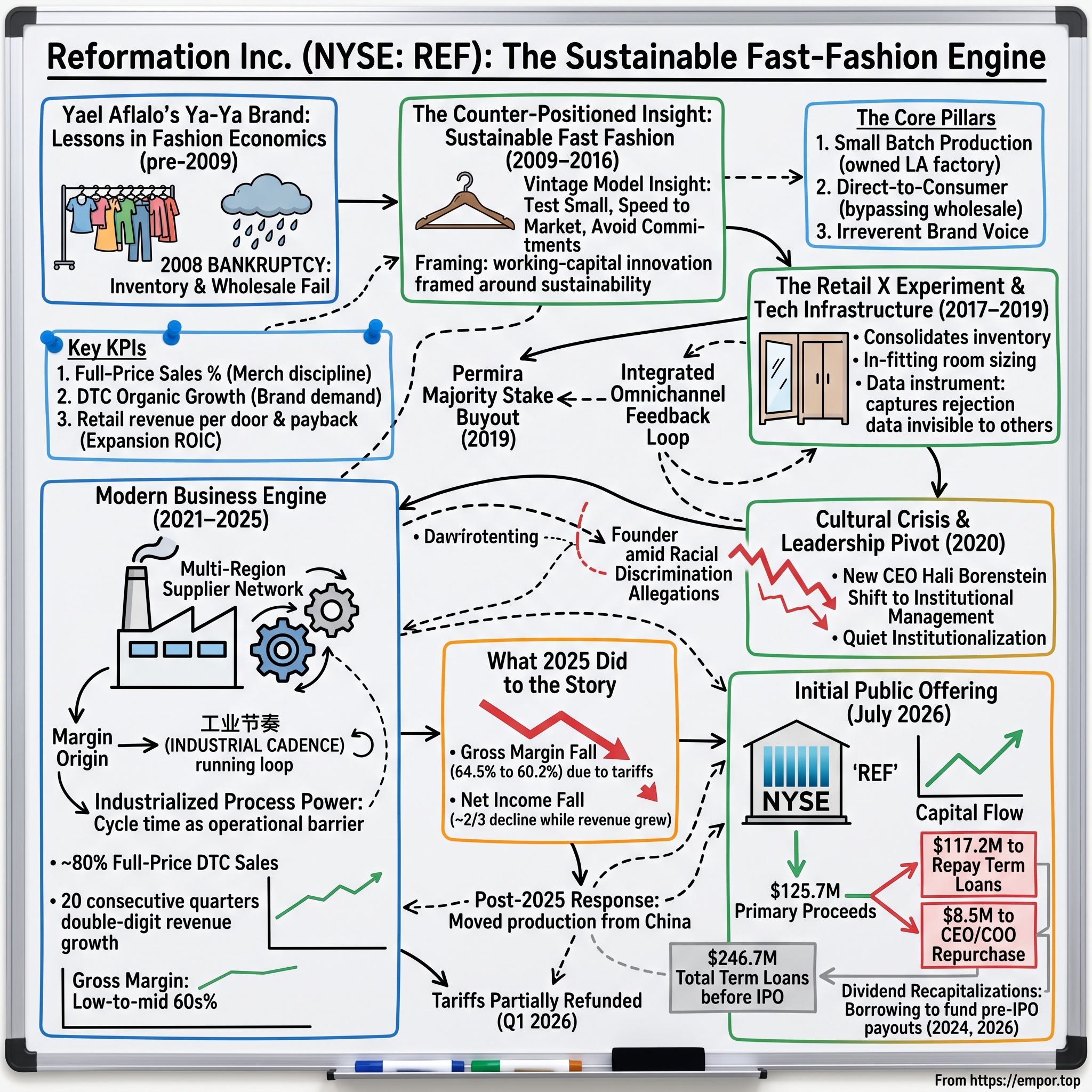
Reformation Inc. (NYSE: REF): The Sustainable Fast-Fashion Engine
I. Introduction & The $1 Billion Eco-Fashion Paradox
At 9:30 in the morning on Thursday, July 30, 2026, the opening bell rang at the New York Stock Exchange and a ticker that had never existed before began to print: REF. Reformation Inc. — a womenswear company headquartered not in Manhattan or Milan but in Vernon, California, an industrial city of roughly two hundred residents wedged between the Los Angeles River and a lattice of rail spurs — was now a public company.
The stock opened at $15.00. That was exactly the price at which the deal had been sold the night before.1 No pop, no first-day fireworks, no market commentators marveling at a doubling. Shares changed hands essentially flat, valuing the company at about $886 million.2 For a brand that had spent seventeen years cultivating an image of effortless cool — the linen slip dress, the deadpan social media caption, the celebrity in the front row — Wall Street's response was muted and unsentimental.
That flat debut provides a clear entry point to this story because it captures the exact question institutional investors were asked to answer. Reformation presents an unusual profile for a direct-to-consumer apparel brand: it is profitable, has grown net revenue for twenty consecutive quarters at double-digit rates, and sells roughly four out of every five dollars of merchandise at full price.3 Those figures are rare in the category. The graveyard of 2021-vintage digitally native brands is filled with companies that cultivated a distinctive brand identity without establishing viable unit economics.
Yet the broader financial picture reveals sharper tradeoffs. In fiscal 2025, Reformation reported net revenue of $507.1 million, up 15.7% from $438.2 million the year before — but net income fell to $12.6 million from $32.9 million.3 Profit fell by nearly two-thirds in the same year revenue expanded by nine figures. The company arrived at the NYSE carrying roughly $246.7 million of term loans against $76.6 million of cash, most of that debt raised not to build stores or buy equipment, but to fund distributions to existing owners.3 Six weeks before the IPO, the company borrowed $92 million and paid out approximately $90 million as a dividend.3
This creates the central tension of the story, requiring examination from several angles rather than assuming an outcome.
The bull framing: Reformation is a rare vertically integrated brand with genuine process power — a merchandising engine that reads demand in near-real-time, an agile supply chain that can chase a winning style in thirty days, and a tech-enabled store format that turns square footage from a warehouse into an interactive fitting room. That combination produces gross margins in the low-to-mid 60s, roughly twenty points above a well-run peer like Aritzia, creating an operational barrier that is difficult to replicate quickly.
The bear framing: Reformation is a well-executed contemporary apparel brand operating in a sector with a long history of volatile taste cycles. Financially engineered by a private equity sponsor, it listed into a soft consumer environment at a valuation that already assumes successful store rollouts in mid-sized markets match the performance of flagships in SoHo. Meanwhile, its sustainability narrative functions as a marketing asset rather than a structural moat, exposing the company to regulatory scrutiny over environmental claims.
Notably, the company never reached a $1 billion valuation at listing. It priced at the bottom of a $15–$17 marketed range and cleared $886.1 million.2 The gap between initial expectations and the final clearing price highlights the core analytical debate.
The narrative follows a clear roadmap. The analysis begins in the wreckage of a 2008 bankruptcy that taught a young designer an expensive lesson in fashion economics. It moves through the invention of a store format that appears simple on the surface but functions as a data-collection engine. It examines a private equity buyout, a founder's public departure, and the quiet institutionalization that followed. It dissects the modern P&L line by line — analyzing where margins originate and how 2025 tariffs impacted profitability. It tests competitive positioning against Helmer's 7 Powers and Porter's Five Forces, tracks capital flow through two debt-funded payouts into the IPO, and finishes with three critical metrics that will determine whether this growth engine is sustainable.
The story begins with a bankruptcy.
 Subscribe on LinkedIn
II. Origins: From Ya-Ya's Ashes to Eco-Fast Fashion (2009–2016)
Every founder story has an origin wound. Yael Aflalo's was a warehouse full of clothes nobody wanted.
She grew up in Beverly Hills watching her parents run a clothing shop, dropped out of school, and launched her first label, Ya-Ya, at age twenty-one—starting with a small batch of handmade skirts cut from pashminas that she sold into Fred Segal, the Los Angeles boutique that functioned as West Coast fashion's tastemaker.4 Ya-Ya succeeded initially. It became a contemporary brand whose body-skimming basics appeared on celebrities, generating roughly $20 million in revenue by 2005.4
Then the Great Recession arrived, and Ya-Ya discovered what its business model actually was.
That downturn exposed the structural fragility of the wholesale apparel model—a dynamic that explains everything Reformation later became. Traditional wholesale is, at its core, a forecasting bet placed nine to twelve months before a customer ever sees the product. A designer creates a seasonal collection, and retail buyers place orders at market. The brand manufactures against those orders, typically overseas in large minimum quantities with long lead times. Cash flows out months before revenue returns. If consumer demand shifts before delivery—or if a retailer cancels, discounts, or returns merchandise—the brand absorbs the loss.
When credit markets froze in 2008 and consumer spending plummeted, Ya-Ya held inventory it had already paid for against orders that evaporated. Excess inventory bankrupted the company and left Aflalo personally millions of dollars in debt.4 She paid down that debt in part by designing clothes for Urban Outfitters—a stark contrast to operating her own namesake label.
In 2009, she launched her next venture with minimal capital: roughly $7,000 and a rack of reworked vintage dresses sold out of a storefront on Melrose Avenue in Los Angeles.3 That first location, which the company still references in its regulatory filings, was a vintage shop.
The insight that scaled, and the one that didn't
The vintage model itself could not scale; a national brand cannot rely on unique garments sourced one at a time. However, two elements of the vintage model proved valuable when transplanted into a manufacturing business.
The first was speed. A vintage store buys, prices, and sells inventory within days. Without a long-term forecast, demand is revealed in real time by watching what leaves the rack. Applied to manufactured apparel, that rhythm yields a disciplined strategy: produce in small batches, test in the market, and rapidly reorder proven sellers.
The second was the aesthetic and the narrative. Vintage carried an implicit environmental rationale—reuse rather than extraction—along with a distinct aesthetic: nipped waists, bias cuts, and 1970s-inspired silhouettes that photographed well on mobile devices. Aflalo recognized that while one-off vintage garments could not be sourced at scale, the aesthetic and environmental narrative could be manufactured.
A 2010 business trip to China deepened that environmental focus. After observing pollution from textile manufacturing firsthand, Aflalo confronted the resource intensity of apparel production—including data showing that producing a single cotton T-shirt can consume hundreds of gallons of water.4 Rather than adopting an instructional tone, Reformation built a proprietary tracking system, later branded RefScale. The tool estimates the pounds of carbon emitted and gallons of water used for each garment compared with conventional apparel, publishing those metrics directly on product pages.3
Counter-positioning, in Helmer's precise sense
Between 2013 and 2016, Reformation made three strategic decisions that together illustrate Hamilton Helmer's concept of counter-positioning—adopting a business model that established incumbents cannot copy without damaging their core business.
Bypassing wholesale. Selling directly to consumers eliminated buyer gatekeeping, markdown chargebacks, and seasonal order books while allowing the brand to capture full retail price on every unit sold. For legacy competitors, matching this direct model would have required cannibalizing the wholesale relationships driving their sales volume.
Manufacturing locally. The company established its own factory in Los Angeles. By 2017, the facility produced roughly 60% of its apparel in-house and employed nearly 280 people, offering on-site amenities along with English and citizenship classes for workers—details that served as both genuine labor policy and effective brand positioning.4 The operational core was cycle time: an owned domestic facility could execute reorders in weeks rather than seasons.
Adopting an irreverent brand voice. "Being naked is the #1 most sustainable option. We're #2" remains a slogan featured in the company's SEC filings—a phrase whose inclusion in regulatory filings highlights the centrality of its brand voice.3 This irreverent tone performed strategic work: it distanced the brand from the earnest associations that had historically confined eco-fashion to a niche, making the label highly shareable just as Instagram emerged as a primary discovery channel for millennial consumers.
By 2015, the business generated roughly $25 million in revenue.4 While relatively small at the time, its operating model was fully formed and rapidly expanding. Over the subsequent decade, from 2015 to 2025, net revenue grew at a 34% compound annual rate.3
The strategic takeaway from this formative era is sharper than brand narrative suggests. What Aflalo designed was less a pure sustainability initiative and more a working-capital innovation framed around sustainability. The architecture was a direct answer to Ya-Ya's failure: test small, observe demand, reorder proven items, and avoid committing capital to unproven inventory. Environmental measurement provided a credible, verified brand narrative, but it rested atop an operating model structured primarily to prevent inventory write-downs. That operational distinction is central to understanding how the company protects its margins.
The next problem was that Aflalo's customers kept wanting to try things on.
III. The Retail X Experiment & Tech Infrastructure (2017–2019)
A conventional apparel store is essentially a decorated warehouse. Racks are dense because inventory must reside somewhere, and that somewhere is the sales floor. The customer's job is to sift: flipping through hangers for a size, accumulating an armful of clothes, queuing for a fitting room, discovering wrong fits, getting dressed, and repeating the process. Retailers have known for decades that this friction kills sales — and that the fitting room is where purchases are actually decided, given that conversion rates for customers who try on garments are multiples of those who merely browse.
Reformation's answer, launched in 2017 and trademarked as Retail X, was to invert the store layout.3
One of everything, and a closet with two doors
In a Retail X store, the sales floor holds exactly one sample garment for each available style.3 There are no size runs, folded stacks, or cluttered racks. The customer browses physical samples like museum exhibits, then builds a fitting room session much like an online shopping cart — tapping items on a touchscreen, using a personal smartphone, or requesting assistance from a store associate.
Behind the fitting rooms sits the actual inventory in a double-sided closet structure: customers open the closet from the front, while staff load items from the back. A customer never leaves the fitting room to search for another option; requesting a different size on an internal touchscreen prompts staff to deliver it directly into the rear of the closet. Early versions in flagship stores included customizable lighting settings with names like "sexy time" and "golden," while inventory fetchers were internally termed "wizards."4 Aflalo's framing at the time was direct: "This is how people shop now, standing next to each other at a screen in a store."4
Dismissing this format as mere retail theater overlooks three distinct economic mechanisms.
Effect one: square-footage arbitrage. In a conventional store, most of the floor serves as a walkable stockroom. Retail X consolidates inventory in the back, converting reclaimed floor space into additional fitting rooms. Because fitting rooms generate the highest conversion per square foot in apparel retail, the format systematically reallocates space from low-productivity displays to high-converting touchpoints.
Effect two: point-of-decision friction removal. The primary driver of abandoned apparel purchases is an unresolved sizing or fit issue. Retail X resolves this barrier inside the fitting room—applying the principles of one-click checkout to physical retail.
Effect three: physical stores as data instruments. Every garment brought into a fitting room but left unpurchased creates a data point invisible to conventional retailers. Standard point-of-sale systems track only completed transactions. Retail X captures real-time consideration and rejection data at the individual style, size, and store levels—providing the physical equivalent of an online abandoned-cart signal to refine demand forecasting.
Reformation operates its e-commerce platform and physical stores on a unified system, combining in-store behavioral metrics with online browsing and waitlist activity into a single customer and product record.3 This integration completes the merchandising feedback loop: the brand releases small product batches twice weekly online and weekly in stores, evaluates conversion rates within hours, and rapidly reorders top-performing items through its agile supply chain.
What the numbers say, and what they don't
The company's disclosed metrics offer concrete evidence of performance. In 2025, locations featuring Retail X generated approximately 8.5% higher average order values and roughly 270 basis points higher conversion rates than conventional stores.3 By the first quarter of 2026, Reformation had deployed the format across 49 stores, representing roughly 75% of its retail fleet.3
These disclosures carry two operational caveats. First, the comparison reflects a company-selected cohort rather than a controlled sample; newer, higher-performing flagship locations were prioritized for Retail X installations. Second, an 8.5% order-value lift, while meaningful, represents an incremental improvement that covers technology overhead rather than a fundamental transformation of retail economics.
The broader strategic implication lies in the data feedback loop. Reformation reported that nearly 90% of its 2025 direct-to-consumer apparel net revenue came from styles informed by prior customer shopping metrics.3 This indicates that the product assortment relies primarily on iterative updates to proven silhouettes rather than speculative fashion trends, allowing management to treat fashion risk as a measurable, controlled variable.
Media commentary often attributes this system to artificial intelligence, but regulatory disclosures reflect a more measured implementation. In SEC filings, Reformation notes that it has begun leveraging machine learning, using third-party models for initial concept development and trend identification alongside "advanced technology to support some product buying, allocation, and digital merchandising decisions."3 This reflects standard data analytics applied to a well-structured dataset rather than a proprietary, unreplicable algorithm. The competitive defense lies in the instrumented store network and seventeen years of first-party behavioral data, rather than the software processing it.
By 2019, the core operating model had been tested at modest scale. With strong cultural momentum, Reformation possessed what private equity investors seek: a repeatable retail format with attractive unit economics across a small initial footprint of several dozen stores—setting the stage for institutional capital expansion.
IV. The Permira Buyout, Cultural Crisis, & Leadership Pivot (2019–2020)
On July 10, 2019, private equity firm Permira announced that its funds had agreed to acquire a majority stake in Reformation.5
Permira, a European-rooted global investment firm founded in 1985, held approximately €86 billion of committed capital across private equity and credit as of the fourth quarter of 2025 and had deployed more than $18 billion in the consumer sector since inception.3 The purchase price was not disclosed and remains confidential.5 While Reformation's December 2017 Series B funding round reportedly valued the business at $195 million, no official figure exists for Permira's transaction value, making widely cited entry valuations speculative.
The announced transaction structure reflected the deal's strategic intent. Founder Yael Aflalo remained as chief executive officer and a significant shareholder, while Hali Borenstein continued as president. Stripes Group, the growth equity firm backing Reformation since 2015, rolled over a portion of its equity rather than fully exiting. Permira outlined an execution-focused strategy: expand e-commerce, scale physical retail domestically and internationally, introduce new product categories, and preserve the brand's sustainability positioning.5 Permira principal David Brisske characterized the opportunity at the time: "It's rare for a business to have both tremendous brand strength and first-rate omnichannel capabilities."5
In essence, Permira was not acquiring a turnaround project. It was investing in a proven store format with plans to replicate it across dozens of new markets.
Eleven months later
Eleven months after the buyout, in June 2020, widespread corporate scrutiny followed the killing of George Floyd, focusing on consumer brands whose public marketing diverged from their workplace practices. For Reformation, a brand built around ethical standards and corporate responsibility, that scrutiny quickly exposed internal workplace vulnerabilities.
A former employee publicly accused Aflalo of racist behavior and discriminatory conduct within the workplace. The allegations extended to product casting practices, which critics noted rarely included Black models.6 Amplified on social media, the accusations prompted immediate boycott calls from the brand's core customer base, directly threatening its values-driven market positioning.
Aflalo responded publicly with a statement titled "I've failed," acknowledging that she had viewed diversity through what she termed "the white gaze" and pledging a personal donation of $500,000 to racial equity organizations.6 On June 12, 2020, she resigned as chief executive.6 In her resignation statement, Aflalo noted: "Over the past few years it has become clear to me that I am not the right person to lead a business of Reformation's size and scope. On a personal note, I have long struggled with the public facing nature of my role and with managing our team."6
From an operational standpoint, the crisis highlighted two distinct risks. Culturally, it represented a founder being held accountable for the disconnect between internal workplace practices and public brand messaging. Corporately, it posed a severe threat to brand equity. While an environmental brand facing greenwashing allegations loses marketing credibility, a values-oriented label facing allegations of workplace misconduct hazards losing the premium pricing power tied to its ethical positioning.
Hali Borenstein's version of the company
To navigate the crisis, the board appointed Hali Borenstein, who had been with Reformation since 2014.
Borenstein brought an analytical background to the role. She holds a bachelor's degree in Political Science and Markets & Management from Duke University and an M.B.A. from Stanford University, having previously worked as a senior merchandiser at Gymboree and a consultant at Bain & Company.3 After joining Reformation in merchandising and design, she was named president in December 2017 and joined the board in August 2019 during the Permira transaction—positioning her as a director when she assumed the chief executive role in June 2020.3 Additionally, from December 2019 to May 2026, she served on the board of directors of children's apparel retailer Carter's, gaining public-company governance experience alongside her executive duties.3
Borenstein's transition marked a shift from founder-led design instincts to institutional management. Regulatory filings highlight a leadership team balanced between internal veterans—with half the executive team holding tenures over seven years—and outside talent recruited from technology and retail enterprises.3 Chief Operating Officer Ivan Tchakarov joined in June 2022 after six and a half years at Alphabet, where he managed operations for Google Express and Google Shopping before overseeing product management for Google Merchant Platform.3 Chief Financial Officer Joshua Moore joined in March 2025 following senior finance roles across major retail chains, including Advance Auto Parts, At Home, Michaels, and Best Buy—an executive appointment that aligned with preparations for the public listing.3
Borenstein's operating record demonstrates steady commercial expansion: net revenue increased from $359.5 million in fiscal 2023 to $507.1 million in fiscal 2025, while the retail footprint expanded from 34 locations at the start of 2023 to 70 by June 2026.3 Through the first quarter of 2026, the company recorded twenty consecutive quarters of double-digit net revenue growth.3
Disclosures regarding workplace culture rely primarily on structural metrics. The company's prospectus notes that women make up 54% of the overall workforce and 68% of the leadership team, alongside ongoing employee sentiment surveys and supply-chain social audits.3 While these policies demonstrate formal governance oversight, public filings cannot independently verify qualitative cultural improvements, leaving prospective investors to evaluate management execution against historical commitments.
Furthermore, governance records show that Aflalo's connection to the company did not end with her executive departure. She rejoined the board of directors in August 2019 and remains a director.3 Under shareholder agreements, the Aflalo Family Trust retains the contractual right to nominate her to the board so long as it holds at least 5% of outstanding shares.3 Outside of Reformation, Aflalo launched a new fashion label, AFLALO, in August 2023 and has served as a principal at Daughters Capital since July 2021.3 While her transition out of management established a professional executive structure, her continued board seat and equity position reflect ongoing governance rights rather than a total severance of ownership ties.
By 2021, Reformation possessed professional executive management, a well-capitalized private equity sponsor, a stabilized brand reputation, and a store model positioned for expansion—setting the baseline for its subsequent commercial trajectory and ultimate initial public offering.
V. Modern Business Engine & Segment Economics (2021–2025)
Here is the machine, taken apart.
The revenue stack
Reformation reports two channels. Direct-to-consumer — the website, the owned stores, outlets, and concessions, which management deliberately manages as one pooled channel — produced $454.1 million in fiscal 2025, or 90% of net revenue. Wholesale and Other produced the remaining $53.0 million.3 Within DTC, e-commerce accounted for 67%, meaning the website is roughly 60% of the total company and physical retail roughly 30%.3
The channel growth rates in 2025 diverged in a way worth noticing: DTC grew 14.6% while wholesale grew 26.9%.3 Wholesale is small — 15 accounts across 142 doors as of June 2026, 116 of them in the U.S. — and management describes it as a customer-acquisition tool rather than a volume outlet, supported by a survey finding that about 11% of the 2025 customer cohort first encountered the brand through a wholesale partner.3 That framing is credible but should be watched: wholesale carries structurally lower revenue per unit because of partner discounts, and the company itself flags that a channel mix shift toward wholesale would pressure gross margin.3
Where the margin actually comes from
This is the heart of the investment case, so let's build it from first principles.
An apparel company's gross margin is determined by two things: the markup it sets, and the fraction of goods it actually sells at that markup. Most contemporary brands set healthy initial markups and then give a large share of them back through markdowns, promotions, and end-of-season liquidation — because they bought too much of the wrong thing nine months earlier.
Reformation's claim is that it has attacked the second variable. Approximately 80% of DTC net revenue came from full-price sales in 2025, and that figure has been consistent every year from 2021 through 2025.3 Five years of stability across a pandemic, an inflation shock, and a soft consumer environment is a meaningfully stronger data point than any single year would be.
The mechanism is the loop described earlier, running at industrial cadence. New styles launch in small quantities twice weekly online and weekly in stores. Performance is read within hours. Pre-orders and waitlists generate demand signals before goods even reach the distribution center. Winners get chased. And the chase is fast: over the past three years, 50% of product arrived at the distribution center within 60 days of the purchase order, and nearly 65% of reorders were manufactured in 60 days or less, with reorder lead times that can run as short as 30 days.3 The comparison the company draws — that much of the apparel industry works on production lead times of up to twelve months or longer — is the entire argument in one sentence.3
The output shows up in the gross margin line. From 2021 through 2024, Reformation consistently generated gross margins of 64.0% or better.3 To put twenty points of context around that: Aritzia, the most frequently cited comparable and a genuinely well-run operator, reported a gross margin of 44.9% on CAD $3.70 billion of net revenue in its fiscal 2026.7 Different mix, different geography, different accounting for occupancy costs — but the gap is far too large to be an artifact.
What 2025 did to the story
And then 2025 happened.
Gross margin fell to 60.2% from 64.5%.3 The company attributes 364 basis points of that 430-basis-point decline to tariffs imposed under the International Emergency Economic Powers Act, with the remainder from a promotional event shifting out of the fourth quarter of 2024 into the first quarter of 2025.3
The cost flowed straight to the bottom line. Income from operations fell 45.3%, from $52.7 million to $28.8 million. Interest expense rose to $14.6 million. Net income fell 61.6%, from $32.9 million to $12.6 million — a 2.5% net margin against 7.5% the year before.3 Adjusted EBITDA, the company's preferred measure, was $45.0 million, or 8.9% of net revenue.3
Two things happened next, and investors should hold them separately.
First, Reformation moved production. The company reallocated manufacturing to mitigate tariff exposure, reducing what had been its largest country of production — China — and stated that it expects no single country to represent more than 25% of total units produced in 2026.3 Its 2025 unit footprint was 51% Asia, 34% North America, 10% Europe, and 5% South America.3
That last statistic deserves a myth-versus-reality flag, because the popular framing of Reformation as a nearshoring, made-in-LA company is only about a third true. The Los Angeles factory is real and strategically important — it is where new ideas get tested and best-sellers get turned around fastest — but the majority of units are made in Asia. The speed advantage comes from how the system is orchestrated, not from the geography of every garment.
Second, the tariffs were partially refunded. In the first quarter of 2026 the company recognized a $15.0 million receivable for an IEEPA tariff refund, of which $12.3 million was recorded as a reduction to cost of goods sold — $10.2 million of it relating to sales that had happened in 2025.3 The result was a reported first-quarter 2026 gross margin of 70.3%, of which 904 basis points came from the refund.3
Which means neither the 60.2% nor the 70.3% is the real number. Anyone building a view on this company needs to normalize both years. The underlying gross margin is probably somewhere in the mid-60s, consistent with 2021–2024 — and the episode is a live demonstration that this business, whatever its brand strength, is a price-taker on trade policy.
Customers, cohorts, and the quality of the revenue base
The customer data is where the model looks strongest.
Active customers reached approximately 1,083,000 at the end of fiscal 2025 and about 1,140,000 as of March 28, 2026 — up 18% year over year.3 DTC net revenue per customer was $422 in 2025, up from $390 in 2023, a 4% compound growth rate.3 Average order value was $315 across a price range running from roughly $40 to $1,500.3
The retention numbers are the ones that matter for durability. Nearly 70% of 2025 DTC net revenue came from returning customers. Fifty-four percent of customers acquired before 2025 have purchased more than once. Nearly 20% of the 2015 cohort was still shopping almost a decade later.3 Approximately 75% of new DTC customers in 2025 were acquired outside paid digital channels, and marketing spend has held steady at roughly 9% of net revenue for four straight years — $44.5 million in 2025 against $38.4 million in 2024.3
That last combination is the single most economically important fact in this section. A brand that grows revenue 15.7% while holding marketing at a constant percentage of sales, and acquires three-quarters of its new customers organically, is not renting its growth from Meta. Contrast that with the 2020–2022 DTC cohort, most of which discovered that its customer acquisition cost curve bent vertical the moment paid social got expensive.
The omnichannel effect is also real and measurable: in 2025, customers who shopped both online and in store made approximately 4.8 purchases annually and generated 3.1 times the net revenue of single-channel shoppers, and the omnichannel share of net revenue rose from 19% in 2021 to 34% in 2025.3 Company-commissioned research found brand awareness among premium apparel shoppers rises approximately 21% within five miles of a store, and customer acquisition in a market can increase by as much as six times in the year after a store opens.3
Stores, categories, and the one number that complicates the picture
Store economics look genuinely good. The 47 full-price stores open for all of fiscal 2025 generated $2.7 million of net revenue per door, and the company underwrites new stores to payback periods under two years, which it says it has historically achieved on average.3 It opened six stores in 2023, ten in 2024, and fifteen in 2025, ending the first quarter of 2026 at 66 and reaching 70 by late June — ten of them outside the U.S., across London, Paris, Toronto, and Vancouver.3
Category expansion has quietly become the growth engine. Dresses — the thing Reformation is famous for — have fallen from roughly 60% of DTC net revenue to slightly more than one-third in 2025, not because dresses shrank but because everything else grew.3 Since 2021 the company added more than $200 million of annual non-dress net revenue, quadrupling that portion of the business, with denim compounding at roughly 30% annually from 2022 to 2025.3 Denim launched in 2017, shoes in 2021, handbags in 2023, swim in 2024.3 Roughly 74% of 2025 DTC net revenue came from customers buying more than one category.3
Now the number that complicates all of it.
Reformation discloses a metric it calls DTC organic growth — essentially a same-store-plus-online comparable. It was 15.2% in 2023, 17.5% in 2024, and 9.3% in 2025.3
Sit with that. Headline net revenue grew 15.7% in 2025. Organic growth was 9.3%. The gap is new stores. That is not damning — opening fifteen stores at sub-two-year paybacks is a perfectly good use of capital, and the acceleration to 30.4% total revenue growth in the first quarter of 2026 suggests momentum did not break.3 But it does mean that a material and rising share of recent growth is being purchased with capital expenditure rather than generated by the existing base, and that the underlying demand trend decelerated by roughly eight points in a single year.
One more disclosure that belongs in any serious read of the top line: Reformation recognized $265.7 million of sales returns and chargebacks in 2025, against $245.9 million in 2024.3 Returns are normal and expected in online apparel — this is a fit-dependent category sold without a physical try-on — but a returns and chargebacks figure equal to roughly half of reported net revenue means the gross demand number is far larger than the net number, and that reverse logistics, restocking, and shrink are permanent, material cost lines rather than rounding errors.
The marketing benchmark
One campaign deserves its own paragraph, because it is the clearest illustration of how this brand converts cultural positioning into customer acquisition.
On February 26, 2024, Reformation launched "You've Got the Power" — a workwear collection fronted by Monica Lewinsky, in partnership with the nonprofit Vote.org, built around a voter information hub with proceeds from a campaign sweatshirt donated to the organization.8 Lewinsky's line was the emotional core: "Voting is using your voice to be heard, and it's the most defining aspect of our democracy."8 Reformation's own copy did what Reformation's copy always does — undercut the earnestness before it curdled: "While Ref knows that a powerful outfit alone isn't going to create a more perfect union, putting it on and going to the polls is a damn good place to start."8
Read commercially, this was a category launch — office dressing, a segment Reformation had underweighted — wrapped in a cultural moment that guaranteed editorial coverage far beyond the fashion press.[^9] Casting a woman whose public identity was forged in a workplace power scandal to sell workwear about power was either extremely cynical or extremely good, and the honest answer is that in brand marketing those are frequently the same thing.9 The campaign sits alongside collaborations with Canada Goose, HOKA, VEJA, New York City Ballet, Kacey Musgraves, and Pete Davidson in a portfolio designed to keep the brand in cultural conversation without paying for reach.3
For investors, the through-line is this: Reformation's marketing efficiency is not a cost-control achievement, it is a content achievement, and content achievements depend on taste. Taste is a management capability that can be lost quietly and is very hard to underwrite from the outside.
VI. Industry Structure, Competition, & The 7 Powers
Fashion is among the most challenging consumer categories because apparel is a positional good whose value relies on currency—and currency decays rapidly. Every apparel company must operate an ongoing business while mitigating the risk that consumer tastes shift elsewhere.
Reformation operates in contemporary apparel, positioned between mass-market and luxury. Its assortment ranges from roughly $40 to $1,500, with an average order value of $315.3 This price point insulates the brand from direct price competition with fast-fashion giants like Zara or Shein, while avoiding the heritage requirements and high structural margins of European luxury houses.
The named competitive set
Aritzia serves as the closest structural analogue and benchmark. The vertically integrated, boutique-led platform reached CAD $3.70 billion in net revenue in fiscal 2026—a 35.2% increase—across 144 boutiques, with digital sales representing 35% of the total.7 While Aritzia is roughly five times Reformation's scale and demonstrated faster recent growth, it generated a 44.9% gross margin compared to Reformation's normalized mid-60s.7 The margin gap reflects contrasting commercial strategies: Aritzia trades price for volume and store traffic, whereas Reformation uses scarcity and rapid cycle times to preserve pricing power.
The second tier—including digitally native labels such as Sézane, Ganni, Dôen, Réalisation Par, and Rouje—competes directly for similar demographics and digital engagement. These brands are predominantly smaller, privately held, and lack extensive retail footprints. Reformation's primary advantage over this group is physical and operational infrastructure, backed by 70 stores across four countries, an owned domestic factory, and a 185,000-square-foot automated distribution center in Los Angeles that absorbed $28.5 million in capital expenditure between 2024 and the first quarter of 2026.3 Conversely, these smaller peers benefit from novelty, which remains a key asset in contemporary fashion.
Helmer's 7 Powers, applied honestly
Counter-positioning—historically effective, but diminishing. The company's initial counter-positioning strategy—avoiding wholesale commitments to build a small-batch, direct-to-consumer model—provided a meaningful advantage over legacy retailers bound by traditional order cycles. However, as direct-to-consumer models have become standard across contemporary fashion, this advantage has eroded. Counter-positioning loses potency once the alternative model becomes the industry standard.
Branding—strong customer resonance with measurable loyalty. In a July 2025 company survey of approximately 2,370 customers, 77% of active shoppers identified Reformation as a favorite or all-time favorite brand, while 84% reported that wearing its clothing boosted their confidence.3 Although internal survey metrics carry inherent selection bias, behavioral data reinforces brand equity: nearly 70% of revenue originates from returning customers, earlier customer cohorts display decade-long persistence, and 75% of new digital customers are acquired organically.3 Furthermore, customers who identify sustainability as a core brand value spend approximately 39% more than average.3
Process power—the most durable competitive barrier. Reformation's operational system integrates a twice-weekly design cadence, a multi-region supplier network achieving 30-to-60-day reorder turnarounds, instrumented retail locations, and a unified omnichannel data platform.3 As defined by Hamilton Helmer, process power stems from complex organizational routines built over time—in this case, developed over seventeen years—that competitors cannot easily replicate through capital alone. Crucially, this operational capability functions independently of shifting fashion trends.
Conversely, the business lacks the remaining four powers. It exhibits no network effects, as additional customers do not increase product utility for others. Switching costs are virtually non-existent, permitting consumers to shift to competing labels without friction. At approximately $507 million in net revenue, scale economies remain modest compared to industry conglomerates, and the company holds no cornered resource.
Porter's Five Forces
Buyer power—structurally high. While individual consumers lack pricing power, they face zero switching costs and possess unlimited alternatives. Reformation mitigates this risk by maintaining brand appeal, with its 80% full-price sales realization serving as the primary indicator of customer retention.
Threat of new entrants—bifurcated between brand and operations. Barriers to launching a niche apparel label are low. However, replicating an integrated operating system—comprising a 30-day reorder mechanism, 70 tech-enabled stores, an owned domestic factory, an automated distribution center, and a first-party behavioral database—requires substantial capital and years of operational development. While the brand layer remains vulnerable to new entrants, the operational foundation is difficult to copy.
Supplier power—moderate and managed. Supply chain risk is mitigated by geographic diversification across four continents, with management targeting no single country to represent more than 25% of total production units in 2026, alongside an owned Los Angeles facility acting as a rapid-response buffer.3 The 2025 tariff adjustments demonstrated both vulnerability to trade policy and operational agility in shifting sourcing.
Substitutes—structurally relevant. Clothing rental platforms, resale marketplaces, and secondhand apparel address similar consumer preferences for variety and sustainability. Reformation has partially integrated these alternatives through external resale partnerships and an internal textile-to-textile recycling program that processed nearly two million garments between 2021 and 2025.3
Rivalry—intense and continuous. Contemporary fashion is characterized by rapid style cycles, fragmented market share, and persistent competition.
For long-term investors, the core takeaway is a strategic paradox: Reformation's operational infrastructure is more defensible than its brand identity, yet consumer demand is driven primarily by the brand. The operating system safeguards gross margins, while brand affinity generates top-line growth. Sustained execution requires both components to function in tandem.
VII. Public Market Debut (NYSE: REF) & Capital Deployment
The formal public offering process began on June 25, 2026, when Reformation filed its Form S-1 with the SEC — detailing operations across 70 retail locations in the U.S., U.K., Canada, and France, serving customers in over 150 countries, with more than one million active shoppers.10 J.P. Morgan and Morgan Stanley led the underwriting syndicate, with Citigroup and RBC as joint bookrunners alongside Guggenheim, Baird, William Blair, BTIG, and Telsey.10
On July 29, 2026, the registration statement became effective and the deal priced: 14,062,500 shares at $15.00 apiece, consisting of 9,478,821 primary shares sold by the company and 4,583,679 secondary shares sold by existing stockholders, with an over-allotment option for an additional 2,109,375 shares.1 Gross proceeds totaled $210.9 million, with trading commencing July 30 and the offering closing July 31.1
Two structural elements of the offering stand out. First, the deal priced at the bottom of its $15–$17 marketed range. Second, of the $210.9 million in gross capital raised, Reformation itself netted approximately $125.7 million after deducting $1.05 per share in underwriting discounts and offering expenses.3 The remaining proceeds flowed directly to selling shareholders. In dollar terms, the offering functioned as roughly 60% a primary capital raise and 40% a liquidity event for existing owners.
Where the money went
A close examination of capital deployment reveals where those net primary proceeds actually flowed.
Of the $125.7 million netted by the company, approximately $117.2 million was earmarked to partially repay term loans, while roughly $8.5 million was used to repurchase 192,557 shares and 830,208 options from Chief Executive Officer Hali Borenstein, Chief Operating Officer Ivan Tchakarov, and certain other employees in what the prospectus terms the "Synthetic Secondary."3
In effect, virtually all of the primary capital raised in the IPO went toward paying down debt and repurchasing equity from executives. Not a single disclosed dollar was directed toward opening new stores, expanding international operations, or upgrading Retail X technology.
To understand why Reformation carried that debt burden into its listing, the underlying financial timeline requires examination.
In fiscal 2023, Reformation's income statement reflected zero interest expense.3 The company operated with virtually no debt, generating $23.9 million of net income on $359.5 million of net revenue.3
In May 2024, the company established a credit agreement with J.P. Morgan acting as administrative agent. That same month, Reformation Inc. received a $165.0 million dividend from its subsidiary, which was used for share repurchases.3 Consequently, interest expense appeared at $10.7 million in 2024 and reached $14.6 million in 2025.3
On June 17, 2026 — eight days before filing its Form S-1 and six weeks before listing — the borrower amended the credit agreement to secure $92.0 million of new term loan commitments. The company drew the full amount, extended maturities to June 2031, and distributed a dividend of $1.63 per share to common holders. Including cash payments to holders of certain options and restricted stock units, the total outlay reached approximately $89.7 million, accompanied by about $2.8 million of debt issuance costs and $0.3 million of third-party fees. The prospectus designates this series of transactions as the "Recapitalization."3
By June 27, 2026, outstanding term loans totaled $246.7 million against $76.6 million of cash and $26.4 million of remaining borrowing capacity.3
Summarizing the financial sequence: a profitable, debt-free company borrowed to fund $165 million of share repurchases in 2024, borrowed again to fund roughly $90 million of dividends in June 2026, completed an initial public offering in July 2026, and directed essentially all of its net primary proceeds toward retiring the debt created by those distributions. Pro forma for the offering, term loans fell from $243.4 million to $128.5 million.3
Dividend recapitalizations represent standard private equity practice, were fully disclosed in regulatory filings, and were audited by PricewaterhouseCoopers.3 From an economic perspective, however, public shareholders funded the retirement of debt whose proceeds had already been distributed to pre-IPO owners — a capital structure distinct from raising growth equity to expand international retail footprints.
Ownership, control, and the overhang
Following the offering, Reformation had 59,076,208 shares outstanding.3 At the $15.00 offer price, the company debuted at an $886.1 million market valuation.2
Permira beneficially owns approximately 49.2% of outstanding shares — or 46.9% if underwriters exercise their over-allotment option in full — down from 64.4% prior to the offering.3 The Aflalo Family Trust holds approximately 19.8%.3
Two governance dynamics emerge from this ownership structure.
Under NYSE rules, Reformation is technically not a "controlled company" because Permira holds slightly less than 50% of the voting equity.3 As a result, the company must adhere to standard board independence requirements rather than claiming governance exemptions.
In practice, governance authority remains concentrated. Four of eight directors are affiliated with Permira, and one represents the Aflalo Family Trust.3 Permira maintains the contractual right to nominate at least one director as long as it owns 5% of outstanding shares, and the Aflalo Family Trust holds identical nomination rights for founder Yael Aflalo.3 The prospectus confirms that Permira and the Aflalo Family Trust acting together will be able to determine the outcome of all matters requiring stockholder approval and can approve or block a change of control.3 Combined, the two shareholders command roughly 69% of the equity and five of eight board seats.
This concentration creates a structural overhang common to sponsor-backed listings: a limited public float paired with a significant future seller. Permira retained nearly half of the company following the IPO. Because that holding will eventually be liquidated, the prospectus explicitly warns that future secondary sales, or the market expectation of them, could exert downward pressure on the stock price.3
The market Reformation listed into
The broader market environment provides necessary context for Reformation's flat debut. The offering took place during a period when U.S. consumer and retail listings had fallen to a ten-year low, and investor focus had shifted firmly toward demonstrated current earnings over growth narratives.2 During the roadshow, Borenstein reported that "the feedback was consistent: this feels different, this is where the consumer is moving and we want to be part of it," while emphasizing the company's sub-1% penetration of its addressable market.2
On its first day of trading, the market priced the company strictly on its current earnings profile. In subsequent trading sessions, the stock traded modestly above the $15.00 offer price.11 Valued at $886 million against $507.1 million in trailing revenue, Reformation entered the public market at approximately 1.7 times sales — a moderate multiple reflecting investor willingness to support the existing operating base while requiring proof of execution before pricing in future expansion.
VIII. Management Credibility & Skeptical Investor Stress Test
Assessing management credibility at a company that has been public for four days requires a different method than reading earnings calls, because there are no earnings calls. There is no track record of guidance set and met, no history of explaining a miss, no archive of quarterly language to test for consistency. Reformation's first reported quarter as a public company has not yet occurred — the company stated that its financial close for the thirteen weeks ended June 27, 2026 would not be completed until early September.3
So the evidence has to come from behavior, from the structure of incentives, and from what the company chose to put in front of investors before it had to.
What the record supports
The operating execution is documented and consistent. Twenty consecutive quarters of double-digit net revenue growth is a hard thing to fake, and it spans the pandemic recovery, the 2022–2023 inflation shock, and a soft 2025 discretionary environment.3 Store count roughly doubled from 34 to 70 across three and a half years while the company says it maintained sub-24-month payback discipline.3 Marketing intensity held flat at approximately 9% of net revenue for four consecutive years — a rare display of discipline in a category where growth is usually bought.3 Capital was committed ahead of demand, not behind it: $28.5 million into a new automated distribution center that opened in October 2025.3
And the company did something notable on disclosure. Rather than let a flat quarter emerge post-listing, it put preliminary second-quarter 2026 estimates into the prospectus: net revenue of $154–155 million against $125.1 million a year earlier, gross margin of roughly 66.6%, net income of approximately $11.7–12.0 million against $6.9 million, and Adjusted EBITDA of about $24.9–25.3 million at a 16.2% margin against 13.2%.3 These are unaudited management estimates, explicitly not reviewed by PwC, and they carry the usual caveats — but volunteering them ahead of a listing is the behavior of a management team that expects to be measured.
What a skeptical investor should press on
The incentive structure is aligned to the sponsor's exit, not to operating targets. This deserves to be stated flatly because it contradicts a claim that circulates in coverage of the company. Reformation's performance-based options do not vest against revenue, EBITDA, or carbon milestones. They vest when the controlling shareholder achieves certain multiples of invested capital, based on cash proceeds received by the investor — with the percentage vesting scaling from zero to one hundred across a MOIC range of 175% to 250% of invested capital.3 Half of options granted under the 2019 plan carry this condition.3
That is a legitimate private equity structure and it is fully disclosed. But it means the most senior people at the company have, for years, been financially oriented toward Permira's realized return. It also means the frequently quoted "~2.4x gross MOIC" figure for Permira's 2019-to-2026 outcome is not a disclosed number — the entry price has never been published — and the only public window into how the deal is being scored is that 1.75x–2.5x vesting band.3 Whether the condition has now been satisfied is not disclosed; as of fiscal year-end 2025 the company had determined the performance and market conditions were not yet achieved.3
The 2025 profit decline is larger than the tariff explanation covers. Tariffs account for 364 basis points of gross margin.3 But SG&A also rose from 43.7% to 45.8% of net revenue, driven by $13.9 million more in shipping and selling, $13.7 million more in personnel, $9.6 million more in rent, plus $7.7 million of distribution center relocation costs and a $1.7 million bad debt charge from the bankruptcy of a significant department store customer.3 Some of that is investment ahead of growth and should lever back. Some of it — rent and store payroll — is the permanent cost of a physical footprint that is expanding faster than comparable sales. Watching whether SG&A ratio reverses is a direct test of whether store expansion is accretive or merely additive.
The stock compensation modification is large and lightly explained. First-quarter 2026 SG&A included $23.8 million of incremental expense from a stock-based compensation modification, which drove a $12.1 million net loss in a quarter with 30.4% revenue growth and a 70.3% gross margin.3 It is non-cash and it is added back to Adjusted EBITDA. But a modification of that size immediately before a listing, in a plan whose performance conditions are keyed to sponsor returns, is exactly the sort of item a governance-focused investor should want explained in detail on the first earnings call.
There were accounting corrections. During preparation of the fiscal 2025 statements, the company identified errors in previously issued financials for 2024 and 2023 involving misclassification of prepaid rent, tenant improvement allowances, and bad debt expense — the last of which had been recorded in net revenue rather than SG&A.3 Management concluded these were immaterial and revised the comparatives, and PwC issued a clean opinion.3 Immaterial reclassifications are common at companies transitioning to public reporting. But a company that had been misclassifying bad debt inside revenue is a company whose historical revenue figures were, however slightly, flattered — and it is a reminder that this is a first-time public reporter building out its control environment in real time.
Leverage remains material. Pro forma term loans of $128.5 million sit against a business that generated $45.0 million of Adjusted EBITDA in 2025.3 That is comfortable in a good year. It is less comfortable if a fashion cycle turns while fifteen new store leases are ramping, and the debt carries variable rates and restrictive covenants that the company itself flags as potentially limiting operational flexibility.3
The sustainability claim is now a legal exposure, not just a marketing asset. The prospectus lists greenwashing litigation among its risks and notes both that Canada and the EU implemented new rules on environmental marketing claims in 2024 and that the FTC's Green Guides may be updated.3 It also discloses, with admirable candor, that PETA labeled Reformation "Greenwasher of the Year" in 2023 over the use of animal-derived materials.3 The company has SBTi-verified climate targets, reports to CDP, obtains annual third-party verification of climate accounting, has kept products carbon-neutral since 2015 with Change Climate Project certification since 2021, and committed in May 2023 to being circular by 2030.3 That is a genuinely rigorous apparatus by industry standards. It is also a large surface area of specific, dated, auditable public promises — and the more specific the promise, the more actionable the failure.
Key metrics are self-defined and self-measured. The company acknowledges the point directly: it tracks key operating metrics with internal and third-party tools subject to imperfect data collection, including missing identifiers for retail customers.3 Active customer counts may include duplicates and household-shared accounts.3 The 77% brand-love figure comes from a 2,370-person internal survey of the company's own email list.3 None of this is unusual. All of it means the operating dashboard investors will be handed is constructed by the company being measured.
The fair conclusion on management is that the execution record is real and the disclosure posture is better than average, while the incentive architecture and the pre-IPO capital movements are unambiguously sponsor-oriented. Both things are true. The next four quarters — the first ones with guidance attached — will be far more informative about credibility than anything written before the listing.
IX. Bear vs. Bull Case & The 3 Critical KPIs
The bull case
The bull case rests on an operating engine that has already demonstrated long-term consistency. Full-price realization at approximately 80% of direct-to-consumer revenue—sustained across five years that included a pandemic and an inflation shock—is among the most difficult benchmarks to achieve in apparel, and Reformation achieved it consistently.3 That pricing discipline produces gross margins roughly twenty percentage points above Aritzia, its closest scaled benchmark.7
The quality of the customer base reinforces that margin advantage. Returning customers generate nearly 70% of direct-to-consumer revenue, the 2015 cohort continues to shop, three-quarters of new customers arrive without paid acquisition spend, and omnichannel shoppers—who grew from 19% of revenue in 2021 to 34% in 2025—spend 3.1 times more than single-channel buyers.3 These dynamics reflect a self-sustaining revenue base rather than growth rented through digital advertising.
The domestic expansion runway remains substantial. A customer base of roughly 854,000 active U.S. shoppers against an estimated addressable population of 94 million American women aged 18 to 60 represents under 1% market penetration.3 With stores in only half of the fifty largest U.S. metropolitan areas, management projects it can more than double its retail footprint over five years while adhering to four-wall profitability standards.3 Overseas expansion offers a parallel growth path: international markets generated 18% of revenue in the first quarter of 2026 across approximately 245,000 active non-U.S. customers, as the company replicates a British playbook that expanded U.K. revenue more than fivefold between 2019 and 2025 across Canada and Western Europe.3
Category expansion has similarly shifted from a growth concept to an operating reality. Adding more than $200 million in incremental annual non-dress revenue since 2021—led by denim compounding at roughly 30% annually—indicates the brand extends beyond its core dress category, supported by internal survey data showing 81% of active customers express interest in purchasing additional product lines.3
Finally, operational leverage is beginning to re-emerge. Preliminary second-quarter 2026 estimates indicate Adjusted EBITDA margin expanded to roughly 16%, up from 13.2% in the prior-year period.3 As tariff distortions recede and recent capital investments in distribution facilities begin to yield efficiencies, underlying earning power appears significantly stronger than the reduced fiscal 2025 results indicated.
The bear case
The bear case presents equally compelling structural counterarguments.
Reliance on consumer discretionary spending. The primary risk factor highlighted in the prospectus is the company's reliance on consumer discretionary expenditure.3 Operating in contemporary womenswear with an average order value of $315 leaves the brand vulnerable when household budgets tighten, regardless of how agile its supply chain may be.
Deceleration in organic growth. Direct-to-consumer organic growth slowed sharply in fiscal 2025, falling to 9.3% from 17.5% the prior year, even as headline revenue grew nearly 16% due to fifteen new store openings.3 If the revenue acceleration reported in early 2026 turns out to be flattered by tariff refunds rather than reflecting a genuine demand inflection, public markets could quickly adjust the stock's valuation downward.
Fashion risk and brand aging. Management mitigates fashion risk by iterating on proven silhouettes, with nearly 90% of direct-to-consumer apparel revenue generated from data-informed styles.3 However, relying heavily on historical data can foster aesthetic conservatism in an industry driven by novelty. Furthermore, while management interprets the fact that roughly 20% of new customers are over age 50 as evidence of multi-generational appeal, it could equally signal brand aging among younger core demographics.3
Unproven store economics outside coastal flagships. Disclosed store payback and productivity figures derive from a fleet concentrated in high-density coastal markets. Replicating those returns in the Midwest and South remains unproven, where foot traffic, rent structures, and brand recognition differ markedly. Company data showing brand awareness increases 21% within five miles of a store underscores both the promotional value of physical locations and how limited brand recognition remains beyond those immediate catchments.3
Exposure to trade policy. The 2025 tariff disruption and subsequent 2026 refund demonstrated that several hundred basis points of gross margin can fluctuate based on regulatory decisions outside management's control.3 Sourcing diversification mitigates this exposure but cannot eliminate geopolitical trade risks.
Capital structure and equity overhang. Post-IPO leverage remains substantial, while approximately 69% of outstanding equity continues to be held by Permira and the founder's trust—two principal owners whose ultimate objective is eventual liquidity.3
Diminishing sustainability differentiation. Company-commissioned research indicates that 82% of European Union customers report a willingness to pay more for sustainably produced clothing, up nearly twenty percentage points year over year.3 However, as environmental claims transition from voluntary marketing narratives to standardized regulatory mandates, competitors will be forced to publish audited disclosures. In a mandatory compliance environment, pioneering voluntary disclosure offers diminishing brand differentiation while preserving legal and regulatory liability.
The three KPIs that matter
Of the numerous metrics disclosed in regulatory filings, three key performance indicators will determine whether Reformation's growth engine is compounding efficiently or losing momentum.
1. Full-price sales as a percentage of DTC net revenue. Benchmark: approximately 80%, sustained from 2021 through 2025.3 This metric represents the core operational indicator, simultaneously measuring forecasting accuracy, inventory discipline, and pricing power. It directly feeds the mid-60s gross margin that separates Reformation from industry peers. A drop into the low 70s would signal either merchandising miscalculations or eroding pricing power, undermining the company's counter-positioning advantage. Investors should monitor this figure alongside inventory reserves, which expanded from $10.1 million in 2024 to $14.5 million in 2025.3
2. DTC organic growth. Benchmark: 15.2% in 2023, 17.5% in 2024, and 9.3% in 2025.3 As the company's internal comparable-sales metric, organic growth isolates underlying brand demand from retail expansion. Headline revenue growth can remain elevated through store openings alone, whereas organic growth reveals whether existing channels are expanding market share. Sustained organic growth in the mid-teens alongside retail expansion validates the growth thesis; a deceleration into low single digits would indicate that top-line gains are being purchased through capital expenditure.
3. Retail store net revenue per door and payback periods. Benchmark: $2.7 million per door across 47 full-price stores open throughout fiscal 2025, with historical payback periods averaging under 24 months.3 This serves as the primary return-on-invested-capital test for store expansion. As locations open in secondary markets, per-door productivity will indicate whether fleet expansion creates genuine economic value or dilutes store-level returns.
X. Playbook & Key Business Lessons
Design the business around the failure you already survived. Reformation's operating architecture — small batches, twice-weekly releases, 30-day reorders, and instrumented fitting rooms — is a direct structural response to how Ya-Ya failed in 2008. The most durable operating models are rarely derived from abstract strategy frameworks; they are forged by founders who have borne the cost of traditional failure modes. The key takeaway is not simply to manufacture locally, but rather that inventory risk represents the central hazard in physical-goods retail. A company that structurally minimizes inventory exposure can defend profit margins that traditional peers cannot match.
Instrument physical locations to compound data. Retail X functions as both a retail concept and an in-store data network. By tracking which items customers bring into fitting rooms but leave unpurchased, the platform captures consideration and rejection data that standard point-of-sale systems miss. Any physical retail business can benefit from identifying uncaptured customer signals and feeding those insights back into upstream supply chain decisions.
Professional management can stabilize brand equity, but governance ties remain. The 2020 executive transition succeeded in sustaining top-line growth and preserving brand equity. However, it did not alter the ultimate ownership structure, as the founder returned to the board and remains a dominant shareholder alongside the private equity sponsor. While formal governance changes are visible and verifiable, internal workplace culture is far harder for external observers to evaluate. Investors underwriting a brand built on ethical positioning must recognize the limits of auditing qualitative culture.
Examine the capital structure rather than marketing narratives. The defining financial details of Reformation's public debut were found in its balance-sheet history: a debt-free operation in 2023, $165 million in debt-funded share repurchases in 2024, a $90 million debt-funded payout shortly before listing, and $117.2 million in primary IPO proceeds applied directly to retiring that debt. Every step was fully disclosed in regulatory filings, even as public commentary focused on growth narratives. In sponsor-backed offerings, the use-of-proceeds section often provides the clearest picture of shareholder value allocation.
A brand premium rooted in explicit claims relies on verifiability. Reformation established a rigorous reporting framework featuring SBTi-validated targets, CDP disclosures, annual third-party audits, and garment-level impact metrics. That verification structure helped the brand maintain its pricing power despite public greenwashing criticism. However, detailed public commitments create measurable compliance obligations. While vague positioning carries little regulatory exposure, publishing specific long-term sustainability roadmaps creates an auditable record as oversight by which regulators and consumers can measure performance.
References
-
Reformation Announces Pricing of Initial Public Offering — PR Newswire, 2026-07-29 ↩↩↩
-
Permira-backed womenswear retailer Reformation valued at $886 million in NYSE debut — Reuters, 2026-07-30 ↩↩↩↩↩
-
Reformation Inc. Prospectus (Form 424B4) — U.S. Securities and Exchange Commission, 2026-07-30 ↩↩↩↩↩↩↩↩↩↩↩↩↩↩↩↩↩↩↩↩↩↩↩↩↩↩↩↩↩↩↩↩↩↩↩↩↩↩↩↩↩↩↩↩↩↩↩↩↩↩↩↩↩↩↩↩↩↩↩↩↩↩↩↩↩↩↩↩↩↩↩↩↩↩↩↩↩↩↩↩↩↩↩↩↩↩↩↩↩↩↩↩↩↩↩↩↩↩↩↩↩↩↩↩↩↩↩↩↩↩↩↩↩↩↩↩↩↩↩↩↩↩↩↩↩↩↩↩↩↩
-
This Model Turned CEO Is Betting 'Bricks And Clicks' Can Create A Green Fast-Fashion Empire — Forbes, 2017-10-03 ↩↩↩↩↩↩↩↩
-
Sustainable fashion brand Reformation announces majority investment from the Permira Funds — Permira, 2019-07-10 ↩↩↩↩
-
Reformation CEO Yael Aflalo Steps Down After Racial Discrimination Allegations — The New York Times, 2020-06-12 ↩↩↩↩
-
Aritzia Reports Fourth Quarter and Fiscal 2026 Financial Results — PR Newswire, 2026 ↩↩↩↩
-
See Monica Lewinsky in Reformation's new You've Got the Power voter encouragement campaign — ABC News/Good Morning America, 2024-02-26 ↩↩↩
-
Monica Lewinsky Partners With Reformation and Vote.org for Workwear Campaign — Business Insider, 2024-02-26 ↩
-
Reformation Files Registration Statement for Proposed Initial Public Offering — PR Newswire, 2026-06-25 ↩↩
-
Reformation Inc. Common Stock Listing (NYSE: REF) — New York Stock Exchange ↩
 LinkedIn
 WhatsApp
 Reddit
 Hacker News
 Email
Email Kindle
 RSS Feed
 Spotify
 Apple Podcasts
 Amazon Music
 Audible
 YouTube