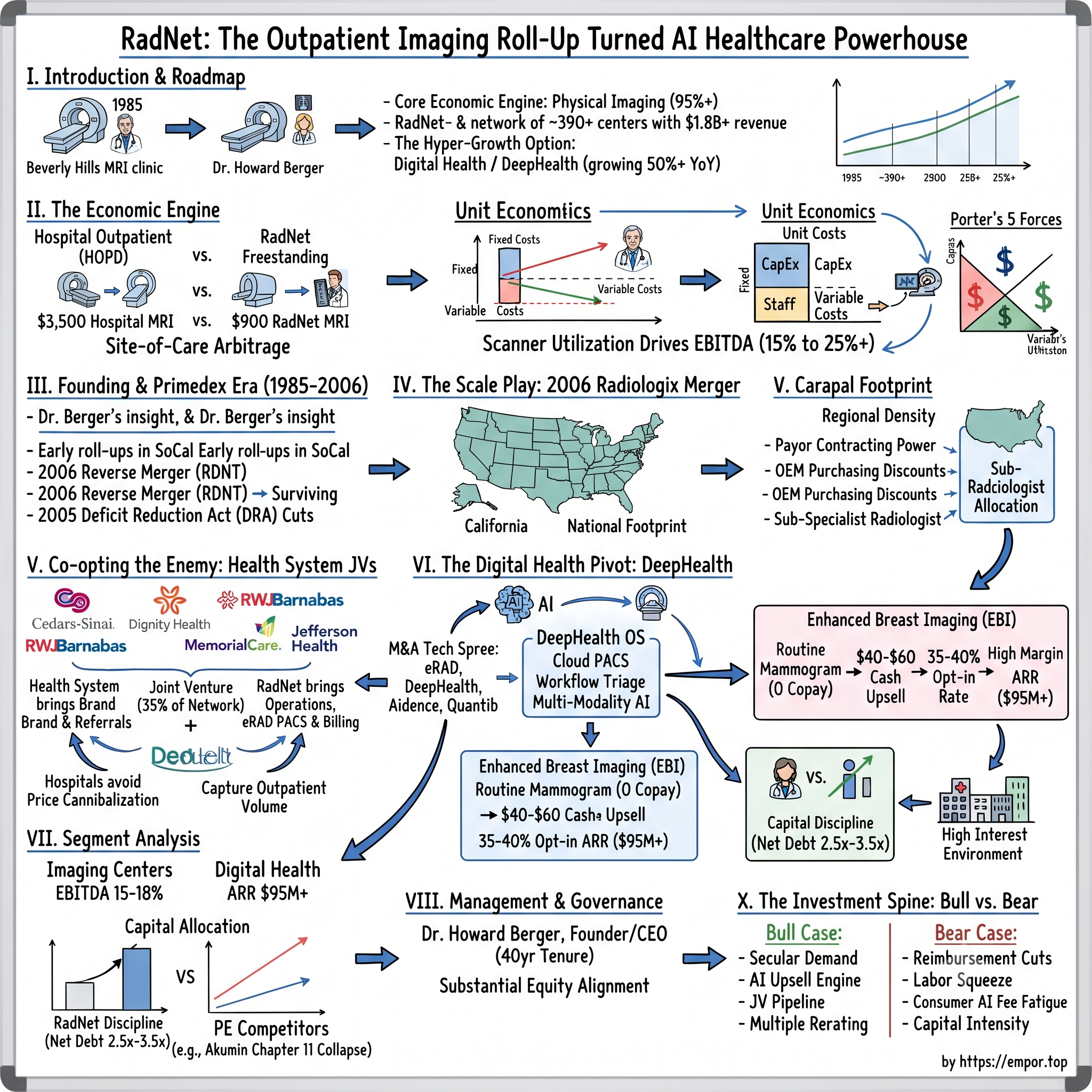
RadNet: The Outpatient Imaging Roll-Up Turned AI Healthcare Powerhouse
I. Introduction & Episode Roadmap
There is a building on Beverly Boulevard in Los Angeles, directly across the street from Cedars-Sinai Medical Center, where a small group of physicians opened a diagnostic imaging center in 1981. The location was not sentimental; it was a declaration. Placing a freestanding imaging center in the shadow of one of America's most prestigious hospitals signaled to West Los Angeles physicians that their patients had a clear choice: send them into the hospital's radiology department with its long queues and facility fees, or across the street to a facility that would scan them faster and bill less.
That single act of geographic provocation captured the core strategy that would define RadNet. Forty-five years later, the enterprise operated 418 imaging centers across nine states at the end of 2025, employed roughly 8,800 full-time staff—including more than 2,800 full-time technologists—and generated $2.04 billion in revenue with $300.2 million of adjusted EBITDA.12 By the first quarter of 2026, its center count reached 440.3 By location count and imaging revenue, RadNet is the largest owner and operator of freestanding outpatient diagnostic imaging centers in the United States.
Yet the primary driver of RadNet's valuation performance in recent years—trading more like a software company than a traditional hospital service provider—has little to do with its physical centers. Instead, market interest centers on a segment that produced $92.7 million in revenue in 2025—just 4.5% of the company total—and lost $32.3 million at the operating line.1 That segment, Digital Health, is built around the DeepHealth subsidiary and represents the most consequential capital allocation decision chief executive officer Dr. Howard Berger has made since 2006.
The core paradox. On paper, outpatient radiology is a demanding business. A single 3-tesla MRI scanner requires millions of dollars in upfront capital, while centers incur substantial ongoing lease, staffing, and licensing costs. Roughly 23% of imaging-center revenue comes from Medicare, where the Physician Fee Schedule has faced downward pressure for two decades, while Medicaid accounts for another 2.5%.1 Meanwhile, a national shortage of radiologists has driven up clinical labor costs, pushing RadNet's professional reading fees up 12.7% in 2025—outpacing overall revenue growth.1 The result is an operational profile marked by high fixed costs, government-regulated reimbursement rates, and a scarce, expensive labor supply.
However, the same structure that makes radiology challenging also renders it defensible. High fixed costs create operating leverage: every incremental scan processed through an active scanner drops a high percentage of revenue to the bottom line. Regulated pricing highlights site-of-care disparities, as nearby hospitals charge two to three times more for an identical image—a price gap that commercial payors and self-insured employers actively target.[^4] And because radiologists are scarce, the operator that successfully enhances clinician throughput captures the economic surplus.
Sizing the story to its economic weight. Physical imaging centers remain the operational core of the company, generating roughly 97% of total revenue and virtually all operating profit. For 2026, management guided the Imaging Center segment to $2.355 billion to $2.405 billion in revenue and $340 million to $353 million in adjusted EBITDA. By contrast, Digital Health is guided to $135 million to $145 million in revenue and $10 million to $12 million in pre-R&D adjusted EBITDA, alongside negative free cash flow of $17 million to $19 million.3 Digital Health is not yet a standalone profit engine; it functions as a growth option funded by the core centers' cash flow and capitalized aggressively by the market. Trading near $72 per share with a $5.7 billion market capitalization in early August 2026—against approximately $631 million in net debt at the end of Q1—RadNet trades near 17 to 18 times the midpoint of its 2026 adjusted EBITDA guidance.34 Historical transactions for outpatient imaging assets have typically valued facilities in the high single digits to low teens. The premium embedded in that valuation gap represents the market's expectation for its AI strategy—the primary thesis investors must underwrite.
What this piece will do. This analysis begins with industry economics, explaining why site-of-care price disparities persist and why scanner utilization drives operational profitability. It traces RadNet's corporate trajectory from a physician-founded management company through a reverse merger with Primedex, a workers'-compensation billing shell, to its navigation of regulatory shocks following the Deficit Reduction Act of 2005. The piece examines the pivotal 2006 acquisition of Radiologix that established national scale, the health-system joint-venture model that transformed hospital competitors into partners, and the DeepHealth acquisition strategy that reshaped its equity valuation. Finally, it evaluates the evidence supporting RadNet's technological transition versus management's claims—addressing a December 2025 short report alleging that Digital Health growth relies heavily on internal billing to RadNet's own centers, alongside company disclosures confirming aspects of that intercompany structure.15
The core question surrounding RadNet is straightforward: after forty-five years of building an established physical outpatient network, the company is asking public markets to price its business at a software valuation. Evaluating whether that multiple reflects genuine technological differentiation or an overextended valuation requires examining empirical operational metrics alongside market claims.
Understanding that valuation requires examining the underlying economics of diagnostic imaging—why a knee MRI costs what it does, and how revenue flows through the system.
 Subscribe on LinkedIn
II. The Medical Imaging Industry & Economic Engine
Imagine two buildings a quarter mile apart in suburban New Jersey: in one, a hospital outpatient department; in the other, a freestanding imaging center. Both house an MRI scanner from the same manufacturer, with identical field strength, running the same lumbar spine protocol. Both employ board-certified radiologists. For clinical purposes, the resulting images are indistinguishable.
The bills are not. Research analyzing private insurance claims shows that hospital outpatient departments charge materially more than physician offices and freestanding centers for identical imaging—an average knee MRI costs near $900 in a hospital outpatient setting versus roughly $600 in a freestanding facility, with the spread widening for higher-acuity studies in many markets.[^4] Medicare institutionalizes this price gap by reimbursing the same scan at a higher rate under the Hospital Outpatient Prospective Payment System than under the Physician Fee Schedule.[^4]
This structural divergence underwrites the freestanding imaging industry. Hospitals maintain emergency departments, intensive care units, uncompensated care, and round-the-clock clinical staffing. Outpatient imaging functions as a high-margin profit center that cross-subsidizes those capital-intensive operations, with negotiated commercial rates structured accordingly. A freestanding center carries none of that overhead. Consequently, an independent operator can undercut hospital pricing by a substantial margin while maintaining attractive margins—giving commercial payors, self-insured employers, and patients in high-deductible health plans a direct incentive to direct volume toward lower-cost ambulatory sites.
This volume shift serves as the primary tailwind for independent operators. On RadNet's fourth-quarter 2025 earnings call, Chief Executive Dr. Howard Berger attributed imaging center revenue growth to "the continuing shift of procedural volumes away from more expensive hospital alternatives to ambulatory freestanding centers."6 Company disclosures reflect that trend: commercial insurance revenue rose to $1.13 billion in 2025 from $1.02 billion in 2024, while Medicare revenue expanded to $477.0 million from $410.1 million.1
Not all scans are equal
Underneath those topline totals, procedure mix dictates profitability. RadNet performs nine diagnostic modalities, which divide into two distinct economic categories.
Advanced imaging—comprising MRI, CT, and PET/CT—represented 28.6% of RadNet's procedural volume in the fourth quarter of 2025 but generated over 60% of total revenue.6 These cross-sectional studies are technically complex: an MRI maps soft tissue via magnetic fields, a CT creates three-dimensional views from sequential X-ray slices, and a PET/CT tracks metabolic activity through injected radioactive tracers. They require greater capital investment and longer scan times, but command reimbursement rates several multiples above routine exams.
Routine imaging—including X-ray, ultrasound, screening mammography, and fluoroscopy—accounts for roughly 71% of volume but under 40% of revenue.7 These low-priced, high-throughput procedures operate near breakeven in some instances. Their strategic value lies in patient acquisition: a routine X-ray or ultrasound revealing an anomaly frequently generates a follow-up referral for a high-margin MRI or CT scan.
RadNet has increasingly tilted its procedural mix toward these higher-margin exams. Advanced imaging reached 29.3% of total volume in the first quarter of 2026, up 235 basis points year over year. PET/CT volume expanded 35.2% over that period, fueled by prostate cancer staging using PSMA tracers and brain amyloid imaging linked to newly approved Alzheimer's therapeutics.7 Same-center advanced imaging volume grew 8.2% during the quarter while routine volume remained essentially flat. When analysts questioned this divergence, Chief Financial Officer Mark Stolper noted that routine imaging volume typically tracks general population growth in the low single digits.7 That dynamic underscores that RadNet's revenue expansion relies heavily on driving higher-acuity scan volume rather than baseline procedure growth.
The unit economics: one number that matters
Stripped of modality distinctions, outpatient radiology functions primarily as a capacity-utilization model. Facility leases, equipment depreciation, service contracts, administrative overhead, and baseline technologist staffing represent fixed costs once a center opens. The incremental cost of processing an additional scan consists mainly of contrast agents, electricity, digital storage, and professional interpretation fees.
This structure creates operational leverage, though performance remains tied to underlying baseline conditions. In the first quarter of 2026, RadNet reported a 22.1% revenue increase and a 36.3% rise in adjusted EBITDA, expanding its operating margin by 115 basis points.8 However, adjusting for severe weather in both comparative periods and the disruption from the January 2025 Southern California wildfires yields an underlying imaging center margin expansion of 52 basis points.7 That 52-basis-point structural improvement on a mid-teens margin base illustrates steady operational gains, though it highlights the distance between physical center performance and software-like margin profiles.
Labor costs present the primary headwind to that operating leverage. RadNet absorbed approximately $30 million in same-center labor cost increases in 2025 and projected a similar 4% inflationary increase for 2026.6 In 2025, consolidated salaries rose 9.1% to $775.6 million, while professional reading fees grew 12.7% to $307.9 million.1 Together, those two lines accounted for 53% of total revenue. When an operator's primary cost input inflates faster than administrative reimbursement rates, driving volume throughput across existing assets becomes an economic necessity.
The five forces, briefly
Supplier power is high on both sides. Equipment manufacturers Siemens Healthineers, GE HealthCare, and Philips dictate scanner pricing and ongoing maintenance contract terms. Meanwhile, clinical staff—including 222 full-time and 88 part-time radiologists employed directly by RadNet, alongside contracted physician groups—exert substantial wage bargaining power amid an industrywide shortage of diagnostic specialists.1
Buyer power is high. Commercial payors and CMS establish reimbursement schedules. RadNet lacks pricing power to unilaterally raise fees; instead, management must negotiate network inclusion and optimize procedural mix.
Substitution risk is low. Cross-sectional and molecular imaging lack direct non-invasive alternatives in clinical diagnostics, sustaining underlying procedural demand.
New entrant risk is moderate and localized. High upfront capital requirements, state certificate-of-need regulations, and payor credentialing processes create barriers to entry, though well-capitalized regional competitors and health systems regularly construct competing outpatient facilities.
Rivalry is intense in fragmented markets and muted where RadNet has cluster density. That competitive dynamic explains why establishing regional market concentration, rather than broad national footprint alone, has served as the company's core strategy for two decades.
That strategic focus did not emerge fully formed; it developed out of an earlier period when the company faced severe financial strain.
III. Founding & The Primedex Era (1985–2006)
Howard G. Berger does not fit the typical profile of a healthcare roll-up founder. He is not a private equity operator who discovered radiology as a financial asset class, but a physician—board-certified in nuclear medicine, with training in internal medicine and a master's program in medical physics from the University of California system. He entered the imaging business from inside the reading room, an origin story that continues to shape RadNet's operational strategy.
The corporate history presents a slightly nuanced timeline. RadNet's official narrative notes the company was founded by six physicians, including Berger, initially providing billing and administrative services to Los Angeles-area radiology practices before opening its first imaging center across from Cedars-Sinai in 1981.9 Its annual filing, however, states simply that the business has operated since 1985.1 The discrepancy reflects different corporate entities and starting points, highlighting an early instance of the interpretive latitude found across RadNet's historical disclosures.
The underlying corporate trajectory remains clear. In 1990, Berger and Dr. Michael Krane bought out their four partners to become sole owners.9 In June 1992, RadNet was acquired by Primedex Health Systems, a publicly traded company whose primary business was managing medical clinics for workers' compensation claimants in greater Los Angeles.9 When California overhauled its workers' compensation regulations in the early 1990s, Primedex divested that clinic operation and effectively became a pure-play diagnostic imaging business. In 1995, Berger bought out Primedex's largest shareholder to become the dominant individual holder.9
Though market narratives often link RadNet's public emergence to 2006, its foundational reverse merger occurred in 1992. The 2006 restructuring primarily formalized the operating identity the company had adopted over the preceding decade.
The California machine
Throughout the 1990s, Berger expanded the footprint into a coordinated regional network rather than a loose collection of sites. Acquisitions targeted unglamorous single- and dual-modality practices across Southern California, often purchased from radiologist-owners who prioritized clinical care over administrative scale. The 1994 acquisition of Tower Imaging marked one of the largest early additions.9 Value creation depended on operational centralization: consolidating scheduling and billing, standardizing scan protocols, and pooling radiologist coverage so sub-specialists could interpret images across multiple facilities rather than a single site.
Underpinning this network was a corporate structure tailored to California regulatory requirements—a setup essential to understanding RadNet's financial reporting. Because California law prohibits the corporate practice of medicine, RadNet cannot directly employ interpreting radiologists. Instead, RadNet Management contracts with Beverly Radiology Medical Group III—a professional corporation 99% owned by Berger—under a management and services agreement, and consolidates the entity as a variable interest entity because RadNet acts as the primary beneficiary of its operations.101 While legally required, this structure creates a prominent related-party arrangement with the chief executive sitting on both sides of the contract.
Trial by fire: the Deficit Reduction Act
The business model faced its first major systemic stress with the passage of federal legislation. The Deficit Reduction Act of 2005 capped the technical reimbursement component for diagnostic imaging in physician offices and freestanding centers at the lesser of the Physician Fee Schedule rate or the hospital outpatient fee schedule, effective January 1, 2007.11 The cuts focused directly on advanced modalities—MRI, CT, PET, and vascular ultrasound—that generated the bulk of industry profits. Initial estimates pointed to an average revenue reduction near 30%, with the policy projected to save Medicare roughly $2.8 billion over five years.12
For a leveraged, capital-intensive operator exposed to Medicare reimbursement, the legislative shift represented a severe threat. While many independent operators downsized, sold out, or declared bankruptcy, RadNet responded by leaning into its core thesis: if fee rates fall by government mandate, an operator must push higher scan volumes through its fixed asset base while building regional scale to preserve pricing power with commercial payors.
Executing that strategy required local cluster density—owning sufficient scanner capacity across a metropolitan market so that health plans could not assemble a viable provider network without including RadNet facilities. Rather than curtailing investment, RadNet sought rapid expansion at a time when capital costs were climbing and sector revenue expectations were dropping. In 2006, as the industry absorbed the impending federal cuts, Berger moved to negotiate the largest acquisition in outpatient imaging history.
IV. The Scale Play: The 2006 Radiologix Merger & Regional Density Model
On July 7, 2006, Primedex Health Systems announced an agreement to acquire Radiologix, Inc. in a cash-and-stock transaction initially valued at roughly $208 million, including net debt.13 By the time the transaction closed on November 15, 2006, an increase in Primedex's stock price had raised the implied deal value to approximately $221 million.14 Radiologix shareholders received 22,621,922 Primedex shares and $42.95 million in cash.14 The combined entity operated 134 locations, creating the largest owner and operator of fixed-site diagnostic imaging centers in the United States.14 Days after closing, Primedex executed a one-for-two reverse stock split and changed its name to RadNet, Inc.15 To finance the transaction and restructure existing debt, the company secured approximately $405 million in syndicated funding.9
The timing of the transaction was notable: RadNet added substantial leverage to acquire a national imaging platform during the precise quarter when federal regulators were preparing to implement the Deficit Reduction Act's nearly 30% cut to Medicare technical reimbursement. The move positioned the company to test whether sheer scale could offset systemic pricing shocks.
Why it worked: density, not breadth
The strategic rationale hinged on local density rather than national breadth. In physical healthcare delivery, market power accrues within specific metropolitan statistical areas rather than across broad national footprints. Controlling a high percentage of outpatient scanner capacity in concentrated regions—such as Los Angeles, Northern New Jersey, Baltimore, or Long Island—provides distinct commercial advantages unavailable to an operator holding a fractional share across dozens of states.
Radiologix provided that concentrated footprint, contributing an East Coast presence across Maryland, Delaware, New York, and New Jersey to complement RadNet's established California base. Company filings articulate this logic directly, noting that RadNet seeks "leading positions in regional markets in order to leverage operational efficiencies," while attributing its long-term relationships with key payors, radiology groups, and referring physicians to its regional scale and density.1
Regional density generates economic returns through three primary mechanisms:
Payor contracting. Commercial health plans constructing provider networks require comprehensive geographic coverage for members within a metropolitan market. When a single operator controls a substantial portion of convenient outpatient sites, payors cannot easily construct competitive networks without including those facilities, strengthening the operator's leverage in rate negotiations.
Purchasing power. Fleet procurement of advanced imaging equipment yields volume discounts on capital purchases and, more critically, on multi-year maintenance service contracts, which constitute a major component of an imaging scanner's total lifetime operating cost.
Sub-specialist allocation. In an unintegrated practice, a sub-specialized radiologist stationed at a single clinic interprets general studies based on local walk-in volume. By linking dozens of centers through a centralized picture archiving and communication system, an operator can route imaging studies digitally across the network. A neuroradiologist can interpret brain and spine scans continuously regardless of where the patient was scanned, maximizing clinical productivity. This digital routing of scarce professional labor laid the operational foundation for RadNet's subsequent digital health strategy.
The footprint today
By the end of 2025, RadNet operated imaging centers across nine states: Arizona, California, Delaware, Florida, Maryland, New Jersey, New York, Texas, and Virginia.1 In January 2026, the company expanded its footprint by acquiring 13 centers in Southwest Florida for approximately $65 million and entering Indiana through the acquisition of six Northwest Radiology centers around Indianapolis for roughly $9 million—transactions expected to contribute approximately $120 million in combined revenue for 2026.67 Internationally, RadNet operates a majority-owned UK teleradiology business, The HLH Imaging Group, which provides remote interpretation services to National Health Service facilities.1
Those early 2026 transactions demonstrated disciplined capital allocation, deploying approximately $74 million in cash to acquire roughly $120 million in annual revenue—reflecting a transaction price below 0.7 times annual revenue. The physical network expanded steadily over the preceding years, growing from 366 centers at the end of 2023 to 398 at year-end 2024 and 418 by the end of 2025.1
Yet regional density alone could not resolve a fundamental competitive dynamic. In nearly every metropolitan market RadNet entered, its primary competitor was not another independent outpatient chain, but the local health system.
V. Co-opting the Enemy: The Health System Joint Venture Strategy
Hospital chief financial officers face a stark dilemma when observing outpatient MRI volumes shift to lower-cost freestanding centers. Building competing freestanding facilities risks cannibalizing the hospital system's own high-margin outpatient billing, while taking no action guarantees a steady loss of market share.
RadNet offered health systems a middle path: joint-venture partnerships.
The operational structure divides responsibilities cleanly. RadNet handles center operations, including scheduling, technologist staffing, scanner procurement, revenue cycle management, and the imaging IT stack built on its eRad subsidiary.1 The health system partner contributes its regional brand, physician referral networks, and payor contract alignment. Ownership is shared, with RadNet often holding a minority stake. For example, the New Jersey Imaging Network partnership with what became RWJBarnabas Health, expanded in 2015, left RadNet with a 49% stake and the health system affiliate with 51%—with RadNet explicitly serving as neither borrower nor guarantor on the venture's debt.161 Similar partnerships with Cedars-Sinai in Los Angeles began forming in 2017 and expanded thereafter.17 By late 2024, RadNet's disclosed partner roster included MemorialCare with 34 centers, RWJBarnabas with 28, Dignity Health with 14, and Cedars-Sinai with 5.[^19]
The model has scaled from a niche arrangement into a central growth vector. At the end of 2025, 151 of RadNet's 418 centers—or 36.1%—operated within health system partnerships.6 Following the April 30, 2026 acquisition of a 51% interest in a Saint Alphonsus Health System partnership entity in Boise, Idaho—which added roughly $30 million in annual revenue for approximately $17 million in cash—the joint-venture count reached 155 of RadNet's 440 centers.718
Why hospitals sign
The economic logic relies on strategic counter-positioning. A hospital system that constructs its own discounted freestanding network uses its own capital to erode its highest-margin facility-fee revenues. By partnering with RadNet, the health system captures a share of ambulatory imaging economics, retains downstream patient referrals within its care network, and avoids directly competing against its own hospital billing structure. The incumbent's existing economics prevent a symmetric competitive response.
By 2025 and 2026, management broadened this pitch to address systemic industry headwinds. On the fourth-quarter 2025 earnings call, Chief Executive Dr. Howard Berger noted that inbound inquiries from health systems had "dramatically increased over the last 12 to 18 months," driven primarily because "the radiologist staffing shortage is an acute problem virtually for every hospital system no matter what size it is."6 Because staffing alone is not RadNet's core offering, initial inquiries frequently expand into broader negotiations encompassing imaging IT, artificial intelligence tools, and outpatient growth. Berger added that traditional center acquisitions were "being dwarfed by potentially larger opportunities with health systems that, instead of just maybe having five hospitals, may have 50 or 100 hospitals."6
This evolution shifts RadNet's value proposition from basic facility management to workforce-scarcity solutions. Whether the company's digital health infrastructure can deliver on that expanded mandate remains a key operational test.
What to be skeptical about
Despite the structural strengths of the joint-venture strategy, three analytical caveats warrant scrutiny.
First, earnings are shared with partners. In 2025, RadNet operated 368 consolidated imaging centers, 101 of which were not wholly owned, generating $35 million in net income attributable to noncontrolling interests—representing 1.7% of total revenue.1 This noncontrolling allocation represents a prior claim on earnings, serving as a primary reason RadNet reported a GAAP net loss of $18.7 million attributable to common stockholders in 2025 despite generating $300.2 million of adjusted EBITDA.12 While adjusted EBITDA metrics exclude noncontrolling interest allocations, GAAP net income reflects the actual residual value accruing to common shareholders.
Second, joint ventures carry contractual and governance risks. These partnerships rely on fixed-term operating agreements with shared decision-making. A partner health system that develops internal outpatient capabilities or undergoes a strategic shift following a merger can alter its partnership posture upon contract renewal.
Third, pipeline projections remain prospective until transactions close. Chief Financial Officer Mark Stolper stated in March 2026 that it was "highly likely that in 2026 we will be announcing some new health system relationships as well as expanding existing ones."6 While the Saint Alphonsus transaction in Idaho closed by early May, demonstrating ongoing execution, broad-scale acceleration across major multi-hospital networks remains to be proven in reported financial results.
The joint-venture strategy stands as RadNet's most proven competitive advantage: it is measurable, has compounded for a decade, and leverages a structural conflict inherent to hospital business models. By contrast, the company's digital health and AI strategy represents a far more speculative valuation driver—one carrying high market expectations against early operational evidence.
VI. The Digital Health Pivot: Building DeepHealth & AI Monetization
In June 2020, in the middle of a pandemic that had temporarily emptied his imaging centers, Berger hired Gregory Sorensen — a radiologist and the former CEO of Siemens Healthcare North America — and bought a small Massachusetts machine learning company founded out of the MIT research community.119 The company was called DeepHealth. The price was reported at over $40 million.20 RadNet's revenue that year was $1.07 billion. Nobody thought it mattered.
Six years later it is the reason people argue about the stock.
The structural problem DeepHealth is aimed at
Start with the constraint, because the constraint is real and is not a marketing construct. Imaging volumes are rising globally — driven by aging populations, expanding clinical indications, and equipment that keeps getting better. The supply of radiologists is roughly flat. Something has to give.
There are only three ways out. Train more radiologists, which takes a decade and is not happening at the required rate. Ration access, which is what long backlogs already represent. Or make each radiologist meaningfully more productive.
DeepHealth's president and CEO, Cornelis Wesdorp, described the target state on the first quarter 2026 call in a sentence that is worth taking seriously as a statement of intent: "every imaging study should and will be read by AI, automating pre-interpretation workflows and delivering an AI-curated draft report to radiologists as they start their reading."7 The shift he is describing is from radiologist-as-author to radiologist-as-editor. As DeepHealth's Sham Sokka pointed out on the fourth quarter 2025 call, for many exams the reporting — dictating findings into a clinical document — takes more of the physician's effort than the interpretation itself.6 If a machine drafts the report and the physician verifies it, the productivity math changes materially.
The shopping list
RadNet assembled the capability by acquisition, at accelerating pace:
- eRad, the in-house PACS and radiology information system business, gives RadNet ownership of the workflow layer — the software that stores, routes, and displays images.1
- DeepHealth (2020) brought screening mammography AI and the leadership team.20
- Aidence and Quantib, two Dutch specialists, closed in January 2022 for a combined total reported at close to $100 million, adding lung nodule detection and prostate and brain MRI quantification.2122
- See-Mode Technologies (June 2, 2025, ~$28.9 million) added ultrasound AI, notably thyroid.1
- iCAD (July 17, 2025) was acquired in an all-stock exchange with total purchase consideration of approximately $110.7 million, bringing a large installed base in breast health and, per the deal announcement, taking combined annual mammograms touched by RadNet's AI to around 10 million across 1,700 sites in 50 countries.123
- CIMAR (UK) (November 10, 2025) added cloud image exchange, including infrastructure behind the UK's lung cancer screening program.17
- Gleamer SAS, announced and closed on March 2, 2026, was the largest: a Paris-based, cloud-native radiology AI company with more than 700 customer contracts across 44 countries and roughly 130 employees, acquired for cash valued at up to €230 million (about $270 million) inclusive of post-closing milestones.2425 Gleamer grew annual recurring revenue at a compound rate above 90% from 2022 to 2025 and was expected to reach approximately $30 million of ARR in 2026.24
Gleamer matters strategically because it is strongest in X-ray — roughly a quarter of RadNet's own imaging volume — and because it had already deployed automated reporting with European customers.6 Management claims the combination makes DeepHealth the largest provider of radiology clinical AI solutions worldwide, with 26 FDA clearances and 22 CE marks and a combined installed base of over 2,700 customers.67
The direct-to-consumer experiment
The most commercially interesting thing DeepHealth built is not sold to hospitals at all. It is sold to women standing at a check-in desk.
Under the Affordable Care Act, an annual screening mammogram is covered without cost sharing. RadNet's Enhanced Breast Cancer Detection program offers patients an optional add-on: a second read of their mammogram by DeepHealth's FDA-cleared SmartMammo software plus an additional physician safeguard review, paid out of pocket. The program launched in 2023 at $75 per screening and was cut to roughly $40 partway through the company's own outcomes study.2627
The results, presented at the Radiological Society of North America's 2024 meeting from data covering 747,604 women across ten clinical practices over twelve months, were striking in both directions. Opt-in was 23% overall, rising to 33% in the final month studied — evidence of genuine consumer demand for a service insurance does not cover.26 Cancer detection among women who chose AI was 43% higher (5.95 versus 4.15 per thousand), of which the study attributed roughly half to the AI itself and roughly half to higher-risk women self-selecting into the program.26 Recall rates were also 21% higher for the AI group — meaning more women called back for additional imaging that would ultimately prove negative.26
That last number is the honest tension in the product, and an analyst pressed on it directly during the first quarter 2026 call: does mammography AI over-flag? Sokka's answer was technically careful — these are task-specific detection models, not generative ones, so "there's no concept of hallucination" — and he described continuously retraining on RadNet's own 1.6 to 2 million annual mammograms, incorporating prior studies, to bring the false-positive rate down.7 He then went further than management usually does, saying the models are candidates "for eventually driving also autonomous type of detection as we go forward."7 That is a regulatory and liability question at least as much as a technical one, and it is not close to resolved.
The economics are the point for investors. This is cash revenue with negligible incremental cost per run. It is also, so far, a modest number. Management explained on the fourth quarter 2025 call that the gap between Digital Health's $92.7 million of 2025 revenue and its $75.4 million of year-end annual recurring revenue was "predominantly the DTC revenue" — implying direct-to-consumer breast AI ran in the mid-to-high teens of millions.6 Real, growing, high-margin, and roughly 0.9% of company revenue.
The strategic bet is that it does not stay direct-to-consumer forever. RadNet has been signing coverage arrangements — three Heritage Provider Network affiliates in Southern California, including Regal Medical Group and Lakeside Community Healthcare, added the program as a member benefit — and management has expressed confidence that national carriers and self-insured employers will begin reimbursing it.2728 If that happens, the revenue per mammogram stops depending on a woman's willingness to pay at the counter. If it does not, RadNet is left charging out of pocket for a service its own data suggests improves cancer detection, which is a position that invites ethical scrutiny and eventual political attention.
The reimbursement flywheel nobody talks about
There is a second, less-publicized monetization path that may matter more. Sokka explained on the first quarter 2026 call that certain AI-enabled quantification and characterization services already have Medicare Category III ("T") codes across ultrasound, CT, and MR. For thyroid ultrasound, coverage among payors has moved from roughly a quarter of insurers early on to 60–70% today.7 Breast ultrasound represents about three times the volume of thyroid at RadNet — over 800,000 of roughly 2.7–2.8 million annual ultrasound exams — and could use the same code path once cleared.7 Neuro MRI adds more than a million studies.7
Wesdorp's framing is the useful one: penetration is high, productivity gains are being captured now, "the billing gains are in early stages."7 Roughly 70% of RadNet's studies now pass through some form of AI — about 60% DeepHealth, 10% third party — and he estimated the company is perhaps one-third of the way through its own clinical AI roadmap.7 Thyroid ultrasound AI deployed across nearly 300 sites cut ultrasound slot times from 30 minutes to 20 — a 33% capacity increase on that modality without a dollar of new capital.7 TechLive, the remote scanning tool that lets an expert technologist supervise multiple scanners from a distance, was credited with reducing exam room closure hours and materially helping MRI utilization.67
Those are the most credible AI claims RadNet makes, precisely because they are internal, measurable, and show up in the same-center numbers rather than in a slide deck.
What the evidence does not yet support
Now the discipline. Digital Health's 2025 GAAP loss from operations was $32.3 million on $92.7 million of revenue, more than double the prior year's $14.9 million loss.1 The segment's adjusted EBITDA of $15.5 million is calculated before roughly $20.2 million of non-capitalized research and development on the DeepHealth Cloud OS and generative AI, and before $9.9 million of stock-based compensation.16 Both are real costs of running this business.
More pointedly, RadNet's own 10-K contains a sentence that reads like it was written by a short seller: for 2025, Digital Health results "reflect steady organic growth prior to the acquisition and a sharp acceleration in the third quarter following the inclusion of iCAD, highlighting that recent performance was driven primarily by external expansion rather than internal volume increases."1 And intersegment eliminations of $40.7 million against $92.7 million of segment revenue mean roughly 44% of Digital Health's 2025 revenue was RadNet selling to RadNet.1
Management has been transparent that this is changing — external revenue reached 64% of Digital Health revenue in the first quarter of 2026, up from 51% a year earlier, and the RadNet-internal share was guided to fall from 45% in 2025 to about 33% in 2026.67 ARR reached $96.9 million at March 31, 2026, up 95% year over year, against a target approaching $140 million by year-end that includes roughly $30 million from Gleamer and $7 million from annualizing iCAD.36 Strip those out and the implied organic ARR build for 2026 is about $27 million.6
That is the number to hold onto. Not $140 million. Twenty-seven million dollars of organically sold, externally contracted, recurring software revenue in a year — against a company being valued as a technology platform.
It is growing fast. It is not yet large. And the market has already paid for it.
VII. Segment Deep-Dive & Capital Deployment Analysis
Evaluating an outpatient radiology roll-up requires looking beyond corporate presentation slides to analyze balance sheet performance across economic cycles. RadNet's financial history reveals a capital deployment model distinctly different from its debt-heavy competitors.
The two segments, in plain numbers
The core Imaging Centers segment generated $1.988 billion in 2025 revenue, up 10.9% from $1.792 billion in 2024, driven by higher fees per procedure and volume growth across existing and acquired centers—with advanced PET/CT scans for prostate cancer and Alzheimer's disease cited as specific drivers.1 However, segment operating expenses rose 13.2% to $1.89 billion, outstripping revenue growth and keeping operating margin expansion confined to basis points.1 Following a first-quarter guidance increase, management projected full-year 2026 segment revenue of $2.355 billion to $2.405 billion, adjusted EBITDA of $340 million to $353 million, and free cash flow of $112 million to $122 million.3
Digital Health presents the opposite profile: compact, rapidly expanding, and operating at a loss. Management guided 2026 segment revenue to $135 million to $145 million, adjusted EBITDA before R&D to $10 million to $12 million, and negative free cash flow of $17 million to $19 million.3 DeepHealth chief executive Cornelis Wesdorp told investors that the organically growing core of Digital Health operates at 30% to 40% EBITDA margins, attributing current segment losses to recent acquisitions and deliberate investments in commercial and deployment capacity. Wesdorp confirmed that 2026 should mark the trough for segment margins while reaffirming the target of approximately 20% segment EBITDA margin by 2028 set at RadNet's November 2025 Investor Day, noting potential upside alongside continued reinvestment.729
That 30% to 40% core margin claim represents an un-audited management characterization rather than a standalone audited financial segment disclosure, and investors should evaluate it as a corporate projection rather than a verified GAAP metric.
The counterexample: what happens when the balance sheet is wrong
The strategic rationale behind RadNet's capital structure becomes clear when contrasted with competitors that relied heavily on private equity debt to fund outpatient imaging consolidation.
In 2021, competitor Akumin Inc. borrowed heavily from Stonepeak to finance an $820 million acquisition of Alliance HealthCare Services. As interest rates escalated and debt service mounted, an operational disruption from a ransomware attack further constrained cash flows. On October 22, 2023, Akumin filed for Chapter 11 bankruptcy protection to restructure approximately $1.6 billion in total debt and seek elimination of roughly $470 million in liabilities.30 The prepackaged bankruptcy deleveraged the company by about $600 million and closed on February 6, 2024, with Stonepeak injecting $130 million to take Akumin private.31
Operating in the same industry with identical secular tailwinds and Medicare reimbursement pressures, Akumin's restructuring illustrates how capital structure dictates outcomes in outpatient radiology. The episode also highlights that cybersecurity threats like ransomware represent an ongoing operational risk across cloud-connected picture archiving and communication networks—including RadNet's eRad infrastructure.
RadNet's answer: sell equity into strength
Rather than accumulating high-cost debt for acquisitions, RadNet has systematically used its equity as funding currency during periods of strong market valuation. In June 2023, as its share price recovered, the company raised approximately $175 million in gross equity proceeds, using $100 million to pay down first-lien term loans.32 In March 2024, RadNet upsized a follow-on equity offering to raise roughly $230.2 million by selling 5,232,500 shares at $44 each.33 Cash flow statements reflect net common stock issuance of $218.4 million in 2024 and $245.8 million in 2023.34 The 2025 acquisition of iCAD was funded entirely through stock.1
As a result of these equity raises, RadNet entered 2026 with a balance sheet significantly stronger than historical industry norms: $767 million in cash at year-end 2025, $323.5 million in net debt at par less cash, net leverage of approximately 1.0 times adjusted EBITDA, and an undrawn $282 million revolving credit facility.6 Total term loan indebtedness stood at $1.085 billion, of which $123.7 million sat at the non-recourse New Jersey Imaging Network joint venture where RadNet is neither borrower nor guarantor.1
Management subsequently deployed that financial flexibility in early 2026. Cash acquisitions—including 13 centers in Southwest Florida, six centers in Indiana, a center in Virginia, and the Gleamer purchase—consumed a large portion of cash reserves in the first quarter, lowering cash to $455.3 million and pushing net leverage to approximately 2.0 times adjusted EBITDA.7 In June 2026, RadNet added a $250 million incremental term loan while simultaneously cutting the rate on its existing term debt by 25 basis points to Term SOFR plus 2.00%, with the combined loan maturing in April 2031 and quarterly principal amortization rising from $2.4 million to approximately $3.1 million.35
The rate reduction on an expanded credit facility reflects lender confidence in RadNet's underlying cash generation, providing a market-driven signal of financial stability that carries more weight than management commentary alone.
The capital intensity that never goes away
Despite balance sheet strength, outpatient imaging remains fundamentally capital-intensive. RadNet spent $213.3 million on capital expenditures for property and equipment in 2025, up from $188.1 million in 2024 and $176.6 million in 2023.34 Operating cash flow was $298.8 million in 2025, yielding simple free cash flow before acquisitions of $85.6 million—a modest figure relative to a $5.7 billion market capitalization.34 Cash spent on acquisitions consumed another $133.4 million during the year.34 Days sales outstanding fell to a company-record 29.5 days, which management attributes to point-of-service patient collections and improved payor querying—a speed that represents an industry-leading collection performance.67
This capital reinvestment represents an ongoing operational requirement rather than discretionary growth spending: MRI and CT scanners face technological obsolescence, and centers that fail to upgrade risk losing physician referrals. With annual capital expenditures near 10% of revenue, RadNet's $300.2 million in reported 2025 adjusted EBITDA converts to less than one-third that amount in actual cash available to equity holders after accounting for capital expenditures, debt service, and noncontrolling interest distributions. Valuation frameworks based solely on EBITDA multiples flatter this operational profile.
An accounting note worth flagging
Two accounting items in 2025 warrant specific attention. Stock-based compensation nearly doubled to $54.6 million in 2025 from $29.8 million in 2024—comprising $44.7 million in Imaging Centers and $9.9 million in Digital Health—and is excluded from adjusted EBITDA calculations by definition.134 At current share prices, that compensation represents tangible shareholder dilution presented as a non-cash adjustment. Additionally, RadNet recorded an $8.6 million lease abandonment charge in December 2025 on centers it closed and consolidated, including $6.7 million in right-of-use asset impairments.1 While small in absolute terms, the charge serves as a reminder that not every facility in a 440-center network remains productive.
RadNet's independent auditors issued an unqualified clean opinion on internal control over financial reporting for 2025, with disclosures containing no going-concern language or identified material weaknesses.1 In a sector marked by recent bankruptcy restructurings, that audit result provides a baseline expectation of financial reporting integrity.
VIII. Management, Governance & Capital Allocation Track Record
Dr. Howard Berger has managed RadNet across its various corporate iterations for over four decades, while Mark Stolper has served as chief financial officer since 2004. In an industry marked by frequent turnover among private equity sponsors, restructurings, and executive leadership teams, this management continuity offers operational stability, yet it also presents governance questions that warrant close evaluation.
The operator
On earnings calls, Berger distinguishes his approach by evaluating operational and technology questions through a clinical lens. Asked in March 2026 whether artificial intelligence would disrupt radiology, he rejected the premise, arguing that unlike other sectors, healthcare AI will not result in widespread employee replacement because clinical workforce supply already trails procedural demand.6 He cited RadNet's internal screening data indicating early cancer detection improvements of 20% to 22%—a figure broadly aligned with findings presented at the Radiological Society of North America conference, though framed toward the upper end of reported ranges.626
Berger's transaction strategy reflects a similar operational orientation. Describing management's philosophy in May 2026 as entering a market with an initial acquisition and expanding around it through de novo facilities, tuck-in purchases, and health-system partnerships, he noted that RadNet functions as an active builder rather than a passive holding entity.76 The company opened seven de novo facilities in 2025 and guided to 11 to 13 additions in 2026.6
Stolper maintains a detailed disclosure practice on financial calls, frequently itemizing operational headwinds before analyst inquiries arise. In prepared remarks for the first quarter of 2026, he outlined an estimated $13 million revenue and $9 million adjusted EBITDA impact from severe weather, then normalized comparative margins against prior-year weather and wildfires to report an underlying 52-basis-point margin expansion.7 He similarly itemized a projected $30 million labor cost headwind embedded in 2026 guidance and an estimated $5 million EBITDA drag from the Gleamer acquisition.6 When asked on an earnings call to break down first-quarter payroll tax and bonus seasonality without immediate figures at hand, he referred analysts to historical reporting patterns rather than estimating.7
While these reporting practices demonstrate transparent communication, they operate independently of board-level governance oversight.
The governance questions
Combined Chairman and CEO. Berger serves simultaneously as President, Chief Executive Officer, and Chairman of the Board. While combining executive and board leadership roles is common among founder-led companies, it consolidates oversight power within executive management.
The related-party professional corporation. A more complex structure involves Beverly Radiology Medical Group III, the professional corporation whose physicians interpret RadNet's California scans. The entity is 99% owned by Berger personally, with RadNet consolidating it as a variable interest entity and collecting management fees under a long-standing service agreement.101 Although California's prohibition on the corporate practice of medicine necessitates a legal separation between facility operations and medical interpretation, the regulation does not mandate that the chief executive officer personally hold ownership of the medical group. This arrangement places Berger on both sides of fee negotiations between RadNet and its primary physician partner—creating a prominent related-party structure that requires ongoing investor scrutiny.
Ownership alignment is lower than founder narrative suggests. Although market commentary often characterizes RadNet as founder-aligned through equity, recent SEC Form 4 filings indicate that Berger directly holds approximately 498,405 shares, with an additional 20,000 shares held indirectly through his spouse.36 Relative to approximately 78 million total shares outstanding, his direct equity stake represents less than 1% of common stock, prior to unvested equity awards. While his economic interest in Beverly Radiology Medical Group III provides separate cash flow, it does not constitute equity ownership in RadNet Inc. As a result, executive alignment is driven primarily through annual compensation structures rather than substantial direct equity ownership.
The short seller
On December 16, 2025, approximately one month after RadNet's Investor Day and following a peak in market capitalization above $6.5 billion, Hunterbrook Media published an investigative report led by journalist Bethany McLean titled "RadNet: The AI Story That Doesn't Add Up," while affiliated fund Hunterbrook Capital disclosed a short position.537 The company's share price declined following the publication.
The report outlined several specific allegations: that Digital Health segment growth relies heavily on internal invoicing to RadNet's core imaging centers; that same-center performance metrics were boosted by undisclosed facility consolidations; that financial disclosures contained reconciliation discrepancies; that the AI segment represents under 5% of consolidated revenue; that corporate insiders sold over 780,000 shares valued at $50.9 million over a two-year period without open-market purchases; and that following RadNet's agreement to acquire iCAD, major imaging operator SimonMed—a key iCAD client—contracted with rival vendor Lunit, indicating potential channel conflict as industry peers view DeepHealth as a direct competitor.537 RadNet did not issue a public response to Hunterbrook's inquiries.5
Evaluating these claims against corporate filings confirms several underlying facts. Digital Health generated less than 5% of total revenue in 2025, intersegment eliminations accounted for roughly 44% of segment revenue,1 and RadNet's annual 10-K explicitly attributed recent Digital Health growth to external acquisitions rather than organic expansion.1 Furthermore, offering software to competing outpatient operators presents an inherent channel conflict when those peers compete directly against RadNet's physical center network.
Conversely, empirical disclosures temper other elements of the short thesis. The share of internal revenue within Digital Health has contracted along management's disclosed trajectory, declining from 45% in 2025 toward a guided 33% in 2026, with external revenue reaching 64% of the segment in the first quarter.67 Additionally, the acquisition of France-based Gleamer establishes an entirely external, recurring revenue base across 44 international markets where RadNet operates no physical centers—providing a direct structural answer to regional channel conflict.24 Finally, insider share sales following a multi-year equity rally represent a common liquidity pattern for executives whose equity grants vest periodically over time.
Ultimately, the short report highlighted a shift in evaluation criteria for public markets. Having introduced annual recurring revenue reporting alongside software acquisitions, management established an explicit target of approximately $140 million in ARR by year-end 2026.6 That metric provides a clear, quarterly benchmark to evaluate whether Digital Health is achieving standalone commercial adoption.
Guidance discipline
Historically, RadNet's financial guidance has followed a conservative baseline that management subsequently raises as operational visibility improves. In 2025, the company met or exceeded its initial Imaging Centers guidance across revenue, adjusted EBITDA, and free cash flow after increasing target ranges mid-year.6 In May 2026, management again raised full-year imaging center guidance based on strong spring volume, while holding Digital Health projections unchanged.3 Stolper noted that guidance incorporates minimal operational efficiency gains from internal AI deployments, framing potential productivity improvements as an unmodeled operational upside.6 Meanwhile, the long-term framework presented at the November 2025 Investor Day—targeting 11% to 13% annual revenue growth through 2028 and 100 to 150 basis points of margin expansion to drive mid-teens EBITDA growth—provides a multi-year yardstick to evaluate that claim.29
IX. The Playbook: Strategic & Investment Lessons
Stripping RadNet down to its core business principles reveals four transferable strategic lessons.
Lesson 1: In physical services, local market share outweighs national footprint. RadNet's pricing leverage stems not from being the largest diagnostic imaging operator nationwide, but from establishing near-indispensability across concentrated metropolitan markets like Los Angeles, Northern New Jersey, Baltimore, and Long Island. Payor networks, physician referrals, and specialized radiologist coverage operate locally and regionally. Holding a 1% market share across fifty fragmented cities yields fifty weak negotiating positions. That dynamic explains why RadNet entered Southwest Florida by acquiring 13 centers in a single transaction, with chief executive officer Dr. Howard Berger immediately outlining plans to follow with de novo builds, tuck-in acquisitions, and health-system joint ventures within that same geographic cluster.6
Lesson 2: When key competitors face structural disincentives to copy you, partner with them. The health-system joint venture represents a classic model of strategic counter-positioning in healthcare services. It succeeds because a hospital's high-margin outpatient facility fees create a direct financial barrier against lowering its own prices. Rather than attempting to overturn that industry dynamic, RadNet built a partnership model around it. The broader lesson applies across capital-intensive services: target markets where incumbents' existing profit pools make a competitive price response financially irrational for them.
Lesson 3: Own the distribution network before scaling the software. DeepHealth's primary structural advantage lies less in proprietary algorithms—where competitors such as Lunit and imaging divisions at GE HealthCare, Siemens Healthineers, and Philips offer competing models—than in its internal deployment environment. RadNet can launch new software across nearly 300 internal sites, measure productivity shifts directly in its operating results, retrain models on its 1.6 million to 2 million annual mammograms, and then market the verified tools to external clients.7 Few radiology AI developers possess both a national center network and an in-house software arm. Operational metrics—such as reducing thyroid ultrasound slot times from 30 minutes to 20—provide the type of empirical proof that only an owner-operator can generate.7
However, that same integration creates a persistent channel conflict. Owning physical distribution accelerates product iteration, but it also transforms the software vendor into a direct competitor against potential third-party customers. RadNet has yet to demonstrate that it can fully resolve that tension.
Lesson 4: In capital-intensive sectors, capital structure is strategy. While competitors like Akumin and RadNet confronted identical Medicare reimbursement cuts, clinical labor inflation, and rising interest rates, their financial structures dictated opposite outcomes. Akumin filed for Chapter 11 bankruptcy under heavy debt, whereas RadNet entered 2026 with net leverage at approximately 1.0 times adjusted EBITDA and $767 million in cash, enabling it to fund major technology acquisitions.630 Issuing equity during periods of valuation strength creates dilution, yet it provided the liquidity required to expand while peers were forced to restructure.
That balance sheet advantage, however, requires ongoing capital discipline. RadNet's net leverage rose from 1.0 times to approximately 2.0 times adjusted EBITDA in a single quarter, followed by the addition of a $250 million incremental term loan.735 While current cash flows comfortably support that debt load, the increase illustrates that financial flexibility remains an active operational choice rather than a permanent structural guarantee.
X. The Investment Spine: Bull vs. Bear Case & Risk Radar
The key analytical question is not whether RadNet is a viable enterprise; it is a proven operator with a defensible physical footprint. The core issue is whether the market's valuation premium is justified by empirical operational evidence.
Why RadNet wins from here
Demographic trends and clinical advances provide a steady volume tailwind. Advanced imaging is expanding across key modalities: in the first quarter of 2026, total PET/CT procedure volume rose 35.2%—with same-center volume up 14.7%—driven by prostate cancer staging and amyloid brain scans for Alzheimer's therapeutics.7 Same-center MRI volume grew 10.1%, while CT volume expanded in the mid-single digits.7 This indicates that organic expansion, rather than pure consolidation, drives performance: management projected that roughly two-thirds of 2026 EBITDA growth will come from same-center volume and new facility openings, with acquisitions contributing slightly under one-third.7
The ongoing shift of imaging procedures from hospital outpatient departments to freestanding facilities provides a durable tailwind. Commercial insurers and self-insured employers actively steer patients toward lower-cost ambulatory sites, allowing independent operators to capture market share without expanding sales overhead.
Health system joint ventures offer a structural expansion vehicle, leveraging hospitals' reluctance to cannibalize their own higher-cost facility fees while securing long-term referral streams.
Internal deployment of clinical AI tools is producing measurable operational gains. Remote technologist supervision via TechLive has reduced scanner downtime, ultrasound appointment slot times have decreased by one-third, X-ray AI software is active across more than 20% of California procedure volume, and the Reporting Pro workflow platform expanded into regional networks following its June 2026 commercial launch in the United States and United Kingdom.738 These operational metrics offer the most direct empirical support for the company's technology initiatives.
Emerging reimbursement codes for specialized AI quantification create an incremental revenue catalyst. Commercial payor coverage for thyroid ultrasound AI has expanded from 25% to between 60% and 70%, with higher-volume modalities—including breast ultrasound and neuro MRI—representing potential future coding targets that require minimal incremental capital expenditure.7
Why it may not
Federal reimbursement policies present an ongoing revenue risk. For the calendar year 2026 Physician Fee Schedule, CMS implemented a 2.5% efficiency reduction to work relative value units for non-time-based diagnostic imaging, yielding an estimated 2% net negative impact on overall radiology payments.3940 CMS indicated plans to re-evaluate this adjustment triennially without establishing a pricing floor.39 On July 14, 2026, the agency published its proposed 2027 rule, which lowers the conversion factor by roughly 1.68% to $32.84 while initiating a multi-year revision of practice expense methodologies.4142 Industry publications framed the proposed cuts as a major financial headwind for practicing radiologists.43 Chief Financial Officer Mark Stolper noted in May 2026 that management would address the proposed rule during the second-quarter earnings call,7 scheduled for August 10, 2026—two days from now—making executive commentary on the rule an immediate focus for market participants.44
Clinical labor inflation threatens to outpace revenue growth. Professional reading fees rose 12.7% in 2025, exceeding the imaging segment's 10.9% revenue expansion.1 While DeepHealth software aims to offset labor costs through workflow efficiency, DeepHealth chief executive Cornelis Wesdorp acknowledged that deployment across the network is only about one-third complete.7 If wage growth continues to outstrip clinical efficiency gains, operating margins will face downward pressure.
Digital Health remains a modest, unprofitable segment dependent on internal business. In 2025, the segment generated $92.7 million in revenue while recording a GAAP operating loss of $32.3 million, with intersegment transactions accounting for 44% of revenue and organic external annual recurring revenue growth projected at approximately $27 million for 2026.16 Consequently, management's Investor Day projection of achieving a 20% segment EBITDA margin by 2028 represents an unproven long-term objective.729
Direct-to-consumer software fees carry regulatory and operational risks. Offering optional out-of-pocket AI screening enhancements generates high-margin cash flow, but the service also yields a 21% higher recall rate, increasing follow-up testing for unconfirmed findings.26 Future payor coverage mandates or regulatory restrictions could eliminate out-of-pocket patient billing for these services.
Selling software to competing outpatient providers creates strategic friction. Independent imaging operators may resist adopting DeepHealth tools from a direct market competitor, as demonstrated when competitor SimonMed partnered with rival AI vendor Lunit following RadNet's acquisition of iCAD.5
High capital requirements limit free cash flow conversion. Annual capital expenditures of approximately $213 million, combined with gross debt exceeding $1.3 billion following a June 2026 incremental term loan, mean that equity valuation remains sensitive to prevailing interest rates and capital allocation efficiency rather than adjusted EBITDA metrics alone.3435
Seven Powers, applied honestly
Counter-positioning is demonstrated through the health-system joint-venture strategy, which exploits hospital partners' structural disincentive to lower their own facility-fee pricing.
Scale economies are effective within local geographic clusters. Equipment procurement discounts, administrative cost distribution across 440 centers, and sub-specialist image routing generate real cost advantages, though these benefits accrue primarily at the regional level rather than nationally.
Switching costs and process power are moderate but expanding. Embedding DeepHealth OS into partner health systems transforms facility management agreements into core workflow infrastructure, though software adoption remains largely unproven outside RadNet's owned network.
Cornered resource status remains questionable. A portfolio of 26 FDA clearances, 22 CE marks, and a database of roughly 12 million annual imaging studies provides an initial data asset,67 but established equipment manufacturers retain significant capital resources. GE HealthCare's acquisition of Intelerad established a competing workflow presence, though Chief Executive Dr. Howard Berger noted that Intelerad operates primarily in viewing and archiving software rather than clinical diagnostic AI.6
Branding, network effects, and consumer pricing power remain negligible. Patients select outpatient imaging locations based on insurance coverage, geographic convenience, and scheduling availability rather than brand recognition.
Evaluating the competitive moat. RadNet possesses one established competitive advantage in its joint-venture model, one regionally bounded advantage in geographic facility density, and an emerging software platform that has yet to establish switching costs among external clients. While this represents a defensible physical services franchise, market debate centers on whether these characteristics justify a software valuation multiple.
Current risk radar
Regulatory and reimbursement policies represent the primary operational risk. Annual Physician Fee Schedule revisions directly adjust reimbursement for approximately 23% of imaging center revenue while setting baseline benchmarks for commercial payor negotiations.139
Clinical labor shortages create ongoing wage pressure. Industrywide deficits in qualified radiologists and technologists establish a rising floor for operating expenses, highlighting the necessity of achieving internal productivity gains through software.16
Cybersecurity vulnerabilities pose a systemic risk across cloud-connected operations. RadNet consolidates patient data across hundreds of facilities internationally while marketing IT services to third-party health systems. Operating disruptions from cyber incidents present significant financial risk, as demonstrated when a ransomware attack contributed to competitor Akumin's financial restructuring.30
Platform integration and execution carry ongoing operational risk. Integrating five technology acquisitions across multiple international jurisdictions while deploying software across 440 physical centers presents significant organizational complexity for a legacy clinic operator.
Capital costs and debt servicing remain key considerations for a capital-intensive model. With annual capital expenditures approaching 10% of revenue and debt pricing tied to Term SOFR plus 2.00%,35 net interest expenses continue to impact cash flow conversion.
XI. Epilogue & What to Watch
Two days from now, on August 10, 2026, Berger and Stolper will host RadNet's second-quarter earnings call.44 They will execute a routine refined over two decades: report scan volumes, outline labor costs, and address proposed CMS reimbursement changes. This time, Wesdorp and Sokka will also report on a software division whose growth thesis faced public scrutiny eight months ago, tracking performance against management's explicit financial targets.
RadNet's 45-year expansion from a single clinic across from Cedars-Sinai to a 440-location network with a European AI subsidiary rests on two consistently executed strategies: establishing dominant regional density and partnering with health systems rather than competing directly against them. Both models are operationally proven, and both continue to generate core cash flow.
The third leg of the strategy—that an operator can run the physical network, develop in-house software, train models on proprietary clinical data, and sell the resulting platform across the broader industry—remains unproven. While internal deployments show early operational productivity gains, the external software business remains small, unprofitable, and largely expanded through acquisitions. Whether that technological thesis warrants a software valuation multiple remains one of the central debates for investors.
Three metrics will determine the outcome:
1. Same-center procedural volume growth, split between advanced and routine modalities. This offers the clearest view of whether procedural demand and ambulatory site-of-care migration remain intact. Because advanced imaging accounts for roughly 29% of volume but over 60% of revenue, the procedural mix within this metric dictates top-line performance.
2. Digital Health ARR and the external share of segment revenue. Annual recurring revenue measures commercial expansion, while the external sales percentage reveals whether revenue reflects true third-party adoption or internal transfer pricing. Management has targeted approximately $140 million in ARR by year-end 2026 and projected internal revenue to drop to roughly one-third of the segment—benchmarks that can be evaluated quarterly.
3. Professional reading fees and clinical labor costs as a percentage of imaging center revenue. This ratio serves as the ultimate test of the AI productivity thesis. If DeepHealth's workflow tools deliver their intended efficiency gains, clinical labor costs as a share of revenue should stabilize. If labor expenses continue to outpace revenue growth, the operational case for AI remains theoretical.
Beyond FDA clearance counts, client logos, and sales pipeline figures, these three operational metrics represent the core evidence underwriting RadNet's valuation.
References
-
RadNet, Inc. Annual Report on Form 10-K for the fiscal year ended December 31, 2025 — SEC EDGAR, 2026-03-02 ↩↩↩↩↩↩↩↩↩↩↩↩↩↩↩↩↩↩↩↩↩↩↩↩↩↩↩↩↩↩↩↩↩↩↩↩↩↩↩↩↩
-
RadNet Reports Fourth Quarter 2025 Results, Including Record Revenue and Adjusted EBITDA and Releases 2026 Financial Guidance — GlobeNewswire, 2026-03-02 ↩↩
-
RadNet Reports Record First Quarter Financial Results and Revises Upwards 2026 Imaging Center Financial Guidance Ranges — RadNet, Inc., 2026-05-10 ↩↩↩↩↩↩↩
-
RadNet Inc (RDNT.O) Market Summary & Corporate Data — Reuters ↩
-
RadNet: The AI Story That Doesn't Add Up — Hunterbrook Media, 2025-12 ↩↩↩↩↩
-
RadNet (RDNT) Q4 2025 Earnings Call Transcript — The Motley Fool, 2026-03-02 ↩↩↩↩↩↩↩↩↩↩↩↩↩↩↩↩↩↩↩↩↩↩↩↩↩↩↩↩↩↩↩↩↩↩
-
Earnings call transcript: RadNet Q1 2026 — Investing.com, 2026-05-11 ↩↩↩↩↩↩↩↩↩↩↩↩↩↩↩↩↩↩↩↩↩↩↩↩↩↩↩↩↩↩↩↩↩↩↩↩↩↩
-
RadNet reports Q1 2026 revenue $575.6M, adjusted EBITDA $63.3M and raises 2026 imaging guidance — TradingView News, 2026-05-11 ↩
-
A History of Key Events for our Outpatient Medical Imaging Company — RadNet, Inc. ↩↩↩↩↩↩
-
RadNet, Inc. Annual Report on Form 10-K for fiscal year 2009 — SEC EDGAR ↩↩
-
Changes to Payment for Imaging Services under the Physician Fee Schedule — Centers for Medicare & Medicaid Services, 2006-11-01 ↩
-
Medicare: Trends in Fees, Utilization, and Expenditures for Imaging Services before and after Implementation of the Deficit Reduction Act of 2005 — U.S. Government Accountability Office, GAO-08-1102R ↩
-
Primedex to Buy Radiologix for $208 Million — Axis Imaging News, 2006 ↩
-
Primedex Health Systems, Inc. Announces Closing of Acquisition of Radiologix, Inc. — RadNet, Inc., 2006-11 ↩↩↩
-
Primedex Health Systems Announces One-for-Two Reverse Stock Split and Name Change to RadNet, Inc. — RadNet, Inc., 2006 ↩
-
RadNet and Barnabas Health Announce a Significant Expansion of their New Jersey Imaging Joint Venture — RadNet, Inc., 2015-08 ↩
-
RadNet Announces Formation of Two Los Angeles-Area Joint Ventures With Cedars-Sinai — RadNet, Inc., 2017-04 ↩
-
RadNet and Saint Alphonsus Health System Announce Joint Venture — RadNet, Inc., 2026-04-30 ↩
-
RadNet to Acquire DeepHealth, Inc., Expanding its Efforts in Artificial Intelligence — RadNet, Inc., 2020-03-11 ↩
-
RadNet subsidiary DeepHealth acquires another artificial intelligence firm — Radiology Business ↩↩
-
RadNet Completes the Acquisitions of Aidence Holding B.V. and Quantib B.V. — RadNet, Inc., 2022-01-24 ↩
-
Imaging giant RadNet buying two more artificial intelligence firms for total of nearly $100M — Radiology Business, 2022-01 ↩
-
RadNet, Inc. to Acquire iCAD, Inc. to Accelerate AI-Powered Early Detection and Diagnosis of Breast Cancer — RadNet, Inc., 2025-04 ↩
-
RadNet Acquires Gleamer, Making RadNet's DeepHealth the Largest Provider of Radiology Clinical AI Solutions Worldwide — GlobeNewswire, 2026-03-02 ↩↩↩
-
RadNet acquires radiology AI firm Gleamer for up to $270M — Radiology Business, 2026-03 ↩
-
Women Pay for AI-Enhanced Mammography — Inside Precision Medicine ↩↩↩↩↩↩
-
RadNet confident payers will cover its breast imaging AI solution by 2026 — Radiology Business ↩↩
-
Regal Medical Group, Lakeside Community Healthcare and ADOC Medical Group Add RadNet's AI-Powered Enhanced Breast Cancer Detection Program — RadNet, Inc. ↩
-
RadNet Announces the Agenda for its November 11, 2025 Investor Day — GlobeNewswire, 2025-11-04 ↩↩↩
-
Radiology provider Akumin files for bankruptcy, seeking to cancel $470M in debt — Radiology Business, 2023-10 ↩↩↩
-
Sidley Represents Stonepeak in Take-Private Transaction of Akumin Through Chapter 11 Process — Sidley Austin LLP, 2024-02 ↩
-
RadNet Announces Proposed $175 Million Underwritten Public Offering of Common Stock — PR Newswire, 2023-06 ↩
-
RadNet raises $230M through public stock offering — Radiology Business, 2024-03 ↩
-
RadNet, Inc. EDGAR Company Filings & Historical Reports — U.S. Securities and Exchange Commission ↩↩↩↩↩↩
-
RadNet Secures $250 Million Incremental Term Loan to Fund Strategic Growth Opportunities and Reduces the Interest Rates on its Credit Facility by 0.25% — GlobeNewswire, 2026-06-10 ↩↩↩↩
-
RadNet (RDNT) Form 4 Insider Trading Activity — StockTitan ↩
-
RadNet tumbles after Hunterbrook Media calls it "the AI story that doesn't add up" — Sherwood News, 2025-12-16 ↩↩
-
DeepHealth Launches Reporting Pro, Bringing AI Automation to Radiology Reporting — DeepHealth, 2026-06-10 ↩
-
CMS Releases CY 2026 Medicare Physician Fee Schedule Final Rule — Holland & Knight, 2025-11 ↩↩↩
-
CMS Releases 2026 MPFS Final Rule — American College of Radiology, 2025-11 ↩
-
CMS Issues CY 2027 Medicare Physician Fee Schedule Proposed Rule — Holland & Knight, 2026-07 ↩
-
Calendar Year (CY) 2027 Medicare Physician Fee Schedule Proposed Rule — Centers for Medicare & Medicaid Services, 2026-07-14 ↩
-
Medicare releases 2027 physician fee schedule with 'devastating' cuts to radiologist payments — Radiology Business, 2026-07 ↩
-
RadNet, Inc. Announces Date of its Second Quarter 2026 Financial Results Conference Call — GlobeNewswire, 2026-07-22 ↩↩
 LinkedIn
 WhatsApp
 Reddit
 Hacker News
 Email
Email Kindle
 RSS Feed
 Spotify
 Apple Podcasts
 Amazon Music
 Audible
 YouTube