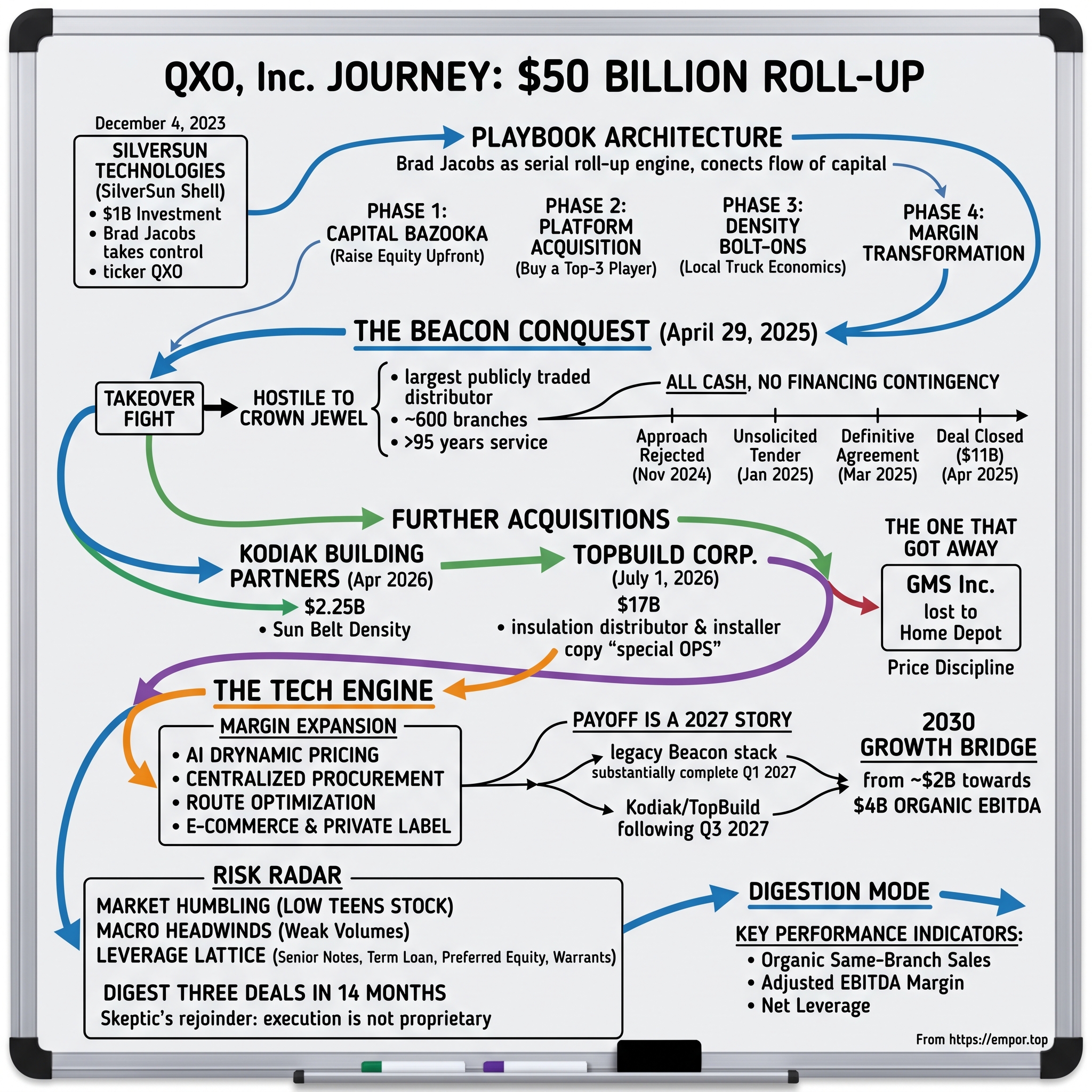
QXO, Inc. (NYSE: QXO): The $50 Billion Roll-Up Engine in Building Products Distribution
I. Prologue & The $800 Billion Fragmented Frontier
The Hook: A Billion Dollars Into a Software Husk
On December 4, 2023, a press release crossed the wires that most of Wall Street initially waved off as a curiosity. A tiny, obscure New Jersey software company called SilverSun Technologies — a reseller of accounting and ERP software to small manufacturers, with a market value in the low tens of millions — announced that Brad Jacobs would inject roughly one billion dollars into it and take control.1
On its face, the news belonged in the microcap bargain bin. The ambition stapled to it did not. Jacobs, a serial billionaire who had already built five companies across oil trading, waste hauling, equipment rental, and freight, declared that this software husk would become the launchpad for a brand-new giant in one of the least glamorous corners of the economy: the distribution of roofing shingles, insulation batts, lumber, and waterproofing membranes.
The number he said out loud was almost comic in its confidence — $50 billion in annual revenue, built essentially from a standing start.1 For context, that would have made the not-yet-existing company larger by revenue than most of the S&P 500. It was a target announced before the company owned a single truck.
The Transformed Enterprise
Fast-forward two and a half years, and the comedy has acquired real mass. Renamed QXO, Inc. and listed on the New York Stock Exchange, the company completed the roughly $11 billion acquisition of Beacon Roofing Supply on April 29, 2025, instantly converting a cash shell into the largest publicly traded distributor of roofing and waterproofing products in North America — a network of about 600 branches, more than 110,000 customers, and a business that had served the building trades for over 95 years.25
Then it kept going. By the middle of 2026, after two further acquisitions — Kodiak Building Partners and TopBuild — QXO reported a combined-company revenue base of roughly $18 billion, nearly $2 billion of adjusted EBITDA, about 28,000 employees, and 1,150 locations spanning all 50 U.S. states and seven Canadian provinces.12 Its fleet exceeded 10,000 vehicles.10
From concept slide to scaled continental platform in under three years is, whatever one ultimately concludes about the valuation, a genuinely rare feat of corporate construction. Very few management teams in modern history have assembled this much operating scale this fast without a merger of equals to lean on.
Why Building Products Distribution Matters
Why this industry, of all things? Because it is enormous and almost comically fragmented — the exact profile a roll-up artist prays for. QXO pegs the global market at roughly $800 billion in annual revenue, split about evenly between North America and Western Europe, and served by more than 7,000 distributors in North America alone and some 13,000 in Europe.2
These are overwhelmingly local and regional operators whose competitive moat is physical rather than technological. A loaded truck can profitably serve a job site only within a limited radius, so density around a branch creates a kind of micro-monopoly that national scale cannot easily dislodge. It is a business of relationships, trade credit, and same-day delivery.
Crucially, it is also an industry where technology adoption has lagged decades behind modern retail. Fragmentation, plus low digitization, plus sticky local economics, is the holy trinity of consolidation opportunities — and it is precisely the combination Jacobs went looking for.
Episode Thesis & Roadmap
This is the story of that consolidation, told with the benefit of results now visible on the scoreboard rather than promises on a pitch deck. Five threads run through it.
First, the anatomy of Jacobs' repeatable playbook, forged across United Waste, United Rentals, and XPO — and whether it truly transfers to shingles. Second, how QXO raised billions in equity dry powder before it owned a single warehouse, inverting the usual order of operations. Third, the takeover fight for Beacon, an unsolicited campaign that its target's board publicly branded opportunistic before ultimately capitulating.
Fourth, the technology thesis that is supposed to convert a low-margin distributor into a high-margin compounder — the linchpin on which the entire valuation rests. And fifth, the part that matters most to a long-term investor: the stress test of whether the economics, the leverage, and the housing cycle actually cooperate with the narrative. Because as of this writing, the market has grown markedly more skeptical than it was on that first heady day, and understanding exactly why is the real work of this story.
 Subscribe on LinkedIn
II. The Playbook Architecture: Brad Jacobs & The Serial Roll-Up Engine
From Oil Cargoes to Garbage Trucks
To understand QXO, you first have to understand that Brad Jacobs is not, at his core, in the building products business. He is in the business of building businesses, and the raw material he consolidates is nearly interchangeable. Now 69, Jacobs has run essentially the same play five times, and the résumé is the pitch.2
The origin story is unusually colorful for a distribution executive. Jacobs dropped out of college and cold-called his way into oil trading in the late 1970s, securing the legendary commodities financier Ludwig Jesselson as a mentor, decamping to London, and making his first fortune on arbitrage — sourcing crude from Russia and Nigeria and chartering ships to carry it to Europe.18 It was in the mechanics of moving physical commodities at scale and financing the spread that the template first took shape.
Then came the chapters that turned Jacobs into a folk hero for a certain kind of investor. In 1989 he pivoted to garbage, of all things, after reading his way into the economics of waste hauling. He founded United Waste Systems, hired away Browning-Ferris veterans, and rolled up hundreds of local haulers across the American heartland. The company went public in 1992 and sold to Waste Management in 1997 for roughly $2.2 billion — reportedly netting Jacobs about $120 million on an initial personal stake of around $3 million.18
United Rentals and the Asterisk Worth Remembering
The same year, he founded United Rentals, raised roughly $285 million across two offerings while retaining a large personal stake, and through a torrent of acquisitions built it into the world's largest equipment-rental company, surpassing Hertz's rental arm.1518
That chapter also carries a cautionary asterisk that promotional retellings tend to skip. An SEC accounting investigation later scrutinized United Rentals' books covering 2000 to 2002, and a 2007 Cerberus buyout of the company collapsed amid the onset of the credit crisis.18 Jacobs himself faced no wrongdoing charges. But the episode is a useful corrective: the roll-up model is powerful, and it has never been frictionless — not even in the hands of its most accomplished practitioner.
XPO: The Act QXO's Marketing Leans On
The fourth act was XPO, and it is the one the QXO story invokes hardest. In September 2011, Jacobs' family investment firm put roughly $62.5 million into a small expedited-freight broker called Express-1, then generating around $170 million of revenue.18 Over the following years he deployed billions across a string of acquisitions, and XPO's stock eventually climbed above $100 a share, compounding at a rate that outran both the S&P 500 and, by some measures, Amazon over the same span.18
He would later split the empire into three separate public companies — XPO, GXO Logistics, and RXO — stepping back from his last chairman roles at the end of 2025.2 For a generation of institutional allocators, "Brad Jacobs is starting something new" became reason enough to write a check before reading the fine print. That reputation is itself QXO's most valuable founding asset, and the company's entire early history is an exercise in monetizing it.
The Jacobs Operational Flywheel
The mechanics are consistent enough to name as phases, and naming them clarifies what QXO is actually attempting.
Phase one is the capital bazooka: raise billions in equity up front, before any operating deal, so that when you approach a target you negotiate from a position of overwhelming financial strength rather than the ordinary acquirer's hedged "if we can arrange financing."
Phase two is the platform acquisition — buy a top-three player in a fragmented industry to serve as the operational spine, accepting a full price for scale and quality rather than hunting for a distressed bargain.
Phase three is density bolt-ons — disciplined tuck-ins bought at modest post-synergy multiples to fill geographic whitespace and thicken the branch network where the local delivery economics reward it.
Phase four is the margin transformation — centralize procurement, install modern pricing and inventory systems, redesign the organization, and wring out working capital. It is less a strategy than a manufacturing process for shareholder returns, and it has worked spectacularly before.
The genuinely open question, which the later sections of this story press on hard, is whether a process that compounded value in waste and freight transfers cleanly to roofing — and whether it transfers in a world of 5% interest rates rather than the near-zero rates that supercharged the XPO years.
The Mind, and the Bench
What shapes an operator like this? Jacobs has often described his approach in terms that would sound pretentious from almost anyone else: he trained in classical and jazz piano alongside mathematics, and calls integration work "a combination of math and music," emphasizing visualization and pattern recognition over spreadsheets alone.18
On operational discipline he is blunter, likening a missed quarter to termites — "where there's one, there's more" — a line that captures a genuine obsession with catching small problems before they compound.18 On adaptability he invokes jazz improvisation, insisting there is "no such thing as a wrong note" if you resolve it well. These are not merely charming anecdotes; they describe an operator who prizes speed, pattern-matching, and comfort with ambiguity. Those traits serve a serial acquirer superbly, and they can also curdle into overreach when the deals outrun the integration.
The bench beneath him reflects the same ambition. Jacobs committed one billion dollars of his own capital through Jacobs Private Equity II, an alignment gesture that simultaneously handed him voting control.1 As chief financial officer he recruited Ihsan Essaid, formerly global head of M&A at Barclays with three decades of dealmaking behind him — a revealing hire for a company whose defining competency is buying things well.2
Chris Signorello, a former XPO deputy general counsel, runs legal. And in April 2025 Jacobs brought in Valeri Liborski — a veteran of Yahoo, HelloFresh, Amazon, and Microsoft — as chief technology officer, signaling that the "tech-enabled distributor" claim was meant literally rather than as garnish.2 Compensation across the leadership team is deliberately weighted toward stock-price performance, which aligns management with equity holders but also creates a quiet standing pressure to keep the deal machine humming.
For an investor, the essential takeaway is that QXO is, to an unusual degree, a bet on a small group of people and a repeatable process — a "management capability premium" wired directly into the share price, for better and for worse.
III. The Birth of QXO: SilverSun Shell, PIPE Financing, & Capital Bazooka
Why a Sleepy Software Reseller
Picture the least likely launchpad imaginable for a fifty-billion-dollar ambition: SilverSun Technologies, a sleepy Nasdaq software reseller run out of East Hanover, New Jersey, whose longtime chief executive Mark Meller would soon be spun back out with the legacy business he had built.1
Why begin here, rather than raise a fresh SPAC or take something private? The answer is speed and cleanliness. A tiny public company with a genuine listing and a manageable balance sheet is a ready-made public vehicle. Reverse-merging into it compresses the timeline to a NYSE ticker while sidestepping the sponsor economics and redemption roulette that had by then discredited much of the SPAC boom. Jacobs wanted a public currency fast, and SilverSun was a clean, cheap door into the public markets.
Structure of the Transaction
The December 2023 structure was intricate but purposeful, and worth understanding because it set the template for everything that followed. Jacobs Private Equity II and its co-investors agreed to inject one billion dollars in cash. SilverSun would execute an 8-to-1 reverse stock split, spin its existing software operations back out to legacy shareholders as an independent company, and issue Jacobs' group convertible perpetual preferred stock and warrants.1
On an as-converted, as-exchanged basis, those securities would leave the investors owning roughly 99.85% of the entity — effectively a complete change of ownership dressed as a reverse merger.1 In June 2024 the shell formally shed its old identity and became QXO, Inc.2
The legacy software business sailed off on its own. What remained on the new balance sheet was, in essence, a billion dollars of cash, a public listing, and Brad Jacobs. A company had been created that was, quite literally, an idea with money attached.
The Capital Bazooka Loads
Then came the real fireworks. In June and July 2024, QXO raised billions more through private placements aimed at institutional and accredited investors — issuing roughly 340.9 million common shares at $9.14 apiece, plus pre-funded warrants for another 42 million shares, and a follow-on placement of 67.8 million additional shares, again at $9.14.7
A roster of blue-chip backers stood behind the raise, and Jared Kushner's Affinity Partners was closely enough associated with the venture that Kushner took a board seat.11 By the time the placements closed, QXO sat on well over five billion dollars in cash and effectively no operating debt — a public company with an enormous war chest and, as yet, no business to run.
This is a genuinely unusual capital structure, and it was the entire point. It meant QXO could walk into any negotiation able to pay all cash, immediately, with no financing contingency to hide behind. The dry powder was not a byproduct of the strategy; it was the weapon.
How the Narrative Was Framed — and How It Aged
Listen to how the story was told at the outset and it becomes clear that QXO sold a destination long before it had a map. Management guided to a revenue run-rate of at least five billion dollars within three years and "tens of billions" over the following decade, en route to the fifty-billion headline — targets so specific and so large that they functioned as much as marketing as forecasting.4
Pressed on why building products in particular, as opposed to any of the dozens of fragmented industries Jacobs could have chosen, the answer stressed structural attractiveness: gross margins in the mid-20s, resilient repair-and-remodel demand, powerful local delivery moats, and — tellingly — a less crowded acquisition landscape than logistics had become by the 2020s.12
It is worth noting how consistent the language has stayed. Two and a half years on, in the July 2026 investor Q&A, management was still describing the sector in nearly identical terms: large, fragmented, "under-digitized and often under-managed" in pricing, procurement, inventory, and transportation.12 Narrative consistency is genuinely a point in management's favor — the story has not quietly mutated to fit disappointing results. What has changed is the timeline of the payoff, which has drifted steadily rightward as integration proved harder than the early messaging implied.
For now, the essential investor observation is this: QXO raised its capital on the strength of a track record and a thesis, not on the strength of a single owned asset. That is an act of financial engineering only a handful of people on earth could have executed — and it front-loaded expectations that the operating business has since had to race to catch up with.
IV. The Anatomy of Building Products Distribution
Standing in the Yard
Before the first deal closed, it is worth walking the value chain QXO chose to conquer, because the economics explain both the opportunity and the risk with unusual clarity.
Stand in a roofing distributor's yard on a weekday morning and you occupy the seam between two very different worlds. On one side sit a small number of enormous manufacturers — GAF, Owens Corning, CertainTeed, Johns Manville — who make the shingles, insulation, and membranes, and who wield real brand equity and pricing power. On the other side are tens of thousands of local contractors, roofers, and specialty trades: fragmented, price-sensitive, and desperate for materials delivered to a job site today, on the right truck, complete and on time.
The distributor's job is to bridge that gap — carry inventory, extend trade credit, advise on job-specific product bundles, and manage the deeply unglamorous last mile.2 Distributors also serve as the industry's shock absorber, holding stock so that neither the manufacturer nor the contractor has to.
The Geography Is the Moat
Because heavy, bulky building materials are costly to haul, each branch profitably serves only a limited radius — roughly a delivery day's drive. That physics shatters the industry into thousands of separate local contests and rewards branch density: the more nearby locations you operate, the faster you can shuttle a missing pallet of underlayment to a waiting crew, and the better you utilize trucks and drivers across the cluster.
It also means a national player has no automatic advantage in any given metro unless it builds genuine local presence there. This is the single most important structural fact about the business, and it cuts both ways for a consolidator. Scale helps enormously with purchasing and technology. It does not automatically win the street corner in Tulsa or Tampa.
Why the Demand Is Defensible
The demand side is what makes the category resilient. QXO's framing is that roughly 80% of roofing distribution revenue comes from repair-and-replacement activity rather than new construction, and that about 94% of that R&R demand is non-discretionary — driven by leaks, age, storm damage, and deterioration rather than by consumer confidence.2
A roof that fails does not wait for mortgage rates to fall; the homeowner replaces it or the ceiling caves in. That single fact separates roofing distribution from most of the housing complex.
Layered on top are secular tailwinds the company likes to cite: a U.S. housing stock estimated to be roughly four million units short of demand, an average existing single-family home older than 40 years, and non-residential structures older still, all generating a steady drumbeat of maintenance.2 Severe-weather frequency has also risen materially over the past two decades, feeding the storm-driven slice of demand. This is why roofing distribution is fundamentally more defensive than, say, framing lumber tethered to new-build starts — a distinction that becomes central to the bull case later.
Segment Micro-Economics
The segments carry meaningfully different economics, and mix matters more than casual observers assume.
Core roofing and exterior products form the largest and most stable pool — QXO sizes the U.S. and Canadian roofing market at roughly $37 billion, growing 3–5% a year.2 Complementary categories — siding, waterproofing, insulation, windows and doors, decking — add perhaps another $28 billion and grow somewhat faster at 4–6%, which is exactly why QXO keeps pushing to widen the basket a contractor buys on any single job.2
Specialty categories like waterproofing and insulation also tend to carry higher margins, because they demand specialized handling, technical knowledge, and dedicated equipment. That is a reminder that "distribution" spans a wide range of profitability, and that shifting mix toward harder-to-serve categories is itself a genuine margin lever rather than a slogan.
Benchmarking the Competition
The competitive set frames both the ambition and the ceiling.
The privately held ABC Supply is the perennial number-one roofing distributor, a low-cost operator legendary for contractor loyalty and disciplined execution — the incumbent QXO most wants to displace and most struggles to out-execute. Builders FirstSource dominates wood components and residential framing at a far larger revenue scale, consolidated through its BMC merger.
Ferguson, in plumbing, HVAC, and industrial distribution, is the industry's gold standard for return on invested capital and e-commerce penetration — explicitly the model QXO's technology pitch aspires toward. Watsco in HVAC and SiteOne in landscape supply round out the specialty-distribution comparables. Each is a living proof point that a disciplined consolidator in a fragmented physical-distribution niche can compound value for decades. Each also took decades to do it.
Economics of the Local Branch
The typical branch these players run does perhaps $10–20 million in revenue at gross margins in the high-20s and mid-single-digit to low-double-digit EBITDA margins. Its real defensibility rests on four unglamorous things: delivery reliability, driver proximity, commercial credit extension, and a branch manager who knows every contractor's first name and job schedule.2
That last point deserves emphasis, because it is where the consolidation thesis meets friction. The moat in this industry is partly personal and intensely local. A centralizing acquirer that standardizes pricing authority and redesigns commission structures is, by definition, tampering with the very asset it paid for. Handled well, that is modernization. Handled poorly, it is moat erosion disguised as efficiency — and it quietly sets up the central tension of the entire QXO transformation.
First, though, QXO had to buy its spine. And it did so in the most combative way available.
V. The $11B Beacon Roofing Supply Takeover: Hostile Campaign to Crown Jewel
The Target Profile
The target was almost preordained. Beacon Roofing Supply — publicly traded on Nasdaq as BECN, the second-largest distributor of roofing and complementary materials in North America — was exactly the kind of scaled, high-quality spine the playbook demanded.
In 2024, Beacon delivered record net sales of $9.76 billion and its highest-ever adjusted EBITDA of $930.2 million, a 9.5% margin, while returning $225 million to shareholders and touting sixteen consecutive quarters of year-over-year sales growth under a strategic plan it branded "Ambition 2025."13 Gross margin held steady at 25.7%, and the company had opened 19 greenfield locations and acquired 42 branches during the year.13
This was emphatically not a broken company begging for rescue. It was a well-run market leader with a proud, independent board — which is precisely why the ensuing fight turned personal and public.
The Courtship Curdles
QXO first approached Beacon privately in the second half of 2024. On November 11, 2024, it submitted a written, non-binding proposal to acquire the company for $124.25 per share in cash, pitched as a 20% premium to Beacon's closing price of $103.25 just before the approach.4 Beacon's board rejected it as inadequate and as undervaluing the company's prospects.
Rather than retreat, QXO escalated. It went public with its interest and, on January 27, 2025, launched an unsolicited tender offer directly to Beacon's shareholders at that same $124.25 — an attempt to go over the board's head and let owners decide.4
Beacon dug in hard. In a Schedule 14D-9 that reads at points like a boxing promoter's trash talk, the board urged shareholders to reject the "opportunistic" offer. It noted pointedly that QXO had publicized its bid just one day after Beacon announced an investor day at which it planned to unveil ambitious 2028 targets, and accused the bidder of trying to acquire a "crown jewel" of the industry at a discount to intrinsic value before management could make its own case to the market.4
Both J.P. Morgan and Lazard delivered formal opinions on February 5, 2025 that the price was inadequate from a financial point of view.4 The filing even needled Jacobs about a recent failed takeover run at the European electrical distributor Rexel, implying he needed a marquee win to validate his shiny new venture.4 It also disputed QXO's public characterization of events, stating flatly that the board had never told QXO it had "put the company up for sale."4
The Ten-Cent Resolution
And then, as these standoffs so often do, the drama resolved through negotiation rather than brute force — but only after the board extracted its pound of flesh in the form of process and dignity.
On March 20, 2025, the two sides signed a definitive merger agreement at $124.35 per share: a nominal ten cents above the tender price, but this time with the board's unanimous blessing and access to confidential due diligence attached.3 The equity was valued at roughly $11 billion including assumed debt. The deal closed on April 29, 2025; Beacon was delisted and renamed QXO Building Products.5
That ten-cent bump is the entire tell. The fight was never really about price — it was about process, control, and whether a proud board would be steamrolled or courted. Once Beacon's directors secured a fair full price and a clean, board-endorsed exit, resistance evaporated. For students of M&A, it is a compact masterclass in how "hostile" campaigns usually end: not with a knockout, but with a negotiated handshake that lets everyone save face.
Financing the Conquest
The financing demonstrated just how much firepower QXO had stockpiled. The all-cash purchase drew on a $2.25 billion tranche of 6.75% senior secured notes due 2032, a $2.25 billion term loan, an asset-based revolver, existing balance-sheet cash, and a cascade of equity issuance.57
That equity cascade is worth walking through, because it maps the market's rising enthusiasm precisely. An $823.8 million private placement closed alongside the merger. Then came public offerings raising roughly $488 million at $13.25 a share, $892 million at $16.50, and a striking $1.96 billion at $22.25 — plus a $558 million mandatory convertible preferred offering in May 2025.7
The escalating strike prices tell their own quiet story. As the platform took shape and the market warmed to the vision, investors kept funding it at higher and higher valuations, right up until the enthusiasm crested. Those same escalating prices later became a liability, because they set the cost basis for a large cohort of shareholders now sitting on losses.
Valuation Stress Test: Did QXO Overpay?
On the numbers, QXO paid a full but defensible price — a low-double-digit multiple of trailing EBITDA before synergies, broadly in line with historical building-products M&A comparables, with the upside case resting on tax assets and the operational transformation to follow.
The more honest framing is that QXO did not buy Beacon cheaply. It bought Beacon as a canvas on which to manufacture value. Management set a target of at least $300 million in run-rate synergies from procurement, logistics, overhead, and technology, and — far more ambitiously — a plan to roughly double legacy Beacon's EBITDA over five years.12
That is a promise, not a fact. And the burden of proof shifted the moment the deal closed.
The One That Got Away
The appetite, notably, did not stop with Beacon — and the next episode revealed both the ambition and its limits. In June 2025, QXO went after GMS Inc., a major distributor of wallboard and ceilings, offering roughly $95.20 per share, about $5 billion.15
This time it lost. Home Depot's SRS Distribution unit swooped in with a superior bid of $110 per share, around $5.5 billion, and GMS agreed to sell to the retail giant instead.15
The episode is instructive on two counts. It confirmed that QXO would not chase a deal past its own price discipline — a genuinely reassuring signal for a company whose central risk is overpaying in a buying frenzy. And it revealed that QXO now competes for targets not against sleepy independents but against Home Depot itself, a reminder that the fragmented frontier has attracted deep-pocketed hunters and that acquisition multiples may not stay friendly. Rather than sulk, QXO simply pivoted to other quarry — and soon found much bigger game.
VI. The Tech Engine: AI, Pricing Power, & Margin Expansion
The Legacy Tech Deficit
Here is the crux of the entire thesis, so it is worth slowing down and getting right.
Walk into a traditional building products branch and you may find pricing set by a regional manager's gut, procurement negotiated store-by-store, inventory tracked on a decades-old AS/400 green-screen terminal, and orders taken by phone and scribbled on paper. QXO's own materials describe replacing exactly that: "a complex legacy AS/400 workflow" swapped for a "fast, intuitive, mobile-enabled system."12
QXO's central contention is that this operational backwardness is not a permanent feature of the industry but its single greatest untapped opportunity — that the ordinary discipline modern retail and logistics take for granted has simply never been applied here at scale.12 If that claim is right, the margin upside is not incremental tinkering; it is structural re-rating. If it is wrong, or merely slower and harder than advertised, the premium unwinds.
The Toolkit, Explained Plainly
The toolkit is familiar from Jacobs' freight days, translated into distribution.
AI-driven dynamic pricing aims to replace manager discretion with algorithms reading local inventory levels, a contractor's order history, price elasticity, and demand urgency to quote the right price at the right moment. Repeated across millions of transactions, that is the difference between leaving money on the table and capturing it.
To make the abstraction concrete: think of an airline's yield-management system pointed at a bundle of shingles. An airline sells the identical seat at wildly different prices depending on timing, demand, and who is buying. QXO wants to do the same with building materials, so that a rush order for a scarce item on a Friday afternoon is priced differently from a routine Monday restock. That is what "AI pricing" means here — not science fiction, but disciplined price optimization of a kind Ferguson and the best industrial distributors already run, and which most roofing distributors simply do not.
Centralized procurement aggregates the buying power of hundreds of branches to extract deeper vendor rebates and lower cost of goods. Management describes this as "the largest financial benefit from scale," and frames it as non-zero-sum: bigger buyers can also offer suppliers better demand visibility in return.12
Route and dispatch optimization lifts fleet utilization and on-time, in-full delivery — the metric contractors actually judge a distributor by, and one QXO returns to repeatedly as its definition of customer experience.12
E-Commerce and Private Label
E-commerce seeks to move ordering away from phone-and-fax toward genuine digital commerce. Management is unusually pointed about the industry's current state, arguing that what "many companies call e-commerce is really just a digital intake channel that still hands off to manual processes."12 The aspiration is that contractors should see live availability, order easily, get fast confirmation, and track delivery — the ordinary experience of consumer retail, finally arriving on the job site.
Private label is the quieter margin lever. Beacon already ran a private-label brand, TRI-BUILT, and QXO has said it intends to expand selectively into categories that are sufficiently commoditized — roofing accessories, underlayment, waterproofing — where it can offer competitive quality at better economics.212 Management explicitly declined to force private label where products are highly specified, which is a sensible constraint but also caps the size of the prize.
Where the Rollout Actually Stands
On the July 2026 investor Q&A, management was refreshingly candid about the timeline, and the honesty is a double-edged gift to investors.12
Some tools — pricing engines, planning systems, CRM work, business-intelligence foundations — are already underway or in place. But the core operating stack for legacy Beacon, spanning enterprise resource planning, warehouse management, point-of-sale, and e-commerce, is targeted to be substantially complete only by the end of the first quarter of 2027, with Kodiak and TopBuild following by the third quarter of 2027.12 Management explicitly expects accelerated organic growth "in 2027 and beyond once the tech stack and basic integration work have matured."12
Translated plainly: the payoff is a 2027-and-later story, and near-term financials are absorbing the cost of building it before reaping any benefit. That timing mismatch — spend now, harvest later — is the single most important thing an investor must internalize about the current numbers.
The Economic Materiality, and the Rejoinder
The arithmetic of why any of this matters is stark. On a roughly $18 billion combined revenue base, each single percentage point of gross-margin improvement translates to something on the order of $180 million of incremental EBITDA — which is why management fixates on pricing and procurement above all other levers.12
QXO's stated ambition is to lift legacy Beacon's roughly 10% EBITDA margin toward the mid-teens levels of best-in-class peers, and to more than double combined EBITDA from nearly $2 billion in 2025 toward $4 billion by 2030 on organic self-help alone.12 That is the bull case distilled to a sentence.
The skeptic's rejoinder is equally compact. Every distributor for twenty years has talked about pricing science, private label, and cross-selling, and a sincere management team can genuinely believe in a lever that thousands of branch employees quietly resist in daily practice. Notably, QXO itself concedes that competitors could replicate the tech stack "in principle," and that its real edge lies in "speed of deployment" and "quality of adoption."12
That is an admission worth dwelling on: the moat here is execution, not proprietary technology. And execution is exactly what has not yet shown up in the reported margins — the uncomfortable bridge to the balance sheet that has to survive long enough to prove the point.
VII. Capital Allocation & Governance: Skin in the Game vs. Leverage Risks
The Question Every Roll-Up Meets
Every roll-up eventually collides with the same question: can the balance sheet digest what the ambition keeps ordering?
QXO's capital-allocation history is, by deliberate design, a rhythm of raising equity ahead of deals and then using cash flow to de-lever afterward. But the frantic pace of 2026 has tested that discipline, and the financing structures have grown steadily more elaborate — to the point where a common shareholder now has to read carefully to understand what sits ahead of them in the queue.
Kodiak: Sun Belt Density, Funded by Apollo
To buy Kodiak Building Partners — a Sun Belt-heavy distributor of lumber, trusses, windows, doors, and building materials generating roughly $2.4 billion of 2025 revenue across about 110 locations in 26 states, with 40% of sales from Florida and Texas — QXO agreed in February 2026 to pay approximately $2.25 billion.9 The structure was $2.0 billion of cash plus 13.2 million shares, with QXO retaining a right to repurchase those shares at $40 apiece.9
To finance it, QXO had lined up in January 2026 a $3.0 billion commitment from investors led by an affiliate of Apollo Global Management to purchase a new Series C convertible perpetual preferred stock. On April 1, 2026 it issued 200,000 of those shares for roughly $2.0 billion.716 The Series C carries a 4.75% dividend and converts into common at $23.25 a share.7
The deal expanded QXO's addressable market past $200 billion and brought immediate procurement logic: sixteen of Kodiak's top twenty vendors overlap with Beacon's, representing about $5.3 billion of combined spend now negotiable as a single book of business.12 That is a concrete, checkable synergy rather than a hand-wave — and it is the clearest evidence yet that the scale thesis has real mechanical content.
TopBuild: The Largest Bet, and a Different Kind of Deal
Then came the biggest swing yet. On April 19, 2026, QXO announced an agreement to acquire TopBuild Corp. — the largest distributor and installer of insulation and related products in North America — for approximately $17 billion. It closed on July 1, 2026.1011
The terms valued each TopBuild share at $505, roughly a 19.8% premium to its 60-day average price and 23.1% to its prior close, split about 45% cash and 55% QXO stock. QXO issued some 312.5 million new shares and drew an incremental $3.0 billion term loan maturing in 2033 to fund the cash portion.1011
Strategically, this was a step-change rather than more of the same. TopBuild does not merely distribute; it installs, visiting roughly 22,000 job sites a day. That pulls QXO closer to the customer, delivers real-time visibility into project progress, and expands exposure to faster-growing end markets like data-center construction.12 It also brought a demonstrably higher-quality business: TopBuild generated about $6.2 billion of 2025 net sales at an industry-leading adjusted EBITDA margin near 18%, which QXO valued at 14.9 times pre-synergy EBITDA and 11.8 times after expected synergies.10
Unlike Beacon and Kodiak, this was not a turnaround. Management said as much, describing the opportunity as "less about cost cutting" and more about combining a very good business with QXO's platform.12 TopBuild's chief executive Robert Buck cited a ten-year sales CAGR of 13% and adjusted EPS CAGR of 31%.10 QXO now says it intends to copy TopBuild's "special OPS" operating practices across the wider group — a striking inversion in which the acquirer learns from the acquired.10
The Lattice, and What Sits Ahead of the Common
Layer all of that atop the original Beacon notes and term loan, the 5.50% Series B mandatory convertible preferred, the perpetual convertible preferred held by Jacobs' own investment vehicle, and an outstanding book of warrants, and QXO's capital structure has become a genuinely intricate lattice — each instrument with its own coupon, conversion price, and dilution profile.7
For a common shareholder, the practical worry is straightforward and legitimate. Preferred dividends and potential conversions sit ahead of the common. The reported share count keeps marching higher — 725.2 million shares outstanding as of early May 2026, before the roughly 312.5 million issued for TopBuild.711 And the "adjusted" earnings the company emphasizes exclude heavy amortization plus recurring restructuring and transformation costs.
In the first quarter of 2026 alone, QXO carried $116.9 million of amortization, $16.3 million of restructuring, and $11.4 million of transformation costs — real charges that adjusted EBITDA sets aside.7 None of this is improper; it is simply the machinery of a leveraged, fast-moving consolidator. But it deserves clear-eyed attention rather than reflexive trust, and it is precisely the sort of thing an activist would put on a slide.
Governance: Alignment, Concentrated
On the governance ledger, the alignment is genuine but concentrated. Jacobs and his affiliated entities control QXO through their preferred and common holdings, fusing his personal fortune to outside shareholders' fate — while also meaning minority investors are along for whatever ride he chooses. That is the classic double edge of founder control.
The board has rotated with the deals. TopBuild's former chairman Alec Covington joined it, while Jared Kushner resigned effective July 1, 2026 to focus on other commitments — a departure the company stated was unrelated to any disagreement over strategy or operations.11
Management's stated priorities from here read exactly as a cautious investor would hope: grow EBITDA, direct substantial free cash flow to reducing net debt, and de-lever while integrating. On the July 2026 Q&A, Jacobs said the company does "not currently foresee any near-term equity issuance" and that the bar for fresh capital deployment after TopBuild is "appropriately high."12 He also floated "portfolio optionality" — the possibility of divesting a non-core asset worth more outside QXO than inside it.12
That is the language of a company deliberately shifting into digestion mode, and it is the right message after committing more than $30 billion of enterprise value in roughly fourteen months. The open question — the crux of the governance stress test — is whether a serial acquirer whose brand, temperament, and compensation are all built around doing deals can actually sit still long enough to prove the model works before reaching for the next one.
VIII. Strategic Frameworks: Helmer's 7 Powers & Porter's 5 Forces
Does QXO Actually Have a Moat?
Strip away the narrative energy and ask the colder analytical question: does QXO possess durable competitive advantage, or is it merely large and well-financed? Two frameworks help discipline the answer, and neither delivers a clean verdict — which is itself the finding.
Helmer's 7 Powers
QXO's clearest genuine power is scale economies. With roughly $18 billion of revenue, it can negotiate procurement terms, amortize technology spend, and run logistics density that a local independent cannot match — and management is explicit that procurement is the single largest financial benefit of size.12 The Kodiak vendor-overlap figure is a concrete illustration of this power operating in practice rather than theory.12 Scale also lets QXO fund technology investment that smaller competitors "often can't justify economically."12
A second, subtler power is a cornered resource — not a patent or an ore body, but Brad Jacobs himself. His deal-making credibility, ability to recruit senior operators, and privileged access to institutional capital are authentically scarce, and they are why QXO could raise billions before owning a single branch. Management itself identifies talent attraction as "the paramount benefit" of scale.12
The honest caveat is that a cornered resource embodied in one 69-year-old executive is also an acute concentration risk. QXO's own filings flag exactly this, listing dependence on Jacobs as a risk factor and warning explicitly that his past performance "may not be representative of future results."6 When a company puts that in writing, investors should read it as more than boilerplate.
The remaining powers are weaker and more contested, and intellectual honesty requires saying so plainly.
Switching costs exist but are moderate. A contractor's job-site credit line, order history, and integrated digital portal create real friction, yet contractors routinely multi-source, and availability or a better price will override loyalty on any given job.
Network and density effects are real at the local level — a dense branch cluster enables fast hot-shot deliveries and inventory sharing — but they do not compound nationally the way a true two-sided network does. Density in Dallas does nothing for the customer in Denver.
Counter-positioning — the seductive idea that legacy distributors structurally cannot copy centralized AI pricing without detonating their own branch-manager commission cultures — is the most speculative claim in the deck, and one QXO has not yet demonstrated it can execute even inside its own walls.
Absent from the list entirely are branding, process power, and any cornered resource beyond Jacobs. That means the durable edge, if it materializes, will come overwhelmingly from scale and execution rather than from structural moats competitors cannot touch.
Porter's 5 Forces
Supplier power is moderate-to-high. A handful of shingle and insulation manufacturers hold strong brands and can push through price, though the largest distributors' volume earns rebate leverage in return. It is a balance of power, not a rout — and QXO's whole procurement thesis is a bet on tilting that balance.
Buyer power is low-to-moderate, because contractors are fragmented and prize delivery speed and product availability over squeezing the last few dollars. This is the force most favorable to QXO, and it is why service quality translates into pricing power here in a way it does not in pure commodity distribution.
Threat of new entrants is low. The capital intensity of inventory, fleets, local real estate, and trade credit is a formidable barrier to any would-be upstart, and the local relationships take years to build.
Threat of substitutes is very low. Physical materials must be physically delivered to a physical roof, and cannot be disintermediated by software. This is a genuinely underappreciated strength of the category in an era when technology has hollowed out so many middlemen.
Competitive rivalry is high and, if anything, intensifying. ABC Supply, Builders FirstSource, SRS/Home Depot, and thousands of scrappy independents contest every metro, and the GMS episode demonstrated that the biggest players will now outbid one another for scale.15
The synthesis is nuanced rather than triumphant. QXO operates in a structurally attractive industry — defensible, non-discretionary, hard to enter, immune to digital substitution. But its firm-specific advantage over the other large, disciplined consolidators is not yet established. It is unambiguously a good business. Whether QXO is a distinctly better operator within it remains the unsettled verdict, and the early results have not resolved it in either direction.
IX. Investor Stress Test: Bull vs. Bear Case & Skeptical Analysis
The Market Renders a Verdict
Now to the reckoning already underway. For a company that spent 2024 and most of 2025 as an investor darling, 2026 has been humbling.
After peaking above $27 a share, QXO's stock slid toward the low teens by mid-2026, falling roughly 14% on the very day the TopBuild deal was announced and trading down about a quarter over the prior twelve months.17 The market was signaling, in real time, that it is reassessing capital structure, integration difficulty, earnings visibility, and the pace of dilution.
The stock is, as more than one observer has noted, less a building-products play than a wager on a management capability premium. When that premium compresses, it compresses violently. Notably, sell-side sentiment remained overwhelmingly positive even as the shares fell — a divergence between analyst enthusiasm and market pricing that is itself worth watching.17
Myth vs. Reality
Three consensus narratives deserve fact-checking against the filings.
Myth: QXO's revenue is exploding. Reality: the top line is exploding because of acquisitions, while the underlying business has been shrinking. Legacy Beacon's sales fell year-over-year in the first quarter of 2026 on macro headwinds, per the company's own 10-Q.7 Compare QXO's $2.19 billion of net sales in the fourth quarter of 2025 against Beacon's standalone $2.40 billion in the same quarter a year earlier, and the direction of the core is clear.613 Acquired revenue and organic health are entirely different things.
Myth: the Beacon transformation is already delivering. Reality: Beacon standalone produced $930.2 million of adjusted EBITDA at a 9.5% margin in 2024.13 QXO's July 2026 materials describe legacy Beacon as sitting at roughly $800 million of EBITDA — below where it started — with the doubling to $2 billion still entirely ahead of it.1213 The transformation is a plan being funded, not a result being harvested.
Myth: the roll-up is protected because roofing demand is non-discretionary. Reality: non-discretionary demand cushions volumes; it does not immunize margins. Gross margin fell from Beacon's steady 25.7% in 2024 to 24.2% for QXO in the fourth quarter of 2025, and QXO's full-year 2025 adjusted gross margin was 24.9%.613 Price and mix pressure are real even where volumes hold.
The Roll-Up Trap
The skeptic's case begins there. Large consolidations can flatter the top line with acquired revenue while organic growth quietly stalls, and integration indigestion tends to surface at exactly the moment macro demand softens.
The reported results make the concern concrete. In the fourth quarter of 2025, QXO posted $2.19 billion of net sales and $150.3 million of adjusted EBITDA — a 6.9% margin, respectable in isolation but well below Beacon's historical high-9% level.6 For the full year 2025, adjusted EBITDA was $647.8 million on $6.84 billion of sales, with a GAAP net loss of $279.4 million.6
Then the first quarter of 2026 was genuinely alarming on its face: net sales of $1.73 billion, a net loss of $227.1 million, and adjusted EBITDA of just $1.2 million — a 0.1% margin — against a year-earlier quarter in which Beacon on its own had generated roughly $82 million of adjusted EBITDA on $1.91 billion of sales.7148
Management attributed the collapse to industry-wide softness compounded by front-loaded investments in technology and sales capacity.8 Two mitigating facts deserve equal weight. The first quarter is seasonally the weakest for exterior building products, when winter suppresses construction and re-roofing — QXO's own filings say it expects "low net income levels or net losses" in March quarters.7 And SG&A absorbed genuine one-time and transformation charges.7
Even granting all that, a near-zero-EBITDA quarter in a business acquired partly for its cash generation is a real and sobering data point, not a footnote to be waved away.
Valuation Meets a Higher Cost of Capital
The second worry is arithmetic. Much of Jacobs' legendary XPO run unfolded during the 2010s era of near-zero interest rates, when cheap debt magnified equity returns.
QXO is building in a materially higher-rate world, servicing 6.75% senior notes and a stack of preferred paying 4.75% to 5.50%.7 That raises the hurdle every acquisition must clear and the cost of every quarter spent below target margins. Interest expense swung from a net benefit of $56.6 million in the first quarter of 2025 — when QXO was a pile of cash earning interest — to a net cost of $31.1 million a year later.7 That swing alone is a roughly $88 million year-over-year headwind to pre-tax income.
A premium multiple built on faith in future execution leaves almost no room for error. If synergy capture slips, or the software rollout slides past its 2027 targets, or the acquisition pace slows, the re-rating can be severe — and arguably has already begun. That is the mechanism behind the stock's slide: not a collapse in the business, but a collapse in the market's willingness to pay in advance for promises.
The Current Risk Radar
The live risks are mechanical rather than vague macro hand-wringing.
A sharp downturn in U.S. residential roofing or commercial construction would pressure same-branch sales directly and immediately. Restructuring compensation and redesigning the organization across thousands of acquired branches risks alienating exactly the local sales talent whose personal relationships constitute the moat — potentially bleeding share to ABC Supply and nimble independents who need only keep their best people happy.
Commodity deflation — falling asphalt-shingle or lumber prices — can compress inventory margins even when unit volumes hold steady. QXO's own risk factors flag supplier pricing, vendor rebate changes, and trade-related cost increases as material exposures, alongside cybersecurity and technology-execution risk from the digital transformation itself.6
Crucially, softness and price pressure are not hypothetical scenarios here. They are already visible in the 2026 numbers, which is precisely why the market is nervous.7
Management Credibility: A Balanced Read
An honest assessment cuts both ways. On the positive side, management has been consistent in its narrative across two and a half years, has not quietly abandoned its targets when results disappointed, and has been unusually specific and self-critical in its disclosures — publishing an itemized 2030 EBITDA bridge by business unit and naming the exact proof points investors should watch to judge execution.12 Walking away from GMS on price was a genuine act of discipline.15
On the negative side, the pattern of raising equity at successively higher prices and then watching those investors sit on losses is a real cost to credibility. Guidance has been aspirational rather than granular — QXO does not issue conventional quarterly guidance, which limits accountability. And the shift to "digestion mode" arrived only after the balance sheet had absorbed three deals in fourteen months, which reads more as a consequence of capacity than a choice made in advance.12
The Bull Case
So what is the bull case, stated fairly and without cheerleading?
That the market is punishing QXO for doing exactly what the playbook prescribes — investing heavily ahead of the curve, at or near a cyclical trough, while assembling a platform designed to compound for a decade.
Management argues, with genuine structural justification, that the model does not require a housing recovery. After TopBuild, the combined company is roughly balanced between new construction and repair-and-remodel, and roughly 60/40 residential to commercial, making it less cyclical than a pure roofing distributor.12 The self-help levers — pricing, procurement, private label, cross-sell, technology, network optimization — are within the company's own control regardless of the macro. Jacobs has said flatly that the business does not "need a strong macro backdrop for the model to work," and that QXO believes it is "operating at or near a low point in several end markets."12
If even a meaningful fraction of the path from nearly $2 billion to $4 billion of organic EBITDA by 2030 materializes — with a further path toward roughly $5.5 billion including tuck-ins and moderate leverage, at mid-teens margins — today's depressed multiple will in hindsight look like a bargain.12
The Bear Case
The bear case is the exact mirror image, and equally coherent.
A sluggish housing market suppresses volume for years while debt service and preferred dividends steadily consume free cash flow. Beacon's legacy IT complexity delays the software rollout past its promised dates, pushing synergy realization further out and testing investor patience precisely when patience is scarcest. Branch-level talent walks out the door during the reorganization, and the local relationships that constituted the moat migrate to competitors.
And the valuation, even after its fall, still embeds a degree of execution that has simply not been demonstrated in any reported quarter to date.
The intellectually honest conclusion is that both cases are genuinely live, and neither the triumphant narrative nor the doomsaying is yet supported by the evidence. What will adjudicate between them is not another investor deck but a sequence of ordinary operating quarters — margins, organic growth, and cash flow — accumulating over the next two years. The story has been told. Now it has to be proven.
X. The Playbook: Key Lessons for Founders, M&A Operators, & Investors
Step back from QXO the stock and consider QXO the case study, because the story already teaches four durable lessons regardless of how the investment ultimately resolves.
1. Capital Structure as a Strategic Weapon
By raising more than five billion dollars in equity before announcing a single operating deal, QXO could approach Beacon with an all-cash, no-financing-contingency offer and then sustain a public tender campaign against a resistant board.7 It negotiated from "the money is already in the bank" rather than the ordinary acquirer's hedged "if we can arrange the money."
That inversion of the normal sequence is the most replicable insight in the entire playbook — and simultaneously the hardest to copy, because it presupposes the personal credibility to raise capital first on nothing but a track record and a thesis. Most founders will never have that option. Those who do should recognize it for the weapon it is.
2. The Power of Industry Selection
Roll-ups compound best where several conditions coincide: gross margins high enough to fund reinvestment, a genuinely fragmented supply-and-demand base, low incumbent technology adoption, and sticky local delivery economics that protect acquired branches from commoditization.
Building products distribution scores on all four, which is precisely why Jacobs chose it over flashier alternatives after surveying the landscape — and why he emphasized that the acquisition field here is "less crowded than it is in many other industries we've operated in."12 The lesson is that the quality of the pond matters at least as much as the skill of the fisherman. Pick the wrong industry and even a brilliant operator drowns.
3. Skin in the Game Builds Immediate Credibility
Jacobs' billion-dollar personal commitment did far more than align incentives on paper. It functioned as a costly signal that let tier-one institutions underwrite a company with zero operating history.1
Alignment here was not a governance nicety bolted on after the fact — it was the precondition that made the capital bazooka possible at all. Money where the mouth is, in a literal and decisive sense. The corollary, though, is that concentrated ownership means concentrated decision rights, and outside investors should price that accordingly.
4. Technology as a Margin Bridge
The entire QXO thesis reframes pricing systems, procurement platforms, and route optimization as direct engines of gross margin instead of back-office overhead to be minimized.12
Whether QXO ultimately delivers on that reframing remains unresolved and genuinely uncertain. But the underlying strategic logic — that the largest returns often come from applying ordinary modern tools to an industry that somehow never adopted them — is sound and generalizes far beyond roofing. The lesson for operators is to look for industries where the technology is not hard, merely absent.
The Meta-Lesson
The thread connecting all four is a caution as much as an endorsement, and it deserves stating plainly.
The playbook is powerful precisely because it is repeatable — but repeatability is not inevitability. Waste and freight are not shingles. Near-zero interest rates are not five percent. And a brilliant, well-financed process still has to survive daily contact with 28,000 employees, thousands of local branch cultures, and an unforgiving housing cycle.
The playbook explains, convincingly, why QXO could be built so fast. It does not, and cannot, guarantee what QXO will ultimately become. Any investor who conflates the two is buying the story rather than testing it.
XI. Key Performance Indicators & What to Watch Next
If you intend to follow this company as a long-term investor, resist the powerful temptation to track everything. A roll-up mid-transformation throws off enormous noise around a very small number of genuinely diagnostic signals. Three metrics carry almost all of the information.
KPI 1: Organic Same-Branch Sales Growth
Because QXO's headline revenue is dominated by acquisitions, the top line tells you almost nothing about underlying health — it will keep rising simply because the company keeps buying. Same-branch organic growth strips out the deals and reveals whether the core is actually gaining or losing share and pricing power.
Watch in particular whether legacy Beacon volumes and pricing stabilize and then improve sequentially through 2026 and into 2027. Management itself flagged this precise sequence — "sequential improvement in Beacon volumes, pricing, procurement, gross margin, and EBITDA progression" — as the proof point that its pricing actions and vendor negotiations are taking hold.12
If organic growth stays negative while the acquired top line balloons, that is the roll-up trap announcing itself in plain sight.
KPI 2: Adjusted EBITDA Margin
This is the single scoreboard for the entire technology-and-transformation thesis. The journey management has promised runs from Beacon's roughly 10% baseline toward the mid-teens levels of best-in-class peers, with combined EBITDA more than doubling to about $4 billion organically by 2030.12
After a 6.9% print in the fourth quarter of 2025 and a near-zero 0.1% in the seasonally weak first quarter of 2026, the direction and durability of margin recovery through the peak construction quarters is the number that will either validate or falsify the bull case.67
One essential caution for the reader keeping score: QXO's "adjusted" EBITDA excludes sizable, recurring transformation and restructuring costs. It is worth watching the widening or narrowing gap between adjusted and GAAP results alongside the headline margin. The closer the two converge over time, the more real the improvement.7
KPI 3: Net Leverage and Deleveraging Progress
Having committed well over $30 billion of enterprise value across three acquisitions in roughly fourteen months — funded with senior notes, term loans, and layered preferred equity — QXO's ability to grow EBITDA and channel free cash flow into reducing net debt is what keeps the whole edifice safe.1112
Management has committed to deleveraging while forgoing near-term equity issuance. Whether reported net debt actually falls, and whether free cash flow comfortably covers the preferred dividends without fresh capital, is the balance-sheet signal that matters most.
TopBuild's historically strong free-cash-flow conversion — management cites the 60–70% range, on cumulative guided free cash flow of $4.2 billion to $5.0 billion from 2026 to 2030 — is a genuine asset here.10 But conversion has to show up in the consolidated cash flow statement, not just in the pitch.
Milestones Ahead
Three events will punctuate the story over the next two years.
The first is tangible synergy realization and margin progression from the Beacon, Kodiak, and TopBuild integrations. The at-least-$300 million synergy target from TopBuild by 2030 is a specific, measurable promise to hold management to.10
The second is the technology rollout itself. Completion of the core Beacon enterprise, warehouse, point-of-sale, and e-commerce stack by the end of the first quarter of 2027, followed by Kodiak and TopBuild by the third quarter of 2027, is the operational timeline on which the entire margin thesis literally depends.12 Slippage here is the single clearest early warning signal available.
The third is capital-allocation discipline — specifically, whether QXO genuinely enters the digestion mode it now describes, or whether the deal machine fires again before the last three acquisitions have proven they can be run as a single company. Watch also for any move on the "portfolio optionality" management has hinted at, which would signal a shift from pure accumulation toward active portfolio shaping.12
For a business whose share price is, more than almost any other in its sector, a direct referendum on management's ability to convert a compelling story into demonstrated results, those are the things to watch — and to let the accumulating evidence, rather than the next investor presentation, decide.
References
-
Form 8-K: SilverSun Technologies Investment Agreement with Jacobs Private Equity II — SEC.gov, 2023-12-04 ↩↩↩↩↩↩↩
-
QXO, Inc. Annual Report on Form 10-K for Fiscal Year 2025 — SEC.gov, 2026-02-27 ↩↩↩↩↩↩↩↩↩↩↩↩↩↩
-
Form 8-K: QXO / Beacon Roofing Supply Merger Agreement at $124.35 per Share — SEC.gov, 2025-03-20 ↩
-
Beacon Roofing Supply Schedule 14D-9 (Board Recommendation Against QXO Tender Offer) — SEC.gov, 2025-02-06 ↩↩↩↩↩↩↩
-
Form 8-K: Completion of Beacon Roofing Supply Acquisition and Related Financing — SEC.gov, 2025-04-29 ↩↩↩
-
QXO Reports Fourth Quarter 2025 Results — QXO, Inc. (Investor Relations), 2026-02-25 ↩↩↩↩↩↩↩
-
QXO, Inc. Quarterly Report on Form 10-Q for the Period Ended March 31, 2026 — SEC.gov, 2026-05-12 ↩↩↩↩↩↩↩↩↩↩↩↩↩↩↩↩↩↩
-
QXO Reports First Quarter 2026 Results — QXO, Inc. (Investor Relations), 2026-05-12 ↩↩
-
QXO to Buy Kodiak Building Partners for $2.25 Billion — QXO, Inc. (Investor Relations), 2026-02-11 ↩↩
-
Form 8-K Exhibit 99.1: QXO to Acquire TopBuild for $17 Billion — SEC.gov, 2026-04-20 ↩↩↩↩↩↩↩↩
-
Form 8-K: Completion of TopBuild Acquisition, Incremental Term Loan, and Board Changes — SEC.gov, 2026-07-01 ↩↩↩↩↩↩
-
QXO Investor Q&A (Value Creation Plan and 2030 Growth Bridges) — SEC.gov / QXO, Inc., 2026-07-09 ↩↩↩↩↩↩↩↩↩↩↩↩↩↩↩↩↩↩↩↩↩↩↩↩↩↩↩↩↩↩↩↩↩↩↩↩↩↩
-
Beacon Reports Record Fourth Quarter and Full Year 2024 Results — SEC.gov (Beacon Roofing Supply), 2025-02-27 ↩↩↩↩↩↩
-
Beacon Roofing Supply Quarterly Report on Form 10-Q for the Period Ended March 31, 2025 — SEC.gov, 2025-04-28 ↩
-
Home Depot's SRS Distribution buys GMS in $5.5 billion deal — CNBC, 2025-06-30 ↩↩↩↩↩
-
Apollo Leads $1.2 Billion Investment in Brad Jacobs' QXO — Bloomberg, 2026-01-05 ↩
-
Stockholders approve QXO's $17 billion TopBuild acquisition — HousingWire, 2026-06-29 ↩↩
-
Better Than Amazon? How Bradley Jacobs Turned A $63M Bet Into A $12 Billion Transportation Empire — Forbes, 2018-04-10 ↩↩↩↩↩↩↩↩
 LinkedIn
 WhatsApp
 Reddit
 Hacker News
 Email
Email Kindle
 RSS Feed
 Spotify
 Apple Podcasts
 Amazon Music
 Audible
 YouTube