Restaurant Brands International: The Capital Allocator's Recipe
I. Introduction & The $60B Fast-Food Empire
Start with a number that sounds like a rounding error and a number that sounds like a fortune, and you have the whole strange story of Restaurant Brands International. In 2010, a little-known Brazilian-American private equity firm bought a tired, teenaged hamburger chain for four billion dollars. Fourteen years later, the firm's founders had turned their original equity into something close to a twenty-eight-to-thirty-fold return — one of the greatest buyouts in the history of the asset class.5 And yet, on a summer morning in 2026, the company that grew out of that buyout traded in the mid-$70s, carried a market capitalization near $25 billion, and spent most of its investor communications trying to convince the market that it had finally stopped being a financial engineering machine and started becoming a restaurant company.
That tension — between the balance sheet and the burger — is the entire point of this episode.
Restaurant Brands International, ticker QSR on the New York and Toronto exchanges, is today one of the largest quick-service restaurant operators on earth. At the end of 2025 it presided over 33,041 restaurants in more than 120 countries, generating roughly $46.8 billion in system-wide sales — the total rung up across every franchised and company cash register in its network.23 It collects a royalty on nearly all of that.
The corporation itself booked $9.4 billion of revenue, $2.58 billion of adjusted operating income, and about $1.6 billion of free cash flow.2 Over 95% of its restaurants are owned and operated not by RBI but by franchisees, which is exactly how a firm this size runs on such a lean corporate spine.3
The empire has four pillars, and they are not equals. Tim Hortons — the double-double, the Timbit, the closest thing Canada has to a secular church — is the cash cow, throwing off roughly 42% of the company's operating profit from a near-monopoly grip on Canadian coffee.2 Burger King is the scale engine: nearly 20,000 restaurants worldwide, the flame-grilled Whopper, and until recently the company's most stubborn problem child in its home U.S. market.3 Popeyes Louisiana Kitchen is the high-growth chicken bet that briefly conquered the internet in 2019 and then, in 2025, badly stumbled.2 And Firehouse Subs, a 1,500-unit sandwich chain, is the small bolt-on option that management keeps promising will matter someday.3
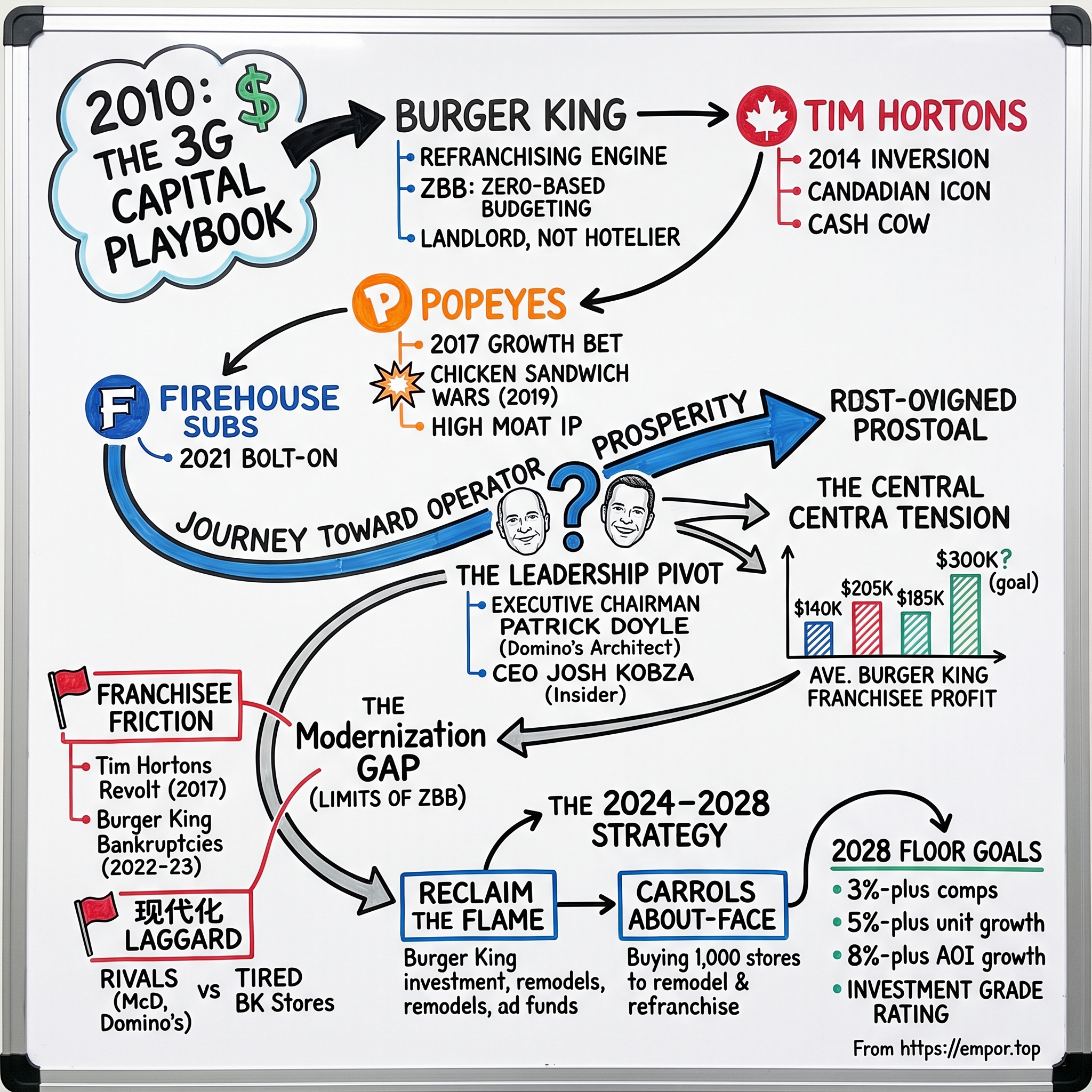
Sitting atop all four is a leadership pairing designed to answer one question. Can a company built on 3G Capital's brutal cost discipline — zero-based budgeting, stripped headquarters, refranchised stores, high leverage — actually pivot into a durable, franchisee-first growth compounder? The two men making the bet are Executive Chairman J. Patrick Doyle, the architect of Domino's Pizza's legendary turnaround, and CEO Joshua Kobza, an eleven-year insider who rose through the finance and operations ranks.2628
The central tension is not abstract. It shows up in a single, brutally concrete number that RBI now discloses every quarter: the average profit an individual Burger King franchisee earns from a single restaurant. In 2022 that figure was roughly $140,000. By 2023 it had climbed to a record $205,000. By 2025 it had fallen back to about $185,000.252 Every strategic question about this company — should it remodel faster, discount harder, buy back stores, raise royalties, expand abroad — ultimately collapses into whether it can push that number toward the $300,000 management says is possible.
Because in a system where someone else owns 95% of the restaurants, corporate growth is a derivative of operator prosperity. That is the lesson 3G's heirs spent a decade learning at considerable expense.
There is also a quieter, structural drama running underneath. RBI's business model has been shifting shape. What began as an American burger chain became a Canadian-domiciled multi-brand franchisor, then a serial acquirer, then — briefly and awkwardly — a large restaurant operator again after buying back its biggest franchisee in 2024. Management now promises to unwind that detour and return to a nearly pure-play franchisor by the end of 2027, while simultaneously deleveraging toward an investment-grade credit rating by 2028.31 Those are two large promises stacked on top of an operational turnaround. Investors are being asked to underwrite all three at once.
Over the next several sections we will trace how this thing was assembled — the 2010 Burger King buyout, the 2014 Tim Hortons inversion, the Popeyes and Firehouse deals — and then interrogate the harder question: when does paying twenty-times-EBITDA for brand IP and squeezing franchisees stop working, and what does it cost to fix. Let's begin where the money began.
 Subscribe on LinkedIn
II. The 3G Capital Playbook & The Creation of RBI
The 3G Capital playbook is not a secret. It is written down, it is repeatable, and it is ruthless. And Burger King was its most audacious proof of concept.
In September 2010, 3G Capital — the investment vehicle associated with the Brazilian financiers Jorge Paulo Lemann, Marcel Telles, and Carlos Alberto Sicupira, and run day-to-day by managing partner Alex Behring — agreed to buy Burger King Holdings for $24.00 a share, a transaction valued at about $4.0 billion including assumed debt.4
The premium was a rich 46% over the undisturbed price.4 Burger King was, at the time, a chronic also-ran: perpetually second to McDonald's, whipsawed through a parade of private equity owners, its franchisees restless and its stores dated.
What 3G did next became a business-school archetype. The firm installed a young partner, Daniel Schwartz — barely into his thirties, and eventually CEO of a global restaurant company at 32 — first as CFO and then, by 2013, in the top job. Alex Behring took a co-chairman seat on the board.4 And 3G imposed zero-based budgeting.
It is worth pausing on what ZBB actually means, because the phrase gets thrown around loosely. In a conventional company, next year's budget starts from this year's budget: a department got $10 million last year, so the conversation begins at $10 million and argues about the delta. Under zero-based budgeting, every line resets to zero annually, and every manager must justify every dollar from first principles as if the expense had never existed.
Combine that with 3G's cultural machinery — meritocratic promotion, aggressive stretch targets, and a famous aversion to corporate comfort — and you get an organization where overhead is treated as a permanent enemy rather than a fixed cost. The fat came off fast. By the end of 2010, 3G had dismissed 413 employees company-wide, including 261 at the Miami headquarters, roughly a third of the head-office staff.4
But the deeper move was structural. 3G took Burger King from a company that owned and ran hundreds of its own restaurants to one that owned almost none. In 2012 alone the company refranchised 752 restaurants in the U.S. and Canada; by the end of 2013 it operated just 52 company restaurants — kept mostly in Miami as a test kitchen — down from 183 a year earlier, with literally zero company-owned units left across Europe, the Middle East, and Africa.6
The logic is the heart of everything RBI would later become. A company-owned restaurant exposes the corporation to labor, rent, food cost, and the daily grind of operations. A franchised restaurant hands all of that to an owner-operator and sends the corporation a clean, high-margin royalty check off the top of sales.
Refranchising trades lumpy, capital-intensive restaurant profits for a predictable annuity — and it dramatically lifts return on invested capital, because the corporation no longer has to fund the stores.
The analogy that helps here is a landlord versus a hotelier. The hotelier books enormous revenue and bears every cost — staff, laundry, heating, breakfast, the broken elevator. The landlord collects rent. Rent is smaller in absolute dollars but enormously more profitable per dollar, far more predictable, and requires almost no working capital. 3G converted Burger King from hotelier to landlord in roughly three years. The trade-off, which would not become visible for another decade, is that a landlord's income depends entirely on the tenant's ability to pay — and a landlord who never reinvests in the building eventually finds the tenants leaving.
The financial results were, briefly, magical: margins expanded, free cash flow converted at extraordinary rates, and in 2012 3G brought the company back to public markets by selling roughly 29% of it to Justice Holdings — a listed acquisition vehicle backed by activist investor Bill Ackman and financier Nicolas Berggruen — for about $1.4 billion, while retaining majority control.7 Burger King was public again, leaner, and hungry for a bigger deal.
The Tim Hortons Inversion
That deal arrived in August 2014, and it was a doozy. Burger King announced it would acquire Tim Hortons, the Canadian coffee-and-donut institution, in a cash-and-stock transaction valued at roughly $11 billion, creating a new parent company — Restaurant Brands International — domiciled in Ontario, Canada.8 Tim Hortons itself was a national icon with a folk-hero origin: founded in 1964 in Hamilton, Ontario by NHL defenseman Tim Horton and his partner Ron Joyce, later owned by Wendy's, and spun back out into public markets in 2006.12
Two features of the deal defined it. The first was Warren Buffett. Berkshire Hathaway agreed to backstop the acquisition with $3 billion of preferred equity carrying a fat 9% coupon — an annual dividend of about $270 million — plus a warrant for a sliver of common stock.9
Think about what Buffett was actually getting: a 9% yield, senior to the common, on a business with utility-like cash flows, from operators he trusted. It was less an endorsement of the burger business than a beautifully structured piece of financing, and Buffett has rarely made an easier $270 million a year. His involvement nonetheless lent the transaction a Good Housekeeping seal even as its second feature drew fire.
That second feature was that the deal was a tax inversion — moving the corporate domicile to lower-taxed Canada. In 2014, corporate inversions were a live political scandal in the United States, and a company as visible as Burger King relocating its tax home became a lightning rod. U.S. senators denounced it, boycott threats circulated online, and the Obama administration, invoking the language of "economic patriotism," soon tightened the rules on inversions.11 Management insisted the deal was about growth and Tim Hortons' coffee franchise, not taxes; the optics said otherwise.
The episode is worth remembering as the first time RBI's financial cleverness collided head-on with public sentiment — a preview of the reputational fragility that would nearly wreck Tim Hortons a few years later.
The Buffett preferred, for its part, was a costly bridge, and RBI treated it like one. In December 2017, having deleveraged rapidly, the company redeemed the entire $3 billion preferred stake — retiring that 9% drag once the balance sheet could stand on its own.10 Getting out from under a $270-million-a-year obligation in just three years is itself a testament to how much cash the combined company threw off in its honeymoon period. The early RBI years delivered exactly what 3G promised shareholders: rapid margin expansion, brisk debt paydown, and market-beating returns.
The playbook also went global through master franchise joint ventures — handing regional operators the rights to build Burger King and Tim Hortons across whole countries in exchange for local capital and local operational control. It was capital-light expansion by proxy: RBI supplied the brand and collected a royalty, while a local partner supplied the capital, the real estate, and the operational know-how. This template set up the international engine that, a decade later, would become RBI's single best-performing business — and, as we'll see in China, would occasionally blow up when the local partner underdelivered. But first, 3G wanted to prove it could buy growth as well as cut costs.
III. The M&A Engine: Popeyes, Firehouse, & Acquisition Benchmarking
Here is where the outline itself contains a trap worth flagging, because it illustrates how easily fast-food deal lore gets garbled. The Popeyes acquisition was not, as one might misremember, a $24-per-share deal — that was Burger King in 2010. Popeyes was far pricier.
In February 2017, RBI agreed to acquire Popeyes Louisiana Kitchen for $79.00 a share in cash, or about $1.8 billion — a 27% premium to the stock's recent trading average.1314
By the standards of restaurant M&A, this was an aggressive price: comfortably north of twenty times trailing EBITDA, when precedent QSR transactions had typically cleared in the mid-teens. The immediate reaction on Wall Street was skepticism that 3G — the cost-cutters — had overpaid for a growth story they might not be able to accelerate.
Then came the sandwich.
On August 12, 2019, Popeyes launched a fried chicken sandwich — a brioche bun, pickles, a thick hand-battered fillet. It sold out nationwide in roughly two weeks, faster than anyone at the company had planned for, after a throwaway tweet needling Chick-fil-A detonated into a viral social-media brawl that pulled in Wendy's and half of the internet. It came to be called the "chicken sandwich wars." Popeyes had planned for the launch supply to last months; the frenzy wiped it out in a fortnight, and the item vanished from menus until a permanent relaunch that November.40
When it came back, the numbers broke the model. In the third quarter of 2019, even before the permanent relaunch, Popeyes' U.S. same-store sales were already running double digits. In the fourth quarter, they went vertical: U.S. comparable sales rose nearly 38% (37.9%), with global comparable sales up 34.4% — figures so far outside the normal range of restaurant performance that trade analysts struggled to find any precedent in the modern era.15
For context, a good quarter in fast food is a low-single-digit comp; a great one is mid-single-digit. Popeyes did roughly ten times that. What had looked like an overpriced acquisition suddenly looked visionary. The sandwich didn't just sell chicken; it validated the thesis under the whole deal — that Popeyes had untapped brand equity, a genuine product edge, and enormous international white space in Europe, Latin America, and Asia. It is the single best data point 3G's "pay up for great brand IP" doctrine ever produced, and management has been chasing that high ever since.
That vindication emboldened the next deal. In November 2021, RBI acquired Firehouse Subs — a roughly 1,200-unit sandwich chain founded in 1994 in Jacksonville, Florida by two former firefighter brothers, Chris and Robin Sorensen — for $1.0 billion in all cash.16 At roughly twenty times EBITDA (on an implied basis, given the chain's expected annual EBITDA of about $50 million), it was another full price for another regional brand with a loyal following.16 The strategic pitch was familiar: asset-light royalty economics, an underpenetrated footprint, and international optionality.
But Firehouse was tiny relative to the portfolio — a low-single-digit contributor to segment profit — and it came burdened with a structural challenge the others didn't share. Firehouse had grown up as an in-line, strip-mall sandwich concept with limited drive-thru and digital infrastructure at exactly the moment those channels were becoming table stakes in fast food.
Step back and the pattern is clear. 3G's post-2017 M&A doctrine was to pay premium multiples for strong, defensible brand IP, trust zero-based budgeting to wring out corporate overhead, and bank on multiplying units internationally to justify the price. When the underlying brand had genuine cultural pull and a growth runway — Popeyes — the math eventually worked spectacularly.
When the brand was smaller and the operating model needed reinvention — Firehouse — the jury stayed out for years. And the doctrine had one blind spot that the next section is built around: it assumed you could always cost-cut and royalty-collect your way to value, even when the people actually running the restaurants were quietly going broke.
IV. The Limits of ZBB: Franchisee Friction & The Modernization Lag
Zero-based budgeting has a hard limit, and RBI ran straight into it. You can strip your own head office to the studs. You cannot strip-mine your franchisees — because in a nearly fully franchised model, the franchisee is not your cost center. The franchisee is your customer, your capital source, and your operator all at once. Squeeze too hard and the whole growth algorithm seizes.
The first place the machine ground its gears was, improbably, the most beloved brand in Canada.
The Tim Hortons Revolt
By 2017, a dissident group of Tim Hortons operators calling itself the Great White North Franchisee Association had formed to fight back against head-office cost-cutting, and it did so in the bluntest way available: lawsuits. That June, the group filed a proposed class action alleging RBI had misused the national advertising fund — the pooled marketing money franchisees pay into — seeking roughly $500 million in damages.17 A second suit followed. The disputes spread to menu bloat, supply-chain markups, and a contentious roughly C$700 million renovation program that some owners said would cost them hundreds of thousands of dollars per store.17
Then the situation turned into a national scandal. When Ontario raised its minimum wage to $14 an hour on January 1, 2018, some Tim Hortons franchisees — including a store owned by the children of the chain's own founders — responded by cutting paid breaks and trimming employee benefits, publicly blaming the wage hike.18 Ontario's premier accused the founders' heirs of "bullying" workers. Labour rallies hit some fifteen cities. And the brand's reputation cratered: in the closely watched Leger corporate-reputation survey, Tim Hortons fell from 4th place to 50th in a single year.19 For a business whose entire moat is affection, that was an existential wound.
RBI's response — the April 2018 "Winning Together" plan, promising a better restaurant experience, product excellence, and image upgrades — was a tacit admission that pure cost discipline had damaged the crown jewel.20
The Burger King Bankruptcies
The U.S. franchisee base broke more quietly but no less seriously. Through 2022 and 2023, soaring labor and food costs collided with the thin store-level economics of dated, underinvested Burger Kings, and large operators simply failed. In January 2023, the roughly 90-restaurant franchisee TOMS King filed for Chapter 11; roughly 82 of its stores were eventually sold to four buyers — one of them Burger King itself.21 Two months later, Meridian Restaurants Unlimited — a roughly 120-unit operator across nine states — filed as well, its court papers laying out the mechanics of the failure in unusually plain language: labor costs up about a third over a few years, food inflation over 20% across two years, staffing shortages, and declining traffic against rent and debt that would not fall to match. Meridian closed 27 restaurants and auctioned off the rest, again partly back to the franchisor.22
The detail that the franchisor kept buying its own bankrupt franchisees' stores is telling. It meant Burger King's corporate parent already understood, by 2023, that some of these restaurants were only viable in stronger hands with fresh capital — a realization that would culminate in the far larger Carrols buyback a year later. These were not fringe operators; they were among the system's larger franchisees, and their collapse exposed the core flaw for anyone still doubting it.
That flaw is a mechanism worth stating plainly, because it governs everything that follows. Corporate royalty growth is mathematically capped by franchisee unit profitability. You can trim head-office SG&A to zero and it barely moves the needle if your operators can't afford to remodel, install kiosks, speed up the drive-thru, or even keep the lights on.
The Modernization Gap, 2018–2021
The competitive cost of that constraint became visible in the years just before the pandemic, and it is best understood by comparing what RBI's rivals were doing with their franchisees' money. McDonald's pushed through its "Experience of the Future" program — a sweeping remodel initiative featuring self-order kiosks, digital menu boards, dual drive-thru lanes, and table service — funded through a cost-sharing arrangement with its operators. Domino's, under a CEO whose name will reappear shortly, spent the decade building a genuine proprietary technology moat: its own ordering platform, its own delivery-tracking system, and a data advantage that let it convert digital orders at rates the rest of the industry could not match.
Burger King U.S., meanwhile, limped along with aging buildings, a bloated menu that slowed the kitchen, and drive-thru times that lagged the segment. Traffic declined and the brand ceded ground in the U.S. burger hierarchy. The point is not that RBI's management failed to notice; it is that the fix required capital that neither corporate — committed to its asset-light identity — nor franchisees — squeezed to the bone — were willing or able to deploy. A remodel costs a franchisee hundreds of thousands of dollars per store and pays back over years. An operator earning $140,000 a year per restaurant, as the average Burger King franchisee was by 2022, simply cannot fund one.25
The stores looked tired because the people who owned them were tapped out. That is the causal chain that connects zero-based budgeting to declining market share, and it took RBI the better part of a decade to say so out loud.
The strategic conclusion was unavoidable and, for a 3G-descended company, almost heretical: the era of pure financial engineering was over. To grow royalties, RBI would have to help its franchisees make money — which meant co-investing corporate capital into the system rather than merely extracting from it. Making that pivot credible required a new kind of leader, and the company went out and hired one of the most credible operators in the entire industry. But before we meet him, we need to understand the assets he inherited — because the four brands are wildly different animals.
V. Segment Breakdown: Cash Cows, Scale Engines, & Growth Vectors
Picture the RBI portfolio as four businesses that happen to share a balance sheet. One prints money, one has global scale but a fragile home market, one is a high-margin growth engine that just tripped, and one is a science experiment. Understanding why the stock does what it does starts with understanding that these four do not move together.
1. Tim Hortons — The Canadian Cash Cow & Crown Jewel
Tim Hortons is the reason RBI is not just another leveraged burger chain. In 2025 it generated roughly $1.08 billion of adjusted operating income — about 42% of the company's total — off a business that is, in its home market, close to a utility.2 Tim's commands an estimated 70%-plus share of brewed coffee in Canada and a commanding position in fast-food breakfast; in the first quarter of 2026 it claimed the top spot in a national "best breakfast" ranking for the first time.381
That is not market leadership; that is a habit embedded in a country's daily routine.
The economics are subtler than a royalty stream. In Canada, RBI runs a vertically integrated supply chain for Tim Hortons — two coffee-roasting plants, a fondant and fills facility, and nine distribution centers — selling coffee, packaging, and ingredients directly to franchisees on top of collecting rent and royalties.3 This distribution business is the single largest Tim Hortons revenue line, and it means RBI captures margin at multiple points in the value chain, not just the till. The risk in that model is that it also gives franchisees something to resent when input costs spike — which is precisely what the 2017–2018 supply-chain lawsuits were about.
The current growth story is about deepening an already-dominant position: a loyalty program that by 2025 drove about a third of sales, with roughly 7 million active members who visit more and spend over 50% more after joining; a digital sales mix near 40%; a fast-growing cold-beverage business; and a slow push into the afternoon "PM" daypart where Tim's has historically been weak.21 Franchisee four-wall EBITDA held at roughly C$295,000 in 2025 despite elevated coffee costs and tariff noise — evidence that the underlying economics remain healthy even in a soft Canadian consumer environment.2 The bear worry is simple: a business with 70% share cannot gain much more share, so growth must come from getting each Canadian to spend a little more, a little more often. That is a grind, not a gusher.
2. Burger King — The Global Scale & Turnaround Engine, and the International Segment
Burger King is the biggest brand by unit count — 19,900 restaurants at the end of 2025, split between roughly 7,000 in the U.S. and Canada and nearly 13,000 internationally — and yet the U.S. Burger King segment contributes only about 18% of operating profit.32 That gap between size and profit is the entire Burger King investment case: a brand with enormous scale but historically subpar per-unit economics at home. The key operational levers are unglamorous — close weak stores, modernize the survivors, speed up the drive-thru — and whether they work is the question Section VI exists to answer.
But the more important story hides in how RBI reports the numbers. The company breaks out an International segment — essentially the Burger King, Popeyes, and Firehouse business outside the U.S. and Canada — and by 2025 it had quietly become the company's second-largest profit pool, roughly 27% of operating profit, ahead of U.S. Burger King.2
This is the genuine growth star. In 2025 International delivered comparable sales up 4.9% and net restaurant growth of 4.9%, driving system-wide sales up nearly 11%, and management noted it had built five separate billion-dollar Burger King country businesses — Spain, Germany, Australia, Brazil, and the U.K. — plus a two-billion-dollar business in France.2 Markets outside the top ten quietly outperform too: Burger King Japan posted 22% same-store sales in 2025 on top of 19% the prior year.2
The economics are elegant — a mid-single-digit royalty rate that flows efficiently to profit, funded by local franchisee capital. If there is a single underappreciated fact about RBI, it is that its best business is not the burger chain Americans know or even the coffee monopoly Canadians love, but the sprawling, capital-light international franchise network most U.S. investors never see.
3. Popeyes Louisiana Kitchen — The High-Margin Growth Challenger That Stalled
Popeyes is where the 2025 story got uncomfortable. The brand still boasts strong unit economics and some of the best food in the chicken category, and its international arm has been on a genuine tear — system sales outside the U.S. grew from $927 million in 2023 to $1.7 billion in 2024, reaching a roughly $2 billion run rate, with Brazil a standout that Doyle now cites almost every quarter as proof of what the food can do when it's executed well.2 But the U.S. business, the profit core, went into reverse.
Full-year 2025 U.S. same-store sales fell 2.9%, and by the first quarter of 2026 they were down a startling 6.5% — characterized in the trade press as Popeyes' worst quarter in roughly two decades.21
Adjusted operating income for the segment was $250 million in 2025, roughly 10% of the company total, and average franchisee profitability of about $235,000 remained healthy in absolute terms.2 But the trajectory, not the level, is what spooked investors.
Here is the irony that makes Popeyes analytically interesting: the same brand that produced the greatest demand surge in modern fast-food history in 2019 was, six years later, its owner's biggest disappointment. That whiplash tells you something important — that a viral product moment is not a durable moat, and that in the chicken category, where competitors added roughly 46% more locations over the decade, the durable advantage is boring, repeatable, in-restaurant execution, not a single great sandwich. Management's diagnosis — operational inconsistency, a bloated menu, and an eroded value proposition — is the subject of an active turnaround we will test below.
4. Firehouse Subs — The Early-Stage Option
Firehouse remains the smallest pillar, contributing roughly $56 million of adjusted operating income in 2025 — about 2% of the total — on 1,496 restaurants.23 The story here is unit growth, not scale: net restaurant growth accelerated to nearly 8% in 2025, franchisee profitability crossed $100,000, and its low-cost, in-line build model supports paybacks of under four years, which is what makes fast unit expansion economically rational.21 It is an option, priced like one, and it will not move the enterprise for years. Which brings us to the man RBI hired to fix the pillar that actually could.
VI. The Turnaround Pivot: Patrick Doyle, Joshua Kobza, & "Reclaim the Flame"
In November 2022, RBI made an announcement that told you more about its self-diagnosis than any strategy deck could. It hired J. Patrick Doyle as Executive Chairman — and it structured his pay so that if the stock didn't rise, he'd earn essentially nothing.26
The Man and the Incentive
Doyle's résumé is the reason the market paid attention. As CEO of Domino's Pizza from 2010 to 2018, he presided over one of the great turnarounds in modern consumer history: a brand that had publicly admitted its pizza tasted like cardboard rebuilt itself into a technology-and-delivery juggernaut, stringing together some 29 consecutive quarters of same-store sales growth while the stock rose roughly twenty-three-fold.26
Doyle understood, viscerally, that marketing only works if the product underneath it is genuinely better — a principle he would repeat, almost as a mantra, on RBI earnings calls years later.
His compensation was built to force alignment, and it was unusual enough that proxy advisors revolted. Doyle took no base salary and no guaranteed bonus.26 Instead he received a one-time equity package: two million stock options struck at $66.74 — roughly the market price at grant, meaning they were worthless unless the stock climbed — plus restricted shares and 750,000 performance units tied to hitting roughly a 10% compound annual shareholder return over five years.26 The whole package was valued around $116.7 million, and to remove any doubt about his conviction, Doyle personally bought $30 million of RBI stock in the open market and agreed to hold it for five years.26 Advisory firms ISS and Glass Lewis urged shareholders to vote the package down as excessive; shareholders approved it anyway.27 The episode is a genuine governance flag — a nine-figure grant to a non-executive chairman is not normal — but it is also, unusually, a package that pays out only if ordinary shareholders win first.
Three months later, in February 2023, RBI elevated Joshua Kobza to CEO.28 Kobza was the ultimate insider: an eleven-year veteran who had been CFO, then chief technology and development officer, then COO, with a hand in the Tim Hortons, Popeyes, and Firehouse acquisitions.28 The pairing was deliberate — Doyle as the credibility-lending operator-philosopher and capital-allocation conscience, Kobza as the continuity executive who knew where every body was buried. As of mid-2026, both remained in place, alongside CFO Sami Siddiqui, and management continuity has itself become part of the pitch.1
Reclaim the Flame
The centerpiece of the operational pivot had actually been unveiled a few months before Doyle's arrival. In September 2022, Burger King announced "Reclaim the Flame," a $400 million U.S. investment plan split into two buckets: $150 million for "Fuel the Flame" — advertising and digital, boosting media firepower and building out the app and loyalty engine — and $250 million for a "Royal Reset" of kitchen technology, equipment, and high-quality store remodels using a refreshed design called "Sizzle."23
Crucially, more than 93% of U.S. franchisees signed on, and — in a mechanism that captures the whole philosophical shift — they agreed to raise their own advertising-fund contributions, but only if their profitability crossed defined thresholds.23 Corporate money and franchisee money would rise together, or not at all.
The plan grew. In April 2024, RBI committed an additional $300 million to accelerate remodels toward a target of 85%–90% "modern image" by 2028.24 And it began publishing the metric that matters most in this model — average franchisee profitability — right on its earnings calls, an act of radical transparency for a company once defined by extraction.
The numbers tell an honest, mixed story: average U.S. Burger King restaurant-level EBITDA climbed from roughly $140,000 in 2022 to a record $205,000 in 2023 and held there in 2024, before slipping back to about $185,000 in 2025 as historic beef inflation bit.252 Management's stated goal is $300,000 a store.25 The point of publishing the figure is accountability: it lets outsiders judge whether "Reclaim the Flame" is actually reaching the franchisee's bank account, and in 2025 it candidly showed a step backward.
The physical progress is measurable too, and it is genuine but slower than promised. The share of U.S. Burger Kings carrying a "modern image" rose from roughly 37% in 2021 to 51% in 2024 and 58% by the end of 2025, against a stated target of 85%–90%.224 Royal Reset funding deployed reached about $189 million of an authorized envelope of up to $550 million by the first quarter of 2026 — meaning that four years into the program, roughly two-thirds of the committed remodel capital remained unspent.1 On the fourth-quarter 2025 call, management conceded that reaching 85% would take longer than the original 2028 timeline, blaming the cost environment, and by the first-quarter 2026 call Kobza was explicit about the sequencing logic: franchisee profitability has to move meaningfully in the right direction before the system can accelerate remodels again.21
That admission is worth sitting with, because it cuts both ways. It is a candid, specific explanation of a missed timeline — the kind of disclosure that builds management credibility rather than eroding it. But it is also a live demonstration that the fundamental constraint identified in the previous section has not been repealed. RBI still cannot remodel faster than its franchisees can afford to, and the evidence of 2025 is that a commodity shock is sufficient to stall the whole modernization program.
The company also pointed to a genuine proof point on the other side: remodeled "Sizzle" restaurants it visited were running annualized average sales approaching $3 million, well above system average — which, if representative, suggests the remodels themselves work when they actually get done.2
The Carrols About-Face
Then came the move that broke 3G's own commandment. In January 2024, RBI agreed to buy Carrols Restaurant Group — Burger King's largest U.S. franchisee, with about 1,000 Burger Kings and 60 Popeyes — for $9.55 a share, roughly $1.0 billion in enterprise value, closing that May.2930 For a company whose entire identity was refranchising out of company operations, buying back a thousand restaurants was a striking reversal.
The rationale was pragmatic: RBI would use its own, deeper balance sheet to rapidly remodel more than 600 Carrols stores with the Sizzle design — investing a further roughly $500 million — and then refranchise the upgraded restaurants to smaller, high-performing local operators over several years.30 It housed these company-run restaurants in a new Restaurant Holdings segment, explicitly temporary.
On the earnings calls of 2024 and 2025, management defended the resulting capex bulge and the drag on its asset-light margins as a necessary catalyst — a way to jump-start the modernization that cash-strapped franchisees couldn't fund fast enough. By early 2026 the company said it had begun refranchising the Carrols restaurants two full years ahead of the original schedule, a decision management framed as a vote of confidence in Burger King's improving momentum.2
On the first-quarter 2026 call, when an analyst pressed on whether shedding a thousand stores so quickly might disrupt the very momentum RBI was touting, Kobza's answer was revealing in its emphasis: the single most important criterion for a new operator, he said, was "the quality of the local operator," and he described spending a recent Friday visiting restaurants with a new franchisee who had bought 30 stores and was already outperforming the system by hundreds of basis points.1
That is the counter-positioning thesis in miniature — the bet that a motivated local owner beats an absentee mega-franchisee — stated as a hope backed by anecdote rather than a proven result.
It is the clearest example in the whole story of the company breaking a dogmatic rule for a tactical end. Whether that judgment pays off depends on execution nobody can yet score — and, as we'll see, the actual pace of refranchising through mid-2026 has been slow. First, though, it's worth stress-testing the competitive position with the frameworks investors reach for when they want to know whether an advantage is real.
VII. Hamilton Helmer's 7 Powers & Porter's 5 Forces Analysis
Frameworks are only useful if they force honesty, so let's use them to separate RBI's genuine advantages from the ones that exist mostly in investor presentations.
Hamilton Helmer's 7 Powers
Scale economies are real but concentrated. RBI's global procurement across 33,000 restaurants gives it buying power in beef, poultry, and coffee, and Tim Hortons' centralized Canadian supply chain — those roasting plants and distribution centers — is a textbook scale advantage that a new entrant simply could not replicate at a competitive cost.3 Note, however, that scale did not protect Burger King U.S. from beef inflation over 20% in 2025; scale smooths procurement, it does not repeal commodity cycles.2
Branding power is the most durable of RBI's advantages, and it is lopsided. Tim Hortons in Canada commands genuine affective loyalty — the kind of emotional pull that lets it hold 70% coffee share and charge everyday prices while still earning healthy franchisee margins.38 The Whopper carries real iconic status globally. But the 2018 reputation collapse showed that affective brand power is a bank account you can overdraw; mistreat the franchisees or the workers and the affection curdles fast.19
Process power is Popeyes' claim — the proprietary, labor-intensive marination and hand-battering that gives its chicken a taste advantage competitors struggle to match. Doyle likes to say Popeyes has "the best food in the category."1
The awkward fact of 2025 is that process power over the product did not prevent a 6.5% same-store sales collapse driven by inconsistent execution.1 Having the best recipe means nothing if the restaurant serves it slowly, inaccurately, or without value — which is management's own diagnosis.
Counter-positioning is the most interesting and least proven. RBI's bet on refranchising Carrols to small, local operators rather than assembling mega-franchisee roll-ups is a wager that local ownership and operational attention drive higher same-store sales than absentee scale.1
It is a coherent theory. It is not yet evidence.
Porter's Five Forces
The competitive structure of quick-service restaurants is, frankly, punishing, and RBI sits inside it.
Bargaining power of buyers is high. Fast-food customers have near-zero switching costs and are increasingly trained to expect app discounts and value menus. The 2025–2026 "value wars" across the industry are the direct expression of that buyer power.
Threat of substitutes is high and rising. Fast-casual players like Chipotle, convenience chains expanding hot food, grocery, and simply cooking at home all compete for the same dollar — and in a pinched consumer environment, the substitute of "eat at home" is the most dangerous of all.
Bargaining power of suppliers is moderate. Beef, poultry, coffee, and cooking oil all swing with commodity cycles; RBI's scale contracts soften but do not eliminate the exposure, and much of it flows through to franchisees, which is where it becomes a profitability — and relationship — problem.2
The 2025 beef spike is worth understanding as a mechanism, because it explains much of the franchisee-profit erosion and the remodel slowdown at once. Beef is roughly a quarter of Burger King's food basket, and in 2025 it rose over 20% — the product of a multi-year U.S. cattle herd-rebuilding cycle, compounded by tariffs and upstream labor shortages.2
Herd rebuilding is slow and biological: ranchers hold back cows to breed rather than slaughter, which tightens near-term supply and lifts prices before it eventually loosens them. Management told analysts on the first-quarter 2026 call that it now expects relief only closer to 2027, and — crucially — that it chose not to chase the inflation with deep discounting that would have hurt franchisees further.1 That is a defensible read of a cyclical, not structural, headwind.
But it is also a reminder that a landlord who collects a royalty off the top of sales is insulated from commodity costs in a way the tenant paying for the beef is not — which is exactly why franchisee profitability, not corporate margin, is the variable that governs this business.
Rivalry is extreme. RBI wages simultaneous war against McDonald's — with well over $100 billion in system sales and a formidable remodel and digital lead — plus Yum! Brands' KFC and Taco Bell, a resurgent Wendy's, Chick-fil-A, and Starbucks. There is no quarter in this industry, and the five-forces exercise ends where it began: this is a knife fight. But scale is a genuine, if partial, shield — which brings us to the last force.
The threat of new entrants is genuinely low at global scale. Matching a worldwide drive-thru footprint, decades of real-estate positioning, and national marketing funds requires capital and time that a startup cannot muster. RBI's protection is not that it's easy to win here; it's that it's nearly impossible for a newcomer to reach this size. A well-funded regional upstart can absolutely take share in one market — Raising Cane's has done exactly that in U.S. chicken — but it cannot replicate a 33,000-restaurant, 120-country system.
The honest synthesis: RBI's strongest, most defensible power is the Tim Hortons Canadian brand-and-supply-chain fortress. Everything else — Burger King's turnaround, Popeyes' process advantage, the counter-positioning bet — is either a scale business in a brutal industry or an unproven thesis. A second-layer diligence note reinforces the point: S&P's May 2026 upgrade to BB+ was explicitly a deleveraging story, not a competitive-moat story, and the agency still modeled adjusted leverage in the low-4x range for 2026–2027.37 The credit market, in other words, is rewarding balance-sheet repair while reserving judgment on the operating turnaround — a fair mirror of where the equity debate sits. That mix is exactly what the 2028 plan is built to change.
VIII. The 2024–2028 Growth Strategy & Capital Allocation Framework
At its February 2024 investor day, RBI laid out a set of 2028 targets that were, by its own description, meant to represent the floor of expected performance: more than 40,000 restaurants, over $60 billion in system-wide sales, more than $3.2 billion in adjusted operating income, and an annual "algorithm" of 3%-plus comparable sales, 5%-plus net restaurant growth, and 8%-plus organic operating-income growth.31 Two years later, at a follow-up investor day on February 26, 2026, the company reaffirmed the growth-rate algorithm — 8%-plus organic AOI, 3%-plus comps, 5%-plus unit growth by 2028 — and framed 2026 as the midpoint check-in.31
But read the disclosure carefully and you notice something the company does not say out loud: RBI has quietly stopped headlining the absolute numbers. With a base of 33,041 restaurants and $46.8 billion in system-wide sales at the end of 2025, the round "40,000 restaurants / $60 billion" figures now look stretched, and management has shifted almost entirely to talking about growth rates rather than growth destinations.23 That is not an abandonment — the algorithm is genuinely reaffirmed — but it is a subtle softening, and a skeptical investor should note that 2025 was, on the company's own admission, the low point for net restaurant growth at 2.9%, well below the 5% target it must reach by 2028.2
This is worth a myth-versus-reality aside, because RBI's own framing invites it. The consensus story management tells is "we are an on-algorithm compounder that has delivered roughly 8% organic operating-income growth three years running." That part is true and verifiable.2 The subtler reality is that the 8% has increasingly been manufactured below the top line — through cost discipline, a stepped-down G&A base, lapping the Fuel the Flame ad-fund contribution, and one-off items like bad-debt recoveries — rather than powered by the 5% unit growth the model ultimately needs.12
On the fourth-quarter 2025 call, CFO Sami Siddiqui walked analysts through exactly these puts and takes, and to management's credit the disclosure was granular and candid.2 But the honest read is that RBI has hit its earnings algorithm while missing its unit-growth algorithm, and the two must eventually converge. The entire 2028 case rests on net restaurant growth reaccelerating — which is why China matters so much.
Realigning the International Master-Franchise Model
A recurring theme of 2024–2026 has been RBI paying to fix its own master-franchise relationships where local partners underdelivered. The most consequential was China. In February 2025 RBI spent about $158 million to take near-total control of a struggling Burger King China business from its prior joint-venture partners, roughly 1,500 restaurants that had badly underperformed.32 It then spent 2025 rebuilding local leadership, cleaning up the store portfolio, and restoring positive same-store sales — before handing majority control to a new, well-capitalized local partner.
In November 2025, RBI announced a joint venture with CPE, a Chinese investment firm, under which CPE would inject $350 million of primary growth capital and take roughly 83% ownership of Burger King China, with RBI retaining about 17% and a board seat under a twenty-year master development agreement; the deal closed in early 2026.3334 The stated ambition is to roughly double the footprint toward 2,500 restaurants within five years and exceed 4,000 by 2035.33
The structure of that deal deserves attention, because it is the clearest statement of what RBI now believes about international growth. RBI did not keep control. It took a minority stake and handed the operating keys — and the obligation to fund development — to a local partner with restaurant expertise and Chinese market knowledge.33 In exchange it collects a royalty, initially struck a couple of points below the standard 5% international rate and ramping over time, on a business someone else finances.2 That is a deliberate trade of control and near-term economics for capital-light unit growth and reduced country risk.
Early results were encouraging — Burger King China posted double-digit comparable sales in the first quarter of 2026 under the new ownership — but a single quarter proves very little about a market that has humbled better-resourced Western operators.1
RBI is running the same play at Popeyes China, which it also took in-house via a small $15 million transaction in 2024, opening 55 net new restaurants in 2025 while it builds brand awareness, with the intention of eventually placing it with a long-term local operator.352 These international start-ups are not free: Popeyes China and Firehouse Brazil together lost about $9 million in the first quarter of 2026 alone, a drag housed in the Restaurant Holdings segment that RBI's headline "organic" growth figures exclude.1 That exclusion is defensible accounting for a transitional business, but investors should note it — the adjusted numbers are flattered by carving out precisely the pieces currently losing money.
The pattern is telling: the capital-light master-franchise model works beautifully when the local partner executes and breaks expensively when they don't — and RBI has learned it must sometimes spend real money to reset those relationships.
Capital Allocation Priorities
The framework management now articulates has four clear priorities. First, high-return organic capex — Sizzle remodels, kiosks, Tim Hortons development — with total capex and cash inducements guided to about $400 million in 2026, stepping down toward $300 million by 2028 as the Carrols reimaging completes.131 Second, a growing dividend, raised roughly 5% to a $2.60 annual target for 2026, marking a 14th consecutive year of increases, with a long-term payout ratio target near 60%.231 Third, deleveraging: net leverage ended 2025 at 4.2x — down from a post-Tim-Hortons peak of 7.5x in 2014 — with a target of about 4.0x in 2026 and low-to-mid 3x long term, en route to an explicit goal of an investment-grade credit rating by 2028.231 That ambition got an early endorsement in May 2026 when S&P upgraded RBI to BB+, one notch below investment grade, citing the deleveraging and a streak of positive comparable-sales quarters.37
Fourth, share repurchases. This is where discipline gets tested, because a company that promised deleveraging and then borrowed to buy back stock would be repeating the very financial-engineering pattern it claims to have outgrown. RBI resumed buybacks in March 2026 for the first time in over two years, targeting about $500 million for the year within a total capital-return commitment of roughly $1.6 billion.131
Notably, management committed to not adding incremental leverage to fund repurchases until investment grade is achieved — buybacks are to come from genuine excess free cash flow, which the company guides to grow from about $1.6 billion in 2025 toward more than $2 billion by 2028.312 That is the right structure on paper. The thing to watch is whether it survives a bad year: the temptation to lever up for buybacks always intensifies when the stock is cheap and the operating results are soft, which is precisely when discipline matters and precisely when this management team's promises will be tested against its 3G inheritance.
IX. Investment Analysis: Bull vs. Bear Case & Activist Stress Test
By early 2026, RBI could finally point to evidence rather than promises — but the evidence cut both ways in the same quarter, which is what makes the stock genuinely debatable.
The Bull Case
The bull case rests on the proof points that arrived in the first quarter of 2026. Consolidated comparable sales grew 3.2% and system-wide sales 6.2%, converting into organic operating-income growth of 10.7% and adjusted EPS up nearly 15% — above the long-term algorithm.1 The single most important data point was Burger King U.S., where same-store sales jumped 5.8%, outpacing the broader burger segment by more than five points and sharply reversing a 1.1% decline a year earlier.1 Management's framing is that this was not a one-off gimmick but the payoff from four years of foundational work — improved operations, better-looking stores, and an "Elevated Whopper" relaunch that drove the highest Whopper unit volumes in three years — finally becoming visible in the numbers.1 Doyle's recurring test — is the average customer having a genuinely better experience than a year ago? — is, on the Burger King evidence, being answered yes.1
The rest of the bull case: Tim Hortons and the International segment each notched their 20th consecutive quarter of positive comparable sales, with International delivering 5.7% comps and 11% system-wide sales growth off a diversified base of five separate billion-dollar Burger King country businesses.12 The deleveraging path toward investment grade is real and rating-agency-validated.37 And the leadership incentives are aligned to shareholder outcomes in a way few large-caps can claim.26
Set against the competitive field, the bull framing has a defensible core. McDonald's remains the industry's gravitational center — larger, better-capitalized, further along on remodels and digital — and RBI will never out-scale it. But RBI does not need to; it needs each brand to out-execute its own direct segment, and in early 2026 three of four were doing exactly that. Burger King U.S. outperformed the burger segment by more than five points, Tim Hortons beat the Canadian industry by roughly 150 basis points, and International kept posting some of the best comps in global QSR.1
The "why win from here" argument is essentially that RBI has finally rebuilt the operational floor under its brands, and that a better guest experience mechanically drives repeat visits — a claim management supports with a concrete data point, the highest post-promotion repeat rate it had seen in years following the late-2025 SpongeBob campaign at Burger King.1 Repeat rate is the right metric to watch, because it is the hardest to fake with marketing.
The Competitive Reality Check
The bear case can be sharpened using the same 7 Powers lens from Section VII — because the powers RBI genuinely possesses are unevenly distributed, and the stock is essentially a Tim-Hortons fortress bolted to three contested businesses.
Strip out the Canadian coffee monopoly and what remains is a global burger chain and two sandwich-and-chicken concepts fighting in the most competitive corner of consumer spending, with buyer power high, switching costs near zero, and substitutes multiplying.
In Porter's terms, RBI operates in an industry structurally hostile to sustained excess returns; its protection at the enterprise level comes disproportionately from one brand in one country, plus the genuine barrier-to-entry of its global footprint. That concentration is a risk the bulls tend to underweight: if anything ever cracked the Tim Hortons moat — a serious new entrant in Canadian coffee, another self-inflicted reputational wound, a structural shift in Canadian breakfast habits — the profit mix would look far more fragile than the consolidated algorithm suggests.
The Bear Case
The bear case is equally grounded in facts. RBI still carries roughly $12.6 billion of net debt, and in a higher-for-longer rate environment that leverage constrains M&A capacity and absorbs cash flow — net adjusted interest expense runs $500–520 million a year.1 Franchisee margin compression is real and admitted: Burger King U.S. store profitability fell in 2025 on 20%-plus beef inflation, and management now expects meaningful commodity relief only closer to 2027 — which is precisely why the pace of remodels toward the 85% modern-image target has slipped past its original 2028 timeline.21 The consumer backdrop is soft, particularly for the lower-income customers who anchor QSR traffic, forcing value-menu pricing that squeezes everyone.
And then there is Popeyes — the clearest single blemish. A 6.5% U.S. same-store sales decline in Q1 2026, following a negative 2025, is not noise; it is a brand that lost its way on execution and value in a chicken category now crowded with better-run competitors.1 Management installed a new brand president, Peter Perdue — who had been chief operating officer of the Burger King U.S. turnaround — in November 2025, and promises a return to positive comps in the second half of 2026 on the back of operational fixes, menu simplification, and a $5 "Faves" value platform.361 On the first-quarter 2026 call, Kobza detailed the specifics: tightening the tender specification, retraining the whole system on bone-in chicken quality, and running manager "experience rallies" across roughly twenty cities.1 That is a credible plan from a credible operator, and the fact that RBI moved its best operations executive onto the problem is itself a signal of how seriously it takes the miss.
But it is a plan, not a result, and it invites a genuinely skeptical question: is Popeyes' problem fixable execution, or is it that the U.S. chicken category simply got too crowded — Chick-fil-A's dominance, Raising Cane's' explosive growth, Wingstop, and a wave of new entrants — for a mid-tier operator to grow same-store sales at all? Management insists it is the former, pointing to the brand's continued international success as proof the food travels.1 The honest answer is that the second half of 2026 is the test, and a long/short investor would be right to treat the promised comp inflection as unproven until it prints.
If Popeyes does not turn, it calls into question the entire "we fixed Burger King, we can fix any of our brands" narrative that underpins the equity story.
The Activist & Skeptical-Investor Stress Test
The most useful stress test comes from RBI's own shareholder register. Bill Ackman's Pershing Square has been an owner since the 2012 Justice Holdings deal and, despite trimming over the years, remained one of the largest holders — roughly 22–23 million shares worth over $1.5 billion — into 2026.39 A long-only owner of that vintage has watched this company do everything a financial engineer could: debt-financed dividends, aggressive buybacks, tax inversion, premium-multiple M&A.
The pointed question such an investor should ask is whether those maneuvers historically came at the expense of brand equity and franchisee health — and the 2018 Tim Hortons reputation collapse and the 2023 Burger King bankruptcies are exhibits suggesting they sometimes did.
The more forward-looking challenge is about the Carrols reversal and disclosure. RBI spent roughly $1.5 billion (deal plus remodels) to buy back and rehabilitate a thousand company-run restaurants — but through the first quarter of 2026, the actual refranchising had barely begun: company-run Carrols Burger Kings fell only from about 1,023 at acquisition to roughly 995, a net reduction of under thirty units.1
Management insists the pipeline of new operators is deep and quality is high, and promises to sunset the entire Restaurant Holdings segment by the end of 2027.131 An activist would rightly press on that gap between the promise and the pace, and on whether the balance-sheet drag from holding those stores — plus loss-making international startups like Popeyes China and Firehouse Brazil — is being clearly enough disclosed inside the "adjusted" numbers that exclude it.1
Governance-minded investors would add the non-standard Doyle pay package and the sheer complexity of a four-brand, multi-continent, partly-company-operated portfolio to the list of things to watch.
There is a fair counter-argument on management credibility, and it deserves airing rather than dismissal. Judged on behavior over time — the standard that matters more than any single quarter — this team has been unusually willing to publish inconvenient numbers. It disclosed a decline in franchisee profitability rather than burying it. It conceded publicly that the 85% modern-image target would slip past 2028 and explained precisely why.
It named the Popeyes underperformance as its own execution failure rather than blaming the consumer, and it changed the brand's leadership. It has hit its roughly 8% earnings algorithm three years running and reaffirmed it rather than quietly restating it.2131 Set against a corporate lineage famous for financial opacity and aggressive adjustment, that record is a meaningful improvement.
The unresolved question is whether candor about problems eventually converts into solving them. Disclosure is not execution. None of the concerns above is disqualifying; all of them are reasons the market has not simply taken management's turnaround narrative at face value — and reasons a long-term owner should be watching outcomes, not adjectives.
X. Business & Investing Playbook Lessons
Strip away the brands and the deals, and RBI offers four lessons that generalize well beyond fast food.
First, the limits of financial engineering. Zero-based budgeting and refranchising can manufacture years of margin expansion and free cash flow — 3G proved that with one of the great buyouts in history.5 But cost-cutting is a one-time act, not a growth engine. In a franchised business, sustainable enterprise value ultimately requires top-line growth driven by customer satisfaction and operator profitability, and no amount of head-office discipline substitutes for it. RBI spent the back half of the 2010s learning that the hard way.
Second, franchisee alignment is the ultimate moat. In a model that is over 95% franchised, corporate management's real customer is not the person buying the Whopper — it's the person who owns the restaurant.3 If store-level return on capital is attractive, unit growth compounds almost automatically as operators fund their own expansion. If it breaks, corporate growth stops dead, no matter how clever the marketing. Publishing franchisee profitability on earnings calls, once unthinkable for a 3G company, is the clearest signal that RBI internalized this.
There is a corollary worth drawing out, because it inverts how most investors instinctively read a franchisor's income statement. A rising corporate margin at a franchisor can be a warning sign rather than a triumph — it may mean the parent is capturing an ever-larger share of a system that is quietly starving. The healthier signal is the boring one: operator profitability climbing alongside corporate profit. RBI's own history is the case study, because the years of its most impressive reported margin expansion were the same years its franchisees were sliding toward bankruptcy court.
Third, know when to break your own rules. The Carrols buyback violated the asset-light gospel that defined RBI's identity. Spending a billion dollars to acquire franchisee assets you spent a decade divesting looks like heresy — unless the alternative is watching your largest market rot because franchisees can't fund the fix. Tactical pragmatism over dogmatic consistency is a genuine skill, though the jury on this particular application won't return until the refranchising actually happens.
Fourth, incentive design drives real alignment. Doyle's performance-only pay structure — no salary, options worthless unless the stock climbs, $30 million of his own money on the line — is a case study in tying executive wealth to long-term shareholder outcomes.26 It drew justified criticism for its size, but its shape is the point: he wins meaningfully only after ordinary owners win first. Whether it produces the intended compounding is the open experiment the next few years will resolve.
XI. Epilogue: What to Watch & Core KPIs
The arc of Restaurant Brands International is one of the more instructive corporate transformations in modern consumer history: a financial-engineering vehicle, built on the brilliant and brutal 3G playbook, forced by the failures of that very playbook to reinvent itself as something harder and slower — an operator that has to earn its growth one franchisee's profit at a time. As of mid-2026, the reinvention is genuinely in progress and genuinely unfinished.
Burger King U.S. has turned; Popeyes has stumbled; Tim Hortons keeps compounding; the balance sheet keeps healing toward investment grade. The story is neither the triumph management narrates nor the value trap the skeptics fear — it is a real turnaround being tested in real time against a punishing industry and a pinched consumer.
For investors who want to cut through the noise, three KPIs carry most of the signal.
First, average franchisee store-level profitability — especially Burger King U.S. four-wall EBITDA, which management targets at $300,000 per store against roughly $185,000 in 2025, and Tim Hortons Canada's roughly C$295,000.252 This is the master variable; in a franchised model, corporate royalty growth cannot durably outrun operator profitability. Watch whether it recovers as beef costs normalize toward 2027.
Second, net restaurant growth. RBI must climb from 2.9% in 2025 — its own stated low point — back toward the 5%-plus target by 2028, with much of the acceleration riding on China and the international markets.2 If units don't inflect, the algorithm doesn't hold.
Third, system-wide same-store sales growth, watched for the quality of the mix. The 3%-plus algorithm is only reassuring if it reflects real traffic and guest satisfaction rather than pure menu-price inflation — and the divergence between a resurgent Burger King and a slumping Popeyes shows exactly why the blended number can hide as much as it reveals.1
Get those three right, and the recipe works. Get them wrong, and the capital allocator's most expensive lesson — that you cannot cost-cut your way to a growth compounder — will have to be learned all over again.
References
-
Restaurant Brands International Inc. Reports First Quarter 2026 Results — PR Newswire / RBI, 2026-05-06 ↩↩↩↩↩↩↩↩↩↩↩↩↩↩↩↩↩↩↩↩↩↩↩↩↩↩↩↩↩↩↩↩↩↩↩
-
Restaurant Brands International Inc. Reports Fourth Quarter and Full Year 2025 Results — PR Newswire / RBI, 2026-02-12 ↩↩↩↩↩↩↩↩↩↩↩↩↩↩↩↩↩↩↩↩↩↩↩↩↩↩↩↩↩↩↩↩↩↩↩↩↩↩↩↩
-
Restaurant Brands International Inc. Form 10-K (FY2025) — SEC EDGAR, 2026-02 ↩↩↩↩↩↩↩↩↩↩
-
Burger King Holdings, Inc. to Be Acquired by 3G Capital — SEC (8-K exhibit), 2010-09-02 ↩↩↩↩
-
How 3G Capital, Architects of a $20 Billion Burger King Profit, Bagged Another Whopper — Forbes, 2024-10-30 ↩↩
-
Burger King Worldwide, Inc. Form 10-K (FY2013) — SEC EDGAR, 2014-02 ↩
-
Burger King Going Public Again Through $1.4B Deal Involving Bill Ackman — Forbes, 2012-04-04 ↩
-
World's Third Largest Quick Service Restaurant Company Launched with Two Iconic and Independent Brands: Tim Hortons and Burger King — RBI, 2014-08-26 ↩
-
Buffett to help finance Burger King's acquisition of Tim Hortons — CNBC, 2014-08-26 ↩
-
Buffett's About to Get $3 Billion Back From Burger King Owner — Bloomberg, 2017-12-11 ↩
-
Tim Hortons, Burger King react as U.S. cracks down on tax inversions — CBC News, 2014-09-23 ↩
-
Wendy's to sell up to 18% of Tim Hortons in IPO — CBC News, 2006-02-23 ↩
-
Restaurant Brands International Inc. Agrees to Acquire Popeyes Louisiana Kitchen — RBI, 2017-02-21 ↩
-
Restaurant Brands in deal to acquire Popeyes Louisiana Kitchen for $1.8 billion — CNBC, 2017-02-21 ↩
-
Popeyes' chicken sandwich helped boost comp sales to 34% in Q4 — Restaurant Dive, 2020-02-11 ↩
-
Restaurant Brands International to acquire Firehouse Subs for $1B — Restaurant Dive, 2021-11-15 ↩↩
-
Tim Hortons franchisee group looks to sue parent company — The Globe and Mail, 2017-10-05 ↩↩
-
Tim Hortons slams franchisees for response to Ontario minimum-wage hike — The Globe and Mail, 2018-01-10 ↩
-
Tim Hortons takes reputational hit; Google remains the darling — Leger 2018 Corporate Reputation Study / Newswire, 2018-05-30 ↩↩
-
Restaurant Brands announces 'Winning Together' plan to improve Tim Hortons — CTV News, 2018-04-25 ↩
-
Toms King Holdings, Burger King franchisee, files Chapter 11 bankruptcy — Restaurant Dive, 2023-01 ↩
-
Second major Burger King franchisee Meridian Restaurants Unlimited declares bankruptcy — Restaurant Dive, 2023-03 ↩
-
Burger King Announces "Reclaim the Flame" Plan to Accelerate Growth in the U.S. — PR Newswire / RBI, 2022-09-09 ↩↩
-
Burger King Announces Additional Investment to Achieve 85%-90% Modern Image in U.S. Restaurants by 2028 — RBI, 2024-04-30 ↩↩
-
Restaurant Brands International Inc. Reports Full Year and Fourth Quarter 2024 Results — RBI, 2025-02-12 ↩↩↩↩↩
-
Restaurant Brands International Inc. Appoints Patrick Doyle as Executive Chairman to Accelerate Growth — PR Newswire / RBI, 2022-11-16 ↩↩↩↩↩↩↩↩
-
Top Proxy Advisors Think Restaurant Brands International's Patrick Doyle's $117 Million Payday Is Excessive — 24/7 Wall St., 2023-05-24 ↩
-
Joshua Kobza Appointed CEO of Restaurant Brands International — RBI, 2023-02-14 ↩↩↩
-
Burger King owner Restaurant Brands buys Carrols, largest US franchisee — CNBC, 2024-01-16 ↩
-
Burger King Company Completes Acquisition of Carrols Restaurant Group — RBI, 2024-05-16 ↩↩
-
RBI Reaffirms Growth Algorithm, including 8%+ Organic Adjusted Operating Income Growth and 5%+ Net Restaurant Growth by 2028, with Plans to Return $1.6 Billion of Capital to Shareholders in 2026 — PR Newswire / RBI, 2026-02-26 ↩↩↩↩↩↩↩↩↩↩
-
Restaurant Brands International Announces Plan for Burger King in China — RBI, 2025-02-18 ↩
-
RBI and CPE Announce Joint Venture to Reignite Growth at Burger King in China — PR Newswire / RBI, 2025-11-10 ↩↩↩
-
RBI and CPE Complete Previously Announced Joint Venture to Reignite Growth at Burger King in China — PR Newswire / RBI, 2026-02 ↩
-
Restaurant Brands International Announces Investments to Drive Growth in China — RBI, 2024-07-01 ↩
-
RBI Announces New President of Popeyes and Chief Operating Officer of Burger King — RBI, 2025-11-04 ↩
-
Restaurant Brands rating upgraded by S&P on deleveraging — Investing.com, 2026-05-18 ↩↩↩
-
Tim Hortons Canada Sets High Standard for RBI and its Portfolio — QSR Magazine, 2025 ↩↩
-
Bill Ackman's Strategic Reduction in Restaurant Brands International Inc — GuruFocus, 2024-07 ↩
-
Popeyes launched its chicken sandwich Aug. 12, 2019 and reignited the chicken sandwich wars — Restaurant Dive, 2020-02-11 ↩
 LinkedIn
 WhatsApp
 Reddit
 Hacker News
 Email
Email Kindle
 RSS Feed
 Spotify
 Apple Podcasts
 Amazon Music
 Audible
 YouTube