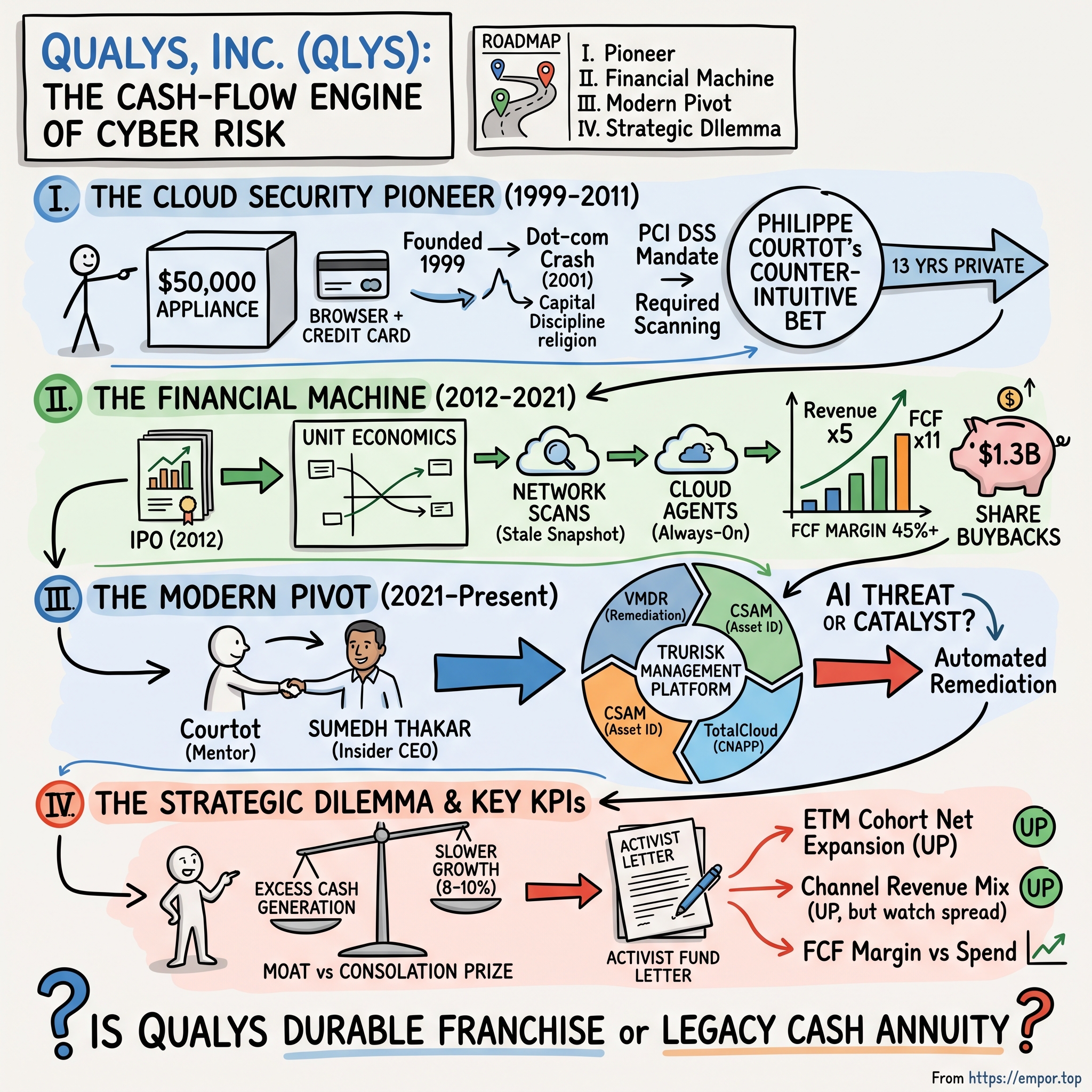
Qualys, Inc.: The Cash-Flow Engine of Cyber Risk
I. Introduction & Episode Roadmap
On the afternoon of April 9, 2026, a software company that had just reported the strongest financial year in its history was valued at roughly $2.7 billion—about half of its market evaluation four months earlier.
The operational business remained intact. Qualys, Inc. had closed 2025 with $669.1 million in revenue, representing 10% annual growth, an adjusted EBITDA margin of 47%, and non-GAAP earnings of $7.07 per diluted share.1 The company carried no debt and generated cash well beyond its immediate operating requirements. Yet over roughly ninety days, public markets erased nearly half its market value.
The shift was driven not by financial disclosures, but by technical demonstrations from artificial intelligence laboratories showing that frontier language models were becoming adept at analyzing source code and detecting software vulnerabilities. Investors reasoned that if automated systems can identify security flaws directly, the long-term value proposition of traditional vulnerability-scanning platforms comes into question.
By late July 2026, the stock had recovered nearly the entire decline, restoring Qualys to a market value of just over $5 billion. Its 52-week trading range reflects that rapid shift in sentiment, spanning a low of $74.51 and a high of $167.86.2 Within a single year, investors debated two starkly different valuations for a company whose underlying revenue grew at a steady 8% to 10%.
That market volatility serves as a proxy for a broader structural question: is Qualys a durable cybersecurity franchise, or a cash-generative legacy vendor in a category increasingly absorbed by broader security platforms?
Qualys occupies an unusual position in enterprise software. Founded in 1999, it delivered multi-tenant, browser-accessible security tools before software-as-a-service became a standard industry model. When the company completed its initial public offering in 2012, it did so with positive operating profit—a rarity among cloud providers at the time.3 Capital allocation has remained focused on returning cash; Qualys has spent approximately $1.3 billion repurchasing its own shares since 2018.4 Furthermore, its balance sheet at the end of 2025 listed just $7.4 million in goodwill—a remarkably low figure for a 27-year-old software enterprise, underscoring management's historical preference for organic development over acquired revenue.5
The central paradox. How did a pioneer from the early era of cloud software build one of the industry's most profitable financial engines, only to find itself twenty-five years later growing at high single digits while integrated platform competitors expand three to five times faster?
Here is the arc the narrative follows:
First, the bootstrapped pioneer: Philippe Courtot's counter-intuitive bet that security scanning belonged on the internet rather than in a $50,000 appliance, and the two market crashes that turned capital discipline from a preference into a religion.
Second, the financial machine: the 2012 IPO, the shift from periodic network scans to always-on cloud agents, and the architecture that produces roughly 83 cents of gross profit on every revenue dollar.
Third, the modern pivot: Sumedh Thakar's attempt to move the company's identity from "we find your bugs" to "we quantify and eliminate your business risk," expressed through the Enterprise TruRisk Management platform and what Qualys calls the Risk Operations Center.
Fourth, the strategic dilemma: whether extraordinary cash generation is a moat or a consolation prize — and whether a company returning less than two-thirds of its free cash flow to shareholders while accumulating a growing cash pile is being disciplined or simply indecisive.
The narrative begins where the capital model was formed.
 Subscribe on LinkedIn
II. The Cloud Security Pioneer: Philippe Courtot & The Anti-Hype Playbook (1999–2011)
In 2001, the enterprise security aisle at an industry trade show was a wall of steel. Vendors sold rack-mounted hardware appliances with blinking lights—boxes that enterprise customers had to purchase, ship, rack, cable, license, and maintain with 20% annual maintenance fees. The business model relied on hardware sales, capital expenditures, and high-friction procurement.
Qualys entered that market with a radical alternative: eliminating hardware entirely in favor of a web browser and a corporate credit card.
Qualys was founded in 1999 by Philippe Langlois and Gilles Samoun, launching QualysGuard the following year as vulnerability scanning delivered as a web service.6 The technical premise was straightforward, but the commercial model was disruptive. Instead of purchasing and operating scanning software internally, organizations pointed Qualys at their network perimeters from the outside to identify vulnerabilities from an attacker's perspective.
The investor who became the operator. Philippe Courtot invested in Qualys at its founding in 1999 and assumed the role of CEO in March 2001.6 A French-born physicist by training, Courtot had led Silicon Valley software companies throughout the 1980s and 1990s—most notably cc:Mail, which was sold to Lotus, as well as Verity and the payments-security company Signio, acquired by VeriSign.6 He arrived at Qualys with an unconventional conviction: the delivery model was the product. While many vendors could write scanner software, few could operate one at scale for thousands of customers simultaneously from shared infrastructure at a fraction of legacy hardware costs.
That philosophy stemmed directly from Courtot's experience at cc:Mail. There, he observed an email system win market share not through superior feature lists, but through a distribution and cost structure that displaced expensive mainframe messaging systems. Applied to cybersecurity in 2001, the same structural dynamic emerged: an entrenched market, high-friction delivery, and enterprise customers eager to avoid managing underlying hardware.
Courtot's tenure began amidst the dot-com crash, which dismantled the venture funding landscape that enabled Qualys's initial creation. As capital for pre-revenue infrastructure startups disappeared and well-funded competitors collapsed, Courtot established an operating discipline that persists at Qualys today. He refused to run the business on external capital, matching operational expansion directly to cash generation, hiring engineering teams against real revenue rather than venture pitch decks, maintaining modest marketing budgets, and letting regulatory requirements drive customer acquisition.
Courtot also exhibited exceptional patience, keeping Qualys private for thirteen years through two full economic cycles while peers raised capital, aggressively burned cash, or pursued early acquisitions. After his death, the company's lead independent director described him as "a transformational leader with a passion for business and cybersecurity."18 Practically speaking, Courtot built an organizational culture where proposed capital expenditures faced a default answer of no.
The 2008 test. The 2008 financial crisis validated the durability of this model. As corporate IT budgets contracted, hardware appliance vendors struggled to sell capital expenditures into budget-frozen enterprises. Qualys, by contrast, offered a subscription model that replaced capital expenditures while tying its functionality to non-discretionary compliance obligations. Even amidst severe economic downturns, merchants still required quarterly PCI scans and public companies needed to satisfy IT audit requirements.
This structural dynamic highlights the resilience of compliance-driven demand. While not completely immune to budget cuts, regulatory compliance sits far lower on the list of potential CFO cancellations. The realization that legally mandated services provide the most reliable revenue streams directed Qualys's strategic investments for the subsequent decade.
The regulatory tailwind that made scanning mandatory. Regulatory mandates between 2002 and 2006 transformed recurring network scanning from an operational best practice into a legal obligation for major sectors of corporate America. Sarbanes-Oxley required public companies to verify internal financial controls, which auditors expanded to cover supporting IT infrastructure. HIPAA introduced strict security rules for healthcare data. Crucially, the Payment Card Industry Data Security Standard (PCI DSS) mandated that merchants processing card transactions undergo quarterly external vulnerability scans administered by an Approved Scanning Vendor.
From a business model standpoint, PCI DSS essentially codified a product specification for a recurring, externally delivered SaaS platform—a market Qualys was already uniquely positioned to serve. Legacy appliance vendors struggled to adapt, as external scans required originating probes from outside a customer's perimeter, a task ill-suited for internal hardware boxes.
Counter-positioning, in the Helmer sense. In Hamilton Helmer's strategic framework, counter-positioning occurs when a newcomer adopts a business model that incumbents cannot copy without eroding their core business. Qualys represented a classic example.
In 2005, legacy vulnerability management vendors relied on three primary revenue sources: upfront perpetual software licenses, hardware margins, and recurring 20% annual maintenance fees. To match Qualys, an incumbent would have had to migrate customers to lower-priced recurring subscriptions, bear the cost of managing multi-tenant cloud infrastructure, and accept an immediate collapse in upfront revenues. Financial logic dictated maintaining the status quo, allowing Qualys to expand within the market space left open by incumbent inertia.
However, counter-positioning serves as a transitional advantage rather than a permanent moat. It shields a company only while legacy rivals remain tied to obsolete models. The strategy offers no protection against born-in-the-cloud competitors, which comprise all of Qualys's primary rivals today. Consequently, the counter-positioning advantage that built Qualys largely dissipated by 2015, forcing the company to establish new competitive differentiators.
By the end of 2011, the year before its initial public offering, Qualys generated $76.2 million in revenue alongside a modest operating profit.5 Though relatively small in revenue scale by Silicon Valley standards, its financial profile stood out: pure subscription revenues, 83% gross margins, and zero debt, built over twelve years of strict capital discipline.
That private discipline was about to face its ultimate test in the public markets.
III. The Unsung Machine: The 2012 IPO & The Anatomy of 45%+ FCF Margins
On September 27, 2012, Qualys priced 7,575,000 shares at $12.00—the middle of its expected range—and began trading on Nasdaq the following morning under the symbol QLYS. When the greenshoe option was exercised and the offering closed on October 3, the company had sold 8,711,250 shares and netted approximately $87.5 million.3
By the standards of the 2012 cloud IPO class, it was an underwhelming debut. In retrospect, that modest debut reflected the company's core financial philosophy.
On paper that year, Qualys posted $91.4 million in revenue and net income of about $2.3 million.5 While modest, that profit set the company apart. In a cohort of cloud providers whose public filings were essentially bets that current losses would fund future market dominance, Qualys arrived with a profitable track record, seeking a public currency and liquidity for employees. The IPO raised roughly one year of revenue, most of which was never required for operations.
From scan windows to always-on: the 2015 architecture bet.
The company's high cash conversion stems from a major architectural shift executed in 2015.
The original vulnerability management model relied on periodic network scanners. In effect, a scanner operated like a security guard patrolling a building on a fixed schedule—once a week or once a quarter—checking doors and recording unlocked entry points. The resulting report provided a point-in-time snapshot that became stale immediately. If an entry point opened on Tuesday afternoon and the scan ran on Friday, three days of exposure remained undetected. Furthermore, network scanners required fixed network addresses. As corporate workloads migrated to remote laptops and temporary cloud instances, perimeter scanning missed assets that lacked static locations.
On April 21, 2015, at the RSA Conference, Qualys announced the Cloud Agent Platform: a lightweight piece of software installed directly on each endpoint, continuously reporting its security state back to the central platform.[^7] Rather than relying on periodic external sweeps, endpoints reported their status continuously, regardless of network location.
Three main operational consequences followed:
First, coverage expanded. Lightweight software agents followed the assets. A remote employee's laptop, a cloud container running for eleven minutes, or an unmapped virtual machine in a public cloud region all remained visible to agents, whereas network scanners frequently missed them.
Second, data accumulated at scale. Millions of deployed agents continuously transmitted structured operational logs, creating a longitudinal dataset of enterprise software configurations across thousands of customers. That repository created a proprietary dataset that underpins subsequent platform expansions.
Third, unit economics improved significantly. Because Qualys operates a single multi-tenant architecture, serving an incremental customer requires only marginal compute and storage on existing infrastructure. In 2025, cost of revenue totaled $114.8 million against revenue of $669.1 million—yielding roughly 83 cents of GAAP gross profit per dollar of revenue, with non-GAAP gross margins slightly higher.5
High gross margins are common in enterprise software, but converting them into cash requires strict spending discipline. In 2025, Qualys spent $143.5 million on sales and marketing, or roughly 21% of revenue.5 That restrained commercial spending stands as a central element of its profit structure.
The decade of compounding, in three snapshots.
The financial impact of the cloud agent architecture appears clearly across three distinct benchmarks. In 2014—the year prior to the Cloud Agent launch—Qualys generated $133.6 million in revenue and $27.4 million in free cash flow, representing a 20% free cash flow margin. By 2019, annual revenue reached $321.6 million and free cash flow expanded to $129.0 million, a 40% margin. By 2025, total revenue of $669.1 million yielded $304.4 million in free cash flow.54
Between 2014 and 2025, revenue roughly quintupled while free cash flow expanded more than elevenfold. That widening gap demonstrates the leverage in the platform: as revenue scaled, an increasing portion of each incremental dollar flowed directly to cash because infrastructure and engineering overhead expanded at a far slower rate.
However, annual top-line growth simultaneously decelerated. Revenue grew 21% in 2018, 15% in 2019, 13% in both 2020 and 2021, 19% in 2022, 13% in 2023, and roughly 10% annually in 2024 and 2025.5 Margin expansion persisted even as revenue expansion slowed, transforming Qualys into a highly cash-generative but slower-growing provider—a shift that prompted public markets to re-evaluate its valuation multiple.
That operational model produced high cash conversion. Operating cash flow reached $309.4 million in 2025 against capital expenditures of just $5.0 million.5 On its February 2026 earnings call, management told investors that free cash flow "reached $304.4 million or 45% of revenues."4
A note on free cash flow metrics.
In its earnings release for the same period, Qualys reported free cash flow of $290.9 million.1 The difference reflects varying accounting treatments below operating cash flow. Because free cash flow is a non-GAAP metric with varying company definitions, evaluating Qualys against industry peers requires normalizing operating cash flow minus capital expenditures.
Capital allocation: the deliberate absence of a strategy.
Unlike many enterprise software providers of similar scale, Qualys has rarely acquired revenue through major corporate acquisitions.
Its transaction history over the past decade consists of three targeted technology purchases. In October 2018, the company acquired container-security startup Layered Insight for $12 million, with up to $8 million in contingent earn-outs and retention incentives.7 In July 2020, it purchased the software assets of Spell Security, an endpoint-detection research firm, for $1.5 million in cash.8 In October 2022, Qualys acquired assets from machine-learning security firm Blue Hexagon for $10 million, paying $8.5 million at closing.9
Combined upfront and contingent consideration for all three transactions totaled roughly $31.5 million—less than Qualys typically spends on share repurchases in a single quarter.
This disciplined acquisition record explains the $7.4 million in goodwill on its balance sheet at the end of 2025.5 Rather than managing disparate acquisitions, Qualys built its expansion modules—including patch management, asset identification, and risk prioritization—internally or integrated small asset purchases directly into its unified codebase.
This organic development model has maintained architectural consistency and protected gross margins. However, an organic-first strategy also carries strategic trade-offs: building capabilities internally takes longer than buying market share, leaving the platform vulnerable when enterprise security buyers demand rapid feature consolidation.
The buyback engine — and what it actually does.
Qualys initiated its share repurchase program in February 2018. By the end of the first quarter of 2026, the company had retired 11.2 million shares and deployed $1.3 billion in buybacks, leaving $306.6 million in authorization after the board expanded the program by $200 million in February 2026.410
A closer examination of cash flow statements clarifies the capital return dynamics. In 2025, Qualys deployed $183.4 million toward stock repurchases against $304.4 million in free cash flow, representing roughly 60% of cash generated rather than complete capital return. Consequently, total cash and marketable investments expanded from approximately $575 million at year-end 2024 to $698 million by the end of 2025.5
Furthermore, a substantial portion of share repurchases absorbs employee stock-based compensation rather than reducing total share count. Stock-based compensation reached $77.0 million in 2025, representing 11.5% of revenue.5 Despite spending $183.4 million on repurchases, the diluted share count declined by 2.4%, from 37.4 million in 2024 to 36.5 million in 2025, as share issuances offset roughly half of the gross repurchase impact.
That equity compensation also accounts for the divergence between reported earnings figures. In 2025, GAAP diluted earnings per share stood at $5.44, compared to non-GAAP diluted earnings per share of $7.07.1 The $59.5 million gap between GAAP and non-GAAP net income primarily reflects stock compensation expense—an ongoing structural cost paid in equity rather than cash.
In total, Qualys's financial architecture demonstrates durable economics: 83% gross margins, minimal capital intensity, and a zero-debt balance sheet are established structural attributes. However, exceptional cash generation does not automatically guarantee revenue acceleration—a challenge that turns on product expansion and platform execution.
IV. The Core Engine: Vulnerability Management, VMDR, & The TruRisk Platform
Virtually every modern enterprise relies on software built by external developers—operating systems, databases, web servers, browsers, and open-source libraries pulled in during late-night build sessions. Every piece of software contains defects, and a subset of those flaws allows attackers to breach systems.
When a defect is publicly disclosed, it receives a Common Vulnerabilities and Exposures (CVE) identifier and enters a global registry monitored by both security teams and cybercriminals. Vulnerability management is the unglamorous operational discipline of continuously answering three questions: What assets does the organization own? What is broken on those assets? Which vulnerabilities pose actual risks?
Qualys established its initial market footprint by answering the second question. Over the past six years, the company has attempted to capture the first and third questions, while adding a fourth operational requirement: Did anyone actually fix the defect?
Why the fourth question is the whole ballgame.
This fourth question exposed the fundamental limitation of traditional vulnerability management. A large enterprise scanning several hundred thousand assets rarely receives a manageable task list; it gets a spreadsheet containing millions of rows. Security teams discover the flaws but lack the administrative authority to modify production systems. Meanwhile, IT operations teams—which hold that authority—receive the spreadsheet as an unfunded mandate, forcing them to balance patching against competing operational priorities.
This friction resulted in what Chief Executive Officer Sumedh Thakar frequently characterizes on earnings calls as "dashboard tourism"—a decade of beautifully rendered risk visualizations that altered nothing on production machines.4 The scanning industry proved effective at identifying flaws, but ineffective at driving remediation.
In March 2020, Qualys introduced Vulnerability Management, Detection and Response (VMDR), consolidating asset discovery, vulnerability detection, threat prioritization, and patch deployment into a single workflow starting at $199 per asset.11 The pivotal addition was automated remediation. Qualys was among the first providers to deliver patching capabilities directly through the same cloud agent that identified the vulnerability.
Economically, combining detection and remediation fundamentally changes the product value proposition. A standalone scanner functions as a diagnostic tool that an enterprise can replace relatively quickly. Conversely, a platform actively deploying patches across tens of thousands of production servers becomes deeply embedded in daily operations, change-management workflows, and joint IT-security governance. This operational entanglement creates high customer switching costs.
Management cites deployment metrics as evidence of operational adoption. On the fourth-quarter 2025 earnings call, Thakar highlighted 140 million patches deployed via Qualys agents over the preceding twelve months, alongside a top ranking in a GigaOm patch-management evaluation; by the May 2026 call, management updated the figure to over 150 million patches, noting that more than 40 million were deployed autonomously during the prior year.410
While these deployment volumes reflect significant technical usage, financial disclosures offer a more measured picture of commercial traction. In the first quarter of 2026, patch management represented 8% of total bookings and 15% of new bookings on a trailing twelve-month basis, compared to 7% of total bookings and 16% of new bookings a year earlier.10 While its share of total bookings rose by one percentage point, its share of new bookings contracted slightly. Six years post-launch, patch management operates as a valuable add-on module rather than an independent growth engine.
The other attach modules, sized honestly.
Qualys has introduced additional modules to expand its platform reach. CyberSecurity Asset Management (CSAM) targets a persistent enterprise vulnerability: unmapped assets. CSAM inventories internal infrastructure detected by agents and scanners, while its external attack surface management feature scans public-facing networks to identify unmonitored subdomains and legacy cloud servers.
TotalCloud serves as the company's Cloud-Native Application Protection Platform (CNAPP), addressing cloud storage misconfigurations, excessive identity permissions, and container workloads. The artificial intelligence and machine learning assets acquired from Blue Hexagon were integrated into this offering.9
Enterprise TruRisk Management (ETM), launched in October 2024, represents Qualys's core strategic initiative.12 The platform aggregates security data from both native Qualys sensors and third-party security tools, normalizes the findings, applies threat intelligence, and presents prioritized exposure metrics formatted as financial business risk rather than abstract technical severity scores.
How to think about a TruRisk score, without the jargon.
For decades, the cybersecurity sector scored vulnerabilities primarily on abstract technical severity. While technical severity offers useful context, it often serves as an inefficient prioritization mechanism. A critical flaw in a disabled software component poses minimal immediate danger, whereas a moderate flaw on a primary transaction-processing server can represent an existential threat.
The TruRisk framework modifies technical severity by incorporating two real-world variables: real-time active exploitation in the wild and the business criticality of the targeted asset. On investor calls, Thakar claimed this methodology identifies specific low-severity flaws as high-risk approximately forty days before they appear in the U.S. government's Known Exploited Vulnerabilities catalog—a testable assertion regarding threat-intelligence lead times.10
Qualys frames this platform around an organizational concept termed the Risk Operations Center (ROC). While enterprises routinely operate Security Operations Centers to detect active attacks, Qualys contends that organizations lack a dedicated operational function for pre-breach risk mitigation—specifically inventorying assets, assessing exploitability, and coordinating remediation. The company positions ETM as the software layer powering the ROC, though whether the Risk Operations Center emerges as an industry-standard category or remains vendor marketing depends on enterprise budget allocations and analyst adoption.
Thakar illustrated the commercial logic on the fourth-quarter 2025 earnings call: a traditional exposure tool might assign Asset A a severity score of 900 out of 1,000 and Asset B a score of 750, directing IT to remediate Asset A first. However, if Asset A supports $2 million in annual revenue while Asset B supports $500 million, business priorities dictate reversing that order.4
While this value proposition is logically compelling, enterprise adoption figures indicate measured market penetration. On a trailing twelve-month basis in the first quarter of 2026, ETM and CSAM combined accounted for 11% of total bookings and 14% of new bookings, up from 8% and 9% respectively in the prior-year period.10 Although this reflects expansion, the combined modules generate roughly one out of every nine booking dollars.
Meanwhile, TotalCloud represented 5% of trailing twelve-month bookings in the first quarter of 2026, remaining flat compared to the previous year despite rapid growth across the broader cloud security market.10 Although Qualys was named a leader in a Forrester CNAPP evaluation during the first quarter of 2026, industry recognition has not yet translated into dominant market share.10
A word about customers, because scale here is not what it looks like.
Qualys serves more than 10,000 customers across 130 countries, including a majority of the Forbes Global 100 and Fortune 100.5 Divided across $669.1 million in annual revenue, this yields an average annual revenue per customer of approximately $65,000.
This distribution illustrates the structure of the customer base. Rather than relying on a small cohort of eight-figure enterprise contracts, Qualys maintains a broad base of mid-sized subscriptions alongside a smaller tier of major enterprise accounts. The cohort of customers generating $500,000 or more in annual recurring revenue grew 9% year over year in the first quarter of 2026, expanding faster than overall revenue, albeit from a modest base.10
Consequently, Qualys's commercial strategy depends heavily on expanding module adoption within existing accounts rather than relying primarily on new customer acquisition. In this model, the net dollar expansion rate serves as a key indicator of execution. The stabilization of this rate at 103% to 104% reflects steady account retention, but highlights the challenge of driving accelerated top-line expansion.
What the mix tells you.
Core vulnerability management and compliance scanning continue to generate approximately three-quarters of total revenue. Rather than serving as primary growth drivers, newer modules function largely as protective enhancements—increasing customer switching costs and creating upsell opportunities during renewal cycles. While this structure maintains customer retention and high profitability, it highlights the operational gap between a focused vulnerability management vendor and an expansive cybersecurity platform.
V. Competitive Warfare & The Platform Consolidation Battle
Nearly every enterprise security executive is familiar with a sobering presentation slide: one displaying the 40 to 80 security tools deployed at a typical company alongside a Chief Information Security Officer's plan to reduce that number by half.
Vendor consolidation stands as the defining structural trend in enterprise security in 2026. The critical question for Qualys is straightforward: when customers compile a shortlist of retained vendors, will Qualys remain, or will it be consolidated into a broader competitor's platform?
The direct rivals, measured properly.
Tenable offers the most direct comparison, sharing the same category lineage stemming from the Nessus scanner and targeting the same enterprise buyer. In fiscal 2025, Tenable generated $999.4 million in revenue while reporting a GAAP net loss of $36.1 million.13 The company allocated $416.9 million to sales and marketing, representing 42% of revenue.
By comparison, while Tenable generated nearly 50% more revenue than Qualys, it operated at a loss because it devoted double the proportion of its revenue to go-to-market efforts. The two companies operate in the same category with fundamentally different philosophies regarding capital efficiency and revenue profitability.
Rapid7 generated $859.8 million in revenue in 2025, yielding a GAAP net income of $23.4 million while spending $317.7 million on sales and marketing.14 Rapid7 has increasingly diversified into detection-and-response and managed services—a distinct, lower-margin competitive arena.
CrowdStrike represents the largest platform rival. In its fiscal year ended January 31, 2026, CrowdStrike generated $4.81 billion in revenue—roughly seven times that of Qualys—and reported a GAAP net loss of $162.5 million alongside $1.83 billion in sales and marketing expenses.15 CrowdStrike's primary strategic threat to Qualys is not a superior scanner, but its pre-existing agent deployment on enterprise endpoints. Adding vulnerability detection as a module to an established CrowdStrike contract carries nearly zero incremental deployment friction for the customer.
Palo Alto Networks approaches the market from another angle. Its "platformization" strategy encourages enterprises to consolidate multiple security functions onto its unified stack, occasionally discounting software to displace incumbent vendors. Palo Alto Networks does not need to offer the leading vulnerability scanner to challenge Qualys; it needs only to incorporate vulnerability data into broader Cortex or Prisma agreements.
Microsoft poses a subtle but pervasive threat through bundling. Its Defender Vulnerability Management product is included in enterprise licensing tiers that many large organizations already buy. When a capability is included in existing software agreements, the customer's evaluation shifts from product comparison to whether a standalone alternative justifies a separate line item, procurement cycle, and vendor assessment.
These four competitors share a common objective: rather than outperforming Qualys strictly on vulnerability management capabilities, they aim to position vulnerability assessment as an included feature within broader enterprise purchasing decisions. This dynamic drives category commoditization, which operates through contractual bundling rather than direct head-to-head product evaluations.
In early 2026, market consolidation accelerated further when ServiceNow moved to acquire Armis, integrating asset visibility into the IT workflow platform widely used across enterprise environments. On Qualys's fourth-quarter 2025 earnings call, an analyst highlighted this transaction alongside a notable detail from Qualys's investor presentation: the company had reduced its total addressable market estimate from $64 billion in 2023 to $53 billion for 2026, while scaling back long-term projections.4
Thakar did not address the market-size reduction directly, focusing instead on product differentiation. He noted that asset visibility tools like Armis identify and inventory assets, but "they don't actually do the patching. They pass it off to somebody else." Citing a Mandiant metric showing that median time-to-exploitation now frequently precedes patch availability, Thakar questioned whether enterprises have time to generate manual IT tickets and coordinate human remediation.4
While the operational logic is sound, the unaddressed total addressable market revision remains notable. A company lowering its addressable market estimate by 17% while asserting that its target category is expanding creates a strategic ambiguity that management left unresolved.
Where Qualys genuinely wins.
Three operational advantages sustain Qualys's market standing.
Cost position. Spending 21% of revenue on sales and marketing compared to Tenable's 42% enables Qualys to maintain strong profit margins during price-sensitive renewals. In an environment where enterprise security buyers face budget constraints, operating as a cost-efficient vendor provides a meaningful commercial advantage.
Detection depth. Twenty-five years of signature engineering have yielded a proprietary detection database that is difficult for newer entrants to duplicate. On the first-quarter 2026 earnings call, Thakar addressed this advantage in the context of automated threat detection, noting that enterprise customers increasingly focus on false negatives—unidentified vulnerabilities. Thakar argued that "if you're using tier-two scanners, the time it takes to get signatures out and find the findings versus a scanner like Qualys, where we are getting signatures out multiple times a day," highlights a fundamental gap in threat coverage.10
Remediation, not just detection. Integrating detection directly with automated patching remains Qualys's primary functional differentiator, bridging the gap between identifying security flaws and resolving them.
Where Qualys loses.
Qualys struggles when enterprise security leaders decide to standardize on broader security platforms. In those negotiations, competition centers on contractual consolidation rather than standalone feature depth. Standalone product arguments face headwinds against bundled solutions because bundling simplifies enterprise procurement and vendor management.
Qualys also faces a significant scale gap in distribution. CrowdStrike invests more in sales and marketing in a single quarter than Qualys expends in three years. Qualys has responded by expanding channel partner relationships—a strategic adaptation to distribution asymmetries, and one explored in the subsequent section—though reliance on channel partners trades direct customer control for distribution scale.
Porter's five forces, applied.
Buyer power: high, and rising. Enterprise customers are actively consolidating vendor relationships, as reflected in Qualys's net dollar expansion rate remaining at 103% to 104% across recent quarters.410 While Qualys maintains strong account retention—with management reporting gross dollar retention comfortably above 90%—upselling additional software modules within existing accounts remains constrained.
Threat of substitutes: high. Substituting standalone scanning with integrated features inside endpoint agents, cloud posture tools, or enterprise software licenses represents the primary competitive threat. Substitution occurs not when a rival wins a technical comparison, but when a customer accepts built-in capabilities as sufficient.
Rivalry: intense. Qualys competes against well-capitalized platform providers, several of which accept GAAP operating losses to capture market share.
Supplier power: low. Operating requirements consist primarily of standard cloud infrastructure and engineering talent.
Threat of new entrants: moderate, and changing shape. Developing an enterprise vulnerability scanner historically required years of signature development. While artificial intelligence accelerates aspects of vulnerability discovery, it does not bypass enterprise requirements such as agent deployment footprints, compliance certifications, and low false-positive rates.
The honest scorecard. Qualys's core advantages—its cost structure, detection coverage, and integrated remediation—remain meaningful but focused. While these capabilities do not prevent platform competitors from bundling vulnerability management, they position Qualys as a practical option for organizations prioritizing specialized threat detection and automated remediation over single-vendor consolidation. That leaves Qualys with a defensible, albeit narrower, market footprint than it occupied in 2015, a shift underscored by its steady expansion rate.
VI. The Leadership Transition & Modern Strategy: Sumedh Thakar's Playbook (2021–Present)
A major leadership transition following a two-decade executive tenure can disrupt an enterprise software provider. At Qualys, however, the executive succession unfolded with minimal operational friction.
Philippe Courtot took a leave of absence for health reasons and resigned as CEO in early 2021, ending a tenure of nearly twenty years.16 The board named Sumedh Thakar interim CEO in February and confirmed him as President and Chief Executive Officer on April 29, 2021.17 Following Courtot's death on June 5, 2021, at age 76, Thakar paid tribute to his predecessor, stating: "Philippe was my mentor and advisor."18
Long-tenured executive departures often leave a significant operational void. Qualys mitigated that disruption by promoting an insider who had spent eighteen years within its engineering and product development organization.
Who Thakar is.
Thakar joined Qualys in 2003 as an engineer, became Chief Product Officer in 2014, added the title of President in 2019, and assumed the CEO role in 2021—an executive trajectory built entirely within a single organization's product hierarchy.17
That engineering background directly influences executive communication and strategic priorities. On quarterly earnings calls, Thakar offers technical detail uncommon among enterprise software CEOs, frequently discussing code mitigations, rollback rates, and signature cadence. When questioned by an analyst in May 2026 regarding frontier artificial intelligence models, Thakar provided a detailed assessment of which security research workflows automated systems accelerate and which remain beyond current model capabilities.10
While a product-focused chief executive enhances technical credibility, it leaves open questions regarding commercial execution and go-to-market performance. Chief Revenue Officer Dino DiMarino, who joined Qualys in 2023, departed in early 2025 to become chief executive of AppViewX—a departure management acknowledged on its February 2025 earnings call as potentially causing "near-term adjustment to the plan."1920 In March 2026, DiMarino joined primary rival Tenable as chief revenue officer.21 That sales leadership transition underscores the competitive mobility of commercial talent within the vulnerability management sector.
Strategy one: from finding bugs to pricing risk.
The Enterprise TruRisk Management (ETM) platform and its TruRisk scoring methodology reflect Thakar's attempt to elevate Qualys from a technical scanner used by security engineers into an executive management system targeted at Chief Information Security Officers reporting to corporate boards.
Platform expansions in 2025 reinforced this positioning. At the ROCon conference in Houston in October 2025, Qualys broadened ETM by introducing identity security posture management, industry-specific threat prioritization via TruLens, and automated exploit validation through TruConfirm.22
TruConfirm represents a distinct functional addition to the platform. Traditional vulnerability metrics evaluate security flaws based on theoretical severity, without factoring in environment-specific controls such as network firewalls, active memory protections, or disabled system components. TruConfirm attempts to execute a non-disruptive proof-of-concept exploit against the target asset to determine whether the vulnerability can be actively exploited in practice.
By seeking to convert probabilistic risk assessments into empirical verification, TruConfirm provides measurable efficiency claims. On the first-quarter 2026 earnings call, Thakar stated that fewer than 1% of detected vulnerabilities prove genuinely exploitable in live production environments.10 Validating this assertion across enterprise deployments at scale will determine whether the capability drives broader platform adoption in coming quarters.
Strategy two: the channel pivot.
The most significant operational shift under Thakar involves distribution strategy. In the first quarter of 2026, partner-sourced revenue reached 52% of total revenue, up from 49% in the prior-year period, as channel revenue grew 17% while direct sales grew 3%.10 This divergence was evident in preceding quarters as well: partner-sourced revenue reached 51% of total revenue in the fourth quarter of 2025 (with channel revenue growing 17% against 4% direct growth) and 50% in the third quarter of 2025 (up from 47% a year earlier).423
This growth spread highlights a structural transition: nearly all incremental top-line expansion is generated through distribution partners rather than the direct sales organization. Management characterizes this shift as an intentional effort to build an ecosystem without incurring massive internal go-to-market costs, establishing a network of certified managed Risk Operations Center ("mROC") partners offering managed services atop ETM—with nearly two dozen partners certified as of May 2026.10
This strategy presents a dual narrative for investors. Channel distribution offers capital efficiency, as partners absorb customer-acquisition expenses and generate high-margin professional services alongside Qualys software licenses. However, with direct sales expanding at just 3% while overall revenue guidance targets 8% to 9% growth, Qualys relies increasingly on third-party sales organizations for top-line expansion, creating operational distance between the company and its primary end-user accounts.
Strategy three: QFlex, and the pricing problem it admits.
To address procurement friction, Qualys introduced QFlex, a flexible consumption model allowing enterprise customers to commit an annual budget and allocate usage dynamically across different Qualys modules as security requirements shift. Following a beta phase in 2025, management scheduled general availability for late 2026.410
Chief Financial Officer Joo Mi Kim explained the strategic rationale behind the model: while Qualys frequently releases product modules mid-year, corporate buyers typically operate on annual budget cycles, delaying adoption of newly released capabilities. QFlex aims to eliminate this procurement barrier by permitting mid-contract module reallocation.
However, Kim also acknowledged the associated commercial risk, emphasizing a phased, case-by-case rollout to ensure the model does not "unintentionally result in a downsell."4 Flexible pricing structures allow clients to reallocate underutilized software commitments, which can drive wider product usage across an enterprise while simultaneously risking spend contraction on core modules—a dynamic that will be reflected in future net dollar expansion metrics.
Management credibility: what the record actually shows.
Evaluating management's track record reveals an unusual operational pattern of guidance beats driven primarily by disciplined cost containment rather than unexpected revenue acceleration.
In February 2025, management provided full-year guidance calling for revenue of $645 million to $657 million (representing 6% to 8% growth), an adjusted EBITDA margin in the low 40s (implying an 18% to 20% expansion in operating expenses), a free cash flow margin in the low-to-mid 30s, and diluted non-GAAP earnings per share of $5.50 to $5.90.23
Qualys ultimately reported full-year 2025 revenue of $669.1 million (10% growth), an adjusted EBITDA margin of 47%, a free cash flow margin of 45%, and non-GAAP earnings per share of $7.07—surpassing the upper bound of initial earnings guidance by approximately 20%.14
A closer examination of those results demonstrates that while revenue exceeded the midpoint of initial guidance by 2%, the substantial earnings beat resulted largely from operating expenditures coming in well below forecast. While management initially guided for 18% to 20% operating expense growth, third-quarter operating expenses grew just 5%, with sales and marketing expenses rising 9%.24 Addressing the margin upside on an earnings call, Kim noted that the company remained "mindful of where to further increase investments while optimizing returns," which "resulted in EBITDA margin exceeding our expectations"—an outcome reflecting capital discipline, but also confirming that planned reinvestment was curtailed.24
This pattern yields two distinct interpretations. Optimists view management as prudently withholding capital from underperforming commercial channels. Skeptics argue that setting conservative expense targets and subsequently under-investing converts unspent operational budgets into short-term earnings beats while top-line revenue growth remains capped in high single digits.
A similar dynamic emerged in 2026. Initial February guidance projected 7% to 8% revenue growth alongside mid-teens operating expense growth and a mid-40s EBITDA margin.4 Following a first-quarter beat, management raised full-year revenue guidance to $721 million–$727 million and EPS guidance to $7.44–$7.65; however, Kim declined to raise the underlying current billings growth forecast, affirming that the 7% to 8% baseline "remains the case."10 This measured adjustment demonstrates management's refusal to extrapolate single-quarter performance into overly ambitious full-year targets.
Strategic messaging across investor communications has shown consistent alignment. The core positioning around ETM, the Risk Operations Center framework, integrated patching capabilities, and channel expansion remained uniform across quarterly calls in February 2025, November 2025, February 2026, and May 2026. Furthermore, when pressed by analysts regarding adoption timelines—such as Rudy Kessinger of D.A. Davidson noting in February 2026 that ETM had not yet accelerated net expansion—Thakar acknowledged the operational dependencies candidly, responding that "all of that needs to go right."4
Incentives.
Executive compensation alignment reinforces this operational posture. Qualys's annual cash bonuses are tied to bookings, revenue growth, and non-GAAP earnings per share, while multi-year performance share units vest based on revenue growth and adjusted EBITDA margins.25 The compensation structure omits total shareholder return targets, incentivizing management to balance top-line expansion directly against profitability. This design discourages large, margin-dilutive acquisitions while simultaneously penalizing aggressive spending shifts aimed solely at acquiring unprofitable market share—aligning executive incentives with the persistent operational spending discipline observed across recent quarters.
VII. Playbook: Durable Business & Capital Allocation Lessons
Stripping away company-specific details leaves five transferable strategic lessons—each paired with an operational limitation, because a playbook presented without its failure modes is merely marketing.
1. Architecture dictates economics, and the decision is nearly irreversible.
Qualys's margin structure was determined in 1999 rather than 2025. Building a multi-tenant cloud architecture from inception meant that the marginal cost of serving an incremental customer was negligible. Competitors burdened by legacy on-premises codebases cannot easily retrofit this design; wrapping hybrid-cloud interfaces around legacy architectures preserves the underlying cost structure.
The limitation: an architectural advantage provides a cost benefit, not a demand engine. It determines how profitably a vendor serves the customers it wins, but offers no intrinsic help in winning them. Qualys's 83% gross margin has not prevented its net dollar expansion rate from remaining bounded at 103% to 104%.
2. Refusing to buy growth preserves the balance sheet—and forecloses strategic options.
Qualys observed the 2020–2021 enterprise software valuation inflation without making major speculative acquisitions. Peer companies that acquired revenue at twenty times forward sales during that period spent subsequent years recording goodwill impairments and attempting to integrate mismatched corporate cultures.
The limitation: relying solely on organic development slows market entry and risks arriving late to emerging software categories. Qualys entered the cloud-native application protection space after early competitors established the category, and TotalCloud's stagnant 5% share of bookings reflects the financial reality of late market entry. Capital discipline imposes its own strategic costs.
3. Closed-loop workflows beat standalone diagnostic tools.
The most durable strategic insight from Qualys's trajectory is the transition from reporting software flaws to actively resolving them. Diagnostic utilities are easily benchmarked, compared, and replaced. Software deeply embedded in production remediation workflows creates far stronger operational stickiness.
This operational principle extends beyond cybersecurity; payment processors that integrate transaction reconciliation remain far stickier than providers that merely transfer funds. The limitation is that closed-loop workflows generate switching costs only where the loop is fully executed. Qualys's modest patch management attach rate indicates that the workflow loop remains open across the majority of its customer base.
4. Align capital returns with actual growth rates—and account for unreturned cash.
When annual top-line growth decelerates from high double digits to high single digits, share repurchases represent a logical deployment of excess cash. Qualys has pursued this capital allocation strategy consistently since 2018.
The limitation lies in what optimistic narrative cases often overlook. Qualys deployed roughly 60% of its 2025 free cash flow toward buybacks, allowing its cash and marketable securities balance to expand to approximately $698 million alongside minimal debt.5 A management team fully convinced of intrinsic undervaluation during the April 2026 market decline—when market capitalization fell near $2.7 billion—possessed the balance sheet capacity for more aggressive repurchases. Instead, it repurchased $53.9 million in shares during the first quarter of 2026.10 While capital allocation has remained prudent, conservative cash management is not necessarily optimal capital allocation—a distinction an activist investor would highlight.
5. Leverage regulatory mandates and operational obligations to drive sales.
The most portable lesson from Qualys's history is the commercial power of mandatory compliance. The company's initial decade of growth was underwritten by regulatory requirements that rendered recurring vulnerability scanning obligatory. Qualys has sought to replicate that structural tailwind through FedRAMP High authorization—which creates an eligibility threshold that limits federal procurement competition—and through a 2026 cyber-insurance partnership with Converge, which aims to link a customer's Qualys risk score directly to reduced insurance premiums.10
The cyber-insurance initiative represents an intriguing commercial framework, though it warrants objective observation rather than premature validation. If verifiable remediation cadence measurably lowers an enterprise's breach insurance premiums, Qualys's diagnostic output acquires a third-party economic value—providing a far more compelling sales pitch than internal executive dashboards. At present, the initiative comprises a single partnership without disclosed financial metrics. The underlying mechanism is logical, but empirical commercial evidence remains pending.
The meta-lesson. Each element of this playbook highlights an operational discipline that served Qualys well, yet each carries an inherent constraint reflected in the company's single-digit growth rate. That duality defines the business: a franchise built on genuine operational rigor whose very disciplines simultaneously form a growth ceiling. That balance sets the stage for the strategic case an activist investor would present.
VIII. Financial Stress Test, Bull vs. Bear Case, & The 3 Critical KPIs
Consider a hypothetical letter from an activist fund holding a 4% stake, addressed to the board of directors. The argument writes itself.
The skeptical thesis.
"Qualys is an extraordinarily well-run business trapped in a strategically ambiguous position. Revenue growth has been pinned in a narrow band around 8% to 10% for three years while the platform vendors you compete against grow multiples faster. Your net dollar expansion rate has not moved off 103% to 104% in eight quarters—meaning your existing customers are barely increasing their spend with you. Your direct sales force grew 3% last quarter.
You told shareholders in February 2025 you would raise operating expenses 18% to 20% to reignite growth. You raised them far less and delivered a margin beat instead. If the investment thesis was right, you failed to execute it. If it was wrong, why did you announce it?
Choose. Either commit real capital to growth—and accept a 35% EBITDA margin for two years while doing so—or stop pretending this is a growth company: leverage the pristine balance sheet, return well above 100% of free cash flow, and run it as the cash annuity it demonstrably is. What you are doing instead is neither, and the market's willingness to halve your value in ninety days on an AI headline reflects a shareholder base that cannot tell which one you are."
Management's counter-argument, assembled from executive commentary: growth is coming from a strategy that requires time to compound. ETM only reached general availability at the end of 2024; the cohort of customers who own ETM or CSAM already shows a 107% net expansion rate against the company-wide 103% to 104%.10 The partner ecosystem is producing 17% growth against a direct business at 3%, and mROC partners are only now launching services. FedRAMP High authorization, granted in August 2025 with the Drug Enforcement Administration as sponsor, opened federal budget cycles that were closed for 2025.26 Furthermore, management contends that pouring spending into a channel before it becomes fully productive destroys capital.
Both arguments are internally coherent, though disclosed financial data currently offers stronger support for management's process than for its results.
Myth versus reality: four things the consensus gets wrong.
Myth: Qualys returns essentially all of its free cash flow to shareholders. Reality: the company returned roughly 60% of free cash flow in 2025, allowing its cash and marketable investments balance to expand to about $698 million.5 The buyback program is substantial and consistent, but it is not a full-payout policy—a distinction that matters when assessing management's conviction in its own valuation.
Myth: non-GAAP earnings per share of $7.07 represent true shareholder earnings. Reality: GAAP diluted earnings per share stood at $5.44, and the gap is driven by stock-based compensation that represents a real economic cost.1 Anyone valuing the stock based solely on the non-GAAP figure is implicitly treating $77 million in annual employee equity transfers as cost-free.
Myth: the rise of artificial intelligence models is unequivocally negative for vulnerability management. Reality: frontier AI models excel at detecting flaws in source code, an activity that occurs upstream of Qualys's core operations. Qualys's workflow begins after a flaw becomes public—identifying every affected asset across an enterprise, evaluating whether it is exploitable behind specific organizational controls, and applying remediation. Thakar has articulated this operational distinction explicitly and repeatedly, presenting a more accurate framing of the technology shift.410 The genuine AI risk to Qualys is more subtle: automated models could eventually compress the long-term value of the signature library Qualys built over twenty-five years.
Myth: Qualys is suffering mass customer defections to CrowdStrike and Microsoft. Reality: gross dollar retention has remained comfortably above 90%, which is not the profile of a business being actively displaced.4 What Qualys is relinquishing is wallet share expansion—the incremental security budget that enterprise buyers direct to broader platform vendors instead. The impact registers in the net dollar expansion rate rather than customer churn, representing a slower, more gradual form of competitive pressure.
The bull case.
In the bull case, Qualys establishes itself as the vendor-neutral risk quantification and remediation layer sitting above whichever detection tools an enterprise deploys. This creates a distinct strategic position rather than operating as another standalone scanner: the platform ingests and correlates data from CrowdStrike and Microsoft rather than competing directly against them, explaining why Qualys emphasizes third-party data integration. The financial model requires modest growth to yield strong returns—at a 45% free cash flow margin on a zero-debt balance sheet, even 7% revenue growth can compound earnings per share in the low-to-mid teens when combined with share repurchases.
Under this thesis, the expansion of artificial intelligence acts as a catalyst rather than a threat. As frontier models accelerate vulnerability disclosures and shrink exploitation windows, the critical bottleneck shifts from detection to rapid remediation—the capability Qualys developed that traditional scanning peers lack. The strategic partnerships announced in the first quarter of 2026 with OpenAI's and Anthropic's cyber programs, alongside the cyber-insurance initiative with Converge, align with a company positioning itself to capitalize on that operational acceleration.10
The bear case.
In the bear case, vulnerability management completes its transition from a standalone product category into an integrated feature. Microsoft bundles it into enterprise licenses, CrowdStrike includes it on endpoint agents, ServiceNow incorporates it into workflow automation, and Qualys's pricing power erodes over successive renewal cycles. Top-line growth slows to mid-single digits, and the net expansion rate falls below 100%, forcing share repurchases to defend a contracting revenue base. High operating margins, rather than serving as a protective moat, become vulnerable to competitive pressure—a sales budget equal to 21% of revenue offers financial efficiency, but risks losing enterprise deals to rivals allocating 42% to go-to-market efforts.
This thesis hinges on a specific indicator: Enterprise TruRisk Management adoption. If ETM fails to meaningfully lift the company-wide expansion rate by late 2027, it would suggest that enterprise buyers appreciate the concept of risk quantification but decline to pay a premium for it—leaving Qualys as a highly profitable scanner with limited expansion upside.
The 7 Powers audit.
Evaluating Hamilton Helmer's 7 Powers framework provides a structured assessment of Qualys's competitive position:
Counter-positioning—expired. Counter-positioning drove Qualys's initial growth over its first fifteen years, but today's primary competitors are natively cloud-based.
Switching costs—real but uneven. Switching costs are strong where patch management is integrated into production change-control systems, but weak for organizations utilizing standalone vulnerability scanning.
Scale economies—substantial on the cost structure side. A unified platform serving millions of agents yields negligible marginal serving costs, representing Qualys's most durable economic advantage.
Cornered resource—reflected in the detection library and telemetry database. Twenty-five years of vulnerability signatures and operational telemetry from millions of agents cannot be easily duplicated. This resource faces potential pressure from AI advancements, though it remains uncertain how rapidly automated models might compress that signature moat.
Network economies—essentially absent. Enterprise customers derive no direct operational benefit from the presence of other customers on the platform.
Branding—modest. Qualys retains strong technical credibility among security practitioners, but lacks the high-level boardroom visibility enjoyed by platform leaders like CrowdStrike and Palo Alto Networks.
Process power—plausible. Developing a low-false-positive detection engine alongside an automated patch pipeline maintaining, per management, a rollback rate under 10% reflects institutional knowledge accumulated over decades.10
In summary, Qualys possesses two strong powers (scale economies and cornered resource), two partial powers (switching costs and process power), and three weak or absent dimensions. This structure supports a durable business with a tangible moat—though not an unassailable one—explaining why the market revalued the stock during the volatility of early 2026.
The three KPIs that matter.
Evaluating Qualys's execution comes down to three key metrics disclosed in quarterly reporting.
1. Net dollar expansion rate, specifically the ETM/CSAM cohort rate. In the first quarter of 2026, Qualys began disclosing a second expansion metric: the net dollar expansion rate for customers subscribing to ETM or CSAM a year prior. This metric offers a clear indicator of platform strategy adoption, reaching 107% in the first quarter of 2026 compared to 103% to 104% company-wide.10 The core growth thesis depends on this trajectory. If the cohort expansion rate rises toward 115% and pulls the overall company expansion rate higher as cohort penetration expands, the platform strategy is succeeding. If the cohort rate plateaus or overall expansion remains flat, cross-selling momentum remains limited.
2. Channel revenue mix and the direct-versus-channel growth spread. Partner-sourced revenue reached 52% of total revenue in the first quarter of 2026, driven by 17% channel growth compared to 3% direct sales growth.10 Investors must monitor two dynamics: whether partner contribution continues to expand, and whether direct sales growth stabilizes or decelerates further. A rising channel mix driven by partner expansion reflects effective distribution leverage; a rising channel mix resulting from direct sales contraction indicates underlying go-to-market weakness.
3. Free cash flow margin relative to expense guidance. For full-year 2026, management projected an adjusted EBITDA margin in the mid-40s and a free cash flow margin in the low 40s, alongside mid-teens operating expense growth.4 The critical measure is the alignment between realized margins and guided expenditure. If free cash flow margins exceed targets due to lower-than-planned operational spending for a third consecutive year, market expectations around top-line acceleration will adjust downward. Conversely, if margins compress toward guidance as growth investments are fully deployed, the strategic reinvestment thesis remains credible.
IX. Epilogue & The Risk Radar
The 2026 volatility in Qualys's market value was no mere noise. It reflected a rapid, real-time debate over the company's underlying identity—an argument that remains unresolved.
The material risks, by mechanism.
Platform consolidation. This represents the primary structural risk, operating gradually rather than abruptly. It registers as muted expansion before appearing as customer churn—a dynamic reflected in a net dollar expansion rate hovering near 103%. The risk manifests not through lost head-to-head technical evaluations, but during contract renewals when enterprise buyers decide a bundled alternative in an existing platform is sufficient.
Artificial intelligence as a double-edged force. As a threat, frontier models risk compressing the value of accumulated detection research and lowering barriers to entry for automated security tools. As an opportunity, those same models accelerate vulnerability discovery and compress exploitation windows, increasing the necessity of automated remediation—the capability Qualys spent years integrating into its cloud agents. Management is explicitly betting on the second dynamic, though the outcome remains unproven. The stock's April 2026 low demonstrated that many investors initially prioritized the threat, while the subsequent summer recovery suggests sentiment shifted even in the absence of definitive financial proof.
Go-to-market execution. Two related commercial risks complicate the growth outlook. First, the transition to the QFlex consumption model could extend sales cycles or allow clients to optimize and reduce spend—a risk acknowledged directly by Chief Financial Officer Joo Mi Kim. Second, the strategic pivot toward channel partners leaves top-line growth reliant on third-party sales organizations outside management's direct control. On the first-quarter 2026 earnings call, Kim offered a candid assessment of channel productivity: "the productivity is not necessarily the traditional SaaS field of it, it's not exactly where we think it will be in the future. We're working on it right now. There's room for increase in efficiency. I'm not seeing it there yet."10 Her unvarnished feedback underscores the operational work required to make the channel strategy effective.
Concentration and category risk. Roughly three-quarters of total revenue remains concentrated in core vulnerability management and compliance scanning. Qualys lacks broader product diversification, meaning any structural repricing or category commoditization impacts financial results directly.
Federal exposure. FedRAMP High authorization expanded Qualys's addressable market across public-sector agencies, providing a potential source of upside highlighted by management. However, federal procurement cycles are notoriously prolonged, uneven, and exposed to external budgetary shifts. Federal demand represents growth optionality rather than a guaranteed revenue stream.
What is not a risk. Qualys carries no debt, faces no refinancing obligations, and holds roughly $698 million in cash and marketable investments. A solvency crisis is off the table; any challenges facing the company will be commercial and competitive rather than financial.
Final reflections.
In 2001, Philippe Courtot gambled that the delivery model would prove to be the ultimate moat—reasoning that while competitors could build vulnerability scanners, few could operate them efficiently as a multi-tenant cloud service. That premise held true for two decades, producing a remarkably lucrative financial architecture: 83 cents of gross profit per dollar, minimal capital expenditure, and a self-funding enterprise.
Sumedh Thakar inherited that financial engine alongside a far more complex strategic challenge. While Courtot's legacy competitors were structurally incapable of adopting cloud delivery, Thakar's modern platform rivals are structurally positioned to bundle vulnerability management directly into broader enterprise agreements. Thakar's counter-strategy rests on the premise that enterprise cybersecurity is shifting from detection to automated remediation, and that Qualys spent six years developing remediation capabilities while competitors focused solely on identification.
That hypothesis is logically coherent, but its commercial validity remains to be proved. It will not be decided by executive commentary or short-term stock swings, which varied widely in 2026. Instead, execution will be judged by three specific metrics in upcoming earnings reports: whether customers adopting the TruRisk platform expand their annual spending, whether channel partners generate the growth direct sales no longer delivers, and whether management executes on its planned growth investments.
The durability of Qualys's cash-flow engine is beyond question. The long-term trajectory of the franchise it powers remains the open question.
References
-
Qualys Announces Fourth Quarter and Full Year 2025 Financial Results — Qualys, Inc., 2026-02-05 ↩↩↩↩↩
-
Qualys, Inc. Financial Quote & Profile — The Wall Street Journal ↩
-
Qualys Announces Pricing of Initial Public Offering — Qualys, Inc., 2012-09-27 ↩↩
-
Earnings Call Transcript: Qualys Q4 2025 — Investing.com, 2026-02-05 ↩↩↩↩↩↩↩↩↩↩↩↩↩↩↩↩↩↩↩
-
Qualys, Inc. Form 10-K for the Fiscal Year Ended December 31, 2025 — SEC EDGAR, 2026-02-20 ↩↩↩↩↩↩↩↩↩↩↩↩↩↩
-
Qualys Acquires Container-Native Security Company Layered Insight — Qualys, Inc., 2018-10-30 ↩
-
Qualys Acquires Software Assets of Spell Security — Qualys, Inc., 2020-07-29 ↩
-
Qualys Acquires Blue Hexagon's AI/Machine Learning Platform — Qualys, Inc., 2022-10-04 ↩↩
-
Qualys (QLYS) Q1 2026 Earnings Call Transcript — The Motley Fool, 2026-05-06 ↩↩↩↩↩↩↩↩↩↩↩↩↩↩↩↩↩↩↩↩↩↩↩↩↩
-
Qualys VMDR — Vulnerability Management, Detection and Response — Now Shipping — Qualys, Inc., 2020-04-15 ↩
-
Qualys Launches Enterprise TruRisk Management: The Industry's First Cloud-Based Risk Operations Center — Qualys Blog, 2024-10-09 ↩
-
Tenable Holdings, Inc. Investor Relations — Tenable Holdings, Inc. ↩
-
CrowdStrike Holdings, Inc. Investor Relations — CrowdStrike Holdings, Inc. ↩
-
Qualys Leadership Update: Moving Forward Together — Qualys Blog, 2021-03-22 ↩
-
Qualys Board Names Sumedh Thakar as CEO — Qualys, Inc., 2021-04-29 ↩↩
-
Qualys Announces Passing of Former CEO and Industry Visionary Philippe Courtot — Qualys, Inc., 2021-06-05 ↩↩
-
Qualys Names Dino DiMarino Chief Revenue Officer — Qualys, Inc., 2023-07-11 ↩
-
AppViewX Appoints Dino DiMarino, former CRO of Qualys, as CEO to Drive Next Phase of Growth — Business Wire, 2025-02-18 ↩
-
Tenable Appoints Dino DiMarino as Chief Revenue Officer — Barchart, 2026-03-12 ↩
-
ROCon Houston 2025: Qualys Expands Enterprise TruRisk Management (ETM) with Built-in Agentic AI Fabric — Qualys, Inc., 2025-10-07 ↩
-
Qualys, Inc. (NASDAQ:QLYS) Q4 2024 Earnings Call Transcript — Insider Monkey, 2025-02-06 ↩↩
-
Qualys, Inc. (NASDAQ:QLYS) Q3 2025 Earnings Call Transcript — Insider Monkey, 2025-11-04 ↩↩
-
Qualys, Inc. Definitive Proxy Statement (DEF 14A) — SEC EDGAR, 2026 ↩
-
Qualys Achieves FedRAMP High Authorization for Comprehensive Risk Management Platform — Qualys, Inc., 2025-08-27 ↩
 LinkedIn
 WhatsApp
 Reddit
 Hacker News
 Email
Email Kindle
 RSS Feed
 Spotify
 Apple Podcasts
 Amazon Music
 Audible
 YouTube