Hyperliquid Strategies: The Public Company That Bought the Token
I. The Stock That Isn’t the Protocol
On the morning of December 3, 2025, a new four-letter ticker lit up on the Nasdaq Capital Market. PURR, the newest way for stock-market investors to bet on crypto, was trading for the first time.1 The day before, a small cancer-drug developer called Sonnet BioTherapeutics had completed its combination with a freshly built company called Hyperliquid Strategies, and the biotech's old listing became the new company's front door.2
To anyone scrolling a brokerage app, the name told a simple story. Hyperliquid was one of the fastest-growing trading venues in crypto, an on-chain exchange for perpetual futures that, by its own backers' telling, had real users, real fees and real fundamentals. Here, at last, was a way to own a piece of it in an ordinary brokerage account, without a crypto wallet, a seed phrase or an offshore exchange login.
Except that is not quite what PURR is. The Hyperliquid protocol is not a company with shareholders. Its trading volumes and fees belong to the protocol and the network that runs it, not to any Delaware corporation.3 What Hyperliquid Strategies owns is a pile of HYPE, the protocol's native token, plus the machinery to stake those tokens and earn rewards on them. At June 30, 2026, that pile stood at about 29.3 million HYPE.3
So a PURR shareholder does not own an exchange. The shareholder owns a share of a treasury: a company whose main asset is a single crypto token, whose income comes mostly from locking that token up to help secure the network, and whose fortunes rise and fall with that token's price. Hyperliquid's success matters to PURR, enormously, but only indirectly. It matters to the extent that more trading and more usage make HYPE more valuable or more in demand.
How big is that pile relative to the whole? In May, the company's chief executive, David Schamis, put HYPE's outstanding supply at about 477 million tokens, worth around $19 billion at the time.4 On that count, 29.3 million tokens is roughly one in every sixteen HYPE in circulation.
That makes Hyperliquid Strategies a very large holder of the token, and it also makes the company something of a whale in a pond: large enough that its buying could move the market, and large enough that a forced sale would be hard to execute quietly.
That distinction between protocol and treasury sounds pedantic. It is not. It shapes every question an investor should ask about this company, and it is the thread that runs through this whole story.
A useful analogy is a gold-mining royalty company versus a gold fund. A royalty company earns a slice of a mine's output. A gold fund just holds bullion. PURR is much closer to the fund, with one twist: it can lend its bullion to the network and collect a modest fee for doing so. It does not get a cut of every trade on Hyperliquid, however much its ticker might suggest otherwise.
The first question is about financing. Hyperliquid Strategies has used its own stock as a tool to raise cash and buy more HYPE. Does selling new shares increase the amount of HYPE behind each existing share, or does it simply make the company bigger while spreading the same exposure more thinly?
The second question is about earnings. In its first fiscal year as a listed company, Hyperliquid Strategies reported hundreds of millions of dollars of profit. How much of that is income that would recur if HYPE's price went sideways, and how much is simply the token going up?
The third question is about resilience. Crypto tokens fall, sometimes by more than half in a matter of months. If HYPE did that, could the treasury carry the company, its costs and its share price, without forcing it to sell tokens at the bottom or issue stock on bad terms?
There is one more boundary to draw before the story starts. For accounting purposes, the acquirer in this deal was not Sonnet, the listed biotech, but Rorschach, the private vehicle that brought the HYPE and the investors.3 That choice means the company's financial history begins with Rorschach in July 2025, not with Sonnet's years of drug development. Sonnet's laboratory costs, its clinical programs and its legacy assets are not an operating track record for a HYPE treasury, and they should not be read as one.
In other words, PURR is a company with almost no past. It has one fiscal year of results, a handful of employees and a balance sheet that is almost entirely one token. Everything worth knowing about it has happened in roughly fifteen months. To understand how a cancer-drug company ended up as a crypto treasury, one has to start with the deal that made it.
 Subscribe on LinkedIn
II. The Reverse Merger That Put HYPE on Nasdaq
The announcement came out of Princeton, New Jersey, on July 14, 2025. Sonnet BioTherapeutics, an oncology company built around a platform for carrying biologic drugs to tumors by binding them to albumin in the blood, said it would combine with a newly formed entity called Rorschach I LLC.5 The combined company would be called Hyperliquid Strategies Inc., it would stay on the Nasdaq Capital Market under a new ticker, and it would hold HYPE.
The numbers in the press release were built to impress. The combined company was expected to hold about 12.6 million HYPE, worth about $583 million at the token's spot price shortly before signing, plus at least $305 million of gross cash, for a total assumed closing value of $888 million.5
When a reporter asked why the total came to exactly $888 million, a number considered auspicious in Chinese culture, a Sonnet spokesperson answered that it was "a sign of good fortune that that's the number we got to."6
Behind Rorschach stood two very different kinds of money. One was Atlas Merchant Capital, the investment firm co-founded by Bob Diamond, who ran Barclays until 2012, and David Schamis, a financial-services investor who had spent fourteen years at J.C. Flowers.57 The other was Paradigm, one of crypto's best-known venture investors. A roster of strategic investors joined them: Galaxy Digital, Pantera Capital, D1 Capital, Republic Digital and 683 Capital.5
Paradigm's Matt Huang supplied the thesis in a single line: Hyperliquid, he said, "has broken out as a crypto project with real fundamentals."5 Diamond would become chairman. Schamis would become chief executive.5 Eric Rosengren, the former president of the Federal Reserve Bank of Boston, would join the board.5
The advisers told their own story about what kind of deal this was. Chardan served as sole placement agent and exclusive financial adviser to Rorschach, and Lucid Capital Markets gave Sonnet's board a fairness opinion.5 The same Chardan would later become the counterparty to the company's main financing facility, which is worth keeping in mind as the story turns to the equity machine.
The timing was not accidental either. In 2025, public companies that held a single crypto asset had become a recognizable genre, following the template Strategy, formerly MicroStrategy, had built around Bitcoin.6 The pitch to equity investors was access: a Nasdaq-listed way to own HYPE, and, as the Sonnet spokesperson put it, exposure to a venue whose trading was "significantly less expensive" than that of large incumbent exchanges.6
For Sonnet, the deal was a lifeline as much as a pivot. Alongside the combination, the biotech announced a $5.5 million private placement of convertible preferred stock and warrants, on top of $2.0 million of convertible notes sold in June 2025.5 Those are the sums of a company raising money in small increments to keep the lights on.
Its interim chief executive, Raghu Rao, framed the deal as a way to "equip Sonnet with funding to potentially realize the future value of our existing biotech assets."5 Within a year, those assets would be written off and handed to a separate company to unwind.
Why go through a biotech at all? The honest answer is speed and access. A conventional initial public offering for a company that had not yet existed, whose only asset would be a token, would have meant a long registration process and a skeptical audience.
A combination with an already listed company delivered a Nasdaq listing, an existing shareholder register and a path to selling stock to the public much faster. Sonnet's own shareholders were not the prize; under the terms announced, Rorschach's owners and the new investors would hold about 98.8% of the combined company, and legacy Sonnet holders about 1.2%.5
The deal had three moving parts. A merger subsidiary combined with Rorschach, another combined with Sonnet, and both ended up as wholly owned subsidiaries of the new Hyperliquid Strategies.8 Sonnet holders received one new share for every five old ones, plus a contingent value right tied to the legacy biotech assets.8 Investors in the private placement that funded the cash side bought about 244 million Sonnet-equivalent shares at $1.25, which converted into about 48.8 million Hyperliquid Strategies shares.8
Because Rorschach's owners ended up with nearly all of the company and its assets dwarfed Sonnet's, accountants treated Rorschach as the acquirer.3 That is why Hyperliquid Strategies reports its history from July 2025, and why Sonnet's assets were brought onto the books at fair value as something acquired, rather than as a continuing business.
The deal closed on December 2, 2025.2 At closing, the company received about $299.9 million of cash and about 12.5 million HYPE, contributed through Rorschach.3 That HYPE is worth distinguishing from what came later. The contributed tokens were the founding endowment, priced into the deal at signing. Every HYPE token after that had to be bought with cash the company raised, and that is where the real test of capital allocation lies.
The contributed HYPE also carried an accounting scar. In the six months to December 31, the company reported a net loss of about $318 million, most of it a $169 million accounting loss on the HYPE contribution commitment.9 The timing explains the pain.
The deal valued the tokens at roughly $46 each at signing;8 by December 31, the 12.9 million HYPE on the balance sheet were worth about $327 million, or roughly $25 a token.9 Agreeing to receive tokens at one price and booking them when they are worth far less produces exactly this sort of charge.
The other scar was the biotech itself. Sonnet's in-process research and development, the value assigned to its drug programs when the deal closed, was written off for $35.6 million in the 2026 annual report.3 The original plan had been for Sonnet to keep developing its lead candidate, SON-1010, while disposing of other assets.5 Instead, the company exchanged legacy assets and cash for a 40% interest in Guidant, which now carries the unwinding of the old Sonnet business under a cost-savings-sharing arrangement.3
It would be easy to read that write-off as a verdict on management. It is better read as the toll paid for using a biotech as the vehicle. Hyperliquid Strategies needed the listing, not the laboratory, and the write-off records the accounting cost of carrying the old shell through the transition. It says nothing yet about whether the treasury strategy will work.
What, then, did the deal actually buy? Not a mature business at a price that can be benchmarked against other acquisitions of mature businesses. There is no like-for-like operating company whose purchase multiple would tell an investor whether Rorschach's investors overpaid or underpaid for Sonnet's listing. What they bought was a channel: a listed equity that could be sold to the public to buy more HYPE.
The day PURR started trading, that channel opened. The question that defines this company is what management did with the access, and the answer runs through two very different businesses. The first is small and steady, the yield from staking HYPE. The second is large and volatile, the equity machine. The small one comes first, because it is the part of PURR that is supposed to work even if HYPE never rises again.
III. What PURR Earns When HYPE Is Flat
On May 13, 2026, a new validator went live on the Hyperliquid network under the name "Hyperliquid Strategies x Unit."3 For a company with five employees, it was the closest thing to opening a factory.3 Until then, Hyperliquid Strategies had been a passive holder of staked tokens. Now it ran, through a partner, a piece of the network itself.
To see why that mattered, start with what staking is. Hyperliquid, like many modern blockchains, relies on a set of validators, computers that agree on the order of transactions and keep the ledger honest.
Validators must put up HYPE as collateral, and token holders who do not run their own validator can "delegate" their tokens to one. In return for locking up their tokens, both validators and delegators earn rewards, paid in newly issued HYPE. The network had 27 active validators at the time of the annual report.3
The arrangement resembles a bank deposit, with two important differences. The deposit is in HYPE, not dollars, so its dollar value moves with the token. And the "interest" is paid in more HYPE, so turning it into dollars to pay salaries or rent means selling tokens.
Before the validator launched, Hyperliquid Strategies earned its yield purely as a delegator. On the February call, Schamis said 100% of the company's HYPE was staked, all of it with Anchorage, the federally chartered crypto bank that also holds substantially all of its tokens in custody.93 He said the steady state the company expected was to stay 100% staked.9
The validator added a second layer. A validator charges a commission on the rewards earned by everyone who delegates to it; Hyperliquid Strategies' validator charged 2%.3 Unit, the technical operator, receives a fixed percentage of that commission under an agreement with a one-year initial term and automatic one-year renewals, and the company keeps the rest.3 The company does not disclose the split. Running its own validator also meant the company no longer had to pay another operator's commission on its own stake.
By August 23, 2026, third parties had delegated about 1.3 million HYPE to the Unit-operated validator.3 That figure is the most useful proof point in the operating business. It shows that people outside the company chose to trust it with their tokens. It also shows the scale involved: 2% of the rewards on 1.3 million tokens is a modest income stream.
Now the full-year numbers. For the fiscal year to June 30, 2026, Hyperliquid Strategies reported about $9.5 million of staking and validator commission revenue, of which about $9.4 million was staking income.3 Validator commissions, in other words, were barely visible, which is unsurprising for a validator that had operated for about seven weeks of the year. The company also earned $2.7 million of interest on cash held in money-market funds, Treasury bills and deposits.3
Against that, the company spent about $14 million on combined selling, general, administrative and research expenses.3 The company does not separately disclose research and development, so the trend in that line is not disclosed. Some of the cost belonged to the old Sonnet wind-down, not to the treasury. On the May call, the finance team said the $7.2 million of operating expense in the March quarter had been inflated by that wind-down.4
The quarterly shape tells the story better than the annual total. Revenue went from nothing in the September 2025 quarter, before the deal closed, to about $0.5 million in the December quarter, $2.6 million in March and $6.3 million in June.3 In the June quarter, the operating line turned positive, at about $3.1 million.3 On the August call, the CFO suggested, according to the call record, that about $4 million of costs a quarter was a reasonable steady-state level.10
Read optimistically, that is the outline of a self-funding business. A June-quarter revenue run rate of about $25 million a year, plus interest income, would comfortably exceed $16 million a year of costs. Hyperliquid Strategies said it expected research and commercial costs to fall once the treasury strategy was established and the legacy-asset transfer was complete.3
Read skeptically, that run rate is a snapshot taken at a high tide. The company's staking revenue is measured in dollars at the HYPE price when the rewards arrive. When the company held more tokens and the token was worth more, revenue jumped.
Dividing June-quarter staking revenue by the value of the HYPE on the balance sheet implies a yield in the low single digits a year. That yield on a $1.9 billion pile is real money; the same yield on a pile worth half as much is half as much money, while salaries, audit fees and custody charges stay roughly where they were.
There is also the difference between revenue and cash. The company's staking income arrives as tokens, and the cash-flow statement treats all $9.46 million of it as non-cash.3 That is why the company could report rising revenue while operating activities used $19.1 million of cash for the year.3
To pay its bills from staking, the company would have to sell reward tokens, which it has not described as its practice. In effect, the staking income accumulates as more HYPE, and the costs are paid out of the cash raised from shareholders.
This is why ordinary customer metrics fit badly here. There are no contracts with minimum commitments, no top-ten customer list and no churn rate.3 The "customers" of the validator are the delegators, who can move their tokens to another validator if the commission is lower or the uptime better. The things that actually determine this business's economics are the amount of HYPE staked, the network's reward rate, the validator's reliability, the commission rate and, above all, HYPE's dollar price.
The plumbing has its own price tag. Anchorage charges custody fees of about 13 basis points a year on assets up to $250 million and about 11 basis points above that, and it takes 10% of the rewards earned on tokens staked through an Anchorage validator.3
On a treasury approaching $2 billion, custody alone runs to a couple of million dollars a year, a meaningful slice of a revenue line that is itself under $10 million. Anchorage also executes some of the company's HYPE purchases, a dual role the company flags as a potential conflict of interest.3
There are risks particular to the plumbing as well. Validators that misbehave or go offline can be penalized, a process called slashing. Under its agreement with the validator operator, the operator must reimburse slashing penalties caused by its breach, gross negligence, willful misconduct or fraud, subject to a cap.3 Concentration matters too: the company leans on Anchorage for custody and delegated staking, and on Unit for its validator.
The verdict on this section is narrow but clear. Hyperliquid Strategies has a real, small, yield-producing operation, and its validator has attracted outside delegations. What the record does not yet show is that the recurring cash yield, in dollars, covers the cost base through a full HYPE price cycle.
The company has one strong quarter at a high token price and no experience of a sustained drawdown. Until it publishes a year of realized rewards against actual cash costs in a flat or falling market, the claim that the business pays for itself remains a promise.
If the staking business is the yield, the protocol is the engine that is supposed to drive the token. And that is where the bull case for PURR really lives.
IV. The Protocol PURR Is Betting On
Picture a trader in Singapore at three in the morning, looking to bet on the price of Bitcoin, or gold, or a stock index, with leverage. A few years ago, the choice would almost certainly have been a centralized exchange like Binance: an account, an identity check, and a company holding the trader's money. Hyperliquid offered something else. The trading happens on a blockchain, the order book is public, and the trader keeps control of the wallet.
The product at the heart of that choice is the perpetual future, or "perp." A normal futures contract expires on a fixed date. A perp never expires; instead, traders on one side periodically pay traders on the other a small "funding" fee that keeps the contract's price tethered to the underlying asset. It is the most popular product in crypto trading because it lets traders take large leveraged positions without rolling contracts over.
Hyperliquid built its own blockchain to run perps. Its core engine, HyperCore, is the native execution environment for fully on-chain perpetual futures and spot order books, and it can process up to 200,000 orders a second.3 Alongside it sits HyperEVM, a general-purpose smart-contract environment compatible with Ethereum's tooling.3 The design goal is the speed of a centralized exchange with the transparency of a blockchain.11
By the summer of 2026, the results looked formidable. As of August 23, 2026, Hyperliquid accounted for about 40.1% of global on-chain perpetuals volume over 24 hours and 62.5% of on-chain perps open interest, the total value of outstanding positions.3 Open interest is arguably the better measure, because it reflects money parked on the venue rather than churned through it, and on that measure Hyperliquid held most of the on-chain market.
Then there is HIP-3, the change that pushed Hyperliquid beyond crypto. HIP-3 allows third parties to deploy their own perpetual markets on Hyperliquid, permissionlessly, by bonding HYPE as a security deposit.311 It is roughly the difference between a shopping mall that stocks only its own goods and one that rents space to any merchant who posts a bond.
By late August, HIP-3 markets represented about 48% of all trading volume on Hyperliquid over a trailing 30 days, and they had processed more than $514 billion of cumulative volume since launch.3 On the May call, Schamis noted that five of the top ten HIP-3 markets were real-world assets, not crypto tokens.4 A newer proposal, HIP-4, brought outcome markets, essentially bets on events, which management said went live on mainnet in May for Hyperliquid's own markets.10
How does any of that reach HYPE? On the August call, Schamis said that 99% of the protocol's revenue dollars are used to repurchase the token, programmatically and every day.10 That is the transmission mechanism the bull case leans on: more trading produces more fees, more fees buy more HYPE in the open market, and HIP-3 deployers must lock HYPE to launch markets. Usage, in that theory, becomes token demand.
That is the strongest version of the story. Now test it.
The first thing to note is what those market-share figures are. They are a snapshot taken on one date, measured against on-chain rivals only. They are not a long-term trend, and they leave out the venues that still dominate crypto derivatives: centralized exchanges such as Binance and Coinbase. Against dYdX, the earlier leader in on-chain perps, Hyperliquid's position is clearly strong; against the whole derivatives market, the filings give no matched, same-period share series for those competitors that would let an investor measure it.
The second thing is that market share is evidence of usage, not proof of a moat. A moat would show up as switching costs, pricing power or sustained retention. Traders are notoriously promiscuous. They follow liquidity, fees and incentives, and a trader's wallet can connect to a rival venue in seconds.
Hyperliquid's dominance in open interest suggests that liquidity begets liquidity, which is a genuine network effect: deeper order books attract more traders, which deepen the books. But crypto has seen several venues rise on that dynamic and then lose it when a rival offered better incentives.
The third thing is regulation. On the August call, an analyst asked about reported work toward a path for U.S. users. Schamis kept it brief: "it's clearly no secret that Hyperliquid is working to get into the U.S."10 That is optionality, not a plan with dates.
A protocol that serves offshore traders is exposed to the possibility that regulators restrict access, and the company's own risk factors flag uncertainty over digital-asset regulation, including the SEC's March 2026 interpretive release and the pending CLARITY Act.3 On the February call, asked about the CLARITY Act, Schamis said "it's really hard to know whether it's gonna happen or not."9
There is also a regulatory risk that attaches to PURR rather than to Hyperliquid. A company whose assets are almost entirely a single token runs the risk of being treated as an investment company under the Investment Company Act of 1940, which would subject it to rules designed for mutual funds and could make its current model unworkable.8
The company names that status as a risk factor. It is the kind of risk that does not show up in any quarterly number until, suddenly, it is the only number that matters.
The fourth is protocol risk itself. Smart-contract exploits, changes to staking mechanics, changes to fee economics and competition from new chains could all weaken the link between Hyperliquid's activity and HYPE's value.3 And Hyperliquid's governance and fee policies are not set by PURR. The company was one large token holder and one validator among 27; it does not control the protocol.
So the verdict is a narrowed one. Hyperliquid's usage is real and material, and it is the single most important driver of PURR's long-term value. But the evidence supports "a leading on-chain venue with a strong liquidity flywheel," not "an entrenched monopoly." HIP-3 broadens the reasons to hold HYPE as collateral and as bonds, and it is a meaningful piece of future-relevant optionality. It is not, today, a revenue line for Hyperliquid Strategies.
Which brings the story back to the shareholder's claim. PURR benefits from Hyperliquid's success only if that success shows up in HYPE's price, or in more HYPE per PURR share, after costs and dilution. The protocol can thrive while PURR shareholders do poorly, if the company sells too many shares too cheaply. That makes the next part of the story, the equity machine, the one that decides who actually captures the protocol's success.
V. The $2.5 Billion Equity Faucet
On October 22, 2025, weeks before the deal even closed, Hyperliquid Strategies signed a purchase agreement with Chardan Capital Markets, Rorschach's financial adviser on the deal.85 The agreement, called the ChEF facility, gave the company the right, but not the obligation, to sell newly issued shares to Chardan over time, up to a total commitment of $1 billion.8 The facility began on the closing date and runs until no later than December 2, 2028.7
An equity line like this works like a tap. When the company wants money and the share price is attractive, it opens the tap; Chardan buys shares and typically resells them into the market. The appeal is flexibility. The cost is that each sale adds shares, at prices set by the market at the time, usually with a discount and fees.
The company used the tap hard. Through June 30, 2026, it issued about 76.1 million shares under the facility for $646.6 million of gross proceeds, an average of about $8.50 a share.3 By September 8, the total had reached about 113 million shares and about $1.1 billion.8 On September 1, the facility was expanded to $2.5 billion, and the September S-1 registered up to 160 million more shares for resale.87 At that date, up to about $1.4 billion of potential gross proceeds remained.8
The headline commitment sounds like a war chest. It is better understood as permission. A $2.5 billion facility creates no value by itself; it allows the company to convert its own stock into cash, and whether that conversion helps existing shareholders depends entirely on the price.
Here is the core mechanism, in plain terms. Suppose the company's HYPE and cash are worth $10 per share, and the market prices the stock at $11.50. Selling a new share for $11.50 and buying $11.50 of HYPE with it leaves every share, old and new, owning slightly more HYPE than before. That is accretive.
Now suppose the stock trades at $8.50. Selling a new share and buying $8.50 of HYPE dilutes everyone, because each new share claims $10 of assets but contributed only $8.50. The ratio of market value to net asset value, which the company calls mNAV, is the dial that decides which case applies.3
Management's own account of its record leans on that dial. On the August call, Schamis said shares issued since the closing had been sold at an average mNAV of about 1.15 times.10
If that is right, the average share sold was priced about 15% above the net asset value behind it, which means issuance added HYPE per share before fees and costs. He also said the company's HYPE purchases had cost an average of about $46.77 a token, and that mNAV had ranged from about 1.3 times to about 0.75 times.10
That range matters, because the company did not simply issue at every price. In the winter, when PURR traded well below the value of its HYPE, the company did the opposite and bought back stock. By February, it had repurchased more than 3 million shares at an average of about $3.42, for roughly $10 million.9
For the fiscal year, buybacks totalled about 3.1 million shares and about $10.5 million.3 Then, as the stock recovered, it sold shares. By early May, it had sold about 6.2 million at an average of $6.31, and it sold the overwhelming majority of the 76 million shares in the weeks between May and the end of June.43
Buying back at $3.42 and selling at well above $6 is, in principle, the right direction. It is what a disciplined treasury manager should do: shrink the share count when the market undervalues the assets, and grow it when the market overvalues them. The record through June supports the claim that management at least tried to follow that logic.
But the discipline was described in deliberately vague terms. On the February call, an analyst asked for the mNAV boundaries that would trigger issuance or buybacks. Schamis said: "we're specifically not gonna put, you know, those kind of specific numbers out there," and added that "ultimately, the decision is with me, the CEO."9
By May he had offered a band of about 0.9 to 1.1 times, while calling the practice "somewhat art, not science" and warning that crossing 1.1 did not mean the company would be "up selling shares like crazy."4 In August, asked which mNAV the company used, he said it was "the straight NAV, not with adding back the DTL," the deferred tax liability.10
That last choice is conservative and worth crediting. A deferred tax liability of about $184 million sits against the treasury because of the HYPE gains, and some token treasuries add such items back to flatter their net asset value.10 Measuring without the add-back makes issuance look less accretive, not more.
Then came September. The share count stood at about 197.8 million on August 23.3 By the September 30 record date for the annual meeting, it was about 278.3 million.7 That is roughly 40% more shares in five weeks, while the stock traded around $12. The company's filings give the totals at each date, not a share-by-share reconciliation of how much of the increase came from facility sales and how much from other issuance.
The stock's last sale price on September 8, as the expanded facility was registered, was $11.93, just below the $12.02 minimum price that would later appear in the Nasdaq proposal.87 In other words, the expansion arrived at the very price level where the exchange's shareholder-approval rule begins to bite.
Selling stock at around $12 may well have been accretive if HYPE and the treasury were worth less per share than that. At HYPE prices in the high $80s in early September, though, the arithmetic is not obvious from the outside.8 The company publishes HYPE holdings weekly on its own website, with a one-week lag.312
What it has not put in the filings is the measure that matters most: fully diluted HYPE per share, before and after each burst of issuance, net of Chardan's discount and fees. Without that, investors must reconstruct accretion themselves.
The facility also carries an accounting cost. In fiscal 2026, the company recorded a $14.3 million charge associated with the equity facility, the main item in its other expense.3
The share count is only part of the dilution picture. At June 30, the company had 166,173 Series A preferred shares, convertible into about 26.6 million common shares, and 27.4 million warrants issued to its advisor, alongside other warrants.3
Across all outstanding warrants, about 28.7 million shares were covered at a weighted average exercise price of about $14.24 at June 30.8 The advisor warrants are struck in three equal tranches at $9.375, $12.50 and $18.75.8 At a share price of $12.29, the first tranche is in the money and the second is close. Those are claims on future HYPE that the per-share math must count.
On top of that sits the November 4 vote. Under Nasdaq's rules, a company needs shareholder approval to sell more than 19.99% of its shares at prices below a defined minimum. For this facility, the cap is about 42.6 million shares and the minimum price is $12.02, and it applies after the first $1 billion of sales.7
The board asked shareholders to remove the cap, describing the facility as a "potential source of capital and the ability to access that capital when and as needed."7 Put plainly, approval would let the company sell beyond that limit even when the stock trades below $12.02, which is precisely the zone in which issuance is most likely to dilute.
Against the faucet sits a drain. On October 23, 2026, the company raised its repurchase authorization from $30 million to $100 million and extended it to October 31, 2027; about $72 million remained available.13 The company did not disclose new repurchase volumes or prices in that announcement.14 An authorization is a permission, not a commitment, and a $72 million buyback capacity sits beside more than $1 billion of potential issuance.
On the May call, Schamis gave the most concrete answer on the trade-off between those two levers. Asked whether the company would sell tokens to buy back stock when mNAV was below one, he said: "the answer is absolutely we would do that," if cash was at its minimum and the stock traded at a serious discount.4 He described $25 million of cash as "sort of a bare minimum."4
That is the skeptical investor's real question. A buyback beats buying HYPE whenever the stock trades below the value of the HYPE behind it, because a dollar spent on the stock buys more than a dollar of tokens. Issuing shares below that value does the reverse; it transfers value from existing holders to new ones. The company's stated framework points in the right direction. The proof will be in a disclosed, per-share record across many issuance and buyback decisions.
The money trail for the year shows what the faucet produced. Financing activities brought in $934 million, investing activities used $777 million, mostly on HYPE and USDC, and operating activities used $19.1 million, leaving $138 million of cash and short-term investments at June 30.3 The treasury deployment is the purchases; the operating business used cash. Which raises the obvious puzzle: if the business used cash, how did the company report a $305 million profit?
VI. $305 Million of Profit, Negative $19 Million of Operating Cash
Hyperliquid Strategies' first annual report as a listed company told two stories at once. On the income statement, it was a spectacular year: net income of $305.5 million.3 On the cash-flow statement, it was an ordinary small company burning money: operating activities used $19.1 million.3 Both are true. The gap between them is the most important thing to understand about PURR's earnings.
Start with the operating business. Revenue was $9.46 million, and the company reported an operating loss of about $4.5 million.3 Interest income added about $2.7 million.3 That is the repeatable core, and on its own it was loss-making for the year.
Now the treasury. HYPE is measured at its quoted market price on its principal market, and changes in that price flow through profit.3 The 10-K reported a $709.9 million unrealized gain on HYPE for the year.3 Unrealized means the company did not sell; the tokens simply became worth more on paper.
Against that gain sat three big accounting items. The $169.2 million loss on the HYPE contribution commitment came from the closing mechanics.3 The $35.6 million write-off of Sonnet's research assets came from the biotech shell.3 And the $14.3 million equity-facility charge came from the financing machine.3 Add them up with the operating loss and the interest, and profit before tax came to about $489 million.3
Then came tax. The company recorded a $183.5 million deferred tax expense.3 That is not a cheque written to the government. It is the accounting recognition that, if the company sold HYPE at those higher values, it would owe tax on the gain. The cash-flow statement adds it back. That expense explains why the effective tax rate for the year looked like 37.5%, far higher than a normal corporate rate, even though no comparable cash tax was paid.3
Put the reconciliation together and the picture is simple. The company's net income consisted, overwhelmingly, of HYPE going up. Strip out the unrealized gain and the one-off charges, and what remains is a small operating business running at roughly break-even on revenue that itself is paid in tokens.
The quarterly pattern confirms it. In the December 2025 quarter, the company lost about $304 million as the contribution loss hit and HYPE fell.3 In the March quarter, it earned about $153 million.3 In the June quarter, it earned about $471 million.3 Revenue rose steadily through those quarters, but profit swung by hundreds of millions of dollars in both directions. That is not an operating growth curve. It is a token-price chart with a small business attached.
The balance sheet tells the same story from another angle. At June 30, the company's $2.1 billion of assets were dominated by $1.904 billion of HYPE.3 Cash and cash equivalents included $100.4 million in money-market funds and $35.7 million in Treasury funds, and the balance sheet also held $12.0 million of USDC, a dollar stablecoin.3 Roughly nine dollars in every ten of assets came from one token.
That concentration is the point of the company, not a flaw in it. Investors who buy PURR want HYPE exposure. But it means that conventional valuation ratios say very little. At October 31, data services quoted PURR at about 16.9 times earnings, 156.7 times sales and 142.1 times enterprise value to sales.
The earnings multiple depends on token remeasurement: a year in which HYPE falls would turn the same company's profit into a large loss, and the P/E into nonsense. The sales multiples divide a treasury vehicle's market value by a tiny revenue base, which makes PURR look absurdly expensive by any operating-company standard and tells an investor nothing about whether the stock is cheap or dear relative to its HYPE.
There is one further wrinkle with those quoted ratios. They appear to rest on a share count well below the roughly 278 million shares outstanding at the end of September, so they understate the company's current market value; that issue returns when the story turns to valuation.
The audit trail is cleaner than the profit line might suggest. The auditor gave an unqualified opinion on the fiscal 2026 statements, without an emphasis-of-matter paragraph, though it did not audit internal control over financial reporting.3
The company said the going-concern doubt that had hung over Rorschach before the deal was alleviated by the private placement and the equity facility.3 The company reported no material legal proceedings and no specific tax demand.3 The accounting judgments that matter most are not hidden; they are the fair-value measurement of HYPE and the deferred tax that follows from it.
Return on equity tells a similar story. A figure in the mid-teens would be respectable for a bank. Here it is simply HYPE's appreciation divided by a balance sheet made of HYPE.
So what does the year say about earning power? It says that Hyperliquid Strategies' reported profit is mostly a mark-to-market measure of its main asset, and that the repeatable income, staking rewards and interest, is an order of magnitude smaller. That repeatable income was improving fast by the end of the year, and in the June quarter it covered the cost base. But it has not been tested against a falling token.
The real test is therefore not next year's net income. That question leads to the most uncomfortable part of the story: the people running the company.
VII. The Advisors, the Paychecks and the Pending Vote
On October 2, 2026, Hyperliquid Strategies mailed its first proxy statement, calling shareholders to a virtual annual meeting on November 4.7 Most proxies are dull. This one, read closely, is a portrait of who runs PURR, how they are paid and who else has a claim on its future. The meeting had not taken place by October 31, so its outcome was not yet known.
Start with the people. David Schamis, 52, has served as chief executive and a director since the closing.7 He is a founding partner and chief investment officer of Atlas Merchant Capital, spent fourteen years at the private-equity firm J.C. Flowers, where he was most recently a managing director, and began at Salomon Brothers in 1995.7
His career has been spent investing in banks, brokers and financial-services businesses, not in crypto. On calls, he comes across as a cautious capital allocator who prefers to say no; in August, according to the call record, he said he had turned down the vast majority of ecosystem opportunities brought to him.10
Bob Diamond, 75, chairs the board. He is a founding partner and chief executive of Atlas, ran Barclays until 2012, and before that worked at Credit Suisse First Boston and Morgan Stanley.7 Brett Beldner, the CFO, came from the venture firm Hard Yaka and before that was controller of Digital Currency Group, one of crypto's largest conglomerates.7 Jeroen Nieuwkoop, the COO, had been group chief strategy officer of Triller Group and spent fifteen years at Primus Pacific Partners.7
This is a team of traditional financiers running a crypto treasury. That is a deliberate feature, meant to reassure institutions that might never otherwise touch a token. It also means that management's record with this strategy is about eleven months old. There is no long history of guidance, promises kept or capital-allocation success to judge them by.
Now the paychecks. For fiscal 2026, Schamis's total compensation was about $1.19 million, made up of a salary of just $86,668, a $900,000 bonus and about $199,000 of stock awards.7 Beldner's total was about $3.45 million and Nieuwkoop's about $4.26 million, most of it grant-date stock-award value rather than cash received; each received two one-time $1 million target restricted stock awards.7 Nieuwkoop's compensation was paid not to him personally but to SBR Limited, a company he controls.7
For fiscal 2027, Schamis's salary rose to $600,000, with a discretionary cash bonus target of 100% of salary and an annual equity-award target of $2 million to $3 million, subject to board approval.7 That is not outlandish for the chief executive of a company with nearly $2 billion of assets.
But it sits awkwardly against a business that, stripped of token gains, ran an operating loss. Executive pay at a five-person treasury company is effectively paid from the treasury, and every dollar of it is a dollar that does not become HYPE per share.
The larger question is the advisor. At closing, Rorschach Advisors, an affiliate, signed a five-year advisory agreement covering ecosystem strategy, vendor selection and treasury advice, and received shares and warrants with a stated combined fair value of $183.6 million.3 That figure is roughly ten times the company's entire annual operating cost base. The advisor also held a contractual right to financing-linked grants, 5% of shares issued and warrants over 15% of shares issued or issuable, in later financings.3
That right, if exercised, would have turned every equity-facility sale into a further dilution for the advisor's benefit. Rorschach Advisors waived it for post-closing financings, unless it revokes the waiver, and no revocation had been reported through the issuance of the fiscal 2026 statements.3 The waiver is the single most important governance protection in this structure, and it is revocable. Investors should want it confirmed as still in force each time the company reports.
The advisor also has rights over the board. While it holds at least 10% of its closing shares, it may nominate directors in proportion to its ownership, including the chair.7 It had not exercised that right.7 In August, it reported holding about 7.76 million shares, or 3.87%, after distributing its advisor warrants, and it ceased to be a greater-than-5% holder.15
The board itself is a study in proximity. The company says all directors except Schamis, Diamond and Jeff Tuder are independent.7 Tuder is an operating partner at Atlas.7 But Larry Leibowitz, the former chief operating officer of NYSE Euronext, and Thomas King, a former head of investment banking at Barclays, are both operating partners at Atlas, and both are counted as independent.7
Jeffrey Sonnenfeld, the Yale management scholar nominated to the board this year, is a senior advisor to Atlas.7 Eric Rosengren, the former Boston Fed president, brings outside credibility. Under Nasdaq rules, the independence determinations may be defensible, but an investor counting ties to Atlas will count more than three.
Ownership is broad rather than controlled. Directors and executive officers together held about 3.0% at September 30, with Diamond holding 1.9%, much of it in exercisable warrants.7 The proxy said the company knew of no holder above 5% as of September 8, but a later filing showed BlackRock holding about 14.4 million shares, or 5.2%, at September 30, down from 7.3% at June 30.16 No shareholder controls the company.
Back to the vote. The November 4 meeting asked shareholders to elect two directors, ratify the auditor and vote on the equity facility.7 The last of those is the one that matters.
The calls also showed how early the institutional story still is. In May, an analyst from Chardan, the facility's own counterparty, asked how conversations with institutions were evolving. Schamis said knowledge levels varied widely and that "we are really starting from the ground up."4
Asked whether the Unit relationship might lead to more ventures, he said "the answer is almost certainly yes," while adding that nothing was about to be announced.4 In August, asked about expanding ecosystem investments, he said the company had "a pretty high bar here."10 The tone was consistent across three calls: cautious, unhurried, and short on numbers that could later be held against him.
It is worth noting who asks the questions. On each of the three calls, at least one analyst came from Chardan, the bank that buys the company's shares under the facility.9410 That is common for small companies with equity lines, and the questions were substantive. But a shareholder looking for adversarial scrutiny of the issuance program will not find much of it on the public calls.
How should one read management's words against that backdrop? Across the February, May and August calls, the team was concrete about holdings, buyback prices and cash floors. It was vague about mNAV thresholds, the timing of the validator and the drivers of HYPE's value.9410 It also leaned on accounting gains in prepared remarks, describing fiscal 2026 treasury income of about $553 million, while the per-share metrics that would let shareholders judge accretion were left to a weekly website dashboard.1012
The verdict, for now, is that incentives point broadly at per-share outcomes, because executives are paid substantially in stock, but the scale and structure of the advisor arrangements deserve sustained scrutiny. The vote, the status of the waiver and the next year of per-share reporting are the events that will strengthen or weaken confidence. With that, it is time to step back and ask what this short, wild history teaches.
VIII. Playbook: Business & Investing Lessons
Every company eventually produces a few moments that explain it better than any spreadsheet. For Hyperliquid Strategies, those moments came fast. In less than a year, a biotech became a token treasury, a stock traded from about $3 to above $14, and a company with five employees reported more profit than many firms with thousands.
The first lesson comes from the equity faucet. The temptation in a treasury company is to measure success by the size of the pipeline: a billion raised, a facility expanded to two and a half. But the pipeline is the cost side of the equation. Each share sold is a claim on the treasury handed to someone new, and it pays off for existing holders only if the share fetches more than the assets it claims.
The winter buybacks and summer issuance show management understood that logic. The burst of September issuance, and the request to sell beyond the Nasdaq cap, show how easily the faucet can run regardless. A billion-dollar pipeline is only valuable if each share sold buys more value per share than it gives away.
The second lesson comes from the income statement. A large unrealized gain turned a five-person company with an operating loss into a reported earner. The same mechanism will run in reverse when HYPE falls, and no amount of accounting sophistication changes that.
For founders, the lesson is that a marked-to-market balance sheet can make a business look like a profit machine and then like a disaster within two quarters, without anything changing in the operations. For investors, it is that the line worth watching is the dull one: staking rewards and interest, net of cash costs. When the treasury rises, mark-to-market profit can speak louder than the cash business; ask what still pays when the chart turns.
The third lesson comes from the shell. Sonnet gave the company a listing in a matter of months, but the transition also brought a write-off, a contingent value right, a stake in the business now unwinding the old assets, and legacy costs that inflated operating expenses into the spring.34
The reverse merger was efficient, but not free. It also handed the company a long, complicated capital structure from the start, with preferred stock, advisor warrants and a financing-linked grant right that only a waiver keeps quiet. A new ticker can change the strategy overnight; it cannot make the old costs or the new risks disappear.
The fourth lesson is about who captures a network's success. Hyperliquid's growth is the reason PURR exists, but PURR does not own the protocol or control its fees or governance. It owns tokens, and it can only pass on the protocol's success through the token's price and the number of tokens per share.
Owning the most exciting asset in a market is not the same as owning its economics. Treasury companies are wrappers, and the wrapper has its own costs, its own governance and its own dilution, each of which sits between the protocol and the shareholder.
Taken together, the verdict is provisional. Hyperliquid Strategies has shown it can raise capital in size and accumulate HYPE. It has not yet shown that it can compound HYPE exposure per diluted share across a full market cycle. That is the defining measure, and it leads directly to the bull and bear cases.
IX. Analysis & Bear vs. Bull Case
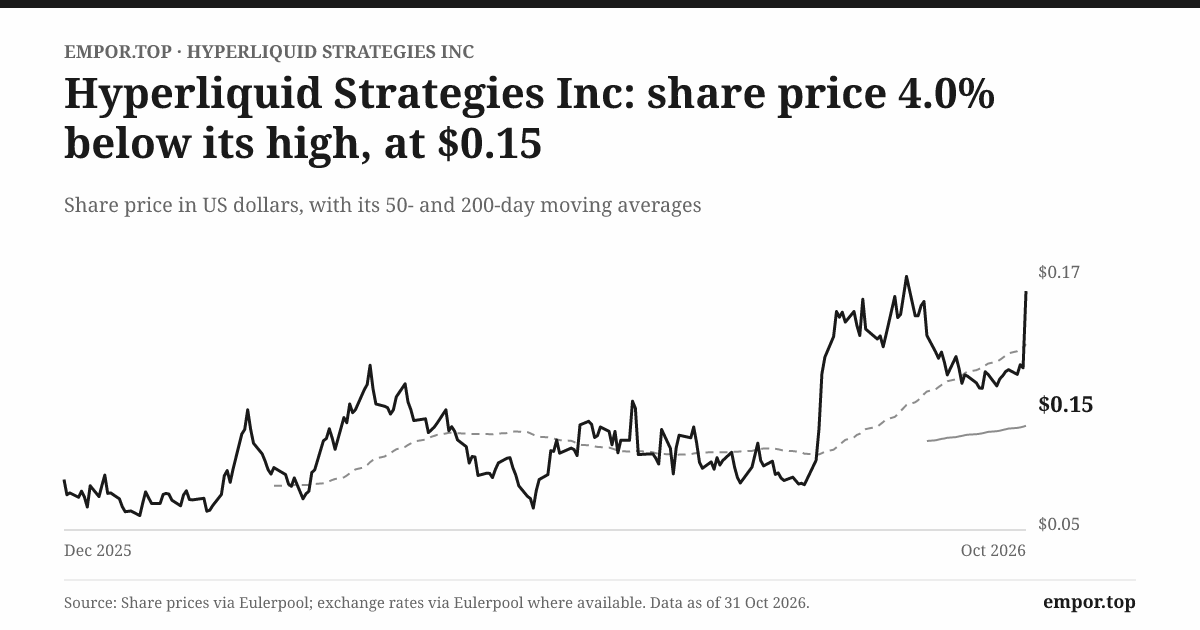
On Friday, October 31, 2026, PURR closed at $12.29, about 13% below its 52-week high of $14.09 and roughly four times its 52-week low of $3.10. Over the past year, the stock's volatility was about 102%, which means daily price swings large enough that a holder should expect to see the position halve, or double, without any change in the business.
What is the company worth on that day? Popular data services quote a market value of about $1.5 billion. But that figure appears to rest on an outdated share count. At the 278.3 million shares outstanding on the September 30 record date, $12.29 implies a market value of roughly $3.4 billion.7
That gap is not a footnote. It changes the price-to-book ratio, the earnings multiple and, crucially, any estimate of mNAV, which is why investors should compute those ratios themselves, from the latest share count and the latest weekly HYPE disclosure.
At June 30, the company's book equity was about $1.9 billion, almost all of it HYPE, and it reported no borrowings.3 Since then, HYPE has been bought with the proceeds of the September issuance, and its price has moved.
A current, fully diluted NAV is not something the company publishes in its filings, and the available figures do not establish PURR's premium or discount either to its own fully diluted HYPE NAV or to a comparable set of token-treasury companies. Other treasury vehicles are adjacent comparisons, not operating peers.
The unit of analysis, then, is not Hyperliquid's volume. It is the shareholder's diluted HYPE exposure per share, alongside the company's cash runway and mNAV.
The bull case starts with the protocol. In late August, Hyperliquid held about 40% of on-chain perps volume and more than 60% of on-chain open interest, and HIP-3 had opened its markets to real-world assets. The protocol, in management's description, spends nearly all its revenue buying back HYPE.10 If usage keeps growing, the token has a fundamental bid that most crypto assets lack.
On top of that, the company's HYPE earns staking rewards, its validator has attracted 1.3 million HYPE of outside delegations, and in the June quarter the yield covered the operating cost base. It has no debt.3 And management has shown, at least once, that it can buy back stock when it trades below NAV and issue when it trades above. If the facility capital is deployed accretively, PURR becomes a vehicle that compounds HYPE per share faster than holding the token directly, plus a staking yield that most retail holders would not capture.
The bear case starts with cash. Operating activities used $19.1 million in fiscal 2026, and the free cash flow yield is negative.3 Profit depended on unrealized appreciation. The treasury is concentrated in a single token, held substantially with a single custodian. The equity facility can add more than a billion dollars of stock, and the share count rose about 40% in five weeks in September.
Preferred stock convertible into about 26.6 million shares and more than 28 million warrants add further potential dilution, and an advisor holds a revocable waiver over a financing-linked grant right. If HYPE fell sharply, the company could find itself trading below NAV, with costs to cover and a choice between selling tokens at low prices or doing nothing while the discount widened.
To weigh those cases, it helps to run the industry through Michael Porter's five forces, applied to the protocol, because that is where any durable advantage would live. Rivalry is intense: centralized exchanges such as Binance and Coinbase and on-chain venues such as dYdX compete for the same traders. Buyer power is high, because traders can move venues with a click and face few switching costs beyond liquidity.
The threat of new entrants is real, since a new chain can copy a design and pay incentives to attract volume. Substitutes, from traditional futures to prediction markets, are plentiful. Supplier power is modest; the key "suppliers" are liquidity providers and market makers, who follow volume. The filings show usage, but they do not demonstrate customer lock-in or durable pricing power.
Hamilton Helmer's seven powers framework sharpens that. Hyperliquid's strongest candidate is network economies: liquidity attracts traders, and traders attract liquidity. Its open-interest share is evidence of that power at work. Scale economies exist in the technology but are not obviously defensible. Switching costs are low.
Counter-positioning, being built on-chain while incumbents are custodial, was powerful early on but is replicable. There is no cornered resource, and no protected process power or brand beyond the community's loyalty. For PURR itself, the honest answer is that the company has no power of its own beyond access to capital and a listing. Its edge, if any, is in executing the treasury strategy well.
An activist looking at PURR would not start with the token. The activist would start with the wrapper. Why does a five-person company need a five-year advisory agreement whose equity was valued at $183.6 million? Why should shareholders authorize issuance below $12.02 before seeing a full, per-share account of September's issuance?
Why is fully diluted HYPE per share, the one number that tells owners whether they are winning, published on a website rather than reported in the filings with the same rigor as net income? Those are not accusations of wrongdoing. They are the questions a demanding owner would put to any capital-allocation vehicle, and the answers so far are partial.
The checklist of other risks is shorter than for most companies, because the company has so little else. It carries no debt, has no material lease obligations, and does not disclose any foreign-exchange exposure or hedging; its currency risk, in effect, is HYPE.3 Its supply-chain risk is its two critical vendors, Anchorage and Unit. Its cyber risk is the risk that keys, custodians or smart contracts fail. Its key-person risk is a small executive team drawn from a single private-equity firm.
Two traps catch investors here. The first is calling PURR cheap on its earnings multiple; that multiple is a function of HYPE's price change, and it will flip with the token. The second is using sales multiples as if this were an operating company; they measure nothing useful.
Three numbers will tell the story from here. The first is fully diluted HYPE per share and mNAV after every financing or buyback; that is the measure of whether the equity machine creates value, and in fiscal 2026 the company sold shares at an average of about 1.15 times NAV, by management's count, before September's surge in issuance.
The second is realized staking rewards and interest, net of cash operating costs; in the June quarter the operating line turned positive, but the yield is paid in tokens and has not yet been tested against falling prices. The third is HYPE's price, together with the company's stake deployment and validator performance; HYPE traded as high as about $88 in early September.8
Finally, the stress test. Suppose HYPE fell by half and stayed there. The company's staking revenue would roughly halve with it, while its costs would not. With about $133 million of cash and cash-like instruments in August and a stated $25 million floor, the company would have years of runway at a cost base of about $16 million a year.104
It would not be forced to sell tokens to survive. The danger is subtler: that the stock would fall below NAV, and that management, holding a newly expanded facility, might issue at unfavorable prices anyway, or that it would sell tokens to buy back stock in a way that shrinks the treasury. The company has said what it would do. It has not yet had to do it.
X. Epilogue
Tonight, Hyperliquid Strategies is a company of a few people sitting on a little under two billion dollars' worth of a single token at mid-year prices, plus whatever the September issuance bought since. It has a functioning validator, a weekly holdings dashboard, an expanded buyback authorization and a financing facility with more than a billion dollars of capacity left at last disclosure. In four days, its shareholders will vote.
The November 4 vote is the first decision point. If shareholders approve issuance above the Nasdaq cap, management gains the freedom to keep selling stock even below $12.02. That would test its stated discipline in exactly the conditions in which discipline is hardest.
If they reject it, the company will have to operate within the cap, lean more on buybacks and cash, or return with a different proposal. Either outcome will reveal how much latitude the owners are willing to give a management team with less than a year of history.
The second is the facility itself. After the September expansion and the jump in the share count, investors will learn in the next quarterly filing how many shares were sold, at what prices, and how much HYPE they bought. That disclosure will answer the question this story has been asking since the opening scene: did the September surge add HYPE per share, or spread it more thinly?
The third is the buyback. About $72 million of authorization is available until October 31, 2027.13 If PURR slips below NAV and the company buys back stock, the framework management described in May will have been tested. If it does not, the authorization will remain a statement of intent.
Then there are the protocol milestones. HIP-3's spread into real-world assets, HIP-4's outcome markets and any progress toward U.S. access could all increase demand for HYPE. They could also stall. None of them is PURR revenue, and none should be counted as such, but all of them will move the asset that determines PURR's value.
What would change the verdict? Evidence that diluted HYPE per share rose after all costs and dilution over several quarters. Recurring cash income, in dollars, that covers operating expenses through a weaker token market. Confirmation that the advisor's waiver remains in force, and a year of itemized related-party costs and executive pay that look proportionate to a five-person company. Any one of those would strengthen the case. A pattern of issuance below NAV, rising costs, or revival of the financing-linked grant right would weaken it.
It helps to imagine the two endings. In the first, a year from now, the company reports that HYPE per diluted share rose meaningfully through a mix of accretive issuance in the good months and buybacks in the bad ones, while staking income, converted to dollars, paid the salaries and the custody bills. PURR would then be what its founders pitched: a better way to own HYPE than holding the token directly.
In the second, the company reports more shares, more HYPE in total, and less HYPE behind each share, with token gains on the income statement masking a wrapper that cost its owners more than it earned them. Both endings are possible from where the company stands tonight, and the difference between them will be decided less by Hyperliquid's trading volume than by a few hundred individual decisions about when to open and close the equity tap.
Until that record develops, the treasury thesis remains plausible but unproven. The structure works in principle. Whether it works in practice is the question each quarter will answer.
XI. Outro
Go back to that first morning, December 3, 2025, and the new ticker that seemed to promise a stake in a crypto exchange. The name evoked a trading protocol. The reality was a treasury wallet, a staking program and a stock that could be sold to buy more of both.
Its first-year results captured that imbalance: a large HYPE treasury, modest staking income and profits driven by token gains.3
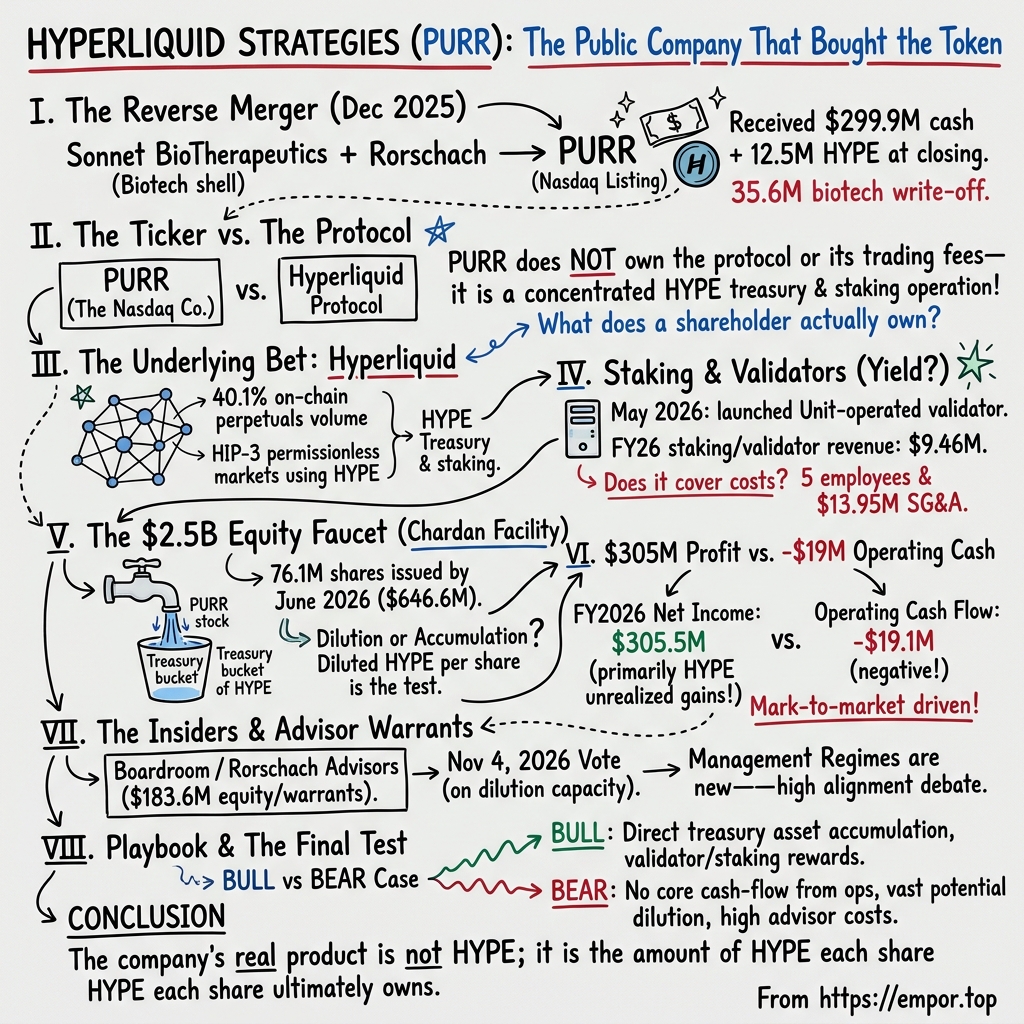
The protocol's success will be measured in volume and open interest. The shareholder's will be measured in something narrower and far more demanding. The company's real product is not HYPE; it is the amount of HYPE each share ultimately owns.
References
-
Nasdaq notice of business-combination close and PURR listing — Nasdaq Trader, 2025-12-02 ↩
-
Annual report on Form 10-K for fiscal year ended June 30, 2026 — SEC, 2026-08-27 ↩↩↩↩↩↩↩↩↩↩↩↩↩↩↩↩↩↩↩↩↩↩↩↩↩↩↩↩↩↩↩↩↩↩↩↩↩↩↩↩↩↩↩↩↩↩↩↩↩↩↩↩↩↩↩↩↩↩↩↩↩↩↩↩↩↩↩↩↩↩↩
-
Q3 FY2026 earnings-call transcript — Stock Analysis / Quartr, 2026-05-07 ↩↩↩↩↩↩↩↩↩↩↩↩↩
-
Sonnet BioTherapeutics announces business combination to launch a HYPE treasury reserve strategy, Exhibit 99.1 — SEC, 2025-07-14 ↩↩↩↩↩↩↩↩↩↩↩↩↩
-
Biotech firm Sonnet to form $888M HYPE treasury — Cointelegraph, 2025-07-14 ↩↩↩
-
Definitive proxy statement for 2026 annual meeting — SEC, 2026-10-02 ↩↩↩↩↩↩↩↩↩↩↩↩↩↩↩↩↩↩↩↩↩↩↩↩↩↩
-
Registration statement on Form S-1, Chardan equity facility — SEC, 2026-09-14 ↩↩↩↩↩↩↩↩↩↩↩↩↩↩↩
-
Q2 FY2026 earnings-call transcript — Stock Analysis / Quartr, 2026-02-11 ↩↩↩↩↩↩↩↩↩
-
FY2026 earnings-call transcript — Stock Analysis / Quartr, 2026-08-27 ↩↩↩↩↩↩↩↩↩↩↩↩↩↩↩
-
Hyperliquid Strategies official website — Hyperliquid Strategies ↩↩
-
Expanded share repurchase program Form 8-K — SEC, 2026-10-23 ↩↩
-
Press release on expanded share repurchase program, Exhibit 99.1 — SEC, 2026-10-23 ↩
-
BlackRock Schedule 13G/A filing data — Disclosery, 2026-10-27 ↩
 LinkedIn
 WhatsApp
 Reddit
 Hacker News
 Email
 Kindle
 RSS Feed
 Spotify
 Apple Podcasts
 Amazon Music
 Audible
 YouTube