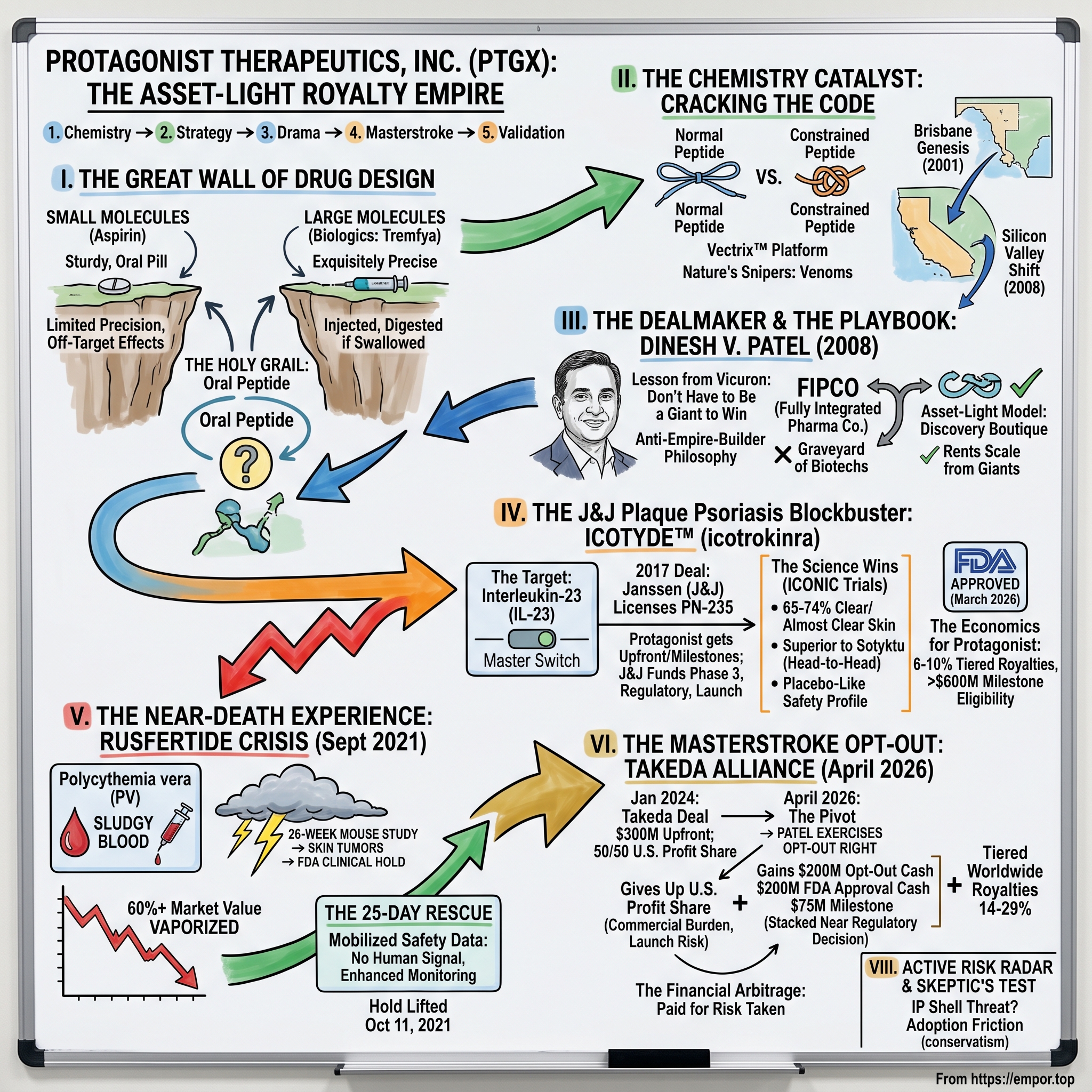
The Asset-Light Royalty Empire: The Protagonist Therapeutics Story
I. Introduction & Episode Roadmap
Drive south from San Francisco, past the salt flats at the bottom of the Bay, and you arrive in Newark, California — a flat, unglamorous suburb better known for its shopping mall than its science. Somewhere in an office park here sits the headquarters of a company that, on paper, looks like it shouldn't exist. Protagonist Therapeutics employs fewer than a hundred people. It has never fielded a sales representative. It has never, in its two decades of life, sold a single vial or pill of its own to a single patient. And yet, in mid-July 2026, the market valued it at roughly $8.5 billion, and it sat on more than $620 million of cash with a runway management said stretched through at least 2028.9
How? That is the puzzle this story exists to unpack.
The standard biotech playbook is, when you strip away the romance, a spectacular money-burning engine. You raise dilutive equity from public shareholders. You spend that money running enormously expensive Phase 3 trials. If — and it is a big if — the data come back clean, you then spend hundreds of millions more building a commercial sales force from scratch, and you pray the launch doesn't flop against entrenched competitors with thousands of reps already in the field. Most companies that try this fail somewhere along the chain, and even the winners dilute their earliest believers into oblivion along the way.
Protagonist rewrote that script. The thesis — and it is worth stating plainly at the top so we can spend the rest of the story testing whether it holds — is that Protagonist built itself as a kind of intellectual-property shell. It discovers drugs, takes them far enough to prove they work, and then hands the expensive, risky end of the business — the giant trials, the regulatory gauntlet, the sales armies — to global pharmaceutical giants like Johnson & Johnson and 武田薬品工業株式会社 Takeda Pharmaceutical. In exchange, it keeps high-margin royalty and milestone streams and almost none of the cost.
It is a seductive story. It is also, as we'll see, one that leaves a great deal of value on someone else's table by design, and one whose durability depends entirely on a discovery engine continuing to produce. So let's hold both ideas at once.
Here is the roadmap. First, the chemistry — the genuinely hard scientific problem Protagonist set out to solve, which is how you make a large, precise "biologic" drug that survives being swallowed. Second, the strategy — the eighteen-year capital-allocation philosophy of chief executive Dinesh V. Patel, and his conspicuous refusal to build an empire. Third, the drama — a September 2021 clinical hold that erased more than half the company's value in a single trading session, and the scramble to reverse it. Fourth, the masterstroke — an April 2026 decision to walk away from a fifty-fifty U.S. profit share in exchange for cash and royalties. And fifth, the validation — the March 2026 approval of ICOTYDE™ (icotrokinra), which regulators cleared as a first-of-its-kind targeted oral peptide for plaque psoriasis.1
Two drugs, two partners, one unusual company. Let's begin where all of it began — not in Newark, but on the other side of the world.
 Subscribe on LinkedIn
II. The Chemistry Catalyst: Cracking the "Oral Peptide" Holy Grail
To understand why Protagonist matters, you first have to appreciate a wall that has frustrated drug designers for a century — what we might call the Great Wall of drug design. On one side of it sit the small molecules. Aspirin is one. Bristol Myers Squibb's psoriasis pill Sotyktu is another. These are tiny, sturdy chemical compounds. They are cheap to manufacture, they survive the acid bath of the stomach, and you can take them as a pill. Their weakness is precision: because they are so small, they tend to bump into targets they were never meant to touch, producing off-target side effects, and they are simply too small to smother the broad, flat surfaces where many proteins talk to one another.
On the other side of the wall sit the large molecules — the biologics. Think of J&J's Tremfya or AbbVie's Skyrizi, blockbuster antibodies for psoriasis. These are exquisitely precise, engineered to lock onto one specific receptor and nothing else. But they are enormous, delicately folded proteins, and that is their curse. Swallow one and your digestive system treats it exactly as it would treat a piece of steak: it chews it into useless fragments. So biologics must be injected, which patients dislike, and which limits their reach.
The holy grail, then, is obvious and maddening: a molecule with the precision of a biologic and the convenience of a pill. A mini-antibody robust enough to survive the stomach yet specific enough to hit one biological pathway. For decades, that was a fantasy.
The Brisbane genesis
The first real crack in the wall came not from a pharma giant but from a laboratory in Brisbane, Australia. At the University of Queensland's Institute for Molecular Bioscience, an associate professor named Mark Smythe had been studying, of all things, animal venoms.3 Venom peptides are nature's snipers — small, and yet, crucially, held in rigid, constrained shapes that make them both stable and lethally specific. Smythe's insight was that if you could engineer synthetic peptides locked into similarly constrained geometries, you might get the best of both worlds: molecules small and tough enough to be swallowed, but shaped precisely enough to block a chosen target.3
That idea became the seed of a company. Protagonist was launched out of the Institute for Molecular Bioscience in 2001, with commercial backing from UniQuest, the university's technology-transfer arm — one of fifteen spin-outs the institute would ultimately produce.3 The technology at its core, later branded the Vectrix™ platform, was essentially a design-and-screening engine for these "conformationally constrained peptides": rings and cages of amino acids stiffened so that stomach enzymes could not get a grip and pull them apart.
The analogy worth holding onto is this. A normal peptide is like a loose shoelace — floppy, easy for an enzyme to grab and snip. A constrained peptide is that same shoelace tied into a tight, complex knot: same material, but now rigid, compact, and far harder to unravel. Smythe's laboratory learned to tie those knots on purpose, and to tie them into shapes that fit specific biological locks.
The Silicon Valley shift
Science is one thing; the capital to scale it is another. Australian academic grants could fund a discovery, but they could not fund the years of development that turning a discovery into a drug requires. So the company followed the money. Protagonist Therapeutics was incorporated in Delaware to court American venture capital, establishing its business center in California while keeping its scientific soul — the peptide chemistry — anchored in Brisbane.3 It is a division of labor the company maintains to this day: an office in Brisbane feeding a headquarters in the Bay Area.
What the company had at this point was a genuinely differentiated platform and essentially nothing else — no approved product, no revenue, no proof that the elegant chemistry would ever translate into a drug a regulator would bless. Platforms are cheap to admire and expensive to validate. What Protagonist needed was someone who knew how to turn platform potential into partnered cash without betting the whole company on any single roll of the dice. In December 2008, that person arrived.
III. The Dealmaker Arrives: The Dinesh Patel Playbook
Dinesh V. Patel did not come to Protagonist as a wide-eyed academic founder. He came as a scarred veteran of the drug business who had already seen how the money was actually made.
Patel trained as a medicinal chemist, and his résumé reads like a tour of the places where peptide and small-molecule chemistry meet commercial reality: a stint at Bristol-Myers Squibb, a directorship of chemistry at Affymax — a company whose entire reason for being was building vast libraries of molecules to screen — and then a senior role at Vicuron Pharmaceuticals.4 Vicuron is the formative chapter. It developed two antibiotics and was acquired by Pfizer in 2005 for roughly $1.9 billion, an outcome that taught Patel a lesson many biotech executives never learn: you do not have to become a giant to win. Sometimes the smartest move is to build something valuable and let a giant pay you for it.
The anti-empire-builder
That lesson hardened into a philosophy, and the philosophy is the single most important thing to understand about how Protagonist has been run. Call it anti-empire-building.
The default aspiration of nearly every clinical-stage biotech chief executive is to build a FIPCO — a Fully Integrated Pharmaceutical Company. The dream is to take your drug all the way from test tube to pharmacy shelf yourself: run the Phase 3s, navigate the FDA, hire the sales reps, own the whole margin. It is an intoxicating vision, and it is a graveyard. The reason is that each of those stages requires a completely different and enormously expensive organizational muscle, and building all of them at once, for the first time, while burning shareholder cash, is how most promising biotechs destroy themselves.
Patel's alternative was to keep Protagonist deliberately small and elite — a discovery-and-early-development boutique that does the one thing it is genuinely world-class at, and rents everything else. Let J&J and Takeda, with their billions in annual R&D budgets and their thousands of sales representatives, run the Phase 3s and manage the launches. Protagonist would take a discovery to the point where its value is proven, strike a partnership, and then clip royalty and milestone checks with almost no associated cost.
The elegance of this model is that it converts biotech's two great enemies — cost and dilution — into someone else's problem. But it comes with an equally real cost of its own: you are, by construction, handing the lion's share of any blockbuster's economics to your partner. A royalty in the high single digits on a drug you invented means watching more than ninety cents of every sales dollar flow to the company that ran the trials and hired the reps. Whether that trade is brilliant discipline or value left on the table is a question we will return to, because it is genuinely arguable in both directions.
On the alignment question, one point is worth making cleanly. Patel's compensation has been weighted heavily toward long-term equity rather than cash salary — a structure that, at least in design, ties his personal outcome to the share price rather than to the size of the organization he commands. That matters, because the anti-empire-building philosophy only survives contact with human ego if the incentives point the same way. A chief executive paid to grow headcount builds a FIPCO; a chief executive paid in stock that rewards capital efficiency does what Patel has done. The behavior and the incentive are, at least here, consistent — and consistency between what management says and how it is paid is one of the more reliable signals an outside investor gets.
The first great test of whether the discovery engine could actually produce a partnerable asset came from an unglamorous corner of immunology: a signaling protein called Interleukin-23.
IV. The J&J Plaque Psoriasis Blockbuster: ICOTYDE™ (icotrokinra)
Picture the patient at the center of this section. Roughly one in thirty adults lives with plaque psoriasis, an autoimmune condition in which the immune system attacks the skin, producing raised, scaly, often painful and disfiguring plaques. For the moderate-to-severe cases, the most effective medicines available have been injectable biologics — extraordinary drugs, but ones delivered by needle. And here is the human friction the entire ICOTYDE story turns on: a large share of eligible patients simply will not take an injectable, whether from needle phobia, inconvenience, or a preference to avoid a lifelong regimen of shots. They settle instead for messy topical creams or older, weaker oral drugs. There is, in other words, an enormous population of people who want biologic-grade results in a form they'll actually accept.
The target and the invention
Interleukin-23 is a master switch. It sits near the top of the inflammatory cascade that drives not only plaque psoriasis but psoriatic arthritis, Crohn's disease, and ulcerative colitis. Block IL-23 and you can quiet the whole downstream storm — which is precisely why the injectable IL-23 blockers, J&J's Tremfya and AbbVie's Skyrizi, became multibillion-dollar franchises in a plaque-psoriasis market worth well over $20 billion globally.
Protagonist's contribution was to ask whether that same master switch could be flipped with a pill. Using the constrained-peptide platform, its chemists engineered a peptide that blocks the IL-23 receptor — the drug that would travel under a parade of names before settling into the world as icotrokinra: first PN-235, then JNJ-2113 once J&J took the reins, and finally the brand ICOTYDE™.
The pivotal commercial event came in 2017, when Johnson & Johnson's Janssen unit licensed the program.13 The structure of that deal is the whole strategy in miniature. Protagonist received upfront and milestone consideration, and in exchange handed J&J responsibility for funding and running the entire late-stage program — every Phase 2 and Phase 3 trial, the regulatory filings, and eventually the launch. Protagonist retained the right to royalties on sales. In other words, Protagonist stopped spending on icotrokinra years before the truly expensive work began, and simply waited to find out whether the world's largest healthcare company could turn its peptide into an approved medicine.
The science wins
The answer arrived in stages, and it was more emphatic than almost anyone expected.
In November 2024, the pivotal ICONIC Phase 3 program read out. In ICONIC-LEAD, the flagship study, 64.7% of patients on icotrokinra reached an Investigator's Global Assessment score of clear or almost-clear skin at week 16 — versus 8.3% on placebo — and that figure climbed to 74.1% by week 24, with nearly two-thirds achieving a 90% reduction in disease severity.6 For an oral drug, these were injectable-caliber numbers. A companion study, ICONIC-TOTAL, showed the pill also worked in the notoriously stubborn spots — scalp, genitals, hands and feet — across a population of 311 patients.6
Then came the head-to-head, which is where the story turns from "impressive" to "genuinely disruptive." In the ICONIC-ADVANCE studies, icotrokinra was tested not just against placebo but directly against Bristol Myers Squibb's Sotyktu (deucravacitinib), the leading oral small molecule on the market — the first time a pill had been run head-to-head against a rival pill in this disease with the explicit goal of proving superiority. Icotrokinra met those superiority endpoints.6 A peptide had beaten the incumbent oral drug on its own turf.
The last piece is safety, and it is arguably the most important for the commercial case. Sotyktu belongs to a class — TYK2 and, more broadly, JAK-pathway inhibitors — that carries class-wide safety scrutiny around events like blood clots and cardiovascular risk. Icotrokinra, by contrast, produced adverse-event rates in the pivotal work essentially indistinguishable from placebo: 49.3% versus 49.1% in ICONIC-LEAD.6 A drug that matches biologic efficacy, comes as a once-daily pill, beats the leading oral competitor, and carries a clean tolerability profile is about as close to a category-defining product as this field produces.
On March 18, 2026, the FDA approved ICOTYDE™ for moderate-to-severe plaque psoriasis in adults and in adolescents twelve and older weighing at least 40 kilograms — clearing it, in J&J's framing, as a new first-line option and the first targeted oral peptide of its kind.15 The approval was not the finish line; it was the starting gun.
The economics for Protagonist
Here the asset-light model shows both its beauty and its ceiling in the same breath. On ICOTYDE™, Protagonist earns tiered royalties of 6% to 10% on global net sales — the company has quantified this as a roughly 7.25% weighted-average rate at $4 billion of annual sales.1 The FDA approval itself triggered a $50 million milestone in the first quarter of 2026, and Protagonist remains eligible for up to $580 million in additional regulatory and sales milestones as J&J pushes the drug into psoriatic arthritis, ulcerative colitis, Crohn's, and pediatric use.1
Run the arithmetic in plain English. If J&J drives ICOTYDE™ to, say, $3 billion in peak annual sales — plausible for a drug with these attributes — Protagonist collects roughly a couple hundred million dollars a year in pure, cost-free royalty. That is real money with no factory, no sales force, and no marketing budget attached. But flip the same fact over: at a single-digit royalty, Protagonist keeps well under a tenth of the franchise it invented. More than ninety cents of every ICOTYDE™ dollar belongs to Johnson & Johnson. That is the price of never having to run a trial or hire a rep — and reasonable investors can disagree about whether it was a bargain or a giveaway.
The ICOTYDE™ story is the model working exactly as designed. But to understand how much conviction that model actually requires, you have to go back to the night the whole company nearly died.
V. Rusfertide & The Near-Death Experience
Every origin myth needs its dark night of the soul, and Protagonist's came from a drug that had nothing to do with skin.
The biology of iron
Deep in the body's machinery sits a hormone called hepcidin, produced by the liver, which acts as the master regulator of iron. Think of hepcidin as the gatekeeper controlling how much iron is released into circulation to build red blood cells. When hepcidin is high, iron is locked away and red-cell production slows.
Now meet the disease. Polycythemia vera, or PV, is a rare, chronic blood cancer in which a mutation — most often in a gene called JAK2 — drives the bone marrow to churn out far too many red blood cells. The blood literally thickens, turning sludgy and viscous, and the consequences are exactly what you'd fear from thick blood: elevated risk of stroke, heart attack, and clots in the lungs. The standard of care is almost medieval in its bluntness — therapeutic phlebotomy, the periodic draining of a pint of blood to keep the red-cell concentration below a safety threshold. It works, but it leaves patients chronically iron-deficient and often exhausted, foggy, and tormented by relentless itching. Imagine managing a chronic cancer by getting bled on a schedule for the rest of your life.
The solution
Protagonist's answer was rusfertide (originally PTG-300), an injectable peptide that mimics hepcidin. Instead of draining blood, it turns down the iron gate at the source, coaxing the bone marrow to slow red-cell production without the systemic iron depletion phlebotomy causes. In its Phase 2 and Phase 3 work — the REVIVE and later VERIFY studies — rusfertide let the large majority of patients stop needing phlebotomies while easing the fatigue and brain fog that make the disease so miserable to live with. For a condition managed with a needle and a bucket, a drug that could largely retire the ritual was a genuine advance.
The September 2021 crisis
And then, in September 2021, the floor gave way.
A routine 26-week study in transgenic mice — animals genetically engineered to be hypersensitive to cancer signals — turned up benign and malignant skin tumors. The FDA responded with the bluntest instrument it has: a full clinical hold, freezing the entire rusfertide program.[^8] To a market that had been pricing rusfertide as a future blockbuster, "clinical hold" and "tumors" landing in the same sentence read as a death notice. Protagonist's stock collapsed, shedding more than 60% of its value and vaporizing over a billion dollars of market capitalization essentially overnight.[^8] Wall Street, in its characteristically decisive way, declared the drug dead.
This is the moment that reveals what a management team is actually made of, because the scientific question underneath the panic was subtle. Transgenic-mouse tumor signals are notoriously prone to false alarms; the relevant question was whether anything remotely similar had appeared in the hundreds of actual humans who had already taken the drug.
The 25-day rescue
Patel's team did not wait and hope. They mobilized immediately, assembling the comprehensive safety record from every human who had been dosed — data that showed no tumor signal whatsoever — and pairing it with enhanced monitoring protocols to satisfy the agency's concerns. The argument was, in essence: the mouse is not the patient, and here is the human evidence to prove it. The FDA lifted the hold on rusfertide on October 11, 2021 — just twenty-five days after imposing it.7
Twenty-five days. For a full clinical hold on a lead program, that is remarkably fast, and it tells you two useful things. First, the underlying human safety data must have been genuinely clean, or no amount of hustle would have moved the agency. Second, this is an organization that executes under existential pressure rather than freezing — a trait worth more than any single data point, because in drug development the crisis is not the exception, it is the job. The company later let rusfertide's Breakthrough Therapy designation lapse as it aligned with the FDA on the path forward, a bureaucratic footnote that mattered little once the trials were running on schedule again.
The near-death experience left Protagonist with a validated but capital-hungry Phase 3 asset and a sharpened appreciation for risk. What it did next with rusfertide would become the purest expression of the entire Patel philosophy.
VI. The Takeda Alliance & The Masterstroke Opt-Out
By early 2024, rusfertide was heading into its pivotal VERIFY Phase 3 study, and Protagonist faced the classic crossroads: it now owned a late-stage rare-disease asset that would soon need a commercial launch, and launching a drug is precisely the thing Protagonist had spent two decades refusing to do.
The January 2024 deal
The solution was to bring in muscle. On January 31, 2024, Protagonist partnered rusfertide worldwide with 武田薬品工業株式会社 Takeda Pharmaceutical, the Japanese giant with deep roots in rare diseases and a global commercial infrastructure Protagonist could never replicate.[^9] The headline terms: Takeda paid $300 million upfront, the two companies would co-develop and co-commercialize rusfertide in the United States under a fifty-fifty profit-and-loss split, and Protagonist would earn tiered royalties on sales outside the U.S.[^9]
Read carefully, that fifty-fifty U.S. structure was a subtle break from the pure ICOTYDE™ model. A profit share is not a royalty. It meant Protagonist would have to fund half of a large commercial launch — building or paying for sales and marketing muscle, and bearing half the downside if the launch started slowly. It was empire-building's foot in the door, dressed up as partnership. The company had bought itself optionality, but also obligation.
The April 2026 pivot
Then, on April 28, 2026, came the decision that this whole story has been building toward — and it is a genuine masterclass in reading your own incentives.
The rusfertide collaboration gave Protagonist a right to opt out of that fifty-fifty U.S. profit share and convert to a straight royalty. With FDA approval approaching, Patel exercised it.8 In a single stroke, Protagonist handed the entire U.S. commercial burden — the sales force, the launch spend, the execution risk — to Takeda, and reverted to being what it prefers to be: a royalty holder.
The financial arbitrage
The economics of that opt-out are worth walking through slowly, because they are the clearest illustration of the model's logic. Opting out triggered a $200 million cash payment to Protagonist on election. A further $200 million becomes payable on FDA approval of rusfertide, and a separate $75 million approval milestone stacks on top — $475 million in near-term, non-dilutive cash clustered around the regulatory decision.8 On top of that, Protagonist traded its U.S. profit share for tiered worldwide royalties of 14% to 29% on net sales, plus eligibility for substantial further sales-based milestones.8
Notice how much richer that royalty band is than the single-digit ICOTYDE™ rate. On rusfertide, at $1.5 billion of annual net sales, a weighted rate in the low twenties would translate to roughly $300 million a year flowing to Protagonist — cost-free. The reason Protagonist commands so much more here than on ICOTYDE™ is straightforward: it carried rusfertide much further down the development path itself, and it gave up the offsetting profit-share upside. You are paid for the risk you actually took.
What did the decision reveal? Patel framed it as securing "the most attractive risk-adjusted value outcome for Protagonist and its shareholders."8 Decoded, the logic is this: a fifty-fifty profit share offers more upside if the launch is a triumph, but only if you are willing to spend and to risk a slow start. By opting out, Patel exchanged that uncertain, cost-laden upside for a large, certain, near-term cash pile and a clean, uncapped royalty with zero execution risk — and, not incidentally, avoided ever having to raise dilutive equity to fund a launch. It is the same trade as ICOTYDE™, made a second time, with eyes open. Whether it is disciplined or overly cautious depends on how much you believe in Takeda's launch and how much you value certainty over optionality — but as a revealed preference, it is perfectly consistent with everything Patel has ever said.
The FDA had already accepted the rusfertide application and granted it Priority Review, with a decision expected in the third quarter of 2026.[^10]8 That pending verdict is the hinge on which the near-term cash actually swings — which is a good moment to step back and ask what kind of durable advantage, if any, this whole machine really possesses.
VII. Hamilton Helmer's 7 Powers & Porter's Five Forces
Strip away the drama and two blockbuster partnerships, and the analytical question is simple: does Protagonist have a moat, or does it merely have two good drugs and a clever contract structure? Let's war-game it using two standard frameworks.
The 7 Powers lens
Hamilton Helmer's framework asks which durable powers, if any, a business actually holds.
The strongest candidate is Cornered Resource: the constrained-peptide platform and its underlying intellectual property. The Vectrix approach — and the accumulated, hard-won know-how of how to design peptides that survive the gut and hit flat protein targets — is not something a competitor can simply buy or reverse-engineer from a patent filing. Two decades of medicinal-chemistry tacit knowledge, much of it originating in that Brisbane laboratory, is genuinely difficult to replicate.3 The patent estate protecting the specific molecules extends well into the 2030s and beyond, which matters enormously, because a royalty stream is only as durable as the patent underneath it.
The second candidate is Process Power — the proprietary, difficult-to-copy synthesis and design knowledge that lets Protagonist do reliably what others do only occasionally and by luck. Oral-peptide stabilization is notoriously finicky; the difference between a peptide that works as a pill and one that doesn't can be a single ring closure, and knowing where to make it is exactly the kind of accumulated craft that resists imitation.
The third, and in some ways most interesting, is a twist on Scale Economies — but borrowed rather than owned. Protagonist has no scale of its own; a hundred people cannot achieve much. Instead it rents the scale of $100-billion-plus partners, plugging its discoveries into J&J's and Takeda's global trial and sales machinery. It is scale-as-a-service, and it is why a boutique can economically participate in blockbuster markets. The catch, and it is not trivial, is that borrowed scale is not a moat you control — it is a dependency. If partners lose interest, or if the discovery engine stops producing partnerable assets, the borrowed scale evaporates.
What Protagonist conspicuously lacks are the powers that protect commercial-stage companies: no brand with patients, no network effects, no switching costs of its own, no pricing power. It does not touch the customer. Its powers are entirely upstream, in the chemistry. That is a coherent position, but a narrow one.
Porter's Five Forces
Now the industry-structure view.
Threat of new entrants — low. The chemical barrier to entry is the whole point. Making a precise biologic that survives being swallowed is hard enough that very few organizations can do it credibly, which is exactly why J&J and Takeda came to Protagonist rather than building in-house.
Bargaining power of buyers — moderate. The real buyers here are not patients but the pharmacy benefit managers and insurers who decide what gets covered. They are powerful and cost-conscious. But a drug that offers biologic-level efficacy in a needle-free pill with a clean safety profile — as ICOTYDE™ appears to — is a genuinely compelling case for formulary inclusion, which blunts some of that power. Note, though, that this force bears on Protagonist only indirectly, through its partners' sales.
Competitive rivalry — high. These are brutally contested markets. In plaque psoriasis, ICOTYDE™ steps into a ring already crowded with Sotyktu, Skyrizi, and Tremfya. In polycythemia vera, rusfertide will contend with entrenched approaches including Incyte's Jakafi (ruxolitinib) and the stubborn inertia of cheap, familiar phlebotomy. Protagonist's drugs win on differentiation — oral convenience, superior head-to-head data, clean safety — but differentiation must be sold, and it is the partners, not Protagonist, who must do the selling. Which means Protagonist's fate rests substantially in others' hands.
The honest synthesis is that Protagonist has a real, defensible edge in one narrow place — the chemistry of oral peptides — and essentially rents everything else. That is enough to generate handsome royalties for as long as the patents hold and the pipeline produces. It is not the kind of broad, self-reinforcing moat that protects a company forever. Which brings us to what the skeptics say.
VIII. The Active Risk Radar & Skeptic's Stress Test
Let's put on the short-seller's hat, because the bull case here is polished enough to deserve a hard adversarial test.
The "IP shell" threat
The most fundamental bear argument is almost philosophical. Protagonist has now out-licensed both of its major assets. ICOTYDE™ belongs, commercially, to J&J; rusfertide, commercially, to Takeda. So what, exactly, is left? Is Protagonist becoming a static royalty-holding entity — a bond fund dressed as a biotech — whose value is simply the discounted sum of two income streams and a pile of cash, with a slowly ticking patent clock underneath?
Management's answer is the pipeline, and this is where the model must prove it is an engine and not just a one-time harvest. The most eye-catching internal program is PN-477, a triple agonist targeting the GIP, GLP-1, and glucagon receptors — aimed squarely at the vast obesity and metabolic market. The subcutaneous version was slated to begin Phase 1 around mid-2026, with an oral formulation to follow in early 2027.9 An oral peptide in obesity is exactly the kind of asset the platform was built to produce, and it represents real optionality in a market measured in the tens of billions. But sobriety is required: this is a Phase 1 program in the most competitive drug category on earth, dominated by Novo Nordisk and Eli Lilly, and it should be valued as the lottery ticket it currently is, not as a fourth blockbuster.
Behind it sits PN-881, an oral IL-17 antagonist peptide that was completing Phase 1 around mid-2026, with a Phase 2 start targeted by year-end,29 plus earlier-stage obesity and hepcidin programs the company has begun to name.2 The bull reading is that the discovery engine is manifestly still running; the bear reading is that all of it is early, unproven, and years from cash, and that a company valued near $8.5 billion is being priced substantially on things that have not yet worked.
The bull vs. bear case
The bull case is clean and, on its own terms, strong. Protagonist is a rare thing: a biotech that has already de-risked its two lead assets by getting them approved or to the doorstep of approval, financed by partners rather than by dilution. It holds more than $620 million in cash, carries funding visibility through at least 2028, and has two high-margin royalty engines about to switch on — one already selling through J&J, one awaiting an FDA decision in the third quarter of 2026.189 For an investor who prizes de-risked, capital-light cash flows, it looks like a portfolio of royalty streams trading in a biotech wrapper.
The bear case has two sharp points. The first is royalty leakage. On ICOTYDE™ — potentially the larger of the two franchises — Protagonist collects a single-digit royalty and thus leaves the overwhelming majority of the blockbuster's value with J&J.1 A skeptic would argue the asset-light model, taken to Protagonist's extreme, systematically undermonetizes the company's own inventions; the discipline that avoids downside also caps the upside hard.
The second is adoption friction, and it is most acute for rusfertide. Polycythemia vera is an orphan indication managed by conservative hematologists, many of whom have patients doing acceptably on phlebotomy — a therapy that is cheap, familiar, and requires no reimbursement fight. Convincing them to switch stable patients onto a premium, novel, injected peptide is a real commercial hill, and it is Takeda, not Protagonist, who must climb it. The royalty is only as large as the launch, and the launch is out of Protagonist's control.
An activist would add a governance-flavored needle: a company this reliant on two partners has, by design, outsourced its own destiny. Protagonist cannot make ICOTYDE™ sell faster or rescue a slow rusfertide launch; it can only watch and collect. That is the flip side of never bearing execution risk — you also surrender execution control. For some investors that is the point; for others it is the vulnerability.
Weighing it honestly: the near-term downside looks genuinely cushioned by cash and de-risked assets, while the long-term question — whether the discovery engine keeps producing partnerable winners fast enough to outrun the patent clock — remains open and is the real thing to watch. Which is the note to end on.
IX. Epilogue & Playbook Lessons
Step back from the specifics — the peptides, the milestones, the clinical hold — and Protagonist Therapeutics offers two durable lessons in how a small company can play a giants' game.
Lesson one: check your ego at the door. The rarest trait in biotech is a chief executive who voluntarily declines to build a commercial empire. The whole cultural pull of the industry is toward integration, toward the FIPCO dream, toward becoming the next Genentech. Patel's willingness — twice, with ICOTYDE™ and again with the rusfertide opt-out — to hand the glamorous, empire-building work to partners and keep only the royalty is a study in valuing risk-adjusted outcomes over corporate grandeur. It is worth noting how unusual that is precisely because it runs against every incentive of professional pride. The discipline is real; whether it also leaves too much money on the table is the fair counter-question, and both things can be true at once.
Lesson two: non-dilutive financing is a form of returns. By leaning on partner capital — upfronts, milestones, opt-out fees — rather than repeated equity raises, Protagonist financed two decades of expensive science while limiting the dilution that quietly erodes so many biotech shareholders' returns. A dollar of milestone cash and a dollar of equity raised are not the same dollar; the first costs no ownership. Over a company's life, the cumulative difference is enormous, and it is the least glamorous and most underappreciated piece of the whole story.
For an investor watching from here, the noise of milestones and press releases resolves into a short list of things that actually matter. Watch three:
First, the commercial launch trajectory of ICOTYDE™ through Johnson & Johnson. The clinical case is made; the question now is purely commercial — how fast a needle-averse patient population converts to a superior pill, and how it fares against entrenched rivals. Royalty checks will tell the tale.
Second, the FDA's decision on rusfertide, expected in the third quarter of 2026.8 Approval unlocks the back half of that $475 million near-term cash package and switches on the second, richer royalty stream; a delay or a surprise would do the opposite.
Third, the first clinical data from the internal pipeline — above all the oral triple agonist PN-477 — in late 2026 and into 2027.9 This is the single best test of whether Protagonist is a living discovery engine that will keep feeding the royalty machine, or a company harvesting the last of a finite crop. Everything about the long-term thesis ultimately rides on that question.
Two drugs, two partners, no sales force, and a mountain of cash in a Newark office park. Whether that is the most disciplined model in biotech or simply an elegant way to give most of your value away is, fittingly, a question Protagonist has arranged for someone else to answer.
References
-
Protagonist Therapeutics Announces U.S. FDA Approval of ICOTYDE™ (icotrokinra) for the Treatment of Moderate to Severe Plaque Psoriasis — BioSpace, 2026-03-18 ↩↩↩↩↩↩↩
-
Protagonist Reports Fourth Quarter and Full Year 2025 Financial Results and Provides Corporate Update — BioSpace, 2026-02-25 ↩↩
-
Clinical trial success for psoriasis drug (Protagonist origins at UQ Institute for Molecular Bioscience) — Mirage News ↩↩↩↩↩↩
-
FDA approval of ICOTYDE™ (icotrokinra) ushers in new era for first-line systemic treatment of plaque psoriasis with a targeted oral peptide — Johnson & Johnson, 2026-03-18 ↩
-
Protagonist Announces Positive Topline Results From Phase 3 ICONIC Studies of Icotrokinra (JNJ-2113) in Plaque Psoriasis — BioSpace, 2024-11-18 ↩↩↩↩
-
FDA Lifts Clinical Hold on Protagonist's Rusfertide — Reuters, 2021-10-11 ↩
-
Protagonist Exercises Rusfertide U.S. Opt-Out Right Under Takeda Collaboration — BioSpace, 2026-04-28 ↩↩↩↩↩↩↩
-
Protagonist Reports First Quarter 2026 Financial Results and Provides Corporate Update — BioSpace, 2026-05-05 ↩↩↩↩↩
 LinkedIn
 WhatsApp
 Reddit
 Hacker News
 Email
Email Kindle
 RSS Feed
 Spotify
 Apple Podcasts
 Amazon Music
 Audible
 YouTube