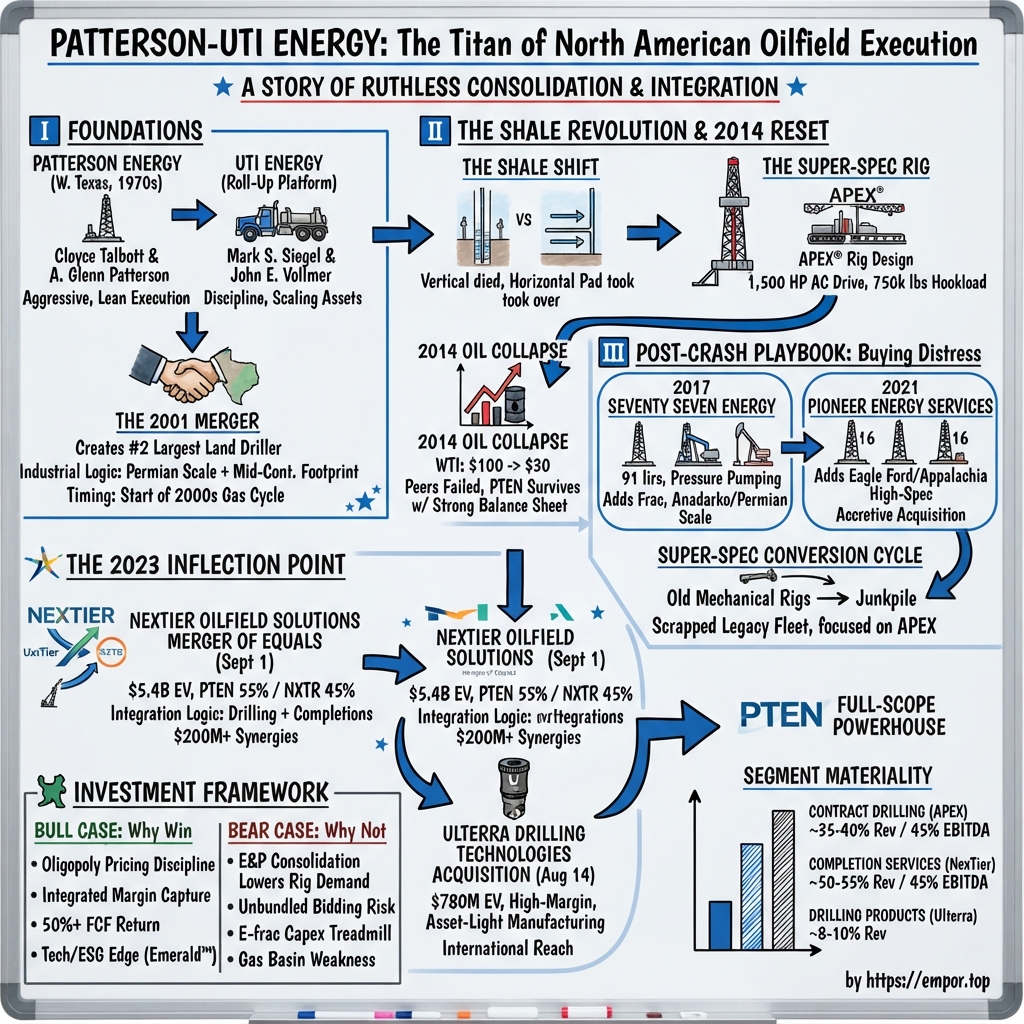
Patterson-UTI Energy: The Titan of North American Oilfield Execution
I. Introduction & Episode Roadmap
On a July morning in 2026, Andy Hendricks opened Patterson-UTI's second-quarter earnings call with a line that would have sounded absurd to anyone who had followed the North American oilfield for the previous decade: business had gotten better than the company had promised only eight weeks earlier. Not "in line." Not "modestly ahead." Patterson-UTI had issued a mid-quarter update at the end of May raising its outlook, and then blew through it anyway — rig count climbing faster than management could publish it, frac calendars filling, and pricing conversations flipping from defence to offence for the first time in three years.1
This is a company whose stock spent the twelve months to that call trading between roughly $5 and $13, and which carried a market value near $4.4 billion in late August 2026 — smaller than the enterprise value of the merger it completed three years earlier.2 That gap between operating momentum and market valuation is the entire story of oilfield services as an asset class, and it frames everything that follows.
The hook is straightforward. Patterson-UTI started as nine drilling rigs in Snyder, Texas, assembled by two brothers-in-law after a Thanksgiving dinner conversation in 1978.3 Forty-eight years later, it markets 152 land drilling rigs — 137 of them Tier-1 super-spec — commands roughly 2.7 million hydraulic fracturing horsepower, sells drill bits in more than thirty countries, employs about 7,900 people, and generated $4.83 billion of revenue in 2025.4[^5]5 It is, by any operational measure, one of the two or three most consequential companies in the physical business of getting American shale out of the ground.
And yet the strategic dilemma is unavoidable. Oilfield services is the graveyard of capital. The sector's defining characteristic is that its customers capture the value of its efficiency gains: every improvement in drilling speed or completion intensity has historically been competed away into lower well costs rather than retained as service-company margin. Patterson-UTI's own accounts make the point without editorial help. In 2025 the company earned a negative return on capital employed on a GAAP basis, and in 2024 it posted a net loss of $968 million.[^5]6 Over that same stretch it generated $416 million of adjusted free cash flow in 2025 alone and returned cash to shareholders every quarter.7 Both statements are true. Reconciling them is the analytical work of this piece.
It helps to be concrete about why the curse exists, because it is not simply a matter of too many competitors. An oilfield service asset has three properties that combine badly. It is expensive, so the owner needs high utilisation to earn a return. It has no alternative use, so the owner will accept almost any price above cash cost rather than let it sit. And its productivity improvements are directly observable by the customer, who therefore knows exactly how much cheaper the well should be. Put those together and you get an industry that innovates furiously and hands the proceeds to someone else. American shale has become the lowest-cost source of incremental oil supply outside the Gulf states in large part because service companies competed their own margins away to make it so.
That is the backdrop against which any claim of structural improvement has to be judged. The bar is not "this company is well managed" — several of them are. The bar is whether something about the market has changed such that efficiency gains stay with the service provider for long enough to earn a return on the capital that produced them.
The company's answer to the curse is a specific bet: that the quality of the asset now matters more than the quantity, and that a shrinking pool of equipment capable of drilling four-mile laterals and pumping on field gas will earn structurally better returns than the commodity fleet that preceded it. Management has been unusually consistent about this. It is deliberately retiring horsepower rather than adding it, deliberately idling rigs rather than discounting them, and deliberately investing in upgrades tied to take-or-pay contracts rather than speculative newbuilds. Whether that constitutes a durable competitive advantage or merely a better position within a still-cyclical commodity business is the question a serious investor has to answer.
The inflection point that made the question worth asking arrived in the summer of 2023, when Patterson-UTI executed two transactions within six weeks of each other: a zero-premium, all-stock merger of equals with NexTier Oilfield Solutions that valued the combined enterprise at roughly $5.4 billion, and a $370-million-cash-plus-34.9-million-share acquisition of Ulterra Drilling Technologies from Blackstone Energy Partners.89 In a single season, a contract driller became a three-segment industrial company spanning the wellbore from the bit at the bottom of the hole to the pumps on the surface.
The route from here runs in order. First, the origins — Patterson and UTI as two different species of consolidator, and the 2001 merger that fused them. Second, the shale revolution that made their entire rig fleet obsolete and the 2014 price war that nearly ended the industry. Third, the post-crash playbook of buying distress, from Seventy Seven Energy to Pioneer Energy Services. Fourth, the 2023 double transaction and what the numbers since have actually proven. Fifth, the real segment economics — which differ meaningfully from the conventional description of this company. Sixth, an assessment of management measured by behaviour over time rather than by rhetoric. Seventh, a moat analysis run through Hamilton Helmer's 7 Powers and Porter's Five Forces. Eighth, the risks a skeptical investor should press hardest on. Ninth, the explicit why-win-and-why-not spine, and the small number of metrics that actually settle it.
Start where the rigs were built: West Texas, in the years when a drilling company was mostly a man, a yard, and a phone.
 Subscribe on LinkedIn
II. Foundations: Patterson, UTI, and the 2001 Merger
Cloyce Talbott was a Texas Tech petroleum engineering graduate from the class of 1958 who had done his four years at Standard Oil of Texas and then gone out on his own with a well servicing outfit in Snyder. Glenn Patterson was his brother-in-law, an Angelo State business graduate. Over Thanksgiving dinner in 1978 they decided to put their names on a drilling company, and Patterson Drilling began with nine land rigs working the Permian.3
Understanding why that was a plausible business in 1978 requires understanding what land drilling looked like. Contract drilling was, and to a degree still is, a rental business with a service veneer: an operator pays a dayrate for a rig, a crew, and the contractor's ability to keep both turning. The barrier to entry was capital and competence, not technology.
Hundreds of small operators ran mechanical rotary rigs across West Texas, Oklahoma and the Gulf Coast, and the industry structure was accordingly brutal. In a downcycle, the marginal contractor cuts price to cover cash costs, and everyone else follows. A rig has no alternative use; it either drills or it rusts. That single fact — that the asset cannot be repurposed and its owner cannot afford to let it sit — has driven the sector's pricing behaviour for a century, and no amount of technology has repealed it.
Timing mattered enormously to how the two founders were shaped. They started the business in 1978, roughly four years before the great Texas oil bust that began in 1982 and ground on for most of the decade, taking down banks, drilling contractors and a fair portion of the state's economy with it. A company founded just in time to be nearly killed learns different lessons than one founded in a boom. Talbott and Patterson did not build for scale; they built for survival, and the operational reflexes of that era — run lean, own your equipment, keep your crews, buy when everyone else is selling — became the company's cultural inheritance.
Patterson's edge was temperament. The firm was built to be lean in the trough and opportunistic when others were selling. It stayed private through the 1980s bust — the worst period in modern Texas oil history — changed its name to Patterson Energy in 1984, and went public in 1993 with a modest $5 million offering.3 What followed was a decade of disciplined acquisition: Questor Drilling in 1994 for $6.4 million, Tucker Drilling in 1996, Wes-Tex Drilling in 1997 in a transaction valued at $35.4 million, Robertson Onshore Drilling in 1998 for $42.2 million, plus drilling-fluids and mud businesses bolted on the side.3 By 1997 the fleet had reached 87 rigs. The pattern is worth naming because it recurs for the next thirty years: buy rigs from distressed sellers at a discount to what it would cost to build them, and let the cycle do the revaluation.
UTI Energy was a different animal entirely — a financial construct rather than a family business. Incorporated in Houston in 1986, it was assembled by acquiring a set of oilfield subsidiaries from UGI Corporation, whose initials gave the company its name. The inherited businesses were old: Union Supply Company had been operating since 1939, Triad Drilling since 1947.3 From 1995 the company came under the chairmanship of Mark S. Siegel, with REMY Capital Partners III as its largest shareholder, and it did what a capital-allocator-led platform does. It sold the oilfield distribution business, declared land drilling the core, and consolidated aggressively — from 27 rigs in 1995 to 82 by September 1997, then Norton Drilling Services for $13 million in 1999 and the assets of the Canadian pressure pumper Fracmaster in a transaction valued around $95 million.3
So by 2000 the North American land drilling industry had two ambitious consolidators pointed at the same prize from opposite directions: Patterson, an operator's company with deep Permian roots and a bias toward execution; UTI, an investor's company with a Mid-Continent and Appalachian footprint and a bias toward deal-making. Both had run out of easy targets. Small acquisitions no longer moved the needle for either.
The merger announced in February 2001 was a $1.34 billion stock swap, and shareholders of both companies approved it on May 8, 2001. UTI holders received one Patterson share for each UTI share. Siegel became chairman; Talbott became chief executive; the combined company kept its headquarters in Snyder.3[^11]
Overnight the new Patterson-UTI operated 302 land rigs — 286 in the United States and 16 in Western Canada — and carried a combined market value of about $2.2 billion, making it North America's second-largest land drilling contractor with roughly a fifth of the U.S. market.3[^11]
The division of labour in that leadership arrangement is telling. The operator ran the company; the financier chaired it. That pairing — execution capability governed by capital discipline — describes the structure Patterson-UTI has kept for twenty-five years, and it is a reasonable summary of why the company survived cycles that eliminated contractors who had one attribute but not the other.
What made it work was less the industrial logic than the timing. The merger closed into the front end of the 2000s natural gas drilling boom, and the plays that drove it — the Barnett, then the Fayetteville and the Haynesville — were land plays that consumed rigs by the hundred.
That boom deserves a moment, because it is where the modern American energy business actually began. George Mitchell's persistence in the Barnett Shale outside Fort Worth demonstrated that hydraulic fracturing could make commercial gas out of rock that had always been considered source, not reservoir. The technique spread quickly, and for most of the decade the constraint on American gas supply was not geology or capital — it was rigs and the crews to run them. For a contractor with 300 of them, that was the best demand environment in a generation.
A combined entity with 300 rigs and a single listing also became the most liquid way for a generalist investor to own U.S. land drilling exposure, which is a real if unglamorous form of competitive advantage: index inclusion and trading liquidity lower your cost of equity relative to the sub-scale operator down the road.
The irony, visible only in hindsight, is that the same technology driving that demand was already writing the obituary of the fleet serving it. Vertical gas wells drilled by mechanical rigs were a transitional phase. What came next needed different machines entirely.
The lesson from the first quarter-century, then, is not that scale conferred pricing power — it did not, and would not for another twenty years. It is that scale conferred survivability and access to capital, which in a violently cyclical industry is the precondition for everything else. Patterson-UTI entered the 2000s with the balance sheet and the fleet to be a buyer rather than a target. What it did not yet know was that within a decade every single one of those 302 rigs would be the wrong kind of rig.
III. The Shale Revolution & The Great 2014 Reset
The technology that broke the old fleet was not hydraulic fracturing itself. It was the pad.
For a century, drilling a well meant moving a rig to a location, drilling straight down, and moving on. Shale changed the geometry. Because the productive rock is a thin horizontal layer, the economically sensible thing is to drill down and then turn the bit sideways, running the wellbore along the layer for a mile, then two, then more. Do that from a single surface location several times over — a pad — and you amortise the site work across many wells. The rig no longer travels between counties; it walks a few dozen feet, lines up on the next slot, and starts again.
That single change made mechanical rigs commercially dead. A legacy rig had to be disassembled and trucked to move at all, which turned an eight-hour pad shift into a multi-day exercise. It lacked the automated pipe handling to run the enormous strings of drill pipe a long lateral demands. Its mechanical drive could not deliver the sustained, precisely controlled torque a top drive needs to steer a bit through two miles of rock. And its pumps could not push mud at the pressures required to clear cuttings from a lateral that long.
The replacement was the super-spec rig: roughly 1,500 horsepower on AC drive, a substructure rated to at least 750,000 pounds of hookload, high-pressure mud systems, and omnidirectional walking gear so the rig can reposition itself under its own power. Think of it as the difference between a truck and a robot — the old rig moved earth, the new one moves itself and thinks about how it drills.
The AC drive deserves a sentence of its own, because it is the part most easily glossed over. A mechanical or DC rig delivers power in coarse increments; an AC drive delivers precisely controlled torque and speed, continuously variable, with the electronics to hold a setpoint. That is what makes automated drilling possible at all. Without it, there is nothing for software to control.
Patterson-UTI's answer was the APEX rig line, its in-house design that let it compete head-on with Helmerich & Payne's FlexRig for the same customer specifications.[^12] Standardisation was the underrated part of that decision: a fleet of near-identical rigs means interchangeable crews, common spare parts, one training curriculum and one software target. It is the same logic that made a single-aircraft-type airline structurally cheaper than a mixed fleet.
Then came November 2014. OPEC declined to cut production into a market already oversupplied by American shale, and the price war that followed took WTI from above $100 a barrel to under $30 within fifteen months. E&P capital budgets, which are ultimately a function of the strip, collapsed. So did the rig count — the U.S. land fleet fell by roughly three-quarters from its 2014 peak to its 2016 trough, an evisceration with few parallels in industrial history.
The 2014–2016 downturn did two things simultaneously, and separating them matters. First, it destroyed the over-levered. Contract drillers and pressure pumpers that had financed fleet growth with debt found themselves with fixed obligations against near-zero revenue, and a long list of them went through restructuring. Second — and less obviously — it accelerated the technological cull. Because dayrates collapsed, operators could rent a super-spec rig for close to what a legacy rig had cost at the peak. Given the choice, no one ever rented the legacy rig again. The downturn didn't just shrink the market; it permanently stranded a generation of equipment.
Patterson-UTI came into that period with a conservative balance sheet, which is the least glamorous and most decisive advantage in this industry. It could absorb the losses, keep its best crews, and — critically — be a buyer when the distressed assets came to market. That optionality was the direct payoff of thirty years of not levering up at the top of a cycle, and it is the single most important thing to understand about how the company got from 2016 to today.
The cost of that discipline should be stated plainly, though, because it complicates the heroic version of the story. The company's fleet still needed hundreds of millions of dollars of upgrade and replacement capital just to remain relevant, and the assets it eventually wrote off — most visibly in 2024, when it retired 42 legacy rigs and took a $114 million charge — were the accounting acknowledgment of value that had evaporated a decade earlier.10 Surviving a technological reset is not the same as escaping its cost.
It is also worth being precise about the scale of the revenue destruction, because it explains the psychology of everything management has done since. Patterson-UTI's contract drilling revenue fell from roughly $1.84 billion in 2014 to $544 million in 2016 — a decline of more than 70% in twenty-four months.6 Pressure pumping fell by a similar proportion. There is no cost structure in existence that flexes fast enough to absorb that, and no amount of operational excellence that offsets it. When management today talks about matching capital spending to returns rather than to growth, this is the memory it is operating from.
What the reset established was the structure of the modern market: a small number of contractors owning most of the rigs that customers actually want, and a long tail of equipment that will never work again. It also, quietly, changed what "quality" meant to a customer. Before 2014, an E&P chose a contractor largely on price and availability. After it, the leading operators began measuring drilling performance formally — footage per day, consistency of wellbore placement, non-productive time — and started paying for the difference. That shift is the precondition for everything Patterson-UTI has attempted since, because a business that cannot be measured cannot be differentiated.
That structure is what made the next phase — buying other people's distress — both possible and profitable.
IV. The Post-Crash M&A Playbook: Seventy Seven, Pioneer, & Fleet Upgrade
In December 2016, with the rig count still near its trough, Patterson-UTI agreed to merge with Seventy Seven Energy — a company whose corporate history reads as a compressed version of the entire shale boom and bust.11 Seventy Seven had been the captive service arm of Chesapeake Energy, spun out in 2014 as an independent company carrying Chesapeake's drilling (Nomac) and pressure pumping (Performance Technologies) businesses along with a substantial debt load. Within two years the commodity collapse pushed it through a prepackaged bankruptcy, and it emerged owned by the distressed-debt funds that had held its paper.
Patterson-UTI bought it in an all-stock deal worth $1.76 billion, issuing roughly 47.5 million shares at an exchange ratio of 1.7851 and repaying $472 million of Seventy Seven's outstanding debt — $403 million net of the cash that came with the target. The transaction closed on April 20, 2017.12
Two things about that deal deserve emphasis.
First, the strategic content: it was the moment Patterson-UTI stopped being purely a drilling contractor. Seventy Seven brought a large and relatively modern pressure pumping fleet alongside its rigs, giving Patterson-UTI a genuine second leg for the first time. Chairman Mark Siegel called it "the most significant transaction since the merger of Patterson and UTI" — a claim that held for six years.12
Second, the honest assessment: buying near a trough is not the same as buying well. The all-stock structure meant Patterson-UTI paid in its own depressed currency, which limited the damage, but the acquired pressure pumping business came with legacy contracts and a cost structure built for a different market, and the segment's returns through the late 2010s were unimpressive. The pressure pumping business Patterson-UTI ran from 2017 to 2020 was, on the evidence of its own reported results, a capital sink — revenue collapsed from roughly $1.57 billion in 2018 to $336 million in 2020, and the company recorded heavy impairments through the COVID trough.6 The strategic direction was right. The execution took longer and cost more than the deal announcement implied.
Then came the worst year the industry has ever had.
In the spring of 2020, the pandemic collapsed global oil demand at the same moment a price dispute between Saudi Arabia and Russia flooded the market with supply. WTI famously traded below zero for a single session in April. American E&Ps did not cut activity; they stopped it. Patterson-UTI's revenue for the full year 2020 came in at $1.12 billion — less than a third of what the same asset base had produced six years earlier — and the company reported a net loss of $803.7 million.6 The following year was barely better on the bottom line: revenue of $1.36 billion and a net loss of $654.5 million, the bulk of it non-cash charges as the company marked down equipment it knew would never work again.6
Two things about that stretch are analytically important, and they point in opposite directions.
The first is that the balance sheet held. Patterson-UTI went through the deepest demand shock in the history of the oilfield without a restructuring, without a rescue financing, and without selling its best assets — which is more than a long list of peers can say. That is the payoff of conservatism, cashed in.
The second is that two consecutive years of nine-figure losses on a business generating over a billion dollars of revenue is not a rounding error, and it is the most honest available answer to anyone who claims oilfield services has been de-risked. The equity of this company has been, repeatedly, a leveraged bet on someone else's capital budget. Nothing in the 2023 transformation changes the fact that the customer sets the activity level.
The 2021 purchase of Pioneer Energy Services was a cleaner piece of work, and it was made possible precisely because Patterson-UTI still had the capacity to act while the industry was on the floor. Pioneer had itself been through a Chapter 11 reorganisation, and Patterson-UTI agreed in July 2021 to acquire it for approximately $295 million including the retirement of all Pioneer's debt, paying with up to 26.275 million shares plus $30 million of cash at an exchange ratio of 1.8692. The transaction closed on October 1, 2021.13 The prize was a small number of genuinely high-specification AC rigs working in South Texas and Appalachia with good customers attached — precisely the assets Patterson-UTI wanted and could not build economically at then-current dayrates.
It also came with something Patterson-UTI did not want: eight older SCR-drive rigs in Colombia. That detail sat quietly on the balance sheet for five years until, in mid-2026, management exited the country entirely, taking about $21 million of non-cash charges. On the second-quarter call, CFO Andy Smith noted that roughly 75% of the written-off value had arrived with the acquisition rather than being invested since, and Hendricks was blunt about the reasoning: the rigs were the wrong technology for a market that had shifted to AC high-spec equipment, and a change in Colombia's political direction had removed any case for putting new capital in.1 It is a small episode, but a useful one — a reminder that acquisitions carry tails, and that even a well-priced deal can leave a five-year cleanup.
Running underneath both transactions was the less visible work: the super-spec conversion. Through the late 2010s and into the 2020s Patterson-UTI systematically scrapped or stopped marketing older mechanical and DC rigs and concentrated capital on the APEX fleet. By the end of 2025, 137 of the 152 rigs it marketed met Tier-1 super-spec standards.4 The strategic effect was to take supply out of the market permanently — a rig that has been cannibalised for parts does not come back when dayrates rise — and to move the company into a small group of contractors, alongside Helmerich & Payne and Nabors Industries, that can actually service the top end of demand.
The financial effect is more ambiguous and worth stating carefully. Scrapping supply improves industry structure only if competitors do the same and no one builds new capacity. Through this period they largely did, because newbuild economics never cleared. But that restraint is a function of depressed returns, not of a structural barrier — which means the discipline is real today and conditional tomorrow.
By 2023, Patterson-UTI had a modern drilling fleet, a subscale completions business, and a balance sheet with capacity. What it did next was the largest bet in its history.
V. The 2023 Mega-Transformations: NexTier & Ulterra
The strategic problem Patterson-UTI faced going into 2023 was not obvious from the outside. Its drilling business was in good shape. Its pressure pumping business, however, was neither big enough to matter to the biggest customers nor small enough to exit gracefully. In a market where E&Ps were consolidating into a handful of enormous, procurement-sophisticated buyers, a middling frac position is the worst place to stand.
On June 15, 2023, the company announced it would combine with NexTier Oilfield Solutions in an all-stock merger of equals.14 NexTier was itself a merger product — the 2019 combination of Keane Group and C&J Energy Services — and had emerged as one of the better-run pure-play completions companies in North America, with a leading position in natural-gas-powered pumping equipment.
The terms were deliberately unsentimental. NexTier shareholders received 0.7520 Patterson-UTI shares per NexTier share, giving Patterson-UTI holders roughly 55% and NexTier holders roughly 45% of the combined company on a fully diluted basis, at zero premium to NexTier's market price.
The combined enterprise was valued at approximately $5.4 billion, with pro forma annualised revenue of $6.9 billion and adjusted EBITDA of $1.9 billion on a first-quarter-2023 run-rate basis. Management targeted approximately $200 million of annual cost and operational synergies within 18 months of closing, against roughly $80 million of one-time integration costs, and both boards committed to returning at least 50% of free cash flow to shareholders.15
A zero-premium merger of equals is worth pausing on, because it is rare and it is revealing. It means neither board could argue its shareholders deserved a control premium, which in practice means neither side believed it was buying from a position of strength. That is an unusually candid piece of corporate self-assessment, and it is the reason the deal was defensible on structure even when the market subsequently moved against it.
The industrial logic was that drilling and completing a shale well are two halves of one operation that the industry had artificially separated. A combined company could offer matched power platforms — the same natural gas fuelling infrastructure serving both the rig and the frac spread — and could sequence rigs and completion crews across a customer's development program rather than bidding for each piece separately. The merger closed on September 1, 2023, creating a company with 172 super-spec rigs, 45 active completion spreads and 3.3 million hydraulic fracturing horsepower, under Hendricks as CEO and Andy Smith as CFO, with NexTier's Robert Drummond as vice chair and an eleven-member board split six-to-five in Patterson-UTI's favour, chaired by Curtis Huff.16
Six weeks earlier, on August 14, 2023, the company had closed a very different kind of transaction. It bought Ulterra Drilling Technologies from Blackstone Energy Partners for $370 million in cash plus 34.9 million Patterson-UTI shares, on a cash-free, debt-free basis.917
Ulterra makes polycrystalline diamond compact drill bits — the business end of the drilling operation. A PDC bit is a steel or tungsten-matrix body studded with synthetic diamond cutters that shear rock rather than crushing it, the way a plane shaves wood rather than a hammer breaking it.
The design details are unglamorous and enormously consequential: cutter geometry, placement, and vibration behaviour determine how fast a bit drills, how long it lasts, and how smoothly it steers. A bit that drills quickly but vibrates destructively can cost an operator more in damaged downhole equipment than it saves in time. Ulterra's advantage was iteration speed — using drilling data to redesign bits for specific formations faster than competitors — supported by its BitHub data platform.17
Strategically, the Ulterra purchase did three things that the NexTier merger could not. It added a genuinely asset-light, high-margin consumables business to a capital-intensive company. It provided international exposure — roughly 30% of Drilling Products revenue now comes from outside the United States — in a portfolio otherwise almost entirely levered to U.S. shale.5 And it gave Patterson-UTI a data feedback loop: what the bit experiences downhole is the highest-resolution information available about how a well is being drilled, and Hendricks argued at the time that combining Ulterra's data with the drilling and completions datasets would create "the most comprehensive set of data for drilling and completions in the United States."17
Now the hard part: what actually happened.
The synergies were delivered. Management guided to $200 million and by early 2025 had line of sight to at least that, achieved through overhead consolidation, facility co-location, supply chain integration and back-office centralisation.18 The Ulterra business has performed well by its own metrics — market share on Patterson-UTI-operated rigs rose more than 10% after the close, revenue per industry rig is up roughly 40% since the start of 2023, and the second quarter of 2026 was the segment's highest-revenue quarter since the acquisition.51
And the accounting told a harsher story. In the third quarter of 2024, Patterson-UTI wrote off $885 million of goodwill — all of it attributable to the Completion Services segment, all of it arising from the NexTier merger — and took the $114 million rig retirement charge alongside it, producing a quarterly net loss of $978.8 million.10 The mechanics of how that goodwill arose are worth understanding, because they are a lesson in the difference between a deal's economics and its bookkeeping. The merger was struck at zero premium, but accounting requires the acquirer to record equity consideration at the share price on the closing date, and Patterson-UTI's stock was 34% higher on September 1, 2023 than it had been at announcement. The gap became goodwill. Fourteen months later, with the completions market weaker than assumed, it became an impairment.10
An investor should hold both facts at once. The impairment was non-cash and did not reflect a payment of $885 million to anyone — it was the reversal of a paper entry created by the acquirer's own share price. It did, however, confirm that the completions market Patterson-UTI merged into was materially worse than the one it had underwritten. Management said as much, citing an "updated macro-outlook."10 Deals of equals executed at market ratios do not protect you from being wrong about the market.
The three-year operating record since the transactions is best read as a stress test that the combined company mostly passed on cash and failed on accounting. Revenue peaked at $5.38 billion in 2024 and fell to $4.83 billion in 2025 as the rig count declined — the company's average U.S. active rigs dropped from 112 in 2024 to 100 in 2025, and wells drilled fell from 2,376 to 2,090.4[^5] Across that decline Patterson-UTI still produced $961 million of cash from operations in 2025 and $416 million of adjusted free cash flow, raised its dividend, and kept buying back stock.419 It also reported a net loss in every one of those years on a GAAP basis.
The reconciliation is depreciation. A company carrying roughly $940 million of annual depreciation, depletion and amortisation against $4.8 billion of revenue is, in accounting terms, consuming its asset base faster than it is earning on it.6 Whether that depreciation charge is economically honest — whether super-spec rigs and gas-powered pumps really do wear out that fast — is the central unresolved question in oilfield services valuation. If the accounts overstate true economic depreciation, this company is far cheaper than it looks on earnings. If they understate it, the cash flow is partly a liquidation. Reasonable investors disagree, and the disagreement is most of the reason the stock trades where it does.
What is not in dispute is that the integration itself took longer than the synergy headline implied. Three separate ERP systems were still running into 2026, facility consolidation continued through 2025, and the completions cost structure was reworked over roughly two years of crew sizing, footprint reduction and back-office centralisation.119 Synergy targets are achieved by decisions; integration is achieved by grinding. The company delivered both, on a slower clock than the deal deck suggested.
VI. Segment Economics & Materiality Deep Dive
Here the conventional description of Patterson-UTI needs correcting, because the shape of the company on paper is not the shape most summaries give it.
In fiscal 2025, Completion Services generated $2.89 billion of revenue, Drilling Services $1.56 billion, Drilling Products $344 million, and Other $33 million — a mix of roughly 60% completions, 32% drilling, 7% products.20 This is, by revenue, a pressure pumping company that also drills wells. But revenue is the wrong lens, because the three businesses convert revenue into profit at wildly different rates. In the second quarter of 2026, Drilling Services turned $374 million of revenue into $114 million of adjusted gross profit (about $134 million excluding the Colombia write-offs); Completion Services turned $754 million into $123 million; and Drilling Products turned $91 million into $37 million.21
Read that again slowly, because it is the single most important set of figures in the company.
Completions produced twice the revenue of drilling and roughly the same gross profit. Drilling Products produced one-eighth of completions' revenue and about a third of its gross profit. On margin, the smallest segment is by far the best business, the drilling segment is the second best, and the largest segment is the weakest.
The practical implication for anyone valuing the equity is that revenue mix and profit mix point in opposite directions, and profit mix is the one that matters. A quarter in which completions grows fastest is not automatically a good quarter.
Completion Services is the pressure pumping operation inherited from NexTier, plus wireline, pumpdown, cementing and — importantly — natural gas fuelling and delivery.
Hydraulic fracturing is conceptually simple and operationally violent: pump water, sand and chemicals into a wellbore at pressures high enough to crack rock, then let the sand hold the cracks open. The equipment is enormous, and it consumes fuel at a rate that makes fuel one of the largest line items in a completion. A single modern spread is closer to a temporary power plant than to a piece of oilfield equipment.
That fuel line is where Patterson-UTI has concentrated its strategy. Diesel is expensive and must be trucked. Natural gas, particularly in the Permian where pipeline constraints have kept in-basin prices very low, is cheap and often available at the wellsite.
Converting a frac fleet to burn field gas — either partially, as dual-fuel, or entirely, as Patterson-UTI's Emerald direct-drive equipment does — attacks the customer's largest variable cost. The company also runs the plumbing that makes it work: a division that compresses, transports, treats and blends field gas at the wellsite, which turns a fuel-switching idea into an executable service. On the second-quarter call Hendricks described the arbitrage as structural rather than temporary: gas is trapped in the basin, diesel prices have risen, and the spread has widened.1
The company's chosen expression of this is unusual, and it is the clearest evidence of a genuine strategy rather than a slogan. Patterson-UTI is shrinking its fleet. Nameplate horsepower stood at 2.7 million at the end of 2025, down more than 600,000 from two years earlier, and management expected further reduction through 2026.22 Roughly 250,000 horsepower sits cold-stacked, and on the first-quarter 2026 call management explained why it stays that way: reactivating a single fleet of that older diesel equipment would cost more than $10 million, and the long-term return is uncertain.23 The stated goal by the end of 2026 is that about 90% of active horsepower will run substantially on natural gas.1
The evidence that this is working is real but recent. Through 2023–2025, completions pricing fell roughly 30% industry-wide by management's estimate.1 Patterson-UTI's response was cost reduction — smaller crews, consolidated facilities, centralised back office — which held segment gross profit near $100 million per quarter through a punishing market.19 Then, in the second quarter of 2026, the market turned, and completions gross profit rose from $98 million in Q1 to $123 million, with guidance of roughly $140 million for Q3, driven almost entirely by price rather than volume.2123 Both Hendricks and Smith were explicit that the majority of the improvement is price, not activity.1
The competitive set here is genuinely difficult: Halliburton, with vastly greater scale and an integrated product portfolio; Liberty Energy, the most-admired pure-play operator; ProFrac and ProPetro among the aggressive consolidators. This is not an oligopoly. It is a fragmenting market in which the top tier of equipment happens to be scarce.
Drilling Services is the historical core — dayrate contracting of the APEX fleet, plus directional drilling, wellbore navigation, an electronics manufacturing operation and a battery storage business called Current Power.5 The economics are conceptually clean: average active rig count multiplied by revenue per operating day, less cost per operating day, equals gross margin. In the second quarter of 2026 the company recorded 8,361 operating days and averaged 92 rigs, exiting the quarter at 96 and guiding to approximately 100 for the third quarter.211
What has changed is the pricing mechanism. Hendricks described a market where specification requirements are escalating faster than supply can follow. Roughly half of recent wells have laterals longer than two miles, up from about a third a year earlier; wells with laterals beyond four miles now exceed 10% of recent activity, roughly four times the prior year's level; and wells targeting deeper shale intervals have more than doubled.1 Those wells need more hookload capacity — the industry standard has crept from 750,000 pounds toward one million — plus more setback capacity to rack drill pipe and larger circulating systems.
The company's response is the most interesting capital allocation decision it currently faces, and it deserves scrutiny. Rather than build new rigs, Patterson-UTI's engineering teams designed upgrades to existing APEX structures — heavier substructures and masts, more setback capacity to rack the additional drill pipe a four-mile lateral consumes, and larger circulating systems.
Hendricks put the cost of the smaller upgrades at roughly $2 million per rig with payback inside a year, identified 10 to 15 candidate rigs for the current wave, and said the larger structural upgrades are being underwritten by contracts of three years or more.1 Upgraded rigs are earning dayrates several thousand dollars per day above standard super-spec, and new contract pricing in the second quarter rose 10–15% versus the first quarter.1
If those numbers hold, this is a very good use of capital — better, on the arithmetic, than a buyback at almost any plausible share price. The caveat an investor should hold is that a one-year payback claim is a management assertion about incremental dayrate that will not be independently verifiable in the reported accounts, because the segment discloses aggregate gross profit rather than upgraded-rig economics.
Drilling Products is Ulterra: torque-control bits, high-flow-rate bits, vibration-dampening bits, geothermal bits, and a growing downhole tools line that reached roughly 5% of segment revenue by mid-2026.51
The financial profile is the mirror image of the rest of the company — consumable revenue, low maintenance capital, gross margins above 40% on the segment's own reported figures, and meaningful international exposure. A drill bit is used up and replaced; a rig is bought once and depreciated for fifteen years. Those are entirely different businesses that happen to sit in the same hole.
Patterson-UTI opened a manufacturing facility in Saudi Arabia that produced its first bit in December 2025, positioning it for Aramco land activity, and management has noted the team qualified to rebuild Aramco's existing bit inventory — a lower-revenue but relationship-building service.191
The segment also illustrates the limits of vertical integration as a moat. Ulterra's bits go on competitors' rigs as well as Patterson-UTI's, which is what keeps the business honest. The share gain on Patterson-UTI-operated rigs is evidence of a real internal channel, but a bit that only wins because it is owned by the driller would not survive a customer's performance review. The data-feedback story — bit performance informing the Cortex drilling automation applications now deployed on nearly all of the company's rigs — is directionally credible but has not yet been shown to produce a quantified, disclosed economic benefit.19
Running across all three segments is a fourth thing that does not appear as a segment at all: the digital layer. It deserves explanation in plain terms because it is where management locates most of its differentiation claim.
A modern rig and a modern frac spread generate enormous quantities of data — pressures, torques, flow rates, vibration signatures, equipment temperatures — most of which historically went nowhere useful. Patterson-UTI has built two software stacks to capture it. Cortex is the drilling side: a library of automation applications that take over specific repetitive tasks a driller would otherwise do by hand, and which by early 2026 were installed on nearly all of the company's rigs, with new applications frequently co-developed with customers.19 Eos, launched in the fourth quarter of 2025, is the completions equivalent — a hardware-agnostic platform that pipes live wellsite data directly to the customer alongside Patterson-UTI's own performance centre, and which incorporates the Vertex automated frac control system deployed across most active fleets regardless of how they are powered.19
The strategic ambition management describes is what it calls push-button frac: a completion where the control loop closes, the equipment adjusts itself to the job design, and consistency stops depending on the crew on shift. The commercial ambition is subtler — by giving customers a single platform, Patterson-UTI displaces the third-party software vendors sitting between it and its customer, which is a modest revenue opportunity and a significant relationship one. Management has said revenue-generating agreements are in place.19 What it has not done is size the contribution, which means an investor should treat the digital story as a plausible source of margin resilience rather than a quantified profit centre.
There is also a small portfolio of geographic and adjacent optionality that is easy to overlook and worth keeping in view precisely because it is not yet material. In late 2025 the company agreed a multi-year lease of two high-spec rigs to Archer's DLS division for work in Argentina's Vaca Muerta — a capital-efficient way to move idle U.S. assets into a market with real growth ahead of it, and one where Ulterra already sells.19 Hendricks has been notably measured about it, observing that Argentine activity forecasts have historically been overinflated and that the country's macro history is difficult, while acknowledging that completed export pipelines change the picture.1 In the Middle East, Patterson-UTI participates in ADNOC's Turnwell unconventional programme in an advisory capacity, coaching efficiency improvements while the operator proves out phase-one costs; management has declined to characterise the size of any phase two.1 And the Current Power electrical engineering division, which builds microgrids and battery storage for the drilling fleet, has been mentioned as a possible entrant into data-centre energy storage — an idea Hendricks explicitly described as very early and unproven.19
That restraint is itself a data point. A management team inclined to promote would have made rather more of an oilfield-services-to-data-centres story in 2026. This one flagged it and moved on.
Taken together, the segment picture supports a specific conclusion: Patterson-UTI's earnings quality is improving at the margin because the mix is shifting toward its better businesses, but the largest segment by revenue remains the most competitive and the least differentiated. The bull case requires completions pricing recovery to be structural. The bear case only requires it to be cyclical.
VII. Current Management, Capital Allocation & Credibility
Andy Hendricks is not from the West Texas drilling tradition that built this company. He is a Texas A&M petroleum engineering graduate from 1987 who started offshore with Ocean Drilling and Exploration, joined Schlumberger in 1988, and spent 24 years there — finishing as president of Schlumberger Drilling & Measurements from May 2010 to March 2012. He joined Patterson-UTI as chief operating officer in April 2012 and became president and CEO that October.24
That biography explains a great deal about the company's subsequent behaviour. Schlumberger's institutional culture is built on technology differentiation, measurement, and the belief that a service company should be paid for outcomes rather than time. Hendricks has spent fourteen years importing that worldview into a business that historically sold rig-days. The APEX standardisation, the Cortex automation stack, the eos completions platform launched in the fourth quarter of 2025, the Vertex automated frac controls, the push toward performance-based commercial agreements — all of it is recognisably an attempt to convert a rental business into a technology business. He chaired the International Association of Drilling Contractors in 2017 and was named its Contractor of the Year in November 2021.24
C. Andrew "Andy" Smith joined as executive vice president and CFO effective September 8, 2017. He came from Kirby Corporation, where he had been CFO since January 2014, with earlier finance roles at NATCO Group, Global Industries and Benthic Geotech; he trained as a CPA at PwC.25 It is worth correcting a commonly repeated claim: Smith was not the CFO of Seventy Seven Energy. He arrived from marine transportation — another capital-intensive, cyclical asset business — which is arguably better preparation for the job he actually has. Kenneth N. Berns has served as executive vice president and chief commercial officer since May 2017, after sixteen years on the board and fourteen as a senior vice president, making him the institutional memory of the 2001 merger.
Now the credibility test, which should be run on behaviour rather than statements.
On guidance discipline, the record is good and getting better. The company guides segment-level adjusted gross profit one quarter ahead, which is a specific and falsifiable format — far harder to fudge than a vague directional outlook, because the number either lands or it does not.
Through 2025 and into 2026 it has generally met or beaten those numbers. The clearest example came in 2026: after the April call, management saw activity accelerating, issued an 8-K and updated investor presentation at the end of May raising the outlook — and then beat the raised numbers in July.15 Voluntarily updating mid-quarter, in either direction, is a behaviour that builds credibility over time. The test that matters more, and has not yet been run on this management team in its current configuration, is whether the same willingness to pre-announce holds when the surprise is negative.
On narrative consistency, the record is strong. Compare the February 2026 call to the July 2026 call. In February, with oil near $60 and gas basins soft, Hendricks cut the gross capital budget roughly 15% to about $500 million, raised the dividend 25% to $0.10 per quarter, and argued that high-graded assets would hold margin better than in prior cycles.19 In July, with oil in the $70s and the rig count inflecting, the capital budget had been raised to approximately $600 million net of asset sales, targeted at rig structural upgrades and Emerald gas-powered completion equipment.21 Those are opposite decisions in the same year — but the stated rule did not change: invest where returns clear the threshold, shrink where they do not. That is what capital discipline looks like when it is real rather than performative.
On capital returns, the delivery has exceeded the promise. The framework commits to returning at least 50% of adjusted free cash flow annually. Since the beginning of 2024 the company has returned more than 70%.5
Through the third quarter of 2024, cumulative returns since the 2023 transactions had reached $475 million including $346 million of buybacks.10 In 2025 it returned $119 million — a smaller absolute figure that reflected a weaker year, with $416 million of adjusted free cash flow generated.19
The mix shift inside that record is worth noting. The heavy buyback year was 2024, when the share price was higher; the 2025 emphasis moved toward a dividend that was then raised 25%. Buying back more stock at higher prices and less at lower ones is the opposite of the textbook, though it reflects the cash available in each year rather than a valuation call. Asked directly on the second-quarter 2026 call whether the 50% commitment still stood given the raised capital budget, Smith said flatly that there was no update and the company fully expected to meet it.1
One further governance item deserves flagging, because it is the sort of thing that only matters when it matters. The board comprises ten directors, nine of whom qualify as independent under Nasdaq standards, and its composition still reflects the 2023 merger's negotiated split.26 Boards assembled by treaty rather than by design can be slower to force hard decisions — a consideration worth holding if the completions business were ever to require a genuinely radical answer rather than an incremental one.
On the balance sheet, management has been consistent and the results are verifiable. Net debt sat at roughly one times trailing adjusted EBITDA as of March 31, 2026, with $337 million of cash, $834 million of total liquidity, interest coverage around 14 times, and investment grade ratings from Moody's, S&P and Fitch.5 In the second quarter the company refinanced its 2028 senior notes out to 2036, leaving no senior note maturities until 2029 and setting quarterly interest expense at roughly $20 million.1 For a business this cyclical, a genuinely investment-grade capital structure is not a vanity item — it is what allows the company to buy rather than sell at the bottom.
Where the skeptic has real ammunition. Three things, and none of them is trivial.
First, executive compensation is not structured the way the company's returns rhetoric implies. The 2026 proxy describes annual cash incentives tied to EBITDA, safety and strategic goals, with long-term awards using free cash flow performance units and relative total shareholder return performance units.26 EBITDA-linked bonuses in a business with heavy depreciation reward activity and scale, not returns on capital. There is no explicit return-on-capital-employed gate in the annual plan — a gap worth pressing, given that GAAP ROCE has been negative in two of the last three years.6
Second, dilution. The 2026 proxy asks shareholders to add 28.9 million shares to the 2021 Long-Term Incentive Plan, which would raise total authorised shares under the plan to roughly 67.8 million and increase overhang from 4.8% to 11.3%.26
The company grants broadly — about 400 employees and directors received awards in 2025 — and in 2025 the compensation committee shifted part of the equity award to cash-settled units specifically because the share price decline made share-settled awards excessively dilutive.26 That is a reasonable response to a real problem, and it also quietly converts an equity-alignment instrument into a cash expense. Requesting a large share authorisation while simultaneously buying back stock is a tension that deserves a direct question on a call.
Third, the ERP integration. On the second-quarter 2026 call Smith disclosed that the company had been running three separate ERP systems following the NexTier and Ulterra transactions, and that a May 2026 cutover covering about a third of the business delayed billings and inflated receivables.1 Three years is a long integration, and the disclosure was volunteered in the context of explaining a working capital miss — which is the right way to disclose it, but also a reminder that the operational integration is not finished.
On the willingness to explain misses, the behaviour is above average. When free cash flow disappointed in the second quarter of 2026, Smith walked through three distinct causes — the annual pattern of fourth-quarter customer prepayments amortising off, receivables building as activity accelerated, and the ERP cutover — rather than blaming the market.1
When the Colombia business failed, Hendricks named the technology mismatch and the political change without hedging. When completions pricing fell roughly 30% over three years, management said so on the record rather than describing it as "competitive intensity."1 That is the tone of a team that expects to be held to specifics, and it is not the industry norm.
The net assessment: Patterson-UTI's management has a strong record of doing what it said it would do on capital allocation and a credible record on operational guidance, set against a compensation structure that does not fully align with its stated returns focus and a request for meaningful additional dilution. That is a materially better scorecard than the oilfield services sector average, which is a low bar honestly met.
VIII. Strategic Moat: Helmer's 7 Powers & Porter's 5 Forces
Run Patterson-UTI through Hamilton Helmer's framework and the result is a company with two real powers, two partial ones, and three that simply do not apply. Being precise about which is which matters more than tallying them.
Scale economies — present, and stronger than the sector average. With about $4.8 billion of revenue and roughly 7,900 employees, Patterson-UTI buys engines, fluid ends, proppant logistics and maintenance parts at volumes few competitors match.4[^5]
Hendricks made the point concretely on the second-quarter 2026 call: the company is one of Caterpillar's largest U.S. customers across both drilling and completions, and consequently has access to 2027 build slots penciled in for it without deposits.1 In a market where the constraint on adding capacity is engine availability rather than capital, that is a genuine and non-replicable advantage — and it is the sort of thing that only shows up when the cycle turns. The fixed-cost absorption argument is weaker: gross margins in this business are dominated by field-level labour and consumables, not by corporate overhead.
Process power — present, and the most credible of the company's claims. This is the accumulated, hard-to-copy operating knowledge of running pad operations at scale: rig moves measured in hours, frac fleets pumping more than 22 hours a day on average, and the ability to execute continuous-pumping jobs that require substantially more equipment on location.19
Management has also been careful to note the limit of that trend — on the fourth-quarter 2025 call it argued that the multi-year increase in pumping hours per day has largely run its course, with most fleets near technical limits.19 That is a notably unpromotional thing to say about your own efficiency story, and it is more useful to an investor than another record statistic.
Management's evidence for the claim is the margin behaviour through the 2024–2025 downturn. In prior cycles, a falling rig count compressed contractor margins sharply; this time Patterson-UTI held drilling gross profit near $130 million per quarter with the rig count in the low 90s.1923 That is a real, observable difference from prior cycles — and the most concrete falsification test available for the "we are structurally better now" thesis. If margins compress hard in the next genuine downturn, process power was overstated.
Cornered resource — partial. The APEX design, the Cortex automation library, Ulterra's cutter technology and the Emerald direct-drive architecture are proprietary and valuable. They are not, however, uncopyable. Helmerich & Payne has its own automation stack; Liberty has its own gas-powered platform; Halliburton has electric fleets. The relevant asset is closer to a lead time than a monopoly — measured in quarters, not decades.
Counter-positioning — weak, and this is where the popular framing of Patterson-UTI is most generous. The bundled "drilling plus frac plus bits" proposition is genuinely differentiated in principle, but sophisticated E&Ps buy services in separate competitive processes precisely to prevent bundling. Nothing in the company's disclosures quantifies revenue won through bundling, and management does not claim it as a primary driver. The verifiable integration benefit so far is narrow and internal: Ulterra's share gain on Patterson-UTI's own rigs.5
Switching costs, network economies and branding — absent. A rig contract ends; the rig moves. There is no network effect in pumping sand. Brand does not price a dayrate. Anyone arguing otherwise is describing a different industry.
Porter's framework fills in what Helmer's leaves out, and it is less flattering.
Buyer power is high and rising. The consolidation of E&Ps — ExxonMobil and Pioneer Natural Resources, Chevron and Hess, Diamondback and Endeavor — has replaced a fragmented customer base with a small number of very large, very disciplined buyers who run professional procurement functions and plan multi-year programs.
Patterson-UTI's own disclosure makes the concentration concrete: one customer accounted for approximately 12% of 2025 revenue.4 Fewer, bigger buyers with longer planning horizons are good for utilisation visibility and bad for price. They are also, on the evidence of 2026, slower to move — Hendricks noted that public operators largely held to budgets set at lower oil prices while private E&Ps drove the initial activity increase.1 Disciplined customers dampen the cycle in both directions.
Supplier power is moderate but real. The Caterpillar relationship cuts both ways: privileged access in a shortage is an advantage, dependence on a single engine platform is a risk. In Drilling Products, tungsten inflation has directly compressed margins — management flagged sharply higher prices in early 2026 and has responded by shifting some customers toward steel-body bits, which use less of it.231 That is competent mitigation of a cost shock the company does not control.
Threat of substitutes is low over any horizon that matters. There is no alternative method for producing hydrocarbons from tight rock. The long-run substitution risk is demand-side — the energy transition reducing the total call on U.S. shale — not technology-side within the oilfield.
Threat of new entrants is low at the top of the market and moderate at the bottom. Building super-spec rigs and 100% gas-powered frac fleets requires very large capital outlays that have not cleared returns hurdles for years, which is why supply has not grown. But the barrier is economic, not structural. If pricing recovers far enough, capital returns — and Smith's own observation on the second-quarter call, that less capital is being devoted to completions this cycle than in past ones, is an argument about current behaviour rather than a permanent condition.1
Rivalry is intense in completions and more rational in drilling. U.S. land drilling has consolidated into a genuine top tier — Patterson-UTI, Helmerich & Payne and Nabors — where the highest-specification rigs are effectively sold out across most basins outside the Permian.1 Pressure pumping remains crowded. That asymmetry is why the drilling segment produces comparable gross profit on half the revenue.
Run the war-game one level deeper and the competitive picture separates cleanly by segment.
Against Helmerich & Payne, Patterson-UTI competes in a genuine duel of standardised super-spec fleets, and the two companies have made structurally different bets in recent years — H&P pushing into international land markets, Patterson-UTI diversifying by product line at home. Neither has obviously won. Both have demonstrated that a standardised rig fleet with a proprietary automation stack holds margin better in a downturn than the fragmented alternative.
Against Nabors, the comparison is mostly about balance sheet. Nabors has carried materially higher leverage for years, and the market values it at a fraction of the other two despite substantial scale.2 That is the clearest available illustration of the argument running through this entire story: in oilfield services, capital structure has been a larger driver of shareholder outcomes than operating skill.
In completions, the competitive set is harder and the differentiation thinner. Halliburton brings integration and international scale that Patterson-UTI cannot match. Liberty Energy has built a reputation for operational excellence in the same gas-powered direction. ProFrac and ProPetro compete aggressively on cost. Patterson-UTI's specific claim — that its fleet is among the highest-quality in the industry and that gas-capable equipment is effectively sold out — is a claim about a market condition as much as about the company, and it is one several competitors have made simultaneously. When multiple rivals independently describe the same scarcity, the scarcity is probably real; it is also, by definition, not proprietary.
The honest synthesis: Patterson-UTI has a defensible position rather than a moat. Its advantages are scale in procurement, accumulated operating skill, and an asset base weighted toward the scarce end of the equipment spectrum. Those are worth real money in a tight market. None of them prevents a determined competitor with capital from eroding returns in a loose one. The company's own income statement — negative GAAP returns on capital in two of the past three years — is the most reliable evidence that the industry's structural problem has been improved, not solved.6
IX. Skeptical Investor Stress Test & Current Risk Radar
An activist looking at Patterson-UTI in August 2026 would open with a simple observation: since the 2023 transactions, the company has generated substantial cash, returned more than it promised, cut costs credibly — and its equity is worth roughly $4.4 billion against a combined enterprise valued at $5.4 billion when the merger was struck.215 The market has not paid for the transformation. The question is whether that is a mispricing or a judgment.
E&P consolidation is the most structurally important risk, and it is not cyclical. The mechanism is specific and often misunderstood.
As mega-cap operators absorb tier-1 acreage, they drill longer laterals from fewer pads with fewer rigs, contacting more reservoir per rig-year. Total footage rises while total rig demand falls. The service industry gets busier per unit of equipment and smaller in aggregate — which is excellent for the contractor holding the scarce equipment and fatal for the one holding the average kind. Patterson-UTI benefits from the mix shift — those longer, deeper wells need the upgraded rigs it is building — but faces a shrinking unit market and buyers with more leverage in every negotiation. The company's contract drilling backlog tells the story: $291 million at the end of 2025 against $426 million a year earlier.4 The bull answer is that this concentrates demand on the equipment Patterson-UTI has and competitors lack. The bear answer is that a 12%-of-revenue customer negotiating annually has structural power the disclosure does not capture.
Natural gas basin exposure has been a persistent drag and is turning. Weak Henry Hub pricing kept Haynesville and Appalachian activity depressed through 2024 and 2025, pushing displaced rigs and frac spreads into oil basins and worsening competition there. By mid-2026 the picture was improving — Hendricks said the company was deploying rigs into gas markets and signing term contracts on gas-directed deliveries, and had earlier framed LNG export growth and power demand as multi-year drivers.119 This is genuine upside optionality, but it is optionality on other people's capital decisions.
The electrification capital treadmill is the risk management most wants to reframe as an opportunity. The concern is straightforward: if customers require ever-newer, lower-emission equipment, the service provider must keep spending to stand still, and free cash flow conversion suffers. The evidence is mixed and worth reading carefully. Unlevered cash conversion — adjusted EBITDA less capital expenditure, as a percentage of adjusted EBITDA — averaged 40% from 2019 to 2024, fell to 36% in 2025, and stood at 38% for the twelve months to March 2026.5 Management targets roughly 40% through cycle, and Smith said on the second-quarter call he would expect 2027 to land on the better side of that.1 So the treadmill is real, but so far it has cost a few points of conversion, not the business model.
The nuance the bears should concede: Patterson-UTI is not simply replacing equipment. It is retiring old horsepower and buying less new horsepower than it retires, which is capital spending that shrinks the asset base while improving its quality. The nuance the bulls should concede: that only works while attrition is faster than demand growth. Should completions demand run past available gas-powered capacity, the pressure to add fleets — at roughly the cost management has implied for new Emerald equipment — will be intense, and the discipline will be tested in exactly the moment it is hardest to maintain.
Commodity volatility remains the master variable, and management does not pretend otherwise. The 2026 recovery was driven by an oil strip well above the roughly $60 assumption in most customers' original budgets, and Hendricks noted that private operators moved first while public E&Ps largely held to pre-set plans.1 Sustained WTI below the mid-$60s would reverse the sequence. The company's mitigation is genuine — term contracts on upgraded rigs extending into 2027 and beyond, a fleet weighted toward what customers will keep running longest, and an investment-grade balance sheet — but no mitigation survives a 2015-style demand shock intact.
Three consensus beliefs about this company are worth testing directly, because each is repeated often enough to have become background assumption rather than analysis.
Myth: Patterson-UTI is a drilling company. Reality: by revenue it is a pressure pumping company with a drilling business attached, and has been since September 2023. Completions generated close to double the revenue of drilling in 2025.20 Anyone modelling the equity primarily off the U.S. land rig count is modelling roughly a third of it.
Myth: the integrated drilling-plus-completion offering is the strategic point of the NexTier merger. Reality: the demonstrated value has come from cost synergies, procurement scale and asset high-grading. Bundled contracting appears nowhere in management's own recent explanations of where growth is coming from, and the company has not disclosed a single quantified bundling win. The integration is real; the bundling thesis is, so far, aspiration.
Myth: the company's fleet is enormous and growing. Reality: it is deliberately shrinking. Rigs marketed have fallen as legacy equipment was retired, and nameplate horsepower has come down materially since the merger closed.422 The strategy explicitly trades capacity for quality — a defensible choice, but one that caps upside if activity runs far ahead of expectations and the equipment simply is not there.
Two smaller items belong on the radar. Geopolitical exposure in Drilling Products is now material enough to move segment results: Middle East conflict disrupted logistics, supply chains and activity in the company's largest international region, contributing roughly 10–15% of segment revenue primarily from Saudi Arabia, and Patterson-UTI still delivered record international revenue in the second quarter of 2026.231 And the accounting judgments that produced the 2024 write-downs remain live: after the goodwill impairment, intangibles still represented roughly 23% of total assets at the end of 2025, so further deterioration in the completions outlook could produce additional non-cash charges.6
One risk conspicuously absent from most sell-side discussion of this company is people. Hendricks opened the first-quarter 2026 call by announcing, before anything else, that the company was hiring.23 In a business where an activity inflection requires crewing rigs and frac spreads within weeks, labour availability is a genuine constraint on how fast the upside can be captured — and reactivation costs, which management has quantified at several million dollars per quarter during the 2026 ramp, are partly the cost of finding and training those crews.1 It is a soft constraint, but it is the one that binds first when the cycle turns quickly.
What is not on the list matters too. There is no refinancing wall — nothing until 2029. There is no leverage problem at roughly one turn of net debt. There is no disclosed material litigation overhang or restatement history. The risks here are operating and cyclical, not financial or governance-existential — which is precisely why the balance sheet decisions of the past decade were the right ones.
X. The Investment Spine: Why Win vs. Why Not (Bull vs. Bear)
Strip away the narrative and the case reduces to four contested propositions. Each has a bull reading and a bear reading, and in each case the evidence currently available points somewhere between them.
On market structure, the bull argument is that U.S. land drilling has consolidated into a genuine top tier where the best rigs are effectively sold out outside the Permian, and where — as Hendricks put it — the cost of mobilising rigs between basins supports pricing for those already working.1
The bear argument is that E&P consolidation permanently reduces the number of rigs and frac spreads North America requires, so a rational oligopoly is dividing a shrinking pie. Both are true. The evidence favouring the bulls is that Patterson-UTI held drilling margins through a rig count decline that would have crushed them in a prior cycle. The evidence favouring the bears is the backlog decline and the fact that current pricing power arrived only when the strip rose — it was not visible at $60 oil.
On the integrated model, the bull argument is that bundling rigs, pumping and bits raises share of wallet per pad and creates a data advantage no single-product competitor can match. The bear argument is that operators deliberately unbundle to maximise competition. The disclosed evidence sides closer to the bears: the only quantified integration benefit is Ulterra's share gain on Patterson-UTI's own rigs, and management has notably not claimed bundled contract wins as a growth driver on recent calls.5 The integration's demonstrated value so far is cost synergy and asset quality, not commercial bundling.
On capital discipline, the bull argument is that a company committing to return at least half its adjusted free cash flow, and actually returning more than 70% since the start of 2024, has broken with sector tradition.5 The bear argument is that maintenance and upgrade capital for modern fleets absorbs cash exactly when utilisation falls. The 2026 sequence tests this directly: management cut the budget when returns looked thin and raised it to roughly $600 million when they improved, while maintaining the payout commitment and stating that adjusted free cash flow would more than cover the dividend even in the heavier spending year.121 The tell to watch is whether 2027 free cash flow arrives as promised. If it does, the framework is credible. If capital expenditure keeps rising to meet it, the treadmill thesis wins.
On technology and fuel economics, the bull argument is that gas-powered completion equipment gives customers a unit-cost advantage they cannot ignore, and that the equipment is scarce. The bear argument is that fuel savings accrue mostly to the customer, and that the arbitrage narrows if in-basin gas prices rise as Permian pipeline capacity expands. The current evidence is that Patterson-UTI is capturing part of the value — completions pricing rose in the second quarter of 2026 on essentially flat horsepower, with management attributing the margin gain primarily to price.1 That is the strongest single data point in the bull case. It is also one quarter.
A fifth question sits underneath all four, and it is about relative position rather than absolute merit. In late August 2026 the equity market valued Patterson-UTI at roughly $4.4 billion, Helmerich & Payne at approximately $4.2 billion, Liberty Energy at about $3.0 billion, and Nabors Industries at around $1.3 billion.2 Patterson-UTI is the largest by revenue of that group and carries the broadest business mix, yet trades in the same band as a pure-play driller and a pure-play pressure pumper.
Two readings are possible. The generous one is that the market applies a conglomerate discount to a three-segment company whose best business is its smallest, and that separating or spotlighting Drilling Products would surface value. The unsentimental one is that the market is pricing what it can verify — that completions economics are structurally weaker than drilling economics, that the segment mix therefore dilutes rather than enhances quality, and that the diversification story has not yet earned a premium. An activist would push the first reading hard. The company's own segment disclosure gives them the ammunition to do so, and also gives management a defensible reason to resist: Drilling Products is small enough that the disruption cost of separating it could exceed the re-rating benefit.
The synthesis for a long-term owner: Patterson-UTI is a well-run, conservatively financed, structurally improved participant in an industry that has historically destroyed capital. The improvement is real and measurable in margin resilience, cash conversion and payout behaviour. It has not yet been demonstrated across a full cycle, and the company's own GAAP returns on capital do not yet clear its cost of capital. The bet is that asset quality has become a durable source of pricing power. The falsification is a downturn in which the premium fleet gets priced like the commodity fleet.
Three metrics settle it, and only three.
Drilling Services adjusted gross profit per operating day. Both inputs are disclosed every quarter — segment adjusted gross profit and U.S. operating days — so the reader can compute it directly and track it across cycles. This is the single cleanest test of whether super-spec differentiation and the rig upgrade program produce durable pricing power rather than temporary scarcity rent. Watch it specifically when the rig count falls: holding this line through a decline is what "structurally better" means in practice.
Completion Services adjusted gross profit per active horsepower. Fleet counts have become misleading as spreads get larger, a point management has made repeatedly.19 Gross profit measured against the horsepower actually deployed strips out that distortion and answers the central question: is the shift to Emerald gas-powered equipment being paid for, or is it a cost the customer captures? Given completions is the largest revenue segment and the weakest margin segment, this is where the thesis is won or lost.
Adjusted free cash flow and the percentage returned to shareholders, measured annually. Quarterly figures are distorted by customer prepayments and working capital swings — management has been consistent that the full year is the only meaningful frame.19 Annual adjusted free cash flow against the stated 50% minimum payout is the direct test of whether capital discipline is a policy or a slogan, and it is the number that reconciles the accounting losses with the cash the business actually throws off.
XI. Playbook: Business & Investing Lessons
Buy commodity assets from forced sellers, never from willing ones. Every significant acquisition in this company's history was made from a party that had to sell: distressed-debt funds exiting Seventy Seven Energy after Chesapeake's spin-out went through bankruptcy, a reorganised Pioneer Energy Services, a private equity owner monetising Ulterra.
The discipline that made this possible was not deal-making skill; it was refusing to lever up at the top, which preserved the capacity to act at the bottom. In cyclical industries, the balance sheet is the strategy — and the option it buys is only exercisable in the years when exercising it feels most uncomfortable.
A merger of equals is a bet on the market, not just on the target. Patterson-UTI structured the NexTier combination at zero premium with a share exchange — about as shareholder-protective a structure as exists — and still wrote off $885 million of goodwill fourteen months later, because the completions market it merged into deteriorated.10 Structure protects against overpaying for a company. It does not protect against being wrong about an industry. The synergies were delivered on target; the market assumption was not.
Consumables beat capital assets, and the accounts prove it. The smallest of Patterson-UTI's three segments generates its highest margins on its lowest capital intensity, with recurring revenue and international reach the rest of the company lacks.21
Any capital-heavy business that can attach a genuine consumable to its equipment should. The strategic bonus — that consumables generate proprietary data about how the core asset performs — is real, but the financial case stands on its own, and it stands whether or not the data ever produces a quantifiable benefit.
In an oligopoly, capacity retirement is a pricing decision. The most counterintuitive thing Patterson-UTI has done in recent years is shrink. It cut nameplate horsepower by more than 600,000 in two years and left 250,000 cold-stacked rather than reactivate it at prices that would not earn a return.2223 Contractors that chase utilisation by discounting hand their customers a permanent price reset; contractors that idle equipment preserve the structure. The catch — and it is the thing to watch from here — is that the discipline is easy to maintain when reactivation economics are poor and hard to maintain when they improve. The next twelve months, with pricing recovering and gas basins waking up, will show whether the restraint was a principle or a constraint.
Upgrade the asset you own before you buy the asset you want. The rig structural upgrade programme is the clearest example of a general principle: in capital-intensive businesses, the highest-return capital is usually incremental rather than transformational. Spending roughly $2 million to lift an existing rig into the specification customers are now demanding, with a term contract attached, is a fundamentally different proposition from spending an order of magnitude more on a newbuild and hoping demand shows up.1 The constraint is that this option is finite — management identified only 10 to 15 candidate rigs for the current wave — and once the upgradeable fleet is exhausted, the company faces the harder capital decision it has so far avoided.
Distinguish accounting losses from economic losses, but do not dismiss either. Patterson-UTI reported net losses in 2024 and 2025 while generating substantial operating cash, and the gap is almost entirely depreciation and impairment.[^5]6 The instinct to wave away non-cash charges is a mistake in a business where equipment genuinely wears out. The instinct to treat GAAP net income as the whole truth is equally a mistake in a business where a share-price-driven goodwill entry can be created and destroyed without a dollar changing hands. The discipline is to hold both numbers, ask which better describes the economics of the specific asset in question, and be honest that the answer is not yet settled for this industry.
Cyclical businesses reward the patient balance sheet more than the clever strategy. Across five decades this company has survived a 1980s regional depression, a 2014 price war, a 2020 demand collapse and a 2024 completions downturn. It did not out-forecast any of them. What it did, repeatedly, was avoid the leverage that would have made survival optional, which preserved its ability to buy assets when they were cheapest and to keep investing when competitors could not. That is a less exciting lesson than a technology moat, and in oilfield services it has been worth considerably more.
References
-
Earnings call transcript: Patterson-UTI tops revenue forecast in Q2 2026 — Investing.com, 2026-07-30 ↩↩↩↩↩↩↩↩↩↩↩↩↩↩↩↩↩↩↩↩↩↩↩↩↩↩↩↩↩↩↩↩↩↩↩↩
-
Patterson-UTI Energy Market Data & Financial Profile — Wall Street Journal ↩↩↩↩
-
History of Patterson-UTI Energy, Inc. — FundingUniverse ↩↩↩↩↩↩↩↩
-
Patterson-UTI details 2025 operations and $500M capex — PTEN Form 10-K summary, StockTitan, 2026-02-10 ↩↩↩↩↩↩↩↩
-
Patterson-UTI Investor Presentation — Patterson-UTI Energy, May 2026 ↩↩↩↩↩↩↩↩↩↩↩↩
-
SEC EDGAR filings for Patterson-UTI Energy, Inc. (CIK 0000889900) — U.S. Securities and Exchange Commission ↩↩↩↩↩↩↩↩↩↩
-
Patterson-UTI Energy Investor Relations Portal — Patterson-UTI Energy, Inc. ↩
-
Patterson-UTI and NexTier Combine in $5.4 Billion All-Stock Deal — Reuters, 2023-06-15 ↩
-
Patterson-UTI to Buy Ulterra Drilling Technologies for $370 Million in Cash plus Shares — Reuters, 2023-07-05 ↩↩
-
Patterson-UTI Energy Reports Financial Results for the Quarter Ended September 30, 2024 — Patterson-UTI Energy IR, 2024-10-23 ↩↩↩↩↩↩
-
Patterson-UTI Energy and Seventy Seven Energy Announce Agreement to Merge — Business Wire, 2016-12-12 ↩
-
Patterson-UTI Energy Completes Merger with Seventy Seven Energy — Patterson-UTI Energy IR, 2017-04-20 ↩↩
-
Patterson-UTI Energy to Acquire Pioneer Energy Services — Business Wire, 2021-07-06 ↩
-
Patterson-UTI Energy & NexTier Oilfield Solutions Announce Merger of Equals — Business Wire, 2023-06-15 ↩
-
NexTier and Patterson-UTI to Combine in Merger of Equals — NexTier Oilfield Solutions, 2023-06-15 ↩↩
-
Patterson-UTI Energy and NexTier Oilfield Solutions Complete Merger — Patterson-UTI Energy IR, 2023-09-01 ↩
-
Patterson-UTI Energy Completes Acquisition of Ulterra Drilling Technologies — Patterson-UTI Energy IR, 2023-08-14 ↩↩↩
-
Patterson-UTI Energy to Acquire Ulterra Drilling Technologies from Blackstone — Business Wire, 2023-07-05 ↩
-
Patterson-UTI Investor Presentation — Patterson-UTI Energy, February 2026 ↩↩↩↩↩↩↩↩↩↩↩↩↩↩↩↩↩↩
-
Patterson-UTI Energy Company Profile & Financial Data — Bloomberg ↩↩
-
Patterson-UTI Energy Reports Financial Results for the Quarter Ended June 30, 2026 — Patterson-UTI Energy IR, 2026-07-29 ↩↩↩↩↩↩
-
Patterson-UTI (PTEN) Q4 2025 Earnings Transcript — The Motley Fool, 2026-02-05 ↩↩↩
-
Patterson-UTI (PTEN) Q1 2026 Earnings Transcript — The Motley Fool, 2026-04-23 ↩↩↩↩↩↩↩
-
Patterson-UTI CEO Hendricks Named 2021 IADC Contractor of the Year — International Association of Drilling Contractors, 2021-11-05 ↩↩
-
Patterson-UTI Energy Announces Appointment of Andy Smith as Chief Financial Officer — PR Newswire, 2017-09-05 ↩
-
Patterson-UTI seeks approval for major equity plan boost — PTEN DEF 14A summary, StockTitan, 2026-04-13 ↩↩↩↩
 LinkedIn
 WhatsApp
 Reddit
 Hacker News
 Email
Email Kindle
 RSS Feed
 Spotify
 Apple Podcasts
 Amazon Music
 Audible
 YouTube