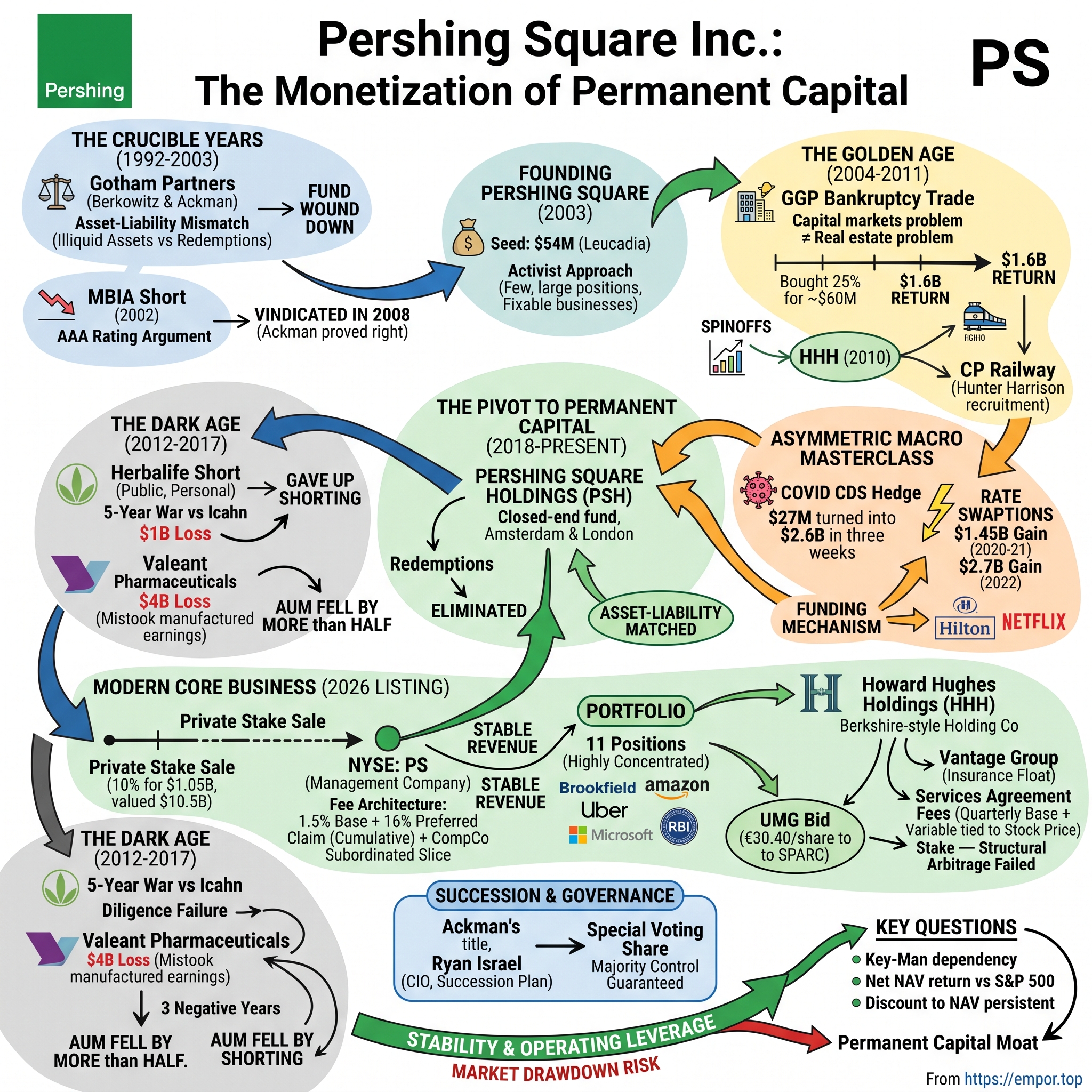
Pershing Square Inc.: The Monetization of Permanent Capital
I. Introduction & Episode Roadmap
On the morning of April 29, 2026, two securities began trading on the New York Stock Exchange at the same moment, and only one of them was actually being sold.
The one being sold was Pershing Square USA, Ltd. — ticker PSUS — a closed-end fund priced at $50.00 per share, offering 40,516,960 shares to American investors who had never before been able to buy Bill Ackman's flagship strategy in a US-listed wrapper.1 The one being given away was Pershing Square Inc. — ticker PS — the management company itself. Every investor who bought five PSUS shares received one share of the manager for free. The prospectus is blunt about it: initial public offering price, $0. Underwriting discounts, $0. Proceeds to Pershing Square Inc., $0.1
Read that structure twice, because it is the entire story compressed into a single line item. Ackman did not sell shares in his asset management business to the public. He handed them out as an inducement to buy his fund. The manager went public without raising a dollar; the fund raised $5.0 billion — $2.026 billion through the public IPO leg and $2.974 billion through a concurrent private placement, including a $200 million anchor investment from Pershing Square Inc. itself.35 In total, PS issued 24,747,254 shares for no consideration, with a relative fair value of $910.8 million.35
The market's verdict was split down the middle. PS closed its first day at $24.20, reached $28.00 the next session, and hit $37.99 by May 1 — a 57% gain in three trading days.35 PSUS opened at $42, about 18% below its offer price, and closed its first day at $40.90 against a net asset value near $49.45 The investors whose purchases created those free manager shares were immediately underwater on the fund they had actually paid for. By July 22, 2026, PS traded around $35 with a market capitalization near $14.1 billion, having ranged between $22.01 and $54.94 since listing.335
That gap between the manager and the managed is the paradox at the center of this story, and it is not new. It is the mature form of a structural insight Ackman has been building toward since 2002: the fee stream is a better business than the fund.
What Pershing Square Inc. actually is today is a listed alternative asset manager with an unusual balance sheet of obligations — which is to say, almost none. It charges a 1.5% annual management fee (0.375% quarterly) on the net asset value of Pershing Square Holdings, Ltd. (PSH, listed in Amsterdam and London) and its two private funds; a 2.0% annual fee on PSUS; and a fee stream from Howard Hughes Holdings (HHH) consisting of a $3.75 million quarterly base fee plus a quarterly variable fee of 0.375% tied to HHH's stock price against a reference level, both indexed to core PCE inflation.1 It runs all of this with 44 employees as of December 31, 2025.1 Total assets under management across the core funds and HHH stood at $30.7 billion at the end of 2025 and $33.0 billion as of April 30, 2026; fee-paying AUM was $20.7 billion and $23.3 billion on those same dates.16
The core of the model is that almost none of that capital can leave. PSH has no redemption provisions and no mandatory repurchase rights exercisable by shareholders.1 An unhappy PSH holder can sell shares to another investor, but cannot withdraw capital from the fund. That is the difference between a hedge fund and a permanent capital vehicle, and it is the difference between an earnings stream that evaporates in a drawdown and one that merely dips.
The man who built it is the same man who once stood on a stage in Manhattan for three hours with a 334-slide deck calling Herbalife a pyramid scheme, who lost roughly $4 billion on Valeant Pharmaceuticals, and who watched firm assets fall by more than half during the drawdown that followed. The transformation from that operator into the CEO of an NYSE-listed fee machine is the arc of this story — and the central analytical question is whether the transformation is real or merely structural. Permanent capital guarantees that the fee revenue survives bad performance. It does not guarantee good performance. As of July 14, 2026, PSH's net asset value was down 9.3% for the year at $77.06 per share, and its London-listed shares traded at $51.75 — a 32.9% discount to the assets they represent.38
Myth versus reality
Before going further, three pieces of consensus narrative are worth checking against the record, because they shape how most people describe this company.
Myth: Pershing Square is an activist hedge fund. Reality: it has not run a public short campaign since Herbalife and has not run a full proxy contest at scale since Canadian Pacific. The current disclosed equity book is eleven positions dominated by mega-cap technology and financials — Brookfield, Amazon, Uber, Microsoft — where no realistic activist lever exists.23 The activism that remains is concentrated in one company, Howard Hughes Holdings, where Pershing already holds board control. What is being sold to public shareholders in 2026 is a fee stream, not a campaign machine.
Myth: permanent capital means the assets are permanent. Reality: permanence describes the liability side — investors cannot redeem — not the holding period of the portfolio. In the eighteen months to March 2026, the funds fully exited Nike, Canadian Pacific Kansas City, Chipotle, and Hilton, cut Alphabet by roughly 95%, and moved to sell the Universal Music stake that had been held since 2021.232444 Turnover has been meaningful. The structure protects the manager from forced selling; it does not commit the manager to holding anything.
Myth: the IPO valued Pershing Square at $10.5 billion. Reality: $10.5 billion was the price set in a private stake sale in 2024.21 The 2026 listing raised nothing for the company and printed an initial public market value closer to $9.7 billion at the first day's close, before the shares roughly doubled and then gave much of it back.335 The valuation the market assigns to this business has been volatile from day one, which is itself informative about how confidently anyone can price a fee stream tied to one manager's returns.
Six themes carry us through. First, the crucible: how the collapse of Ackman's first firm taught him the one lesson that would eventually become his business model. Second, the activist golden age, and the General Growth Properties bankruptcy trade that made his reputation. Third, the abyss — Herbalife and Valeant — and what a $4 billion loss actually does to a fund's liability structure. Fourth, the pivot to permanent capital and the two asymmetric macro trades that funded it. Fifth, the mechanics of the listed manager itself: fees, margins, share classes, and who controls the votes. And sixth, the hard part — testing whether any of this constitutes a durable competitive advantage, or whether Pershing Square Inc. is a high-multiple wrapper around one 59-year-old man's stock picking.
To understand why permanent capital became an obsession rather than a preference, you have to go back to a golf course.
 Subscribe on LinkedIn
II. The Crucible Years: Gotham Partners & The Founding of Pershing Square (1992–2003)
On December 27, 2002, two men in their mid-thirties told their investors the fund was closing.8
Bill Ackman and David Berkowitz had started Gotham Partners a decade earlier, straight out of Harvard Business School, with roughly $3 million. They were, by the standards of early-1990s Wall Street, absurdly young to be running other people's money, and their strategy was the sort of thing that reads brilliantly in a pitch deck and terribly in a redemption cycle: deep-value, concentrated, often in securities nobody else wanted to touch.
The killing blow was structural rather than intellectual. Gotham had accumulated large, illiquid positions — most notoriously a stake in Gotham Golf, a collection of golf courses — inside an open-ended hedge fund. Open-ended means investors can ask for their money back on a defined schedule. Illiquid means you cannot produce that money without selling the assets. When performance lagged, redemption requests arrived, and Gotham found itself needing to convert golf courses into cash on somebody else's timetable. An attempted merger of Gotham Golf into First Union Real Estate — a transaction that would have solved the liquidity problem by giving Gotham a tradeable security — was blocked by the New York Supreme Court in 2002 after minority shareholders sued.8 The escape hatch closed. The fund wound down.
This is the asset-liability mismatch, and it is worth explaining in plain terms because it recurs constantly in finance and almost always with the same result. Imagine running a bank where deposits can be withdrawn any day, but every loan you have made runs for thirty years and cannot be sold. On a calm day, nothing is wrong. On a bad day, you are insolvent not because your assets are bad but because your timing is. A hedge fund holding illiquid positions against quarterly redemption rights is exactly that bank. Ackman's stated investment philosophy is about business quality; his structural philosophy — the thing that actually shaped the company he now runs — is about never being that bank again.
The Gotham era produced one other formative experience, and it is the one that explains why Ackman later became so committed to publishing his research rather than quietly accumulating positions.
Beginning in 2002, Gotham published a research report arguing that MBIA, the municipal bond insurer, did not deserve its AAA credit rating given the structured credit it had guaranteed — and shorted it.9 The economics of that business are worth explaining, because they are counterintuitive. A monoline bond insurer sells a promise: if the underlying bond defaults, we will pay. That promise is only worth something if the insurer is more creditworthy than the bonds it insures. So the AAA rating is not a nice-to-have marketing asset; it is the entire product. An insurer that loses its top rating has, in a single stroke, nothing left to sell. Ackman's argument was that the amount of capital standing behind MBIA's guarantees was far too small relative to the risk it had taken on newer, untested asset-backed securities — meaning the rating was a convention rather than an economic fact.
What followed was a preview of every campaign he would later run, in both directions. MBIA's management persuaded New York Attorney General Eliot Spitzer to investigate Ackman for market manipulation, and the SEC opened its own inquiry. Both concluded without finding wrongdoing.9 The thesis was eventually vindicated during the 2008 financial crisis — roughly six years after publication, and after Gotham itself no longer existed to profit from it.
Six years is a very long time to be right and losing money, and it is a useful data point about the temperament of the person we are analyzing: he does not fold quickly, and he is willing to absorb regulatory and reputational pressure to hold a position. That trait produced the GGP trade. It also produced the Herbalife trade. The same disposition generates both outcomes, and no framework tells you in advance which one you are watching. That is the honest core of the key-man question, and it does not go away just because the company is now listed.
Pershing Square Capital Management opened in 2003 with roughly $54 million, the bulk of it — $50 million — seeded by Joe Steinberg and Leucadia National.9 The number matters mostly for scale: the same firm reported $30.7 billion of AUM at the end of 2025, and its first core fund, Pershing Square, L.P. (PSLP), launched on January 1, 2004, is the vehicle whose track record the company still uses as its founding benchmark.1 Every performance chart in the 2026 IPO prospectus begins on that date, tracing a hypothetical investor who put money into PSLP at inception and transferred to PSH when it launched on December 31, 2012.1 It is a legitimate presentation — the funds really are continuous for such an investor — but it is worth noticing that the twenty-two-year record on which a $14 billion public company is valued is anchored to a $54 million fund started by a man who had just wound down his first one.
The new firm's stated approach was narrow by design: a small number of large positions in North American businesses that were simple, predictable, free-cash-flow generative, and — critically — fixable. Fixable is the activist's word. It means the gap between the current stock price and the intrinsic value is not a mystery to be discovered but a problem to be solved, usually by a board that needs replacing or a corporate structure that needs unwinding. That framing gave Ackman something most concentrated value investors lack: agency. He was not waiting for the market to agree with him. He intended to force the issue.
The firm's own prospectus makes the durability claim explicitly, arguing that reputation is what allows Pershing Square to "garner substantial influence and drive long-term value creation in our portfolio companies without paying a control premium."1 That is a real economic claim and worth holding onto — it says the firm can capture control-like influence at minority-stake prices. It is also, as we will see, the exact asset that Herbalife and Valeant damaged.
For the first several years, though, the strategy worked almost embarrassingly well, and it worked on the biggest brand names in America.
III. The Golden Age of Activism & The GGP Masterpiece (2004–2011)
By late 2008, General Growth Properties was trading at 34 cents.10
To understand how extraordinary that was, you have to remember what GGP actually owned. It was the second-largest shopping mall operator in the United States — hundreds of properties, many of them dominant in their local markets, generating rent from national retail tenants under long leases. The malls were not empty. Occupancy held. Tenants paid. What had happened was purely financial: GGP had funded a large portfolio with short-dated, property-level debt on the assumption that commercial mortgage markets would always be there to refinance it. In the autumn of 2008, those markets simply stopped existing.
This is the distinction Ackman made, and it is the whole trade: a capital markets problem is not the same as a real estate problem. If the buildings still produce cash and the only issue is that the maturity wall arrived during a freeze, then the equity is not worthless — it is optioned. Bankruptcy, in that reading, is not the end of the equity; it is the legal mechanism for extending maturities while the buildings keep earning.
Pershing Square accumulated roughly 25% of GGP's equity for approximately $60 million as the stock collapsed from $63 toward its lows.10 GGP filed for Chapter 11 on April 16, 2009 in what was then one of the largest real estate bankruptcies in US history, and Pershing Square provided debtor-in-possession financing — $375 million — which is the kind of move that converts an investor from spectator to participant.10 Ackman took a board seat and led the equity holders' side of the restructuring, and the crucial fight was not with creditors but with rescuers: Brookfield and Simon Property Group both circled with recapitalization proposals that would have handed control to a strategic buyer at a price the existing equity found inadequate. Ackman played them against each other, extracting competing bids rather than accepting the first lifeline.
GGP emerged from bankruptcy in November 2010 with creditors paid in full and equity holders substantially recovered — an outcome so rare in large Chapter 11 cases that it is genuinely the exception that proves the rule.10 The stock ultimately ran from 34 cents to above $30.10 Pershing Square's $60 million became roughly $1.6 billion.
What did the trade actually demonstrate? Three things worth separating. It showed Ackman could underwrite a complex capital structure under extreme uncertainty, which is a genuine analytical skill. It showed he was willing to put the firm's credibility and cash behind a position that most institutional investors would have deemed uninvestable, which is temperament. And it showed something less flattering that only became visible later: the return profile of GGP — tiny capital in, enormous multiple out, driven by a binary structural outcome — is the profile Ackman would spend the next fifteen years trying to replicate, and that pursuit produced both the best and the worst trades of his career.
The GGP restructuring also produced a durable asset. In November 2010, GGP spun off its master-planned communities and non-core development assets into the Howard Hughes Corporation — Summerlin outside Las Vegas, the Woodlands north of Houston, Ward Village in Honolulu.11 These were not malls. They were enormous land banks with decades of entitlement runway, the sort of asset that produces almost nothing for years and then produces a great deal. Ackman became chairman. Sixteen years later, Howard Hughes Holdings is the single largest source of externally contracted fee revenue growth at the listed manager — a through-line that most narratives of this story miss.
The activist playbook that made the firm's name in this era was more mixed than the highlight reel suggests, and the failures are more instructive than the wins.
The 2005 Wendy's campaign worked. Ackman's argument was that the market was valuing Wendy's as a mediocre American burger chain while ignoring that it owned Tim Hortons, a genuinely dominant Canadian coffee and baked-goods franchise with far better unit economics. Separate the two and the sum of the parts exceeds the whole, because different investors want different assets. Wendy's spun off Tim Hortons, and the thesis paid.
The campaigns at McDonald's and Target did not work, and both rested on the same structural argument: that a retailer sitting on valuable real estate should separate the property into a REIT, where income-focused investors would pay a higher multiple for the rent than equity investors were paying for it embedded inside an operating company. It is an elegant idea on a spreadsheet. Boards kept rejecting it for a reason that turns out to matter enormously in a downturn: selling the ground under your stores converts an owned asset with no cash cost into a permanent, contractual rent obligation that must be paid whether or not customers show up. Operating flexibility is worth something that a valuation model does not capture. McDonald's refused outright. The Target campaign ended in a proxy defeat and heavy losses in a dedicated single-stock fund that Pershing Square had raised specifically for it — a structure that, notably, concentrated the pain onto investors who had bought exactly one idea.
The pattern across the era is worth naming because it recurs. Ackman's wins came where the underlying business was sound and the problem was structural or operational — a bankruptcy timetable, a hidden subsidiary, a badly run railroad. His losses came where he was arguing with a board about financial engineering that management had already considered and rejected on operating grounds. The distinction is not about being right on the arithmetic. It is about whether the counterparty has information you do not.
The last great campaign of the era was Canadian Pacific Railway. Beginning in 2011, Pershing Square built a stake and then ran a proxy contest that replaced the CEO with Hunter Harrison, the retired Canadian National executive who had spent a career proving that railroads were operations problems disguised as asset problems. Harrison took over in June 2012 and drove CP's operating ratio — operating expenses as a percentage of revenue, the industry's single most-watched efficiency metric — from 81.3% down to 58.6% by 2015, with profits nearly tripling.12 Pershing Square exited in August 2016 having made roughly $2.6 billion on a $1.7 billion investment.13
Canadian Pacific is the cleanest case for the activist model there is: identify a good asset run badly, replace management with a proven operator, and let operating leverage do the rest. It also happens to be the last time the model worked at that scale. What came next tested whether Ackman had a repeatable process or an extraordinary run.
IV. The Dark Age: Herbalife, Valeant, and the $4B Drawdown (2012–2017)
On December 20, 2012, Ackman stood in front of an audience in midtown Manhattan and spent more than three hours presenting 334 slides arguing that Herbalife was a pyramid scheme.
The presentation was titled "Who wants to be a Millionaire?" and its argument was, on its own terms, coherent: that Herbalife's multi-level marketing structure derived its economics from recruiting distributors rather than selling nutrition products to end consumers, that its own disclosures about retail sales were unverifiable, and that its recruitment was concentrated in low-income communities. Ackman said publicly he would take the position "to the end of the earth" and pledged personal profits to charity. Pershing Square was short roughly $1 billion of stock.
What followed was less an investment thesis than a five-year war, and the losses came from the structure of the trade rather than the accuracy of the analysis.
Consider what shorting an equity actually is. You borrow shares, sell them, and hope to buy them back cheaper. Your maximum gain is 100% — the stock goes to zero. Your maximum loss is unbounded, because there is no ceiling on a stock price. In between, you pay to borrow the shares, and if the company pays dividends you owe those too. That is negative carry: the position costs money every day merely to exist. And because your losses grow as the position moves against you, a rising stock forces you to post more collateral, which is how short squeezes kill people who are eventually right.
Herbalife was close to the worst possible target for that structure. It was capital-light, cash-generative, and actively buying back its own stock — which shrinks the float and makes the shares harder to borrow. Then the position became personal. Carl Icahn went long, appeared live on CNBC in January 2013 to call Ackman a "crybaby in the schoolyard," and the two men conducted a shouting match on national television that is still the most-watched segment in the network's history. Dan Loeb and George Soros also took the long side. Ackman's public commitment had told every large opportunistic investor on Wall Street exactly where the trapped seller was.
By November 2017, with Herbalife stock up 51% on the year, Ackman restructured the position into put options — a structure with capped downside, which is what he should arguably have used from the start. On February 28, 2018, he exited entirely, having lost close to $1 billion.[^14] Icahn made roughly $1 billion on the other side.14 Ackman has not launched a public short campaign since.
The lesson Pershing Square drew — and it is embedded in the firm's current strategy documents as a stated preference for "opportunistic asymmetric hedges" over equity shorts1 — is a good one. But it is worth noting what it does not address: the decision to make the position public, personal, and irreversible. The structural flaw was the short; the behavioral flaw was the stage.
Valeant Pharmaceuticals was worse, and it was worse in a way that cannot be blamed on structure at all.
The relationship began in 2014, when Pershing Square partnered with Valeant in a hostile bid for Allergan — an unusual arrangement in which the activist accumulated the target's stock while the acquirer prepared the offer. Allergan escaped by selling itself to Actavis, and Pershing Square made a substantial profit on its Allergan shares. Having watched Valeant up close during that campaign, Ackman then did something considerably harder to defend: in 2015 he bought roughly $3.2 billion of Valeant stock directly, at prices around $196 per share.15
Valeant's business model deserves a plain-English description because the market's willingness to believe it is the actual story. The company acquired existing pharmaceutical products, cut research and development spending to a fraction of industry norms, and raised prices on the acquired drugs — sometimes dramatically. It funded the acquisitions with debt. As long as it kept acquiring, reported growth looked spectacular. Strip out the acquisitions and price increases, and the underlying business was not growing much at all. It was, in structural terms, a roll-up whose earnings depended on continuing to do more of the same thing at increasing scale — the financial equivalent of a bicycle that stays upright only while pedaling.
Three things then broke at once. Political attention turned to specialty drug pricing, removing the pricing lever. In October 2015, reporting revealed the company's relationship with Philidor, a specialty pharmacy that had been used to steer prescriptions toward Valeant products, triggering SEC scrutiny and the eventual severing of the relationship. And the debt — which had been perfectly serviceable against rising earnings — became an existential constraint against falling ones.
Ackman joined the Valeant board in March 2016 to attempt a turnaround, which is a decision worth pausing on. Board membership restricts when you can trade. It converts a portfolio manager into a fiduciary of the thing he needs to sell. On March 13, 2017, Pershing Square sold its entire remaining stake at around $11 per share and Ackman stepped off the board, realizing a total loss of roughly $4 billion.15 The stock had fallen approximately 96% from its 2015 highs.15
To his credit, Ackman's post-mortem in the 2016 annual letter was direct: "Clearly, our investment in Valeant was a huge mistake," and "in retrospect, we misjudged the prior management team."16 That is more candor than most managers offer. It is also, on inspection, a narrow admission. The failure was not primarily a misjudgment of individuals. It was paying a high multiple for earnings that were manufactured by leverage and price increases rather than by products people wanted more of — a diligence failure about the nature of the earnings, not the character of the executives. When you assess management credibility over time, this distinction matters: the explanation offered locates the error in something unknowable rather than in something the analysis should have caught.
The financial consequence was not merely the loss; it was the run that followed. PSH posted three consecutive negative years — down 20.5% in 2015, 13.5% in 2016, and 4.0% in 2017 — with 2015 the worst in the firm's history.38 The company's own prospectus describes 2015 to 2017 as a "challenging period."1 Two forces compounded during it: the investments lost money, and investors in the open-ended funds redeemed, which forced selling into the same weakness. Firm assets fell by roughly half from their mid-2010s peak. Ackman was living inside the Gotham problem again, at vastly greater scale — forced to think about liquidity at exactly the moment he most needed to think about opportunity.
He had already begun building the answer. He just needed the crisis to prove why it mattered.
V. The Pivot to Permanent Capital & The Asymmetrical Macro Masterclass (2018–2023)
The structural fix predated the crisis. Pershing Square Holdings, Ltd. — a Guernsey-domiciled, closed-end investment vehicle — launched on December 31, 2012 and listed on Euronext Amsterdam in October 2014, later adding a London Stock Exchange listing.1 What made it different from every fund Ackman had run before was a single omission: it had no redemption rights.
The company now dates its "permanent capital era" from January 1, 2018 — the year it stopped accepting new money into the open-ended structures and made PSH the core of the business.1 The choice cost the firm real money in the near term, because closed-end funds trade at whatever the market will pay, and what the market pays for a concentrated, high-fee, one-manager vehicle is frequently less than the assets are worth. PSH's discount to NAV has been a persistent feature ever since, and we will return to it, because it is arguably the central unresolved problem in the entire structure.
There is a second consequence of the closed-end form that rarely gets discussed and matters a great deal to risk. Because PSH's capital cannot run, PSH can borrow against it. The fund has issued long-dated bonds — its assets under management at the end of 2025 included $2.3 billion and €1.15 billion of bond proceeds, with a further $1.24 billion raised during 2025 alone.1 An open-ended fund cannot responsibly carry that kind of term leverage, because a redemption wave and a margin call would arrive together. A permanent vehicle can. The effect is to magnify both directions of the portfolio's returns, and it is part of why PSH's annual return series is as violent as it is. Investors evaluating the manager's track record should hold in mind that some portion of the compounding was borrowed.
But the compensating benefit arrived faster than anyone expected, and it arrived in the form of a pandemic.
In late February 2020, as reports emerged from Wuhan and northern Italy, Pershing Square did something that had nothing to do with picking stocks. Beginning around March 3, it bought credit default swaps on investment-grade and high-yield corporate bond indices at a total cost of roughly $27 million.17
A credit default swap is, in the simplest framing, insurance on a bond. You pay a small periodic premium; if the borrower defaults, you get paid. When credit markets are calm, that insurance is very cheap, because nobody expects defaults. The critical property is convexity: the price of the insurance does not rise linearly with distress. In a genuine credit panic, the cost of protection can move by orders of magnitude, because everyone wants it at once and nobody wants to write it. So a small premium paid in calm can be worth an enormous amount in panic — and the maximum loss is exactly the premium. You cannot lose more than you paid.
That is the asymmetry, and it is the same shape as buying a deeply out-of-the-money option: high probability of losing the whole thing, small probability of a return so large it changes the fund's year.
On March 18, 2020, Ackman appeared on CNBC and delivered an emotional interview warning that "hell is coming" if the United States did not shut down for thirty days. He was widely criticized for talking his book. His response was specific and checkable: by 12:30pm that day, he said, he had already sold slightly more than half the notional value of his CDS position and booked over $1.3 billion of gains.17 By March 23 — the exact day the S&P 500 bottomed — the position was closed. Roughly $27 million had become approximately $2.6 billion in about three weeks.17
What happened next is the part that actually matters for evaluating the firm, and it is the part usually skipped. Ackman did not bank the gain. He redeployed it immediately into equities at generational lows — adding to and re-establishing positions in Starbucks, Agilent, Hilton, Lowe's, and Chipotle.17 The hedge was never intended as a directional bet on catastrophe. It was intended as a funding mechanism for buying quality businesses in a panic. This is the operational expression of permanent capital: an open-ended fund facing redemption requests in March 2020 could not have made that purchase, because it would have needed the cash for its own investors.
The firm repeated the trick with interest rates. In December 2020 and early 2021, believing that fiscal expansion, monetary accommodation, and reopening demand would produce inflation the Federal Reserve would be forced to fight, Pershing Square bought out-of-the-money interest rate swaptions — options on interest rate swaps, which pay off if rates rise sharply. The original investment was $188 million; the 2020–2021 tranche ultimately produced cumulative proceeds of $1.45 billion.18 A replacement hedge established in 2022 produced $2.7 billion of gains that year.19
The 2022 result is instructive precisely because it was not enough. Despite $2.7 billion from the rate trade, PSH finished 2022 down almost 9%.19 Asymmetric hedging cushions; it does not immunize. Notably, in January 2022 the firm sold the substantial majority of the hedge for $1.25 billion and used the proceeds to establish a new core position in Netflix18 — a position it exited at a loss within months. The hedges have been extraordinary. The redeployment of hedge proceeds has been mixed, and that is a fair critique of the "hedge funds the buying" narrative.
The same period produced the firm's most public failure of execution. In July 2020, Pershing Square Tontine Holdings raised $4 billion in what was then the largest SPAC IPO ever.20 In June 2021, PSTH agreed to acquire 10% of Universal Music Group from Vivendi, valuing UMG at an enterprise value of approximately €35 billion.[^22] The structure was unconventional — PSTH would hold a minority stake in a company listing in Amsterdam rather than merging with an operating business — and the SEC raised concerns about whether it qualified under NYSE rules and the Investment Company Act. In July 2021 the deal was withdrawn. Pershing Square's funds honored the obligation and bought the UMG stake directly, with a co-investment vehicle raised for the purpose.1
PSTH never found a replacement target. On July 11, 2022, unable to complete a business combination within 24 months of its IPO, it announced it would liquidate and return all $4 billion to shareholders.20 Investors got their money back with interest; Pershing Square absorbed the transaction costs and the reputational damage of the most expensive dry hole in SPAC history.
Ackman's answer was to invent a replacement, and it is worth understanding because it becomes relevant again in 2026. Pershing Square SPARC Holdings, Ltd. — a "special purpose acquisition rights company" — became effective with the SEC on September 29, 2023.1 Where a SPAC raises money first and then hunts for a deal, SPARC distributes rights to investors and only calls capital once a specific transaction is identified. There is no founder stock, no warrants, and no underwriting fee.1 Whether it is a better mousetrap is still unproven. What is not in doubt is that Ackman kept iterating on the same structural question — how do you get permanent, non-redeemable capital into public markets — for two decades.
By 2024 he had run out of structures to invent. The last one available was to sell the manager itself.
VI. Modern Core Business: Portfolio Mechanics, Segment Economics, and Asset Management Architecture
The first transaction was private. On June 3, 2024, Pershing Square sold a 10% stake in the management company for $1.05 billion, valuing the business at $10.5 billion.21 The buyers were a deliberately assembled group: Arch Capital Group, BTG Pactual, Consulta Ltd., ICONIQ Investment Management, Menora Mivtachim Holdings, and a set of international family offices.2122 Roughly $500 million of the proceeds was earmarked to anchor the future US fund.21
That $10.5 billion valuation is the number to hold in mind, because it was set against a business earning $455.5 million of revenue in 2024 — $206.1 million of management fees and $249.4 million of performance fees.1 In 2025, revenue rose to $762.5 million, with management fees of $230.4 million and performance fees of $532.1 million.1 Fee-related earnings — the company's preferred non-GAAP measure, capturing management fees plus its preferred slice of performance fees, net of directly related compensation — were $269.1 million in 2024 and $297.9 million in 2025.1 Distributable earnings were $294.6 million and $312.5 million respectively.1
Notice what those two series tell you. Total revenue jumped 67% between 2024 and 2025, but fee-related earnings rose only 11%. That is not an accounting quirk; it is the design. Performance fees above a defined threshold do not accrue to shareholders at all.
Here is how the fee architecture actually works, and it is the single most important thing to understand about PS as a security.
Management fees are the annuity. PSH and the two private funds (PSLP and Pershing Square International) pay 0.375% quarterly — 1.5% annually — on net asset value before accrued performance fees.1 PSUS pays 0.5% quarterly, or 2.0% annually, payable in advance at the start of each quarter.1 HHH pays its base-plus-variable arrangement under a Services Agreement dated May 5, 2025.1 Because PSH cannot be redeemed and HHH is an operating company, this revenue base does not shrink when investors get nervous. It shrinks only when asset values fall.
Performance fees are split, and the split is the clever part. The company retains a preferred claim on what it calls Preferred Performance Fees — generally the performance fees earned on the first five percentage points of return net of management fees, above each fund's high-water mark.1 Everything above that, the Subordinated Performance Fees, is paid to a separate entity (CompCo) that compensates the investment professionals.1 Crucially, the preferred claim is cumulative: if it is not fully paid in one year, it accrues to subsequent years.1
Translate that into English. Shareholders of PS own a senior, accruing claim on a thin, predictable slice of performance fees. Employees own the volatile, upside slice. The company's own framing is that "as long as our funds can achieve a 5% annual compound return net of their management fees over the long-term, the Preferred Performance Fees will be fully paid."1 The disclosed mechanics show the size: against a 2025 high-water-mark base of $12.54 billion for performance-fee-paying PSH investors, the current-year Preferred Performance Fee was $100.4 million, computed as the base times 16% times 5%.1
This structure deserves both credit and skepticism. The credit: it converts the most volatile line in any asset manager's P&L into something closer to a bond coupon, which is genuinely why the business can support a high multiple. The skepticism: a 5% net hurdle is not demanding, and the accrual feature means shareholders keep earning the preferred fee in years when investors are losing money — a real economic transfer that will attract attention if performance stays weak.
There is also a fee-offset arrangement that most summaries miss and that materially shapes reported revenue. In February 2024, PSCM amended the PSH management agreement so that PSH's performance fee is reduced by 20% of the performance fees earned from non-PSH funds and 20% of the management fees earned from non-PSH funds that carry no performance fee — a category that now includes PSUS.37 The stated long-term goal is to eliminate PSH's incentive fee entirely. Separately, the Howard Hughes arrangement reduced core-fund management fees by each fund's pro-rata share of the HHH fees.37 The practical effect is that launching PSUS did not simply add 2.0% on $4.9 billion to the top line; a portion flows straight back to existing PSH investors, worth roughly $20 million of PSH's 2026 performance fee.7 That is unusually shareholder-friendly behavior toward fund investors, and correspondingly a drag on company shareholders — a tension baked into owning both sides.
One further accounting item deserves attention because it will suppress reported revenue for a decade. Those 24.7 million shares handed out for free were not costless. Their $910.8 million relative fair value was capitalized as a deferred asset and is being amortized as contra-revenue over ten years.35 In plain terms, the company effectively pre-paid roughly $91 million a year of customer-acquisition cost, and that cost lands as a reduction to reported management fees rather than as an expense line. Any investor comparing PS's headline revenue to peers, or watching the management fee line grow, needs to hold that adjustment in view.
The 2026 listing completed the architecture. Effective April 28, 2026, Pershing Square Holdco, L.P. — a Delaware limited partnership — converted by statutory conversion into a Nevada corporation and changed its name to Pershing Square Inc., with 400 million shares outstanding.135 Control was engineered rather than left to chance. Senior management owns 63.93% of the common stock directly or indirectly; Pershing Square Management, LLC holds voting power over 74.73% of it, and additionally holds a Special Voting Share with no economic rights whose voting power automatically adjusts to whatever number of votes is required to keep ManagementCo at a majority.1 In other words, even if the economic stake were diluted below 50%, control would not move. PS qualifies as a "controlled company" under NYSE rules, though it has said it does not intend to rely on the associated governance exemptions.1
The portfolio those fees are levied on has changed almost beyond recognition from the activist era. As of the Q1 2026 13F, Pershing Square disclosed eleven positions worth $13.71 billion, down from $15.53 billion the prior quarter, with the top five being Brookfield Corporation (17.6%), Amazon (17.4%), Uber (15.7%), Microsoft (15.3%), and Restaurant Brands International (12.2%).23 Meta sat at 11.1% and Howard Hughes at 8.7%; the tail included small stakes in Seaport Entertainment and Hertz.23 Microsoft was a new position of 5.65 million shares, roughly $2.1 billion; the Alphabet stake was cut by about 95%, liquidating roughly $1.9 billion; Hilton was exited.523
Rewind eighteen months and the roster looked entirely different. Nike was exited in Q1 2025 at a loss of about 30% in roughly eighteen months.24 Canadian Pacific Kansas City went in Q2 2025. Chipotle was fully exited in Q4 2025 after roughly a decade, with the firm attributing the decision to valuation compression rather than operational deterioration.24 Alphabet was built up through 2025 to nearly $2.7 billion at its peak and then almost entirely liquidated within two quarters.23 New money went into Hertz, Amazon, and Meta Platforms.25
Two positions sit outside the 13F entirely and are worth flagging as embedded optionality rather than core thesis. Pershing Square holds large stakes in Fannie Mae and Freddie Mac common stock — securities that trade over the counter and are not 13F-reportable — accumulated more than a decade ago on the thesis that the government-sponsored enterprises would eventually exit conservatorship. In November 2025 the firm published a proposed privatization framework arguing for immediate exercise of the Treasury warrants and an NYSE relisting.39 The GSEs remained in conservatorship as of this writing, and the outcome depends entirely on political decisions the firm does not control. It is a genuine call option with an unknowable expiry — appropriate to note, inappropriate to underwrite.
That aside, the rotation described above is substantial for a manager whose entire pitch is decadal holding periods, and it is fair to flag the tension. The prospectus describes a portfolio of "long-term holdings with limited trading activity" managed by few professionals precisely because turnover is low.1 The 2025–2026 activity — full exits from two decade-scale consumer positions, a 95% cut to a top holding, a large new mega-cap technology position — looks more like conventional portfolio management than permanent ownership. A skeptical investor is entitled to ask which description is accurate.
Two holdings sit outside the marketable portfolio and increasingly define the firm. The first is Howard Hughes Holdings. On May 5, 2025, Pershing Square invested $900 million for nine million newly issued shares at $100.00 each — a 48% premium to the prior close, which is a striking thing to pay when you are already the largest shareholder.41 The transaction took Pershing to roughly 46.9% economic ownership with voting rights contractually capped at 40%, installed Ackman as Executive Chairman and Ryan Israel as HHH's Chief Investment Officer while David O'Reilly remained CEO, and created the Services Agreement described above — converting a 16-year equity position into a recurring fee stream.141
The stated ambition is a "modern-day Berkshire Hathaway," and the first concrete step came in December 2025 when HHH agreed to acquire Vantage Group Holdings, a Bermuda-based specialty insurer and reinsurer founded in 2020 with backing from Carlyle and Hellman & Friedman. The $2.1 billion all-cash deal closed on June 4, 2026, funded by HHH cash plus $1 billion of non-voting exchangeable perpetual preferred stock issued to Pershing Square Holdings, with an additional $200 million injected into Vantage at closing.2642 Pershing Square manages Vantage's investment portfolio without charging a fee.42 The logic is Buffett's: insurance float is capital you hold and invest before you pay claims.
It is worth stating plainly what this means for PS shareholders. HHH's fee-paying AUM is defined as HHH's market capitalization.1 The variable fee is 0.375% of the increase in HHH's equity market capitalization above a reference level set at the time of the deal.141 The manager's revenue therefore rises and falls with a single mid-cap stock price — a form of embedded leverage that is not obvious from the phrase "recurring management fee," and one that showed up immediately in the Q1 2026 accounts.
The second is Universal Music Group, and its arc in 2026 is the most revealing episode in the whole story. Having acquired 10% of UMG directly in 2021 after the SPAC structure failed, Ackman spent four years arguing that the Amsterdam listing systematically undervalued the asset relative to US-listed media peers. He trimmed 2.7% in March 2025 and resigned from UMG's board in May 2025, leaving Pershing with roughly 7.3%.43 Then, on April 7, 2026, Pershing Square proposed merging UMG with SPARC — the rights-based acquisition vehicle built in 2023 — with the combined company redomiciling as a Nevada corporation, listing on the NYSE, reporting under US GAAP, and becoming eligible for the S&P 500.143 The cash-and-share proposal valued UMG at roughly €55.8 billion (about $64 billion), or €30.40 per share — €5.05 in cash plus 0.77 shares of a new entity — a 78% premium, with Michael Ovitz proposed as chairman.2743
On May 29, 2026, UMG's board unanimously declined, stating that the proposal "fundamentally and materially undervalues UMG and will not deliver superior value creation," and countering with an expanded €500 million buyback and a plan to monetize half its Spotify stake.2829 Days later, on June 3, Pershing Square moved to sell its remaining 4.7% holding — roughly 80.6 million shares — via an overnight placement through Bank of America marketed at €17.66 to €18.62 per share.44
Sit with that sequence. Pershing offered €30.40 per share in April and was marketing its own stake at under €19 in June. The proposal was not, on the evidence, a valuation Pershing was prepared to defend by continuing to own the asset at market prices; it was a structural arbitrage on the listing venue, and when the arbitrage was refused, the position was liquidated. That is a legitimate strategy. It is not the decadal permanent ownership the marketing describes, and it is a direct test of the claim that reputation buys control-like influence without a control premium.1 Against a company whose register includes the Bolloré family and Tencent, a 78% premium and a celebrity chairman were not enough. The company's own disclosure had been appropriately blunt: "There is no assurance that our proposal will be accepted by UMG or result in the transaction we proposed or any other transaction."1
VII. Management, Ownership, Incentives, and Governance
There is a line in the compensation tables of the PS prospectus that tells you more about this company than any strategy slide: in 2025, Bill Ackman received no salary, no bonus, and no option awards.1
What he received instead was $142,775,160 of "all other compensation" — up from $46,647,594 in 2024.1 Ryan Israel received $44,045,910 in 2025 against $27,997,302 in 2024; Ben Hakim received $17,771,413.1 These are distributions of performance fees, not salary. The entire senior team is paid out of the subordinated slice — the portion above the shareholders' preferred claim. When the funds do well, employees capture the upside. When they do not, employees are paid very little, and shareholders still collect the preferred fee.
Ackman, 59, serves as Chief Executive Officer, Chairman of the Board, and Portfolio Manager.1 He beneficially owns approximately 44.9% of the company post-transaction, alongside the voting control exercised through ManagementCo; Israel holds 7.7%, Hakim 3.2%, and all directors and officers as a group 61.2%.1 He is a genuinely unusual public-company CEO: a Harvard MBA who has spent thirty years being extremely public about extremely concentrated positions, who lost his first firm to an illiquidity spiral, who conducted a televised feud with Carl Icahn, who has been vindicated slowly on MBIA and wrong expensively on Valeant, and who has built one of the largest direct audiences of any investor on X. His public profile is simultaneously the firm's distribution channel and its largest single risk factor — a duality the prospectus states plainly, warning that the business depends on "the efforts, judgment, skill and personal reputations" of its founder.1
Ryan Israel, 41, is the answer to the key-man question, or at least the beginning of one. He joined Pershing Square in 2009 from Goldman Sachs, became Chief Investment Officer in August 2022, and joined the board in June 2024.1 The prospectus describes an eight-stage research process in which Ackman "and/or Ryan Israel" conduct due diligence on candidate companies1 — deliberately institutional language for what was, for two decades, one person's judgment.
The honest assessment is that this succession is asserted rather than demonstrated. Israel has held the CIO title through a period that includes both the strong 2025 (+20.9% NAV) and the weak 2026 to date.5 There is no public track record separating his decisions from Ackman's. Investors are being asked to accept that a firm defined by one man's convictions can survive that man's departure, on the strength of an org chart. That is not evidence; it is a plan.
Ben Hakim, 50, became President in June 2024 and joined the board in February 2025, overseeing capital markets and corporate development. He joined the investment team in 2012 from Blackstone, where he had been a senior managing director — a background in transaction structuring rather than security analysis, which is precisely the skill set the past three years of the firm's history have demanded. The broader executive group includes Halit Coussin as Chief Legal and Compliance Officer and Michael Gonnella as CFO, both of whom, alongside Israel, Hakim, and Anthony Massaro, are members of ManagementCo — meaning the voting bloc is not Ackman alone but a small, long-tenured senior group.1 The board includes outside directors David Coppel Calvo, Kerry Murphy Healey, Orion Hindawi, and Marco Kheirallah, the last of whom is affiliated with BTG Pactual, one of the 2024 strategic investors, which retains a board-nomination right.1
Alignment, at least on the investment side, is unusually strong and measurable. Employees and affiliates had $5.8 billion of their own capital invested in the funds and in HHH as of December 31, 2025.1 That is roughly a fifth of total AUM, and it is a far more meaningful signal than any statement about eating one's own cooking. The people making the decisions lose real money when the decisions are wrong.
The alignment for PS shareholders specifically is more subtle, and it is worth being precise about, because the two groups are not identical. A fundholder wants maximum net return. A manager-shareholder wants maximum fee-paying AUM at maximum margin. Those objectives coincide most of the time — returns drive AUM here, since there is no fundraising machine — but they diverge in specific situations. Launching PSUS grew the fee base and diluted PSH's institutional demand, widening its discount. Buying back PSH stock at a discount helps fundholders and shrinks the fee base. The February 2024 fee-offset amendment and the PSUS rebate are explicit attempts to bridge the gap, and they do so by transferring economics away from the manager. That is management behaving well toward its fund investors, and PS holders should understand they are the ones paying for it.
That public profile is not incidental to the business model — it is the distribution channel, and the company has now institutionalized it. On June 2, 2026, Pershing Square announced that beginning with second-quarter results it would hold a live webcast led by Ackman and Israel for analysts and institutional investors, followed immediately by a public question-and-answer session on X open to anyone.45 No other listed asset manager runs its investor relations this way. The strategic logic is coherent: a closed-end fund sold to US retail investors needs demand that does not route through pension consultants and gatekeeper platforms, and a founder with a mass direct audience can generate that demand without paying for shelf space. The risk is the mirror image. A distribution channel built on one person's public voice is exposed to everything that voice says, including on subjects that have nothing to do with investing.
On capital allocation and credibility, the record is genuinely mixed and should be assessed as such. On the positive side: the pivot to permanent capital was announced and then actually executed, at real near-term cost. The Valeant post-mortem was published rather than buried. PSH has repurchased 29.5% of its shares outstanding since inception, including $369.1 million of buybacks in 2025 alongside $118.1 million of dividends — a genuine attempt to close the NAV discount rather than complain about it.1 And the fee rebate structure, under which PSH receives 20% of the management fees earned on PSUS — worth roughly a $20 million reduction in PSH's 2026 performance fee — is a real transfer from the manager to existing fundholders to compensate them for the new fund's competition.7
On the negative side: the SPAC raised $4 billion and returned it two years later having accomplished nothing. The Netflix position was established and abandoned within a single year. Two long-term consumer holdings were exited in 2025 after the theses deteriorated. And the UMG bid was rejected in public. None of these are frauds or governance scandals — but they are the accumulated record of a manager who takes large, visible swings, and investors buying the fee stream should be clear-eyed that the swings continue.
Governance itself invites the sharpest activist critique, which is nicely ironic. A PS shareholder owns economics without any meaningful power. The Special Voting Share means that no accumulation of stock by outsiders can ever produce a change of control.1 The company is substantially dependent on investment management agreements with PSH and PSUS and on the HHH Services Agreement, each terminable in defined circumstances1 — so the revenue base rests on contracts with entities whose boards are heavily influenced by the same people. Related-party density is high by design: the manager advises a fund whose largest holdings include a company its CEO chairs, which pays the manager a fee based on its own stock price, and which funded an acquisition partly with preferred securities issued to that manager's funds. Every element is disclosed. None of it is arm's-length in the way a generalist investor might assume.
That combination — extraordinary structural quality on the revenue side, extraordinary concentration on the control side — is what a competitive analysis has to weigh.
VIII. Strategic Position, Competitive Frameworks, & Playbook
Ask what business Pershing Square Inc. is actually in and you get two defensible answers with very different implications.
The first: it is an alternative asset manager, comparable to Blackstone, KKR, Apollo, Blue Owl, or Brookfield Asset Management, and it should be valued on fee-related earnings and AUM growth like its peers. The second: it is a single-strategy, single-manager fund wrapper whose revenue is a fixed percentage of one portfolio's value, and it should be valued as a leveraged claim on that portfolio.
Both are true, and the tension between them is where the analysis lives.
Applying Hamilton Helmer's 7 Powers honestly requires distinguishing what is proven from what is asserted.
Scale economies are real but narrow. The company employs 44 people managing $30.7 billion of AUM.1 That ratio — roughly $700 million of AUM per employee — is extraordinary, and the reason is structural rather than clever: a portfolio of eleven positions with low turnover simply does not require many analysts.23 The prospectus argues the firm could manage "an asset base many times larger than our current AUM" with existing infrastructure.1 That claim is credible for marketable equities. It is much less credible for the operating-company ambitions at HHH, which require underwriting, actuarial, and development capabilities the manager does not have.
Cornered resource is the strongest and most fragile power simultaneously. Ackman's brand genuinely does open doors — it produced the Leucadia seed, the board seats, the DIP financing role at GGP, the Hunter Harrison recruitment, and a retail following large enough to help distribute a US closed-end fund. But a cornered resource that is a person ages, and this one has an unusually high public variance. The prospectus lists reputational damage as a distinct risk from investment underperformance,1 which is an accurate reading of a business where the input is credibility.
Counter-positioning is the most durable and the most underrated. This is the permanent capital point, and it is real: an open-ended competitor cannot buy aggressively in a panic, because its own investors are withdrawing exactly then. Pershing Square's March 2020 redeployment of CDS proceeds into equities at the bottom is the empirical proof.17 The reason competitors cannot simply copy it is not technical — it is commercial. Investors prefer liquidity, and charging full fees for an illiquid wrapper requires a track record most managers do not have. That reluctance is precisely why the structure is defensible, and also precisely why PSH trades at a discount. The moat and the discount are the same fact viewed from two directions.
Process power is asserted and not yet evidenced. The eight-stage research process under Israel is described in the prospectus, but the portfolio has turned over meaningfully in the past eighteen months and produced both winners (Brookfield, Uber, Amazon) and losers (Nike, Netflix).2324 There is no visible mechanism here that a competent competitor could not replicate.
Switching costs and network economies are largely absent for a manager of liquid equities. Branding overlaps with the cornered resource. It is more honest to say Pershing Square Inc. has two-and-a-half powers than seven.
Porter's Five Forces for this niche produce an unusually favorable picture on paper, with one crucial exception.
Buyer power is nearly zero — and this is the single most unusual feature of the business. PSH holders cannot redeem.1 They can only sell to another buyer, which changes the share price but not the fee base. Compare this to a mutual fund, where a bad year produces outflows that permanently reduce revenue, or a private equity fund, where capital returns at the end of the fund's life and must be re-raised. Pershing Square's disclosure makes the contrast directly: unlike private equity managers who "must raise increasingly larger funds in order to replace liquidated funds," its fee-paying AUM grows primarily through investment returns.1
Threat of new entrants is low at this specific intersection. Launching a permanent capital vehicle with retail distribution requires a multi-decade track record, regulatory approvals under the 1940 Act, and underwriters willing to place it — and even Ackman, with all three, priced PSUS at a level the market immediately rejected.4
Rivalry is moderate and mischaracterized in most descriptions of the firm. Pershing Square does not compete with Blackstone for LP allocations in any meaningful way; it competes for the marginal dollar of an investor choosing between an index fund, Berkshire Hathaway, and a concentrated manager. That is a much harder competitive set than it sounds, because the index alternative costs nearly nothing.
Substitutes are therefore the binding force, and they are severe. Any investor can replicate an eleven-stock portfolio of Brookfield, Amazon, Uber, Microsoft, and Restaurant Brands at essentially zero cost. What they cannot replicate is future stock selection and the asymmetric hedges. The entire value proposition reduces to whether Ackman's team can outperform enough to justify 1.5% to 2.0% plus performance fees.
Supplier power, unusually, is meaningful here — the suppliers are the investment professionals, and they capture the subordinated performance fees. In a very good year, employees receive the majority of the performance economics.1
Three durable lessons emerge from the full arc, and each is testable rather than rhetorical.
Match your liability structure to your asset structure. Gotham died of this; the 2015–2017 drawdown nearly repeated it; PSH solved it. The evidence that it was solved is not the marketing — it is that AUM fell by more than half in the open-ended era and did not fall in the permanent era despite a weak 2024 and a negative 2026 to date.
Buy convexity rather than sell it. Shorting Herbalife had capped upside and uncapped downside; buying CDS and swaptions had capped downside and enormous upside. Same directional view, opposite payoff geometry, roughly $1 billion lost versus roughly $4 billion made.
The manager is a better asset than the fund. This is the culminating insight and the one investors in PS are paying for. PSH's NAV can fall 20% and the manager's revenue falls 20% — but the manager has no capital at risk, minimal fixed costs, and an accruing preferred claim on performance fees. A fee stream is a lower-beta, higher-margin instrument than the assets it is levied on. That is why the manager was worth $10.5 billion in 2024 while the flagship fund traded at a persistent discount to its own net assets.
Which brings us to the question of what could break it.
IX. Analysis & Bull vs. Bear Case / Stress Test
Start with the uncomfortable fact, because everything else follows from it.
PSH's net asset value has fallen every month of 2026 to date. It was down 5.4% year to date in early February, drew down as much as 13.9% in March, recovered to roughly –6.0% by late May, and stood at –9.3% as of July 14, 2026, with NAV per share at $77.06 against $85.32 at the end of 2025.5303840 That follows a 2025 in which NAV rose 20.9% — ahead of the S&P 500's 17.9% total return — and a 2024 in which the company itself concedes performance lagged the index.13839
The discount has moved with it. Aggressive buybacks and dividend growth narrowed PSH's share price discount to NAV from about 31% at the start of 2025 to 24.1% at year-end.39 It then re-widened to 32% by May 1, 2026 — Ackman attributed this to US institutions selling PSH to buy PSUS instead — and stood at 32.9% on July 14, with the London-listed shares at $51.75 against $77.06 of NAV.738 On June 4, 2026, PSH was still repurchasing at an average price of $53.61 against a NAV of $81.12.7
Buying your own assets at roughly two-thirds of stated value is excellent capital allocation. It is also an admission that the market does not believe the assets are worth what you say. Both readings are correct, and after eighteen months of buybacks the discount is wider than when the program was accelerated — which suggests repurchases alone are not the solution.
The long-run record remains the strongest argument on the other side. From PSLP's inception through the end of 2025, the strategy compounded at 16.2% net annually versus 10.7% for the S&P 500 — cumulatively +2,644% against +836% over twenty-two years.39 That is a genuine record. It is also a record whose shape matters: the annual return series includes +40.4% in 2014, three consecutive negative years from 2015 to 2017 (−20.5%, −13.5%, −4.0%), +58.1% in 2019, +70.2% in 2020, and −8.8% in 2022.38 Investors are not buying an index-like path. They are buying the manager's ability to survive its own volatility, which is precisely what the permanent structure was built to guarantee.
Three KPIs to track, and only three, because everything else in this business is downstream of them.
Fee-paying AUM. This is the revenue base, full stop. It was $14.0 billion at the end of 2024, $20.7 billion at the end of 2025, and $23.3 billion at April 30, 2026.16 Because the funds are permanent, this number moves for exactly two reasons: investment performance and new vehicles. There is no redemption line to worry about, but equally, there is no fundraising cavalry — organic growth requires the portfolio to go up. Watch the composition too: HHH's contribution is a function of its market capitalization, so a fall in one mid-cap stock reduces the manager's fee base directly.1
PSH's net NAV return versus the S&P 500 over rolling multi-year periods. Not any single year — the company explicitly disclaims annual outperformance as a goal.1 But performance fees only accrue above high-water marks, and the entire justification for the fee load is long-run outperformance. If PSH compounds below the index net of fees for a five-year stretch, both the performance fee stream and the credibility of the model come under pressure simultaneously.
PSH's discount to NAV. This is the market's live verdict on the manager's value-add, and it is also the constraint on growth. A fund trading at a 30% discount cannot issue new shares at NAV to grow, which is why growth has had to come through new vehicles (PSUS) and new mandates (HHH) rather than through PSH itself. A narrowing discount would validate the strategy; a persistent one implies investors want the strategy at a substantial markdown.
The bull case rests on three propositions that are, importantly, not merely rhetorical.
The revenue base is genuinely unusual. No other listed alternative manager has a fee stream this insulated from investor behavior, and the market has begun to price it — PS rose roughly 49% from its $24 debut to about $35.67 by mid-July 2026, against a broader market up about 21% year to date.31 Citigroup initiated coverage with a Buy rating and a $50 target, later trimmed to $45, with most other firms clustering in the $37–$42 range.3132
The operating leverage is real. Fee-related earnings have compounded at roughly 18% annually since 2020, and total AUM at about 24% annually through April 2026, on a headcount that has barely moved.6 Adding $10 billion of AUM to this platform requires close to zero incremental cost.
And the optionality is not trivial. If HHH's Berkshire-style transformation works — using Vantage's insurance float to fund acquisitions — the manager's fee base grows with HHH's market capitalization without Pershing Square deploying additional capital.126 If PSUS scales, it does so at 2.0% rather than 1.5%.1 If SPARC eventually completes a transaction, it creates a fourth permanent vehicle.
The bear case is equally concrete, and an activist looking at PS would build it around five points.
You are paying a very high multiple for someone else's stock picking. At roughly $14.1 billion of market capitalization against 2025 revenue of $762.5 million and fee-related earnings of $297.9 million, PS trades at a substantial premium to most listed alternative managers.13 Q1 2026 illustrated exactly what sits underneath. Revenue was $57.5 million — all of it management fees, with performance fees at zero — and operating income was a positive $5.1 million, yet the net loss attributable to Holdco was $147.6 million against income of $19.7 million a year earlier.3335 The swing was almost entirely a $148.6 million unrealized mark-down on the HHH shares the company holds on its own balance sheet.35 Fee-related earnings held up at $47.7 million versus $42.4 million — the fee model working as designed, at an 87% margin — while distributable earnings slipped to $47.8 million from $52.3 million on higher operating expenses, including $3.9 million of severance, and transaction-related amortization.636 Investors will need to get comfortable that reported GAAP earnings at this company are dominated by marks on a single mid-cap holding rather than by operations.
The permanence cuts both ways. Locked-up capital means no run risk. It also means investors who dislike the manager's decisions cannot leave, and the market prices that trapped position at a 30% discount.5 Permanence is a benefit to the manager and a cost to the fundholder — and PS shareholders are betting the market will keep tolerating that asymmetry.
Key-man risk is not mitigated; it is disclosed. The prospectus identifies dependence on the founder's reputation, judgment, and skill as a distinct risk.1 Ackman is 59, publicly outspoken on politically charged topics, and the primary distribution channel for retail products. Public controversy that would be a footnote at a diversified manager is a direct threat to the fundraising engine here.
Related-party complexity would draw fire at any other company. An activist looking at this structure would flag the HHH fee tied to a stock price the manager influences, the $1 billion preferred security funding an acquisition by that same company, the cumulative preferred performance fee that accrues in losing years, and a control structure that makes shareholder pressure structurally impossible.1 Disclosure is thorough. Accountability is another matter.
The portfolio itself is highly concentrated and increasingly conventional. Eleven positions, with the top five at about 78% of the disclosed 13F portfolio.23 A meaningful portion is now in mega-cap technology — Amazon, Microsoft, Meta — where it is not obvious what edge a 44-person activist firm has over the thousands of analysts covering those names. The 2020 CDS trade and the 2021–2022 swaptions were genuine differentiators. Owning Microsoft is not.
The current risk radar, restricted to what actually bites this business. Market drawdown risk is the dominant exposure, because fee revenue is a direct linear function of asset values. Regulatory risk is material and specific: the SEC's scrutiny of closed-end fund fee disclosure and retail distribution goes to the heart of the PSUS growth plan, and the prospectus separately flags CFTC compliance costs and the possibility that new derivatives rules could force the firm to reduce the very hedging strategies that produced its best outcomes.1 Contract risk is real, since the manager's revenue rests on terminable agreements with PSH, PSUS, and HHH.1 Concentration risk needs no elaboration. And there is an underappreciated execution risk at HHH: a real estate developer that just bought a Bermudian reinsurer is now running two businesses neither its board nor its manager has operated before, funded partly with an instrument that ranks ahead of common equity.
What would falsify the bull case? A five-year stretch of net underperformance versus the index, a PSH discount that stays above 25% despite continued buybacks, PSUS failing to grow beyond its IPO size, or any material break in Ackman's public standing. What would confirm it? Fee-paying AUM crossing $30 billion on organic performance rather than new vehicles, the discount compressing toward the low teens, and HHH demonstrating that insurance float can actually be deployed at attractive returns.
Management, for its part, has changed how it will be judged, and the change cuts in two directions at once. Beginning with second-quarter results, the company will disclose financial supplements for completed fiscal periods only, ending the monthly operating-metric cadence it used through the listing.34 Reducing reporting frequency in a year when NAV is falling is defensible normalization for a newly public operating company; it is also, unavoidably, less disclosure at an inconvenient moment. In exchange, investors get the first genuine earnings call in the firm's history, with Ackman and Israel taking analyst questions live and then facing an open public forum immediately afterward.45 That Q&A will be the first real opportunity to test whether the succession narrative, the portfolio turnover, and the UMG episode hold up under direct questioning — and it is worth watching how specific the answers are.
X. Epilogue & Final Reflections
There is a symmetry to this story that is almost too neat.
In 2002, Bill Ackman lost his firm because he owned assets that could not be sold quickly enough to satisfy investors who could leave whenever they wanted. In 2026, he runs a public company whose entire economic value derives from managing assets that investors cannot leave at all. The same insight, inverted and monetized.
Everything in between — the mall bankruptcy, the railroad proxy fight, the television shouting match, the pharmaceutical roll-up, the pandemic hedge, the four-billion-dollar SPAC that never bought anything, the free shares handed to fund buyers on an April morning — reads as a twenty-four-year search for a structure in which being right slowly is not fatal.
He found it. The question that remains is narrower and harder: a structure that guarantees you get paid while you wait is only valuable if what you are waiting for eventually arrives. Permanent capital removes the mechanism by which bad performance destroys an asset manager. It does not remove bad performance. PS shareholders own a high-margin, low-capital, contractually protected claim on the value of a portfolio picked by a small team in New York — a claim that, unlike the fund it feeds on, does not trade at a discount to what it holds.
The most interesting tension in mid-2026 is that both of Ackman's identities are visible at once, and they are pulling in opposite directions. The asset-manager identity wants stability: recurring fees, a narrowing discount, a broadening investor base, a successor with a title. The investor identity keeps doing the other thing — a $64 billion unsolicited bid for a European company he was simultaneously preparing to sell, a real estate developer converted into an insurance holding company, a nine-figure premium paid to increase a stake he already controlled. Public shareholders bought the first identity. They are exposed to the second.
That is not a criticism so much as a description of what is actually on offer. A conventional listed asset manager grows by adding strategies, geographies, and distribution — a diversification machine that becomes progressively less dependent on any one decision. Pershing Square has deliberately built the opposite: fewer positions, fewer employees, fewer vehicles, and every one of them concentrated in the judgment of the same small group. That design produced 16.2% compounded net returns over twenty-two years. It also produced three straight losing years in the middle of that run, and a fourth in progress.
Whether the resulting business is the most elegant financial engineering of the modern era or simply an expensive way to own eleven stocks depends entirely on the next decade of returns — a question no framework in this piece can settle, and one that the structure was explicitly designed to keep open. Ackman's ultimate trade was not General Growth Properties, and it was not the COVID hedge. It was recognizing that in asset management, the durable business was never the investing. It was the fee — and then building a fortress around the fee that no investor, in either direction, can knock down.
References
-
Pershing Square Inc. Form 424B4 Prospectus — U.S. Securities and Exchange Commission, 2026-04-29 ↩↩↩↩↩↩↩↩↩↩↩↩↩↩↩↩↩↩↩↩↩↩↩↩↩↩↩↩↩↩↩↩↩↩↩↩↩↩↩↩↩↩↩↩↩↩↩↩↩↩↩↩↩↩↩↩↩↩↩↩↩↩↩↩↩↩↩↩↩↩
-
Pershing Square USA, Ltd. Form 424B4 Prospectus — U.S. Securities and Exchange Commission, 2026-04-29 ↩
-
Pershing Square (PS) Stock Price & Overview — StockAnalysis, 2026-07-22 ↩↩↩
-
Pershing Square USA opens ~18% below IPO price in NYSE debut — Seeking Alpha, 2026-04-29 ↩↩
-
Can Ackman Sell Public-Market Permanence While Pershing Square NAV Is Falling? — Disruption Banking, 2026-06-08 ↩↩↩↩↩
-
Pershing Square (NYSE: PS) lifts AUM to $33B on PSUS IPO and HHH fees — StockTitan (Form 8-K), 2026-05 ↩↩↩↩
-
Bill Ackman: My US fund's poor start won't stop Pershing Square Holdings gaining from fee cut and narrower discount — QuotedData, 2026-05 ↩↩↩↩
-
Bill Ackman | Life, Career, Investments, & Activism — Britannica Money ↩↩
-
How To Invest Like Bill Ackman: A Guide For Investors — Forbes, 2025-08 ↩↩↩
-
Bill Ackman's $1.6 Billion GGP Win: A Masterclass in Bankruptcy Investing — CRE Analyst ↩↩↩↩↩
-
Ackman Makes Long Bet on Property Reversal With Howard Hughes — Bloomberg, 2010-10-15 ↩
-
A "Successful" Case of Activism at the Canadian Pacific Railway: Lessons in Corporate Governance — Harvard Law School Forum on Corporate Governance, 2016-12-23 ↩
-
By Selling Canadian Pacific, Billionaire Bill Ackman Is Planning To Invest Again — Forbes, 2016-08-03 ↩
-
It's Over: Icahn Beats Ackman in Battle Over Herbalife — TheStreet, 2018 ↩
-
Billionaire Bill Ackman Sells Disastrous Valeant Investment After Nearly $4 Billion Loss — Forbes, 2017-03-13 ↩↩↩
-
Valeant Pharmaceuticals stock, Bill Ackman, Pershing Square hedge fund letter — Fortune, 2017-03-29 ↩
-
Bill Ackman warned 'hell is coming' because of virus: He then pocketed $2B in bets against markets — CNBC, 2020-03-25 ↩↩↩↩↩
-
Pershing Square Holdings, Ltd. 2021 Annual Report — Pershing Square Holdings, 2022-03-29 ↩↩
-
Ackman's Pershing Square Reaps $2.7 Billion From Rate Trade but Down 9% in 2022 — Reuters via U.S. News, 2023-02-10 ↩↩
-
Pershing Square Tontine Holdings, Ltd. Releases Letter to Shareholders — Business Wire, 2022-07-11 ↩↩
-
Ackman's Pershing Square raises $1.05 billion in stake sale ahead of potential IPO — Reuters via Yahoo Finance, 2024-06-03 ↩↩↩↩
-
Willkie Advises Arch Capital Group on GP Stake Investment in Pershing Square — Willkie Farr & Gallagher, 2024-06 ↩
-
Pershing Square Capital Management, L.P. Q1 2026 13F Top Portfolio Holdings — 13f.info, 2026-05 ↩↩↩↩↩↩↩↩↩
-
Facing Losses, Ackman Exits Chipotle and Nike — Institutional Investor, 2026 ↩↩↩↩
-
Pershing Square buys Hertz, Amazon and Meta, exits Hilton and Nike — Yahoo Finance, 2026-02 ↩
-
Howard Hughes Holdings Completes $2.1B Acquisition of Re/insurer Vantage Group — Insurance Journal, 2026-06-05 ↩↩
-
Ackman's Pershing Square proposes $64 billion merger deal with Universal Music Group — Reuters via Yahoo Finance, 2026-04-07 ↩
-
Universal Music Group N.V. Board of Directors Declines Unsolicited Pershing Square Proposal — PR Newswire, 2026-05-29 ↩
-
Universal Music Group's Board Rejects Pershing Square Offer: 'It Fundamentally Undervalues UMG' — Billboard, 2026-05-29 ↩
-
Bill Ackman's Pershing Square Reports 13.9% YTD Drawdown — HedgeCo Insights, 2026-03 ↩
-
Citi sets bold Pershing Square stock price target for 2026 — TheStreet, 2026-07 ↩↩
-
PS Initiated Coverage by Citigroup — Rating Set to Buy with $50 Target — GuruFocus, 2026 ↩
-
Pershing Square Inc. 1Q 2026: Revenue $57.51M, Net income $(147.59)M — 10-Q Summary — TradingView, 2026-05 ↩
-
Pershing Square Announces Quarterly Investor Communications Format to Begin with Second Quarter 2026 Results — Yahoo Finance, 2026 ↩
-
Pershing Square Inc. Form 10-Q for the quarter ended March 31, 2026 — U.S. Securities and Exchange Commission, 2026-06-04 ↩↩↩↩↩↩↩↩↩
-
Pershing Square Inc. Q1 and April 2026 Financial Supplement (Form 8-K, Exhibit 99.1) — U.S. Securities and Exchange Commission, 2026-06-04 ↩
-
Pershing Square Holdco, L.P. Form S-1 Registration Statement — U.S. Securities and Exchange Commission, 2026 ↩↩
-
Pershing Square Holdings, Ltd. — Net Asset Value and Historical Performance — Pershing Square Holdings, 2026-07-14 ↩↩↩↩↩↩
-
Pershing Square Holdings H2 2025 Letter to Shareholders — Seeking Alpha, 2026-02 ↩↩↩↩
-
Pershing Square Holdings, Ltd. Releases Regular Weekly Net Asset Value and Year-to-Date Return as of 14 July 2026 — Pershing Square Holdings, 2026-07-14 ↩
-
Pershing Square to Invest $900 million to Acquire Nine Million Newly Issued Shares of Howard Hughes Holdings and Transform HHH Into a Diversified Holding Company — GlobeNewswire, 2025-05-05 ↩↩↩
-
Howard Hughes Holdings Announces Closing of Vantage Group Holdings Acquisition — GlobeNewswire, 2026-06-04 ↩↩
-
Bill Ackman's Pershing Square bids to buy Universal Music Group in $64 billion deal — Music Business Worldwide, 2026-04-07 ↩↩↩
-
Bill Ackman's Pershing Square Moves to Sell Remaining Universal Music Group Stake — TheWrap, 2026-06-03 ↩↩
-
Pershing Square Announces Quarterly Investor Communications Format to Begin with Second Quarter 2026 Results — Business Wire, 2026-06-02 ↩↩
 LinkedIn
 WhatsApp
 Reddit
 Hacker News
 Email
Email Kindle
 RSS Feed
 Spotify
 Apple Podcasts
 Amazon Music
 Audible
 YouTube