Prudential Financial: The Rock, the Reinsurers, and the Broken Promise in Japan
I. The Rock Meets the Sales Ban
On October 9, 2026, Japan's financial regulator, the Financial Services Agency (金融庁), told two of the most important life-insurance sales forces in the country to stop selling. プルデンシャル生命 (Prudential Life Insurance Company), known to investors as Prudential of Japan, was ordered to stop soliciting new business through January 31, 2027. Its sister company, ジブラルタ生命 (Gibraltar Life), had its Life Consultant channel partly suspended over the same period. Both companies were told to deliver business-improvement plans by the end of November.12 For an insurer whose logo is a rock, the image was hard to miss. The thing that was supposed to be immovable had been told to stand still.
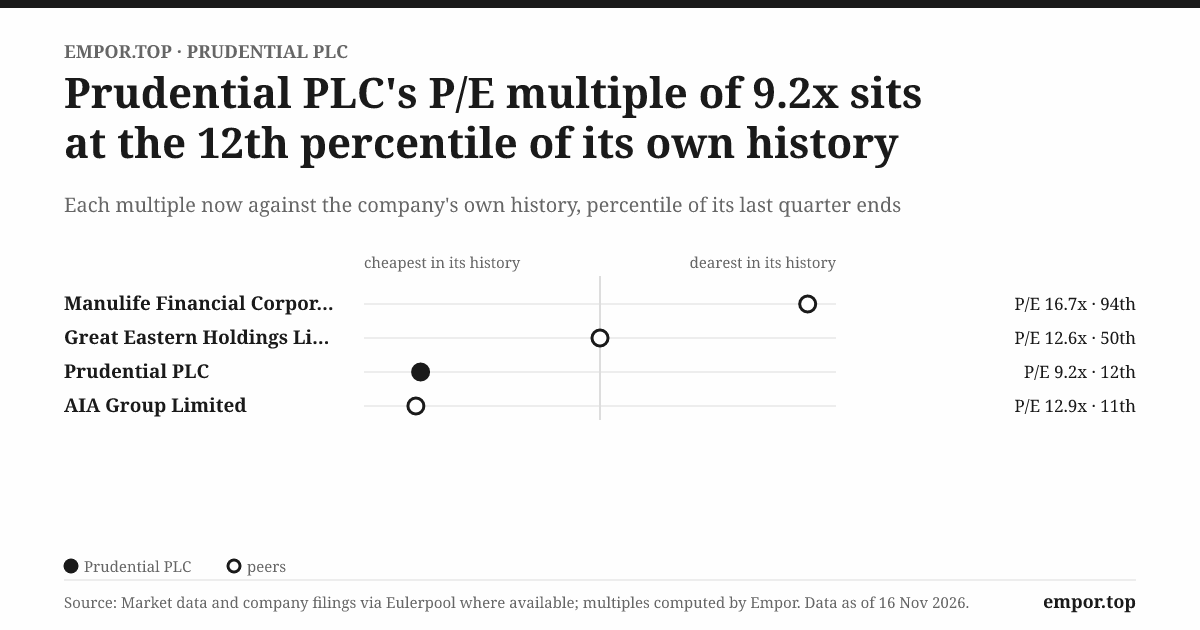
The company on the receiving end of that order needs a precise introduction, because its name causes confusion every week. This is Prudential Financial, Inc., listed on the New York Stock Exchange under the ticker PRU and headquartered in Newark, New Jersey.3 It is not Prudential plc, the London- and Hong Kong-listed Asian insurer that shares a name, a little distant history and none of its current ownership. When a screen shows a "Prudential" share price around thirteen dollars, it is showing the British company. The American one is a different business with a different balance sheet, and this is its story.
That story has an unusual shape for a company of its age and size. In 2025 Prudential Financial reported about $60.8 billion of revenue and about $3.6 billion of net income attributable to shareholders.3 By the end of September 2026 it counted about $1.6 trillion of assets under management, most of it run by its asset-management arm, PGIM.4 Those are the numbers of an institution, and for most of its 151 years Prudential has behaved like one. Yet in 2026 its most profitable overseas franchise is explaining to a regulator why more than a hundred of its salespeople had taken money from the customers they were supposed to protect.5
The cost was already visible. Prudential estimated that the sales suspension had reduced the pre-tax adjusted operating income of its Japan businesses by about $375 million in the first nine months of 2026.4 In the third quarter alone, management put the cost at roughly $140 million, and Japan's adjusted operating income fell by about a quarter from a year earlier.6 Companywide assets under management, meanwhile, were little changed from a year before.6 The rest of the machine kept running, which is precisely why the Japan problem is so revealing. A big insurer can absorb a quarter of lost sales. What it cannot easily absorb is a finding that the way it sells is broken.
To understand why, it helps to start with the bargain at the centre of every life insurer. A customer hands over money today. In return, the company promises protection if something goes wrong, or an income stream decades from now. The insurer must price that promise correctly, invest the money so it is still there when the bill comes due, and serve the customer honestly for the whole life of the contract. A bank can recall a loan. A factory can stop making a product. An insurer that sold a policy in 1995 may still be paying on it in 2045. Its product is not really the policy. Its product is confidence that the promise will be kept.
That frame turns Prudential's situation into three questions, and they carry the rest of this story. The first is whether Prudential can restore trust in Japan, the country that produces its largest pool of segment earnings, after misconduct that ran across years of sales. The second is whether it can turn its enormous scale in insurance, retirement and asset management into earnings that grow steadily, rather than earnings that jump around with pension deals and market marks. The third is whether management has learned to allocate capital more carefully after a digital acquisition that went to zero.
None of those questions is answered by size. Scale is the first thing anyone notices about Prudential, and it is the thing most easily mistaken for an advantage. Trillions of dollars of client assets do not prove that clients prefer Prudential, and tens of billions of revenue do not prove that the revenue is profitable. The investigation begins where the company did, with a man selling three-cent policies in a Newark basement, because the promise he sold is the same one now under examination in Tokyo.
 Subscribe on LinkedIn
II. The Burial Policy That Became a Balance Sheet
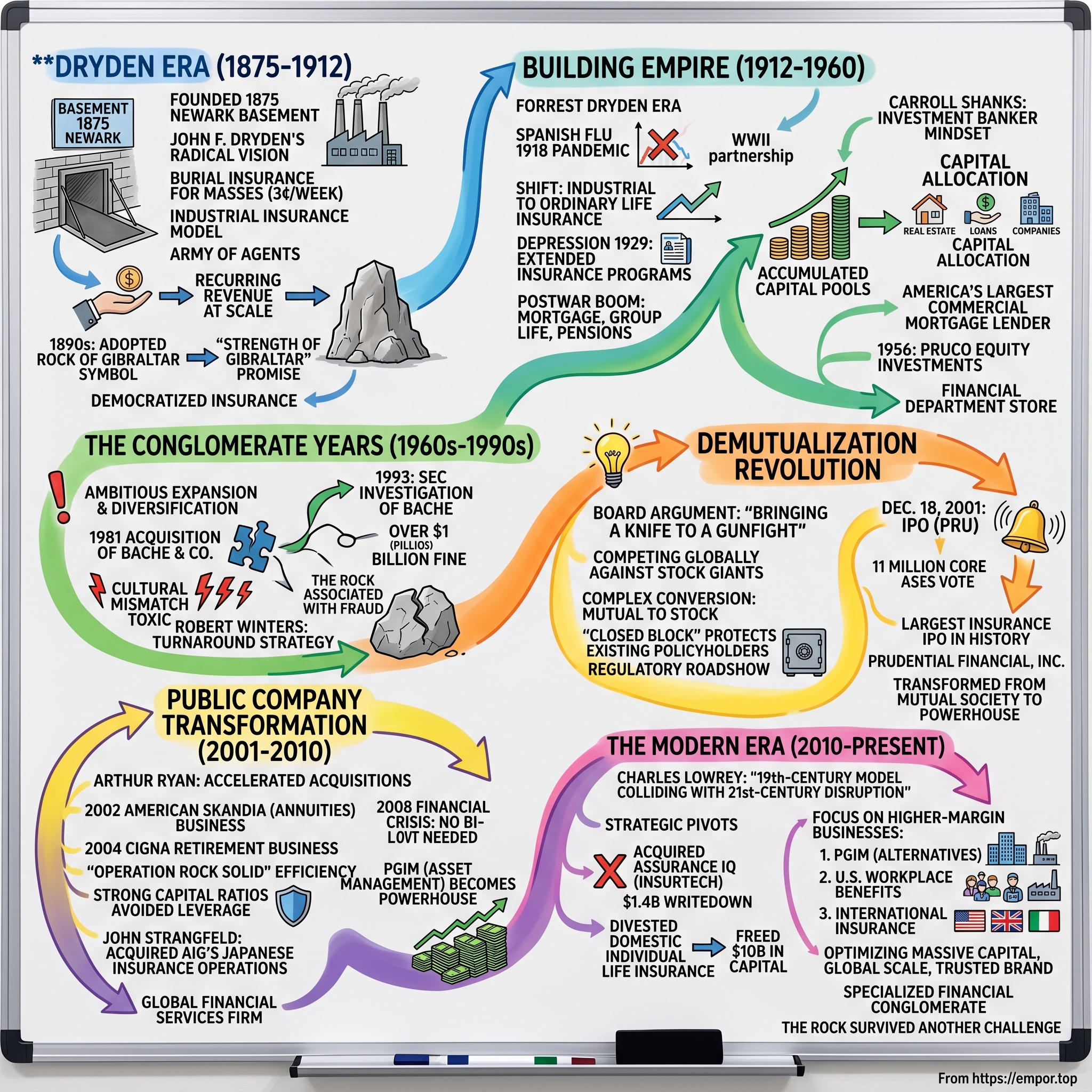
In the 1870s, a working family in an American industrial city faced a fear that sounds strange today but was very concrete then: the fear of a pauper's grave. A father died, the wages stopped, and there was no money to bury him. John Fairfield Dryden, an insurance agent with more ambition than capital, believed that families like these would pay a few pennies a week to make sure that never happened. In 1875 he opened the Prudential Friendly Society, which grew out of his Widows and Orphans Friendly Society, in a basement office in downtown Newark.78 Within two years it was renamed The Prudential Insurance Company of America.7
The product was burial insurance, and the price was the whole idea. The company's own later history took its title from it: early policyholders paid about three cents a week.7 That was "industrial" life insurance, sold door to door by agents who collected premiums in person every week. It was expensive to administer, because a salesman had to climb the same stairs every Saturday for a few coins. But it reached customers that the gentlemen's insurance companies of the day ignored. Prudential was among the first American companies to bring life insurance to the working class.7
The insight that made Dryden's company enduring was not the burial policy. It was access. If an insurer could build a distribution system that reached ordinary families, gather their small payments, and keep its promises reliably, it could become enormous. Dryden ran the company for about three decades, and it became one of the largest life insurers in the country.7 Along the way it acquired a symbol: the Rock of Gibraltar, chosen to suggest the strength and permanence a family needed to believe in before handing over money it could not easily spare.7 For a business built on promises that outlive the people who make them, the rock was more than a logo. It was the sales pitch.
The rest of the long history can move briskly. Prudential grew from industrial policies into ordinary life insurance for the middle class, then into group insurance sold through employers, annuities for retirement, and investment management. Through all of it, the company remained a mutual: legally owned by its policyholders rather than by shareholders. That mattered. A mutual's job is to serve its policyholders, and its surplus belongs, in effect, to them. It cannot easily raise equity, and it is not judged quarter by quarter on return on capital.
That changed in 2001. Prudential's policyholders voted on a plan to convert the mutual into a stock company, and about 91% of the roughly 4.1 million votes cast approved it.9 New Jersey's insurance commissioner signed off in October 2001, and in December the new holding company, Prudential Financial, sold shares to the public at $27.50 each.9 Eligible policyholders received about 457 million shares plus roughly $3.5 billion in cash and about $1 billion in policy credits in exchange for giving up their ownership.9 At the time the plan was approved, Prudential had roughly $606 billion of assets under management and administration, an indication of how large the mutual had become while nobody could buy a piece of it.9
The conversion did something subtle and important. The old participating policies, contracts that entitled their owners to share in the company's profits, were walled off in a "closed block," with assets set aside to pay them. The remaining financial-services businesses were free to answer to a new kind of owner.9 Before 2001, the question "who is Prudential for?" had a simple answer. After 2001 it had two, and they are not always aligned.
The fingerprints of that conversion are still visible a quarter of a century later. Because the shares were handed to millions of policyholders rather than sold only to institutions, Prudential still had about 981,000 registered holders of record at the end of January 2026, an enormous number for a single company and a figure that does not even count investors who hold through brokers.3 Many of those accounts began as a household's life policy and turned into stock by vote. The policyholder-owners became shareholder-owners, and their descendants now receive proxy statements instead of dividend notices on a participating policy.
That tension is the lasting legacy of demutualization, and it runs through every later chapter. Policyholder promises need capital, and they need assets matched carefully against liabilities so that a 40-year promise is not funded with money that might vanish in a market panic. Shareholders, meanwhile, expect that capital to earn a competitive return. Hold too much, and the return looks poor. Hold too little, or invest it too aggressively, and the rock cracks. Every acquisition, buyback and reinsurance deal Prudential has made since then is a choice about where that line sits.
Public ownership also brought something a mutual rarely has: currency. Prudential could now issue shares, raise debt more freely, and buy companies. That flexibility could produce focused growth, or it could produce an empire assembled because it was possible. Within two years of its listing, Prudential made its first big move, and it showed which instinct was winning at the start.
III. The $1.2 Billion Bet on American Skandia
In the early 2000s, the battle for American retirement savings was not fought in insurance company offices. It was fought in the offices of independent financial planners, the advisers in strip malls and suburban office parks who chose which annuity or fund their clients would buy. Those planners were not on Prudential's payroll. They owed loyalty to their clients and to whichever product they thought served them best. An insurer that wanted to sell variable annuities to the growing wave of near-retirees had to win them one at a time, or buy a company that already had.
American Skandia was that company. It was one of the leading sellers of variable annuities through independent planners, the kind of distribution machine Prudential's own captive agents could not replicate quickly. In 2003 Prudential closed its purchase of American Skandia for about $1.2 billion.10 The business brought roughly $21.5 billion of variable-annuity assets under management, and Prudential told investors it expected the deal to earn a return on equity in the mid-teens and add 10 to 15 cents to its 2003 earnings per share.10
The logic was coherent because it was adjacent. A variable annuity is a retirement product in which a customer invests money in funds inside an insurance wrapper, often with guarantees that the payout will not fall below a certain level. Prudential already made such products. What it lacked was enough shelf space with independent advisers. American Skandia did not ask Prudential to learn a new business. It asked Prudential to sell more of what it already knew how to manufacture through a channel it could not easily build from scratch.
The returns forecast is the right test of the deal, more than its size. Management promised a mid-teens return. The acquired annuity business became part of Prudential's core retirement franchise for years, and the American Skandia name eventually disappeared into Prudential Annuities. But the variable-annuity business also carried the guaranteed benefits that later made it one of the most market-sensitive parts of the balance sheet. Those guarantees, which promise customers a minimum outcome regardless of how markets behave, are why Prudential's auditor identifies the valuation of guaranteed annuity and life benefits as a critical audit matter today: the numbers depend on models and assumptions about markets and policyholder behaviour decades into the future.3 So American Skandia was a fit in the sense that mattered for distribution, and a long-dated source of risk in the sense that mattered for capital. The record supports calling it a strategically sound purchase. It does not support calling it a bargain, because the filings never present a comparable deal multiple that would settle whether Prudential paid too much or too little.
The second big deal of the public era was larger and further from home. On September 30, 2010, Prudential agreed to buy AIG Star Life and AIG Edison Life in Japan from American International Group for $4.8 billion, about $4.2 billion in cash plus about $0.6 billion of assumed debt.11 AIG, rescued by the U.S. government in 2008, was selling assets to repay taxpayers. Prudential was the buyer with capital and a Japanese franchise already in place. It planned to fund roughly $2.2 billion from its own cash and short-term investments and the rest with about $1 billion of new equity and about $1 billion of new debt.12 The deal closed in early 2011, and the acquired companies were folded into Gibraltar Life.13
Seen from 2011, it was a confident move. Prudential had built a Japanese business over decades through Prudential of Japan's Life Planners, highly paid, carefully selected salespeople who sold protection to affluent households, and through Gibraltar Life, which itself was a rescue acquisition from the early 2000s. Star and Edison added scale, more agents and more bank-channel distribution. Japan was an ageing, wealthy country where households held huge savings and valued life insurance. The acquisition bought an established franchise at a moment when its seller had to sell.
Set the two deals beside each other and the contrast is instructive. American Skandia extended an existing American retirement channel. Star and Edison deepened Prudential's exposure to a single foreign country, financed partly by issuing new shares to existing owners. Both bought distribution, the ability to put a product in front of a customer. Neither bought proof that the distribution would behave well forever. Prudential disclosed the purchase prices and management's expected returns, but comparable industry deal multiples do not establish whether either acquisition was cheap or expensive, and the honest verdict is to judge them by fit and financing rather than by labels.
On fit, both look defensible. On risk, the Japan deal proved the more consequential. When Japan's regulator suspended sales in 2026, it was suspending the very channels that Prudential had spent decades and billions assembling, and one of them, Gibraltar's Life Consultants, traces part of its scale to that 2011 purchase.1 Acquired scale, it turns out, does not come with a warranty on the controls.
That lesson took fifteen years to arrive. In the meantime, Prudential faced a more immediate question about its distribution strategy: if American Skandia showed how to buy an existing channel, could Prudential build an entirely new, digital one? Before that bet makes sense, though, it is worth understanding what the whole machine actually sells.
IV. A Retirement Giant With Three Different Engines
Picture a large American manufacturer with a defined-benefit pension plan. It has thousands of retirees who expect a check every month for the rest of their lives. The company never wanted to be in the business of predicting how long those retirees will live, how interest rates will move, or how its pension assets will perform. So it runs a competitive process, invites insurers to bid, and pays one of them a large premium to take the obligations off its hands. From that day, the retirees' checks come from the insurer. That transaction is called pension risk transfer, or PRT, and it is a good place to begin following the money through Prudential, because it shows how misleading the top line of an insurer can be.
When Prudential wins a PRT deal, the premium it receives appears as revenue. A single large deal can add billions of dollars to reported revenue in a quarter. But that premium is not profit. It comes with a matching obligation: the insurer books a policy liability equal to the present value of all the checks it must now pay. Profit, if any, arrives slowly over decades, as the difference between what the insurer earns investing the premium and what it pays out, minus expenses and the cost of capital. Revenue at an insurer is less like a store's sales and more like deposits into a very long account.
That is why Prudential's recent revenue line tells a misleading growth story. Revenue was about $70.4 billion in 2024, then about $60.8 billion in 2025.3 A reader comparing those numbers might conclude the business shrank by more than a tenth. It did not. The 2024 figure was swollen by unusually large PRT transactions, whose premiums came with corresponding policy-benefit costs, and those deals were smaller in 2025.3 A decade earlier, in 2015, revenue was about $57.1 billion.14 Over ten years, then, the top line barely moved in nominal terms. The real question is what happened underneath it.
Following the money through three engines
Prudential earns money in three broad ways. The first is premiums and policy charges: customers pay for protection, and the company charges fees on policies and annuities. The second is investment spread: Prudential invests the money backing its insurance promises, mostly in bonds and commercial mortgages, and keeps the difference between what those assets earn and what it has promised policyholders. The third is asset-management fees, earned by PGIM for running money for pension funds, sovereign funds, insurers and retail investors. In 2025 PGIM reported about $3.44 billion of asset-based management fees and a further $94 million of performance fees.3 Prudential does not disclose contract lengths, minimum commitments or a consolidated "recurring revenue" share, so investors have to infer durability from the products themselves.3
The cleaner way to see what earns its keep is adjusted operating income, Prudential's measure that strips out investment gains and losses and other market-driven items. In 2025, total segment adjusted operating income was about $6.6 billion, up from about $5.9 billion in 2024.3 The split is the revealing part. International Businesses, led by Japan, produced about $3.2 billion. The U.S. Businesses, covering retirement strategies, group insurance and individual life, produced about $2.5 billion. PGIM produced $878 million.3
That arithmetic overturns a common perception. Prudential is often described as a retirement and asset-management company, and its marketing leans hard on PGIM's roughly $1.6 trillion of assets. But by current earnings, the engine is insurance and retirement, and nearly half of segment profit comes from international operations dominated by Japan. PGIM is strategically useful: it manages Prudential's own general account, gives the company institutional investing capabilities, and earns fees that do not require the same capital as insurance. Yet its earnings are about a seventh of the segment total. Before the suspension, the Japanese sales forces that the regulator just halted were feeding the largest single profit pool in the company.
The balance sheet is the business
At an industrial company, the balance sheet is something that supports the business. At an insurer, the balance sheet is the business. At the end of September 2026, Prudential held about $471 billion of investments and about $19 billion of cash and equivalents.4 Most of that money is not Prudential's to spend. It is held against promises: annuity payments, death benefits, pension checks. The portfolio is made up mostly of fixed-maturity securities, government bonds and commercial mortgage loans; in Japan, about 89% of the insurance operations' country exposure at the end of 2025, measured at amortized cost, was Japanese government bonds.3
So the questions an investor asks are different. Not "how fast do receivables turn?" but "is the asset quality good enough that credit losses will not eat the spread?" Not "how much working capital does growth absorb?" but "are the durations of assets and liabilities matched, so that a move in interest rates does not open a hole?" And increasingly, "if part of the risk has been handed to a reinsurer, can that reinsurer pay?" Those are the variables that determine whether the rock holds.
Japan adds a currency layer to all of this. Prudential's Japanese companies sell yen policies backed by yen assets, but they also sell policies denominated in U.S. dollars and other currencies, backed by investments in the same currency, which appeal to Japanese savers looking for higher yields than their home bond market offers.3 Meanwhile, the parent reports in dollars, so the value of yen earnings and yen equity moves with the exchange rate. Prudential hedges part of that exposure; at the end of 2025 its disclosed yen-hedging instruments totalled about $7.8 billion, most of it in dollar-denominated assets.3 The foreign-exchange line within realized investment results swung from losses of about $123 million in 2023 and $76 million in 2024 to a small gain in 2025, and those amounts are excluded from adjusted operating income.3 Hedging narrows the swings; it does not abolish them. An investor in Prudential is, whether intending to or not, partly betting on the yen.
Cash flow at an insurer needs the same translation. In 2025 Prudential reported about $3.7 billion of net income, including noncontrolling interests, and about $6.3 billion of operating cash flow.15 A naive reader would call that superb cash conversion. But the bridge between the two numbers is full of insurance mechanics. It adds back about $4.1 billion of realized investment losses, which reduced accounting profit without consuming cash. It includes a $3.5 billion increase in future policy benefits and other insurance liabilities, money collected now that will be owed later. It subtracts about $1.2 billion for deferred acquisition costs, the commissions paid to sell policies that accountants spread over time. It includes a $2.3 billion swing in reinsurance balances and a $4.5 billion negative "other" adjustment.15 The lesson is simple. Operating cash flow at an insurer measures money moving through the system, not money available to send to shareholders. What a holding company can actually distribute depends on what regulated subsidiaries are allowed to pay up, and that is set by capital rules, not by the cash-flow statement.
The same caution applies to profit. In 2025, "other income" was about $4.4 billion, roughly 95% of consolidated pre-tax income, and that line included market-value changes such as about $750 million of unrealized gains on equity securities still held at year-end.3 Reported profit at Prudential can move by billions with markets, independent of whether the underlying business improved.
The arenas and the moat question
Prudential competes in several distinct arenas, and each has different rules. In individual protection and group benefits, it faces MetLife, AIG's successor life business Corebridge, and large mutual insurers that do not have to satisfy outside shareholders. In pension risk transfer, it bids against Athene and other insurers, many backed by private-capital firms with aggressive appetites for long-dated liabilities. In asset management, PGIM competes with far larger firms such as BlackRock, Fidelity and Capital Group for the same pension mandates and retail flows.
Each of those markets has a structure that limits any one company's power. Retail customers can compare policies and advisers. Pension sponsors run formal bidding processes with consultants who push prices down. Asset owners can and do move mandates when performance lags. Japanese households can buy from domestic giants as well as from Prudential's units. Prudential's 2025 filing does not disclose top-customer revenue shares, comparative retention rates or pricing power, and it does not claim a clear cost advantage over peers.3
What Prudential does have is real but ordinary for a top-tier insurer: a recognized brand, a broad product shelf, decades-long policy relationships, institutional investment capabilities, and the capital to write very large contracts. Those are qualifications to compete, not barriers that keep competitors out. The most distinctive asset, a trusted, highly trained sales force in Japan, is exactly the one under regulatory suspension. The claim that $1.6 trillion of AUM is itself a moat should be retired. AUM rises with markets and falls with outflows; it says how much money Prudential manages, not whether clients would refuse to move it.
So the honest verdict on the machine is this. Insurance and retirement drive most of the earnings, PGIM is a smaller and useful fee engine, and the whole thing is so intertwined with markets and long-dated liabilities that headline revenue and cash flow mean little without segment detail. Prudential's edge depends on service, product design, investment results and trusted distribution, none of them exclusive. That last ingredient, distribution, is where management tried in 2019 to buy a shortcut into the future.
V. Assurance IQ Turns a Digital Shortcut Into a Capital-Allocation Test
In September 2019, the founders of a young company in Bellevue, Washington, sold their business to one of the oldest insurers in America. Assurance IQ, led by chief executive Michael Rowell, used data and software to match consumers with life, health, auto and Medicare insurance, connecting them by phone and online with agents who could close the sale.16 Prudential agreed to pay $2.35 billion upfront, plus up to $1.15 billion more in cash and stock if Assurance hit multi-year growth targets.16 Assurance would become a wholly owned subsidiary inside the U.S. Businesses division, and its founders would keep running it.16
The strategic promise was easy to understand. Prudential's traditional distribution ran through agents, advisers, employers and pension consultants. Younger and middle-income customers increasingly shopped online, and the cost of reaching them face to face was high. Assurance offered a machine for generating and converting leads at scale. In principle, Prudential could plug its own products into that machine, gain access to millions of customers who would never have met a Prudential agent, and do it at lower cost. It was American Skandia's logic transplanted into the internet era: buy a channel, then pour product through it.
The difference was that American Skandia's channel already existed and was already profitable at selling the kind of product Prudential made. Assurance's model was newer and more fragile. Its revenue depended on how much it cost to acquire a customer, how many leads turned into sales, how long those policies stayed on the books, and how much commission each sale earned. Those numbers can look excellent in a fast-growing start-up and then deteriorate quickly when advertising costs rise, conversion falls or customers lapse early. Owning the sales channel meant owning all of those risks.
The deterioration showed up in the cleanest place an investor can look: goodwill. When a company pays more for an acquisition than the book value of its assets, the excess is recorded as goodwill, an accounting claim that the business is worth more than its parts. When expectations fall, goodwill must be written down. Prudential impaired Assurance IQ's goodwill by about $1.06 billion in 2021, with the charge falling to about $177 million by 2023, and by the end of 2023 none was left.17 Along the way, the business lost money for twelve straight quarters after the acquisition, about $381 million in total, before a brief profitable quarter at the end of 2022.18 In early 2023 it cut about a fifth of its workforce and was moved into Corporate and Other, where Prudential stopped reporting its results separately, saying they were no longer significant.1817 In May 2024, Prudential stopped selling new policies through Assurance and began winding the business down over the following months.18
The total goodwill write-down came to roughly $2.1 billion against a $2.35 billion upfront price. That is a failed deployment of capital by any reasonable definition. It is fair to add one caveat: the filings do not provide a like-for-like deal multiple showing that the business was overpriced on the day it was bought, and the earnout structure meant Prudential paid more only if growth materialised. But the outcome is what matters to owners. Billions of dollars meant for a growth engine produced a wind-down.
The obvious lesson, that digital distribution cannot work for insurers, is the wrong one. Online channels sell plenty of insurance. The sharper lesson is about economics. Assurance's value depended on customer-acquisition costs, conversion rates, product suitability and persistency, and Prudential owned the channel rather than renting it, so every deterioration fell directly on its income statement and balance sheet. American Skandia had extended an established annuity business with known economics. Assurance asked Prudential to bet that a young model's economics would survive commercialization at scale. They did not.
What did management say about it? Over the impairment years, the explanations followed a familiar arc: the opportunity was large, conditions had changed, the business was being repositioned, and finally the business was not material and would be wound down. Prudential paired the write-downs with a broader simplification push, recording $200 million of simplification charges in 2023 and $135 million in 2025.3 Those charges are restructuring costs, not evidence of a better acquisition process. The record shows that Prudential recognised the loss and stopped the bleeding. It does not show a detailed public post-mortem explaining what the company learned about evaluating distribution acquisitions, and that gap matters, because the next capital-allocation decisions belong to a new chief executive and are being made during a crisis in a different distribution channel.
Assurance IQ was a failure of a channel Prudential bought. The crisis that arrived in 2026 was worse in one respect: it was a failure inside a channel Prudential had spent decades building and celebrating.
VI. The CEO Inherits a Japan Crisis
The channel that was supposed to be the model
For years, Prudential of Japan's Life Planners were held up as the gold standard of insurance distribution. They were recruited from other professions, trained intensively, and paid largely on performance to sell needs-based protection to affluent families and business owners. In a market where many insurers relied on armies of part-time saleswomen or bank counters, the Life Planner model looked like proof that advice could be a premium product. That is what made the January 2026 disclosure so damaging.
That month, Prudential disclosed that current and former Prudential of Japan employees had engaged in monetary misconduct with customers, activity outside the insurance products themselves: soliciting customers for outside investments, borrowing money from them, and similar schemes.19 By early February, the reported scope involved more than 100 current and former employees and roughly 500 customers, and on February 9, Prudential of Japan began a voluntary 90-day pause on new sales.20 A third-party panel, led by a former senior prosecutor, was appointed to investigate.21 The pause was later extended, and Prudential estimated the hit to 2026 at $525 million to $575 million, with a further $400 million to $450 million in 2027, before the regulator's October order changed the outlook again.224
The panel's report, released on October 8, 2026, rejected the comforting explanation. It attributed the fraud to a corporate culture that placed excessive emphasis on sales performance, and it noted that managers found it hard to oversee high-performing salespeople.23 Reporting on the findings tied the misconduct partly to a pay system weighted heavily toward new contracts.24 The next day the FSA issued its orders, finding that the insurer had failed to adequately manage and supervise its sales employees and that its internal systems for preventing misconduct were ineffective.2 The regulator stopped short of more severe penalties such as revoking a licence, but it put both Prudential of Japan and Gibraltar Life's Life Consultant channel under suspension until the end of January 2027.21
That combination of facts matters more than any single number. The misconduct involved many people over many years. It was enabled by the incentive structure that made the channel famous. And the controls did not catch it. "A few rogue employees" is not an adequate explanation when the investigator, the regulator and the company's own remediation all point to the system.
The financial mechanism
The cost of a sales suspension arrives through two doors. The first is lost new business: no new policies means no new premiums, no new future profits and, because many costs are fixed, a heavier expense burden on the existing book. The second is remediation: reimbursing customers, paying investigators, disciplining staff and rebuilding controls. In the third quarter of 2026, Japan's adjusted operating income fell about 25% from a year earlier to $559 million, and management put the quarter's suspension cost at roughly $140 million, including compensation-related and regulatory expenses.6 The company's after-tax adjusted operating income for the whole group fell to about $1.32 billion from about $1.44 billion a year earlier.6
The repair work has several strands. Prudential of Japan has been reimbursing affected customers, and the company put the expected compensation at about ¥4.7 billion.25 It disciplined, including by dismissal, 157 current and former sales employees involved in misconduct.24 Its president and two other executives agreed to return 30% of their monthly pay for three months.24 Most significantly, it said it would introduce guaranteed minimum pay for sales staff from 2027, a change aimed directly at the compensation design the investigators criticised.24 Improvement plans were due to the regulator by the end of November.1
The pause itself did not stay quiet. During the voluntary suspension, Prudential flagged a further fraud case at its Japanese operations, and Japanese press reports separately alleged that some Gibraltar Life staff had taken agency data without approval.2627 Each new disclosure lengthened the list of problems the improvement plans have to address, and the volume of fresh complaints that arrived once the company publicised the misconduct showed how much had gone unreported while the channel was running normally.28 That pattern is familiar from conduct scandals elsewhere in financial services: once customers are told it is safe to come forward, the scale of the original problem tends to grow before it shrinks.
Whether those changes are enough is the central open question. Guaranteed minimum pay reduces the pressure to close at any cost, but it also changes the economics of a sales force whose appeal to recruits was uncapped performance pay. If the best Life Planners leave, production may recover slowly even after the ban lifts. If they stay and behave differently, Prudential will have shown that the model can be reformed. Neither outcome is visible yet.
The credit view and the reinsurers
AM Best's response offers an outside verdict. In 2026 the rating agency affirmed the A+ financial-strength ratings of Prudential's life and health subsidiaries and the "a-" issuer rating of the holding company, all with stable outlooks, citing very strong balance-sheet strength and a very favourable business profile.29 But it lowered its assessment of Prudential's enterprise risk management from "very strong" to "appropriate," explaining that the Japan misconduct showed weaknesses in early detection and in limiting recurrence.29 That is a precise judgment: the balance sheet can absorb the loss, but the risk-management system that was supposed to prevent it did not work as advertised.
Risk management at Prudential extends well beyond sales conduct, and reinsurance is the part most investors overlook. Reinsurance is insurance for insurers: Prudential pays another company to take on part of a block of liabilities, which reduces its exposure and can free up capital that would otherwise sit idle. The catch is that the risk does not vanish. If the reinsurer cannot pay, the obligation comes back. At the end of September 2026, Prudential's reinsurance recoverables and deposit receivables totalled about $45.5 billion, against a credit-loss allowance of only $14 million.4 Named balances included about $8.3 billion with Wilton Re and about $2.6 billion of deposit receivables with Somerset Re, and after those specifically identified counterparties, four major reinsurers accounted for about 61% of the rest.4
The largest relationship is closer to home. Prismic, a Bermuda-based reinsurer in which Prudential holds about 20%, was set up with outside capital partners to take on Prudential-originated liabilities. At the end of September 2026, related-party balances with Prismic entities included about $15.8 billion of reinsurance recoverables and deposit receivables and about $7.3 billion of payables.4 Prudential also guaranteed up to $1.9 billion of Prismic's letters of credit, provided an $80 million contingent debt facility and had an unfunded $300 million capital commitment, and PGIM manages assets for Prismic entities.4 Prudential does not quantify related-party revenue or expenses as a share of its totals.4
None of that is evidence of a problem. Arrangements like Prismic are a common way for life insurers to bring in outside capital and release their own. But they turn a balance-sheet question into a counterparty question. The collateral posted, the funds withheld and the guarantees given determine how much risk truly left Prudential. Investors should treat the Prismic relationship as a material capital connection to watch, especially at a moment when the rating agency has just marked down the company's risk-management assessment.
The man in the chair
The executive who must answer all this is Andrew Sullivan, who became chief executive on March 31, 2025, succeeding Charles Lowrey.30 Sullivan is an unusual insurance CEO in one respect: he is a mechanical engineer by training, a graduate of the U.S. Naval Academy, and he came to Prudential from the health-insurance world, having held senior roles at Cigna and CareFirst BlueCross BlueShield.30 He joined Prudential in 2011 to run group insurance underwriting, claims and service, later led Workplace Solutions and the U.S. Businesses, and before becoming CEO ran International Businesses and PGIM, which means he oversaw the Japan operations in the period before the misconduct came to light.30 Lowrey stayed on as executive chairman until March 2026, after which Sullivan became chairman as well.3132
Sullivan's pay for 2025, a partial year as CEO, was about $11.4 million, against Lowrey's roughly $18.6 million for 2025.31 His proxy-reported beneficial ownership was 279,382 shares, and 75% of named executives' 2026 long-term incentive awards were performance shares, tying a large share of future pay to measured results.31 At the May 2026 annual meeting, shareholders supported executive pay with 91.3% of votes cast. They also voted on a proposal to separate the chairman and CEO roles. It failed, but by a margin that deserves attention: about 62.8 million shares for and about 143.0 million against, which means close to three in ten voting shares wanted an independent chair at the moment the chief executive also held the board's top seat.32 Prudential's largest disclosed holders, Vanguard and BlackRock, are passive giants with roughly 11.7% and 9.0%, and there is no controlling shareholder to force change.3133
So how credible is Sullivan? He inherited a strategy with legacy costs, a large Japan franchise and the Assurance IQ write-offs. On the Japan question, the evidence so far shows a management that moved from disclosure to voluntary pause to outside investigation to compensation reform within a year, and that published cost estimates rather than hiding behind "not material." That counts in its favour. Against it: the misconduct ran for years under a structure that Sullivan's own international division oversaw, the initial estimates had to be revised as the ban lengthened, and the second-quarter strategy call came with withdrawn earnings-growth guidance amid the uncertainty.34
The live calls show where analysts are pushing. On the second-quarter call in August 2026, management paired the Japan update with a refreshed strategy that narrowed the company's geographic footprint toward large developed markets and capital-light businesses.3435 On the third-quarter call in November, Sullivan described the Japan suspension as a continuing headwind while calling the broader franchise resilient, and pointed to U.S. retail annuity sales at their highest quarterly level since 2013.6 The questions that matter are the ones analysts kept returning to: when Japanese production recovers, how much of the old Life Planner productivity survives the new pay structure, and whether the strategic pivot is a plan or a reaction. Management's prepared remarks emphasise resilience; the Q&A keeps returning to how much earnings power has been permanently lost. The honest verdict is that the remediation has begun in earnest, but the decisive test, whether sales behaviour actually changes and production comes back after the restrictions lift, has not yet been taken.
And that test sits inside a larger one: whether Sullivan's strategy can make Prudential's earnings grow without leaning on the parts of the business that just failed.
VII. The Strategy Has to Earn Its Retirement Story
In August 2026, while Prudential of Japan's sales offices sat idle, management stood in front of investors and fleshed out its next steps, focusing on large developed markets, retirement, asset management and selected protection businesses, and stepping back from emerging markets.35 The idea was to tilt the portfolio toward businesses that need less regulatory capital and produce steadier fees. It is a reasonable strategy. It is also a familiar one, because almost every large life insurer has spent the past decade telling investors it would become more capital-light and more fee-driven. The question is not whether the destination makes sense. It is whether Prudential's results show it moving there.
Start with what the current portfolio looks like. It combines U.S. retirement and insurance businesses, Japan-led international operations, and PGIM's management of the general account and third-party money. In 2025, adjusted operating income rose, which looks like healthy growth.3 Some of it was real operating progress. Some came from items that do not repeat; the 2025 results included a contribution from the sale of Prudential's Taiwan asset-management business, for instance.3
Where growth is actually appearing
To find durable growth, an investor has to separate four things. Insurance production and spread income are the slow, compounding core: if Prudential writes more profitable business and invests the proceeds well, earnings rise steadily. Pension-risk-transfer premiums are lumpy: a big year inflates revenue, and the profit trickles in for decades. Asset-management earnings depend on flows and markets: a rally lifts fees without any client choosing Prudential. And one-off investment gains are exactly that.
On the evidence available, the core is growing, but modestly. U.S. retail annuity sales in the third quarter of 2026 were at a record level for recent years, a sign of genuine demand as baby boomers retire and interest rates make guaranteed income attractive.6 Retirement adjusted operating income, though, slipped about 3% in the third quarter, and the legacy U.S. products segment fell further.6 Strong sales and soft earnings in the same quarter are not a contradiction; new annuity business takes years to produce profit. But they are a reminder that a sales record is not an earnings record.
PGIM is the business on which the capital-light story most depends, and it deserves a clear-eyed look. Its adjusted operating income rose to $263 million in the third quarter of 2026 from $244 million a year earlier.6 For the whole of 2025, it earned slightly more than in 2024.3 Management reorganized it into a unified platform and talks about private credit as a growth opportunity. Yet total assets under management were little changed from a year earlier.6 A trillion-and-a-half-dollar manager earning under $1 billion a year is a business with thin fee rates, partly because much of its money is Prudential's own fixed-income general account. The KPIs that will tell investors whether PGIM is genuinely growing are third-party net flows, fee rates and earnings, not the headline asset total. A rising market can make AUM look like momentum when it is only valuation.
Capital returns are the third test. Prudential used its full $1 billion repurchase authorization in 2025, and in December 2025 the board authorized up to another $1 billion for 2026.3 Steady buybacks during a crisis signal confidence in capital, and the company reported compliance with its debt covenants and no draws on its committed credit facilities at the end of September 2026.4 But buybacks are a use of capital, not a strategy. After Assurance IQ, the question investors should ask about every dollar is simple: what return does it earn compared with the alternative?
The long view on acquired scale
The 2011 Japan acquisition offers a long-horizon check on the "scale wins" thesis. Prudential bought Star and Edison to enlarge an important franchise, and for more than a decade Japan delivered: it became the largest contributor to segment earnings. Then the 2026 crisis showed that acquired and organically built scale alike depend on controls that the company had not proved. The thesis that buying more distribution in a trusted market creates durable earnings survives, but in narrower form. It holds only when the controls scale with the sales force. Prudential's own record now contains a fifteen-year example of the claim working and a single year of evidence that it can fail badly.
How much is Prudential reinvesting in the machine it is reshaping? The company does not answer that question in a way investors can use. It does not separately disclose research and development or capital expenditure in its annual or quarterly filings, so the share of revenue going into new systems cannot be tracked.3 It employed 36,824 people at the end of 2025, but it does not publish a comparable headcount series that would show whether the simplification programmes have shrunk the organisation.3 Management speaks of investing in technology and data platforms, and the restructuring charges are real, but without disclosure the evidence supports "ongoing change" rather than any confident claim that the business is either being invested in or harvested.
Technology and artificial intelligence belong in this story only in proportion. Insurers can use digitisation to lower servicing costs, speed underwriting and detect fraud faster. Detecting misconduct earlier is exactly what AM Best said was missing. But Prudential's filings do not describe a material AI business, and its last big technology-enabled bet was Assurance IQ. The tests are customer outcomes and operating efficiency, measured in expense ratios and complaint rates, not announcements.
Three numbers that tell the story
If an investor wanted to track Prudential with only a few gauges, three would carry most of the signal. The first is Japan's new-business production after sales resume, because it measures whether the trust repair is working; current production is constrained by the suspension.6 The second is segment adjusted operating income, read without PRT spikes and market marks, which rose in 2025 but slipped in the third quarter of 2026.36 The third is PGIM's third-party net flows and fee-related earnings, which determine whether the fee engine is really compounding; its quarterly earnings were rising modestly at the latest reading.6
Management's 2026 strategy deserves credit where it is concrete: a narrower footprint is measurable, buybacks were delivered as promised, and the company published cost estimates for Japan. It deserves scepticism where it relies on the idea that the Japan interruption is temporary. That may prove true. But the claim that Japan's earnings power will return to its old level is a forecast that the evidence does not yet support, and the withdrawal of earnings-growth guidance in August suggests management knows it.34 Retirement demand gives Prudential a large, credible market. Durable growth requires segment earnings, fee flows, sales quality and capital returns to hold up together, and in 2026 only some of them did.
That leaves the investor's final question: whether all of this is worth owning at all.
VIII. What the Rock Can and Cannot Protect
Put the Rock of Gibraltar beside Prudential's balance sheet and ask what the symbol actually protects. It protects against a lot. Prudential's balance sheet remains substantial,4 and its operating subsidiaries carry A+ financial-strength ratings.29 Total borrowings were about $20.7 billion, most of it at the holding company. The company was in compliance with its debt covenants and had drawn nothing on its committed credit lines.4 There is no sign in those filings of a near-term refinancing squeeze. A policyholder worried about whether Prudential can pay a claim has little reason to lose sleep.
Two details keep that comfort honest. The first is that insurer liquidity is not the same as unrestricted corporate cash. The long-term debt figure is reported net of about $16.6 billion of surplus notes that sit inside set-off arrangements with corresponding assets, an engineering feature common in life-insurance capital structures that makes the headline borrowing number look simpler than the plumbing behind it.4 And most of the cash and investments belong, in substance, to policyholders; the holding company can only spend what regulated subsidiaries are permitted to send up. The second detail is the legal reserve. At the end of 2025, Prudential estimated reasonably possible losses from litigation and regulatory matters, beyond what it had already accrued, at less than $250 million, while warning that the figure was not a ceiling.3 That estimate predates the full scale of the Japan remediation. Its auditor, PwC, issued a clean opinion on the 2025 accounts, with the valuation of guaranteed benefits singled out as the area demanding the most judgment.3 Nothing in those disclosures signals a hidden crisis. They do signal how much of an insurer's strength rests on models and on permissions rather than on cash in a drawer.
But a shareholder is asking a different question. Not "will the promises be paid?" but "will owning this company compound my money?" And on that question, the rock protects less. In 2015 Prudential earned about $5.6 billion of net income on about $57.1 billion of revenue.14 In 2025 it earned about $3.6 billion on about $60.8 billion.3 Over a decade, the top line grew by single digits in total, and net income fell by about a third. Some of that reflects accounting changes, interest rates and the market sensitivity of reported profit. Still, ten years is long enough to test the claim that scale produces compounding, and the result narrows that claim sharply. Scale has produced resilience. It has not, on this record, produced growth in reported profit.
The bull case and the bear case
The bull case starts with demographics. Americans and Japanese are ageing, defined-benefit pensions are being offloaded, and individuals increasingly need products that turn savings into guaranteed income. Prudential is one of the few companies with the capital, investment capability and brand to serve all three markets at scale. Spread earnings tend to be resilient once written. Pension risk transfer offers large deals for insurers with balance sheets to absorb them. PGIM's fees require little capital. Capital returns have been consistent. If Japan normalizes and the strategy shift toward capital-light businesses works, the company could earn a higher return on the same equity.
The bear case starts in Japan. The sales restrictions and reputational damage could permanently reduce the productivity of the channel that generated the largest profit pool, and the new pay structure may change who wants to be a Life Planner. Beyond Japan, credit losses in a downturn, falling reinvestment yields and interest-rate moves can squeeze spreads. PRT revenue is lumpy and competitive. Reported earnings swing with market marks. And the company is executing a reorganization while repairing a crisis, a combination that has tripped up many large institutions.
On the liability side, the risks are quieter but real. Guaranteed annuity and life benefits depend on assumptions about how long people live and how they behave: whether they surrender policies, exercise guarantees or keep paying premiums. If those assumptions prove wrong, earnings and capital needs change, which is why the auditor flags them as a critical judgment.3 Reinsurance reduces that exposure but adds counterparty risk, concentrated in a handful of large reinsurers and in the related Prismic vehicle. Currency matters too: Prudential hedges part of its yen exposure, but hedging reduces volatility rather than removing it.3
Five forces, seven powers
Map the industry through Michael Porter's five forces and the picture is sobering. Buyer power is significant: pension sponsors use consultants and competitive auctions, institutional asset owners shop mandates, and retail customers can compare products. Supplier power shows up in distribution; skilled agents and independent advisers can move to whoever pays or treats them best, as American Skandia's planners once showed. The threat of substitutes is constant, as index funds and target-date funds compete with annuities for retirement savings. New entrants are real: private-capital-backed insurers such as Athene have taken large shares of annuity and PRT markets in a decade. And rivalry among incumbents is intense, because products are hard to differentiate. None of the five forces is extreme, but none is in Prudential's favour.
Hamilton Helmer's seven powers ask what could let a company earn persistently higher returns than its rivals. Scale economies exist in insurance, but every major competitor has them too. Network effects are absent. Switching costs exist for policyholders, because a life policy or annuity is costly to cancel, but they protect the in-force book rather than winning new customers. Brand is genuine, and the rock has been on American television for generations, but the Japan episode shows that brand power depends on the behaviour of the people using it. Counter-positioning, cornered resources and process power are hard to identify: Prudential has no exclusive asset its rivals cannot acquire, and its claims to superior process were just contradicted by a rating agency's verdict on its risk management. The honest conclusion is that Prudential's advantages are those of a strong incumbent in a competitive industry: enough to earn a fair return with good execution, not enough to guarantee one.
What the price would have to assume
That framework shapes how to think about valuation. Insurers rarely trade on a single blended multiple that means much, because a PRT book, a Japanese protection franchise and an asset manager deserve different prices. A fair comparison sets Prudential's retirement and protection businesses against life-insurance peers such as MetLife and Corebridge on price to normalized operating earnings and price to book, and PGIM against listed asset managers on fee-related earnings. Any valuation also has to be built on normalized earnings, which means adding back a reasonable estimate of Japan's lost production and stripping out market-driven gains and losses, because the reported figures swing by billions either way.
The central question for the market is how much of Japan's earnings power to treat as temporarily lost and how much as gone for good. A price that assumes full recovery is betting on the remediation working. A price that assumes permanent impairment is betting it will not. The decade-long record argues against paying for compounding that the company has not delivered, while the balance sheet argues against pricing in a crisis of solvency that the evidence does not suggest. Where the market sits between those poles is the real valuation debate, and it will move with each piece of news out of Tokyo.
The rock, in other words, protects policyholders very well. It protects shareholders only as well as management's choices allow, and the history of those choices offers some clear lessons.
IX. Playbook: What Prudential's Long Life Teaches
Go back to the start: a three-cent weekly policy and the promise that a rock-solid company would be there when the family needed it. Then jump to October 2026: a regulator in Tokyo ordering two sales forces to stop, and the goodwill from a failed digital acquisition sitting at zero. The same company produced both scenes, and the distance between them holds the lessons.
The first lesson is that a trusted brand is earned in the channel, not printed on the policy. Prudential spent more than a century building a symbol of permanence, and in Japan it built what looked like the most professional sales force in the industry. But customers never meet a logo. They meet a salesperson, and the investigators found that the salespeople worked inside a culture that rewarded new contracts above everything else. Decades of brand equity could not prevent that; it could only make the damage larger when it came out. For any company whose product is advice, from wealth managers to software vendors selling through partners, the brand is only as good as the incentive plan of the person delivering it.
The second lesson is to buy distribution only when it complements the product and the economics are already proved. American Skandia showed the value of a mature channel with proven economics; Assurance IQ showed the cost of an untested one. The difference was not old versus new or analogue versus digital. It was proven economics versus hoped-for economics. A channel is only worth owning when its unit economics survive a bad year.
The third lesson is that scale is a responsibility before it is an advantage. The larger a book of long-term promises grows, the more it depends on unglamorous disciplines: matching assets to liabilities, policing the sales force, checking the creditworthiness of reinsurers, and building controls that spot trouble before a regulator does. Prudential's scale magnifies every weakness, as its reinsurance exposure and the rating agency's revised risk-management assessment show. Bigness gives Prudential the capacity to absorb shocks; it also gives it more places for shocks to start.
The fourth lesson is that the best strategy is the one you can see in the segment. Prudential's revenue fell in 2025 while its adjusted operating income rose, and PGIM's assets dwarf its earnings. Headlines can tell almost any story. The segment tells the true one: which business earns the money, what it costs to sustain, and whether the customers behind the sales were well served. Investors who watch segments see the strategy; investors who watch totals see noise.
Put together, Prudential's record supports one company-specific truth. Financial promises compound only when the system that sells them deserves the customer's trust. That truth is now being tested in real time.
X. Epilogue
In mid-November 2026, Prudential of Japan's offices are not selling new policies, and Gibraltar Life's Life Consultants are partly sidelined. Somewhere in Tokyo, managers are finishing the business-improvement plans that the Financial Services Agency asked for by the end of the month.1 Those documents will describe new controls, new pay structures and new oversight. Their real audience is not only the regulator. It is every customer deciding whether to sit down with a Prudential salesperson again.
The next few months will be unusually decisive. The first moment is whether the FSA accepts the improvement plans, and whether the suspension ends on January 31, 2027, as scheduled, or is extended again.1 The second is what happens to production when the doors reopen. Before the October order, Prudential had estimated a Japan impact of $400 million to $450 million in 2027; that figure now depends on how quickly Life Planners can rebuild pipelines under a new pay system, and on whether the best of them stay.22 The third is customer remediation: whether the reimbursements are completed and the complaints taper off, or whether new cases emerge, as they did during the pause.25 Each quarterly report from here will carry a number for Japanese new business, and that number is the closest thing investors will have to a trust index.
Meanwhile the rest of Prudential has to keep the lights on. If PGIM's flows and earnings keep rising, if U.S. retirement sales keep turning into adjusted operating income, and if buybacks remain consistent with capital needs, the company can ride through the repair without a broader reset. If those engines falter at the same time as Japan, the pressure for another round of strategic change will grow, and the shareholders who sent a clear message on board independence in May will have more to say.
What would change the verdict is not hard to describe. Regulator acceptance, a clean restart of sales, steadily recovering production and stable group earnings would support the case that Prudential repaired a serious failure and emerged with a more sustainable model. Further restrictions, weak production after the restart, or another control failure anywhere in the group would undermine it, and would suggest that the problem was never confined to one sales force. Today, neither path is proven. The recovery is a plan, not yet a result.
XI. Outro
Above the Newark skyline, the rock still stands where it has for generations, a picture of permanence borrowed from a cliff on the other side of the Atlantic. Eleven thousand kilometres away, a Prudential sales office in Tokyo waits for permission to make its next promise.
That is the whole company in one image. Prudential's balance sheet can fund its promises at scale; it cannot buy back trust once the people selling them betray it. The rock was always a symbol. Whether it still means something will be decided not in a vault in New Jersey, but across a table in Japan, one customer at a time.
References
-
October 2026 Japan Business Suspension Disclosure — Prudential Financial, Inc., 2026-10-09 ↩↩↩↩↩↩
-
Japan orders Prudential's life units to stop soliciting new business until January 31 — Insurance Business, 2026-10 ↩↩↩
-
2025 Form 10-K — Prudential Financial, Inc., 2026-02-12 ↩↩↩↩↩↩↩↩↩↩↩↩↩↩↩↩↩↩↩↩↩↩↩↩↩↩↩↩↩
-
Form 10-Q for quarter ended September 30, 2026 — Prudential Financial, Inc., 2026-11-04 ↩↩↩↩↩↩↩↩↩↩↩↩↩
-
Japan Business Improvement Disclosure — Prudential Financial, Inc., 2026-10-08 ↩
-
Third Quarter 2026 Earnings Release, Form 8-K Exhibit 99.1 — Prudential Financial, Inc., 2026-11-03 ↩↩↩↩↩↩↩↩↩↩↩↩
-
The Prudential Insurance Company of America — Encyclopedia.com ↩↩↩↩↩↩
-
Widow and Orphans Friendly Society — Encyclopaedia Britannica ↩
-
Form 10-K405 for fiscal year 2001 — Prudential Financial, Inc., 2002 ↩↩↩↩↩
-
2003 Acquisition of American Skandia — Prudential Financial, Inc., 2003-05-01 ↩↩
-
Prudential Financial to Acquire AIG Star and AIG Edison in Japan, Form 8-K Exhibit 99.1 — Prudential Financial, Inc., 2010-09-30 ↩
-
Form 10-Q for quarter ended September 30, 2010 — Prudential Financial, Inc., 2010-11 ↩
-
Full Year and Fourth Quarter 2025 Results — Prudential Financial, Inc., 2026-02-03 ↩↩
-
Prudential to buy Seattle-area insurance tech startup Assurance for $2.35B — GeekWire, 2019-09-05 ↩↩↩
-
2023 Form 10-K, Assurance IQ Goodwill Impairments — Prudential Financial, Inc., 2024-02-15 ↩↩
-
Prudential to shut down Assurance IQ — Insurance Journal, 2024-05-01 ↩↩↩
-
Prudential discloses employee misconduct at Japan unit — Insurance Journal, 2026-01-23 ↩
-
Prudential of Japan to pause new sales amid misconduct probe — Insurance Business, 2026-02 ↩
-
Prudential Life Sets Up 3rd-Party Panel to Investigate Fraud — Nippon.com / Jiji Press, 2026-02-10 ↩
-
2Q 2026 Earnings Call Transcript — Prudential Financial, Inc., 2026-08-05 ↩↩
-
Fraud at Prudential Life Attributed to Sales-Oriented Culture — Nippon.com / Jiji Press, 2026-10-08 ↩
-
Japan regulator orders Prudential units to halt sales until 2027 over employee fraud — Insurance Business, 2026-10 ↩↩↩↩
-
Prudential Life pegs client compensation at ¥4.7 billion — Insurance Business, 2026 ↩↩
-
Prudential Flags New Japan Fraud Case During Its Sales Pause — Bloomberg Tax, 2026 ↩
-
Prudential Gibraltar staff allegedly took Japan agency data without approval – report — Insurance Business, 2026 ↩
-
Prudential Japan swamped by new misconduct complaints — Insurance Business, 2026 ↩
-
AM Best Affirms Credit Ratings of Prudential Financial, Inc. and Its Life/Health Subsidiaries — AM Best, 2026 ↩↩↩
-
Prudential Promotes Global Investment Leader Sullivan to CEO — PlanAdviser, 2024 ↩↩↩
-
2026 Proxy Statement — Prudential Financial, Inc., 2026-03-26 ↩↩↩↩
-
2026 Annual Meeting Voting Results, Form 8-K — Prudential Financial, Inc., 2026-05-12 ↩↩
-
2025 Proxy Statement — Prudential Financial, Inc., 2025-03-27 ↩
-
Prudential Financial (PRU) Q2 2026 earnings summary — Quartr, 2026-08 ↩↩↩
-
Prudential Financial (PRU) Strategy update presentation summary — Quartr, 2026-08-05 ↩↩
 LinkedIn
 WhatsApp
 Reddit
 Hacker News
 Email
 Kindle
 RSS Feed
 Spotify
 Apple Podcasts
 Amazon Music
 Audible
 YouTube