Park National Corporation (NYSE American: PRK): The Reluctant Empire of Licking County
I. Introduction & Episode Roadmap
Drive east out of Columbus on Interstate 70 for about forty minutes and the landscape changes in a way that feels almost deliberate. The office parks thin out. The billboards stop advertising data centers and start advertising farm equipment. Crossing into Licking County leads eventually into Newark, Ohio — a town of roughly 50,000 people whose economy was built on glass, steel tubing, and the kind of mid-century American manufacturing that most investors assume has been hollowed out. On the town square sits a limestone building housing the headquarters of a bank holding company that, as of mid-2026, carried $12.7 billion of assets on its balance sheet.1
Nearly everything about Park National Corporation reads as an anachronism.
It does not host quarterly earnings conference calls. There is no sell-side ritual, no prepared remarks, and no analyst Q&A where someone from a bulge-bracket firm asks about puts and takes on the net interest margin outlook. Park publishes a press release and an investor deck and lets the reported figures speak. For an institution of its size, this silence is genuinely unusual, and it carries real trade-offs: analyst coverage remains thin, the public float turns over slowly, and there is no live transcript where management must defend against quarterly misses. It also provides operational insulation, an advantage this analysis tests rather than assumes.
The stock trades on the NYSE American — the former American Stock Exchange — rather than the NYSE proper or Nasdaq, where essentially every peer of comparable scale lists.
Until the summer of 2020, Park ran its banking operations as a federation of twelve separately branded divisions, each maintaining its own name, logo, website, and mobile application.2 Twelve distinct platforms. In an era when the industry's dominant strategic focus was digital consolidation, Park maintained a dozen parallel brand identities across Ohio, Kentucky, North Carolina, and South Carolina.
Yet the financial engine performed: for the year ended December 31, 2025, Park generated a 1.78% return on average assets and a 15.76% return on average tangible common equity — profitability levels that place it, by its own disclosures and S&P Global peer benchmarking, consistently in the top quartile of its regional banking cohort.3 Its net interest margin reached 4.88% in the fourth quarter of 2025 and stood at 4.81% for the second quarter of 2026 after absorbing an acquisition.41 A margin near 4.8% in a banking environment where the median mid-cap peer struggles to clear 3.3% is not a rounding difference. It indicates either a structurally differentiated operating model or an unsustainable anomaly awaiting correction, and distinguishing between those two scenarios represents the core work of this story.
Park has paid uninterrupted quarterly cash dividends, layering special year-end distributions on top in recent years. In the fourth quarter of 2025, the company declared a $1.25 per share special dividend alongside a regular quarterly payout that had been raised to $1.07.4 By the third quarter of 2026, the regular dividend reached $1.10.1
The central question of this story: Is Park National the purest surviving specimen of durable, relationship-based community banking in America — a deposit fortress that larger universal banks structurally cannot breach — or is that fortress being quietly diluted, one metropolitan expansion at a time, as the institution pushes into Charlotte, Greenville, and now Nashville and Memphis?
Answering that question requires testing the bullish thesis against Park's historical record, because the bank has broken its own rules before. It did so once, spectacularly, and nearly failed to survive.
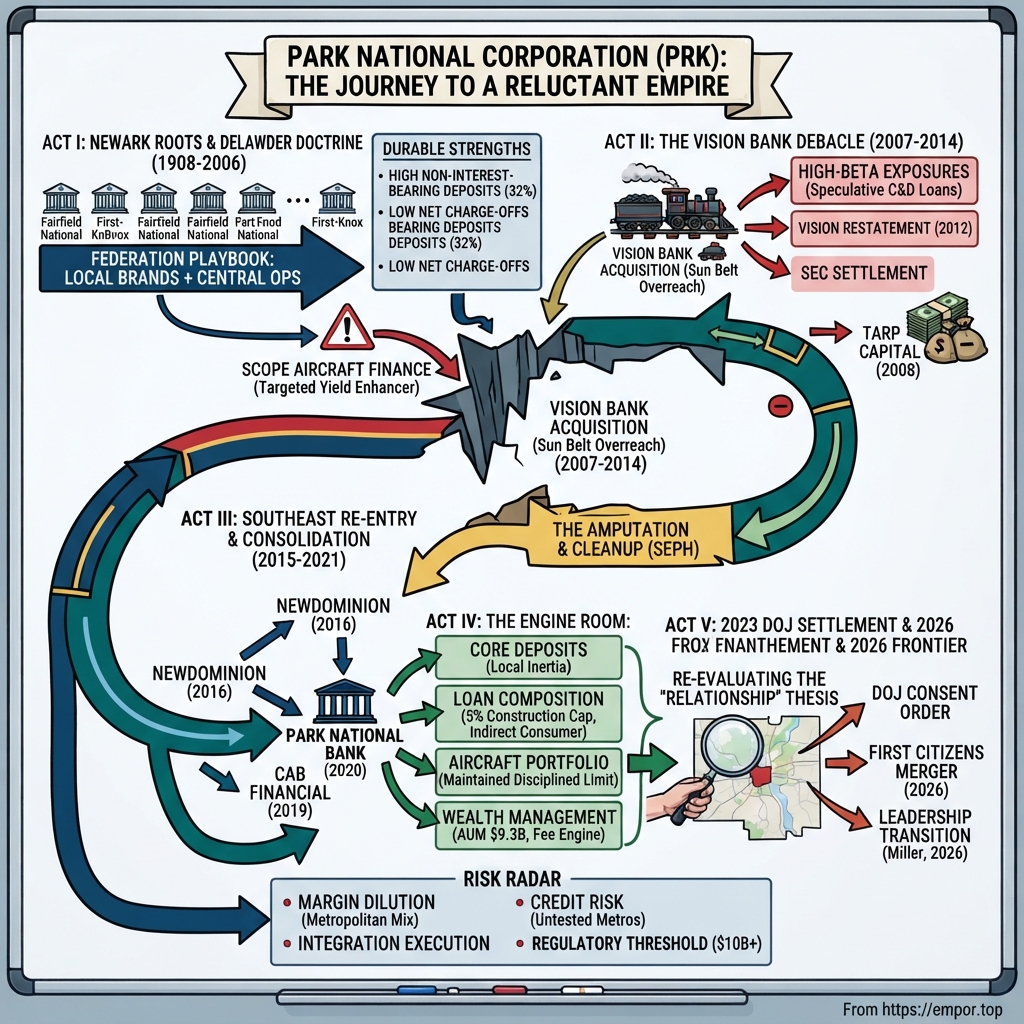
Here is the road ahead. Act I covers the Newark roots and the federation playbook that C. Daniel DeLawder assembled across small-town Ohio. Act II examines the Vision Bank catastrophe — the Gulf Coast acquisition that cost Park hundreds of millions of dollars, forced the holding company into TARP, and concluded with an SEC accounting settlement. Act III traces the recovery: expansion into the Carolinas and the 2020 decision to finally collapse the twelve-brand structure into a unified bank. Act IV inspects the balance-sheet engine: core deposits, loan composition, the indirect consumer lending portfolio, aircraft financing, and a wealth management division that market participants frequently undervalue. Act V details the 2023 Department of Justice redlining consent order, the leadership transition to chief executive Matthew Miller, and the $324 million Tennessee merger completed in February 2026. Act VI through Act VIII deliver the analytical core: structural playbook takeaways, a competitive moat assessment using the Helmer and Porter frameworks, and a rigorous bull-versus-bear stress test tracking the financial metrics that govern the bank's trajectory from here.
The story begins where that conservative culture took shape: in a central Ohio county seat, more than a century ago.
 Subscribe on LinkedIn
VI. Act I: The Main Street Republic of Newark, Ohio (1908–2006)
Park National Bank was founded in Newark, Ohio, in 1908.5 That founding date is notable for a fundamental reason: it places the institution's birth five years before the establishment of the Federal Reserve. Park's formative operating environment required a bank's survival to depend almost entirely on the rigor of its own credit underwriting and the trust of its local depositors, with no central lender of last resort available. The institutional posture forged during those early decades — maintaining surplus capital, lending strictly to known borrowers, and resisting speculative growth — originated directly from that pre-Fed reality.
For much of the twentieth century, the bank operated as a traditional county-seat lender, financing Licking County agriculture, local glassworks, family-owned businesses, and area households. The institution's pivotal strategic shift began in the 1980s and 1990s, when federal and state banking deregulation unleashed an industry-wide consolidation wave that prompted regional bank executives across the country to pursue aggressive acquisitions.
The DeLawder Doctrine
C. Daniel DeLawder joined Park in 1971 and became chief executive in 1994. He defined Park's modern identity by adopting an operating philosophy that ran directly counter to the prevailing industry consensus.
The standard consolidation playbook of that era was mechanical: acquire a smaller institution, eliminate its back office, dismiss its executive team, rebrand the branches, and harvest the cost savings. The efficiency ratio improved, earnings per share accreted, and the consolidator moved on to the next target. Nearly every acquisitive regional bank in the country operated under this formula.
DeLawder pursued the reverse. As Park acquired community institutions across Ohio — Fairfield National, Richland Bank, Century National, First-Knox National, Second National, Security National, United Bank, and Unity National — it deliberately preserved them. The bank kept their local corporate names, retained their community boards, and preserved substantial local loan-approval authority. Park centralized only back-office functions: data processing, regulatory compliance, investment portfolio management, and internal audit. What management refused to centralize was credit decision-making for local commercial borrowers.
The economic logic was straightforward to articulate but difficult to maintain. In a town of 15,000 people, a local bank president understands which general contractor reliably finishes projects and which one overpromises, which farming family has a succession plan in place, and whose relative recently assumed management of the local auto dealership. That qualitative insight carries measurable financial value, yet it cannot be replicated by quantitative credit-scoring algorithms. To preserve that relationship advantage, Park accepted a persistent operational overhead: twelve marketing budgets, twelve separate brand identities, and eventually twelve parallel digital banking applications.
For investors, that decentralized federation produced two opposing consequences. On one hand, it explains two of Park's most durable balance-sheet strengths: a deposit franchise anchored by an uncommonly high share of non-interest-bearing deposits, and net charge-off rates that management describes as persistently below peer benchmarks.3 Depositors who interact directly with their local bank president are far less likely to shift operating balances elsewhere for an incremental fifteen basis points of yield. On the other hand, running duplicate systems imposed an efficiency penalty that Park absorbed for nearly three decades before management finally decided, in 2020, that the overhead was no longer sustainable.
The Aircraft Detour
In the mid-1990s, Park acquired Scope Leasing, Inc., a Columbus-based general aviation finance company.6 While an aviation finance unit might seem an unexpected addition for a conservative community bank, it marked the earliest indication that Park's leadership was willing to deploy capital outside its retail footprint in search of asset yield.
Scope finances piston aircraft, turboprops, and light business jets flown by regional corporations, charter operators, and wealthy individuals rather than commercial airlines. In practical terms, the portfolio functions much like indirect vehicle lending for an expensive, highly mobile asset class. Because the underlying collateral is registered with the Federal Aviation Administration, tracked continuously, and traded in an active global secondary market, credit losses on properly underwritten aviation paper have historically remained modest. Meanwhile, loan spreads remain wide because relatively few regional banks possess the specialized valuation and repossession expertise required to underwrite the sector.
As of December 31, 2025, Scope's portfolio stood at $338.8 million, representing 4.21% of Park's total loans.7 That modest allocation was deliberate: throughout thirty years of ownership, Park's leadership never allowed the specialty portfolio to reach a scale that could endanger the institution. Scope served as a targeted yield enhancer kept within strict limits. That disciplined boundary makes Park's subsequent decisions all the more striking: in 2007, the bank pursued another out-of-footprint expansion, but this time left the guardrails behind.
The Dividend Cult
The final pillar of Park's pre-2007 foundation was its shareholder base. Over several generations, Park came to resemble a civic institution throughout central Ohio, held by multigenerational family shareholders, local charitable endowments, and employees through the company's KSOP. This ownership group provided a structural defense. These shareholders did not dump equity during temporary earnings softness, nor did they pressure the board to sell out to a super-regional acquirer. That supportive constituency helps explain why Park could forgo quarterly earnings conference calls without facing public shareholder friction: a large share of its owners had no interest in sell-side quarterly debates.
Yet this protective ownership structure also warrants caution rather than automatic praise. A captive, locally sympathetic shareholder base protects management against short-term Wall Street pressures, but it can equally insulate executives from necessary accountability. The ultimate test of whether that insulation represented healthy operational patience or executive insulation arrived when Park expanded beyond the familiar boundaries where its relationship advantages applied.
III. Act II: The Vision Bank Debacle & The Dark Night of the Soul (2007–2014)
Picture the Alabama and Florida Gulf Coast in 2006: Gulf Shores, Orange Beach, and Panama City. Condominium towers were rising along the beaches faster than municipal planning departments could track them. Lot developers flipped platted parcels to other developers in rapid succession, supported by population inflows that looked on spreadsheets like an enduring demographic migration rather than a credit-fueled spike. Across the country, regional bank executives were presented with Sun Belt growth projections, and many found them persuasive.
Park was flush with capital. Capital ratios were strong, Ohio's economy was expanding slowly, and the classic dilemma confronting well-capitalized institutions—deploy surplus balance-sheet capacity or return it to shareholders—weighed heavily on management.
On March 9, 2007, Park completed its acquisition of Vision Bancshares, Inc., paying $87.8 million in cash plus 792,937 Park common shares valued at roughly $83.3 million, or about $105.00 per share—a total transaction value near $171 million.8 Operating across the Florida Panhandle and the Alabama Gulf Coast, Vision represented both the largest geographic leap in Park's history and an immediate departure from its foundational operating doctrine. Park's stated competitive edge rested entirely on local knowledge wielded by community bankers embedded in their towns. Lenders in Newark, Ohio possessed no qualitative insight into beachfront construction risk in Baldwin County, Alabama.
When the Tide Went Out
Vision's loan portfolio was concentrated in the asset classes that deteriorate first and most severely during a real estate downturn: speculative residential construction, raw land, and subdivision lot development. In commercial banking, these represent the highest-beta exposures. A fully leased commercial building generates operating cash flow while a lender waits out a soft market. A half-graded subdivision lacking infrastructure produces no revenue, requires ongoing carrying costs, and sees its underlying collateral value plunge once the speculative buyer pool evaporates.
Beginning in 2008, that vulnerability materialized. Non-performing assets at Vision surged, and collateral values across Gulf Coast land developments collapsed.
In December 2008, Park issued $100 million of preferred stock to the U.S. Treasury under the Capital Purchase Program of the Troubled Asset Relief Program (TARP). Management framed TARP participation as an opportunistic capital buffer rather than an emergency lifeline—a standard rationalization offered by regional lenders during the crisis. That characterization warrants skepticism. Park accepted government capital while absorbing mounting credit losses from an out-of-footprint acquisition completed just eighteen months earlier, and it held that capital for more than three years. Whether the bank would have faced insolvency without federal assistance remains unanswerable; what is incontrovertible is that Park tapped emergency public funds precisely as its signature capital allocation decision unraveled.
The Falsification: Does Culture Travel?
This episode provides an essential empirical test for evaluating Park's business model, making it critical to state the central premise before examining the record.
The claim: Park's credit conservatism is an institutional cultural trait—an ingrained discipline that naturally travels with the organization into any market it enters.
The disconfirming record: The Vision transaction directly challenged that assumption. The same board and executive leadership that had overseen decades of pristine credit performance across small-town Ohio acquired a coastal construction lender near the peak of a speculative bubble, then supervised the operation so poorly that the bank's financial reporting ultimately broke down.
That regulatory breakdown is often omitted in retrospectives, yet it represents the most critical finding. In 2012, Park restated its financial results for the full year 2010 and the first three quarters of 2011 after concluding that its allowance for loan and lease losses on certain impaired Vision construction and development credits had been materially understated. The 2010 allowance shortfall alone reached $22.2 million, and the restatement reduced reported net income for that year by $24.8 million, or approximately 25%.9 The Securities and Exchange Commission opened an investigation, and Park subsequently paid a $500,000 civil penalty to settle allegations that its loan-loss accounting had understated credit distress within the Vision unit.9
Erasing a quarter of reported annual earnings was no minor disclosure technicality; it stemmed from a flawed reserve adequacy judgment on the riskiest segment of the balance sheet, skewed in a direction that inflated reported profitability. Any evaluation of Park's accounting conservatism today must weigh that history objectively. While the event occurred fourteen years ago, was fully remediated, involved a modest financial penalty, and has had no recurrence in subsequent filings, it established an important precedent: under conditions of credit stress, this management organization proved capable of misjudging loss reserves on unfamiliar, out-of-footprint assets. That risk profile is particularly relevant as Park pursues larger-scale expansions across the Carolinas and Tennessee.
The Amputation
By late 2011, Park concluded that Vision could not be rehabilitated and had to be excised through a classic good-bank/bad-bank restructuring.
In February 2012, Centennial Bank—a subsidiary of Home BancShares—acquired Vision's seventeen branch locations, taking on loans with an unpaid principal balance of roughly $354 million and assuming approximately $520 million of deposit liabilities, for a purchase price of about $27.9 million.10 The financial destruction was stark: having paid approximately $171 million to acquire Vision in 2007, Park offloaded the surviving operating franchise five years later for less than $28 million—and that transaction accounted solely for the viable assets.
The distressed assets were transferred into SE Property Holdings, LLC (SEPH), a non-bank workout vehicle into which Vision Bank merged after relinquishing its Florida banking charter.11 SEPH became Park's decade-long penance: foreclosures, deficiency judgments, litigation extending to the Alabama Supreme Court, and the protracted liquidation of distressed coastal real estate.11 The workout was so protracted that Park was still booking other real estate owned (OREO) valuation markups and gains related to Vision as recently as 2022, which the company disclosed as a contributor to that year's non-interest income.12
Park repaid its TARP preferred stock in April 2012 and redeemed the associated Treasury warrants shortly thereafter.
The organizational scar was both institutional and personal. Brady Burt, Park's chief financial officer since December 2012, and Matthew Miller, who joined Park in 2009 and served as chief accounting officer from 2012 through 2017, both developed their senior executive careers navigating the wreckage—Miller occupying the chief accounting seat during the restatement's aftermath.7 David Trautman, who assumed the chief executive role in January 2014, spent the early years of his tenure managing the cleanup rather than pursuing growth initiatives.7
That crucible provides the most plausible explanation for Park's conservative posture during subsequent industry disruptions. It also raises a persistent strategic question: whether Park's hard-won risk discipline reflects an indelible institutional trait, or a generational lesson that may fade as the executives who managed the cleanup retire.
IV. Act III: The Southeast Re-Entry & "Untangling the Hairball" (2015–2021)
David Trautman presented an unusual profile for a modern regional bank chief executive. After earning an undergraduate degree from Duke University, he joined Park immediately following graduation, subsequently completing an MBA with honors at The Ohio State University. He led First-Knox National Bank as a Park division president from 1997 through 2002, chaired that division's board until 2006, became Park's president in January 2005, assumed the chief executive seat in January 2014, and added the board chairmanship in May 2019 — compiling a 42-year career within the same organization.7
That tenure cuts both ways analytically. It provided deep institutional memory and cultural continuity, but it also anchored an executive team whose senior ranks averaged roughly twenty years at Park, with limited outside exposure to how peer institutions solve operating challenges.3 Homogeneous management can excel at preserving an established model, but it often struggles to detect when external market dynamics have rendered that model obsolete.
Going South Again — Carefully
The striking feature of Park's re-entry into the Southeast was how deliberately leadership departed from the Vision playbook.
Rather than executing an immediate buyout, Park took an initial minority stake in NewDominion Bank of Charlotte, North Carolina, acquiring roughly 8.55% of the institution in 2016. Management observed the operation for two years before committing to a full acquisition in July 2018.
Then, on April 1, 2019, Park acquired CAB Financial Corporation, the parent of Spartanburg, South Carolina-based Carolina Alliance Bank, in a cash-and-stock transaction valued at approximately $141.8 million.[^13] Carolina Alliance occupied branches along the Interstate 85 corridor stretching from Charlotte through Spartanburg to Greenville — an active commercial-and-industrial growth corridor supported by manufacturing investment and corporate expansions, rather than speculative beachfront land syndication.
The analytical distinction matters far more than the geographic map. Vision had been an asset-class speculation disguised as geographic diversification, concentrating balance-sheet risk in coastal land appreciation. The Carolinas transactions were franchise acquisitions designed to secure operating commercial accounts, established deposit relationships, and commercial-and-industrial borrowers with verifiable operating cash flows. In effect, Park was acquiring customer relationships rather than unbuilt collateral.
Whether this approach insulated the bank from out-of-footprint hazards remains partially unresolved. Park learned to avoid speculative raw-land development, yet it has not navigated a protracted regional credit downturn in the Carolinas under its current structure. Competing in metropolitan growth centers requires underwriting without the multi-generational brand equity, local board networks, or sticky low-cost deposit advantages that protect the bank across central Ohio, all while facing entrenched super-regional competitors such as Bank of America and Truist on their home turf. The Carolinas thesis remains viable but unproven; its principal stress test will be whether future net charge-offs in those portfolios remain aligned with Park's legacy Ohio performance.
Twelve Apps, One Pandemic
Meanwhile, the federation model that sustained Park's early growth had quietly turned into an operating drag.
By 2019, Park National Bank was operating twelve separately branded divisions: ten across Ohio, alongside NewDominion in North Carolina and Carolina Alliance in South Carolina.2 That structure required maintaining twelve distinct websites, twelve mobile banking applications, and twelve parallel marketing campaigns. Every routine digital investment had to be coded, verified, and updated twelve separate times. A commercial client operating across three adjacent Ohio counties routinely encountered three distinct institution names, even though all three were backed by the identical balance sheet.
The qualitative asset that this decentralization originally safeguarded — personal trust rooted in local autonomy — carried measurable value when client interactions occurred primarily at branch teller counters. It grew increasingly difficult to defend once daily interactions migrated to mobile devices, where development budgets fractured across twelve parallel platforms risked delivering a digital experience inferior to centralized regional competitors.
Effective July 1, 2020, Park retired all twelve legacy division names and consolidated its banking operations under a unified brand: The Park National Bank, adopting the consumer tagline "Where you mean more."213 Management publicly framed the consolidation as an initiative to establish an identical customer experience across its footprint.2 The underlying driver, however, was basic operating efficiency.
The timing proved both accidental and defining. The consolidation took effect during the height of COVID-19 branch restrictions, when digital functionality abruptly transitioned from an amenity to an operational requirement. Park carried out the system integration while concurrently processing an unprecedented surge in Paycheck Protection Program loans. To retain its localized service identity within a consolidated digital framework, Park introduced ParkDirect, a digital messaging channel designed to pair retail clients directly with a designated personal banker rather than routing inquiries to an anonymous call center.
Whether that digital delivery model successfully replicates the historic branch relationship remains an open strategic question. Park's core economic premium depends on the premise that commercial and retail depositors willingly accept modest deposit yields in exchange for responsive, relationship-driven service. If that relationship is increasingly mediated through a smartphone screen, the digital interface must sustain the perceived value. Park's public disclosures offer no segmented retention metric isolating that dynamic.
What can be evaluated directly, however, is the funding engine that the legacy franchise constructed — and whether those low-cost deposits continue to power the balance sheet. That examination begins with the asset and liability mix.
V. Act IV: The Engine Room—Segment Economics & The Hidden Power
Strip away the corporate history and Park operates with a distinct balance-sheet configuration. It gathers deposits at an exceptionally low cost and deploys them into higher-yielding assets, achieving that spread without taking on visibly elevated credit risk relative to regional peers. Understanding the durability of that spread requires dissecting both sides of the ledger.
The Liability Side: Where the Margin Actually Comes From
Non-interest-bearing deposits represented 32% of Park's total deposits as of December 31, 2025.14 That single metric explains more about Park's core profitability than almost any other disclosure in its regulatory filings.
In basic commercial banking, deposits serve as raw material. Some balances pay account holders nothing: business payroll accounts, corporate operating cash, municipal funds, and everyday household checking. Other deposits must compete directly against Treasury bills and high-yield digital accounts. When the Federal Reserve tightens monetary policy, interest-bearing deposits reprice upward rapidly, whereas zero-cost operational balances remain largely fixed. The proportion of funding parked in zero-cost accounts represents the closest equivalent in banking to a structural cost moat.
With non-interest-bearing funds at 32% of deposits, compared to roughly 20% for a typical mid-cap regional peer, Park captured a funding advantage worth roughly a full percentage point during recent high-rate cycles. That spread accounts for the bulk of its net interest margin hovering near 4.8% while comparable institutions struggled to exceed 3.3%.
Deposit composition reinforces that cost profile. Park disclosed minimal reliance on costly time deposits, with certificates of deposit at just 9% of total deposits and no brokered deposits at all.14 Wholesale brokered deposits represent flight-prone, rate-sensitive liquidity; avoiding them entirely demonstrates that Park had not been paying premium rates to rent temporary balance-sheet growth. Concurrently, public funds — spanning local municipalities and school districts — made up $1.3 billion, roughly 16% of on- and off-balance-sheet deposits.14 While these public accounts tend to be relationship-driven and contractually sticky over decades, they introduce concentration risk: forfeiting a handful of municipal mandates would produce an immediate, noticeable funding drain.
From an analytical standpoint, Park's margin advantage does not stem from speculative duration positioning or bond-portfolio bets; it reflects a localized deposit-gathering franchise. While that represents one of the most defensible advantages in banking, it remains vulnerable to demographic shifts. Low-cost deposit inertia relies heavily on customer habits that younger, digitally native commercial operators and retail depositors exhibit far less reliably.
The Asset Side: Diversification With Teeth
On the asset side, Park deployed that low-cost funding across an $8.05 billion loan portfolio as of December 31, 2025, which broke down as roughly 30% residential real estate, 27% commercial real estate, 23% consumer, 15% commercial, financial, and agricultural, and 5% construction, generating a quarterly loan yield of 6.34%.7
Several asset allocations reveal clear institutional risk choices. Restricting construction lending to just 5% reflects the lasting imprint of the Vision debacle, capping exposure to the speculative asset class that previously threatened the bank's survival. Within commercial real estate, non-owner-occupied office exposure — the segment driving industry-wide distress after 2023 — totaled $323.2 million, of which $320.8 million remained on accruing status.7 Across an $8 billion balance sheet, that represents a contained exposure, bolstered by the fact that 33% of Park's commercial real estate was owner-occupied, where credit risk functions primarily as corporate cash-flow lending backed by an operating business rather than pure tenant re-leasing risk.7
The 23% consumer allocation marks where Park diverges most sharply from traditional community bank peers. Park National Bank's installment portfolio included $1.6 billion of indirect loans and $186 million of direct loans, with balances having nearly doubled since first exceeding $1 billion in 2017.15
Indirect loans are originated through auto, marine, and recreational vehicle dealerships rather than local branch networks. On its face, dealer-originated paper contradicts the relationship-banking ethos: the bank holds no direct advisory relationship with the borrower, interacting instead with the selling dealer. Rather than relying on local character assessment, Park manages this risk through strict credit segmentation: the portfolio maintained a weighted average FICO score exceeding 780, with 52.35% of balances classified in the Premier tier of 780 or higher and just 0.40% falling into the sub-640 D tier.15
Underwriting a $1.8 billion consumer book at a 780-plus weighted average FICO establishes a prime-plus credit profile. Nevertheless, two analytical caveats apply. Indirect installment debt remains the most cyclically exposed credit bucket on Park's balance sheet, and its rapid doubling occurred during a decade of largely benign consumer credit conditions. Consolidated net charge-offs ran $2.5 million in the second quarter of 2026, or 0.10% annualized, with non-performing loans at 0.86% of period-end loans.1 While those credit metrics demonstrated solid near-term performance, they reflected an operating environment that had not yet faced a protracted consumer recession.
Beyond Scope's aircraft book, Park carried $274.0 million of structured finance loans — lending to non-bank consumer finance companies nationally, which management disclosed as conservatively structured.7 Combined with Scope's $338.8 million aviation portfolio, that totaled roughly $613 million, or about 7.6% of total loans, deployed outside the retail footprint into specialty lending channels. That allocation is small enough to avoid systemic risk to the institution, yet substantial enough to demonstrate that Park's appetite for out-of-market yield never fully disappeared after the financial crisis.
The Fee Engine Nobody Prices
Park's wealth management business held $9.3 billion in market value of assets under management at December 31, 2025 — an AUM figure larger than the bank's entire balance sheet at that date.12
Within a total revenue base of $437.3 million in 2025, non-interest fee income represented approximately 21.5% of operating revenue.12 Fiduciary activities were the single largest component at 38% of non-interest income, ahead of interchange at 22%, other service income at 12%, service charges at 8%, bank-owned life insurance at 6%, and other fee income at 14%.12 Wealth management revenue grew 19.8% in 2024 over the prior year.12
The strategic function of that fiduciary platform is counter-cyclical insulation. Trust and investment management fees are assessed against asset values, rendering them largely independent of borrower credit quality and only loosely tied to prevailing interest rates. If net interest margin compresses in a lower-rate environment, recurring fee income cushions overall earnings. Park's commercial premise is that affluent families and mid-market business owners across Newark, Mount Vernon, Zanesville, and Spartanburg prefer working with an accessible local trust officer over an impersonal wirehouse team in a distant money center.
That value proposition is supported by disclosed scale: $9.3 billion in fiduciary assets does not accumulate by chance in smaller regional markets. However, two analytical caveats qualify that performance. First, a significant portion of asset growth during bull markets reflects broad equity and bond market appreciation rather than organic net new client inflows; because Park does not break out organic net flows in its public filings, outsiders cannot determine how much of that 19.8% revenue expansion stemmed from market performance versus new client acquisition. Second, legacy trust and estate portfolios face an unavoidable demographic headwind. These balances are tethered to aging multi-generational accounts; as wealth transfers down generations, inheriting accounts frequently migrate toward low-cost index platforms and independent registered investment advisors. An established trust franchise can function like a stable annuity for decades before attrition accelerates.
All of which sets up the question of what happens when this carefully calibrated balance-sheet machine is asked to absorb major out-of-state acquisitions — and, at the same time, answer for serious compliance failures closer to home.
VI. Act V: The 2023 DOJ Settlement & The 2025–2026 Frontier
On February 28, 2023, the Department of Justice announced that Park National Bank had agreed to pay more than $9 million to resolve allegations of lending discrimination—specifically redlining majority-Black and Hispanic neighborhoods in the Columbus, Ohio metropolitan area in violation of the Fair Housing Act and the Equal Credit Opportunity Act.[^17][^18]
The core disparity documented in the complaint was pronounced: from 2015 through 2021, just 0.92% of Park's residential mortgage originations across the Columbus area went to borrowers in majority-Black and Hispanic neighborhoods, compared to a peer benchmark of 6.98%.[^17] The DOJ also alleged that Park conducted minimal mortgage advertising in the Columbus market, with negligible outreach directed toward majority-minority audiences.[^17]
As is standard in such agreements, Park settled without admitting liability. The consent order established binding remediation terms: $7.75 million dedicated to a loan subsidy fund to expand credit access in affected neighborhoods, $750,000 for targeted marketing and outreach, $500,000 for community partnerships, the opening of a full-service branch and a mortgage production office in majority-Black and Hispanic census tracts in the Columbus area, and the appointment of a full-time executive to oversee community lending.[^17][^18]
Sitting the Finding Next to the Thesis
From an analytical standpoint, the settlement's importance extends well beyond the monetary penalty, which represented an immaterial cost for a bank earning more than $180 million annually.
Park's corporate identity—the rationale justifying its federation history, localized boards, and decentralized commercial credit authority—rests on the premise of being deeply embedded within the communities it serves. The retail branding tagline, "Where you mean more," functions as the conceptual foundation of its low-cost deposit franchise rather than ordinary marketing copy.
The DOJ enforcement action tests that premise and narrows its scope. It does not dispute Park's established relationships in historical county seats such as Newark or Mount Vernon, which were not cited in the complaint. What it demonstrates is that when transplanted into an expansive metropolitan market, the relationship model tended to direct credit along existing customer networks rather than serving the broader metropolitan area. Relationship banking can easily function as a closed-loop network that channels capital toward familiar, incumbent borrower profiles. In a demographically homogeneous county seat, that dynamic remains largely invisible; in a metropolitan area like Columbus, it yielded a residential lending share roughly seven times below peer levels across seven years—a disparity that federal regulators treat as structural exclusion.
This finding narrows the investment thesis: Park's relationship moat is genuine where the institution is entrenched, but it does not automatically reproduce in new metropolitan markets. That distinction directly informs how investors should evaluate ongoing expansions into Charlotte, Greenville, and Nashville. Park operates under a court-monitored consent order while concurrently executing the largest metropolitan expansion in its history, increasing both compliance overhead and the likelihood of heightened regulatory scrutiny. Park's Form 10-K explicitly includes the consent order within its forward-looking risk factors.16 The practical test of management's execution will be whether mortgage origination across majority-minority Columbus tracts converges toward peer averages over the order's duration, and whether supervisory reviews in Tennessee and the Carolinas remain clean.
The Handoff
On July 28, 2025, Park's board elected Matthew R. Miller as chief executive officer effective January 1, 2026, with David Trautman continuing as board chair.17
Miller, who was 47 at the time of the late-2025 disclosures and had spent 16 years with Park, brings a professional background distinct from the typical community bank leader: eight years auditing financial institutions at Deloitte, followed by leadership as Park's vice president of accounting starting in 2009, chief accounting officer from December 2012 through March 2017, executive vice president through 2019, and president from May 2019 onward.7 He completed a B.A. in accounting, summa cum laude, at the University of Akron.7
Aligning those career dates against the Vision Bank aftermath highlights the formative environment that shaped his leadership. Miller joined Park in March 2009, during the acute phase of the Vision fallout, and assumed the chief accounting officer role in December 2012—shortly after the financial restatement that wiped out a quarter of reported annual earnings. In effect, the chief executive now guiding Park into larger metropolitan markets spent his formative executive years rectifying the reserve inadequacies and reporting failures that unraveled during that earlier out-of-market expansion.
That professional lineage supports expectations of disciplined underwriting and reserve conservatism. What it does not prove is commercial growth leadership, and an objective assessment requires weighing both aspects. An executive with an accounting and audit background provides appropriate rigor for integrating a $2.6 billion bank and operating under a regulatory consent order. Whether that profile offers the competitive edge necessary to capture commercial banking market share against entrenched regional competitors like Truist and Pinnacle in metropolitan Nashville remains an open question that will take several years to answer.
Trautman's ongoing tenure as board chair follows standard corporate practice, but it also reflects familiar governance inertia: having an immediate predecessor supervise an incoming successor can slow strategic pivots. In an executive suite and boardroom where tenures already average two decades, that dynamic tends to reinforce cultural consensus rather than introduce fresh perspectives.
Tennessee
On October 27, 2025, Park announced an agreement to acquire First Citizens Bancshares, Inc., the Dyersburg, Tennessee-based parent of First Citizens National Bank, closing the transaction on February 1, 2026.1819
The all-stock transaction utilized a fixed exchange ratio of 0.5200 Park shares per First Citizens share, valuing the deal at approximately $324.1 million, or roughly $82.96 per First Citizens share, through the issuance of 1,988,131 common shares.2018 Former First Citizens shareholders owned approximately 11% of the combined company upon completion.20
First Citizens added roughly $2.6 billion in assets and $2.22 billion in deposits, expanding Park's balance sheet to $12.7 billion in pro forma assets and expanding its footprint to more than 100 branches across Ohio, Kentucky, North Carolina, South Carolina, and Tennessee.3119 Jeffrey D. Agee, First Citizens' former chairman and chief executive officer, joined Park's board of directors and assumed executive leadership of the newly created Tennessee Region.2019
The valuation, examined critically. Park paid 168% of tangible book value per share and 13.5 times trailing twelve-month earnings.20 Factoring in fully phased cost synergies, the purchase multiple compressed to 7.4 times projected 2026 earnings.20 Management projected 15% earnings accretion in 2026, a slightly accretive impact on tangible book value, a 20% internal rate of return, and non-interest expense reductions equal to 30% of First Citizens' cost base, with half realized in 2026 and the full run rate captured thereafter.20
A purchase multiple of 168% of tangible book value sits above typical Midwest bank transaction benchmarks in recent years. Management justified the pricing through funding quality: First Citizens brought a 1.46% cost of deposits against Park's 1.19%—both disciplined profiles—demonstrating that the deal was structured to secure low-cost core deposit funding across West and Middle Tennessee rather than speculative loan volume.21 Furthermore, by funding the acquisition entirely with its own highly valued stock—achieving a pay-to-trade ratio of 76%—Park used equity that traded at a premium relative to the target's underlying valuation.20 That relative multiple advantage explains why an acquisition priced at 168% of tangible book value could still deliver modest accretion to Park's tangible book value per share, presenting the strongest financial rationale for the deal.
However, several balance-sheet costs accompany management's accretion forecast: Park recognized $36.2 million in pre-tax transaction expenses, with $28.7 million absorbed at closing; took on an embedded $60.1 million unrealized available-for-sale securities loss within acquired equity, amortizing straight-line over five and a half years; planned the sale of approximately $100 million in lower-yielding acquired securities at an additional pre-tax loss of $1.4 million; and booked a core deposit intangible equal to 3.0% of acquired core deposits amortized over ten years.20 While standard in regional bank combinations, these obligations mean reported accretion depends heavily on execution assumptions—particularly capturing the full 30% overhead reduction following core systems conversion.
The $10 billion threshold. Crossing $10 billion in total assets triggered the Durbin Amendment's cap on debit interchange fees along with enhanced regulatory supervision. Park modeled the resulting headwind at an annual pre-tax non-interest income reduction of approximately $14.5 million across its own operations and $2.4 million for First Citizens once fully phased in.20 For a bank where interchange accounts for 22% of non-interest revenue, that marks a structural and permanent fee contraction. Management maintained that it had spent five years preparing for the transition and that incremental earnings from the acquisition would offset the regulatory costs, noting that organic asset growth would have crossed the $10 billion threshold during the first quarter of 2026 in any case.2022 That reasoning holds merit: because crossing the threshold was unavoidable, absorbing the compliance costs alongside a larger revenue and balance-sheet base provided greater operational scale.
Initial post-merger operating results were supportive but preliminary. In the second quarter of 2026, Park reported net income of $58.8 million, up 22.1% from $48.1 million in the second quarter of 2025, with diluted earnings per share rising to $3.23 from $2.97; total loans grew 22.2% year over year to $9.73 billion; deposits increased 29.5% to $10.67 billion; return on average assets stood at 1.84%, with return on average equity at 13.69%; and tangible book value per share reached $78.92.1 Management reported "exceptional progress" toward completing its scheduled third-quarter systems conversion.1
Two analytical caveats qualify those reported figures. First, a single quarter of post-closing earnings demonstrates that balance-sheet assets transferred successfully, not that long-term credit underwriting standards and projected operating efficiencies will materialize as planned. Second, the technical systems integration—the operational junction where bank combinations most frequently encounter customer attrition and execution friction—was slated for the third quarter of 2026, leaving ultimate integration performance unconfirmed. Because Park does not conduct quarterly earnings calls, outside analysts have no direct setting to question management on conversion progress or operational friction, illustrating the informational penalty that the bank's communications silence imposes on public investors.
VII. Act VI: Business & Investing Playbook
Step back from the chronology. Four transferable insights emerge from Park's operating record, and each carries a qualification grounded in the bank's own history.
Lesson 1: The anti-Wall Street posture is a deliberate choice with symmetric trade-offs.
Park's refusal to host quarterly earnings conference calls is frequently praised by supporters as an unyielding virtue—freedom from the ninety-day treadmill and permission to underwrite across a full ten-year credit cycle. That assessment has merit. Regional banks managing toward quarterly EPS estimates face persistent structural incentives to release loan-loss reserves prematurely, compromise on credit standards, or stretch for yield across longer-duration assets. Park's modest 5% construction lending allocation and complete avoidance of brokered deposits reflect an executive team unconcerned with optimizing for the next headline print.
Yet the operational cost is symmetric and warrants equal weight. Without an earnings call, there is no public transcript, no unscripted analyst questioning, and no forum where leadership must answer challenging inquiries or risk appearing evasive. Assessing executive credibility at Park must therefore be conducted entirely through written disclosures and longitudinal results: regulatory filings, investor decks, and whether reported performance matches earlier guidance. By that standard, Park's recent execution has been disciplined: management disclosed the First Citizens transaction economics in granular detail, including unflattering balance-sheet adjustments, and has reported no financial restatements since 2012. Nevertheless, the Vision Bank era demonstrated that a management team insulated from outside challenge can harbor flawed underwriting judgments for years before accounting rules compel recognition. Reduced market scrutiny remains a tangible corporate risk factor, not merely an operating advantage.
Lesson 2: Geographical balance-sheet arbitrage represents the true business model.
The core mechanism of Park's franchise is geographic balance-sheet arbitrage. The bank gathers low-cost, low-beta, sticky deposits in mature county seats where loan demand is modest—Newark, Mount Vernon, Lancaster, and Dyersburg—and redeploys that funding into faster-growing metropolitan markets where credit demand is robust and pricing is competitive, including Charlotte, Greenville, Nashville, and Columbus.
While that balance-sheet structure is conceptually straightforward, it also represents the strategy attempted by nearly every deposit-rich community institution. Long-term execution determines the outcome, and the historic failure mode is clearly documented in Park's own past: deposit funding remains stable, but credit losses materialize when lenders enter unfamiliar markets. While Park has executed this geographical redeployment across the Carolinas for roughly seven years without a significant credit event, that performance unfolded during an extended expansion that lacked a regional credit downturn to fully test underwriting standards.
Lesson 3: Scar tissue functions as an asset only until the personnel carrying it depart.
Park's balance-sheet positioning during 2020 and 2021 provides the clearest available evidence of institutional discipline. While several regional peers invested pandemic deposit surges into long-duration fixed-income securities at historically low yields—an asset-liability mismatch that triggered the failures of Silicon Valley Bank and Signature Bank in early 2023—Park kept balance-sheet liquidity anchored in shorter-duration, relationship-originated commercial and consumer loans. Fully 54% of its loan portfolio consisted of variable-rate facilities repricing over a 28-month weighted average life, while the fixed-rate portion carried an 86-month weighted average contractual life.7 Its investment portfolio remained concentrated in mortgage-backed securities and investment-grade municipal debt, with mortgage holdings predominantly collateralized by 15-year residential loans.23 Park also retired $175 million of subordinated debt and $15 million of trust preferred securities in 2025, simplifying its capital structure rather than adding leverage.24
Attributing that balance-sheet caution directly to the Vision debacle is plausible even if impossible to demonstrate definitively. What can be verified is the actual operating behavior. The forward risk is that this hard-earned risk aversion is embodied in specific individuals—Trautman, Burt, and Miller—whose direct memory of the 2008 financial crisis is increasingly the exception rather than the norm across Park's workforce. Over time, institutional memory inevitably decays.
Lesson 4: The capital return hierarchy departs sharply from regional banking conventions.
Park's capital allocation follows a disciplined sequence: regulatory capital strength first, followed by a competitive regular dividend, with surplus earnings returned through variable special dividends rather than unchecked balance-sheet expansion. The holding company's 14.0% Common Equity Tier 1 ratio—more than 600 basis points above regulatory minimums—alongside a tangible common equity to tangible assets ratio of 12.35% provide the foundation.325 The variable special dividend serves as the core capital management tool, exemplified by the $1.25 per share distribution declared in 2025.4 Returning excess earnings through discretionary special payouts rewards shareholders without creating a permanent dividend baseline that must be defended during a severe credit downturn.
Yet the activist critique of this capital posture deserves a serious hearing. A 14% CET1 ratio can be interpreted as substantial over-capitalization, leaving equity deployed at returns below what a more leveraged balance sheet could achieve and depressing overall return on equity below the franchise's full earnings capacity. Park's 13.69% return on average equity in the second quarter of 2026, compared to a 15.76% return on average tangible common equity for full-year 2025, highlights that capital drag.13 Skeptical investors may ask why an institution reporting 0.10% annualized net charge-offs requires 600 basis points of excess regulatory capital, advocating instead for aggressive share repurchases or a larger permanent payout. Park's response, demonstrated through its corporate history rather than public rhetoric, is that the institution held that capital reserve once before and required every dollar of it to survive.
That tension leads directly into the formal assessment of whether Park's competitive advantages are durable and structural or circumstantial.
VIII. Act VII: Strategy Breakdown—7 Powers & 5 Forces
Banking is an unusually difficult industry in which to hold a durable advantage. Deposits and loans are commodities. Products are legally standardized and readily copied across competitors. Regulation applies uniformly. Whatever economic edge exists must derive from the cost of funds, the cost of credit risk, or the cost of distribution—not from proprietary product design.
Hamilton Helmer's 7 Powers, Applied Honestly
Switching costs — the strongest power Park holds, and it is genuinely strong on the deposit side. A retail checking account with direct deposit, recurring bill payments, and fifteen years of transaction history is cumbersome to relocate. A commercial treasury management relationship—encompassing payroll processing, lockboxes, ACH origination, and automated liquidity sweeps—is materially expensive to move, requiring a client's finance staff to re-engineer their daily cash workflows. Municipal deposit relationships require collateralization agreements and formal public procurement processes. Fiduciary trust and estate accounts, where legal documentation explicitly appoints the institution, represent some of the highest-friction arrangements in financial services. The bank's 32% non-interest-bearing deposit ratio and total absence of brokered funding serve as the empirical fingerprint of those switching costs.14 This power is structural, and it remains the single most defensible element of Park's operating model.
Cornered resource — moderate, geographically bounded, and slowly eroding. In a county seat of 12,000 residents, Park's branch is frequently the sole full-service commercial banking office in town, because national institutions cannot justify physical branch overhead at that population density. That physical presence constitutes a localized monopoly on commercial banking access. Yet the mechanism of erosion is continuous: physical branch proximity matters less each year, and the same digital infrastructure that lowers the cost of serving a rural depositor simultaneously lowers the cost for outside institutions to contest that relationship. This power functions as a depreciating asset rather than a permanent barrier.
Process power — moderate, and partly dismantled by Park itself. An operating model pairing local credit judgment with centralized stress testing is difficult to replicate because it requires a decentralized management structure that most competitors dismantled decades ago. Yet the 2020 brand consolidation and ongoing metropolitan expansion reflect an institutional trade-off: Park has steadily exchanged localized autonomy for operating efficiency. Concurrently, the Department of Justice redlining settlement illustrated the limitations of unguided local discretion in larger metropolitan markets, where informal commercial networks simply replicated incumbent customer patterns. Process power at Park remains real, but it has been narrowed by management's own strategic choices.
Counter-positioning — essentially absent. Park operates a conventional commercial banking model. Regional and super-regional peers such as Huntington, KeyCorp, Fifth Third, Truist, and Pinnacle provide every service Park offers, frequently supported by superior technology budgets. Nothing inherent in Park's business architecture prevents a larger competitor from replicating its offerings; what deters direct encroachment is simply that rural county seats generate volumes too modest to justify a major bank's capital commitment. That dynamic reflects a market-size barrier, not counter-positioning.
Scale economies — negative. Scale represents Park's most pronounced structural vulnerability. JPMorgan Chase alone spends more on annual technology investments than the entirety of Park's balance sheet. Regulatory compliance, cybersecurity, fraud mitigation, automated underwriting, and digital platform development all carry substantial fixed costs that must be amortized across an institution's asset base. At $12.7 billion in assets, Park absorbs those burdens across a base roughly one-three-hundredth the size of the nation's largest banks. Crossing the $10 billion threshold compounded that disparity by triggering Durbin Amendment interchange fee caps alongside enhanced supervisory mandates. Viewed through this lens, the First Citizens transaction served partly as a defensive measure: building asset scale so fixed compliance costs can be distributed across a wider foundation.
Network economies and branding — not material. Commercial banking offers no meaningful network effects for an institution of Park's regional footprint. While the brand commands deep community goodwill throughout central Ohio, it carries negligible organic recognition in Nashville or Memphis, where Park entered as an out-of-state acquirer purchasing an incumbent's localized reputation rather than exporting its own.
Net assessment: Park possesses one durable power in deposit switching costs, two moderate and depreciating advantages in localized presence and process, and a significant structural disadvantage in scale economies. That combination yields a defensible but geographically bounded moat—sufficient to explain sustained above-peer profitability within its legacy core, but insufficient to ensure equivalent margins as the institution expands outward.
Porter's Five Forces
Bargaining power of depositors — historically low, structurally rising. Depositor leverage represents the pivotal variable in the valuation thesis, bearing directly on Park's low-cost funding advantage. For decades, community bank depositors exhibited deep rate inertia. That inertia has steadily eroded under the influence of mobile banking, digital institutions marketing yields above 4%, and Treasury money market funds accessible in a few taps on a smartphone. The fact that Park's non-interest-bearing deposits remained near 32% throughout the 2022–2024 Federal Reserve tightening cycle proved that its core funding possesses genuine stickiness under stress—arguably the most compelling empirical support for the bullish thesis, as it represents a stress test the balance sheet successfully cleared. Whether that low-beta advantage persists into future tightening cycles as older customer cohorts transfer wealth to younger, digitally native depositors remains untested.
Threat of substitutes — moderate to high, concentrated in fee businesses. Trust and wealth management face ongoing fee pressure from low-cost passive index platforms and independent registered investment advisors. Indirect vehicle lending contends with automotive captive finance subsidiaries, which frequently subsidize borrowing rates to clear dealership inventory. Concurrently, card interchange and payment fees face persistent disintermediation from fintech payment rails, compounded by the statutory Durbin fee ceiling.
Competitive rivalry — asymmetric by geography. Competitive pressure fractures along geographic lines. In rural Ohio and West Tennessee, rivalry remains subdued, contested primarily against credit unions and smaller community lenders. In Charlotte, Greenville, Nashville, and Memphis, competition is intense: Bank of America and Truist maintain entrenched market dominance across the Carolinas, while Pinnacle Financial and Regions command deep commercial relationships in Tennessee. Park enters each metropolitan center as a smaller challenger competing for growth within markets where rival balance sheets are aggressively deployed.
Barriers to entry — high and rising, which helps Park. De novo commercial bank formation across the United States has remained largely dormant since 2010, as heightened regulatory capital requirements and compliance overhead make small-scale charters economically unviable. As a result, Park's established county-seat branch network is virtually irreplaceable; no competitor will invest the capital required to build a de novo brick-and-mortar presence in a municipality of 9,000 residents. This regulatory barrier provides durable protection for legacy deposit franchises, ensuring that Park's branch network and charter retain structural scarcity value.
Bargaining power of borrowers — moderate and rising in metropolitan markets. Small-town commercial borrowers and family farms have historically operated with few competitive financing options. By contrast, middle-market corporate borrowers in metropolitan growth centers are financially sophisticated, conduct competitive bidding processes across multiple regional lenders, and routinely negotiate tighter loan spreads, flexible amortization schedules, and looser covenants. To the extent Park's future loan expansion relies on urban and suburban growth corridors, the blended bargaining power of its borrower base will rise—introducing the primary mechanical channel through which asset yields and net interest margins could compress over time.
IX. Act VIII: The Bull vs. Bear Case & Material Risk Radar
The Bear Case
The mix-shift problem is the core bear argument, and it is not a risk — it is a deliberate operating plan. Park's premium net interest margin is generated by rural, low-beta, non-interest-bearing deposits funding a mix that includes prime consumer installment debt and owner-occupied commercial real estate. Every incremental dollar of future balance-sheet growth is directed into competitive metropolitan markets where deposits cost more, commercial loan spreads are compressed, and Park lacks incumbent brand loyalty. Management does not dispute this dynamic; the First Citizens transaction was explicitly justified by the target's low-cost deposit franchise. Yet the underlying arithmetic is inescapable: blending a 4.8% legacy margin with metropolitan banking economics produces a lower consolidated margin over time. Nothing in Park's public disclosures suggests its margin premium is permanent, and framing it as an unassailable structural advantage rather than a legacy balance-sheet profile undergoing active dilution overlooks basic banking mechanics.
Integration and regulatory threshold costs are concrete and front-loaded. The core systems conversion, scheduled for the third quarter of 2026, represents the operational juncture where bank combinations most frequently encounter friction and customer attrition. Management's 30% non-interest expense reduction target remains an unfulfilled projection. Meanwhile, the $14.5 million annual pre-tax Durbin Amendment fee reduction is a permanent statutory reality already quantified in financial models.20
Deal pricing leaves minimal margin for operational error. At 168% of tangible book value, the investment return depends entirely on delivering projected cost synergies in full and preventing acquired deposit attrition during the brand transition and core platform migration.20 Core deposit attrition following core conversions is a well-established industry pattern. Moreover, Park's own corporate history features an out-of-market transaction that appeared compelling at announcement before destroying roughly $140 million in shareholder value over the ensuing five years.
Credit underwriting in unfamiliar metropolitan markets remains untested under severe economic stress. Park's consolidated 0.10% annualized net charge-off rate reflects both disciplined underwriting and an exceptionally benign credit environment.1 The Carolinas commercial portfolios have not navigated a protracted regional downturn under Park ownership, nor has the doubled indirect consumer installment portfolio experienced a sustained recession.
Governance concentration and disclosure opacity limit outside accountability. A board chair who served as chief executive for twelve years, an incoming chief executive promoted entirely from within, an executive leadership team averaging two decades at the institution, a shareholder base defined by multi-generational local loyalty, and a deliberate refusal to host quarterly earnings conference calls describe an unusually insular organization. While each practice is defensible on its own merits, together they create an environment with minimal external scrutiny—the exact structural condition under which the Vision-era loan-loss reserve deficiencies remained unaddressed for years.
The DOJ consent order imposes ongoing supervisory and reputational risk. Compliance with branch expansion, advertising commitments, and specialized lending quotas across the Columbus market remains subject to formal court monitoring. Any secondary fair-lending inquiry—whether in central Ohio or within newly entered metropolitan regions in the Carolinas or Tennessee—would inflict severe damage on the relationship-banking ethos that supports Park's valuation multiple.
The Bull Case
The core funding advantage cleared a definitive real-world stress test. Park maintained non-interest-bearing deposits at 32% of total deposits and relied on zero brokered funding throughout the most aggressive Federal Reserve rate-tightening cycle in four decades and the regional banking crisis of March 2023.14 That funding stability is not a speculative model forecast; it is a completed empirical demonstration. The resulting net interest margin—reaching 4.88% in the fourth quarter of 2025 and 4.81% in the second quarter of 2026 after absorbing an acquisition—represents tangible, defensible cash generation.41
The fiduciary platform provides substantial counter-cyclical diversification. Generating 21.5% of operating revenue and supported by $9.3 billion in fiduciary assets under management, Park's wealth management division partially decouples total earnings from traditional credit cycles and interest-rate volatility.12
Balance-sheet capitalization is genuinely fortress-grade. A 14.0% Common Equity Tier 1 ratio, a 12.35% tangible common equity to tangible assets ratio, and a capital structure streamlined in 2025 through the retirement of $190 million in subordinated and trust preferred debt provide substantial downside protection.32524 This capital buffer creates strategic flexibility: the capacity to absorb a protracted credit downturn, acquire a distressed competitor opportunistically, or accelerate variable capital returns to shareholders.
Operating returns consistently rank in the top quartile of regional peers. Park generated a 1.78% return on average assets and a 15.76% return on average tangible common equity in 2025, with post-merger ROA sustaining at 1.84% in the second quarter of 2026.31 Generating persistent top-quartile returns across disparate monetary policy regimes cannot be dismissed as a temporary statistical anomaly.
Structural scarcity value underpins the franchise. With de novo commercial bank formation remaining practically dormant under post-crisis regulatory capital requirements, a clean $12.7 billion institution anchored by an entrenched rural core deposit franchise represents a genuinely scarce banking asset, supporting enterprise value independent of near-term rate fluctuations.
Weighing It
The balanced synthesis is narrower than either partisan narrative suggests.
Park's deposit franchise advantage is real and empirically verified, demonstrated by its stability through the recent Federal Reserve tightening cycle. Its credit discipline is proven across its legacy footprint but untested outside it, shadowed by the catastrophic Vision failure and accounting restatement, alongside an eight-year Carolinas expansion that has yet to navigate a regional recession. Its relationship banking claim is narrowed rather than disproven: powerful where the bank is historically entrenched, but demonstrably non-transferable in major metropolitan centers, as documented in the DOJ redlining record. Its capital allocation track record is uneven: severe value destruction in 2007, a disciplined series of bolt-on entries starting in 2018, and a Tennessee combination priced at a full multiple that relies heavily on projected cost efficiencies. Finally, its exceptional net interest margin is genuine today but structurally diluting as a direct mathematical consequence of management's own metropolitan growth strategy.
The result is a highly profitable institution with a defensible but geographically bounded moat, a documented failure mode, and a leadership team that navigated the prior cleanup but has not yet faced equivalent macro stress in its expansion markets.
The KPIs That Actually Matter
Three metrics carry nearly all of the signal from here. An investor tracking these three will know whether the thesis is holding before the market does.
1. Non-interest-bearing deposits as a percentage of total deposits. This is the franchise's load-bearing wall. Zero-cost balances represented 32% of total deposits at year-end 2025.14 If that proportion holds above roughly 28% as the acquired Tennessee operations are fully integrated and interest rates normalize, Park's net interest margin advantage remains intact and the relationship thesis survives its digital transition. If the ratio drifts into the low twenties, Park's margin will converge toward regional peers, eroding the core justification for its valuation premium. Every other financial metric in this story is downstream of this number.
2. Net charge-offs in the Carolinas and Tennessee portfolios versus legacy Ohio. Park's consolidated net charge-off rate of 0.10% annualized blends together markets with very different risk profiles.1 Regulatory filings do not currently break out charge-offs by region—a notable disclosure gap for outside investors. A sustained rise in consolidated charge-offs while legacy Ohio credit metrics remain pristine would provide the earliest signal that underwriting standards failed to travel, repeating the central mistake of the Vision era. This dynamic warrants close tracking alongside the indirect consumer portfolio, whose 780-plus weighted average FICO score has never been tested in a severe consumer recession.15
3. Realized cost savings and deposit retention following the third-quarter 2026 systems conversion. Management projected non-interest expense reductions equal to 30% of First Citizens' cost base and 15% earnings per share accretion for 2026.20 The systems conversion represents the operational dividing line where modeled projections must translate into verified financial performance. Tracking core deposit balances across the Tennessee branches over the two quarters following platform conversion will offer the cleanest empirical test of whether Park acquired an enduring customer franchise or merely leased temporary balance-sheet volume.
X. Outro & Epilogue
There is a version of the Park National story often told approvingly at value investing conferences: the disciplined Ohio lender that ignored Wall Street, refused to play the quarterly earnings game, maintained conservative underwriting, and quietly compounded shareholder capital for a century while flashier institutions overextended themselves.
Much of that narrative is supported by the record. The top-quartile operating returns are real. The low-cost deposit franchise is real, having weathered a historic monetary tightening cycle and regional banking disruption that destabilized weaker competitors. The balance-sheet capitalization is genuinely conservative, and management's refusal to chase bond duration during the pandemic deposit surge proved prescient.
Yet the fuller record is considerably more complex. It includes an out-of-footprint acquisition that cost roughly $171 million and returned less than $28 million for its operating franchise five years later, a decade-long workout vehicle, $100 million in emergency federal capital, an accounting restatement that erased a quarter of reported annual earnings, an SEC settlement over loan-loss reserves, and a Department of Justice consent order resolving allegations that residential lending in Columbus ran seven times below peer benchmarks in majority-minority neighborhoods. Park is not a fable of unbroken Midwestern prudence. It is a highly profitable bank with a documented historical failure mode—stretching beyond the geographic and relationship boundaries where its competitive advantages apply—that is now expanding outward again, at an unprecedented scale, under a chief executive who spent his formative years managing the cleanup of that earlier misstep.
The core question is not whether Park is a sound institution. It is whether the structural edge that makes it exceptional—a low-cost deposit base anchored by customer inertia, personal familiarity, and branch proximity in markets too small for national competitors to prioritize—can survive being spread across five states and steadily diluted by growth in metropolitan banking markets where none of those legacy advantages exist.
Newark, Ohio is still forty miles from Columbus. Dyersburg, Tennessee is four hundred and fifty miles further. Somewhere between those two distances lies the answer.
References
-
Park National Corporation Form 8-K, Exhibit 99.1 — Second Quarter 2026 Earnings Release — U.S. Securities and Exchange Commission, 2026 ↩↩↩↩↩↩↩↩↩↩↩↩
-
Park National Corporation Form DEF 14A Proxy Statement — U.S. Securities and Exchange Commission, 2020 ↩↩↩↩
-
Park National Corporation Q4 2025 Investor Slides — Park National Corporation, 2026-02-09 ↩↩↩↩↩↩↩↩
-
Park National Corporation Form 8-K, Exhibit 99.1 — Fourth Quarter and Full Year 2025 Earnings Release — U.S. Securities and Exchange Commission, 2026 ↩↩↩↩
-
Park National Corporation Q4 2025 Investor Slides, Company Overview — Park National Corporation, 2026-02-09 ↩
-
Scope Aircraft Finance: Aviation Financing Solutions Overview — Scope Leasing Inc. ↩
-
Park National Corporation Q4 2025 Investor Slides, Loan Portfolio and Senior Management — Park National Corporation, 2026-02-09 ↩↩↩↩↩↩↩↩↩↩↩
-
Park National Corporation and Vision Bancshares, Inc. Complete Merger Transaction — GlobeNewswire, 2007-03-09 ↩
-
Park National to Pay $500,000 to Settle Lingering Accounting Probe — American Banker ↩↩
-
Home BancShares, Inc. and Centennial Bank Announce Acquisition of Vision Bank Branch Locations — Home BancShares, Inc., 2012 ↩
-
SE Property Holdings, LLC, f/k/a Vision Bank v. Bank of Franklin — Supreme Court of Alabama, 2019 ↩↩
-
Park National Corporation Q4 2025 Investor Slides, Non-Interest Income and Wealth Management — Park National Corporation, 2026-02-09 ↩↩↩↩↩↩
-
First-Knox National Bank to rebrand in 2020 — Knox Pages, 2019 ↩
-
Park National Corporation Q4 2025 Investor Slides, Deposit Composition — Park National Corporation, 2026-02-09 ↩↩↩↩↩↩
-
Park National Corporation Q4 2025 Investor Slides, Consumer Installment Portfolio — Park National Corporation, 2026-02-09 ↩↩↩
-
Park National Corporation Form 10-K for the Fiscal Year Ended December 31, 2025 — U.S. Securities and Exchange Commission, 2026 ↩
-
Park National Corporation names Matthew R. Miller Chief Executive Officer; David L. Trautman to continue as Board Chair — Form 8-K Exhibit 99.1, U.S. Securities and Exchange Commission, 2025-07-29 ↩
-
Park National Corporation Form 8-K — U.S. Securities and Exchange Commission, 2026-01-21 ↩↩
-
Park National Bank announces completion of First Citizens National Bank merger — Park National Bank, 2026-02 ↩↩↩
-
Park National Corporation Q4 2025 Investor Slides, First Citizens Transaction Terms — Park National Corporation, 2026-02-09 ↩↩↩↩↩↩↩↩↩↩↩↩↩
-
Park National Corporation Q4 2025 Investor Slides, Park & First Citizens Summary — Park National Corporation, 2026-02-09 ↩
-
Park National Corporation Form S-4 Registration Statement — U.S. Securities and Exchange Commission, 2025 ↩
-
Park National Corporation Q4 2025 Investor Slides, Investment Portfolio — Park National Corporation, 2026-02-09 ↩
-
Park National Corporation Q4 2025 Investor Slides, Capital Ratios — Park National Corporation, 2026-02-09 ↩↩
-
Park National Corporation Q4 2025 Investor Slides, Tangible Common Equity — Park National Corporation, 2026-02-09 ↩↩
 LinkedIn
 WhatsApp
 Reddit
 Hacker News
 Email
Email Kindle
 RSS Feed
 Spotify
 Apple Podcasts
 Amazon Music
 Audible
 YouTube