Progress Software Corporation: The Software Company That Buys Its Next Act
A software company with a growth problem
On the last day of September 2026, Yogesh Gupta joined Progress Software's third-quarter earnings call with good news to deliver first. Eight days earlier, Progress had closed its purchase of substantially all of Domo's AI and data-platform business.1 Gupta described the new unit as a way to add real-time data integration, analytics, automation and what he called "agentic orchestration" to a company that has spent four decades selling software businesses run on but rarely talk about.1 The deal cost about $400 million in cash, nearly all of it borrowed on the company's revolving credit line.1
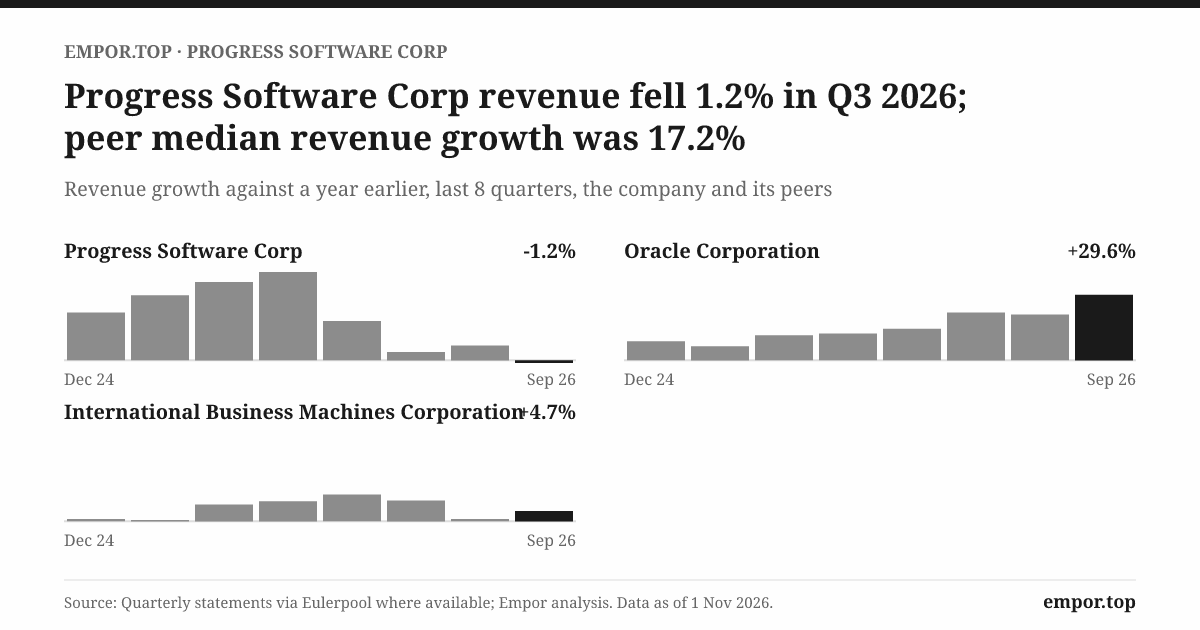
The quarter itself was harder to cheer. Progress reported revenue of $246 million for the three months to August, a little lower than the same quarter a year earlier.12 Annualized recurring revenue, the company's own measure of what its contracts would bring in over a year, was $873 million, up just over 1% on a constant-currency, pro forma basis.13 Net retention, which compares what existing customers pay now with what they paid a year ago, was 99%.1 So the average existing customer was paying slightly less than before, and Progress was not adding much new business.
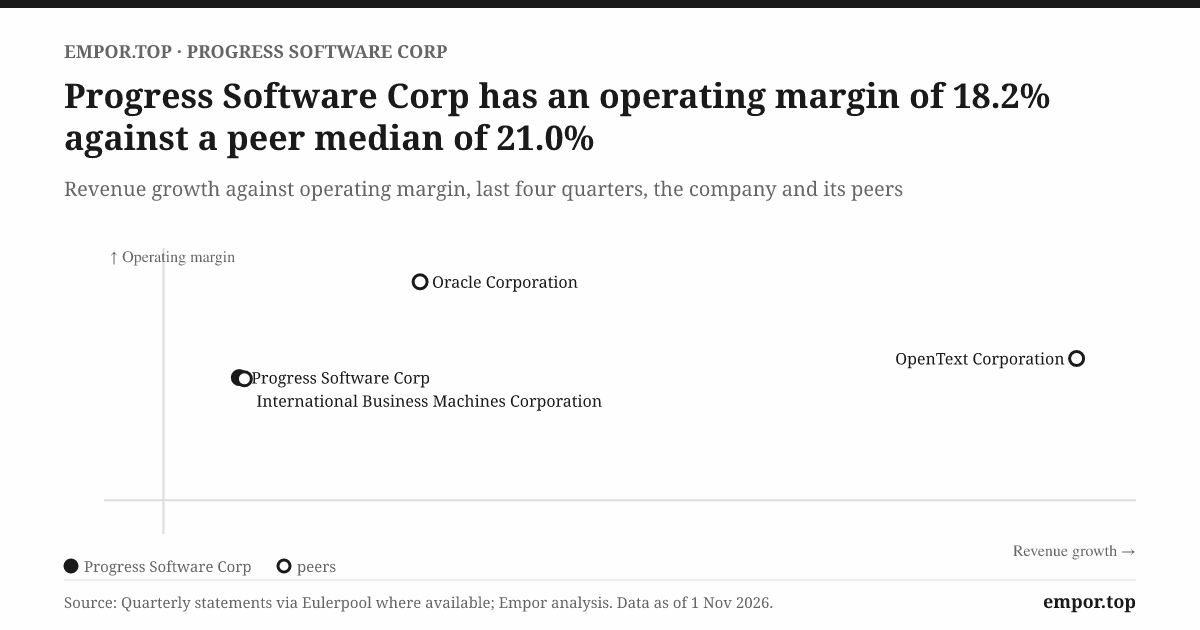
Management led with other numbers. Non-GAAP operating margin reached 43%, up three percentage points, and non-GAAP earnings per share rose about 13% to $1.69.1 Adjusted free cash flow for the year to date was up 44%.1 None of those figures is invented, but they are drawn on a particular scoreboard. Progress's GAAP operating margin for the same quarter was about 19%.2 The difference between 19% and 43% is mostly the cost of the companies Progress has bought: the amortization of acquired intangible assets, stock-based compensation, and restructuring and acquisition charges. Management excludes those items. A GAAP income statement counts them.
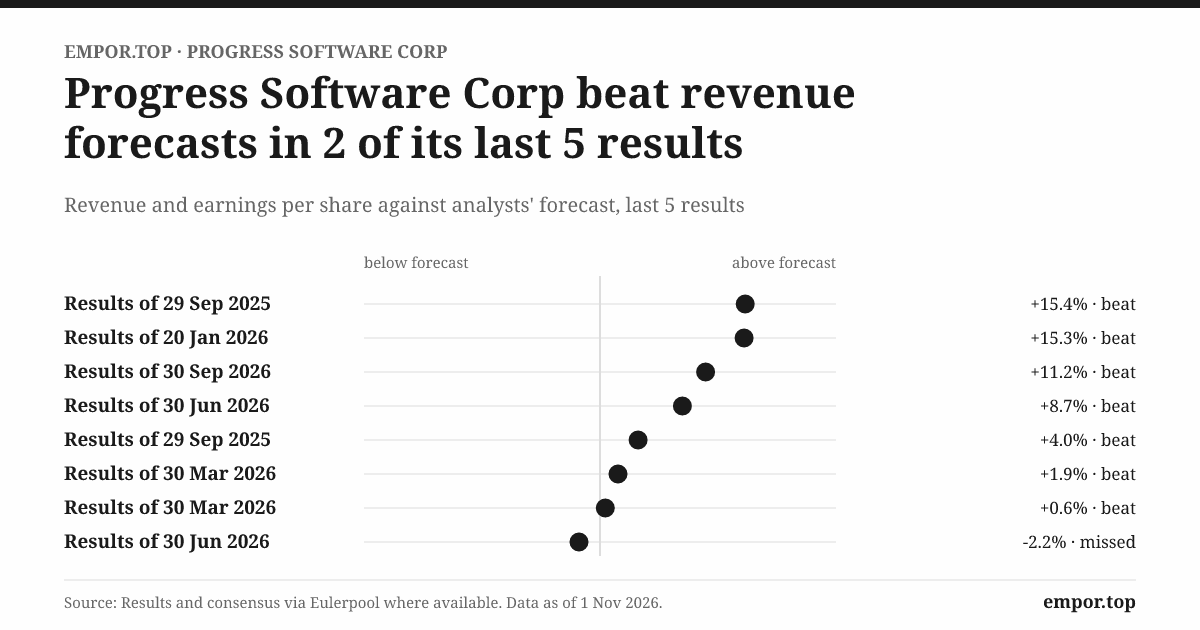
There was also a timing story behind the dip. Three months earlier, Progress had beaten its second-quarter forecast, and management said at the time that a little more than half of that beat came from deals pulled forward out of the third quarter.4 So the year-over-year decline in the August quarter is partly an accounting echo of June's strength. Even allowing for that, the full-year picture is modest. Management guided fiscal 2026 revenue to between $1.044 billion and $1.052 billion, an increase of more than $50 million, and much of that increase comes from about two months of Domo and a full year of businesses bought earlier.1
That gap is the clue to the whole company. Progress reported $977 million of revenue in fiscal 2025, the year that ended in November 2025, and $153 million of GAAP operating profit.5 Over the decade to fiscal 2025, revenue grew about 10% a year. That is a respectable pace for a company founded in 1981. But it is mainly the result of acquisitions, and the faster growth of the last three years, about 17.5% a year, came almost entirely from the businesses Progress bought.5 Over those same three years, GAAP net profit fell about 8% a year.
So the Domo call raises three questions that run through Progress's history. The first is whether the core products, the ones customers have relied on for decades, can keep those customers paying more each year rather than slightly less. The second is whether the acquisitions that built today's Progress have earned back their price once interest, amortization and integration are counted, not just on the adjusted scoreboard. The third is the newest: whether Domo can bring growth to a portfolio whose existing products have mostly stopped growing, without leaving the balance sheet too weak to absorb a mistake.
The tension is plain. Progress is a software company whose stated strategy depends on two things that pull in different directions. It has to keep old products alive for customers who would rather not move off them, and it has to keep buying new products, because the old ones do not grow fast enough on their own. To see why that strategy exists at all, the story has to go back to a small database company in the Boston suburbs and the unglamorous product that still pays a large share of the bills.
 Subscribe on LinkedIn
The database that became a life raft
Progress started in 1981, when personal computers were still a novelty and most business software was written to order.[^6] Its founders were building something for companies that did not want to buy an off-the-shelf package but did not have an army of programmers either. What they built was a database tied closely to a programming environment. A business, or a small software house serving businesses, could use it to write its own order-entry system, inventory tracker or billing engine, and keep the data that system needed in the same place.
The best way to picture it is as the plumbing and wiring of a house rather than its furniture. A distributor of auto parts might never hear the name Progress. But the system it used to take orders, check stock and print invoices could have been written by a local software firm on Progress's platform, and then extended over twenty years as the distributor grew. The product is known today as OpenEdge.5 Its users rarely chose it in any one year. They chose it once, a long time ago, and then built a business on top of it.
The company went public on August 5, 1991, on what is now the Nasdaq Global Select Market.[^6] By then the model had a second layer that would matter more than any single customer. Independent software vendors, smaller companies that wrote industry applications for manufacturers, wholesalers, banks and hospitals, built their products on Progress and resold them. Each of those vendors' customers became, in effect, a Progress customer too. This is the source of the stickiness that has kept Progress alive through every technology fashion since: client-server, the web, cloud computing and now AI.
Switching off a platform like OpenEdge is not like switching email providers. The business logic, the thousands of small rules about how a company prices, ships and bills, is written in the platform's own language and depends on its database. Moving it means rewriting and retesting software that works, often with the original authors long gone, while the business keeps running. Most chief information officers looking at that project decide to renew the maintenance contract and leave it alone. That is a real economic advantage. It is also a trap of a kind, because the reason customers stay is often the cost of leaving, not the desire to expand.
Forty-five years later, OpenEdge still matters enormously. Progress says it is substantially dependent on two products, OpenEdge and ShareFile, and that together they made up slightly more than half of fiscal 2025 revenue.5 Long-run figures show what that durability has bought and what it has not. Revenue was roughly $330 million to $410 million a year from fiscal 2014 through fiscal 2019, almost flat for six years, before acquisitions lifted it.56 Operating margins swung widely in the same period, from about 24% to a loss in fiscal 2016, as the company restructured and wrote off bets that did not work.
That flat stretch is the important fact in this part of the story. A product that customers keep for decades is a good base for a business. It does not, on its own, make the business grow. OpenEdge kept its customers. Over most of the past decade, the evidence that it was winning many new ones is thin. The company does not publish OpenEdge's standalone revenue, growth rate or customer count, so an investor cannot tell from the filings whether the product is growing slowly, holding steady or shrinking slowly behind a stable maintenance base.
That gap between keeping customers and winning them is the tension this story keeps returning to. By the middle of the 2010s, Progress had a loyal installed base, a flat top line, and a board searching for a leader who could turn that loyalty into growth. Its eventual answer was not to reinvent OpenEdge. It was to start buying other companies' loyal customers.
Gupta makes the company a buyer
When Progress announced on October 10, 2016, that Yogesh Gupta would become its chief executive, the company was on its fourth CEO in seven years.7[^9] Phil Pead, his predecessor, retired from the role and stayed on the board.7 Gupta arrived from Kaseya, an IT-management software company he had run as chief executive from 2013 to 2015, and before that he had led FatWire Software, a content-management firm.7 He was an operator from the business-software world rather than a founder or a product visionary, and the job he inherited suited that profile. At the time he said he would continue the company's shift toward cloud-based software, add new product capabilities and sign up more large enterprise customers.[^9]
What he built instead, over the next decade, was a disciplined acquirer. The strategy has a simple logic, and Gupta repeated it on call after call. Find software businesses with large installed bases, high recurring revenue and loyal customers. Buy them at sensible prices. Strip out duplicated costs. Run them for cash. Use the cash to pay down the debt and buy the next one. Progress was not trying to win new markets with these products. It was trying to own steady, cash-generating franchises that other owners undervalued.
The first big step came in 2019 with Ipswitch, a Massachusetts company whose products included MOVEit, a tool for securely transferring files, and WhatsUp Gold, network-monitoring software. Progress agreed to pay about $225 million for a business with about $75 million of annual revenue, roughly three times sales.[^10] In 2020 it bought Chef, an infrastructure-automation company that helped IT teams configure fleets of servers, for $220 million.[^11] In November 2021 it completed the $258 million purchase of Kemp, which made load balancers and application-delivery software that keep websites and applications running under heavy traffic.8 Kemp brought roughly $70 million of annual revenue, so the price was a little under four times sales. Progress paid for Kemp from its own cash rather than new debt, and the accounting shows what it believed it was buying: of the roughly $122 million booked as acquired intangible assets, about $75.5 million was assigned to customer relationships, far more than the roughly $39 million assigned to Kemp's technology.8 In other words, the asset Progress valued most was not the code. It was the customers who were already paying for it. In February 2023, Progress completed the $355 million acquisition of MarkLogic, a data-platform company owned by private-equity firm Vector Capital, which it said would add more than $100 million of annual revenue.[^13]
To a non-engineer, these products can sound interchangeable, but each solved a narrow, unglamorous problem. File-transfer software is the armored truck that carries a bank's payroll file to a payment processor. Infrastructure automation is a recipe book that lets one engineer set up a thousand servers the same way instead of configuring each by hand. A load balancer is the traffic officer standing in front of a website, sending each visitor to whichever server has room. A data platform like MarkLogic is a filing system for messy information that does not fit neatly into rows and columns. None of these is a product people talk about at dinner. All of them are products that, once installed and trusted, IT departments rarely want to rip out, which is exactly the quality OpenEdge had taught Progress to value.
The pattern is clear. Each deal was priced at roughly three to four times the revenue Progress quoted at the time. That is cheap compared with the double-digit revenue multiples paid for fast-growing software companies in the same years, and the cheapness was the point. These were not hot companies. Several came from private-equity owners who had already harvested the easy gains. Progress's bet was that it could run them more cheaply than their previous owners and keep their customers renewing.
Headline multiples, however, do not prove value. A business bought at three times revenue is a bargain only if its revenue holds up, its margins expand after integration, and the cash it throws off covers the cost of the debt used to buy it. Progress does not publish product-level revenue history for Ipswitch, Chef, Kemp or MarkLogic after acquisition, so outside investors cannot directly check whether each one grew, held steady or shrank. What the consolidated results show is that operating cash flow roughly doubled between fiscal 2018 and fiscal 2025, while total borrowing went from almost nothing to well over $1 billion.56 The cash rose. So did the leverage that bought it.
There is also an earlier chapter that sits uneasily beside this tidy story. In Gupta's first years, Progress tried to build new growth organically, under the banner of "cognitive" applications. It had acquired DataRPM, a predictive-maintenance analytics company, and Kinvey, a mobile back-end platform, to put machine learning and modern app development at the center of its strategy. In 2019 the company cut investment in those products and wrote off $22.7 million of related intangible assets.9
That write-off was small. It was a fraction of the price paid for any later acquisition, and the business survived it easily. But it is the clearest disclosed failure in Gupta's record, and it failed in a particular way: the technology worked well enough, but customers did not buy it in sufficient volume. Progress responded by changing strategy, not just products. Instead of trying to invent the next growth business, it would buy businesses that already had customers. That pivot made sense. It also meant that the AI ambitions of 2017 did not produce a commercial track record, which matters now that Progress is again presenting itself as an AI company.
By 2023, the acquisition engine was running smoothly, and every one of these deals was a few hundred million dollars. The next one would cost more than any of them, more than twice the largest, and it would change both the shape of Progress's revenue and the shape of its balance sheet.
The $875 million ShareFile bet
In September 2024, Progress announced that it would buy ShareFile from Cloud Software Group, the private-equity-backed company formed from Citrix and TIBCO, for $875 million.10 In the same announcement it suspended its quarterly dividend.10 For a company that had paid a dividend every year since fiscal 2017, that second decision said as much about the size of the bet as the first.
ShareFile is a cloud service that lets businesses share, store and sign documents securely with clients. The core customers are firms that exchange sensitive files all day: accountants sending tax returns, lawyers swapping contracts, financial advisers collecting signed forms. It is software-as-a-service, sold on subscription and run in the cloud. That made it a different kind of asset from OpenEdge, whose revenue comes largely from licences and maintenance. Management argued it added document-centric collaboration, a large SaaS revenue stream and a base of enterprise and mid-market customers to the portfolio.10
Progress told investors that ShareFile would bring more than $240 million of revenue and annual recurring revenue.10 At $875 million, that is about 3.6 times revenue. Compared with the earlier deals, the multiple was at the upper end of Progress's range, above Ipswitch's roughly three times and in line with Kemp and MarkLogic. The real step-up was in the size of the cheque. ShareFile cost about two and a half times the price of MarkLogic, the previous record. Management justified the price on ShareFile's recurring revenue, high customer retention and margins it expected to reach once ShareFile was folded into Progress's cost structure.10 Those were underwriting assumptions. The debt was a fact the day the deal closed.
Progress completed the acquisition on October 31, 2024.[^16] It paid in cash, drawing heavily on its revolving credit facility, and said it expected net leverage of roughly 3.6 times EBITDA at close.10 Net leverage measures how many years of earnings before interest, tax, depreciation and amortization it would take to repay net debt; 3.6 times is high for a company of Progress's size, though not alarming for one with steady cash flows. Management set out its priorities plainly. Debt repayment would come first, while the company kept room for share repurchases and for further acquisitions.10
The first year inside Progress shows both what ShareFile delivered and what it cost. Because Progress's fiscal year ends in November, ShareFile contributed only one month to fiscal 2024. In that quarter, net profit fell to about $1 million as acquisition and integration costs landed.5 In fiscal 2025, the first full year, revenue rose about 30% to $977 million, almost all of it from ShareFile and the smaller Nuclia acquisition.5 Operating profit rose to $153 million. Net profit rose only about 7%, to $73 million.5
The reason sits a few lines below operating profit. Interest expense in fiscal 2025 was $70.9 million, against profit before tax of $81 million.5 Put simply, almost half of what Progress earned from its operations went to its lenders before taxes. And amortization of acquired intangible assets in operating expenses alone was $104.3 million.5 Amortization is an accounting charge that spreads the price of an acquired business's customer relationships and technology over several years. It costs no cash in the current year, but it reflects cash already spent. Each acquisition raises revenue, and it also raises the amortization and interest the business has to cover before shareholders see a GAAP profit.
The cash side of the first year was weaker than it looks in hindsight. On the third-quarter 2026 call, CFO Anthony Folger said ShareFile's integration had caused billing and collection problems, so 2025 cash flow was "light" and 2026 would be "probably a little bit heavier" as the backlog cleared.1 That is a candid admission, and it explains why the company's receivables swelled. It also means part of 2026's strong cash growth is a catch-up rather than new earning power.
ShareFile's purchase also brought fixed costs. Progress assumed a cloud-hosting purchase commitment that still had $76.5 million left to run at the end of fiscal 2025, through May 2029.5 A SaaS product is paid for every month whether customers grow or not, so this is part of what makes ShareFile's economics more fixed than OpenEdge's.
The verdict on ShareFile is still provisional. Progress has not reported ShareFile's standalone organic growth since closing, so investors cannot check the core claim, that it was a durable, growing SaaS franchise, directly. What they can see is that the company as a whole has not grown organically since the deal closed. The purchase changed Progress's scale. It has not yet changed its growth rate. That brings the story to the products that have to carry this larger structure, and to whether customers' loyalty to them is as strong as the strategy needs.
The products that pay for the portfolio
Picture a mid-sized manufacturer renewing its software contracts with Progress. The renewal for the system it built on OpenEdge years ago is not a decision about innovation. It is a decision about whether to keep the lights on. Next to it on the same desk might be a ShareFile subscription that the finance team uses to send documents to auditors, and perhaps a MOVEit licence for moving payroll files to a bank. Each of these is a small line in a large IT budget. Each is also attached to a process the company does not want to disrupt.
That is how Progress makes money, and the way the contracts work explains why its quarterly revenue can move unexpectedly. Customers can buy perpetual licences, which they own forever and are generally billed at signing; term licences, which run for one to three years and are generally billed annually in advance; maintenance and support, recognized gradually over the contract; SaaS subscriptions; and professional services.5 Accounting rules make Progress book much of a term licence's value when the contract starts, not over its life, so a large multi-year renewal can fill one quarter and leave the same quarter next year looking empty. Management made exactly that point on the third-quarter call: renewal timing shifted revenue, while constant-currency revenue for the year to date grew about 2%, closely tracking ARR.13
Investors need to keep three measures of visibility separate. ARR is a company-defined measure, not a GAAP figure, and it includes maintenance, software upgrade rights, cloud services, on-premises subscriptions and managed services, including annualized monthly SaaS contracts.5 It is not a measure of how much revenue is pure subscription, and Progress does not publish a single consolidated recurring-revenue percentage. Remaining performance obligations, the value of signed contracts not yet recognized as revenue, were $536.3 million at the end of fiscal 2025, with about 74% expected within a year.5 Deferred revenue, mostly maintenance and SaaS, is cash or invoices collected ahead of the service. Together these give real visibility over the next year. None of them guarantees what happens at the renewal after that.
The two anchor products pull in different ways. OpenEdge is the larger source of licence and maintenance revenue, the old base. ShareFile is the largest SaaS product, the new base. Progress tells investors that continued customer acceptance of both is material to its future results, and the two together made up slightly more than half of fiscal 2025 revenue.5 What Progress does not publish is a product-level profit and loss: revenue, growth or margin for OpenEdge, ShareFile, MOVEit, Chef or MarkLogic. On the third-quarter call, management said ARR growth was "led by OpenEdge."1 That is a useful signal that the oldest product is still adding a little. It is not a growth rate.
So how strong is the customer lock-in? The best evidence is the absence of concentration. No single customer or partner accounted for more than 10% of revenue in any of fiscal 2023, 2024 or 2025, and no customer exceeded 10% of receivables.5 Thousands of small decisions to renew, rather than a handful of large contracts, are what keep Progress going. That makes the business resilient to the loss of any one account. It does not, by itself, show strong pricing power. Progress does not disclose the share of revenue from its largest five or ten customers, a long history of product-level retention or win rates against competitors.
The retention figure it does publish points to stability, not expansion. Net retention was 100% in the second quarter of fiscal 2026 and 99% in the third.41 A software company with real pricing power and strong cross-selling would usually show net retention well above 100%, because existing customers would buy more each year. Progress's figure says the average customer is renewing at roughly the same level, with price increases and upsells offset by customers who shrink or leave. That fits a business whose products are hard to remove but not ones customers are rushing to expand.
Then there is the competition, which is much larger. Progress competes across application development, data platforms, file transfer, infrastructure management and document collaboration, and in most of those markets it is not the largest company. Gartner estimated that Microsoft, Atlassian and GitHub, which Microsoft owns, together generated $7.9 billion in revenue in the broad application-development software market in 2024.11 That category is not the same as Progress's business, and Progress's $977 million is total company revenue, not application-development revenue alone, so the numbers are not directly comparable. But the comparison shows the scale gap. The platforms Progress competes with can spend more on research and development in a quarter than Progress spends in a year.
Progress is also more international than its Massachusetts roots suggest. In fiscal 2025, about $281 million of revenue came from Europe, the Middle East and Africa, about $52 million from Asia Pacific and about $22 million from Latin America.5 That spread adds a modest currency exposure. The company estimates that a 10% adverse move in exchange rates would cut revenue by about $20 million but net income by only about $0.9 million before hedging, because many costs are incurred in the same currencies.5 Currency is a translation nuisance for Progress, not a threat to the thesis.
Progress does spend heavily for its size. Product development expense was $192.3 million in fiscal 2025, about 20% of revenue, up from about $146 million the year before.5 Of 2,801 employees at year-end, 1,048 worked in product development.5 But much of that increase came with ShareFile's engineers, so it shows the cost of a larger portfolio more than a surge in organic reinvestment. Capital expenditure was only about $5.7 million.5 This is an asset-light business whose real investment is people and code.
Put the forces together and the picture is mixed. Buyers have choices: they can move new projects to larger platforms, specialist tools or open-source alternatives, even if they leave old applications where they are. Switching a working OpenEdge application is costly and risky, which protects the installed base. Cloud services, AI coding assistants and modern developer tools offer substitutes for new work, and they may make migrations cheaper over time, which is the most serious long-term threat to that installed base. If an AI tool can translate decades-old business logic into a modern language at a fraction of today's cost, the moat narrows. Progress has smaller research and distribution budgets than its largest rivals.
The verdict is that Progress has a narrow moat built on switching costs and a broad, diversified installed base. The evidence supports durability: steady renewals, no customer concentration and net retention around 100%. It does not support a broader claim of pricing power or growing market share. The filings would reject that stronger claim, at least for now, because organic growth is in the low single digits and net retention has slipped below 100%. The evidence that would change this verdict is product-level ARR growth and renewal rates for OpenEdge and ShareFile, published consistently. Until then, the products pay for the portfolio, but they do not grow it. What they do produce, reliably, is cash, and that is where Progress's investment case is strongest and also easiest to misread.
Strong cash, with a weaker earnings story
Lay twelve years of Progress's financial statements side by side and one comparison stands out. From fiscal 2014 to fiscal 2025, the company reported about $575 million of cumulative net profit. Over the same twelve years, it generated about $1.8 billion of cash from operations, more than three times as much.56 Free cash flow, operating cash minus capital spending, was about $1.7 billion.
A gap that wide is either a sign of an exceptionally good business or a sign that accounting profit understates economic reality for specific reasons. For Progress, it is mostly the second, and the two reasons are worth working through, because they explain how the acquisition strategy looks from the inside.
The first reason is amortization. When Progress buys a company like ShareFile, much of the price is recorded as intangible assets, customer relationships and technology, which are then charged against earnings over several years. That charge reduces reported profit each year, but the cash was spent on the day of the deal and shows up in investing cash flow, not operating cash flow. In fiscal 2025 alone, amortization of acquired intangibles in operating expenses was $104.3 million, more than the year's entire net profit of $73 million.5 So operating cash flow looks strong partly because the cost of buying the business is counted somewhere else. A fair way to judge the acquisition engine is to subtract acquisition spending from free cash flow, not to admire free cash flow on its own.
The second reason is customer prepayments. Maintenance and SaaS are typically billed in advance, so cash arrives before revenue is recognized. That helps operating cash flow when the business grows and becomes a drag if it shrinks. Stock-based compensation, a real cost paid in shares rather than cash, also lifts operating cash relative to profit.
None of this makes Progress's cash flow fake. Fiscal 2025 free cash flow was $229 million, on revenue of $977 million.5 That is a lot of cash for a company of this size. But two trends point the other way. Revenue grew about 17.5% a year from fiscal 2022 to fiscal 2025, while net profit fell about 8% a year.5 More revenue came with more amortization, more interest and more integration cost, so less of each dollar reached shareholders. And cash from operations fell from about 100% or more of EBITDA in the early years to about 77% in fiscal 2025.5 Some of that decline reflects interest payments, which rise with debt and come out of operating cash. Some reflects slower collections.
Collections are the working-capital clue. Receivables measured as days of revenue rose from about 75 in fiscal 2014 to a peak of 96 in fiscal 2024, then eased to 91 in fiscal 2025.56 In fiscal 2025, rising receivables used $46.6 million of operating cash.5 Part of this comes from the way term licences are accounted for: Progress recognizes revenue at the start of multi-year contracts but bills annually. At the end of fiscal 2025, it carried $29.95 million of non-current unbilled receivables scheduled to be billed in 2027 through 2029.5 That is revenue already booked for cash that customers have not yet been asked to pay.
The ShareFile billing problems explain much of the recent spike, and 2026 shows them easing. On management's own measure, days sales outstanding fell to 42 at the end of the third quarter of fiscal 2026, from 55 a year earlier and 73 at the end of fiscal 2025.1 Adjusted free cash flow for the first nine months was $265 million, up 44%.1 That is a real improvement. It is also partly a one-time recovery of cash that should have arrived a year earlier, which is why the improvement should not be extrapolated without checking whether collections stay at the new level.
Where did the cash go? Over the twelve years, dividends took about $229 million, about 13% of free cash flow, until they were suspended for ShareFile.510 Most of the rest went to acquisitions, share repurchases and debt repayment. In fiscal 2025, Progress spent $105 million on buybacks and repaid $130 million of revolver borrowings.5 In September 2025 the board added $200 million to the repurchase authorization, bringing it to $242.2 million, and Progress bought back $71.6 million of stock in the first nine months of fiscal 2026.52 It repaid $170 million of revolver debt over the same nine months.1 And yet cash and short-term investments at the end of fiscal 2025 were about $95 million, less than the roughly $231 million it held at the end of fiscal 2013.5 Progress has not hoarded its cash. It has recycled it into deals, buybacks and debt service.
That choice shows up in the small print of the treasury. In fiscal 2025, interest income and other gains were only about $1.8 million, set against interest expense of nearly $71 million.5 A company with a fat cash pile earns interest; a company that runs lean and borrows pays it. About $69 million of the cash Progress held at the end of August 2026 sat in foreign subsidiaries, so the readily available cushion at home was thinner still.2 Meanwhile the debt mix shifted. The convertible notes due in 2026 had been repaid or converted by August, leaving the revolver and the 2030 convertible notes as the two main sources of borrowing.2 Revolving credit is flexible and cheap to draw, but its rate floats, so every move in interest rates passes straight through to Progress's earnings. That makes the pace of repayment a bigger lever on per-share profit than almost anything management can do in operations.
The verdict here is balanced. Cash generation is a genuine strength, and it is what makes the acquisition model possible at all. But the long-run comparison of cash with profit flatters the business, because it leaves out the cash spent buying the assets whose amortization depresses profit. The better test is the recent trend: cash conversion weakened, net profit shrank while revenue grew, and receivables stretched before recovering. The question an investor should take into the Domo deal is simple. Can Progress keep collections at their improved level and keep repaying debt while it absorbs another acquisition, this time one whose profits are still mostly forecasts?
Domo: the cheaper deal with the larger promise
On September 22, 2026, Progress completed its acquisition of substantially all of Domo's AI and data-platform business and its employees.12 The total purchase consideration was $403.2 million, funded with $390 million of new borrowing on the revolver plus cash.12 Domo, a Utah-based company that had been public for years, had built a cloud platform for pulling together a company's data from dozens of systems, cleaning it, analyzing it and putting it into dashboards and apps that business users can use without writing code.
Why would a company built on databases and file transfer want a business-intelligence platform? Gupta's answer is about context. For more than a year he had told investors that "context and control are key to AI efficacy, outcomes, and value."4 Corporate AI systems are only as useful as the data and documents they can reach and the rules that govern them. Progress already holds a lot of that context: business logic in OpenEdge applications, data in MarkLogic, documents in ShareFile and files moving through MOVEit. Domo adds the layer that connects and transforms data in real time, analyzes it and, in management's description, orchestrates AI agents that act on it.1 On paper, it fits the portfolio better than most of Progress's earlier deals fit one another.
But a capability is not the same as customer demand. A slide showing how the pieces connect does not tell anyone whether customers will buy them together. Progress has not sized the expected cross-selling between Domo and its existing base. The 2017 cognitive-applications push is a reminder that an AI story can be technically credible and still fail to turn into revenue. Domo is a different case, because it already has paying customers. But the integration story, Domo's tools working with OpenEdge, MarkLogic and ShareFile, is the part that has to prove itself.
On price, the case is better. CFO Folger described the deal as roughly 1.4 times revenue and about 3.5 times pro forma EBITDA, measured against Domo's expected steady-state revenue.13 That is less than half the revenue multiple of ShareFile and well below the three to four times Progress paid for Ipswitch, Kemp and MarkLogic. Measured by Progress's own history, the price does not suggest overpayment.
There is a reason it was cheap. Domo, as a standalone public company, lost money for most of its history and said so in its own filings.13 The business Progress bought excluded Domo's tax-loss carryforwards, the accumulated losses that could have sheltered future profits from tax, which stayed with the public company.12 Management pointed instead to "meaningful tax benefits" from the asset-purchase structure.1 A low multiple can reflect a buyer's skill. It can also reflect a business whose revenue is shrinking and whose seller had few better options. Both appear to apply here.
The shrinkage is visible in management's own numbers. Gupta said Domo's revenue annualizes at about $300 million, but Progress expects steady-state revenue of $280 million to $290 million.1 The gap comes from two parts of Domo's business that Progress expects to decline. Its older seat-based subscriptions, priced by the number of users, "will continue to see significant churn," in Gupta's words, and its professional services, about 10% of revenue, are being handed to partners because they earn lower margins.1 The part Progress wants is consumption-based pricing, where customers pay according to how much data they process, which management said makes up more than 85% of Domo's ARR and carries "significantly higher net retention rates."1
Consumption pricing is attractive, but it cuts both ways. It is like an electricity bill: if customers use more data and run more AI workloads, revenue rises without a new sale. If budgets tighten or a customer finds a cheaper tool, usage falls and revenue falls with it, with no annual contract to cushion the decline. Progress has not published Domo's consumption revenue growth or its consumption-customer net retention as a number.
The profit case is still a forecast. Gupta said Domo will add "well over $100 million" of EBITDA a year once fully integrated, a level management targets by the end of fiscal 2027.1 On the way there, Folger said Domo would run at an operating margin slightly below 30% in fiscal 2027 as cost savings ramp up, pulling Progress's overall adjusted margin from the 38% to 39% range down to perhaps 36% to 37%.1 Asked by Guggenheim's Lawrence Vensko where the savings would come from, Gupta gave a specific answer: merging two public companies into one, cutting general and administrative costs, and shifting Domo's sales approach away from the growth-at-all-costs spending of its standalone years.1 He also said Domo's professional-services work would move to partners as a lower-margin business.1 That is a credible playbook, and it is the one Progress has used before. But it is a plan, not a result.
The arithmetic shows how much rides on it. If Domo settles at roughly $285 million of revenue, the midpoint of management's range, then more than $100 million of EBITDA implies a margin above 35%, against a starting point that, by Domo's own filings, was a loss-making business.113 Progress has made that kind of jump before with mature software. It has not done it before with a consumption-priced analytics platform whose customers can turn usage down as easily as up. To keep those customers, management planned a roadshow of a dozen cities, meeting fifty to one hundred Domo customers at each stop.1 It is a sensible move, and a sign that the company knows retention, not just cost-cutting, will decide the deal. The new borrowing will cost about $21 million in extra interest in fiscal 2027.1
The balance sheet bears the immediate cost. Before Domo, Progress had cut net leverage to about 2.7 times trailing EBITDA, down from 3.4 times at the start of fiscal 2026.14 Total debt was about $1.23 billion at the end of August, made up of $790 million of revolver borrowings and about $443 million of convertible notes due in 2030.2 The Domo draw added $390 million to the revolver. On reported earnings at close, net leverage moved back to roughly 3.8 times. Progress's pro forma presentation, which counts Domo's expected EBITDA, put it nearer 2.9 times.3 The difference between those two numbers is the value of a promise. Folger said Progress would again "delever quickly and aggressively."1
The credit terms add some edges. The revolver requires Progress to stay within limits on interest coverage and senior secured net leverage, and the 2025 credit agreement, which matures in July 2030, contains a springing-maturity condition tied to the 2030 notes.52 That means the revolver could come due 91 days before the notes unless specified repayment, refinancing or liquidity conditions are met. None of this signals near-term trouble. It does mean the company's flexibility depends on delivering the EBITDA it has promised.
So the Domo bet will be settled by four measurements: whether Domo's consumption revenue grows organically, whether its net retention stays high, whether Domo's EBITDA reaches the promised level after integration, and whether Progress's net leverage falls as planned. The price was low enough to absorb some disappointment. It was not low enough to make execution irrelevant. And Progress has been reminded before that in its line of work, the most expensive failures are not always the ones on the acquisition spreadsheet.
MOVEit put the trust promise to a real test
In late May 2023, Progress told customers that attackers had found a previously unknown vulnerability in MOVEit Transfer, the file-transfer software that came with Ipswitch. Within days, security researchers reported that hackers were exploiting the flaw to steal data from organizations that ran the software on their own servers.14 MOVEit's whole purpose was to move sensitive files safely: payroll data, health records, pension details. Now it had become the way that data left.
The mechanism matters for understanding the risk. MOVEit Transfer is installed and run by customers inside their own environments. A single flaw in the product meant that every unpatched installation was exposed at once, so one vulnerability turned into breaches at many organizations. By early July 2023, Axios counted more than 200 organizations hit and millions of individuals affected, with victims including government agencies, universities and companies.15 Cybersecurity researchers attributed the campaign to the Cl0p ransomware group.14
The direct cost to Progress has been modest so far. After insurance recoveries, the company reported net MOVEit-related costs of $1.5 million in fiscal 2023, $5.6 million in fiscal 2024 and $2.8 million in fiscal 2025.5 Against nearly $1 billion of revenue, those figures barely register. But they cover only the expenses Progress has already paid. The company faces lawsuits, claims and investigations arising from the incident, and it says a loss is reasonably possible but that it cannot yet estimate a range.5 An exposure that cannot be measured is different from one that is small.
The audit offers no shortcut here. Progress's auditor gave an unqualified opinion on the fiscal 2025 financial statements, and the critical audit matter it highlighted concerned acquisition accounting and the valuation of acquired intangible assets, not MOVEit.5 That is reassuring about the books. It says nothing about how the legal claims will end.
The reputational exposure is harder to measure and possibly more important. Progress sells reliability and security in several products. MOVEit's breach went straight at that promise. The company does not report MOVEit's revenue or retention separately, so investors cannot see whether customers left or stayed. The broader lesson for the portfolio is that security is part of what customers pay for in file transfer, document sharing and infrastructure management, so a single incident can damage a product's value in a way an accounting charge does not show. Future incident response and retention in Progress's security-sensitive products are part of the investment case, not an afterthought. And responsibility for the portfolio, its deals and its risks, sits with one executive whose pay and reputation are tied to the acquisition strategy.
The CEO's incentives meet the integration bill
Ten years into the job, Gupta is one of the longest-serving chief executives Progress has had, and the company it now is reflects his decisions. He stopped the cognitive-application push, turned Progress into an acquirer, bought ShareFile with debt, suspended the dividend and has now bought Domo with more debt. CFO Anthony Folger, in the role since 2020, has been his partner in the financial side of that strategy.16 On every call, the two present a consistent message: buy recurring-revenue businesses at reasonable prices, cut costs, generate cash and pay down debt quickly.
Their incentives line up with that message in some ways. Executive pay at Progress combines salary, an annual cash bonus tied to corporate targets and large equity awards. Gupta's total reported compensation was $10.5 million in fiscal 2025, $10.4 million in fiscal 2024 and $8.6 million in fiscal 2023.16 Over the same three years, net profit was roughly flat at $70 million, $68 million and $73 million.5 His fiscal 2025 corporate bonus was $845,000 against a $650,000 target, meaning the company exceeded the bonus goals the board set.16 Those goals are built on adjusted revenue and earnings, so it is possible for management to beat its pay targets in a year when GAAP profit barely moves. That is common in software, but it means investors should watch GAAP profit and cash after acquisitions themselves rather than relying on the bonus scorecard.
Gupta also owns a meaningful slice of the company. The 2026 proxy reported his beneficial ownership at about 1.7% of shares, a stake worth roughly $30 million at the current share price.16 That is real exposure to the outcome. The largest outside holders are index and asset managers. The proxy listed BlackRock with about 6.6 million shares and Vanguard with about 5.5 million, based on filings from different dates, and BlackRock reported a stake above 5% in June 2026.1617 No shareholder controls the company. Eight of nine directors are independent, and the chair and CEO roles are separate.16
Folger's pay, about $4.2 million in fiscal 2025, follows the same structure on a smaller scale.16 The point is not that either executive is overpaid by software-industry standards; it is that a large share of their rewards arrives in stock, which ties them to the share price, while their annual bonuses are tied to adjusted measures that look past the costs of acquisitions.
Shareholders have broadly backed the pay plan. At the May 2026 annual meeting, about 31.2 million shares voted for say-on-pay and about 2 million against, roughly 94% support among votes cast for or against.18 That is not unanimous, but it is solid.
The harder question is whether management's record justifies trust in the next deal. The evidence is mixed in a specific way. Management has delivered on the parts of the strategy it controls most directly: cost cuts, cash generation and debt repayment. Adjusted margins have expanded, and after ShareFile, leverage came down roughly as promised, from about 3.4 times to 2.7 times within fiscal 2026.14 It has delivered less on the part it controls least: organic growth. On the second-quarter call, Gupta reiterated an organic growth rate of around 2% and declined to forecast further out.4 And the one disclosed product failure, the 2019 DataRPM and Kinvey write-off, came from exactly the kind of AI-driven new-product bet that Domo now represents, even if Domo is a far more mature business.
Analysts have pressed on this. On the same second-quarter call, Guggenheim's John DiFucci asked about the acquisition pipeline, and Gupta said Progress intended to stay within its existing revolver capacity for acquisitions.4 Three months later, Progress drew $390 million on that revolver for Domo. That is consistent with what he said, but it shows that "within revolver capacity" leaves room for another large deal while the last one is still being digested.
A skeptical shareholder would not need to agitate to make the obvious point. The case for pausing further large acquisitions until Domo's integration, product-level growth and leverage targets are visible is strong, because the alternative uses of cash, debt repayment and buybacks at a high free-cash-flow yield, offer returns that can be measured now. Progress does not report quantified related-party revenue, a controlling shareholder or parent-company fees; its results are consolidated, and its governance questions are about capital allocation, not conflicts of interest.5 The governance test that matters more than any single vote is whether management will show the return on Domo, in organic revenue, EBITDA and leverage, before asking investors to back the next deal. That question frames how the market is now pricing Progress.
Analysis & Bear vs. Bull Case
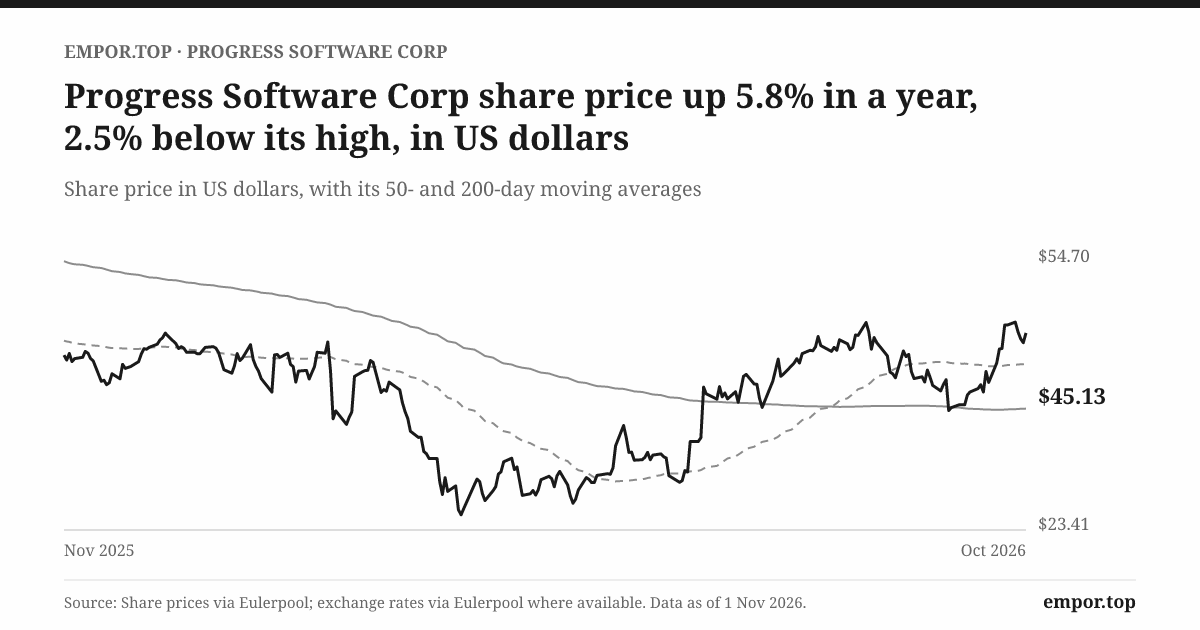
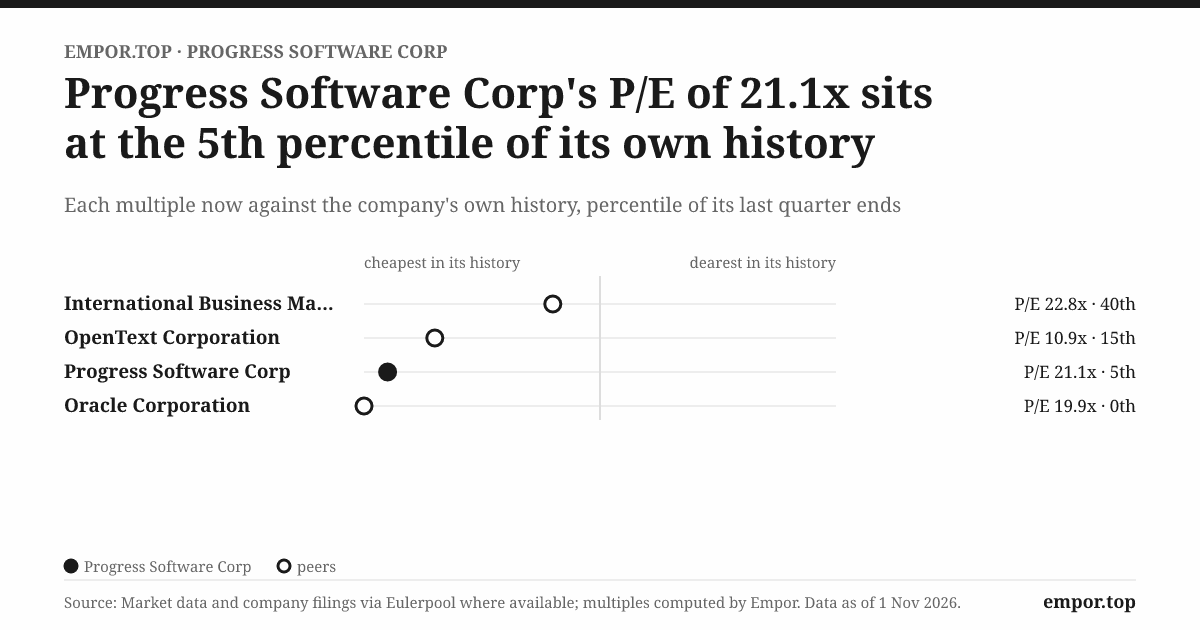
On November 1, 2026, Progress shares closed at about $45, within a few percent of their 52-week high and up from a low of about $25 within the past year. That puts the company's market value at about $1.9 billion and, including net debt, its enterprise value at about $3.1 billion. The stock has been volatile. Over five years, it has fallen as much as 64% from a peak, and its one-year volatility is around 55%. Even after the rebound, it trades at about 21 times trailing GAAP earnings, below its own five-year median of about 28 times, at about 10 times EBITDA and with a trailing free-cash-flow yield of about 17%.52
Those figures look cheap, and on management's adjusted scoreboard they look cheaper still. Progress guided to fiscal 2026 non-GAAP earnings per share of $6.15 to $6.23, which is about seven times the share price.1 One peer screen put Progress at about 7.3 times forward earnings against a broad software and IT-services median above 50 times.19 A separate comparison dated October 30 put Progress at about 21 times trailing earnings and about two times sales, against a peer median of about 26 times earnings and nearly seven times sales.20 Both comparisons mix very different companies, and the forward one uses Progress's adjusted earnings, which exclude amortization from acquisitions. GAAP earnings per share over the last twelve months were about $2.19.2 The gap between $2 and $6 a share is, again, the cost of the acquisitions, and the market's discount appears to say it does not fully trust that cost to stay out of the picture.
What does the price assume? A free-cash-flow yield in the mid-teens implies that investors expect little growth, some decline, or a meaningful risk from leverage and acquisitions. A business that could hold its cash flows flat forever, with no debt, would be worth considerably more at that yield. So the market is pricing Progress as a portfolio of mature software assets with a debt load, run by an acquirer whose next purchase is uncertain. The discount is not proof that the market is wrong. It is a statement of what has to happen for it to be wrong.
The bull case rests on four points. Customers rely on Progress's products for processes they cannot easily replace, and that dependence is spread across thousands of accounts. Recurring contracts and $536 million of remaining performance obligations give good visibility over the next year.5 Progress has converted earnings into large amounts of cash for more than a decade, and its integration playbook has repeatedly expanded the margins of the businesses it buys. And Domo, bought at a low multiple, adds data and AI capabilities that could make the whole portfolio more relevant to the way companies are building AI systems. If Domo reaches $100 million of EBITDA and leverage falls toward three times, the free cash flow per share could rise meaningfully even without organic growth.
The bear case rests on four points too. OpenEdge and ShareFile generate slightly more than half of revenue, and neither has a published organic growth rate.5 ARR growth slowed from about 2% in the second quarter to just over 1% in the third, and net retention slipped below 100%.41 Domo's legacy seat and services revenue is declining by management's own description, and its consumption revenue is unproven at scale inside Progress.1 And the balance sheet is carrying more acquisition debt again, with interest already consuming almost half of pre-tax operating earnings before Domo.5 In this view, Progress is a company that has to keep buying revenue to stand still, and each round adds debt and integration risk.
Michael Porter's five forces help sort these claims. Buyer power is moderate. No customer exceeds 10% of revenue, which limits any single buyer's leverage, but every buyer can move new work elsewhere, which caps price increases.5 Supplier power is low in general but real in places, such as ShareFile's cloud-hosting commitment.5 The threat of substitutes is the most serious force. Cloud platforms, AI coding tools and open-source databases offer alternatives for new projects, and they may eventually make migrating old applications cheaper. The threat of new entrants is low for the installed base and high for AI and data platforms, where well-funded startups and giant platforms compete. Rivalry with much larger players is intense in nearly every category Progress serves.11
Hamilton Helmer's seven powers give a similar answer. Progress clearly has one, switching costs, built into OpenEdge applications and into the workflows that ShareFile and MOVEit support. It does not have scale economies against Microsoft or the other large platforms, network effects, a cornered resource or meaningful brand power with end users. It may have a form of process power in its acquisition and integration machine, the repeated ability to buy mature software and run it at higher margins. The non-GAAP operating margin of 43% is evidence for that. But process power should show up in returns on capital, and Progress's return on invested capital has fallen from about 14% in fiscal 2022 to about 11% in fiscal 2025, and about 9% over the latest twelve months.52 So the integration machine produces margins, but the returns on the money spent buying the businesses have narrowed. The moat is real but narrow, and it protects existing revenue more than it creates new revenue.
Three measures matter most for following this story. The first is organic, constant-currency ARR growth, which was just over 1% in the third quarter and has slowed this year.1 The second is net retention, together with any product-level renewal evidence for OpenEdge and ShareFile; net retention was 99% in the third quarter, down from 100% in the second.14 The third is free cash flow after interest, set against net leverage, which was about 2.7 times before Domo and higher after the deal.13
Analysts have probed the right weak spots. Through 2026 they have asked about organic growth, the share of revenue tied to AI demand, acquisition appetite and leverage, and management has been most specific on cost synergies, debt and guidance and least specific on organic growth beyond about 2% and on cross-selling.41 That pattern is itself information. The parts of the plan management describes most precisely are the parts it controls. The parts the market most wants to see are the ones it can only hope for. The case will be decided by the first full-year disclosure of Domo's results inside Progress and by whether the company can grow ARR while cutting net leverage at the same time.
Playbook: Business & Investing Lessons
The first lesson belongs to OpenEdge. A product can outlive its technology cycle when customers build their businesses around it, but staying power is not the same as growth. Progress's oldest product has kept its customers through four decades of technology change, and that loyalty has paid for almost everything else the company has done. But the six flat years before Gupta's acquisitions are the proof that loyalty alone does not move a revenue line. For founders, the lesson is that switching costs protect a business best when it is also giving customers reasons to buy more. For investors, it is that a high renewal rate tells you a product is hard to leave, not that it is worth expanding.
The second lesson belongs to the 2019 write-off. A technical milestone is not a market; a product earns its place only when customers keep paying. DataRPM and Kinvey were bought in the excitement of an AI wave, and $22.7 million was written off when customers did not follow.9 The loss was small, but it was a precise warning, and it is the closest thing in Progress's own record to the Domo bet. Any company describing itself as an AI platform should be judged by consumption revenue and renewals, not by the elegance of the architecture diagram.
The third lesson belongs to ShareFile and Domo. A recurring-revenue label does not erase the price, the debt or the integration work. Together the two deals cost more than $1.2 billion, and they have turned Progress into a larger, more leveraged company with more amortization to cover.1012 Recurring revenue made both deals easier to finance and easier to explain. It did not make the debt disappear, and it did not make ShareFile grow fast enough to lift the whole company's growth rate. The shareholder's question about any acquirer is never whether a target's revenue is recurring. It is whether the buyer's return on the price exceeds what the same cash would have earned paying down debt or buying back stock.
The fourth lesson belongs to the gap between Progress's cash and its profit. Amortization is the receipt for growth you bought. For twelve years, Progress produced roughly three dollars of operating cash for every dollar of net profit, and it is tempting to read that as a business secretly more profitable than its accounts admit. Part of it is. But much of the difference is the price of past acquisitions, paid up front in cash and then charged against earnings year after year. An investor who adds back the amortization and ignores the purchase price is counting the harvest without the cost of the land. The honest measure for a serial acquirer is cash generated after the cash spent on deals, per share, over a full cycle.
The fifth lesson belongs to MOVEit. When trust is the product, a breach is not a one-time cost. The direct expense of the 2023 attack has been a few million dollars a year, a rounding error against revenue, yet the claims still cannot be measured and the damage to the promise of secure file transfer cannot be booked at all.5 A portfolio of security-sensitive software inherits every product's vulnerabilities along with its customers.
The discipline investors should demand follows directly from these lessons. Before the next strategic promise, Progress should show organic expansion and lower leverage in the numbers it already publishes. A company that buys its next act has to prove, every few years, that the previous act was worth the ticket.
Epilogue
Tonight, Progress is a different company from the one that reported its third quarter a month ago. Domo is inside the portfolio. The revolver is larger by $390 million. The fourth-quarter guidance of $297 million to $305 million of revenue includes about two months of Domo, so the next set of results will be the first in which the new business shapes the numbers.1 Formal guidance for fiscal 2027 is due in January.1
The next two to four quarters will answer the questions that matter. Progress needs to show how Domo's revenue divides between consumption, seats and services, and whether consumption revenue is growing while the seat business declines. It needs to show whether Domo customers renew at the high retention rates management described and whether the cost savings arrive on schedule. If Domo moves toward the $280 million to $290 million of steady-state revenue and the more than $100 million of EBITDA that management has promised, the low purchase price will look shrewd and the leverage will fall quickly.1 If the seat-based churn runs deeper, or consumption slows as customers watch budgets, the multiple will look cheap for a reason.
The second test is the rest of the portfolio. Progress's ARR comparisons will soon include Domo, so the measure that matters will be organic growth excluding acquisitions. If that figure climbs back toward the mid-single digits, it would suggest that Progress's AI framing is bringing in new spending from existing customers. If it stays near 1%, Progress will remain a company whose growth comes from buying it.
The third test is cash. Leverage should fall from its level at close, and the improvement in collections that lifted free cash flow this year should persist after the ShareFile backlog is cleared. Folger has promised quick and aggressive deleveraging.1 The record after ShareFile makes that credible. The record of organic growth makes it necessary.
January will bring the first real scene of the next act. When Progress sets its fiscal 2027 guidance, investors will see for the first time how management splits the year between Domo and everything else, how much of the roughly $21 million of extra interest it expects to absorb, and how quickly it plans to bring the revolver back down.1 A guide that leans on synergies while organic growth stays near zero would tell one story. A guide that shows the older products growing again, even slowly, alongside a shrinking debt balance would tell a very different one. And the board's choice of what to do with each spare dollar of cash in 2027, repay borrowing, buy back stock or hunt for the next deal, will say more about the company's confidence in Domo than any slide about AI.
Some questions will remain open because Progress does not disclose the answers: product-level renewal rates, the overlap between Domo customers and Progress customers, and Domo's standalone economics after the close. Those are the numbers that would settle whether Progress has bought a new growth engine or another franchise to run for cash. Until they appear, the company asks investors to judge it on a promise backed by a long, mostly successful history of integration and a short, mostly flat history of growth.
Outro
Back on that September call, the contrast was striking: a company reporting ARR growth of about 1% while announcing that it had borrowed nearly $400 million to buy a data platform that might make it central to corporate AI.112 Underneath both facts sits the same foundation, an old database business whose customers never left, and a newer document-sharing service whose cash now helps pay the interest on the debt that bought it.5
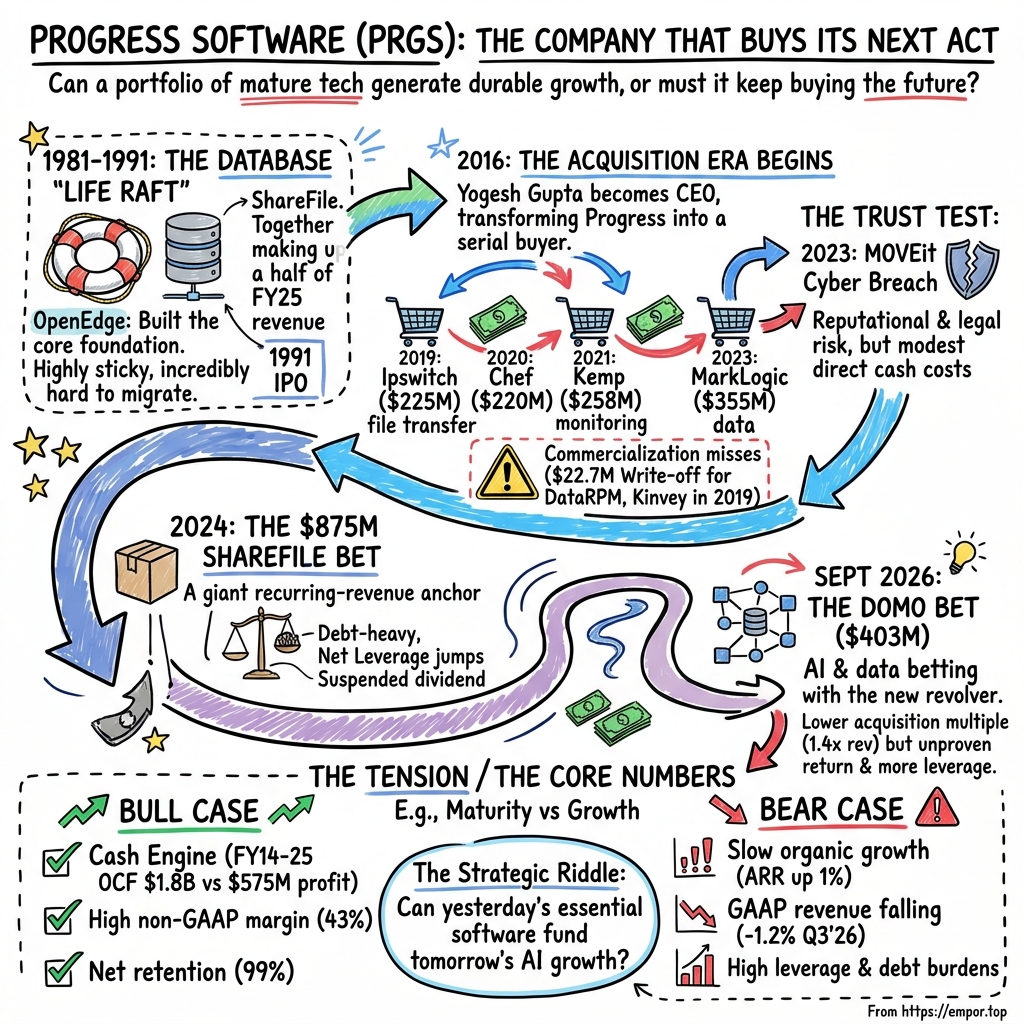
That is what makes Progress unlike a conventional software growth story. It is not trying to grow faster than its markets by inventing new ones. It is trying to turn yesterday's essential software into tomorrow's growth, and it is borrowing against the answer. Progress has spent decades keeping business software running; the next chapter is whether it can make that software grow again.
References
-
Progress Software (PRGS) Q3 2026 Earnings Call Transcript — The Motley Fool, 2026-10-01 ↩↩↩↩↩↩↩↩↩↩↩↩↩↩↩↩↩↩↩↩↩↩↩↩↩↩↩↩↩↩↩↩↩↩↩↩↩↩↩↩↩↩↩↩↩
-
Q3 FY2026 Form 10-Q — Progress Software, 2026-09-30 ↩↩↩↩↩↩↩↩↩↩
-
Q3 FY2026 Earnings Supplement — Progress Software, 2026-09-30 ↩↩↩↩↩
-
Earnings Call Transcript: Progress Software Tops Q2 2026 Estimates — Investing.com, 2026-06-30 ↩↩↩↩↩↩↩↩↩↩
-
2025 Form 10-K — Progress Software, 2026-01-20 ↩↩↩↩↩↩↩↩↩↩↩↩↩↩↩↩↩↩↩↩↩↩↩↩↩↩↩↩↩↩↩↩↩↩↩↩↩↩↩↩↩↩↩↩↩↩↩↩↩↩
-
Progress Announces CEO Succession, Exhibit 99.1 — Progress Software, 2016-10-10 ↩↩↩
-
Form 8-K: Completion of Kemp Acquisition — Progress Software, 2021-11-01 ↩↩
-
FY2020 Form 10-K: DataRPM and Kinvey Impairment — Progress Software, 2021 ↩↩
-
ShareFile Acquisition Transaction Overview — Progress Software, 2024-09-09 ↩↩↩↩↩↩↩↩↩
-
Market Share: Application Development, Worldwide, 2024 — Gartner, 2025-05-20 ↩↩
-
Domo Pro Forma Financial Information — Progress Software, 2026 ↩↩↩↩↩
-
Hackers Use Flaw in Popular File Transfer Tool to Steal Data — Reuters via Investing.com, 2023-06-01 ↩↩
-
More Than 200 Organizations Targeted in MOVEit-Related Breaches — Axios, 2023-07-07 ↩
-
2026 Proxy Statement — Progress Software, 2026-03-25 ↩↩↩↩↩↩↩
-
2026 Annual Meeting Results, Form 8-K — Progress Software, 2026-05-11 ↩
 LinkedIn
 WhatsApp
 Reddit
 Hacker News
 Email
 Kindle
 RSS Feed
 Spotify
 Apple Podcasts
 Amazon Music
 Audible
 YouTube