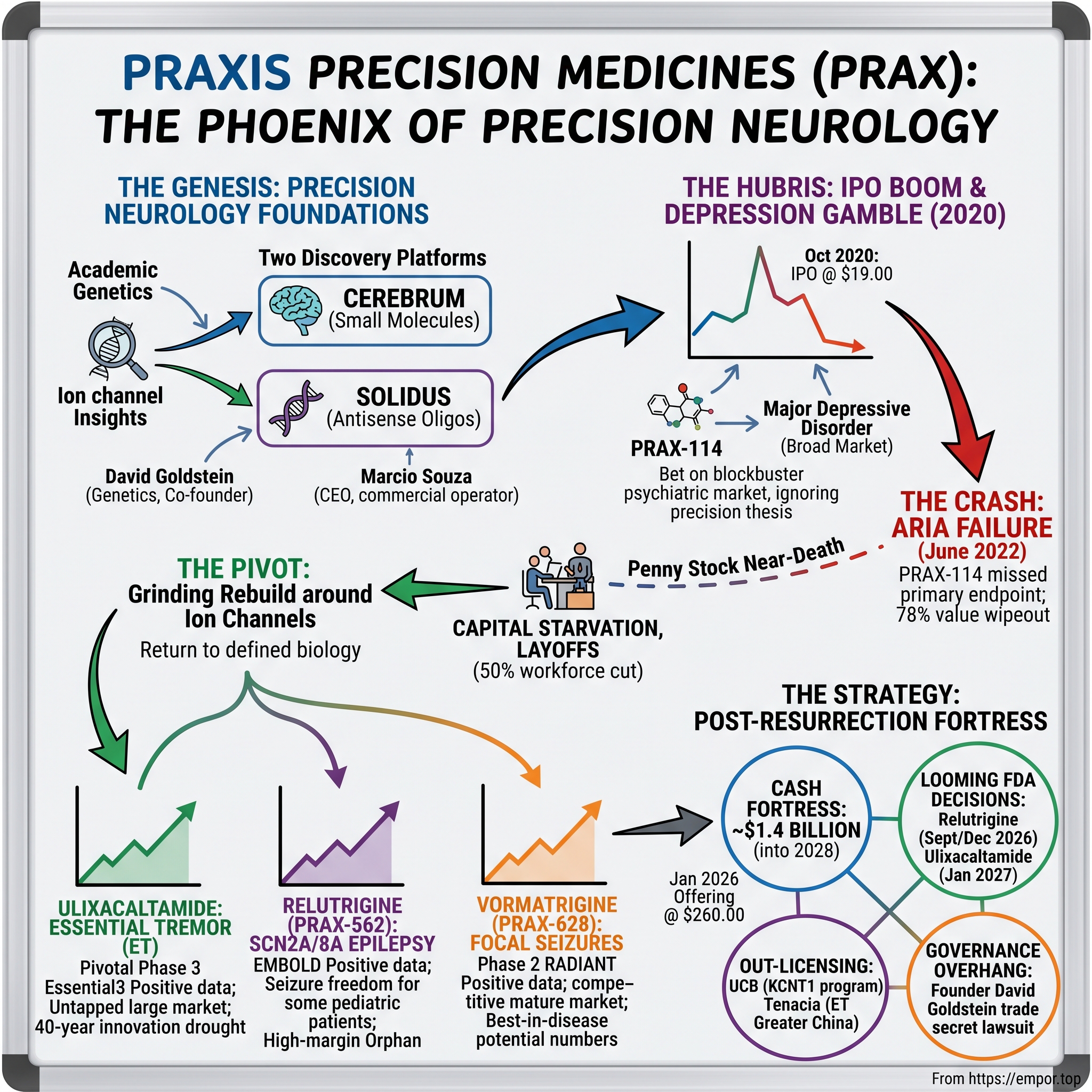
Praxis Precision Medicines: The Phoenix of Precision Neurology
I. Introduction & Episode Roadmap (00:00 - 00:10)
On a June morning in 2023, a small Cambridge biotech did the corporate equivalent of selling the furniture to keep the lights on. Praxis Precision Medicines priced a public stock offering at ninety-five cents a share — not a typo, ninety-five cents — dumping more than fifty-five million new shares onto a market that had all but stopped believing the company would survive.[^1] A year earlier its lead drug had failed in spectacular fashion; its market value had been vaporized; roughly half its employees were gone. To even keep its listing on the Nasdaq, Praxis would soon have to perform the most humbling maneuver in public markets, a reverse stock split, squashing fifteen old shares into one so the ticker didn't get delisted for trading below a dollar.1
Now fast-forward to January 2026. The same company — same ticker, same CEO — priced a follow-on stock offering at $260.00 per share, raising roughly $661 million in a single, oversubscribed transaction.2 Its enterprise value had swung from near-zero to the multi-billion-dollar range. Wall Street analysts who had written the obituary were now debating not whether Praxis would survive, but how big its first three drug launches might become.
This is a resurrection story. But it is also a cautionary tale about how modern biotech actually works — where the distance between a "penny stock near-death experience" and an "$8 billion powerhouse" is not decades of compounding but a handful of binary clinical readouts, each one a coin-flip that can 5x or halve the stock overnight. The job of this episode is to separate the genuine science from the survivor's-bias narrative: to ask why Praxis nearly died, what actually changed, and whether the thing the market is now paying up for is a durable franchise or simply the last good roll of the dice.
The thesis at the center of it all is "precision neurology." For most of pharmaceutical history, brain drugs were designed against symptom checklists in the psychiatrist's manual — the DSM. You had "Major Depressive Disorder," a single label stretched over millions of biologically different patients, and you threw a broad chemical at all of them and prayed the average moved. Precision neurology inverts that. It starts from the biology — a specific ion channel, sometimes a specific gene mutation — and builds a molecule to hit that target with surgical selectivity. Praxis's bet, in one sentence: the reason CNS drugs fail so often is that they treat heterogeneous crowds with blunt instruments, and the reason Praxis can win is that it treats defined targets with precise ones. That is the claim. The rest of this story is a test of it.
Here is the arc we'll trace. The Genesis — academic geneticists, two discovery platforms named Cerebrum and Solidus, and the collision between lab-bench idealism and commercial ambition. The Hubris — a 2020 IPO into a zero-interest-rate bubble and a bet on the blockbuster psychiatry market that ended in catastrophe. The Pivot — capital starvation, layoffs, and a grinding rebuild around ion channels almost nobody was watching. The Triumph — three positive clinical readouts in a row across essential tremor, rare pediatric epilepsy, and focal seizures. The Strategy — a $1.4 billion cash fortress, out-licensing deals with global pharma, and the looming FDA decisions that will decide everything. And The Drama — a trade-secret lawsuit against the company's own celebrated co-founder, filed by one of the most feared litigation firms in America.
A word on the posture of this episode before we start. It is tempting, with a story this cinematic, to simply narrate the comeback and cheer. We won't. The uncomfortable feature of clinical-stage biotech is that the same set of facts — a broken lead asset, a pivot, a string of positive readouts, a huge capital raise — describes both the companies that go on to build durable franchises and the companies that flame out one bad data point later. Survivorship bias is the field's original sin: for every Praxis whose pivot worked, there is a graveyard of names you've never heard of whose pivot didn't, and they all told the same hopeful story on the way up. So the discipline here is to keep asking not "what happened" but "what does the evidence actually prove," and to hold management's claims and the market's enthusiasm at arm's length. The stock has told a triumphant story. Our job is to interrogate it.
Let's begin where every good origin myth begins: with a handful of people convinced the entire field was doing it wrong.
 Subscribe on LinkedIn
II. The Genesis: High-Throughput Genetics and the Cerebrum Platform (00:10 - 00:30)
Picture a geneticist staring at a wall of DNA sequencing data in the early 2010s, watching a pattern emerge that the drug industry had spent decades ignoring. Time and again, in children with devastating, treatment-resistant epilepsy, the culprit was not some mysterious environmental cocktail. It was a single misspelled letter in a single gene — often a gene coding for an ion channel, the tiny protein gates that control the electrical firing of every neuron in the brain. The biology was screaming its answer. The pharmaceutical industry, organized around broad symptom categories, mostly wasn't listening.
That geneticist was, in significant part, David Goldstein — at the time the director of the Institute for Genomic Medicine at Columbia University and one of the more prominent human-genetics figures of his generation. Alongside Steven Petrou, an ion-channel electrophysiologist, and Kiran Reddy, a physician-investor operating out of the venture firm Blackstone Life Sciences (then in its earlier incarnation), Goldstein helped seed the intellectual core of what would become Praxis. The company was originally incorporated in 2015 under the name EpiPM Therapeutics — the "Epi" for epilepsy, the "PM" for precision medicine — before rebranding to Praxis Precision Medicines in 2016 and setting up shop in Cambridge, Massachusetts, the dense square mile of brick and glass that is arguably the densest concentration of drug-discovery talent on earth.3
The founding insight was uncomfortable for the whole field. Central nervous system drug development has one of the worst success rates in medicine. Depression trials fail. Alzheimer's trials fail, spectacularly and expensively. The founders' explanation was not that the brain is unknowable, but that the trials were built wrong: you cannot treat a genetically and biologically heterogeneous population with one blunt chemical and expect a clean signal, because the drug might genuinely help a subset of patients while the average washes out to nothing. The precision answer was to go the other direction — find the patients whose disease was driven by a known molecular defect, and build a molecule tuned to that exact defect.
To do that at scale, Praxis built two engines.
Cerebrum, the first, is a small-molecule discovery platform. In plain terms, think of an ion channel as a doorway in the neuron's membrane that opens and closes to let charged particles (sodium, calcium, potassium) flow in and out — that flow is how neurons fire. In disease, some of these doors get stuck in the wrong state: a sodium channel that won't fully close leaves a neuron chronically over-excited, firing when it shouldn't, which at the level of the whole brain can look like a seizure or a tremor. The trick — and it is genuinely hard medicinal chemistry — is designing a molecule that damps the pathological behavior of the channel without shutting down all the normal, necessary firing everywhere else in the body. Cerebrum's pitch is that by combining electrophysiology (measuring the actual electrical current through channels) with computational modeling, Praxis can hunt for molecules that are "state-dependent" or "functionally selective" — hitting the channel only when and where it's misbehaving. That selectivity, if real, is the difference between a drug patients can tolerate and one they quit.
Solidus, the second engine, aimed at an even more genetically pure problem: monogenic epilepsies, where a single gene is unambiguously the cause. For these, Praxis pursued antisense oligonucleotides — short synthetic strands of genetic material (ASOs) designed to intercept the faulty genetic instructions before they're ever translated into a broken protein. If Cerebrum is a lock-pick tuned to a jammed door, Solidus is a note passed to the factory saying stop building the defective door in the first place.
It's worth pausing on why this two-platform structure was clever as a business design, not just as science. Small molecules and antisense oligonucleotides are radically different modalities — different chemistry, different manufacturing, different delivery, different regulatory playbooks. Most young biotechs pick one and bet the company on it. By running both, Praxis gave itself a wider aperture on the same underlying insight (ion-channel dysfunction), so that whichever modality proved most tractable for a given disease could be the one advanced. The risk of that breadth, of course, is dilution of focus and cash — a discovery house that can chase everything can also finish nothing. That tension between breadth and focus would sit at the heart of nearly every strategic decision the company later made, and it is the lens through which the 2022 collapse and the subsequent ruthless narrowing are best understood.
A note on the founders as characters, because it matters for what comes later. Goldstein was, and is, an academic star — the kind of scientist whose name on a paper carries weight, whose lab produced a generation of human-genetics researchers, and whose conviction that genetics should drive drug discovery was less a hypothesis than a worldview. Petrou brought the complementary discipline of the electrophysiologist, the person who actually measures the current flowing through a single channel and knows how fiendishly hard it is to nudge one channel-state without disturbing the rest. Reddy supplied the investor-builder's instinct for turning a scientific thesis into a fundable company. This is a familiar and productive archetype in Cambridge biotech: the visionary academic, the technical craftsman, and the capital allocator. It works beautifully in the discovery phase. It also plants the seeds of future conflict, because the incentives of a founding academic — who thinks in decades, publications, and platforms — and the incentives of a public company that must hit clinical milestones and defend its intellectual property can diverge sharply once real money and real drugs are on the line. Hold that thought; it detonates in Section VII.
Into this academically-flavored discovery house walked the person who would ultimately define the company's fate as a business: Marcio Souza, who joined as Chief Operating Officer in 2018. Souza was not a bench scientist dreaming of channels; he was an operator and commercial strategist, forged at PTC Therapeutics — where he'd served as COO — and before that at NPS Pharmaceuticals, Shire, and Genzyme, all companies that had learned the brutal art of turning rare-disease biology into an actual, sellable product.3 The pairing was telling. Academic founders supply the science; a commercial operator supplies the discipline to choose which science becomes a company. In April 2020, Souza was elevated to President and CEO, formally handing the wheel from the discovery engine to the development corporation.3
That handoff mattered more than anyone appreciated at the time. Because the first big decision on Souza's watch was not to double down on the pure, genetically-defined orphan epilepsies that had birthed the company. It was to chase something far larger, far riskier, and — as we'll see — far closer to the exact broad-population trap the founders had built the platform to avoid.
III. The IPO Boom and the Great Depression Gamble (00:30 - 00:55)
To understand what Praxis did next, you have to remember what October 2020 felt like inside biotech. Interest rates were pinned near zero. The pandemic had made "biotech" a household word and drug development a national obsession. Capital was not just available; it was practically begging to be deployed into pre-revenue, pre-proof clinical-stage companies. In that gilded moment, a company with a compelling platform story and a big-market lead asset could go public at a valuation its actual data could not remotely support — and investors would thank you for the privilege.
Praxis walked straight through that open door. In mid-October 2020, it priced an upsized initial public offering on the Nasdaq Global Select Market, selling shares at $19.00 apiece for roughly $190 million in gross proceeds; with the underwriters' over-allotment exercised days later, the total raise swelled to about $218.5 million.4 The company's valuation vaulted past a billion dollars. For a business with no approved products and no revenue, this was the ZIRP-era bargain in its purest form: a decade of future optionality, priced today, in cash.
The horse Praxis chose to ride was PRAX-114. And here the strategy quietly inverted the founding thesis. PRAX-114 was not a precision tool for a genetically defined orphan population. It was a GABA-A receptor positive allosteric modulator — a molecule designed to amplify the brain's primary "calming" neurotransmitter system — aimed squarely at Major Depressive Disorder, one of the largest, broadest, and most commercially seductive markets in all of psychiatry. The logic was seductive too: a rapid-acting oral antidepressant, taken as needed, that might work in days rather than the weeks conventional SSRIs demand. If it worked, it wouldn't be an orphan drug with a few thousand patients. It would be a blockbuster with millions.
Why would a company built on the premise that broad psychiatric categories are a graveyard for drugs go chase the broadest psychiatric category of all? The honest answer is that markets reward TAM — total addressable market — and a genetically-pure epilepsy franchise, however scientifically elegant, tops out at a modest patient count. Depression was the number that made public investors dream. It's the recurring tension in this whole story: the scientific case for Praxis was precision, but the financial case its early leadership sold was scale. Those two are not always the same drug.
The money that flooded in validated the ambition — at least on paper. The cap table and surrounding investor base read like a who's-who of the era's specialist healthcare capital: Vida Ventures, Novo Holdings, the Citadel-affiliated crossover pod Surveyor Capital, Point72, and Blackstone Life Sciences all featured among the institutional believers underwriting the multi-billion-dollar dream.5 These are not naive tourists; they are sophisticated funds with deep scientific benches. Their participation is worth remembering precisely because of what came next — it's a humbling reminder that in binary-outcome biotech, smart money and correct money are not the same thing. The most rigorous diligence in the world cannot change a coin-flip trial into a sure thing.
Myth versus reality on the "platform" premium. The market in 2020–2021 paid enormous multiples for the word "platform," on the theory that a discovery engine could produce drug after drug and therefore deserved a valuation untethered from any single asset. The reality, which the next two years would enforce brutally, is that a platform is worth exactly as much as its first clinical validations. Until a molecule from the engine actually works in humans, "platform value" is a story investors tell themselves — and stories, unlike patents, do not survive a failed trial. Praxis at IPO was priced for the story. It had not yet earned the proof. That gap between narrative valuation and validated value is the single most important thing to understand about why the fall, when it came, was so total.
There is also a subtler point about the type of risk Praxis had taken on. A precision, genetically-defined orphan program carries lower biological risk — you know the target, you know the patients — but modest commercial upside. A broad psychiatry program carries the inverse: enormous commercial upside if it works, but brutal biological and trial-design risk, because the endpoint (a depression rating scale) is subjective, the placebo response is high, and the patient population is heterogeneous in exactly the way the founding thesis warned against. By leading with PRAX-114, Praxis had, in effect, taken its most defensible scientific philosophy and pointed it at its least defensible clinical setup. That was a choice about which risk to run, and it is fair to judge the earlier leadership on it — not with hindsight alone, but because the company's own intellectual premise flagged the danger in advance.
Praxis was, in the language of the moment, a platform company with a blockbuster lead asset, fully funded, richly owned, and pointed at an enormous market. Everything was in place. Which is exactly the setup for the kind of fall that gets its own chapter.
IV. The Crash: The Aria Failure and the Biotech Lazarus Pivot (00:55 - 01:25)
The number came out before the market opened on Monday, June 6, 2022. The Phase 2/3 Aria study — PRAX-114 as a monotherapy for major depressive disorder — had missed. Not narrowly, not ambiguously. The drug failed to separate from placebo on the primary endpoint, a change in the 17-item Hamilton Depression Rating Scale at Day 15, and it failed on every secondary endpoint as well.[^7] In the antiseptic language of the press release, PRAX-114 was "well-tolerated" but "the effect did not deliver to meet the needs of patients." In the language of the stock market, it was a catastrophe.
Shares that had closed at $8.59 the previous Friday opened Monday in free-fall and bottomed near $1.88 — a wipeout of roughly 78% of the company's value in a single session.6 Years of platform narrative, the billion-dollar IPO valuation, the blue-chip investor validation: all of it repriced in hours to reflect the market's new verdict — Praxis was just another clinical-stage company whose lead drug didn't work. The cruelty of biotech is compressed into days like this. There is no gradual erosion, no chance to manage the message over quarters. One data readout, and the thesis is either alive or dead.
What Souza did next is the part that actually matters for investors. Faced with a dead lead asset and a collapsing balance sheet, management chose speed and triage over hope. Development of PRAX-114 was terminated. A workforce reduction of roughly half the company was initiated almost immediately, and early-stage programs were frozen to stop the cash burn — a deliberate decision to extend the operating runway into 2024 by shrinking the company down to its most defensible assets.7 There is a version of this story where a proud management team keeps pouring money into subgroup analyses and salvage trials to protect the narrative that raised all that capital. Souza didn't do that. He cut. Whatever else you think of the earlier strategy, the response to failure was disciplined and fast — a data point in management's favor that would look prescient only in hindsight.
Consider what that moment actually demanded of Souza personally. He was the executive who had been elevated to CEO to carry the blockbuster ambition, the one who had stood in front of investors and sold the depression story. When it collapsed, the easy human instinct — the career-preserving instinct — is to defend the decision, to slow-walk the bad news, to run the salvage analyses that keep hope (and the stock) alive for another quarter. Instead, on the same day the failure was announced, the company laid out the pivot and the layoffs.7 There is something clarifying about an operator who has spent time at rare-disease companies like Genzyme and Shire, where the discipline of running a business on defined, unglamorous biology is bred in the bone. Souza's background wasn't in chasing psychiatric blockbusters; it was in the grind of orphan-drug development. The pivot, in that light, wasn't just strategy — it was a return to the kind of company he actually knew how to run. Investors evaluating management credibility should weight this heavily: the response to the failure revealed a temperament that the original bet had obscured.
But discipline doesn't manufacture capital, and 2022–2023 was the worst possible moment to need it. The Federal Reserve was raising rates at the fastest pace in decades, and the same ZIRP dynamics that had inflated biotech valuations went violently into reverse. The XBI — the small-cap biotech index — cratered. Speculative pre-revenue names were left for dead across the sector. Praxis, its lead gone and its story broken, was exactly the kind of company the market no longer wanted to fund at any reasonable price.
Which is how you end up selling stock at ninety-five cents. In June 2023, out of options, Praxis priced that deeply dilutive offering of more than fifty-five million shares at $0.95 apiece simply to keep the doors open.[^1] For existing shareholders it was brutal dilution; for the company it was oxygen. And the transaction itself, on a pre-split basis, tells you everything about how far the mighty had fallen — a company that had gone public at $19 a share was now raising money at a price that rounded, in market parlance, to a penny stock.
The cleanup came in November. To restore its share price above Nasdaq's minimum listing threshold and to rationalize a share count that had ballooned into the hundreds of millions, Praxis executed a 1-for-15 reverse stock split, effective November 28, 2023.1 Fifteen shares became one. Reverse splits are cosmetic in theory — they don't change the value of what you own — but they are also a public admission of distress, the financial equivalent of a company changing its name to escape its reputation. It is genuinely hard to overstate how thoroughly, at the end of 2023, the market had given up on Praxis.
Why the pivot was credible rather than desperate — and how to tell the difference. Failing biotechs pivot all the time, and most of the time the "new strategy" is just a press release designed to justify continued existence and one more capital raise. What distinguished the Praxis turn was that it wasn't a leap into some fashionable new modality the company had no expertise in; it was a retreat to the biology the company had been built on before the blockbuster ambitions pulled it off course. The ion-channel work — the Cerebrum chemistry, the epilepsy and movement-disorder targets — had been quietly progressing in the background the whole time. So the pivot was less an invention than a re-prioritization: stop funding the moonshot, feed the assets that were already de-risked by defined biology. That is a meaningfully more credible move than a company chasing whatever the market currently rewards, and it is one of the reasons the eventual recovery had real substance under it rather than just narrative.
Still, credibility in strategy is not the same as certainty in outcome. At the end of 2023, the ion-channel pipeline was still just a set of promises. Ulixacaltamide had a troubled Phase 2 behind it. Relutrigine was early. Vormatrigine was earlier still. A shareholder who had ridden the stock from $19 to under a dollar had every reason to assume the pivot would fail like the last strategy had. The reason we now call this the "Lazarus" moment rather than the "final chapter" is entirely because of what the data did next — not because the strategy was self-evidently right at the time. Stripped of its psychiatric ambitions and forced by circumstance to focus, management pointed the company back toward movement disorders and epilepsy, the defined targets and defined patients the platform was actually built to serve. The blockbuster-psychiatry detour was over. What remained was smaller, stranger, and — as it turned out — far more real. The next chapter is about the drug that proved it.
V. Core Asset Deep-Dive: Ulixacaltamide & The Untapped Essential Tremor Market (01:25 - 01:55)
Try to sign your name with your hand shaking so violently you can't hold the pen. Try to drink a cup of coffee without wearing it. This is daily life for someone with severe essential tremor — the most common movement disorder in the world, a condition that turns the ordinary mechanics of eating, writing, dressing, and speaking into a public struggle. It is estimated to affect on the order of seven million Americans, of whom roughly two million actively seek clinical care.8 And here is the scandal at the heart of the market: no genuinely new, targeted therapy has been approved for it in more than four decades.
Instead, patients get hand-me-downs. The standard of care is off-label — beta-blockers like propranolol, borrowed from cardiology, and anticonvulsants like primidone, borrowed from epilepsy. Neither was designed for tremor. Both come freighted with systemic side effects: propranolol can slow the heart and flatten mood; primidone can produce sedation and cognitive fog severe enough that many patients decide the treatment is worse than the disease. Real-world persistence on these drugs is poor, with a large fraction of patients abandoning therapy within a couple of years. This is the definition of an underserved market — enormous, symptomatic, and clinically abandoned. The question is why nobody had cracked it.
The answer is that essential tremor is a drug-development graveyard, and understanding why is the key to the entire Praxis bull case. Consider the bodies in the field. Jazz Pharmaceuticals, developing its own T-type calcium channel blocker, suvecaltamide (JZP385), failed a Phase 2b trial in essential tremor in 2024. Neurocrine Biosciences discontinued its candidate NBI-827104 after a Phase 2 miss. Sage Therapeutics and Biogen walked away from their GABA-A modulator SAGE-324 after it failed to hit key endpoints. One after another, well-capitalized, technically excellent companies took their shot at essential tremor and missed. The disease is notoriously hard to run trials in — tremor is subjective to measure, symptoms fluctuate, and placebo response rates run high because patients desperate for relief report improvement regardless of treatment.
Into that graveyard, Praxis brought ulixacaltamide (PRAX-944), a highly selective, oral, once-daily T-type calcium channel blocker. Here's the mechanism in human terms. Tremor is generated by a specific brain circuit — the cerebello-thalamo-cortical (CTC) loop — that under certain conditions starts firing in abnormal, hypersynchronized bursts, like a section of an orchestra locking into a rhythm nobody asked for. T-type calcium channels are the components that let neurons produce those rhythmic bursts. Block them selectively, and the theory is you quiet the pathological rhythm that becomes the physical shake, without sedating the whole brain the way older drugs do. It is precision neurology applied to a movement disorder — the founding thesis, finally aimed at a target big enough to matter.
The path was not clean, and honesty requires saying so. An earlier Phase 2 program in essential tremor had struggled with exactly the placebo-response problem that has sunk everyone else, and at one point the program carried an interim futility signal — the kind of warning that usually ends a drug's life. That Praxis kept going, and redesigned the pivotal trials to control for the placebo effect that had plagued the field, was either stubbornness or conviction. For a long time it was impossible to tell which.
Then, in October 2025, came the readout that redefined the company. Praxis reported positive topline results from its two pivotal Phase 3 Essential3 studies. In the parallel-group study, patients on ulixacaltamide showed a mean improvement of 4.3 points on the modified Activities of Daily Living scale (mADL11) at the primary timepoint — a statistically significant, clinically meaningful reduction in exactly the functional impairments (writing, eating, dressing) that define the disease — with a safety and tolerability profile the company described as robust.9 After forty years of failure, Praxis had the first positive Phase 3 program in essential tremor. The stock, needless to say, was no longer trading at a penny.
It's worth being precise about what this does and doesn't prove. It proves ulixacaltamide beat placebo on a validated functional endpoint in the trials as designed — a genuine scientific achievement in a disease that has humbled the industry. It does not yet prove commercial success, durability of effect over years, or that payers will pay a brand price when generic propranolol costs pennies. Those are the next tests. But the binary that mattered most — does the drug work — flipped to yes.
Why the trial design deserves as much credit as the molecule. The essential-tremor graveyard is not primarily a graveyard of bad drugs; it is a graveyard of trials defeated by the placebo effect. When you enroll patients desperate for relief and ask them to rate their own tremor, the mere act of being in a study — attention, hope, the ritual of taking a pill — produces large apparent improvements in the placebo arm, which can swamp a real drug signal. Several of the competitor failures plausibly owe as much to this measurement problem as to molecular weakness. Praxis's Essential3 program leaned on a decentralized design and a functional daily-living endpoint chosen and powered specifically to cut through that noise. If ulixacaltamide's approval holds up, part of the lesson for the field will be that essential tremor was beatable all along — the industry just kept losing to its own trial designs. That is a subtle but important point for investors: it suggests the "monopoly" position may be less about a uniquely magical molecule and more about Praxis being the team that finally solved the trial, which is a different and arguably more replicable kind of advantage — meaning a determined competitor could, in principle, follow the same playbook.
A brief detour on why the market itself is so large, and so awkward. Essential tremor sits in a strange commercial position: it is simultaneously enormous and under-monetized. Enormous, because millions of people have it and its prevalence rises steeply with age in a demographically aging population. Under-monetized, because for forty years there has been nothing branded to prescribe, so the entire treatment paradigm — physician behavior, patient expectations, insurance coverage — was built around cheap generics and, for the most severe cases, invasive interventions like deep brain stimulation surgery or focused-ultrasound thalamotomy. That legacy is a double-edged sword for Praxis. On one hand, it means a genuine unmet need and no branded competitor to fight. On the other, it means Praxis must do the expensive, slow work of creating a market: educating neurologists who have long since stopped expecting new tremor drugs, convincing patients who've given up to try again, and persuading payers to reimburse a branded product in a category they've only ever paid pennies for. Creating a market is harder than winning share in an existing one. It is the single most underappreciated element of the ulixacaltamide commercial story.
Praxis moved quickly to fortify the asset globally. In January 2024 — well before the pivotal readout, when conviction still required faith — it licensed Greater China rights to ulixacaltamide to 元羿生物 Tenacia Biotechnology (Shanghai) Co., Ltd., a company backed by Bain Capital. The deal brought $15 million upfront (including a $10 million equity investment in Praxis itself, a nice vote of confidence when cash was scarce), up to $264 million in development and commercial milestones, and tiered royalties.10 Then, in July 2026, Praxis took an equity stake in Remagine Labs to co-develop an iontophoretic transdermal patch version of ulixacaltamide — a skin-delivered formulation aimed at patients who struggle to swallow pills, and a way to extend the franchise's patent-protected life and reach beyond the original oral product.11 Neither deal is transformative on its own, but together they show a management team thinking about the asset as a durable, multi-format, global franchise rather than a single pill.
One drug, however impressive, does not make a company worth billions. For that, you need a pipeline. And Praxis's next two assets aimed at a different and, in some ways, more urgent kind of patient.
VI. High-Margin Orphan and Seizure Franchises: Relutrigine & Vormatrigine (01:55 - 02:15)
There is a category of human suffering that even veteran neurologists find hard to describe without emotion: an infant having hundreds of seizures a day. In the developmental and epileptic encephalopathies (DEEs) driven by mutations in the genes SCN2A and SCN8A, that is the reality. These genes encode sodium channels, and the mutations make the channels hyperactive — stuck slightly too open, leaking a "persistent sodium current" that keeps neurons pathologically over-excited. The result is catastrophic, relentless seizures in the first months and years of life, alongside profound developmental impairment. There is no approved therapy that targets the underlying defect. Families are left managing an unmanageable disease.
Relutrigine (PRAX-562) is Praxis's answer, and mechanistically it is the mirror image of the tremor drug. Where ulixacaltamide blocks a calcium channel to quiet abnormal rhythms, relutrigine is a first-in-class small molecule that preferentially inhibits that leaky persistent sodium current — the pathological trickle — while largely sparing the normal, transient firing neurons need to function. That selectivity is the whole game: it's what could let a drug calm the seizures without shutting the brain down.
The proof arrived in September 2024, when Praxis reported positive topline results from the EMBOLD study. Relutrigine delivered a 46% placebo-adjusted reduction in monthly motor seizures in the double-blind period, with a confirmatory registration cohort showing an even larger effect, and — the number that stopped clinicians cold — roughly a third of treated patients achieved seizure freedom, with reports of dramatic improvements in alertness and cognitive engagement.12 In a population defined by hundreds of seizures a day, seizure-free stretches are not an incremental improvement; they are the difference between a life and a diagnosis. The study was compelling enough that it was stopped early for efficacy.
There is a piece of hidden financial optionality tucked inside relutrigine that generalist investors often miss. Because it targets a rare pediatric disease, an approval could make Praxis eligible for a Priority Review Voucher — a transferable coupon the FDA awards for certain rare-pediatric approvals that lets the holder (or a buyer) jump the queue on a future drug review. These vouchers have historically sold on the secondary market for sums in the hundreds of millions of dollars. It is not guaranteed, the program's continuation has been subject to legislative uncertainty, and a voucher is a one-time windfall rather than a recurring asset — so it should never be central to a valuation. But it is a real, monetizable form of non-dilutive upside that sits on top of the drug's own commercial value, and it is exactly the kind of orphan-disease economics that made Souza's rare-disease pedigree relevant. The orphan model isn't just "small market, high price"; it's a whole toolkit of regulatory incentives that reward companies willing to work on diseases big pharma finds too small to bother with.
The regulatory machinery moved accordingly. Relutrigine had already collected Breakthrough Therapy, Orphan Drug, and Rare Pediatric Disease designations. In March 2026, the FDA accepted the New Drug Application and granted Priority Review, initially setting a PDUFA target action date of September 27, 2026.13 Investors should note an important wrinkle, though — and it's the kind of detail promotional summaries tend to skip. In late June 2026, Praxis disclosed that the FDA had extended the review by three months, to December 27, 2026, after the company submitted additional sensitivity analyses that the agency classified as a major amendment. Praxis stated the FDA had raised no new safety or manufacturing concerns and requested no new clinical studies.14 A three-month extension is common and usually benign, but it is a delay, and a neutral observer files it as a small increase in timeline risk rather than waving it away.
If relutrigine is the high-value orphan asset — small patient population, premium pricing, and potentially a Priority Review Voucher worth hundreds of millions if granted — then vormatrigine (PRAX-628) is the swing at a much larger prize. And the competitive stakes here are entirely different from essential tremor. Focal epilepsy is a crowded, mature market with many effective generic anti-seizure medications already available, so vormatrigine will not enjoy the empty-field advantage ulixacaltamide has. Its path to relevance runs through differentiation — better tolerability, cleaner drug-drug interaction profile, once-daily convenience, and efficacy in the roughly one-third of patients who remain uncontrolled despite existing drugs. That refractory, treatment-resistant population is precisely where RADIANT generated its eye-catching numbers, and it is also where the medical need and the pricing latitude are greatest. The commercial question for vormatrigine is therefore not "is the field empty" (it isn't) but "is the molecule good enough to earn premium share in a competitive field," and that is a higher bar the registrational trials still have to clear. Vormatrigine is a next-generation, functionally selective sodium channel blocker being developed as a once-daily oral treatment for focal onset seizures in adults — the largest, most common form of epilepsy, and a market measured in the millions rather than the thousands.
The signal here is genuinely striking. In August 2025, Praxis reported topline data from the Phase 2 RADIANT study showing a 56.3% median reduction in seizure frequency over eight weeks, with roughly 22% of patients achieving complete seizure freedom in the final 28 days and about 60% hitting the 50%-responder bar — and this in a heavily treatment-resistant population that had already failed multiple existing drugs.15 Best-in-disease numbers, if they hold. The obvious caution is that Phase 2 studies in refractory epilepsy are small and open to favorable patient selection; the effect size has to survive the far larger, blinded, placebo-controlled crucible of registrational trials before it means anything commercially.
Those trials are underway. The POWER1 Phase 2/3 registrational study completed enrollment, with topline data expected in the first half of 2026, while the POWER2 registrational study is actively enrolling.15
Step back and notice the portfolio logic, because it is the single most important structural change from the pre-crash company. In 2020, Praxis was a one-asset company wearing a platform costume: PRAX-114 was the whole thesis, and when it died, the company nearly died with it. By 2026, Praxis holds three clinically-validated, mechanistically-distinct assets aimed at three different diseases with three different regulatory clocks — a premium orphan drug (relutrigine), a large-market movement-disorder drug (ulixacaltamide), and a potential large-market epilepsy drug (vormatrigine). Crucially, they fail independently. A safety surprise in one channel-blocker does not automatically doom the others, and a regulatory delay in one program does not reset the whole company. This is the difference between a coin flip and a portfolio of coin flips: the expected value can be similar, but the variance — the risk of total loss — is dramatically lower. For a company that has already been to zero once, lowering variance is not a footnote; it is the entire point.
The counterweight a skeptic must hold in mind is that "three shots on goal" also means three expensive, simultaneous late-stage programs plus the looming cost of commercialization — a burn rate that only a fortress balance sheet can sustain. Diversification bought Praxis resilience; it also bought a very large bill. Which is precisely what made the financing engine roar back to life, and how a company that once sold stock at ninety-five cents came to sit on more than a billion dollars in cash.
VII. The Playbook: Biotech Financing, Platform Realignment & Capital Deployment (02:15 - 02:35)
Here is the oldest truth in drug development, and the one Souza appears to have internalized in the wreckage of 2022: in biotech, you do not raise money when you need it. You raise money when the market will give it to you, because those two moments are almost never the same. The company that learned this the hard way — pricing stock at ninety-five cents because it had no choice — spent 2025 and early 2026 executing the exact opposite behavior with almost clinical discipline.
The sequence tells the story. Once the positive Phase 3 Essential3 data landed in October 2025 and the stock re-rated violently upward, Praxis didn't sit on its improved position waiting for the "perfect" time. It monetized the good news. The centerpiece was the January 2026 follow-on offering, priced at $260.00 per share. It launched targeting roughly $575 million, and demand was strong enough that the underwriters' over-allotment was fully exercised, taking gross proceeds to about $661 million.162 Compare the arithmetic that management surely did: raising a given dollar amount at $260 a share requires a fraction of the dilution it would have taken at $0.95. Selling equity into strength rather than desperation is the single most valuable financial skill a clinical-stage biotech can have, and this is a textbook execution of it.
It is worth appreciating just how psychologically hard this discipline is to execute, because it runs against every instinct. When your stock is soaring on great data, the temptation is to believe your own story and wait for an even higher price. When your stock is in the gutter, the temptation is to refuse to sell at humiliating prices and pray for a bounce. Both instincts destroy value: the first leaves you raising into weakness later, the second leaves you insolvent. Praxis, across a single company lifecycle, demonstrated the correct behavior at both extremes — it took the ninety-five-cent lifeline when survival demanded it, and it filled the war chest at $260 when the market handed it the chance. That is not luck; it is a repeatable competence in the one skill that most directly determines whether a pre-revenue biotech lives or dies. If there is a single reason to extend management the benefit of the doubt after the 2022 misjudgment, it is this financing track record.
The result is what management calls, and what genuinely functions as, a cash fortress. As of March 31, 2026, Praxis reported roughly $1.4 billion in cash, cash equivalents, and marketable securities — up from about $926 million at the end of 2025, the jump driven by the January raise — sufficient, the company says, to fund operations into 2028.17 For a company approaching multiple commercial launches, this is the difference between negotiating from strength and negotiating with a gun to your head. A well-capitalized biotech can launch its own drugs, hold out for better partnership terms, and survive a disappointing readout. A cash-poor one gets forced into fire-sale licensing deals precisely when its assets are most valuable. Praxis spent 2022–2023 as the latter. It intends never to be that company again.
The other half of the playbook is out-licensing as a non-dilutive engine — and here the discipline is notable. Rather than doing what flush biotechs often do at the top of a cycle, which is overpay to acquire external molecules, Praxis has mostly moved in the other direction, licensing out non-core or geographically-specific rights to partners better positioned to develop them. The clearest example is its KCNT1 epilepsy program, where the global pharma company UCB exercised its exclusive option to in-license the small-molecule program in December 2024 — validation from a serious neurology player, and cash and future milestones for Praxis without the burden of funding the program itself.[^20] Combined with the Tenacia deal for Chinese tremor rights, the pattern is a company that partners away what it can't optimally develop and keeps what it can. That is capital-efficient portfolio management, not empire-building.
There is, however, a shadow over the discovery engine that funded all of this — and it is the kind of governance overhang a skeptical investor should not ignore. In October 2025, Praxis filed suit in the U.S. District Court for the District of Delaware (Case No. 1:25-cv-01256) against its own co-founder, David Goldstein, and his new venture, Actio Biosciences, alleging trade-secret misappropriation under the Defend Trade Secrets Act.1819 The complaint — brought by Cravath, Swaine & Moore, one of the most formidable litigation firms in the country, a signal in itself of how seriously Praxis takes the matter — alleges, per the public docket, that Goldstein misappropriated confidential information relating to KCNT1 epilepsy research while serving in an advisory capacity, and used it to build a competitor targeting overlapping ion-channel biology.19
Read this carefully, because the framing cuts both ways. On one hand, a company suing its own celebrated scientific founder is airing a fight over the very platform know-how that is supposed to be its "cornered resource" — an implicit admission that the crown-jewel discovery capability may be more portable, and more contestable, than the platform narrative suggests. On the other hand, aggressively defending trade secrets is exactly what a company should do if that capability is genuinely valuable. What management has been conspicuously cagey about — on earnings calls and elsewhere — is the specific relief and damages it is seeking, and the litigation is early, with the defense expected to contest the claims. It is an unresolved overhang, not a resolved fact, and it belongs on the risk ledger until a court says otherwise. It also raises a fair question for any investor: how much of Praxis's edge lives in proprietary systems, and how much lived in the head of a founder who has now walked out the door?
The activist lens on capital allocation, briefly. Would a skeptical long/short investor find anything to attack in how Praxis is deploying its cash? A few things are worth naming. First, running three registrational programs at once plus building a commercial organization is expensive, and if one or two of the launches disappoints, the market will retroactively decide the company raised too much and diluted too aggressively at $260 — though that critique only lands if the drugs underperform; raising cheap capital against strong data is defensible on its face. Second, the string of equity-linked and equity-adjacent deals (the Tenacia equity investment, the Remagine equity stake) are individually small but collectively signal a company comfortable using its shares as a strategic currency, which shareholders should watch for creep. Third — and this is the sharpest available critique — the very existence of the founder lawsuit invites the question of whether Praxis's governance and IP-protection processes were tight enough in the first place. You don't usually end up suing your own co-founder if the fences were high to begin with. None of these is a red flag on the order of the 2022 strategic misjudgment, but they are the threads a genuinely adversarial analyst would pull. That question — where exactly the durable advantage resides — is the right one to carry into a hard-nosed competitive analysis.
VIII. Competitive Landscape, Helmer's 7 Powers & Porter's 5 Forces (02:35 - 02:50)
Strip away the resurrection narrative and ask the cold question an analyst has to ask: if Praxis's drugs get approved, what actually stops someone else from eating the market? Let's war-game it using two standard frameworks — Hamilton Helmer's 7 Powers and Porter's Five Forces — and be honest about which "powers" are real and which are management poetry.
Start with the strongest claimed power: the cornered resource. Praxis argues its Cerebrum and Solidus discovery platforms constitute a genuinely differentiated capability — the ability to rapidly generate molecules that discriminate between the states of an ion channel (persistent versus transient current, misbehaving versus normal firing). If true, this is the kind of repeatable engine that produces multiple assets rather than one lucky drug, and the fact that three distinct, mechanistically-precise molecules — ulixacaltamide, relutrigine, vormatrigine — all cleared meaningful clinical bars lends the claim real support. But the skeptic's counterpoint is sitting right there in the docket: if the platform's value is so cornered, why is Praxis in court trying to stop a co-founder from allegedly recreating parts of it elsewhere? A cornered resource that can walk out the door in someone's expertise is less "cornered" than the word implies. The honest verdict: the platform has demonstrated productivity, which is more than most platform companies can say, but its inimitability is contested rather than proven.
The more defensible power is intellectual property. Approved small-molecule drugs are protected by composition-of-matter and method-of-use patents, and Praxis's franchise patents extend, per the company, into the late 2030s and beyond. Unlike a discovery process, an issued patent on an approved molecule is a hard, legally enforceable moat for a defined period. This is the most bankable of the powers — it's the reason a successful drug can generate high-margin cash flows for over a decade before generics arrive.
The third claimed power — switching costs — is real but often misunderstood. In neurology, once a patient finds a drug that controls their seizures or tremor and that they can tolerate, both patient and physician are extremely reluctant to change. Nobody experiments with a stable epileptic. That stickiness is genuine. But notice the trap: switching costs protect an incumbent. For Praxis, launching into markets where patients are currently (unsatisfactorily) parked on cheap generics, switching costs are initially a headwind — inertia works against the newcomer — and only become a moat after Praxis has won the patient. The power is real; it just accrues later than the bull case implies.
Now Porter. Threat of new entrants is genuinely low — the capital intensity, the multi-year regulatory gauntlet, and the sheer failure rate of CNS drug development (that essential-tremor graveyard is not an accident) make casual competition impossible. That's a real structural advantage for anyone who actually makes it through.
Threat of substitutes, though, is the sharpest blade at Praxis's throat, and it's easy to underrate. The relevant substitute for ulixacaltamide is not another novel drug — the competitors failed, remember. It is cheap, generic, off-label propranolol and primidone, which cost pennies. Praxis must convince payers that its superior tolerability and its validated efficacy justify a brand-name premium over drugs that are nearly free. That is a payer-value argument, not a scientific one, and it is far from automatic. A drug can win its Phase 3 and still lose the formulary.
Which flows directly into the bargaining power of buyers, which is high and rising. In the U.S., the real customers are not patients but pharmacy benefit managers and commercial insurers, who wield enormous leverage over formulary placement and reimbursement. They can — and routinely do — require patients to fail cheaper generics first ("step therapy") before authorizing a premium branded drug. For a first-time commercial company launching into markets full of penny-cost alternatives, unfavorable formulary treatment is one of the most underappreciated risks to the uptake curve. Praxis's science has been validated by the FDA process; its pricing power has been validated by no one yet.
Rivalry among existing competitors deserves its own honest read, because it differs sharply across the three assets. In essential tremor, direct rivalry is currently near-zero — the field cleared itself out through failure — which is the strongest competitive position Praxis holds anywhere. In the SCN2A/SCN8A orphan encephalopathies, rivalry is also low simply because so few companies work on ultra-rare pediatric epilepsies at all; the barrier there is willingness, not capability. Focal epilepsy is the exception: intense rivalry, entrenched generics, and large branded incumbents. The pattern tells you something about how to weight the portfolio — the two assets where Praxis has the cleanest competitive runway (ulixacaltamide and relutrigine) are also the two furthest along and closest to approval, while the asset facing the toughest competition (vormatrigine) is the one still in registrational trials. That is a favorable ordering: the company gets to prove it can commercialize in its easiest arenas first, before it has to win a knife-fight in focal epilepsy.
Benchmarked against the broader neurology-biotech peer set, Praxis's distinguishing feature is less any single power than the combination — a validated multi-asset pipeline, a large cash reserve, and a first-mover position in an abandoned large market, all at once. Plenty of peers have one or two of those. Few have all three simultaneously, and that rarity is a meaningful part of why the stock re-rated so violently. But rarity of setup is not the same as inevitability of outcome, and every one of these powers has an asterisk we've now named. Netting it out: Praxis has a legitimate patent moat, a scarcity advantage from operating in diseases too hard for most to crack, and eventual switching-cost stickiness — genuine powers. But it faces a substitution-and-payer dynamic that no clinical trial can solve, and a "cornered resource" whose durability is, at this moment, literally being litigated. A durable franchise is plausible. It is not yet proven. Which is the perfect frame for the final act: the explicit bull-and-bear spine.
IX. The Investment Spine: Bull vs. Bear Case & Analyst Q&A Stress Test (02:50 - 03:00)
Every good investment debate reduces to two questions asked in sequence: why does this company win from here, and what breaks the case? Let's put both on the table without a thumb on the scale.
The bull case — "why win" — rests on three pillars. First, a near-monopoly setup in essential tremor: with Jazz, Sage/Biogen, and Neurocrine all having failed, ulixacaltamide is the only novel oral therapy to post a positive Phase 3 in a disease affecting millions with a four-decade innovation drought. Being the only credible new entrant in a large, abandoned market is about as good as competitive positioning gets in pharma. Second, a dense sequence of near-term commercial catalysts: relutrigine's FDA decision (now targeted for December 27, 2026 after the review extension) could deliver Praxis its first approved product, proving it can commercialize at all, with ulixacaltamide's decision following on January 29, 2027 — two shots at becoming a real commercial company within roughly a year. Third, the balance sheet: north of $1.4 billion in cash means Praxis can fund its own launches and never again be forced into a distressed deal. A biotech that controls its own financing controls its own destiny.
The bear case — "why not" — is equally concrete, and investors should sit with it. Start with the launch-scaling mountain: Praxis has zero commercial track record. It has never sold a drug, never built a specialty salesforce, never negotiated a formulary. Standing up an organization to reach thousands of neurologists is expensive, slow, and a fundamentally different competency than running trials — and the graveyard of biotech is full of companies that nailed the science and botched the launch. Second, the safety trap: CNS drugs are exquisitely sensitive to post-marketing safety signals — a surprise psychiatric effect, a suicidal-ideation warning, a drug-drug interaction — and a single label warning on ulixacaltamide or relutrigine could kneecap sales overnight, no matter how clean the trials looked. Third, payer pushback: as the Porter analysis made clear, insurers may wall these drugs behind step-therapy requirements, forcing patients through cheap generics first and flattening the launch curve into a slow grind rather than a fast ramp.
Now the stress test — what analysts are actually pushing on. Across the Q3 and Q4 2025 and Q1 2026 earnings calls, the recurring line of questioning has been commercialization strategy: will Praxis launch ulixacaltamide alone, absorbing the full cost and risk of building a salesforce, or will it seek a U.S. co-promotion partner to accelerate penetration and de-risk the launch? Management has kept its options open — which is defensible strategically but leaves a genuine uncertainty at the center of the entire investment thesis, because "go it alone" and "partner" imply very different cost structures and very different economics. On pricing, management has been notably cagey: it has not committed to an orphan-pricing versus broad-access model for relutrigine, and it has declined to quantify the damages sought in the Goldstein litigation. Cagey is not the same as dishonest — early-stage commercial and legal matters are legitimately fluid — but a neutral observer notes where the disclosure gets thin, because those vague zones are exactly where the real risk lives.
On management credibility, the behavioral record cuts both ways, and that nuance matters. The negative: the original strategy chased a broad psychiatric blockbuster in direct tension with the company's own precision thesis, and it ended in a catastrophic, near-fatal failure. That was a strategic misjudgment, not merely bad luck. The positive: the response was fast, disciplined, and effective — the company cut hard, refocused on defensible biology, raised survival capital at humiliating prices when it had to, and then raised abundant capital at strong prices when it could. Souza's team has, since 2022, largely done what it said it would and hit its clinical milestones. A management team that fails, adapts, and executes the recovery is a more credible team than one that has never been tested — provided you never forget it was tested because of its own earlier bet.
Finally, the KPIs worth actually tracking, because for a company like this, the daily stock noise is meaningless and only a few variables truly matter. First and above all: the regulatory outcomes and their timing — the relutrigine PDUFA decision (targeted December 27, 2026) and the ulixacaltamide decision (January 29, 2027). These are the binary events that validate or invalidate the entire franchise; nothing else comes close. Second, once approved, the commercial launch trajectory — early prescription uptake and, critically, formulary and reimbursement wins, which will reveal whether Praxis actually has the pricing power the bull case assumes or whether payers throttle it. Third, the POWER1/POWER2 vormatrigine readouts, which determine whether Praxis has a large-market epilepsy franchise on top of its tremor and orphan assets, or just the two.
One final reflection on what this story teaches about the asset class. Praxis is, in miniature, an education in why clinical-stage biotech is its own peculiar corner of the market — a place where fundamental analysis matters enormously and yet cannot rescue you from a bad coin flip. The 2020 investors who bought the platform story were not stupid; they were early to a thesis whose lead asset simply didn't work. The 2023 investors who bought at ninety-five cents were not geniuses; they were buying a broken company that happened to have real assets buried inside it, and the ones who held were rewarded by data they could not have predicted. The lesson is not "buy the dip" or "trust the platform." The lesson is that in this business, position sizing and an honest accounting of binary risk matter more than conviction, because the future genuinely bifurcates on dates that are printed on the calendar in advance. Praxis has told you exactly when its story will be tested: late December 2026, and late January 2027, and the vormatrigine readouts around them.
The phoenix has, undeniably, risen from the ash of 2023. What remains genuinely unresolved is whether it has learned to fly as a commercial enterprise, or whether it is still — for all the cash and all the positive data — a clinical-stage company holding a fistful of winning trial results and an unproven ability to turn any of them into a durable business. The next eighteen months, on the calendar dates above, will answer that question with the same brutal clarity that the market has always reserved for this industry.
References
-
Praxis Precision Medicines — Form 8-K, Reverse Stock Split (effective November 28, 2023) — SEC EDGAR, 2023 ↩↩
-
Mintz Advises on Praxis Precision Medicines' $661 Million Public Offering — Mintz, 2026-01 ↩↩
-
Praxis Precision Medicines: Rebuilding a Pipeline after Depression Trial Bust — BioPharma Dive, 2023-04-18 ↩↩↩
-
Praxis Precision Medicines Announces Pricing of Upsized Initial Public Offering — GlobeNewswire, 2020-10-16 ↩
-
SEC EDGAR Browse — Praxis Precision Medicines, Inc. CIK 0001689548 ↩
-
StockWatch: Praxis Shares Crater as Aria Strikes a Sour Note — Genetic Engineering & Biotechnology News, 2022-06-06 ↩
-
Praxis slashes pipeline, jobs to extend cash runway after lead depression drug fails Phase 2/3 — FierceBiotech, 2022-06-06 ↩↩
-
Praxis Precision Medicines Announces Positive Topline Results from Two Pivotal Phase 3 Studies of Ulixacaltamide HCl in the Essential3 Program for Essential Tremor — GlobeNewswire, 2025-10-16 ↩
-
Praxis Reports Positive Phase III Results for Ulixacaltamide in Essential Tremor — Applied Clinical Trials, 2025-10 ↩
-
Praxis Precision Medicines Announces Licensing and Collaboration Agreement with Tenacia Biotechnology for Ulixacaltamide in Greater China — Praxis Press Release, 2024-01-05 ↩
-
Praxis Precision Medicines and Remagine Labs Announce Strategic Collaboration to Develop Transdermal Ulixacaltamide for Essential Tremor — GlobeNewswire, 2026-07-07 ↩
-
Praxis Precision Medicines announces positive topline results from the EMBOLD study in SCN2A and 8A developmental epilepsies — GlobeNewswire, 2024-09-03 ↩
-
Praxis Precision Medicines Announces FDA Acceptance and Priority Review of New Drug Application for Relutrigine in Patients with SCN2A and SCN8A DEEs — GlobeNewswire, 2026-03-30 ↩
-
Praxis Precision Medicines Announces Extension Period for Relutrigine for Treatment of SCN2A and SCN8A Developmental and Epileptic Encephalopathies — GlobeNewswire, 2026-06-29 ↩
-
Praxis Precision Medicines Provides Corporate Update and Reports Second Quarter 2025 Financial Results — GlobeNewswire, 2025-08-04 ↩↩
-
Praxis Precision Medicines, Inc. Announces Pricing of $575 Million Public Offering — Praxis Precision Medicines, 2026-01-06 ↩
-
Praxis Precision Medicines Provides Corporate Update and Reports First Quarter 2026 Financial Results — GlobeNewswire, 2026-05-07 ↩
-
Praxis Precision Medicines v. David B. Goldstein and Actio Biosciences, Inc. — Justia Delaware District Court Filings, 2025-10-14 ↩
-
Praxis Precision Medicines, Inc. v. Goldstein — Law.com Radar, 2025-10-14 ↩↩
 LinkedIn
 WhatsApp
 Reddit
 Hacker News
 Email
Email Kindle
 RSS Feed
 Spotify
 Apple Podcasts
 Amazon Music
 Audible
 YouTube