Perpetua Resources: The Mine That Still Has to Be Built
I. The $2.9 Billion Question
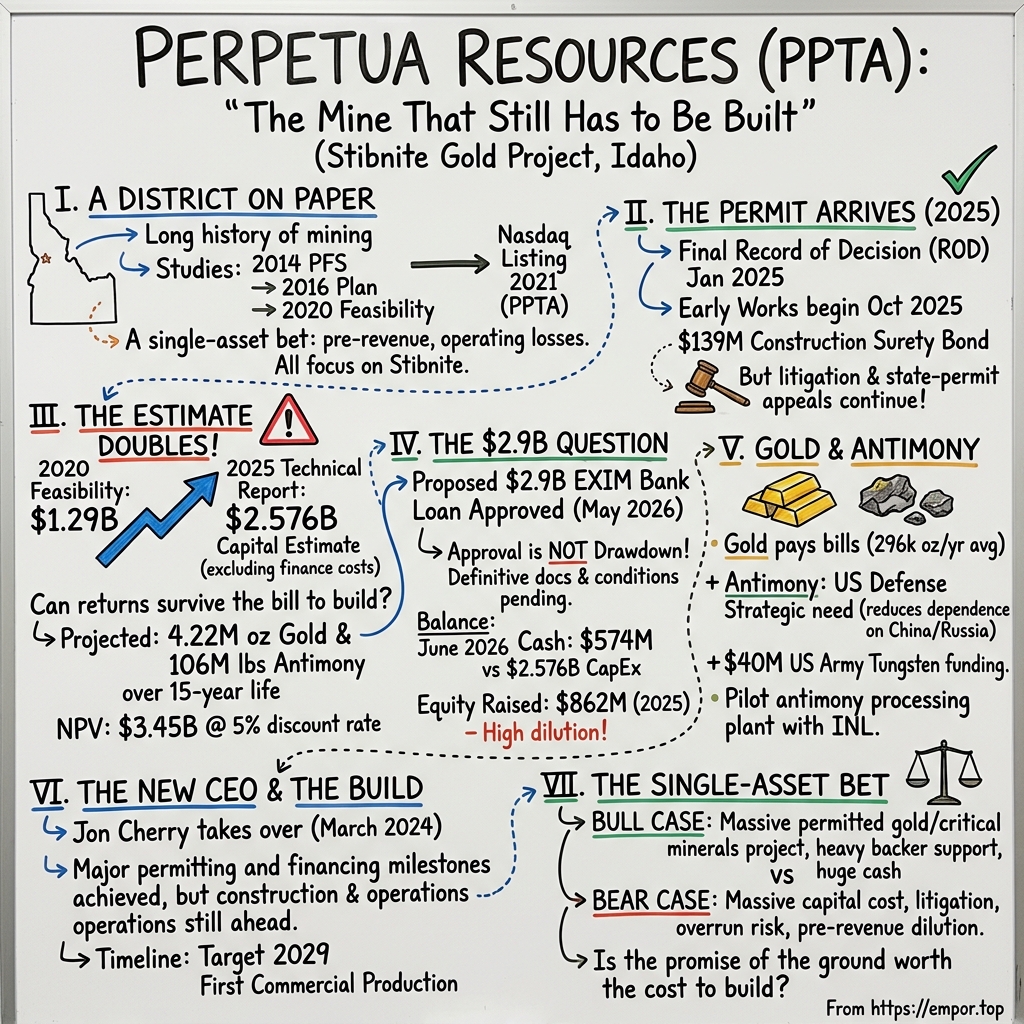
On May 21, 2026, the board of the Export-Import Bank of the United States voted to approve a proposed loan of $2.9 billion for a gold and antimony mine in the mountains of central Idaho.1 For a company that had never sold an ounce of gold, it was the largest vote of confidence it had ever received. The press release went out, the headlines followed, and much of the market read the news as the moment the Stibnite Gold Project became real.
Read the fine print and the moment looks different. An approval by a lender's board is a decision to lend if a long list of things happens next. Lawyers still have to write the definitive loan agreement. The borrower still has to satisfy conditions precedent, the checklist of proofs a lender demands before the first dollar moves. When Perpetua Resources filed its quarterly report for the period ended June 30, 2026, nearly three months after the EXIM vote, that work was still open, including the question of what facilities would cover cost overruns if the build ran over budget.2 The same filing warned that final terms, draw conditions and the sufficiency of total funding remained uncertain.2 An approval, in other words, is not a drawdown.
The scale of what that loan is supposed to carry explains why the distinction matters so much. Perpetua's most recent technical report put the initial capital cost of the mine at $2.576 billion.3 At the end of June 2026 the company held about $574 million of unrestricted cash.2 The bill to build the mine was more than four times the money in the bank. Everything between those two numbers depends on a government lender finishing its paperwork, on the cost estimate holding, and on a construction program in a remote mountain district going roughly to plan.
It helps to be precise about what Perpetua actually is. It is a company incorporated in British Columbia, listed on the Nasdaq and the Toronto Stock Exchange, whose wholly owned subsidiaries own the Stibnite Gold Project.4 It reports a single business segment, mineral exploration and development in the United States, and it has never recorded revenue from mining operations.4 There is no smaller producing mine throwing off cash in the background, no royalty portfolio, no services arm. There is one district, one plan and one balance sheet.
For investors used to valuing businesses on what they sell, a company like this requires a different set of instincts. There is no quarterly revenue line to check against expectations, no margin to track, no customer churn to worry about. The quarterly reports measure something else: how fast cash is being spent, what it is being spent on, and whether the milestones the company promised arrived when it said they would. A developer's financial statements read less like the accounts of a business and more like the progress report of a construction project funded by its shareholders. That is the lens through which every number in this story should be read.
That shape defines the stakes of this story. The first question is whether the EXIM loan closes on terms that leave enough money to finish the job, including the costs that sit outside a technical report's construction estimate. The second is whether a permitting and financing campaign that has run for more than a decade can turn into the harder, dirtier business of moving rock. The third is subtler and runs through the whole story: Stibnite would be one of the few significant antimony sources in the United States, a metal that Washington now treats as a national-security input. Does that make the mine more valuable, or mainly more strategic? Those are not the same thing, and the gap between them is where investors can get hurt.
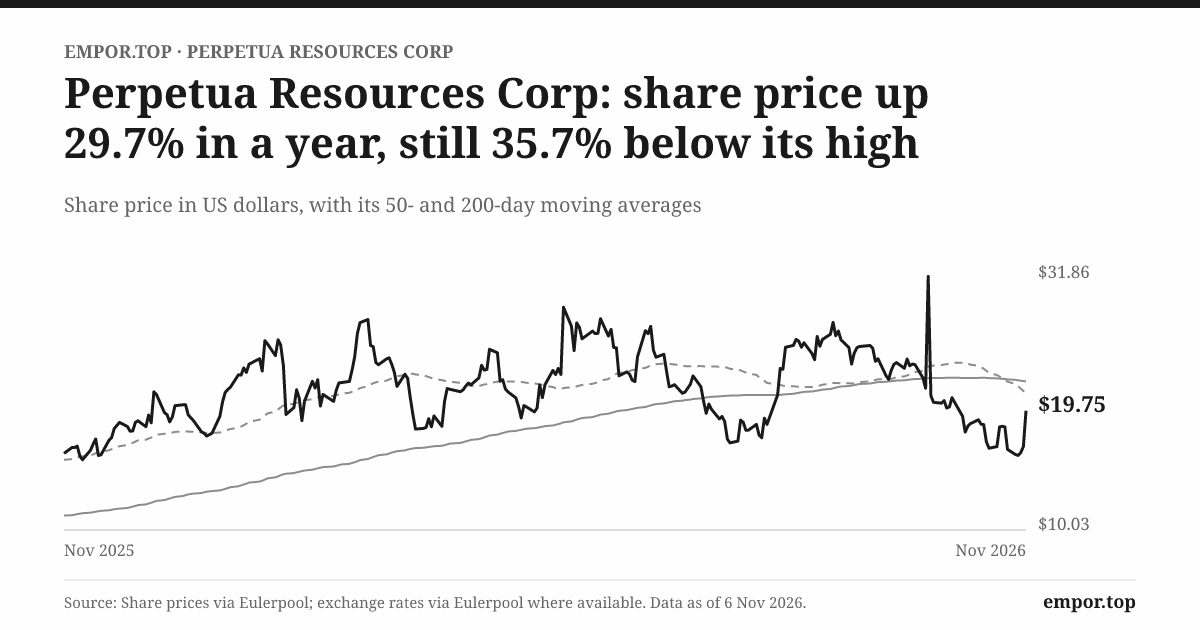
At $19.75 a share on November 6, 2026, the market valued Perpetua at about $2.5 billion, with an enterprise value of roughly $1.9 billion once cash is netted out. The stock sat about 36% below its 52-week high, and its one-year volatility of more than 90% says the market itself cannot decide how much of the mine to believe in. None of that value rests on current sales or operating cash flow. It rests on what a mine that does not yet exist will earn, and on whether it gets built. To understand how the company arrived at the edge of that decision, the story has to go back to a district that had been mined, abandoned and argued over long before Perpetua existed.
 Subscribe on LinkedIn
II. A District Rebuilt on Paper
The Stibnite district sits at the end of long mountain roads in Valley County, Idaho, in the drainage of the East Fork of the South Fork of the Salmon River. Its name is a mineral's name: stibnite is antimony sulfide, the ore of antimony. During the Second World War the district's mines produced tungsten and antimony for the American war effort,5 and mining continued in fits and starts for decades afterward. What those operations left behind was the kind of landscape that makes modern permitting hard: open pits, waste rock, tailings, and a historic pit that blocked the upstream migration of salmon. The legacy turned out to be both the project's burden and its pitch. Any company that wanted the gold would have to argue that a new mine could clean up the old one.
Midas Gold, the company that became Perpetua, made that argument on paper for years. It published a preliminary feasibility study for Stibnite in 2014, the first full attempt to show that a modern open-pit operation could work in the district.6 Two years later, in 2016, it submitted its plan of restoration and operations to regulators, the document that started the formal federal review.6 The plan's ambition was unusual for a mining proposal. It promised to reprocess legacy tailings, restore fish passage and clean up historic impacts as part of mining, so that the environmental case and the economic case came bundled together.
It is worth pausing on what these documents are, because the whole story turns on them. Mining companies climb a ladder of studies, each more expensive and more precise than the last. A preliminary economic assessment is a sketch: is there anything here worth studying? A preliminary feasibility study, like the 2014 document, is a rough architectural drawing, accurate perhaps to within a quarter or a third on cost. A full feasibility study is meant to be the blueprint a bank can lend against, with costs pinned down by engineering, quotes and test work. The industry treats each rung as a reduction in uncertainty. The Stibnite record, as the rest of this story shows, is a reminder that even the top rung is only as reliable as the world stays still while the company waits to build.
Then came the long middle. Through the late 2010s the company did what developers do while they wait for permits: it drilled, engineered, revised the mine plan in response to regulators and critics, and raised money to keep the lights on. In December 2020 it released a full feasibility study, which put initial capital at about $1.29 billion.6 A few weeks later the company completed its reinvention. Midas Gold became Perpetua Resources, and its shares began trading on the Nasdaq on February 18, 2021.4 The new name was a statement of intent, a brand built around restoration and permanence rather than the frontier connotations of a gold rush.
What did "growth" mean during these years? Not sales. Revenue stayed at zero through 2025.4 Operating losses ran in the tens of millions of dollars every year, and cash from operations was negative in every year of the record from 2014 onward.4 The money came instead from the capital markets, through repeated equity raises and, at one point, convertible notes. Those notes left a strange scar on the income statement. In 2020 the company recorded a $179.1 million noncash loss on the fair value of convertible-note derivatives, because the notes' conversion feature became more valuable as the share price rose; the 2020 loss was $220.6 million, and the derivatives were largely converted into shares.7 That single accounting entry explains a large part of the gap between the roughly $735 million of cumulative net losses since 2014 and the roughly $304 million of cash actually burned in operations over the same span.4 The cash burn, not the accounting loss, is the better measure of what the paper years cost.
The more important point is what did not happen. Perpetua did not diversify. It did not buy a small producing mine to generate cash, it did not assemble a portfolio of exploration projects across several states, and it did not merge with a peer to spread risk. Its assets, spending and future value remained concentrated in Stibnite.4 There is no operating acquisition whose fate an investor can study to judge management's dealmaking. Capital deployment went principally into one project's exploration, engineering, permitting and financing.
That focus cuts both ways. It gave the company a clean story: one asset, one plan, one ambition, and a shareholder base that knew exactly what it owned. It also meant that every year of delay and every change in the cost estimate landed on the whole company at once. A diversified miner can absorb a slipped schedule at one project because another is producing. Perpetua could not. The question that outlasted all the studies was simple and uncomfortable: could the economic case survive the time and capital it would take just to win permission to build?
III. The Permit Arrives, Then the Clock Starts
In January 2025 the U.S. Forest Service issued its final Record of Decision for the Stibnite Gold Project.5 For people who had followed the project, the document carried the weight of nearly eight years of federal review. The process had formally begun with scoping in 2017, the stage where an agency asks the public and other agencies what it should study.5 From there came a draft environmental impact statement, a supplemental draft after the company revised its plan, a final statement, objections and responses, and finally the decision itself. Along the way the mine plan changed more than once to reduce its footprint and address water-quality concerns.
Why does American mine permitting take so long? The National Environmental Policy Act does not tell an agency what to decide; it tells the agency what it must study before deciding. The Forest Service had to analyze the mine's effects on water quality, fish, wildlife, cultural resources, roads and communities, compare the company's plan against alternatives, take public comment, answer objections, and build a record sturdy enough to survive the lawsuits everyone knew would follow. The decision is less a single verdict than a defended file. One example of how the file shaped the project is the access road. The agency identified the Burntlog Route, a new road that avoids the existing route along the river, as both its preferred and its environmentally preferred alternative, which means the mine's main access road had to be built from scratch before heavy construction could move freely.8 A decision made to protect a river became a construction-schedule item.
Approval was a threshold, but not the last one. Before a mine on federal land can begin construction, the operator has to post financial assurance: a guarantee that money will exist to reclaim the site if the company fails. Perpetua arranged a $139 million construction-phase reclamation surety bond.4 In October 2025, after the company posted that assurance, the agencies confirmed that construction requirements had been met, and early works began.4 Perpetua marked the moment with a celebration it titled, simply, "It's happening."9
What the bond really costs
A surety bond can sound like construction money. It is not. It is closer to an insurance policy that protects the government, not the company. Perpetua's 2025 annual report records that the bond carries a 1.5% annual fee, along with collateral, covenant and default provisions.4 On $139 million, a 1.5% fee works out to roughly $2 million a year, a modest but permanent cost of doing business, and the collateral and default terms mean the bond is a claim on the company's resources if things go wrong. At June 30, 2026, the asset-retirement obligation on the balance sheet was only about $1.3 million, because little new disturbance had yet occurred.2 As construction expands the footprint, the financial-assurance obligations will grow with it.
The legal picture after approval was not a clean victory, and it deserves its actual shape rather than a headline. Two federal lawsuits challenged the project's approvals and remained pending at the time of the Q2 2026 filing.2 One was brought by environmental groups; the other by the Nez Perce Tribe, whose treaty-reserved fishing interests in the Salmon River basin have made it the most consequential long-term critic of the project. In May 2026 the federal district court denied the environmental plaintiffs' request for a preliminary injunction that would have halted work, and in June the Ninth Circuit denied their request for a stay while they appealed.2 Reporting in August 2026 described the groups' loss of their bid to halt the mine.10 Opponents also appealed a state ruling on the project's air permit.10 Losing a request for emergency relief is not losing a case. It means a court judged the plaintiffs unlikely enough to win, or the harm unclear enough, that work could proceed while the litigation runs. A ruling on the merits could still go the other way.
The scrutiny has deeper roots than the 2025 decision. In 2019 the Nez Perce Tribe sued the company under the Clean Water Act over discharges from the legacy mine workings. That case was settled in 2023, and settlement payments continue.4 The point for investors is not the size of the payments, which the filings treat as routine, but what they reveal: the tribe has been willing to litigate for years, and its relationship with the project is a permanent feature of the operating environment, not a risk that ends with a permit.
What did the 2025 approval prove? It proved that the company could navigate one of the most demanding environmental reviews in American mining, over an extended period, without abandoning the project. That is a genuine accomplishment; many mining projects in the American West have spent longer in review and ended with nothing. It did not prove that the mine can be built within its estimate, or that the restoration commitments that made the project acceptable will be delivered on schedule and at the promised cost. A permit converts a political and legal question into an engineering and financial one. It does not answer the engineering and financial one.
And so the clock changed. Before January 2025 the binding constraint was permission. After October 2025 it was money and time. Early works meant crews, contractors, camp facilities, roads, procurement and engineering, and the cash balance began to fall in a way it had not during the permitting years. The next test was whether engineering, procurement and financing could converge before that balance was consumed. That test depended on a number that had changed a great deal since the feasibility study that took the company public.
IV. The Estimate Nearly Doubles
Every mining project has a moment when the spreadsheet meets the steel. For Stibnite, the new spreadsheet arrived with the company's 2025 technical report, prepared under the SEC's S-K 1300 rules for disclosing mineral properties and filed with the annual report on March 31, 2026.3 It was the document that would anchor the financing, the construction decision and the market's valuation. It also contained a number that should make any long-term investor slow down.
The 2020 feasibility study had estimated initial capital of $1.292 billion.6 The 2025 technical report estimated $2.576 billion, including contingency and capitalized operating costs.3 Even before reaching construction, the estimated cost of building the mine had roughly doubled. And the newer figure excludes debt service and other financing costs, which means the true amount of money required to reach production is larger than the headline.3
The comparison needs care, because it is not a clean measure of overspending. The two estimates were prepared five years apart, on different estimate dates and different cost bases, and after mine-plan changes driven by permitting. Between 2020 and 2025 the mining industry absorbed a burst of inflation in steel, fuel, labor and equipment, and contractor markets in the American West tightened. A reader who calls the jump "a $1.3 billion overrun" is overstating the case: nobody spent that money and then discovered they needed more. But a reader who waves it away as mere inflation is understating it. The near doubling is evidence of estimate risk, of how much the cost of a large, remote project can move while it waits. It is the company's own record of how far its forecasts have traveled, and it is the most relevant base rate for how far the current forecast might travel.
What the new plan says the mine can do
The technical report's operating case is impressive on its face. It projects 4.223 million ounces of recovered gold and 106 million pounds of antimony over a 15-year mine life, with average annual gold production of about 296,000 ounces.3 To put that in perspective, a mine producing close to 300,000 ounces a year would rank among the larger gold mines in the United States. The report puts life-of-mine all-in sustaining cost at $833 an ounce, net of antimony by-product credits.3
All-in sustaining cost is the mining industry's attempt to answer a simple question: what does it cost to produce an ounce of gold and keep the mine running, including the routine capital needed to sustain production but excluding the initial build? A figure in the low hundreds of dollars below a high gold price is what makes a mine attractive. But this particular figure has three moving parts that are not yet proven. Grade and recovery determine how much metal each tonne of rock yields. Metal prices determine what that metal is worth. And the by-product credit, the value of antimony sold alongside gold, is subtracted from gold costs. Until the mine operates, all three are model inputs.
The headline output of the model is an after-tax net present value of $3.457 billion at a 5% discount rate, using the report's stated price assumptions.3 Net present value is the sum of all future cash flows, minus the cost of building, discounted back to today. Think of it as the price a buyer would pay today for the mine's entire future, if the buyer believed every assumption and demanded a 5% annual return. Five percent is a low discount rate for a single-asset mine not yet built; many investors would demand more, and a higher rate would shrink the number sharply. The figure is a model output, not cash already earned and not a floor under the share price.
Here is where the two capital estimates start to talk to each other. The gold price rose dramatically between 2020 and 2025, which lifted the projected value of the mine. At the same time the cost to build it doubled. A mine can become more valuable on paper even as the bill to build it rises, and that is roughly what happened. The improved economics depend heavily on prices staying high. The higher capital cost is a fixed commitment that has to be paid regardless of where prices go.
What the market is and is not measuring
There is no way to value Perpetua the way investors value a producer. It has no commercial revenue, no mine-scale operating record, and no sales history.4 Its zero ratio of enterprise value to sales does not mean the stock is cheap; it means the denominator is zero. Price-to-book, at about 3.4 times, is only a rough guide, because large equity raises in 2025 reshaped the balance sheet. Book value per share of about $5.80 mostly reflects cash raised recently, not the value of the ore body.
A more honest comparison is the one the market itself is implicitly making. An enterprise value of roughly $1.9 billion against a modeled project NPV of about $3.5 billion suggests the market is pricing the mine at a bit more than half of its modeled value. That discount is not irrational. It reflects the remaining financing gap, the cost of the loan, legal risk, construction risk, commodity risk, and the time value of waiting until 2029 for first production. It also reflects the reality that a project NPV is calculated before corporate overhead and before the cost of the financing itself. Investors, in effect, are saying: show us the build.
The income statement shows how quickly the company changed character once early works began. Exploration and pre-development expense, the line where a developer records most of its project spending, rose from about $45 million in 2024 to about $121 million in 2025.4 In the first six months of 2026 alone it reached about $157 million, of which roughly $102 million was engineering and about $32 million was field operations and drilling support.2 Engineering on that scale is the work of turning a technical report into drawings that contractors can bid on and build from. It is also the stage at which cost estimates are most often revised, because a design detailed enough to build is a design detailed enough to price honestly. The company did all this with a small corporate staff, 49 employees at the end of 2025, 46 of them working directly on Stibnite, relying on contractors for the heavy lifting.4 That is normal for a developer, and it puts a premium on the quality of contractor management, because most of the people building the mine will not be Perpetua employees.
Two other lines softened the loss without changing its nature. In 2025, grant income of about $15 million and interest income of about $12 million offset part of the $128 million operating loss.4 In the first half of 2026, interest income of about $14.5 million exceeded grant income several times over, a direct consequence of holding hundreds of millions of dollars of raised cash while waiting to spend it.2 Interest on the treasury is real money, but it is a by-product of the financing, and it will shrink as the cash is deployed into the ground.
That is the practical test this section leaves behind. The published economics matter less than three numbers the company has not yet put in front of the market as a final package: the committed cost of construction once contractors sign, the size of the contingency that protects against surprises, and the terms of the money that pays for it all. The equity raises of 2025 bought time to answer those questions. Whether they bought enough is the next part of the story.
V. Equity Buys Time; EXIM Would Buy Scale
In the spring of 2024 Perpetua was a company with an approved project in sight and almost no money. At the end of 2023 it held about $3 million of cash and short-term investments.11 At the end of 2024, after a public offering in November priced at $10.17 a share, it had about $44 million.4 That was enough to keep a permitting company alive, not enough to start a mine. What followed in 2025 was the most important financial transformation in the company's history, and it was built on equity.
The sequence moved fast. In June and July 2025 Perpetua sold shares in a public offering at $13.20, with a concurrent private placement to Paulson & Co., its largest shareholder.4 In October 2025 it struck strategic placements with Agnico Eagle, one of the world's largest gold miners, and with JPMorgan, including warrants.4 In November and December 2025 it completed further private placements at $24.25 and $28.84 a share.4 Altogether, the company reported $862 million of gross equity proceeds between June and December 2025.4 Cash and short-term investments rose from about $44 million at the end of 2024 to about $774 million at the end of 2025, and shareholders' equity rose from about $109 million to about $861 million.4
Notice the prices. The company sold stock at about $10 in late 2024, around $13 in mid-2025, and nearly $29 by December 2025. Each raise was done at a higher price than the last, which meant each new dollar diluted existing holders less. That is the positive reading: management raised money into strength, as the market came to believe in the permit and the antimony story. The negative reading is equally valid. Every raise still added shares. The company reported about 125.1 million shares outstanding in April 2026.12 And 6.64 million potentially dilutive options, units and warrants were outstanding at the end of 2025.4
The clearest picture of what dilution means comes from the largest shareholder. Paulson & Co., the investment firm founded by John Paulson, owned about 38.6% of Perpetua in March 2024 and about 34.8% in March 2025.11 By April 2026 its stake had fallen to about 25.9%, 32.35 million shares, even though it participated in the 2025 financings.12 Agnico Eagle held about 8.7%, including shares issuable on warrants.12 Paulson's percentage fell not because it sold but because the register grew around it. For a smaller holder who did not participate in the private placements, the dilution was greater.
Where the money sits matters too, because a developer's cash is its only defense against delay. At the end of 2025, cash including restricted cash totaled about $774 million, of which about $60 million was restricted.4 The company says most of its cash is held with Canadian chartered banks, whose credit standing it monitors.4 The balance sheet carried essentially no project debt at year-end, only small lease obligations.4 For one last moment before the loan, Perpetua was a pure equity story: an ungeared bet on one mine, with nothing ahead of shareholders except the reclamation obligations.
What the government loan would and would not do
The EXIM facility is designed to finance the bulk of the build. It is a proposed senior secured loan with a 13-year term, comprising $2.4 billion available upfront and the remainder to cover capitalized interest and fees.1 Its rate is tied to long-dated U.S. Treasury rates plus 100 basis points, or one percentage point.1 For a single-asset mining developer, that is remarkably cheap money. A commercial bank lending to a pre-revenue miner would typically demand far more, if it lent at all. The pricing is the clearest evidence that Washington views Stibnite as a strategic asset rather than an ordinary commercial credit.
But "senior secured" carries weight too. Senior means the lender gets paid first; secured means the loan is backed by the project's assets. Shareholders sit behind it. And the facility was approved, not executed. At the Q2 2026 filing, definitive documents and conditions precedent were still outstanding, including possible cost-overrun facilities.2 The company warned that additional financing could impose restrictive covenants, the rules lenders use to control what a borrower can do with its cash and assets.2 A loan of this size typically requires the borrower to demonstrate that the project is fully funded, which means equity in the bank, an independent engineer's sign-off on the cost estimate, and a plan for what happens if costs run over.
Do the arithmetic in round numbers and the risk becomes clear. About $2.4 billion of upfront loan plus about $574 million of cash comes to roughly $3 billion. That is more than the $2.576 billion headline capital estimate. But the capital estimate excludes financing costs, and the company also has to fund financial assurance, debt service, corporate overhead, exploration, and its share of programs like the tungsten study. It was spending heavily already: cash fell by about $200 million in the first half of 2026 as engineering and field work ramped up.2 Some of that spending is part of the initial capital, which helps; some is not. The cushion between sources and uses, once everything is counted, is not as large as the headline totals make it look, and a cost increase of even 10 or 15% would consume it.
Paying for insurance years in advance
One transaction in the summer of 2026 shows how management is thinking about risk. In July and August, Perpetua paid a premium of about $28.9 million for put options on up to 158,016 ounces of expected 2031 gold production at a strike price of $3,000 an ounce.2 A put option is the right to sell at a set price. If gold falls below $3,000 in 2031, the puts pay out; if gold stays above it, the company keeps the upside and the premium is simply the cost of the insurance. Lenders like this kind of protection because it puts a floor under the cash flows that will service debt.
The choice of puts rather than forward sales is the shareholder-friendly version of hedging: Perpetua gave up no upside. But the cost is real. Nearly $29 million left the bank years before the first ounce is poured, to protect production that will not exist unless the mine is built on schedule. It is a bet that the financing will close and the mine will produce, purchased in cash today.
There is no clean acquisition multiple or past deal to judge how well this management deploys capital. Perpetua's central capital-allocation decision is whether to keep financing one project alone, at 100% ownership, and on what terms. Thus far it has chosen to keep full ownership, taking minority strategic investors rather than a joint-venture partner. The key financing falsifier is concrete. Signed loan documents and committed cost-overrun coverage would change the risk picture more than any presentation or non-binding expression of government support. Until then, the story the company tells about why the government is backing it rests on a metal most investors had never thought about before 2023.
VI. Gold Pays the Bills; Antimony Changes the Pitch
On July 29, 2026, Perpetua, the U.S. Army and Idaho National Laboratory held a ribbon-cutting at the laboratory's site in Idaho Falls for a modular pilot plant.13 The plant was built to process antimony-bearing material trucked from Stibnite into antimony trisulfide, a compound used in military munitions.13 The image was carefully chosen: a mining company, a national laboratory and the Army standing together, turning Idaho rock into a defense input. It is the image of Stibnite that has drawn the government's money. To see what it means for shareholders, it helps to separate the strategic story from the revenue model.
Start with the revenue model, told plainly. Perpetua has no current mining sales, no commercial customers, and no disclosed sales contracts.4 The future mine would sell gold, which in the company's modeled economics is the dominant source of value, with antimony recovered as a by-product.3 The drivers are the classic ones for any mine: metal prices, ore grade, metallurgical recovery, processing costs and production timing. Gold pays the bills. Antimony lowers the cost of producing gold and gives the project a role in national security.
What antimony is and why Washington cares
Antimony is a brittle, silvery metalloid that most people have never handled, but it is everywhere in the modern economy. It is used in flame retardants, in lead-acid batteries, in some solar glass, and crucially in military applications such as ammunition primers, tracers and other munitions components. The U.S. Geological Survey estimated world antimony mine production at about 110,000 tonnes in 2025, of which China mined about 40,000 tonnes.14 Russia and Tajikistan were also significant producers.14 China's dominance is greater in refining than in mining, and its export restrictions on antimony products in recent years sent prices sharply higher and alarmed defense planners in Washington. That alarm is the reason the Army has funded antimony work at Stibnite and the reason EXIM's approval came under a program aimed at domestic industrial capacity.1
The strategic case is real. But the market context matters: Perpetua would enter an international market with established producers, not a market without alternatives. If China relaxes export controls, or if new supply arrives from elsewhere, antimony prices could fall, and with them the by-product credit that helps lower the mine's gold costs.
The "only domestic source" shorthand also needs correcting. The USGS reports that a domestic company began mining antimony in Montana in 2025.14 United States Antimony Corp., which has operated a smelter in Montana for decades, reported mining 840 tons of ore that year.15 That is tiny compared with what Stibnite is designed to produce, and Perpetua's potential scale and reserve position are of a different order. But domestic production is no longer purely prospective, and the rhetorical claim that Stibnite would be the country's only source needs a qualifier: it would be by far the largest planned source, not the only one.
From by-product credit to buyer
A simple analogy helps explain the economics. Think of the mine as a dairy whose product is milk, with cream skimmed off and sold on the side. The farm's budget is built on milk prices; the cream makes each litre of milk cheaper to produce, because its sales offset some of the costs. But if nobody nearby churns cream into butter, the farmer has to truck it somewhere that does, sell it at whatever that buyer offers, or build a creamery. Antimony at Stibnite is the cream. The mill is designed to separate an antimony concentrate from the gold-bearing ore before the gold is recovered,3 and that concentrate is only as valuable as the price someone will pay to refine it.
That is why the size of the credit, not just its existence, deserves scrutiny. The mine's projected all-in sustaining cost is calculated after subtracting antimony revenue. If antimony prices fell back toward their levels before China's export restrictions, or if the concentrate sold at a steep discount to refined metal because domestic refining capacity remained scarce, gold costs per ounce would rise. The gold half of the model would still carry the mine, but its margin would be thinner than the headline suggests. Investors who value Stibnite mainly as an antimony play are, in effect, valuing the cream more than the milk.
The technical report treats antimony as a credit that lowers projected gold costs.3 That is not the same as a contracted offtake price or a proven processing chain. Antimony from Stibnite would come out of the mill as a concentrate, which needs to be refined before it becomes a product the military or industry can use. The United States has very little antimony refining capacity. The 2025 annual report describes antimony processing and offtake arrangements as ongoing work.4 The pilot plant at Idaho National Laboratory is an attempt to prove one piece of that chain, the conversion into antimony trisulfide, at a scale of roughly one ton of material a day.13 It is a pilot, not proof of commercial sales or a second operating business.
Then there is tungsten, which takes the story further into optionality. On October 26, 2026, Perpetua announced an award of up to $40 million from the U.S. Army, through the Defense Ordnance Technology Consortium, over 36 months to evaluate whether tungsten concentrate could be produced economically at Stibnite.16 The company has to match the Army's funding, so the total program could reach $80 million, and the first 18-month phase is expected to cost about $18 million, split equally.16 The work focuses on tungsten mineralization beneath the Hangar Flats pit, and any production outside the existing mine plan would require additional regulatory review and permits.16 The award is a sign of government interest. It is not a reserve, a permit or a revenue line, and it carries a cost-sharing obligation that the company will pay out of the same cash it needs to build the gold mine.
The record bears weighing here. Perpetua has now won roughly $126 million of U.S. government awards for critical-minerals work since 2022, by its own count.16 Those awards have funded studies, engineering and pilot work. None has yet produced commercial antimony revenue, because the mine does not yet exist. Government money has been good at advancing the technical case; whether that converts into a commercial business depends on the mine being built and on buyers signing contracts at prices that justify the by-product credit.
There is no producing-company moat to score yet. Geological endowment, a permitted footprint and domestic strategic positioning are advantages in principle. Whether they become durable advantages will be decided by evidence the company cannot produce until the mine runs: actual recoveries, a cost position against other gold producers, contracted buyers for antimony, and repeatable delivery. The strategic story has opened doors at EXIM and the Army. The question that remains is whether this single project can produce at its modeled cost while converting that strategic interest into buyers and cash. That question falls to the people running it.
VII. The New CEO Inherits the Build
Jon Cherry became Perpetua's chief executive in March 2024.12 He arrived with more than three decades in mining, spanning project development, permitting, operations and capital raising.12 Most notably, he had previously run PolyMet Mining, the developer of a copper-nickel project in Minnesota whose permits spent years in regulatory review and litigation.12 It is hard to imagine a more relevant résumé for a company that needed to push a contested project in the American West through the final stage of permitting and into financing. It is also a résumé shaped by the experience of how long such projects can take, and how fragile approvals can be in court.
Cherry inherited a company that had been led through the bulk of the federal review by his predecessor, Laurel Sayer, who had become the public face of the project's restoration pitch and who stayed on as a senior advisor to the chief executive.12 Cherry's job was different. Sayer's era was about permission. Cherry's would be about money and construction.
Keep the credibility claim bounded. Under his tenure, the company secured the final Record of Decision, posted financial assurance, began early works, raised more than $860 million of equity, and won EXIM board approval. Those are consequential milestones; many developers in his position would have failed at one of them. But none of them is evidence of successful mine construction or production. The skills that win permits and raise capital overlap only partially with the skills that deliver a multibillion-dollar build on schedule in a mountain district with a short construction season.
What the pay rewards
The 2026 proxy reports that Cherry's total compensation for 2025 was about $2.46 million, of which about $1.19 million was non-equity incentive compensation and about $797,000 was stock awards; in 2024, a partial year, his total was about $984,000.12 The mix is heavily weighted toward incentive and equity, which is what shareholders should want in a pre-revenue company. The question is which outcomes drive the awards. For a developer, the natural scorecard is milestone-based, permits, financing, construction start, and the proxy's detailed scorecard and vesting terms are the place to see how heavily safety, cost and schedule weigh against the more visible milestones. A scorecard that rewards financing announcements more than cost control would create the wrong incentive at exactly the wrong moment.
Ownership is a starker comparison. Cherry beneficially owned 44,895 shares as of April 8, 2026, less than 0.1% of the company.12 Paulson & Co. held about 25.9% and has contractual rights to designate two directors while it owns at least 20% and one while it owns at least 10%.4 The CEO's personal stake is small, and the most influential owner is an outside fund. Paulson's partner Marcelo Kim chairs the board.12
Governance is not a clean pass. At the June 2026 annual meeting, Kim received about 72.6 million votes for and 11.8 million against, materially more dissent than other nominees.17 All nine directors were elected, and the 2026 equity incentive plan passed overwhelmingly, with about 83.7 million votes for and 0.6 million against.17 The pattern says something specific. Shareholders broadly supported management's incentive plan but registered a protest against the chair, the director most closely identified with the largest shareholder. As Paulson's stake has diluted, some investors appear to be asking whether its influence on the board should shrink in step. Eight of nine directors were classified as independent, with Cherry the only employee director.12
The finance function changed hands at a sensitive moment. Jessica Largent resigned as chief financial officer effective October 1, 2025, and Mark Murchison became CFO.12 Michael Wright, the vice president of projects, left in December 2025, with a 2025 total of about $3.55 million that included about $2.19 million of estimated value from accelerated equity awards and other separation payments.12 Departures of a CFO and a projects lead within a few months, right as construction began, are worth noting. The filings do not attribute them to disagreement, and nothing suggests impropriety, but projects leadership in particular is the role a construction-stage miner can least afford to churn.
One signal supports confidence in the statements themselves. The auditor gave an unmodified opinion on the 2025 financial statements, with no material weakness finding.4 That supports trust in the numbers reported. It says nothing about the reliability of the project forecast.
There is a deeper point about the kind of leadership this stage demands. A developer's chief executive spends most of the permitting years in hearing rooms, investor meetings and government offices, and the company's culture tends to reward persuasion: making the case to regulators, tribes, lenders and shareholders. Construction rewards a different instinct, the willingness to deliver bad news early, to cut scope when costs rise, and to say no to an exciting side project because the main build needs the money. Perpetua's simultaneous pursuit of a gold mine, an antimony pilot, a tungsten study and new exploration discoveries is defensible, since much of the side work is funded by government awards. It is also the kind of breadth a skeptic would watch closely as the build absorbs management attention.
What would demonstrate credibility now? Not more milestones of the kind already achieved. Credibility at this stage means transparent changes to cost and schedule as contractor quotes come in, prompt explanation of any miss, and funding updates that clearly separate what is committed from what is expected. Management has been consistent in one useful respect: in its June 2025 status update, it framed the financing as a sequence of steps leading to a final investment decision, and the company's 2026 materials still describe a decision expected in the second half of the year.1819 That consistency is a strength. The risk is that "second half of 2026" becomes 2027 without a clear explanation of why. The broader lessons of the Stibnite story begin with that tension between paper progress and built progress.
VIII. What a Single-Asset Bet Teaches
Imagine standing on the edge of the old Yellow Pine pit, where a twentieth-century mine cut off a salmon river and left the water to find its own way through the wreckage. Every version of the Stibnite plan has promised to mine that ground again and leave it better than it was found. It is a powerful image, and it is also a reminder that this district has seen more plans than finished projects. The lessons Perpetua offers are specific to that history.
The first lesson comes from the feasibility-study reset. Between 2020 and 2025 the project's modeled value rose as gold prices climbed, while the estimated cost of building it doubled. Both facts are true at once, and investors who focus on only one of them misread the company. A mine can get more valuable on paper while the bill to build it gets bigger. The wider lesson for anyone backing a long-dated development project is that time is not neutral. Every year of permitting exposes the plan to inflation, scope changes and new engineering, and the price assumptions that make the economics look better can reverse long after the higher capital commitments are locked in.
The second lesson comes from EXIM and antimony. Stibnite's strategic role helped win cheap, long-dated government credit and Army funding for pilot and exploration work. Those are real advantages that most gold developers could never access. But strategic importance can open doors; only production and contracts turn it into cash. A pilot plant in Idaho Falls is not an offtake agreement, and a board approval is not a drawn loan. For founders and investors in critical-minerals companies more generally, the lesson is to price the strategy and the business separately, because governments change priorities and markets change prices, while the bills for construction arrive on schedule.
The third lesson comes from Paulson and the 2025 raises. A patient, concentrated backer kept the project alive through the permitting years, when no one else would fund it at scale, and participated again when the company raised capital in 2025. That support was arguably the difference between a dead project and a permitted one. Yet a committed backer can keep a project moving, but public shareholders still pay attention to dilution and control. The dissent against the chair in 2026 showed that investors were watching the gap between Paulson's shrinking stake and its continuing influence.
The fourth lesson comes from the litigation and restoration commitments. The company spent years earning a Record of Decision, and that achievement survived the first legal tests. But a permit is a milestone, not a moat; the operating record begins after the approval. Courts can still rule on the merits, restoration promises must be delivered with real money, and a regulator's sign-off provides no protection against a cost overrun, a metallurgical surprise or a bad construction season.
A fifth lesson hides in the accounting. In 2020 the company's reported loss ballooned because its own share price rose, which made the conversion feature of its notes more expensive on paper. Good news for the stock produced a terrible-looking income statement. For a developer, the profit and loss account can mislead in both directions, and the only figures that tell the truth are the ones that track cash and commitments. A developer's income statement measures accounting; its cash balance measures time. Anyone judging a pre-production miner should start with how many months of runway it has and what it has already promised to spend, and only then look at earnings per share.
Return to the original question. Perpetua's investment case is not diversified by segments, customers or geographies. One project must carry the value of the entire listed company. That concentration is what makes the upside large and legible, and it is what makes every risk in this story land on the same place at the same time. Weighing those two facts against each other is the work of the bull and bear cases.
IX. Analysis & Bear vs. Bull Case
Put the two documents side by side. On one is the 2025 technical report, with its $2.576 billion capital estimate and its $3.457 billion after-tax NPV at a 5% discount rate.3 On the other is the Q2 2026 filing, with $574 million of cash, a lender's approval awaiting documents, two federal lawsuits pending, and a warning that the sufficiency of total funding remains uncertain.2 Between them sits a share price of $19.75 and a market value of about $2.5 billion on November 6, 2026. The investment question is how much of the first document an investor should believe given the second.
Why it could win, and why it may not
The bull case is concrete. Stibnite has a defined gold reserve large enough to support a 15-year mine producing close to 300,000 ounces a year.3 It has its federal Record of Decision and has survived the first round of emergency legal challenges.2 It holds a large cash balance raised from equity, much of it at rising prices, and it has strategic investors in Agnico Eagle and JPMorgan alongside Paulson.4 It has a board approval from a government lender offering long-term capital at rates far below what a commercial lender would charge.1 And it has a domestic antimony resource at a time when Washington wants one, which has already brought government funding and could bring preferential buyers. If the loan closes on the approved terms and the build holds near its estimate, the market's discount to the modeled NPV leaves room for value to be recognized as risk falls away.
The bear case is equally concrete. The company is pre-revenue. Its cost estimate roughly doubled between study updates. Its latest quarterly filing warned that loan terms and total funding sufficiency remained uncertain.2 Opponents continued their legal appeals, and a ruling on the merits could disrupt work. And the economics depend on commodity prices that the company cannot control; gold's rise is what made the higher capital cost tolerable, and a meaningful fall would compress the margin between modeled returns and committed costs. The bear does not need any single catastrophe. A moderate cost increase, a six-month financing delay and a softer gold price together could force another equity raise at a lower price, which would dilute the very holders who have waited longest.
Michael Porter's five forces are an imperfect fit for a company that has not yet sold anything, but they clarify where power will sit once it does. Buyer power in gold is low in a specific sense: gold is a global, liquid commodity, and a producer can sell every ounce at the market price without needing a customer relationship. The flip side is that a gold miner has no pricing power at all; it takes the price the market gives. Antimony is different. The buyer base is narrower, concentrated in defense contractors, chemical companies and battery makers, and the U.S. government itself is a powerful buyer with its own priorities. A seller whose pitch depends on a government buyer's strategic interest has to recognize that the same government can change its specifications, fund competitors, or lose interest if China's export restrictions ease.
Supplier power is high during construction. Specialized contractors, equipment manufacturers and engineering firms such as Hatch, the EPCM contractor for specified facilities, ATCO for the camp and Idaho Power for long-lead power-line items, have leverage over a single-project developer that cannot spread procurement across several sites.4 The threat of new entrants is low in the narrow sense that permitting a mine of this scale in the United States takes the better part of a decade, which Perpetua's own history proves. Substitutes do not threaten gold's role as a store of value in any near-term way, though antimony in some industrial uses can be replaced by other materials if prices rise too far. Rivalry, finally, is global for gold and growing for antimony as other countries and companies chase the same strategic premium.
Hamilton Helmer's seven powers framework asks a harder question: what gives a business persistent differential returns? Most of the seven powers, scale economies, network economies, switching costs, branding, counter-positioning and process power, do not apply to a pre-production mine, or will only become measurable after it operates. The one that fits is cornered resource: privileged access to a valuable asset on attractive terms. Stibnite's ore body, its permitted footprint and its historical claims position are as close to a cornered resource as mining offers. Nobody else can mine this deposit.
The historical record narrows that claim. A cornered resource is only valuable if it can be developed at a cost below what the market pays for its output, and the doubling of the capital estimate shows how quickly the cost side can move. Permits, too, can be challenged, and the federal appeals remain live. The antimony half of the cornered-resource argument is further weakened by the existence of other global supply and the arrival of small but real Montana production.1415 The verdict is that Stibnite has a cornered resource in principle, but it is unproven as a source of durable advantage, because the evidence that would prove it, actual recoveries, unit costs and contracted antimony sales, cannot exist until the mine produces.
The risk radar around the project is short but sharp. Inflation in construction inputs is the most direct threat, because it already roughly doubled the estimate once. Cost of capital matters less than it would for most developers, because the EXIM loan's pricing is pegged to Treasury rates with a thin spread, but a rise in long-dated Treasury yields would still raise the interest bill that gets capitalized into the loan. Political risk cuts in two directions: today's bipartisan enthusiasm for domestic critical minerals helps, but a project whose financing leans on a government lender and Army programs is exposed to shifts in Washington's priorities and budgets. And commodity risk is the one the company has partly addressed, with puts on a slice of 2031 gold, while leaving the rest of the mine's life exposed to the price of both metals.
The valuation figures should be treated as context, not as operating multiples. At 3.4 times book value and with effectively zero sales, the ratios that investors use for producers say nothing useful here. The relevant comparison is the market's enterprise value against the modeled NPV, roughly half, which encodes the market's collective estimate of the probability and timing of success.
The company's own historical falsification test is its estimate record. The 2020 and 2025 cost bases differ, so the rise cannot be read as a simple overrun, but it means investors should require an updated cost-to-complete, a funded contingency, the full cost of financing and a measure of how much of the budget is already locked in by signed contracts before accepting the modeled return.
The price of keeping all of it
A skeptical, activist-minded shareholder would push on one issue above all: ownership structure. Perpetua has chosen to keep 100% of Stibnite and fund it with equity and government debt. If the EXIM loan were delayed or came with conditions requiring more equity, would shareholders be better served by bringing in a partner, perhaps a major gold producer such as Agnico Eagle, which already owns a stake, to take a share of the project in exchange for funding? Or by staging the spending, building the most critical infrastructure first and pausing larger commitments until financing closes? Keeping full ownership preserves upside, but if it forces another dilutive raise at a lower price, it could cost minority holders more than selling a slice of the project would. The skeptic would also ask whether a board chaired by the largest shareholder's partner is structurally inclined to choose the path that preserves that shareholder's position.
Three KPIs will decide the case. The first is execution of the definitive EXIM loan documents and satisfaction of the initial draw conditions; at the latest filed quarter, this stood at board-approved but not documented.2 The second is committed funding against an updated cost-to-complete, including contingency; at the latest filed quarter, the company had about $574 million of cash against a $2.576 billion headline estimate that excludes financing costs, with the gap pending the loan.23 The third is schedule progress toward first production, followed by actual recoveries, unit costs and cash generation; the company targets gold and antimony production in 2029.8
Signed financing and a controlled build would move Perpetua decisively toward being a mine. Another capital reset or a funding gap would test the project's economics and management's credibility together, and the market would not distinguish between the two.
X. Epilogue
Through the summer and autumn of 2026, the Stibnite site looked more like a construction zone than a permitting exhibit. Crews advanced the Burntlog Route, the new access road that is planned to become the main route into the project, removing dead timber left by old wildfires ahead of earthworks.8 Bridge deliveries for the route, installation of the worker housing facility and powerline procurement were scheduled through the fall, while the administrative pad was underway and fabrication of the autoclave, the pressure vessel at the heart of the gold processing circuit, had begun.8 In late September the company reported continued progress on construction and exploration, and on November 4 it announced a new gold discovery and continued high grades from the Clark Tunnel fault zone.2021 The company says its planned work this season targets the critical items needed to keep development on track for gold and antimony production in 2029.8
Tonight, the project stands at the moment between early works and full commitment. The first event to watch is the EXIM documentation. If it closes on terms consistent with the board-approved facility, and if the company shows that the combined funding covers direct construction costs, financial assurance, financing costs and corporate needs, the central financing risk in this story would shrink dramatically. If it closes on tighter terms, requires more equity, or slips into 2027, the market will reprice the risk accordingly.
The second is the cost-to-complete. As engineering matures and contractors sign, the company will know far more about what the mine will actually cost than it did when the technical report was written. Investors should watch for a current estimate, a funded contingency and any changes in scope. Given the record from 2020 to 2025, the absence of an updated figure would be as telling as a higher one.
The third is the courtroom. The federal appeals and the state air-permit appeal continue alongside construction.10 Earlier losses for opponents did not end the proceedings, and a merits ruling could still impose new conditions or delays.
Each of these moments has a clear good outcome and a clear bad one, and they are not independent. A signed loan with a cost-overrun facility would make a schedule slip survivable. An updated estimate that holds near the technical report's figure would make the loan's sizing look comfortable. A favorable court ruling would remove the tail risk of a work stoppage just as the company commits most of its money. Run them the other way and they compound: a higher estimate makes the loan look small, a smaller cushion makes a court delay more dangerous, and a delay raises the cost again. The company's fate over the next eighteen months is less a series of separate tests than a single chain, and a chain is only as strong as the weakest link the market discovers.
There is also the question of the season. Construction in the high country of central Idaho runs to the weather, and the company's work plans are built around what can be finished before snow closes in. Every financing delay that pushes a major contract award past a construction window can cost months rather than weeks, because the work simply cannot begin until the ground and the roads allow it. That is why the timing of the final investment decision matters more than the calendar alone suggests.
Treat the drilling results, the antimony pilot plant and the tungsten study as secondary for now. They matter if they change reserves, permitted mine plans, contracted sales or project economics, and none has done so yet. A new discovery adds to the long-term resource; it does not change whether the first mine gets built.
Finally, revisit what management said and when. In its June 2025 status update, the company laid out its path to financing; in its Q2 2026 materials it described a final investment decision expected in the second half of 2026; its construction updates since have described steady progress.182219 Those statements have been broadly consistent. The test ahead is whether they stay consistent when the facts get harder, and whether any change in plan arrives with a clear explanation. The 2029 target is a plan, not a result.
XI. Outro
Go back to the Idaho mountains one last time. There is a brownfield district where men once dug tungsten and antimony for a world war, a pit that blocked a salmon run, a new road being cut through burned timber, and a company that has spent more than a decade and hundreds of millions of dollars preparing to mine there. What it does not have yet is its first mining sale.
That is what makes Perpetua unlike a conventional gold producer. A producer's value is the cash it generates. Perpetua's value is a promise about cash, backed by a permit, a reserve, a government lender's approval and a strategic story Washington wants to believe. The promise is credible enough to have raised hundreds of millions of dollars and to have won a $2.9 billion approval. It is not yet a mine. At Stibnite, the ore is in the ground. The proof is what gets built above it.
References
-
U.S. EXIM Approves $2.9 Billion Loan for Stibnite Gold Project — Perpetua Resources, 2026-05-21 ↩↩↩↩↩
-
Form 10-Q for quarter ended June 30, 2026 — Perpetua Resources, 2026-08-14 ↩↩↩↩↩↩↩↩↩↩↩↩↩↩↩↩↩
-
Stibnite Gold Project S-K 1300 Technical Report Summary — Perpetua Resources, 2026-03-31 ↩↩↩↩↩↩↩↩↩↩↩↩↩
-
Form 10-K for year ended December 31, 2025 — Perpetua Resources, 2026-03-31 ↩↩↩↩↩↩↩↩↩↩↩↩↩↩↩↩↩↩↩↩↩↩↩↩↩↩↩↩↩↩↩
-
Final Record of Decision — Stibnite Gold Project, U.S. Forest Service, 2025 ↩↩↩
-
Stibnite Gold Project Feasibility Study Technical Report — Perpetua Resources, 2021-01-27 ↩↩↩↩
-
Consolidated Financial Statements for 2020 and 2019 — Perpetua Resources, 2021-03-31 ↩
-
August 2026 Construction Update — Perpetua Resources, 2026-08-31 ↩↩↩↩↩
-
Green Groups Lose Court Bid to Halt Idaho Mine — E&E News, 2026-08-19 ↩↩↩
-
Form 10-K for year ended December 31, 2024 — Perpetua Resources, 2025-03-31 ↩↩
-
2026 Definitive Proxy Statement — Perpetua Resources, 2026-04-24 ↩↩↩↩↩↩↩↩↩↩↩↩↩
-
Perpetua Resources, U.S. Army and Idaho National Laboratory Launch Critical Minerals Pilot Plant to Advance Antimony Trisulfide Supply — Perpetua Resources, 2026-07-30 ↩↩↩
-
Antimony — Mineral Commodity Summaries 2026, U.S. Geological Survey, 2026 ↩↩↩↩
-
Annual Report for year ended December 31, 2025 — United States Antimony Corp., 2026 ↩↩
-
Perpetua Secures US Army Funding to Delineate Tungsten at Stibnite Project — Mining Weekly, 2026-10-27 ↩↩↩↩
-
Annual Meeting Voting Results, Form 8-K — Perpetua Resources, 2026-06-10 ↩↩
-
Status Update Transcript — Perpetua Resources, 2025-06-18 ↩↩
-
Perpetua Resources Q2 2026 Results Press Release — Perpetua Resources, 2026-08 ↩↩
-
Construction and Exploration Update — Perpetua Resources, 2026-09-28 ↩
-
New Gold Discovery at Stibnite Gold Project — Perpetua Resources, 2026-11-04 ↩
-
Q2 2026 Earnings Summary and Related Materials — Quartr, 2026-08-17 ↩
 LinkedIn
 WhatsApp
 Reddit
 Hacker News
 Email
 Kindle
 RSS Feed
 Spotify
 Apple Podcasts
 Amazon Music
 Audible
 YouTube