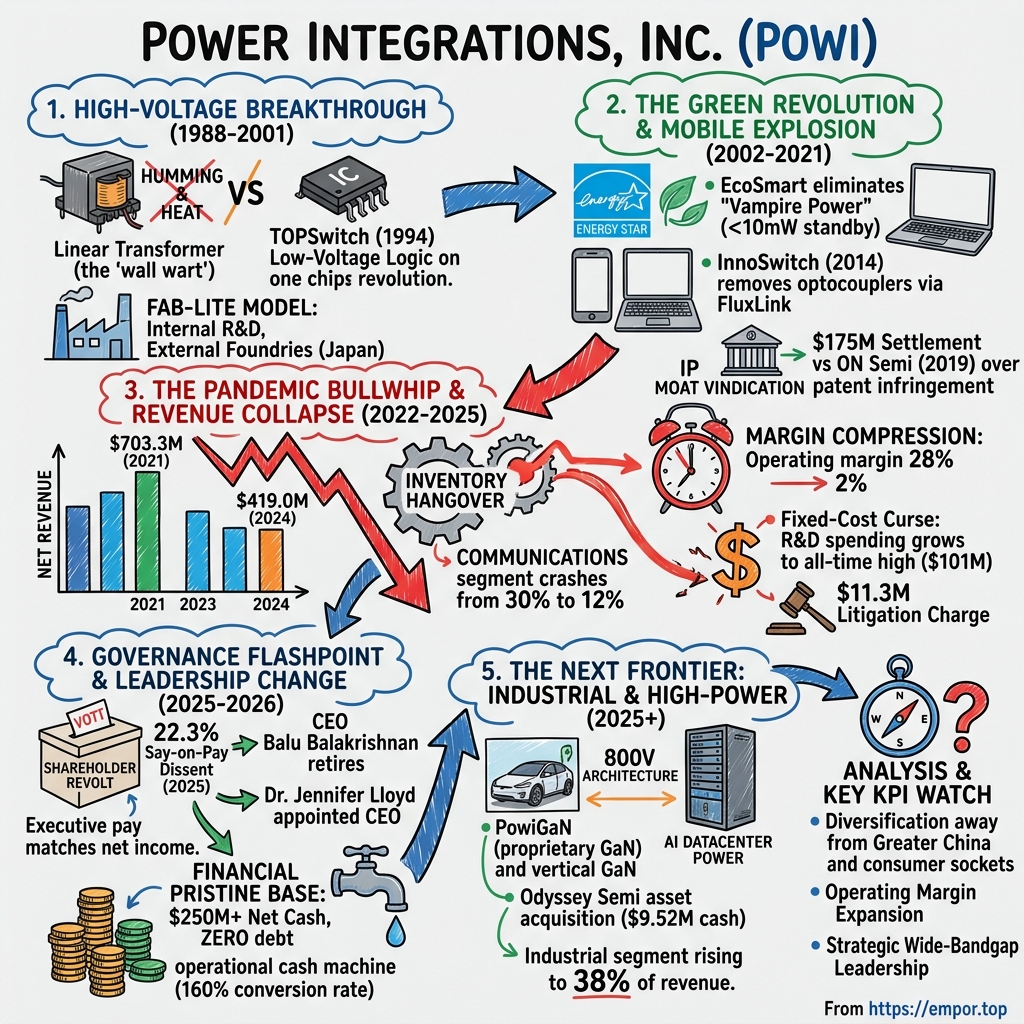
Power Integrations: The Silicon of the Wall Wart and the 800-Volt Crucible
I. Introduction & Episode Roadmap (00:00–08:30)
The brick in the drawer
Open almost any kitchen drawer in America and you'll find the archaeology of consumer electronics: a tangle of old chargers. The oldest ones are heavy. You can feel the weight in your palm, a lump of copper windings wrapped around laminated iron. Plug one into the wall and hold it for an hour and it gets warm. Leave it plugged in with nothing attached and it hums faintly, still drawing power, still turning electricity into heat for nobody. That was the "wall wart," the linear transformer that powered the cordless phone, the answering machine, the modem and the Walkman for most of the twentieth century.
The newer chargers in the same drawer are light, cool and quiet, and they put out far more power. The 65-watt USB-C brick that charges a laptop today weighs less than the 5-watt transformer that once charged a cordless phone. Lighter copper is only part of the story. The real change is a different idea of how to turn wall power into device power. Instead of stepping the voltage down with a big iron core running at 50 or 60 cycles per second, a modern charger chops the incoming current on and off tens of thousands of times a second. At that speed the transformer can shrink to the size of a sugar cube.
That chopping, called switch-mode power conversion, needs a switch that can stand up to the raw voltage of a wall socket. It also needs a small brain to decide, cycle by cycle, when to open and close. For decades those were separate parts: a rugged high-voltage transistor, a delicate controller chip, and dozens of resistors, capacitors and diodes to make them work together. A small company in San Jose built its business on a simple and very difficult proposition: put the muscle and the brain on the same piece of silicon.
That company is Power Integrations. Its TOPSwitch, TinySwitch and InnoSwitch product families have shipped into chargers, appliances, smart meters, LED lights and industrial equipment worldwide1. If you own a phone charger, there's a decent chance one of its chips is inside.
The puzzle
The story has an awkward middle. A company with real technology, a defended patent estate, gross margins in the mid-50s and no debt should, on paper, compound. Over twelve years it barely grew. Revenue went from about $347 million in 20132 to about $444 million in 20251, a compound rate of roughly 2% a year, which is below inflation for much of that period. In between came a pandemic surge to $703 million in 20214, then a collapse. Operating margin peaked near 28% in 20224 and fell to just over 2% in 20251.
So the core question is whether Power Integrations is a cyclical franchise sitting at the bottom of its cycle, or a high-quality niche that has reached the edge of its niche. The company itself is betting on a third reading: that the next wave of high-voltage power conversion, in 800-volt electric vehicles, grid equipment and AI datacenter racks, will pull a wall-outlet specialist into much bigger markets.
The balance sheet gives it time to find out. At the end of 2025 the company held about $250 million in cash and marketable securities and owed nothing1. The rest of the case is still open.
The roadmap
The story runs in six movements. First, the physics problem: getting roughly 700 volts and sub-5-volt logic to live on one die, and the fab-lite model that made it affordable. Second, the long reign of CEO Balu Balakrishnan, when energy-efficiency regulation turned a component vendor into a standard-setter. Third, the decade-long patent war with Fairchild, which ended in a $175 million settlement from ON Semiconductor3. Fourth, the pandemic boom and the fast-charger bust. Fifth, the governance flashpoint that ended with a new CEO, Dr. Jennifer Lloyd. Sixth, the playbook, the moat and the bet on 800 volts.
The thread through all of it is a company that has repeatedly been right about the technology and less reliably rewarded for it. Understanding why starts with the physics.
 Subscribe on LinkedIn
II. High Voltage on Silicon: Founding, Physics, and the Fab-Lite Gamble (1988–2001) (08:30–19:00)
The unglamorous corner of electrical engineering
Picture Silicon Valley in the late 1980s. Intel and its rivals are racing down the Moore's Law curve, shrinking transistors every couple of years, and the prestige in chip design sits with the people building processors and memory. Power supplies are the other end of the industry. They're bulky, hot and full of discrete parts. Engineers who design them are treated as plumbers next to the architects. Nobody gives keynotes about the box that turns 120 volts AC into 5 volts DC.
Power Integrations was incorporated into that unfashionable corner in 198811. Its founding wager was that the power supply was a semiconductor problem that nobody had seriously tried to solve.
Why 700 volts is so hard
The physics is worth a minute, because it's the whole moat.
A typical logic chip runs on 3.3 or 5 volts. Its transistors are tiny, with insulating layers only a few atoms thick in modern processes. The wall socket delivers 110 or 230 volts of alternating current. Once that's rectified and the inevitable spikes from lightning, motors switching on and dirty grids are added, a switch on the primary side of a charger has to withstand peaks of roughly 650 to 700 volts without breaking down.
Think of a dam. A low-voltage transistor is a garden fence holding back a puddle. A high-voltage transistor is a concrete dam holding back a reservoir. It needs a long, carefully graded slope of silicon, called a drift region, so the electric field spreads out instead of punching through. Building a fence and a dam on the same plot is the integration problem. Process steps that make a good dam (deep implants, thick oxides, long diffusions) tend to ruin the fence, and steps that make a good fence make the dam leaky. Doing both on one die with good yields and low cost was widely regarded as uneconomic.
Power Integrations' answer was a proprietary high-voltage process that let a power MOSFET rated for roughly 700 volts share a die with low-voltage CMOS control logic2. That one chip could replace a discrete transistor, a separate controller and much of the supporting circuitry around them.
TOPSwitch: turning a black art into a parts list
The first commercial proof was TOPSwitch, the "Three-terminal Off-line PWM Switch," introduced in the mid-1990s2. "Off-line" means it connects to the AC line, the wall outlet. "PWM" means pulse-width modulation: the chip regulates output by varying how long the switch stays on each cycle.
The economic point was simplicity. Designing a discrete switch-mode supply used to be a black art. You needed an experienced power engineer, lots of bench time and a long bill of materials, and every extra component was another thing that could fail. TOPSwitch collapsed much of that into a single package with three pins. A company making a modem or a set-top box no longer needed a power guru. It could use the reference design, follow the application note and ship.
That's the first strategic insight in the company's history, and it's still the clearest explanation of its business. Power Integrations doesn't sell transistors. It sells engineering time removed from its customer's design cycle. The chip costs more than a commodity MOSFET, but the power supply costs less to design, build and certify.
The fab-lite gamble
The second founding decision was about factories.
In the 1990s conventional wisdom said a serious semiconductor company owned its fabs. Real men have fabs, as AMD's Jerry Sanders memorably put it. But fabs are capital furnaces. They cost hundreds of millions of dollars, depreciate whether or not they're full, and turn every industry downturn into a balance-sheet crisis.
Power Integrations chose a middle path, now usually called "fab-lite." It developed its own high-voltage process recipes and then ran them inside other companies' factories in Japan, chiefly ラピスセミコンダクタ Lapis Semiconductor, a subsidiary of ローム ROHM, and セイコーエプソン Seiko Epson1. A wafer fab and cleanroom at its San Jose headquarters handled development and some production1. Assembly and packaging went to subcontractors in China, Malaysia and the Philippines1.
The arrangement needs one clarification, because "fabless" is the wrong word. The process know-how belongs to Power Integrations, and it isn't a generic foundry node bought off a menu. That makes switching hard for competitors, who can't simply order the same process from a foundry, and also for Power Integrations, which depends on a small number of Japanese partners. The model trades capital intensity for concentration risk. For three decades the trade worked, and the company never needed to carry bank debt to fund factories1.
Going public
Power Integrations listed on NASDAQ in December 1997 under the ticker POWI11. The timing put it on the cusp of the internet hardware boom, when modems, set-top boxes and the first wave of mobile phones were multiplying the number of small power supplies in the world.
The company that went public had three things competitors found hard to copy: a high-voltage integration process, a design-in model that made customers' lives easier, and a capital-light manufacturing setup. It lacked a forcing function, some reason for the whole market to switch from cheap, inefficient linear transformers to its more expensive integrated switchers. That reason came from regulators.
III. The Green Wave and the 20-Year Balu Era (2002–2018) (19:00–31:30)
The vampire in the outlet
Around the turn of the millennium, energy researchers began to quantify something homeowners had never thought about. Every plugged-in transformer was drawing power even with nothing attached. The TV waiting for its remote, the microwave clock, the cable box, the charger left in the wall: each one used a small amount of electricity around the clock. Spread across hundreds of millions of homes, that "vampire" or "phantom" load added up to entire power stations of wasted output.
Governments responded with efficiency standards: the U.S. Energy Star program, California Energy Commission rules and the European Union's Code of Conduct for external power supplies. Each new tier tightened limits on no-load power and raised the efficiency floor. The old linear transformer couldn't meet them. Switch-mode supplies could, and integrated switch-mode supplies could do it most cheaply.
For Power Integrations, this was a market created by law.
Enter Balu
The man who rode that wave was Balu Balakrishnan. An engineer by training and an early Power Integrations employee, he became President and CEO in 2002 and held the job for the next 23 years[^10]. That's an extraordinary tenure for a public semiconductor CEO, comparable to founder-led companies rather than professionally managed ones.
Balakrishnan's style was that of an engineer-CEO. The product roadmap ran through him, and the company's public identity, its sustainability messaging and its "energy efficiency" positioning, carried his imprint. Under him Power Integrations stopped describing itself as a component vendor and started describing itself as a clean-power technology company. Its EcoSmart technology let power supplies cut standby consumption to milliwatt levels, which meant the chips didn't merely comply with the new standards; they made compliance close to automatic2.
The commercial logic was neat. An OEM facing a regulatory deadline doesn't want to reinvent its power supply. It wants a chip with a reference design already certified to the new tier. Power Integrations kept supplying that chip.
InnoSwitch: removing the weakest link
The second major product leap came with InnoSwitch, launched in 20142. Again, a little physics helps.
A charger has two sides. The primary side touches the wall and its dangerous voltages. The secondary side touches your phone and must be electrically isolated from the wall for safety. But the primary-side switch needs to know what's happening on the secondary side to regulate the output. Traditionally that information crossed the gap through an optocoupler, a tiny LED shining across an insulating barrier to a light sensor. Optocouplers work, but they age, drift with temperature and are a common failure point.
InnoSwitch put primary control, secondary control and synchronous rectification into a single package and replaced the optocoupler with a magnetic communication link the company calls FluxLink2. The analogy is passing notes across a fence by radio instead of by flashlight. That made the supply smaller, more efficient and more reliable, and it became the platform the company later adapted for gallium nitride.
The ten-year war with Fairchild
Technical leadership invites imitation, and Power Integrations defended its patents relentlessly. Its longest fight was with Fairchild Semiconductor, a rival in power components, over patents covering power conversion techniques such as frequency jitter, a trick that spreads a switcher's electromagnetic noise across many frequencies so the power supply passes interference tests more easily.
The litigation spanned roughly a decade of jury trials, appeals and remands. It survived Fairchild's acquisition by ON Semiconductor in 2016. In 2019 ON Semiconductor agreed to settle by paying Power Integrations $175 million10, and the company recognized a net gain of about $169 million in its 2019 results3. That single payment pushed 2019 operating income to $217 million on revenue of about $421 million3, the only year in which reported operating income exceeded half of sales.
The settlement mattered beyond the cash. It showed that Power Integrations' high-voltage patents could be enforced against a large, well-funded semiconductor company. For a company whose moat rests on process and circuit know-how, that's a real deterrent. It also cost years of management attention and legal spending, and the patents themselves age: protection on the earliest inventions has a finite life.
The disconfirming evidence: the growth ceiling
Here's the uncomfortable part of the Balu era. For all the regulatory tailwind, revenue barely moved. The company reported about $347 million in 2013 and about $416 million in 201823, growth of under 4% a year. Revenue actually dipped in 20152. Operating margins in those years mostly sat in the low-to-mid teens2, respectable for a manufacturer and well below what a company with roughly 50% gross margins and protected IP might be expected to earn.
The explanation is in the mechanism of the regulatory moat. Mandates force everyone to adopt efficient power conversion at roughly the same moment. That creates a market. It doesn't stop the market from becoming competitive once the technique is common knowledge. Each time a standard tightened, Power Integrations enjoyed a window of advantage, and each time the window closed, customers making millions of cheap chargers pushed the price of the chip down. Unit volumes grew while average selling prices drifted lower.
The history therefore narrows the claim that regulation gave Power Integrations a durable pricing moat. It gave the company repeated, time-limited leads and a reputation as the default choice for difficult designs, but not the power to raise prices across a consumer market. The next test came from a new material that promised to reset that clock.
IV. The Pandemic Supercycle, PowiGaN, and the Fast-Charger Illusion (2019–2022) (31:30–43:00)
The matchbox charger
In 2020, much of the world moved its office to the kitchen table. People bought laptops, monitors, webcams, appliances and phones, and the phones were getting hungry. Chinese smartphone makers were in a charging-speed arms race, advertising 65 watts, then 100 watts and more, to fill a battery in the time it took to drink a coffee. Accessory brands were selling laptop chargers barely bigger than a phone charger.
The material that made those chargers possible was gallium nitride.
Why GaN matters
Silicon has been the default material for power switches for half a century, but it has limits. Every time a switch turns on or off, it wastes a little energy in the transition. Run it faster and you waste more. Since a faster switch allows smaller transformers and capacitors, silicon forces a compromise between size and efficiency.
Gallium nitride is a "wide-bandgap" semiconductor. In plain terms, its atoms hold their electrons more tightly, so a GaN switch can withstand high voltage in a much thinner layer and switch with far lower losses. That's how a charger gets lighter without getting hotter: a GaN switch can run at higher frequency, and the magnetics shrink accordingly.
Power Integrations developed its own GaN switches, branded PowiGaN, and built them into InnoSwitch3 and later InnoSwitch4 parts4. Its differentiation was integration again. Several GaN start-ups sold discrete GaN transistors or relied on outside GaN foundries; Power Integrations packaged its own GaN switch together with the controller and its isolation link, so a charger designer got the GaN benefit without learning to drive an unfamiliar, finicky transistor. It was the TOPSwitch playbook, applied to a new material.
The windfall
The demand arrived quickly, and much of it came from China. Phone makers such as 小米 Xiaomi, OPPO and vivo and a crowd of accessory brands designed PowiGaN-based chargers into their products. The Communications end market, mostly phone chargers, grew to roughly 30% of company revenue in 2020 and 20214.
Combined with the general rush for electronics and a global chip shortage, the effect on the income statement was dramatic. Revenue rose from about $488 million in 2020 to about $703 million in 20214, growth of about 44% in one year for a company that had averaged low single digits for most of the previous decade. Operating income more than doubled to about $175 million, and rose again to about $180 million in 2022 even as revenue slipped to about $651 million4. Operating margin reached almost 28%4.
That's what operating leverage looks like going up: once a company's engineering and sales costs are covered, most of each extra dollar of gross profit falls straight through.
Spending as if it were permanent
Management made capital decisions that matched a belief that the new level was durable. Capital spending jumped to about $71 million in 2020, around 14% of sales, much of it to expand wafer and cleanroom capacity in San Jose4. Then the company turned to buybacks, repurchasing about $110 million of stock in 2021 and about $166 million in 20224, at prices set by the boom. Headcount kept rising, from 725 employees at the end of 20203 to 831 by the end of 20224.
Each choice can be defended in isolation. Capacity was scarce; the shares had cash behind them; engineers are hard to hire. Together they show a company positioning for a bigger revenue base, and the capital was committed at the peak.
Historical falsification: was it structural?
The investment case at the time held that GaN fast-charging was a structural step-up, a new and larger market in which Power Integrations held technical leadership. The company's own record now offers a clear test.
Within two years, Communications shrank to roughly 12% of revenue in 2024 and 20251. Part of that was the end of panic ordering. During the shortage, customers and distributors ordered more than they needed and double-booked across suppliers, so sell-in ran ahead of real consumption. Part of it was competition. Once GaN chargers were mainstream, Chinese analog design houses targeting domestic phone and appliance sockets, companies such as 圣邦微电子 SG Micro, 南芯科技 Southchip and 芯朋微电子 Chipown, made the low-power charger socket a price fight. And part of it was the industry itself, as some phone makers stopped putting chargers in the box.
The evidence rejects the strong version of the claim. PowiGaN was and remains real technology, and it moved the company's product range into GaN early. But the revenue surge was largely a cycle, not a new plateau, and fast phone chargers turned out to be a commodity-prone socket, the same pattern seen with earlier regulatory tailwinds. That set up the next three years, when the inventory built during the boom had to work its way back out.
V. The Inventory Hangover and Margin Compression (2023–2025) (43:00–55:30)
The quiet order book
A semiconductor downturn usually doesn't start with customers walking away. It starts with customers who already have enough. In 2023, Power Integrations' distributors and contract manufacturers were sitting on chips they'd bought during the shortage. They stopped ordering and lived off their shelves. Demand at the end of the chain hadn't fallen by nearly as much as orders had. The whole channel was simply digesting.
The largest of those distributors is Avnet, which by 2025 accounted for about a third of Power Integrations' revenue on its own1. When a channel partner that large decides to draw down inventory, the supplier's revenue moves quickly.
Revenue fell about 32% in 2023 to roughly $445 million and slid again to about $419 million in 20241. In two years the company gave back the entire pandemic gain and then some. In 2025 revenue recovered only to about $444 million1.
The gross margin that didn't break
The most informative number through this period is the one that barely moved. Gross margin held in the low-to-mid 50s throughout1.
That matters for the bear case. If Chinese competitors had been destroying Power Integrations' pricing, gross margin would have shown it, because price cuts with stable costs flow straight through the gross margin line. Instead, the company sold fewer chips at broadly similar economics per chip. The problem was volume, not pricing.
There's an accounting detail worth understanding here. Distributors often buy at one price and later receive a credit when they resell to a particular customer at a negotiated lower price, a practice called "ship and debit." Power Integrations reserves for those expected credits against receivables. At the end of 2025 the reserve was about $34 million against gross trade receivables of about $54 million1, leaving net receivables of just $18 million1, or roughly 15 days of sales. Bad-debt losses were essentially nil1. The receivables are high quality; the large reserve is a reminder that reported revenue is a judgment about future distributor credits. A shift in channel pricing would show up in this reserve before it showed up anywhere else. By mid-2026 the reserve had risen to about $35 million5.
Where the margin went
If gross margin was stable, why did operating margin fall from almost 28% in 2022 to about 2% in 202514? Decompose it and the answer is plain arithmetic.
Gross profit fell roughly in proportion to revenue: about a third less revenue meant about a third less gross profit. Operating expenses didn't fall. Research and development rose to a record of about $101 million in both 2024 and 20251, close to a quarter of revenue, compared with about 14% of revenue at the 2022 peak4. Headcount kept rising every year, reaching 877 at the end of 20251. Stock-based compensation climbed to about $40 million1. With a fixed cost base of more than $200 million and gross profit of under $250 million, there was very little left.
Then came a self-inflicted charge.
The courtroom in Santa Clara
In June 2025 a Santa Clara County Superior Court jury found against Power Integrations in a suit by a former employee alleging disability harassment and retaliation. It awarded about $3.2 million in compensatory and $6.0 million in punitive damages1. The court later added about $2.1 million in attorney fees1. The company booked roughly $11.3 million of litigation charges in 2025 and has appealed1.
The money is small next to the balance sheet. Against an operating income of about $10 million in 2025, it was large: without it, operating income would have been roughly double. A punitive award is also a different kind of fact from a patent dispute. It reflects a jury's view of how the company treated an employee, and it belongs alongside the governance questions in the next section.
The same year brought a more welcome courtroom result. In an August 2025 trial in Delaware, a jury found CogniPower's patent claims against the company's InnoSwitch products invalid and not infringed1, removing a long-running cloud over the flagship family.
Profits on life support from the treasury
One more decomposition finishes the picture. In 2025 Power Integrations reported net income of about $22 million1. Interest on its Treasury and agency holdings contributed about $12 million of pre-tax income1, and total other income was more than half of pre-tax profit1. In plain English: in the trough, the company's cash pile earned about as much as its chip business.
The verdict on this period is mixed but clear. Pricing power at the product level held, which supports the quality of the franchise. Cost discipline in the downturn didn't, or at least the company chose not to apply it. Keeping engineers through the trough is a legitimate strategy, as the playbook section will discuss. Combined with pay practices that kept executive compensation high while profits collapsed, it also lit the fuse on a shareholder revolt.
VI. Governance Flashpoint and The Changing of the Guard (2025–2026) (55:30–67:00)
The vote count
Annual meetings at mid-cap technology companies are usually dull. Index funds vote with the board, retail holders mostly don't vote, and the 8-K reporting the results is a formality. The one Power Integrations filed after its May 15, 2025 meeting wasn't. On the advisory say-on-pay proposal, about 11.6 million shares voted against and about 40.6 million in favor8, an opposition rate of roughly 22%.
For context, most S&P 1500 companies win say-on-pay with well over 90% support. Opposition above 20% is the level at which proxy advisers and large index managers expect a board to respond. It had also been building: a year earlier, opposition was already about 18.5%9. The shareholder base is dominated by exactly the investors who drive such votes. BlackRock held about 15% and Vanguard about 14% of the shares as of the 2026 record date, with State Street and Neuberger Berman each around 6%6.
Pay against profit
The arithmetic behind the dissent is easy to state. Total compensation for the named executive officers in 2025 exceeded $23 million, more than the company's entire net income of about $22 million6. Balakrishnan received about $8.2 million for 2025, after about $8.6 million in 2024, most of it in stock awards6. Operating income in those two years was about $18 million and $10 million1.
Proxy disclosures added an optical problem. The company employs Balakrishnan's son, Vikram Balakrishnan, who received about $1.5 million in total compensation in 2025, including salary, stock awards, a bonus, patent awards and an international-assignment housing allowance6. The board discloses the arrangement as a related-party transaction6, and there's no evidence it was improper. But a seven-figure package for the CEO's son, in a year when executive pay exceeded profits, is the kind of detail a skeptical holder notices. The only other related-party item was minor: about $350,000 of purchases from Tessolve Semiconductor, where a relative of director Nicholas Brathwaite works6.
The defense: cash, not earnings
The board's best argument is that GAAP net income understates the business. From 2020 to 2025, cumulative operating cash flow was about $830 million against cumulative net income of about $517 million14, a conversion rate above 160%. In 2025 alone, the company generated about $112 million of operating cash and about $87 million of free cash flow on $22 million of net income1.
The gap has two main sources. Depreciation, about $28 million in 2025, is a genuine non-cash charge from past investment1. Stock-based compensation, about $40 million, is non-cash only in the narrow sense that no cash leaves the company: shareholders pay through dilution instead1. The company has offset that dilution with buybacks, about $98 million in 20251, so a fair reading of "cash conversion" is that a big part of the extra cash was spent repurchasing the shares the company issued to employees. That makes the cash story genuine and less generous than the headline ratio suggests.
The handoff
On July 21, 2025, Power Integrations announced that Balakrishnan would retire as CEO after 23 years and that Dr. Jennifer Lloyd would succeed him as President and CEO[^10]. He stayed on as Executive Chairman until February 20266.
Lloyd came from Analog Devices, one of the best-run analog semiconductor companies in the world, where she had been a senior executive[^10]. She'd also served on the Power Integrations board, so she arrived knowing the company's numbers and politics. The contrast with her predecessor is useful. Balakrishnan was the insider-engineer who built the product franchise. Lloyd brings the experience of a much larger, more diversified analog company whose playbook emphasizes industrial and automotive customers, long product lives and disciplined pricing. Whether that playbook transfers is the open question of her tenure. Her own first-year pay of about $6.3 million was mostly sign-on equity6.
The finance seat turned over too. Longtime CFO Sandeep Nayyar left; Robert Eric Verity served as interim CFO, and semiconductor veteran Nancy Erba was appointed CFO in 202656.
The 2026 meeting: partial repair
By the June 3, 2026 annual meeting, say-on-pay opposition fell to about 7%7, a clear signal that large holders saw the leadership change as a response. The repair was partial. A proposal to add 2.0 million shares to the equity incentive plan drew about 17% opposition, and lead independent director Balakrishnan S. Iyer received about 12% withheld votes7. Insiders as a group now own only about 1.2% of the shares6. Shareholders, in other words, accepted the new CEO but are still watching how much equity the company hands out and whether pay tracks profit.
Lloyd's first half offered early evidence. Revenue for the six months to June 2026 rose about 3% to about $227 million, operating income roughly doubled to about $10 million, and the company booked about $6 million of restructuring charges while pausing buybacks5. The restructuring is the first sign of the cost discipline the downcycle never brought. The company now needs revenue in places it has historically struggled to win.
VII. The Next Frontier: Automotive, High-Voltage Grids, and the AI Datacenter (67:00–78:00)
A small deal with a big ambition
On July 1, 2024, Power Integrations completed a deal that barely registered on its financial statements. It acquired the assets and engineering team of Odyssey Semiconductor Technologies, a small developer of vertical gallium nitride devices, for about $9.5 million in cash1[^11]. Roughly $4.9 million was allocated to in-process R&D, $3.4 million to goodwill and $1.2 million to equipment1.
For the price of a few months of R&D, the company bought an option on a technology that could take it into voltages it has never served.
Lateral versus vertical, in plain English
Today's GaN power devices, including PowiGaN, are mostly "lateral": current flows sideways across the surface of the chip. That's fine for chargers and appliances at hundreds of volts, but it hits limits as voltage rises, because blocking more voltage sideways means a wider chip.
In a vertical device, current flows straight down through the wafer, like water through a filter rather than across a tabletop. Blocking voltage depends on thickness rather than surface area, which in principle allows much higher voltages, above 1,200 volts, on compact chips[^11]. That's territory currently dominated by silicon carbide, the material that won the electric-vehicle traction inverter over the past decade.
Vertical GaN is hard to manufacture at scale. Several companies have tried, and none has yet made it a high-volume commercial product. The Odyssey purchase was cheap precisely because the technology is unproven; for Power Integrations it's a bet that its process skill can succeed where a small start-up couldn't.
Industrial: the quiet diversification
The more tangible evidence of diversification is already in the revenue mix. Industrial was the largest end market in 2025 at about 38% of revenue, up from about 33% a decade earlier12. Computer rose to about 13%, and Consumer, mostly appliances, held around 37%1.
Some of that industrial business is unusually heavy-duty. The SCALE and SCALE-iDriver gate drivers, which came from the company's acquisition of the Swiss company CT-Concept in 2012, control the giant switches in high-voltage DC transmission links, wind and solar inverters and locomotive traction systems2. These sockets are the opposite of a phone charger: few units, long qualification and product lives measured in a decade or more1. In electric vehicles, the company sells into auxiliary and emergency power supplies, battery management and DC-DC converters that run off 400-volt and 800-volt battery packs1.
The AI datacenter pitch
The newest part of the story is the datacenter. AI server racks are pushing past 100 kilowatts each, and the industry, led by NVIDIA's roadmap, is moving power distribution toward higher-voltage DC, including 800-volt architectures, to reduce the copper and conversion losses involved in feeding them1. Each conversion stage, from grid AC down to the roughly 1-volt core of a GPU, wastes energy. Fewer, more efficient high-voltage stages mean less heat and more compute per megawatt.
Power Integrations' pitch is that high-voltage GaN can perform some of those front-end conversions more efficiently and that its experience at the wall outlet transfers to the rack1. That's a reasonable technical argument. It's also a management claim that the market has not yet tested.
Certification is not commercialization
The historical base rate should temper the enthusiasm. Automotive design cycles typically run three to five years from first design-in to volume production; grid and rail programs take longer1. The company's own record shows that technical leadership converts into revenue slowly and sometimes not at all: GaN leadership produced a fast-charger boom and then a bust, and the SCALE gate-driver franchise, now more than a decade inside the company, hasn't changed the company's overall growth rate.
The datacenter also has entrenched incumbents. Monolithic Power Systems and Vicor own much of the low-voltage power delivery right next to the processor, where the dollar content per rack is largest. Power Integrations competes further upstream, in the high-voltage stages, where Infineon, Texas Instruments, ON Semiconductor and a crowd of GaN and silicon-carbide specialists are all chasing the same 800-volt sockets.
The fair conclusion is that the optionality is real but unproven. The evidence that would confirm it is specific: named datacenter or automotive production programs, and revenue from them visible in the Computer and Industrial lines. Until then it's a pipeline, and pipelines are what the next section's lessons are partly about.
VIII. Playbook: Business & Investing Lessons (78:00–85:30)
Lesson 1: The Fab-Lite Moat
Picture a Power Integrations process engineer in a Seiko Epson cleanroom in Japan, tuning implant and diffusion steps that exist nowhere else, on equipment the company helped specify, in a factory it doesn't own. That arrangement let a company with a few hundred million dollars of revenue keep a proprietary high-voltage process for three decades without ever borrowing to build a fab1.
The lesson for founders is that control of the know-how matters more than ownership of the building. The lesson for investors is the hidden price: two Japanese foundry partners are a concentration risk that never appears on the balance sheet.
"Own the recipe and the tooling; let someone else swallow the multi-billion-dollar depreciation cycle."
Lesson 2: The Vampire Power Trap
Energy Star and its European counterparts handed Power Integrations a market: every phantom-load rule forced OEMs toward integrated switchers. Yet the decade of mandates delivered growth of under 4% a year23, and the GaN charger boom later followed the same arc. Regulation creates adoption; it doesn't create scarcity. Once everyone can meet the standard, the standard stops being a reason to pay more.
"A regulatory tailwind can force customers to your door, but it cannot stop them from grinding your ASP down to the penny."
Lesson 3: The Fixed R&D Tax
In 2024 and 2025 Power Integrations spent a record of about $101 million a year on R&D, near a quarter of revenue, while net income fell from about $171 million at the peak to $22 million14. Management didn't lay off its analog engineers, and headcount kept rising1.
There's a real argument for that choice. High-voltage analog designers take years to train, and a company that fires them in a downturn may not have products ready for the upturn. The cost is that public shareholders bear the whole swing, and the bet only pays if the products those engineers build win sockets in bigger markets. The 2026 restructuring shows even the company concluded the bench had grown too large for the revenue base5.
"Analog talent takes a decade to train and five minutes to lose; keeping the bench is a bet on the next cycle, and shareholders pay for it in this one."
Lesson 4: The Compensation Lightning Rod
The May 2025 vote, with more than a fifth of shares opposing pay in a year when executive compensation exceeded total profit68, showed that even passive index holders have limits. Two months later, the 23-year CEO announced his retirement[^10]. Boards can lean on adjusted metrics and cash flow, but when the headline comparison is that simple, the headline wins.
"Indexers will tolerate generous equity in a bull market; pay the executives the whole profit pool in a downcycle and the index votes back."
IX. Analysis & Bear vs. Bull Case (85:30–92:00)
What the market is pricing
In early October 2026 Power Integrations traded at about $54 a share, a market value of roughly $3 billion and an enterprise value of about $2.8 billion after netting out its cash125. Against trailing revenue of about $449 million, that's roughly six times sales. Against trailing net income of about $25 million, it's a price-to-earnings ratio well above 10051.
The P/E isn't the useful number here; it's distorted by trough margins. The sales multiple is more informative. It's within the range the stock has occupied for much of the past decade, which suggests the market is assuming margins recover toward something like mid-cycle levels. It isn't paying a growth premium of the kind Monolithic Power Systems commands for its datacenter exposure, and it's paying well above the multiples given to larger, more diversified power semiconductor makers such as ON Semiconductor and STMicroelectronics. In other words, investors are pricing Power Integrations as a quality franchise at the bottom of a cycle, not as a structurally impaired business and not as an AI winner.
The moat, argued once
Hamilton Helmer's 7 Powers. The strongest power is process power: three decades of proprietary high-voltage process know-how embedded in partner fabs and its own San Jose line1. It's hard to copy because it lives in recipes, equipment settings and people, not in a document. The patent estate, enforced against Fairchild and ON10 and defended in the CogniPower case1, approximates a cornered resource, though patents expire. Switching costs are real but uneven. In industrial, automotive and grid equipment, swapping a qualified power IC means redesigning the board and recertifying safety; in consumer chargers, a new model every year gives customers a fresh chance to switch. The Communications collapse is direct evidence that switching costs in that market are weak. Scale economies, network effects and counter-positioning are largely absent; Texas Instruments and Infineon are far bigger. Brand matters only among power engineers, where the reference designs carry weight.
Porter's five forces. Buyer power is the critical weakness. Distributors handled about 69% of 2025 revenue, the ten largest customers accounted for about 81%, and Avnet alone accounted for about 32%1. Charger maker Salcomp was another 11%1. About 55% of revenue was billed into China and Hong Kong1. Distributors don't usually set prices for end customers, but their stocking decisions drive the bullwhip that wrecked 2023 and 2024. Rivalry is intense and rising, especially from Chinese domestic suppliers in low-power sockets and from much larger firms in high-power ones. Supplier power is moderate but concentrated, given the reliance on two Japanese foundries and Asian assembly. Threat of substitutes runs both ways: GaN and silicon carbide could displace silicon parts, which is why the company invested in both GaN generations. Barriers to entry are high at 700 volts and above and much lower in commodity chargers.
The verdict: the moat holds where design cycles are long and the voltage is high, and is narrow where products turn over yearly. The company's future depends on which part of that map grows.
The bear case
The bear case starts with base rates. Twelve years of roughly 2% annual revenue growth21 is a long record, spanning regulatory tailwinds, a GaN lead, a patent windfall and a pandemic boom. A bear would argue that the company has occupied its niche fully and that each new opportunity becomes a cycle rather than a step.
Second, geopolitics. More than half of revenue billed into China and Hong Kong, assembly in China, and wafers in Japan1 leave the company exposed to tariffs, export rules and the push by Chinese OEMs to buy domestic chips.
Third, the cost base. R&D of about $101 million, SG&A above $100 million and stock compensation near $40 million1 set a high bar. Operating margins don't get back to 20% without revenue far above anything the company has delivered outside 2021 and 2022.
An activist reading this would ask pointed questions: why headcount rose every year through a 40% revenue decline, why buybacks were heaviest at peak prices in 20224 and paused at the trough in 20265, and why equity-plan expansion requests continue while profits remain thin7.
The bull case
The bull case starts from the same cost base, seen as leverage. With gross margin in the mid-50s and largely fixed operating costs, every incremental $100 million of revenue could add more than $50 million of operating profit. At revenue between $550 million and $600 million, operating margins would recover sharply without any heroics.
Second, the balance sheet. About $250 million in cash and securities, no debt and a revolving credit line1 mean the company can wait for the cycle and fund R&D without asking anyone for money. The line was briefly drawn and fully repaid during 20251.
Third, positioning. Odyssey's vertical GaN, PowiGaN, the SCALE gate drivers and a new CEO from the industrial-analog world give the company a credible set of products for 800-volt cars, grid equipment and AI racks1[^11]. The bull doesn't need all of these to work; one sizable win would change the growth rate.
Weighing it
The history leaves the quality of the franchise intact and the growth thesis unproven. The gross margin through the downturn is strong evidence that the products still command a price. The record of converting technical leadership into lasting revenue growth is weak, so new optionality deserves to be discounted until it shows up in reported revenue.
The KPIs that matter
Only a few numbers will settle this.
- Quarterly revenue run-rate. First-half 2026 revenue of about $227 million5 implies an annual pace of about $450 million, flat to slightly up. A sustained $140 million a quarter, driven by industrial, automotive or datacenter sales rather than distributor restocking, would signal a break from the plateau.
- GAAP operating margin. About 2% in 20251 and about 4.6% in the first half of 2026 including restructuring5. Operating income above $75 million a year, or a margin above 15%, would show the cost base can deliver leverage.
- Ship-and-debit reserve against gross receivables. About $35 million against about $64 million of gross receivables at mid-20265. A rising ratio would be an early warning of price pressure in the channel; a stable one supports the pricing story.
X. Epilogue (92:00–94:30)
Tonight Power Integrations is in its first full year under a CEO who isn't Balu Balakrishnan. The founder-era chairman is gone6, the finance chief is new5, buybacks are paused and restructuring charges are on the books5. Revenue is drifting up from the trough, slowly. In a San Jose cleanroom and at the former Odyssey site, engineers are trying to make vertical gallium nitride do something no one has yet made it do at volume.
Three moments will decide what this era means.
The first is the conversion of the Odyssey bet into a product. A sampled vertical-GaN device with a named customer would turn a $9.5 million option into a strategy. Silence through 2027 would suggest the technology stayed a science project, the fate of most vertical-GaN efforts so far.
The second is the 2027 annual meeting. Shareholders cut Lloyd's board some slack in 2026, dropping pay opposition to single digits while still resisting share-plan expansion7. If the board rewrites performance-share hurdles so executive equity vests on GAAP margin recovery, the governance story closes. If dilution keeps outrunning profit, the 2025 revolt could return.
The third is the one investors will watch most closely: design wins in automotive and server power that lift revenue out of its $400 million to $450 million orbit. A quarter above $140 million, built on those sockets, would answer the question this story opened with. Another cycle of consumer restocking would answer it differently.
The tension is the same one that has run through Power Integrations for 25 years. The company has world-class process technology, a gross margin that survived a 40% revenue fall and a balance sheet with no debt. It hasn't yet shown that it can be anything more than the best supplier in a market that refuses to grow.
XI. Outro (94:30–95:30)
Go back to that kitchen drawer. The heavy, humming transformer from the 1990s is a museum piece now, and Power Integrations is a big part of the reason. Someone had to figure out how to make a silicon chip survive 700 volts and still think clearly, and a small company in San Jose did it, then kept doing it as the chips got smaller, smarter and made of new materials.
The fight over efficiency has moved since then. It isn't only about the wall outlet any more. It's about 800-volt battery packs, gigawatt grid links and racks of GPUs that draw as much power as a small neighborhood. Power Integrations is the quiet Silicon Valley craftsman that solved the hardest physics problem in the wall outlet and kept a 54% gross margin through a brutal downturn. Its next job is to prove it can power the gigawatt future.
References
-
Power Integrations, Inc. Form 10-K for Fiscal Year Ended December 31, 2025 — U.S. Securities and Exchange Commission, 2026-02-06 ↩↩↩↩↩↩↩↩↩↩↩↩↩↩↩↩↩↩↩↩↩↩↩↩↩↩↩↩↩↩↩↩↩↩↩↩↩↩↩↩↩↩↩↩↩↩↩↩↩↩↩↩↩↩↩↩↩↩
-
Power Integrations, Inc. Form 10-K for Fiscal Year Ended December 31, 2017 — U.S. Securities and Exchange Commission, 2018-02-14 ↩↩↩↩↩↩↩↩↩↩↩↩↩
-
Power Integrations, Inc. Form 10-K for Fiscal Year Ended December 31, 2020 — U.S. Securities and Exchange Commission, 2021-02-05 ↩↩↩↩↩↩
-
Power Integrations, Inc. Form 10-K for Fiscal Year Ended December 31, 2022 — U.S. Securities and Exchange Commission, 2023-02-07 ↩↩↩↩↩↩↩↩↩↩↩↩↩↩↩
-
Power Integrations, Inc. Form 10-Q for Quarterly Period Ended June 30, 2026 — U.S. Securities and Exchange Commission, 2026-08-06 ↩↩↩↩↩↩↩↩↩↩↩↩
-
Power Integrations, Inc. Definitive Proxy Statement on Schedule 14A — U.S. Securities and Exchange Commission, 2026-04-21 ↩↩↩↩↩↩↩↩↩↩↩↩
-
Power Integrations, Inc. Current Report on Form 8-K: Voting Results of 2026 Annual Meeting — U.S. Securities and Exchange Commission, 2026-06-04 ↩↩↩↩
-
Power Integrations, Inc. Current Report on Form 8-K: Voting Results of 2025 Annual Meeting — U.S. Securities and Exchange Commission, 2025-05-16 ↩↩
-
Power Integrations, Inc. Current Report on Form 8-K: Voting Results of 2024 Annual Meeting — U.S. Securities and Exchange Commission, 2024-05-21 ↩
-
Power Integrations and ON Semiconductor Settle Long-Standing Patent Litigation for $175 Million — PR Newswire / Power Integrations, 2019-10-25 ↩↩
-
SEC EDGAR Submissions API: Power Integrations, Inc. (CIK 0000833640) — U.S. Securities and Exchange Commission ↩↩
-
Power Integrations, Inc. Official Investor Relations Portal — Power Integrations, Inc. ↩
 LinkedIn
 WhatsApp
 Reddit
 Hacker News
 Email
Email Kindle
 RSS Feed
 Spotify
 Apple Podcasts
 Amazon Music
 Audible
 YouTube