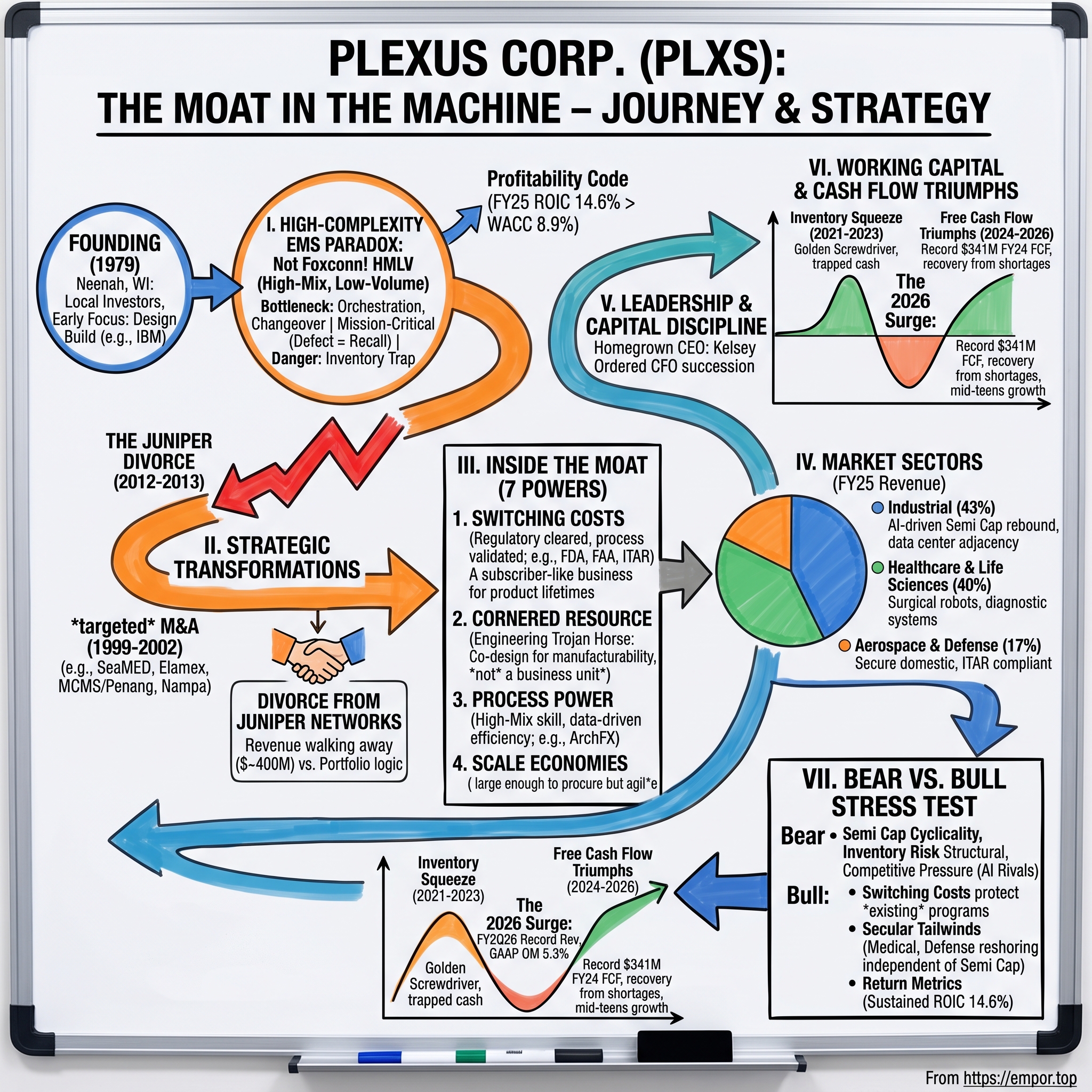
Plexus Corp.: The Moat in the Machine
I. The High-Complexity EMS Paradox
Start with the paradox, because everything else in this story descends from it.
Electronics Manufacturing Services — EMS, in the industry's shorthand — is one of the least glamorous and thinnest-margin businesses in the modern economy. The archetype is 富士康 Foxconn (Hon Hai Precision Industry), the Taiwanese colossus that assembles the world's iPhones. Foxconn's game is volume at a scale that borders on the surreal: take a design handed down by Apple, replicate it hundreds of millions of times with near-perfect consistency, and squeeze fractions of a cent out of a process measured in seconds per unit.
It is a magnificent operational achievement. It is also a brutal financial one. Net margins in the tier-one, high-volume EMS world sit in the low single digits, and the reason is structural rather than managerial. When you build a million identical things, your customer knows precisely what each one costs to build. There is no information asymmetry left to monetize. Every efficiency you discover eventually becomes a price concession you grant. The industry has a grim, accurate nickname for itself: solder-for-hire.
Now flip every variable.
Instead of one product built a million times, imagine a thousand different products, each built a few hundred times. This is High-Mix, Low-Volume manufacturing — HMLV — and it is not merely "the same business, smaller." It is a genuinely different discipline requiring a genuinely different set of muscles.
The bottleneck in HMLV is not assembly speed. It is orchestration. A single HMLV facility might run hundreds of active customer programs simultaneously, each with its own bill of materials, its own regulatory documentation, its own test regime and acceptance criteria. The surface-mount lines — the machines that place tiny components onto bare circuit boards at thousands of placements per hour — must be reconfigured constantly. Engineers call this "changeover": physically swapping out reels of components, reprogramming the pick-and-place heads, revalidating the solder-paste stencils, so the same line that built avionics on the morning shift can build blood analyzers in the afternoon.
Every changeover is downtime. Every downtime is margin. The entire art of profitable HMLV manufacturing is minimizing the cost of variety.
And because these products are mission-critical, the concept of "good enough" simply does not exist. A defect in a consumer earbud is an annoyance and a warranty claim. A defect in an implantable cardiac device or a defibrillator is a regulatory investigation, a recall, a lawsuit — or a death.
The inventory trap. The financial danger unique to this world is inventory. When you are simultaneously waiting on thousands of distinct parts to build thousands of distinct products, a single missing microcontroller can strand a nearly finished, million-dollar surgical robot on a shelf. Complete except for one chip. Unsellable. Consuming cash and earning nothing.
Multiply that across hundreds of programs and you have the nightmare that makes most observers assume HMLV must be a structurally worse business than high-volume EMS: all the operational chaos, none of the scale.
And yet.
Cracking the profitability code. In fiscal 2025 — Plexus operates on a September-ending fiscal year — the company generated a Return on Invested Capital of 14.6%, against a weighted average cost of capital it calculated at 8.9%. That spread, roughly 570 basis points of what the company calls "economic return," is the single most important number in the entire Plexus story.1
It is worth pausing on why. Return on Invested Capital measures how much operating profit a business generates per dollar of capital — equity and debt combined — that it has tied up in the enterprise. The weighted average cost of capital is what those same dollars cost to obtain. When ROIC exceeds WACC, every additional dollar the company invests creates value. When it falls below, growth actively destroys value, which is precisely the trap that has consumed so many EMS companies that chased revenue for its own sake.
A 570-basis-point spread, sustained, tells you that something structural is happening beneath the surface of what is supposedly a commodity industry. Plexus is not simply busy. It is earning genuine economic profit.
The claim to interrogate. That sets up the analytical question this piece will test rather than assume: is Plexus a genuine infrastructure layer for regulated industries — sticky, hard to replace, structurally advantaged — or is it an unusually well-run contract manufacturer currently enjoying a cyclical upswing that will eventually mean-revert?
The bull thesis holds that the complexity and the regulation are the moat: that once you are designed and certified into an FDA-cleared diagnostic instrument, you are effectively unremovable for a decade.
The bear thesis holds that complexity is just cyclicality wearing a lab coat: that the returns look structural at the top of a semiconductor capital-equipment boom and will look considerably less structural at the bottom of the next one.
Both cases have real evidence behind them. Neither should be accepted on management's say-so.
The roadmap. The journey ahead runs from a 1979 incorporation in Neenah, Wisconsin, through a disciplined burst of globalizing acquisitions around the turn of the millennium. Then through the wrenching, deliberate "divorce" from its largest customer, Juniper Networks, in 2012 and 2013. Then into the pandemic-era chip shortage that took the inventory trap from theoretical risk to live cash-flow crisis. And finally into the 2025 and 2026 rebound, powered simultaneously by artificial-intelligence-driven semiconductor capital spending and by the reshoring of defense electronics onto secure domestic soil.
To understand why the recent boom matters — and why it might not last — you first have to understand the town where all of it began.
 Subscribe on LinkedIn
II. The Wisconsin Roots & The Value Stream Transformation
Neenah, Wisconsin sits on the northern shore of Lake Winnebago, a paper-mill town of fewer than thirty thousand people, historically better known for producing specialty papers and tissue than circuit boards. Winters are long. The nearest thing to a technology cluster is a few hours south in Madison.
It is an improbable birthplace for a global electronics firm, and that improbability turns out to be load-bearing for the culture that followed.
The founding. On February 13, 1979, Peter Strandwitz, John Nussbaum, and a small group of associate engineers incorporated Plexus with roughly $100,000 raised from thirteen local investors.2 There was no venture capital, no institutional backer, no strategic partner. The money came from neighbors — people who could see the founders at the grocery store.
That funding structure imposed a discipline that many better-capitalized startups never learn. When your investors are local and known to you, capital is not an abstraction to be burned in pursuit of growth. It is somebody's money.
The commercial pitch was simple and, at the time, still somewhat novel: design and build electronic circuit boards under contract for companies that would rather not run their own factories. The first major customer was IBM, which fed the young company enough work to find its footing during the early years of the personal-computer era.2
The early decades. The 1980s boom in personal computing and industrial automation produced a growing pool of firms that needed electronics built but lacked either the scale or the appetite to build them in-house. Plexus grew the way sound industrial businesses actually grow — which is to say, unevenly.
Revenue reached $24.5 million in 1987, and the company posted a net loss.3 The very next year, sales leapt 117% to $53.2 million and Plexus swung to a modest profit of $393,000 — a swing that reveals both the operating leverage and the volatility inherent in contract manufacturing.3 Sales climbed to $78.1 million in 1989, crossed $120 million in 1991, and by 1998 net sales had reached $396.8 million with net income of $19.2 million.3
Buried inside that growth curve, however, was a warning. In 1999, Lucent Technologies accounted for roughly 16% of sales and General Electric for another 12%.3 Contract manufacturing is inherently lumpy work, and survival depends on not becoming a hostage to any single customer or product cycle.
Plexus would have to learn that particular lesson the hard way. Twice.
The strategic M&A wave, 1999 to 2001. As the dot-com bubble inflated and then spectacularly burst, Plexus executed a cluster of acquisitions that, viewed with the benefit of a quarter-century of hindsight, built the entire skeleton of the company that exists today.
What is striking about them is how surgically targeted they were. Each purchase bought a specific capability or a specific geography. None of them bought revenue for its own sake.
SeaMED, 1999. A Seattle-based designer and manufacturer of electronics for medical devices, SeaMED brought roughly 135 engineers and support personnel into the fold.3 But the headcount was the least valuable part of the transaction. What SeaMED really delivered was world-class competence in the FDA-regulated medical world — quality management systems, design-history files, validation protocols, and the institutional scar tissue that comes from having survived regulatory audits.
This matters more than it sounds. A company cannot simply decide one morning to start building medical devices. The regulatory apparatus has to be earned, built, and demonstrated over years. SeaMED arrived pre-loaded with all of it, and became the seed of what is today an enormous Healthcare & Life Sciences franchise.
Elamex, 2000. By acquiring the electronic contract-manufacturing operations of Elamex in Juárez, Mexico for roughly $54 million, Plexus established a "nearshore" manufacturing hub.3 The logic was to offer low-cost labor within a truck's drive of American customers who wanted geographic proximity — short lead times, easy engineering visits, no ocean freight — without paying U.S. wages.
At the time this looked like straightforward cost arbitrage. Two decades later, as tariffs and geopolitical friction made trans-Pacific supply chains look considerably less benign, the Juárez footprint looked prescient.
Keltek Holdings, 2000. In July of that year Plexus acquired Keltek, an operation of roughly 461 employees across facilities in Kelso, Scotland and Maldon, England, giving the company European design and manufacturing feet for the first time.4
MCMS, 2001 to 2002. The masterstroke of the cycle. With the EMS industry deep in a downturn and distressed assets everywhere, Plexus outbid rivals for the assets of struggling competitor MCMS, signing an asset purchase agreement in November 2001 and closing on January 8, 2002 at a base price of roughly $45 million.5
The prize was geography: manufacturing operations in 槟城 Penang (Malaysia) and 厦门 Xiamen (China), plus a plant in Nampa, Idaho.5 This was Plexus's first meaningful Asian footprint, and it was purchased at a cyclical bottom from a motivated seller.
Reading the pattern. The behavior across this wave is the tell. Plexus used a downturn — when assets were cheap, sellers were desperate, and most competitors were retrenching — to globalize its footprint and buy capabilities it could not have built organically in a decade. That is the disciplined counter-cyclical buyer's move, not the empire-builder's.
And then it stopped. After 2001, Plexus essentially quit acquiring companies. This is genuinely unusual for an industrial firm of its size, and it deserves more attention than it typically receives.
The EMS industry is littered with the wreckage of roll-ups. The playbook was seductive: grow by acquisition, consolidate fragmented capacity, harvest synergies. In practice, acquirers overpaid at cycle tops, drowned in integration complexity, discovered that manufacturing cultures do not merge cleanly, and destroyed the very returns they had been chasing.
Plexus appears to have concluded — early, and correctly — that in a business whose actual product is disciplined execution, bolting on somebody else's factory and somebody else's culture was more likely to dilute the moat than widen it. You cannot acquire process power. You can only accumulate it.
So instead the company grew organically, through greenfield capacity it could build to its own specifications and staff with people it trained itself. The clearest modern expression of this philosophy is the advanced manufacturing center in กรุงเทพฯ Bangkok (Thailand). Plexus broke ground on March 29, 2021, and opened the facility on August 8, 2022 — a 400,000-square-foot site built for more than $60 million, with two levels of production and warehouse space plus four levels of offices, designed to eventually employ more than 1,800 people.6
Build it yourself, build it your way, staff it with your own culture. It is slower than buying. It is also, in a business where execution is the product, almost certainly better.
That instinct for capital discipline reveals a management team treating capital allocation as something closer to a moral obligation than a growth lever. And it was about to be tested by a customer relationship that had quietly grown large enough to threaten the entire enterprise.
III. The Juniper Divorce: Unshackling from Commodity Tech
Every concentrated business eventually meets its reckoning. For Plexus, the reckoning wore the logo of Juniper Networks.
The concentration trap. Through the 2000s, Juniper — the networking-equipment maker locked in perpetual trench warfare with Cisco — grew into Plexus's single largest customer, at one point climbing to roughly 19% of net sales in 2005. The dependence proved stubbornly durable. Juniper represented approximately 17% of net sales in fiscal 2011, 16% in fiscal 2012, and still 13% in fiscal 2013.7
On paper, a marquee technology customer buying a fifth of your output looks like validation. Sales teams put it on slides. Analysts cite it as proof of capability.
In practice, it was a slow-motion trap, and it is worth being precise about why.
The friction. High-volume networking gear sits, financially speaking, much closer to the Foxconn world than the surgical-robot world. The contracts were enormous but violently volatile, because networking demand swings with carrier and enterprise capital-spending cycles that can turn in a single quarter.
They carried relentless, structural pricing pressure. Networking equipment is less heavily regulated than medical or aerospace hardware, which means qualification barriers are lower, which means alternative suppliers exist, which means the customer has leverage — and uses it.
And they demanded heavy, ongoing capital expenditure to support production volumes that could evaporate without warning. Plexus was pouring capital into a relationship that generated impressive revenue but thin and unstable returns on that capital.
For a company whose entire self-conception rested on earning returns comfortably above its cost of capital, this was not merely suboptimal. It was corrosive to the thesis.
The decision. So across 2012 and 2013, Plexus did something that looks close to reckless until you follow the logic: it initiated a complete, managed disengagement from its largest customer.
The nuance matters. This was not Juniper firing Plexus in a dispute. It was a mutual wind-down that Plexus was willing to accept and, in strategic terms, effectively chose — a structured exit rather than a rupture, executed over time so that neither side's operations collapsed.
The unwinding is visible in the filings in stark arithmetic. In the third quarter of fiscal 2013 alone, net sales to Juniper fell by roughly $64 million year-over-year as the disengagement took hold, and the company signaled that it expected no further shipments to Juniper in fiscal 2014.7 Cumulatively, Plexus was walking away from a revenue stream on the order of $400 million a year.
Walking away from that is the kind of move that gets a management team second-guessed by every analyst on every call for the following two years. The revenue disappears immediately and visibly. The benefits arrive slowly and invisibly, if they arrive at all.
Testing whether it worked. The strategic thesis was straightforward to state and hard to execute: trade volatile, low-margin, capital-hungry commodity revenue for sticky, regulated, high-complexity programs in medical devices, defense, and industrial automation. Trade revenue that is easy to win and easy to lose for revenue that is difficult to win and nearly impossible to lose.
The proof is not in the press releases from the time. Management always says the strategy is working. The proof is in the customer-concentration data more than a decade later.
In fiscal 2024 and fiscal 2025, no single customer represented 10% or more of Plexus's net sales, and the ten largest customers combined accounted for 49.1% of net sales in fiscal 2025.1 Set that against a company that once leaned on a single account for nearly a fifth of everything it sold.
That is a fundamentally re-architected revenue base. The Juniper disengagement did not merely remove a risky account; it forced the construction of a portfolio diversified enough that no individual customer decision can now threaten the enterprise.
What it means. There is a broader lesson here, and it is the intellectual spine of the entire Plexus story: the difference between good revenue and bad revenue.
Bad revenue is large, cyclical, price-pressured, and capital-intensive. It flatters the top line, impresses at conferences, and quietly starves returns on capital. Good revenue is smaller on a per-program basis, harder to win, and vastly more defensible — sticky, high-return, and durable across cycles.
Plexus made an explicit, expensive bet that the market would eventually reward the second kind. To understand why that bet has paid off, we need to open up the machinery of the moat itself.
IV. Inside the Moat: The Hamilton Helmer "7 Powers" of Plexus
Here is the question that determines whether Plexus is a good business or merely a well-run one: what actually stops a customer from taking its surgical-robot program to a cheaper manufacturer next year?
Hamilton Helmer's "7 Powers" framework offers a useful discipline for answering that — it forces a separation between genuine, durable advantage and the comfortable illusion of it. Plexus draws meaningfully on four of the seven, and they reinforce each other in ways that make the whole considerably stronger than the parts.
Switching costs: the primary power. This is the load-bearing wall of the entire investment case, so it deserves to be made concrete rather than asserted.
Suppose you run a medical-device company whose blood analyzer is manufactured by Plexus on an FDA-cleared production line. You receive a quote from a competitor promising to build the same instrument for 8% less. Do you switch?
Almost certainly not — and the reason is not loyalty. To move that program, you would not simply courier the drawings across town. You would have to re-qualify and re-validate the entire manufacturing process under regulatory scrutiny: new facility, new equipment qualification, new process validation, new test protocols, new documentation, new operator training records, and a new round of regulatory filings demonstrating that the device coming off the new line is equivalent to the one that was cleared.
That process routinely runs 12 to 24 months and costs millions of dollars. During every month of it, you carry dual-source risk, and any misstep can jeopardize your clearance to sell the product at all. Against that, an 8% unit-cost saving is not a temptation. It is a rounding error attached to an existential risk.
The same logic — often intensified — governs FAA-certified avionics, where airworthiness documentation is unforgiving, and ITAR-controlled defense electronics, where the manufacturing location itself is a regulated variable and the customer is ultimately the U.S. government.
The result is customer stickiness measured not in contract terms but in product lifetimes. Once Plexus is designed and qualified into a regulated product, it tends to remain there until the product itself is retired — frequently a decade or more. Switching costs of this magnitude are the closest thing that heavy manufacturing has to a subscription business.
The honest caveat: switching costs protect existing programs magnificently. They do nothing to guarantee that Plexus wins the next program. Every new design win is a genuinely competitive fight. Which is why the second power exists.
Cornered resource: the engineering Trojan horse. This is the genuinely clever part of the model, and it is frequently underappreciated because it looks financially unimportant.
Plexus operates a substantial in-house engineering organization — hundreds of design engineers who will co-develop a customer's product from the earliest conceptual stage: architecture, schematic design, mechanical packaging, regulatory strategy, test development.
As a standalone revenue line, engineering services are a minor contributor to the company. Judged as a business unit, it would look almost irrelevant.
That judgment misses the entire point. Engineering is not a business unit. It is a sales funnel.
When Plexus engineers help design a customer's product, they design it to be manufacturable in a Plexus factory — with Plexus's preferred components, test methodology, and process capabilities baked into the architecture from the first schematic. By the time that product is ready for production, Plexus is not bidding for the manufacturing contract. Plexus is the incumbent, holding a design that was shaped around its own capabilities, competing against outsiders who would need to re-engineer half of it.
It is razor-and-blades logic applied to industrial services: under-monetize the design, capture the multi-year, far larger, higher-margin build. The Trojan horse framing is exact — engineering is how Plexus gets inside the customer's walls before the real contract is even drafted.
It is also, tellingly, the path the current CEO walked to the top of the company. More on that shortly.
Process power. Running a High-Mix, Low-Volume factory profitably is an accumulated organizational skill rather than a purchasable asset. It is the hard-won knowledge of how to change over production lines dozens of times a day across hundreds of live programs without hemorrhaging efficiency — how to sequence builds so that changeovers cluster, how to stage materials, how to schedule test capacity, how to keep quality systems intact across constant reconfiguration.
None of that comes off a shelf. It is learned over years of doing it badly and then progressively less badly.
Plexus has increasingly attempted to instrument that knowledge with data rather than leaving it in the heads of experienced supervisors. In December 2023 the company announced a three-year partnership with Arch Systems to deploy the ArchFX analytics platform across its surface-mount lines, spanning key geographies across the Americas, Asia-Pacific, and EMEA in seven countries — capturing telemetry from individual machines all the way up to the global network, with plans to extend into automation and robotic connectivity in back-end assembly.8
The payoff shows up in a specific and instructive form. On the fiscal 2026 second-quarter earnings call, incoming CFO David Abuhl noted that recent efficiency work had delivered roughly a 10% throughput gain, which averted approximately $20 million in equipment purchases.9
That is process power converting directly into avoided capital expenditure — which flows straight into the denominator of the ROIC calculation. It is a small illustration of a large idea: in a capital-intensive business, getting more output from existing assets is mathematically equivalent to a return on capital you never had to raise.
Scale economies, with a deliberate twist. At roughly $4.0 billion in fiscal 2025 revenue, Plexus is dramatically larger than the regional job-shops it competes against for complex programs.1 That scale matters most where it is least visible: component procurement. In a shortage, allocation is not democratic. Suppliers ration scarce parts toward their largest and most strategic customers, and a $4 billion buyer gets returned calls that a $200 million buyer does not.
Yet Plexus remains, quite deliberately, a fraction of the size of the commodity giants — Jabil and Flex operate at multiples of Plexus's revenue, but carry the heavy, low-margin overhead structure that consumer-scale manufacturing demands.
Plexus occupies a chosen middle ground: large enough to procure and to matter, focused and agile enough to run genuinely high-mix work profitably.
The risk embedded in that positioning — and we will return to it in the bear case — is that "the middle" can also mean squeezed from both ends. But taken together, these four powers offer a coherent explanation for how a company in a supposedly commoditized industry sustains a 14.6% ROIC.
The next question is where, exactly, that value gets created.
V. Market Sectors: Sizing and Analyzing the Core Pillars
Plexus manages its factories geographically — the Americas, Asia-Pacific, and EMEA — but it tells its strategic story by market sector, and the sector lens is the one that matters for understanding the business.
In fiscal 2025, revenue split across three pillars: 43% Industrial, 40% Healthcare & Life Sciences, and 17% Aerospace & Defense.10 Each operates on a distinct rhythm, and the differences between those rhythms explain both the current boom and the risks buried beneath it.
Industrial — 43% of FY25 revenue — the rebound engine.
The beating heart of Plexus's Industrial segment is semiconductor capital equipment, universally shortened to "Semi Cap."
For readers not steeped in the supply chain, the concept deserves unpacking. When a chipmaker announces it is spending twenty billion dollars to build a new fabrication plant, that money does not go into the building. The overwhelming majority goes into the machines that fill it: photolithography scanners that project circuit patterns onto silicon, deposition chambers that lay down films a few atoms thick, etch tools that carve away material with plasma, metrology systems that verify all of it worked.
These machines are among the most complex objects humanity manufactures. A single advanced lithography system contains tens of thousands of components and can cost more than a commercial aircraft. And the companies that build them — Applied Materials, Lam Research, ASML, KLA — do not manufacture every subsystem in-house. They outsource complex control modules and electromechanical subsystems to specialists.
Plexus is one of those specialists, which places it two steps removed from the AI boom but firmly in its slipstream.
Here is the crucial subtlety for investors: Semi Cap is ferociously cyclical. Chip capacity is added in waves. When capacity is tight, everyone builds fabs simultaneously; when capacity overshoots demand, equipment orders do not decline gently, they fall off a cliff. The 2023 and 2024 downturn in equipment spending hit Plexus's Industrial segment hard, and there was nothing management could do about it beyond controlling costs and waiting.
The 2025 and 2026 up-cycle has been the mirror image. AI-driven data-center construction has ignited enormous demand for advanced logic and memory capacity, and Plexus has ridden it. In the fiscal 2026 second quarter, Industrial revenue climbed 12% sequentially, and the segment booked a record $195 million in new program wins — including what Executive Vice President Oliver Mihm described as a substantial award from an existing customer launching a new product line in data-center power solutions.9
That last detail is worth flagging, because it shows adjacency in action. Plexus is not building AI servers. But the electrical infrastructure that powers and cools AI data centers is exactly the kind of complex, high-reliability industrial hardware it already knows how to build — an adjacent market opened by a boom it does not directly serve.
The upside here is real. So is the reminder embedded in the word "cyclical."
Healthcare & Life Sciences — 40% of FY25 revenue — the quality fortress.
If Industrial is the throttle, Healthcare is the flywheel: slower to accelerate, but heavy, steady, and stabilizing.
This is the segment built on the SeaMED foundation acquired more than two decades ago, and it now spans complex diagnostic instruments, therapeutic devices, and surgical systems — including robotic-surgery platforms and point-of-care ultrasound systems, one of which featured among the $116 million of Healthcare wins booked in the fiscal 2026 second quarter.9
Two forces make the segment structurally attractive.
The first is product life cycle. A cleared medical device may be manufactured, essentially unchanged, for ten years or more. Regulatory clearance is expensive and specific; device makers have every incentive to leave a working product alone rather than redesign it. That turns a single design win into a decade-long annuity and makes the switching-cost moat deeper here than anywhere else in the portfolio.
The second is a secular outsourcing tailwind. Medical-device OEMs are progressively divesting their own manufacturing footprints, concluding that their competitive advantage lies in R&D, clinical evidence, and physician relationships rather than in running factories. The messy, capital-intensive, heavily regulated business of actually building the devices gets handed to specialists.
The segment grew a modest 1% sequentially in the fiscal 2026 second quarter — and that is precisely the point.9 Healthcare does not spike. It compounds. Its steadiness is the ballast against Semi Cap's violence.
It is not, however, immune to shocks of its own. In fiscal 2024, Healthcare revenue declined 17% as medical customers worked through their own post-pandemic inventory corrections — a reminder that even long-cycle businesses can experience sharp destocking.11 Notably, Plexus booked a record $568 million in Healthcare program wins during that same weak year, which is a useful illustration of how bookings and revenue can diverge sharply in a business with multi-year ramp timelines.11
Aerospace & Defense — 17% of FY25 revenue — the secure shield.
The smallest pillar has recently been the fastest-moving.
A&D at Plexus means ultra-high-reliability electronics for defense communications, flight control systems, and targeting systems — products where failure is measured in lives and where the U.S. government requires manufacturing to occur in secure, ITAR-compliant domestic facilities. Plexus's operations in Wisconsin and Idaho serve exactly this need, and the Idaho footprint traces back, fittingly, to the Nampa plant acquired in the MCMS transaction two decades earlier.
The regulatory framework here functions as a moat in its own right. ITAR — the International Traffic in Arms Regulations — governs who may handle defense-related technical data and where. It restricts the supplier pool to firms with cleared personnel, audited facilities, and demonstrated compliance histories. That is a barrier that no amount of cost advantage can overcome.
The tailwinds are geopolitical and, for better or worse, durable: elevated global defense budgets, active and near-active conflicts concentrating minds in every capital, and a broad reshoring push to bring critical defense electronics back onto trusted domestic soil.
The results have followed. A&D revenue surged 19% sequentially in the fiscal 2026 second quarter, well ahead of the mid-single-digit growth management had guided, helped substantially by improved component availability finally allowing long-delayed programs to ramp.9 More telling than the revenue was the forward indicator: the Aerospace & Defense and Industrial funnels each grew more than 45% year-over-year.9
Funnel growth of that magnitude in two of three sectors suggests demand that is broadening rather than spiking — a pipeline being built rather than a single quarter being harvested.
The portfolio logic. The three pillars pull on different cycles, and that is the entire architectural point of the post-Juniper redesign. Semi Cap swings hard. Healthcare compounds slowly and destocks occasionally. Defense follows government budgets and geopolitics. The correlations between them are low enough that Plexus can post records even when one end market wobbles.
But a portfolio is only as good as the people allocating capital across it — which brings us to the leadership.
VI. Leadership, Culture, and Governance Guardrails
Walk into the chief executive's office at Plexus and you will not find a parachuted-in turnaround artist, a celebrity operator, or a private-equity-installed cost-cutter. You will find an electrical engineer from Wisconsin who has worked at the same company for more than three decades.
That continuity is not an accident of circumstance. It is the culture, and it has governance consequences worth examining honestly — both favorable and otherwise.
The homegrown CEO. Todd Kelsey joined Plexus in 1994 as a 29-year-old design engineer. He holds bachelor's and master's degrees in electrical engineering from the University of Wisconsin–Madison and, later, an MBA from the University of Wisconsin–Oshkosh.12 Both the technical training and the executive education happened within a hundred miles of the company's headquarters.
His path to the top ran directly through the operating core of the business rather than around it. He was named vice president of the Neenah Design Center in 2002, senior vice president of Plexus Engineering Solutions in 2006, senior vice president of global customer services in 2007, executive vice president of global customer services in 2011, and then chief operating officer — before succeeding Dean Foate as president and chief executive officer on October 2, 2016.12
Read that sequence again and notice what it means. The man running Plexus spent four years leading the engineering solutions organization. He is, quite literally, a living embodiment of the engineering-as-Trojan-horse strategy — someone who understands in his bones why co-designing a customer's product at the conceptual stage is how you win the factory contract five years later. A CEO who came up through sales or finance would be far more likely to view engineering as a cost center to be optimized rather than a funnel to be fed.
Over his tenure, revenue has grown from roughly $2.5 billion toward the $4 billion-plus level of the present day.12 Just as importantly for anyone assessing management credibility, the strategy has remained remarkably consistent across a decade of filings, presentations, and earnings calls. The company said in 2016 that it would pursue complex, regulated, high-mix programs and avoid commodity volume; a decade of behavior has matched that language. Narrative consistency of that kind is itself a governance asset — it is the absence of the unexplained strategic pivots that so often precede value destruction.
Executive alignment, assessed skeptically. The compensation structure ties the substantial majority of executive pay to performance-based equity, and Kelsey's personal beneficial ownership runs to tens of thousands of shares.
A sophisticated reader should treat alignment claims of this type with appropriate skepticism. "Over 70% of pay is performance-based" is standard proxy-statement boilerplate at nearly every large public company, and performance metrics can be — and frequently are — calibrated to be achievable.
The more persuasive evidence is behavioral rather than documentary. A management team that voluntarily walked away from its largest customer, refused to chase M&A-driven growth for two decades, and self-funds greenfield capacity out of operating cash flow is acting like a team that owns the business rather than rents it. Actions of that kind are harder to fake than compensation tables.
Orderly CFO succession — with one nuance. On April 29, 2026, Plexus announced that Patrick Jermain — chief financial officer for 12 years and a 15-plus-year veteran of the company — had elected to retire. David Abuhl was appointed to succeed him as senior vice president and chief financial officer effective May 11, 2026, with Jermain remaining employed in an advisory capacity through July 31, 2026.13
The structure of that transition is textbook: announced well in advance, with a defined overlap period and an internal successor. Abrupt CFO departures without a named successor are among the more reliable warning signs in public markets. This was the opposite.
But there is a nuance worth flagging against the simple "homegrown" narrative, because it cuts against the cultural continuity story. Abuhl is not a Plexus lifer. He joined the company only in September 2025 as senior vice president of finance, arriving after more than 15 years at Kimberly-Clark Corporation, where he served in finance, treasury, and investor relations roles — most recently as CFO of the enterprise supply chain, with financial oversight of approximately $14 billion in cost of goods sold.13 He holds an MBA from the SMU Cox School of Business and a BA in business and economics from Wheaton College.13
So the succession is internal in title but quite recent in tenure. Roughly eight months elapsed between Abuhl's arrival and his elevation to the CFO chair.
That is a genuine blend rather than a pure continuity story, and reasonable investors can read it either way. The optimistic reading is that Plexus deliberately recruited large-company supply-chain financial expertise from an operationally sophisticated consumer-goods firm and then promoted it — importing fresh perspective without importing a stranger. The cautious reading is that eight months is not long enough to absorb a culture built over four decades, and that Plexus's famously conservative capital allocation is now in the hands of someone who did not spend a career internalizing why it matters.
Whether Abuhl preserves that discipline or gradually loosens it is one of the more important open questions for the next several years, and it is genuinely unresolved today.
The capital allocation record. The through-line of Plexus governance has been a near-religious avoidance of dilutive or expensive M&A since 2001, paired with reinvestment in organic capacity and consistent return of cash to shareholders through buybacks.
The recent cadence is measured rather than aggressive: the company repurchased approximately 109,000 shares for $20.6 million in the fiscal 2026 second quarter, with roughly $42 million remaining under authorization at that point.9 Note what that is not — it is not a debt-funded mega-buyback executed at a cyclical peak, which is the classic way that disciplined companies destroy value at precisely the wrong moment.
Disciplined capital allocation is the connective tissue between good management and good returns. And that discipline was about to face its most severe test — a crisis that struck the balance sheet at exactly its most vulnerable point.
VII. The Working Capital Crisis & The 2025-2026 Free Cash Flow Triumphs
For most of its history, Plexus's inventory position was a footnote that only credit analysts read carefully. Between 2021 and 2023, it became the headline — and a genuine test of whether the High-Mix, Low-Volume model could survive contact with a broken global supply chain.
The golden screwdriver dilemma. Recall the structural trap described at the outset: in high-mix manufacturing, a product is shippable only when every component is present. There is no partial credit. A device that is 99.9% complete generates exactly zero revenue.
During the pandemic-era supply-chain convulsion, semiconductors went from ubiquitous to unobtainable — and the cruelest part was that the scarcity concentrated in the cheap chips. Not exotic processors, but humble commodity parts: microcontrollers, power-management ICs, voltage regulators, interface chips. Components costing well under a dollar, with lead times that stretched from a few weeks to more than a year.
Plexus consequently found itself holding warehouses full of almost-finished, high-value devices. Surgical consoles. Industrial control systems. Defense electronics. Each missing one or two trivial parts, and therefore commercially worth nothing until those parts arrived.
The industry's grim nickname for this captures the absurdity precisely: you have everything except the golden screwdriver. The most valuable object in the building is the cheapest one, because it is the only one you cannot get.
Cash that should have converted into shipped product and then into collectible receivables instead sat frozen on the balance sheet as work-in-process inventory.
The mechanics of the squeeze. The consequence was arithmetic rather than strategic. Inventory ballooned. Days Inventory Outstanding stretched. The cash conversion cycle — the number of days between paying for materials and collecting from customers — extended dramatically, and free cash flow came under severe pressure.
For a company whose entire identity rests on superior returns on invested capital, this was acutely uncomfortable in a specific way. The crisis attacked the denominator of the ROIC equation directly, bloating invested capital with unproductive inventory that generated no return at all while it sat.
The individual quarters tell the story vividly. In the three months ended December 31, 2022, Plexus generated negative free cash flow of $71.9 million, as $48.8 million of cash used in operations combined with $23.1 million of capital expenditure.14 Even in the third quarter of fiscal 2023, free cash flow remained negative at $11.5 million.14 Full-year fiscal 2023 free cash flow finished at approximately $61.8 million — positive, but modest against the capital intensity of the business, and the fiscal fourth-quarter cash cycle stood at 87 days.14
Eighty-seven days. Nearly three months between spending cash and recovering it.
There was, crucially, no quick fix available. You cannot conjure a missing microcontroller through better management. You cannot ship a 99%-complete surgical robot. Management's only real option was to hold the inventory, protect the customer relationships, keep the programs alive, and methodically work the problem while waiting for supply to normalize.
This is where a skeptical investor should give credit where it is genuinely due. Plexus did not panic-cancel customer programs to preserve short-term cash, which would have shredded the switching-cost moat it had spent decades building. It absorbed the balance-sheet pain to protect the franchise. That is the right trade, and it is not an obvious one when investors are asking angry questions every ninety days.
The turnaround. As component supply loosened through 2024, Plexus executed a deliberate working-capital recovery: matching purchasing far more tightly to buildable demand rather than nominal demand, shipping down the accumulated backlog of stranded product, and grinding inventory back toward normal levels.
The recovery, when it came, was dramatic. Plexus generated record free cash flow of $341 million in fiscal 2024 — more than double its previous record and roughly three times that year's net income.11 The fourth-quarter cash cycle improved to 64 days, a 19-day sequential improvement from the 83 days recorded in the third quarter.11 The company used the windfall to repurchase shares and repay borrowings, reducing revolver debt by $100 million sequentially and ending the year in a net cash position with approximately $347 million of cash.11
It is worth being precise about what that $341 million actually was, because it is easy to misread. It was not a sudden explosion in earnings power. It was the release of cash that had been trapped — a one-time unwinding of the inventory build. Free cash flow that vastly exceeds net income is almost always a working-capital event rather than a profitability event, and investors who extrapolated it would have been disappointed.
Indeed they were, in the ordinary sense: fiscal 2025 free cash flow came in at $154 million.1 Lower than 2024, but that comparison is the wrong one. $154 million against a resumption of revenue growth is a healthier signal than $341 million generated by liquidating a balance sheet.
The honest asterisk. By the fiscal 2026 second quarter, the cash conversion cycle had improved to 64 days, a better-than-expected five-day sequential improvement, and management guided to full-year fiscal 2026 free cash flow of $50 million to $75 million.9
That guidance range deserves scrutiny rather than applause, and the retiring CFO supplied the explanation himself on the call. Jermain noted that companies in this business typically require 10% to 15% additional working-capital dollars to support any given increment of revenue growth.9
Read that alongside guidance for mid-teens revenue growth and the tension becomes clear. The very demand boom that is thrilling investors is simultaneously a persistent consumer of cash. Growing revenue by roughly $500 million requires somewhere in the neighborhood of $50 million to $75 million of additional working capital to fund it — which is precisely why free cash flow guidance sits well below what the earnings growth alone might imply.
This is not a flaw in Plexus's execution. It is the structural physics of the business model, and it means that in any rapid growth phase, free cash flow will materially lag earnings. Investors who value the company on free cash flow during an up-cycle, without understanding this, will consistently misjudge it in both directions.
The 2026 surge. Against that backdrop, the recent operating results are striking.
The momentum had been building for several quarters. In the fiscal 2026 first quarter, announced January 28, 2026, Plexus reported revenue of $1.070 billion with non-GAAP diluted EPS of $1.78 and won 22 manufacturing programs representing $283 million in annualized revenue at full ramp — prompting management to say it saw potential to meet or exceed the high end of its 9% to 12% revenue growth goal.15
Then came the fiscal second quarter, announced April 29, 2026. Record revenue of $1.164 billion, up 19% year-over-year and the fifth consecutive sequential increase. GAAP operating margin of 5.3% and GAAP diluted EPS of $1.82; non-GAAP operating margin of 6.0% — the top end of guidance — and non-GAAP diluted EPS of $2.05.9 Gross margin reached 10.2%, also at the top of the guided range.9 Free cash flow of $16.0 million came in ahead of forecast, and ROIC of 13.8% represented an economic return of 480 basis points above a 9.0% cost of capital.9
More important than any of those figures were the two forward indicators. Plexus won 30 new manufacturing programs representing a record $355 million in annualized revenue at full ramp, spread across aerospace and defense, surgical platforms, imaging, data-center power, and semiconductor capital equipment.9 And the funnel of qualified manufacturing opportunities expanded 11% sequentially to an all-time high of $4.0 billion.9
On the strength of that, management raised its full-year fiscal 2026 outlook substantially — from the original 9% to 12% growth goal to mid-teens or greater revenue growth, with at least 6% non-GAAP operating margin — and guided fiscal third-quarter revenue to $1.200 billion to $1.250 billion, implying roughly 20% year-over-year growth at the midpoint.9
What the evidence means. Note the sequence, because it speaks to management's guidance behavior: Plexus set a 9% to 12% growth goal, then in January said it might exceed the high end, then in April raised to mid-teens or greater. That is a pattern of setting an achievable target and revising upward against demonstrated results — the opposite of the overpromise-and-miss cycle that erodes credibility.
The funnel is the metric that deserves the most weight. It is management's own measure of demand identified but not yet booked, and a record funnel is the strongest available evidence that current momentum reflects genuine market-share gains and secular demand rather than a one-off restocking bounce.
The skeptic's necessary counter-question: funnels are self-reported, definitionally soft, and unaudited. What matters is conversion. And whatever the funnel says today, it will say something very different when the semiconductor capital-equipment cycle turns.
Which is exactly the argument to have next.
VIII. Bear vs. Bull: The Skeptical Investor Stress Test
Every genuine investment case is an argument rather than a conclusion, so let us hold both sides of it up to the light with equal seriousness. Filtered through Michael Porter's five forces and the Helmer powers already dissected, a clear-eyed picture emerges — one with real teeth on each side.
The bear case, argued properly.
Semi Cap cyclicality is the central risk, and it is not hedged. The most serious bear argument reduces to a single word: cyclicality. The Industrial segment's recent heroics are powered by a semiconductor capital-equipment up-cycle that is, by the immutable nature of the industry, destined to peak and reverse. It always has.
The mechanism is worth understanding rather than merely asserting. Chip capacity is added in discrete, enormous increments. AI demand today looks insatiable, which drives fab construction, which eventually delivers a wave of new capacity all at once. If that capacity arrives into demand that has moderated even slightly, equipment orders do not soften — they collapse, because a fab that has been built does not need to be built again.
At 43% of revenue, Industrial represents a great deal of exposure to the most violent cycle Plexus touches. The 2023-2024 downturn provides the template for what a reversal looks like, and a sharp cyclical decline in fiscal 2027 would strip a considerable amount of shine off the current growth narrative.
The bull's honest answer is that the switching-cost moat means a downturn produces a revenue dip rather than a customer loss. That is genuinely true, and it is meaningful. But it does not make the earnings decline any less real for shareholders in the year it happens.
Inventory risk is structural, not solved. The second bear argument is the shadow of the recovery just described. The working-capital machinery that whipsawed the balance sheet in 2021 through 2023 has not been dismantled; it has merely been idle. The business still requires every component present to ship anything.
And the early warning lights are not entirely off. On the fiscal 2026 second-quarter call, Oliver Mihm acknowledged tightening across semiconductors, passives, memory, and raw printed-circuit-board fabrication, while arguing that proactive sourcing mitigates the risk.9 Memory in particular is worth watching, since AI infrastructure demand is consuming an extraordinary share of global memory output.
Any meaningful recurrence of shortages would immediately re-trap cash in inventory — and it would do so precisely while the company is already consuming working capital to fund growth. The two effects compound rather than offset.
Competitive pressure, and the Celestica problem. This is the most provocative bear argument, and it is the one that should make bulls least comfortable.
Consider Celestica, a Tier-2 peer that made a fundamentally different strategic bet. Rather than concentrating on regulated, long-cycle industrial and medical work, Celestica leaned hard into hyperscale AI hardware and optical networking — building custom compute and networking systems for the largest cloud operators.
The financial results of that bet have been striking. Celestica's operating margins expanded toward 6.5% during 2025, and the company delivered an 8.0% adjusted operating margin in its first quarter of fiscal 2026, with 2026 revenue anticipated at approximately $17 billion and full-year non-GAAP operating margin expected around 7.8%.16 The margin expansion has been driven by a rising mix of higher-value solutions work, which reached 42% of revenue in that quarter.16
Set that against Plexus's roughly 6.0% non-GAAP operating margin and $4.0 billion revenue base, and the bear's needle finds its mark: a rival positioned differently has captured both faster growth and higher margins from the defining technology buildout of the decade, while Plexus — tethered to slower-ramping medical and industrial life cycles — participates only at one remove, through semiconductor equipment and data-center power.
There is real substance to this. Plexus has deliberately not chased hyperscale AI hardware, and that discipline carries a genuine cost in forgone growth and forgone margin. Whether that restraint is prudence or timidity is precisely the debate an investor must resolve.
The strongest bull rebuttal is that the comparison cuts both ways. Celestica's margins are levered heavily to a single, extraordinarily hot end market and to a small number of hyperscale customers whose buying decisions are concentrated and negotiable. Single-market leverage looks brilliant right up until the market cools — and Plexus, having lived through exactly that lesson with Juniper, made a conscious choice not to repeat it. The right way to judge these two strategies is across a full cycle, not at the peak of one.
On Porter's forces. Two of the five press hard on Plexus. Buyer power is real: large OEMs are sophisticated, professional negotiators with visibility into cost structures. Supplier power spikes violently during shortages, when component makers hold the whip and can allocate at will. The two forces that press less hard are the moat: barriers to entry are high in regulated work, and the threat of substitutes is limited because someone has to physically build these devices. Rivalry, the fifth force, is intense in the commodity tier and considerably less so in the qualified, regulated tier — which is exactly why Plexus lives there.
The bull case, argued properly.
Switching costs are the answer to cyclicality. The bull's central rebuttal rests on the mechanism dissected earlier, now marshaled as defense. Because qualified, regulated programs cannot be economically moved, a cyclical downturn costs Plexus volume but not position. Customers do not defect during weak periods; they simply order less. When the cycle turns, the same programs ramp back up on the same lines, with no re-qualification required. Compare that to a commodity manufacturer that loses the program outright to a lower bidder during a downturn and never gets it back.
Secular tailwinds are genuinely independent of Semi Cap. Medical-device outsourcing is a multi-decade structural migration driven by OEM strategy rather than by economic cycles. Global defense spending is set by governments responding to geopolitics, not by corporate capital-budget cycles. Domestic reshoring of advanced electronics is a policy-driven trend with bipartisan support and long lead times.
None of those three correlate meaningfully with semiconductor equipment demand. That is not a coincidence — it is the entire architectural purpose of the post-Juniper portfolio, and it is why the Healthcare and A&D pillars exist at all.
The return metrics are the evidence. Ultimately, the strongest bull argument is empirical rather than narrative. A business that sustains ROIC well above its cost of capital across multiple cycles — 14.6% against 8.9% in fiscal 2025, 13.8% against 9.0% in the most recent quarter — is demonstrating something structural.19 Luck does not persist across a decade of very different operating environments. Superior returns that survive both a supply-chain catastrophe and a sector downturn are evidence of a mechanism, and the mechanism has a name: qualification-based switching costs compounded by design-stage entry.
The risk radar. Beyond the central bull-bear argument, two operational risks deserve specific mention because they are particular to this business rather than generic macro anxiety.
Skilled labor constraints. Plexus's competitive edge depends materially on specialized engineering talent in the United States and Europe — design engineers with regulated-industry experience, which is a genuinely scarce and expensive category. If the company cannot recruit and retain those engineers at the pace its funnel implies, the engineering-Trojan-horse strategy throttles directly, because the funnel converts through engineering capacity. Wage inflation in this category also pressures the economics of the design work that Plexus deliberately under-monetizes.
Geopolitical supply-chain concentration. Substantial manufacturing capacity sits in Penang, Malaysia and Bangkok, Thailand. That footprint is simultaneously a strategic asset — skilled, cost-effective, and close to Asian component supply and customers — and a concentration of risk in a region exposed to regional tension, trade policy shifts, and tariff regimes. The Juárez nearshore footprint and the domestic Wisconsin and Idaho facilities provide partial diversification, but the Asia-Pacific segment carries the largest share of quarterly revenue, and that concentration is real.
An activist investor examining Plexus would find comparatively little of the usual ammunition — no sprawling conglomerate structure to break up, no serially value-destroying acquisitions to criticize, no related-party complexity, no leveraged balance sheet, and a disclosure record that includes voluntarily publishing an ROIC-versus-WACC comparison that most companies would prefer to obscure. The sharper activist critique would run the other direction: that Plexus is too conservative, that a fortress balance sheet and modest buybacks under-utilize a business earning 14.6% on capital, and that the refusal to pursue adjacent higher-growth markets has left returns on the table that a peer captured instead.
The KPIs that matter. Cutting through the noise, three metrics carry most of the signal going forward. Not a dashboard — three.
First, the qualified manufacturing funnel, in dollars. This is the cleanest leading indicator of future revenue available. Watch whether it holds at or above the recent $4.0 billion mark or begins to erode. Because bookings precede revenue by several quarters in this business, funnel deterioration would signal a cycle turning well before the income statement shows it.
Second, ROIC. This is the single clearest test of whether the moat remains intact. Sustained readings near or above the company's roughly 15% target mean the value-creation engine is running as designed. A slide toward the cost of capital would say, unambiguously, that the infrastructure-layer thesis is breaking — either because pricing power has eroded or because capital intensity has risen without commensurate return.
Third, Days Inventory Outstanding and the broader cash conversion cycle. This is the early-warning gauge for whether the working-capital demons have returned. Given the structural 10% to 15% working-capital-to-growth relationship, this metric will naturally deteriorate somewhat during rapid growth. What matters is distinguishing normal growth-related expansion from a genuine shortage-driven blowout of the kind that produced 87-day cash cycles in 2023.
Together those three answer the only two questions that finally matter: is demand still building, and is Plexus still converting that demand into high-return, cash-generative growth?
With the argument framed on both sides, the lasting lessons come into focus.
IX. Epilogue & Playbook Lessons
Step back from the quarterly noise and Plexus offers a small, durable playbook — three lessons that generalize well beyond one electronics company in Wisconsin.
1. Walk away from bad revenue.
The Juniper disengagement remains the defining strategic act in the company's history precisely because it was so counterintuitive and so painful in the moment. Plexus voluntarily shed its single largest customer and hundreds of millions of dollars in annual revenue to escape a low-return, high-volatility trap that looked, from the outside, like a valuable relationship.
The payoff — a diversified base in which no customer reaches 10% of sales, achieved and sustained more than a decade later — demonstrates that top-line volume and enterprise value are emphatically not the same thing. Sometimes the highest-return decision available to a management team is subtraction.
Founders and chief executives rarely have the stomach for this. Revenue is visible, celebrated, and easy to explain; return on capital is abstract and takes years to prove. The leaders who can hold that line tend to compound quietly for decades while noisier competitors flame out.
2. Design is the ultimate Trojan horse.
In complex business-to-business relationships, the most powerful customer-acquisition tool is not a sales force. It is an engineering team that gets inside the customer's product before the product exists.
By co-designing at the conceptual stage, Plexus converts a financially modest engineering business into a funnel for large, sticky, high-margin, multi-year manufacturing contracts. The design work is the loss leader. The decade-long build is the prize.
The broader principle: in any industry where switching is expensive, the decisive competitive battle happens at the moment of specification, not the moment of purchase. Whoever shapes the specification usually wins the purchase by default.
3. Growth via capacity, not M&A.
Plexus's refusal to roll up its industry after 2001 — choosing greenfield sites built to its own standards over acquisitions of other people's factories — stands as a quiet rebuke to the empire-building instinct that has consumed so many industrial companies.
In a business whose actual product is disciplined execution, importing another company's culture and another company's operational habits tends to erode the very advantage you were attempting to buy. Organic, self-funded capacity built to your own standard is slower, more expensive per unit of near-term growth, and almost certainly better over a full cycle.
Final thoughts, held at arm's length.
Plexus has transformed a thirteen-investor contract shop on the shore of Lake Winnebago into an indispensable, largely invisible layer of infrastructure beneath surgical robots, defense radios, and the machines that make the world's semiconductors. It has done so while earning returns that the commodity-EMS stereotype says should be impossible, and it has done so without a single significant acquisition in a quarter century.
The bull sees a durable, switching-cost-protected compounder that is finally being rewarded by secular and cyclical tailwinds arriving simultaneously — a business whose 14.6% ROIC is a structural feature of complexity and regulation rather than an artifact of a good year.
The bear sees a competent manufacturer enjoying a semiconductor capital-equipment sugar high, carrying a working-capital fragility that was never truly resolved so much as temporarily relieved, and watching a differently positioned rival capture the richest margins of the AI era.
Both are looking at exactly the same $4.0 billion funnel and exactly the same return metrics. They simply disagree about what happens to those numbers on the other side of the cycle.
Which story proves true will not be settled by the next record quarter. It will be written in the next semiconductor downturn — the moment when the market finally learns whether the moat is in the machine, or merely in the cycle.
References
-
Plexus Announces Fiscal Fourth Quarter and Fiscal Year 2025 Financial Results — Plexus Corp. / GlobeNewswire, 2025-10-22 ↩↩↩↩↩
-
Plexus Corp — Encyclopedia.com / International Directory of Company Histories ↩↩↩↩↩↩
-
Plexus Corp. Opens New Manufacturing Facility in Bangkok, Thailand — Plexus Corp. / GlobeNewswire, 2022-08-08 ↩
-
Plexus Corp. Form 10-K, Fiscal 2013 (Juniper Networks customer concentration and disengagement) — U.S. Securities and Exchange Commission, 2013 ↩↩
-
Arch Systems Announces Partnership to Empower Plexus Corp. with Cutting-Edge Industry 4.0 Capabilities — SMT Today, 2023-12-04 ↩
-
Plexus (PLXS) Q2 2026 Earnings Call Transcript — The Motley Fool, 2026-04-30 ↩↩↩↩↩↩↩↩↩↩↩↩↩↩↩↩↩
-
Plexus Corp. 2025 Annual Report and 2026 Proxy Statement — Plexus Corp. ↩
-
Plexus Announces Fiscal Fourth Quarter and Fiscal Year 2024 Financial Results — Plexus Corp. / GlobeNewswire, 2024-10-23 ↩↩↩↩↩
-
Plexus Announces Todd Kelsey to Succeed Dean Foate as Chief Executive Officer — Plexus Corp. / GlobeNewswire, 2016-04-20 ↩↩↩
-
Plexus Announces Planned Chief Financial Officer Transition — Plexus Corp. / GlobeNewswire, 2026-04-29 ↩↩↩
-
Plexus Announces Fiscal Fourth Quarter and Fiscal Year 2023 Financial Results — Plexus Corp. / GlobeNewswire, 2023-10-25 ↩↩↩
-
Plexus Announces Fiscal First Quarter Financial Results — Plexus Corp. / GlobeNewswire, 2026-01-28 ↩
-
Celestica's AI Infrastructure Boom Lifts Q1 Margins and Forces a Bigger 2026 Outlook — AlphaStreet ↩↩
 LinkedIn
 WhatsApp
 Reddit
 Hacker News
 Email
Email Kindle
 RSS Feed
 Spotify
 Apple Podcasts
 Amazon Music
 Audible
 YouTube