ePlus inc.: The Systems Architect's Working-Capital Tightrope
I. The $2.4 Billion Middleman at the AI Crossroads
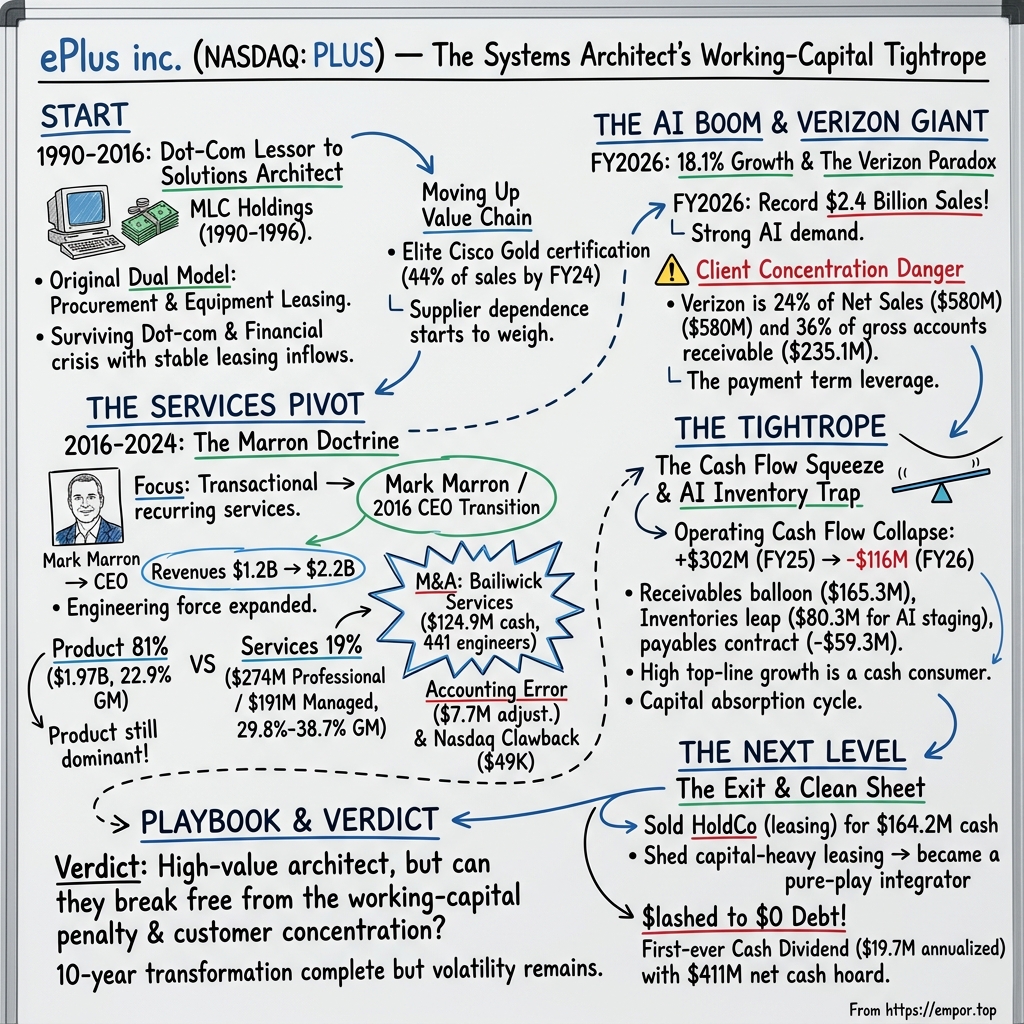
On June 30, 2025, a deal closed that ended ePlus's original identity. For thirty-five years the company from Herndon, Virginia had done two jobs at once. It sold corporations the routers, servers, storage arrays and software licences that run their networks, and it lent them the money to pay for that equipment. That day ePlus sold HoldCo, the holding company for its domestic financing business, to Marlin Leasing Corporation, which trades as PEAC Solutions and is backed by HPS Investment Partners.12 Net cash proceeds came to about $164 million.1 The leasing desk, which had once been the whole company, became a line called "discontinued operations." What remained was a pure technology integrator: engineers, architects, security analysts and a large procurement machine, arriving in the market just as corporate boards began asking their IT departments what an AI strategy would cost.
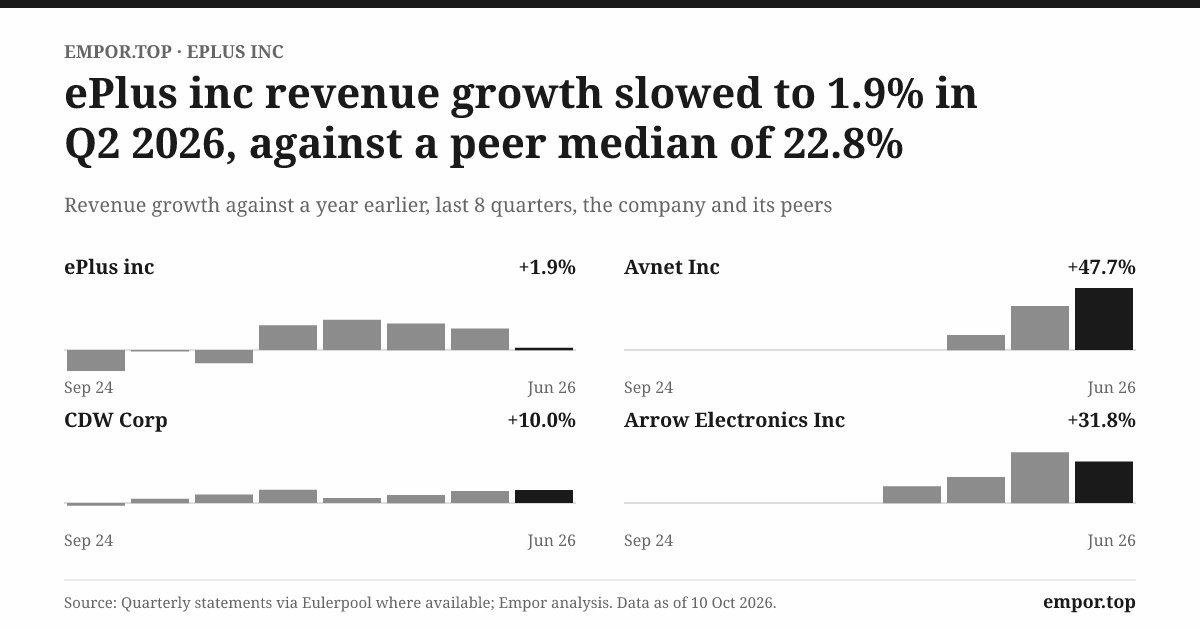
The first full year under that new shape looked like a victory. In fiscal 2026, which ended March 31, 2026, consolidated net sales rose 18.1% to about $2.4 billion, gross profit reached a record, and net income climbed to $128 million.13 After a 7.1% decline the year before, ePlus was growing at more than twice its ten-year average again.1
The cash flow statement told a different story. In fiscal 2025, a year of shrinking sales, ePlus generated about $302 million of cash from operations. In fiscal 2026, the year of record growth, operating cash flow was negative $116 million.1 Accounting profit and cash moved roughly $244 million apart in a single year, at a company that spends less than $5 million a year on property and equipment.1 There are no factories here and no fleet of trucks. The money went into receivables, into warehoused hardware, and into paying suppliers before customers paid ePlus.
One customer was behind a large share of that gap. At fiscal year-end, Verizon Communications owed ePlus $235.1 million, about 36% of the company's $653 million in gross trade receivables. A year earlier Verizon's share had been 17%.1 Over the same year Verizon's share of net sales rose to 24%.1 The comeback was real, and a large part of it came from a single telecom carrier.
That tension runs through the whole story. Value-added resellers, the industry's term for companies like ePlus that buy technology from manufacturers, add engineering, and resell it to enterprises, sit between two powerful groups. Above them are manufacturers like Cisco with strict payment terms. Below them are Fortune 50 customers who negotiate hard on price and on when they pay. When AI infrastructure projects get larger and more complicated, the reseller in the middle ends up financing the gap. This episode asks four questions. Can ePlus keep growing at double digits without its balance sheet becoming an interest-free lender to Verizon? Was the fiscal 2026 cash drain a one-time inventory bottleneck, or the normal cost of staging complicated AI hardware? Did selling the financing arm produce a cleaner, higher-return business, or did it remove the steady income that used to cushion downturns? And does a recent accounting revision, which led to small but real clawbacks of executive bonuses, point to control strain as the company grows through deals like the purchase of Bailiwick Services?
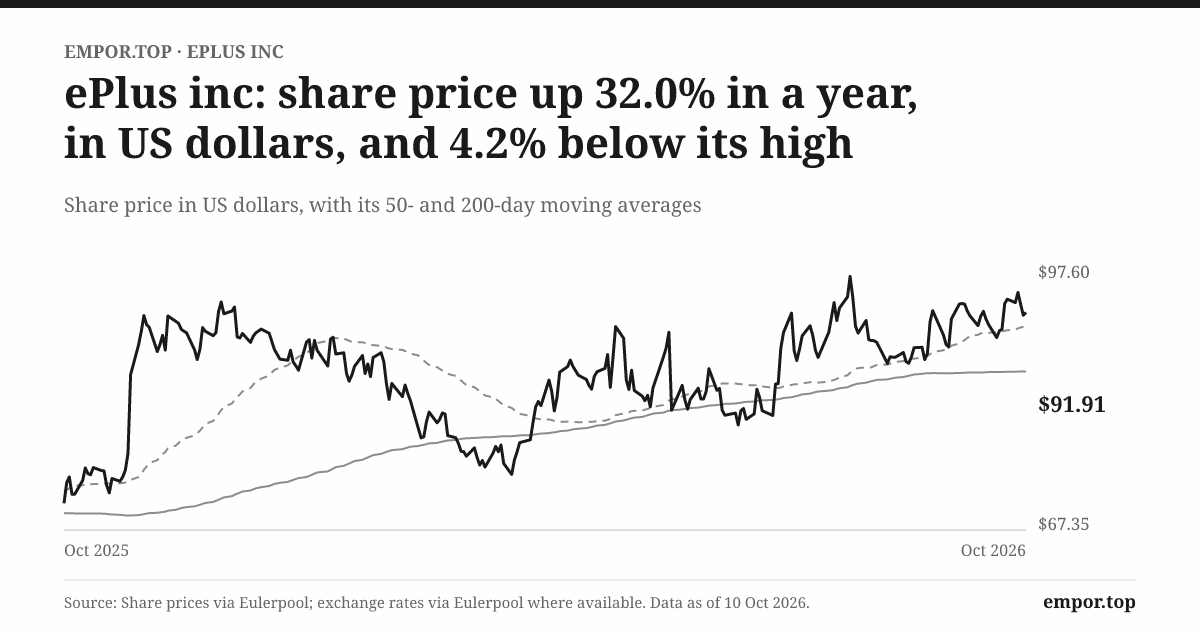
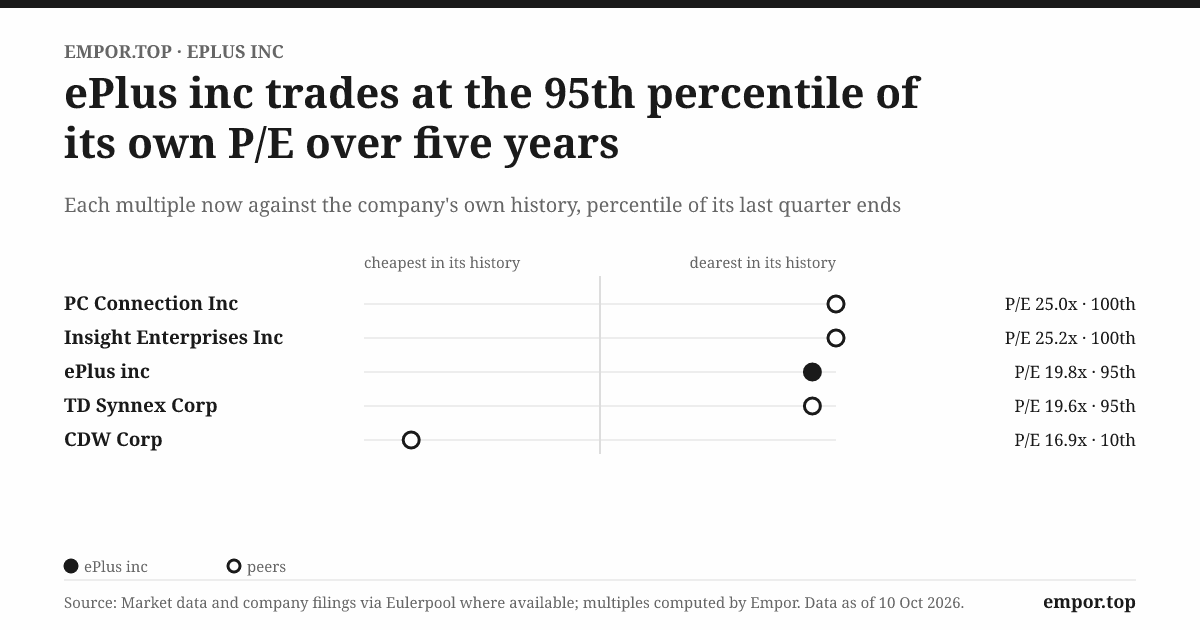
Here is where the company stood on October 10, 2026. It had essentially no funded debt and about $411 million in cash at fiscal year-end, rising to nearly $449 million by June.14 The market valued its equity at about $2.5 billion and the whole enterprise at about $2.0 billion.5 The shares traded at 19.8 times trailing earnings, roughly 29% above the company's own five-year median of 15.3 times.5 Investors are paying more for ePlus than they have at any comparable point in recent history. To judge whether that is justified, you have to go back to how the company started, as a firm that rented mainframes.
 Subscribe on LinkedIn
II. From Dot-Com Lessor to Solutions Architect (1990–2016)
ePlus was founded in 1990 as an equipment leasing company.1 The founders' bet was a financing bet: mid-sized American companies needed expensive computers, telecom gear and, in some cases, medical equipment, and they would prefer to pay for it monthly. When the company filed its IPO prospectus in November 1996, it was called MLC Holdings, a lessor that also sold the equipment it financed.6 Co-founder Phillip G. Norton led the company through that period, which was the height of the internet boom, and soon renamed it ePlus. The new name advertised an electronic procurement platform that would sit inside corporate purchasing departments and send their orders to ePlus.
It looked like a typical dot-com rebrand, and a lot of companies with an "e" added to their names in those years did not last. ePlus did, and the leasing book is the main reason. A hardware broker that sells a box and collects a single margin depends entirely on the next order. A lessor collects a payment every month whether or not the customer buys anything new. When corporate IT budgets froze in 2001 and again in 2008, leasing income kept coming in while new hardware orders dried up. The procurement software gave ePlus a second advantage: once purchasing departments had built their ordering workflows around a supplier's system, they tended to keep using that supplier.
The 2000s also showed that the hardware itself was losing its value as a business. PCs and standard servers became commodities, and margins for the companies reselling them fell toward low single digits. The profitable work moved up the stack, into enterprise networking, firewalls, storage and data-centre design, where a customer pays for the expertise to make the equipment work as well as for the equipment. ePlus followed that shift by tying itself closely to Cisco, the dominant maker of enterprise switches and routers. Over time Cisco became the largest single source of what ePlus sold. In fiscal 2024, Cisco products made up 44% of ePlus's net sales.7 That gave ePlus access to the industry's biggest product line, and it also meant that one supplier's channel strategy had a large influence on ePlus's results.
The hybrid model held the company together, but it was also a drag. Leasing required a balance sheet full of financing receivables and loans to fund them. In fiscal 2015, ePlus had debt of about 56 cents for every dollar of shareholder equity, and return on invested capital was in the low teens, roughly 11% to 13%, where it stayed for most of the following decade.18 The leasing business tied up capital that a pure integrator would not need. Investors could not decide whether ePlus was a technology company or a small finance company, and the stock was priced as something in between.
Management's long-standing argument for keeping leasing was that customers could not get the same thing from competitors: the same partner that designed a network would also finance it, and that bundle kept customers loyal. The company's own later behaviour tests that argument. In fiscal 2025, the final year ePlus owned domestic financing, the segment produced about $28 million of net profit, a meaningful contribution.1 If leasing had been the main reason customers stayed, selling it would have put the core business at risk. ePlus sold it anyway, and its product and services revenue grew 18% in the following year.1 The record does not support the claim that financing was the essential source of loyalty. A narrower version holds up better: financing was a useful sweetener and an important source of stability in downturns, but customers stayed for the engineering and the vendor relationships. Ten years of 7.3% compound revenue growth into fiscal 2026 points the same way.1
By the mid-2010s, then, ePlus was profitable, cautious and somewhat overlooked: a leasing company with a growing engineering staff attached to it. The person who changed that mix was not the founder. It was his chief operating officer.
III. The Marron Doctrine and the Services Pivot (2016–2024)
On August 1, 2016, Mark P. Marron became President and CEO of ePlus, succeeding Phillip Norton.19 Marron had been chief operating officer and was not a founder. He had spent his career selling and running enterprise technology, and his idea of what the company should become was simpler than the e-commerce pitch of the 1990s. ePlus should earn more of each customer dollar from what its people knew and less from the boxes it delivered. Security assessments, cloud advisory work, network design, and round-the-clock monitoring sold as a subscription were, in his view, the business. Hardware was how ePlus got into the customer.
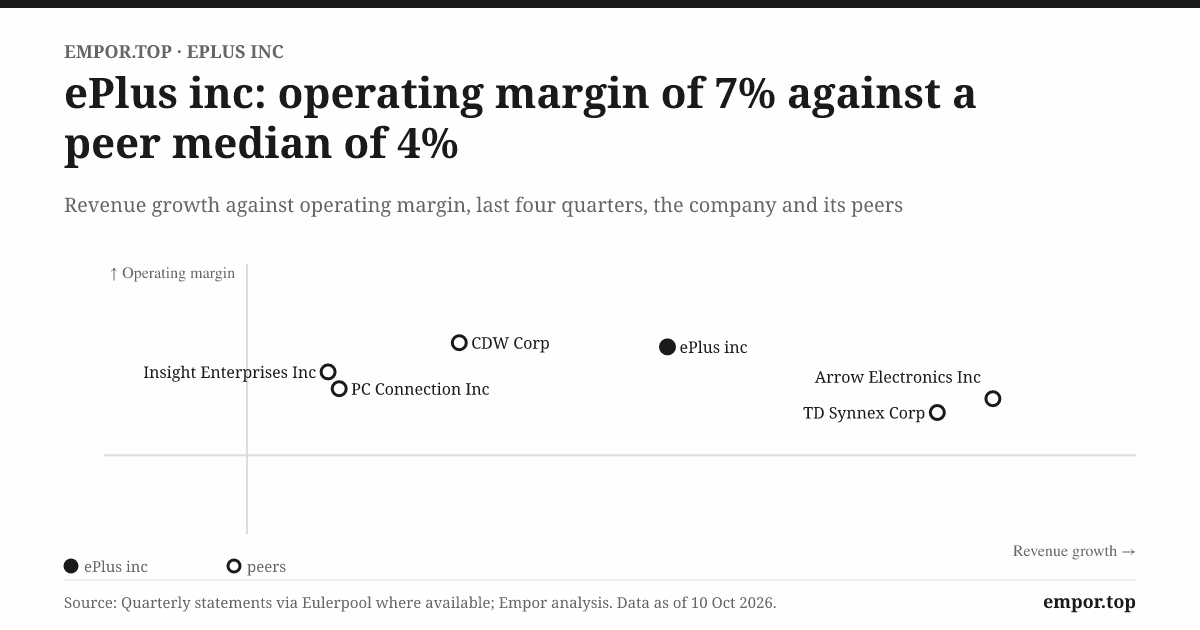
Eight years later the results of that strategy were visible. Revenue roughly doubled, from about $1.2 billion in fiscal 2016 to about $2.2 billion in fiscal 2024.1 Net profit grew faster, at about 11% a year over the decade compared with 7% for revenue, so each dollar of sales was producing more profit.1 Operating margin moved from the low sixes to about 8% at the fiscal 2022–2023 peak before settling at about 6.8%.1 The workforce changed as well. By March 2026 ePlus had 2,148 employees, and just over half of them, 1,079 people, were customer-facing engineers and technical services staff.1
The mix shift is clearest in the revenue line, and so is its limit. In fiscal 2026, product sales of hardware, software and the logistics around them were 81% of net sales, about $1.98 billion, at a gross margin of about 22.9%.1 Professional services, which covers engineering projects billed by the hour, by fixed milestone or by placing staff with the client, were about 11% of sales at a gross margin near 39%.1 Managed services, multi-year subscriptions in which ePlus runs a customer's security monitoring or cloud environment, were nearly 8% of sales at about 30% gross margin.1 A simple comparison: product resembles a grocery store's margin on goods from someone else's farm, and services resemble a restaurant's margin on its kitchen. ePlus has added more restaurant to the store, but most of the revenue still comes from the shelves.
One accounting detail affects how growth should be read. When ePlus resells a third-party maintenance contract or a cloud subscription as an agent, it books only its commission as revenue, not the full amount billed. In fiscal 2026, about $215 million of product revenue was recorded on that net basis.1 Reported revenue therefore understates gross billings to customers. It also means that any shift between agent and principal sales, which depends partly on what vendors sell and how they structure it, can move revenue up or down without any change in the underlying business. That is why the company's auditor later focused on this area.
The income statement has no research and development line. For an integrator, the equivalent is the engineering staff, and that is where reinvestment shows up. Capital expenditure was about $4.4 million in fiscal 2026, under a fifth of one percent of revenue.1 The investment shows up in salaries, certifications and acquisitions instead.
Executive pay is relatively large for a company of this size. Marron's total compensation was about $8.5 million in fiscal 2026, up from roughly $5.7 million two years earlier. Most of it came from stock awards and a cash incentive that rose with the year's profit rebound.9 The incentive plans are tied to operating income and return-on-capital measures, so the large fiscal 2026 payout followed real profit growth.9 Shareholders approved the pay package with 96% support at the September 2026 annual meeting.10 Marron's daughter works at an ePlus subsidiary as a non-executive customer success manager and was paid about $150,000. This is disclosed and was approved by the governance committee, and it is the only related-party arrangement in the filings.9
The company's investor materials describe ePlus as moving toward high-margin recurring services. After eight years of Marron's leadership, the gross profit figures put that claim in proportion. Services produced about 26% of gross profit in fiscal 2026, and product produced about 74%.1 When customers stopped buying hardware in fiscal 2025, after they had finished absorbing the equipment they stockpiled during the pandemic, revenue fell 7.1% and net profit fell 7%.1 Services were not large enough to offset the drop. The evidence does not show ePlus has become a services company. It shows a hardware reseller whose services wing has become large enough to win and keep accounts, and to lift margins, but not large enough to steady the business through a downturn. The useful measure going forward is services' share of gross profit, which was about 26% in fiscal 2026. Marron's next step was to grow that share by buying a services business, and it was the largest acquisition the company had made.
IV. The $125 Million Bailiwick Bet and the Integration Friction (2024–2025)
On August 19, 2024, ePlus paid about $124.9 million in net cash for Bailiwick Services, LLC, a Minnesota-based firm whose technicians install and maintain technology at many locations at once: wireless networks in retail chains, digital signage in restaurants, and sensors and edge devices in distribution centres.111 The deal brought 441 people, increasing ePlus's headcount by about 16% in one step.1 It was the largest acquisition in ePlus's history, and it was paid for entirely with cash from the balance sheet. No new shares were issued.
The reasoning was practical. A national retailer upgrading Wi-Fi in two thousand stores, or a bank installing new branch equipment, needs people physically present on site across many locations at the same time. ePlus's engineers were concentrated in regional centres and usually handled that work by hiring subcontractors, who are hard to supervise and who take part of the margin. Bailiwick provided its own field technicians. The price was roughly 0.8 times Bailiwick's annual sales, based on management's pre-deal description, which is reasonable for a mid-market IT services business and below the multiple of one times sales or more that larger services firms often command. The available evidence suggests ePlus did not overpay.
The harder part was integration. Bailiwick's technicians were used to rollout work, where each site is a repeatable job with a set number of installations per day. ePlus sells consulting and design work. Combining the two means connecting different billing practices, cost-tracking systems and ways of recognising revenue on a fast-growing project business. Headcount at the end of fiscal 2026 was 2,148, almost the same as the 2,151 a year earlier.1 That is consistent with the acquired staff being absorbed without further hiring.
Note 2 of the fiscal 2026 annual report disclosed an accounting problem. ePlus said it had miscalculated accrued product revenue and the related inventory costs in fiscal 2024 and fiscal 2025.1 Correcting it reduced beginning retained earnings by $7.7 million and cut fiscal 2025 net income by $3.4 million.1 The company called the misstatement immaterial and corrected it through a revision, not a formal restatement. The filing does not say whether the error was related to the Bailiwick integration, and the two should not be treated as connected without evidence. Both happened during a period of rapid organisational change.
The error had consequences under a newer rule. Nasdaq Rule 5608 requires listed companies to recover incentive pay that executives earned on figures later corrected. ePlus's compensation committee applied it and recovered $49,949 from CEO Mark Marron, CFO Elaine Marion and COO Darren Raiguel combined. The amount was repaid before the proxy statement was filed.9 Relative to an $8.5 million CEO pay package the sum is small. The fact that the rule was triggered at all is the more meaningful signal.
Management's position is that the problem was immaterial and that internal controls work. Deloitte & Touche, the auditor, agreed with that conclusion as of March 31, 2026, issuing an unqualified opinion on the financial statements and on internal control over financial reporting.1 Deloitte also chose one area as its single Critical Audit Matter, meaning the part of the audit that needed the most difficult judgment: whether ePlus acts as principal or agent on third-party software and multi-part support contracts, which decides whether revenue is booked gross or net.1 This is the same area of judgment as the net-basis revenue treatment on maintenance and cloud contracts. The revision was minor, and a clean audit opinion reduces concern about it. What remains is that revenue recognition in this business depends heavily on judgment, and judgment calls become harder as the business grows and adds acquisitions. The next annual report is the test: a filing with no further revision notes would support management's account, and another one would weaken it. The fiscal 2026 numbers that drew the most attention, however, were about one customer, not about accounting.
V. The Verizon Paradox: The 18% Rebound and Customer Concentration (FY2026)
When ePlus reported fourth-quarter results in May 2026, the full-year figure was what stood out. Revenue had grown 18.1% to about $2.4 billion, after declining the year before.3 Each quarter of the fiscal year had grown between 17% and 23% against the prior-year quarter, a run the company had not had since the post-pandemic recovery.1 The annual report, filed the same day, identified the main source of that growth.
Sales to Verizon Communications were 19% of net sales in fiscal 2024 and 17% in fiscal 2025. In fiscal 2026 they rose to 24%.1 On roughly $2.4 billion of revenue, 24% is about $580 million from a single customer. Verizon's share of gross billings, before netting agent revenue, was smaller at 17%.1 That gap indicates Verizon buys mostly hardware that ePlus books at full value, so Verizon contributes more to reported revenue than to ePlus's services work.
The balance sheet shows the effect more sharply. At March 31, 2026, Verizon owed ePlus $235.1 million of the company's $653 million in gross trade receivables.1 About 36 cents of every dollar owed to ePlus was owed by one company. A year earlier, Verizon's share of receivables had been 17%.1
Default risk is low. Verizon has an investment-grade credit rating, and ePlus's total allowance for bad debts was about $3 million, under half a percent of gross receivables, with write-offs in the low single millions or less over the past three years.1 Verizon will pay. The risk is about timing and bargaining power. A customer that large decides when it pays, whether projects are staged across a fiscal year-end, and how much margin the integrator keeps at the next contract renewal. In the cash-flow figures discussed in the next section, Verizon's payment schedule effectively becomes a factor in ePlus's own liquidity.
Analysts on the calls have repeatedly asked how long carrier spending can stay at this level. Management's answer emphasises breadth: thousands of customer relationships across healthcare, financial services, and state, local and education accounts, grouped together as SLED. The data allow a direct check. If one customer is about a quarter of net sales, all other customers together are about three-quarters, roughly $1.8 billion. That is a large and varied business. But growth in fiscal 2026 came disproportionately from the top customer. Verizon's sales increased by roughly $230 million against total company growth of about $370 million, which means Verizon accounted for well over half of the year's increase. Measured by customer count, the franchise is broad. Measured by where growth came from, it is narrow.
The conclusion is clear. Fiscal 2026 showed that ePlus can win and deliver very large carrier projects, which is a real capability. It did not show broad enterprise AI demand across the customer base, because that demand cannot be separated from the Verizon contribution in the disclosures. The figure to watch is Verizon's share of net sales in the fiscal 2027 annual report. A decline below 20% while total sales keep growing would show the rest of the customer base picking up. A rise would show increasing dependence on one buyer. Either way, the size of the Verizon relationship on the balance sheet explains much of what happened to cash.
VI. The Cash Flow Squeeze and the AI Inventory Trap
At the close of fiscal 2026 on March 31, ePlus's finance team was looking at a working-capital outflow of about $305 million. Receivables had increased by about $165 million. Inventory had increased by about $80 million. Payables to suppliers had decreased by about $59 million.1 Each of those moved cash out of the company. Together they more than offset $128 million of net income and produced operating cash flow of negative $116 million.1
The mechanism works like a relay. ePlus buys equipment from Cisco or a distributor and has a fixed window to pay, typically 45 to 60 days, financed interest-free through its Wells Fargo floor-plan facility.1 ePlus then stages, configures, ships and installs the equipment, and the customer pays after delivery or acceptance on its own terms. If a project grows, or slips across a quarter-end, or the customer pays slowly, ePlus has already paid its supplier and is waiting on its customer. In fiscal 2026 all three happened together. Large fourth-quarter deliveries, many tied to Verizon project milestones, raised receivables. Shortages of the memory and networking components used in AI servers led ePlus to buy ahead and hold stock for scheduled rollouts, so inventory rose to about $201 million.1 Supplier invoices came due before customer payments arrived. Debtor days, the average time customers take to pay, were 106 at fiscal year-end. That was actually lower than the 131 of the year before, so the problem was more about volume and timing than about customers paying more slowly.1
The obvious concern is that this is a lasting change, and that the AI build-out turns resellers into permanent warehouses of expensive components. ePlus's twelve-year record is a good test. From fiscal 2015 to fiscal 2026 the company reported about $974 million of cumulative net profit and generated about $636 million of operating cash flow, converting roughly 65% of profit into cash over the period.1 Part of that shortfall dates from the leasing years, when growing the loan book appeared as an operating outflow. The pattern within that record also comes in waves. Fiscal 2022 and 2023 both had negative operating cash flow during the supply-chain crunch, when ePlus bought ahead heavily. Those were followed by about $248 million of operating cash in fiscal 2024 and about $302 million in fiscal 2025 as inventory was sold through and receivables were collected.1 Working capital at ePlus expands when the business grows and is released when growth slows.
The first quarter of fiscal 2027 supported that pattern. By June 30, 2026, inventory had fallen by about $55 million to roughly $146 million, and cash had risen to nearly $449 million.4 That is consistent with management's description of a temporary build-up. One quarter is not the whole explanation, though, because receivables and Verizon's payment timing still have to come down in later quarters.
The structural point is clear, and it is not obvious from the income statement. At ePlus, fast growth uses cash and slower growth releases it. A year with 18% revenue growth will look strong on reported earnings and weak on cash flow, and a flat year will look the opposite. Investors who value the company on trailing free cash flow will tend to see it as expensive after strong years and cheap after weak ones, which is the reverse of what they might expect. Judging the business on one year of cash flow, or one year of profit, gives a misleading answer. The full-year fiscal 2027 cash flow statement is the clearer test: operating cash flow above about $150 million would show that fiscal 2026 was a timing issue. ePlus could absorb that $305 million outflow without borrowing because of the decision it made in June 2025.
VII. The HoldCo Exit, the Clean Balance Sheet, and the First Dividend
On September 10, 2026, ePlus shareholders held their annual meeting and approved an increase in authorised common shares from 50 million to 75 million.10 The company described the change as providing flexibility for possible stock splits, equity compensation and acquisitions. The more notable fact was that ePlus had begun paying dividends. In fiscal 2026 it paid its first regular quarterly cash dividend in more than three decades as a company, distributing $19.7 million, about 15% of net profit, at an annual rate of $0.75 per share.1
The HoldCo sale made that possible. ePlus received about $164 million in net cash, and roughly $38.8 million of non-recourse project debt went to the buyer.1 Non-recourse means the lender could only claim the leased equipment if a customer defaulted, not ePlus's other assets. That debt was secured project financing tied to specific leases, and it is now gone. Total borrowings had been about $213 million at the fiscal 2020 peak and about $128 million in fiscal 2025. They fell to about $16 million of residual obligations at March 2026, and contractual debt was zero by June 30, 2026.14 The debt-to-equity ratio, 0.56 in fiscal 2015, was 0.02 at fiscal 2026 year-end.1
ePlus has no public bonds and no credit rating from Moody's, S&P or Fitch, and does not need either. Its liquidity comes from the Wells Fargo Commercial Distribution Finance facility: a $500 million floor-plan line that pays approved vendors on ePlus's behalf and gives ePlus interest-free payment terms, plus a $200 million revolving credit sublimit that was undrawn at both March and June 2026.14 Floor-plan balances were about $120 million at fiscal year-end. They are recorded as trade payables, not interest-bearing debt, and the company reported meeting all covenants.1 For a reseller, this arrangement serves the role a bond issue would play for a manufacturer. It works as long as vendors and the bank continue to support it, and nothing in the filings suggests otherwise.
Capital allocation has changed in the same period. ePlus has repurchased shares opportunistically for years, spending about $43 million in fiscal 2025 and about $28 million in fiscal 2026 under a 1.5 million share authorisation approved in August 2025.1 The dividend adds a regular, committed payout. Combined, these returns are modest relative to the cash balance. Over twelve years, dividends used about 4% of cumulative free cash flow, and cash on the balance sheet rose from about $83 million to about $411 million.1
Ownership is concentrated in institutions and is calm. BlackRock owned about 15% of the shares, and River Road, Dimensional and Vanguard each owned just over 5%. Those four held about 31% together.9 Directors and executive officers owned about 2.2%. No shares are pledged and there is no poison pill.9 There is no controlling shareholder or activist position, and the 96% say-on-pay vote indicates the main holders are content.10
ROIC improved after the sale, to 17.7% in fiscal 2026 and 19.5% for the twelve months to June 2026.1 Part of that increase comes from the arithmetic of the ratio: removing a capital-heavy leasing book and holding large cash balances shrinks the invested-capital denominator. Part of it reflects a higher-return core business. There was a cost. The discontinued financing business produced about $28 million of net profit in its last full year and about $54 million of gross profit, and that income was not tied to hardware cycles.1 Without it, all of ePlus's earnings now depend on enterprise and carrier IT spending. The sale made returns higher and the balance sheet cleaner, and it also made earnings more cyclical. That is the setup for the lessons, and for the question of whether a higher multiple is justified.
VIII. Playbook: Business & Investing Lessons
The first lesson comes from the cash flow statement for fiscal 2026. In the year ePlus grew 18%, it used $116 million of operating cash. The fiscal 2024 and 2025 surpluses, in years of slow or negative growth, came from the same mechanism in reverse. Founders of integration businesses should plan financing for growth years, not for downturns, because growth is when customers' payment terms catch up with them. Investors should match the multiple they pay to where the company is in its working-capital cycle. At an integrator, growth costs cash up front and repays it later.
The second lesson is about Verizon. A carrier that rose from 17% to 24% of sales drove the recovery, and by year-end it owed ePlus more than a third of all outstanding receivables. Nobody expects Verizon to default. The problem is that a customer of that size sets the pace of the supplier's cash flow and holds the advantage in every renewal. When one customer accounts for most of a recovery, the supplier is relying on that customer's purchasing decisions for its own results. A customer that delivers the turnaround also gains leverage over the balance sheet.
The third lesson is from the HoldCo sale. Selling the leasing book cleared about $164 million of cash, eliminated project debt, and lifted ROIC toward 20%. It also removed about $28 million a year of profit that did not depend on hardware demand. Many divestitures are presented as making a company simpler and better. Investors should also ask what the sold unit used to absorb in bad years. Selling the steady unit raises returns and removes some protection in downturns.
The fourth lesson is from the Note 2 revision and the roughly $50,000 clawback. ePlus's growth is in people and project revenue, where revenue recognition depends on estimates of accrued deliveries and decisions about whether ePlus is principal or agent. The amounts involved were small. Their significance is that the area Deloitte flagged as hardest to audit is the same area where an error occurred. When a company acquires services capacity, the accounting judgments it has to make multiply too.
The fifth lesson is about the Wells Fargo facility. A $500 million floor-plan line with interest-free vendor terms lets ePlus run $2.4 billion of annual sales with no funded debt. It is low-key and effective, and it depends on continued support from vendors and the bank. ePlus's balance sheet depends on the floor-plan facility in the way a manufacturer's depends on its bond market access.
IX. Analysis & Bear vs. Bull Case
Consider ePlus alongside its closest public peers. ePlus trades at 19.8 times trailing earnings and about 10 times EV/EBITDA.5 CDW, which is roughly ten times larger by revenue, has recently traded at around 18 to 21 times earnings. Insight Enterprises has traded around 16 to 19 times.12 Measured against peers, ePlus is not expensive. Measured against its own five-year median of 15.3 times, it is.5 The market now values ePlus like a mid-sized integrator instead of a leasing hybrid. Whether that is justified depends on how durable its competitive position is.
Hamilton Helmer's 7 Powers framework sets out what can sustain above-average returns. Switching costs are ePlus's strongest power, and they are moderate. When ePlus runs a customer's security operations centre or manages its hybrid cloud under a multi-year contract, changing providers partway through means transferring monitoring, procedures and institutional knowledge, which customers are reluctant to do. That applies mainly to the managed-services business, which earns about 30% gross margin but is only about 8% of sales.1 On the 81% of sales that is product, a customer can obtain a competing quote from CDW or a regional reseller for the same Cisco part number. Something close to a cornered resource comes from ePlus's top-tier certifications with Cisco, NetApp, Arista, Palo Alto Networks and others. These bring better rebates and deal-registration protection, but any competitor of similar size can earn the same certifications, so the advantage is narrow. Scale economies exist but are limited: ePlus sends over 30% of product purchases through Ingram Micro, Arrow and TD SYNNEX, but it is much smaller than CDW.1 Network effects, branding and counter-positioning are not meaningful here, because buyers do not choose a router based on the reseller's brand.
Porter's Five Forces show similar pressure. Supplier power is high. Cisco was 29% of fiscal 2026 sales, down from 44% two years earlier.1 That decline reduces dependence on one vendor, but it also means ePlus's growth came from hardware other than Cisco's, which was largely carrier-related. Any change to Cisco's partner rebate programmes or direct-sales approach would affect margins directly. Buyer power is the most severe force, given Verizon's 24% of sales and 36% of receivables. Rivalry is intense: CDW, World Wide Technology, Insight and many regional integrators compete for the same enterprise customers. Substitution risk is moderate. Hyperscale cloud providers have taken workloads that once ran on hardware ePlus would have sold, but AI inference, data-residency requirements and cost pressure are bringing some infrastructure back on-premises, which helps hybrid integrators.
The bull case has three parts. First, enterprise AI requires network upgrades: faster campus switching, low-latency data-centre networks, and zero-trust security around new data flows, which is the work ePlus's engineers do. Second, cash should recover. If fiscal 2026's working capital is released as it was in fiscal 2024, operating cash flow could be well over $150 million in fiscal 2027, and the June quarter's inventory reduction is consistent with that.4 Third, services mix could keep rising, with professional and managed services growing toward a quarter of sales and lifting consolidated gross margin. The balance sheet supports all three: about $449 million of cash and no debt provides room for acquisitions and buybacks.4
The bear case also has three parts. First, Verizon could reduce network capital spending, split work among multiple integrators, or push for longer payment terms, any of which would hit ePlus's revenue, receivables and possibly margin together. Second, product gross margin could fall below 20% if Cisco moves more business direct or distributors take a larger share, which would hurt a business that earns about 74% of gross profit from product. Third, continued growth in complex AI staging could keep consuming working capital, leaving reported profit consistently above free cash flow. The PEG ratio of 5.8 reflects only about 2.5% annual earnings growth over three years. That means the current multiple depends on future growth, not on the recent earnings record.51
A skeptical investor would also ask about the cash. ePlus holds over $400 million, about a sixth of its market value, while the dividend yields 1.1% and buybacks are modest.5 One possible criticism is that the company is holding more cash than it needs. The other is that cash on hand invites an expensive services acquisition. ePlus's response would be that cash cushions working-capital swings like fiscal 2026. That is a reasonable argument, but it also confirms the cash is not truly surplus, so it should not be counted as freely deployable.
Overall, ePlus has a narrow position based on switching costs in managed services and vendor certifications, and it has no pricing power. The premium to its own historical multiple assumes Verizon spending stays strong, AI demand broadens, and working capital is released, all at once. Three indicators will test those assumptions. The first is Verizon's share of net sales, which rose from 17% to 24% last year. The second is full-year operating cash flow, which was negative $116 million in fiscal 2026 and appeared to be recovering in the June quarter. The third is services' share of gross profit, about 26% and rising slowly. The current price leaves little room for any of these to disappoint.
X. Epilogue
As of October 2026, ePlus has no debt and close to $449 million in cash. It is two years past its largest acquisition and fifteen months past the sale of the business it was founded on.4 Its shares are within about 4% of their 52-week high, and the market is paying one of the higher multiples in the company's history.5 Several upcoming events will show whether that valuation holds up.
The first is the fiscal 2027 annual report, due around May 2027, with its customer-concentration disclosure. If Verizon's share falls back toward the high teens while total sales grow, the rebound will look like broad enterprise demand. If it rises toward 30%, ePlus will look increasingly like a contracted procurement and integration partner for one carrier, a business that typically earns a lower multiple.
The second is the fiscal 2027 cash flow statement. The first quarter's inventory reduction was a good start. If full-year operating cash flow exceeds $150 million, fiscal 2026 will be seen as a timing year that fits the company's established pattern. If cash flow stays weak while profit grows, the concern about a structural AI inventory burden will gain support.
The third is the services share of gross profit. Crossing 30% would give the services strategy, after nine years under Marron, real financial weight. Staying in the mid-twenties would mean ePlus remains a hardware reseller with a capable engineering group.
The fourth is the absence of something. The next 10-K should contain no further Note 2-style revision and no material weakness. That would support management's view that the fiscal 2026 issue was a one-time error. A recurrence would reopen questions about controls at a company that is growing through acquisitions.
The tension that remains is between record profit and weak cash flow, and between a broad customer base and a growing dependence on one customer.
XI. Outro
The 1996 prospectus of MLC Holdings describes a leasing company in a Virginia office park that wanted American businesses to rent their computers instead of buying them.6 Thirty years later that leasing business has been sold to a lender backed by private credit. What was kept was the customer relationship: the engineers in the server room, the architect on the design call, and the team that receives a call when the network fails.
That is what has kept ePlus going through each technology cycle, though it has never made the technology itself. In the current AI build-out, ePlus does not make the chips or own the models. It is the integrator that installs and connects the equipment, and the fiscal 2026 accounts show that it also carries the cost of doing so until customers pay. A reseller lasts only as long as customers see it as an essential partner, and the record so far is that ePlus has kept that role through each cycle, financing much of the cost from its own balance sheet.
References
-
Annual Report on Form 10-K for Fiscal Year Ended March 31, 2026 — SEC EDGAR, 2026-05-28 ↩↩↩↩↩↩↩↩↩↩↩↩↩↩↩↩↩↩↩↩↩↩↩↩↩↩↩↩↩↩↩↩↩↩↩↩↩↩↩↩↩↩↩↩↩↩↩↩↩↩↩↩↩↩↩↩↩↩↩↩
-
PEAC Solutions Completes Acquisition of ePlus Financing Business — PEAC Solutions Press Office, 2025-06-30 ↩
-
ePlus Reports Fourth Quarter and Full Year Fiscal 2026 Results — ePlus Investor Relations, 2026-05-28 ↩↩
-
Quarterly Report on Form 10-Q for Period Ended June 30, 2026 — SEC EDGAR, 2026-08-04 ↩↩↩↩↩↩↩
-
ePlus inc. Company Profile and Quote — NASDAQ, 2026-10-10 ↩↩↩↩↩↩↩
-
Prospectus under Rule 424B1 for Initial Public Offering — SEC EDGAR, 1996-11-18 ↩↩
-
Annual Report on Form 10-K for Fiscal Year Ended March 31, 2024 — SEC EDGAR, 2024-05-23 ↩
-
Annual Report on Form 10-K for Fiscal Year Ended March 31, 2025 — SEC EDGAR, 2025-05-22 ↩
-
Definitive Proxy Statement on Schedule 14A — SEC EDGAR, 2026-07-24 ↩↩↩↩↩↩↩
-
Current Report on Form 8-K: Voting Results of 2026 Annual Meeting — SEC EDGAR, 2026-09-14 ↩↩↩
-
ePlus Completes Acquisition of Bailiwick Services, LLC — ePlus Investor Relations, 2024-08-19 ↩
-
ePlus inc. Overview and Peer Benchmarking — Reuters, 2026-10-10 ↩
 LinkedIn
 WhatsApp
 Reddit
 Hacker News
 Email
Email Kindle
 RSS Feed
 Spotify
 Apple Podcasts
 Amazon Music
 Audible
 YouTube