Plug Power: The Hydrogen Economy That Had to Arrive
I. The Forklift in the Warehouse
Start inside a distribution center at the end of a night shift. The aisles are forty feet high, the trailers are backed up to the dock doors, and a forklift driver who has been moving pallets for hours rolls up to a dispenser that looks a little like a petrol pump. A nozzle clicks into the truck. A few minutes later the driver is back in the aisle. There was no battery room, no swap, and no hour on a charger while another truck took its place. The forklift runs on a hydrogen fuel cell, a box that combines hydrogen with oxygen from the air and gives off electricity, heat and a little water. Plug Power has sold that box, the station that fills it, the hydrogen that goes in it and the technicians who keep it running to some of the largest retailers in America.1
That small scene holds Plug's whole founding bet. The company has never been content to sell a component. It wanted to make hydrogen useful enough that a customer would buy the full package: the equipment, the fuel and the service, bundled into one relationship that would last for years. If a warehouse could be persuaded to run on hydrogen, the theory went, then hydrogen could become a business rather than a science project, and from there an economy.
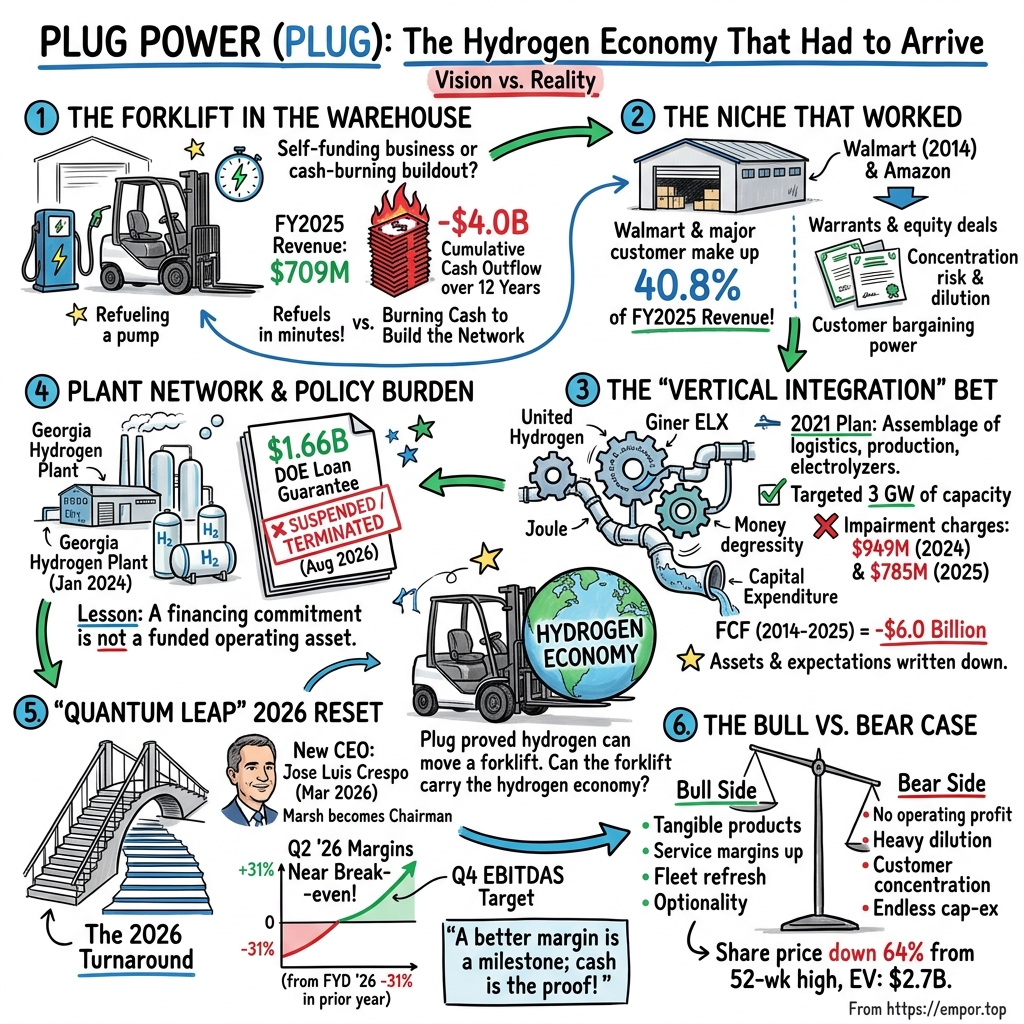
Now walk outside the warehouse and the picture changes. The hydrogen in that dispenser had to be made somewhere, liquefied, trucked in a cryogenic trailer and stored on site. For most of its history Plug bought that molecule from industrial-gas suppliers. Over the past five years it set out to make the molecule itself, building plants, buying equipment makers and promising a national network. That network is where the money went. Across the twelve years to the end of 2025, Plug's operations consumed about $4.0 billion of cash, and its net losses over the same stretch added up to roughly $7.4 billion.1 The forklift works. The question this story keeps asking is whether the business around it does.
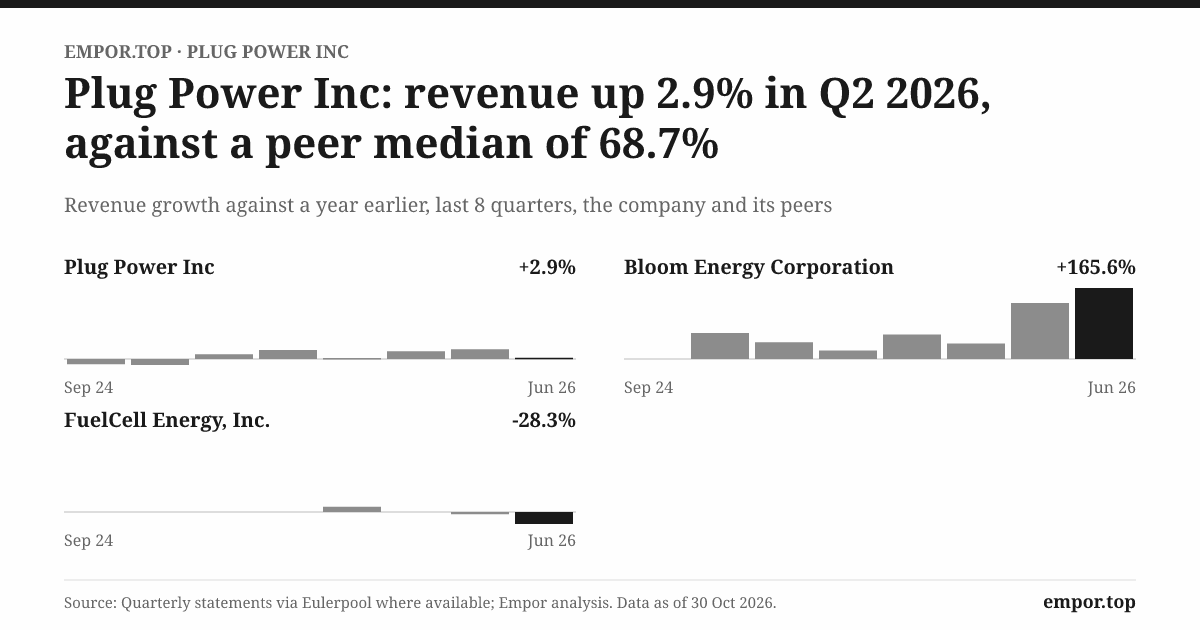
The scale today is modest for a company that has been public for more than a quarter of a century.2 Plug reported revenue of about $709 million in 2025.1 In the second quarter of 2026 it brought in about $178 million and reported a gross margin close to break-even, a large improvement on the deeply negative margins of a year earlier.3 That improvement is real, and it is the reason the stock still trades on hope rather than on salvage value. But a gross margin near zero means Plug is roughly covering the direct cost of what it sells before paying for research, sales, administration or interest. A company in that position does not fund itself. It funds itself from other people.
So the episode has three questions. The first is whether the material-handling business, the forklift and its fuel, can earn attractive repeat revenue on its own terms, or whether it was won with concessions that cap its value. The second is whether Plug can turn its sprawling hydrogen build-out, the plants, liquefiers, trailers and electrolyzers, into infrastructure that earns a return rather than one that consumes capital. The third is about character: Plug has a long habit of selling a future before it has the money to build it, and the question is whether the current reset, under a new chief executive, changes that habit or merely pauses it.
The clock matters. Plug will report its third-quarter 2026 results on November 9. On October 15 it published a preliminary update that put net cash use for the quarter at about $28 million and cash, excluding restricted balances, at about $134 million.4 If those numbers hold, that would be the lowest quarterly cash burn in years, and management has pointed to it as evidence that its restructuring is working. They are unaudited, they do not separate operating cash from asset sales or released restricted cash, and a single quarter has never been enough to settle anything at this company. The rest of this story explains why investors have learned to wait for the audited version.
To understand why the forklift matters so much, and why it has never been quite enough, the story has to go back to the warehouse where Plug first proved something.
 Subscribe on LinkedIn
II. The Niche That Worked
In February 2014 Plug announced what it called a milestone order from Walmart: hydrogen fuel cells for forklifts across six distribution centers, along with the fueling infrastructure and service to support them.5 For a company that had spent the 2000s chasing home generators and backup power, and had come close to running out of money more than once, the order mattered less for its size than for what it signaled. The largest retailer in the world had decided, after trials, that hydrogen forklifts were worth deploying at scale. Plug had found a niche where its technology solved a problem a customer actually paid to solve.
The problem was simple once you see it. A big distribution center runs around the clock. Battery-powered forklifts run for a shift and then need hours on a charger, or a heavy battery swap that takes labor, floor space and a room full of spare batteries. A fuel-cell forklift refuels in a few minutes, holds its voltage as the tank empties rather than slowing as a battery drains, and frees the battery room for storage. In a high-throughput building, those minutes and square feet add up to real money. That was the operational case Plug sold, and it worked best exactly where utilization was highest.
It also created a business model with several layers. Plug could sell the fuel-cell units that slot into the forklift's battery compartment, build the hydrogen storage and dispensers on site, deliver the hydrogen, and sign multi-year contracts for maintenance and replacement units.1 In theory each new site became an annuity: the equipment was sold once, but the fuel and the service flowed for years. In practice, Plug often had to bend that model to win the account. Some customers did not want to own the equipment, so Plug sold units to financial institutions and leased them back, or sold the power output under power purchase agreements, so the customer paid for usage rather than hardware.1 Those arrangements made adoption easier and left Plug carrying obligations and assets that would surface later on its own balance sheet.
Then came the warrants. In April 2017 Plug signed a transaction agreement with Amazon under which it issued Amazon a warrant to buy up to about 55 million Plug shares, with tranches vesting as Amazon spent up to $600 million with the company, at an exercise price of about $1.19 a share for the early tranches.6 Three months later Plug gave Walmart a similar arrangement: a warrant for up to about 55.3 million shares, vesting as Walmart's purchases grew.7 The logic from Plug's side was clear. It got two anchor customers committed to large, multi-year deployments, and its suppliers and lenders could see that demand was real. The logic from the customers' side was even clearer. If Plug succeeded, they would share in the equity upside their own purchases helped create.
That is where the commercial victory gets complicated. A warrant tied to purchases is, economically, a discount paid in stock. Accounting rules treat the value of those warrants as a reduction of revenue, so every dollar Walmart or Amazon spent arrived with a contra-revenue charge attached. Existing shareholders were diluted when the warrants vested and were exercised. And outside investors lost a clean view of the customer economics, because the reported revenue line mixed product sales with non-cash charges whose size depended on Plug's own share price.
The most extreme example sits in the 2020 accounts, where Plug's reported revenue was negative, roughly minus $93 million for the year.1 Product shipments did not collapse into reverse. What happened was that the accounting value of customer warrants, recognized as a reduction of revenue, overwhelmed the sales in that period, a charge that grew as Plug's stock soared during the hydrogen boom of late 2020. The episode fed a credibility problem that never fully left. Securities litigation followed, and in its most recent annual report Plug still described a securities class action with dismissal motions pending.1 For investors, the lesson of the negative-revenue year is not that the business vanished. It is that Plug's headline numbers have repeatedly required a second reading.
Bring the story forward to 2025 and the shape of the original deal is still visible. Walmart accounted for about 24% of Plug's revenue last year, and that figure already includes a $29.2 million reduction for warrant-related charges.1 A second, unnamed customer contributed about 14%. Together the two largest customers supplied almost 41% of revenue, up from about 31% a year earlier.1 At year-end one customer accounted for about 36% of everything Plug was owed.1 That concentration cuts both ways. It proves that the biggest warehouse operators in the country keep buying. It also means a handful of procurement departments hold enormous leverage over Plug's pricing, payment terms and growth rate, and a decision by any one of them to slow deployments or shift to batteries would show up immediately in the results.
There is an honest bull reading of this history. Material handling is the clearest commercial proof Plug has ever produced: tens of thousands of units in buildings that run them hard, sold to customers who have renewed and expanded over a decade. The bear reading is just as honest. The proof was purchased partly with equity, the customers are few and powerful, and no disclosure tells investors how profitable an average site actually is over its life. Plug does not report a recurring-revenue share, a retention rate or a typical contract term by product.1 Customer adoption, on this record, demonstrates that the product works. It does not demonstrate pricing power.
Service is where that gap has been most visible. For much of the past decade, maintaining the forklift fleets was a line Plug ran at a loss: units in hard-working buildings broke down, technicians drove from site to site, and contracts signed to win the account did not charge for the work the fleets actually needed. The 2025 numbers show how much room there was to fix it. Service revenue rose about 81% to roughly $94.5 million, not because Plug suddenly signed thousands of new sites but because it repriced and restructured the contracts it already had.1 That is encouraging, and also revealing. A business whose revenue can jump by four-fifths in a year through repricing was, until recently, giving a lot of value away. The customers that accepted higher service prices did so because their fleets depend on Plug's technicians; that is the first hard evidence of switching costs in the record. Whether they accept the next round of increases, as refresh contracts come up for negotiation, is the more demanding test.
The current test is the refresh cycle. The first big fleets are now old enough that their fuel cells need replacing or upgrading. On the second-quarter 2026 call, management said roughly 2,000 units were slated for refresh during 2026 and described larger customer refreshes stretching over the next three years.8 That could be the moment the annuity finally shows up: a customer that already has the hydrogen infrastructure buys new units with better reliability and signs a service contract priced to reflect what the fleet actually costs to maintain. It could also be a moment when a dominant buyer negotiates hard, knowing that its supplier needs the volume. The evidence to watch is not the unit count. It is whether refreshed fleets carry better service margins and whether the cash arrives on time.
What Plug did next, though, was not to perfect the warehouse niche. It decided the niche was the doorway to something much larger.
III. When "Hydrogen Economy" Became a Balance-Sheet Strategy
By early 2022 Plug looked, briefly, like a company that could afford any ambition it chose. The hydrogen enthusiasm of 2020 and 2021 had driven its share price to levels its operating history never justified, and management did the rational thing with an overvalued currency: it raised money. Cash and short-term investments at the end of 2021 reached about $3.9 billion, up from about $450 million a year earlier.1 Shareholders' equity went from under $600 million to around $4.6 billion in a single year.1 For a company that had spent most of its life a few quarters from the edge, this was a war chest.
The plan for spending it was laid out in Plug's fourth-quarter 2021 investor letter, and it read like a chess player announcing every move at once.9 Plug would no longer be a fuel-cell company that bought hydrogen from someone else. It would produce green hydrogen, liquefy it, move it in its own trailers and sell the electrolyzers that make it, becoming the vertically integrated supplier of the entire hydrogen value chain. The letter set targets of three gigawatts of installed electrolyzer capacity by 2025 and 1,000 tons a day of green hydrogen production by 2028.9 To put the second number in perspective, Plug's own hydrogen network today has nameplate capacity of a little under 40 tons a day.1
The pieces had been assembled through acquisitions in quick succession. In 2020 Plug bought United Hydrogen, a producer and distributor of liquid hydrogen, and Giner ELX, an electrolyzer developer that brought proton-exchange-membrane technology for splitting water into hydrogen and oxygen.1 In 2021 it added Frames, a Dutch systems integrator for energy and process plants, and Applied Cryo Technologies, which made cryogenic tanks, trailers and equipment for storing and moving liquefied gases.1 In 2022 came Joule Processing, an engineering firm that designed and built modular hydrogen liquefaction systems.1 Each answered a real bottleneck. Hydrogen is light and slippery, and liquefying it requires chilling it to about minus 253 degrees Celsius, so the ability to produce, liquefy and deliver reliably was precisely what limited every forklift customer's confidence in fuel supply. Owning that chain promised lower costs and fewer outages.
The investor letter put numbers on the promise. It forecast that the acquisitions would be accretive to gross margin and that Joule alone could save up to $200 million in capital expenditure on Plug's liquefier build-out.9 That claim deserves to be tested against what followed, because the test is the heart of this section. The plants were built more slowly and expensively than planned. Electrolyzer revenue arrived in lumps tied to projects whose own financing depended on customers and subsidies. And the acquired assets, together with the plant investments, were written down heavily. Plug recorded impairment charges of about $949 million in 2024 and about $785 million in 2025.1 Those charges are an accountant's admission that the expected cash flows from the assets were smaller, later or less certain than the balance sheet had assumed.
Precision matters here, because "Plug overpaid for its acquisitions" is the kind of claim that sounds obvious and is hard to prove. Plug's filings do not provide a deal-by-deal accounting of returns on each acquired business, and there is no clean comparison of the prices it paid against industry transaction multiples. The impairments cover plants, equipment and goodwill together. So the defensible conclusion is narrower but still damning: the combined strategy did not produce the margins or cash flows the 2021 plan projected, and the assets built and bought to execute it were marked down by well over a billion dollars in two years. Whether any individual deal was a bad price is unknowable from outside. Whether the bundle earned its keep is not.
Follow the cash and the scale of the bet becomes clearer. Purchases of property, plant and equipment peaked at about $665 million in 2023, an amount equal to roughly three-quarters of that year's revenue.1 Spending then fell sharply, to about $287 million in 2024 and about $111 million in 2025, as Plug shifted from building to conserving.1 Over the twelve years through 2025, free cash flow, operating cash flow minus capital spending, totaled roughly negative $6.0 billion.1 Plug paid no dividends and bought back no stock across that span. Its cash and short-term investments rose by about $550 million over the same period, which means outside financing covered something like $6.5 billion of combined burn and cash build. That money came overwhelmingly from issuing shares and debt-like instruments.
The arithmetic says something uncomfortable about the strategy. A vertically integrated hydrogen company needs every link to earn its cost of capital: the electrolyzers have to make money for the customers who buy them, the production plants have to run at high utilization on cheap electricity, the liquefiers and trailers have to move enough volume to spread their fixed costs, and the end customers have to pay a price that covers it all. If any link is uneconomic, integration does not fix it. It simply moves the loss onto the integrator's balance sheet. Plug's own disclosures describe the fuel business selling hydrogen at negative margins in the early 2020s, as the cost of buying and delivering the molecule ran ahead of the prices charged to forklift customers.10 Building its own plants was meant to fix that.
The integration push also spread into joint ventures, each of which added a new geography and a new set of partners. Plug formed 50/50 ventures such as AccionaPlug in Spain and Hidrogenii in the United States, and it held stakes in HyVia, a French venture for hydrogen vans, and SK Plug Hyverse, a Korean venture with the SK group.1 The record of those ventures is a small-scale version of the larger story. HyVia entered liquidation in February 2025, and Plug sold its 49% interest in SK Plug Hyverse on the last day of 2025 for about $6.5 million.1 Sales to those two ventures, which had brought in about $16 million in 2023, fell to nothing in 2025.1 None of this was large enough to break Plug on its own. Together, it shows a company that said yes to more fronts than it could finance, and then had to retreat from several at once.
The retreat reached the laboratory too. Research and development spending fell from about $114 million in 2023 to about $58 million in 2025, and the company attributed part of the decline to restructuring-related headcount cuts.1 By the end of 2025 Plug employed about 2,580 people, including temporary workers.1 Halving R&D in two years is a rational response to a cash crisis. It is also a strange posture for a company whose investment case rests on staying ahead technologically in electrolyzers and fuel cells, and it means the products Plug sells over the next few years will mostly be the ones it had already designed. It could only do so if the plants ran well and cheaply.
There is a version of this strategy that looks smarter in hindsight than it did in the investor letter. Fuel supply really was the weak point of the warehouse business. Plug did learn, at great cost, how to build and operate liquid hydrogen plants, and the equipment businesses gave it products to sell to third parties. Some of that capability is still on the books and still selling. But the scale of the promise outran both demonstrated demand and available financing. The company tried to build an industry with equity raised in a bubble, and when the bubble deflated, the industry had not yet arrived to pay for it.
The question that carried forward was therefore practical, not visionary. Once the plants existed, could Plug run them, fill them and sell what came out at a profit?
IV. The Plant Network Meets the Market
On January 23, 2024, Plug announced that its plant in Woodbine, Georgia, had started producing liquid green hydrogen.11 It was the first real test of the integrated strategy. The site used eight five-megawatt electrolyzers to split water, a liquefier to chill the hydrogen, and storage and trailers to move it to customers, with a design capacity of about 15 tons a day.11 Plug said it had built the plant in roughly eighteen months, and a week later it filled its first customer tanker. Management presented Georgia as the template: proof that Plug could produce its own fuel and the start of a network that would cut its dependence on industrial-gas companies.
The template met the market almost immediately. Plants are fixed-cost machines. A hydrogen plant's economics depend on how many hours a year it runs, how much it pays for electricity, how reliably the liquefier works and how much of the output finds paying customers. Plug's network, which by the time of its latest annual report was expected to exceed 39 tons a day of nameplate capacity across its own plants and joint ventures, was still small relative to the forklift demand it served and very small relative to the 2021 ambitions.1 Meanwhile the projects that were supposed to follow Georgia were slowed, rethought or suspended.
To understand where the money comes from, it helps to see the business as four engines running at different speeds. Equipment and infrastructure, the fuel cells, stations and electrolyzers, depend on delivering projects to customers, with revenue recognized as units ship or milestones are reached. Hydrogen fuel depends on supply, plant utilization and electricity prices, and its margin is the gap between what Plug charges a warehouse and what it costs to make or buy and deliver the molecule. Power purchase agreements earn money slowly over the life of a contract. Service and parts depend on how reliable the installed fleet is and how service contracts are priced.1 When the engines are out of sync, as they usually have been, the company's results swing with project timing rather than with steady demand.
Scale puts Plug in context, although not with precision. Its roughly $709 million of 2025 revenue compares with about $2.02 billion at Bloom Energy, which sells solid-oxide fuel cells for stationary power, a business that has grown fast on demand from data centers.12 Ballard Power, a narrower fuel-cell supplier focused on buses, trucks and rail, reported about $99 million.13 These are scale markers, not market shares. Bloom sells a different product to different customers; Ballard sells fuel-cell modules rather than full systems; neither sells forklift fleets plus fuel.
The competition is better described business by business. In material handling, the main rival is not another fuel cell but the battery, especially lithium-ion batteries that charge faster and last longer than the lead-acid packs fuel cells first displaced. In electrolyzers, Plug competes with Nel, ITM Power and a large field of Chinese, European and American equipment makers, in a market where orders are lumpy and prices have fallen. In hydrogen supply, it sits beside Air Products, Linde and Air Liquide, industrial-gas giants with decades of experience running plants and fleets of trailers. Plug's filings do not establish a single market share across these arenas, and any number claiming one would be invention. The more useful observation is that Plug is the only player trying to compete in all three at once, which is either its distinctive advantage or the root of its cash problem.
The case for an advantage rests on the installed base. Thousands of forklift units in the field, many at the same customers for a decade, create a service relationship and a natural channel for refresh sales. A customer that has built hydrogen storage and dispensers on site has sunk money it will not lightly abandon. Local hydrogen supply, if reliable, makes that customer less exposed to shortages. Against that sit counterweights that are equally concrete: Walmart's and the second customer's bargaining power, the ever-improving battery alternative, and the absence of any published retention rate or recurring-revenue share. The full moat argument belongs later in this story, but the short version is that the installed base gives Plug a toehold, not a lock.
Then there is the order book. At the end of 2025 Plug reported about $724 million of orders and estimated future revenue.1 That sounds like a year of sales in hand, but the company itself warns that the figure is subject to delays and cancellation, and that contracts in it can stretch from 90 days to ten years.1 A backlog of electrolyzer projects awaiting customers' final investment decisions is not the same thing as a delivery schedule, and nameplate capacity is not the same thing as tons sold. That distinction will matter again and again in the quarters ahead.
The working-capital record tells the other half of the conversion story. When Plug delivers a project, it often recognizes revenue before it can invoice the customer, and it often invoices long before it gets paid. Debtor days, receivables expressed as days of revenue, rose to about 152 in 2023, fell to about 124 in 2025, and remained well above the roughly 95 days of 2013.1 At the end of June 2026, net receivables were about $126 million after an allowance for doubtful accounts of about $39 million, and contract assets, revenue earned but not yet billable, were about $103 million.14 In the first half of 2026 alone Plug recognized about $69 million of revenue it had not yet billed.14 Standard invoice terms run from 30 to 120 days. The company does not publish an ageing schedule for receivables or overdue balances by customer, so outsiders cannot see who pays slowly. What they can see is that an allowance equal to almost a quarter of gross receivables is large, and that one customer accounts for over a third of the total.
Inventory adds to the strain. Inventory days hovered around 200 in 2024 and 2025, and the auditor singled out inventory reserves as a critical audit matter in its 2025 report, with reserves of about $152 million at year-end.1 Put the pieces together and the cash conversion cycle, the time between paying for materials and collecting from customers, ran at about 259 days in 2025.1 That is the profile of a project contractor that finances its customers, not a utility collecting a steady fuel bill.
The European arm adds a currency wrinkle. Most of Plug's contracts are in dollars, but Plug Power Europe and the Dutch business acquired with Frames earn and spend in euros, and the company has historically done little to hedge that exposure.1 In 2025 currency movements produced a transaction gain of about $15 million, after a loss of about $13 million the year before.1 Those swings are small next to an operating loss measured in hundreds of millions, but they can flatter or dent a single quarter, which matters for a company now being judged quarter by quarter. Electrolyzer projects in Europe, where subsidy programs have been more generous, are also where much of the equipment order book sits, so the currency exposure is likely to rise if the order book converts.
Finally there is the optionality that gets the most attention when hydrogen stocks rally. Plug has run a three-megawatt backup-power test for Microsoft in a data-center setting, and management has spoken about electrolyzer awards in Europe, Australia and elsewhere. On the second-quarter call, though, management said it had made no decision to prioritize the data-center market.8 The company's history counsels caution. It has announced technical firsts, pilots and ambitious partnerships for two decades, and the share of those that became recurring revenue is small. A pilot proves that a product can work in a new setting. It does not prove that a customer will pay enough, often enough, to matter.
The most expensive version of the gap between promise and proof did not involve a customer at all. It involved the federal government.
V. The $1.66 Billion Guarantee That Never Funded a Plant
On January 16, 2025, four days before a change of administration in Washington, the Department of Energy's Loan Programs Office announced that it had closed a loan guarantee of up to $1.66 billion for a Plug subsidiary.[^15] The money, about $1.55 billion of principal plus capitalized interest, was meant to help finance up to six facilities to produce and liquefy clean hydrogen.[^15] For Plug it looked like the missing piece of the integration story. The plants that equity markets had grown reluctant to fund would be built with cheap, government-backed debt, and the company would finally have the low-cost hydrogen supply its warehouse business needed.
It never happened. No money was ever advanced under the guarantee.14 In November 2025, Plug suspended work on the planned program, and over the following months it held discussions about reframing the arrangement into something smaller or different.14 Those discussions did not produce a first draw. In August 2026 the guarantee was terminated because the initial advance had not occurred by the contractual longstop date; Plug said it expected no termination fee.14
It is worth stating plainly what this episode was not, because the headlines invite a misreading. Plug did not lose an advance it had already spent, and the government did not claw back funding from a half-finished plant. The financing never reached the company, and Plug itself stepped back before drawing it. The guarantee's end was the formal conclusion of a decision Plug had already made.
It helps to understand what a loan guarantee actually is, because the phrase sounds more like cash than it is. The government does not hand the borrower money. It promises to stand behind a loan, usually made through a federal financing arm, so that the borrower pays something close to the government's own interest rate rather than the much higher rate a loss-making company would otherwise face. The loan is then advanced in stages, each one released only when the borrower meets conditions: construction progress, equity contributed, contracts signed for the output. Think of it as a mortgage pre-approval for a house that has not been built. The approval is valuable, but it does not pour a single foundation, and if the buyer cannot afford the down payment, the approval simply expires.
That is close to what happened. By the time the guarantee closed, Plug was already deep into the cash crunch that would drive its 2025 restructuring, and every plant financed with cheap federal debt would still have required equity the company was struggling to raise on acceptable terms. The guarantee answered the question of who would lend. It never answered who would pay for the rest.
The more interesting question is why the decision was made. A government loan guarantee lowers the cost of debt, but it does not remove the need for equity, and it does not remove the risk of building a plant whose output might not sell at a profitable price. Loans of this type typically require the borrower to contribute substantial equity, meet construction milestones and demonstrate offtake. By late 2025 Plug was cutting costs, closing projects and trying to stop burning cash. Committing hundreds of millions of its own dollars, alongside billions of government-backed debt, to six new hydrogen plants would have run straight against that reset. Suspending the program was a choice to preserve liquidity at the cost of the long-term supply plan.
That choice is defensible on its own terms. It also says something important about the integration thesis. The planned plants were the mechanism by which Plug was supposed to secure lower-cost hydrogen and expand supply for its own customers. Without them, the network stays at roughly its current size, and the company continues to rely on a mix of its own plants, joint ventures and third-party supply. The commitment that was supposed to make the strategy affordable turned out to be one Plug could not afford to use.
The obligations that remain are less glamorous but more immediate. Plug carries restricted cash, money pledged to support leases and other arrangements that cannot be spent freely, of about $155 million at the end of June 2026.14 It has about $214 million of finance obligations, mostly tied to historical sales of future revenues and failed sale-leaseback transactions, of which about $58 million is due within twelve months.14 Separately, it reported about $215 million of operating lease liabilities and about $29 million of finance lease liabilities.14 At year-end 2025 it also had about $108 million of non-cancellable purchase obligations stretching beyond a year, and during 2025 a renegotiation with a supplier cost it a $40 million charge.1 Every one of those claims competes with operating cash use for a liquidity pool that, outside restricted balances, was about $162 million at the end of June.14
Those finance obligations deserve a moment of explanation, because they are a legacy of the warehouse business. When customers preferred to rent fuel-cell fleets rather than buy them, Plug often sold the equipment to a bank and leased it back, then served the customer under a long contract. Because Plug kept the risks and rewards, accounting rules treated many of those deals as borrowings rather than sales. The customer adoption of the 2010s, in other words, left a debt-like tail that Plug is still paying down.
Set beside all this the wider policy picture. Clean-hydrogen tax credits, grants and loan programs can improve project returns, and Plug's electrolyzer customers in the United States and Europe depend on them. But policy can shift with elections, permitting can take years, electricity prices can move against a plant, and customers can struggle to finance their own projects even when Plug's equipment is ready to ship. The DOE episode showed all of those clocks running at once: an agreement closed at the end of one administration, a project suspended under the next, and a termination driven by a contract date. Policy support is an input to economics, not a substitute for them.
So the open question for the reset is precise. Can Plug sell electrolyzers and hydrogen capacity to third parties, letting others own the plants and bear the capital, without quietly rebuilding the same burden on its own balance sheet through guarantees, offtake commitments or vendor financing? The 2026 restructuring is management's answer, and the early results look better than anything Plug has reported in years.
VI. Quantum Leap: A Turnaround in the Margins, Not Yet in the Cash
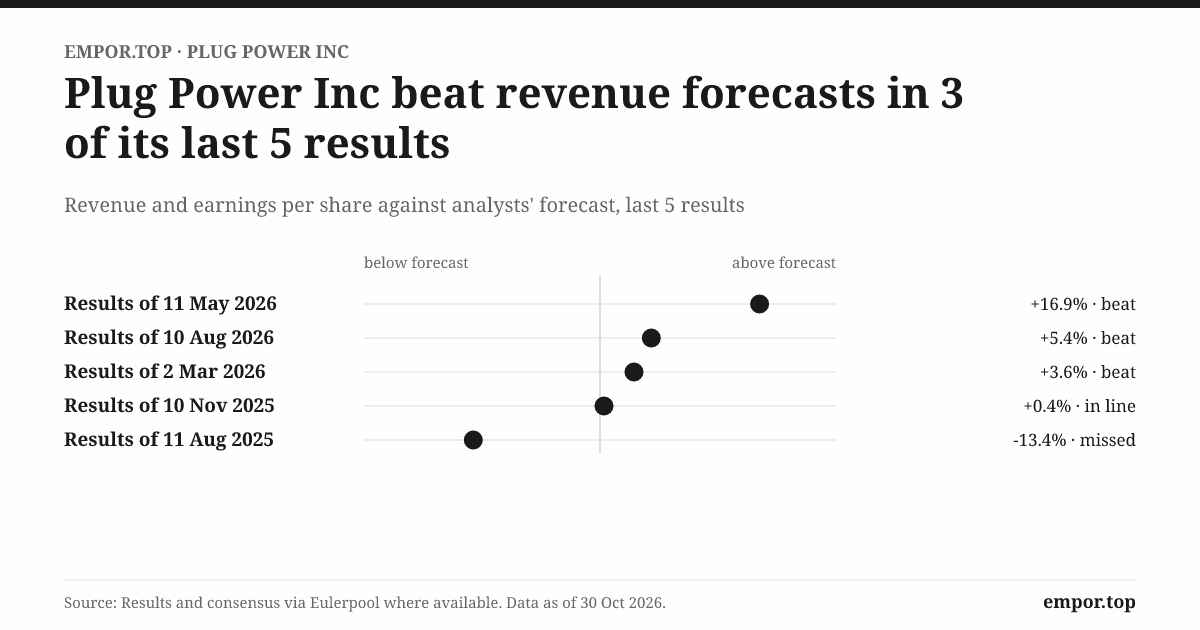
In August 2026, Plug's new chief executive, Jose Luis Crespo, reported the company's second-quarter results with a number Plug investors were not used to seeing. Gross margin, which a year earlier had been about negative 31%, was close to break-even.3 Revenue was about $178 million, slightly ahead of the prior year.3 And Crespo repeated a target that would have sounded fanciful eighteen months earlier: positive EBITDAS, earnings before interest, taxes, depreciation, amortization and stock compensation, in the fourth quarter of 2026.8
The program behind the improvement is called Project Quantum Leap. Plug launched it in 2025 as a restructuring and cost-reduction effort, and it has several moving parts.15 The company cut headcount and operating expenses, consolidated facilities, ran its plants at higher utilization, and raised service prices. On the call, Crespo attributed service gross margin of about 27% to three things: more reliable fuel-cell units in the field, fewer technician hours per unit, and pricing that better reflected the true cost of service.8 That explanation matters because service was for years one of Plug's most embarrassing lines, with the company sometimes spending more to maintain its fleets than customers paid for the maintenance. If units break less often and contracts finally price in the work, the warehouse annuity begins to look like what it was always promised to be.
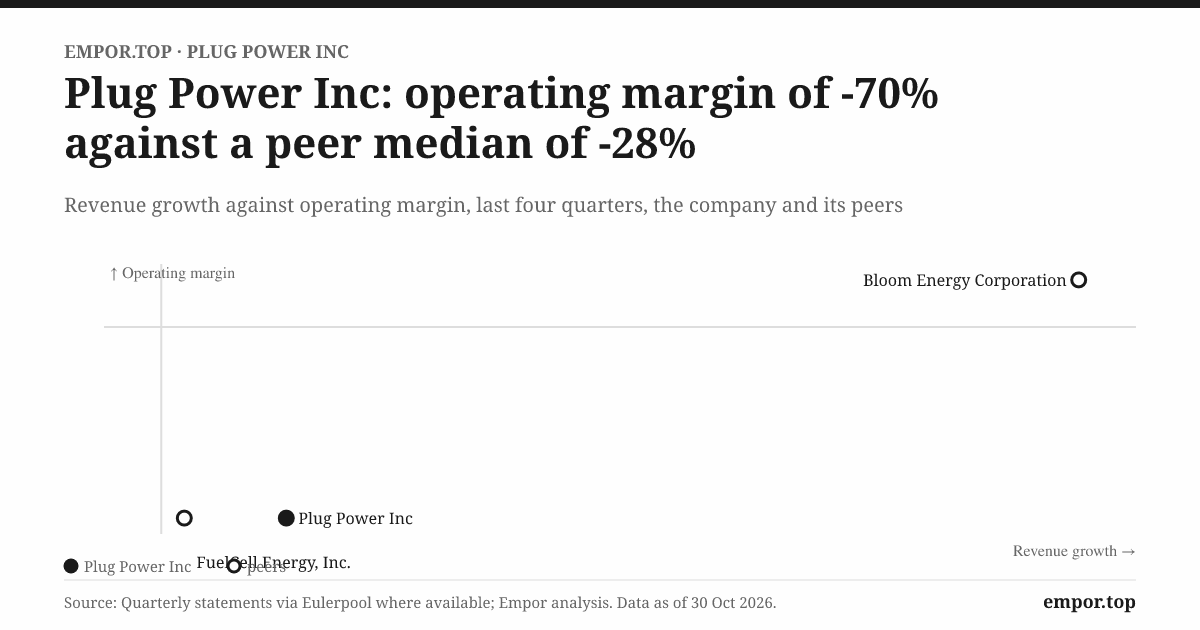
The improvement looks less dramatic when placed in the longer record. Plug's 2025 revenue of about $709 million was barely above the roughly $701 million it reported in 2022, after peaking near $891 million in 2023 and falling in 2024.1 Three years of revenue growth, in other words, averaged close to zero. Plug has never reported a quarter of positive operating profit, and its operating margin in the second quarter of 2026 was still about negative 36%, meaning that for every $100 of sales the company spent about $136 running the business.3 That is a vast improvement on 2025, when the full-year operating margin was about negative 96%, but it is not a profitable business.1
The quarter also contained a one-off. Plug settled a contract dispute with a customer for $50 million in cash, released about $13 million of contract assets and booked a gain of about $37 million.14 The gain reduced reported operating expenses. On the call, the chief financial officer, Paul Middleton, said that after backing out the recovery the normal quarterly operating-expense run rate was about $75 million.8 That is useful candor and also a reminder that the headline improvement had help. Strip out the gain and the operating loss for the quarter would have been closer to $100 million than $64 million.3 The direction of travel is still good; the size of the leap is smaller than the headline.
Cash tells a similar story. In the first half of 2026, Plug used about $244 million in operations, compared with about $297 million in the first half of 2025.14 Part of that improvement came from the $50 million settlement, which is a discrete receipt rather than recurring operating conversion. The October 15 update, which put third-quarter net cash use at about $28 million, is far more striking.4 But net cash use is not the same as operating cash flow. It nets operating outflows against any asset sales, releases of restricted cash and other inflows, and Plug has said it is actively monetizing assets. The update did say no equity or debt was raised in the quarter.4 Until the 10-Q separates the pieces, the $28 million figure is a promising signal rather than a demonstrated run rate.
Working capital has been doing some of the lifting as well, and that source runs out. In 2023, when Plug was building plants and stocking up for growth that did not come, inventory absorbed about $409 million of cash. In 2025 the same line released about $52 million as the company sold down what it had.1 Turning surplus stock into cash is a healthy thing to do, but it is a one-way move: once the warehouse shelves reach their right size, the tailwind disappears and operating cash flow has to stand on margins alone. The auditor's focus on inventory reserves points to the other risk, that some of the stock built in the boom years may be worth less than it cost, which would show up as further charges rather than as cash.1
Liquidity has to be read with the same care. At the end of June, Plug held about $162 million of unrestricted cash and about $155 million of restricted cash.14 The October update's figure of about $134 million excluded restricted balances.4 Management said in the second-quarter filing that its cash, working capital and expected releases of restricted cash supported at least twelve months of operations.14 That assessment depends on the cash-burn trajectory continuing to improve, and on restricted cash being released as planned. With $58 million of finance obligations due within the year, there is not much slack if either assumption slips.14
The earnings calls offer a record of promises that can be checked. In the first quarter, management guided to revenue growth of about 13% to 15% for 2026.16 In the second quarter it raised that range to 15% to 16%.8 Raising guidance after a quarter of only about 3% year-on-year growth implies a heavy second half, which in turn depends on electrolyzer deliveries and the forklift refresh cycle landing on time. The analyst questions on the second-quarter call were telling. They pressed on what exactly drove the margin improvement, when electrolyzer customers would reach final investment decisions, how much cash the company would generate from selling assets, and why guidance was framed the way it was.8 Management's answers were more concrete than in past years on service economics and cost, and more general on project timing. That pattern, crisp on what Plug controls and vague on what customers control, is worth remembering on results day.
It also fits a longer habit. Plug has set ambitious public targets for most of the past decade, from revenue goals at investor days to the gigawatts and tons of the 2021 letter, and the company has more often missed them than met them. The current team's targets are notably smaller: a growth range of a few percentage points, a single quarter of positive EBITDAS. Smaller promises are easier to keep, and keeping them is how credibility is rebuilt. But the fourth-quarter EBITDAS target is also the first test the new chief executive has set for himself in public, and a miss would land on a market that has heard confident forecasts from this company before.
How should an investor judge whether Quantum Leap is working? Three measures matter more than the rest, and none of them is revenue. The first is gross margin excluding one-offs such as dispute recoveries and inventory reserve releases; the latest reading is close to break-even, up from deeply negative a year earlier. The second is operating cash flow, not net cash use; it was negative $244 million in the first half of 2026, improving from negative $297 million a year earlier. The third is cash collected against delivered revenue and project milestones, which shows up in receivables, contract assets and debtor days; debtor days improved to about 124 in 2025 from a peak of about 152, but remain high. If all three keep moving the right way through year-end, the turnaround will have become measurable in cash. If only the first moves, it will have been a story about accounting.
Turnarounds are judged by the people who lead them, and Plug's has a new leader inheriting an old problem.
VII. A New CEO, an Old Capital-Allocation Test
On March 2, 2026, Jose Luis Crespo became Plug's chief executive.17 He replaced Andrew Marsh, who had run the company since 2008 and who moved into the role of non-executive chairman.17 Marsh's tenure spanned nearly the whole arc of this story. He took over a struggling developer of stationary fuel cells, pivoted it to forklifts, signed Walmart and Amazon, rode the hydrogen bubble, and launched the integration strategy. He was the face of the hydrogen economy pitch, a relentless optimist who set big targets on investor days and stood by them. Under his leadership Plug went from a tiny company to a well-known one. It never went from losing money to making it.
Crespo is a different kind of character in the story. He served as Plug's president before the succession, which means he arrived in the top job knowing the customers, the contracts and the products from the inside rather than as an outside fixer.17 Paul Middleton stayed on as chief financial officer, so the people who will report the turnaround are largely the people who reported the years before it.17 Continuity has advantages in a business this operationally complicated. It also means that the new regime cannot fully disown the old one's promises. His public style, at least on the calls so far, has been less visionary and more operational: service margins, technician hours, cost run rates and cash. That is the right register for this moment. It is also too early to call a record. Two quarterly calls are not a tenure. The next few quarters will show whether he keeps guidance conservative, explains misses specifically, and protects product reliability while the cost base shrinks. Cost-cutting in a service business has a way of looking brilliant until the fleet starts breaking down.
Compensation is a useful lens because it shows what the board rewards. Marsh's total pay for 2025 was about $4.40 million, including a cash bonus of about $930,000 against an $830,000 target and options on 2.25 million shares.17 Crespo, then president, received a $784,000 bonus against a $470,000 target.17 Paying above-target bonuses in a year when the company lost about $1.6 billion requires an argument, and the board's argument was that cost and cash milestones had been met.17 Shareholders accepted it, narrowly by Plug's standards: the say-on-pay proposal passed with about 67.6% support at the June 2026 meeting, down from about 80% a year earlier, after the proxy adviser ISS recommended voting against.1718 That is not a revolt. It is a sizable minority signaling that pay and performance have drifted apart.
The board's structure is conventional on paper. Eight of the nine directors are classified as independent, and because Marsh as chairman is not, the board maintains a lead independent director.17 That arrangement is common when a long-serving chief executive moves upstairs, and it can work. It also leaves the architect of the integration strategy chairing the board that now has to judge how much of that strategy to dismantle. Investors who want to know whether the board is willing to cut deeper than management would like should watch which assets are sold, at what prices, and whether the explanations mention the original investment cases or quietly skip them.
The trust question, though, is less about pay than about capital. Look at how Plug funded itself in the last two years. In 2024 it sold about 220 million shares through an at-the-market program, raising about $667 million.1 In March 2025 it raised about $280 million in a registered direct offering of shares and warrants.1 Later that year it persuaded holders of about 185 million warrants to exercise them at $2.00 a share by giving them new warrants exercisable at $7.75, a so-called inducement that brings in cash today in exchange for more potential dilution tomorrow.1 It sold another 35 million or so shares through its ATM in 2025, and in November it issued about $431 million of 6.75% convertible notes due 2033.1 In February 2026, shareholders approved doubling the authorized share count from 1.5 billion to 3 billion.19 In June they approved 25 million more shares for the equity incentive plan.18
Every one of those decisions can be defended individually. A company burning cash needs to raise it, and selling shares is better than defaulting. But taken together they describe a company whose share count has ballooned, whose shareholders have been asked repeatedly to fund a future that keeps receding, and whose board has made sure it has room to ask again. The doubled authorization does not mean a raise is coming. It means one can happen quickly if needed.
The ownership structure leaves no one in a position to say no. BlackRock was the largest disclosed holder, with about 10.5% of the shares as of April 2026, a large index-heavy position rather than a controlling stake.17 No controlling shareholder is identified. Plug estimated that it had more than 543,000 beneficial stockholders, most holding through brokers.1 That is a famously retail-heavy base, the kind that buys narratives and sells on disappointment, and it gives management more freedom on capital raising than a concentrated institutional register would.
Now apply the skeptical investor's stress test to the capital-allocation record. Plug raised billions in 2020 and 2021 and spent them on acquisitions and plants that were later impaired by well over a billion dollars. It secured a $1.66 billion federal guarantee and then suspended the plants it was meant to fund. It is now pursuing asset monetization, selling or financing assets to raise cash, which helps liquidity but may also sell the very infrastructure the integration strategy was supposed to rest on. The filings do not provide deal-level returns that would isolate the performance of each acquisition, so a perfectly fair accounting of which bets failed is impossible. The aggregate is not ambiguous. This has not been a disciplined allocator of capital, and the new team has to earn a different reputation through action rather than inherit one.
That leads to the question any skeptical holder should put to Crespo directly. If the cost base is lower and margins are improving, why should another financing be necessary? The answer has to come in three currencies: cash on the balance sheet at year-end, the share count a year from now, and projects delivered and paid for. Until those line up, the market will assume that the next capital raise is a matter of when, not whether, and it will price the stock accordingly.
That is exactly where the stock trades tonight.
VIII. Analysis & Bear vs. Bull Case
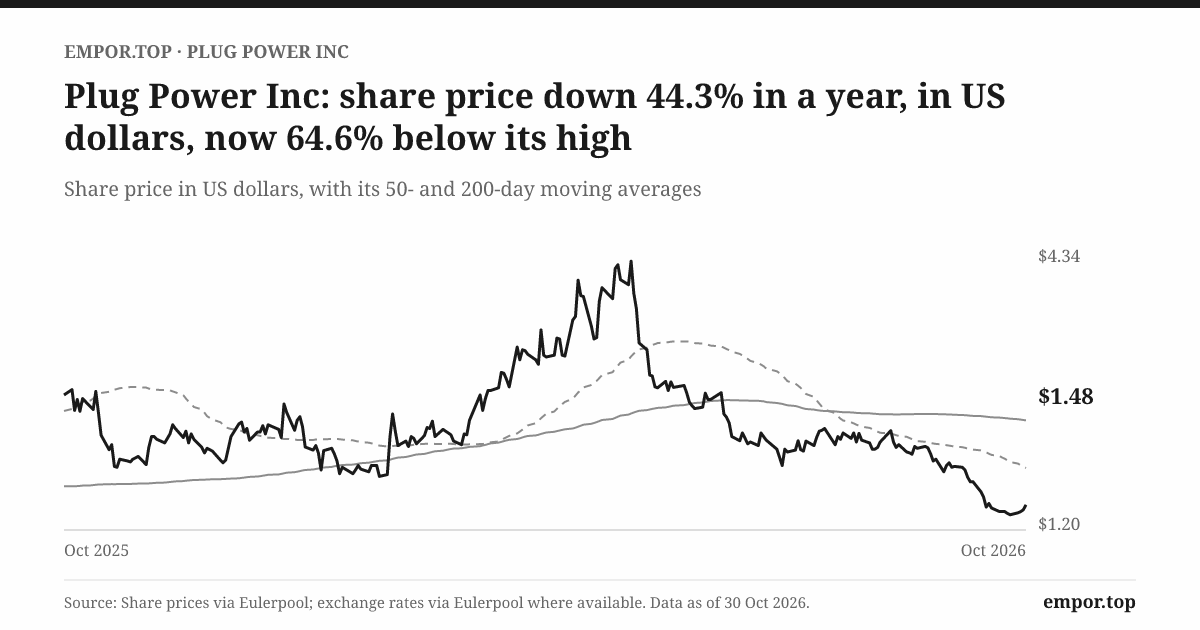
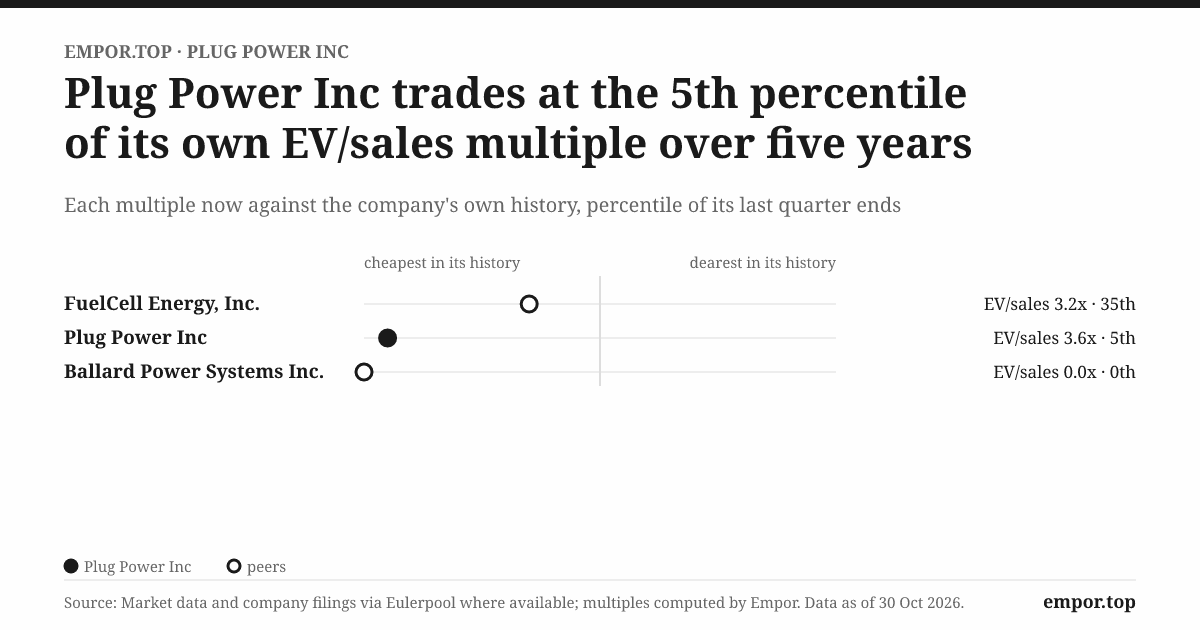
On October 30, 2026, Plug closed at $1.48 a share, about 65% below its 52-week high of $4.17.20 At that price the company's market value is about $2.1 billion and its enterprise value, adding debt and subtracting cash, about $2.7 billion.20 That is roughly 3.6 times the last year's sales on an enterprise basis, for a company that has no operating profit and a free-cash-flow yield of about negative 26%, which means that at the 2025 rate of burn the company consumes about a quarter of its market value in cash every year.20 The stock has fallen about 97% from its peak in the past five years and moves with annual volatility near 80%.20 Investors are not pricing a hydrogen utility. They are pricing an option on a turnaround.
A sales multiple is the only standard yardstick that works here, because a price-to-earnings ratio is meaningless while losses persist and there is no five-year median to compare against. Even the sales comparison with peers needs care. Bloom Energy has a far larger and faster-growing business tied to data-center power demand, and its multiples reflect that mix and its path to profitability. Ballard is smaller and more focused. None of these makes a clean benchmark. The most honest reading is that Plug's valuation assumes the improvement of 2026 continues long enough for the company to fund itself, and that the market is applying a large discount for the probability that it does not.
The balance sheet explains why the market is not paying for the assets either. After two years of impairments, shareholders' equity had fallen to under $1 billion at the end of 2025, from about $4.6 billion at the end of 2021, and book value now works out to about 42 cents a share.120 The stock trades at about 3.4 times that book value.20 Debt now roughly equals equity, a ratio that was below 0.2 in the flush year of 2021.1 And current liabilities exceed current assets once cash is set aside, which is another way of saying the working capital is not a cushion.20 A buyer at today's price is not getting a hydrogen network at a discount to replacement cost. The accountants have already written that discount into the books, and the market is still paying a premium to what remains, on the bet that the remaining business earns its keep.
Industry structure explains why that discount is large. Start with buyers, the strongest force in Plug's world. The two largest customers provide about 41% of revenue, the largest receivable is a third of the total, and the biggest warehouse operators have shown they can extract equity warrants as a condition of their business. That is buyer power in its most explicit form. Substitutes are the second force, and they are improving: lithium-ion forklift batteries charge quickly, need less maintenance than lead-acid ones and require no hydrogen supply chain at all. Suppliers are the third. Hydrogen economics depend on electricity prices, and when Plug buys hydrogen it buys from the industrial-gas majors, which are also its competitors in supply. New entrants face real barriers in project approvals and capital intensity, which protects incumbents but also slows Plug's own expansion. Rivalry among electrolyzer makers is intense, with orders lumpy and prices falling. On balance, it is a tough neighborhood: powerful customers, improving substitutes, well-capitalized suppliers and competitors, and capital-hungry projects.
The moat case, argued once in full, rests on switching costs and the installed base. A customer with hydrogen storage, dispensers and a trained workforce has sunk costs and operating habits that favor staying with Plug when fleets refresh. Service relationships give Plug data on how units perform and a recurring presence on site. Those are genuine mechanisms. Their strength, however, cannot be measured from outside, because Plug does not disclose retention rates, renewal pricing or the share of revenue that recurs. And the strongest evidence about switching costs cuts the other way: when the biggest customers came to the table, Plug paid them in equity to stay, which is not what a supplier with a lock on its customers does.
Hamilton Helmer's seven powers framework sharpens the point. Of the seven sources of durable advantage, two could plausibly emerge here. Process power, the hard-to-copy operating know-how of running a reliable hydrogen network and a large fuel-cell fleet, is real in principle; Plug has built and operated liquid hydrogen plants and maintains tens of thousands of units. Scale economies could follow if plants ran full and the service fleet grew. Neither is proven while plants are underutilized and cash burn persists. Switching costs exist but are unquantified and partly bought. Plug has no network effects, no cornered resource, no counter-positioning against incumbents who could not copy it, and no brand that commands a premium. The framework's verdict is that Plug has the ingredients of an advantage in one niche, not an advantage.
The bull case still has substance. Unit reliability is improving, and service margins of about 27% suggest the fleet business can be profitable when priced honestly. The installed base creates replacement demand that does not require winning new customers. Electrolyzer orders, if they convert, add equipment revenue without Plug owning the plants. Operating costs are down, capital spending has fallen to a fraction of its peak, and cash use is shrinking quickly. If Plug reaches positive EBITDAS in the fourth quarter and holds it, the company would be on a path to needing much less outside money, and today's price would look like the trough of a long overcorrection.
The bear case has the longer record behind it. Demand remains concentrated and timed by projects; orders could fail to convert, as some have before; and a quarter of near-zero gross margin owed something to a legal recovery. Plant utilization and supply costs have not been shown to improve sustainably. Every past period of improvement has been followed by another capital raise, and the authorized share count has just doubled. In the bear's view, the 2026 improvement is what happens when a company stops spending, and the harder question is whether it can grow while staying lean, something Plug has never demonstrated.
Weighed against each other, the history neither rejects the bull case nor confirms it. It narrows it. The defensible claim is not that Plug is building the hydrogen economy; it is that Plug may be able to run a profitable fuel-cell fleet and service business, with equipment sales on top, if the cost cuts hold and customers keep refreshing. That smaller claim is plausible and unproven. The events that would confirm it are specific: audited operating cash flow for 2026 that keeps shrinking toward zero, gross margin that stays positive without dispute recoveries, a falling share for the two largest customers as others grow, and cash actually collected from the $724 million order book. Each of those can be checked, starting in ten days.
What, then, does a quarter century of this story teach?
IX. Lessons from the Hydrogen Bet
Picture two scenes at the same moment. In a warehouse, a forklift pulls up to a dispenser, refuels and goes back to work, as it has every shift for a decade. Hundreds of miles away, the planned plant network that was supposed to fuel a much larger hydrogen future is being scaled back, its federal guarantee gone, its acquired builders written down. Both scenes belong to Plug Power. The distance between them is the lesson.
The first lesson comes from the Walmart deployments. Plug found a customer with a real problem and a product that solved it, which is rarer than it sounds in clean technology. But it won that customer partly by handing over equity, and then let the customer grow into a quarter of its revenue. A supplier whose biggest buyer is also a shareholder and its largest source of demand is not negotiating; it is asking. Founders chasing an anchor customer should remember that the anchor holds you in place. At Plug, the warrant was the price of admission, and the price kept rising.
The second lesson comes from the acquisition wave of 2020 to 2022. Buying United Hydrogen, Giner, Frames, Applied Cryo and Joule gave Plug in two years capabilities that would have taken a decade to build. It could not buy the customers who would make those capabilities pay. Integration removes bottlenecks only if every link in the chain earns its own way; otherwise it simply collects the losses in one place. Plug proved it could own the whole hydrogen value chain. It did not prove the chain was worth owning.
The third lesson comes from Washington. The $1.66 billion guarantee closed in a burst of celebration and ended without a dollar drawn. A financing commitment is not a project, and a project is not an operating asset. Each step down that ladder requires money, customers and time that no announcement supplies, and investors who priced the guarantee as if it were a plant learned the difference the hard way.
The fourth lesson comes from the year Plug's revenue went negative. A company that pays its customers in stock turns its own share price into a line on its income statement, so the better the stock does, the worse the sales look, and the harder it becomes for anyone to see what the business actually earns. Investors forgave the confusion while the stock was soaring and punished it when it fell. When a company's revenue depends on its share price, the investor is no longer reading a business; they are reading a mirror.
The fifth lesson belongs to the present quarter and the people now running the company. Crespo's team has done the unglamorous work: fewer technician hours, honest service pricing, a cost base cut down to size. The numbers look better than at any time in years. But Plug has posted encouraging quarters before, and they did not stop the next raise. A better margin is a milestone; cash is the proof.
X. Epilogue
Tonight, Plug Power stands between a preliminary number and an audited one. On October 15 the company told investors that third-quarter net cash use had fallen to about $28 million, that it had about $134 million of unrestricted cash, and that it had raised no new equity or debt in the quarter.4 Management has also kept in place its target of positive EBITDAS in the fourth quarter.8 On November 9, the full results will show how those numbers were built.
The first thing to look for is the split. If operating cash flow itself fell sharply, the cost and margin story has started to show up in cash, and that would be the strongest evidence of the turnaround so far. If instead most of the improvement came from asset sales, released restricted cash or one-time collections, the quarter will have bought time rather than proved a model. Either outcome is possible, and the difference between them is the difference between a company healing and a company selling the furniture.
The second thing is whether the margins hold. A service margin near 27% that survives another quarter, without a dispute recovery to flatter it, would suggest the warehouse business is finally priced to make money. Electrolyzer awards moving to final investment decisions and deliveries would show that the equipment business can grow without Plug financing the plants. On the second-quarter call, analysts pushed hardest on exactly these points, project timing, margin drivers and liquidity, and the answers on November 9 can be compared directly with what was promised in August.
The third thing is proportion. Data-center power will feature in any optimistic telling, and asset monetization may help near-term liquidity. But the three-megawatt Microsoft test remains a pilot, not a revenue stream, and Plug's history of turning pilots into durable business is thin.
None of this will settle the long-term question in one quarter. What would settle it is repetition: positive gross margin quarter after quarter, operating cash use falling toward zero, and project revenue converting into collected cash, all without another large issue of shares. That is a high bar for a company that has never cleared it, and it is the bar Plug has set for itself.
XI. Outro
Go back to the warehouse. The forklift is still refueling in a few minutes, still running through the night, still doing exactly what Plug promised a decade ago. Inside that building, hydrogen works. Outside it, the company is still trying to make the plants, the trailers, the electrolyzers, the leases and the balance sheet add up to something that pays for itself.
Plug Power has proved that hydrogen can move a forklift. It has not yet proved that the forklift can carry the hydrogen economy.
References
-
Plug Power Inc. 2025 Form 10-K — SEC, 2026-03-02 ↩↩↩↩↩↩↩↩↩↩↩↩↩↩↩↩↩↩↩↩↩↩↩↩↩↩↩↩↩↩↩↩↩↩↩↩↩↩↩↩↩↩↩↩↩↩↩↩
-
Plug Power Q2 2026 Results, Exhibit 99.1 — SEC, 2026-08-10 ↩↩↩↩↩
-
Q3 2026 Preliminary Business Update, Exhibit 99.1 — SEC, 2026-10-15 ↩↩↩↩↩
-
Plug Power Receives Milestone Order From Walmart for Multi-Site Hydrogen Fuel Cell Deployment — Plug Power, 2014-02-26 ↩
-
Plug Power Q2 2026 Earnings Call Transcript — Stock Analysis / Quartr, 2026-08-10 ↩↩↩↩↩↩↩↩
-
Plug Power Fourth Quarter 2021 Investor Letter — Plug Power, 2022 ↩↩↩
-
Plug Power Starts Production of Liquid Green Hydrogen at its Georgia Plant — Plug Power, 2024-01-23 ↩↩
-
Ballard Reports Q4 2025 and Full Year Results — Ballard Power Systems, 2026-03-12 ↩
-
Plug Power Inc. Q2 2026 Form 10-Q — SEC, 2026-08-10 ↩↩↩↩↩↩↩↩↩↩↩↩↩↩
-
Plug Power 2025 Business Update and Financial Results — Plug Power, 2025-03-03 ↩
-
Key Takeaways from Plug Power's First Quarter 2026 Earnings Call — Plug Power, 2026 ↩
-
Plug Power Inc. 2026 Definitive Proxy Statement — SEC, 2026-04-30 ↩↩↩↩↩↩↩↩↩↩
-
2026 Annual Meeting Voting Results, Form 8-K — SEC, 2026-06-15 ↩↩
-
Authorized Shares Amendment and Special Meeting Results, Form 8-K — SEC, 2026-02-13 ↩
 LinkedIn
 WhatsApp
 Reddit
 Hacker News
 Email
 Kindle
 RSS Feed
 Spotify
 Apple Podcasts
 Amazon Music
 Audible
 YouTube