Park Hotels & Resorts: Betting the House on Hawaii
I. Introduction & Episode Roadmap
On the morning of June 5, 2023, a real estate investment trust headquartered in the Virginia suburbs of Washington did something that publicly traded landlords almost never do in plain sight. It announced that it had stopped paying the mortgage on the largest hotel in San Francisco. Park Hotels & Resorts told the market it would no longer service a $725 million loan secured by the 1,921-room Hilton San Francisco Union Square and the 1,024-room Parc 55 next door, and that it intended to hand the keys to the lender.1 There was no restructuring, no heroic turnaround plan, and no pretending. Chief executive Thomas J. Baltimore Jr. put it bluntly: "The continued burden on our operating results and balance sheet is too significant to warrant continuing to subsidize and own these assets."1
For a company whose entire reason for existing is to own hotels, walking away from nearly 3,000 rooms in one of America's great convention cities was a strange kind of confession. It was also, depending on how one reads it, either the smartest thing management has ever done or proof that it was slow to see what the debt markets had already seen. This story will argue that it was a little of both.
Park Hotels & Resorts (NYSE: PK) is a pure-play hotel landlord. It was carved out of Hilton Worldwide Holdings in January 2017 as a real estate investment trust, or REIT, and it owns a concentrated portfolio of large, upper-upscale and luxury hotels.2 What it does not do is run them. Hilton, and a handful of other managers, operate the front desks, own the brands, run the loyalty programs, and hold the relationship with the guest. Park owns the buildings, pays for the renovations, carries the debt, and collects what is left over.
That structure frames the central tension of this story. Park owns some genuinely irreplaceable real estate, above all Hilton Hawaiian Village on Waikiki Beach, a property that on its own is close to the single biggest profit pool in the company. But it does not control the brand that fills those rooms, it does not own the customer, and, as San Francisco demonstrated, its own forecasts about which cities deserve capital have not always been right.
The roadmap runs like this. First, the origin: why Hilton split itself into three companies and what that left Park with. Then the economics of owning big, full-service hotels, which are among the most capital-hungry assets in real estate. Then Hawaii, where the concentration bet lives. Then two capital-allocation case studies that define management's record: the 2019 acquisition of Chesapeake Lodging Trust, and the San Francisco walk-away. Finally, the current "shrink to grow" strategy, a balance sheet that remains the most important live risk, and the handful of numbers that will tell investors whether the story is working.
The punchline, for those who like to know where a story is going: Park is a bet that a few trophy properties, one very large beachfront resort above all, are worth more than the market thinks, once the balance sheet catches up. Whether that bet pays depends less on the quality of the real estate, which is not really in doubt, than on the discipline of the people allocating the capital. And to understand those people, the story has to go back to the moment Hilton decided it no longer wanted to own hotels at all.
 Subscribe on LinkedIn
II. Origins: Splitting Hilton Into Three Companies
The last holdout
Picture the hotel industry of the early 2010s as a slow-motion divorce. For decades, the biggest names in lodging had both owned their hotels and run them. Then, one by one, they figured out that Wall Street valued those two activities very differently. Running hotels under a famous brand and collecting a percentage of revenue as a fee is a capital-light, high-margin, annuity-like business, and investors paid rich multiples for it. Owning the hotels is capital-intensive, cyclical, and heavily indebted, and investors paid real estate multiples for that. Marriott had long since split its property ownership away into what became Host Hotels & Resorts. Starwood, Wyndham, and others had moved in the same asset-light direction. Hilton, under private-equity owner Blackstone and then as a newly relisted public company, was one of the last major chains still carrying an enormous owned portfolio.
In February 2016, Hilton announced it would resolve that by breaking itself into three public companies: Hilton itself, which would become an almost pure franchisor and manager; Hilton Grand Vacations, the timeshare business; and a new lodging REIT that would take the owned and leased hotels.3 That REIT became Park Hotels & Resorts.
Why a REIT
The logic was part strategy, part tax engineering. A REIT that distributes most of its taxable income to shareholders generally avoids federal corporate income tax at the entity level. Real estate held inside a normal corporation gets taxed twice, once at the company and again when dividends reach shareholders. Put the same buildings inside a REIT and the first layer largely disappears.3 For Hilton, the separation meant shedding a balance-sheet-heavy business that dragged on its valuation. For the new REIT, it meant a tax-efficient wrapper around billions of dollars of hotels.
The spin-off was completed on January 4, 2017, when Park began trading on the New York Stock Exchange.2 Pre-spin coverage described a portfolio of roughly 67 to 69 hotels with around 35,000 rooms, heavily weighted toward luxury and upper-upscale properties in major U.S. markets and resort destinations.4 Overnight, Park became one of the largest lodging REITs in the country, second only to Host in scale.
The man in the chair
The person chosen to run it was Thomas J. Baltimore Jr., who remains Park's first and only chief executive nearly a decade later. His background tells you a great deal about how Park thinks. Baltimore co-founded RLJ Development with Robert L. Johnson, the founder of BET, and went on to lead RLJ Lodging Trust as a public hotel REIT; earlier in his career he held development roles at Hilton Hotels Corporation itself.3 In other words, he is a hotel real estate capital allocator by training, not a hotelier. His career has been about buying, financing, renovating, and selling buildings, not about designing a guest experience or building a loyalty program.
That background matters because it shapes the questions Park asks. A brand operator asks, "How do we get more guests to choose us?" A capital allocator asks, "Is this building earning its cost of capital, and if not, who will pay me more for it than it is worth to me?" Much of Park's history since 2017, from the Chesapeake acquisition to the San Francisco exit to today's non-core sales program, is the second question asked over and over.
A landlord in a franchisor's clothing
The early years revealed a recurring frustration that has followed Park ever since. Public hotel REITs frequently trade below the private-market value of their hotels, because public investors apply a discount for leverage, cyclicality, and the cost of capital spending. Park was no exception. That gap shaped nearly every major decision Baltimore made: when the stock trades below the value of the buildings, selling buildings and buying back stock looks attractive; when it trades above, issuing stock to buy another REIT looks attractive. Much of the company's history is an attempt to close that gap from one side or the other.
The structural fine print
There is one more piece of plumbing that matters for everything that follows. Because Park is a REIT, it cannot directly operate hotels and still keep its tax status. So each hotel is leased to a taxable REIT subsidiary, which in turn hires a professional manager, most often Hilton, under a long-term management agreement.5 Park approves annual budgets and major capital projects. Hilton runs day-to-day operations, collects base and incentive management fees, and plugs the hotels into its reservations engine and its Hilton Honors loyalty program.5
Think of it like owning a stadium but leasing the team, the ticketing system, and the season-ticket-holder list from someone else. The stadium is valuable and scarce. But the people who decide whether fans show up, and how they book their seats, work for a different company. That asymmetry, Park owns the building while Hilton owns the customer, is the thread that runs through the moat discussion later.
For investors, the origin story sets up a clean question: when you strip a hotel company down to only its real estate, how good is that real estate, and how well does management deploy capital around it? To answer the first half, it helps to understand what owning a big full-service hotel actually costs.
III. The Business: Full-Service Luxury Lodging Economics
What Park owns today
Walk into the lobby of one of Park's hotels and the first thing to notice is scale. These are not roadside select-service boxes with a breakfast bar. They are sprawling complexes with ballrooms, multiple restaurants, spas, pools, and meeting space designed to host thousands of convention guests at a time. Park's portfolio has always skewed toward big buildings in gateway cities and resort markets, and that skew has only intensified as the company has shrunk.
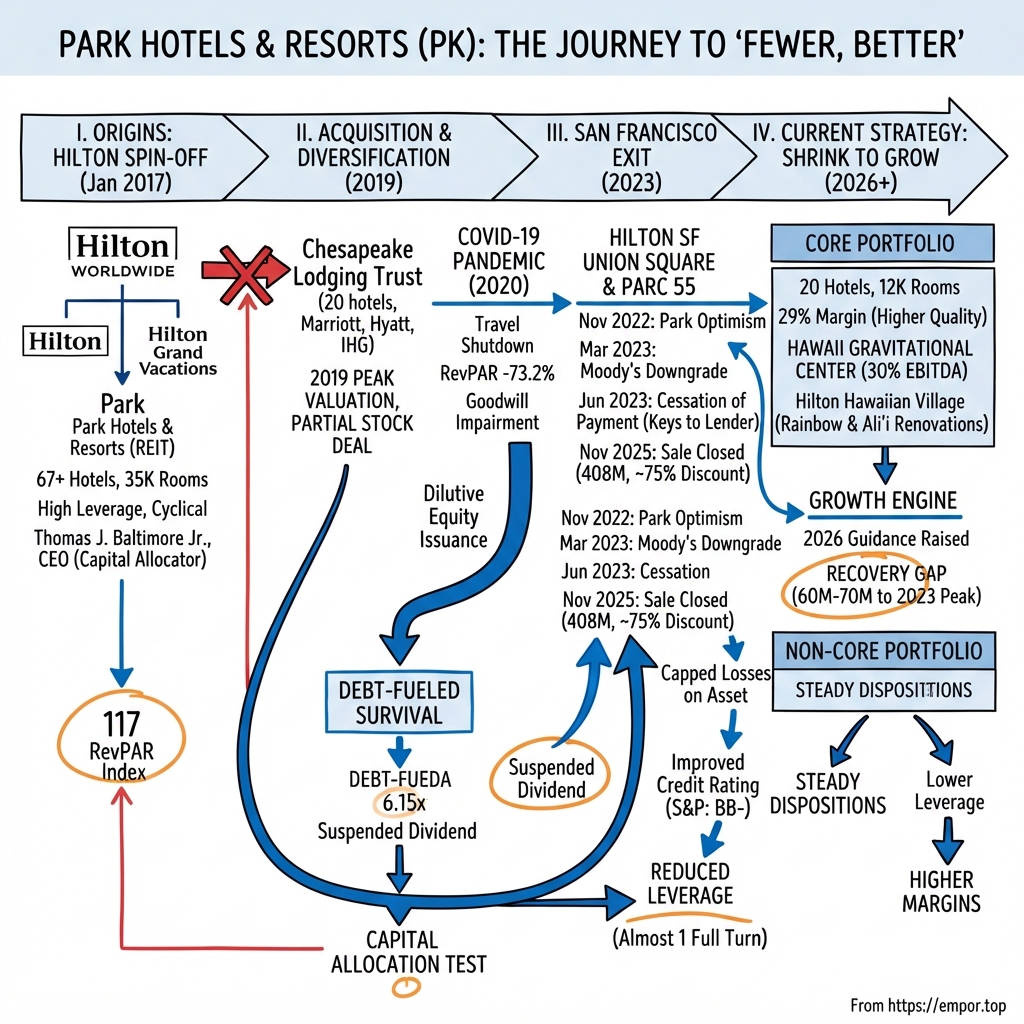
By the end of 2025, Park divided its holdings into two buckets. The "core" portfolio contained 20 hotels with just under 12,000 rooms, generating about $586 million of adjusted EBITDA at a margin of roughly 29%.6 The "non-core" portfolio contained 12 hotels with about 4,200 rooms, generating only $58 million of EBITDA at a margin under 10%.6 That is the whole strategy in two numbers: the core hotels earn roughly three times the margin of the non-core ones, and management wants to own only the core.
The shrinkage has been dramatic. From the roughly 67 hotels at the spin-off, Park is now down to about 32, and it has told investors it intends to sell or exit the rest of the non-core tail, including ten remaining non-core hotels and three properties on ground leases held by Safehold.6 The stated goal is "fewer, better": a portfolio of about 20 large, high-margin properties with better growth prospects.
Where the profits come from
Hawaii is the gravitational center. According to S&P Global Ratings, Hawaii accounted for roughly 30% of Park's hotel-level adjusted EBITDA in 2024, anchored by Hilton Hawaiian Village in Waikiki and supplemented by the Hilton Waikoloa Village on the Big Island.7 Outside Hawaii, the core portfolio leans on a few large complexes: the Bonnet Creek resort cluster in Orlando, Casa Marina in Key West, and big-city hotels in markets such as Washington, Chicago, New York, Boston, and Miami.8
That mix is deliberate. Resort and convention hotels in supply-constrained or high-demand locations tend to command the highest room rates in the industry. But it also means Park's earnings depend heavily on a small number of assets. When one of them is under renovation, the whole company feels it.
Why full-service hotels eat capital
To understand Park's economics, it helps to understand a phrase that haunts every hotel owner: the Property Improvement Plan, or PIP. Every five to seven years, a brand like Hilton requires owners to renovate rooms, refresh lobbies, upgrade technology, and rebuild restaurants to keep the property up to brand standard. The owner pays. The brand does not.
Before going further, one piece of vocabulary. The hotel industry's favorite metric is RevPAR, revenue per available room, which is simply occupancy multiplied by the average daily rate. A hotel that is 80% full at $250 a night has a RevPAR of $200. Park's comparable portfolio ran at 81.4% occupancy and about $190 of RevPAR in 2025.6 The reason investors obsess over RevPAR is operating leverage. A big full-service hotel has a huge fixed-cost base: housekeeping and banquet staff, engineering, property taxes, insurance, and the building itself. When RevPAR rises a few percent, much of the extra revenue drops straight to profit. When it falls a few percent, profit falls much faster. That is why hotel REIT earnings swing so violently through a cycle, and why a portfolio of big, fixed-cost-heavy hotels amplifies both good and bad years.
For a small select-service hotel, a PIP might mean new carpets, beds, and televisions. For a 2,000-room resort, it can mean gutting entire towers. That is why full-service, upper-upscale hotels are the most capital-intensive class of lodging real estate, with capital spending often running in the high single digits as a percentage of revenue. Park's capital budget reflects this. In the fourth quarter of 2025, Park guided 2026 capital spending of $230 million to $260 million, with the largest single projects both in Waikiki: a roughly $94 million renovation of Hilton Hawaiian Village's Rainbow Tower and a second major renovation of its Ali'i Tower, budgeted at roughly $100 million.69
It is worth pausing on one detail. In October 2025, S&P's analysis had assumed 2026 capital spending of $200 million to $225 million, a step down from an elevated 2025.7 The current guide is higher. Capex creep is not unusual in a renovation cycle, but it matters when the same cash could otherwise be paying down debt that the rating agency is watching.
The competitive set
Among lodging REITs, Host Hotels & Resorts is the clear heavyweight, larger than Park by a wide margin and more diversified across brands, with deep exposure to Marriott and growing exposure to Hyatt. Park sits in the second tier by enterprise value, alongside a cluster of smaller full-service peers: Pebblebrook, DiamondRock, Xenia, and Sunstone. None of them carries anything like Park's Hawaii concentration. Ryman Hospitality is a different animal, owning a handful of giant Gaylord convention resorts managed by Marriott. RLJ Lodging Trust, Baltimore's old company, chose the opposite model entirely: lots of smaller, cheaper-to-maintain select-service and compact full-service hotels.
The RLJ contrast is instructive. RLJ bet that a larger number of cheaper hotels, with lighter capital needs and lower operating leverage, would compound more steadily. Park bet that a smaller number of trophy assets, with heavier capital needs but greater pricing power, would earn more over a cycle. Neither is obviously right. The Park model tends to win when high-end demand is strong and capital is cheap, and to suffer when renovations drag and refinancing gets expensive.
Where Park genuinely wins
The strongest case for Park's advantage lives in Waikiki. In Hamilton Helmer's "7 Powers" framework, a Cornered Resource is an asset that a competitor simply cannot acquire on equivalent terms. Beachfront land in Waikiki comes close. The district is a small, densely built strip of Honolulu governed by special zoning and design controls, and there is very little room for anyone to build another resort of Hilton Hawaiian Village's scale directly on the sand. New projects on Oahu do exist, but they are modest relative to a resort of this size. That scarcity is real, not narrative, and it supports pricing power that shows up in Park's Hawaii numbers (discussed in the next section).
Where the moat is thinner than it looks
The weakness sits right next to the strength. Park's advantage is location scarcity. It is not customer lock-in, because Park does not own the customer. Hilton's brand drives the demand, Hilton Honors captures the loyalty, and Hilton's booking platform controls the channel. If Hilton pushed harder on fees, or required an expensive PIP at an inconvenient time, Park's negotiating leverage would be limited. Park needs Hilton's distribution more than Hilton needs any one owner's hotels, and the broader industry has seen recurring friction between owners and brand managers over fees and renovation mandates.
There is also a quieter economic leak. Hilton's management agreements pay it a base fee tied to revenue plus an incentive fee tied to hotel profitability.5 That means when Park spends $100 million renovating a tower and the hotel's profits rise, Hilton shares in the upside through higher fees without having funded the renovation. Owners accept this because the brand's distribution is what makes the renovation pay off in the first place. But it is a reminder that Park's return on a renovation dollar is always a little lower than the headline improvement in hotel EBITDA suggests.
A quick Porter's Five Forces read confirms the split personality. The threat of new entrants is low in Waikiki but moderate to high in most big cities, where upper-upscale supply can and does get built. Supplier power is high, because the manager-brand is the key supplier. Buyer power is moderate: corporate travel managers and meeting planners can shift business between cities. Rivalry is intense and cyclical, tracking GDP and business travel.
The industry tailwind being underwritten
The macro backdrop has swung in Park's favor this year. 2025 was a soft year for U.S. hotels: Park's own comparable RevPAR, revenue per available room, fell 2.0% and occupancy slipped 1.7 points.10 But CBRE's mid-2026 forecast raised its national RevPAR outlook to 2.5% growth for 2026 and projected luxury RevPAR growth of 5.2%, roughly double the national pace, with business transient and convention-linked group demand expected to contribute more than half of the growth.11 CBRE also noted that hotel construction has declined for 15 consecutive months, which supports pricing.11
That is exactly the backdrop Park's asset mix needs. But it is also cyclical, and investors should be clear that Park's recent momentum is partly the industry's momentum. The part that is Park's own lives in Hawaii, which deserves its own section.
IV. Hawaii: The Concentration Bet
Sixty-five years on the sand
Stand at the edge of the lagoon at Hilton Hawaiian Village at sunset and look up at the Rainbow Tower, the one with the giant mosaic of a rainbow running up its side. It is one of the most photographed hotel façades in the world, and it sits on some of the most valuable resort land in the United States. The resort has flown the Hilton flag since 1961, which is why Hilton and Park marketed the recently completed Rainbow Tower renovation under the banner "65 Years of Aloha."6
For Park, the Village is not a nice-to-have trophy. It is close to being the company. When Park talks about "core" portfolio growth, Hawaii is the largest part of that story, and Hilton Hawaiian Village is the largest part of Hawaii.
The renovation cycle
The investment thesis here is straightforward: spend heavily to modernize tired towers, reposition them at higher rates, and watch the resort's earnings climb. The Rainbow Tower renovation, a roughly $94 million project, was completed in phases through March 2026.6 The next phase, the Ali'i Tower, is a boutique-within-a-resort product with 348 rooms, and on the Q2 2026 call management described a roughly $100 million renovation commencing imminently, with completion expected in early 2027.9
Renovations are a double-edged sword. They lift future rates, but while they are underway, rooms go offline and guests encounter construction. Management has repeatedly cited renovation disruption as a drag on results, and S&P explicitly listed renovation displacement among the reasons it expected Park's margins to compress in 2025.7 Investors therefore need to judge the program not on how the brochures look, but on whether the post-renovation rates and occupancy justify the spend.
The bull case, in numbers
The early evidence is encouraging. In the fourth quarter of 2025, Hilton Hawaiian Village grew RevPAR by 22%, with group revenue up nearly 78%, despite ongoing renovations and a federal government shutdown.10 In the second quarter of 2026, Park's Hawaii portfolio grew RevPAR by about 9% year over year, and Hilton Hawaiian Village itself posted RevPAR growth of nearly 12% and EBITDA growth of more than 13%.9 Its RevPAR index, a measure of how much revenue per room it captures relative to its competitive set, gained four points to 117 by June.9 A reading of 117 means the resort captures about 17% more revenue per available room than its peer set, and the improvement suggests it is taking share, not just riding the tide.
That is what pricing power looks like in practice: a scarce, freshly renovated asset in a supply-constrained market growing faster than its competitors.
The honest caveat from management itself
The juxtaposition rule matters here, because management's own words bound the bull case. On the Q2 2026 call, management identified roughly $60 million to $70 million of EBITDA that the Hawaii portfolio still needs to recover to return to its 2023 peak.9 Management framed that gap as upside. It is also an admission that, three years later, Hawaii has not yet recovered to where it was.
This distinction matters. When investors see double-digit growth, the temptation is to extrapolate it. But the right framing is that Park is asking shareholders to underwrite the closing of a known gap, not a new growth trajectory. If Hawaii simply returns to 2023 levels, that is a recovery, not a structural step-up.
There is a second named headwind. The Hawaii Convention Center in Honolulu has faced a partial closure that management expects to persist through 2027, removing a source of city-wide convention demand.9 Park has offset this with leisure travelers and in-house groups that book directly into the resort's own meeting space. That substitution has worked so far, but it means the resort is leaning harder on discretionary leisure, the most economically sensitive demand segment.
Why the credit analysts worry
S&P has been explicit that the Hawaii concentration is a credit risk, not just an equity-story positive: roughly 30% of hotel EBITDA in one destination exposes the company to volatility in discretionary travel.7 Hawaii's visitor economy depends on a small number of variables Park does not control: airline seat capacity from the U.S. mainland and Japan, the strength of the Japanese yen, consumer spending on long-haul vacations, and exposure to natural disasters, including wildfire and hurricane risk. A shock to any one of those would hit Park harder than it would a more diversified peer such as Host.
There is a subtler version of the concentration risk, too. Because Park is shrinking the rest of the portfolio, Hawaii's share of the company's profits is likely to rise, not fall, as non-core hotels are sold. Every successful disposition makes the remaining company higher quality, and also more dependent on a single island economy. Investors who like the "fewer, better" strategy are, whether they intend to or not, increasing their bet on Waikiki. That is not necessarily wrong, since the asset is excellent, but it should be a conscious choice rather than a side effect.
Consider how the risk would actually play out. A mainland recession that squeezed household budgets would reduce long-haul vacation demand at exactly the moment corporate group bookings also weakened. Hilton Hawaiian Village's large fixed-cost base would then work in reverse, and because the resort represents so much of Park's EBITDA, the company's leverage ratio would jump even if its debt stayed flat. In other words, the Hawaii concentration and the balance-sheet risk are not two separate risks; they are the same risk seen from two angles.
Weighing the Hawaii claim
So what does the evidence say? The claim that Park owns a genuine Cornered Resource in Waikiki survives testing: the land scarcity is real, and the recent RevPAR-index gains are evidence of pricing power being exercised. But the claim that Hawaii is a growth engine should be narrowed to a recovery engine for now. The KPI that confirms or falsifies it is whether the $60 million to $70 million gap closes once the Rainbow and Ali'i towers are both back in full service in 2027. If Hawaii EBITDA surpasses 2023 levels after the renovations, the thesis upgrades to growth. If it stalls short, the renovations were maintenance, not transformation.
Hawaii, in other words, is the asset. The next question is whether the people allocating capital around it have a track record that deserves trust. The first big test came in 2019.
V. The Chesapeake Lodging Trust Deal: A Capital-Allocation Test Case
A bigger Park
Spring 2019 was a confident moment in American lodging. The economic expansion was in its tenth year, business travel was strong, and hotel REITs were looking for ways to get bigger. Park, just over two years old, went shopping. In May 2019 it agreed to acquire Chesapeake Lodging Trust, a smaller REIT that owned 20 upper-upscale hotels in major U.S. markets, in a cash-and-stock deal. The acquisition closed on September 18, 2019, at an enterprise value of roughly $2.7 billion.12
The deal did something strategically important: it diversified Park beyond Hilton. Chesapeake's hotels carried Marriott, Hyatt, and IHG flags, giving Park its first meaningful exposure to other brand families.12 With the acquisition, Park described the combined company as the second-largest lodging REIT, with an enterprise value of just over $10 billion.12
The structure of the payment is worth a moment. Because the deal was paid partly in Park stock, Chesapeake's shareholders became Park shareholders, and Park did not have to borrow the entire purchase price. That limited the leverage the deal added. But it also meant Park issued shares at 2019 prices to buy hotels at 2019 valuations, which, in retrospect, was close to the top of the cycle. When the pandemic hit, Park's existing shareholders bore their share of the downturn on a larger, more diluted base. That is not a criticism of the decision at the time; it is simply what happens when an acquirer's currency and the target's assets are both priced at a peak.
What management promised
Management underwrote the deal on a fairly conventional logic: brand and geographic diversification, plus cost savings. The company projected roughly $24 million of incremental EBITDA in 2020 and $34 million in 2021 from synergies, along with about $17 million of annual G&A savings from eliminating a duplicate public company.12 For a combined company of Park's size, those were modest, credible targets, the kind of synergies that come from removing a second headquarters, not from heroic operating improvements.
Then the world stopped traveling
The deal closed roughly five months before COVID-19 shut down global travel. Hotels went from full to empty in weeks. Park's pro-forma RevPAR for 2020 fell 73.2% versus 2019, and for the full year the company posted a net loss of $1.44 billion.13 Inside that loss sat a $607 million goodwill impairment recognized in the first quarter of 2020, which wrote off Park's entire remaining goodwill balance.1314
That goodwill traces substantially to the Chesapeake acquisition, since goodwill arises when a buyer pays more than the fair value of identifiable net assets. But the company attributed the impairment to COVID-19's effects: the collapse in its stock price, negative operating cash flow, suspended hotel operations, and plunging demand.14 In a bounded search of Park's 2020 annual report and full-year results release, no management statement was found blaming the Chesapeake deal by name. The link should therefore be read as documentary, not as a management admission.
Surviving the crisis
What Park did next matters for the shareholder-protection story. It suspended the dividend, cut costs aggressively, and reduced its monthly cash burn to roughly $42 million by the fourth quarter of 2020.13 Instead of issuing common stock at depressed prices, it raised $1.375 billion of senior secured notes in 2020, $650 million in May and $725 million in September, and negotiated covenant relief with its bank lenders.1413 That is a real, verifiable data point in favor of avoiding dilution. It is also one of the reasons Park's debt load remains heavy today: the bill for surviving COVID was paid in borrowed money.
The falsification test
Did Chesapeake perform as underwritten? Largely no, though the reason matters. The synergies were never given a fair test in a normal operating environment, and the goodwill created by the acquisition was wiped out within months. That is a material, same-management-regime data point against any claim that Park has demonstrated skill at timing large acquisitions.
But it should narrow the "skilled acquirer" claim rather than reject it outright. The strategic logic, reducing dependence on a single brand and adding hotels in good markets, was reasonable. No one priced a global pandemic into a 2019 hotel deal. What the episode proves is not that management is bad at M&A, but that its one large acquisition has no clean scorecard, so the claim remains unproven.
Discipline, or no choice?
Here is the behavioral tell. Since 2019, Park has not attempted another large, debt-funded acquisition. Nearly every major capital decision has run the other way: selling hotels, buying back stock, and reducing debt. There are two ways to read that. The flattering reading is lesson-learned discipline: management saw how leverage magnified the pandemic and decided never to repeat it. The less flattering reading is forced retrenchment: with leverage elevated and a stock price well below the value of its assets, Park simply could not afford another big deal.
The evidence does not yet distinguish between them, because the opportunity to break discipline has not really arisen. The forward signal to watch is simple. If Park returns to large-scale, debt-funded M&A before its leverage target is met, that would suggest the restraint was circumstantial rather than a genuine change in philosophy.
Chesapeake tested management's timing. San Francisco tested something harder: whether management could see a structural problem in its own portfolio before the market did.
VI. San Francisco: When the Story Changed
Two towers on Union Square
Imagine the view from the top of the Hilton San Francisco Union Square in the fall of 2019. Below sits the city's commercial heart: cable cars, flagship department stores, and, a few blocks away, the Moscone Center, the convention hall that brought tens of thousands of technology workers to town every year. Park owned the Hilton, the largest hotel in the city, plus the Parc 55 around the corner. Together they held nearly 3,000 rooms.1 In a good year, those two hotels were money machines.
In 2016, the two hotels had been financed with a $725 million non-recourse commercial mortgage-backed securities loan, which matured in November 2023.115 "Non-recourse" is the key phrase. It means the lender's claim was limited to the two hotels. If Park stopped paying, the lender could take the buildings but could not come after Park's other assets. Think of it as a mortgage where the bank can repossess the house but cannot garnish your wages.
A confident fall
Then came COVID, and San Francisco's recovery lagged almost every other major market. Still, through 2022, Park projected optimism. In its third-quarter 2022 results, released November 2, 2022, the company reported that its San Francisco hotels had reached 65% occupancy for the quarter, peaking at 69% in September, and that business transient demand was accelerating in both New York and San Francisco.16 Group bookings for 2023 across the portfolio stood at 72% of 2019 levels.16 Baltimore said he was "very encouraged" by the quarter's results "in spite of increased macro uncertainty," and the company's messaging put San Francisco in the recovery column alongside New York.16
That tone matters. It came roughly seven months before the walk-away.
The debt market got there first
In March 2023, Moody's downgraded every class of the $725 million CMBS loan, citing a higher loan-to-value ratio driven by the hotels' weak performance.17 Bond investors who owned pieces of that loan now had a public signal that the collateral was worth materially less than when the loan was made.
Three months later, on June 5, 2023, Park announced it had stopped paying.1 In the announcement, Baltimore said San Francisco's "path to recovery remains clouded and elongated by major challenges – both old and new: record high office vacancy; concerns over street conditions; lower return to office than peer cities; and a weaker than expected citywide convention calendar through 2027."1 He added that it was in the best interest of stockholders "to materially reduce our current exposure to the San Francisco market."1
The sequencing deserves to be stated plainly. This was not management getting ahead of a problem. It was management catching up to what debt markets had already priced.
The long goodbye
What followed was slow and legal. In October 2023, the special servicer representing the bondholders filed suit, and the hotels were placed into court-ordered receivership, ending Park's economic interest in their operations.1819 Park removed the hotels from its balance sheet. The company said at the time of the announcement that exiting the hotels would reduce its net leverage by nearly a full turn and lift its portfolio RevPAR and EBITDA margin by about 800 and 230 basis points respectively.1 In the aftermath, Park executives laid out their plan for the post-San Francisco company: a smaller, more profitable, less leveraged portfolio.20
The hotels themselves kept deteriorating. In 2024, Moody's downgraded the bonds again as the hotels continued to underperform, and data firm Trepp estimated that the complex had lost roughly $1 billion in value; CBRE's data ranked San Francisco last among 65 major U.S. markets for post-pandemic hotel recovery.21 In September 2025, a buyer finally emerged.22 On November 21, 2025, the sale closed to a partnership of Newbond Holdings and Conversant Capital for a combined $408 million, roughly a 75% discount to the properties' 2016 appraised value.15 Park confirmed the completion shortly after, noting the transaction produced no incremental financial hit to the company.23
The payoff
The market liked the exit. In February 2024, S&P raised Park's corporate credit rating two notches, from B to BB-, explicitly citing improved leverage following Park's effective exit from the San Francisco hotels.19 The financial logic worked exactly as non-recourse debt is designed to: Park lost the equity it had in two hotels, but the rest of its balance sheet was never at risk.
Weighing the credibility claim
So is management a disciplined capital allocator? The San Francisco record neither confirms nor rejects the claim. It narrows it.
Against management: the shift from public confidence in November 2022 to walking away in June 2023 is a legitimate mark against the reliability of its forward commentary on hard-to-call urban recoveries. Moody's downgrade preceded Park's reversal. That should temper how much weight investors give to any current management optimism about a specific market's trajectory, including, candidly, Hawaii's recovery gap.
For management: once the decision was made, it was executed cleanly. Park used the non-recourse structure exactly as intended, took the loss, and did not throw good money after bad by trying to refinance a loan on assets it no longer believed in. Many owners in 2023 chose to "extend and pretend." Park did not.
It is worth spelling out the alternative Park rejected. To refinance a $725 million loan on hotels whose value was falling, Park would almost certainly have needed to write a large equity check to pay the loan down to a size new lenders would accept, and then keep funding operating shortfalls and renovations in a market that CBRE later ranked last in the country for recovery.21 With the benefit of hindsight, the 75% discount at which the hotels eventually traded suggests that any such check would have been largely lost.15 Seen this way, the walk-away was not just a defensive move; it was a decision to stop investing in an asset whose value was falling faster than any renovation could fix.
There is one more nuance. Walking away also carried reputational costs with lenders, and Park had to weigh how a public default would affect its access to secured financing elsewhere. The subsequent credit upgrade suggests that, at least in the eyes of rating analysts, the balance-sheet benefit outweighed any reputational harm.
The fair verdict is "reactive but decisive": slow to recognize a structurally impaired market, fast and clean in cutting the loss once recognized. The KPI to watch is whether management flags the next structurally challenged asset earlier, before the rating agencies and bond markets force the issue. The non-core portfolio's performance, which fell sharply in late 2025, is the natural place to watch for that test, and it leads directly into the strategy Park runs today.
VII. Current Strategy & Management: Shrink to Grow
A company getting smaller on purpose
In most corporate strategy decks, growth means getting bigger. Park's current strategy means getting smaller. Since 2023, the company has sold or exited a steady stream of hotels, and the pitch to investors is that every non-core sale makes the remaining company better: higher margins, faster growth, and lower leverage.
The pruning did not start in 2023. It has been a thread since the early years. In 2022, Park sold its interests in seven non-core hotels for about $317 million of gross proceeds, a price equal to 14.0 times their combined 2019 adjusted EBITDA.16 In January 2023, it sold the Hilton Miami Airport for $118.25 million, and in June 2023 it gave up the Embassy Suites Phoenix Airport after the ground lessor terminated the lease.19 The 2022 pricing matters: selling weaker hotels at a mid-teens multiple of pre-pandemic earnings, while Park's own stock traded at a much lower implied multiple, was a way to turn discounted public-market equity into full private-market value.
The pace since has been steady rather than explosive. In 2025, Park exited two non-core hotels for $120 million of gross proceeds and returned three more to their ground lessors; sales included the Hyatt Centric Fisherman's Wharf in San Francisco and the Capital Hilton in Washington.10 That was below the $300 million to $400 million of non-core sales management had targeted for 2025 in its mid-year investor presentation.8 The shortfall is not surprising in a soft transaction market, but it is a reminder that asset sales depend on buyers, and buyers of mediocre hotels are cautious.
There is also an accounting footprint. Park's 2025 net loss of $277 million included $318 million of impairment charges, primarily related to its non-core hotels.10 Impairments are accounting judgments: management writes down an asset when it concludes the carrying value will not be recovered. The size of the charge is itself evidence that the non-core tail is worth materially less than its book value, and that the "shrink to grow" plan involves recognizing losses along the way.
The redevelopment bets
Alongside the sales, Park has been concentrating capital into a small number of large renovations. Besides the Waikiki towers, the most visible is the Royal Palm South Beach in Miami, which underwent a more than $100 million redevelopment completed on July 22, 2026.9 On the Q2 call, Baltimore argued the property is "now exceptionally well-positioned to capitalize on ongoing strength of the South Florida market," and described the overall collection as "an underappreciated, iconic portfolio" with "outsized growth opportunities" from the second half of 2026 through 2028.9 Those are management claims. The evidence will come in the form of post-renovation RevPAR and margins at Royal Palm and Hilton Hawaiian Village over the next four to six quarters.
Guidance: from cut to raise
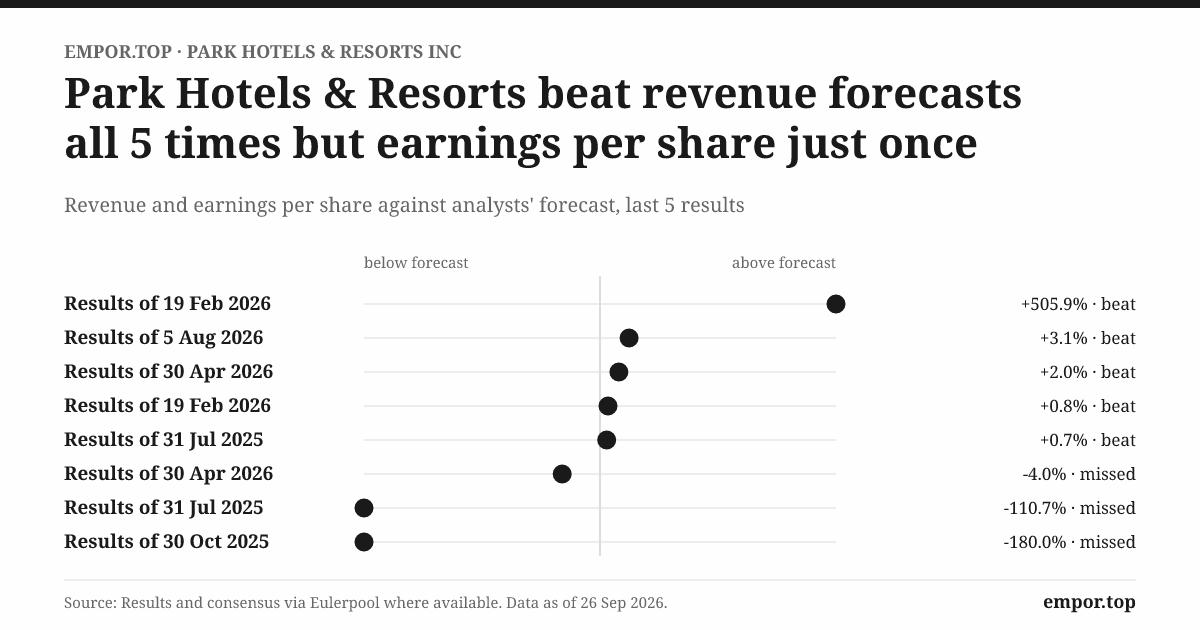
Park's guidance record over the past year is mixed but improving. The company's 2025 results missed its own earnings guidance, with a per-share loss of $1.04 against earlier guidance of a small profit, largely because of impairments.6 It then guided 2026 conservatively, forecasting adjusted EBITDA of $580 million to $610 million.6 By August 2026, it had raised that range to $617 million to $637 million, lifted its RevPAR growth outlook to 3.0% to 4.5% from 0.75% to 2.25%, and raised adjusted FFO per share guidance to $1.90 to $2.00.249
That raise is a credibility positive: management set a bar it could beat. But context matters. Park's adjusted EBITDA was $659 million in 2023 and $609 million in 2025, so even the raised 2026 guidance remains below the 2023 level, though the portfolio has shrunk since then.1910 The company is growing again, but it is climbing back, not breaking new ground.
Tom Baltimore: incentives and credibility
Baltimore is the kind of executive who speaks in the language of capital markets: net leverage, multiples, per-key pricing. His compensation structure reflects that orientation. According to the 2026 proxy statement, his 2025 total compensation was approximately $9.7 million, about 88.5% of which was performance-based or at risk.25 The long-term incentive program leans on performance stock units tied to three-year relative total shareholder return against the FTSE Nareit Lodging/Resorts Index.25
That design is better than many. It rewards beating named lodging peers, not merely growing an adjusted metric that management itself defines. It does not, however, directly reward deleveraging, and relative TSR can pay out even when absolute returns are poor if the whole peer group suffers.
One key personnel move deserves mention. In February 2026, Park named Sean M. Dell'Orto chief operating officer effective February 12, while he retained his role as chief financial officer.10 Consolidating operations oversight with the finance function fits a company whose strategy is essentially an asset-management and balance-sheet exercise. Baltimore has led the company since before the spin-off, and no formal succession plan has been publicly detailed in the materials reviewed here, so the Dell'Orto appointment is worth watching as a possible signal of the next leadership generation, though the company has not described it that way.
A governance friction point, remediated
The say-on-pay vote dipped to roughly 83% support in 2022, a meaningful if not severe signal of shareholder discontent.26 The compensation committee responded with an outreach campaign that reached holders of more than 40% of shares, and it shifted the long-term incentive mix further toward performance-based equity.26 Subsequent votes recovered to the mid-90s.25 That reads as a genuinely remediated issue rather than an ongoing problem.
Ownership is dominated by passive institutions, with BlackRock the largest holder at roughly 14.7% according to the 2026 proxy.25 In a search of Park's proxy filings from 2023 to 2026 and news coverage under Park's name alongside well-known activist funds, no activist campaign or proxy fight was found. That is a bounded result, not an assurance that no activist has ever looked at the company.
The activist's stress test
If an activist did show up, what would they challenge? Probably three things. First, the sales pace: why is the non-core tail still around, and why were 2025 sales below target? Second, capital priorities: S&P specifically flagged Park's continued share repurchases while leverage sat above its downgrade threshold as a material rating risk.7 Buying back stock below asset value can create per-share value, but doing it with borrowed money while the rating agency watches is a real tension. Third, the renovation budget: with capex guidance rising, is the Waikiki spend earning its cost of capital, or chasing a 2023 peak?
Capital returns: the tangible record
The dividend tells its own story. Park suspended it in 2020 during COVID, reinstated it at a token $0.01 per share in 2022, and raised it to $0.25 per quarter by early 2024, where it has remained.135199 At recent prices, that equals an annualized yield of roughly 6.5%.9 Buybacks have come in a series of authorizations rather than one large program: Park repurchased 14.6 million shares for $180 million in 2023 and about 3.5 million shares for $45 million in the first quarter of 2025.1910 Management has cited roughly $1.3 billion returned to shareholders over a trailing three-year period.8 On the Q2 2026 call, however, the emphasis had shifted: debt reduction and reinvestment, not new buybacks, dominated the discussion.9
That pivot is sensible given what sits on the liabilities side of the balance sheet, which is where the story turns next.
VIII. The Balance Sheet: A Real, Live Risk
The number that matters most
Every hotel REIT lives or dies by two things: the earnings of its hotels and the cost of the debt secured by them. Park's hotels are recovering. Its debt remains the most important risk in the story.
At the end of 2025, Park's net debt stood at about $3.7 billion, and its net debt to adjusted EBITDA ratio had risen to 6.15 times, up from 5.61 times a year earlier.6 By mid-2026 that ratio had eased to about 6.1 times.9 In plain English: it would take Park roughly six years of its entire EBITDA, before any interest, taxes, capex, or dividends, to pay off its net debt. Management's stated leverage target range tops out at 5 times, and S&P noted that Park was operating above it, which is itself an acknowledgment that the company is not there yet.7
Where the rating agency drew the line
S&P has effectively published the scorecard. On October 2, 2025, it revised Park's outlook to negative from stable, affirming the BB- rating but warning that leverage was expected to remain above its 5.5 times downgrade threshold through 2026.7 It cited softer group and leisure demand, margin compression from wages and renovations, Hawaii concentration, and Park's continued share repurchases despite elevated leverage.7
This is the single most concrete, falsifiable data point in the whole Park story. If leverage drops below 5.5 times, the negative outlook likely goes away. If it stays above, a downgrade becomes more likely, raising Park's future borrowing costs.
The maturity wall
The more acute issue is timing. Park's debt stack is heavily front-loaded. The largest single loan, the roughly $1.27 billion mortgage on Hilton Hawaiian Village, matures in November 2026.27 On the Q2 2026 call, management said it planned to fully repay that mortgage in September using delayed-draw term loan proceeds, with a refinancing of other mortgage debt planned later in 2026.9 Additional mortgage debt matures in 2026 and a further cluster comes due in the second half of 2028.27 The company's weighted-average debt maturity was about 2.2 years at year-end 2025.10
Think of this like a homeowner with a large mortgage balloon payment due every couple of years. As long as lenders are willing and rates are reasonable, it is manageable. But it leaves little room for error if credit markets tighten at the wrong moment, and it gives lenders leverage over Park in every refinancing negotiation.
Liquidity and a shrinking asset base
Two other numbers from year-end 2025 fill in the picture. Park's cash balance fell to $232 million from $402 million a year earlier, and its total assets fell to $7.70 billion from $9.16 billion, reflecting dispositions, impairments, and the removal of hotels.6 A shrinking asset base is exactly what the strategy intends. But it means that debt has to shrink at least as fast as assets do for leverage to improve, and in 2025 it did not: net debt rose from $3.58 billion to $3.72 billion even as the portfolio got smaller.6
A simple stress scenario shows why this matters. If a mild recession cut Park's EBITDA by 15%, which is not extreme by hotel-cycle standards, a leverage ratio of about 6 times would rise toward 7 times without any new borrowing. That would push the company further from S&P's threshold just as it tried to refinance its maturities. The combination of operating leverage in the hotels and financial leverage on the balance sheet is what makes hotel REITs so sensitive to the cycle, and Park carries more of both than most peers.
The partial offset
Most of Park's debt is fixed-rate, which limits the immediate impact of rising interest rates on interest expense.27 That protects near-term earnings. It does not remove refinancing risk: every maturing fixed-rate loan must be replaced at whatever rate the market offers at the time. Replacing the Hilton Hawaiian Village mortgage with term-loan proceeds adds flexibility, but to the extent Park leans more on corporate-level borrowing and less on single-asset mortgages, it narrows its ability to walk away from an individual problem asset the way it did in San Francisco.
What the balance sheet reveals
The balance-sheet claim investors need to test is management's promise to delever. History cuts both ways. On one hand, Park avoided dilutive equity during COVID and used non-recourse structures to cap its San Francisco losses. On the other, leverage has risen rather than fallen over the past year, and the rating agency has specifically flagged buybacks as a concern. The verdict: the deleveraging claim remains intact but unproven. The KPI that settles it is net debt to EBITDA over the next four to six quarters, measured against S&P's 5.5 times threshold and management's 5 times target.
With the assets, the management record, and the balance sheet on the table, it is time to put the case together.
IX. Bull Case vs. Bear Case
Framing the debate
Imagine two analysts sitting across a table from each other, each holding the same 10-K. One sees a collection of trophy hotels trading well below replacement cost, run by a management team whose incentives are tied to beating its peers. The other sees a leveraged, geographically concentrated landlord with no control over its brand and a record of being late to recognize problems. Both are reading the same document. Here is how each would argue.
The bull case
Scarcity first. Hilton Hawaiian Village occupies land that cannot be replicated, in a market where large-scale new beachfront resort supply is structurally limited. The recent RevPAR-index gains show that the asset has pricing power, and the renovation program is designed to extend it.
Second, the industry tailwind is aligned with the asset mix. CBRE's forecast for luxury RevPAR growth at roughly double the national rate, driven by business and group travel, favors exactly the kind of large full-service hotels Park owns.11 Park's raised 2026 guidance suggests it is already capturing some of that.24
Third, incentives are sensible. Relative TSR against lodging peers is harder to game than absolute adjusted EBITDA targets, and management's pay is overwhelmingly at risk.
Fourth, management has shown it will cut losses. San Francisco proved Park would rather hand over the keys than subsidize a failing asset. The non-core sales program extends the same logic.
Fifth, the portfolio's quality keeps rising. As the low-margin non-core tail is sold or exited, the remaining core hotels, earning margins nearly three times higher, make up an ever-larger share of the company.6
The bear case
Leverage first. Park's net debt to EBITDA remains above S&P's downgrade threshold, with a heavy refinancing calendar and a short weighted-average maturity.710 Any hiccup in credit markets hits Park harder than lower-levered peers.
Second, concentration. Roughly 30% of hotel EBITDA from one discretionary-leisure destination is a real single-point-of-failure risk.7
Third, management's forward calls have a mixed record. San Francisco showed management behind the market, not ahead of it. The Hawaii recovery gap shows that even the best asset has not yet reached its prior peak.
Fourth, Park does not control the customer. Hilton controls the brand, the loyalty program, and the booking channel. Park's economics depend on a partner whose interests do not always align.
Fifth, the M&A record is thin. The one large deal, Chesapeake, was overwhelmed by a pandemic, leaving no clean evidence either way about management's acquisition skill.
The risk radar
A few other risks deserve a brief mention because they work through specific mechanisms. Labor costs are the largest operating expense in a full-service hotel, and S&P already cited rising wages as a cause of margin compression in 2025.7 Any new round of union contracts in Park's big-city markets would squeeze margins again. Technology is a two-sided issue: online travel agencies and any AI-driven booking intermediaries that emerge sit between guests and brands, and while Hilton bears most of that fight, higher distribution costs flow through to the hotel's profit and therefore to Park. Cybersecurity risk also runs through Hilton's systems rather than Park's own, which means Park carries exposure to a breach it cannot directly prevent. Finally, climate and insurance costs matter for a portfolio with large coastal assets in Hawaii, Key West, and Miami, where property insurance and storm exposure are real line items.
Hamilton Helmer's 7 Powers, applied
Run Park through Helmer's framework and the picture is narrow but real. Cornered Resource is the one power Park clearly holds, and only in Waikiki and a few other truly scarce locations. Scale Economies are limited: a hotel REIT does not get dramatically cheaper to run as it grows, and Park is shrinking. Network Economies belong to Hilton Honors, not to Park. Switching Costs are weak on the guest side, since travelers can choose another hotel; on the owner side, they cut against Park, because changing managers is costly and disruptive. Brand power belongs to Hilton. Counter-Positioning does not apply in any meaningful way. Process Power, the ability to run renovations and asset management better than peers, is plausible but unproven by any external benchmark.
In short, Park has one strong power in one place, and the rest of its competitive position is borrowed from its manager.
Porter's Five Forces, revisited
The forces lean against owners in general and in favor of Park only in Hawaii. Supplier power (the brand-manager) is high everywhere. Buyer power is moderate. The threat of substitutes, whether alternative accommodations or remote meetings replacing business travel, is real but has not prevented the current business-travel recovery. Rivalry among big-city upper-upscale hotels is intense. The threat of new entrants is low in Waikiki and moderate to high elsewhere.
Against the peers
Compared with Host, Park is smaller, more levered, more concentrated in one destination, and more dependent on a single brand. Compared with smaller full-service peers such as Pebblebrook, DiamondRock, Xenia, and Sunstone, it offers a unique Hawaii exposure but carries similar big-city risks. Compared with RLJ, it has higher capital needs and higher operating leverage, which amplifies both upside and downside.
The myth-versus-reality check
Myth: Park is a Hawaii growth story. Reality: it is, for now, a Hawaii recovery story, with management itself identifying a $60 million to $70 million gap back to 2023.9
Myth: Park walked away from San Francisco because it saw the future. Reality: bond markets moved first, and management followed.171
Myth: Park is deleveraging. Reality: leverage rose in 2025 and has only started to ease in 2026, remaining above the rating agency's threshold.67
What would change the verdict
The debate is not permanent; specific events would settle it. The bull case strengthens materially if three things happen together: leverage falls below S&P's 5.5 times threshold, Hawaii EBITDA surpasses its 2023 peak after the tower renovations, and the remaining non-core hotels are sold at prices close to their carrying values. The bear case strengthens if any one of three things happens: a downgrade, a Hawaii-specific shock that interrupts the recovery, or another large write-down that reveals management again held on to a declining asset too long. Notably, several of these outcomes depend on the broader travel cycle rather than on management, which is the most honest way to describe a hotel REIT: a leveraged bet on the cycle, sharpened or blunted by the quality of its assets and its capital allocators.
The honest synthesis
Park's answer to "why does this company win from here" rests almost entirely on two things: the scarcity value of its Hawaii assets and the disciplined deleveraging of its balance sheet. Both are plausible. Both are still mid-execution. Neither is proven at the finish line. Beyond the specific numbers, the Park story holds some lessons that apply well beyond one hotel REIT.
X. Playbook: Durable Business & Investing Lessons
Owning the building is not owning the customer
Park's structure is a textbook illustration of how value splits between those who own assets and those who own distribution. Hilton's spin-off deliberately kept the brand, the loyalty program, and the fee stream, and gave Park the buildings, the capex, and the debt. The market has consistently valued those two halves very differently. For any investor looking at an asset owner that relies on someone else's brand, the question is always: who holds the customer relationship, and how much of the economics do they capture?
Non-recourse debt is a risk-management tool
The San Francisco exit shows why sophisticated real estate owners finance assets individually. Non-recourse, asset-level debt is often described simply as leverage, but it is also insurance. It lets an owner cap losses on a single property without contaminating the rest of the balance sheet. Park's ability to walk away was only possible because the loan was structured that way from the start. As Park moves toward more unsecured borrowing, that optionality shrinks.
Concentration can be a moat and a risk at the same time
Hawaii scarcity limits competitors' new supply, but it equally limits Park's own diversification. The same asset that gives Park its pricing power is also the asset that could hurt it most in a destination-specific shock. Investors should not treat concentration as purely good or purely bad; it amplifies whatever happens to the concentrated asset.
Timing can overwhelm logic in M&A
Chesapeake's strategic logic was sound: diversify brands, add good hotels, cut duplicate costs. But its timing, five months before a pandemic, meant the underwriting was never tested. Great deals can be ruined by bad timing, and mediocre deals can be rescued by good timing. That is why investors should judge acquirers over multiple deals and cycles, and why Park's single large deal says less about management than it might seem.
Credibility is built in the gap between words and outcomes
The most useful lens for Park's management is not what it says, but how its statements have tracked outcomes over time. San Francisco showed a gap. The 2026 guidance raise shows a narrowing of that gap. The next test is whether management's claims about Hawaii's recovery and its leverage target hold up. The final section lays out exactly what to watch.
XI. Epilogue: What to Watch
Three numbers
Late September 2026 finds Park at an inflection point. The Rainbow Tower is finished. The Ali'i Tower is under renovation. Royal Palm has reopened. The Hilton Hawaiian Village mortgage, the company's single largest loan, was slated for repayment this month. And the industry backdrop is the best it has been in several years. The question is whether that momentum will carry through to the balance sheet.
Three KPIs will answer it.
First, net debt to EBITDA. The rating agency's 5.5 times threshold and management's 5 times target give investors a clear yardstick. Over the next four to six quarters, the direction of this number will tell investors whether Park's deleveraging promise is real.79
Second, Hawaii EBITDA versus the 2023 peak. Management has quantified the gap at $60 million to $70 million.9 Once the Rainbow and Ali'i towers are both back in full service, investors will see whether that gap closes, and whether Hawaii becomes a genuine growth engine or remains a recovery story.
Third, speed of recognition. San Francisco set a precedent: management acted after the market did. Whether the next underperforming asset gets flagged and addressed faster, particularly within the remaining non-core tail, will reveal whether that lesson has been learned.
The closing frame
Park Hotels & Resorts is, at its core, a bet that a handful of irreplaceable properties, chief among them one very large beachfront resort in Waikiki, are worth more than the market currently implies. The real estate case is strong. The management case is mixed but improving. The balance-sheet case is unfinished. For the story management is now telling to become the story the numbers tell, the balance sheet has to catch up to the beach.
References
-
Park Hotels & Resorts Inc. Announces Cessation of Payment on $725 Million Non-Recourse CMBS Loan Secured By Two of Its San Francisco Hotels — GlobeNewswire, 2023-06-05 ↩↩↩↩↩↩↩↩↩
-
Hilton Completes Spin-off of Park Hotels & Resorts and Hilton Grand Vacations — BusinessWire, 2017-01-04 ↩↩
-
Park Hotels & Resorts Preliminary Information Statement (Form 10, Exhibit 99.1) — SEC EDGAR, 2016-06-02 ↩↩↩
-
Hilton Spinoff Park Hotels & Resorts to Have 69 Hotels — CoStar ↩
-
Park Hotels & Resorts Form 10-K, fiscal year 2025 — SEC EDGAR, 2026-02-20 ↩↩↩↩
-
Park Hotels Q4 2025 slides: portfolio split drives mixed results — Investing.com, 2026-02 ↩↩↩↩↩↩↩↩↩↩↩↩↩↩
-
Park Hotels & Resorts outlook revised to negative at S&P on high leverage — Investing.com, 2025-10-02 ↩↩↩↩↩↩↩↩↩↩↩↩↩
-
Park Hotels & Resorts Nareit investor presentation, June 2025 (8-K exhibit) — SEC EDGAR, 2025-06 ↩↩↩
-
Earnings call transcript: Park Hotels beats revenue in Q2 2026 and lifts outlook — Investing.com, 2026-08 ↩↩↩↩↩↩↩↩↩↩↩↩↩↩↩↩↩
-
Park Hotels & Resorts Inc. Reports Fourth Quarter and Full-Year 2025 Results — StockTitan, 2026-02-19 ↩↩↩↩↩↩↩↩↩
-
U.S. Real Estate Market Outlook Midyear Review 2026: Hotels — CBRE, 2026 ↩↩↩
-
Park Hotels & Resorts Completes Acquisition of Chesapeake Lodging Trust — BusinessWire, 2019-09-18 ↩↩↩↩
-
Park Hotels & Resorts Inc. Reports Fourth Quarter and Full Year 2020 Results — GlobeNewswire, 2021-02-25 ↩↩↩↩↩
-
Park Hotels & Resorts Form 10-K, fiscal year 2020 — SEC EDGAR, 2021 ↩↩↩
-
San Francisco hotel sales close at a 75% discount — SF Standard, 2025-11-21 ↩↩↩
-
Park Hotels & Resorts Inc. Reports Third Quarter 2022 Results — GlobeNewswire, 2022-11-02 ↩↩↩↩
-
Moody's Downgrades $725M Loan on Two SF Hilton Hotels — The Real Deal, 2023-03-08 ↩↩
-
Park Hotels & Resorts Inc. Announces Lawsuit Related to $725 Million Non-Recourse CMBS Loan — GlobeNewswire, 2023-10-26 ↩
-
Park Hotels & Resorts Inc. Reports Fourth Quarter and Full-Year 2023 Results and Announces First Quarter Dividend of $0.25 Per Share — GlobeNewswire, 2024-02-27 ↩↩↩↩↩↩
-
Park executives lay out next steps after San Francisco default — CoStar ↩
-
Downtown San Francisco hotels' value drops by $1B: Trepp — Hotel Dive, 2024-07-03 ↩↩
-
San Francisco's two largest distressed hotels finally have a buyer — SF Standard, 2025-09-02 ↩
-
Park Hotels & Resorts announces completion of San Francisco hotels sale — Park Hotels & Resorts, 2025-11-24 ↩
-
Park Hotels & Resorts Inc. Reports Second Quarter 2026 Results — BusinessWire, 2026-08-06 ↩↩
-
Park Hotels & Resorts DEF 14A proxy statement — SEC EDGAR, 2026-03-12 ↩↩↩↩
-
Park Hotels & Resorts DEF 14A proxy statement, 2023 — SEC EDGAR, 2023 ↩↩
-
Park Hotels & Resorts Form 10-Q, quarter ended June 30, 2026 — SEC EDGAR, 2026-08-07 ↩↩↩
 LinkedIn
 WhatsApp
 Reddit
 Hacker News
 Email
Email Kindle
 RSS Feed
 Spotify
 Apple Podcasts
 Amazon Music
 Audible
 YouTube