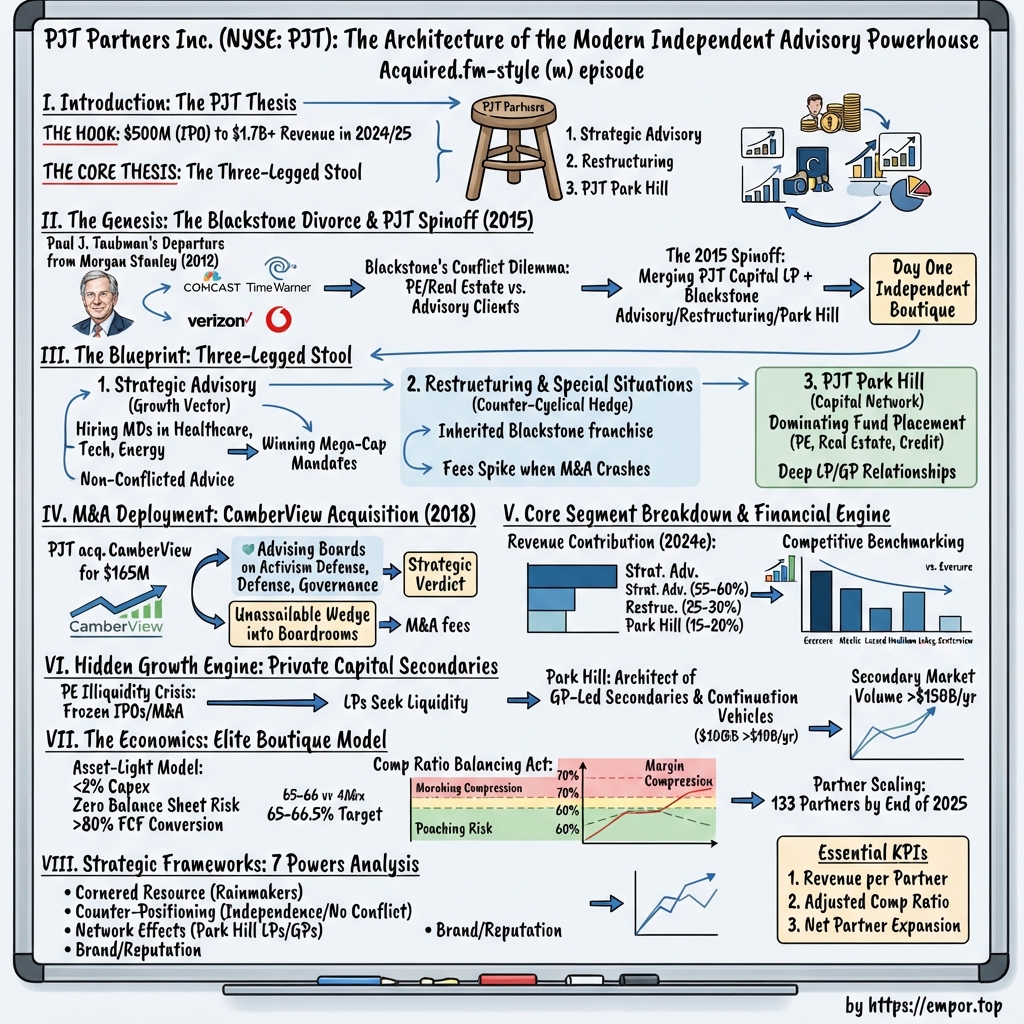
PJT Partners Inc. (NYSE: PJT): The Architecture of the Modern Independent Advisory Powerhouse
I. Introduction & Episode Roadmap
A specialized tier of corporate advisory work begins with a high-stakes phone call. It arrives on a Sunday from a chief executive discovering an activist fund has built a 6% position, a private equity general partner facing an eighteen-month maturity wall, or a board evaluating an unsolicited takeover offer. In these moments, clients are not seeking a standardized pitchbook; they are paying for seasoned individual judgment.
For roughly forty years, Paul J. Taubman has been one of those trusted advisers. For investors, the story centers less on individual relationships and more on the institutional architecture built around them. In 2012, Taubman departed as co-president of Morgan Stanley's institutional securities business after three decades at the firm.1 He then launched an independent advisory boutique—operating initially without a bank balance sheet, research department, trading floor, or established brand beyond his own name.
Eleven years after PJT Partners went public, its financial results reflect substantial growth. PJT Partners generated $1.714 billion of revenue in 2025, up 15% year over year, with record adjusted pretax income and record adjusted earnings per share, achieving these results with 133 partners, 1,224 total employees, no funded debt, and $586 million of cash on the balance sheet.2 Trailing-twelve-month revenue through June 2026 reached roughly $1.89 billion—about 365% above the $406 million the business produced in its first year as a standalone company.34
The core thesis behind PJT Partners is what investors describe as a three-legged stool. The firm operates three primary divisions: Strategic Advisory (mergers, capital markets advice, board and shareholder defense), Restructuring & Special Situations (bankruptcy, liability management, creditor and debtor mandates), and PJT Park Hill (private capital placement and secondary liquidity solutions for private equity). In theory, these businesses are uncorrelated: when corporate confidence falls and M&A activity slows, balance sheet distress rises and restructuring mandates surge. Running both under one roof aims to smooth advisory revenue across economic cycles.
That thesis requires examination across four key areas. First is the firm's origin: a spinoff combining Taubman's firm with Blackstone's advisory arm, giving a startup immediate global scale while solving strategic goals for Blackstone. Second are the unit economics: a model that converts intellectual capital into cash flow with minimal physical assets, where two-thirds of revenue goes to talent and the critical efficiency metric is the compensation ratio rather than traditional operating margin. Third is capital deployment, highlighted by the 2018 purchase of CamberView Partners—PJT's sole major acquisition, executed at a full price. Fourth is Park Hill's secondaries and private capital solutions franchise, which has become a primary growth engine as private equity sponsors navigate liquidity constraints.
Evaluating PJT also requires addressing several critical questions. Why did PJT grow slower than Evercore and Moelis in 2025 despite the strongest M&A recovery since 2021? Why has the compensation ratio remained stubbornly above management's historical framing? How resilient is a talent-driven advisory model when senior rainmakers can leave for competitors? And what drove the firm's decision, at the end of 2025, to stop breaking out placement fees as a standalone reported revenue line?
The analysis begins with the firm's formation and the initial deal structure that established its global scale.
 Subscribe on LinkedIn
II. The Genesis: Wall Street's Ultimate Rainmaker & The Blackstone Divorce (2012–2015)
On November 5, 2012, Morgan Stanley issued a press release announcing that Paul J. Taubman, co-president of institutional securities, would retire at year-end, leaving his co-president, Colm Kelleher, to take sole charge of the division starting in January 2013.1 The language was warm and corporate, but on Wall Street the subtext was clear: a dual-leadership model had reached its predictable end.
Taubman's career to that point had followed a steady trajectory. After joining Morgan Stanley out of Wharton in 1982, he became managing director in 1995, global head of M&A in 2004, sole head of M&A a year later, head of global investment banking from 2007 through the financial crisis, and ultimately co-president of the institutional securities division.5 Former colleagues described him as an understated listener whose gift was imbuing clients "with a sense of confidence in what they are doing."5 In an industry that often rewards theatrical bravado, Taubman relied on patience, deep memory, and a calm demeanor during high-stakes corporate decisions.
Though he initially planned to take time off, former clients quickly called him back. Within a year, Taubman was advising on some of the largest transactions in corporate history. He advised Verizon Communications on its $130 billion buyout of Vodafone's stake in Verizon Wireless, and in February 2014 served as sole individual adviser to Comcast on its proposed $45.2 billion acquisition of Time Warner Cable.567 The Comcast mandate illustrated a broader shift on Wall Street: a single banker with a phone and a laptop sat at the same table as Goldman Sachs and JPMorgan, reportedly earning a fee near $10 million while major institutions shared a separate pool.6
Beyond the fee itself, the transaction demonstrated that in critical strategic decisions, chief executives often select individual advisers over institutional platforms. That realization underpins the independent advisory model, and Taubman had just validated it at scale as a one-person firm.
What Blackstone Was Actually Solving For
The second half of PJT's foundation originated at Blackstone. Over two decades, Blackstone had assembled an advisory portfolio spanning corporate finance, a leading restructuring practice, and Park Hill Group, a private fund placement arm established in 2005.4 By 2014, however, that advisory footprint created strategic friction.
The issue stemmed from structural conflicts rather than performance. As Blackstone's private equity, real estate, and credit funds grew into major global acquirers, corporate boards and sovereign wealth funds became reluctant to hire advisory bankers affiliated with a competing buyout firm. Consequently, the advisory division's expansion was constrained by its corporate parentage.
In late 2014, Blackstone president Tony James approached Taubman to discuss combining their operations. Following discussions with chairman Stephen Schwarzman, a transaction structure emerged: Blackstone would spin off its financial and strategic advisory, restructuring, and Park Hill businesses to merge with Taubman's firm, creating an independent entity owned by Blackstone unitholders.5[^8] Announced on October 10, 2014, the transaction highlighted the reality that fee-for-service advisory units often held greater strategic value outside a private equity conglomerate.89
The deal closed on October 1, 2015. Blackstone unitholders of record as of September 22, 2015, received one share of PJT Partners Class A common stock for every 40 Blackstone common units in a tax-free distribution, launching PJT as an independent listed company on the New York Stock Exchange.10[^12]11 Regulatory filings outlined an advisory-focused firm featuring three core divisions, global reach, and a partnership combined from two distinct corporate cultures.12
Each party accepted clear trade-offs. Blackstone surrendered a steady revenue stream and relinquished the ability to build an in-house advisory practice at scale, while accepting that its unitholders would own shares in a firm competing against major investment banks. In return, Blackstone eliminated client conflicts capping its advisory business and transferred management of a talent-driven firm to an experienced dealmaker. Taubman surrendered sole ownership of his boutique and assumed the obligations of leading a public company accountable to shareholders, quarterly financial disclosures, and a broader partner base.
The transaction equipped Taubman with two capabilities a solo boutique cannot easily replicate: an established restructuring practice with institutional depth and a private capital placement network with extensive limited partner relationships. Yet it also presented an operational challenge—integrating roughly 350 employees and 46 partners under a brand bearing his initials.35
Initial market sentiment remained cautious, and the firm's performance over its first three years revealed why.
III. The Blueprint: Architecting the Three-Legged Stool (2015–2018)
PJT's initial years as an independent public entity were marked by top-line stagnation. Revenue reached $406 million in 2015 and remained flat at $499 million in both 2016 and 2017, with the company recording GAAP net losses in both 2016 and 2017.13 Rather than delivering immediate revenue expansion, the firm absorbed substantial upfront costs, committing the vast majority of its revenue to compensation to hold its newly assembled partnership together.
Early operational challenges were compounded in March 2016 by a severe legal and reputational crisis. Andrew Caspersen, a managing principal in Park Hill's secondaries advisory group, was arrested and charged by federal prosecutors in Manhattan in connection with a fraud scheme involving fictitious private equity investments. Prosecutors initially detailed approximately $95 million in solicited and misappropriated funds, including capital taken from a charitable foundation affiliated with a New York hedge fund.14 Caspersen had been dismissed earlier that month after the firm uncovered unauthorized transactions. While the scheme was executed individually rather than institutionally—involving fraudulent investments rather than misallocated client funds—the scandal posed severe risk to a five-month-old public company whose business model depended entirely on market trust.
PJT contained the fallout through swift termination and full cooperation with law enforcement, demonstrating how established advisory franchises can insulate themselves from isolated individual misconduct. However, the incident highlighted a fundamental governance challenge inherent to human-capital intensive firms: granting rainmakers the autonomy necessary to generate business complicates institutional oversight.
Myth vs. Reality: The "Instant Scale" Spinoff
The prevailing narrative surrounding PJT's launch suggested that Taubman inherited a fully operational global franchise requiring minimal foundational work. The financial performance of its early years points to a more complex integration process.
The spinoff transferred operational infrastructure: an established restructuring practice, a fund placement platform with extensive investor relationships, and an international office footprint. What it could not instantly transfer was institutional cohesion. Assembled from former Blackstone executives, Park Hill placement specialists, and senior investment bankers who followed Taubman from Morgan Stanley, the firm initially operated as three distinct corporate cultures with separate compensation histories. The flat revenue in 2016 and 2017 reflected the operational friction of unifying these groups while simultaneously recruiting the strategic advisory talent required to build an M&A franchise.
Furthermore, independence did not automatically generate advisory mandates. Corporate boards typically retain advisory firms based on demonstrated institutional execution rather than individual reputation alone. Converting Taubman's personal relationship network into a self-sustaining corporate brand required years of broad-based deal execution—a transition that was ultimately reflected as top-line growth resumed in subsequent years.
Leg One: The Cash Cushion
The restructuring franchise inherited from Blackstone represented PJT's most established division. In 2018, the firm named Steve Zelin—who spent seventeen years as a senior managing director at Blackstone following a partnership at Ernst & Young's restructuring practice—as global head of Restructuring and Special Situations.15 Zelin's prior advisory record encompassed major corporate reorganizations, including mandates for General Motors, Caesars Entertainment, iHeartMedia, and Pacific Gas & Electric.15
The structural importance of restructuring lies in its cash-flow dynamics and counter-cyclical profile. Unlike M&A advisory, which relies on transaction closures for success fees, restructuring mandates typically generate monthly retainers alongside completion fees over engagements lasting twelve to thirty-six months. Because corporate distress is triggered by elevated interest rates, credit contractions, or operational strain—conditions that generally suppress broader M&A volume—restructuring provides predictable cash flow during broader economic downturns.
Complementing traditional courtroom bankruptcies, the division expanded its focus on liability management exercises (LME). These out-of-court balance-sheet restructurings involve debt-for-debt swaps, maturity extensions, collateral repositioning, and new senior capital injections. PJT's advisory role in Carvana's $5.5 billion distressed debt exchange, which yielded $900 million in liquidity, and Sunac's offshore restructuring involving over $10 billion in creditor claims highlight the scale of these mandates.16 These complex out-of-court transactions provide steady fee opportunities driven by corporate leverage rather than macroeconomic recessions.
Leg Two: The Growth Vector
In contrast to restructuring and placement, Strategic Advisory had to be constructed almost entirely from scratch, launching with just 18 partners at the spinoff.3 Management pursued a deliberate, capital-intensive expansion strategy: selectively hiring senior coverage bankers from bulge-bracket institutions across core sectors—including healthcare, technology, energy, industrials, and financial institutions—as well as expanding geographic reach in Europe and Asia. Because senior bankers typically face non-compete provisions and client transition periods, newly hired rainmakers required two to three years of compensation investment before generating meaningful advisory revenue.
PJT positioned its advisory model around strict independence. The firm does not engage in corporate lending, securities underwriting, prime brokerage, or proprietary asset management. This structure eliminates potential conflicts of interest when advising corporate boards, offering a distinct positioning shared by boutique peers like Evercore, Moelis, Centerview, and Lazard, but unreplicable by full-service universal banks.
Leg Three: The Capital Network
Park Hill formed the third pillar of the firm's initial architecture, serving as a placement agent for private equity, real estate, credit, and hedge fund managers seeking institutional capital. Since 2005, the platform has assisted fund managers in raising more than $565 billion across more than 540 primary funds.3 While placement fees generated immediate cash flow, the division's strategic value centered on its extensive investor intelligence network—providing real-time visibility into the allocation preferences and liquidity needs of sovereign wealth funds, public pension plans, endowments, and insurance companies worldwide.
By 2018, PJT had established its three core divisions, though their relative maturity varied significantly. While restructuring and Park Hill provided baseline revenue and market intelligence, Strategic Advisory still lacked a systematic entry point into corporate boardrooms prior to transaction announcements. Addressing that strategic gap prompted the firm's first major acquisition.
IV. M&A & Capital Deployment: The CamberView Acquisition Benchmarking (2018)
The sequence determining which advisory firm lands a major transaction mandate rarely begins when a corporate board formally decides to sell. Instead, it starts eighteen months earlier—when an activist fund files a Schedule 13D, when a proxy advisory firm recommends against an executive compensation plan, or when directors realize their largest shareholders include index managers whose stewardship teams vote on matters the board has never discussed. By the time a formal sale process starts, advisers are usually already in the boardroom.
CamberView Partners was built specifically for those early interactions. Founded in 2012 and headquartered in San Francisco with offices in New York and London, the firm advised public company boards and management teams on investor relations, corporate governance, shareholder engagement, and contested situations such as proxy fights, activist campaigns, and say-on-pay battles. By 2018, CamberView employed more than 40 professionals and had advised over 180 public companies, including nearly half of the Fortune 100. Its largest outside investor was Corsair Capital, and its founder and chief executive was Abe M. Friedman, a former BlackRock executive who had helped build the governance function at the world's largest index manager.17
On August 28, 2018, PJT announced an agreement to acquire 100% of CamberView for approximately $165 million—comprising roughly $100 million in equity, split between Class A common stock and partnership units, and roughly $65 million in cash, subject to working capital adjustments.1718 The transaction closed on October 1, 2018.19
Was It A Full Price?
CamberView did not publish its financials, leaving its exact revenue undisclosed. However, a firm of roughly 40 professionals operating in a retainer- and project-based advisory niche at 2018 industry economics likely generated $40 million to $50 million in annual revenue—implying an acquisition multiple in the range of 3.5 to 4 times sales. By comparison, regional broker-dealers consolidating middle-market advisory shops during the 2010s typically paid one to two times revenue, often structuring a large portion of the consideration as earnouts tied to retention.
PJT paid a premium, allocating a significant portion of the purchase price in equity at a time when its own stock traded at a modest valuation following two years of flat top-line performance. The transaction also created goodwill and intangible asset amortization that has remained in PJT's GAAP results ever since, serving as one of the primary reasons the firm's adjusted numbers diverge from reported ones.20
The strategic rationale, however, was less about purchasing existing revenue than acquiring structural positioning. Governance and activism-defense advice reaches a board well before a transaction is contemplated, provides recurring retainer income rather than episodic success fees, and establishes relationships with key decision-makers—independent directors and general counsel—rather than solely the chief executive. Building that capability organically could have taken five years, as credibility in corporate governance depends on a multi-year track record of proxy outcomes that cannot be quickly replicated.
The Verdict, Eight Years On
Because PJT does not report CamberView's standalone financial contribution, its precise return on investment cannot be calculated. However, the directional impact is clear. PJT integrated the business as PJT Camberview directly into Strategic Advisory rather than operating it as a standalone profit center—a structure that facilitated cross-selling while masking the unit's independent financial performance. Meanwhile, Strategic Advisory expanded its partner count from 18 at the 2015 spinoff to 91 by mid-2026, as total firm revenue nearly quadrupled from its 2015 baseline.34
Skeptics would emphasize that correlation does not equal causation: Strategic Advisory's growth also reflected dozens of senior lateral hires and a decade of broader brand building, with CamberView's boardroom access representing just one of several growth catalysts. A balanced assessment yields a narrower conclusion: PJT acquired a specialized advisory capability that few boutique peers possess in-house, paid a full valuation using equity that subsequently appreciated, and demonstrated disciplined capital allocation by refraining from further major acquisitions. Eight years after closing, CamberView remains PJT's sole material transaction—a notable departure from the aggressive acquisition strategies common across financial services.
Yet acquiring CamberView alone could not reshape PJT's broader financial trajectory. Sustained growth required scaling the firm's underlying operational divisions.
V. Core Segment Breakdown & Financial Engine
Understanding PJT's financial engine begins with an unusual balance sheet characteristic: the firm carries virtually no capital-intensive assets. As of June 30, 2026, the firm held $535 million in cash, cash equivalents, and short-term investments, with no funded debt.4 PJT maintains no loan book to mark, no trading inventory to hedge, and no securitizations to roll. Capital expenditures are largely confined to office leases, technology infrastructure, and travel. The firm's primary productive asset is human capital—an asset base that walks out the door every evening.
This asset-light model produces a distinct income statement profile. Revenue is volatile and largely recognized upon transaction closing, causing quarterly results to fluctuate significantly based on deal timing. In the second quarter of 2026, for example, eight transactions closed earlier than scheduled, pulling $35 million of revenue into the quarter—$14 million more than the prior-year comparable.21 Expenses, by contrast, are dominated by a single line item: compensation. Non-compensation operating expenses—including office space, travel, market data, technology, and professional fees—accounted for roughly 12.1% of revenue in 2025.2
The Growth Curve, And Where It Came From
The firm's historical trajectory illustrates how its business model functions over time. Revenue rose from $499 million in 2016 and 2017 to $580 million in 2018, expanding to $718 million in 2019. In 2020, as the COVID-19 pandemic severely strained corporate balance sheets, PJT crossed the $1 billion threshold as its restructuring business performed as designed. Top-line performance remained resilient, holding near $992 million in 2021 and $1.026 billion in 2022 despite volatile market conditions, before climbing to $1.153 billion in 2023, $1.493 billion in 2024, and $1.714 billion in 2025.132
This sequence lends credibility to the firm's counter-cyclical design. In 2020, amidst widespread economic disruption, PJT posted what was then its highest annual revenue. In 2021, during an extraordinary M&A expansion, PJT's revenue dipped slightly as low interest rates and readily available liquidity temporarily depressed restructuring demand. When M&A activity contracted to a decade low in 2023, PJT expanded top-line revenue by 12%. Management highlighted this structural balance during its February 2026 earnings call, noting that firm revenue grew nearly 75% between 2021—the historic peak for global M&A volume—and 2025.21
Revenue composition has evolved alongside total growth. In 2025, PJT reported $1.50 billion in advisory fees, up 14% year over year; $181.6 million in placement fees, up 24%; and $31.7 million in interest income and other revenue.2 However, PJT no longer publishes segment profit-and-loss statements, and beginning in 2026, the company stopped breaking out advisory versus placement fees altogether, consolidating top-line revenue into a single line item. On its fourth-quarter 2025 earnings call, management explained that reported placement fees no longer served as a reliable proxy for Park Hill, given the integration of private capital solutions and corporate placement activities across divisions.21
While logically consistent, the change represents a reduction in financial disclosure. Investors seeking to track Park Hill's performance independently lost their primary quantitative benchmark at the exact time management framed the division as a core growth driver. Consequently, equity analysts must rely on third-party volume data. During the fourth-quarter 2025 call, an analyst observed that PJT's implied revenue per dollar of restructuring volume appeared weak based on Dealogic metrics. Taubman dismissed the comparison, stating that he does not track Dealogic data, that the period marked the best restructuring quarter in firm history, and that "those are the facts."21 While both perspectives reflect different data sources, the exchange underscores a broader reality: investors must rely on management's qualitative narrative because granular segment data is no longer provided.
The Accounting Wrinkle Every Investor Should Understand
Beyond revenue reporting, evaluating PJT's financial performance requires navigating its corporate structure. PJT operates as a publicly traded parent company atop an operating partnership, with a substantial portion of total equity held as partnership units rather than Class A common stock. Consequently, GAAP metrics reflect net income attributable solely to PJT Partners Inc., whereas the underlying economics of the enterprise are reflected in management's "if-converted" metrics, which assume all partnership units are converted to Class A shares and all income is taxed at full corporate rates.
The divergence between these measures is material. In 2025, GAAP diluted earnings per share reached $6.68, while the adjusted if-converted figure was $6.98, based on a weighted-average if-converted share count of 43.9 million versus roughly 25.7 million basic Class A shares.220 Adjusted metrics also strip out intangible asset amortization inherited from the CamberView transaction and certain equity-based compensation expenses. While these reconciliations are standard for partnership structures, investors analyzing unadjusted GAAP figures evaluate a different share count and earnings base than the full enterprise economics dictate.
An advantage of this model is high cash conversion. With minimal capital reinvestment required outside of talent retention and office infrastructure, adjusted pretax income translates efficiently into free cash flow. In 2025, PJT generated $357 million in adjusted pretax income while returning a record $384 million to shareholders through share repurchases and quarterly dividends—yet still expanded its year-end cash balance to $586 million.2 Returning more than 100% of pretax earnings while building cash reserves demonstrates the cash-generative power of asset-light advisory models, enabling PJT to fund capital returns while simultaneously reinvesting in senior lateral talent.
The Peer Group, Honestly Assessed
Benchmarking PJT against its boutique advisory peers in 2025 highlights the trade-offs of its business mix. Evercore generated $3.88 billion in 2025 revenue, up roughly 29%.22 Moelis reported full-year 2025 adjusted revenue of $1.536 billion, a 28% increase driven by 35% growth in M&A and record capital markets activity.23 Lazard reported net revenue of $3.099 billion, with Financial Advisory revenue rising 4% to $1.834 billion.24 Meanwhile, Houlihan Lokey posted record revenue of $2.62 billion for its fiscal year ended March 2026, with Corporate Finance rising 14% to $1.74 billion while Financial Restructuring declined 3% to $528.7 million.25
Several conclusions emerge from these peer comparisons. First, PJT's 15% top-line growth in 2025 lagged Evercore and Moelis. This divergence stems primarily from business mix rather than execution deficit: during pronounced M&A recoveries, firms heavily weighted toward traditional strategic advisory capture greater upside. PJT's restructuring franchise acts as a buffer in downturns, but mathematically moderates top-line growth during cyclical M&A surges.
Second, the comparison with Houlihan Lokey illustrates PJT's positioning in restructuring. While Houlihan leads the market in total restructuring deal volume—focusing heavily on middle-market transactions—its restructuring revenue contracted in the year ended March 2026 at the same time PJT posted record restructuring performance.225 This divergence highlights PJT's focus on large-cap, multi-tranche, and cross-border liability management mandates, where average fee realization per assignment significantly exceeds middle-market averages.
Third, metrics regarding productivity per senior banker require careful contextualization. In 2025, PJT generated approximately $12.9 million per partner across its 133 partners.2 By comparison, Evercore employed 171 investment banking senior managing directors at year-end 2025, generating materially higher revenue per senior producer based on total firm revenue.22 Direct comparisons are imperfect, as PJT's partner count includes restructuring and Park Hill placement professionals alongside M&A bankers, while Evercore's top line reflects equities and capital markets businesses that PJT does not operate. Nonetheless, while simple parity claims between the two firms are overstated, PJT's revenue per partner has expanded steadily as the firm has scaled.
VI. The Hidden Growth Engine: PJT Park Hill & Private Capital Secondaries
A central structural problem facing private equity in recent years stems from a cash flow bottleneck. Consider an institutional pension fund that committed $100 million to a buyout fund in 2019, expecting cash returns to begin flowing back by 2024. Although the underlying portfolio companies remained operational, rising interest rates, a quiet IPO market, and cautious strategic buyers led fund managers to delay asset sales rather than sell into depressed valuations. As a result, institutional investors faced ongoing capital calls for newer fund vintages without receiving the distributions needed to fund them.
Multiplied across global institutional investors, this dynamic created a severe liquidity strain across private markets. PJT management characterized this imbalance between capital called and capital monetized as a dynamic that "creates stresses and strains in the system" when sustained.21
The secondary market serves as the primary mechanism to relieve this liquidity pressure, operating across two main transaction types. In a limited partner (LP)-led transaction, an investor sells existing fund commitments to a specialist buyer at a negotiated price—functioning essentially as a secondary market for private equity stakes. In a general partner (GP)-led transaction, most commonly structured as a continuation vehicle, a fund manager transfers one or more portfolio assets from an older fund into a new vehicle that the manager continues to direct. Existing investors choose whether to cash out or roll their exposure over into the new entity. Because the manager acts as both buyer and seller, the transaction requires a rigorous competitive process, fair valuation benchmarks, and structural safeguards to manage inherent conflicts of interest while securing fresh investor capital.
Executing these complex transactions yields lucrative advisory fees, placing PJT Park Hill among a select group of intermediaries capable of managing the full process. The franchise relies on a deep institutional relationship network developed over two decades. Since 2005, the platform has advised on more than $140 billion in LP sales and more than $155 billion in GP-led secondary transactions.3
This work commands premium advisory pricing rather than standard transaction brokerage fees. For example, when a buyout fund nears the end of its term while holding a performing software company, an adviser must value an asset lacking clear public market comparables, syndicate secondary buyers to capitalize a new vehicle, negotiate rollover terms for existing limited partners, and structure a process that demonstrates price fairness to investors and regulators. A failure in execution risks transaction collapse or litigation.
Because secondary engagements demand valuation expertise, capital syndication, and conflict resolution, fees scale with transaction complexity and deal size rather than pure deal volume. This positions the service cleanly alongside PJT's core board advisory and fairness opinion practices.
The Numbers Behind The Tailwind
Industry data illustrates the scale of this tailwind. According to Jefferies' market review, global secondary transaction volume expanded 48% year over year in 2025 to a record $240 billion. GP-led transactions accounted for nearly half of all activity, surging 53% to $115 billion. The average continuation vehicle expanded to roughly $900 million, while the number of GP-led deals exceeding $1 billion rose from 21 to 29. Meanwhile, dedicated secondary capital reserves reached a record $327 billion.26
For an advisory firm, these dynamics present favorable market conditions: expanding deal sizes, rising transaction complexity, and high execution stakes. Management reported that PJT outperformed broader market benchmarks through the first half of 2026, noting that growth in private capital solutions more than offset softness in traditional primary fundraising, aided by integration with Strategic Advisory and the firm's investor network.21
These performance claims cannot be independently verified because PJT consolidated placement fees into its broader revenue disclosures. However, third-party data confirms a broader shift away from traditional fund placement. Primary fundraising—Park Hill's foundational business—faced a multi-year contraction, with global volumes declining for a fourth consecutive year in 2025.21 Taubman acknowledged these structural headwinds, observing that major private equity sponsors increasingly rely on internal investor relations teams rather than third-party placement agents. Furthermore, Taubman noted that the 2021 fund vintage "may turn out to be a less than flattering vintage when history is written," creating potential headwinds for future asset allocations.21
These dynamics highlight a key nuance in Park Hill's trajectory: secondaries growth is expanding fast enough to outpace structural declines in primary fundraising. However, should secondary volumes normalize following consecutive record years, the underlying contraction in primary placement will re-emerge as a drag on overall performance.
Competition presents an additional challenge. Major investment banks and independent boutiques have aggressively built out private capital advisory practices to capture market share. As large continuation vehicles become more standard, fee margins face competitive pressure typical of maturing financial markets. PJT attempts to counter this by combining secondaries execution, primary distribution, and industry M&A coverage—an integrated positioning that provides a competitive edge, though not an insurmountable barrier to entry.
Ultimately, the key mechanism determining whether this growth translates into long-term shareholder value is how efficiently the firm manages its primary cost center: senior compensation and talent retention.
VII. The Economics of Elite Boutique Advisory
Every financial business model features a defining operating metric. For retailers, it is same-store sales; for commercial banks, net interest margin. For an independent corporate advisory firm, that metric is the compensation ratio. This figure directly addresses the central economic tension of a human-capital enterprise: of every dollar of fee revenue generated by advisory judgment, how much is allocated to employee compensation versus public shareholders?
PJT's trajectory with this metric illustrates the ongoing balance between talent retention and margin expansion. Adjusted compensation expense stood at 69.0% of revenue in 2024 before declining to 67.1% in 2025.2 Through the first half of 2026, the firm accrued compensation at 66.5% of revenue—down from 67.5% in the prior-year period—with management setting 66.5% as its baseline estimate for the full year.421
This moderation aligns with management's long-term framing, though with notable nuances. During PJT's February 2026 earnings call, Taubman recalled stating several years earlier that the compensation ratio had peaked when maximal talent investment collided with depressed M&A volume. While noting that the ratio was expected to trend downward, he added, "I think we're done working it down. The question is just simply the pace and rate of that."21 Although the payout ratio declined roughly two and a half percentage points over two years, management has refrained from establishing a fixed long-term floor. In July 2026, executives reiterated that the compensation ratio remains a flexible full-year estimate shaped by the revenue outlook, partner hiring plans, and competitive talent dynamics.21
Why The Floor Is Higher Than Investors Would Like
The structural constraint keeping this ratio elevated stems from talent mobility: in boutique corporate advisory, the primary productive asset can easily walk to a competitor. A senior partner producing $15 million in annual advisory fees understands their market value because rival firms actively quote it. Attempting to suppress compensation ratios too aggressively creates severe flight risk; if a key rainmaker departs, their client relationships and deal flow typically follow, while onboarding a replacement requires a two-to-three-year productivity ramp-up.
Conversely, allowing compensation to absorb too much revenue effectively converts a publicly traded company into a private partnership with a stock listing. Public shareholders fund the institutional platform, brand equity, balance sheet, and compliance infrastructure in exchange for residual earnings. With a 66.5% compensation ratio and non-compensation operating expenses running near 12%, PJT generated an adjusted pretax margin of 21.7% in the second quarter of 2026 and 20.9% for the first half, up from 19.7% and 18.6% in the corresponding prior-year periods.4
This two-percentage-point margin expansion reflects top-line operating leverage rather than compensation cuts. During the July 2026 call, Taubman emphasized that management focuses on overall pretax margin rather than its individual components, noting that the pace of margin improvement depends on top-line revenue growth and the competitive environment.21 However, rising non-compensation expenses present an offsetting drag. PJT raised its full-year 2026 non-compensation expense growth guidance to approximately 14% from prior expectations, driven by higher occupancy and depreciation costs from expanded office space in New York and London, elevated travel and professional fees, and increased spending on artificial intelligence and technology infrastructure.421
Addressing these cost pressures, Taubman stated that he would not manage the business to a single quarter at the expense of long-term franchise value, specifically noting that the firm would never fine-tune an expense ratio at the expense of data security and data integrity.21 This stance highlights a real constraint on near-term margin expansion, though it aligns with PJT's record of signaling overhead increases prior to execution.
The Partner Ladder
The second driver of boutique unit economics is senior headcount expansion. At its 2015 spinoff, PJT operated with 46 partners and 353 total employees. By the second quarter of 2026, partner headcount had grown 209% to 142, while total headcount expanded 250% to 1,234 over roughly eleven years, with Strategic Advisory partners rising from 18 to 91.3 In 2025, partner headcount grew 12% compared to 7% overall headcount growth, demonstrating that the firm added senior producers faster than support staff.2
This hiring structure embodies operating leverage in human capital: junior execution teams can be shared across senior dealmakers, and institutional brand awareness is not consumed by use. However, rapid hiring also introduces productivity lag. During the July 2026 earnings call, an analyst noted that roughly 19 of the 91 Strategic Advisory partners had been with the firm for less than two years and questioned whether partner productivity was approaching a mature steady state. Taubman rejected that assumption, arguing that returns come in step functions rather than linearly. He noted that partners do not operate independently of one another and that reaching critical coverage mass within a given region or sector matters as much as time in seat.21
While this perspective points to cross-selling network effects across coverage teams, it also allows management to defer definitive productivity benchmarks. To date, historical evidence supports management's position: average revenue per partner has expanded even as partner headcount grew 209%. Nevertheless, management's assertion that the firm remains in an early growth phase—a narrative maintained for over a decade—will ultimately be tested by whether top-line revenue growth continues to outpace partner expansion over full market cycles.
That operational mechanism ultimately depends on the executives directing it, establishing the context for examining the firm's governance structure.
VIII. Current Management, Incentives & Governance
There is a specific test for whether a founder-led public company is aligned with its outside shareholders, and it is not what the proxy says about pay philosophy. It is whether the founder's wealth sits in the same instrument as everyone else's, and whether it stays there.
Paul Taubman's does. As of a Form 4 filed in early August 2026, he held 5,352,000 partnership units in PJT Partners Holdings LP, of which 200,000 remained subject to time-based vesting through March 1, 2027.27 Against a share count of roughly 42.6 million on an if-converted basis, that represents a low-double-digit equity stake in the company—a holding worth substantially more than a decade of executive compensation.427 He has exchanged units in small, pre-disclosed increments through the firm's quarterly exchange mechanism, with the July 2026 settlement covering 36,000 units at $166.17 each.27 Monetizing roughly 0.7% of a position through a telegraphed schedule reflects orderly diversification rather than an insider exit signal.
The broader governance structure, however, remains less conventional. PJT's Class B common stock carries no economic rights but votes in proportion to partnership units held. In connection with the 2015 spinoff, Blackstone's senior leadership—including Stephen Schwarzman and other executive officers—granted Taubman an irrevocable proxy to vote their Class B shares for as long as he serves as chief executive.2027 The practical effect is that voting control is concentrated in the founder well beyond his economic ownership, contingent on his remaining in the role.
To date, that concentration of control has not led to governance abuses. The firm has avoided dilutive equity issuances for empire-building, related-party transactions, balance-sheet leverage, and material acquisitions since 2018. Capital returns have remained consistent and increasingly focused on share repurchases. PJT deployed a record $384 million on repurchases in 2025, retiring roughly 2.4 million shares and share equivalents at an average price of $157.18, followed by another $244 million in the first quarter of 2026 at an average of $154.04, alongside a new $800 million repurchase authorization and a steady $0.25 quarterly dividend.228 Taubman has also highlighted cash-settled unit exchanges as an efficient mechanism to repurchase economic interest without reducing the public float.21
While this demonstrates disciplined capital allocation, repurchasing stock at $154 to $157 per share in a cyclical advisory business represents a bet on sustained market strength. Furthermore, allocating capital to buybacks rather than building a cash buffer limits flexibility to execute aggressive lateral hiring sprees during industry downturns.
This capital allocation strategy also creates a structural market dynamic: a small and shrinking public float. In 2025, PJT had roughly 25.7 million weighted basic Class A shares outstanding compared to 43.9 million on an if-converted basis, meaning the majority of the firm's economic ownership is held in employee partnership units rather than freely traded stock.2 Ongoing share repurchases and cash-settled unit exchanges compress that float further. While existing shareholders benefit as earnings accrue to fewer shares, the reduced float makes Class A stock less liquid than the firm's revenue footprint implies, meaning modest trading volumes can drive outsized share price fluctuations.
The CFO Transition
The firm announced a major leadership transition during its second-quarter 2026 earnings call. Helen Meates, who served as chief financial officer since prior to the 2015 spinoff, will step down from the role on October 1, 2026, remaining through year-end to complete the transition. Arun Kalra, who joined PJT in 2016 as Director of Finance, was named as her successor. Taubman described Meates as his primary strategic partner and sounding board since the firm's founding.421
Meates played an unusually central role in PJT's investor positioning because the compensation ratio is an accrued accounting estimate. In an advisory business where fee recognition depends on transaction timing, setting quarterly compensation ratios requires forecasting full-year revenue. Imprecise estimates force fourth-quarter adjustments, as occurred in 2025 when higher accruals through nine months resulted in a 66.2% fourth-quarter compensation rate to hit the 67.1% full-year target.2 Meates consistently communicated this process to the market, emphasizing that management evaluates compensation on a full-year basis rather than managing to single-quarter margins.21
The transition follows a structured internal succession plan. However, replacing an experienced CFO removes a highly credible voice on the firm's most judgment-sensitive line item, creating a short-term execution test as the new financial leadership navigates shifting market conditions.
With executive incentives and governance structures established, the central analytical question shifts to long-term sustainability: how durable is PJT's competitive position across market cycles?
IX. Strategic Frameworks: Porter's 5 Forces & Hamilton Helmer's 7 Powers
Consider how a competitor equipped with unlimited capital might attempt to capture PJT's market share. Underpricing is ineffective: advisory fees on a $10 billion transaction represent a fraction of a percent, and a board navigating a corporate crisis does not select counsel based on price. Superior distribution is equally non-viable, as advisory work relies on individual senior bankers rather than distribution channels. Technology presents no shortcut, since the primary deliverable is human judgment applied to unprecedented situations. A rival's only viable strategy is recruiting PJT's key talent. That operational reality defines the competitive landscape of independent advisory.
Seven Powers, Unevenly Held
Cornered resource represents PJT's primary power. This resource consists of a select group of senior advisers whose long-standing relationships with chief executives, boards, creditor committees, and private equity sponsors cannot be replicated through simple capital deployment. The evidence is historical: Taubman personally secured mega-cap mandates in 2013 and 2014 operating as a sole practitioner.56 Crucially, however, this asset is rented rather than owned. While cornered against new entrants and institutions unable to match market compensation, it remains vulnerable to rival boutiques willing to bid for top talent. Because the firm must effectively re-sign these advisers at prevailing market rates each year, the compensation ratio remains elevated, meaning a rented cornered resource generates less durable economic surplus for shareholders than standard economic theory suggests.
Counter-positioning provides a more defensible advantage by exploiting a structural asymmetry. PJT offers independent counsel unencumbered by potential conflicts from corporate lending, underwriting, proprietary trading, or asset management. A universal bank cannot match that conflict-free model without sacrificing business lines that generate the majority of its profits. While classic counter-positioning deters integrated incumbents from responding, this advantage is shared across the independent boutique cohort—protecting the category against universal banks rather than differentiating PJT from peers like Evercore or Moelis.
Network effects apply primarily within PJT Park Hill. A private capital placement and secondaries platform with extensive limited partner relationships gains visibility into more transactions, enhancing its pricing intelligence and execution capabilities, which in turn attracts further mandate volume. However, this dynamic functions as a matching network rather than a compounding platform effect, and established competitors maintain comparable networks.
Brand grants operational permission rather than pricing power. Strong restructuring league table standings or industry accolades do not enable PJT to command higher fees; rather, they secure entry onto client shortlists for assignments the firm might otherwise miss.16 For a boutique expanding its coverage footprint, institutional credibility remains a key requirement, explaining why management invests in client events—with Taubman noting in July 2026 that the firm's client conferences were well attended and produced direct commercial benefits.21
Scale economies, switching costs, and process power remain largely absent. Size offers minimal cost advantages in elite corporate advisory; clients face zero switching costs when engaging different advisers for subsequent transactions; and while firm culture serves as an important operational asset, it does not constitute process power in Helmer's framework because it relies on individual talent rather than institutionalized systems that survive personnel turnover.
Five Forces, Scored
Supplier power is the dominant force and remains extreme. The primary suppliers are senior partners who understand their standalone revenue generation in a transparent, highly liquid market for talent. This dynamic explains why an asset-light industry with minimal capital requirements and no balance-sheet risk yields pretax operating margins in the low twenties rather than the forty-percent range typical of software or platform models.
Buyer power is low in PJT's targeted engagements. Corporate boards managing hostile takeover defense or complex balance-sheet restructurings are among the least price-sensitive clients in financial services. However, buyer power increases substantially as transactions become routine or standardized, reinforcing PJT's strategic focus on complex, high-stakes mandates where advisory judgment commands premium fees.
Threat of new entrants is bifurcated. Launching a boutique advisory firm requires minimal startup capital. However, gaining access to Fortune 500 boardrooms requires a proven track record built over decades. Management addressed a real-world instance of this dynamic during its February 2026 earnings call following the departure of a partner to launch a competing restructuring practice, asserting that PJT remains a talent-focused firm confident in its culture and senior team.21 While reflecting standard corporate positioning, senior departures demonstrate that barriers to entry at the boutique level remain low for established rainmakers.
Substitutes are limited but present. Management consulting firms, legal counsel, and internal corporate development teams absorb peripheral advisory tasks. Meanwhile, artificial intelligence offers automated financial analysis, but cannot substitute for senior board-level judgment or fiduciary accountability.
Rivalry is intense but rational. Independent boutiques—including Evercore, Lazard, Moelis, Centerview, Houlihan Lokey, Rothschild, Perella Weinberg, Guggenheim, and Jefferies—compete alongside universal investment banks for major mandates. Because competition centers on reputation and execution rather than fee discounting, rivalry inflates compensation costs without depressing baseline fee pricing.
Net Assessment: PJT maintains distinct but partially rented competitive advantages in an attractive advisory market where economic surplus accrues primarily to senior talent rather than equity holders. This outcome reflects the structural dynamics of boutique advisory, where PJT's multi-pillar strategy represents an effective adaptation to industry economics.
These strategic dynamics frame the central investment considerations facing the firm.
X. Investment-Story Spine: "Why Win / Why Not" & Skeptical Investor Stress Test
Why This Firm Wins From Here
The bullish investment thesis does not rely on PJT's counter-cyclical balance, which is well understood by the market and reflected in its valuation. Instead, it turns on a more specific dynamic: PJT operates as a maturing platform whose growth trajectory remains incomplete.
The underlying mechanism reflects human-capital economics. Senior hires incur immediate costs while generating advisory revenue on a two- to three-year delay, meaning a firm expanding headcount continuously carries a predictable drag from its newest bankers. If hiring stabilizes as senior cohorts reach full productivity, top-line revenue mathematically outpaces expenses. Demonstrating this shift, PJT achieved operating margin expansion over the past two years even while compensation absorbed roughly two-thirds of revenue and non-compensation expenses grew at a double-digit rate.4 Further runway is supported by Strategic Advisory partner headcount, which has more than quintupled since the spinoff, with roughly one-fifth of the group still within their initial two-year onboarding ramp.321
The second pillar assumes the restructuring franchise is operating in a permanent structural regime rather than a temporary credit cycle. This claim represents the most critical—and contested—element of the positive thesis. Management has consistently argued over several years of earnings calls that sustained restructuring activity is supported by normalized interest rates, record absolute corporate debt burdens, sector-specific technological disruption, and private equity sponsors actively managing complex debt structures.21 In July 2026, Taubman framed current activity levels as a structural baseline rather than a cyclical peak, emphasizing that strong demand has persisted without a broader economic recession, credit freeze, or market panic.21 Validating this structural view, PJT posted record restructuring performance in 2025 and again through the first half of 2026 despite open capital markets and narrow credit spreads.
The third pillar relies on a structural tailwind across secondary markets. The underlying driver is straightforward: institutional capital committed to private funds must ultimately yield distributions, and when traditional exit avenues such as initial public offerings and strategic mergers face friction, capital realization shifts directly to secondary liquidity solutions.
Why It Might Not
Rainmaker dependency presents a direct operational risk. With roughly 142 partners generating nearly $1.9 billion in annual revenue, losing a small group of lead producers in a specialized practice can instantly eliminate tens of millions of dollars in high-margin advisory fees while fixed platform expenses remain unchanged. Highlighting this mobility, a senior restructuring partner departed to establish a competing boutique.21 Contractual provisions offer limited protection; multi-year vesting schedules increase departure costs but cannot stop departures when competing firms actively compensate rainmakers for unvested equity.
Compensation creep can decouple firm revenue from shareholder returns. During periods of lower fee volume, leadership faces a difficult trade-off between trimming partner payouts—which heightens poaching risk when senior talent is most mobile—or maintaining compensation levels at the expense of profit margins. PJT demonstrated this dynamic when its compensation ratio rose to 69% of revenue in 2024 during a slower deal environment.2 Investors projecting permanent operating margin expansion are essentially betting on a docile talent market, a condition rarely sustained in elite corporate advisory.
The multi-pillar hedge limits upside during broader advisory booms. PJT's 15% revenue expansion in 2025 lagged peer boutiques that achieved growth rates near 30%, reflecting the trade-off of a diversified revenue mix. If the M&A recovery accelerates while restructuring demand cools, PJT will naturally trail pure-play M&A firms—reversing the outperformance it demonstrated during the 2020 downturn.
A simultaneous slowdown across divisions represents the core macro vulnerability. A prolonged macro environment characterized by subdued M&A volume alongside low corporate default activity would compress both strategic advisory and restructuring fees simultaneously, while primary fund placement continues to face structural headwinds. Although not the consensus base case, this quiet transaction environment poses a more direct threat to the firm's multi-pillar model than a standard economic recession.
Resurgent competition from major investment banks poses long-term pressure. Universal banks including Goldman Sachs, Morgan Stanley, and JPMorgan Chase have reinvested in their capital structure and liability management advisory teams. While structural conflicts remain when advising on debt restructurings they previously underwrote, integrated banks bring balance-sheet capital and financing capabilities that pure advisory boutiques cannot provide.
The Activist's Stress Test
A critical evaluation of PJT's public profile highlights several operational and governance questions an activist shareholder might raise.
The primary critique would center on financial disclosure. Following the decision to consolidate placement fees into single-line advisory revenue in 2026, alongside the absence of segment profitability metrics, public investors cannot independently evaluate the ongoing returns from CamberView, Park Hill's operating margins, or the standalone economics of Strategic Advisory. While management maintains that historical segment lines no longer reflect how divisions interact internally, the resulting consolidation limits external financial visibility.21
Governance structure represents a second key focus. A dual-class voting framework, supported by an irrevocable proxy from Blackstone executives that grants Taubman voting authority over Class B shares for the duration of his tenure as chief executive, concentrates corporate control significantly beyond his economic equity stake.2027 This arrangement insulates management from traditional shareholder oversight while creating governance risk surrounding succession, as the voting proxy is tied specifically to Taubman without a publicly detailed leadership transition plan.
Skeptics would also challenge the long-term compensation ratio. With the platform maturing and institutional brand equity established, investors continuously question why compensation continues to absorb roughly two-thirds of total revenue. Management's explanation—attributing the ratio to full-year performance outlooks, talent recruitment, and market competition—outlines operational variables rather than establishing a binding margin target.21
Conversely, an activist would find minimal leverage regarding capital discipline. PJT carries no debt, reports no material related-party transactions, has executed only one primary acquisition since going public, and maintains steady capital returns via regular dividends and an expanding share buyback program backed by an $800 million authorization.228 Furthermore, management has built a track record of transparent guidance on overhead costs, openly acknowledged structural headwinds in primary fundraising, and attributed peer performance gaps to business mix rather than external market factors.
These structural strengths and vulnerabilities set the stage for examining the specific operational risks facing the firm.
XI. Material Risk Radar & Earnings Transcripts Evidence
The most useful thing about PJT's risk profile is what is absent from it. There is no credit risk, no duration mismatch, no refinancing wall, no inventory, no supply chain, and no meaningful foreign-currency translation exposure of consequence. The 10-K's risk factors accordingly concentrate on the things that actually matter for an advisory firm: dependence on key personnel, the episodic and unpredictable nature of transaction revenue, reputational harm, conflicts, cybersecurity, and the regulatory regime governing broker-dealer and placement activities across jurisdictions.20
Execution risk sits at the top. PJT is simultaneously expanding sectors, geographies, and capabilities, with occupancy costs rising from additional New York and London space and non-compensation expense guided to roughly 14% growth in 2026.4 Every new region requires reaching critical mass before it contributes, and management has been explicit that returns arrive in step functions.21 Step functions can also fail to arrive.
Concentration and lumpiness are structural, not incidental. The firm has advised more than 500 restructuring clients globally, which sounds diversified until you remember that a small number of mega-mandates can drive a quarter.3 The pull-forward mechanics — where a cluster of completions accelerates recognition into one period — mean single-quarter results carry limited information.21
Information security is the risk most disproportionate to its cost line. An advisory firm's servers hold, at any moment, the unannounced strategic intentions of dozens of public companies and the confidential financials of private ones. A single breach would not merely be expensive; it would be existential in a way that a comparable breach at an industrial company would not, because the product being sold is confidentiality. This is the one area where management has explicitly refused to optimize for margin, and part of the raised 2026 non-compensation guidance was attributed to technology and AI infrastructure investment.421 Investors should treat rising spend here as insurance premium rather than cost inflation.
Key-person concentration has no hedge. The firm's regulated operating subsidiaries — broker-dealers and their non-U.S. equivalents — require registered supervisory personnel, and the client franchise requires named individuals. There is no product that persists if the person leaves, no patent, no installed base. A firm with 142 partners generating close to $1.9 billion has an average that conceals a distribution: a modest number of individuals almost certainly account for a disproportionate share of revenue, and PJT does not disclose that concentration. That non-disclosure is standard for the sector and is also a genuine gap in what an outside investor can know.
Regulatory risk is real but second-order. Changes to SEC rules on private fund disclosure, adviser conflicts, or secondary-market transaction practice would raise compliance costs and could alter how continuation vehicles are marketed and priced. It is worth noting that regulation of this kind has historically been a tailwind for independent advisers, because it increases the value of an intermediary who can document a fair process.
On artificial intelligence, the honest assessment is mixed rather than dismissive. AI is genuinely good at the work junior bankers do: building comparable-company analyses, drafting materials, summarizing diligence, and modeling scenarios. That is the bottom of the pyramid, and it is where PJT's headcount growth has been. Over time, the same output should require fewer analysts — a margin opportunity, but also an erosion of the training pipeline that produces future partners. What AI cannot do is sit across from a board and accept accountability for a recommendation, which is what the fee actually buys.
On the demand side, AI has become a genuine revenue driver, and management's account of the mechanism is specific enough to be testable. In February 2026 Taubman identified software as an area of elevated restructuring focus given AI pressures, and in July 2026 he expanded the analysis: the debate for exposed software companies is about terminal value rather than near-term operating performance, which leaves managements and boards convinced their businesses are sound while public valuations say otherwise and no near-term mechanism exists to settle the argument.21 His expected consequences were concrete — take-privates of healthy companies unable to regain prior valuations, scale-driven consolidation, liability-stack work at leveraged names, impaired private equity distributions driving monetization of unaffected assets, more secondaries demand, and creative data-center financings.21 That is a coherent chain from technological disruption to fee events across all three businesses, and it is falsifiable: if software take-privates and continuation-vehicle volumes do not materialize, the framing was wrong.
What The Calls Reveal
Reading PJT's transcripts in sequence is a useful exercise in narrative consistency, and two pressure points recur.
The first is the compensation ratio, raised on essentially every call. The pattern of management's response has been consistent for years: a full-year view, no target, refreshed quarterly. In July 2026 a UBS analyst asked directly what would need to happen for the ratio to come in below 66.5% given a strong pipeline; the answer named the inputs and reaffirmed the estimate without moving.21 An investor can read this as discipline or as evasion. The strongest argument for discipline is that the guidance has been reliable — the accrual has landed near where the firm said it would — and that the ratio has in fact declined for two consecutive years.
The second is business-mix verification in the absence of segment disclosure, which produced the sharpest exchanges of the past year. Analysts arrive with third-party volume data; management declines to engage with it and asserts records instead.21 Notably, Taubman also volunteered detail that cut against the easy story, acknowledging on the February 2026 call that global deal count had declined for a fourth straight year even as volumes surged, then explaining that most of the decline sat in sub-billion-dollar transactions where PJT does not compete.21 On the mix within restructuring, when asked whether activity was shifting from liability management back toward traditional in-court bankruptcies, he allowed that the balance was probably moving somewhat in that direction while arguing it was additive rather than substitutive.21
That is a management team that answers narrow questions narrowly and refuses to be drawn on the ones it cannot control. Whether that reads as credible or as opaque depends largely on whether an investor is willing to accept qualitative characterization in place of segment data. It is the central disclosure trade in owning this company.
XII. Playbook: Core Business & Investing Lessons
1. Counter-cyclical design is a real form of financial engineering — and it costs you the boom. PJT's revenue rose in 2020 when confidence collapsed and fell slightly in 2021 when M&A hit its all-time peak.13 That is the hedge functioning as designed. The lesson is not that hedges are free, but that a business balanced against its own cycle trades peak participation for survivable troughs. The value of that trade shows up in the ability to keep hiring, keep investing, and maintain partnership stability during periods when competitors must retrench. Long-term compounding requires continuity more than maximum torque.
2. Alignment beats aggressiveness when the asset walks. PJT carries no funded debt, has completed only one major acquisition in eleven years, and directs capital primarily toward hiring and share repurchases.221 In an enterprise where the primary productive asset goes home every evening, effective capital deployment usually means structuring compensation and equity packages that retain talent rather than pursuing transactions. The corollary is that the balance sheet exists to insulate the firm against shocks rather than maximize asset turnover—holding $535 million in cash with zero funded debt is not balance-sheet inefficiency for an advisory boutique; it is the core foundation.4
3. Independence is a product feature that incumbents cannot copy without self-harm. The durable version of counter-positioning is not claiming to be superior; it is offering a structure that established competitors cannot replicate without disrupting their own business models. PJT's conflict-free advisory positioning functions because matching it would require universal banks to dismantle lending, underwriting, and trading businesses that generate the majority of their revenue. When evaluating an advisory firm's competitive moat, that asymmetry is critical—if an incumbent could replicate the offering quickly at acceptable cost, the positioning is a temporary feature rather than a durable power.
4. Buy capability and sequence, not scale. CamberView commanded a full valuation multiple but provided an asset PJT could not quickly build organically: boardroom credibility in corporate governance and shareholder activism, establishing relationships well before transaction planning begins.17 The strategic test for M&A in financial services is whether an acquisition advances when the firm engages with clients rather than simply boosting top-line revenue. However, the offsetting caveat remains clear: PJT fully integrated the unit and discontinued separate financial reporting, leaving investors to evaluate the transaction's returns largely on trust.
5. In talent-driven businesses, track the revenue split before top-line growth. Top-line expansion in corporate advisory is often driven by market cycles rather than management execution alone. What leadership directly controls is the proportion of fee revenue retained for public shareholders versus distributed to talent. Investors who focus exclusively on top-line revenue growth risk mistaking a favorable market cycle for a durable business model.
XIII. Epilogue & Essential KPIs to Watch
Eleven years after Paul Taubman's boutique merged with three businesses spun off from Blackstone, PJT Partners operates as a roughly $1.9 billion revenue enterprise with 142 partners, no funded debt, three core practices that each posted record quarterly performance, and a founder who holds more than five million partnership units alongside voting control.3427
The strategic significance of this expansion lies less in the overall growth rate than in the underlying business model: scaling an enterprise without physical assets, scale economies, or customer switching costs, where the primary productive talent can leave at any time. Furthermore, this growth occurred across two distinct macroeconomic shocks—a global pandemic that disrupted corporate balance sheets and a rapid interest-rate increase that strained private equity exit timelines. PJT's multi-pillar structure was engineered to navigate those exact market shifts, and its operational performance validated the design.
Several critical questions remain unresolved for investors evaluating the firm's long-term trajectory. First is whether the elevated demand for restructuring represents a permanent structural shift or an extended cyclical wave. Second is whether secondaries advisory will endure as a core growth pillar or normalize after consecutive record years. Third is whether the firm can reduce its compensation ratio materially below 66%, or if competitive talent markets will enforce that baseline floor. Finally, there is the question of institutional succession: whether a franchise anchored by its founder's personal judgment and relationships can successfully transfer both—an uncertainty compounded by voting control concentrated in a proxy contingent on his tenure.
Three key metrics will track this evolution over time.
Revenue per partner. This serves as the clearest measure of whether the platform is generating true operating leverage or simply expanding through headcount. Because both total revenue and partner headcount are disclosed, tracking this trend line reveals whether newly onboarded bankers are reaching full productivity. If partner headcount expands by double-digit percentages while revenue per partner stagnates over multiple years, management's thesis of step-function productivity gains will face increasing scrutiny.
Adjusted compensation expense ratio. This metric determines how fee revenue is divided between talent retention and shareholder returns. The ratio fell from 69.0% in 2024 to 67.1% in 2025 and was accrued at 66.5% through mid-2026.24 At current revenue levels, every percentage point change in this ratio represents roughly $19 million in pretax income. The true test of this metric lies in its performance across market cycles: a declining ratio during revenue surges demonstrates standard operating leverage, whereas holding or lowering the payout ratio during a sluggish advisory environment would provide genuine evidence of structural pricing power over talent costs.
Net partner expansion. Defined as gross partner hires minus departures, this annual disclosure serves as a real-time indicator of the firm's competitive recruitment power. Continued net additions of senior producers from major bulge-bracket institutions validate PJT's brand pull and market standing. Conversely, a cluster of senior departures—especially within the anchor restructuring practice—would offer the earliest warning that the firm's cornered talent base is beginning to erode.
References
-
Morgan Stanley Announces Key Executive Changes; Paul J. Taubman to Retire at End of Year; Colm Kelleher to Become President of Institutional Securities Business — Morgan Stanley, 2012-11-05 ↩↩
-
PJT Partners Inc. Reports Record Full Year and Fourth Quarter 2025 Results — PJT Partners Inc., 2026-02-03 ↩↩↩↩↩↩↩↩↩↩↩↩↩↩↩↩↩
-
PJT Partners Q2 2026 investor slides: revenue up 365% since 2015 IPO — Investing.com, 2026-07-28 ↩↩↩↩↩↩↩↩↩↩
-
PJT Partners Inc. Reports Record Second Quarter and Six Months 2026 Results — PJT Partners Inc., 2026-07-27 ↩↩↩↩↩↩↩↩↩↩↩↩↩↩↩
-
Takeover Veteran Paul Taubman Aims High with PJT Partners — Institutional Investor ↩↩↩↩↩↩
-
Lone Wolf Of Wall Street Again Stands To Cash In On Comcast's $45B Deal For Time Warner Cable — Forbes, 2014-02-13 ↩↩↩
-
Time Warner Cable to Merge with Comcast Corporation to Create a World-Class Technology and Media Company — Comcast Corporation, 2014-02-13 ↩
-
Blackstone to Spin Off Advisory Unit, Merge It With Paul Taubman's Firm — The Wall Street Journal, 2014-10-10 ↩
-
Blackstone to spin off advisory unit and merge with Taubman firm — Financial Times, 2014-10-10 ↩
-
Blackstone Announces Record and Distribution Dates for Spin-Off of PJT Partners — Blackstone Inc., 2015-09-11 ↩
-
Blackstone completes spinoff of advisory arm PJT Partners — Reuters, 2015-10-01 ↩
-
PJT Partners Inc. Form S-1/A Registration Statement — SEC EDGAR, 2015-09-02 ↩
-
PJT Partners Inc. SEC Filings & Annual Reports — SEC EDGAR Database ↩↩↩
-
Andrew Caspersen Charged by U.S. With $95 Million Fraud Scheme — Bloomberg, 2016-03-28 ↩
-
Steve Zelin, Partner and Global Head of Restructuring and Special Situations — PJT Partners ↩↩
-
IFR Awards: Restructuring Adviser — PJT Partners — IFR, 2023 ↩↩
-
PJT Partners Inc. Enters into Agreement to Acquire CamberView — PJT Partners Inc., 2018-08-28 ↩↩↩
-
Taubman's PJT Partners to Buy CamberView for $165 Million — Bloomberg, 2018-08-28 ↩
-
PJT Partners Inc. Completes Acquisition of CamberView Partners — PJT Partners Inc., 2018-10-02 ↩
-
PJT Partners Inc. Form 10-K for the fiscal year ended December 31, 2025 — SEC EDGAR, 2026-02-26 ↩↩↩↩↩
-
PJT Partners Inc. Earnings Call Transcripts and Quarterly Results — Seeking Alpha ↩↩↩↩↩↩↩↩↩↩↩↩↩↩↩↩↩↩↩↩↩↩↩↩↩↩↩↩↩↩↩↩↩↩↩↩
-
Evercore Reports Record Fourth Quarter and Full Year 2025 Revenues; Quarterly Dividend of $0.84 Per Share — Evercore Inc., 2026-02-04 ↩↩
-
Moelis & Company Reports Fourth Quarter and Full Year 2025 Financial Results — Moelis & Company, 2026-02-04 ↩
-
Lazard Reports Fourth Quarter and Full Year 2025 Results — Lazard, 2026-01-29 ↩
-
Houlihan Lokey Reports Fiscal Year and Fourth Quarter 2026 Financial Results — Houlihan Lokey, Inc., 2026-05-06 ↩↩
-
2025 Global Secondary Market Review: Another Record-Breaking Year — Jefferies, 2026-01 ↩
-
Form 4 — PJT Partners Inc. Insider Trading Activity, Paul J. Taubman — StockTitan, 2026-08-03 ↩↩↩↩↩↩
-
PJT Partners posts record Q1 2026 results; announces $800 million repurchase authorization (Form 8-K) — StockTitan, 2026-04-28 ↩↩
 LinkedIn
 WhatsApp
 Reddit
 Hacker News
 Email
Email Kindle
 RSS Feed
 Spotify
 Apple Podcasts
 Amazon Music
 Audible
 YouTube