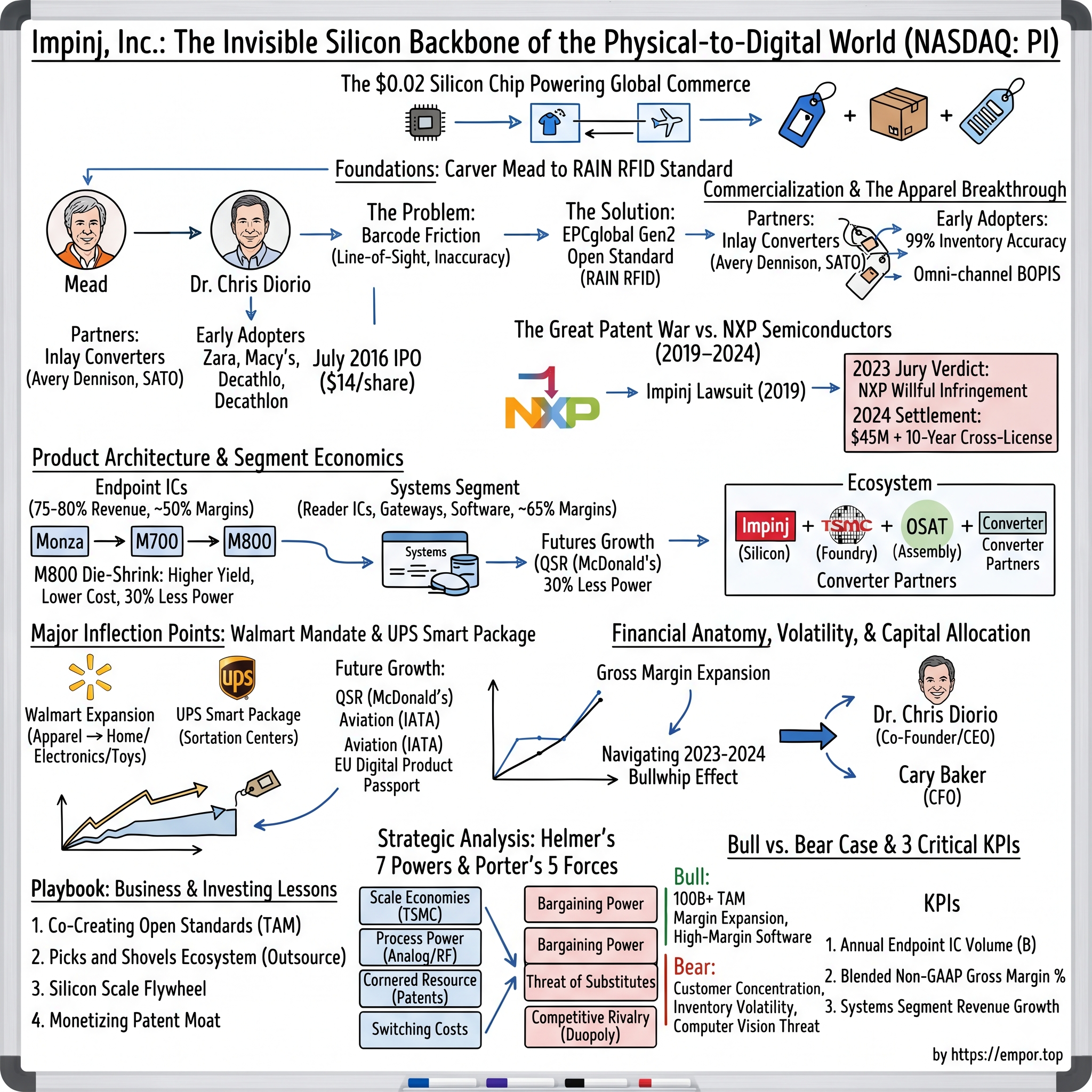
Impinj, Inc.: The Invisible Silicon Backbone of the Physical-to-Digital World
I. Introduction & Episode Roadmap
Walk into a Walmart in Bentonville, a Zara in Madrid, or a UPS sorting hub in Louisville, and the product driving this story remains invisible. Shoppers and workers walk past it hundreds of times. It is a sliver of silicon smaller than a grain of rice, glued to an aluminum antenna and laminated inside a paper label on the back of a T-shirt or the side of a cardboard box. It has no battery and remains dormant until a radio wave washes over it, at which point it harvests a few microwatts of energy from the signal, wakes up, and transmits a serial number unique among the trillions of items manufactured worldwide each year.
That transmission forms the core of the business.
In 2025, the industry that manufactures these chips shipped 42.7 billion units — according to data reported by the RAIN Alliance, the industry standards body that tracks volumes across the four dominant manufacturers.1 That marked a sharp decline from the record 52.8 billion units shipped in 2024.2 Holding both figures in view captures the central tension of the market: while long-term demand expands, short-term volume fluctuates wildly. Impinj, Inc., which has traded on the Nasdaq Global Select Market under the ticker PI since July 21, 2016, sits directly at the center of both dynamics.3
Impinj is not a consumer brand. It is a fabless semiconductor company headquartered in Seattle at 400 Fairview Avenue North, employing 457 people worldwide as of year-end 2025, including 255 in research and development.3 The company generated $361.1 million in revenue in 2025, down slightly from $366.1 million in 2024.3 It has never paid a dividend and has yet to report a full year of meaningful GAAP net profit.3 As of early August 2026, public markets valued the company's equity at roughly $5.6 billion, with a fifty-two-week trading range spanning from $87 to $247 per share — a wide gap that reflects sharp investor disagreement over its trajectory.4
Despite its modest revenue footprint, Impinj occupies a distinct competitive position. It produces both the endpoint integrated circuits — the tag chips inside physical labels — and the reader chips, finished readers, and gateways required to query them. It is one of two primary global suppliers of endpoint silicon, competing alongside NXP Semiconductors. In its annual SEC filing, Impinj lists its endpoint IC competitors as NXP, Kiloway, Quanray, Shanghai Fudan Microelectronics Group, Alibaba, and Alien Technology — though NXP represents its primary rival, leading Impinj into a five-year patent lawsuit against the company.3
The economics of that position differ markedly from standard semiconductor models. Most chipmakers sell higher-priced silicon into limited sockets, such as a processor into a smartphone or a controller into an automobile. Impinj instead sells low-cost integrated circuits into an expansive set of physical targets. With the average selling price of an endpoint chip measured in fractions of a cent, commercial performance hinges almost entirely on volume: how rapidly enterprises choose to apply digital identity to physical goods.
Under this model, opposing investment theses come into sharp focus. The bullish perspective posits that adoption will eventually encompass the majority of manufactured goods, pointing out that current deployment accounts for less than one percent of potential items. The bearish perspective contends that adoption occurs only when large corporate buyers enforce mandates, noting that historical growth waves have depended on a small group of enterprise decisions. Both arguments align with historical data, and the valuation variance between them accounts for the multi-billion-dollar swings seen in the company's market capitalization over the past year.
The central question facing Impinj is whether its foundational strategic choices will build a lasting competitive moat. Co-founded in 2000 by CEO Chris Diorio and his Caltech doctoral advisor Carver Mead, the company staked its strategy on several key premises: that an open radio standard would expand the total addressable market faster than proprietary protocols; that focusing on silicon architecture while relying on partners for downstream applications was the optimal value-chain position; that continuous chip-die shrinkage would lower unit costs enough to unlock high-volume categories; and that its patent portfolio was worth enforcing in court against a competitor twenty times its size. While each decision yielded structural advantages, whether they translate into consistent long-term profitability remains unproven.
Four themes shape the analysis in the upcoming sections. First, the industry's shift from fragmented proprietary RFID systems to the open standard branded RAIN, along with Impinj's decision to support an open ecosystem rather than a closed protocol. Second, the financial mechanics of fabless chip design when unit prices are fractions of a cent and enterprise customers regularly demand price concessions. Third, the strategic impact of the patent dispute with NXP, which began in 2019, resulted in 2023 jury verdicts, and resolved in March 2024 into a structure that now flows Impinj a growing annual license payment.[^5] Fourth, potential expansion avenues across grocery, quick-service food, digital product passports, parcel logistics, and retail categories — such as cosmetics and over-the-counter pharmaceuticals — that Diorio described on the July 2026 earnings call as "gigantic" and untagged.5
A fifth theme addresses operational execution: the company missed its internal first-quarter targets twice in consecutive years due to unexpected demand shifts, as acknowledged by its chief financial officer. The analysis examines these missteps, recognizing that management's handling of operational shortfalls often reveals more about execution risks than steady quarterly beats.
The story begins with two physicists, a whiteboard, and an initial business model that ultimately led to a very different company.
 Subscribe on LinkedIn
II. Foundational Origins: Carver Mead, Caltech, & The Silicon Pioneer (2000–2005)
The founding vision of Impinj had nothing to do with retail, logistics, or item tracking. It focused instead on 3G cellular base stations.
In 2000, Chris Diorio was a physicist by training and an assistant professor of computer science and engineering at the University of Washington, three years into his faculty appointment. His doctoral advisor at Caltech was Carver Mead, a prominent semiconductor pioneer who spent more than four decades on the Caltech faculty, co-authored Introduction to VLSI Systems with Lynn Conway, pioneered the design methodology for large-scale integrated circuits, and coined the term "Moore's Law." Mead's involvement gave the startup immediate credibility across venture capital and academic circles.
What the founders possessed in the lab was not a commercial product, but a physical effect. The company's name originated as an acronym for Impact-ionized hot-electron injection—a mechanism for precisely moving charge onto a floating gate to create analog memory that retains state without continuous power. The technique was technically elegant, but in 2000, it lacked a clear market application.
Madrona Venture Group and ARCH Venture Partners co-led a $15 million seed round in the summer of 2000, splitting the investment evenly.6 The original plan targeted low-power wireless silicon for 3G telecommunications infrastructure. When the dot-com bubble burst and telecom capital spending dried up, that initial business model collapsed. The team spent the next several years searching for alternative applications, evaluating ultrasound, GPS, and other markets. As Diorio later recalled, "The founding vision was none of those things — we settled on RFID because we could make miniature radio chips that were tiny."6
That pivot reflected necessity rather than prescience. Impinj selected radio-frequency identification through elimination, finding that its core expertise—ultra-low-power analog circuits and non-volatile storage on tiny silicon dies—aligned directly with the core constraint of passive RFID tags. Because a passive tag lacks an internal battery, every microjoule of energy required to power its logic, read its memory, and modulate a response must be harvested from the reader's incoming radio signal. An inefficient chip design yields a read range of just two feet, whereas an optimized design can extend that range to thirty feet.
The mechanics of passive RFID rely on backscatter technology. A reader floods an area with radio energy, acting much like a lighthouse. The tag's antenna captures a tiny fraction of that signal—measured in millionths of a watt—and an internal rectifier converts the alternating field into direct current. That small pulse of electricity powers up the chip, which reads its unique serial number from memory. Instead of generating its own radio transmission, the chip toggles the impedance of its antenna, altering how much of the incoming radio wave reflects back to the source. The reader listens to its own reflected signal and decodes the data stream. By eliminating the need for an active transmitter, oscillator, or battery, backscatter keeps unit manufacturing costs down to fractions of a cent.
The underlying engineering challenge centers entirely on power efficiency. Because radio signal strength decays with the square of distance, cutting a chip's power requirement in half roughly doubles the distance at which a reader can activate the tag. That fundamental physics relationship explains why semiconductor designers can spend decades optimizing the same basic circuit architectures while continuing to extract performance gains.
Commercial demand for passive RFID stemmed from the inherent operational limits of the optical barcode. Barcodes require direct line of sight and manual scanning one item at a time. Because manual counting is labor-intensive, retailers historically conducted inventory counts only a few times per year, allowing physical inventory to drift away from database records. That discrepancy creates real costs: items registered as in-stock that are misplaced or missing cannot be sold online, fulfilled for store pickup, or timely reordered. Passive wireless identification drastically lowers inventory tracking costs by allowing handheld or fixed readers to scan thousands of items per minute through packaging materials without requiring direct line of sight.
Industry enthusiasm peaked prematurely in 2003 when Walmart announced a high-profile RFID mandate for its top suppliers. The announcement triggered intense market speculation, projected tag volumes in the billions, and attracted venture investments into scores of hardware startups. However, as Diorio later noted, the underlying technology was not ready for mass commercial deployment: global spectrum allocations were fragmented, unified air-interface standards did not exist, and viable commercial hardware remained scarce.6 Vendors marketed incompatible proprietary protocols, preventing tags from one manufacturer from communicating with readers from another. By 2006, the initial hype cycle had collapsed, leading to widespread startup failures and industry consolidation.
In response to the market contraction, Impinj adopted a strategy focused on open industry standards rather than proprietary architectures. Instead of attempting to lock customers into closed protocols, the company helped lead the development of the EPCglobal UHF Gen2 air-interface standard—later formalized as ISO/IEC 18000-63—while advocating for global spectrum allocations and co-founding the RAIN industry alliance. Today, that alliance includes over 150 member companies, and RAIN RFID operates in license-free spectrum across 81 countries representing approximately 95% of global GDP.3 In 2006, Impinj released the market's first commercial Gen2-compliant products.
The industry's broader rebranding from "RFID" to "RAIN"—evoking radio waves connecting physical items to cloud databases—formed part of that repositioning strategy. The change sought to distance the technology from the premature expectations of 2003 and privacy concerns regarding item tracking. For enterprise buyers cautious after early failures, the unified RAIN brand offered a standardized, interoperable ecosystem.
Establishing an open standard created direct competition with suppliers such as NXP, which manufacture to the exact same specifications. However, open standards also eliminated single-source vendor risk for major enterprise customers. Large retailers were unwilling to mandate tags across millions of products if switching suppliers required redesigning their entire reader infrastructure, and label converters resisted building specialized manufacturing capacity around single-source chips. By lowering switching costs, the open standard shifted enterprise evaluation from proprietary architecture choices to overall adoption volume.
Building a viable market required significant time and capital. Although the Gen2 standard achieved ratification in the mid-2000s, broad commercial adoption did not materialize until around 2010, when major retailers including Macy's, Decathlon, and Marks & Spencer initiated large-scale item-level tagging programs to improve inventory accuracy.6
Diorio later reflected on the prolonged development cycle, stating, "Any transformative technology takes time. The 'fail fast' mantra works for disruptive approaches — not when inventing a new category."6 While such framing can serve to rationalize extended burn rates, Impinj's capital trajectory illustrated the patient backing required. The company raised approximately $125 million across multiple private funding rounds prior to its initial public offering, securing strategic investments from Taiwan Semiconductor Manufacturing Company, UPS, and Unilever—representing a cross-section of semiconductor manufacturing, global logistics, and consumer goods.6
Sixteen years after its founding, Impinj finally had a commercial market mature enough to support a public offering.
III. Commercialization, Apparel Invasion, & The 2016 IPO (2006–2016)
The foundational architectural decision for Impinj involved determining which parts of the value chain to avoid.
The physical journey of a RAIN tag begins as a silicon wafer at a semiconductor foundry, where it is diced into microscopic dies just a few hundred microns wide. Those dies are bonded to antennas—strips of etched aluminum or printed conductive ink—on high-speed roll-to-roll manufacturing lines, creating an intermediate assembly known as an inlay. Converting partners then laminate the inlay into paper labels, print them with barcodes, prices, and brand logos, and ship the finished rolls to garment factories and distribution centers worldwide for item application.
Every stage past wafer fabrication represents a converting business characterized by capital-intensive equipment, thin operating margins, high volumes, and fragmented regional competition. Impinj chose to focus on designing silicon dies while relying on third parties for downstream conversion. The company sells its endpoint integrated circuits to inlay manufacturers and tag original equipment manufacturers—including Avery Dennison, Beontag, Checkpoint Systems, and SATO—which handle assembly, lamination, printing, and distribution.3 Impinj also outsources nearly all chip fabrication and assembly: TSMC has manufactured its endpoint IC wafers since 2003, post-processing is performed by specialized subcontractors including Stars Microelectronics in Thailand, Chipbond, and Unisem, and contract manufacturer Plexus has built its readers and gateways since 2005.3
This structure allows the company to reach tens of billions of physical items annually with minimal fixed capital overhead. In its SEC filings, management describes this approach as a capital-efficient operating model designed to scale with volume—a structure reflected in financial disclosures showing total capital expenditures of $12.9 million against $361.1 million in revenue for 2025.37 For a semiconductor supplier operating at multi-billion unit volumes, this model yields a lean asset base. However, it also creates an operational constraint: selling exclusively through channel partners limits direct visibility into channel inventory and end-market consumption.
The initial commercial breakthrough emerged in retail apparel due to compelling economics. Apparel retail features high stock-keeping unit counts, broad product variation, and notable inventory shrinkage. Because a single store stocks thousands of distinct size, color, and style combinations, an unrecorded stockout directly results in a lost sale. Retailers deploying item-level tagging improved store inventory accuracy from roughly two-thirds to over 90 percent. Crucially, high inventory accuracy proved essential for omnichannel initiatives, such as buy-online-pickup-in-store and ship-from-store fulfillment, which depend on real-time item visibility.
Global retailers including Inditex's Zara, Macy's, Decathlon, and Marks & Spencer validated the technology at enterprise scale. As these early adopters demonstrated quantifiable returns on investment, adoption across retail shifted from speculative trials to a competitive requirement.
The systems side of the business originated from market necessity rather than an initial product roadmap. In the industry's early years, a scarcity of high-performance readers threatened enterprise rollouts, prompting Impinj to develop fixed readers, gateways, and specialized reader ICs that competing hardware vendors eventually integrated into their own devices and portals. Although developing hardware alongside semiconductor design added operational complexity, controlling both endpoints of the radio link allowed Impinj to develop proprietary protocol enhancements that optimize performance between readers and tags.
By 2016, commercial traction in retail supported a public listing. Impinj priced its initial public offering on July 20, 2016, offering 4,800,000 shares at $14.00 per share, with a 30-day underwriter option for up to 720,000 additional shares, listing on the Nasdaq Global Select Market under the ticker PI.8 RBC Capital Markets, Pacific Crest Securities, and Piper Jaffray served as joint book-running managers, with Needham as lead manager and Canaccord Genuity as co-manager.8 The base transaction raised approximately $67 million in gross proceeds—a modest sum relative to typical technology offerings, indicating that the listing served primarily to establish acquisition currency, public visibility, and balance sheet credibility rather than fund heavy capital expenditures.
Following the initial trading surge, public markets encountered persistent challenges in financial modeling due to the company's distinct product mix. Impinj operates two product lines with contrasting economic profiles. Endpoint ICs function as a high-volume consumables business characterized by sub-cent unit prices, periodic price concessions, and demand tied directly to enterprise tagging volume. Systems—encompassing reader ICs, fixed readers, gateways, production hardware, and software—operate as a capital equipment business subject to project timing. Disclosure in annual SEC filings illustrates this revenue concentration: a gateway deployment for a major North American logistics provider generated 14% of total revenue in 2019, while a self-checkout and loss-prevention deployment for a large European retailer accounted for 13% of revenue in the second quarter of 2021 alone.3 Neither project recurred at a comparable level.
This structural split produced volatile financial performance that complicated straight-line revenue forecasting. Total revenue grew from $112.3 million in 2016 to $125.3 million in 2017, contracted to $122.6 million in 2018, rebounded to $152.8 million in 2019, and dipped to $138.9 million during the 2020 pandemic. Revenue subsequently expanded to $190.3 million in 2021, $257.8 million in 2022, and $307.5 million in 2023.7 Despite top-line expansion, the company generated annual GAAP operating losses continuously from 2017 onward.7
The post-IPO period highlighted the risks of customer concentration and project lumpiness. When revenue declined in 2018 from $125.3 million to $122.6 million, GAAP operating losses expanded to nearly $35 million.7 Because base revenues remained modest, the shift of a single major enterprise rollout into a subsequent quarter created outsized impacts on quarterly results. Investors evaluating Impinj as a broad infrastructure play found that near-term results depended heavily on the procurement schedules of a small number of enterprise buyers.
While higher annual revenue and a larger share of consumables softened the impact of individual project delays, quarterly volatility remained a key feature of the business model. Over its first decade as a public entity, Impinj expanded its footprint and customer relationships while maintaining heavy expenditure on research and development and sales channels—a strategy that prioritized market share over near-term GAAP profitability. This financial dynamic underscored the importance of IP protection and structural profitability, leading into a pivotal multi-year dispute over its core semiconductor patents.
IV. The Great Patent War: Impinj vs. NXP Semiconductors (2019–2024)
The endpoint IC market functions primarily as a two-horse race with a crowded field of secondary players. Impinj sits on one side, while NXP Semiconductors — the Dutch chipmaker with revenue roughly thirty times that of Impinj — sits on the other with its UCODE family. Together, they supply the overwhelming majority of the world's RAIN endpoint silicon. Everyone else listed in the company's SEC filings represents a regional or niche player.3
That market structure carries a specific vulnerability. When two vendors design to the same open standard, durable differentiation rests almost entirely on implementation quality — how effectively a circuit harvests power, how reliably the die attaches to the antenna, and how compact the design can be made. Those engineering implementation details form the core of patentable intellectual property.
Impinj spent two decades accumulating its IP portfolio. As of December 31, 2025, the company held 285 issued and allowed U.S. patents, nine issued international patents, and 39 pending applications across domestic and foreign jurisdictions.3 However, public disclosures highlight a structural limitation within that portfolio: because filings were concentrated primarily in the United States, Impinj maintains "limited ability to assert our IP rights outside the United States."3 That geographic constraint carries operational weight, given that the majority of tag conversion occurs in Asia.
After spending roughly two years trying to resolve its IP concerns with NXP privately, Impinj initiated litigation in 2019.9 What followed was a five-year, multi-jurisdictional legal battle across multiple venues. Impinj filed three patent infringement lawsuits against NXP subsidiaries in federal courts in California and Texas. NXP counter-filed against Impinj in Delaware — a case later transferred to Washington — added counterclaims in Texas, and launched three separate legal actions against Impinj's subsidiary in China.3 The financial burden registered clearly on Impinj's income statement: general and administrative expenses rose from $45.5 million in 2022 to $57.6 million in 2023, driven by legal fees, before receding to $49.8 million in 2024 following the resolution of the dispute.7
The legal tide turned decisively in 2023. Across three U.S. trials, federal juries in California and Texas found that NXP endpoint ICs infringed five Impinj patents evaluated at trial. Juries in Washington and Texas subsequently rejected NXP's claims, finding Impinj did not infringe any of the three NXP patents brought against it, while NXP withdrew all three of its pending actions in China.3
The central ruling came from a federal jury in California on July 14, 2023, which awarded Impinj approximately $18.5 million in damages and lost profits after finding infringement on two patents, determining one violation to be willful.9 The patents in question touched core operational mechanics: one covered Impinj's Enduro method for the IC-to-antenna connection — the physical joint determining tag durability through lamination and printing — while the other covered power-harvesting circuitry critical to read sensitivity.9
Chief Executive Officer Chris Diorio addressed the verdict publicly, stating, "We were disheartened to see a large company copy the patented inventions of a small, innovative company like ours."9
With additional trials pending, the companies reached a settlement on March 13, 2024.[^5] The financial terms established a multi-part compensation structure.
NXP paid a one-time settlement of $45.0 million, recognized in the first quarter of 2024 as non-operating income from litigation settlement below the operating line.3 In addition, NXP agreed to annual license fee payments due every April 1, starting April 1, 2024, tied to NXP's continued use of designated Impinj "Indicator Patents." These annual payments increase by a fixed percentage each year, with no reciprocal payment required from Impinj. The agreement included worldwide non-exclusive cross-licenses between both companies and extends until the underlying Indicator Patents expire in approximately 2034 — a duration of roughly ten years.3
The license revenue has arrived on schedule, generating $15.0 million in the second quarter of 2024, $16.0 million in the second quarter of 2025, and $17.0 million in the second quarter of 2026.35 Because Impinj recognizes the entire annual license fee in the second quarter, Q2 financial results exhibit structural seasonal expansion relative to other quarters — a reporting dynamic that elevates second-quarter gross margins and requires normalization in multi-period modeling.
Despite the recurring income, the settlement carries strategic caveats. NXP retains the contractual right to terminate licensing payments if it successfully designs around all valid claims of the Indicator Patents.3 Impinj's corporate risk disclosures explicitly acknowledge that if NXP breaches the agreement or successfully designs around the patents, "our licensing revenue would decline and our overall results of operations and cash flows would suffer."3
During an April 2026 earnings call, an analyst inquired whether NXP's latest endpoint IC incorporated design-around modifications. Diorio offered a cautious response, noting that Impinj had not yet determined the full technical profile of the new product, while emphasizing that adjudicated older chips remained subject to the agreement. Management expressed "guarded optimism" regarding the anticipated 2027 license payment while declining to speculate on long-term outcomes.5
From a financial analysis standpoint, a high-margin revenue stream accounting for roughly 5% of total revenue with a counterparty-controlled termination clause operates less like an annuity and more like a decaying option. Economically, the licensing revenue functions as a financial bridge, funding research and development while the core product operations scale toward sustainable profitability.
From an accounting perspective, Impinj reported no accrued contingency liabilities as of December 31, 2025 and 2024, and disclosed no ongoing material litigation.3 Independent auditor Ernst & Young LLP issued clean audit reports without restatements, going-concern qualifications, or accounting firm changes.3 Key accounting estimates remain typical for semiconductor design operations, focusing on inventory obsolescence reserves, business combination contingent consideration, and a full valuation allowance against deferred tax assets.3 Maintaining that full valuation allowance means Impinj records no balance sheet asset for past net operating losses; establishing sustained profitability in future periods could prompt a reversal of the allowance, creating a non-cash earnings gain unrelated to core operational expansion.
Beyond immediate licensing income, the multi-year litigation established a legal precedent. By securing jury determinations that a competitor thirty times its size infringed core patents, Impinj demonstrated that its proprietary design innovations in power harvesting and antenna assembly are legally defensible. For a business whose primary competitive separation relies on micro-scale circuit design, establishing legal defensibility provides a meaningful strategic safeguard.
While the legal battle concluded, the technical and commercial competition across the endpoint silicon market continues.
V. Product Architecture & Segment Economics: Endpoint ICs vs. Systems
Although Impinj reports financial results as a single operating segment, its chief executive evaluates the business through two distinct product categories that exhibit fundamentally different economic behavior.3
In 2025, endpoint ICs — the tag chips, whose revenue includes recurring NXP patent licensing payments — generated $299.8 million, accounting for 83% of total revenue. Systems, which encompasses reader ICs, fixed readers, gateways, tag production equipment, and software, generated $61.3 million, or 17%.3 This sales mix fluctuates based on enterprise deployment schedules. In 2023, for instance, endpoint ICs generated $234.4 million while systems generated $73.1 million, driven by elevated project expenditure.3 Because Impinj does not report gross margins separately by category, relative profitability remains undisclosed. Management notes, however, that the transition toward newer endpoint chip generations serves as the primary catalyst for gross margin expansion, whereas systems revenue margin fluctuates depending on product mix.5
The core driver of margin expansion in high-volume silicon is die shrinkage and wafer optimization. Because the cost of processing a silicon wafer remains largely fixed regardless of circuit design, reducing chip surface area increases the yield of sellable dies per wafer, lowering unit production costs. Impinj transitioned to 300-millimeter wafers with its M700 family, yielding roughly twice as many chips per wafer as competing solutions available at the time.3 In 2023, the company introduced the M800 series — including the M830 and M850 — achieving approximately 25% more die per wafer than the M700 generation while reducing power consumption by roughly 30%.310
These dual improvements address different sides of the income statement. The 25% increase in die density directly improves unit economics by lowering cost per chip. The 30% reduction in power consumption improves tag read sensitivity, expanding effective operating range and allowing tags to function near liquids and metals — materials that absorb or reflect radio signals. Improved sensitivity enables tagging in challenging categories such as packaged food, beverages, and personal care products, where physical interference previously hindered performance.
Chief Financial Officer Cary Baker quantified the financial impact, stating that the M800 architecture will eventually generate approximately 300 basis points of gross margin expansion as it fully replaces older chip generations. In the second quarter of 2026, product gross margin expanded by about 120 basis points sequentially, with management forecasting a comparable increase in the third quarter.5
This cost reduction mechanism provides a structural offset to limited pricing leverage. Impinj negotiates endpoint IC pricing annually with original equipment manufacturers, effective at the start of each calendar year, with adjustments typically favoring buyers. Baker estimated the net impact of the 2026 price adjustments at approximately $2 million, describing the pricing strategy as "maybe a little bit on the aggressive side as we were driving pricing to support the food ramp."5 Voluntary price concessions illustrate a strategic posture that prioritizes market volume over short-term unit margin, relying on scale to unlock high-volume segments such as quick-service food and grocery.
The systems category, while representing a smaller share of revenue, provides strategic leverage across the product architecture. Impinj's E-family reader ICs power handheld and fixed readers produced by third-party manufacturers. In its SEC filings, the company notes that "most major reader and gateway suppliers leverage, or have a stated intent to leverage, our platform."3
Controlling technology at both ends of the radio link enabled the introduction of Gen2X, a series of protocol extensions designed to enhance system performance when Impinj reader ICs communicate with Impinj endpoint chips. Released in December 2024 and expanded in November 2025 to include tag verification, accelerated reinventory, and selective tag reading, Gen2X was integrated into more than 100 inlay designs and 50 reader models within its first year.11 To encourage broader adoption, Impinj licenses the technology to third parties: EM Microelectronic signed a licensing agreement in late 2025, while Qualcomm incorporated Gen2X support into its Dragonwing Q-6690 processor, launched on September 2, 2025 as the first enterprise mobile processor with integrated UHF RFID capabilities.125
Gen2X represents an effort to build proprietary feature enhancements on top of an open industry standard. While an open standard established the broader RAIN market, proprietary extensions allow Impinj to capture additional value when customers adopt its full product ecosystem. Asked during a February 2026 investor call whether Gen2X would serve as a primary catalyst for market share gains, Diorio responded, "I'm going to answer the question yes."5 This strategy introduces differentiation and customer switching costs, though its ultimate success depends on whether enterprise buyers accept proprietary extensions within an ecosystem originally built around open interoperability.
A third architectural evolution involves custom ASICs. In late 2025, Impinj began shipping a specialized integrated circuit designed for a major North American supply chain and logistics customer, streamlining features while adding specialized capabilities such as label authentication.5 Diorio confirmed that Impinj retains ownership of the underlying intellectual property, maintains a high market share with the customer, and intends to develop additional custom chips as requirements dictate, while remaining cautious regarding the operational complexity of managing multiple custom stock-keeping units.5
Concurrently, Impinj is increasing processing capacity at the network edge. In April 2026, Diorio announced processor and memory upgrades to the company's flagship reader to enable on-device machine learning, alongside a planned Gen2X update for reader ICs and fixed readers expected to improve M800 tag read range by up to 25% — building upon a prior update that increased reader sensitivity by over 40%.5
On-device processing addresses a persistent operational challenge in automated tracking: fixed readers in distribution centers and retail stores frequently detect tags outside the target scanning zone. By processing signal data locally, edge hardware filters background reads to verify specific physical movements — confirming, for instance, that an item passed through a specific dock door rather than remaining on an adjacent shelf. Management frames this capability as shifting from raw radio reads to verified enterprise events.5
Diorio presents this edge intelligence as complementary to broader enterprise artificial intelligence deployments, arguing that AI models depend on accurate physical data, and that serialized RFID reads provide verifiable ground truth for supply chain operations.5 While this positions RAIN technology within enterprise software architectures, its commercial valuation remains tied to physical deployment volume.
VI. Major Inflection Points: The Walmart Mandate & UPS Smart Package Rollout
Two enterprise deployments have driven Impinj's addressable market growth far more effectively than its direct marketing efforts. Neither enterprise buys directly from Impinj; instead, both purchase tags from converters who source silicon from Impinj—making them what Diorio calls channel partners.
Walmart functions as the primary demand-side flywheel. After validating item-level tagging in apparel, the retail giant instructed suppliers to tag home goods, sporting goods, electronics, and toys by September 2022. It subsequently expanded the mandate to more than a dozen additional product lines with a February 2024 compliance deadline, encompassing automotive, books, camera supplies, crafts, hardware, lawn and garden, media and gaming, paint, and stationery.13
The mechanics of this expansion explain why a single retailer's operational directive can shift volumes across the entire semiconductor supply chain.
Walmart does not purchase tags directly. Instead, it requires tens of thousands of suppliers to apply RAIN tags to goods delivered to its distribution hubs. Suppliers without internal RFID capabilities purchase compliant labels from converters, who in turn buy endpoint ICs from semiconductor manufacturers. Consequently, suppliers absorb tag costs, while the retailer gains inventory precision, improved omnichannel fulfillment, and fewer out-of-stock items, driving unit volume to chipmakers. Walmart merchandising executives cited "dramatic results in our ability to ensure product is available for our customers."13 This model represents a highly effective demand-generation structure, allowing a single corporate directive to convert an entire vendor ecosystem without direct software or hardware expenditure by the retailer.
This multi-tiered model also accounts for disclosure practices that often frustrate financial analysts. Impinj rarely identifies end-user deployment partners by name. On the July 2026 earnings call, when asked about a food-tagging initiative at "the largest retailer in the United States," Diorio stated, "we as a company tend to let our partners and customers speak for themselves."5 This indirect commercial relationship creates an information asymmetry for investors. Impinj sells almost exclusively through channel intermediaries rather than directly to end users, a dynamic the company's annual SEC filing identifies as a key operational risk, noting that its "ability to affect or determine end-user demand is limited."3
UPS serves as the primary supply-side flywheel, representing a highly complex logistics implementation. The carrier integrated RAIN reading infrastructure across its sorting facility network and transport fleet, equipping roughly 60,000 vehicles by year-end 2024 and planning for an additional 40,000 in 2025.14 A major hub operates upwards of 155 miles of conveyor belts and processes over four million packages daily. Published operational data highlights the scale of the deployment: the initiative eliminated approximately 20 million manual barcode scans per day, reduced package misload rates by 67% after implementation, and achieved item positioning accuracy within approximately three feet.14
These operational metrics represent substantial productivity improvements. In parcel logistics, a 67% drop in misloads reduces missed delivery windows, eliminates secondary delivery routes, and decreases customer support requests—offering a clear case study for competing logistics networks.
Impinj is expanding upon this deployment. The custom ASIC developed for UPS—discussed in Section V—serves as what Diorio termed a door-opener, as the logistics provider applies its internal RFID capabilities to assist commercial customers, introducing Impinj to what management described in April 2026 as "a double-digit number of accounts."5 CFO Cary Baker also clarified a structural seasonal pattern: peak chip purchasing by inlay partners supporting this customer occurs during the second and third quarters, followed by a sharp fourth-quarter drop as the supply chain adjusts for annual supplier reallocations.5 This procurement cycle operates independently of the logistics provider's peak seasonal package volumes, presenting an important variable for quarterly financial modeling.
Three additional market opportunities represent potential future growth waves, though each carries distinct timing and execution profiles.
Quick-service food and grocery represent significant long-term addressable markets that remain in early adoption stages. On the July 2026 earnings call, Diorio outlined four primary deployment categories: store replenishment in quick-service restaurants; in-store inventory management in supermarkets focusing on stock levels and expiration tracking; loss identification for unscanned items at checkout; and automated self-checkout, spearheaded by a major vertically integrated European grocer.5 While three of the five largest U.S. grocery chains have initiated pilots or deployments in bakery, deli, and meat departments, Diorio noted that initial implementations still account for "a modest number of endpoint ICs relative to current RAIN industry volumes."5
Evaluating these four food applications requires examining their underlying silicon consumption. Quick-service restaurant replenishment relies on tagging transport totes and master cases shipped between distribution centers and outlets, yielding high operational value per read but modest total chip volume. Supermarket inventory management tags individual perishable items across specific departments, such as bakery, deli, and meats—the current focus of chain-wide rollouts. Point-of-sale loss identification requires tagging high-shrink items, whereas automated self-checkout requires tagging every item across an entire store, representing the largest potential unit volume but also the highest technical hurdle. Consequently, total chip demand scales alongside deployment complexity across these categories.
The financial rationale for grocery adoption is clear in high-loss categories. Diorio highlighted one supermarket operator reporting $100 million in annual point-of-sale inventory shrinkage, heavily concentrated in meat, poultry, wine, beer, and spirits.5 For high-value items, applying a sub-cent endpoint IC provides a straightforward return on investment. Adoption challenges center on environmental physics and supply chain integration: food packaging often involves high moisture, cold temperatures, or metallic foils that obscure radio signals, while tag application requires coordination across external packaging suppliers. The vertically integrated European grocer cited by management controls its own production and distribution network, enabling it to mandate tag application internally.5 Impinj and its ecosystem partners met the grocer's lab readability benchmarks and, as of April 2026, were awaiting authorization for a live store trial.5
Aviation baggage tracking represents a steady, incremental growth segment. Although International Air Transport Association Resolution 753 mandates end-to-end baggage tracking for member airlines, optical barcode scanning remains the predominant technology, utilized at approximately 75% of surveyed airports. RAIN RFID adoption stands at roughly 27% across all facilities, rising to 54% at high-volume hub airports.15 While representing an established long-term market, baggage tracking serves as a gradual expansion driver rather than an immediate volume inflection point.
The European Union Digital Product Passport (DPP) introduces a regulatory catalyst. RAIN RFID has been approved as an official data carrier under DPP regulations. The delegated regulation governing textiles is scheduled to take effect in 2027 with an estimated 18-month grace period, leading Diorio to project that DPP volume contributions will become "meaningful near the end of this decade."5 Management links this regulatory mandate to broader consumer engagement, enabling smartphones to read product tags via integrated processors such as Qualcomm's enterprise mobile chipsets. From a valuation perspective, DPP represents long-term strategic optionality rather than a near-term revenue driver.
Across each of these expansion vectors, Impinj's growth velocity remains dependent on procurement decisions made within client boardrooms. This reliance highlights the structural trade-off of a component-supplier business model: while providing broad exposure to physical-to-digital adoption, top-line performance remains tied to end-market deployment schedules and corporate mandates.
VII. Financial Anatomy, Supply Chain Volatility, & Capital Allocation
On February 5, 2026, Impinj reported a fourth quarter that was fine and guided to a first quarter that was not. Revenue guidance of $71 million to $74 million came in roughly $17 to $18 million below where analysts sat.165 The first question on the call, from Harsh Kumar, was essentially: what happened, and why should we believe your claim that it fixes itself by the second quarter?
The answer Baker gave is the most instructive passage in three years of Impinj disclosure, and it goes to the heart of what this business model costs.
Impinj's second large North American supply chain and logistics end user rebids its label suppliers annually. Ahead of that rebid, inlay partners hoping to win a larger allocation bought M800 chips in advance. They felt safe doing so because the M800 is a general-purpose part — if they lost the award, they could push those chips into apparel or general merchandise instead. The award came in oversubscribed. The partners who won less than they hoped were left holding inventory they had to burn down. And because that inventory sat in the channel rather than on Impinj's balance sheet, Impinj could not see it. As Baker put it, the company's own fourth quarter "came together as we expected," but when it reconciled unit volumes against channel inventory reports in mid-January, it realized "the logistics-related build had masked the weakness in retail."5
Each week of channel burn-down, he said, is worth roughly $5 million of revenue.5
This had happened the year before too, for different reasons, also centered on the same customer. Baker acknowledged both directly: "After missteps in the last couple of Q1s, yes, we're very alert to this."5 That is a CFO taking ownership rather than blaming macro, and it should count for something. He also said, twice, "we have to prove it to you" — first about 2026, then about the first quarter of 2027.5
The fix is structural rather than promissory, which is why it is credible. Because the custom ASIC ships only to that one customer and can be used by no one else, Impinj can now match its shipments directly against the customer's monthly consumption reports. What is shipped minus what is consumed equals what is in the channel. The fungibility that made the M800 commercially convenient is exactly what made it invisible.5
This dynamic has a longer history than two quarters, and 2023 was the textbook case. Coming out of the pandemic, retailers and their suppliers over-ordered across virtually every category, terrified of running short. Impinj's first two quarters of 2023 were $85.9 million and $86.0 million — solid, sequentially stable, apparently healthy. Then the third quarter collapsed to $65.0 million and the fourth recovered only to $70.7 million.7 Nothing about end demand had changed by 25% in ninety days. What changed was that converters stopped ordering chips and started consuming the ones already on their shelves. That is the bullwhip effect in its purest form: a small wobble in end demand, amplified at each upstream layer, arriving at the chip supplier as a violent swing.
Management's response to that downturn tells you something about its priorities. Research and development spending rose in 2023 rather than falling, from $74.1 million to $88.6 million, funding the M800 launch and next-generation reader silicon straight through the trough.7 The company did take a restructuring charge of $1.8 million from an action initiated on February 7, 2024 — modest, and the only one in recent years.3 Then the recovery came hard: 2024 revenue of $366.1 million was up 19%, and the fourth quarter of 2023 turned out to have been the bottom.7 Spending through a cyclical trough to be ready for the recovery is the correct playbook in a market like this, and it is the strongest single piece of evidence for management's willingness to manage the business on a multi-year horizon rather than a quarterly one.
Set against that, 2025 as a whole was a demonstration of relative strength in an ugly market. Industry endpoint IC volumes fell from 52.8 billion to 42.7 billion — roughly a 19% decline — driven by tariff-related supply chain whipsaws, retail destocking, and, in Diorio's telling, excess channel inventory of competitor chips working its way through.125 Impinj's own endpoint IC unit volumes grew 9% in the same year.5 When the RAIN Alliance published 2025 industry volumes, Impinj calculated that its market share had risen 1,700 basis points over 2024.5
Take a moment with that. A seventeen-point share gain in a single year, in a two-player market, in a down year, is an extraordinary result if accurate — and the number is Impinj's own calculation off third-party industry data, so treat it as management's estimate rather than an audited fact. But the corroborating evidence is reasonable: revenue held roughly flat at $361.1 million against a 19% industry unit decline, and the mix shift toward the M800 pushed full-year gross margin to 55.3% from 54.0% in 2024.316 Adjusted EBITDA reached a record $69.6 million, a 19.3% margin that Baker noted was in line with the long-term model management had shared at its 2023 investor day.165 Free cash flow was $45.9 million.16
The GAAP picture is less flattering and worth stating plainly. Impinj lost $10.8 million on a GAAP basis in 2025 and has posted a GAAP operating loss every year since 2017.7 The 2024 GAAP net income of $40.8 million was primarily the NXP settlement, not operations.7 The company carried $275.8 million of U.S. federal net operating loss carryforwards and $43.7 million of federal R&D credits at the end of 2025, against which it holds a full valuation allowance.3 The gap between adjusted EBITDA and GAAP results is mostly stock-based compensation, and any investor using the non-GAAP figures should know they are excluding a real economic cost paid in dilution.
Then the recovery arrived faster than management guided. First quarter 2026 revenue of $74.3 million beat the top of the range, and endpoint IC bookings hit an all-time record.17 The second quarter, reported July 29, 2026, was a genuine record: revenue of $108.4 million, up 46% sequentially and 11% year over year; endpoint IC revenue of $96.4 million; gross margin of 60.9%; adjusted EBITDA of $30.7 million at a 28.3% margin; non-GAAP net income of $27.0 million, or $0.86 per fully diluted share.18 Bookings set an all-time high for the second consecutive quarter. Third quarter guidance of $105.5 million to $108.5 million implied a 17% sequential increase over second quarter product revenue at the midpoint.18
Strip out the $17 million NXP license and the picture is more measured but still strong: product gross margin of 53.6% versus 52.6% a year earlier, and adjusted EBITDA margin of 15% rather than 28.3%.185 That is the honest version, and management provided it unprompted — a disclosure habit worth crediting.
On the risk radar, two exposures are material and one is frequently overstated.
Trade policy is material and mechanical. Impinj does not sell to consumers, but its chips ride on goods that cross borders, and the company says so plainly: because most of its revenue derives from endpoint ICs that partners embed into items, "to the extent that those items are impacted, positively or negatively, by trade measures and tariffs, we are impacted as well."3 The effect runs in both directions and on a lag. Diorio attributed part of the 2025 industry decline to tariff-related whipsaws and a downward trend in apparel imports; in the second quarter of 2026, by contrast, retailers pulled orders forward ahead of a July tariff reset, which Baker sized as a small benefit and explicitly ranked third among the drivers of the quarter's booking strength.5 Management's willingness to name a favorable one-off as small, rather than let investors extrapolate it, is a point in its favor.
Geographic concentration is the second material exposure, and it is structural. Wafer fabrication sits with a single foundry primarily in Taiwan, wafer test and assembly sit with subcontractors across Asia, and China plus Hong Kong accounted for $159.2 million of 2025 revenue by shipment destination.3 There is no dual-sourcing arrangement disclosed and no long-term supply contract. A meaningful disruption in the Taiwan Strait would not be a margin problem for Impinj; it would be an existential one. That risk is unhedgeable and shared with much of the semiconductor industry, but it is more acute for a company with one foundry and no contractual capacity commitment.
The frequently overstated risk is AI displacing the technology. The more plausible reading, discussed in Section IX, is that AI raises the value of verified physical-world data. The genuine AI-adjacent risk is narrower and sits inside the company: Impinj's own filings note that increased adoption of AI by it and its partners may raise cybersecurity exposure.3 That belongs on the list, but not near the top.
On capital allocation, the record is conservative bordering on cautious. Impinj has made one meaningful acquisition in its history: Voyantic, a Finnish maker of RFID inlay and label test-and-measurement equipment, in 2023, for undisclosed terms.19 It fits the strategy logically — if solution reliability depends on label quality, owning the tools that measure label quality is a sensible adjacency — but it also contributed to the test-and-measurement revenue that declined in 2025.16 There is no pattern of empire-building here. Asked in April 2026 about inorganic opportunities, Diorio's answer amounted to: we keep our eyes open.5
The balance sheet activity has been about managing dilution. Impinj issued $287.5 million of 1.125% convertible notes due May 2027 in November 2021. In September 2025 it issued $190.0 million of 0% convertible notes due September 2029 and used the proceeds plus cash to exchange $190.0 million of the 2021 notes for cash and approximately 811,000 shares, booking a $15.0 million induced conversion expense.3 In March 2026 it opportunistically repurchased a further $40.2 million principal of the 2021 notes with cash on hand, which Baker framed as eliminating roughly 400,000 shares of dilution.175 The company ended the second quarter of 2026 with $263.7 million in cash and investments and $91.5 million of inventory.18 Refinancing risk on the remaining 2027 maturity appears manageable.
On management. Chris Diorio, 64, remains CEO and vice chair, and beneficially owned 752,164 shares — about 2.5% of the company — as of the 2026 proxy.20 His total reported compensation was $7.1 million in 2025, $11.2 million in 2024, and $6.8 million in 2023.20 The detail that matters for credibility: his non-equity incentive plan compensation was zero in both 2023 and 2025, and $954,825 in 2024.20 The annual bonus plan is tied to financial metrics, and in the two years the company underperformed, the bonuses did not pay. That is pay-for-performance functioning as designed, which is more than can be said at many companies of this size.
Cary Baker has been CFO since February 2020, arriving from RealNetworks.20 His communication style on calls is unusually specific — sizing individual effects in basis points and dollars rather than gesturing at "headwinds" — and he volunteers unflattering detail.
The governance question a skeptical investor should press is bench depth. As of the 2026 proxy, Impinj listed exactly two executive officers: Diorio and Baker. Chief Operating Officer Hussein Mecklai resigned effective May 20, 2025, and Chief Innovation Officer Cathal Phelan ceased to be an executive officer effective June 5, 2025.20 The company added Chris Hundley as executive vice president for enterprise solutions in late 2025 to lead the software push.5 But a founder-CEO in his mid-sixties with two decades of tenure, a two-person executive roster, and no publicly identified successor is a real governance exposure — particularly at a company whose competitive position rests substantially on that founder's technical authority. Institutional ownership is concentrated: FMR at 13.3%, BlackRock at 12.4%, and Capital International at 5.0%.20
VIII. Playbook: Business & Investing Lessons
Strip away the company-specific details and four transferable lessons remain. Each offers analytical value, and each carries a clear structural limit.
1. Co-creating an open standard can expand the addressable market far more than owning a closed one. The counterfactual is instructive. Had Impinj won a proprietary standards war in 2005, it would likely control most of a market a fraction of its current size — because major retailers like Walmart will not mandate a single-source technology across tens of thousands of suppliers, and label converters will not construct specialized facilities around a single chip vendor. By spearheading the open air interface, lobbying for global spectrum, and co-founding an industry alliance that now spans more than 150 members across 81 countries, Impinj deliberately fostered its own competition in exchange for expanding the annual market to tens of billions of units.31
The limitation: an open standard shifts competitive separation from proprietary architecture to cost and execution, creating a demanding pricing environment. Impinj faces routine annual price concessions and must continually maximize die yield per wafer. Open standards expand total addressable markets, but they do not automatically generate pricing power. Capturing durable margin expansion requires secondary mechanisms — such as the proprietary Gen2X protocol features — which have yet to demonstrate definitive pricing leverage at scale.
2. Sell the pick, not the shovel, and definitely not the mine. The downstream converting layer — inlay assembly, lamination, printing, and regional distribution — requires heavy capital investment while operating on thin margins amidst fragmented competition. Impinj bypassed those conversion steps to focus exclusively on silicon design. The financial efficiency of that choice is evident on its balance sheet, where capital expenditures totaled $12.9 million against $361.1 million in 2025 revenue.163
The limitation is precise and operational. Selling through an unowned distribution channel reduces direct visibility into end-market consumption. As documented in early 2026, two consecutive first-quarter guidance shortfalls stemmed from accumulated inventory inside converter warehouses that remained hidden from internal reporting. Developing a custom integrated circuit addresses this visibility gap for a specific customer by creating a non-fungible stock-keeping unit. More broadly, however, a capital-light distribution model trades balance sheet liability for information asymmetry — and that information gap can trigger guidance revisions and valuation multiple compression.
3. The die-shrink flywheel is the most reliable margin mechanism in commodity semiconductors. Shrinking chip surface area yields more dies per wafer, lowers unit manufacturing costs, enables competitive pricing in price-sensitive categories, drives higher volume, and unlocks further manufacturing scale. Impinj has executed this cycle repeatedly, transitioning to 300-millimeter wafers with the M700 generation and subsequently increasing die yield per wafer by approximately 25% with the M800 series — a progression projected to yield 300 basis points of gross margin expansion once fully deployed.35
The limitation lies in the predictable nature of chip design cycles: competitors can anticipate manufacturing roadmaps, and enterprise buyers can factor expected cost reductions into price negotiations. Furthermore, Impinj periodically reinvests these cost savings into strategic growth, offering competitive pricing on M800 chips to accelerate adoption in quick-service food and grocery.5 Reinvesting unit cost reductions into volume acquisition functions as a growth strategy rather than a pure margin expansion driver.
This dynamic illustrates a broader economic principle across component manufacturing: a cost reduction in a commodity component is only as valuable as the proportion a company can retain. Impinj's channel partners negotiate pricing annually while maintaining alternative sourcing options. In such market structures, manufacturing savings are shared between supplier and customer based on relative bargaining leverage. Financial disclosures indicate Impinj has retained a portion of these gains, as full-year gross margin expanded from 54.0% in 2024 to 55.3% in 2025 alongside rising unit volume and lower unit pricing.16 Nevertheless, modeling continuous margin expansion requires accounting for ongoing pricing concessions to end customers.
4. A patent portfolio is an asset only if a company is willing to litigate it. Impinj accumulated intellectual property for nearly two decades before initiating enforcement. Monetizing those assets required a five-year, multi-jurisdictional litigation campaign against a significantly larger competitor, generating substantial legal expenses within general and administrative line items and carrying real risk of invalidation.7 The ultimate resolution — combining a one-time settlement with a decade of rising annual licensing fees — validated the enforcement strategy.
This asset carries two notable limitations. First, enforcement capability is geographically constrained: Impinj's portfolio is concentrated in U.S. filings, leaving limited legal recourse outside the United States within an industry where conversion and assembly occur predominantly in Asia.3 Second, patent litigation provides a defensive moat rather than an offensive growth vector; while enforcement prevented a major rival from copying key designs, it did not directly generate new customer conversions. Consequently, applying standard valuation multiples to recurring litigation settlements misinterprets their strategic function.
A broader lesson underpins these strategic choices, though it is frequently misconstrued. Impinj is often cited as evidence that long-term patience validates category creation — navigating twenty-six years from initial formation through market hype cycles and strategic pivots to reach record quarterly revenues. However, that interpretation risks survivorship bias. Numerous RFID startups from the early 2000s possessed equal conviction yet failed to navigate the prolonged market adoption cycle.
Impinj succeeded not through conviction alone, but through a distinct alignment of factors: a core technical capability in ultra-low-power analog design that solved the fundamental physical constraint of passive tag harvesting; patient strategic investors with a direct interest in supply chain tracking; and a deliberate strategy to open the industry standard to build a viable market ecosystem. Without those specific technical and structural foundations, patience alone remains an incomplete strategy.
Taken together, these strategic advantages are real, but each remains slow-acting, self-limiting, or dependent on external enterprise decisions. That framework shapes the ultimate strategic evaluation of the business.
IX. Strategic Analysis: Helmer's 7 Powers & Porter's 5 Forces
Strategic frameworks are useful when they force an analyst to distinguish between an advantage a company has and an advantage it merely claims. Applied to Impinj, the exercise reveals a mixed competitive profile.
Where the powers are real
Process Power represents the company's strongest structural advantage, supported by empirical evidence rather than assertion. Designing an integrated circuit that powers up, reads memory, executes cryptographic logic, and modulates a backscatter signal using only microjoules harvested from ambient radio waves — produced for fractions of a cent across tens of billions of units — requires capabilities that cannot be rapidly acquired. Two decades of accumulated analog and radio-frequency engineering underpin this position. The litigation record provides external validation: federal juries determined that NXP, a competitor with roughly thirty times Impinj's revenue, infringed patents covering its power-harvesting and antenna-attachment designs.39 A rival does not copy engineering that it can easily replicate independently.
Cornered Resource takes the form of an extensive patent portfolio, though the asset remains bounded and subject to expiration. Impinj holds 285 issued and allowed U.S. patents, but filings remain concentrated primarily in one jurisdiction, with eleven utility patents expiring in 2026 alone and the key Indicator Patents tied to the NXP licensing agreement set to expire around 2034.3
Scale Economies exist primarily in wafer procurement and chip fabrication. As volume grows, mask sets and design expenses amortize over a larger unit base, reinforcing the die-shrink cost cycle. However, this scale advantage is relative and incomplete. While Impinj maintains substantial volume in passive tag silicon, NXP's competing division operates within a far larger global semiconductor business with significantly greater overall purchasing scale.
Switching Costs remain the most contested element of the business model. At the standalone component level, switching costs are low: inlay converters regularly qualify and substitute rival chips. Management is attempting to build higher switching costs at the system level through integrated hardware and software. When an enterprise customer deploys machine-learning read-zone filtering built on the Gen2X protocol — combining Impinj endpoint ICs, reader chips, firmware, and software — replacing an individual layer disrupts system functionality. CEO Chris Diorio argued that integrated solutions "outperform mix and match efforts using competitor products," framing the strategic intent.5 Yet this system-level moat remains prospective, as Impinj explicitly characterizes its capacity to deliver enterprise solutions at scale as "nascent" in its regulatory filings.3 The resulting moat remains under construction rather than fully established.
Network Economies exist at the industry standard level rather than the company level — a structural dynamic that limits proprietary capture. As total RAIN deployments expand, the broader ecosystem becomes more valuable for all participants, including direct competitors such as NXP.
Branding and Counter-Positioning offer minimal strategic separation. The Impinj brand carries weight among specialized enterprise engineers and procurement officers, but ultimate end consumers rarely interact with the label brand.
How Impinj compares to the people it shares a market with
Direct peer comparisons are challenging because Impinj lacks a pure-play public equivalent. Its primary rival, NXP Semiconductors, presents a stark structural asymmetry: RAIN RFID constitutes nearly all of Impinj's operational focus, whereas it represents a fraction of NXP's broader portfolio spanning automotive, industrial, mobile, and secure identification markets. This asymmetry creates distinct trade-offs. NXP possesses the balance sheet strength to absorb prolonged pricing pressure in tag silicon without existential risk, whereas Impinj cannot. Conversely, NXP cannot easily align its entire product roadmap around a single retailer's technical requirements. Operational focus represents a primary strategic defense for a specialized competitor, and Impinj has leveraged that focus to maintain design leadership in core chip physics.
An instructive comparison lies with the converting layer directly above chip design. Avery Dennison, the largest tag converter and part of Impinj's primary customer base, operates as a diversified materials company where intelligent labels form one segment among several. Its capital intensity, operating margins, and raw material exposures differ fundamentally from Impinj's fabless design model. While both companies benefit from expanding RAIN adoption, Avery Dennison operates high-speed conversion machinery and maintains physical inventory, whereas Impinj focuses on semiconductor architecture. Consequently, when industry demand contracts, Impinj's asset-light model limits fixed overhead, but its position upstream behind channel inventory intermediaries amplifies top-line revenue volatility during supply chain corrections.
The five forces
Rivalry: high, and structurally persistent. Competing against NXP to supply standardized chips creates ongoing margin pressure, exacerbated by annual customer price negotiations. When NXP introduced a new endpoint IC in early 2026, Diorio noted on an earnings call that Impinj had "not seen it significantly in market yet," adding that customer qualification cycles for new chip generations require considerable time.5 While qualification delays are standard in semiconductor procurement, the commercial impact of NXP's new offering will become clearer as 2027 production volumes materialize. Meanwhile, regional manufacturers in China — including Quanray, Shanghai Fudan Microelectronics, and Alibaba — compete aggressively on price within domestic markets. That competition carries direct weight for Impinj, given that shipments destination data for China and Hong Kong accounted for $159.2 million of its total $361.1 million revenue in 2025.3
Buyer power: high, and expanding. Customer concentration has intensified over recent fiscal years. In 2025, three major channel customers accounted for 61% of total revenue — contributing 34%, 15%, and 12% respectively.3 This marked a steady rise from 60% in 2024 and 44% in 2023.3 Impinj acknowledges this vulnerability in its SEC filings, noting that "sales concentration to a small number of OEMs decreases our bargaining power."3 Demand pull from enterprise end users like Walmart provides a partial buffer by creating volume pull-through, but because end users mandate the RAIN standard rather than a specific chip supplier, inlay converters retain the ability to switch endpoint IC vendors if pricing or terms dictate.
Supplier power: high. TSMC fabricates all endpoint and reader IC wafers for Impinj on a purchase-order basis with no long-term supply agreement.3 Similarly, specialized subcontractors perform post-processing, assembly, and test operations without long-term contractual volume commitments. This structure leaves Impinj dependent on third-party foundry capacity concentrated primarily in Taiwan, layering geopolitical exposure onto commercial manufacturing risks. Impinj reported $24.9 million in long-lived assets located in Taiwan at year-end 2025.3 Management has cited "strong support from our foundry partner" to assure investors of wafer availability, pointing to a working relationship dating back to 2003 when TSMC was an early venture investor.56 However, historical relationships do not substitute for binding supply agreements if global foundry capacity tightens.
Threat of substitutes: medium. Traditional 2D barcodes cost virtually nothing to print, but require direct line of sight and manual scanning, preserving the exact labor bottlenecks that RAIN technology addresses. Computer vision coupled with artificial intelligence poses a more complex substitute, as camera networks can track items visually without physical tags as hardware and processing costs decline. Addressing this alternative, Diorio argued that radio readings generate "hard event data" — providing definitive verification that a specific serialized item passed a designated location at a precise moment, without statistical inference.5 For enterprise software systems requiring verified physical tracking, serialized tag reads offer deterministic ground truth at low unit costs. Alternative wireless technologies, such as Bluetooth Low Energy, remain largely complementary: their higher unit costs and battery requirements suit continuous environmental logging rather than high-volume item tagging at multi-billion-unit scale.5 Consequently, optical vision systems are likely to prevail where item tagging is cost-prohibitive, while RAIN RFID retains its advantage where physical data verification is essential.
Threat of new entrants: low to medium. Developing competitive passive endpoint silicon requires specialized ultra-low-power analog design capabilities. While regional competitors periodically enter the market, they compete primarily on price in lower-tier applications rather than challenging established suppliers in high-reliability enterprise deployments.
In sum, Impinj maintains a defensible technical position within a structurally demanding industry. Its primary strengths lie in specialized engineering capabilities and legally defended intellectual property. Conversely, its core vulnerabilities stem from high customer concentration, uncontracted foundry reliance, and demand cycles governed by external corporate capital budgets. The company's strategy to expand system-level solutions represents an ongoing effort to translate circuit design leadership into a durable commercial moat — a transition that remains in its early stages.
X. Bull vs. Bear Case & 3 Critical KPIs
Both investment cases remain grounded in verifiable disclosures, accounting for the persistent volatility in the company's valuation. Before evaluating either perspective, three common market assumptions require examination against regulatory filings.
Myth versus reality
Myth: Impinj operates as a duopolist with strong pricing power. Reality: while holding a primary position alongside NXP in a market built on open standards, Impinj negotiates price concessions with major customers every January.3 Chief Financial Officer Cary Baker characterized these annual reductions as totaling several million dollars, noting that 2026 price adjustments were "maybe a little bit on the aggressive side" to accelerate adoption in quick-service food and grocery.5 A supplier with true pricing power does not grant voluntary price cuts to seed new verticals.
Myth: Walmart mandates and UPS deployments represent growth engines directly controlled by Impinj. Reality: these initiatives reflect internal strategic decisions by large enterprise buyers. Impinj benefits through component demand and provides technical support, but its SEC filings state that its "ability to affect or determine end-user demand is limited in part because we sell and fulfill primarily through partners and rarely directly to end users."3 The company functions as a component supplier to an ecosystem it helped establish, rather than controlling customer deployment schedules.
Myth: The NXP settlement fundamentally transformed core operating economics. Reality: the agreement introduced a high-margin licensing stream accounting for roughly 5% of total revenue, recognized entirely in the second quarter of each year, with a fixed expiration and a counterparty termination clause.3 While providing meaningful cash flow and elevating second-quarter gross margins, the licensing stream represents a non-operational financial bridge rather than a structural change in baseline profitability.
The bull case
The primary bullish thesis rests on long-term addressable market penetration rather than immediate percentage growth rates. In 2025, the industry connected roughly 42.7 billion items — a large figure that accounts for less than one percent of total connectable manufactured goods.16 Under this framework, expanding deployment across existing commercial applications provides a multi-year growth runway without requiring fundamental technological shifts.
Market adoption continues to broaden across multiple sectors. Retail apparel, which Chief Executive Officer Chris Diorio characterizes as being in mainstream adoption, continues to add new brand programs, including Abercrombie & Fitch, Aritzia, Fabletics, Old Navy, and Academy Sports.5 General merchandise is expanding across product categories, while large segments such as over-the-counter pharmaceuticals, cosmetics, and personal care remain largely untagged, according to management disclosures.5 Logistics tracking is extending from parcel sorting into e-commerce and third-party fulfillment. In food retail, three of the top five U.S. grocers have launched public pilots, while a major European grocer is evaluating full-store self-checkout trials. Diorio described the food opportunity as featuring "the opportunity breadth and sheer number of large engaged enterprises, so early in the market cycle, is far larger and faster than anything I've seen in our industry's history."5
Operating leverage is expected to improve through gross margin gains from the M800 chip family, recurring licensing revenue from the NXP agreement through roughly 2034, projected growth in systems sales, and system-level enhancements driven by the Gen2X protocol, custom integrated circuits, and edge processing capabilities.185 Near-term financial results support this trajectory, highlighted by record quarterly revenue, adjusted EBITDA, earnings per share, endpoint chip unit volumes, and consecutive quarters of record customer bookings.18
The bear case
The bearish thesis highlights operational, concentration, and structural execution risks. First, channel opacity remains an ongoing challenge. Because Impinj sells through third-party converters, accumulated channel inventory contributed to consecutive first-quarter guidance shortfalls. Management introduced direct tracking for custom chip customers to improve visibility, though broader channel transparency across general-purpose inventory remains unproven ahead of early 2027 results.5
Customer concentration has intensified. Three primary converter partners accounted for 61% of total revenue in 2025, up from 44% two years prior.3 Allocation shifts by end-user enterprises or market share losses among key converters directly affect quarterly revenue.
Growth velocity remains dependent on external corporate capital decisions. Expansion timelines for retail mandates, carrier network rollouts, grocer trials, and European Digital Product Passport regulations depend on decisions made by end-user capital committees. Consequently, management limits financial guidance to one quarter ahead and refrains from providing multi-year revenue projections.5
Competitive dynamics present ongoing pressure. NXP introduced a new endpoint integrated circuit, while management noted that part of Impinj's 1,700 basis point market share gain in 2025 resulted from competitor channel inventory adjustments — indicating that some share gains could reverse as rival supply chains normalize.5
GAAP profitability remains unestablished. Impinj has generated one year of GAAP net profit over a decade as a public company, driven primarily by a litigation settlement.7 Stock-based compensation accounts for much of the adjustment between reported GAAP operating losses and non-GAAP adjusted EBITDA. Meanwhile, total diluted share count expanded roughly 20% from 2022 through the second quarter of 2026, rising from approximately 25.5 million to 30.5 million shares before accounting for partial offsets from convertible note repurchases.718
Alternative tracking technologies and governance concentration present additional considerations. Computer vision and automated optical scanning systems present potential alternatives in fixed sortation environments if deployment costs fall. From a governance perspective, executive management is concentrated in two officers, with founder Diorio serving twenty-six years without a publicly designated successor.20
The activist's questions
An institutional investor evaluating capital efficiency would likely press management on four specific operational issues:
- What is the strategic rationale for retaining acquisition flexibility when past inorganic capital deployment went toward a test-and-measurement acquisition that subsequently experienced revenue declines?1619
- Why does the systems business — positioned as the higher-margin strategic layer — represent only 17% of total revenue after ten years as a public company, and on what timeline will software capabilities yield transparent financial reporting?3
- What explicit operational milestones will validate progress across early-stage enterprise solutions?
- With $263.7 million in cash, cash equivalents, and short-term investments, and no active dividend or share repurchase programs, what is the long-term plan for capital allocation relative to core operational returns?18
The three KPIs that matter
Three primary metrics provide a framework for evaluating operational execution:
1. Endpoint IC unit volume growth relative to RAIN industry volume growth. This metric isolates market share movement from annual price concessions, product mix shifts, and second-quarter license revenue timing. In 2025, Impinj achieved 9% unit volume growth against an industry-wide unit contraction of roughly 19%, establishing an operational benchmark that requires sustained repetition.512
2. Product gross margin excluding licensing revenue. This metric measures underlying silicon manufacturing productivity and product mix by stripping out NXP licensing revenue. Product gross margin reached 53.6% in the second quarter of 2026, up from 52.6% in the prior-year period, against an anticipated 300 basis points of total gross margin accretion from the M800 chip generation.185
3. Systems revenue performance and solution adoption. This metric tracks the transition from component supplier to integrated solution provider. Systems revenue totaled $61.3 million in 2025, up 2% year over year, before contracting 10% year over year to $12.0 million in the second quarter of 2026.318 Management projects sequential expansion in systems revenue for the third quarter of 2026, driven by reader chip demand; long-term strategic expansion depends on systems revenue outstripping endpoint chip growth.18
Ten years after its public offering — a milestone Diorio acknowledged during the July 2026 earnings call by thanking long-term shareholders — Impinj remains a specialized semiconductor designer possessing defensible technical capabilities, navigating an expanding addressable market, channel inventory opacity, annual price concessions, and customer concentration.5
References
-
RAIN Alliance Reports 42.7 Billion Tag Chip Shipments in 2025 — The RAIN Alliance, 2026 ↩↩↩↩↩
-
RAIN Alliance Report Shipments of 52.8bn RAIN Tag Chips Globally in 2024 — The RAIN Alliance, 2025 ↩↩↩
-
Impinj, Inc. Annual Report on Form 10-K for the year ended December 31, 2025 — U.S. Securities and Exchange Commission, 2026-02-09 ↩↩↩↩↩↩↩↩↩↩↩↩↩↩↩↩↩↩↩↩↩↩↩↩↩↩↩↩↩↩↩↩↩↩↩↩↩↩↩↩↩↩↩↩↩↩↩↩↩↩↩↩↩↩↩↩
-
Impinj, Inc. Company Profile & Stock Quote (PI) — Reuters, 2026-08-08 ↩
-
Impinj, Inc. Quarterly Earnings Conference Calls and Prepared Remarks (Q4 2025, Q1 2026, Q2 2026) — Impinj, Inc. Investor Relations, 2026 ↩↩↩↩↩↩↩↩↩↩↩↩↩↩↩↩↩↩↩↩↩↩↩↩↩↩↩↩↩↩↩↩↩↩↩↩↩↩↩↩↩↩↩↩↩↩↩↩↩↩↩↩↩↩↩
-
Perseverance Over Speed: Creating a New Category with Impinj's Chris Diorio — Madrona Venture Group ↩↩↩↩↩↩↩↩
-
Impinj, Inc. Annual Report on Form 10-K for the year ended December 31, 2023 (historical financial statements) — U.S. Securities and Exchange Commission, 2024-02-12 ↩↩↩↩↩↩↩↩↩↩↩↩↩
-
Impinj, Inc. Announces Pricing of Initial Public Offering — Impinj, Inc., 2016-07-20 ↩↩
-
Impinj Wins Patent Infringement Lawsuits Against NXP Semiconductors; Jury Awards $18 Million — Impinj, Inc., 2023-07-17 ↩↩↩↩↩
-
Impinj M800 Series RAIN RFID Endpoint ICs — Impinj, Inc., 2023-09-12 ↩
-
Impinj Expands Gen2X to Unlock New Enterprise RAIN RFID Use Cases — Impinj, Inc., 2025-11-12 ↩
-
Qualcomm Launches Mobile Processor with Integrated RFID Capabilities — RFID Journal, 2025-09-02 ↩
-
Walmart Expands RFID Mandate: What It Means for RFID in Retail — Impinj, Inc. ↩↩
-
UPS Delivers Next Phase in Smart Package/Smart Facility Initiative with RFID — RFID Journal ↩↩
-
IATA Resolution 753 Implementation Status: 2025 Annual Report — International Air Transport Association, 2025-12 ↩
-
Impinj, Inc. Current Report on Form 8-K: Fourth Quarter and Full Year 2025 Financial Results — U.S. Securities and Exchange Commission, 2026-02-05 ↩↩↩↩↩↩↩↩
-
Impinj, Inc. Current Report on Form 8-K: First Quarter 2026 Financial Results — U.S. Securities and Exchange Commission, 2026-04-29 ↩↩
-
Impinj, Inc. Current Report on Form 8-K: Second Quarter 2026 Financial Results — U.S. Securities and Exchange Commission, 2026-07-29 ↩↩↩↩↩↩↩↩↩↩↩
-
Impinj, Inc. Definitive Proxy Statement (Schedule 14A) for the 2026 Annual Meeting of Stockholders — U.S. Securities and Exchange Commission, 2026-04-16 ↩↩↩↩↩↩↩
 LinkedIn
 WhatsApp
 Reddit
 Hacker News
 Email
Email Kindle
 RSS Feed
 Spotify
 Apple Podcasts
 Amazon Music
 Audible
 YouTube