PennyMac Financial Services: The Mortgage Machine Built for the Next Rate Cycle
I. A 90-Basis-Point Shock
The quarter had gone wrong in the most ordinary way a mortgage quarter can go wrong. Between July and September 2026, mortgage rates rose by more than 90 basis points, almost a full percentage point, and the borrowers who had been circling a refinance or a purchase stepped back from the counter.1 When David Spector, PennyMac Financial Services' chairman and chief executive, opened the third-quarter call on October 29, 2026, the headline was blunt. The company had earned $29 million for the quarter.2 A year earlier the same quarter had produced about $182 million.2
The detail underneath the headline is where the story starts. PennyMac runs two businesses that share one balance sheet. One makes and buys mortgages, packages them and sells them into the securities market. The other collects the payments on those mortgages for years afterwards. In the third quarter the first business lost money: production posted a pretax loss of $7 million.2 The second business earned $99 million before tax, and $132 million once the accounting swings in the value of its servicing rights and the hedges against them were stripped out.2 One engine stalled while the other kept turning.
That is the promise PennyMac has made to investors for more than a decade. A pure mortgage lender is a bet on falling rates: when rates drop, refinancing floods in and the lender prints money; when rates rise, the phones go quiet and the lender shrinks. A servicer is the mirror image, because higher rates mean fewer borrowers pay off their loans early, so the stream of servicing fees lasts longer. Put the two together and, in theory, the company has a machine that earns through the whole cycle.
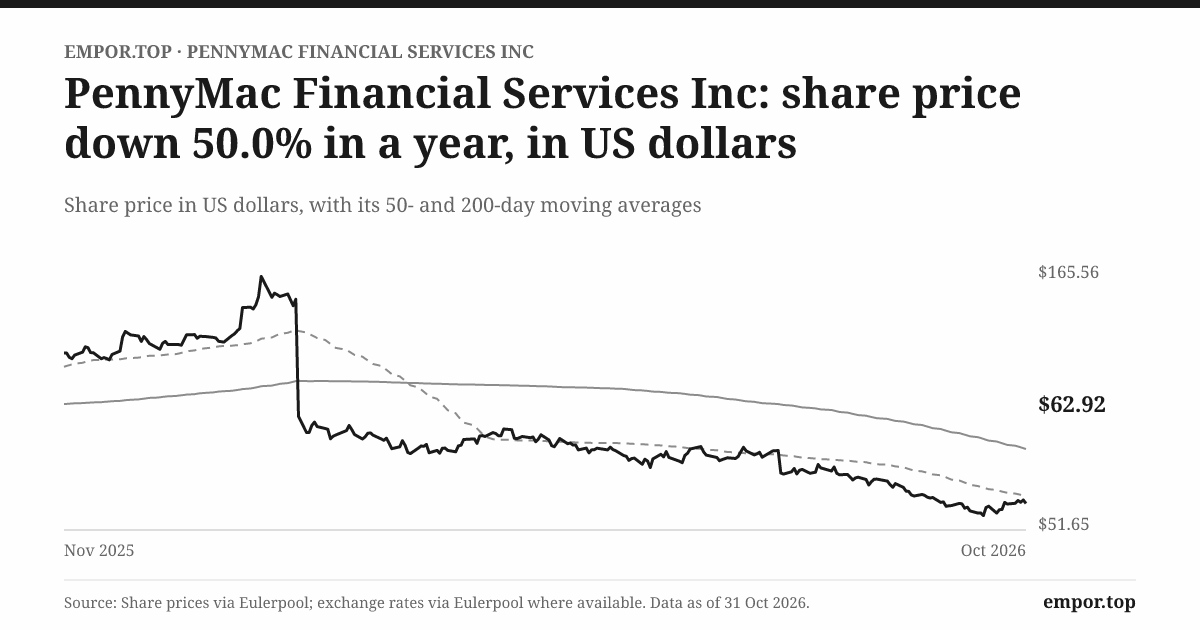
The third quarter was a live test of that theory, and the result was mixed. Servicing did cushion the blow. Without it, a $7 million production loss and corporate overhead would have pushed the company into a loss. But a cushion is not a floor. Pretax income fell about 82% from a year earlier in the company's own presentation, and the quarter came straight after a second quarter in which net income had already dropped to about $22 million.23 The stock told the same story in its own language: at the end of October it traded near $63, roughly 60% below its 52-week high of about $159.4
So the question this story has to answer is not whether PennyMac is a good mortgage company. By most operating measures it is a large and capable one. The question is whether its two-engine design genuinely dampens the mortgage cycle, or merely changes the shape of the damage. Three threads run through everything that follows. The first is how much protection the servicing portfolio really provides when rates, delinquencies and funding costs move together. The second is whether PennyMac's scale and technology earn it durable economics, or simply let it compete harder in a market where the borrower can always shop for a lower rate. The third is whether the pending purchase of Cenlar's subservicing business, a deal that would add hundreds of billions of dollars of loans to PennyMac's books, can make those economics steadier.
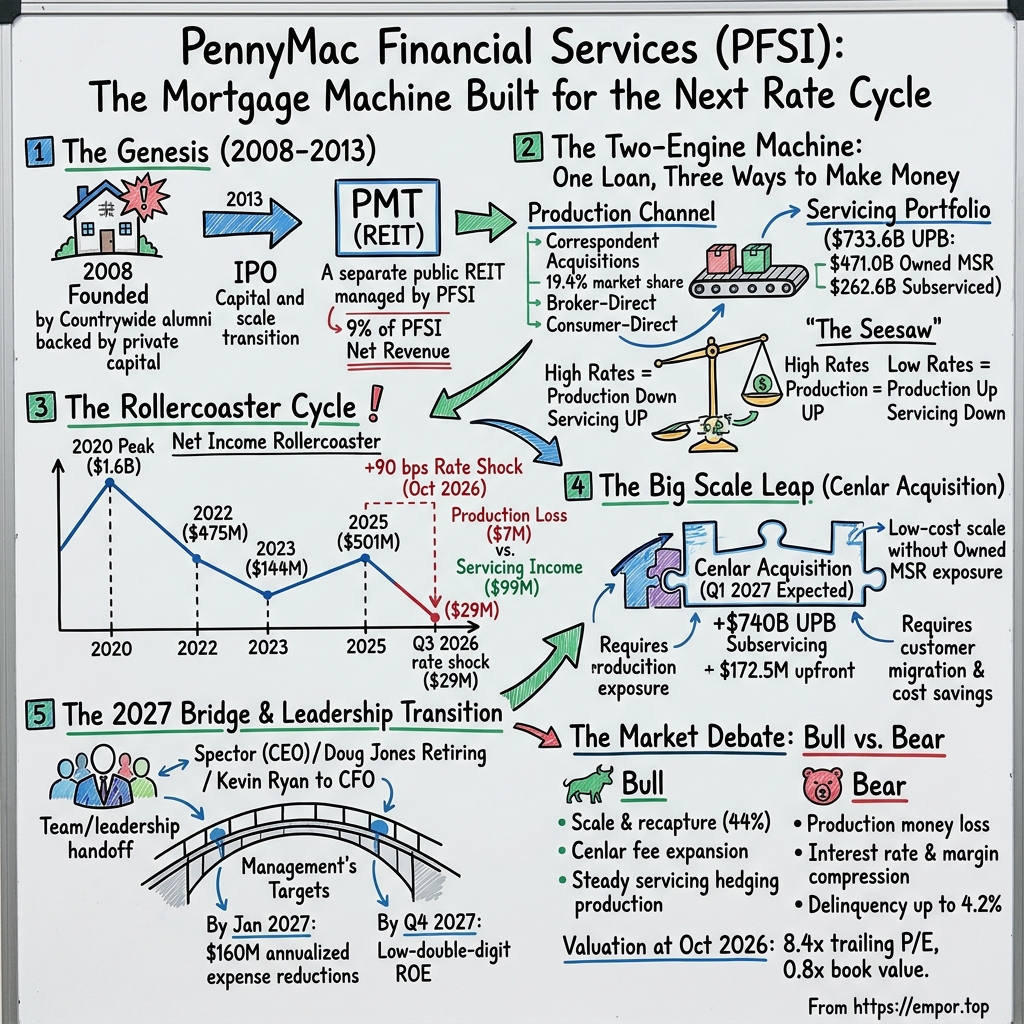
Management left investors with a specific scorecard on that October call. It promised about $160 million of annualized expense reductions by January 2027.1 It announced that Doug Jones, the president and the executive who had run the mortgage-banking operation, will retire in 2027, and that Kevin Ryan will move from chief strategy officer to chief financial officer.2 And it set a target of returning to a low-double-digit return on equity by the fourth quarter of 2027.1 Those three markers, cost, leadership and returns, are the next test. To understand why the company is in a position to make such promises at all, and why investors are no longer taking them on faith, the story has to go back to a moment when the American mortgage market was not slowing down but falling apart.
 Subscribe on LinkedIn
II. From Distressed Mortgages to a Public Platform
In 2008 the mortgage business was the last place a sensible person would start a company. Lehman Brothers was failing, Fannie Mae and Freddie Mac were heading into government conservatorship, and Countrywide Financial, once the largest mortgage lender in the country, had been sold to Bank of America in a rescue. Yet that year a group of former Countrywide executives, led by Stanford Kurland, Countrywide's former president and chief operating officer, launched a new firm called PennyMac.5 David Spector, who had run capital-markets and investment businesses at Countrywide, was among the founding team.5
The founders were not trying to make new loans into a collapsing market. Their idea was closer to a salvage operation. Banks and investors were dumping troubled mortgages at deep discounts, and almost nobody had both the capital to buy them and the operational know-how to work them out, modifying loans, chasing payments, foreclosing where necessary, and squeezing value from paper the market had written off. PennyMac raised money from private investors, with BlackRock and Highfields Capital's affiliate HC Partners among its early backers, and set about doing exactly that.5 The bet was on competence: people who had spent careers inside the machinery of mortgage finance believed they could price and manage what panicked sellers could not.
In 2009 the founders added a second vehicle. PennyMac Mortgage Investment Trust, known by its ticker PMT, went public as a real estate investment trust to invest in mortgage assets, with PennyMac acting as its external manager.5 That structural choice still shapes the company today, so it is worth being precise about it. PMT is not PennyMac Financial's parent, and it is not a division. It is a separate listed REIT with its own shareholders and its own balance sheet. PennyMac Financial manages it for a fee, services its loans, and does business with it under contracts.6 When this story talks about "PennyMac" or "PFSI", it means the operating company: the holding company whose principal assets are Private National Mortgage Acceptance Company, known as PNMAC, and its subsidiary PennyMac Loan Services, which makes and services the loans.6
The distressed-loan trade worked, but it had an expiry date. As the housing market stabilized, the supply of cheap troubled mortgages dried up. The founders had built something more durable in the process: a servicing operation capable of managing large, complicated loan books, a capital-markets desk that knew how to price and hedge mortgage risk, and relationships with the institutions that sell loans. The logical next step was to stop waiting for other people's broken loans and start producing and servicing new ones.
That step needed capital, and capital needed a public listing. In May 2013 PennyMac Financial Services listed on the New York Stock Exchange, selling about 12.8 million shares of Class A stock, which netted $16.875 a share after underwriting discounts.5 The IPO was not a clean break from the investment-management model that came before it. The company still managed PMT and still earned fees from investment funds. What changed was the centre of gravity. The money raised, and the borrowing capacity a listed company could command, were pointed at an operating platform: buying newly made loans from smaller lenders, originating its own loans, and keeping the servicing rights that came with them.
The original listing used a holding-company structure in which public shareholders owned a minority economic stake alongside the founders' and investors' units. In 2018 the company reorganized into a simpler structure with a single class of public shareholders, which is why reported shareholders' equity jumps from under half a billion dollars in 2017 to about $1.7 billion in 2018.7 That jump reflects a change in how ownership was counted, not a sudden windfall, and it is a useful reminder that some of PennyMac's long-run numbers were shaped by corporate housekeeping rather than operating performance.
There is a temptation in telling this story to lean on the Countrywide connection, as if the founders' former employer explained everything about what PennyMac became. It does not. Countrywide's failure came from the loans it chose to make and the risks it chose to keep; PennyMac was built in the aftermath, under a regulatory regime rewritten by that crisis, and its business is dominated by government-backed and agency-eligible loans. What the founders carried over was operating experience, not a corporate culture that can be assumed in either direction. The fairer way to judge PennyMac's management is by its own record, which the rest of this story tests directly.
By the end of 2025 that record had produced one of the largest mortgage platforms in the United States. To see why it behaves the way it does in a quarter like the third quarter of 2026, it helps to follow a single loan through the machine.
III. One Loan, Three Ways to Make Money
Picture a credit union in a mid-sized town. A local family buys a house, and the credit union's loan officer takes the application, checks the paperwork and closes the mortgage. The credit union does not want to hold a 30-year fixed-rate loan on its own balance sheet, and it has no appetite for running a national servicing operation. So, within days, it sells the loan to a bigger buyer. Very often, in the American market, that buyer is PennyMac.
This is correspondent lending, the channel that made PennyMac's name. Hundreds of small banks, credit unions and independent mortgage companies originate loans and sell them to an aggregator, which checks the underwriting, pays for the loan, pools it with others and sells the pool as a mortgage-backed security guaranteed by Fannie Mae, Freddie Mac or Ginnie Mae. At the end of 2025 PennyMac bought from 790 correspondent sellers.6 It also runs two other channels. In broker-direct lending, independent mortgage brokers bring borrowers to PennyMac, which underwrites and funds the loan; it had 5,267 approved brokers at the end of 2025.6 In consumer-direct lending, PennyMac deals with the borrower itself, most often an existing servicing customer who wants to refinance. On top of these channels it fulfils loans for PMT, earning a fee for doing the work on loans PMT acquires.6
Add it all up and PennyMac's production in 2025 came to about $145.5 billion of loans by unpaid principal balance.8 That is a staggering amount of money moving through one company in a year, and it is also the most volatile part of the business.
Where the production money comes from
Production economics start with a promise. When a borrower applies, they usually lock an interest rate, which means PennyMac commits to fund a loan at that rate weeks before it actually closes. Not every lock becomes a loan; some borrowers walk away, find a better deal or fail to qualify. The industry calls the locks that are expected to survive "fallout-adjusted" volume, and it is the number that drives production revenue. Once the loan closes and is sold, PennyMac earns the difference between what it paid, or lent, and what investors will pay for the security, plus fees. That spread, expressed as a gain-on-sale margin in basis points, is tiny on any one loan and enormous in aggregate.6
Because rates can move between the day a borrower locks and the day a loan is sold, PennyMac hedges its pipeline, mostly by selling forward contracts on mortgage securities that gain value when the loans in the pipeline lose it. The hedge protects the margin on loans already in the pipe. It does nothing to bring in the next borrower. That distinction is the whole story of the third quarter of 2026: the hedges did their job on the loans PennyMac had, but rising rates thinned the flow of new locks, and staff costs built for a busier market did not fall as fast as revenue.1
The asset hidden inside every loan
The second way PennyMac makes money is the one most outsiders miss. When it sells a loan into a security, it usually keeps the right to service it: to collect the monthly payment, forward principal and interest to bondholders, manage escrow for taxes and insurance, and deal with borrowers who fall behind. For that work the servicer keeps a small slice of the interest every year for as long as the loan stays alive. Accountants capitalize the expected stream of those future fees as an asset called a mortgage servicing right, or MSR, and PennyMac records it at fair value.6
An MSR is a strange asset. Its value depends on a guess about how long borrowers will keep their loans. If rates fall and borrowers refinance, the loan disappears, the fee stream stops and the MSR is worth less. If rates rise and borrowers sit tight, the fees run longer and the MSR is worth more. So PennyMac's production business manufactures an asset whose value moves opposite to production's own fortunes. That is the natural hedge at the heart of the two-engine model.
The servicing business also includes work done for other people's loans. In subservicing, PennyMac performs the servicing for an owner of MSRs, chiefly PMT, in exchange for a contracted fee per loan, without owning the servicing asset itself. At the end of 2025 PennyMac's servicing portfolio totalled about $733.6 billion of loans, of which roughly $471.0 billion were loans where it owned the servicing rights and $262.6 billion were subserviced for others.8 The difference matters. Owned MSRs carry valuation risk, need financing and require PennyMac to advance payments to bondholders when borrowers miss them on government-backed loans. Subservicing is closer to a fee-for-service contract: lower risk, lower reward, and dependent on the client renewing.
The third way to make money closes the loop. A servicer talks to millions of homeowners every month. When rates fall and one of them wants to refinance, PennyMac, which already knows the borrower, the property and the payment history, has a head start on every other lender. Capturing that borrower's new loan is called recapture. It turns a servicing loss, the payoff of an old loan, into a production gain, a new loan with a fresh servicing right attached. In the third quarter of 2026 PennyMac said it recaptured 44% of the first-lien refinances in its portfolio, near its historical highs.1
That brings the listener to the central tension of the business. A sharp fall in rates is good for production and bad for owned MSRs, because borrowers refinance faster and the old fee streams run off. A sharp rise in rates is the reverse. Recapture is the valve that lets some of the value lost on one side flow back on the other. When it works, PennyMac is not just hedged; it is recycling its own customers. When it fails, when a borrower refinances with a competitor, PennyMac loses the fee stream and gets nothing back. Nearly half of refinancing borrowers stayed in the third quarter. That also means the majority left. Whether PennyMac's scale gives it the power to keep more of them, and to earn more than a competitive return on the ones it keeps, is the question that matters most for the next section.
IV. Scale Is Not the Same as Pricing Power
Think of the American mortgage market as a three-way war fought on different terrain. United Wholesale Mortgage, run from Pontiac, Michigan, has built its empire through independent mortgage brokers and closed about $163.4 billion of loans in 2025.9 Rocket Companies, the Detroit-based heir to Quicken Loans, built a brand that talks to borrowers directly and closed about $130.4 billion of originations that year.10 PennyMac produced about $145.5 billion, and its home ground is neither the broker's office nor the consumer's phone screen. It is the back office of the community lender.8
Those three numbers make PennyMac sound like one of three equals. The comparison needs care. UWM is overwhelmingly a broker-channel originator; Rocket is mainly a direct-to-consumer lender with a servicing book greatly enlarged by its purchase of Mr. Cooper; PennyMac's volume is dominated by loans it buys from correspondents rather than originates itself. The three companies count volume differently, earn different margins on different channels, and are not competing for exactly the same borrowers in exactly the same way. The numbers are scale markers, not market shares.
Within its own channel, PennyMac's position is clearer. Its share of the correspondent market rose from about 16.7% in 2021 to about 19.4% in 2025.118 In a channel where hundreds of sellers can choose among several large aggregators on any given day, holding roughly one-fifth of the market and growing it through the 2022–23 downturn is real evidence of distribution strength. S&P Global Ratings cited exactly that scale and market position when it revised PennyMac's outlook to positive in February 2026.11
What a buyer of loans can and cannot control
To see why share is not the same as pricing power, walk through the forces acting on each side of PennyMac's business.
Start with the borrower. A homeowner shopping for a mortgage can compare rates on a dozen websites in an afternoon, and the product is largely standardized: a conforming 30-year fixed-rate loan sold into a government-guaranteed security looks much the same whichever lender closes it. Borrower switching costs at origination are close to zero. Then look at the correspondent seller, the credit union in the last section. It sells loans to whichever aggregator offers the best price that day, often splitting volume among several. Sellers have many potential buyers, which means real bargaining power over the margin PennyMac earns. Above the whole market sit Fannie Mae, Freddie Mac and Ginnie Mae, which set the standards, the guarantee fees and the rules for servicers. They are not competitors, but they shape the profit pool more than any lender does.
Against those forces, PennyMac's advantages are operational. Scale spreads the fixed cost of technology, compliance and capital-markets expertise across more loans. A large servicing book generates recapture opportunities a smaller competitor cannot match. Repeated dealings with hundreds of sellers create habits and trust, even if sellers can leave. These are cost and distribution advantages, and they matter. But they are the kind of advantage that lets a company win share at a given price, not the kind that lets it charge more.
PennyMac's own words make the point. In discussing its fourth-quarter 2025 results, the company attributed lower margins in correspondent lending to increased competition.8 That was at the end of a strong year, when net income had recovered to about half a billion dollars. Nine months later, production posted a loss as lock volumes fell and expenses adjusted more slowly.21 A business with genuine pricing power would have expected margins to hold up when rivals pressed; PennyMac's margins gave way. The history does not reject the scale claim. It narrows it. PennyMac can win and hold share in correspondent lending; it has not shown it can set the price there.
The borrower who comes back
Management's deeper claim is that this creates a flywheel. The company's reported third-quarter recapture rate is the best operating evidence for it.1 It suggests that a servicing relationship is worth something tangible when a borrower decides to refinance, and it gives PennyMac a source of consumer-direct volume that does not depend on buying leads or winning a correspondent auction.
The flywheel has limits that the same evidence reveals. Recapture works best when rates fall, and the flywheel slows in a rising-rate quarter like the third, when production needs it most. And a 44% capture rate means competitors still win more than half of PennyMac's refinancing borrowers. Rocket's acquisition of Mr. Cooper was built on the same logic at even larger scale: own a giant servicing book and recapture its borrowers through a consumer brand.12 PennyMac is not alone in owning the flywheel; it is one of several large players running versions of it against each other.
Technology sits awkwardly in this debate. PennyMac has spent heavily on its own systems, including building its servicing platform in-house, and in recent years it has described the use of artificial intelligence and workflow automation in production.1 Technology expense rose from about $143 million in 2023 to about $163 million in 2025.6 The honest framing is that AI at PennyMac is an efficiency program. The company does not quantify its expected revenue or cost impact in its filings, and it lists the implementation, data, security and compliance risks that come with it.6 If automation is working, it should show up in lower cost per loan and in a production business that breaks even at lower volumes. The third quarter, with costs lagging the revenue decline, is the opposite of that evidence. The investor case for technology will be proven in expense lines and margins, not in demonstrations.
Put together, PennyMac's competitive position comes down to this: a scale leader in a commoditized channel, with a recapture engine that works best in exactly the conditions that hurt its servicing asset. That is valuable, but it is not a fortress. And the clearest demonstration of what that position is worth, and how fast it can change, came during the most extraordinary mortgage boom in American history.
V. The Boom That Made the Cycle Visible
In the spring of 2020, as the pandemic shut down offices across the country, the Federal Reserve cut its policy rate to near zero and bought mortgage-backed securities on a vast scale. Mortgage rates fell to historic lows. Millions of homeowners realized that refinancing could cut hundreds of dollars a month from their payments, and the mortgage industry, working from kitchen tables and spare bedrooms, found itself handling more applications than it had ever seen.
For a company built like PennyMac, that was the perfect storm in the best sense. Correspondent sellers had more loans than they could handle, gain-on-sale margins widened because the industry lacked the capacity to meet demand, and PennyMac's servicing book became a hunting ground for consumer-direct refinances. Net income rose to about $1.6 billion in 2020, roughly four times the 2019 level, and return on equity reached about 49%.7 In 2021 the boom continued, with net income of about $1.0 billion, still far above anything the company had earned before.7
It is tempting to look at those years and treat them as a demonstration of what the platform can do. That reading is the consensus trap. The 2020–21 results were the platform plus an unrepeatable rate environment. Industry capacity was scarce, so margins were fat; refinancing was nearly universal among borrowers who could do it, so volume was enormous. Neither condition was within PennyMac's control, and neither lasted.
The other side of the mountain
When the Fed began raising rates aggressively in 2022, the refinancing market shut almost overnight. Borrowers who had locked in historically cheap loans had no reason to touch them. Production volumes fell across the industry, and the capacity that lenders had hired in the boom became cost they could not cover. PennyMac's net income fell to about $475 million in 2022.13 That was a sharp decline, but it was also where the two-engine model earned its reputation. As refinancing vanished, the loans in PennyMac's servicing portfolio stopped paying off, so the servicing rights lasted longer and became more valuable, and the servicing fees became a larger share of what the company earned.13 In a year when many pure originators lost money, PennyMac stayed solidly profitable.
Then came 2023, and with it a result that looks worse than the operating business was. Net income fell to about $144 million, and the fourth quarter of that year showed a net loss of about $37 million.14 The main reason was a legal charge. Black Knight, the mortgage-software company whose servicing system PennyMac had used before building its own, had pursued a dispute over that transition, and in 2023 PennyMac recorded about $163 million of legal settlement expense, most of it tied to the Black Knight arbitration.146 That was a material one-off. It was not a recurring operating cost, and legal settlement expense fell to about $1.6 million in 2024 and to nothing in 2025.6 But it was also not nothing. It was the price of a strategic decision to own the servicing technology rather than rent it, and it consumed most of a year's profit.
Strip the charge out and 2023 still showed the industry at its low ebb: high rates, thin volumes and margins squeezed by competitors fighting for a smaller pie. Return on equity fell to about 4%.14 The recovery that followed was real. Net income rose to about $311 million in 2024 and about $501 million in 2025, with return on equity back near 12%.8 The 2025 rebound came as production volume climbed and the servicing book kept growing. Yet even that recovery reached less than a third of the 2020 peak.
What the numbers really say
The long arc is easy to misread in either direction. Over ten years to 2025, net profit grew about 27% a year, which sounds like a growth compounder. Over five years, from the 2020 peak, it shrank about 21% a year, which sounds like a business in decline. Over three years, from the 2022 trough-adjacent level, it grew less than 2% a year.87 All three numbers are arithmetically correct, and none is a reliable description of normalized earnings power. What they show together is that the starting point determines the conclusion, which is the defining feature of a cyclical business.
The same forces described earlier drove the cycle: rates moved refinancing demand and MSR values, while production expenses followed funded volume with a lag. Hedges offset some swings in MSR value, but not changes in the flow of loans.
That was why the third quarter of 2026 looked the way it did. After a strong 2025, the company had expanded: year-end headcount grew from about 3,900 at the end of 2023 to about 5,200 at the end of 2025.6 Then rates jumped, locks slowed and production costs could not fall fast enough. Pretax income fell about 82% from the third quarter of 2025.2 Servicing did what it was supposed to do, but it could not absorb the full shock of a production business sized for a busier market.
The lesson of the boom and bust is not that PennyMac's model failed. It is that the model reduces the amplitude of the cycle without removing it. There is, however, another source of steadiness in PennyMac's business that has nothing to do with rates and everything to do with a single, closely connected customer.
VI. PMT: A Separate Company, a Connected Customer
At the end of 2025, about $226.8 billion of the loans PennyMac serviced for others belonged to one client.6 That client was PMT, the REIT the founders had launched in 2009, which PennyMac still manages. The relationship runs in both directions, and it runs through almost every part of PennyMac's business. PennyMac services PMT's loans. It fulfils loans that PMT acquires through its own correspondent activity. It buys loans from PMT and sells loans to PMT. And it earns a management fee for running the REIT.6
Picture the paper flowing between the two companies in a single year. In 2025 PennyMac sold PMT about $11.2 billion of loans and bought about $52.1 billion of loans by principal balance from it.6 PMT paid PennyMac about $84 million in servicing fees and about $24 million in fulfilment fees, and PennyMac paid PMT about $5.2 million in sourcing fees.6 Altogether PMT and its subsidiaries generated about 9% of PennyMac's net revenue in 2025, or roughly $184 million of the company's roughly $2.05 billion total, down from 10% in 2024 and 11% in 2023.6
That is the first thing to understand about PMT: it is material, but it is not dominant. A 9% revenue share is large enough that losing it would hurt, but the trend has been downward as PennyMac's own production and owned servicing grew faster. The company does not disclose any non-affiliated customer that exceeds 10% of revenue, and its correspondent and broker networks are spread across hundreds of sellers and thousands of brokers.6 On revenue alone, PMT is a significant client rather than a lifeline.
The second thing to understand is that revenue understates the operational tie. PMT's $226.8 billion sat inside a subservicing portfolio of about $262.6 billion at year-end 2025, which means PMT accounted for roughly six of every seven subserviced loans.68 PennyMac's subservicing business, in other words, is overwhelmingly a PMT business. That is why the pending Cenlar deal matters so much strategically: it would, if completed, turn subservicing from a related-party arrangement into a broad third-party franchise.
How the plumbing is priced
Related-party relationships invite two lazy conclusions. One is that the external manager must be extracting value from the REIT's shareholders. The other is that contracts between companies with the same management must be arm's-length because the paperwork says so. Neither is a substitute for looking at how the fees are set.
The servicing fee PMT pays is set per loan under a servicing agreement, scheduled to run through 2029 with renewal provisions.6 Fulfilment fees follow a negotiated schedule. The management fee depends on PMT's shareholders' equity and on performance thresholds, so PennyMac earns more when PMT is larger and does better.6 PennyMac's board reviews related-party matters through a committee process described in its proxy statement.15 Those are the right structures. Whether the prices inside them are generous to one side or the other cannot be judged from the structure alone, and PennyMac does not publish a benchmark comparing PMT's servicing fees with what it charges third-party clients. What can be said is that the fees are set by formula and schedule rather than negotiated loan by loan, which limits the scope for discretionary transfers between the two companies.
The relationship also brings something harder to put a number on: capital-markets connectivity. PMT is an investor in mortgage assets, including credit risk and servicing rights, and its appetite for certain loans gives PennyMac a ready buyer and partner for parts of its production. When PMT buys a loan from PennyMac, or retains servicing rights that PennyMac then subservices, the two companies split the economics of a single loan between an operator and an investor. That is a sophisticated arrangement. It is also a dependency.
PennyMac warns that termination of the PMT agreements, or an adverse change in the relationship, could harm its results and liquidity.6 The two companies share management, but they have different shareholders whose interests can diverge, particularly over fees. PMT's board could, in principle, seek to renegotiate terms, internalize management or move servicing elsewhere. None of that is happening. But because the subservicing book is so concentrated, the relationship is a single point of exposure that a skeptical investor should price.
The longest-running evidence is reassuring as far as it goes. The relationship has survived since 2009, through the distressed-loan era, the boom and the bust, and PMT's share of PennyMac's revenue has drifted gently lower rather than collapsed. What the record does not contain is a test of replacement economics: no one has seen what PennyMac's subservicing business would look like without PMT, because it has never had to find out.
There is one more number worth watching. Between the end of 2025 and the end of September 2026, PennyMac's subserviced portfolio fell from about $262.6 billion to about $233 billion, even as its owned portfolio rose from about $471 billion to about $496 billion.82 The company reports portfolio totals but does not identify the reason for every movement, and a shift between subserviced and owned loans can reflect PMT's own portfolio decisions rather than any loss of business. But it is a reminder that subservicing volume can move by tens of billions of dollars in nine months, and that the client deciding those moves is a related party. PennyMac's answer to that concentration is to buy a much larger, far more diversified subservicing business.
VII. Cenlar: Buying a Bigger Servicing Platform
Cenlar is the biggest mortgage company most homeowners have never heard of. For decades the Ewing, New Jersey, firm has done the unglamorous work of servicing mortgages on behalf of banks, credit unions and other lenders that want to own their customers' loans without building a servicing operation. Its name appears on payment statements and escrow notices, not on billboards. By the time PennyMac came calling, Cenlar was servicing up to about $740 billion of loans across roughly two million borrowers for about 100 clients.16
On February 11, 2026, PennyMac announced it had agreed to acquire Cenlar's subservicing business.16 The price was $172.5 million upfront, plus up to $85 million of contingent consideration tied to how much of the business actually transfers and stays.16 Cenlar reported about $459 million of subservicing revenue in 2025.16 At the time of the announcement, the company expected to close in the second half of 2026. On the October call, management said closing was now expected in the first quarter of 2027, pointing to regulatory approvals and the transition process.1
Why would PennyMac want a business that, by definition, does not own the loans it services? Because subservicing adds contracted work and scale without adding the same balance-sheet exposure that owned MSRs bring. A subservicer does not carry the asset whose value swings with rates, does not need to finance it, and in most arrangements does not bear the same advance obligations. It earns fees for operating a platform. If PennyMac can run Cenlar's loans on its own technology at a lower cost per loan than Cenlar could, the difference is profit. And the deal would solve the concentration problem: Cenlar's book, spread across about 100 clients, would dwarf PMT's share of PennyMac's subservicing.
What the price does and does not tell you
The headline arithmetic makes the deal look cheap. The upfront payment is about 0.38 times Cenlar's stated 2025 subservicing revenue, and even with the full contingent payment the total would be about 0.56 times revenue. For a business with roughly $459 million of annual revenue, paying at most about $257.5 million looks, on the surface, like a bargain.
The surface is misleading in three ways. First, the revenue figure includes escrow-related income, the interest earned on the tax and insurance money a servicer holds on behalf of borrowers.16 That income depends on short-term interest rates; if the Fed cuts, it falls, regardless of how well PennyMac runs the platform. Second, revenue is not profit. Subservicing is a labour-intensive business, with call centres, default management and compliance teams, and Cenlar's margins are not disclosed. A low revenue multiple can simply reflect a low-margin business. Third, the asset being bought is a set of client relationships, not a portfolio of owned loans. Each of those roughly 100 clients has a contract, and each contract can, eventually, be moved.
That last point is why the contingent consideration matters more than the multiple. Up to $85 million of the price depends on retention, so PennyMac pays the full amount only if the clients and loans actually come across and stay.16 The structure shifts some of the risk back to the seller, and it tells investors what both sides believe the key uncertainty is: not whether the platform works, but whether the customers follow.
The obvious comparison, Rocket's agreement to buy Mr. Cooper, is the wrong one. Rocket announced a $9.4 billion all-stock deal in March 2025 for the largest mortgage servicer in the country, a business that owned servicing rights on millions of loans and came with a direct relationship with those borrowers.12 That was a bet on owning servicing assets and recapturing their borrowers at enormous scale. Cenlar is a platform-and-contracts business whose clients own their own customer relationships. There is no clean, like-for-like transaction that tells investors whether PennyMac overpaid or got a bargain. The useful tests are the ones the deal structure itself sets up.
The integration scorecard
The delay deserves to be read carefully. Moving from a second-half 2026 close to the first quarter of 2027 is not proof of trouble. Acquisitions involving regulated mortgage servicing need approvals from multiple parties, and migrating two million loans from one servicing system to another is one of the riskiest operations in the industry, because every escrow account, payment schedule and borrower record must arrive intact. Doing it slowly can be prudent. But a slipped timeline is evidence worth watching, and every quarter of delay pushes the benefits further out while the company is promising investors a return to low-double-digit returns by the end of 2027.
The scorecard for the deal is straightforward to state and hard to deliver. The first measure is retention: how many of Cenlar's clients and loans actually transfer, and how many leave in the first year. The second is migration: whether borrowers experience the move as a non-event or as missed payments, lost escrow payments and complaints. The third is cost per loan: whether running Cenlar's book on PennyMac's platform genuinely lowers the unit cost of servicing. The fourth is subservicing fee revenue as a line in its own right, separate from owned servicing. And the last is whether the added scale lifts servicing pretax returns, not just servicing volume.
If those measures move the right way, Cenlar could transform PennyMac's subservicing from a PMT-dependent sideline into a diversified, fee-based business that earns through rate cycles. If they move the wrong way, PennyMac will have bought a large, low-margin operation and the operational risk that comes with it, at a moment when it is shrinking costs in its own production business. Either way, the people who will be accountable for the result are about to change.
VIII. A Transition Year for Spector's Team
David Spector has been at PennyMac since the beginning. A capital-markets specialist by background, Spector took over as chief executive in 2017 and added the chairman's title in 2021, when the founding chairman stepped back.15 That means the current team has run the company through every phase that matters for judging it: the build-out of correspondent lending, the 2020–21 boom, the 2022 downturn, the 2023 legal charge and the recovery of 2024–25. The record they bring to the third-quarter call is long enough to test.
The October call was a moment of both continuity and change. Spector announced that Doug Jones, the president and chief mortgage banking officer who had led the production operation, will retire in June 2027, with his responsibilities transitioning over several months.2 Kevin Ryan, the chief strategy officer, will become chief financial officer.2 Changing the head of mortgage banking and the CFO in the same window that a large acquisition closes and a cost programme is executed is a lot of moving parts. It may be well planned, and the long timeline suggests an orderly handoff. It still concentrates execution risk.
Spector's plan to restore returns has three parts. First, about $160 million of annualized expense reductions by January 2027.1 Second, closing and integrating Cenlar. Third, a return to a low-double-digit return on equity by the fourth quarter of 2027.1 For context, return on equity over the twelve months to September 2026 was about 5.5%.82 Getting from there to the low teens within about five quarters would require both cost discipline and a better production environment.
The bill for a busy 2025
What is the record on promises like these? The strongest affirmative evidence is the correspondent franchise. PennyMac's management has steadily grown share in that channel through good markets and bad, which is the kind of slow, repeated execution that is hard to fake.118 The servicing build-out, including the decision to bring the servicing system in-house, is a second piece of evidence: the company built and operates one of the largest servicing books in the country on technology it owns. That decision also produced the 2023 charge of about $163 million, so it is a strategic success that came with a large bill.
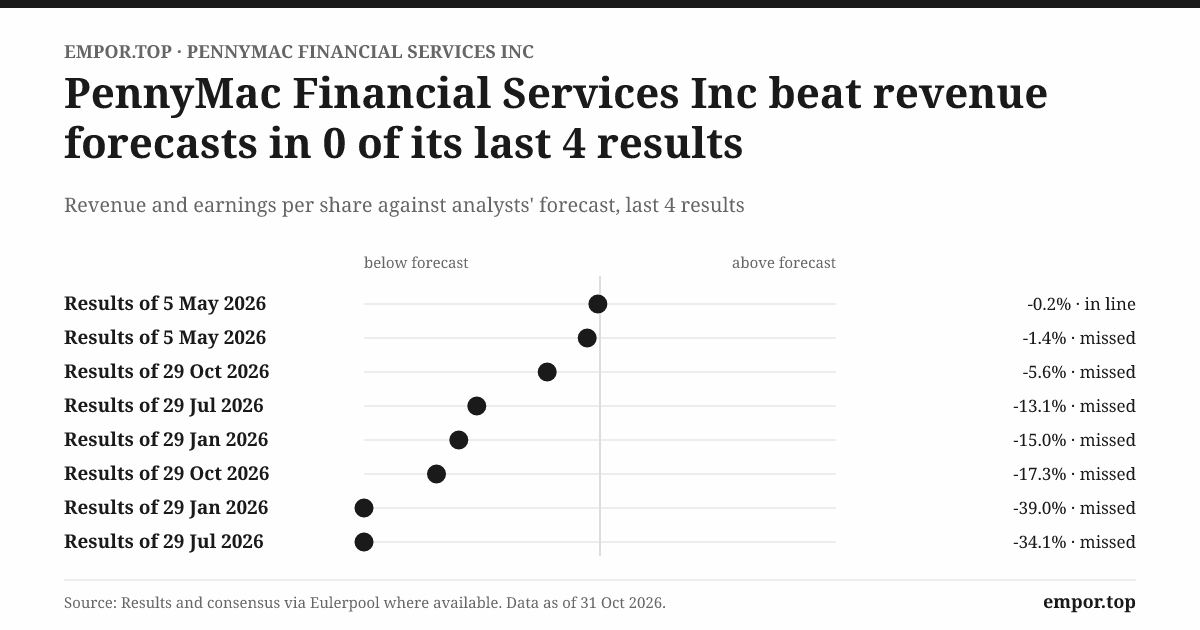
The disconfirming evidence is closer at hand. After strong 2025 results, the company grew its workforce substantially, with year-end headcount up about 18% in 2025 alone.6 When rates turned in 2026, those costs could not be cut fast enough. In the analyst questions on the October call, management acknowledged that cost reductions lag the decline in revenue, which is exactly how the third-quarter production loss came about.1 That is an honest answer, and a specific plan accompanies it. It is also an admission that the company was sized for a market that did not arrive. The warning had arrived a quarter earlier, when second-quarter net income fell to about $22 million.3 By October the language on the call had moved from trimming to resizing.1 The narrative did not contradict itself, but it shifted quickly, and each shift followed the results rather than anticipating them.
Investors who want to judge management credibility should treat the $160 million cost target and the late-2027 return target as forecasts, not results. The previously announced headcount reductions had already helped lower sequential expenses in the third quarter, which is early evidence of follow-through.2 The true test is whether reported expenses, not announced actions, fall by the promised amount, and whether production margins recover without the company giving away price to buy volume.
Who owns the company, and how management is paid
Spector's reported 2025 compensation was about $12.66 million, of which about $7.46 million came from stock and option awards and about $3.61 million from performance incentive compensation.15 Most of the package, in other words, depends on the share price and on results, which aligns pay with shareholders at least in structure. In 2025, about 90.7% of votes cast supported the company's say-on-pay proposal, a solid if not unanimous endorsement.15 The proxy also reports a different figure, about $17.75 million of "compensation actually paid", a regulatory measure that reflects changes in the value of equity awards rather than cash received.15
The shareholder register is concentrated. HC Partners, the Highfields Capital affiliate that backed PennyMac at its founding, held about 30.3% of the shares in the 2026 proxy, and MFN Partners held about 8.7%.15 HC Partners is the largest holder and has the right to nominate directors, but the proxy does not describe PennyMac as its subsidiary, and the board has an independent lead director and a majority of non-management directors.15 A large, long-term holder can be a stabilizing force; it can also mean that minority shareholders have limited influence over strategy. For now, the alignment question is simpler: management's equity pay and the largest holder's stake both depend on the share price recovering from a 60% fall.
Credibility, in the end, will be measured against the business mechanism that management cannot control. That mechanism is the servicing hedge, and it has more sides than the two-engine story usually admits.
IX. The Servicing Hedge Has Two Sides
Imagine a seesaw with production on one end and owned servicing on the other. In the third quarter of 2026, it held: higher rates slowed prepayments, the servicing portfolio grew to about $737 billion of loans, and servicing carried the quarter while production lost money.2
The seesaw image is accurate but incomplete, because it treats the servicing side as if it had only one moving part. In practice it has at least four: interest rates, borrower credit, funding and operations. Rates are the part the hedge is designed for. The other three are not.
Start with the hedge itself. PennyMac does not simply let the value of its MSRs float with rates. It buys financial instruments whose value moves in the opposite direction, so that a fall in MSR value from a rate rally is partly offset by gains on the hedge, and vice versa.6 The goal is to stabilize book value and reported earnings against sharp valuation swings. In the third quarter the MSR fair-value changes net of hedging took about $33 million off servicing's pretax income, the gap between the reported $99 million and the $132 million excluding those effects.2 Even in a quarter when higher rates should have supported MSR values, the combination of mark and hedge was a cost, which shows that hedging is imperfect and that it has a price.
A hedge is insurance for the value of the asset. It does not insure the fees, which depend on how many borrowers keep paying, or the production business, which depends on how many new borrowers arrive.
When borrowers stop paying
The second moving part is credit. PennyMac's owned servicing book leans heavily on government-insured loans, the FHA and VA mortgages pooled into Ginnie Mae securities, whose borrowers typically have smaller down payments and thinner financial cushions. When those borrowers fall behind, the servicer must keep advancing scheduled payments to bondholders, and sometimes taxes and insurance, until the loan is cured, modified or resolved.6 The money comes back eventually, but not always in full and not quickly.
In the third quarter, the share of PennyMac's owned servicing portfolio that was 60 or more days delinquent rose to about 4.2%, up from about 3.4% a year earlier.2 That is not a crisis figure, but it is moving in the wrong direction. At the end of 2025, net servicing advances stood at about $590 million, and the allowance for losses on those advances had risen from about $74 million in 2023 to about $104 million in 2025.6 The trend says that servicing a large government-loan book in a softer consumer economy costs more, ties up more cash and produces more losses. Rising delinquencies can also cut against the rate seesaw: if a downturn arrives alongside falling rates, PennyMac could face faster prepayments on good loans, more advances on bad ones and a production rebound that does not arrive until credit stabilizes.
The money that keeps the machine running
The third moving part is funding, and it is where the balance sheet stops looking like a normal company's. At the end of 2025 PennyMac reported about $23.1 billion of borrowings against about $4.3 billion of shareholders' equity, a debt-to-equity ratio of about 5.4.6 To a reader used to industrial companies, that looks alarming. For a mortgage company it needs to be read differently. Most of the borrowing is secured financing for specific assets: warehouse lines and repurchase agreements that fund loans for the few weeks between closing and sale, and term notes backed by MSRs and servicing advances. A smaller slice is unsecured corporate debt; in 2025 the company issued about $2.35 billion of unsecured senior notes while redeeming about $650 million of older ones.6
The secured facilities come with conditions. PennyMac's lenders require, among other things, at least $100 million of unrestricted cash, at least $1.25 billion of tangible net worth and total liabilities no more than ten times tangible net worth.6 The company reported compliance with its covenants. The risk is not that the covenants are tight today. It is that the collateral behind the secured financing is marked to market, so a sharp move in mortgage values can trigger margin calls just when liquidity is most valuable. PennyMac reported about $3.5 billion of total liquidity in the third quarter of 2026, a meaningful buffer.2 Liquidity in mortgage finance is a stock that can drain quickly.
That funding model also explains why PennyMac's cash flow statement looks so strange. Cash from operations was negative by about $1.65 billion in 2025, about $4.53 billion in 2024 and about $1.58 billion in 2023, while net income was positive each year.6 The reason is the loan pipeline. When PennyMac funds or buys more loans than it sells in a period, the cash leaves through operations while the borrowing to fund it comes back through financing. In 2025, the increase in loans held for sale accounted for about $2.65 billion of operating cash outflow, more than the whole negative total.6
Gains on loans are also recognized when they are locked and valued, often before cash arrives. For this kind of lender, operating cash flow says more about the size of the pipeline than about the quality of earnings. It should not be read as a sign that profits are fictional, but it should not be ignored either: a business that must keep borrowing to grow its pipeline is a business that depends on lenders staying open.
The credit view reflects exactly this balance. S&P Global Ratings affirmed PennyMac Financial at B+ in February 2026 and revised its outlook to positive, citing scale, market share and a balanced production-and-servicing model, while naming MSR prepayment risk and intense origination competition as constraints and expecting adjusted debt to EBITDA of around four to five times.11 KBRA, which rates a different entity, PNMAC, the intermediate holding company owned by PennyMac Financial, affirmed that company at BBB- with a stable outlook in August 2026.17 KBRA highlighted management's track record and hedging as supports but warned that hedge performance, liquidity and funding could pressure the rating.18 The two ratings sit several notches apart partly because they cover different legal entities in the capital structure and partly because the agencies weigh the same risks differently. Neither should be read as the other's opinion.
The remaining risks follow the same mechanisms. Regulatory requirements from the agencies and Ginnie Mae govern how much capital and liquidity a servicer must hold. Cybersecurity and technology execution matter more for a company that runs millions of borrowers' payments on its own systems, and will matter more still if Cenlar's two million loans migrate onto them. None of these risks is unusual for a large servicer. Together they explain why servicing can buy time in a downturn but cannot make PennyMac a utility. And they explain why the market, in October 2026, was pricing the company at a discount.
X. Analysis & Bear vs. Bull Case
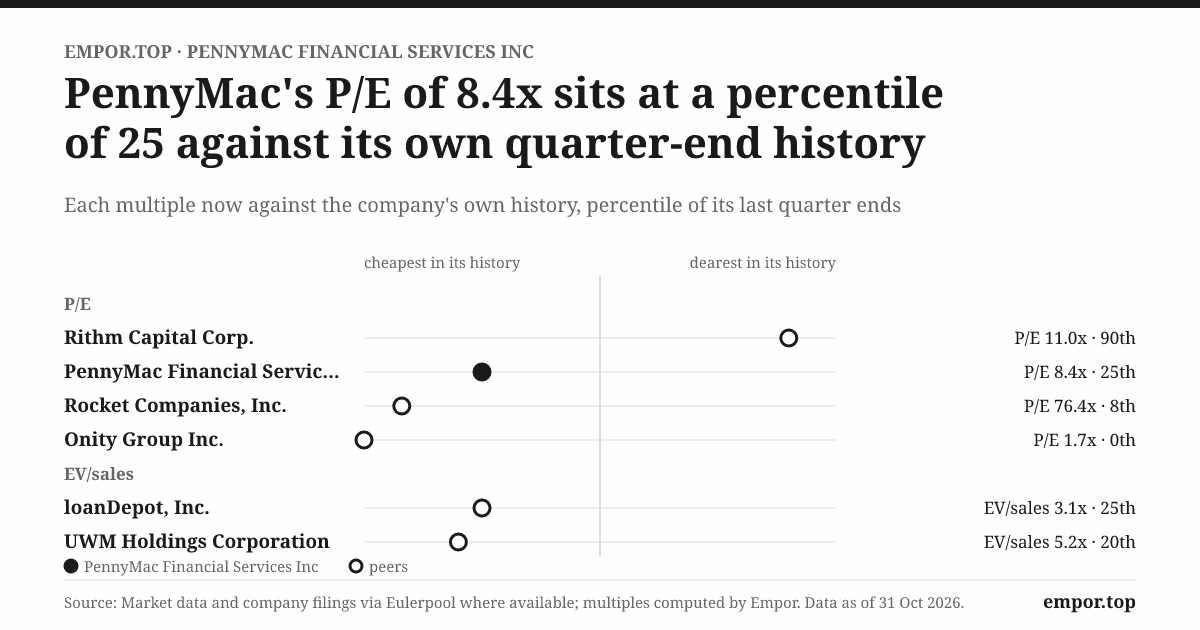
At the end of October 2026, PennyMac's shares closed at about $62.92.4 At that price the company was valued at about $3.3 billion, roughly 8.4 times trailing earnings, against a five-year median of about 13.3 times, and about 0.75 times book value of about $83.69 a share.42 Flip the earnings multiple and the trailing earnings yield is about 11.9%. Rocket, by contrast, traded at about 28 times trailing earnings, and UWM had negative trailing earnings, so a multiple comparison with it is meaningless.1920 The peer numbers are not like-for-like; Rocket's earnings and balance sheet were reshaped by Mr. Cooper, and each company's accounting earnings swing with mortgage fair values. But the gap tells investors something about how the market views PennyMac's earnings: as cyclical, exposed and hard to normalize.
What is the market assuming? A price below book value implies that investors expect the company to earn less than its cost of equity for some time, or that they doubt the book value itself. Both doubts are reasonable. A large part of PennyMac's book is MSRs carried at fair value, whose value depends on prepayment and discount-rate assumptions that can change sharply. And trailing earnings include a strong late 2025 that may not repeat soon. The latest quarter alone, at $29 million of net income, annualizes to far less than the trailing figure.2 The cheap-looking multiple is partly an artefact of strong earnings that have already faded.
Run the industry through Porter's five forces and the picture is unforgiving. Buyer power is high on both sides of the production business: borrowers shop rates freely and correspondent sellers can sell to any of several large aggregators. Supplier power is concentrated in the funding markets and in the government-sponsored enterprises and Ginnie Mae, which set guarantee fees, standards and servicer requirements. The threat of new entrants is moderate; licensing, capital requirements and agency approvals keep out small players, but large banks and well-capitalized nonbanks can expand when margins are attractive. Substitutes are limited for the mortgage itself, but within the market any lender's loan is a near-perfect substitute for another's. Rivalry is intense, and PennyMac's own explanation of lower correspondent margins in late 2025, competition, is the clearest evidence.8
Hamilton Helmer's seven powers framework asks which durable advantages could let a company earn above-average returns despite those forces. Scale economies are PennyMac's strongest candidate: technology, compliance and capital-markets expertise spread across about $145 billion of annual production and more than $700 billion of servicing.82 Switching costs exist in servicing, where moving a subservicing book is costly and risky for the client, which is why Cenlar's client retention is so important. Process power, the accumulated skill of running a complicated operation reliably, is plausible, given PennyMac's record through several cycles. Network effects, branding and cornered resources are weak: PennyMac does not have a consumer brand to rival Rocket's, and it does not control anything competitors cannot buy. Counter-positioning is limited, because the correspondent-plus-servicing model is visible and has been copied.
The verdict on the moat is narrower than management's framing. PennyMac has scale and process advantages that let it produce and service loans at lower cost and win share in correspondent lending. It does not have the pricing power that would turn those advantages into steady excess returns through a cycle. That makes it a strong competitor in a structurally competitive industry, not a franchise immune to the industry's economics.
Why it could win from here
The bull case begins with the servicing base. A portfolio of about $737 billion, with first-lien recapture near historical highs, is a large and sticky asset that keeps earning while production waits for better conditions.21 The steady gain in correspondent share shows that PennyMac can grow in its home channel even when the market shrinks. A rate rally would restore production volume, and a company that has already cut $160 million of annual costs would earn more on each loan. Cenlar, if it closes and integrates well, could add a large fee-based business with about 100 clients, reducing the dependence on PMT and on rates. Under that scenario, returns move back toward the low teens, and the share price discount to book value narrows as investors regain confidence that book value can earn its keep.
What could break the case
The bear case is the same facts read from the other side. Production lost money in the third quarter, and it did so not because of a hedging mistake but because volume fell and costs could not follow.2 Net profit over five years has shrunk about 21% a year, and the last two quarters together earned about $51 million, a fraction of the 2025 run rate.23 MSR valuations, prepayment assumptions, funding costs and advance needs can all move against the thesis at the same time, and rising delinquencies in a government-heavy book are already moving in the wrong direction. Cenlar adds integration risk at exactly the moment the leadership team is changing. And a rate rally, the bull case's catalyst, would accelerate runoff on owned servicing while giving competitors with strong consumer brands an equal chance to win the refinances.
The sharpest question a skeptical investor would put to management is about discipline. When correspondent margins compressed in late 2025, did PennyMac hold its price because returns matter, or did it lose volume to competitors with stronger capture? The third-quarter discussion of channels and margins should carry more weight than general claims about scale. A company that defends margin at the cost of share is behaving like a returns-focused operator; a company that defends share at the cost of margin is behaving like a volume-focused one. The October call framed the plan around resizing costs to the market and restoring returns, which points toward discipline.1 The evidence will come in the margin and volume figures over the next several quarters.
Three measures matter most. The first is servicing pretax income excluding MSR fair-value changes net of hedges, which was about $132 million in the third quarter and is the cleanest view of whether the servicing engine is earning steadily.2 The second is the first-lien recapture rate, about 44% and near historical highs, which tests whether the servicing relationship is worth something when a borrower refinances.1 The third is production pretax income alongside fallout-adjusted lock volume and margin, which turned into a $7 million loss in the third quarter and will show whether production can earn money at lower volume once costs are cut.2
Management's targets turn this into a falsifiable bridge. If the $160 million of savings shows up in reported expenses by early 2027, Cenlar closes and retains its clients, and return on equity reaches the low double digits by the end of 2027, the thesis that PennyMac's platform is sturdier than its recent results suggest will be confirmed. If any of those links breaks, the market's skepticism will have been the better forecast.
XI. Business & Investing Lessons
PennyMac’s results swung from about $1.6 billion in earnings and a return on equity near 49% in 2020 to about $475 million two years later.713 In October 2026, the company announced about $160 million in annualized expense reductions and awaited the close of a purchase of Cenlar’s subservicing business, which serviced up to $740 billion of loans.116 The same team, the same strategy, three very different results. That sequence holds the lessons.
The first lesson is that servicing buys time in a downturn, but cannot cancel the rate cycle or the risks that come with it. For investors, servicing is a stabilizer, not an annuity.
The second lesson is that Cenlar’s added scale matters only if PennyMac can lower the cost of serving the loans and retain the clients who own them. A trillion dollars of unpaid principal is a measure of work, not of profit.
The third lesson is that the right mortgage volume is the volume that clears the return hurdle. PennyMac’s share gains and its own explanation of lower margins in late 2025 make the test clear: whether it rebuilds production on margin or on volume.
The fourth lesson is the one the boom taught most expensively: for a cyclical lender, a peak is a data point, not a forecast. PennyMac’s record across the cycle shows a well-run operator in a hard industry, which is a different thing from a growth story.
For founders and operators, there is a wider point in the company’s origin. PennyMac’s founders started by buying distressed assets when no one else could, then used what they learned to build an operating company. That kind of counter-cyclical start teaches a business to respect the cycle. The challenge, almost two decades later, is to keep that respect when the good years return, and not to hire, expand and price as if the next downturn will not come.
XII. Epilogue
Tonight, at the end of October 2026, PennyMac stands between two quarters that will tell investors a great deal. The stock trades near $63, below book value, with a production business that lost money in the most recent quarter and a servicing business that kept the company profitable.42 The cost programme is under way. The Cenlar deal is signed but not closed. The leadership handoff has been announced but not completed.
The next moments are clear. The fourth-quarter results, due early in 2027, will show whether the expense reductions are appearing in reported costs rather than only in announcements, and whether production can return to profitability at the volumes the market is offering. Then the Cenlar closing, now expected in the first quarter of 2027, will begin the hardest part of the deal: moving clients and loans onto PennyMac's systems.1 Each quarter after that will report retention, the share of Cenlar's business that actually transfers and stays. The contingent payment will settle in a way that tells investors how much of the business came across. Through all of it, Doug Jones's responsibilities will move to new hands before a June 2027 retirement, and Kevin Ryan will take on the CFO role.2
Each outcome maps directly onto the questions this story set out. If savings are delivered, servicing returns hold steady excluding valuation effects, and the Cenlar transfer happens with high retention and little borrower disruption, the case that PennyMac's platform is sturdier than its recent results suggest will gain real evidence. If the closing slips again, production margins stay thin, delinquencies keep rising or servicing economics weaken, the market's doubts will have been justified. And if rates fall sharply in 2027, the company will face the other side of its own seesaw: a production rebound and a servicing runoff at the same time, with recapture deciding which effect wins.
The target that ties it together is a low-double-digit return on equity by the fourth quarter of 2027.1 It is a specific, testable promise. It is also management's forecast, made at a moment when the company's most recent quarter delivered a fraction of that return.
XIII. Outro
Go back to the October call. Rates had jumped almost a percentage point in three months. Production lost $7 million. Servicing earned $99 million.2 In a single quarter, the two halves of PennyMac moved in opposite directions, exactly as the company's design intended, and the result was still a sharp fall in profit.
That is what makes PennyMac different from a lender that only wins when rates fall. It is built to make money at several points in a loan's life: when it is bought from a credit union, when it is sold into a security, every month while it is serviced, and again when the borrower refinances. Its promise is that those pieces will balance when the rate cycle turns. Its risk is that they will not balance quite enough. Somewhere tonight a family is making its mortgage payment to a servicer whose name it barely knows. The question PennyMac still has to answer is whether a larger platform can turn that payment into steadier returns.
References
-
PennyMac Financial Services (PFSI) Q3 2026 Earnings Call Transcript — The Motley Fool via AOL, 2026-10-29 ↩↩↩↩↩↩↩↩↩↩↩↩↩↩↩↩↩↩↩
-
PennyMac Financial Services, Inc. Reports Third Quarter 2026 Results — Business Wire via Nasdaq, 2026-10-29 ↩↩↩↩↩↩↩↩↩↩↩↩↩↩↩↩↩↩↩↩↩↩↩↩↩↩↩↩
-
PennyMac Financial Services, Inc. Reports Second Quarter 2026 Results — PennyMac Financial Services, 2026-07-29 ↩↩↩
-
Form S-1 Registration Statement — PennyMac Financial Services, Inc., 2013 ↩↩↩↩↩
-
2025 Form 10-K — PennyMac Financial Services, Inc., 2026-02-20 ↩↩↩↩↩↩↩↩↩↩↩↩↩↩↩↩↩↩↩↩↩↩↩↩↩↩↩↩↩↩↩
-
2021 Form 10-K — PennyMac Financial Services, Inc., 2022 ↩↩↩↩↩
-
PennyMac Financial Services, Inc. Reports Fourth Quarter and Full-Year 2025 Results — PennyMac Financial Services, 2026-01-29 ↩↩↩↩↩↩↩↩↩↩↩↩↩
-
UWM Holdings Corporation Announces Fourth Quarter & Full Year 2025 Results — UWM Holdings, 2026-02-25 ↩
-
Rocket Companies Announces Fourth Quarter and Full Year 2025 Results — Rocket Companies, 2026 ↩
-
PennyMac Financial Services Inc. Outlook Revised To Positive — S&P Global Ratings, 2026-02-19 ↩↩↩↩
-
Rocket to buy Mr. Cooper in $9.4 billion deal — Associated Press, 2025-03-31 ↩↩
-
PennyMac Financial Services, Inc. Reports Fourth Quarter and Full-Year 2022 Results — PennyMac Financial Services, 2023-01-31 ↩↩↩
-
2026 Notice of Annual Meeting and Proxy Statement — PennyMac Financial Services, Inc., 2026-04-20 ↩↩↩↩↩↩↩
-
PennyMac Financial Services to Acquire Cenlar's Subservicing Business (Exhibit 99.1) — PennyMac Financial Services, Inc. via SEC, 2026-02-11 ↩↩↩↩↩↩↩
-
KBRA Affirms Rating for Private National Mortgage Acceptance Company, LLC — KBRA, 2026-08-12 ↩
-
Private National Mortgage Acceptance Company, LLC Surveillance Report — KBRA, 2026-09-01 ↩
-
Rocket Companies (RKT) Stock Price and Statistics — Stock Analysis, 2026-10-31 ↩
-
UWM Holdings (UWMC) Stock Price and Statistics — Stock Analysis, 2026-10-31 ↩
 LinkedIn
 WhatsApp
 Reddit
 Hacker News
 Email
 Kindle
 RSS Feed
 Spotify
 Apple Podcasts
 Amazon Music
 Audible
 YouTube