Pebblebrook Hotel Trust: The Hotel Portfolio That Had to Change Its Address
I. The Hotel Owner Waiting for the City to Come Back
In June 2026 San Francisco did something it had not done reliably for six years: it filled up. Two software conferences, Snowflake's and Databricks', brought citywide crowds to Moscone Center, and they more than made up for the RSA security conference moving to March.1 Business travellers who had vanished in 2020 were back in the lobbies, and leisure guests were paying more.
Across Pebblebrook Hotel Trust's seven San Francisco hotels, occupancy rose by nearly five points and the average room rate by almost 9% compared with a year earlier.1 Revenue per available room, the hotel industry's master number, was up 16%, and San Francisco hotel EBITDA was up 24.6%.2
For a company that had spent most of the decade explaining why San Francisco would eventually recover, the quarter was a vindication. Same-property RevPAR across the whole portfolio rose 6.5% to about $259, driven mostly by higher rates rather than more occupied rooms.2
Same-property Hotel EBITDA came in $6.6 million above the top of management's own outlook, and adjusted funds from operations of 68 cents a share beat the high end of guidance by six cents.2 Management raised its full-year outlook for the second time in three months.234 The stock, which had traded below $8 in the tariff panic of April 2025, closed at $20.39 on October 23, 2026.5
Now look at the number that does not fit the celebration. In 2025, the same group of hotels produced same-property RevPAR of about $213, a shade below the $214 of 2024.3 Same-property Hotel EBITDA fell 5.3% that year, and Chairman and CEO Jon Bortz called 2025 "a volatile and uneven year."3 In other words, the hotels that were sprinting in June 2026 had been going backwards eighteen months earlier. A good quarter on top of a weak base is a recovery. It is not yet proof of a new growth rate.
The stakes are concrete. At the end of June 2026, Pebblebrook held interests in 43 hotels with 10,937 rooms, nearly all of them luxury or upper-upscale properties in American cities and resort towns.67 Each of those rooms is a perishable product. A room that sits empty on a Tuesday night in Washington cannot be sold again on Wednesday. Demand is local, it rises and falls with the economy, and it swings on convention calendars, corporate travel budgets, wildfires, hurricanes and even government shutdowns.
Pebblebrook does not run the hotels itself. It owns them and hires third-party managers, among them Marriott, Highgate and Davidson, to operate them under long-term agreements.8 It competes for guests and groups with far larger owners. Host Hotels & Resorts, the largest lodging REIT, carried a stock-market value of about $17 billion in late October 2026, roughly seven times Pebblebrook's.9 Park Hotels & Resorts is also bigger. And above all of them sit the global brands, which control the loyalty programmes and much of the booking traffic that decide where travellers sleep.
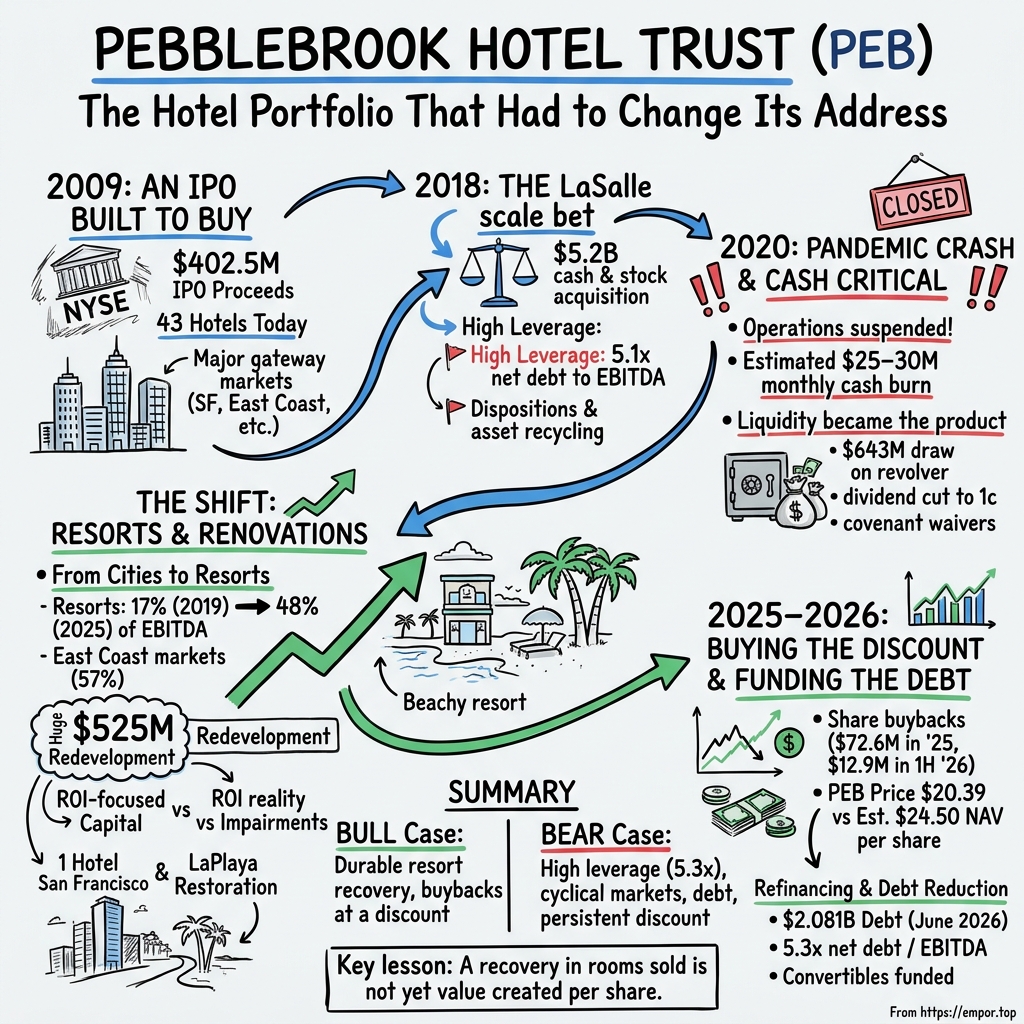
So the story of Pebblebrook is not really a story about one great quarter in San Francisco. It is a story about a company that bet heavily on American cities, watched those cities empty out, and then spent six years changing the address of its earnings. By 2025 resorts produced 48% of the portfolio's Hotel EBITDA, against 17% in 2019.7
The questions that matter are whether that repositioned portfolio earns better returns than the old one, whether management can turn a cyclical recovery into value per share while paying down debt, and whether the gap between the share price and management's estimate of what the hotels are worth is an opportunity or a warning.
To answer them, the story has to go back to a company that was created, almost literally, to go shopping.
 Subscribe on LinkedIn
II. An IPO Built to Buy Hotels
December 2009 was a strange moment to start a hotel company. The financial crisis had just driven American hotel revenues through the floor, credit markets were still frozen, and owners who had borrowed heavily in 2006 and 2007 were handing keys back to lenders. For a buyer with cash, that wreckage looked like a sale.
Pebblebrook Hotel Trust listed on the New York Stock Exchange that month, selling 20.125 million common shares and raising $402.5 million of gross proceeds.10 It owned no hotels. It was a blind pool, a bet on the people rather than on any building, and its stated purpose was to buy upper-upscale, full-service hotels in major U.S. gateway markets and run them better.10
The people were the point. Jon Bortz had already built one hotel REIT from scratch. He founded LaSalle Hotel Properties in 1998 and ran it as president and chief executive until 2009, after seventeen years at what became Jones Lang LaSalle, where he founded and led the hotel investment group.11 He is a Wharton economics graduate and an inactive CPA, and he has chaired the board of the American Hotel & Lodging Association.11
Raymond Martz, who became chief financial officer, had worked in finance at LaSalle from 1998 to 2005 before CFO roles at Eagle Hospitality and Phillips Edison.11 Thomas Fisher, the chief investment officer, had led Jones Lang LaSalle's national full-service hotel sales platform for the Americas.11 All three are still running the company today, Bortz as chairman and CEO and the other two as co-presidents.11 That continuity cuts both ways. It means the team that made every major decision in this story is the same team asking investors to trust its next ones.
The early playbook was simple and suited the moment: buy distressed or under-managed urban hotels as the cycle turned, renovate them, often swap generic branding for independent "lifestyle" concepts, and ride the recovery. It worked well enough that by 2015 Pebblebrook reported revenue of $770.9 million.12 By 2025 that figure had nearly doubled, to about $1.48 billion.8
That doubling is the kind of number that looks like compounding and is not. Over those ten years Pebblebrook swallowed a rival, sold dozens of hotels, suffered a pandemic that wiped out most of a year's revenue, and rebuilt. Total revenue measures how many hotels the company owned as much as how well they performed. Net income is even less helpful.
Pebblebrook lost $74.3 million in 2023, earned essentially nothing in 2024, and lost $62.2 million in 2025, a year that included $48.9 million of impairment charges.8 Hotel REITs carry enormous depreciation charges on buildings that may be gaining value, so their accounting profits are a poor guide to what owners earn.
The early years also flattered the strategy, and management still leans on them as evidence. From 2010 to 2016, U.S. hotel demand grew faster than supply for seven straight years, and the industry's RevPAR rose about 6.0% a year on average. Management says Pebblebrook's own RevPAR grew about 6.6% a year over that stretch, and its EBITDA about 13% a year.7 Those figures are management's, and they come from a period when almost any owner who bought urban hotels in 2010 looked clever.
The real point is narrower: Pebblebrook's first playbook was a cyclical one. It worked because it bought near the bottom and rode a long recovery with little new supply. That matters now, because management's 2026 pitch rests on the same conditions repeating: low supply growth, recovering cities and a long runway of events. The first cycle shows the playbook can work. It also shows how much the results depend on where in the cycle the buying happens.
A useful way to read this company, then, is in two layers. The first layer is the hotels. Same-property RevPAR and same-property Hotel EBITDA compare the same set of buildings year over year, stripping out acquisitions and sales, and they reveal whether the properties are getting better at selling rooms and keeping costs down. The second layer is the shareholder.
Funds from operations per share and free cash flow per share reveal whether better hotels actually translate into more money for each owner of the common stock, after interest, preferred dividends and the endless capital spending that buildings demand. A hotel company can win the first contest and lose the second. Pebblebrook's own boundary is clean here: the figures in its filings are its own and its subsidiaries', and the managers and brands are counterparties paid under contract, not a parent group whose economics should be blended in.8
The gap between those two layers opened widest in the decision that defined the modern company. In 2018, Jon Bortz went back to buy the company he had founded.
III. The LaSalle Deal Made Pebblebrook Bigger—and More Exposed
The bidding war for LaSalle Hotel Properties had the plot of a corporate thriller and the paperwork of a merger proxy. In March 2018 Pebblebrook offered $30 a share for LaSalle, and LaSalle's board rejected it.13 Pebblebrook came back higher, but in May LaSalle chose Blackstone, which offered $33.50 a share in cash, the most certain currency there is.13 Pebblebrook kept going. Its bids were mostly paper, in the form of Pebblebrook shares; the cash portion rose from 20% to 30%.
Its August 21 proposal let LaSalle shareholders elect $37.80 in cash or 0.92 of a Pebblebrook share, with cash capped at 30% of the shares.1314 On September 5, the day before LaSalle shareholders were due to vote on Blackstone's deal, LaSalle's board unanimously declared Pebblebrook's offer superior, which meant walking away from Blackstone and paying a termination fee of about $112 million.13
There was an obvious human story underneath. Bortz had built LaSalle over eleven years, and now he was paying a premium over private equity's best cash bid to bring it back under his control. Pebblebrook valued the transaction at about $5.2 billion in cash and stock, based on its own share price of $38.49.14 The deal closed on November 30, 2018, creating a company with 64 upper-upscale and luxury hotels and about 15,400 rooms in 18 urban markets.15 Bortz called it "the premier, best-in-class lodging REIT."15
The investment case had three parts. The first was overhead: two head offices became one, and Pebblebrook projected $18 million to $20 million a year of general and administrative savings.14 The second was earnings: management said the deal would be immediately accretive, adding roughly 18 to 20 cents a share to annual adjusted FFO.14 The third was capital recycling.
Pebblebrook planned to sell a large slice of LaSalle's hotels quickly, using private buyers' appetite to cut the debt it took on. At closing it sold five hotels for about $821 million, a price it put at 15.6 times trailing hotel EBITDA and a 5.5% capitalisation rate, and it announced a programme to sell $750 million to $1.25 billion of LaSalle legacy hotels within six to twelve months.15 After those initial sales, net debt was estimated at 5.1 times trailing corporate EBITDA.15
What did scale buy? It bought a vastly bigger footprint in exactly the places Pebblebrook liked: at announcement, the combined company would have had 12 hotels in San Francisco, 10 in Washington, 9 in West Los Angeles and 7 in San Diego.14 In 2018, with the Moscone Center expansion under way and tech money flooding the Bay Area, that concentration looked like a strength. Within two years it would look like a trap. The same urban, business-travel, convention-heavy portfolio that justified the premium was the portfolio the pandemic hit hardest and longest.
Judging the deal properly requires more than synergies, and the record offers a few clean benchmarks. The best is the market's own verdict on the currency Pebblebrook paid with. A LaSalle shareholder who took 0.92 Pebblebrook shares received stock that, at the October 23, 2026 close, was worth about $18.76, before dividends, against the $33.50 in cash Blackstone would have paid in 2018.513 That comparison is unkind but incomplete, because it mostly measures what happened to every urban hotel owner after 2020, and Blackstone's offer would have cashed holders out before the crash.
A second benchmark is the sale prices. The three hotels sold at closing went for about $443,000 a room, at a 5.0% cap rate on management's estimate of their income.14 Recent sales tell a similar story about private buyers' appetite: the three hotels Pebblebrook sold between August 2025 and June 2026 fetched just under $160 million at an aggregate 15.4 times EBITDA and a 4.6% cap rate.17 Private buyers have generally paid full prices for the hotels Pebblebrook chose to sell.
What the record does not allow is a clean verdict that Pebblebrook overpaid hotel by hotel. The company never disclosed a per-room price or EBITDA multiple for the LaSalle portfolio as a whole, and the hotels retained have since been renovated, rebranded and sold in pieces.14 The honest conclusion is narrower.
The deal achieved scale and recycled assets at good prices, but it also doubled down on the most cyclical slice of American lodging at a peak valuation, paid largely in shares that later lost about half their value, and set up a decade of portfolio surgery. Today the company owns about 10,900 rooms, roughly 4,500 fewer than the merged company had at closing.615
Since 2019 that surgery has had a clear direction: more resorts, more East Coast, less West Coast urban exposure.7 Management presents the shift as portfolio learning. The timing suggests something more reactive, a response to the damage that arrived in March 2020. That month, the question stopped being what the hotels were worth and became whether the company could stay solvent while they were empty.
IV. When the Hotels Closed, Liquidity Became the Product
On March 22, 2020, 28 of Pebblebrook's 54 hotels had suspended operations, and management expected most of the rest to close within a week.16 Bortz described "an unprecedented and frankly unimaginable decline in hotel travel demand."16 For a hotel owner, closing a building does not stop the bills. Interest is still due. Property taxes are still due. Insurance and ground rent still have to be paid, and a skeleton crew is needed to keep pipes from freezing and roofs from leaking, while revenue falls toward zero.
Management's response came in a single release on March 23, and it read like a triage list. Pebblebrook drew $643 million of its $650 million unsecured revolving credit line, taking almost all the cash the banks had promised before anyone could change their minds.16 It cut the quarterly common dividend to one cent a share, conserving about $50 million a quarter.16
It postponed $50 million of non-essential capital projects and targeted about $7 million of corporate overhead savings.16 Bortz gave up his salary for the rest of 2020, Martz and Fisher took 30% cuts, and the three forfeited cash bonuses and long-term retention awards approved only weeks earlier.16 The company held about $740 million of cash and had no debt maturing until November 2021.16
Then came the arithmetic of survival. By early May, operations were suspended at 46 of the 54 hotels, and the company estimated it was burning $25 million to $30 million a month, including hotel costs, corporate overhead, interest and preferred dividends, before any capital projects.17 At that rate, $747 million of cash on hand bought roughly two years of runway with no revenue at all.17 Bortz said the company was planning "for a prolonged and gradual demand recovery."17 That proved accurate. For the full year 2020, same-property RevPAR fell 72.6%, from about $213 to about $58.18 The net loss was $392.6 million.19
By the end of the year the bleeding had slowed but not stopped. At December 31, 2020, 38 of 53 hotels were open.18 Hotel-level cash burn in the fourth quarter averaged within management's $5 million to $8 million monthly estimate, rising to about $9 million in December, and total corporate burn, including $12 million a month of interest and dividends, ran at $16 million to $21 million a month.18 Occupancy at the open hotels fell from about 38% in October to under 20% in December as winter and the second wave arrived.18
The financial engineering that followed was clever and costly. Pebblebrook's lenders waived its financial covenants, first through the end of 2021 and later, after further amendments, until the second quarter of 2022.1819 Covenant waivers are a quiet form of permission: they tell the company it will not be declared in default for breaching ratios that, with empty hotels, it could not possibly meet.
In December 2020 the company issued $500 million of six-year convertible senior notes carrying a 1.75% coupon, convertible at about $25.47 a share, a 35% premium to the stock price at the time; in February 2021 it sold another $250 million of the same notes at a premium to par.18 Convertibles are cheap debt because investors accept a low coupon in exchange for an option on the stock. They are a bet that the share price recovers. Six years later, those notes are the last big maturity on Pebblebrook's calendar.
Here the record is unambiguous in one direction. Management moved fast, protected the balance sheet, and shared some of the pain at the top. But the episode exposed what a high-fixed-cost hotel portfolio becomes when demand disappears: a liquidity problem with buildings attached. Even with good assets and a prudent maturity schedule, the company needed its banks' forbearance and the convertible market's goodwill to get through.
What Pebblebrook did next looked bold. Even before the company stopped burning cash, it went shopping again. In 2021 it bought Jekyll Island Club Resort in Georgia for $94 million, Margaritaville Hollywood Beach Resort in Florida for $270 million including an assumed mortgage, a pair of Key West guesthouses for $20 million and Estancia La Jolla Hotel & Spa for $108 million, about $492 million in all.19
In the same year it sold three urban hotels, Sir Francis Drake and Villa Florence in San Francisco and The Roger in New York, for about $264 million.19 The direction was unmistakable: out of downtown San Francisco and Manhattan, into beaches, islands and drive-to resorts, where leisure travellers had come back first.
The sales Pebblebrook made in 2020 provide a useful reference point. The InterContinental Buckhead Atlanta and Sofitel Washington DC Lafayette Square fetched $331 million at 14.2 times EBITDA, while Union Station Hotel Nashville sold for $56 million at just 8.1 times.18 Those multiples were struck on pre-pandemic earnings in a market where buyers were scarce, so they are an imperfect benchmark against the 15.4 times of the recent sales.
They do show that Pebblebrook could still find private buyers at reasonable prices during the worst year in the industry's modern history, which mattered for liquidity. They do not show the business had normalised. Same-property RevPAR in 2021 was about $104, less than half of 2019's level.19
The pandemic taught Pebblebrook what hotels cost when nobody is sleeping in them. To understand the recovery, it helps to understand what they earn when somebody is.
V. A Room Is Sold One Night at a Time
A business traveller books a room at a Pebblebrook hotel for two nights in Boston, perhaps through Expedia, perhaps through Marriott's app, perhaps through the hotel's own website. The guest arrives, sleeps, orders a cocktail at the lobby bar, eats breakfast and pays for parking. The traveller's company conference has rented a ballroom downstairs. Every one of those transactions lands on Pebblebrook's income statement, but they behave very differently.
Room revenue is recognised over the stay, night by night. Food, beverage and other services are recognised when they are delivered.8 The industry measures the room business with three numbers that fit together like a recipe. Occupancy is the share of rooms sold. Average daily rate is the price paid for the rooms that were sold. Multiply them and you get RevPAR, revenue per available room, which tells an owner how much each room in the building earned whether or not anyone slept in it.
In the second quarter of 2026, Pebblebrook's portfolio ran at about 79% occupancy and an average rate of about $327, which produced RevPAR of about $259.2 The 6.5% gain that quarter came mostly from rate, up 4.7%, rather than occupancy, up 1.7%.2 Rate-led growth is the more valuable kind, because a higher price on a room that was already being sold costs almost nothing extra to deliver, while filling an extra room requires housekeeping, laundry and labour.
That is the heart of hotel economics, and it is the reason hotel profits swing so violently. A full-service hotel carries a large fixed cost base: managers, engineers, minimum staffing in restaurants and front desks, property taxes, insurance, utilities, maintenance. Those costs do not fall in step when demand drops, which is why a 72% RevPAR collapse in 2020 turned into hundreds of millions of dollars of losses. On the way up, the same leverage works in reverse.
In the second quarter of 2026, a 6.5% RevPAR gain became a 7.1% gain in same-property Hotel EBITDA, and the EBITDA margin widened by 0.7 percentage points to 30.6%.2 Martz told analysts that costs per occupied room rose only about 2%, below inflation, while cautioning against assuming expense growth that low every quarter.1 The lesson for an investor is that small changes in RevPAR produce larger changes in profit, in both directions.
The guest's journey to the booking also matters, because every intermediary takes a slice. On the second-quarter call, an analyst pressed management on online travel agencies. Martz said OTAs supply about a quarter of the portfolio's transient business overall, around 12% to 13% at branded hotels, 20% to 30% at urban lifestyle hotels and 20% to 23% at resorts.1 Independent, unbranded hotels lean harder on Expedia and Booking because they lack a giant loyalty programme to deliver guests.
Martz pushed back on the idea that every OTA booking is a loss, saying "all OTA business isn't negative" and that the right test is net RevPAR, the revenue a property keeps after commissions, and whether the channel brings business the hotel would not otherwise get.1 That is a sensible operating view. It also concedes a structural fact: Pebblebrook does not own a proprietary distribution network, and part of its pricing is set in marketplaces where the guest can compare it with every alternative on the same screen.
Then there are the operators. Pebblebrook's hotels are run by 12 third-party management companies, including Marriott, Highgate and Davidson.8 Base management fees generally run 1% to 4% of hotel revenue, with incentive fees tied to profit, usually after the owner earns a priority return.8 Remaining terms run up to eight years excluding renewals, and up to 27 years including them.8 For the owner, that structure provides professional operations without a hotel workforce on its own payroll; Pebblebrook had just 52 full-time corporate employees at the end of 2025.8
But it also means Pebblebrook's influence over day-to-day service, staffing and sales runs through contracts. Getting out of a bad agreement can take years, which is why management highlighted that the agreement at Margaritaville Hollywood Beach Resort became terminable at will in September 2026 and counted savings from an expiring legacy management agreement among its sources of future EBITDA.7
Who pays late? The receivables on Pebblebrook's balance sheet are principally amounts due from hotel guests and group customers for rooms and services.8 At June 30, 2026, net hotel receivables were $44.3 million, against an allowance for credit losses of only $246,000.6 The company does not publish an aging schedule or name overdue customers, and the business does not lend itself to large single-customer exposure. The low allowance is consistent with diffuse, quickly collected bills; it is not, on its own, a proof of collection quality.
The verdict on the business model is that Pebblebrook has a broad, diversified base of guests but nothing like a recurring subscription. It has no minimum commitments from travellers, and it discloses no recurring-revenue percentage because none exists in the conventional sense.8 Group contracts give some forward visibility, and the best locations command premium rates, but every night is resold.
Pricing power depends on location, product, brand, events and the ability to fill rooms at an attractive net rate after labour, fees and booking commissions. Which raises the question Pebblebrook has spent more than half a billion dollars trying to answer: can an owner make a hotel worth more per night by rebuilding it?
VI. The $525 Million Bet on Renovation
For years the Hotel Vitale sat on San Francisco's Embarcadero, a pleasant waterfront hotel with a view of the Bay Bridge and a reputation that was solid rather than special. Pebblebrook closed it during the pandemic and kept it closed long after the rest of the portfolio had reopened. By July 2021 every Pebblebrook hotel was operating again except the Vitale, which stayed shut for renovation into 2022.19
It reopened as 1 Hotel San Francisco, an "eco-luxury" property with upscaled guest rooms, new public and meeting spaces, an expanded spa and restaurants, all anchored by a wellness programme.7 Pebblebrook spent $28 million on the conversion, of which it classifies $19.6 million as return-on-investment capital.7
The 1 Hotel is the poster child for a strategy that ran through the whole post-LaSalle era. From 2018 through 2024, Pebblebrook carried out what it called a $525 million multi-year capital reinvestment and redevelopment programme, which it declared complete in early 2025.20 Part of that spending was simply maintenance and catch-up on tired buildings. The part management labels "ROI-focused", about $274 million across 2018 to 2024, was meant to make hotels earn more: new restaurants and bars, converted meeting spaces, reflagged brands, treehouses at Skamania Lodge in Washington state, upgraded rooms at Newport Harbor Island Resort.4
Management's claims about those projects are specific. It says the 2018–2024 ROI projects have generated, or will generate once stabilised, a cash return of 16% to 18%, about $44 million to $48 million of annual EBITDA gains on roughly $270 million invested by the hotels it still owns.7
At the 1 Hotel, it says the hotel's RevPAR relative to its sub-market rose from 143% of competitors' levels in 2019 to 267% in 2025, which it translates into a $7.7 million annual EBITDA gain and a 39% cash return.7 It cites a 36% return at the Hilton San Diego Gaslamp Quarter, 23% at Estancia La Jolla and 19% at Newport Harbor Island, each with more upside to come.7
Those are good numbers, but there is a catch in how they are measured. The gains are calculated from market-share improvements on pre-renovation revenue plus non-room revenue growth, run through management's own assumptions about how much of each extra dollar reaches profit.7 They are counterfactual estimates: what the hotel earns compared with what management thinks it would have earned without the work. The actual earnings tell a humbler story.
The 1 Hotel produced $7.5 million of Hotel EBITDA in 2019 as the Vitale and $6.5 million in 2025 after its transformation.7 Both statements can be true at once: the renovated hotel may be vastly outperforming a San Francisco market that is still far below 2019. But a shareholder is paid in actual cash, not in market share. The claimed 39% return is a statement about relative performance in a depressed market. It is not yet visible as more money than the hotel made before.
The broader record contains stronger counterevidence. Pebblebrook recorded $48.9 million of impairment charges in 2025, connected to hotel dispositions, and another $8.8 million in the first half of 2026.36 An impairment is an admission that a building's carrying value exceeds what the company expects to recover, often because it plans to sell sooner than once assumed.
The hotels sold recently, among them the Montrose at Beverly Hills, the Westin Michigan Avenue Chicago and the Chamberlain West Hollywood, were urban properties in Los Angeles and Chicago, where earnings had lagged.324 In October 2026 Pebblebrook sold The Hotel Zags, a 174-room Portland hotel, for $10 million, about $57,000 a room; its trailing twelve-month Hotel EBITDA was negative $0.6 million.21 Not every renovated or repositioned hotel becomes a winner, and the losers get sold.
That pattern also explains why the auditor focused where it did. KPMG gave Pebblebrook an unqualified opinion on its 2025 financial statements and internal controls, and its critical audit matter was the estimated hold period for hotel investments, which represented 94% of total assets.8 The reason is mechanical. Under accounting rules, a hotel the company plans to own for twenty years is tested for impairment against twenty years of undiscounted cash flow, which almost always clears the bar.
Shorten the expected hold to two years because a sale is likely, and the test suddenly compares book value with something close to today's sale price. The judgment about how long management intends to keep each hotel therefore decides whether losses appear on the income statement. Nothing in the audit suggests the judgment was wrong. It does mean that reported asset values depend on intentions, and intentions can change quickly when management decides to sell.
The spending trend raises a different question. Hotel improvements and additions fell from $200.6 million in 2023 to $97.4 million in 2025, and the first half of 2026 ran at about half the prior year's pace.86 Management expects $65 million to $75 million of capital investment for all of 2026, mostly routine refurbishment plus repositioning at properties such as Paradise Point in San Diego and Chaminade in Santa Cruz.6
Lower spending lifts free cash flow immediately, and it is the main reason management can project retained free cash flow of about $123.5 million in 2026.7 The risk is the slow one: luxury and lifestyle hotels compete on looking newer than the hotel across the street, and a portfolio that renovated heavily from 2018 to 2024 will need to do it again. A potential redevelopment of Paradise Point is already in planning for 2027 or 2028.7
The resort that best illustrates both the promise and the fragility is LaPlaya Beach Resort & Club in Naples, Florida. It earned $17.7 million of Hotel EBITDA in 2019 and $27.4 million in 2021 as leisure travel boomed. Then Hurricane Ian struck in 2022, and Hurricanes Helene and Milton followed in 2024. LaPlaya's EBITDA fell to a loss of $0.6 million in 2023 before recovering to $24.5 million in 2025.7
Insurance partly filled the hole: business-interruption income and settlement gains were $48.6 million in 2024 and $17.4 million in 2025.8 For 2026, management forecast $28 million to $30 million of LaPlaya EBITDA and estimates stabilised earnings of about $35 million.37 The second quarter looked encouraging, with LaPlaya RevPAR up 33.9% and EBITDA up 28.8%.1 Whether the full year lands in the forecast range is one of the cleanest tests of management's operating promises in 2026.
There is no research-and-development line in a business like this; reinvestment is physical. It means bulldozers, carpet, kitchen equipment, new spas and sometimes new brands. The verdict on the renovation thesis is that it is plausible at the property level and partly supported by market-share data, but unproven in aggregate.
Management's ROI figures are estimates built on its own assumptions, and they sit beside impairments, losses on sold hotels and earnings at some flagship properties still below 2019. The proof, if it comes, will be in absolute Hotel EBITDA at renovated hotels over the next two or three years. That proof matters most in the places where Pebblebrook has chosen to put its weight, which are no longer the places it chose in 2018.
VII. Resorts, Cities, and the Cost of Being in the Right Place
Pebblebrook's portfolio map in 2026 tells a story of migration. In 2019, resorts produced 17% of the company's Hotel EBITDA and East Coast markets 38%. By 2025, resorts produced 48% and the East Coast 57%.7 Its five largest markets, San Diego, Boston, Naples, Key West and San Francisco, generated about 70% of 2025 Hotel EBITDA.7 Its guest mix is roughly balanced between business and leisure, with leisure transient guests the largest single group at about 45%.7 Management calls the result "a more durable long-term earnings profile."7
The claim deserves the hardest test in the story, because the resort shift is the central plank of the bull case. The first test is what drove it. Using the hotels Pebblebrook owns today, resort Hotel EBITDA rose from about $131 million in 2019 to about $167 million in 2025, a gain of about 28%.7 Over the same span, the urban hotels' EBITDA fell from about $292 million to about $184 million, a drop of 37%.4
Part of the change in mix came from buying resorts, and part came from cities losing earning power. Management's own figures show San Francisco hotel EBITDA down 62% from 2019 to 2025, Los Angeles down 64% and Washington down 44%.4 Urban occupancy in 2025 was still about ten points below 2019.4 "Repositioning" therefore describes both strategy and damage.
The city numbers also show how the recovery has worked. In Boston and San Diego, rates in 2025 were 14% and 19% above 2019, while occupancy was still five to eight points lower.4 Those hotels are selling fewer rooms at higher prices, which protects margins but leaves revenue short of where it would be if demand were back.
San Francisco is the opposite case: occupancy was down 15 points from 2019 and rates were still 8% lower, so the city has the most room to recover and the least evidence so far that it will.4 The second-quarter jump in San Francisco came from both lines moving at once, the kind of move that has to be repeated many times before 2019 earnings come back.1
The second test is whether resorts are actually less volatile. The record is mixed. Resorts held up far better in the pandemic: the eight resorts, all open throughout the last quarter of 2020, produced $7.3 million of Hotel EBITDA in a quarter when the company as a whole lost $173 million.18 But resorts carry their own exposures.
LaPlaya's swing from $27 million of EBITDA to a loss and back shows that a coastal resort in a hurricane zone can lose a year at a time, and insurance for such properties is a large and unpredictable cost. Leisure demand at the high end is also tied to the stock market and to the spending of affluent households, which management itself calls a "K-shaped" economy.7 Resorts reduce dependence on business travel. They substitute other risks: weather, insurance, affluent consumer confidence and seasonality.
The third test is how the latest quarter's growth broke down. In the second quarter of 2026, resort RevPAR rose 12.0% and resort Hotel EBITDA 18.5%, and resorts generated about $16.5 million of the portfolio's $18.3 million revenue increase.21 San Francisco was the other engine. Elsewhere, Washington RevPAR fell 9.9% and the four urban San Diego hotels fell 9.1% on a weaker convention calendar; San Diego had about 120,000 fewer convention room nights in the first half than a year earlier.21
So the growth is real but narrow, concentrated in resorts and a single city, and partly driven by events such as the June software conferences. Bortz himself estimated underlying demand growth at about 1.5% to 2%, roughly tracking GDP, and told analysts that Pebblebrook's 300-basis-point outperformance of the industry that quarter "is not a long-term achievable spread," adding that 50 to 100 basis points was more typical.1 That candour matters. It is management drawing its own boundary around the quarter.
Competition happens at two levels. At the corporate level, Pebblebrook is a mid-sized player. Host Hotels & Resorts is roughly seven times its equity value, and Park Hotels & Resorts, DiamondRock and Sunstone compete for the same pool of capital, buyers and investors.9 Pebblebrook's advantage cannot be scale: it lacks the purchasing power, the data or the negotiating weight of the largest owners.
Its case rests on property selection and asset management: buying distinctive hotels, repositioning them and choosing markets where new supply is hard to build. Management forecasts supply growth in its markets of only about 0.9% a year from 2026 to 2028, which, if correct, would let existing hotels raise prices as demand grows.7
At the property level, competition is local and ruthless. A guest choosing between Estancia La Jolla and a nearby resort can compare both on one screen in seconds. The brands that operate or flag many of Pebblebrook's hotels are allies and rivals at the same time.
Marriott and Hilton bring loyalty members and reservation systems that independent hotels struggle to match, but they also own the guest relationship and collect fees whether or not the owner makes money. Pebblebrook's preference for independent and soft-branded lifestyle hotels gives it more control over design and pricing at the cost of greater dependence on online travel agencies, as the OTA figures from the second-quarter call show.1
The verdict on the mix shift is that it is material and has narrowed the company's dependence on corporate and convention travel. It has not removed concentration. The portfolio still relies on five markets for most of its profit, on a few resorts for most of its growth, and on weather, events and affluent leisure spending to keep it going.
The metrics that would confirm the more durable claim are same-property RevPAR and Hotel EBITDA growing across both resort and urban hotels, with rate rather than one-off events doing the work, over several quarters. That record does not yet exist. In the meantime, management has found a more immediate way to try to create value: buying its own stock.
VIII. From Buying Hotels to Buying Back the Discount
In April 2026, Pebblebrook's investor presentation opened with a provocation. Management estimated the private-market value of its hotels at $23.50 a share, net of debt and preferred stock, while the shares traded around $13.50, a discount of roughly 45%.4 Buying Pebblebrook stock at that discount, the presentation argued, was "a compelling value opportunity."4 The company was not just saying it. It was doing it.
Since August 2025, Pebblebrook's capital allocation has turned almost entirely toward shrinking. Between August 2025 and June 2026 it sold about $160 million of hotels at an aggregate 15.4 times EBITDA, reduced debt by about $160 million, retired about $50 million of preferred stock at a 23% discount to its liquidation value, and repurchased about $70 million of common stock, 5.9 million shares at an average of about $11.80.7
Over all of 2025, common repurchases came to $72.6 million, under a programme authorising up to $150 million; in the first half of 2026, they were another $12.9 million.86 Management says the preferred and common repurchases added about 76 cents a share to NAV, because each share retired below estimated value leaves more value for the shares that remain.7
The Chamberlain West Hollywood sale in May 2026 showed the method in miniature. The buyer paid $43.5 million, and part of that consideration came as Pebblebrook preferred shares with $33.7 million of liquidation preference, which Pebblebrook accepted at a value of $26.1 million, a 23% discount.2
In effect, Pebblebrook sold a hotel and used part of the proceeds to retire a fixed-dividend preferred claim at 77 cents on the dollar. On the July call, Bortz said the allocation strategy had not changed and that buybacks and debt reduction remained the best uses of capital.1 He also acknowledged that the arbitrage had narrowed as the share price rose, saying management would have to "sharpen our pencils."1
The logic is coherent. When a company's shares trade far below what private buyers will pay for its assets, selling assets at private prices and buying back shares at public prices transfers value to remaining shareholders. But the strategy has three conditions, and each deserves scrutiny.
The first is that the NAV estimate must be credible. Management's figure is its own, built from transaction data, financing conditions and cash-flow projections, and it is calculated before transaction costs of about 3% and excludes the value of tax losses.7 The recent sale multiples of 15.4 times EBITDA support the idea that private buyers pay more than the stock market implies, but those sales were of hotels Pebblebrook chose to sell, and some were small.
The Hotel Zags sale at $10 million, a negative-EBITDA property, is a reminder that not every hotel carries a premium value.21 The estimate also moves. It rose from $23.50 in April to $24.50 in July; Martz said the gross value of the hotels had not changed, and the gain came from fewer preferred and common shares outstanding and more cash.17
The second condition is leverage, and it is easy to miss. In July, with the stock near $19, management's figures put the public market's implied value of the hotels at about $431,000 a room, against its private estimate of $486,000.7 That is a discount of only about 11% on the hotels themselves.
The discount on the equity was 22% because about $2.6 billion of debt, convertibles and preferred stock sits ahead of the common shares, and a small gap in asset value becomes a large gap in equity value.7 At $20.39 the per-room gap is narrower still. The bull case and bear case therefore hinge on the same lever: if hotel values hold, leverage magnifies the upside for the common; if they fall even modestly, it magnifies the loss.
Management's own breakdown of that value is revealing. Of the roughly $5.3 billion it assigns to the hotels, about $2.6 billion, nearly half, is the resorts, valued at about $841,000 a room.7 Boston comes next at about $1 billion. San Francisco, Washington and Los Angeles together are valued at only about $1.1 billion, at $273,000 to $337,000 a room.7
Martz told analysts that resort and San Francisco values had moved up since the spring while Washington, Los Angeles, Boston and San Diego values had moved down.1 On the same call, Fisher said that "capital follows performance" and described a transaction market tilted toward luxury and resort assets.1 So the NAV case rests above all on the resorts, the part of the portfolio private buyers want most and the part most exposed to weather and insurance.
The third condition is that the money has no better use. Every dollar spent buying back stock is a dollar not spent renovating hotels, paying down debt or building a cushion for the next downturn. Management claims the renovation programme earned 16% to 18% stabilised cash returns, yet it has chosen buybacks over new projects, which implicitly says management sees the buyback return as higher.7 That judgment is reasonable at a 45% discount and harder to defend at 17%.
The people making these calls are paid in part on whether they work. Bortz's 2025 compensation was $6.59 million, including an $840,000 salary, $3.59 million of share awards and a $2.09 million cash incentive.11 Sixty percent of his long-term equity is performance-based, measured 70% on total shareholder return relative to ten peers and 30% on absolute return over three years, with payouts capped at target if absolute returns are negative.11
The formula for the 2025 cash bonus produced 156% of target; the executives recommended a lower payout because of the year's poor shareholder return, and the compensation committee cut it to 150%.11 That was a modest gesture in a year when the company lost $62.2 million. Bortz's pay was $7.38 million in 2024 and $6.99 million in 2023, both years of losses or break-even.118
Governance is conventional. Bortz is both chairman and CEO, and six of seven trustees are independent.11 Say-on-pay received more than 90% support in 2025.11 At the May 2026 meeting, shareholders cast about 93.7 million votes for executive pay and 9.6 million against; about 5.34 million votes opposed Bortz's re-election as a trustee.22 Those numbers do not describe a revolt. They describe a minority of investors who want to see performance catch up with pay, a signal worth watching rather than a crisis.
One more question is resolved by the filings. The $39.8 million of base and incentive fees paid in 2025 went to hotel managers under operating agreements, about 2.7% of revenue; no parent royalty, intercompany loan or parent receivable is disclosed.8 These are ordinary operating costs, not a hidden flow of money to insiders.
The shift from buying hotels to buying back stock makes sense with the shares at a deep discount. Its success depends on numbers that will only be visible over time: realised sale prices, debt reduction, and per-share earnings that grow faster than the hotels' own earnings. To see how much cash is available for any of it, the story has to get past the income statement.
IX. The Loss That Still Generated Cash
In February 2026, Pebblebrook reported a $62.2 million loss for 2025.3 The same filings show the business generated $249.7 million of cash from operations.8 Both statements are accurate, and the distance between them is the best lesson in how to read a hotel REIT.
The bridge has two big planks. The first is depreciation and amortisation, $227.7 million in 2025.8 Accounting rules require Pebblebrook to treat its buildings as wearing out on a fixed schedule, deducting part of their cost from profit every year. Some of that wear is real, which is why hotels need constant capital spending. But the charge is not a cash payment, and it often bears little relationship to what a well-located hotel is actually worth.
The second plank is the $48.9 million of impairments, also non-cash, which recorded losses on hotels being sold.8 Adding back $13.7 million of share-based compensation and $9.6 million of non-cash ground rent, and accounting for the swing in working capital—which included a $17.9 million increase in deferred revenue from guests paying in advance—turned the loss into a large cash inflow.8
Operating cash flow, however, is not free cash flow. Hotels consume capital constantly, and in 2025 Pebblebrook spent $97.4 million on hotel improvements.8 After that come interest on about $2 billion of debt, dividends on about $717 million of preferred shares carrying an average yield of about 6.1%, and the common dividend.7
Management's own definition of free cash flow, adjusted FFO minus actual capital investment and common dividends, is projected at $119.5 million to $127.5 million for 2026, or about $1.08 a share.7 That is the pool from which buybacks, preferred retirements and debt repayment are funded without selling hotels. In the first half of 2026, operating cash flow was $170.4 million, up from $140.9 million a year earlier, consistent with a business producing more cash as hotels recover and capital spending falls.6
Management's estimate of that pool has risen as the year has gone on, from $104 million to $108 million in February to $119.5 million to $127.5 million by July.347 Raising the estimate twice in five months is good evidence that the hotels are doing better than management first expected. It also shows how sensitive the cash available for buybacks is to small changes in hotel profit, because capital spending, interest and dividends are largely fixed.
Some of the cash in recent years was not recurring: insurance payments related largely to hurricane damage at LaPlaya.8 Those payments replaced lost earnings, so they were real cash, but they will not repeat if the resort operates normally. Management notes that LaPlaya's ramp-up will lift Hotel EBITDA without adding the same amount to adjusted FFO per share, because the insurance proceeds already filled part of the gap in 2025.7 An investor comparing 2026 with 2025 needs to know that some of the improvement is replacing insurance with operating income.
The balance sheet held $184.2 million of cash and cash equivalents at the end of 2025, plus $12 million of restricted cash, and $270.4 million of cash and restricted cash by June 30, 2026, part of it earmarked for the convertible notes due in December.86 Receivables rose from $34.2 million at year-end to $44.3 million in June, which is normal as a seasonal portfolio moves into summer; the allowance for credit losses barely moved.6
Taxes add a quieter wrinkle. As a REIT, Pebblebrook generally pays no corporate income tax on income it distributes, but it must distribute most of its taxable income to shareholders each year. For now, net operating losses accumulated during the pandemic shelter its taxable income, which is why it can retain most of its free cash flow while paying a small common dividend.
Management has said that required distributions are expected to increase once those losses are used up.7 When that happens, more cash will be forced out as dividends and less will be available for buybacks or debt reduction. The company does not report a material tax dispute.8
The verdict is that Pebblebrook's accounting losses understate its cash generation, and that its cash generation, after capital spending and distributions to preferred and common shareholders, is meaningful but modest relative to its debt. The retained cash of roughly $1.08 a share is the figure that pays for every strategic promise in the July presentation. It is also the figure that the balance sheet will test in December.
X. The Debt Is Funded; the Cycle Is Not
In February 2026, Pebblebrook's treasury team finished the work it had been doing for a year. The company added a $450 million unsecured term loan and restored its revolving credit line to $650 million, extended through October 2029.23 The refinancing, together with cash on hand, a $90 million delayed-draw term loan and expected free cash flow from the second half of 2026, was designed to pay off the $350 million of convertible notes due in December 2026.237 By the end of June, management said that maturity was fully funded and that no other debt came due until 2028.2
Of those pandemic-era notes, Pebblebrook repurchased $400 million at a discount in 2025, paying for them with a new $400 million issue of 1.625% convertible notes due 2030 plus cash.8 The new notes convert at about $15.89 a share, a 37.5% premium to the stock price in September 2025, and the company bought capped calls that protect against dilution up to $20.23 a share.7
The stock has since overshot. At $20.39 it sits just above the cap, so a sustained higher price would begin to create a small amount of real dilution; management's own illustration put the effect at about 0.9 million extra diluted shares at a $21 average price.7 That is a minor cost and a side effect of success, but it shows that the cheap coupon on convertibles was never free.
At June 30, 2026, Pebblebrook reported debt, net of issuance costs, of $2.081 billion, and net debt was 5.3 times trailing corporate EBITDA, down from 5.9 times at the end of 2025.62 Including the preferred shares, which rank ahead of common stock and carry fixed dividends, the ratio was about 7.4 times.7
The weighted-average interest rate was 4.1%, about 98% effectively fixed, with a weighted-average maturity of only 2.7 years.7 Management claims the lowest cost of debt among lodging REIT peers, 130 basis points below their average.7 Much of that advantage comes from convertible notes paying less than 2%, which is cheap precisely because investors were paid with an option on the shares.
Interest-rate risk is mostly hedged. Pebblebrook held $865 million of interest-rate swaps at June 30, converting floating-rate term loans into fixed rates, and only $36.9 million, about 1.8% of debt, remained unhedged and variable.6 The movements in those swaps flow through other comprehensive income and reflect rate expectations, not currency; the portfolio and operations are entirely in the United States, and the company reports no material foreign-exchange exposure.68
The debt mix explains why the 4.1% average rate will drift upward. Pebblebrook's $902 million of term loans cost about 5.1% after swaps, its $400 million of senior notes about 6.4%, and its $750 million of convertibles only about 1.7%.7 Retiring the remaining $350 million of 1.75% convertibles with cash and term-loan money that costs around 5% means replacing very cheap debt with ordinary debt.
A rough calculation puts the extra interest at about $11 million a year, if all of it were refinanced at the term-loan rate. That is manageable against retained free cash flow above $100 million, but it shows that some of the company's cost advantage over its peers was borrowed from the convertible market, and it will not last forever.
Leases form a second layer of obligations. Many hotels sit on ground the company does not own, and at June 30 operating lease liabilities were about $336 million.6 At the end of 2025 finance lease liabilities were a further $44.6 million.8 These are not borrowings, but ground rent must be paid before shareholders see anything, and in a downturn it behaves like debt. A secondary report recorded S&P affirming a B rating with a stable outlook in July 2025; the agency's detailed reasoning is not public in the company's filings, and the company's credit agreement permits private ratings.246
The maturity wall is not the risk now; the cycle is. Pebblebrook's debt is serviceable at today's earnings, and the next large maturity is about $405 million in 2028.6 But net debt at 5.3 times EBITDA means a 15% decline in EBITDA would push leverage above six times, and a 2020-style shock would again turn the balance sheet into the company's main problem.
The 2.7-year average maturity also means much of the debt will be refinanced at whatever rates prevail in 2028 to 2030.7 The metric that will tell investors whether management is winning is not any single ratio but the combination: debt and leverage falling, share count stable or shrinking, liquidity intact after the December payment. With the maturity funded, the remaining question is the one the stock market is answering every day.
XI. Analysis & Bear vs. Bull Case
On October 23, 2026, Pebblebrook stock closed at $20.39.5 Management's July estimate of NAV was $24.50 a share, so the gap has shrunk from roughly 45% in April to about 17%.47 The shares have risen by about three-quarters since the start of 2026.5 The stock now trades near its 52-week high, which means the market is already pricing in a good part of the recovery management described.5 The question is no longer whether the discount was too wide in April. It is what has to happen for the remaining gap to close, and what could reopen it.
The bull case has five connected links. RevPAR growth broadens beyond a few events and resort markets into Boston, Washington, Los Angeles and San Diego, where urban occupancy remains well below 2019. Management says the event calendar supports that, with the Super Bowl in Los Angeles in February 2027, the NFL Draft in Washington in April 2027, baseball's All-Star Game in Chicago in July 2027 and the Olympics in Los Angeles and San Diego in 2028.7
Renovated hotels deliver their claimed returns in actual EBITDA. Resorts hold their higher rates and out-of-room spending. Asset sales at private-market prices fund debt reduction. And buybacks at a discount grow per-share value faster than the hotels grow. Management sizes the operating upside at about $90 million of Hotel EBITDA, or about 70 cents a share of adjusted FFO, from urban recovery, LaPlaya, remaining renovation returns and an expiring management contract.7
The bear case is the mirror image. Hotel demand weakens with the economy, against management's expectation of modest underlying demand growth.1 Labour and insurance costs absorb rate gains, especially at coastal resorts. Urban recovery stalls, as it did in 2025, when same-property RevPAR fell. Impairments and below-expectation sales reveal lower asset values than the NAV estimate. And debt, preferred dividends and capital spending absorb the cash before common shareholders benefit. Third-quarter guidance, with RevPAR growth of only 1% to 3% after the second quarter's 6.5%, shows how quickly the pace can slow.1
Michael Porter's five forces describe a tough industry. Buyer power is high because guests can compare rooms instantly and switch at no cost; OTA use at urban lifestyle hotels is evidence of that.1 Supplier power is meaningful, as brands, managers, labour and insurers constrain the owner's economics.
The threat of new entrants is modest at the moment because building a luxury hotel in a coastal city is slow and expensive, and management forecasts supply growth below 1% a year in its markets, a real support for pricing.7 Substitutes, including short-term rentals and rival destinations, are always present. Rivalry is local and event-sensitive: a convention fills a city for a week, then every hotel discounts to fill the following week.
Hamilton Helmer's seven powers framework gives a sharper answer. Pebblebrook has no scale economies relative to Host or the brands, no network effects and no switching costs for guests. Its brand power is property by property, not corporate; a guest who loves the 1 Hotel San Francisco has no particular loyalty to Pebblebrook. The strongest power available is something close to a cornered resource: irreplaceable locations such as a beachfront resort in Naples, a historic club on Jekyll Island or a waterfront hotel in San Francisco, where new supply is restricted.
That advantage is real but local, and it can be bought by any well-capitalised rival. Process power, the claimed skill of repositioning hotels, is management's core argument, and it is the least proven: the ROI figures are internal estimates, and the record includes impairments and money-losing sales. The verdict is that Pebblebrook has good assets but no demonstrable company-wide moat; its returns depend on asset selection, execution and the cycle.
The record on management's claims is mixed. The pandemic liquidity actions were concrete and effective. The LaSalle deal achieved scale, but its share-funded cost proved high. Renovation returns are management estimates that need to be matched against property results. On guidance, 2026 has been better: the February outlook for adjusted FFO of $1.50 to $1.62 a share was raised to $1.69 to $1.76 by July.32 A year of raising guidance is a good sign, but not a trend.
Three indicators matter most from here. The first is whether same-property RevPAR keeps growing, especially in urban markets outside San Francisco.23 The second is whether same-property Hotel EBITDA and margin continue to expand.23
The third is retained free cash flow per share after capital spending and distributions, guided at about $1.08 for 2026.7 If all three improve together, the NAV argument gains credibility; if RevPAR rises but per-share cash does not, the recovery is accruing to lenders, preferred holders and managers rather than to common shareholders.
A skeptical activist would ask harder questions. Why does a 42-hotel company with a $2.3 billion equity value need a separate public listing, with its overhead and cost of capital, if private buyers value its hotels more than the public market does? Why not sell more hotels faster, or the whole company? Why has the CEO's pay remained high through several poor years?
Management's answers would point to the discount closing, the debt coming down and the per-share value created. The activist would answer that the shares remain far below Pebblebrook's $38.49 acquisition currency.145 There is no target price in this analysis, and no forecast of which side is right. The market's discount to management's NAV, however, is a judgment about leverage, asset values and the durability of a recovery that is still narrow.
XII. Playbook: Business & Investing Lessons
In the spring of 2020 Pebblebrook's hotels were dark, and the company was living on a credit line. Eighteen months later it was buying beach resorts. Five years after that, it was selling hotels and buying back its own stock. That is a great deal of strategy for one management team in six years, and it leaves lessons that belong to this company more than to any other.
The first lesson is that, in a hotel downturn, liquidity is the room you need before the guests come back. Pebblebrook's emergency draw and dividend cut bought time, and the covenant waivers that followed gave it more. A hotel owner cannot cut its way through a collapse in demand; it can only wait, and waiting requires cash. The lesson for founders and investors is that balance-sheet strength in a fixed-cost business is measured in months of survival with zero revenue, not in normal-year leverage ratios.
The second lesson is that a renovation is a return only when guests pay for it. Pebblebrook's renovation programme produced impressive market-share figures, but the absolute profit test remains unresolved. Beating your neighbours in a shrinking market is a skill. It is not the same as making more money. Investors should demand to see absolute profit before believing a counterfactual return.
The third lesson is that selling an asset can be discipline or an admission, and the price and the next use of the cash decide which. Pebblebrook's sales have ranged from hotels sold at full private-market prices to the Hotel Zags, sold after the hotel lost money.
Both moves can be correct. What turns a sale into value is where the money goes next: a buyback at a deep discount, a debt payment that reduces risk, or a new hotel bought at the top of the market.
The fourth lesson is that a recovery measured in rooms sold is not yet value created per share. RevPAR can rise, Hotel EBITDA can grow, and the common shareholder can still get little, because interest, preferred dividends, capital spending and management fees take their share first. With debt and preferred dividends ahead of common shareholders, the figure that matters to an owner is the cash left over, per share, after everyone else is paid.
The fifth lesson is that a cheap coupon is a loan from future shareholders. Pebblebrook's pandemic and 2025 convertible issues kept coupons low by giving investors an option on its stock.
The 2025 convertible issue again traded a low coupon for potential dilution, which capped calls limited to $20.23 a share.7 The stock now sits just above that line. The coupons were low, but the price of that cheap money was always going to be paid in shares, cash or refinancing costs once the stock recovered. Companies that boast of a low cost of debt should be asked how much of it is really equity in disguise.
XIII. Epilogue
Tonight, Pebblebrook stands at an interesting point. The hotels are performing better than at any time since the pandemic, the stock has risen sharply this year, and management has raised guidance twice. The October sale of the Hotel Zags took one more hotel out of the 43 it held in June.216 Yet the next few months will provide a sharper test than any presentation.
The first moment arrives on October 29, when Pebblebrook reports third-quarter results, followed by a conference call the next morning.25 Management guided to same-property RevPAR growth of only 1% to 3% for the quarter, while noting that July was on pace for 7% to 8%.1 If the quarter beats that range comfortably, it will suggest the recovery is broadening. If it falls within or below it, the second quarter will look more like a calendar quirk driven by San Francisco's conventions.
The second moment is December, when the remaining 2026 convertible notes mature.2 Management says the payment is funded. After it is made, investors will be able to see the balance sheet without the overhang: how much cash remains, where leverage stands, and how much capacity is left for buybacks. The next significant maturity will not arrive until 2028.6
The third test is LaPlaya. Management's 2026 forecast will be tested when the resort's full-year result is reported in February 2027.3 It will show whether the company's resort forecasts can be trusted and whether the hurricane-damaged property can return to its pre-storm earning power without another storm.
The fourth test is capital spending. The question is whether spending stays within management's 2026 plan, with a possible Paradise Point redevelopment in planning.67 If spending stays low while RevPAR holds up, free cash flow will rise. If competitors renovate faster, Pebblebrook will face a choice between spending more and losing share.
The final test is the NAV claim. Each hotel sale provides another data point on whether private buyers will pay the prices management assumes for the portfolio. The central questions of the story remain open: whether the recovery is durable, whether the portfolio is more resilient, and whether the per-share value will reach common shareholders. They can only be answered together, as demand, asset values and leverage all move in the right direction at the same time.
XIV. Outro
Picture the lobby of a San Francisco hotel on a June night in 2026. The convention badges are still around people's necks, the bar is full, and the rate on the front desk screen is higher than it has been in years. That night is Pebblebrook at its best, a well-located hotel full of guests who pay well.
The convention ends. The badges go home. The next week, the same rooms must be sold again, to different people, at whatever price the market will bear. That is the difference between a busy hotel and a durable investment. The first is one night's demand. The second requires pricing power night after night, returns on the capital poured into the buildings and cash left over after the lenders and preferred holders are paid.
Pebblebrook owns about 11,000 rooms in some of the most desirable places in America, and carries net debt of 5.3 times its EBITDA.62 It has proved it can survive. It has not yet proved that its rebuilt portfolio of places can earn its value one night at a time for long enough, or that the balance sheet lets that value reach the people who own the common stock.
References
-
Pebblebrook Hotel Trust Q2 2026 Earnings Call Transcript — Stock Analysis, 2026-07-30 ↩↩↩↩↩↩↩↩↩↩↩↩↩↩↩↩↩↩↩↩↩
-
Pebblebrook Hotel Trust Reports Second Quarter 2026 Results — SEC, 2026-07-29 ↩↩↩↩↩↩↩↩↩↩↩↩↩↩↩↩↩↩
-
Pebblebrook Hotel Trust Reports 2025 Results and Provides 2026 Outlook — Pebblebrook Hotel Trust, 2026-02-25 ↩↩↩↩↩↩↩↩↩↩↩↩
-
April 2026 Investor Presentation — Pebblebrook Hotel Trust, 2026-04-28 ↩↩↩↩↩↩↩↩↩↩↩↩
-
Pebblebrook Hotel Trust (PEB) Stock Price History — Stock Analysis, 2026-10-23 ↩↩↩↩↩↩
-
Pebblebrook Hotel Trust Q2 2026 Form 10-Q — SEC, 2026-07-29 ↩↩↩↩↩↩↩↩↩↩↩↩↩↩↩↩↩↩↩↩
-
July 2026 Investor Presentation — Pebblebrook Hotel Trust, 2026-07-29 ↩↩↩↩↩↩↩↩↩↩↩↩↩↩↩↩↩↩↩↩↩↩↩↩↩↩↩↩↩↩↩↩↩↩↩↩↩↩↩↩↩↩↩↩↩↩↩↩↩↩↩↩↩
-
Pebblebrook Hotel Trust 2025 Form 10-K — SEC, 2026-02-25 ↩↩↩↩↩↩↩↩↩↩↩↩↩↩↩↩↩↩↩↩↩↩↩↩↩↩↩↩
-
Host Hotels & Resorts (HST) Stock Overview — Stock Analysis, 2026-10-23 ↩↩
-
Pebblebrook Hotel Trust 2026 Proxy Statement — SEC, 2026-04-17 ↩↩↩↩↩↩↩↩↩↩↩
-
LaSalle Moves To Cancel Blackstone Takeover After Latest Pebblebrook Bid — Bisnow, 2018-09-05 ↩↩↩↩↩
-
Merger Benefits Presentation — Pebblebrook Hotel Trust via SEC, 2018-09-13 ↩↩↩↩↩↩↩↩
-
Pebblebrook Hotel Trust Completes Acquisition of LaSalle Hotel Properties — SEC, 2018-11-30 ↩↩↩↩↩
-
Pebblebrook Hotel Trust Announces Action Plan to Mitigate COVID-19 Impact — Pebblebrook Hotel Trust, 2020-03-23 ↩↩↩↩↩↩↩
-
Pebblebrook Hotel Trust Reports First Quarter 2020 Results — SEC, 2020-05-07 ↩↩↩
-
Pebblebrook Hotel Trust Reports 2020 Results — SEC, 2021-02-23 ↩↩↩↩↩↩↩↩
-
Pebblebrook Hotel Trust 2021 Form 10-K — SEC, 2022-02-24 ↩↩↩↩↩↩
-
Pebblebrook Hotel Trust Reports 2024 Results and Provides 2025 Outlook — Business Wire via Wedbush, 2025-02-26 ↩
-
Pebblebrook Hotel Trust Completes $10.0 Million Sale of The Hotel Zags — Hotel News Resource, 2026-10-10 ↩↩↩
-
Pebblebrook Hotel Trust 2026 Annual Meeting Results — SEC, 2026-06-02 ↩
-
Pebblebrook Hotel Trust February 2026 Credit Agreement Amendment — SEC, 2026-02-11 ↩↩
-
S&P Global Ratings Affirms Pebblebrook at "B," Stable Outlook — Cbonds, 2025-07-17 ↩
-
Pebblebrook Hotel Trust Schedules Third Quarter 2026 Earnings Release and Conference Call — Pebblebrook Hotel Trust, 2026-09-11 ↩
 LinkedIn
 WhatsApp
 Reddit
 Hacker News
 Email
 Kindle
 RSS Feed
 Spotify
 Apple Podcasts
 Amazon Music
 Audible
 YouTube