PACCAR: The Truck Company That Learned to Make Money Between Truck Cycles
I. The Truck Cycle Turns—Again
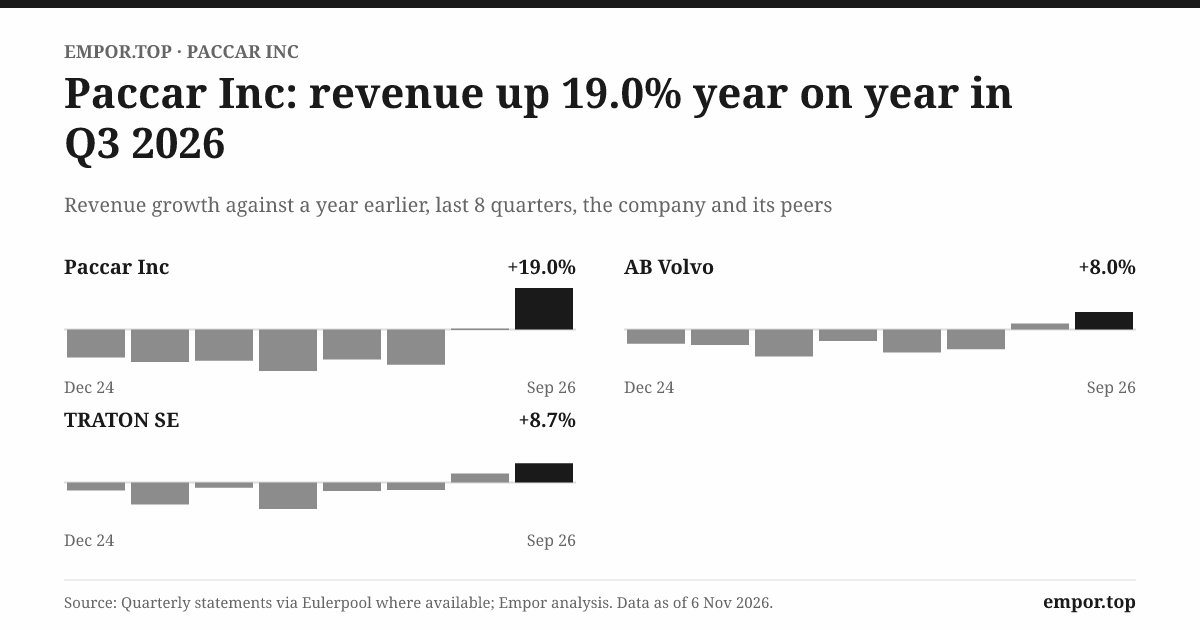
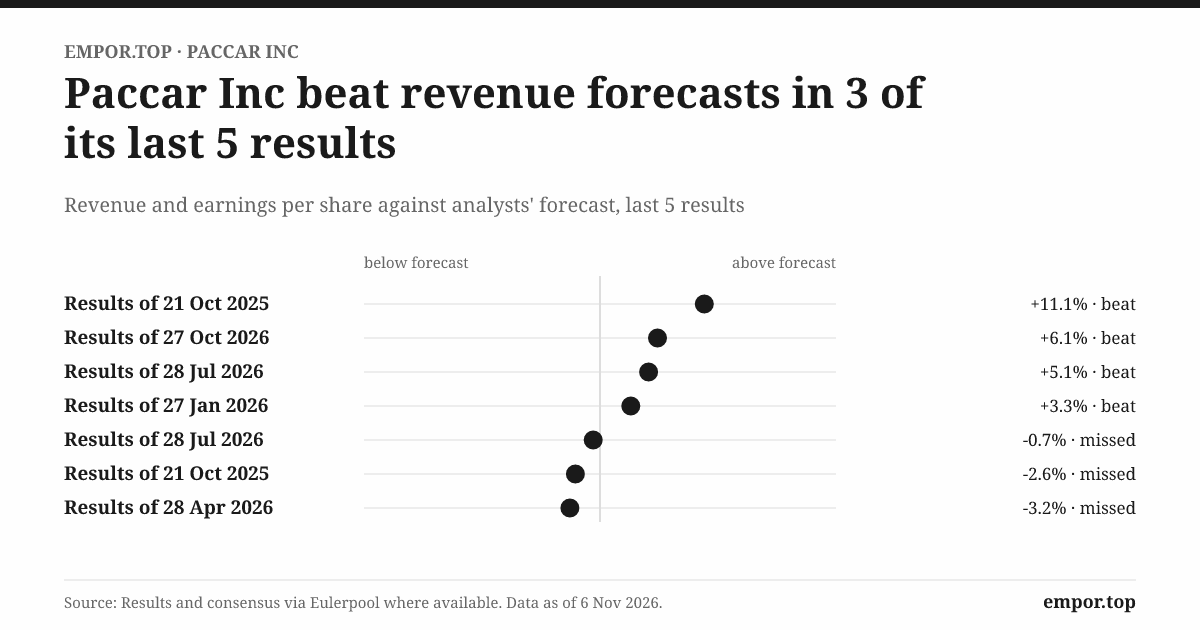
On October 27, 2026, a company founded to haul timber out of Washington's forests told the market that its trucks were selling again. PACCAR's third-quarter revenue came in at about $7.9 billion, 19% higher than a year earlier, and net income rose 44% to roughly $848 million.1 Factories that had spent most of 2025 trimming output shipped 40,100 trucks in the quarter, against 31,900 in the same three months of the prior year.2 The headline on the press release called the results "excellent."1
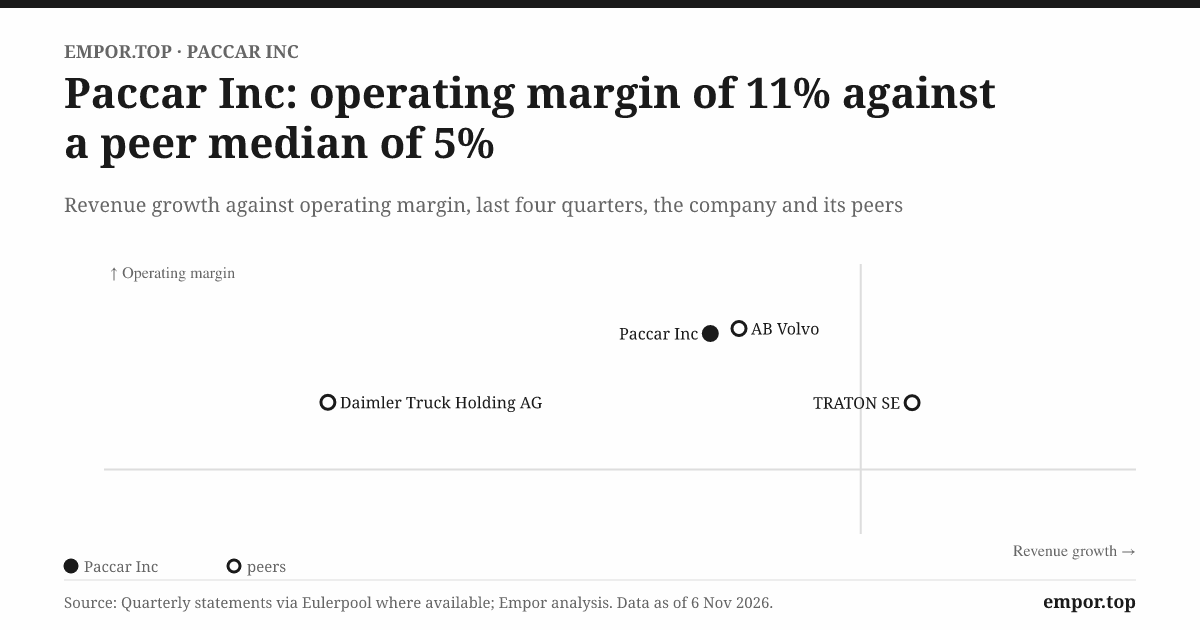
The word deserves a second look, because the same numbers can be read in two very different ways. Read against 2025, the quarter was a sharp rebound: operating profit rose by more than half, and operating margin climbed from about 9.5% to 12.2%.2 Read against the peak, it was something less. In the first quarter of 2024, PACCAR earned an operating margin above 16% on roughly $8.7 billion of revenue.3 Two and a half years later the company was selling about the same dollar volume of goods and keeping roughly a quarter less of each dollar as operating profit. The rebound is real. The recovery to the old earnings power is not yet in the numbers.
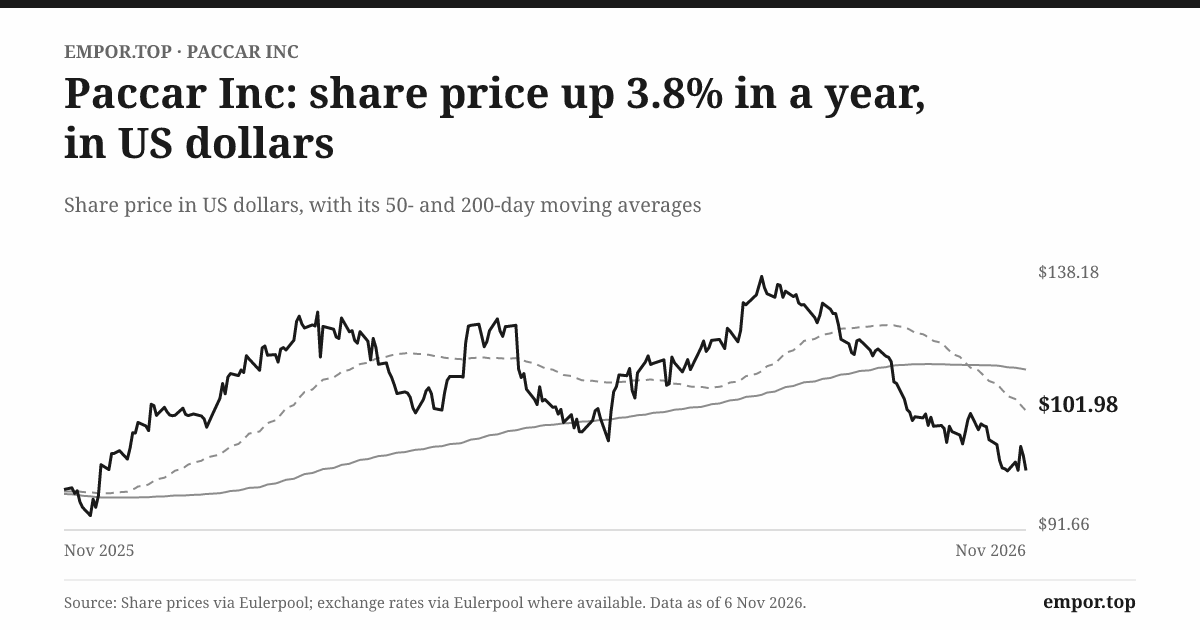
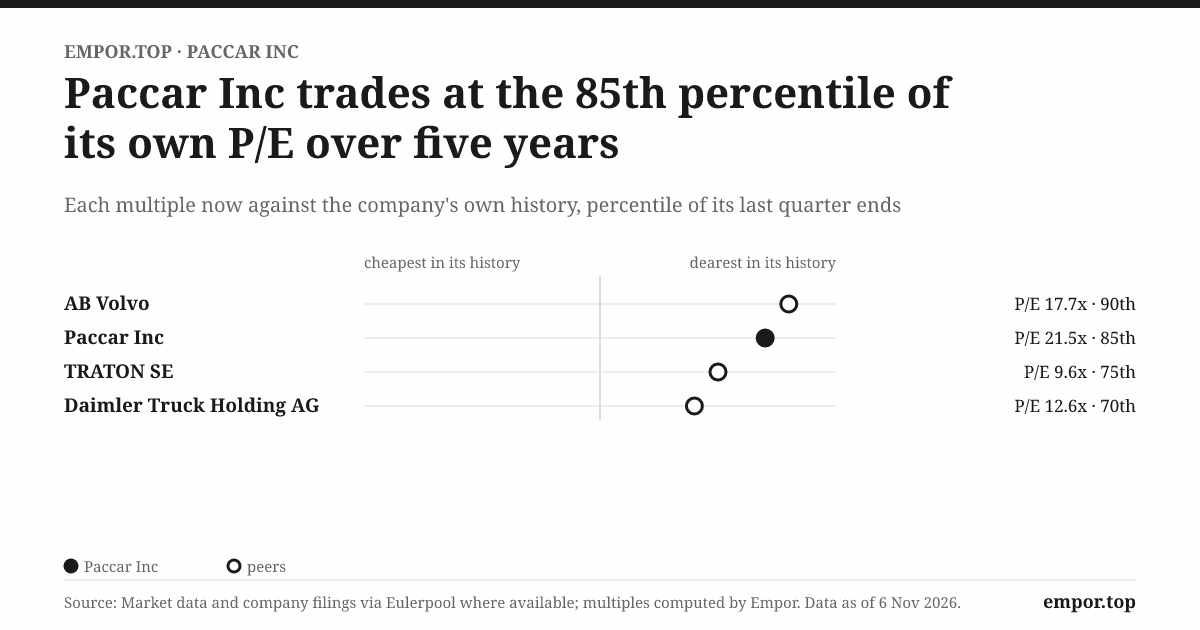
That gap matters because the stock market has not waited for it. On November 3, 2026, PACCAR's shares traded at about $103, valuing the company at roughly $54.5 billion. That price is almost a quarter below the 52-week high of about $136, so investors have already lived through a sharp fall. Yet the shares still sit at about 21.8 times trailing earnings, against a median of about 13.1 times over the past five years. Put differently, a buyer today pays roughly two-thirds more for each dollar of PACCAR's recent profit than buyers typically paid during a period that included both the post-pandemic boom and the 2025 slump. The market is either looking through depressed earnings to a recovery it can already see, or it is paying a premium for a business it believes has changed character. Those are different bets, and this story is about which one the record supports.
The peak itself deserves a word, because it sets the bar every recovery will be judged against. In 2023 PACCAR sold about $35 billion of goods, earned an operating margin of almost 17% and booked net profit of roughly $4.6 billion, more than three times what it had earned in 2020.3 That was a strange and favorable moment for every truck maker. Pandemic-era supply shortages had left fleets short of equipment, used-truck prices were high, and buyers were willing to accept price increases simply to secure a build slot. Some of that peak was PACCAR executing well. Some of it was an industry-wide windfall that was never likely to repeat. Any honest test of whether PACCAR has "recovered" has to decide which of those two peaks it is measuring against.
The company behind the bet is less famous than its products. PACCAR Inc is the listed parent of Kenworth and Peterbilt, the long-nosed trucks with chrome grilles that dominate the American imagination of the open road, and of DAF, the Dutch brand that is one of Europe's largest heavy-truck makers.4 Behind the badges sit two less glamorous businesses that turn out to be central to the investment case. PACCAR Parts sells replacement components through dealers and its own branded stores, and PACCAR Financial lends money to the dealers who stock the trucks and the fleets that buy them.3 When a trucker in Texas signs for a new Peterbilt, PACCAR may earn on the truck, on the loan that paid for it, and on the brake pads, filters and engine components that keep it on the road for the next decade.
That structure is the through-line of this episode. Heavy trucks are one of the most cyclical products in the industrial economy. Fleets buy them when freight is strong and credit is cheap, and stop buying when either turns, so a truck maker's volumes can swing by a third in a single year. PACCAR's long-standing pitch is that it has built something more durable around that cycle: premium brands that command loyalty, an integrated powertrain it designs itself, a parts network that earns whether or not new trucks are selling, and a finance arm that keeps customers inside the family. The bull story says this ecosystem turns a cyclical truck maker into a compounder. The bear story says it is still a truck maker, and that a 21.8 times multiple is a price for a promise that the cycle has repeatedly tested.
Both stories have evidence. To weigh it, the place to start is where PACCAR's habits were formed, long before anyone in Seattle had built a truck.
 Subscribe on LinkedIn
II. From Logging Railroads to a Truck Bet
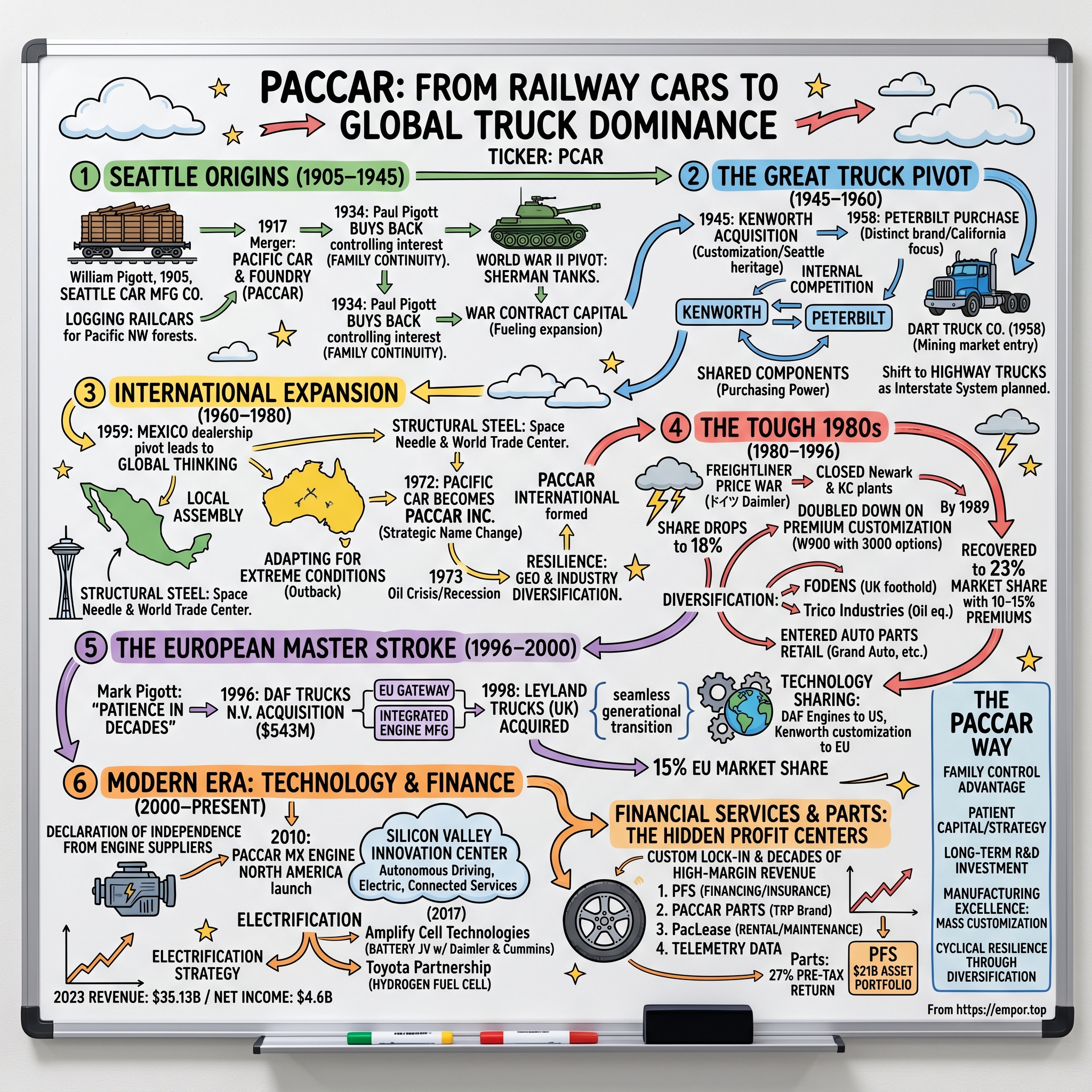
In 1905, the Pacific Northwest had more timber than it knew how to move. Douglas firs grew so large that a single log could fill a flatcar, and the logging railroads that threaded the hills around Puget Sound needed rolling stock built for that brutal work. William Pigott, a Seattle businessman with interests in steel, saw the opening and founded Seattle Car Manufacturing to build railcars for the logging trade.4 It was a regional business serving a regional industry, and nothing about it suggested a global truck empire.
What it did instill was a particular way of thinking about heavy equipment. Logging cars took a beating, so customers cared about durability more than price, and a builder that understood the specific needs of a specific operator could earn repeat business. In 1917 the company merged with a neighbor to become Pacific Car and Foundry, and over the following decades it widened its industrial range.4 During the Second World War its plants turned out tanks for the Allied effort, an experience that taught a regional railcar builder how to produce complex vehicles at scale under deadline.4 When the war ended, the company had capacity, engineering talent and a question about what to build next.
The answer arrived through acquisition rather than invention. In 1945, Pacific Car bought Kenworth, a Seattle truck maker that built heavy, custom vehicles for loggers and long-haul operators.4 Thirteen years later it added Peterbilt, a California maker with a similar reputation for building trucks to a customer's specification, and in the same era it bought Dart, a builder of heavy off-road haulers.4 By 1972 trucks had become so central to the company's identity that it renamed itself PACCAR, a compression of Pacific Car.4 The founding family stayed in the story. Pigotts led the company across much of the twentieth century, and Mark Pigott, a member of the founding family, ran it as chief executive from 1997 to 2014 before becoming executive chairman.5
This history usually gets told as a tale of continuity, and the company tells it that way itself. PACCAR reports that 2025 was its 87th consecutive year of net profit, a streak that began before the Second World War.3 It is an extraordinary claim for a manufacturer in one of the most volatile industries on earth, and it is true as stated. The useful question for an investor is what kind of profitability the streak actually describes.
The longest comparable financial record available runs from 2014, and it contains three hard tests. In 2016 a European Commission finding on truck-pricing practices at DAF and other manufacturers produced a large charge, and PACCAR's net profit fell by about two-thirds, to roughly $521 million.3 In 2020 the pandemic cut revenue by more than a quarter, and net profit fell by nearly half, to about $1.3 billion.3 And in 2025 a truck downturn, tariffs and another European litigation charge cut net profit by about 43%.3 In each case the company stayed in the black, which is more than most heavy-equipment makers can say about the same years. In none of those years did profit hold steady. The streak tells you PACCAR does not lose money in a downturn. It does not tell you PACCAR's earnings are stable, and over this twelve-year window they plainly were not.
That distinction is the right frame for everything that follows. The age of the company and the length of its profit streak are evidence of conservative financing and cost discipline, habits that matter when a quarter of revenue can vanish in a year. They are not, by themselves, evidence of a moat. A moat would show up as share that holds when rivals cut prices, margins that recover faster than the industry's, and profit pools that keep earning when trucks stop selling. PACCAR's modern case rests on whether its brands and network deliver those things, and that question begins with the two nameplates it bought in Seattle and California.
III. The Brands That Became the Business
Walk onto a truck-stop lot anywhere in America and the two PACCAR brands are easy to spot, yet hard to tell apart for an outsider. A Kenworth W900 and a Peterbilt 389 are both long-hooded, chrome-heavy, unapologetically traditional trucks, and they share a parent, a parts catalog and increasingly an engine. Drivers nonetheless treat them as rivals. Owner-operators who customize a Peterbilt with stainless trim and a stretched sleeper tend to say they would not be caught in a Kenworth, and the reverse is true too. PACCAR has spent more than six decades letting that rivalry run.
The logic is a kind of controlled competition. When PACCAR bought Peterbilt in 1958, it could have folded the brand into Kenworth and pocketed the savings.4 Instead it kept separate nameplates, separate dealer networks and separate customer identities, while sharing engineering, purchasing and later powertrains behind the scenes. The trucks are also built largely to order. A fleet or owner-operator can choose the engine, transmission, axle ratio, sleeper size, interior and dozens of other features, so each truck leaves the factory configured for a particular job.3 That customization is why PACCAR describes its trucks as premium. A buyer who wants a specific specification, a resale value that holds and a dealer who understands the product has a reason to pay more than the cheapest quote.
The question is how much of that premium is visible in the numbers. In 2025, PACCAR's Kenworth and Peterbilt brands together held about 29.9% of the U.S. and Canadian heavy-duty market.3 That makes PACCAR a heavyweight, but not the champion. Daimler Truck, whose Freightliner and Western Star brands have led the North American market for decades, reported a share of about 39.6% for the same segment.6 Volvo Group's Volvo and Mack brands together held roughly 16.4%.7 The three companies define their markets in slightly different ways, so the figures are not perfectly comparable, but the shape is clear. Freightliner is the volume leader, sold heavily to large fleets that buy on total cost. PACCAR is the strong number two, with a mix tilted toward customers who care about specification and image.
That positioning explains both the strength and the limit of the brand claim. The strength is that PACCAR keeps close to three in every ten heavy trucks sold in its home market without being the price leader, through more than 2,000 dealer sales, parts and service locations worldwide.3 The limit is that PACCAR does not publish the evidence that would turn "premium brand" from a reputation into a measurable advantage. It discloses no customer retention rate, no repeat-purchase data and no quantified price premium over Freightliner or Volvo.3 Investors are asked to infer pricing power from margins and share, and those numbers move with the cycle.
They moved the wrong way in 2025. PACCAR's North American share slipped from about 30.7% in 2024 to 29.9%, and DAF's European share also declined.3 Worldwide truck deliveries fell about 22%, from roughly 185,300 vehicles to about 144,200.3 A share loss of under a point in a falling market is not a collapse. Truck buyers shift orders for many reasons, including delivery slots, emissions timing and fleet-specific deals, and one year is a small sample. But it does undercut the most expansive version of the brand story, which holds that loyal customers keep buying PACCAR regardless of what rivals do. When demand fell and rivals competed for fewer orders, some of those customers chose other trucks.
The fair verdict is that PACCAR's brands are a real competitive asset whose power is moderate rather than absolute. They keep the company in a strong second place with a desirable customer mix, and they give dealers something to sell beyond price. They do not exempt PACCAR from a downturn, and they did not prevent share erosion in the most recent one. The single best number to watch for whether the brands still carry weight is North American heavy-duty share, last reported at 29.9% and trending slightly down.
There is one more thing the brand story does not explain. By the 1990s PACCAR had a strong position in a single continent and very little anywhere else. North American trucks were too long, too heavy and too differently regulated to sell into Europe, where cab-over designs and tight road rules dominated. If PACCAR wanted to grow beyond the American cycle, it needed a European brand, and in 1993 one of the best of them went bankrupt.
IV. The DAF Deal: A Global Truck Company for $543 Million
In February 1993, DAF, the Dutch truck maker that had grown out of a small engineering workshop in Eindhoven, ran out of money. Its parent group, which had merged with Britain's Leyland truck business only a few years earlier, collapsed under debt and a slump in European truck demand, and the combined company was broken apart in receivership.8 What emerged from the wreckage was a smaller DAF Trucks, still building well-regarded cab-over tractors in the Netherlands, and a separate Leyland Trucks in Lancashire. Both were good assets attached to weak balance sheets, which is exactly the kind of situation a patient, conservatively financed buyer waits for.
PACCAR waited. In October 1996, the company announced it would buy DAF Trucks, in an offer reported at about $543 million.8 For a company with PACCAR's conservative balance sheet, it was a large but digestible bet. Two years later PACCAR added Leyland Trucks, the British operation that had once been DAF's partner, and the old Leyland DAF footprint was reunited under an American owner.4
What PACCAR bought was not mainly factories. It bought a European engineering base that knew how to design cab-over trucks for European roads and regulations, production in the Netherlands, Belgium and Britain, and a dealer network across the continent. None of that could have been built from Seattle with North American products. DAF gave PACCAR entry to a market as large as its home market, with its own cycle that does not always move in step with America's. In good years that diversification smooths the group's earnings. In years like 2025, when both continents weakened together, it did much less.
Three decades later, DAF is a substantial business. PACCAR's European truck revenue was about $5.0 billion in 2025, and DAF held about 13.5% of Europe's heavy-duty market.3 DAF also became PACCAR's engine laboratory. The MX engine family that would later reshape the company's North American economics was developed and refined in Eindhoven long before it went into a Kenworth.9
It is tempting to call the deal one of the great industrial acquisitions, and many people do. The record allows a narrower conclusion. Comparing $543 million in 1996 with $5 billion of revenue today is not a return calculation. Revenue is not profit, and three decades of reinvestment, inflation and organic growth sit between the purchase price and today's sales. PACCAR does not report DAF's standalone profit, invested capital or return on that capital. Its segment reporting combines Europe with North America inside the Truck segment, and Parts and Financial Services earnings from European customers sit elsewhere.3 So a purchase multiple or a lifetime return on the deal cannot be computed from what the company discloses. What can be said with confidence is that DAF turned PACCAR from a North American company into a global one at a price that was modest against PACCAR's balance sheet, and that the asset has been kept, grown and integrated rather than written down or sold.
DAF also brought PACCAR some of its most expensive problems. The European Commission's investigation of truck-pricing coordination among major manufacturers from the late 1990s into the 2010s included DAF, and the resulting claims have trailed PACCAR for a decade. After the 2016 charge, PACCAR recorded further charges of $600 million in 2023 and $350 million in the first quarter of 2025 for civil claims from European truck buyers seeking damages.3 The company says the 2025 charge was non-recurring, but lawsuits continue in several European jurisdictions.10 Any honest tally of the DAF deal has to include those costs alongside the market access.
Finally, globalization did not cancel the cycle. In 2025 DAF's European heavy-duty share fell from about 14.4% to 13.5% as the market contracted.3 The pattern repeated on the other side of the Atlantic. DAF gave PACCAR reach. It did not give it immunity.
What DAF gave PACCAR that turned out to matter even more was technical capability. The engineers in Eindhoven knew how to design a heavy-duty diesel engine, and in the late 2000s PACCAR decided to bring that capability to America, in the middle of the worst downturn the industry had seen in a generation.
V. The Engine Plant That Changed What PACCAR Could Control
In 2009, the American truck business was in free fall. Freight volumes had collapsed with the financial crisis, credit for fleet purchases had evaporated, and PACCAR's North American factories were running at a fraction of capacity. The company closed plants and cut its workforce by roughly 40% through the downturn.11 Most manufacturers in that position conserve every dollar. PACCAR, at the same time, was finishing a new engine factory in Columbus, Mississippi.
To see why that was a bold move, it helps to understand how American heavy trucks had traditionally been built. For decades, truck makers like Kenworth and Peterbilt functioned partly as assemblers. They designed the cab, chassis and body, and bought the most expensive and technically complex component, the diesel engine, from specialists such as Cummins, Caterpillar or Detroit Diesel. Think of it like a high-end computer maker that designs a beautiful case but buys the processor from Intel. The customer gets choice, but the truck maker hands a large share of the value and much of the engineering control to someone else.
PACCAR had already broken that model in Europe, where DAF built its own engines. By the time North American production began, more than 125,000 PACCAR MX engines were already operating in DAF trucks.9 The Columbus plant was designed to bring that engine, adapted to American emissions rules, into Kenworth and Peterbilt trucks. In July 2010, PACCAR announced that MX engine production had begun at Columbus, as it introduced the engine to North American customers after certification and extensive road testing.9
The order of events matters, because it is a useful template for judging PACCAR's newer technology bets. First came the European proof: an engine with a long service history in real trucks. Then came regulatory certification and test miles in America, which proved the engine could meet the rules and survive the roads. Only after that came production, dealer orders and installation in trucks customers paid for. Certification was a milestone. Orders and installed engines were the commercial evidence.
The strategic benefits followed from control. Designing its own engine let PACCAR integrate the powertrain with the rest of the truck, tuning engine, transmission and axles together for fuel economy and reliability, and gave it a product differentiator that rivals buying the same third-party engine could not copy. Over time the company added its own automated transmission and its own tandem drive axle, matched to the MX engine.3 It also gave PACCAR a larger share of the aftermarket parts flow, because an engine PACCAR designs is serviced with parts PACCAR sells. The investment kept compounding after the downturn: the Columbus site has since been expanded, and in 2025 PACCAR described a new $35 million engine remanufacturing facility there.3
What PACCAR has not done is quantify the payoff. The company does not disclose the cost advantage of its own engine versus a purchased one, the share of its North American trucks that carry an MX engine, or the margin uplift from engine integration. Customers can still order Cummins engines in Kenworth and Peterbilt trucks, so the powertrain is a choice, not a lock-in. A skeptic might note that the engine strategy has not prevented the share slippage or margin compression of 2025. The fair reading is that the Columbus plant converted a European technical capability into an American production business, used it to deepen integration across the truck and its parts, and survived a long test of customer adoption. That is stronger evidence than any certification or pilot. It is not evidence of a measured cost moat, because PACCAR has not published one.
The engine episode also offers a yardstick for the company's current bets. PACCAR is investing in battery cells through a joint venture, and in connected services through a platform called PACCAR Connect. Neither has yet traveled the full path from announcement to installed product to recurring revenue that the MX engine did. When those investments come up later in this story, the question will be how far along that path they have actually traveled.
For now, the engine plant points back to PACCAR's broader business model. That is where the most surprising number in PACCAR's recent accounts lives.
VI. The Parts Business Keeps Earning After the Truck Is Sold
Follow a single new Kenworth from the factory in 2025 and the money trail is longer than it looks. The truck leaves the plant and is shipped to an independent dealer, who may have borrowed from PACCAR Financial to hold it in inventory. A fleet buys it, perhaps with a loan or lease from the same finance arm. Then the truck starts working, covering 100,000 miles or more a year. Every few weeks it needs filters, oil and brake components. Every year or two it needs tires, clutches, lighting and electrical parts. Over a decade of hard use it may need an engine overhaul. Much of that maintenance flows through PACCAR dealers and, increasingly, through PACCAR's own parts distribution network.
In 2025, that trail produced the most important comparison in PACCAR's accounts. The Truck segment, which sells the vehicles, earned revenue of about $19.4 billion, roughly two-thirds of the company, but only about $871 million of pretax income.3 The Parts segment earned revenue of about $6.9 billion, roughly a quarter of the company, and about $1.67 billion of pretax income.3 In a bad truck year, the business that sells replacement brake pads earned almost twice as much as the business that sells $150,000 trucks. Financial Services added another $485 million of pretax income on about $2.2 billion of revenue.3
That inversion is the strongest piece of evidence for the bull case, so it is worth understanding how it works. Parts margins are structurally higher than truck margins because the economics differ. Building a truck means buying steel, engines, electronics and labor in a competitive market and selling to sophisticated fleet buyers who can play one manufacturer against another. Selling a replacement part to a truck that is already on the road is a different negotiation. The truck owner needs the part now, the dealer has it on the shelf, and the cost of a truck sitting idle is far larger than any difference in part price. PACCAR earns on availability and speed as much as on the part itself.
The network that makes this possible is large. PACCAR's parts business serves a dealer network of more than 2,000 sales, parts and service locations and supplies over 350 TRP stores, a brand of aftermarket parts that covers trucks from all manufacturers, not just PACCAR's own.3 Parts distribution centers around the world hold inventory close to customers; the company counted 21 of them at the end of the third quarter of 2026 and announced plans for a new one in France.1 TRP matters strategically because it lets PACCAR sell parts to the owner of a Freightliner or a Volvo, turning a rival's installed base into a customer pool.
The cycle contrast is striking. Parts revenue reached a record in 2025 even as truck revenue fell about 22%.3 In the third quarter of 2026 Parts revenue set another quarterly record at about $1.78 billion.2 That resilience has a simple driver: the fleet of trucks on the road does not shrink when new-truck sales fall. If anything, fleets that delay buying new trucks keep older ones running longer, which can require more parts.
The evidence also has limits, and they matter for how far the Parts story can carry the investment case. Parts revenue did not grow in a straight line through 2026. Aftermarket volumes were softer in the first nine months of the year, and pretax income in the record third quarter was about $404 million, slightly below the $410 million earned a year earlier.210 Currency translation flattered the reported revenue, so the record headline overstates growth in the number of parts actually sold.10 Management guided full-year Parts sales growth of 3% to 5% for 2026, a respectable but unspectacular pace.12 Parts dampens the truck cycle. It does not escape the broader freight economy, because a recession that idles trucks also reduces the miles they drive and the parts they wear out.
Financial Services deserves its own explanation, because it is easy to misread. PACCAR Financial makes loans and leases to the dealers and customers who buy PACCAR trucks, earning a spread between what it pays to borrow and what it charges.3 That helps truck sales, because a dealer or fleet with ready financing is more likely to buy, and it keeps PACCAR close to the customer. But a finance company's economics are different from a manufacturer's. Its profits depend on interest rates, credit losses and the resale value of used trucks it repossesses. Its receivables and borrowings belong to a lending book, not to the factories. When this story turns to cash and debt, that boundary will matter a great deal.
Put the three segments together and the mix explains why PACCAR is not a pure truck maker, and why it is not a recurring-revenue business either. The company does not disclose what share of its revenue is contractually recurring. It offers extended warranty and repair-and-maintenance contracts, generally lasting up to five years, but publishes no overall service-contract penetration rate, customer retention data or customer-level parts loyalty.3 Investors can see that Parts earns well through a downturn. They cannot see how secure that earnings stream is against independent parts distributors, rival dealers or fleets that maintain their own trucks.
The finance arm kept earning through the recovery too. In the third quarter of 2026, Financial Services earned about $138 million before tax, up roughly 9% from a year earlier, on slightly lower revenue, while Parts contributed about $1.22 billion of pretax income across the first nine months.2 Those two businesses together produced well over half of PACCAR's pretax income in the nine months, a share that will fall as truck profits recover. That is the double edge of the mix: the steadier businesses look biggest precisely when trucks are weakest.
PACCAR Connect is the company's attempt to deepen the relationship further. Unveiled in October 2026, it combines fleet telematics, PACCAR's own truck data, productivity applications and electronic driver logs into one platform, and it will be available in Kenworth and Peterbilt trucks beginning in early 2027.1 In principle, connected trucks can tell a dealer when a part is about to fail, schedule service before a breakdown and steer that service to a PACCAR location. That could make the parts relationship stickier and add subscription revenue. In practice, PACCAR has not disclosed pricing, adoption targets or expected revenue, and the platform has not yet shipped in volume. Like the MX engine in 2009, it is an announcement waiting for orders.
The verdict on this section is that Parts is already a material and resilient earnings engine, the single strongest fact supporting the idea that PACCAR is more than a truck cycle. It earned more than the trucks in 2025, and it kept setting revenue records through the downturn. But it is a quarter of revenue, its volumes softened in 2026, and its durability rests on a network whose switching costs PACCAR does not measure publicly. The truck business still sets the overall direction of the company's earnings, as 2025 showed with brutal clarity.
VII. When the Truck Cycle Took Away Two-Thirds of Truck Profit
The 2025 truck downturn did not arrive as a single shock. It built through the year in layers. American freight markets had been weak since 2023, squeezing trucking companies' profits and making fleets cautious about replacing equipment. Then came new tariffs on imported materials and components, which raised the cost of building trucks. On top of that, truck makers faced higher content costs from evolving emissions and safety requirements, and uncertainty about the next round of federal emissions rules scheduled for 2027 made some customers hesitate to commit.3 PACCAR's management described the result plainly: lower retail demand reduced deliveries, while tariffs and higher truck-content costs weighed on profitability.3
The numbers show how fast operating leverage works in reverse. As deliveries fell sharply in 2025,3 the impact on profit was amplified by fixed costs. A truck factory has large fixed costs: plants, salaried engineers, tooling and depreciation that must be paid whether the line runs at full speed or half. When volume falls by about a fifth, revenue falls by about a fifth too, but costs fall by much less, so profit falls by far more. Truck segment pretax margin dropped from about 11.5% in 2024 to about 4.5% in 2025, which meant the Truck business lost close to two-thirds of its pretax profit.3 At the company level, revenue fell about 15.5%, while Parts and Financial Services cushioned the drop in profit.3
The 2026 recovery runs the same mechanics in the other direction, and the third quarter shows it working. Truck revenue rose from about $4.4 billion to $5.6 billion year on year, and Truck pretax income more than quadrupled, from about $103 million to about $455 million.2 Truck pretax margin rose from about 2.3% in the third quarter of 2025 to roughly 8.1%.2 Management attributed the improvement to higher deliveries, favorable price realization and lower tariff costs.112 That is a meaningful recovery, but it also puts the scale of the remaining gap in focus. An 8% truck margin is better than a 2% one, yet still well below the 11.5% PACCAR earned in 2024, let alone the peak margins of 2023.
Management's tone on the October call was confident but specific. PACCAR estimated 2026 U.S. and Canadian Class 8 retail sales at 240,000 to 260,000 trucks, and forecast 240,000 to 280,000 for 2027, saying it was experiencing "a good year of truck demand in 2026" and expected that to continue.1 Executives guided fourth-quarter deliveries to 41,000 to 43,000 trucks, with a gross margin for trucks, parts and other of 14% to 15%.12 The European market, by their estimate, would hold steady at 300,000 to 320,000 heavy trucks in both years, and they estimated that South America would grow modestly.1
Where those trucks went also matters. Of the 40,100 delivered in the third quarter, about 23,800 went to customers in the United States and Canada, about 10,400 in Europe and about 5,900 elsewhere.2 North America is still where PACCAR's truck profits are made, so a recovery that leans on the home market is the most valuable kind it can get. It is also the most exposed to a single country's freight cycle and trade policy.
The order book had told the same story on the way down. At the end of 2023, PACCAR's truck backlog stood at about $7.6 billion. By the end of 2025 it had shrunk to about $4.9 billion, of which roughly $2.6 billion was firm for delivery within ninety days.3 A truck maker with a shrinking backlog has less visibility and less pricing leverage, because it must compete for each new order rather than allocating scarce build slots. Rebuilding that backlog is one of the quieter signs to watch in 2027.
The answers also exposed the risks that could break the recovery. Supply constraints "modestly affected production" in the quarter, and Chief Executive Preston Feight explained why small shortages matter in his business: missing a single part can hold up a finished truck.12 Customers were placing orders for 2027 but waiting for the government to set the nonconformance penalty, the fee manufacturers pay for engines that do not meet the new emissions standard, which affects what a 2027 truck will cost.12 Management described tariffs as "not material" to quarterly results, partly because some costs were offset by benefits.12 That reading is plausible but bounded: PACCAR's own guidance has shifted with these factors before, and its 2027 market range is wider than its 2026 range, a sign that management sees real uncertainty.
The emissions question needs a brief translation, because it sits underneath every 2027 truck order. American regulators set limits on nitrogen oxides, the smog-forming gases diesel engines emit, and a tighter limit is scheduled to apply to engines built from 2027. Meeting it means more sophisticated after-treatment hardware and engineering, which raises the price of a new truck. Manufacturers that cannot fully meet a new standard can, in some circumstances, pay a per-engine penalty instead, and the size of that penalty effectively sets how much compliance is worth. Until the government fixes the number, neither PACCAR nor its customers can be sure what a 2027 truck will cost, which is why Feight told analysts he expected a decision within four to eight weeks and why customers were hedging their orders in the meantime.12 Historically, emissions changes have pulled demand forward as fleets buy older-specification trucks before prices rise, then left a lull afterward. That pattern, if it repeats, would flatter late 2026 and early 2027 and make the following year harder.
Truck-market forecasts deserve caution in either direction. They move with freight rates, credit conditions and regulation, and PACCAR's own ranges have been revised as those inputs shifted, sometimes in the company's favor. A forecast midpoint is a planning assumption, not a commitment, and the width of the 2027 range is itself information about how uncertain management considers next year.
Share is the other clue. PACCAR's slight 2025 share losses came in a falling market, when the bull thesis says a premium brand should hold its customers. If the recovery returns North American share above 30%, the brand case strengthens. If share keeps slipping while volumes rise, the recovery is being carried by the market, not by PACCAR's position within it.
So is the third quarter the start of a new earnings base or a bounce from a very low comparison? The evidence points to a genuine but incomplete recovery. Volume, pricing and lower tariff costs are all moving the right way, and the operating margin has risen for two straight quarters. But the margin remains below the 2024 peak, truck profitability remains well below its prior level, and the 2027 emissions rules add a fresh uncertainty to the order book. Three indicators will settle it: North American heavy-duty share against 29.9%, global deliveries and backlog as the year turns, and Truck pretax margin against the 11.5% of 2024. Until those move together, the recovery is a cyclical upturn with promising details, not yet proof of a new normal.
Profit, though, is only half of how a cyclical company survives a downturn. The other half is cash, and PACCAR's cash statement tells a more complicated story than its income statement.
VIII. Cash, Dividends, and the Debt That Belongs to Finance
At first glance, PACCAR's 2025 cash flow statement looks like a magic trick. In the year its net income fell to about $2.4 billion, the company generated about $4.4 billion of cash from operations.3 A business whose profits had nearly halved produced almost twice its profit in cash. Most industrial companies would be delighted to report that kind of conversion in a good year, never mind a bad one.
The explanation is the first lesson of reading PACCAR's cash: much of the swing comes from the finance business, not the factories. Part of the gap was ordinary non-cash expenses such as depreciation, which reduce profit but not cash. The more unusual piece came from wholesale receivables, the loans PACCAR Financial makes to dealers to carry new trucks in inventory. When truck sales slowed, dealers held fewer new trucks and repaid more of those loans, releasing about $1.49 billion of cash in 2025.3 In a sense, the downturn made PACCAR's cash flow look better, because the finance arm shrank its lending book. In a recovery the process reverses. In the first nine months of 2026, operating cash flow was about $2.5 billion against $2.2 billion of net income, as working-capital changes used about $309 million, partly because trade receivables grew.10
Over the long run, PACCAR's cash record is genuinely strong. From 2014 through 2025, the company generated about $37 billion of operating cash flow against about $27 billion of net income, or roughly 137% of profit.3 After capital spending, free cash flow over those twelve years was about $16.9 billion. Of that, about $13.7 billion, or roughly 81%, went out as dividends, while cash and short-term investments grew by about $6.5 billion to roughly $9.5 billion at the end of 2025.3 Those figures do not fully reconcile, because some cash came from finance-business funding and working-capital swings rather than free cash flow, and that is precisely the point: in PACCAR's consolidated accounts, the manufacturing business and the lending business are tangled together.
The dividend policy shows the company's priorities. PACCAR pays a regular quarterly dividend and, in good years, a larger year-end extra dividend, so the total payout rises and falls with earnings.3 Across 2014 to 2025 the median payout was about 44% of net profit, but in 2025 it reached about 95%, as dividends of roughly $2.3 billion nearly matched the year's profit.3 It is a choice that rewards shareholders, but it also means very little of 2025's profit was retained.
Morningstar DBRS, which rates PACCAR's debt, made a pointed calculation in April 2026. It estimated that the manufacturing businesses ran a free-cash deficit of about $340 million in 2025 after dividends and capital spending, even as their debt-to-EBITDA ratio stood at zero.13 Manufacturing EBITDA, by the agency's estimate, fell below $2.9 billion from $4.9 billion the year before.13 That is the skeptical investor's key question for PACCAR's capital allocation: in a weak year, did the factories earn enough cash to fund both their own investment and the dividend? According to the ratings agency, they did not, and the gap was covered by the company's ample cash reserves.
That does not mean the company was stretched. DBRS affirmed PACCAR's rating at AA (low), with a stable trend, citing strong brands, global diversification and strong cash generation, while flagging truck cyclicality and reliance on suppliers.13 The agency's description of the manufacturing business is notable: it said manufacturing had no material indebtedness.13
That brings the story to the debt line, which can mislead a casual reader. At the end of 2025, PACCAR's consolidated balance sheet showed about $15.6 billion of borrowings, and a debt-to-equity ratio of about 0.81.3 Almost all of that debt sits in Financial Services. At the end of 2025, the finance business owed about $15.6 billion, mostly commercial paper and term notes, at a weighted average rate of about 4.5%, with roughly $8.3 billion scheduled to mature in 2026.3 That debt is supported by a matching book of loans and leases.
The finance book carries its own risk, and it moved in a reassuring direction this year. Accounts 30 or more days past due fell to about 1.9% worldwide at the end of September 2026, from 2.4% at year-end 2025.10 That improvement deserves one caveat, however: without contract modifications for customers in financial difficulty, the past-due figure would have been about 2.7%, and modifications ran at about $123 million in the third quarter, concentrated in the U.S., Australia and Mexico.10 Some trucking customers were still under strain, and PACCAR was working with them rather than repossessing trucks. The refinancing risk is real but manageable: the finance arm depends on investment-grade ratings and functioning credit markets to roll over billions of short-term debt each year.3
Treasury income is the last piece. PACCAR earned about $395 million of investment income on its cash and securities in 2025, roughly 13% of consolidated pretax income in a weak year.3 That income is real, but it depends on interest rates and cash balances, not on selling trucks.
That pile of cash is held conservatively. At the end of 2025, PACCAR held about $6.3 billion in cash and about $3.2 billion in marketable securities, mostly government, municipal and corporate debt held for liquidity rather than return.3 By the end of September 2026 the combined balance had slipped only about $116 million, even after a year of dividends, capital spending and a recovering working-capital build.10 For a company whose finance arm must roll over billions of short-term debt every year, that cushion is part of the reason lenders and rating agencies are comfortable.
The verdict here is that PACCAR's cash generation and liquidity are substantial, and the AA-category rating confirms that independent analysts see little balance-sheet risk. But the headline cash flows and the headline debt both require a mental separation of factories from finance. In 2025, the manufacturing business did not cover its dividends and capital spending from its own cash generation, and the recovery year will consume working capital as dealers restock. The test is whether manufacturing free cash flow after dividends turns positive through a full recovery year. That depends partly on how management balances returning cash with investing in the next generation of trucks, and the person making that call has run the company for seven years.
IX. Feight's PACCAR: Long Tenure, New Bets, and a Harder Earnings Test
Preston Feight is an engineer who rose by running trucks. He studied mechanical engineering at Northern Arizona University and earned a master's in engineering management from the University of Colorado, then spent two decades inside PACCAR before reaching the top job.14 Along the way he ran Kenworth as general manager and served as president of DAF Trucks in the Netherlands, an unusual combination that gave him direct experience of both PACCAR's American brand culture and its European engine and cab-over engineering base.14 In April 2019, the board named him chief executive, effective that July, succeeding Ron Armstrong, who had led the company since 2014.14 Mark Pigott, who had been chief executive from 1997 to 2014, remained executive chairman and continued to provide strategic counsel.145
That structure is worth understanding. PACCAR is not a family-controlled company in the legal sense. Mark Pigott beneficially owned about 5.7 million shares, or roughly 1.1%, according to the 2026 proxy, and his brother John Pigott also sits on the board.5 The largest holders are index giants, Vanguard with about 11.9% and BlackRock with about 7.0%, based on filings made in early 2024.5 Yet the presence of a founding-family executive chairman with a four-decade link to the company gives PACCAR an unusually long institutional memory and, arguably, an unusually long planning horizon. It also concentrates influence in a way that independent shareholders cannot easily check, a governance trade-off that has not produced visible conflict: shareholders backed the company's 2025 executive pay with more than 93% support.5
Feight's pay offers a window into how the board measures performance. His total compensation in 2025 was about $12.6 million, down from about $20.9 million in 2023.5 The direction tracked the earnings decline. But the board excluded the $264.5 million after-tax European litigation charge and the impact of tariffs when it calculated his 2025 annual incentive.5 Boards often adjust for one-off items, and there is a case that a CEO should not be penalized for a legal dispute rooted in conduct that predates his tenure, or for tariffs set in Washington. There is also a case the other way: tariffs and litigation are real costs to shareholders, and a pay plan that excludes them weakens the link between reported profit and executive reward. Investors can take either view, but they should know the adjustment exists.
The management team also changed in a key seat. In 2025, Brice Poplawski succeeded Harrie Schippers as chief financial officer after Schippers retired.5 The transition appeared orderly, with no sign of disagreement, but it means the person managing the company's capital through the recovery is relatively new in the role.
The capital record under Feight is consistent with PACCAR's long habits. The company kept investing through the downturn, with research and development of about $446 million and capital investments of about $729 million in 2025, and guided to similar spending in 2026 and 2027.31 It kept paying regular and extra dividends. It bought back very little stock: about 0.4 million shares in 2025 and none in 2024 or 2023, and about $372 million of a repurchase authorization dating to December 2018 still unused by September 2026.310 Its filings from 2023 through the third quarter of 2026 record no equity raise, and PACCAR issued only about 1.1 million shares through employee compensation in the first nine months of 2026.10 That is a record of low dilution and consistent reinvestment, not of aggressive financial engineering.
Measured against sales, that reinvestment is modest but steady. Research and development ran at about 1.2% of revenue in 2023 and about 1.6% in 2025, a rising share mainly because revenue fell while engineering budgets held.3 The company guided 2027 research and development to $460 million to $500 million, higher than 2026, and capital spending to $650 million to $700 million.1 PACCAR ended 2025 with about 25,900 employees, a workforce small enough relative to its revenue that the company relies heavily on suppliers and dealers for much of the labor behind each truck.3 The picture is of a company that kept its engineering budget roughly intact through a profit collapse, which is the behavior the Columbus engine story would lead one to expect.
The harder question is the bets themselves. Feight's PACCAR is investing in two areas that could reshape the truck business. The first is battery cells. PACCAR is a partner in Amplify Cell Technologies, a joint venture building a battery-cell factory in the United States, intended to supply batteries for electric commercial vehicles.3 The second is PACCAR Connect, the connected-truck platform launching in early 2027.1 Both are strategically relevant. Battery-electric trucks could eventually displace diesel in some uses, and a truck maker that controls its batteries may control the next powertrain the way the MX engine helped it control this one. Connected services could make the parts and service relationship more valuable.
But neither is yet a material profit pool, and the engine story offers the right yardstick. The MX engine had more than a hundred thousand units of European service history before it went into American trucks. Battery-electric heavy trucks remain a small share of PACCAR's sales, and the company does not disclose battery revenue or the expected return on the joint venture. PACCAR Connect has no published pricing or adoption targets. Until those investments produce customers, deliveries and revenue, they are options, not earnings, and a 21.8 times multiple should not be justified by them.
On management credibility overall, the evidence supports a measured case. Feight's team has kept investing through a downturn, maintained the balance sheet and dividend, and recovered margins over 2026. It has also guided carefully, with market ranges that have proved reasonable, though they have shifted as conditions changed. What it has not yet done is restore truck margins to their pre-downturn level, and that is the test still in front of it. The final reckoning comes in the valuation, where the market has already priced an answer.
X. Analysis & Bear vs. Bull Case
Imagine two investors looking at the same PACCAR quote on November 3, 2026. The first sees a share price almost a quarter below its 52-week high and a business that has just reported a 44% jump in quarterly profit. The second sees a stock at 21.8 times trailing earnings, against a five-year median of 13.1 times, in an industry where earnings can fall by half in a single year. Both are looking at the same facts. The question is which facts carry more weight.
What loyalty can and cannot hold
PACCAR's competitive advantage, argued once in full, rests on four connected mechanisms. The first is brand and customization: Kenworth and Peterbilt trucks are built to order for customers who value specification, resale and image, which lets PACCAR compete on more than price. The second is distribution: more than 2,000 dealer locations give customers access to sales, service and parts across North America and beyond. The third is integrated finance: PACCAR Financial makes it easier for dealers to stock trucks and for customers to buy them. The fourth is parts: the aftermarket business, extended through TRP to rival brands, earns high margins on the installed base of trucks long after they are sold. In Hamilton Helmer's framework of competitive powers, this is mostly branding plus a modest form of switching costs and scale economies in distribution. PACCAR also shows elements of a cornered resource in its integrated powertrain, which competitors buying third-party engines cannot fully replicate.
Each of those powers can be tested against the record. Branding should show up as price realization and share that holds through downturns. PACCAR's price realization was favorable in the third quarter of 2026, but its North American and European share both slipped in 2025, and it publishes no quantified price premium.123 Switching costs should show up as customer retention; PACCAR publishes none. Customers can and do choose rival brands, and fleets routinely buy from more than one manufacturer. Scale economies are real but not decisive: Daimler Truck is larger in North America, with roughly 39.6% share, and builds at greater volume.6 The powertrain advantage is credible but unquantified. So the record narrows the moat claim to a smaller, more defensible version: PACCAR has a strong brand-and-network position that supports premium positioning and resilient parts earnings, but it does not have the kind of lock-in that would let it hold share and pricing regardless of the cycle.
Michael Porter's five forces sharpen that view. Buyer power is meaningful: large fleets buy in volume, compare quotes and switch brands, while independent dealers carry multiple product lines and owner-operators are price-sensitive in a downturn. PACCAR has no customer above 10% of revenue, which limits concentration risk but also reflects a fragmented market where no single relationship is locked in.3 Supplier power is real in a different way: PACCAR relies on outside suppliers for many components, including a long-term supply contract for Renault cabs used in products representing about 2% of revenue, and it warns that sudden interruptions could hold up production.3 The third-quarter supply constraints showed that risk in action. Rivalry is intense among three large players, Daimler, PACCAR and Volvo, plus Navistar in North America; in Europe, DAF competes with Daimler, Volvo, Scania, MAN and Iveco. The threat of new entrants is low for diesel trucks, given the capital, distribution and regulatory barriers, but higher for electric trucks, where new players and battery suppliers could reshape the value chain. Substitutes are limited, since freight by road has few alternatives for most routes, though rail and intermodal compete on long hauls.
The industry structure is therefore a disciplined oligopoly, not a monopoly. Several capable manufacturers compete hard for orders in a cyclical market, and PACCAR's edge lies in positioning and aftermarket economics rather than in market power.
Two ways to read the same quote
The bull case starts with the recovery. If the North American market holds near 240,000 to 280,000 trucks in 2027, as management forecasts, PACCAR's deliveries and truck margins should keep rising toward their 2024 level.1 Parts earnings, which held up through the downturn, would compound on top. Market share would recover modestly as the brands regain momentum, and the 2027 emissions rules could pull some orders forward as customers buy before prices rise. In that world, today's 21.8 times trailing earnings would look less demanding against higher forward earnings, and the parts and finance businesses would justify a higher multiple than PACCAR's history suggests. The bull would point to Parts pretax income of about $1.67 billion in a bad year as proof that a large part of PACCAR's earnings is more resilient than a pure truck maker's.
The bear case starts with the multiple. A P/E of 21.8 times is well above PACCAR's five-year median of 13.1 times, which already included some very strong years. The bear would argue that the market is paying a premium on earnings that are still recovering, at a time when the truck cycle remains volatile and the 2027 emissions rules add uncertainty. Truck margin, at about 4.5% in 2025, shows how quickly profit can vanish when volumes fall, and the 2026 recovery has not yet restored it.3 Share slipped in both major markets last year. Tariffs and regulatory costs could squeeze margins again. And the newer bets, battery cells and connected services, could absorb capital without producing commercially meaningful returns, as many industrial technology investments have.
Weighing the two, the evidence supports a measured conclusion. The bull case has solid evidence in market share, parts profitability and an integrated product line. The bear case has equally solid evidence in cyclicality, recent share slippage, compressed truck margins and a valuation above history. Relative cheapness to peers cannot be established on a like-for-like basis from published comparable multiples on the same date, so the valuation argument rests on PACCAR's own history.
A skeptical activist would probe a few specific points. The first is disclosure. PACCAR reports North American and European trucks inside one Truck segment, so investors cannot see whether DAF earns more or less than Kenworth and Peterbilt, or how much capital each consumes. The second is capital return. The company prefers year-end extra dividends to buybacks and has left most of a 2018 repurchase authorization unused, which is defensible for a cyclical business but means shareholders receive cash rather than a higher ownership share when the stock is cheap. The third is pay. The board's decision to exclude the European litigation charge and tariffs from the 2025 incentive calculation softens accountability for costs shareholders bore in full.5 None of these is a red flag. Each is a place where a company asking for a premium multiple could give investors more evidence.
Three measures cut through the noise for anyone tracking the case from here. The first is Truck segment pretax margin, which fell to about 4.5% in 2025 and recovered to roughly 8% in the third quarter of 2026; it tells whether pricing power and operating leverage are returning. The second is North American heavy-duty market share, last reported at 29.9% and slightly down; it tells whether the brands are winning orders or merely riding the market. The third is Parts pretax income, about $1.67 billion in 2025 and roughly flat year on year in the latest quarter; it tells whether the steadier business keeps compounding when truck demand recovers and attention moves elsewhere.32
That history points to a normalization problem. A P/E calculated on a trough year looks high, and one calculated on a peak year looks low; neither is a fair measure on its own. The more useful exercise is to estimate earnings across a full truck cycle and compare the price to that average. Over 2014 to 2025, PACCAR's net profit ranged from about $0.5 billion to about $4.6 billion, with a median closer to $2 billion.3 At about $54.5 billion of market value, the current price implies an earnings yield of roughly 4.6% on trailing profit, which suggests the market is pricing in a recovery toward stronger earnings rather than a return to the median. Whether that proves right depends on the three indicators already in view: truck margin, North American share and Parts profit through the next cycle.
The lessons from PACCAR's record, though, reach beyond whether this price is right.
XI. Playbook: Business & Investing Lessons
Go back to Columbus, Mississippi, in 2009. Truck plants were closing, workers were being laid off by the thousands, and PACCAR was pouring concrete for an engine factory that would not produce a single engine for another year. That image holds the first lesson, and it belongs to PACCAR more than to any other truck maker: build the capability before the cycle gives you permission. PACCAR's MX engine shows the value of building a core capability through a downturn and turning it into a product customers bought. The wider lesson for founders is that a downturn is the cheapest time to build, but only for a company that has kept enough cash to survive it.
The second lesson lives in the 2025 segment accounts, where brake pads beat trucks. A durable-equipment company with an aftermarket business can earn on a different cycle, and that business may be worth more than the product the company is famous for.
The third lesson comes from the 2025 market-share tables, where a famous nameplate slipped. A famous brand still has to win the order: PACCAR's brands lost share in 2025. Brand power is real, but it is not a contract. For investors, the lesson is to measure a brand by what it does in a downturn, through share and price, rather than by what it is called in a good year.
The fourth lesson is written in the 2025 cash statement, where profit fell and cash rose. PACCAR's finance arm released cash as dealers repaid inventory loans, a process that reverses when dealers restock. The lesson is that consolidated cash flow at a company with a captive finance arm must be read in two parts. The factory and the bank keep different books.
The fifth lesson ties the others together, and it comes from the DAF deal. A patient buyer can turn a competitor's bankruptcy into a global platform. But patience does not make a company immune to the cycle it serves. PACCAR's playbook argues for selectivity: invest through downturns, in capabilities close to the core, and earn across the life of the product. It does not argue that a well-run truck maker can escape the truck market.
XII. Epilogue
As 2026 draws to a close, PACCAR stands at a familiar place in an unfamiliar way. Its trucks are selling again, with fourth-quarter deliveries guided at up to 43,000, and its parts business has just posted a record quarter.122 In early 2027, PACCAR Connect will begin shipping in Kenworth and Peterbilt trucks, and by then the federal emissions rules will shape what customers pay for a new diesel truck.112 The company enters the next year with a recovering income statement, a strong balance sheet and a stock price that already assumes good news.
The next moments that will decide the story are easy to name. The first is the government's decision on nonconformance penalties for the 2027 emissions rules, which management expected within weeks of the October call.12 If it settles the cost of compliance quickly and reasonably, orders that customers have been holding back could flow into the 2027 backlog, supporting management's forecast of a market as large as 280,000 trucks. If it adds cost or delay, the recovery could stall just as the comparison with 2025 becomes harder. The second is PACCAR's annual results in early 2027, which will show whether Truck pretax margin for the full year is climbing back toward the 11.5% of 2024 or settling closer to the high single digits of the third quarter. The third is the North American market-share figure for 2026, which will reveal whether PACCAR regained ground as volumes rose or let the market carry it.
Beyond those dates lie slower tests. Parts must keep growing through a full cycle, not just in record quarters, with volumes that rise as well as prices. PACCAR Connect and the battery venture must produce reported customers, deliveries and revenue rather than announcements. And as normalized earnings become clearer, investors will learn whether 21.8 times trailing profit was a price for a cyclical bounce or for a business that genuinely earns more through each cycle than it did through the last.
The tension that remains is the one that opened this story. PACCAR has proved that it can survive the truck cycle profitably for 87 years. It has not yet proved that it can make the next recovery last longer, and earn more, than the boom that came before.
XIII. Outro
More than a century ago, a railcar built in Seattle rolled out of the Pacific Northwest carrying logs to the sawmills. Today a Kenworth tractor rolls out of a PACCAR factory carrying freight across a continent, and the story does not end at the factory gate. Its relationship with PACCAR can continue throughout the life of the vehicle.
That is what makes PACCAR unlike a company that simply builds trucks. It still lives and dies by truck demand, as 2025 proved. But its engines, dealers, parts and finance stretch the relationship with each customer across the whole life of the vehicle. The unresolved test is whether that ecosystem can make the good years last longer than the bad ones, and turn a company that learned to make money between truck cycles into one that makes more of it with every turn.
References
-
PACCAR Achieves Excellent Quarterly Revenues and Profits — PACCAR, 2026-10-27 ↩↩↩↩↩↩↩↩↩↩↩↩
-
PACCAR Third Quarter 2026 Earnings Release, Exhibit 99.1 to Form 8-K — SEC, 2026-10-27 ↩↩↩↩↩↩↩↩↩↩
-
PACCAR 2025 Annual Report on Form 10-K — SEC, 2026-02-18 ↩↩↩↩↩↩↩↩↩↩↩↩↩↩↩↩↩↩↩↩↩↩↩↩↩↩↩↩↩↩↩↩↩↩↩↩↩↩↩↩↩↩↩↩↩↩↩↩↩↩↩↩↩↩
-
PACCAR Investor Relations — Company Overview — PACCAR ↩↩↩↩↩↩↩↩↩
-
PACCAR 2026 Definitive Proxy Statement — SEC, 2026-03-18 ↩↩↩↩↩↩↩↩↩
-
Paccar Will Buy DAF Trucks — The Spokesman-Review, 1996-10-08 ↩↩
-
PACCAR MX Engine Begins Production — SEC exhibit, 2010-07-27 ↩↩↩
-
What PACCAR (PCAR) Said on Its Q3 Earnings Call — MarketBeat via The Cerbat Gem, 2026-10-30 ↩↩↩↩↩↩↩↩↩↩↩
-
Morningstar DBRS Confirms Credit Ratings on PACCAR Inc at AA (low) and PACCAR Financial Ltd. at AA (low) and R-1 (middle) With Stable Trends — Morningstar DBRS, 2026-04-08 ↩↩↩↩
-
PACCAR Names Preston Feight as Chief Executive Officer — DAF Trucks, 2019-04-18 ↩↩↩↩
 LinkedIn
 WhatsApp
 Reddit
 Hacker News
 Email
 Kindle
 RSS Feed
 Spotify
 Apple Podcasts
 Amazon Music
 Audible
 YouTube