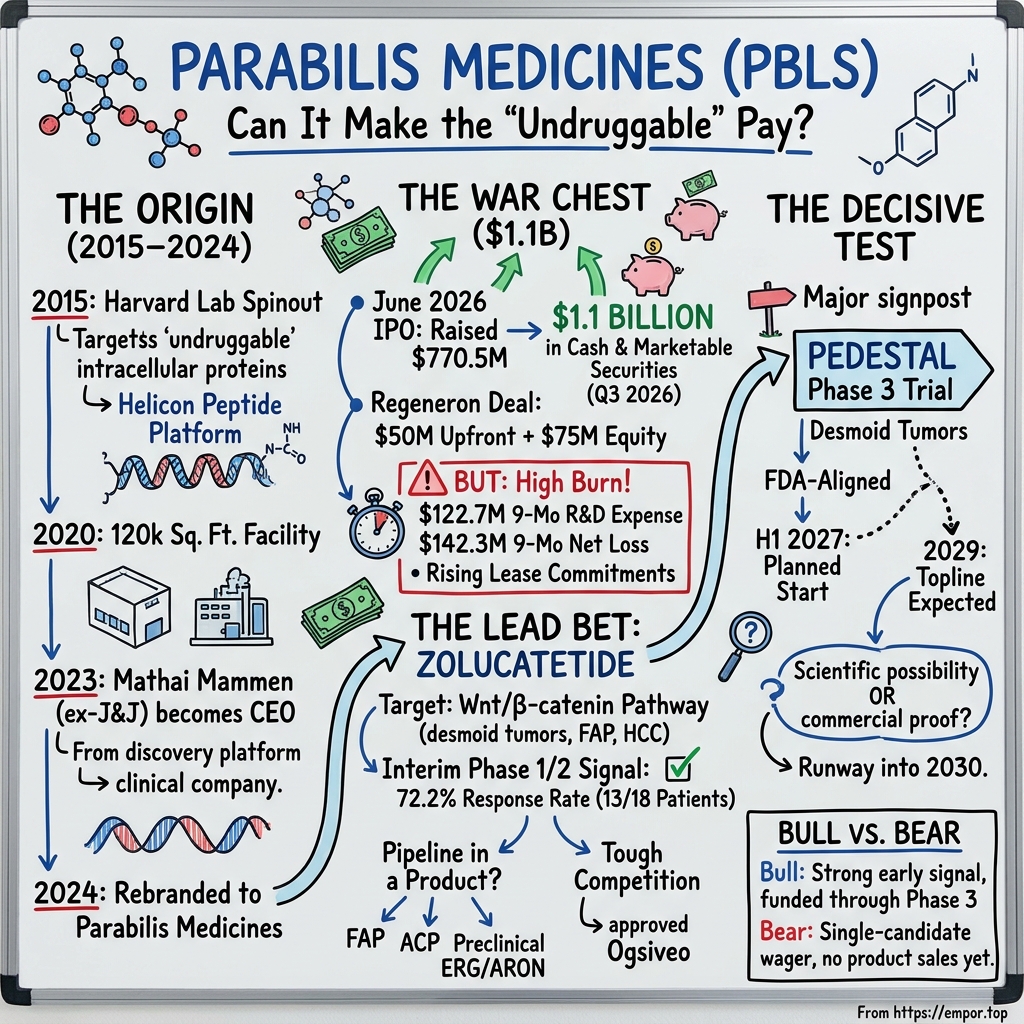
Parabilis Medicines: Can It Make the Undruggable Pay?
I. A Phase 1 Result, a Billion-Dollar Runway—and No Product
On October 24, 2026, in an oral session at the ESMO Congress in Madrid, a sarcoma specialist from Memorial Sloan Kettering stood up to present a slide that a young biotech company had been waiting most of a decade to show.[^1] The drug was zolucatetide, a molecule that had been known only as FOG-001 until recently, and the disease was desmoid tumors, a rare, stubborn growth of soft tissue that rarely spreads to distant organs but can wrap itself around nerves, muscles and bowel and make ordinary life miserable. The headline number was 72.2%. Among the patients who had started treatment at the higher doses and had been on the drug long enough to reach a scan at 32 weeks, nearly three out of four had seen their tumors shrink enough to count as a formal response.[^1] Parabilis Medicines, the company behind the drug, said the same day that it had aligned with the U.S. Food and Drug Administration on the design of a Phase 3 trial, called PEDESTAL, which it planned to start in the first half of 2027.[^1]
That is the kind of moment that makes a biotech story. But the setting around the slide tells a stranger and more interesting story. Three weeks later, when Parabilis reported its first full quarter as a public company, it showed roughly $1.1 billion of cash and marketable securities, a sum larger than many mid-sized drug companies with products on pharmacy shelves.1 It also showed revenue, over nine months, of about $2.3 million, every dollar of it from research collaborations, none of it from selling a medicine.2 Parabilis had no approved product, no sales force, and no pricing record. It had a molecule, a platform, a pile of cash, and a promising chart.
The investor sitting in the Madrid audience, or listening on the company webcast that evening, was really being asked four questions at once. The first is the obvious one: can zolucatetide clear a randomized Phase 3 trial? The second is the one the company's whole identity rests on: can the chemistry it calls Helicon produce more than one valuable medicine, or is this a one-molecule company wearing a platform's clothes? The third concerns money coming in: how much of the revenue and cash generation Parabilis reports is repeatable, and how much is a one-time prepayment passing through the books? And the fourth concerns money going out: can that billion-dollar balance sheet fund expansion without building a cost base that is hard to reverse if the science disappoints?
Start with that 72.2%, because the denominator matters more than the numerator. Parabilis had treated 76 desmoid-tumor patients across all dose levels in its Phase 1/2 study at the June 22, 2026 data cutoff.[^1] Of those, 48 had started at a dose of 450 milligrams or more, and 46 of them could be assessed for response. But only 18 of those 46 had been on the drug long enough to have a 32-week scan, and 13 of the 18 had responded.[^1] So the striking figure is 13 people. The company's second headline, a 100% disease-control rate, covers the larger group of 46 and means that none of them had seen their tumor grow at the cutoff. That is encouraging, but those patients had been on the drug for a median of only about 4.7 months.[^1] Desmoid tumors are notoriously slow and unpredictable; some stabilize or even shrink on their own. Neither number came from a comparison with placebo, and both are interim readings from a trial designed mainly to find a safe and active dose.
The calendar compounds the uncertainty. PEDESTAL is planned to begin in the first half of 2027, and Parabilis expects topline results in 2029.[^1] That means the answer to the most important question about this company is roughly three years away. The spending, meanwhile, is happening now: research and development expense ran at about $46 million in the third quarter of 2026 alone, up by more than half from a year earlier.1 The billion dollars buys time. It does not buy an answer.
The fair way to frame Parabilis tonight is this. The clinical signal and the financing give the company a credible chance to reach a pivotal test, which is more than most platform biotechs ever get. They do not yet establish efficacy in a registrational trial, a repeatable revenue model, or a proven platform. To see why a company with so little revenue could raise so much money, and why it has bet so heavily on one molecule, the story has to go back to a Harvard chemistry lab and an idea about the shape of proteins.
 Subscribe on LinkedIn
II. The Lab's Bet on Proteins Medicine Couldn't Reach
Greg Verdine did not start out as a chemist. He began college as an English major at St. Joseph's University before organic chemistry pulled him in, and his childhood had been shaped by something far from a laboratory: when he was five, his father was paralyzed from the neck down in an accident, and the family lived in the Pine Barrens of New Jersey, where by the age of seven the boy was skipping school to help with projects such as retrofitting a van for his father's wheelchair.3 It is tempting to read a straight line from that kitchen-table engineering to a career spent trying to reach the parts of the body that medicine could not. Verdine has been more modest about it. Looking back on the bet that defined his science, he put it plainly: "You can see how risky that was. It could have all been wrong."3
The bet went like this. Most drugs are small molecules, little chemical keys that fit into pockets on a protein, the way a key slides into a lock. Many of the proteins that drive cancer have no such pocket. They do their damage by gripping other proteins across broad, flat surfaces, like two hands clasping. A small key cannot pry apart a handshake. Antibodies, the other great class of modern drugs, are big enough to cover a flat surface, but they are too large to get inside a cell, so they mostly work on the outside. That left a vast territory of disease-driving proteins inside cells that the industry had labeled "undruggable."
In the late 1990s, Verdine's lab at Harvard's Department of Chemistry and Chemical Biology reasoned that nature had already designed a tool for the job: the alpha helix, a short spiral of amino acids that proteins use to grip each other.4 If a chemist could take a short spiral like that, lock it into shape, and make it sturdy enough to survive in the body and slip through a cell membrane, it might be possible to break up the handshakes that small molecules could not touch. In 2000, the lab published a paper in the Journal of the American Chemical Society describing "all-hydrocarbon stapling," a way of bolting the spiral into its helical shape; the first generation of these molecules became known as stapled peptides.4 The analogy is a coiled spring held in place by a staple so that it keeps its shape when it is thrown into a crowd.
Verdine was not a first-time founder when Fog Pharmaceuticals came along. His Harvard profile lists companies he had founded or co-founded, including Enanta Pharmaceuticals, Gloucester Pharmaceuticals, WaVe Life Sciences, Warp Drive Bio and Aileron Therapeutics; two drugs, romidepsin and paritaprevir, had reached approval through companies in that list.5 That record matters to the Parabilis story in two ways. It shows a scientist who knew how to turn academic ideas into companies. It also contains the most relevant cautionary tale for anyone weighing the Helicon thesis, because Aileron was the first company built on stapled peptides. Its lead molecule, ALRN-6924, a stapled peptide designed to reactivate the tumor-suppressor protein p53, missed the composite primary endpoint of a lung-cancer trial in 2022, and the company narrowed its efforts to a single breast-cancer study.6 It never became an approved medicine. The first attempt to make stapled peptides pay, in other words, did not pay.
Fog was the second attempt, and it was built to fix what the first generation had struggled with. Verdine has said the lab discovered that "just forming a peptide into an alpha-helix solves a lot of the problems" that had held peptides back.4 The company says it was founded in 2015 and started operations in 2016, with Verdine as chief executive and scientific head, co-founder WeiQing Zhou as chief operating officer, and scientific co-founder John McGee leading the discovery platform.4 It began in a corner of a laboratory rented from another biotech in Newton, Massachusetts, moved into its own labs at Cambridge Discovery Park during its first winter, and, unusually for a Boston biotech, started without traditional venture-capital backing.4 Harvard's Blavatnik Biomedical Accelerator had already backed the underlying work with three grants beginning in 2011, totaling $450,000, a reminder of how small the seed was relative to what came later.3
The milestones of those early years read like the slow climb of a platform proving its chemistry rather than its medicine. The company ran its first discovery screen for new hits in 2018, produced its first β-catenin blockers that worked inside cells in 2020, and in 2021 showed Helicons for β-catenin that were active in living animals, along with cell-active Helicons against two more targets.4 It added machine learning to the platform in 2022, and in 2023 it dosed the first human with zolucatetide.4 Somewhere in that stretch, the company also committed to scale: it opened a building of about 120,000 square feet, which it dates to 2020.4 That is a big physical bet for a company whose drugs had not yet been tested in a single person, and it is best read as a commitment to discovery capacity. A building full of chemists is an input. It says nothing yet about how many medicines will come out the other side.
In October 2024, the company changed its name from FogPharma to Parabilis Medicines and unveiled what it called an expanded Helicon platform integrating artificial intelligence and physics-based design with experimental technology.7 By then it said it had raised more than $500 million.7 The rebrand is worth a sentence of skepticism. AI and physics-based design are now standard vocabulary across drug discovery, and Parabilis has not quantified any specific advantage those tools give it in speed, cost or success rate. The company's case will not be settled by the sophistication of its software. It will be settled by whether molecules reach patients and work.
So the founding thesis is coherent, scientifically elegant, and inherited from a lineage whose first commercial attempt failed. The falsification test is simple to state and slow to run: do programs beyond zolucatetide advance through clinical milestones, and does any candidate become a durable product? A decade in, the answer to both is not yet. And by the time the first molecule reached the clinic, Verdine had decided the company needed a different kind of leader to get it there.
III. A New CEO Turns the Platform Toward the Clinic
In March 2023, STAT reported that one of the most sought-after free agents in pharmaceutical research had picked his next job, and it was not the one many people expected.8 Mathai Mammen had run research and development for Johnson & Johnson's pharmaceutical business and had been considered a candidate for the top job at Biogen.8 Instead he chose a privately held Cambridge company spun out of Greg Verdine's lab, taking the titles of chairman, president and chief executive.8 He joined in June 2023, and Verdine, who had led the company since its founding, stepped out of the chief executive role.94
Mammen's résumé explains why a private biotech would want him and why he could have gone almost anywhere. He holds an M.D. from the joint Harvard–MIT Health Sciences and Technology program and a Ph.D. in chemistry from Harvard, where he trained under George Whitesides, one of the most influential chemists of his generation.10 He co-founded Theravance, where he led research and development toward five approved therapies, then served as a senior vice president at Merck overseeing a wide sweep of therapeutic areas including oncology and immuno-oncology.10 At J&J he sat on the executive committee as global head of R&D, a period in which the company lists nine approvals, among them the blood-cancer drugs Darzalex Faspro and Carvykti, along with more than 40 acquisitions and licensing deals.10 His own explanation for the move was about the rarity of the opportunity: "There are very few technology platforms that are legitimately broad and capable of producing important medicines," he told STAT.8
That sentence is the thesis of the company in his words, and it deserves to be read twice. It is both a compliment to Helicon and a standard to hold it to. Mammen's record shows a leader who has shepherded molecules through late-stage development and regulatory review at scale, which is exactly the skill a platform company needs once its first molecule shows a signal. But a résumé is context, not evidence about this company. The track record that matters for Parabilis investors is the one being written now, and it is short.
The early entries in that record are mostly kept promises. In its August 2026 results, Parabilis said it expected to engage with the FDA on the Phase 3 design in the fourth quarter and to begin enrolling a dedicated familial adenomatous polyposis cohort in the second half of the year.[^12] By late October the company had announced FDA alignment on dose, regimen and trial design, and by November it reported that a dose-ranging cohort in familial adenomatous polyposis had started.[^1]1 Those are modest milestones, and a company controls its own calendar for such things more than it controls trial outcomes. Still, the narrative stayed consistent from the prospectus to the second-quarter release to the third: start PEDESTAL in the first half of 2027, report topline in 2029, fund operations into 2030.[^12]1 The tests that will actually reveal execution quality are further out: whether PEDESTAL starts on time, whether enrollment holds pace in a crowded disease, and whether topline arrives when promised.
Mammen's style comes through in the company's own language, and it is not modest. When Parabilis unveiled its new name, he spoke of the company's mission to "break boundaries, crush dogma, operate with the highest ambitions."7 In November 2026 he described zolucatetide as having the potential "to become a pipeline in a product."1 Ambition is part of the job; a company that is trying to drug the undruggable will not attract talent by promising incrementalism. But ambitious language raises the bar for disclosure. The fair reading of those statements is as goals, not findings.
The organization he built is still compact. As of April 2026, Parabilis had 145 full-time employees and 31 consultants, and 122 of those employees worked in research and development.9 That ratio, more than four in five employees in R&D, is what a discovery company looks like before it has to build manufacturing, medical affairs, market access and a sales force. Each of those functions will add cost if PEDESTAL succeeds. None of them exists yet.
The incentives are what one would expect for a pre-revenue biotech. Mammen's 2025 compensation was about $1.30 million, including a discretionary company-performance bonus of $496,000, in a year when Parabilis lost $145.9 million.9 The bonus was discretionary, which means the board judged performance rather than mechanically applying a formula the public can inspect. His option awards vest in monthly installments over four years, which ties a meaningful part of his reward to the share price over four years, though nothing in the public record suggests he holds anything like a controlling stake.9 The executive team has already seen one significant turnover: the chief medical officer, Keith Orford, resigned effective April 2025, and Fawzi Benzaghou joined in September 2025, receiving a sign-on bonus and option awards.9 A change of CMO two years before a pivotal trial is not unusual, but it means the clinical leadership that will run PEDESTAL is new.
Governance looks orthodox on paper. Seven of eight directors were identified as independent at the IPO, and all three audit-committee members were independent.9 The board added Craig Tendler, a physician, in August 2026.1 The one structural feature that a governance-minded investor will notice is that Mammen holds both the chairman and chief executive roles, which concentrates authority at exactly the moment when the board's most important job may be to decide how much of the platform to fund before the lead trial reads out. The first annual meeting is scheduled for 2027, so there is no record yet of how shareholders vote.9
The verdict on leadership, then, is that Parabilis has the right kind of executive for the stage it is entering, and that he has delivered the near-term milestones he set. But the public record is too short to establish guidance discipline or capital-allocation judgment. Mammen's tenure will be judged on a single molecule first, and that molecule now faces the hardest test a drug can face: a market where someone else got there first.
IV. One Molecule Has to Earn the Platform's First Proof
Before the Madrid slide, there was a quieter moment that may matter more. Sometime in the autumn of 2026, Parabilis sat across from the FDA and reached agreement on three things: the dose and regimen zolucatetide would use in a registrational trial, a placebo-controlled design, and progression-free survival as the primary endpoint.[^1] The planned study, PEDESTAL, will be randomized and double-blind.[^1] In plain terms, half the patients, or some fixed share of them, will receive the drug and the rest a placebo; neither patients nor doctors will know who got what, and the trial will measure how long patients go before their tumors grow or they die. That agreement converts a promising early study into a defined path to a regulatory decision. It also sets the bar: the drug must keep tumors from progressing, measured against nothing at all, in a disease where two rival drugs have already shown they can do exactly that.
To see why zolucatetide is interesting, start with what drives a desmoid tumor. Most of these tumors carry a mutation in the gene for β-catenin, a protein that acts like a messenger in a signaling pathway called Wnt. Normally β-catenin is broken down quickly. When it is mutated, it piles up, travels into the cell's nucleus, and grips a partner protein called TCF; together they switch on genes that tell cells to grow. Patients with familial adenomatous polyposis, an inherited condition caused by mutations in a related gene, have a much higher risk of desmoid tumors for the same reason. For decades, oncologists have known that β-catenin is one of the central drivers of a large family of cancers, and it has been a classic undruggable target. Zolucatetide is designed to slip into the cell and block the β-catenin:TCF connection directly.9
Parabilis says it is the first company to inhibit that interaction directly in humans. That is a genuine scientific achievement. It is not, by itself, a commercial moat. Patients and doctors do not choose drugs by mechanism; they choose by how well a drug works, how long it keeps working, what it does to the body, and how hard it is to take. And on those measures, zolucatetide is entering a market that is already occupied.
The incumbent is Ogsiveo, chemically nirogacestat, which the FDA approved in November 2023 as the first treatment for desmoid tumors.11 It works by a different mechanism, blocking an enzyme called gamma secretase that sits upstream of a separate growth signal. Its approval rested on a randomized trial called DeFi, which enrolled 142 patients and showed a roughly 71% reduction in the risk of progression or death versus placebo, with a 41% response rate against 8% for placebo.11 SpringWorks Therapeutics, which developed it, was sold to Merck KGaA of Darmstadt, Germany, in a deal agreed in April 2025, so the commercial incumbent now has the resources of a large multinational behind it.12 A second gamma-secretase inhibitor is close behind. Immunome's varegacestat completed its Phase 3 trial, RINGSIDE, with 156 patients; it reduced the risk of progression or death by 84% against placebo and produced a 56% response rate versus 9%.13 The FDA accepted Immunome's application in July 2026 and set a decision date of April 28, 2027.14 By the time PEDESTAL is enrolling in earnest, there may well be two approved targeted pills for desmoid tumors.
This is where the temptation to compare numbers across trials becomes dangerous. Seventy-two percent sounds better than 56% and much better than 41%. But the zolucatetide figure comes from 18 patients at a single landmark in a non-randomized dose-finding study; the others come from hundreds of patients in randomized, blinded trials that counted every patient from the moment of enrollment. Small early cohorts tend to look better than large late ones, partly because the first patients in a trial are often chosen carefully and partly because small numbers swing wildly. The honest statement is that zolucatetide's early response rate is in the range that would make a randomized trial worth running, and that nothing in the record yet shows it is superior to anything.
The more promising axis for differentiation may be tolerability rather than efficacy. Gamma-secretase inhibitors carry a burden that is especially significant in this disease. Desmoid tumors disproportionately strike young women; in the zolucatetide study the median patient age was 37 and about 70% of patients were female.[^1] Ovarian toxicity is among the most common adverse reactions listed for nirogacestat.11 In RINGSIDE, ovarian toxicity occurred in more than half of premenopausal women on varegacestat, and diarrhea affected 82% of patients.13 Parabilis reports that zolucatetide's treatment-related side effects were mostly low-grade, led by fatigue, hair loss and nausea; that no patients had discontinued because of treatment-related side effects; and that it had seen no ovarian toxicity and none of the high-grade gut or skin toxicity typical of gamma-secretase inhibitors.[^1] The company also reports that responses occurred regardless of whether patients had previously been treated with a gamma-secretase inhibitor.[^1] If those findings hold up in a larger, longer trial, the commercial argument writes itself: a drug that works in patients who have already tried the incumbents, and that spares young women from a fertility-related side effect, could earn a place even without being more potent.
That is a big "if," and the release itself shows why. Parabilis has not published adverse-event rates by grade in its press materials, and the safety population had been on the drug for a relatively short time.[^1] The regimen also differs from its rivals in a way that matters to patients: zolucatetide is given weekly at 450 milligrams for four cycles of induction and then at 300 milligrams every two weeks for maintenance, a schedule supported by a three-arm randomized dose-optimization study.[^1] Nirogacestat, by contrast, is a pill taken twice a day, and varegacestat is a once-daily pill.1113 Whether patients and physicians see a periodic dosing schedule as a burden or a convenience will depend on how it is administered and how it fits into the life of a 37-year-old with a job and children, and the company has not yet shown how patients will weigh that trade.
The market itself is small but not trivial. Parabilis estimates that about 30,000 people in the United States live with desmoid tumors and about 11,000 are actively managed.[^1] Those are company estimates, and actively managed does not mean on drug therapy; many patients are watched without treatment, and some are treated with surgery, radiation, or older systemic options such as chemotherapy. The real addressable population for a third targeted drug, entering after two incumbents, is narrower still, and the filings give no basis for estimating a market share.
The placebo-controlled design raises a subtler problem. Once two targeted drugs are approved, recruiting patients with progressing tumors into a trial where they might receive a placebo becomes harder, because those patients have alternatives. Parabilis has started a Phase 1/2 study in China to support including Chinese patients in PEDESTAL, which may help with enrollment, and it presented again at the Connective Tissue Oncology Society meeting in November 2026.1 The company has not disclosed PEDESTAL's planned size or the number of sites. Enrollment competition from other desmoid trials and from approved drugs could affect Parabilis's timing and costs as well as its eventual prescribing position, which is why the trial start and enrollment pace are worth watching as closely as the final result.
The signal is real, and it did its job: it informed dose selection, it supported FDA alignment, and it earned zolucatetide Fast Track designation for desmoid tumors in November 2025, along with Orphan Drug status.3[^1] None of those is an approval or a revenue event. The small, selected, non-comparative analysis cannot establish superiority or commercial adoption. The key tests are whether PEDESTAL confirms a durable benefit and whether safety and dosing distinguish zolucatetide from the two gamma-secretase inhibitors already ahead of it. The principal settling event remains the 2029 topline result. And yet Parabilis has never pitched zolucatetide as only a desmoid drug, which brings the story to the company's favorite phrase.
V. "A Pipeline in a Product" Still Depends on One Product
The logic of the phrase is seductive. If β-catenin drives desmoid tumors because it is stuck in the "on" position, and if the same pathway is stuck "on" in other diseases, then a molecule that blocks β-catenin's handshake with TCF should, in principle, work wherever the pathway is the engine. That is why Mammen described zolucatetide in November 2026 as having the potential to become "a pipeline in a product."1 One molecule, many diseases, one manufacturing process, one safety database. In biotech economics, that is the dream: the costly work of proving a drug is safe gets reused again and again.
The company has planted flags in three places beyond desmoid tumors. The first is familial adenomatous polyposis, the inherited condition in which a broken APC gene, part of the same Wnt machinery, causes hundreds to thousands of polyps to grow in the colon and the upper intestine. Patients typically face surgery to remove the colon and lifelong surveillance of the duodenum, the first stretch of the small intestine, where polyps continue to form. Parabilis reported early reductions in duodenal polyps in two patients and started a dose-ranging cohort; it expects translational data and additional clinical data in the first quarter of 2027.1 The second is adamantinomatous craniopharyngioma, a rare brain tumor near the pituitary gland that is overwhelmingly driven by β-catenin mutations and is often treated with surgery and radiation that can damage vision and hormones. Here the company reported early antitumor activity in three patients and expects more data in the first half of 2027.1 The third is hepatocellular carcinoma, the most common form of liver cancer, in which a substantial minority of tumors carry Wnt-pathway mutations; Parabilis reported early activity in one heavily pretreated patient, with more data expected at a medical meeting in the first quarter of 2027.1
Counting those patients is the most useful thing an investor can do. Two in familial adenomatous polyposis. Three in craniopharyngioma. One in liver cancer. These are clinical footholds, not validated markets. A single exceptional case, or a handful of patients, can mean the drug is doing something important; it can also mean those few patients had unusual biology or a disease course that would have happened anyway. Each indication will need its own dose finding, its own trial design, and in all likelihood its own registrational study. The "pipeline in a product" is real as an idea, and the adjacent indications are plausible future sources of value because they reuse a molecule whose safety profile is being characterized in the desmoid program. But each of them still has to earn its own proof.
Liver cancer illustrates the size of the gap. It is a large market, but a large market is also a crowded one, served by immunotherapy combinations and targeted drugs, and mutation-defined subsets of it have historically been hard to treat with single agents. Familial adenomatous polyposis has frustrated drug developers for years precisely because preventing polyps is a different goal from shrinking tumors, and regulators have historically been demanding about what counts as clinical benefit. The rarity of craniopharyngioma makes trials small and slow. None of that means the programs will fail. It means that their probability of success should be judged one dataset at a time, not inherited from the desmoid result.
The company's most intriguing new combination sits in colorectal cancer. Parabilis agreed to a clinical collaboration with Revolution Medicines to test zolucatetide alongside Revolution's zoldonrasib, an oral drug that blocks the RAS G12D mutation, and cetuximab, an established antibody, in patients with previously treated RAS G12D-mutant, microsatellite-stable metastatic colorectal cancer.1 The scientific rationale is that when Parabilis treated colorectal-cancer patients with zolucatetide, it saw the Wnt pathway turn down and a separate growth pathway, MAPK, turn up, which suggests that tumors were escaping through a second route that a RAS inhibitor could close.1 Parabilis will sponsor and run the study, Revolution will supply its drug, and the two companies will split the trial costs equally.1 It is worth putting that arrangement in its proper scale. It is a test of a biological hypothesis, with Parabilis bearing half the cost and doing the work. It is not a licensing deal, and it brings no revenue. It also quietly reveals something about zolucatetide's history: colorectal cancer, the most common Wnt-driven cancer, was where the drug was mostly being tested when the company renamed itself in 2024, and the program has since pivoted toward desmoid tumors and combinations.7 Single-agent activity in colorectal cancer, the biggest prize of all, has not been the headline.
Beyond zolucatetide sit the discovery programs. Parabilis is developing degraders, molecules designed not just to block a protein but to tag it for destruction by the cell's own disposal system, against targets called ERG, a protein implicated in prostate cancer, and ARON, along with a β-catenin degrader.[^12] All are preclinical. Their value depends on reaching human trials and succeeding there, and none has a disclosed timeline to first dosing. They are long-dated options.
That brings the story back to the uncomfortable test any platform has to pass. Parabilis has no approved product and no record of product sales, so its conversion rate from platform concept to durable revenue remains unproven. The broader stapled-peptide lineage has yet to produce an approved drug.6 Zolucatetide is the first Helicon to show strong clinical activity, which is a meaningful break from that history. But a pipeline built on one molecule is still a single bet with several payoffs attached. If the molecule works, the bets compound. If it fails on safety or durability, they fail together. The cleanest evidence that Helicon is a platform rather than a single success would come from a second, structurally distinct molecule working in people, and the company's best chance of getting that evidence from outside its own walls arrived in 2026, from one of the most demanding partners in the industry.
VI. Regeneron Pays for Research, Not a Second Product Yet
Regeneron does not hand out money casually. The Tarrytown, New York company built its reputation by discovering and developing its own antibodies with its own technology. So when it agreed in the spring of 2026 to pay Parabilis $50 million upfront and invest another $75 million in the company's stock to develop a new kind of drug, the signal mattered as much as the money.[^12]9
The idea is a hybrid. Regeneron is one of the world's best antibody makers, and its VelocImmune technology generates fully human antibodies against almost any target.[^12] Antibodies are excellent at finding specific cells, because they lock onto proteins on the cell surface, but they are poor at doing anything inside those cells. Helicons are designed to work inside cells. An antibody-Helicon conjugate bolts the two together, using the antibody as a guided delivery vehicle and the Helicon as the payload that does the work once inside. The model is antibody-drug conjugates, which have become one of oncology's hottest drug classes by attaching toxic chemotherapy to antibodies; here, instead of a poison, the payload would be a precise blocker of an intracellular protein. The collaboration also covers Helicons developed as standalone medicines.9
The dollars need to be separated carefully, because they are easy to blend. The $50 million upfront payment was consideration for a contract. Parabilis allocated it across its research obligations, license rights, and rights that let Regeneron swap out targets later.2 The $75 million was a separate purchase of Parabilis shares in a private placement alongside the IPO, at $18 a share.2 That price is worth a pause: it was 10% below the $20 IPO price, the same price at which an earlier $50 million SAFE converted into stock.2 Regeneron, in other words, was a strategic partner and an investor that bought at a discount to public investors.
The accounting tells the rest. Because Parabilis received the upfront cash before doing the research it paid for, most of that money sits on the balance sheet as deferred revenue, a liability that converts into revenue as the work is performed. At September 30, 2026, $40.8 million remained deferred, and the company expects to recognize it through at least 2029.2 So far Regeneron work has produced about $819,000 of revenue over nine months.2 Then there is the headline number. The deal carries up to roughly $2.2 billion of potential development, regulatory and commercial milestones, plus tiered royalties up to low double-digit percentages on future sales.[^12] That figure is a ceiling, not a forecast. It assumes every target succeeds through discovery, development and regulatory review, and then that the resulting drugs sell. Parabilis itself treats most of the contingent payments as too uncertain to count, and Regeneron can terminate the agreement for convenience.2 A $2.2 billion milestone pool is the theoretical maximum of a successful collaboration. It is not a backlog.
The verdict on Regeneron splits in two. As validation, the deal is meaningful: a disciplined, technically sophisticated partner paid real money to bet on Helicon chemistry outside zolucatetide and outside oncology alone. As economics, it mainly funds research whose eventual value remains contingent. The signal that would change that assessment is concrete: a Regeneron-originated antibody-Helicon conjugate entering clinical development, ideally alongside a second wholly owned Parabilis program moving beyond discovery.
Not every partnership has gone the distance. ARTBIO, a collaborator on another program, gave notice in April 2026 that it intended to opt out, and Parabilis terminated the agreement in May, leaving a $2.7 million liability for its share of costs under the deal.2 The amount is small. The fact of the exit is worth holding beside the Regeneron headline, because it shows that partner interest in Helicon applications is not uniform.
The rest of the revenue line has a different and more delicate source. The largest single contributor to Parabilis's reported revenue in 2026 has not been Regeneron but Altos. Altos generated about $1.4 million of revenue over nine months, about 64% of the company's roughly $2.3 million total.2 Altos counts as a related party because a Parabilis director is also an Altos operating executive.2 Under that arrangement Altos reimburses Parabilis for research costs plus an applicable profit margin, subject to a cap, and holds an option to negotiate a license later; its $1 million upfront payment is fully refundable and creditable against the costs it reimburses.2 Two points need to be kept in proportion. Sixty-four percent sounds alarming, but it is 64% of about $2.3 million, set against more than $120 million of nine-month R&D spending, so the dependence is not financially material to the company's survival. It is, however, material to the story the revenue line tells. The cost of performing the Altos work is not reported separately, so investors cannot tell whether this is profitable research or a pass-through, and the related-party link makes that disclosure gap matter more than it otherwise would.
The deeper question is what all this collaboration revenue says about demand. Reimbursed research and an upfront payment that is gradually earned are evidence that sophisticated organizations want access to Helicon chemistry. They are not evidence that anyone will pay for Helicon medicines. That distinction is the whole difference between a research contractor and a drug company. And it is the backdrop for the single largest event in Parabilis's financial history, the moment the public markets were asked to fund the gap.
VII. The IPO Bought Time—and Diluted the Old Cap Table
On June 10, 2026, shares of Parabilis Medicines began trading on the Nasdaq Global Select Market under the ticker PBLS.[^12] The company had sold 38.525 million shares at $20 each, including the full exercise of the underwriters' option to buy extra shares, raising $770.5 million in gross proceeds and about $712.9 million after fees and expenses.92 It was an upsized offering.[^12] The deal closed on June 11.15
The IPO was the last link in a financing chain that had been tightening for two years. Parabilis raised a Series E of $145 million in two closings in early 2024 and January 2025.97 In January 2026 it raised a $305 million Series F, led by RA Capital Management, Fidelity and Janus Henderson Investors, at a higher valuation than the previous round.16 In March 2026 it took in another $50 million through a SAFE, a simple agreement for future equity, which converted into about 2.78 million shares at $18 when the company listed.2 And alongside the IPO, Regeneron bought its $75 million block. Put together, Parabilis raised well over $1.2 billion of fresh equity in roughly six months. The balance sheet tells the before-and-after: cash, cash equivalents and marketable securities rose from about $27.7 million at the end of 2025 to about $1.07 billion at the end of September 2026.1
That first number deserves attention, because it frames how urgent the financing was. At the end of 2025, Parabilis held less than three months of cash at its then-current burn rate, which is why the Series F closed in early January. The company that appears flush today was, a year ago, a company that had to raise money. That is normal in biotech, and the financing succeeded. But it is a reminder that the IPO was a necessity before it was a luxury.
The dilution is the price of that runway. The financing sequence brought in tens of millions of new shares at prices from $18 to $20, and the company's accumulated deficit, the running total of everything it has lost since 2015, had reached $683.8 million by September 30, 2026.1 Parabilis has never repurchased shares, and it has made no material acquisitions; its capital deployment history is, almost entirely, money raised and spent on research.2 There have been no failed acquisitions or write-downs to point to, but there has also been no commercial return on the capital yet. Every dollar spent so far is still waiting to be judged.
Where is the money going? Research and development rose to $122.7 million in the first nine months of 2026 from $92.2 million in the same period of 2025, an increase of about a third.2 Of that, $43.6 million went directly to zolucatetide.2 General and administrative costs climbed too, to $32.6 million over nine months, as the company took on the legal, audit and investor-relations costs of being public; total operating expenses reached $155.3 million.12 The trend matters more than the total. In the third quarter alone, operating expenses were about $57 million, which annualizes to roughly $230 million before PEDESTAL has enrolled a single patient.1 The company says losses will increase as its trials advance, and a global, randomized Phase 3 study is far more expensive than a dose-finding study.2
The gap between losses and cash use is a classic source of confusion in biotech accounts, and Parabilis's 2026 numbers illustrate it well. The company reported a nine-month net loss of $142.3 million but used only $93.9 million of cash in its operations.2 The difference is not hidden profitability. About $40.8 million came from the deferred Regeneron revenue: cash arrived upfront, before the research it pays for, so it boosted operating cash flow this year and will not recur.2 The rest came from non-cash charges, including stock-based compensation, depreciation, and a $5.6 million accounting charge from revaluing the SAFE before it converted.2 Stripping out the Regeneron prepayment, underlying operating cash use was close to the reported loss. An investor who annualizes the $93.9 million figure will underestimate the true burn.
Interest income partly offsets that burn. With more than a billion dollars invested in U.S. Treasury securities and commercial paper, Parabilis earned about $17 million of interest in the first nine months of 2026 and about $10.4 million in the third quarter alone.21 At current yields, the cash pile is paying for a meaningful share of the company's general and administrative costs. That cushion is real but rate-dependent: if short-term interest rates fall, so does the offset.
The debt picture is simple. The company's only term loan, from Silicon Valley Bank, had a carrying value of about $2 million at September 30 and matured and was fully repaid on October 1, 2026; the covenant that had required Parabilis to keep the lesser of $60 million or half its cash with the lender ended with it.2 No external credit rating exists, and none is needed. The obligations that remain are leases: about $38.2 million of operating-lease liabilities and $1.6 million of finance leases at quarter-end.2
And the leases are growing. In November 2026 Parabilis amended the lease on its headquarters to add 33,525 square feet of space starting in 2028 and to extend the lease through 2037.17 The 8-K did not quantify the added rent. That is a disclosure gap worth naming, because this is a decade-long fixed commitment made before the pivotal trial has even started, by a company that already occupies a 120,000-square-foot building. It is consistent with planned expansion, and if PEDESTAL succeeds, Parabilis will need more people and more space. But it is the kind of commitment that is easy to make when the cash balance has ten digits and hard to unwind if the clinical story turns.
Management says the current cash will fund operations into 2030.1 That runway extends past the expected 2029 PEDESTAL topline, which is the crucial point: Parabilis should not need to raise money before its most important answer arrives, assuming the plan holds. The settling numbers will be annualized cash burn once Phase 3 enrollment ramps and the full incremental cost of the expanded lease. The IPO bought time and optionality. It did not remove dilution risk or clinical risk, and it put a large sum of shareholder capital in the hands of a small number of people. Who those people are, and how they are paid, is the next part of the story.
VIII. Who Gets Paid While the Evidence Is Still Early?
Every newly public biotech goes through a moment when its owners change character. Before the IPO, the people with the most at stake are venture investors who sit on the board, can call the chief executive on a Sunday, and know the data before anyone else. After it, a large share of the risk belongs to fund managers and individual investors who see only what the company discloses. Parabilis entered that moment in June 2026 with a chief executive who is also chairman, a performance bonus that the board awarded at its discretion, and a revenue line in which most of the dollars came from a customer linked to one of its own directors. None of those facts is unusual on its own. Together they define what a skeptical owner should be watching.
Start with who owns the company now. The largest holder is RA Capital Management and its affiliated funds, which reported 28.93 million shares, or 23.8% of the class, in a Schedule 13D filed in June 2026.18 RA led the Series F, and a 13D, rather than the shorter 13G passive-investor form, is the filing an investor uses when it does not want to rule out influencing the company. Fidelity's parent, FMR, reported about 10.3 million shares, or 8.5%, and ARCH Venture Fund XII reported about 6.4 million shares, or 5.3%, based on June 30 positions.1920 There is an oddity worth flagging without overinterpreting. The IPO prospectus, based on April positions and offering assumptions, showed RA affiliates at about 10% before the offering and about 6.6% after it, while RA's own filing a week after the IPO reported nearly a quarter of the company.918 The two documents measure different things on different dates; RA's filing aggregates several funds, including RA Capital Healthcare Fund and Nexus Fund III, and the filings do not reconcile the figures.18 It would be wrong to read the gap as a straightforward purchase. It would be fair to say that one specialist investor now holds a position large enough that its view on strategy will carry weight, and that no single holder controls the company.
The pay picture is moderate by the standards of the industry. Mammen's $1.30 million of 2025 compensation, with its $496,000 discretionary bonus, is not lavish for a chief executive of his pedigree, and the option awards and vesting schedule tie his larger potential reward to the share price over time.9 The discretionary nature of the bonus is the part to watch. In a year when the company lost $145.9 million and had not yet shown its updated desmoid data, the board judged that performance merited a bonus of nearly half a million dollars. Clinical-stage companies often reward progress on milestones rather than profits, which is reasonable. But it means shareholders have to take the board's judgment largely on trust until the company publishes a public-company compensation framework and puts it to a vote, which will first happen at the 2027 annual meeting.9
The Altos relationship is the governance item that deserves the clearest explanation, because it is the kind of thing that looks worse in a headline than it is in the numbers, and better in the numbers than it is in principle. It looks worse in a headline because a related party supplied about 64% of revenue. It looks better in the numbers because that revenue was only $1.443 million, and Parabilis's research-and-development budget is nearly a hundred times larger.2 At September 30, Altos owed Parabilis $443,000, and that is the only related-party receivable on the balance sheet.2 The arrangement reimburses costs with a margin, subject to a cap, and the $1 million Altos paid upfront is refundable and creditable against those costs.2 There is no sign of anything improper. The issue is visibility: the company does not report what it costs to do the Altos work, so there is no way to tell whether it is earning a margin, breaking even, or subsidizing a partner linked to its own board. For a company that will want investors to judge its collaboration revenue as evidence of platform demand, that is a disclosure worth improving.
There was also an earlier related-party arrangement that has now ended. Parabilis sublet space to a counterparty with common board members and stockholders, earning $4.2 million of sublease income in each of 2024 and 2025, plus occupancy-cost reimbursements of about $2 million a year, most of which reduced reported R&D expense.9 The sublease expired in December 2025.9 Its disappearance has two small consequences. Other income loses a steady few million dollars a year, and reported R&D loses a modest offset, which makes part of 2026's R&D increase mechanical rather than a sign of new programs.
The other contingent obligation that a careful owner should know about runs back to the company's founding. Parabilis licenses its core technology from Harvard and owes up to $18.3 million in development, regulatory and sales milestones, low-single-digit royalties on future net sales, and a share, ranging from single digits up to the mid-teens as a percentage, of certain sublicense or partnership income.2 Only $0.3 million of those milestones had been achieved by September 30, 2026.2 The royalties are small enough not to change the economics of a successful drug, but the sublicense share means a slice of partnership income, potentially including Regeneron payments, flows back to the university. No material legal proceedings were reported, the auditor's opinion on the 2024 and 2025 statements was unmodified, and as an emerging growth company Parabilis is exempt from an auditor's attestation on internal controls.29
So what would an activist-minded long-term owner push on? The sharpest question is about breadth. If PEDESTAL is delayed or the adjacent indications disappoint, should management narrow the pipeline to zolucatetide and preserve cash, or keep funding degraders, conjugates and new targets in the name of the platform? The company has given no explicit framework for that trade-off. The lease extension through 2037 and the steady rise in headcount-driven costs suggest the default is breadth. A disciplined answer would tie each program's funding to a defined clinical gate and publish those gates, so that shareholders could see the money following the evidence. For now, the disclosures let investors identify the issues: the combined chairman-chief executive role, a discretionary bonus culture, a related-party revenue source, and a concentrated owner. What they do not yet allow is a judgment based on a record, because there is no public-company history of voting, guidance execution or collections to judge.
That leaves the most important governance question of all, which is not about pay or related parties. It is whether the thing all this money is being spent on, the Helicon platform, gives Parabilis a durable advantage once its drugs meet patients and competitors.
IX. The Moat Has to Survive Contact with Patients
Imagine a desmoid-tumor specialist in 2029, sitting across from a 34-year-old woman whose tumor in the abdominal wall has started growing again. By then, if the FDA approves varegacestat on its schedule, the specialist will have two approved gamma-secretase pills to offer, each with years of real-world use, each backed by a randomized trial, each with a known pattern of diarrhea, rash and ovarian side effects.111314 If PEDESTAL has succeeded, she may also have zolucatetide, a drug with a different mechanism and a schedule of periodic doses rather than daily pills. Which one does she choose? That conversation, not any chemistry slide, is where Parabilis's moat will be decided.
The company's claim to a durable advantage rests on the Helicon platform's ability to hit targets others cannot, and specifically on being the first to block the β-catenin:TCF interaction directly. Hamilton Helmer's 7 Powers framework is a useful way to test that claim, because it asks what kind of advantage, if any, would let Parabilis earn persistent returns rather than just a one-time win. The closest fit is what Helmer calls cornered resource and process power: proprietary chemistry, patents and accumulated know-how about how to design, stabilize and manufacture helical peptides that penetrate cells. The decade of failed and successful experiments behind zolucatetide is not easy to reproduce, and the Regeneron deal is evidence that a sophisticated outsider valued that know-how enough to pay for it. But the filings do not establish that competitors cannot reach the same biological outcome another way, for instance through small-molecule degraders or other peptide technologies, or that Parabilis can capture the value even if they do not. And the history of the stapled-peptide field is a warning that unique chemistry is no guarantee of medicines. The other powers, such as network effects, scale economies, switching costs, brand and counter-positioning, do not apply to a company with no products. The honest summary is that Parabilis has a plausible technical advantage and no demonstrated economic one.
Porter's five forces sharpen the picture of the desmoid market itself. The threat of substitutes is high: two gamma-secretase inhibitors, plus surgery, radiation, observation and older systemic therapies, give patients and doctors many alternatives. Rivalry is intensifying rather than easing; Merck KGaA paid a large sum to own the incumbent and has every incentive to defend it, and Immunome is about to launch a competitor with its own Phase 3 data. Buyer power, which for an approved specialty drug means physicians choosing and payers covering, will depend on whether zolucatetide offers something distinctive, such as efficacy after gamma-secretase failure or a cleaner fertility profile; a third drug that is merely as good will face pressure on price and access. Supplier power is modest, although Parabilis will need specialized peptide manufacturing at commercial scale, and the barrier to new entrants is high, because a desmoid drug needs a randomized trial, but that barrier protects the incumbents as much as it protects Parabilis.
The like-for-like evidence is thin, and that is the point. The only randomized, placebo-controlled results in desmoid tumors belong to nirogacestat and varegacestat.1113 Zolucatetide's early data cannot be ranked against them. What can be said, cautiously, is that zolucatetide's reported tolerability, particularly the absence of ovarian toxicity, and its reported activity in patients previously treated with gamma-secretase inhibitors are the two characteristics that would most clearly distinguish it if they survive a larger trial.[^1] Those are differentiation hypotheses. PEDESTAL, as a placebo-controlled study, is designed to show that zolucatetide works, not that it beats anything, so even a positive result will leave the comparative question to be argued from cross-trial evidence and clinical experience.
One external price point shows what the industry has been willing to pay for desmoid-tumor franchises. In April 2025, Merck KGaA agreed to buy SpringWorks for $47 a share, an equity value of about $3.9 billion and an enterprise value of about $3.4 billion.12 That bought an approved desmoid drug and a second marketed product, Gomekli, for a different rare tumor.12 It is tempting to set that number beside Parabilis's market value, but they are not comparable. SpringWorks had approved products and sales; Parabilis has a Phase 1/2 dataset and a platform. The deal shows that rare-tumor franchises with proven drugs can be strategically valuable. It cannot tell anyone whether Parabilis is cheap or expensive.
So the moat claim should remain "promising but unproven." No approved Parabilis product exists, which means no retention data, pricing record, market share or head-to-head evidence. A Phase 3 win would strengthen the case for the drug. Durable clinical differentiation, then physician adoption, then sustained access and pricing would be needed to show commercial power. Each step is a separate test, and the company has yet to take the first one. That makes the bull and bear cases unusually clean to state, because almost everything turns on what happens next.
X. Analysis & Bear vs. Bull Case
On November 12, 2026, Parabilis reported the results of its first full quarter as a public company, and the numbers sketched both cases at once.1 There was about $1.07 billion of liquidity. There was quarterly research spending of about $46 million and rising. There was collaboration revenue of about $2.1 million for the quarter, which was more than the company had earned in all of its previous history combined but still a rounding error beside its costs.1 And there was a deferred-revenue balance of about $40.8 million, cash already received for research not yet performed.1 Two investors could look at that page and see different companies.
The bull sees a funded clinical opportunity with a defined catalyst. Zolucatetide has an encouraging interim desmoid-tumor signal, and the company says no patients have stopped treatment because of side effects.[^1] FDA alignment has removed a common source of late-stage regulatory risk.[^1] Earlier trials in the same disease show that a placebo-controlled progression-free-survival trial can succeed, so the regulatory path is well trodden.1113 The company says its cash will fund operations into 2030, beyond the expected 2029 topline, so it should not have to raise money from a position of weakness before the answer arrives.1 The adjacent indications in familial adenomatous polyposis, craniopharyngioma and liver cancer offer additional shots on goal with the same molecule, and the Regeneron collaboration offers a second, independent route to proving the platform.1[^12] In the bull case, the market is paying for a lead asset with several indications and a platform with a credible partner, and the price of entry is a few years of patience.
The bear sees a costly platform story whose evidence remains concentrated in one early candidate. The signal comes from a small cohort followed for under five months in a disease that can stabilize on its own.[^1] Phase 1/2 results often fail to reproduce in randomized trials, and a placebo-controlled study launched in a market with an approved drug and a second one under FDA review may struggle to enroll on schedule.14 Even success would leave zolucatetide as the third targeted therapy in a modest-sized rare disease, competing against Merck KGaA's commercial muscle and Immunome's head start. The adjacent indications rest on handfuls of patients, the discovery programs are preclinical, and the stapled-peptide lineage that preceded Helicon failed to produce a medicine.6 In the bear case, investors are paying for a platform premium that has not yet been earned.
The economics need a stress test of their own. The deferred balance will support reported revenue through at least 2029, but it is tied to work under an existing collaboration and will not recur unless new deals replace it.2 The reported operating cash outflow was flattered by that same prepayment and should not be read as a recurring burn rate.2 And the cost base is rising: R&D up by about a third year over year, general and administrative costs up sharply, a lease commitment stretching to 2037, and management's own warning that losses will grow as trials advance.217 A runway into 2030 is a plan, not a guarantee; it depends on the pace of PEDESTAL spending, interest rates on the cash pile, and whether the company resists the temptation to add programs.
Three measures will tell investors most about whether the story is working. The first is PEDESTAL itself: whether it starts in the first half of 2027 as promised, how fast it enrolls, and whether topline arrives in 2029. The latest reading is FDA alignment on design, which was the necessary precondition, and the direction so far has been on schedule. The second is the durability and safety of zolucatetide's effect at the selected dose, as more desmoid patients pass the 32-week mark and follow-up lengthens beyond the current cohort's 4.7-month median; the latest reading remains encouraging, with no treatment-related discontinuations.[^1] The third is cash burn measured against milestones, along with any new collaboration revenue once the deferred Regeneron balance runs down; the latest reading is a rising quarterly cost base.1
Valuation needs discipline because the usual tools fail. Earnings-based measures such as the price-to-earnings ratio are meaningless for a company that loses money. A revenue multiple on $2.3 million of lumpy collaboration revenue is no better. What the market price does reveal is the scale of expectations. Parabilis shares closed at $27.44 on November 20, 2026, about 37% above the $20 IPO price but well below their high of $42.49, giving the company a market value of about $3.4 billion.21 Subtract roughly $1.07 billion of cash and securities, and the market is assigning something like $2.3 billion to the science: zolucatetide across its indications, the Regeneron collaboration, and the platform's future. That is less than what Merck KGaA paid on an enterprise basis for a company with two approved drugs, and more than most companies with a single Phase 1/2 asset command, which is about what one would expect for a company priced on a credible but unproven pivotal opportunity plus a platform premium.12 The share price's slide from its peak suggests that the market has already marked down some of its post-IPO enthusiasm. Whether the remaining value is too high or too low depends almost entirely on the probability one assigns to PEDESTAL.
Management's live commentary has followed a consistent shape. The prepared language in the second-quarter release in August set out the October data, FDA engagement and a first-half 2027 start; the October data release and webcast delivered the dataset and the FDA alignment within the quarter it had promised; and the November results restated the same 2027 and 2029 dates while adding the China study and the Revolution combination.[^12][^1]1 The company had been scheduled to present at the Jefferies conference on November 16 and was scheduled to present at the Evercore ISI conference on November 30.1 Where the answers have been specific, they concern dates and designs. Where they remain contingent, they concern the questions that matter most: PEDESTAL's size, the cost of the trial, the incremental rent on the new lease, and the timeline for the next Helicon to reach the clinic. The company has not published those figures, and they are the ones that would let investors measure the bear case directly.
The bull case has a concrete catalyst and enough capital to reach it. The bear case is that one small interim dataset carries too much of the value, while the collaboration receipts and platform milestones are not yet durable product economics. Both are right about the facts. They disagree about probability, and only the trial can settle that. Which raises the question of what Parabilis, at this moment, teaches about investing in platforms before they have proven themselves.
XI. Business & Investing Lessons
The first lesson begins with the slide in Madrid: a target is not a medicine, and a response signal is not a registrational result. Parabilis has done something the field once doubted, but that early signal is a reason to run a trial, not the result of one. The earlier stapled-peptide effort is a reminder that clearing the technical hurdle does not ensure clinical success. The lesson for anyone underwriting a platform: give the science full credit for what it has proven and no credit for what it has not.
The second lesson comes from the June listing: a large runway buys experiments, not certainty. The listing gave Parabilis more room to experiment, but it did not change what zolucatetide will do in a randomized trial. Money also has a way of shaping behavior. A company with ten digits on its balance sheet signs ten-year leases, hires ahead of need, and finds reasons to fund one more program. The best biotech capital allocators treat a big raise as a fixed budget for answering specific questions, not as a war chest that justifies expanding the questions. Parabilis's first test of that discipline will be how its burn rate tracks against PEDESTAL's progress.
The third lesson belongs to the Regeneron deal: its headline milestone ceiling is optionality, not a sales forecast.
The fourth lesson belongs to the company's founding idea: a platform earns its moat one validated program at a time. Zolucatetide remains Helicon's only clinical data point.
The wider lesson for founders and investors is about sequencing. Parabilis shows how a scientific platform can attract talent, partners and financing years before it has shown commercial repeatability. That is a feature of the biotech model, not a flaw. But it shifts the investor's job from evaluating a business to tracking a transition: from technical possibility to clinical proof, and from clinical proof to cash. The company is at the first of those boundaries now.
XII. Epilogue
Tonight, Parabilis Medicines is a company with more money than it has ever had, a lead drug that has shown more than it has ever shown, and a pivotal trial that has not yet started. The next milestone is not the 2029 answer. It is whether PEDESTAL actually opens its first sites and randomizes its first patients in the first half of 2027, on the design Parabilis agreed with the FDA. A company that hits that date, with the dose and regimen it promised, will have passed its first real public test of execution. A company that slips will have to explain why, and the explanation will matter as much as the delay.
The spring of 2027 will be unusually crowded with moments that matter. Late in April, the FDA is due to decide on Immunome's varegacestat.14 Approval would give desmoid patients a second targeted pill and give PEDESTAL a more difficult enrollment environment, because every patient who might join a placebo-controlled trial will have one more alternative. In the first quarter, Parabilis expects to report translational and clinical data in familial adenomatous polyposis and new data in liver cancer; in the first half, more data in craniopharyngioma.1 Those updates should be read for patient counts, dose consistency, duration of effect and safety, not merely for the presence of activity. A disciplined reading will treat five or six new patients with consistent results as more informative than one dramatic case.
Further out, two signals would change the platform argument decisively. The first is a Regeneron antibody-Helicon conjugate entering clinical development, which would show that Helicon chemistry can work as a payload inside a partner's molecule, not just as a stand-alone peptide. The second is a wholly owned Parabilis program beyond zolucatetide moving out of discovery and into people. Either would begin to turn "a pipeline in a product" into a pipeline of products. Neither has a public date.
Meanwhile, the money will tell its own story. As the deferred Regeneron balance is recognized, reported revenue will look steadier than the business underneath it, so the revealing number will be any new collaboration income that does not come from that prepayment. As PEDESTAL ramps, quarterly cash use will rise, and the comparison that matters is between that burn and the company's statement that its cash will last into 2030.1 If burn accelerates faster than milestones, the runway narrows, and the board will face the breadth-versus-focus question sooner than it would like.
Each outcome maps onto the questions that opened this story. An on-time PEDESTAL start, steady enrollment and a positive 2029 topline would answer the first: zolucatetide would be on its way to becoming a drug, and Parabilis a drug company. Consistent early data in other indications and a partner program in the clinic would begin to answer the second: Helicon would be on its way to being a platform rather than a single success. New revenue beyond existing deferred balances would address the third. A burn rate that tracks the trial rather than the lease would address the fourth. None of those answers is available tonight, and the core efficacy question will stay open until the pivotal result. The next year can test execution and reveal whether the adjacent indications have repeatable signals. It cannot tell anyone whether the science can produce medicines that earn their development cost.
XIII. Outro
Go back to the slide in Madrid. On it, a small cluster of patients points toward a Phase 3 trial that will take years to report. Behind the slide sit a billion dollars, a ten-year lease, a partnership with a sophisticated antibody maker, and a quarter-century of chemistry that began with a staple holding a spiral of amino acids in place.
Parabilis has raised the money and found a signal. It was built to make the undruggable reachable, and with zolucatetide it has shown that reachable is possible. What investors still have to learn is whether reachable can become treatable, and whether treatable can become a business. The answer will come from patients who have not yet been enrolled, in a trial that has not yet begun.
References
-
Parabilis Medicines Reports Third Quarter 2026 Financial Results, Exhibit 99.1 — SEC, 2026-11-12 ↩↩↩↩↩↩↩↩↩↩↩↩↩↩↩↩↩↩↩↩↩↩↩↩↩↩↩↩↩↩
-
Form 10-Q for the quarter ended September 30, 2026 — SEC, 2026-11-12 ↩↩↩↩↩↩↩↩↩↩↩↩↩↩↩↩↩↩↩↩↩↩↩↩↩↩↩↩↩↩↩↩↩
-
Finding ways to "drug the undruggable" diseases — Harvard Gazette, 2026-06-22 ↩↩↩↩
-
Gregory Verdine faculty profile — Harvard Department of Stem Cell and Regenerative Biology ↩
-
ALRN-6924 Halts Development in p53-Mutant NSCLC, Advances in p53-Mutant Breast Cancer — OncLive, 2022-07-01 ↩↩↩
-
Parabilis Medicines (formerly FogPharma) Announces New Company Name and Unveils AI and Physics-Based Discovery Platform — BioSpace, 2024-10-28 ↩↩↩↩↩
-
Former J&J exec Mathai Mammen takes the helm at privately held FogPharma — STAT, 2023-03-30 ↩↩↩↩
-
Form 424B4 IPO Prospectus — SEC, 2026-06-10 ↩↩↩↩↩↩↩↩↩↩↩↩↩↩↩↩↩↩
-
FDA approves nirogacestat for desmoid tumors — U.S. Food and Drug Administration, 2023-11-27 ↩↩↩↩↩↩↩
-
Merck KGaA, Darmstadt, Germany, Agreement to Acquire SpringWorks Therapeutics — Merck KGaA, 2025-04-28 ↩↩↩↩
-
Varegacestat Hits Phase 3 PFS End Point in Progressing Desmoid Tumors — OncLive, 2025-12-15 ↩↩↩↩↩↩
-
FDA Accepts NDA for Varegacestat in Desmoid Tumors — Targeted Oncology, 2026-07-08 ↩↩↩↩
-
Parabilis raises $305M to advance beta-catenin cancer drug — BioPharma Dive, 2026-01-08 ↩
-
Parabilis Medicines (PBLS) Stock Price and Market Cap — Stock Analysis, 2026-11-20 ↩
 LinkedIn
 WhatsApp
 Reddit
 Hacker News
 Email
 Kindle
 RSS Feed
 Spotify
 Apple Podcasts
 Amazon Music
 Audible
 YouTube