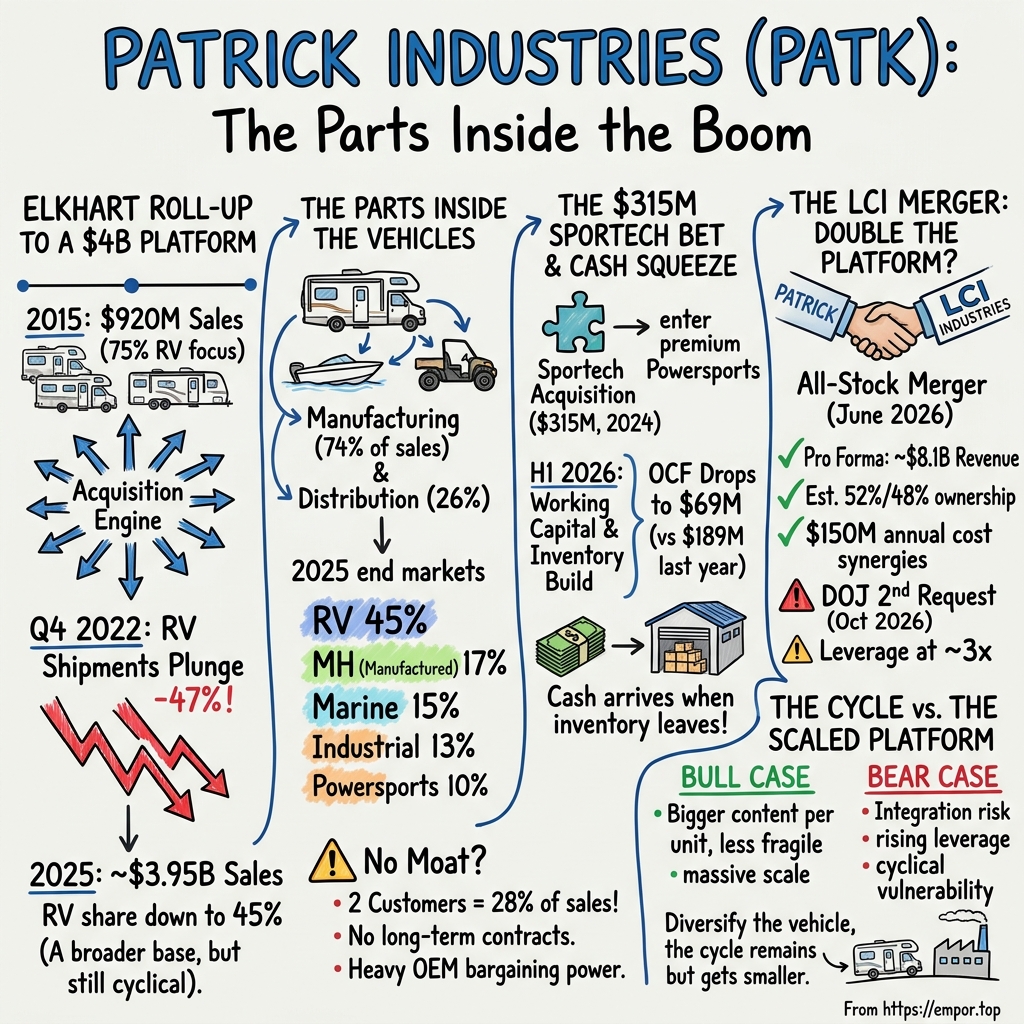
Patrick Industries: The Parts Inside the Boom
I. The 47% Drop That Tested the Diversification Story
In the last three months of 2022, the recreational-vehicle factories of northern Indiana slammed on the brakes. Dealers were sitting on lots full of travel trailers ordered during the pandemic camping craze, interest rates were climbing, and the OEMs cut production to let dealers sell down their stock. Industry wholesale shipments, the units that leave the OEM's plant for the dealer, fell 47% in the quarter, to roughly 78,000.1 For a supplier whose name had been synonymous with RV interiors for decades, that should have been a catastrophe.
Instead, Patrick Industries reported the best year in its history. Sales for 2022 reached about $4.9 billion, up 20%, and net income hit $328 million, up 46%.2 Even in that brutal fourth quarter, RV revenue fell only 39% while marine revenue jumped 35%, so the company's total sales dropped by 17% rather than by half.2 In the February 2023 results release, CEO Andy Nemeth framed the moment as proof of concept: the business model, he said, had served the company well.2 Patrick had spent years buying its way into boats, manufactured homes and industrial products precisely so that a collapse like this one would not sink it.
There is a tidy version of this story, and it goes like this: Patrick diversified, so the RV cycle no longer matters. The record says something more complicated. The full-year 2022 number was a record largely because the first nine months were spectacular; the downturn arrived late in the year and did its real damage in 2023. Net income fell to about $143 million that year, less than half the peak.3 It fell again in 2024 and again in 2025, to $135 million on sales of roughly $3.95 billion.4 Three years after the "record year," Patrick was earning about 41 cents for every dollar it had earned at the top.
So what did the broadening actually protect? It protected revenue, clearly. Patrick's sales in 2025 were only about 19% below the 2022 peak, while its earnings were nearly 60% below it.42 That gap is the whole story in miniature. Diversification kept the factories busy and the customers served, but it did not stop margins from compressing when the largest market shrank, and it did not prevent the expense of the acquisitions that bought the diversification from showing up below the operating line. In 2025, RV still made up 45% of Patrick's sales, more than any other end market.4
The first quarter of 2023 showed both halves of that truth at once. RV wholesale shipments fell 54% from a year earlier, yet Patrick's sales fell 33%, because marine had grown from 16% of revenue to 31% in a single year while RV shrank from 61% to 41%.5 Management pointed out that adjusted EBITDA in that quarter was still 78% higher than in the same quarter of 2019, before the pandemic.5 The cushion was real. But a company whose sales fall by a third in a quarter has not escaped the cycle; it has simply stopped being the most exposed name in it.
That is why the stakes in Patrick today are not abstract. Three questions run through everything that follows. The first is whether sales growth can turn back into durable earnings, rather than revenue that arrives with thinner margins attached. The second is whether the company's favorite metric, "content per unit," meaning the dollars of Patrick product inside each RV, boat or manufactured home, truly improves its position, or merely describes how much of the vehicle it supplies in a good year. The third is the newest and largest: whether the proposed all-stock merger with LCI Industries, Patrick's similarly sized neighbor in Elkhart, is worth the leverage, regulatory scrutiny and integration risk it brings.
Here is where Patrick stands tonight, on October 24, 2026. It is a roughly $4 billion supplier with two reporting segments, manufacturing and distribution, and five end markets: RV, marine, powersports, manufactured housing and industrial.4 It operated about 191 manufacturing plants and 50 warehouse and distribution facilities across 25 states at the end of 2025.4 Its second quarter of 2026 showed the diversification argument in its best light, with marine revenue up 22% and powersports up 28% while RV revenue fell 15%.6 And yet in that same quarter, management cut its 2026 RV shipment outlook for the third time in six months, net leverage rose to 3.0 times, and by the end of that quarter Patrick had signed a merger it had walked away from only eight weeks earlier.78
The merger awaits shareholder votes and an extended antitrust review by the Department of Justice.9 Before judging whether bigger is better, though, it is worth understanding how Patrick got this big in the first place, because the method it used, buying a long string of small and mid-sized companies, is the same method it is now proposing to apply on a scale it has never attempted.
 Subscribe on LinkedIn
II. Elkhart's Roll-Up Becomes a Four-Billion-Dollar Supplier
Elkhart, Indiana, calls itself the RV capital of the world, and Patrick has been part of that landscape since 1959.10 Its headquarters still sit at 107 West Franklin Street, a few minutes from the factories that build most of North America's travel trailers.4 For most of its history Patrick was a regional business: it made laminated wall panels and moulding, and it distributed drywall, doors and other building products to the RV and manufactured-housing plants clustered around northern Indiana. When the housing bust and the financial crisis gutted both of its markets at once, Patrick was a small company in a shrinking industry, and in February 2009 the board handed the CEO job to Todd Cleveland.10 Andy Nemeth, who had been Patrick's chief financial officer and secretary-treasurer since the early 2000s, became Cleveland's partner in what followed.1011
What followed was a roll-up. The logic was simple and very Elkhart. RV and housing OEMs buy hundreds of components from dozens of small, often family-owned suppliers. Many of those suppliers have one plant, a handful of customers and an owner nearing retirement. A larger company with access to bank credit could buy them one at a time, keep the entrepreneurial founder running the shop, and offer the OEM a single relationship for cabinets, countertops, painting, fiberglass, wiring and plumbing. Each deal added products to the catalog and a few more plants to the map.
By 2015, the playbook was running at full speed. Patrick reported $920 million in sales that year and $42 million of net income, and it had completed ten acquisitions over the prior three years for about $229 million.10 The 2015 deals alone included Better Way Products, Structural Composites of Indiana and North American Forest Products, a moulding and laminating operation whose campus would reappear in Patrick's story a decade later.10 The company employed about 3,500 people across 42 plants in 11 states.10
But the 2015 Patrick was still very much an RV company. About 75% of its sales went to the RV industry, 14% to manufactured housing and 11% to industrial markets.10 More striking still, two customers, Forest River and Thor Industries, accounted for 55% of consolidated sales.10 Patrick's fate depended on the production schedules of two companies whose own fate depended on whether Americans felt like buying a camper. That is the starting position against which every later claim of diversification should be measured.
The decade that followed had two engines running at once. The first was deliberate: Patrick bought its way into new markets. In 2016 it acquired the Progressive Group, its first meaningful step into powersports; later deals added audio brands such as Rockford Fosgate and Wet Sounds.12 Marine became the biggest new frontier, with acquisitions in boat towers, flooring, fuel tanks and electrical systems. The second engine was not deliberate at all: the pandemic. Americans who could not fly took to campgrounds and lakes, RV and boat production surged, and Patrick's revenue rose with them. Sales roughly quintupled from 2015 to the 2022 peak of $4.9 billion.210
Then the second engine reversed. Sales fell to about $3.5 billion in 2023 as RV wholesale shipments dropped 37% for the year.312 The recovery since has been partial: sales rose back to about $3.95 billion by 2025, still well below the peak, while net income remained near its low.43
The mix shift, however, is real and visible in the filings. By 2025 RV had fallen to 45% of sales, with manufactured housing at 17%, marine at 15%, industrial at 13% and powersports at 10%.4 Forest River and Thor together accounted for 28% of sales, about half their 2015 share.4 Patrick now runs that national network, with a small presence in Mexico, China and Canada.4 Measured by footprint and customer list, the regional supplier of 2015 has become a national platform.
The harder question is how much of the recent growth Patrick earned and how much it bought. In 2025 sales rose 6%, but acquisitions contributed $44 million of that year's sales, compared with $296 million in 2024.4 The 2024 figure matters because it shows how dependent the post-downturn rebound was on deals: in the year Patrick acquired its largest-ever business, acquired revenue accounted for most of the growth. In 2025, with smaller deals, the organic engine had to do more of the work, and it delivered modest growth in a flat-to-soft market.
Deal count, in other words, is not the scorecard. What a long-term investor wants to know is whether the profit from acquired businesses covers the price paid and the interest on the debt used to pay it, and whether the leverage taken on to fund the next deal ever comes back down. Patrick spent about $560 million in cash on acquisitions from 2023 through 2025 alone.4 To judge whether that money built something better, it helps to look first at what Patrick actually does inside a vehicle, and where in that process it makes its money.
III. What Patrick Sells When an RV Leaves the Factory
Picture a fifth-wheel trailer at the end of an assembly line in Elkhart County. A family in Texas ordered it through a dealer; the OEM, likely Forest River or Thor, designed the floor plan, framed the chassis and stamped its brand on the side. But walk inside and much of what the family will touch may have come from Patrick: the laminated wall panels, the cabinet doors, the countertops, the shower surround, the moulding, the wiring harness, the painted exterior caps, the speakers. The same is true, in different proportions, of a wake boat leaving a marine OEM's plant, or a side-by-side utility vehicle rolling out with a fully enclosed cab. Patrick is rarely the name on the vehicle. It is the supplier that turns the OEM's design into a finished unit.
That business is organized into two segments, and the difference between them explains where Patrick's profit comes from. Manufacturing makes components, things like laminated panels, fiberglass parts, cabinetry, towers, wiring and cab enclosures, and it generated $2.96 billion of sales in 2025, about 74% of the total.4 Distribution buys and resells materials and finished products, from drywall and plumbing to electronics and appliances, delivering them to OEM plants on tight schedules; it generated about $1.01 billion, the remaining 26%.4
The profit split is more lopsided than the sales split. Manufacturing produced $358 million of segment operating income in 2025, a margin of roughly 12%, while distribution produced $103 million, about 10%.4 Manufacturing's profit grew by about $17 million in 2025; distribution's slipped slightly.4 So manufacturing is the profit engine, and distribution is the connective tissue: it adds breadth, keeps Patrick present in the OEM's plant every day, and gives it a channel to sell more of its own products. Those segment figures are before corporate costs and the amortization of acquired intangibles, which is why consolidated operating income was a smaller $276 million, or about 7% of sales.4
The unit of revenue is simple and physical. Patrick sells goods, and it recognizes revenue when control of those goods passes to the customer.4 It has no meaningful subscription income, no long-dated contracts and no material backlog of performance obligations.4 When an OEM decides to build fewer trailers next month, Patrick sells fewer panels next month. That is the heart of the cyclical exposure, and no amount of portfolio diversification changes it for any individual product line.
The end-market mix puts those mechanics in proportion: RV still sets the pace. One important caution follows. Patrick reports profit by segment, not by end market, so there is no public figure for how much of its operating income comes from RVs. It is tempting to treat the 45% revenue share as a 45% profit share, but the company does not disclose that, and the margins on marine towers, powersports cabs and RV wall panels are unlikely to be identical.
The metric Patrick asks investors to watch instead is content per unit. Think of it as Patrick's share of the wallet inside each vehicle: take the company's sales into an end market and divide by the number of units the industry shipped. If an OEM builds fewer trailers but buys more Patrick product per trailer, content per unit rises, and Patrick's revenue falls less than the industry. In the second quarter of 2026, trailing-twelve-month RV content per unit rose 7% to about $5,300, and marine content per powerboat rose 22% to about $4,900.6 Management estimated that most of the marine increase was organic, driven by its electrical systems, towers, windshields and SeaDek flooring.7
Here is the falsification test that the headline number invites. Content per unit can be lifted by winning new products, but also by price increases, by a richer model mix and by acquisitions that add products to the numerator. In 2022, at the top of the cycle, Patrick reported RV content of about $5,260 per unit and marine content of about $5,280.2 So three and a half years later, after inflation, several acquisitions and the much-celebrated recent gains, RV content per unit is roughly where it was at the peak, and marine content is still below it. The recent growth is real, but some of it is recovery from the 2023 trough rather than a new high-water mark. Content per unit, it turns out, is cyclical too.
Housing is the quieter half of the portfolio, and it behaves differently. Patrick groups manufactured housing and industrial sales into a housing end market that grew 2% in the second quarter of 2026, even as manufactured-housing wholesale shipments fell an estimated 8%.7 The growth came from the industrial side, including laminated panels sold into big-box retailers, while content per manufactured home was flat at about $6,700 on a trailing basis.7 Manufactured housing is a business tied to affordability; Patrick's president, Jeff Rodino, pointed to the newly enacted Road to Housing Act as a potential long-term unlock for pent-up demand.7 It is a plausible tailwind, but a legislative one, and its timing is outside Patrick's control.
The RV numbers also hide a timing story that matters for the outlook. In the second quarter of 2026, dealers sold an estimated 99,200 RVs to consumers while OEMs shipped only about 77,600 to dealers, meaning dealers shrank their inventories by more than 21,000 units.7 Dealer stock fell to an estimated 18 to 20 weeks of sales, well below the 26 to 30 weeks that was normal before the pandemic.7 For a supplier, that is a mixed signal. Lean dealer lots mean production is running below retail demand, which caps the downside. But it also means OEMs are choosing to stay lean, and Patrick's revenue follows OEM production, not consumer purchases.
Powersports revenue also grew sharply in the second quarter of 2026, which management attributed to strong demand for utility-focused vehicles and rising "take rates" on cab enclosures, the doors, roofs and windshields that turn an open side-by-side into a weatherproof work vehicle.7 When an analyst noted that one large customer was seeing demand from AI data-center construction, Nemeth said Patrick's orders moved in parallel with those customers and that cab adoption had exceeded the company's expectations.7 Much of that content arrived through the Sportech acquisition, which is why the powersports story is partly organic momentum and partly a bet paid for in cash.
The same quarter also showed the limits of diversification in plain numbers. Total sales were flat at $1.04 billion, but Patrick decomposed the change into 7% organic growth, 1% from acquisitions and a 9% drag from shrinking industry volumes.7 Adjusted operating margin fell to 7.5% from 8.3% a year earlier.6 Then came the outlook. Chief Financial Officer Matt Filer cut the 2026 RV wholesale estimate to 285,000 to 300,000 units, down from 315,000 to 330,000 three months earlier, and said adjusted operating margin would now be flat with 2025.713
The most revealing moment came in the analyst Q&A. Filer had added that Patrick was rolling out "volume-based programs" with customers in the second half to help with affordability, and that these could cut margins by another 20 basis points.7 Analysts pressed on what that meant. Nemeth described it as a chance to "embed" the partnership with customers and acknowledged that Patrick "may sacrifice some margin," while suggesting the lost margin could be offset by volume and better factory absorption; he also confirmed that customers trading down to cheaper "good" options in Patrick's good-better-best range was part of the 20-basis-point hit.7 He expected pricing to be neutral for the rest of the year.7 Read plainly, a supplier with a broad catalog was offering its largest customers price help in a weak market. That is a sensible commercial decision. It is also the clearest evidence of who holds the bargaining power, which is the question the next part of the story has to answer.
IV. A Broad Catalog Is Not Yet a Moat
Every supplier in Elkhart knows the names that matter. In 2025, Forest River, the Berkshire Hathaway-owned RV giant, and Thor Industries each bought more than 10% of everything Patrick sold, and together they accounted for 28% of its sales.414 In the first half of 2026, two customers each represented 13% of sales.15 And Patrick states plainly that it has no long-term agreements with its customers.4 There is no ten-year supply contract to point to, no exclusive platform award that locks in revenue. Each year, sometimes each model year, the business has to be won again.
That is the scene against which any claim of a competitive moat has to be tested. Start with the battlefield. Patrick's own 10-K does not name its direct competitors, describing a mix of national, regional and local suppliers.4 The most obvious peer is LCI Industries, which does business as Lippert and sits a few miles away. LCI reported $4.1 billion of sales in 2025, slightly more than Patrick, and $188 million of net income, noticeably more.14 Its catalog leans toward the structural and mechanical side of an RV, chassis, axles, slide-out and leveling systems, windows, doors, furniture and appliances, while Patrick's leans toward interiors, panels, fiberglass and distributed materials.144 The overlap is real but partial, a point that matters later for the antitrust review. When bankers assembled lists of comparable public companies for the merger, they reached for OEMs and enthusiast brands such as Thor, Winnebago, Polaris, Brunswick, Fox Factory and Sweden's Dometic, a reminder that there is no perfect pure-play peer.8
Now war-game the buyer. An RV OEM assembling tens of thousands of trailers a year buys panels, cabinets and wiring by the truckload. It can split orders between Patrick, Lippert and smaller local shops; it can threaten to make components itself; and in a down year it can ask every supplier for price help. That last threat is not hypothetical. When Patrick's board weighed the LCI merger in April 2026, it explicitly discussed customer reactions, "including the risk of vertical integration (i.e. 'self-supply') initiatives by certain significant customers."8 Shortly afterward, the CEO of a "strategic industry participant and customer of both Patrick and LCI" called Nemeth to express reservations about the combination and floated the idea of a transaction between that customer and Patrick instead; no proposal followed.8 The filing does not name the customer. It does not need to. Buyer power in this industry is concentrated, informed and willing to make itself heard.
The barriers protecting suppliers are modest by Patrick's own account. Its 10-K says the barriers to entry in each of its industries are "generally low," while noting that competing on a national scale would require a substantial commitment of capital, facilities and people.4 That nuance is important. Making a laminated panel is not hard; making thousands of them, in dozens of variants, delivered just-in-time to plants across several states, while also supplying the countertop, the moulding and the wiring harness, is harder. Patrick's real defense is not any single product but the network: about 191 plants and 50 distribution facilities, many within a short truck ride of the OEMs they serve.4
Patrick describes itself as a "supplier of choice" and a "full solutions" provider, and it points to a nationwide footprint that cuts delivery time and cost, the ability to shift production among facilities, and a design center where OEMs develop new models.4 Those are plausible advantages. The question is whether the evidence shows them translating into economic power, and three kinds of evidence would. The first is share gains that persist through a downturn. The second is price realization, meaning Patrick can hold or raise prices when the customer's volume falls. The third is customer behavior: OEMs that consolidate purchases with Patrick rather than splitting them.
The strongest evidence for an edge is content growth. In the second quarter of 2026, Patrick grew RV content per unit through a 16% decline in industry shipments, which management described as "continuing to win new business through a period of contraction."7 Marine content grew faster still. If Patrick were merely a commodity vendor, it is hard to see why content would rise while industry volumes fell.
But the same quarter supplied the counter-evidence, and it belongs right here, next to the claim. Patrick did not raise prices into the downturn; it offered its customers volume-based affordability programs that it expected to cost up to 20 basis points of margin, and it said pricing would be neutral.7 Customers were trading down within its good-better-best range.7 Customer concentration has fallen dramatically since 2015, when two OEMs bought 55% of Patrick's output, but the absence of long-term agreements means each of those relationships is renegotiable at will.104 And content per unit, as the comparison with 2022 showed, has recovered rather than broken through.
Weighing it, the history does not reject Patrick's competitive claim, but it narrows it. Patrick has an advantage of scale, breadth and proximity that makes it a preferred, convenient supplier and lets it win incremental programs. The record does not show pricing power or switching costs strong enough to protect margins when OEMs cut production. That is a smaller claim than "moat," and a more defensible one. The two companies' own disclosures make the point from the other side. LCI, the closest peer, reports that Berkshire Hathaway's businesses and Thor together accounted for about a third of its 2025 sales, which means the two largest RV makers sit atop both of Elkhart's biggest suppliers.14 That is the structure of the industry in one sentence: two giant buyers, two large suppliers, and a long tail of smaller ones, with the buyers setting the pace. The test that would upgrade Patrick's claim is straightforward: content per unit and organic growth that keep outpacing wholesale shipments through a full downturn, without a matching giveback in operating margin. Patrick does not disclose top-five or top-ten customer shares, or how concentrated its own supplier base is, so outsiders have to infer the rest from the margin line.
If scale and breadth are the advantage, the obvious way to get more of it is to buy it. That is what Patrick did in January 2024, with the largest acquisition in its history.
V. The $315 Million Sportech Bet
On January 11, 2024, Patrick announced it would pay about $315 million in cash for Sportech, a company in Elk River, Minnesota, that most RV investors had never heard of.16 Sportech made the parts that turn an open side-by-side utility vehicle into something closer to a pickup truck cab: integrated door systems, roofs, canopies, windshields, bumpers, fender flares and cowls.16 Its customers were powersports OEMs, with additional sales into golf and turf, industrial and agricultural vehicles, and the aftermarket.16 Sportech had grown revenue at a 17% compound annual rate over five years and expected about $255 million of sales in 2023.16
Strategically, the deal made sense. Patrick had first stepped into powersports with the Progressive Group acquisition in 2016, and its audio brands had given it a toehold in the category.12 Sportech gave it scale in the fastest-growing slice: premium utility vehicles, vehicles bought as much for work as for play. On the fourth-quarter 2023 call, analysts asked the obvious question, whether a powersports business bought near a cyclical high might soon face the same dealer destocking that had hit RV and marine; management pointed to Sportech's backlog and new product introductions as reasons for confidence.12 Management also argued that the utility concentration and the "premiumization" of side-by-sides made Sportech more durable than typical recreational demand, and highlighted a growing appetite for add-ons such as HVAC once a cab enclosure was installed.12
Now benchmark the price, carefully. A $315 million price against roughly $255 million of prior-year revenue works out to about 1.2 times sales.16 That is a useful reference point and nothing more. Patrick did not disclose Sportech's EBITDA or the enterprise-value multiple, so it is not possible to say from the public record whether this was cheap or expensive relative to comparable industrial deals. A business with 15% operating margins at 1.2 times sales would look inexpensive; one with 7% margins would look fully priced. The disclosure simply does not settle it.
Patrick said the deal was expected to lift profit margins and earnings per share right away.16 It funded the purchase with its revolving credit facility and cash on hand, pushing net leverage to about 2.9 times at closing, and said it expected to bring leverage back down to its 2.25 to 2.5 times target range within two to three quarters.1612
How did those promises age? The accretion claim is hard to verify, because Patrick reports the contribution of acquired businesses only in aggregate. The 2025 10-K says acquisitions contributed about $296 million of sales and $47 million of operating income in 2024, the year Sportech and the RecPro aftermarket business both joined.4 That is an operating margin of about 16% on acquired revenue, above the company average, which is encouraging. But it is a blend of several deals, and it is before the interest cost of the debt that paid for them. There is no standalone Sportech profit series to track.
The leverage promise is easier to check, and it did not hold on the original schedule. Patrick spent heavily on further acquisitions in 2024, with total business-acquisition cash outlays of about $412 million that year.4 At the end of 2025, nearly two years after the Sportech closing, net leverage stood at about 2.6 times, still above the target range; by June 2026, after a large buyback, it had risen further.176 Management did not abandon its target, but it repeatedly chose new deals and repurchases over getting there.
The wider program shows the same pattern of steady deal flow. In 2025, Patrick paid roughly $117 million for a cluster of marine electrical and technology companies such as Medallion Instrumentation Systems, Egis Group and LilliPad Marine, as well as Elkhart Composites.417 Those 2025 deals contributed $44 million of sales but only $1.3 million of operating income in their first year, as integration costs and partial-year ownership weighed on the result.4 First-year numbers are rarely representative, but they are a reminder that the press release and the profit arrive at different times.
This is also where management's framing over the cycle is worth reading side by side. On the fourth-quarter 2022 call, with RV shipments collapsing, Patrick emphasized liquidity, a 1.9 times net leverage ratio, and the ability to keep making strategic investments through the downturn; it had spent $249 million on acquisitions that year.1 The company kept that promise in the sense that it never stopped buying. Whether it bought well is a question of returns, and the disclosures that would answer it, deal-level revenue, margin and return on invested capital, are not published.
The balance sheet carries the residue of past deals. Goodwill stood at about $840 million at the end of 2025.4 No goodwill impairment was recorded from 2023 through 2025, though $27.4 million of accumulated impairment remains on the manufacturing side from earlier years.4 The auditor flagged goodwill impairment testing as a critical audit matter and noted specifically that no impairment was recognized for the Fiberglass reporting unit in 2025.4 A critical audit matter is not a red flag in itself; it means the judgment involved is significant. But when the assumptions behind acquired-business valuations depend on recoveries in RV and marine volumes, they are worth watching.
One smaller deal deserves a mention for governance reasons rather than size. In March 2026 Patrick paid $7 million for the assets of two companies in which one of its directors indirectly held a majority interest; the director recused himself and the independent Audit Committee approved the transaction.15 Related-party purchases in 2025 were small, around $1.6 million of packaging and foam purchases from director-affiliated companies, about 0.04% of sales.11 The amounts are immaterial. The process point is that Patrick reviews such transactions through its Audit Committee but has no formal written related-party policy.11
The verdict on the acquisition machine, then, is mixed in a specific way. It clearly bought diversification and growth: powersports and marine are the reason Patrick's revenue held up in 2026. It may well have bought good returns; the aggregate 2024 contribution suggests the better deals were profitable. But the company has not shown it in a form an outsider can verify, and it repeatedly stretched its own leverage targets to keep buying. Which raises the question a skeptic always asks about a serial acquirer: is the cash real?
VI. The Cash Arrives When Inventory Leaves
In the first half of 2026, Patrick's warehouses filled up. The company had bet heavily on composites, engineered panels that can replace the wood and imported lauan plywood used in RV and marine walls and floors, and it had bought ahead, purchasing raw material in anticipation of customer adoption and stocking plywood ahead of new anti-dumping and countervailing duties on imports from Indonesia.7 Then RV production fell faster than expected, and the inventory did not turn. Operating cash flow for the first six months dropped to $69 million, from $189 million a year earlier.6 Nemeth acknowledged on the call that the composites inventory had "moved a little bit slower" and that "we haven't had the turns that we wanted."7
That moment is the clearest illustration of how cash works in a factory business. Patrick buys materials, converts them, ships them, and collects. When volumes fall, the cycle runs in reverse: production slows, inventory is sold down, and cash floods in, even as profits shrink. When volumes rise, or when management buys ahead, the cash goes the other way. Reported profit and cash flow can tell very different stories in any single year, which is why they need to be read across a cycle.
Over 2023 to 2025, the long view is reassuring. Patrick earned a combined $416 million of net income and generated about $1.07 billion of operating cash flow, roughly two and a half times as much.4 The biggest reconciling item was depreciation and amortization, about $481 million over the three years, which reflects both the wear on 191 plants and the accounting write-down of intangible assets acquired in all those deals.4 Because amortization of acquired customer lists and trade names is a non-cash charge, a serial acquirer will almost always show more cash than profit; the question is whether that cash is then needed to buy the next business.
Inventory was the swing factor. In 2023, as the RV collapse hit, inventory reductions released about $162 million of cash; in 2025 inventory absorbed about $25 million.4 That pattern explains why 2023, a year of sharply lower earnings, was also a year of record free cash flow, about $350 million, which management highlighted at the time.12 It also explains why the first half of 2026 looked so weak. The working capital that cushions a downturn is the same working capital that soaks up cash when the company invests ahead of growth. Management said it expected inventory to become a source of cash in the second half of 2026.7
The composites bet itself is a good example of how Patrick tries to manufacture its own growth. Early in 2025 it bought Elkhart Composites, and management has argued that engineered composite panels are a better solution than the wood products used in RV and marine construction, especially as tariffs and trade actions have pushed up the cost of imported plywood.17 It said testing of a composite roofing product had been completed and that composites could open content opportunities outside its existing addressable market.17 If adoption follows, Patrick gets a higher-value product that substitutes for a commodity it already sells. The risk is the one the first half of 2026 exposed: material bought ahead of demand ties up cash until customers actually switch, and in a falling market they may be slower to change specifications.7
Capital spending has risen steadily, from $59 million in 2023 to $83 million in 2025, about 2% of sales, directed toward facilities, automation and capacity.4 That is separate from acquisitions, and modest for a manufacturer of Patrick's size. One example of where it goes surfaced in the second quarter of 2026: a multi-million-dollar digital printing line on the North American Forest Products campus, the moulding operation Patrick bought in 2015, that prints wood grains and textures directly onto panels, including composite ones, instead of laminating vinyl or paper.710 Patrick does not disclose a research and development total, so its product investment has to be inferred from capex and from launches like that one.
Receivables deserve a careful look precisely because nothing alarming shows on the surface. Trade receivables rose to about $172 million at the end of 2025 from $149 million a year earlier, while the allowance for credit losses fell to $2.8 million from $3.7 million.4 Patrick's customers are mostly large OEMs that pay on short terms, so a small allowance is not surprising. But a rising balance alongside a shrinking reserve is the kind of combination a skeptic notes. Patrick describes its method, combining historical experience, forward-looking customer information and past-due amounts, but it does not publish an aging schedule or overdue balances, so outsiders cannot test it directly.4
One expense in the 2025 earnings bridge was unusual and painful. Patrick recorded a $24.4 million settlement related to a motor-vehicle accident that resulted in two fatalities.4 It was a realized cost, excluded from adjusted earnings, and there was nothing comparable in 2023 or 2024.4 Separately, the second-quarter 2026 10-Q described another legal matter at an early stage, for which Patrick could not estimate a range of loss and recorded no liability.15 Neither changes the long-term economics, but a company operating a large truck fleet to deliver product to OEM plants carries this kind of tail risk.
The remaining items are small. Patrick's effective tax rate was 23.7% in 2025.4 Currency translation effects were measured in tens of thousands of dollars, trivial against its earnings, because its foreign operations in Mexico, China and Canada are small.4 Patrick holds no significant investment portfolio; its cash balance at the end of 2025 was about $26 million.4
Put together, the cash record supports the claim that Patrick converts accounting profit into cash over a cycle, helped by heavy non-cash amortization and the natural release of working capital in downturns. It does not support treating any single year's cash flow as a run rate. The 2026 cash outlook was cut from $380 million to $400 million in February, to $370 million to $390 million in April, and to $320 million to $350 million in July.17137 Where that cash goes next is a decision for management, and management's own record is the next thing to examine.
VII. The CEO's Scorecard Meets a Bigger Deal
Andy Nemeth is a finance man who became an operator. He served as Patrick's chief financial officer from 2004 through 2015, after a year as vice president of finance, and was the company's secretary-treasurer from 2002.11 He became president in 2016, chief executive in January 2020, and chairman of the board in May 2024.11 He has sat on Patrick's board since 2006 and joined the board of Standex International in October 2025.11 His style on earnings calls is upbeat and relentless, a vocabulary of "partnership," "solutions" and being "on offense." On the second-quarter 2026 call, in the middle of an RV slump, he told analysts the company could "be in a position to be on offense" and that its M&A pipeline was "starting to gain some traction."7
Around him is a team that has worked together for years. Jeff Rodino, who was chief operating officer from 2013 to 2016 and has more than three decades in RV, marine and housing, became president in October 2025.11 In January 2026, CFO Andrew Roeder stepped down and Matthew Filer succeeded him under the company's succession plan.18 Todd Cleveland, the CEO who started the roll-up in 2009, remains a director.11
The pay scorecard deserves context rather than a headline. Nemeth's reported total compensation was about $6.75 million in 2023, $6.40 million in 2024 and $10.14 million in 2025.11 Over the same period net income slipped from $142.9 million to $135.1 million, and remained far below the 2022 peak.114 Most of the 2025 increase came from stock and option awards, not cash; his base salary was $900,000, and his annual bonus paid out below target because adjusted net income reached only 84% of its goal.11 The long-term plan is tied to three-year cumulative EBITDA.11 That design has a weakness a skeptical investor would note: EBITDA can be grown by acquisitions funded with debt, so a plan that rewards it does not directly reward return on capital.
Ownership alignment is moderate. Directors and executive officers held about 3.8% of the company as a group, while BlackRock, Fidelity, Vanguard and Wellington were the largest holders.11 Nemeth is required to hold stock worth four times his salary and met that requirement.11 Shareholders have not objected: at the May 2026 annual meeting, 97.2% of votes cast supported say-on-pay.19 The director with the most withheld votes was Joseph Cerulli of Tontine Associates, with about 4.95 million shares withheld, a modest protest rather than a revolt.1911
Capital allocation is the best test of credibility, because the choices compete. In 2025 Patrick spent about $83 million on capex, about $122 million on acquisitions, $55 million on dividends and $32 million on buybacks.4 In 2024 it refinanced, issuing $500 million of 6.375% notes due 2032 and redeeming its 7.5% notes.4 Then in the second quarter of 2026 it bought back 980,000 shares for $91 million, more than in all of 2025, even as operating cash flow was weakening and inventory was building.6 Nemeth said the company had "intentionally increased our leverage profile in the short term."7 The timing is notable: those repurchases happened in a quarter that opened with merger talks under way, saw them collapse in May and revive in June, for an all-stock deal in which Patrick's own share price would help determine how much of the combined company its holders would own.8 The merger agreement now generally prohibits further buybacks before closing.7
Guidance history offers the cleanest test of management's forecasting. In February 2023, Patrick projected 2023 RV wholesale shipments of 325,000 to 350,000 units and an operating margin of 7.5% to 8.5%.1 In April it cut the shipment range to 310,000 to 325,000.5 The year ended with shipments down 37%, inside the revised range, and an operating margin of 7.5%, the bottom of the original band, with operating cash flow of $409 million against a promise of at least $400 million.125 That is respectable forecasting in a collapse. The same call offered another prediction worth checking. Asked how far margins might fall, the then-CFO, Jake Petkovich, recalled that a 16% RV decline in 2018 and 2019 had cost Patrick about 130 basis points of margin, and suggested the coming downturn might cost 160 to 270 basis points from a starting point of about 10%.1 The 7.5% that followed sat exactly at the painful end of that range.12 Less well kept was the promise made on the same February 2023 call that, after 2023, Patrick would "resume our historical operating margin growth cadence of 30 to 50 basis points annually."1 Operating margin instead fell to about 6.9% in 2024 and stayed near 7% in 2025.4
The 2026 guidance has followed a similar arc of steady retreat. In February the company expected RV wholesale shipments to rise low to mid-single digits and adjusted operating margin to improve 70 to 90 basis points.17 In April the shipment range became 315,000 to 330,000 and the margin improvement 30 to 50 basis points.13 In July it became 285,000 to 300,000, with margins flat and possibly 20 basis points lower.7 Each revision was explained by external conditions, fuel prices, interest rates and consumer confidence, and analysts on the July call pressed on dealer softness, commodities, trade-down and pricing; the answers were direct about margin sacrifice but optimistic about volume offsets.7 The pattern is not of evasion but of a management team that consistently starts the year expecting recovery and then adapts.
That is a reasonable profile for running a cyclical supplier. It is a more demanding profile for running the largest transaction in the company's history, which is exactly what this team signed up for on June 30, 2026.
VIII. The Merger That Could Double the Platform
The deal almost did not happen, and the way it nearly failed says a great deal about it. In the autumn of 2025, after LCI's board rejected a no-premium approach from an unnamed strategic suitor, Nemeth and Cleveland met LCI's then-CEO Jason Lippert and its chairman to talk about whether the two Elkhart neighbors should combine.8 By April 2026 Patrick had sent a written proposal for an all-stock "merger of equals" with no premium, a twelve-member board split evenly, Elkhart as headquarters, and one condition it repeated at nearly every turn: Nemeth would be chief executive of the combined company.8 Patrick floated an ownership split of roughly 55% for its holders and 45% for LCI's.8
Then, on April 17, Bloomberg reported the talks, and both companies confirmed them.8 Both stocks fell, Patrick's by more, which shifted the ratio of their market values against Patrick.8 Patrick insisted that the exchange ratio be set on pre-leak prices; LCI insisted its holders deserve more than 45%.8 On May 3, Patrick's board voted to end the talks, and the next morning both companies announced that discussions had terminated.8 A month later, LCI announced that Jason Lippert would retire as CEO and that its chairman had also stepped down; director John Sirpilla became interim CEO.8 LCI's board quickly decided to re-engage, citing the then-current share prices and the risk that Patrick might pursue other opportunities.8 On June 30, 2026, the two companies announced the deal.20
The structure is worth stating precisely, because headlines sometimes call it an acquisition. It is an all-stock combination in which each LCI share converts into 1.244 Patrick shares, leaving Patrick holders with about 52% of the combined company and LCI holders with about 48%.20 Legally, Patrick is the surviving public parent and LCI becomes its subsidiary, a two-step structure chosen partly to avoid triggering change-of-control provisions in Patrick's existing debt.89 The combined company would be led by Nemeth as CEO, with Todd Cleveland as chair and Sirpilla as vice chair, and would be renamed Patrick LCI, Inc. if shareholders approve.8 Using June 29 closing prices, the ratio valued each LCI share at about $116, roughly 16% above LCI's own closing price of $100.12 that day.8 So after a negotiation that began as "no premium," LCI's holders received a modest one, and Patrick's holders ended up with less than the 55% their board first proposed.
It helps to know what LCI brings to the table. It is the larger of the two by sales and, in 2025, by profit, with about 12,300 employees and a product line built around the mechanical skeleton of a vehicle: chassis and suspension, slide-out and leveling systems, axles, windows, doors and furniture.14 Its aftermarket segment, at about $932 million, or 23% of sales, is much larger than Patrick's.14 Patrick brings interiors, fiberglass, marine towers and electrical systems, powersports cabs and a large distribution arm. On paper the two catalogs fit together like the frame and the finish of the same vehicle.
The strategic pitch is scale and breadth. The parties presented the combination as having about $8.1 billion of trailing revenue, about $1 billion of adjusted EBITDA and $508 million of free cash flow, figures that already include expected synergies.20 They promised more than $150 million of annual run-rate cost savings within three years, mainly from procurement, overhead, engineering practices and supply chain.20 The aftermarket business of the combined company would be about $1.3 billion, roughly 16% of pro forma revenue, which the boards argued would make demand more stable.8 Projected net leverage at closing was about 2.1 times, with a 2.25 to 2.5 times target thereafter.20
Now set those claims against the evidence. The $150 million is a forecast of savings that have not yet been realized, from two companies that have never been integrated. Even the direction of who keeps the savings is open: on the July call, Nemeth said the synergies would allow the combined company "to share savings with our customers" to support affordability.7 Given what the customer concentration figures already showed, that line is probably realistic, and it means investors should not assume all $150 million falls to the bottom line. The combined company would also double down on the same two buyers. LCI reported that Berkshire Hathaway's businesses, Forest River and Clayton Homes, accounted for 18% of its 2025 sales and Thor for 15%.14 Combining two suppliers to the same concentrated customer base creates scale, but it does not make the customers smaller. One had already voiced reservations.8
The financing deserves the closest stress test. At the end of June 2026, Patrick had about $1.43 billion of borrowings: a term loan, revolver draws, $259 million of 2028 convertible notes, and two issues of senior notes.15 Its net leverage was 3.0 times by its credit-agreement measure.6 Patrick has warned that the merger may require additional debt to repay LCI's borrowings, and that this could reduce financial flexibility.8 Its covenants leave room. At the end of 2025, its secured net leverage was 0.34 times against a 2.75 times limit, and interest coverage was 6.6 times against a 3.0 minimum, because most of its debt is unsecured notes.4 Still, the combined company's leverage target depends on the synergies arriving and on RV volumes not falling further, and neither is in management's control.
The regulatory process has lengthened. Both companies filed their antitrust notifications in August, withdrew and refiled them in September, and on October 9, 2026, each received a Second Request from the Department of Justice's Antitrust Division.9 A Second Request is a demand for a much deeper pile of documents and data; the waiting period now runs until 30 days after both companies substantially comply, unless the DOJ ends it sooner.9 The parties have said they expect closing in the first half of 2027, but the merger agreement gives no assurance, and the companies are obliged to oppose any attempt to block it.208 Patrick's own board, in April, had described the two companies' products as largely complementary and non-competing.8 The Second Request suggests the DOJ wants to test that description, product by product.
The market has delivered its own early verdict, which is a clue rather than a conclusion. Patrick closed at $93.18 on June 29, the day before the announcement; on October 16 it closed at $68.04, a decline of about 27%.821 Part of that reflects the deteriorating RV outlook and the July guidance cut, not the merger alone. But it is useful context for the bankers' fairness work. J.P. Morgan, one of Patrick's advisers, applied a range of 7 to 11.25 times projected 2026 adjusted EBITDA to arrive at an implied value range for Patrick shares of roughly $61 to $118.8 At October prices, the market is valuing Patrick near the low end of the range its own adviser considered reasonable, which suggests investors are pricing in either weaker earnings or more risk than the deal model assumed.
Finally, there are the execution constraints that are easy to dismiss as fine print. Either company may owe the other a $94.2 million termination fee in specified circumstances, such as a change in board recommendation.8 Until closing, Patrick is restricted from repurchasing shares and must operate under the interim covenants of the agreement.7 Both sets of shareholders must vote, the S-4 must become effective, and the DOJ must be satisfied.9 Even if everything goes right, the reward arrives only after integration, in an industry where both companies' largest customers are watching closely. Whether that trade is worth it depends on how one weighs the case for Patrick in the first place.
IX. Analysis & Bear vs. Bull Case
The second quarter of 2026 is the best single snapshot of the argument. RV revenue fell 15%. Marine revenue rose 22% and powersports 28%.6 Total sales were flat. If an investor could freeze that quarter, the bull case would write itself: a diversified supplier, growing content in its newer markets, holding revenue steady through a slump in its oldest one. But the same period also carried the bear case: margins down, cash flow down, leverage up, guidance cut, and a large merger pending.
The bull case begins with the evidence that diversification works at the revenue line. Compared with 2019, Nemeth noted, RV and marine wholesale shipments were both down more than 20%, yet Patrick's trailing sales were up nearly 70% and adjusted earnings per share more than 60%.7 Content per unit grew in RV and marine through 2026's contraction. The marine, powersports and aftermarket businesses give Patrick growth that does not depend on the travel trailer. And because dealer lots are already lean, a retail recovery would force OEMs to build to restock rather than simply sell down.7 In this view the merger adds an aftermarket business, purchasing scale and engineering breadth that neither company could build alone.
The bear case starts with the same facts read differently. Earnings in 2025 were less than half the 2022 peak despite years of acquisitions. Operating margins never resumed the 30 to 50 basis-point annual climb management promised in early 2023. Content per unit has only recovered to its peak-cycle level, and Patrick is now giving customers price help. Two customers still account for more than a quarter of sales, with no long-term contracts. Cash flow is sensitive to inventory decisions, and leverage rose just as the company signed up for a transaction that could add more debt. In this view, Patrick is a well-run cyclical business whose diversification has changed the shape of its earnings curve, not its fundamental exposure, and the merger makes it a bigger version of the same thing.
The frameworks help sort which of these readings the evidence supports. On Porter's five forces, buyer power is the dominant force: concentrated OEM customers, no long-term agreements, a demonstrated willingness to demand affordability help, and a stated risk of self-supply. The threat of new entrants is low for a national platform but high for any single product, by Patrick's own admission that barriers are "generally low." Rivalry is real, with LCI, many regional and local suppliers, and global component makers such as Dometic at the edges, though the merger would fold Patrick's closest Elkhart-based peer into the same company. Supplier power is moderate: commodity inputs such as imported lauan plywood and metals are exposed to tariffs and duties, but Patrick's purchasing scale lets it buy ahead, as it did with plywood in 2026. Substitutes come mostly from new materials, such as composites replacing wood, and Patrick is trying to be the substitute rather than the victim.
Hamilton Helmer's seven powers are a stricter test, because each one requires both a benefit and a barrier that stops rivals from copying it. Scale economies are the most credible power: a national network of plants and distribution facilities lowers delivery cost and lets Patrick spread overhead and purchasing across more volume, and the merger would extend it. Cornered resources are weak; Patrick has acquired brands and know-how but nothing rivals cannot also buy. Switching costs exist in a mild form, because an OEM that designs a model around Patrick's panels and wiring faces some re-engineering cost, but the absence of long-term agreements and the ease of splitting orders limit them. There is no meaningful network effect, counter-positioning or brand power at the OEM level, though aftermarket brands such as SeaDek and RecPro carry some consumer recognition. Process power, the hardest to prove, is what Patrick claims with its automation, digital printing and composites work; it is plausible, but not yet visible in margins. The overall conclusion is that Patrick has one real power, scale, and a collection of advantages that are useful but contestable.
Technology is a smaller risk than it might seem. Patrick sells physical goods that have to be built, shipped and installed, so artificial intelligence is far more likely to change how it designs and makes products than to replace them. Management has described piloting AI tools in administration, using them to guide aftermarket product launches, and installing AI-enabled camera inspection at Sportech.7 Those are cost and quality levers, not a moat. The more material external risk is trade policy: duties on imported plywood and other inputs can raise costs faster than customers will accept price increases, as the 2026 plywood episode showed.7
Credit analysts have reached a similar conclusion in their own language. Fitch affirmed Patrick at BB with a stable outlook in May 2025, a solid but sub-investment-grade rating.22 S&P's most recent detailed rationale available publicly dates to 2019, when it assigned BB- and cited highly cyclical, competitive end markets with potentially very high EBITDA volatility, partly offset by the company's leverage discipline; that analysis is old and should be weighed accordingly.23 The point for equity holders is the same one the rating agencies made: the business can carry debt, but its earnings swing enough that leverage matters more than it would for a steadier company.
Three operating measures can settle the argument over the next few years. The first is organic growth and content per unit by end market, compared with industry shipments; the latest reading is 7% organic growth in the second quarter of 2026 against a 9% industry decline, with RV content per unit up 7% on a trailing basis.76 The second is operating margin, which shows whether content gains come with pricing power or with price concessions; adjusted operating margin was 7.5% in the second quarter, down from 8.3%.6 The third is operating cash flow and inventory, which shows whether growth is self-funding; first-half operating cash flow was $69 million, down from $189 million.6 Two of the three are moving the wrong way, and the one moving the right way is the one management chooses to emphasize.
Valuation is a lens, not a verdict. Patrick's share price fell from the low $90s at the merger announcement to the high $60s in October.821 Against the J.P. Morgan reference range, that price sits near the bottom of what the bankers treated as reasonable trading multiples of projected EBITDA, which suggests the market is either discounting the 2026 and 2027 projections or applying a lower multiple to a more leveraged, more complex combined company.8 The more useful comparison for a long-term investor is cycle-normalized earnings: neither the 2022 peak nor the 2025 trough represents what Patrick earns on average, and any valuation built on either year will mislead.
A skeptical activist would push on three points. First, disclosure: if acquisitions are creating value, the company should be able to report the operating income and return on capital of acquired businesses in a form outsiders can track, rather than one aggregate figure per year. Second, capital discipline: a company that missed its post-Sportech leverage target and then bought back $91 million of stock while cash flow was weakening should explain why the next dollar goes to deals and buybacks rather than debt reduction. Third, the merger itself: if $150 million of synergies will be partly shared with customers, investors deserve a clear view of how much is expected to reach shareholders.
The mechanisms of risk are all familiar ones. Weak RV and housing demand reduces OEM production. Concentrated buyers pressure terms. Duties, input costs and affordability programs squeeze margins. Inventory investment absorbs cash. And the merger adds regulatory, integration and refinancing risk on top. Weighing it all, the evidence supports a credible operating platform with real scale advantages and real growth outside RV. It does not yet support the claim of a countercyclical moat. That is the gap the next few years have to close, and it is where the lessons of this story come from.
X. Playbook: Business & Investing Lessons
Go back to that winter of 2022, when RV shipments fell by nearly half in a quarter and Patrick still posted a record year. The first lesson is in what happened next. Patrick had cut its dependence on RVs from three-quarters of sales to under half, and its revenue held up better than the industry. But earnings fell by more than half from the peak and stayed there. The broader lesson for anyone building a supplier around cyclical customers: diversify the customer's vehicle, and the downturn gets smaller, but it does not disappear. Diversification across end markets that all depend on consumers financing big-ticket discretionary purchases is a hedge against one market's timing, not against the business cycle itself.
The second lesson comes from Sportech and the long chain of deals around it. Patrick bought a fast-growing business at about 1.2 times sales, promised immediate accretion, and has never shown investors a standalone profit number for it. Its 2025 acquisitions produced $44 million of sales and $1.3 million of operating income in their first year. None of that proves the deals were bad, and the aggregate 2024 contribution suggests some were quite good. But for an acquirer, the burden of proof sits with the buyer. A deal is only a growth engine when the profit arrives after the press release.
The third lesson is about cash. In 2023, falling inventories released about $162 million and helped Patrick generate record free cash flow in a year of collapsing profits. In 2026, composite panels and duty-protected plywood filled the warehouses and operating cash flow fell by almost two-thirds in the first half. The same balance-sheet line produced both outcomes. For investors in manufacturers, it is a reminder that working capital is not an accounting footnote. In a factory business, inventory is part of the plot.
The fourth lesson is the most uncomfortable for Patrick's bulls. Content per unit is the company's proudest metric, and it rose through a downturn in 2026. In the same quarter, Patrick offered its largest customers affordability programs that would cost it margin, watched them trade down to cheaper options, and told analysts pricing would be neutral. A supplier that grows its share of the vehicle while giving back price has won business; it has not necessarily won leverage. Content growth is not pricing power until it survives the buyer's next negotiation.
And there is a fifth, which belongs to the merger negotiations of spring 2026. Patrick walked away in May when the leak moved the share prices against it, and came back in June to accept a smaller share of the combined company than it had first proposed. Walking away was a mark of discipline; coming back on worse terms is a reminder that in an all-stock merger, the currency is your own share price, and the market can renegotiate your deal for you.
XI. Epilogue
On October 29, 2026, five days from now, Patrick will report its third-quarter results before the market opens and take questions on its call.24 It will enter that morning with the tension unresolved. The RV outlook is soft, with management expecting 285,000 to 300,000 wholesale units this year and second-half production running 20% to 25% below the first half.7 Content metrics in RV and marine are improving. Net leverage was 3.0 times at the end of June.6 And the merger with LCI sits in an extended DOJ review, with shareholder votes still to be scheduled.9
The first thing to watch is whether the gains outside RV keep offsetting the losses inside it without a larger margin giveback. If marine and powersports continue to grow at double-digit rates while RV declines moderate, and the operating margin holds near last year's level despite the affordability programs, the diversification story gets stronger. If margins slide further as volume programs and trade-downs bite, the bears' reading, that Patrick is buying share with price, gains weight.
The second is cash. Management told analysts in July it expected working capital to become a source of cash in the second half, and it projected $320 million to $350 million of operating cash flow for 2026.7 That implies a very strong second half after a $69 million first half. If inventory turns and composites adoption improves as customers suggested, the 2026 cash dip will look like a timing story. If inventory stays elevated, it will look like a judgment error, and leverage will stay higher for longer going into a merger.
The third is the deal. The DOJ's Second Request could be answered and cleared within months, or it could stretch the timeline, invite remedies such as divestitures of overlapping product lines, or lead to a challenge. Shareholder votes will test whether Patrick's holders accept the 52% share at today's lower prices. And if the deal closes, the measure of success will be simple to state and hard to achieve: realized synergies that reach shareholders rather than just customers, pro forma leverage that falls into the 2.25 to 2.5 times target, and cash returns that justify a larger, more complex company.
None of those outcomes is decided tonight. The next chapters should be judged on organic growth, cash conversion and deal execution, not on headline scale. Patrick has spent a decade proving it can get bigger. The next two years will show whether bigger has made it sturdier.
XII. Outro
Go back to the trailer at the end of the line in Elkhart County. It leaves the factory carrying more Patrick product than a trailer of a decade ago would have, wall panels printed with wood grain, cabinets, wiring, perhaps a composite floor where plywood used to be. Patrick now sells into five end markets, with RV still its largest.4 In the latest twelve months, RV content per unit rose.6
But the trailer still comes off a line that speeds up and slows down with how many families decide to buy one, and Patrick still sells only when that line moves. That is what makes the company distinct: it has put more of the outdoor economy under one roof than almost any supplier in the business, and it is about to try to put even more there. Patrick sells the parts inside the boom, and has spent a decade trying to make the next bust count for less.
References
-
Fourth Quarter 2022 Earnings Call Transcript — Patrick Industries, Inc., 2023-02-09 ↩↩↩↩↩
-
Q4 and Full Year 2022 Financial Results — Patrick Industries, Inc., 2023-02-09 ↩↩↩↩↩↩
-
2025 Form 10-K — Patrick Industries, Inc., 2026-02-19 ↩↩↩↩↩↩↩↩↩↩↩↩↩↩↩↩↩↩↩↩↩↩↩↩↩↩↩↩↩↩↩↩↩↩↩↩↩↩↩↩↩↩↩↩↩↩↩↩↩↩↩
-
First Quarter 2023 Earnings Call Transcript — Patrick Industries, Inc., 2023-04-27 ↩↩↩↩
-
Second Quarter 2026 Earnings Release — Patrick Industries, Inc., 2026-07-30 ↩↩↩↩↩↩↩↩↩↩↩↩↩
-
Second Quarter 2026 Earnings Conference Call Transcript — Patrick Industries, Inc., 2026-07-30 ↩↩↩↩↩↩↩↩↩↩↩↩↩↩↩↩↩↩↩↩↩↩↩↩↩↩↩↩↩↩↩↩↩↩↩↩↩
-
Amendment No. 1 to Form S-4 Registration Statement (Joint Proxy Statement/Prospectus) — Patrick Industries, Inc., 2026-10-16 ↩↩↩↩↩↩↩↩↩↩↩↩↩↩↩↩↩↩↩↩↩↩↩↩↩↩↩
-
Merger Regulatory Update, Form 8-K — Patrick Industries, Inc., 2026-10-13 ↩↩↩↩↩↩
-
2015 Form 10-K — Patrick Industries, Inc., 2016-03-14 ↩↩↩↩↩↩↩↩↩↩↩
-
2026 Proxy Statement — Patrick Industries, Inc., 2026-03-30 ↩↩↩↩↩↩↩↩↩↩↩↩↩↩↩
-
Fourth Quarter 2023 Earnings Call Transcript — Patrick Industries, Inc., 2024 ↩↩↩↩↩↩↩↩↩
-
First Quarter 2026 Earnings Call Transcript — Patrick Industries, Inc., 2026-04-30 ↩↩↩
-
Form 10-Q for the Quarter Ended June 28, 2026 — Patrick Industries, Inc., 2026-08-06 ↩↩↩↩
-
Patrick Industries Signs Definitive Agreement to Acquire Sportech, LLC — Patrick Industries, Inc., 2024-01-11 ↩↩↩↩↩↩↩
-
Fourth Quarter 2025 Earnings Call Transcript — Patrick Industries, Inc., 2026 ↩↩↩↩↩↩
-
Patrick Industries Announces Chief Financial Officer Transition — Patrick Industries, Inc., 2026-01-05 ↩
-
2026 Annual Meeting Results, Form 8-K — Patrick Industries, Inc., 2026-05-18 ↩↩
-
Patrick Industries and LCI Industries to Combine in All-Stock Merger — Patrick Industries, Inc., 2026-06-30 ↩↩↩↩↩↩
-
Fitch Affirms Patrick Industries at BB, Stable Outlook — Cbonds, 2025-05-23 ↩
-
Patrick Industries Inc. Assigned BB- Rating — S&P Global Ratings, 2019-09-09 ↩
-
Patrick Industries Announces Third Quarter 2026 Earnings Release and Conference Call Webcast on October 29, 2026 — Finviz, 2026-10-15 ↩
 LinkedIn
 WhatsApp
 Reddit
 Hacker News
 Email
 Kindle
 RSS Feed
 Spotify
 Apple Podcasts
 Amazon Music
 Audible
 YouTube