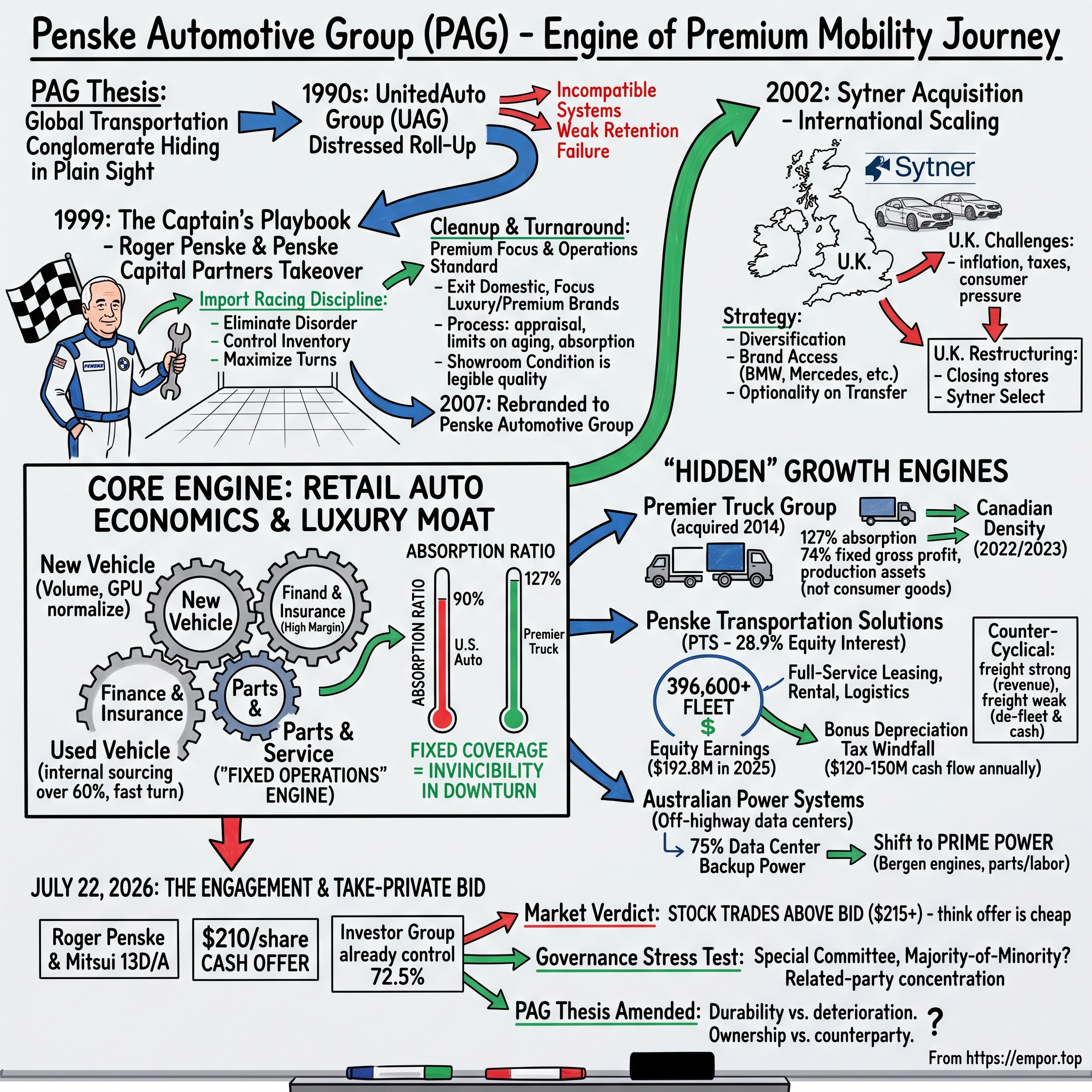
Penske Automotive Group, Inc. (NYSE: PAG): The Engine of Premium Mobility
I. Introduction, Episode Roadmap & The Penske Thesis
On the morning of July 22, 2026, a Schedule 13D amendment landed on the SEC's servers that changed the question every investor in Penske Automotive Group had been asking. For twenty-seven years, the debate had been about gross profit per unit, absorption rates, and whether a luxury-weighted dealer group deserved a higher multiple than its peers. That morning, the debate became something else entirely: what is this company actually worth to the man who built it?
Penske Corporation and Roger S. Penske, together with 三井物産 Mitsui & Co., Ltd. and its U.S. subsidiary, submitted a non-binding proposal to acquire in cash all outstanding voting common stock of Penske Automotive Group not already owned by the group, at $210.00 per share.1 The investor group already controlled 47,655,705 shares, or 72.5% of the company — Penske Corporation and Roger Penske holding 34,333,500 shares, or 52.2%, with Mitsui holding the balance.1 The remaining free float carried an implied value of roughly $3.8 billion.2 The stock had closed the prior session at $195.19; it opened at $215 and traded as high as $219.09, finishing the day up more than 10% at roughly $215.3
Read that last sentence again, because it contains the entire analytical tension of this story. The market priced the shares above the offer. When a controlling shareholder offers to buy out the minority and the stock immediately trades through the bid, the market is saying something specific and unflattering: we think you are trying to buy this cheap, and we intend to make you pay more. That is not a verdict on Penske's operating record. It is a verdict on the price, and on the structural reality that a 72.5% holder negotiating with a special committee of its own board is a governance situation requiring scrutiny rather than applause.
So this is a story about a company at the moment its public life may be ending. And it is worth understanding what, exactly, is being taken off the table.
The conglomerate hiding in plain sight. Penske Automotive Group generated $31.8 billion of revenue in fiscal 2025 and $935.4 million of net income, or $14.13 per share.4 It is, by revenue, one of the largest retailers of anything in the United States — and yet most investors could not describe its business model in a sentence. That is because it is not one business. As of December 31, 2025, the company operated 365 franchised automotive dealerships — 148 in the United States and 217 internationally — plus 15 standalone used-vehicle stores and 45 retail commercial truck locations, spanning seven countries.5 Retail automotive contributed $27.5 billion of revenue; retail commercial truck, $3.4 billion; and a commercial vehicle distribution and power systems business centered on Australia and New Zealand, roughly $923 million.4 Underneath all of that sits a 28.9% equity interest in Penske Transportation Solutions, a truck leasing and logistics partnership that never appears in the revenue line but contributed $192.8 million of equity earnings in 2025.5
The central question. How did a man who once drove at Le Mans build a global transportation enterprise out of a business — car dealerships — that is famously fragmented, cyclical, capital-hungry, and structurally hostage to manufacturers? And more importantly for anyone holding the stock today: is the resulting advantage durable, or is it a very good operator running very hard inside an industry whose economics are quietly deteriorating?
We will not answer that with slogans. Penske's own numbers tell a more complicated story than the bull case admits. Earnings per share peaked at $18.55 in 2022 and have declined in each of the three subsequent years — $15.50 in 2023, $14.49 in 2024, $14.13 in 2025 — even as revenue grew from $27.8 billion to $31.8 billion over the same span.6 Revenue up, earnings down: that is the signature of margin compression, and it is the single most important fact about auto retail in this decade.
The roadmap. We will trace Roger Penske's origins and the operating culture he imported from a race paddock; the 1999 rescue of a stumbling roll-up called UnitedAuto Group; the 2002 Sytner acquisition that made the company genuinely international; the construction of a commercial truck franchise and the truck-leasing joint venture that decouples it from car cycles; the post-COVID normalization and the used-car superstore experiment that did not work; a hard look at capital allocation against peers, including a related-party purchase that deserves more attention than it received; the competitive structure through the lenses of Porter and Helmer; and finally the bull and bear cases, the KPIs that actually matter, and how the take-private proposal reframes all of it.
It begins, as these things usually do, with one person who was unreasonably particular about details.
 Subscribe on LinkedIn
II. The Captain's Playbook: Roger Penske & The Pre-Automotive Roots
There is a story racing people tell about Roger Penske that explains more about this company than any 10-K. In an era when race garages were oil-stained, cluttered places, Penske's crews painted the floors. They wore matching uniforms. Tools were laid out and returned to marked positions. Visiting rivals mocked it as showmanship. It was not showmanship. It was a thesis: that in a business where outcomes are decided by fractions of a second, the team that eliminates disorder eliminates error, and the team that eliminates error wins races it has no business winning.
Roger Searle Penske was born on February 20, 1937, in Shaker Heights, Ohio, and was named Sports Illustrated's Driver of the Year in 1961.7 He was, by the standards of American road racing, genuinely fast. He was also, unusually for a driver, a natural merchant — he had been buying, fixing, and reselling cars since he was a teenager. In 1965 he made the decision that defined everything after: he retired from driving, at 28, to run a Chevrolet dealership in Philadelphia. The racing did not stop; it simply changed roles. Team Penske became the laboratory, and the dealership became the factory floor where the laboratory's findings were applied.
Why racing discipline transfers to car retail. This sounds like corporate mythology until you look at the mechanics. A racing team is an inventory-management problem with a stopwatch attached: you have finite capital, perishable assets, and a fixed date by which everything must be ready. A dealership is the same problem on a monthly cadence. Vehicles depreciate the moment they arrive. Floorplan financing — the revolving credit that funds inventory — charges interest daily. Service bays are the fixed capacity that must be utilized. The operator who turns inventory faster, keeps bays full, and refuses to let clutter accumulate compounds small advantages into large ones over decades. Penske's obsession with clean facilities was never aesthetic. Clean is a proxy for controlled, and controlled is a proxy for measured.
The architecture around the public company. This is where investors need to be careful, because Penske Automotive Group is one node in a much larger private network. Penske Corporation — the parent — is a diversified transportation services enterprise whose interests include Penske Truck Leasing, Penske Logistics, Premier Truck Group, Team Penske, and Penske Entertainment, which acquired the Indianapolis Motor Speedway, the Indianapolis 500, and the IndyCar Series from the Hulman family on November 4, 2019.7 Penske Corporation and Roger Penske together held 52.2% of PAG's voting common stock as of July 21, 2026.1
The conventional framing of that ownership is "alignment": the CEO owns half the company, so he thinks like an owner. That framing is half right and worth interrogating. A 52% holder does have every incentive to compound value over decades rather than manage to quarterly consensus, and PAG's behavior — twenty-one consecutive quarterly dividend increases, leverage held near 1.5x, an unglamorous willingness to sell underperforming stores — is consistent with that.4 But a controlling holder is also a counterparty. When PAG buys assets from a Penske Corporation affiliate, or when Penske Corporation offers to buy out PAG's minority, the interests of the 52% holder and the 28% float are not aligned; they are opposed. Both things are true simultaneously, and the July 2026 proposal is the moment that second truth stopped being theoretical.
The bench. Roger Penske remains Chair and CEO at 89. Around him sits a management team that has been notably stable and notably specialized. Shelley Hulgrave serves as EVP and Chief Financial Officer, and her public communication style is a useful tell: on earnings calls she does not defend SG&A ratios in the abstract, she itemizes them. On the first-quarter 2026 call she walked through exactly why SG&A as a percentage of gross profit came in at 74.3% — roughly $4 million of employee benefit costs, $3.5 million of U.K. payroll taxes and social program charges, $7 million of rent and real estate taxes — and then stated plainly that absent those items the ratio would have been in the 71% to 72% range the company had previously guided to.8 That is the behavior of a finance organization that expects to be checked.
Rich Shearing runs North American operations; Randall Seymore runs international. Both handle their own segments on calls rather than routing everything through the CEO, which is more informative for analysts than it sounds — it means the operating detail is coming from people who own the numbers. Compensation is oriented toward earnings before taxes, return on equity, and operating performance rather than revenue growth, which matters in an industry where revenue is the easiest thing in the world to buy and the hardest thing to convert into returns.9
Which brings us to a company that had bought a great deal of revenue and converted very little of it.
III. The Birth of UnitedAuto Group & The 1999 Turnaround
The 1990s produced one of the great American consolidation stories, and — like most great consolidation stories — it produced a great deal of wreckage on the way to producing a few winners.
The setup was irresistible on paper. U.S. auto retail was a cottage industry: roughly twenty thousand franchised dealerships, most family-owned, most single-point, most run by operators approaching retirement with no succession plan and no access to public capital. Wayne Huizenga's AutoNation, Group 1 Automotive, Sonic Automotive, and UnitedAuto Group all ran the same play — issue stock, buy dealerships at four to six times earnings, consolidate, and let the arbitrage between private multiples and public multiples do the work.
The problem with roll-ups is that arbitrage is not a business. UnitedAuto Group, assembled under financier Marshall Cogan, expanded quickly and then discovered what quick expansion actually buys you: a collection of stores with incompatible systems, inconsistent inventory discipline, weak customer retention, and no shared operating standard. By the late 1990s the company was struggling with the consequences, and Cogan had run into money problems of his own.10
April 1999. Under an agreement announced on April 12, 1999, Penske Capital Partners — a partnership formed in 1997 by Penske Corporation with Chase Capital Partners, Aon, and GE Capital to invest in transportation and transportation services — committed $83.0 million of new capital to UnitedAuto Group in exchange for controlling interest, with the first installment of approximately $33.5 million funded in early May.11 Roger Penske succeeded Cogan as chairman and chief executive.10
Consider the size of that check against what it bought. Eighty-three million dollars, in a company that would generate nearly $32 billion of revenue a quarter-century later. This is one of the more remarkable entry points in modern American retail, and it was available for exactly one reason: the previous strategy had failed publicly enough that control was cheap. Penske was not buying a growth story. He was buying a distressed operating problem in an industry whose economics he understood better than the seller did.
What the cleanup actually consisted of. The playbook applied at UAG was not financial engineering. It was, tediously and unglamorously, the racing garage applied to two hundred showrooms.
First, brand mix. Penske began exiting underperforming domestic volume franchises and concentrating on premium, luxury, and import brands. The logic runs through every line of the income statement: a luxury vehicle carries more gross profit per unit, its buyer is less sensitive to interest rates and fuel prices, its financing attaches at higher rates through captive lenders, and — crucially — it is more complicated to maintain, which drives higher-value service work back to the franchised dealer for years after the sale.
Second, operating standardization. Common processes for how vehicles were appraised, reconditioned, priced, and displayed. Hard limits on inventory aging, because a used car held ninety days is not inventory, it is a slow-motion loss. And relentless pressure on the parts and service department's contribution to fixed overhead — the metric the industry calls absorption, which we will unpack properly in Section V, because it is the load-bearing concept in this entire business.
Third, showroom condition. Penske reportedly walked stores personally and commented on things that seemed irrelevant to a financial analyst: signage, landscaping, whether the customer lounge was clean. The underlying claim is that a manufacturer allocating scarce vehicles or awarding a new franchise point is making a judgment about operator quality, and operator quality is legible in a parking lot before it is legible in a P&L.
The 2007 rebranding. In 2007 UnitedAuto Group renamed itself Penske Automotive Group — putting the family name on the public entity and, in effect, staking personal reputation on the operating standard. It was a branding decision with a governance implication: the Penske name is a shared asset across a private network and a public company, and its owner has an interest in protecting it that is stronger than any incentive-comp formula.
What the 1999 turnaround demonstrated, and what still matters to an investor evaluating this business in 2026, is that scale in auto retail is not itself an advantage. Scale badly executed is a liability, as UAG's own history proved. The advantage — if it exists — lives in the execution layer. The next test of that proposition came three thousand miles away.
IV. Rebranding & International Scaling: The Sytner Deal & Global Luxury Strategy
In February 2002, while the American consolidators were still digesting their domestic acquisitions and the U.S. market absorbed the aftermath of the dot-com collapse, Penske did something none of his peers did. He left the country.
On February 12, 2002, UnitedAuto Group agreed to acquire Sytner Group, the premier luxury dealership network in the United Kingdom, in a transaction valued at approximately $135 million.12 Sytner operated 47 dealerships and held franchises for the brands that define the top of the British market — BMW, Mercedes-Benz, Jaguar, Land Rover, Aston Martin, Ferrari.13 It remains, more than two decades on, the most consequential acquisition in the company's history and the largest expansion outside the United States it had ever undertaken.
On price. Public disclosure around the structure — the mix of cash, stock, and assumed debt — is limited enough that precise multiple reconstruction from primary sources is not possible, and we will not manufacture one. What can be said with confidence is directional: $135 million of enterprise consideration for the leading luxury retail network in a G7 economy, at a moment when European retail assets were unloved and the sterling market was consolidating, was a price that would be unrecognizable today. For comparison, PAG paid $519.4 million in November 2025 for four dealerships.14 The strategic asset acquired in 2002 for a fraction of that sum still contributes roughly a quarter of company revenue.
Why the U.K., and why it mattered strategically. Three reasons, and only two of them are obvious.
The obvious two: diversification and brand access. A pure-play U.S. dealer group is exposed to a single credit cycle, a single set of franchise laws, a single consumer. Sytner gave PAG a second economy with a different rhythm — the U.K.'s twice-yearly registration plate changes in March and September create a demand pattern that concentrates volume into the first and third quarters, partially offsetting the U.S. summer selling season. And Sytner's franchise portfolio made PAG a top-tier retail partner for the German luxury manufacturers in their most important European export market, which is a relationship asset that cannot be bought at any price by a newcomer.
The non-obvious third reason: optionality on operating transfer. If the Penske playbook was genuinely a process advantage rather than a lucky brand mix, it should port across borders. Sytner was the test. Two decades of evidence suggest the transfer was real in aftersales — on the first-quarter 2026 call, international same-store service and parts revenue rose 7%, driven by a 10% increase in customer-pay work that more than offset a 3% decline in warranty, with Italy up 11% and Germany up 20%.8 That is process, not luck: customer-pay work has to be won, whereas warranty work arrives automatically.
But the transfer was not universal, and honest analysis requires saying so. The U.K. has been PAG's most persistently difficult market. Management has described it in consistent terms across multiple calls — inflation, higher taxes, consumer affordability pressure, and a government mandate toward electrification weighing on the overall market.8 The response has been contraction, not expansion: closing unprofitable franchised dealerships, reducing the Sytner Select used-car footprint, and cutting U.K. headcount by 1,000 people over the course of 2025.15 In January 2026 the company reorganized U.K. management from a brand-driven structure to a market-driven one, explicitly modeled on the U.S. approach.15 Twenty-four years after acquisition, the U.K. business was being restructured to look more like the American one. That is a fair thing for a skeptic to note.
The luxury franchising thesis, examined. The deliberate tilt toward premium brands is the most-cited element of the PAG story, and the mechanism is sound. Premium and luxury brands represented 71% of retail automotive revenue in 2025, volume non-U.S. brands 23%, and U.S. manufacturer brands just 3%.5 The affluent buyer is less rate-sensitive; the vehicle is more complex and therefore more service-intensive; the captive finance arms of BMW, Mercedes-Benz, Porsche, and Toyota Financial Services are among the strongest lenders in the industry, which supports both new-vehicle demand and lease penetration.
Two counterpoints deserve equal weight. First, luxury is not recession-proof; it is recession-resilient, which is a different claim. In 2020 PAG's net income fell to $543.6 million from a pre-pandemic base, and earnings per share dropped to $6.74.6 Second, and more current: luxury has recently been the weak end of the market, not the strong end. In the fourth quarter of 2025, PAG's new unit sales of German luxury brands declined 20% in the U.S. and 22% in the U.K.15 In the first quarter of 2026, Audi was down roughly 30%, BMW down about 15%, Mercedes-Benz down about 15%, and Porsche down about 18%.8 Meanwhile the segment carrying PAG's growth was Toyota and Lexus — volume-foreign, not luxury — which management noted had risen to about 18% of automotive business following recent acquisitions.8
That is a meaningful evolution of the thesis. The company that spent two decades explaining why it avoided volume brands is now growing fastest in one. Management's framing — that トヨタ自動車 Toyota and Lexus run the lowest day supply in the industry and possess exceptionally strong captive finance — is coherent. But an investor should register that the brand-mix moat is being amended in practice, and ask whether the underlying advantage was ever really "luxury" or was always something more basic: disciplined inventory turns and dominant aftersales.
Which is exactly where the money is made.
V. The Core Engine: Retail Automotive Economics & The Luxury Moat
Walk into a Penske dealership and the architecture tells you where management thinks the profit is — or rather, it tells you where the manufacturer thinks the profit is, which is not the same thing.
On the first-quarter 2026 call, Roger Penske said the quiet part aloud in a way that repays close reading. Discussing capital expenditure demands from manufacturers, he described pushing back: "Let's make the showroom smaller, let's put more cars outside and work on more inside. I know it's opposite of what the thinking is."8 He then turned to the commercial truck business and asked Rich Shearing how many trucks Premier Truck Group keeps in its showrooms. The answer was zero. Premier Truck's fixed coverage ratio, Shearing noted, is 127%.8
That exchange is the most important thing said on any PAG earnings call in the last two years, and to understand why, we need to unpack how a dealership actually makes money.
The four legs of the stool. A franchised dealership is not one business; it is four, stapled together and sharing a roof.
New vehicle sales are the volume driver and the worst business of the four by margin. The dealer buys inventory from the manufacturer on floorplan credit and sells it at a spread that has historically been thin. In 2025, PAG's gross profit per new retail unit averaged $4,920.4 That figure is well above the pre-pandemic norm and well below the 2022 peak — a point we return to in Section VII.
Used vehicle sales are an inventory-turn game. You make money by buying right, reconditioning efficiently, and selling fast. In 2025, gross profit per used unit averaged $2,074.4 The critical variable is sourcing: a car taken in on trade or bought from a customer costs less than a car bought at auction, because auctions are where every dealer competes for the same metal. Roger Penske quantified this on the fourth-quarter 2025 call — the share of used inventory sourced internally, from trades and street purchases, had risen from roughly 46-47% to over 60%.15 That single sourcing shift is worth more to used-vehicle margin than almost any pricing tactic.
Finance and insurance is the highest-margin line in the store. When a dealer arranges financing, it earns a reserve on the rate; when it sells a service contract or protection product, it earns a commission. There is almost no incremental cost. PAG generated $1,812 of F&I gross profit per unit in 2025.4 Multiply that across 485,000 vehicles delivered in the year and the arithmetic becomes obvious.15 It is also the line most exposed to regulation, since F&I products have drawn scrutiny from consumer regulators in both the U.S. and the U.K.
Parts and service — "fixed operations" — is the actual engine. It is high-margin, recurring, and structurally insulated from the sales cycle, because cars need maintenance whether or not anyone is buying new ones. In the first quarter of 2026, PAG reported record first-quarter service and parts revenue and gross profit, with same-store revenue up 4.6% and gross profit up 5.7%, and gross margin expanding 60 basis points.8
Absorption, explained properly. Here is the concept that makes the whole structure work, and it deserves a plain-English analogy.
Imagine you run a restaurant where the rent, utilities, and salaried staff cost $100,000 a month. Now imagine the coffee counter at the front — a small, high-margin operation — generates $90,000 of gross profit every month, rain or shine, regardless of whether anyone orders dinner. You are 90% "absorbed." Every dinner you sell is nearly pure profit, and a month with no dinner reservations is a small loss rather than a catastrophe.
That is a dealership. Parts and service is the coffee counter. The fixed coverage or absorption ratio measures what percentage of the store's total fixed overhead is covered by parts-and-service gross profit alone. On the fourth-quarter 2025 call, Shearing disclosed that the U.S. automotive fixed absorption rate had risen 200 basis points to 89.6%.15 Premier Truck Group's, as noted, runs at 127% — meaning the truck dealerships' service departments cover all fixed costs and then some before a single truck is sold.8
An absorption rate near 90% is a genuine competitive datapoint, materially above what the industry typically achieves, and it explains why PAG's earnings do not collapse when unit sales fall. It is also the reason Roger Penske is arguing with manufacturers about showroom size. Capital spent on marble and glass earns nothing. Capital spent on service bays raises absorption. Management has been putting money where that logic points: expanding to 100 bays at Longo Toyota in California, building a new dealership with 100 bays in Hutto, Texas, and adding roughly 30 bays in Central Florida.8
The constraint nobody can engineer away. Bay utilization in the U.S. automotive segment stood at 84% in the first quarter of 2026, with technician count up 3% year over year.8 Asked what prevents that from reaching 100%, Shearing was refreshingly unpromotional: you need technicians, you need every part on hand at the moment you need it, and complex jobs occupy adjacent bays. Pushing north of 90%, he said, would be a challenge.8 Translation: fixed operations growth is capped by skilled labor supply and parts logistics, not by demand. That is the real ceiling on the most valuable part of the business, and no amount of capital solves it quickly.
Competitive dynamics. PAG competes against AutoNation, Lithia Motors, Group 1 Automotive, and Asbury Automotive among the publics, and against large private operators such as Hendrick and Holman. Its differentiation is location and mix — a heavy concentration of premium franchises in affluent metropolitan markets, and, increasingly, dominant single-point stores in high-growth Sun Belt metros. The stated targets in recent acquisitions have been California, Texas, Florida, and Arizona, where existing scale allows a new store to plug into regional management rather than requiring new infrastructure.15
What that scale does not do is create pricing power over the customer. On the first-quarter 2026 call, only 25% of new units sold at manufacturer's suggested retail price, down from 29% a year earlier.8 Digital price transparency means the buyer arrives knowing the market. The advantage PAG has is on the cost and turn side of the ledger, not the pricing side — and investors should be clear-eyed that these are different things.
Still, all of this is retail automotive: a good business, a cyclical business, a business everyone can see. The parts of PAG that peers genuinely cannot replicate are somewhere else on the balance sheet.
VI. The "Hidden" Growth Engines: Premier Truck Group & Penske Transportation Solutions
There is a reason Roger Penske pivoted, mid-answer, from showroom design to a truck dealership with nothing in the showroom at all. The commercial vehicle side of PAG is where the operating philosophy runs unencumbered by manufacturer aesthetics — and where two very different assets sit.
Premier Truck Group: buying a business nobody wanted to talk about.
In 2014, PAG acquired The Around the Clock Freightliner Group, a heavy- and medium-duty commercial truck retailer operating 14 dealerships across three states, adding approximately $700 million of annualized revenue.16 It was rebranded Premier Truck Group, headquartered in Dallas, and became the platform for a decade of methodical expansion — including Canadian additions such as Team Truck Centres in Ontario in 2022 and Transolutions Truck Centres in Winnipeg in 2023, the latter part of a stated push to build Canadian density.17 By the end of 2025 the segment comprised 45 retail commercial truck locations across ten U.S. states and Canadian provinces, representing Daimler Truck North America's Freightliner and Western Star brands.5
Why this was strategically clever is worth stating plainly. A commercial truck is a production asset, not a consumer good. Its owner is a fleet operator whose economics depend on uptime, which means maintenance is not discretionary — it is scheduled, mandatory, and expensive. Repair orders carry higher ticket values than passenger vehicles. The customer relationship is contractual and multi-year rather than transactional. The result is the 127% fixed coverage ratio: a dealership network that is profitable on service alone, with truck sales as the upside.
That structure was tested severely in 2025, and the test is instructive. In the fourth quarter, Premier Truck retailed 3,789 new and used trucks, generating $725 million of revenue and $121 million of gross profit, with service and parts representing 74% of segment gross profit.15 New truck retail sales declined 14% — against an industry Class 8 decline of 28%.15 Segment earnings before taxes fell from $45 million to $34 million.15 So: a brutal freight recession cut the segment's profit by roughly a quarter, but the network outperformed its market by fourteen percentage points and remained solidly profitable. That is what a high-absorption business looks like under stress. It bends.
The first quarter of 2026 was worse on volume and better on signal. Premier Truck retailed 3,583 trucks for $695 million of revenue and $128 million of gross profit, with new unit sales down 26% in line with the North American Class 8 market.8 But sequentially, new unit gross profit rose $111 and used unit gross profit rose $4,624; service and parts revenue rose 5%, the first growth in fixed gross profit in six quarters; and Class 8 industry orders rose 91% year over year with the industry backlog up 33% to 175,000 units.8
Management attributed the order recovery to three things: resolution of uncertainty around EPA 2027 emissions rules, a tariff-driven pull-forward as customers ordered ahead of a $1,000-to-$1,500 price increase, and — most interestingly — a structural tightening of trucking capacity as the Department of Transportation and FMCSA cracked down on illegal carriers and non-domiciled CDL holders, with spot rates up 30% to 40% year over year.8 The first two are cyclical and temporary. The third, if it holds, is structural. Management said so explicitly rather than blurring the distinction, which is the correct way to answer that question and a reasonable mark in favor of its credibility.
Penske Transportation Solutions: the asset that isn't on the income statement.
Now the genuinely unusual piece. PAG holds a 28.9% equity interest in Penske Truck Leasing Co., L.P., the partnership operating under the Penske Transportation Solutions banner. Penske Corporation owns 41.1%; Mitsui owns 30.0%.18 PTS provides full-service truck leasing, truck rental, contract maintenance, and logistics, and manages a fleet that stood at over 396,600 trucks, tractors, and trailers at the end of 2025, employing more than 42,000 people.5
Because PAG's stake is a minority interest, none of PTS's revenue appears in PAG's revenue line. What appears instead is a single figure: equity earnings, $192.8 million in 2025, alongside $98.7 million of cash distributions received.5 For a company earning $935.4 million of net income, an equity stake contributing nearly $193 million pre-tax is not a footnote.
The strategic logic is elegant. Truck leasing is a long-duration contractual business — leases run three to five years with built-in economic escalators, as Roger Penske described on the first-quarter call.8 It is capital-intensive in a way PAG could never fund on its own balance sheet, and it is counter-cyclical in useful ways: when freight is strong, lease and rental revenue rise; when freight is weak, the leasing company de-fleets, which generates cash and reduces interest and depreciation expense.
That second mechanism did exactly what it should in 2025-26, and the transparency around it is worth noting. PTS reduced its fleet from 435,000 units at the end of 2024 to just under 397,000 by the end of 2025 and 387,500 by March 2026, selling 41,500 units during 2025 alone.158 The de-fleeting cut roughly $1.4 billion of debt from the leasing company.15 Fourth-quarter 2025 equity earnings fell less than 10% to $48 million despite gain-on-sale declining $18 million in the quarter and $87 million for the full year.15 Roger Penske's summary was blunt and, importantly, separated operating performance from asset-sale gains: operationally, earnings before taxes were off roughly $16-17 million for the year while gains on sale fell $87 million.15
Then the turn. In the first quarter of 2026, PTS operating revenue declined 4% to $2.5 billion and gain on sale fell another $26 million — yet equity income rose 24% to $41 million, driven by lease revenue growth of 2%, rental fleet utilization improving roughly 500 basis points to 76%, and lower maintenance, depreciation, and interest expense.8 Earnings rising while revenue and gains fall is the signature of a cost structure that was genuinely reset rather than merely waited out.
Two caveats a skeptic should hold. First, equity-method accounting means PAG reports a share of profit it does not control and cannot direct; cash reaches PAG only via distributions, which in 2025 were roughly half of reported equity earnings.5 Second, PTS is co-owned by the same parties now proposing to take PAG private, which is a related-party concentration worth naming rather than glossing.
There is also a tax angle that has received less attention than it deserves. On the fourth-quarter 2025 call, Hulgrave disclosed that the bonus depreciation provisions of the One Big Beautiful Bill were expected to generate an estimated $120 million to $150 million of additional cash flow each year through PAG's 28.9% PTS partnership interest.15 That is a material, policy-driven cash flow item flowing through a non-consolidated stake — precisely the kind of thing that is easy to miss reading only the income statement.
And one operational detail from the same call that illustrates how granular the cost-recovery effort has been. Roger Penske disclosed that the rental business had been suffering meaningful losses to fraud — customers making online reservations with credentials that verified cleanly, then failing to return trucks or pay. PTS had implemented new screening techniques and expected to reduce bad debt expense by $10 million to $15 million in the coming year.15 It is a small number against a $31 billion enterprise. It is also exactly the kind of unglamorous leak that most managements never mention on a call, and the willingness to name it is consistent with the pattern of specificity running through this company's disclosure.
The third engine nobody discusses: Australian power systems.
Buried inside the commercial vehicle distribution segment — 2.9% of revenue, easy to ignore — is a business that has quietly become one of the more interesting optionality assets in the portfolio.5 PAG's Australia and New Zealand operations distribute engines and power systems, split roughly two-thirds off-highway and one-third on-highway by both revenue and gross profit.8 The off-highway half serves mining, defense, and — increasingly — data centers.
Seymore disclosed that PAG holds approximately 75% market share in Australian data center backup power for the 1,250-kilowatt-and-above range, which covers the majority of installations.8 That sounds like an AI-infrastructure story, and it partly is. But Seymore was careful to explain why it is a worse business than it appears: a backup generator is sold, installed, tested monthly, and then sits idle. It generates no aftersales annuity, because it never runs.
The strategy, therefore, is to shift toward prime power — engines that run continuously and therefore consume parts and labor. The illustrative case Seymore described is a single mining customer operating a 175-megawatt power station built four years ago with fifteen Bergen engines, twenty cylinders each, running seven to eight thousand hours a year. Having reached the major maintenance interval, PAG began remanufacturing 300 cylinder heads in-country — roughly 15,000 hours of work from one installation.8 The segment completed nearly $700 million of project revenue in 2025, entered 2026 with AUD 600 million of secured orders already exceeding its full-year plan, and management has stated a target of at least AUD 1 billion of Energy Solutions revenue by 2030.158
The pattern should be familiar by now. It is the absorption thesis applied to industrial equipment: sell the machine to earn the right to service it, then engineer the installed base toward the applications that generate the most service. Whether a 2030 revenue target hit is unknowable today, and it is a target rather than guidance. But Australian earnings before taxes nearly doubled year over year in the fourth quarter of 2025 and rose 15% in the first quarter of 2026, so the direction is at least corroborated.158
Diversification of this kind is real, and it is the strongest structural argument in the bull case. But it did not protect PAG from the cycle that reshaped the entire industry.
VII. The COVID Windfall, GPU Normalization, & The CarShop Experiment
For roughly three years, the car business stopped being the car business.
Semiconductor shortages beginning in 2021 throttled global vehicle production at precisely the moment stimulus-fueled consumers wanted to buy. Inventory collapsed. Discounting vanished. Dealers who had spent a century competing on price found themselves selling above sticker with waiting lists. The industry's oldest complaint — that manufacturers overproduce and dealers absorb the discount — was suspended.
The financial consequence at PAG was extraordinary. Net income rose from $543.6 million in 2020 to $1.19 billion in 2021 and $1.38 billion in 2022, with earnings per share reaching $18.55.6 Revenue grew 36% over those two years while net income more than doubled — operating leverage of a kind auto retail had never produced.
What actually happened, mechanically. Gross profit per unit is the spread between what a dealer pays for a vehicle and what it sells for. When supply is scarce, that spread widens without the dealer doing anything. Simultaneously, SG&A as a percentage of gross profit collapses — not because costs fell, but because the denominator exploded. Every dollar of windfall gross profit dropped nearly intact to pre-tax income.
The honest way to characterize 2021-22, then, is that the industry received a transfer payment from consumers created by a supply shock. Managements everywhere described it as operational excellence. It was mostly scarcity.
The normalization. Production recovered, inventory rebuilt, manufacturers reinstated incentives, and gross profit per unit began a multi-year descent. PAG's earnings per share declined every year from the 2022 peak.6 The company's new-vehicle gross profit per unit of $4,920 in 2025 remains far above the pre-pandemic norm of roughly $2,000, which is why the compression story is not finished.4 Recent quarters show the deceleration flattening rather than reversing — $4,689 in the fourth quarter of 2025 and $4,783 in the first quarter of 2026, up $94 sequentially, with used GPU at $2,076, up $306 sequentially.158 Sequential stabilization is genuine, but a base still more than double 2019's leaves substantial room for further erosion, and no investor should treat the current level as a floor simply because it has held for two quarters.
The cost response, and whether it was real. This is where management's execution can be tested against its own prior statements — the fairest way to assess credibility.
PAG had guided to SG&A as a percentage of gross profit in the low 70s. For full-year 2025 it delivered 72.1%, or 71.5% adjusted for one-time items, which Hulgrave stated was in line with prior guidance.15 Total SG&A grew 2.1% for the year — below inflation.15 In the first quarter of 2026 the reported ratio deteriorated to 74.3%, and management itemized the causes rather than deflecting, restating that the underlying ratio was 71-72%.8 SG&A grew 1.5% in the quarter while gross profit declined 1.7% — which is the honest arithmetic of the situation: costs are controlled, but they are not falling as fast as gross profit.8
Grade that fairly. The company set a target, hit it, missed it in a subsequent quarter, explained the miss with specific line items and dollar amounts, and noted which items would annualize away. That is disciplined communication. It is not, however, evidence that PAG can hold low-70s SG&A ratios if gross profit per unit resumes falling — and management has not claimed it can.
CarShop: the experiment that did not work.
Every good operator has a strategic misfire, and how they handle it reveals more than their successes do.
PAG entered standalone used-vehicle retail by acquiring CarSense in the U.S. in 2016 and CarShop in the U.K., later consolidating the U.S. stores under the CarShop banner.19 The ambition was substantial: expand from 17 locations to 40, reach 150,000 annual unit sales, and generate $2.5 to $3.0 billion of revenue by the end of 2023.20 The strategic rationale was to capture standalone used-vehicle share against Carvana and CarMax without franchise constraints.
The economics did not cooperate. Used vehicle acquisition costs spiked post-COVID; interest rates rose, hurting both floorplan costs and customer affordability; and the fundamental problem with a standalone used-car superstore surfaced — it has no captive service business. Randall Seymore articulated this precisely on the first-quarter 2026 call, discussing new Chinese franchise points: open a brand-new standalone store and "instead of running at 75% fixed absorption, at zero."8 A store with no absorption must earn its entire overhead from vehicle margin, which is the thinnest and most volatile profit pool in retail.
PAG shelved the expansion plan.21 Then it retrenched. In the U.K., the CarShop brand was retired and the surviving locations rebranded as Sytner Select, with the footprint reduced — two former stores sold to Big Motoring World, another closed, leaving nine sites, all deliberately positioned near existing new-car stores to give them a cheap internal source of trade-in inventory.19 On the first-quarter 2026 call, Roger Penske stated the U.K. decision as a reduction from 14 Sytner Select stores to 6, which he described as paying off, with the freed-up locations being used to house Chinese franchise brands in existing showrooms at minimal incremental fixed cost.8
Roger Penske's own postmortem on the fourth-quarter 2025 call was unusually candid for a CEO discussing a failed initiative. The core problem, he said, was sourcing: the business could never reliably acquire the 5,000 to 6,000 used cars a month it needed at prices that supported profitability, and an attempt to buy 1,000 to 1,500 cars in bulk blocks left the company working through poorly-bought inventory at compressed margin. He was equally direct on why the company would not chase older, cheaper vehicles: policy returns and buybacks on older cars in the U.K. had been uncontrollable, and reconditioning cost on an older car exceeds what a lender will finance. "We're not in the old car business," he said.15
What this episode says about the company. The favorable reading is that PAG identified a losing concept, quantified why it was losing, stopped funding it, and redeployed the capital and the physical assets. That is genuine capital allocation discipline, and it distinguishes PAG from operators who defended used-vehicle formats far longer.
The less favorable reading is that PAG made the same strategic error nearly everyone made — mistaking a scarcity-inflated used-car market for a structural opportunity — and spent seven years and real capital learning what its own absorption math should have told it upfront. Both readings are true. The relevant question for an investor is whether the recovery behavior is repeatable, and on that, the record is encouraging.
Which raises the broader question of how PAG deploys capital compared with everyone else trying to do the same thing.
VIII. Capital Allocation & Competitive Benchmarking (PAG vs. Lithia, AutoNation, Group 1)
Four large public dealer groups entered the post-COVID windfall with roughly the same problem: an unprecedented pile of cash and a decision about what to do with it. Their answers diverged sharply, and those divergences are now the clearest expression of each company's actual philosophy.
The four playbooks.
Lithia Motors chose scale. It pursued aggressive, debt-funded acquisition of mass-volume and regional dealership groups, layered on the Driveway digital retail platform, and accepted materially higher leverage to build national coverage fastest. AutoNation chose the balance sheet, running a domestic-focused, moderate-leverage portfolio and directing enormous sums into share repurchase — reducing its share count dramatically and effectively betting that buying its own equity beat buying anyone else's stores. Group 1 Automotive pursued a middle path of disciplined domestic and U.K. acquisition. PAG chose diversification and yield: high-end luxury plus commercial trucks plus a non-consolidated logistics stake, conservative leverage, and a steadily growing dividend.
PAG's actual numbers. In 2025, PAG generated approximately $1 billion of cash flow from operations, $1.5 billion of EBITDA, and $651 million of free cash flow after $325 million of capital expenditures.15 It repaid $550 million of senior subordinated notes at scheduled maturity, paid $344 million of dividends, and repurchased 1.2 million shares — roughly 1.8% of shares outstanding — for $182 million.15 Non-vehicle long-term debt ended the year at $2.17 billion with leverage at 1.5x, rising to $2.6 billion and 1.8x by March 2026 following acquisitions.158 Over the four-plus years through 2025, roughly $2.5 billion was returned to shareholders through dividends and buybacks.15
The buyback deserves a specific note. Weighted average shares outstanding fell from 80.6 million in 2020 to 66.2 million in 2025 — an 18% reduction.6 That is meaningful, though notably less aggressive than AutoNation's approach. PAG's dividend, by contrast, has been increased in twenty-one consecutive quarters to $1.40, with a payout ratio of 37.4% and a forward yield of roughly 3.4% — which management has repeatedly and accurately described as the highest in its peer group.48
Portfolio pruning: the underdiscussed discipline. The more interesting behavior is on the sell side. In 2025 PAG completed divestitures representing approximately $700 million of revenue and just $4.5 million of earnings before taxes, generating $200 million of proceeds, with another $140 million of divestiture proceeds planned for 2026.15 Read those two figures together: $700 million of revenue producing $4.5 million of pre-tax profit is a 0.6% margin. Selling it is not portfolio management, it is arithmetic.
Roger Penske explained the process on the first-quarter 2026 call in unusually procedural terms — the board had reviewed brand and location strategy roughly eighteen months earlier, evaluated low performers against manufacturer capital expenditure demands and growth potential, and identified stores to sell.8 The stated benefit went beyond proceeds: reducing the store count was expected to cut capital expenditure by roughly $100 million in 2026.8 Divesting a low-margin store therefore saves twice — once in proceeds, once in avoided manufacturer-mandated facility spending. That is a genuinely sophisticated read of where dealership capital actually goes.
Recent acquisitions, and the multiple question. Did PAG overpay? The primary evidence available is narrower than commentary suggests, and we should be honest about what can and cannot be verified.
What is disclosed: on November 19, 2025, PAG acquired four dealerships — Longo Toyota and Longo Lexus in El Monte, California, Lexus of Stevens Creek in San Jose, and Longo Toyota of Prosper, Texas — for $519.4 million, funded from availability under the U.S. credit agreement and a note payable to the seller.14 Those stores retailed over 28,000 new and used vehicles in 2024 and were expected to generate approximately $1.5 billion of annualized revenue.14 That implies roughly 0.35 times revenue. In February 2026, PAG added two Lexus dealerships in Orlando and Winter Park representing approximately $450 million of annualized revenue; the purchase price was not separately disclosed.8 Earnings multiples for these transactions were not disclosed, and we will not estimate them.
The related-party issue. Here is what deserves more scrutiny than it received. The seller of the four dealerships was Penske Motor Group — an affiliate of Penske Corporation, the same entity that controls 52% of PAG. One Penske entity sold assets to another Penske entity for $519.4 million.14 Because the transaction was between entities under common control, GAAP required PAG to retrospectively recast prior-period financials to include Penske Motor Group's results in both periods, which management disclosed and provided reconciliation schedules for.15 There is a further wrinkle: Penske Motor Group had been a partnership not subject to income tax, so prior-period comparisons of net income and EPS are not directly comparable — management quantified the effect at roughly 100 basis points on the effective tax rate and $0.05 per share.8
None of that is improper. Common-control accounting is prescribed, the disclosure was proactive, and the assets are genuinely excellent — Longo Toyota is the largest-volume Toyota dealership in the United States, and Roger Penske noted its body shop alone generates roughly $1 million of gross profit per month.15 Independent directors would have reviewed it.
But an activist investor would frame the sequence differently, and the framing is not unreasonable. In November 2025, the controlling shareholder sold assets to the public company for half a billion dollars. Eight months later, in July 2026, the controlling shareholder offered to buy the entire public company's float at a 7.6% premium to the prior close — an offer the market immediately repriced above.13 A skeptic would ask whether the acquisition of Penske Motor Group was in part a pre-positioning of assets, whether the price PAG paid was tested against genuinely independent alternatives, and whether the free float is now being offered a price that reflects the earnings power those very assets were purchased to enhance. The Schedule 13D/A explicitly conditions the transaction on approval by a special committee of disinterested and independent directors, and states that financing is expected to come from third-party debt commitments plus equity, with no assurance the proposal will be completed and the right to modify or withdraw it at any time.1 The special committee's independence, and whether a majority-of-minority approval condition is ultimately included, are the governance facts that will matter most.
The broader point for anyone assessing this business: PAG's capital allocation record on operating decisions is strong and evidenced. Its governance structure concentrates enormous discretion in one shareholder, and that concentration is now being exercised. Investors should weigh both, not just the first.
IX. Strategic Frameworks: Helmer's 7 Powers & Porter's 5 Forces
Frameworks are useful only if they are applied adversarially — if you look for where the power isn't as hard as you look for where it is. Let us do that.
Hamilton Helmer's 7 Powers.
Scale Economies — moderate, not high. PAG shares regional management structures, spreads technology and back-office costs across hundreds of rooftops, and negotiates floorplan financing at a scale a single-point dealer cannot match. All real. But auto retail scale economies are weaker than they appear, because the dominant costs — vehicle acquisition from the manufacturer, technician labor, real estate — do not fall meaningfully with size. Manufacturers set vehicle pricing to dealers; a 365-store group does not buy a BMW cheaper than a one-store dealer. The evidence for this is in the results: PAG grew revenue 14% from 2022 to 2025 while net income fell 32%.6 If scale economies were powerful, that spread would not exist. Call scale a cost advantage in overhead and financing, not a structural moat.
Process Power — high, and the best-evidenced of the seven. This is where PAG's claim is strongest, because it is measurable rather than asserted. A 200-basis-point improvement in U.S. fixed absorption to 89.6%; internal used-vehicle sourcing rising from 47% to over 60%; SG&A growth held below inflation for a full year; a truck network outperforming its industry by fourteen percentage points in a down market.15 These are operating outcomes, not narratives, and they took decades to build. A competitor cannot buy them. Process power is also the hardest advantage to transfer through succession, which is precisely why succession is a material risk rather than a governance formality.
Counter-Positioning — moderate, and frequently overstated. The claim is that the PTS equity stake creates an earnings stream competitors cannot replicate without enormous logistics capital. Partly true: no other public dealer group owns a piece of a 396,600-unit leasing fleet.5 But counter-positioning in Helmer's sense requires that incumbents cannot respond because responding would damage their existing business. Nothing prevents Lithia or AutoNation from acquiring commercial truck dealerships or logistics assets; they have simply chosen not to. This is a strategic choice with a long head start, not a structural trap for competitors. Call it durable differentiation rather than counter-positioning.
Branding — moderate to high, but the brand that matters is B2B. The Penske name carries genuine weight with manufacturers, and manufacturer relationships are the gating factor in this industry: BMW, Mercedes-Benz, Porsche, Toyota, and Lexus decide who receives new franchise points and who is approved to acquire existing ones. Roger Penske noted that PAG had to commit to divesting two Lexus stores in order to proceed with the Penske Motor Group transaction and remain within manufacturer ownership caps.8 That cuts both ways — the relationship grants access, and the manufacturer's rules constrain it. With the retail consumer, the Penske brand is worth considerably less; consumers shop by price and inventory.
Switching Costs, Cornered Resource, Network Economies — largely absent. A car buyer has no switching cost. There is no network effect in dealership retail. The closest thing to a cornered resource is real estate — prime sites in affluent metros with manufacturer franchise rights attached — which is real but geographically local rather than company-wide.
Porter's 5 Forces.
Supplier Power — high, and the most underrated risk in the story. Manufacturers control vehicle allocation, pricing to dealers, facility standards, capital expenditure mandates, and increasingly the retail model itself. PAG's own disclosures make this vivid: Land Rover production halted for six weeks following a cyber incident, costing PAG roughly 800 units and an estimated $8 million of pre-tax earnings in the fourth quarter of 2025.15 A supplier's IT failure cut a retailer's quarterly profit. That is what high supplier power looks like. U.S. state franchise laws buffer dealers from termination and territorial encroachment, which is a genuine legal protection — but those laws do not exist in the same form across PAG's international markets, which represent 38% of revenue.5
Buyer Power — low to moderate. Affluent luxury buyers are less price-sensitive, which supports margin. But digital transparency has eroded information asymmetry, and the MSRP statistic — 25% of new units sold at sticker versus 29% a year earlier — is a direct measurement of buyer power increasing.8
Threat of New Entrants — genuinely low. Building a franchised dealer network from scratch is close to impossible: capital requirements are severe, franchise grants are controlled by manufacturers, state laws restrict new points near existing ones, and manufacturers award scale to proven operators. This is the strongest force in PAG's favor and the reason the industry consolidates rather than fragments.
Threat of Substitutes — moderate and rising. Two vectors matter. The first is the agency model, under which manufacturers sell directly at fixed prices and pay dealers a delivery commission — a structure trialed by several European manufacturers. If adopted broadly, it converts the new-vehicle gross profit line into a fixed fee and removes the dealer's ability to earn on the spread. PAG has not quantified its exposure, and the honest position is that this remains an unpriced risk in the U.K. and European operations. The second is Chinese manufacturers entering Europe and Australasia, discussed below.
Competitive Rivalry — high but locally buffered. Franchise laws create quasi-territorial exclusivity for a given brand, so PAG's BMW store does not compete with another BMW store next door. But it competes intensely with the Mercedes-Benz and Audi stores across the road, and with every independent shop and national chain for service work once vehicles leave warranty.
The disruption nobody had modeled: Chinese brands. The most interesting competitive development in PAG's international markets is not agency or EVs — it is 比亚迪 BYD, 吉利 Geely, and 奇瑞 Chery. Seymore disclosed that Chinese brands had more than doubled share in the U.K., Italy, and Germany, reaching nearly 10% of the U.K. market, and in Australia had risen from 15% of the market in 2025 to 23% by the first quarter of 2026 — an eight-point share shift in roughly a quarter.158
PAG's response is a genuinely clever piece of capital-light positioning: place Chinese franchises inside existing Sytner Select used-car superstores, which already carry roughly 400 guests per week and full service infrastructure, so the incremental fixed cost is a corporate-identity refresh rather than a new building.8 By the first quarter of 2026 the company operated 11 such locations across four brands in the U.K. and Germany.8 Roger Penske noted margins on Chinese vehicles in those stores were running roughly a couple of thousand pounds above the used cars sold alongside them — then immediately added, "right now, it could be Christmas. We don't know what's going to happen as we go forward."8 Seymore's caution was more specific: the risk is that these manufacturers over-dealer the market and trigger a race to the bottom, and none of them yet have the units-in-operation base that generates aftersales annuity.8
That is the correct posture, and it is worth crediting. A management team that describes early success as possibly temporary is easier to trust than one that does not.
X. Playbook, Risk Radar, & Bull vs. Bear Investment Case
The playbook — what generalizes beyond this company.
Absorption is invincibility. The single most transferable lesson in this story is that a business with a recurring, high-margin revenue stream covering its fixed costs converts its cyclical revenue into pure optionality. A dealership at 90% absorption and a dealership at 60% absorption are not the same business at different scales; they are different businesses. In a downturn, one bends and one breaks.
Structure beats forecasting. PAG did not predict the freight recession, the semiconductor shortage, the collapse of BEV demand after the U.S. tax credit expired in September 2025, or the arrival of Chinese brands in Europe. It built a structure — multiple geographies, multiple vehicle categories, a non-consolidated leasing stake — in which no single shock is fatal. The 2025 results demonstrate this: automotive units fell, truck sales collapsed, freight was in recession, and the company still earned $935 million.4
Know when to stop. CarShop cost time and capital. It was ended, its physical assets repurposed for Chinese franchises, and its lesson — no absorption, no business — was applied to the next decision. Failure handled well is cheaper than failure defended.
Ownership concentration is not the same as alignment. This is the lesson 2026 added to the list. A 52% owner-operator produces long-horizon thinking and low agency cost in normal times, and produces a structurally conflicted counterparty at the moment of exit.
The risk radar.
GPU compression. New-vehicle gross profit per unit remains roughly double pre-pandemic levels.4 There is no economic law holding it there. Sequential stabilization over two quarters is encouraging but not proof of a floor, and every dollar of GPU decline flows almost directly to pre-tax income.
Fixed-operations ceiling. Parts and service is the profit engine, and its growth is capped by technician supply and parts availability, with bay utilization already at 84% and management indicating limited headroom.8 Warranty work — currently elevated because manufacturers have had extensive recalls across Toyota, BMW, and Audi — is explicitly not guaranteed to recur, and Shearing said so directly.15
EV disruption to aftersales. Battery electric vehicles have dramatically fewer moving parts and require less routine maintenance, which structurally threatens the highest-margin line. This risk is currently masked rather than resolved: PAG's EV sales fell 61% year over year in the first quarter of 2026 following the expiration of the U.S. tax credit, stabilizing at roughly 4-5% of retail sales, while BEV days' supply ballooned from 12 days to 78 days.8 Slower EV adoption defers the aftersales problem; it does not eliminate it. Meanwhile U.K. and European electrification mandates push in the opposite direction, meaning PAG faces the revenue risk of EVs in its international markets while gaining little of the volume.
The agency model. The most under-quantified risk in the story. Neither PAG nor its peers have disclosed a modeled earnings impact from a broad European shift to agency retailing. Absence of disclosure is not absence of exposure.
Freight and truck cyclicality. Premier Truck Group and PTS together contributed materially to the 2025 earnings decline. The first-quarter 2026 order recovery is partly structural (capacity enforcement) and partly cyclical (tariff pull-forward, emissions clarity), and management distinguished the two rather than claiming all of it.8
Tariffs and cost of capital. Roger Penske described the tariff environment as "really undecided Washington," with a 25% impact on German manufacturers and 10% on the first 100,000 U.K. units, and predicted manufacturers would need to de-content vehicles to hold price points.15 Separately, PAG estimated that a 25-basis-point change in interest rates would move interest expense by approximately $15 million.8 With floorplan at $4.1 billion and non-vehicle long-term debt at $2.6 billion, this is a genuinely rate-sensitive balance sheet.8
Succession. Roger Penske is 89. The process power described in Section IX was built by one person over sixty years and is embodied in an operating culture rather than a system. The management bench is deep and specialized, and the company has not disclosed a formal succession plan. This is the highest-consequence unquantifiable risk in the story — and it is plausibly one motivation behind a take-private structure, since a private company can manage a generational transition without quarterly scrutiny.
The bull case. PAG is a structurally diversified transportation retailer with a demonstrated, measurable operating advantage in aftersales — the industry's most durable profit pool — trading with conservative leverage near 1.5-1.8x, an 18% reduction in share count over five years, and twenty-one consecutive quarterly dividend increases at a sector-leading yield.1564 The commercial truck cycle appears to be inflecting, with Class 8 orders up 91% and backlog up 33%, which should benefit both Premier Truck Group and the PTS stake in the second half of 2026.8 PTS has already demonstrated earnings growth on declining revenue as its cost structure resets, and bonus depreciation adds an estimated $120-150 million of annual cash flow through the partnership stake.15 Recent acquisitions concentrated the portfolio into the highest-turn, lowest-day-supply franchises in the fastest-growing U.S. metros, while low-margin stores were sold at a profit and future capital expenditure was cut by roughly $100 million.8 And the controlling shareholder has now revealed his own view of value by offering to buy the whole thing.
The bear case. Earnings have fallen three consecutive years while revenue grew — the definition of margin compression, not growth.6 New-vehicle GPU still has substantial room to normalize toward pre-2020 levels. The luxury brand mix that constituted the historic moat has been the weakest part of the portfolio, with German luxury volumes down 15-30%, and the company's growth is now coming from Toyota and Lexus, which is a different strategy wearing the old thesis's clothes.8 The U.K. — a quarter of revenue — has required headcount cuts of 1,000, store closures, and a management restructuring.15 Chinese manufacturers are taking share rapidly in three of PAG's international markets, and PAG's participation in that shift is early, small, and explicitly unproven by its own management. The aftersales engine faces a labor ceiling near-term and an EV-driven structural threat long-term. And the governance structure means minority holders own an economic interest in a company whose controlling shareholder is simultaneously its counterparty in asset purchases and now its would-be acquirer.
The activist stress test. What would a skeptical investor actually challenge? Three things. First, the sequencing of the $519.4 million related-party acquisition followed eight months later by a take-private proposal at a 7.6% premium, and whether the special committee will demand a majority-of-minority vote. Second, the buyback pace: at 1.8% of shares in 2025 against $651 million of free cash flow, PAG returned less proportionally than AutoNation has historically, and a skeptic would ask whether capital was conserved for reasons that served the controlling shareholder's eventual bid. Third, portfolio complexity — a business spanning seven countries, franchised auto retail, commercial trucks, an Australian power-systems distributor, and a minority interest in a leasing partnership is genuinely difficult to value, and complexity that depresses the public multiple benefits a buyer of the float.
None of those questions has a proven answer today. All three are legitimate to ask, and the market's decision to trade the stock above the offer price suggests investors are asking them.
XI. Key Investor KPIs & Conference Call Blueprint
Strip away the segments, the geographies, and the narrative, and three numbers tell you whether this business is working. Not five, not ten. Three.
1. Same-store parts and service gross profit growth. This is the health of the recurring, high-margin, cycle-resistant profit pool that covers fixed overhead and makes everything else optional. Watch the same-store figure specifically — total growth can be manufactured by acquisition — and watch the split between customer-pay and warranty. Customer-pay growth is earned; warranty growth is a gift from manufacturer quality problems and can reverse without notice. Management has been explicit that it has not yet "cracked the code" on retaining owners of older, out-of-warranty vehicles, which is the largest untapped opportunity and the clearest test of whether the process advantage extends beyond captive warranty work.15
2. SG&A as a percentage of gross profit. This is the single cleanest measure of operating leverage in auto retail, because it captures both cost discipline and the gross-profit pressure the company is absorbing. Management has guided to the low 70s and has been willing to itemize misses against that target rather than obscure them.8 A sustained drift above the mid-70s without one-time explanations would indicate that GPU compression is outrunning the cost structure — the central bear thesis made visible in one ratio.
3. Gross profit per unit, new and used. The slope matters more than the level. This is where the post-COVID normalization either finds a floor or continues eroding, and it is the variable with the largest leverage to pre-tax income. Track it sequentially rather than year-over-year, since seasonality and registration-period effects distort annual comparisons in the U.K. and U.S. differently.
How to read the calls. PAG's earnings calls follow a consistent structure — Roger Penske frames the quarter, Rich Shearing covers North America, Randall Seymore covers international, Shelley Hulgrave covers cash flow and capital allocation — and the consistency itself is informative. Segment leaders answer questions on their own segments, and answers tend toward specific dollar amounts rather than directional language.
The most valuable material is in the Q&A, and there is a reliable pattern to where analysts push. Michael Ward of Citigroup pressed on whether elevated SG&A items were recurring; Hulgrave answered "a little bit of both" and specified which would annualize away.8 Rajat Gupta of JPMorgan repeatedly pressed for forward guidance on PTS earnings; management consistently declined to give guardrails and instead described operating drivers.8 John Babcock of Barclays asked directly whether truck order recovery was structural or temporary, and received an answer that separated the two.8 David Whiston of Morningstar asked what prevents bay utilization from reaching 100%, and got a constraint-based answer rather than an aspirational one.8
The pattern across those exchanges is consistent: this management team declines to forecast, quantifies what it can, and states limits. That is a favorable credibility signal — but it also means investors receive no guidance to hold them to, which cuts both ways.
Two things to watch going forward. First, whether the second-half 2026 commercial truck recovery that management has now described on two consecutive calls actually materializes in delivered units, since that is a specific, testable prediction. Second — and for now, more consequential than any operating metric — the disclosures surrounding the take-private proposal: the composition and independence of the special committee, whether a majority-of-minority approval condition is adopted, and whether the $210 price is revised.1
XII. Epilogue
There is a version of this story that ends in 1965, with a 28-year-old retiring from a driving career at its peak to sell Chevrolets in Philadelphia, and everyone in the paddock thinking he had lost his nerve. There is another version that ends in April 1999, with an $83 million check buying control of a stumbling roll-up that nobody else wanted to fix. And there is a version that ends in February 2002, with an American dealer group buying the best luxury retail network in Britain for a sum that would today purchase four stores in California.
What connects them is not deal-making genius. It is a single, unfashionable conviction: that in businesses everyone considers commoditized, execution is not a tiebreaker — it is the entire game. Painted floors and organized tools in a race garage. Absorption rates and inventory turns in a dealership. The willingness to sell $700 million of revenue that generates $4.5 million of profit because arithmetic is arithmetic. The willingness to shut down a used-car format after seven years and admit the sourcing never worked.
Whether that conviction outlasts the man who holds it is the open question, and the events of July 22, 2026 suggest the man himself has been thinking about it. A take-private proposal is many things — a valuation judgment, a financing structure, a governance event — but it is also a statement about time horizons. Public markets ask a company to justify itself every ninety days. A business built on decade-long relationships with manufacturers, multi-year truck leases, and a generational succession problem may reasonably prefer to solve those things without an audience.
For the investors who own the other 27.5%, the question is narrower and more immediate: whether $210 is a fair price for an asset whose earnings have declined three years running but whose cyclical engines — commercial trucks and freight — appear to be turning. The market's first answer, delivered within hours, was no. What the special committee decides will be the last chapter of Penske Automotive Group's public life, and it will be written by people who did not build the company but who owe a duty to those who funded it.
References
-
Schedule 13D/A — Penske Corporation, Roger S. Penske and Mitsui non-binding proposal to acquire Penske Automotive Group free float at $210.00 per share, filed 2026-07-22 ↩↩↩↩↩↩
-
Mitsui and Penske Move to Take Penske Automotive Group Private with USD 3.8 Billion Free-Float Bid — TipRanks, 2026-07-22 ↩
-
Penske Automotive Group, Inc. (PAG) Quote and Market Data — NYSE ↩↩
-
Penske Automotive Group Reports Fourth Quarter and Full Year 2025 Results — PR Newswire, 2026-02-11 ↩↩↩↩↩↩↩↩↩↩↩
-
Penske Automotive Group, Inc. Annual Report on Form 10-K for fiscal year 2025, filed 2026-02-27 ↩↩↩↩↩↩↩↩↩↩
-
Penske Automotive Group, Inc. — SEC EDGAR Filings and Company Profile (CIK 0001019849) ↩↩↩↩↩↩↩↩
-
Roger Penske — Biography and Career Overview, Encyclopedia.com ↩↩
-
Penske Automotive Group, Inc. First Quarter 2026 Earnings Conference Call Transcript, 2026-04-29 ↩↩↩↩↩↩↩↩↩↩↩↩↩↩↩↩↩↩↩↩↩↩↩↩↩↩↩↩↩↩↩↩↩↩↩↩↩↩↩↩↩↩↩↩↩↩↩↩↩↩↩↩↩↩↩
-
UnitedAuto Receives First Installment of Investment From Penske — The Auto Channel, 1999-05-03 ↩
-
Sytner Takeover Deal Near, Source Says — Automotive News, 2002-02-11 ↩
-
Penske Automotive Group Increases Presence in California and Texas — PR Newswire, 2025-11-19 ↩↩↩↩
-
Penske Automotive Group, Inc. Fourth Quarter 2025 Earnings Conference Call Transcript, 2026-02-11 ↩↩↩↩↩↩↩↩↩↩↩↩↩↩↩↩↩↩↩↩↩↩↩↩↩↩↩↩↩↩↩↩↩↩↩↩↩↩
-
Penske Automotive Group Acquires Commercial Truck Dealerships in Canada — PR Newswire, 2023-06-01 ↩
-
Penske Automotive Group, Inc. Form 8-K, Second Quarter 2025 Results, Exhibit 99.1 — U.S. Securities and Exchange Commission ↩
-
Sytner Completes the Rebrand of Nine CarShop Used Car Supermarkets — Car Dealer Magazine ↩↩
 LinkedIn
 WhatsApp
 Reddit
 Hacker News
 Email
Email Kindle
 RSS Feed
 Spotify
 Apple Podcasts
 Amazon Music
 Audible
 YouTube