PACS Group: The Nursing-Home Operator Growing Faster Than Its Controls
I. The $5.3 Billion Question
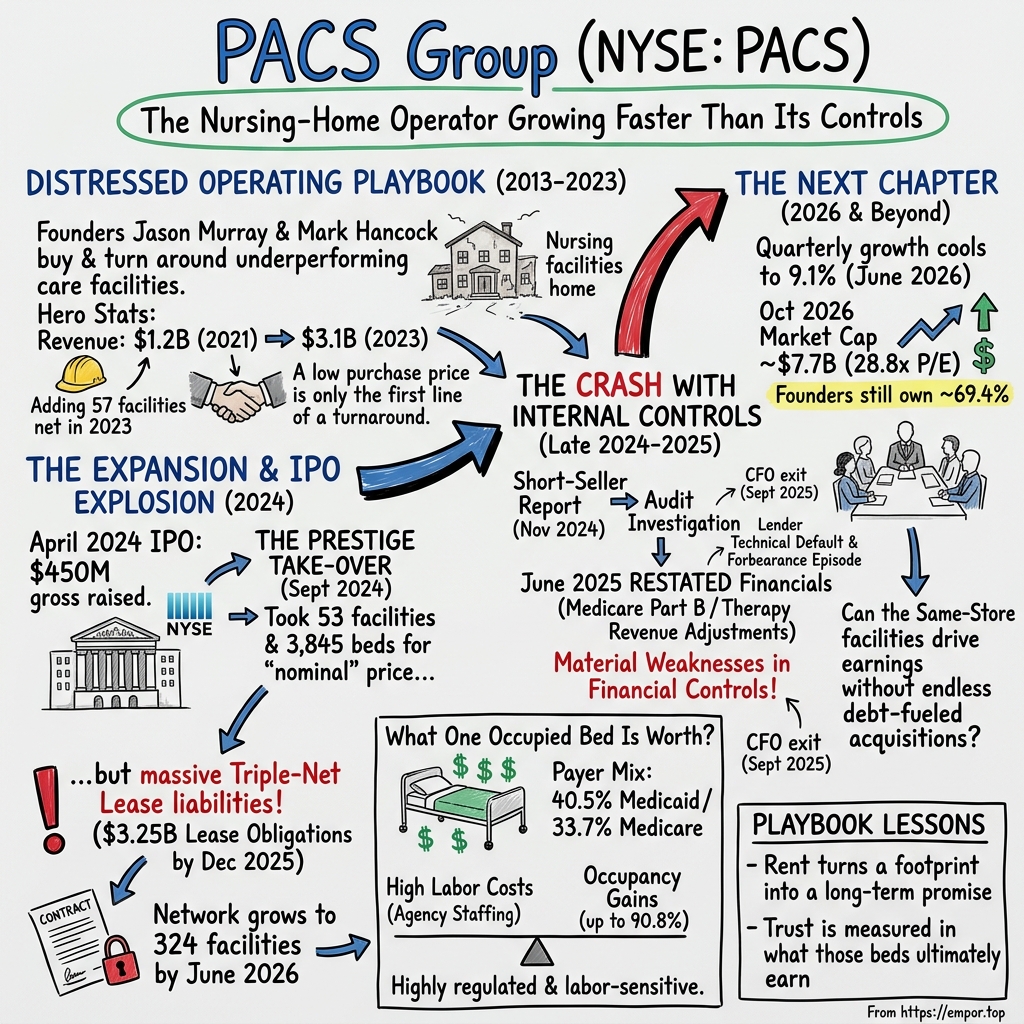
In April 2024, a company most Wall Street investors had never heard of priced its shares at $21 and began trading on the New York Stock Exchange under the ticker PACS.12 The offering raised $450 million before fees.1 The pitch was unusual for a public market that had spent a decade chasing software. PACS did not sell code or chips. It ran nursing homes: hundreds of them, across a widening map of states, filled with elderly patients recovering from hip replacements, strokes and infections, and with long-term residents who would never go home again.
The numbers that came with the pitch were what made people lean in. In 2021 PACS had booked about $1.2 billion of revenue.3 By the time of the listing it was compounding at close to 30% a year, a pace closer to a growth-stage technology company than to an industry better known for thin margins, staffing shortages and government reimbursement fights.3 By 2025 revenue reached $5.3 billion.4 Over the twelve months to June 2026 it was about $5.5 billion, earned across 324 facilities in 17 states, with roughly 48,000 employees caring for more than 31,900 patients on an average day.56
And yet the story that followed the IPO was not the clean compounding curve the prospectus had sketched. Within seven months of listing, a short seller had accused the company of gaming Medicare. Within fourteen months, PACS had told investors that two quarters of its 2024 financial statements could no longer be relied upon.7 Its lenders spent much of 2025 in forbearance. Its chief financial officer left after an internal investigation found he had accepted high-value gifts in breach of company policy.8 And when its auditor, Ernst & Young, signed off on the 2025 accounts, it gave a clean opinion on the financial statements while concluding, in the same report, that the company's internal control over financial reporting was not effective.4
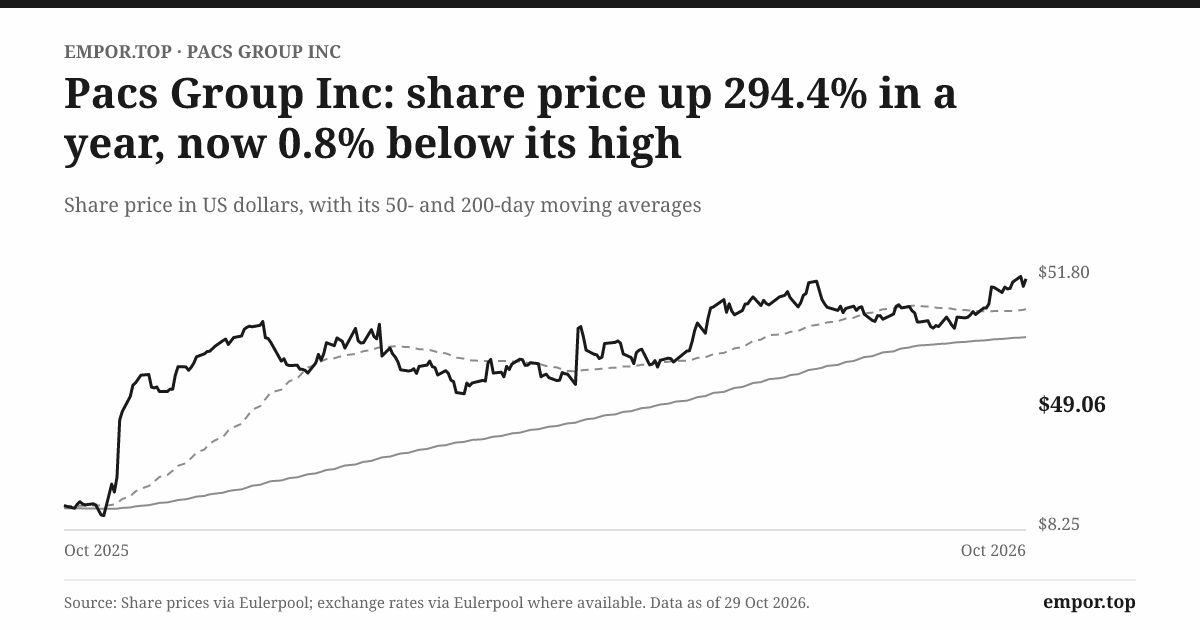
That is the improbable pairing at the heart of this story. On October 29, 2026, the market valued PACS at about $7.7 billion, with the shares less than 1% below their 52-week high and nearly five times their 52-week low. Investors were paying around 29 times trailing earnings for a company whose revenue base is real and large, whose operating results have been improving, and whose ability to measure that revenue has been formally judged deficient.
Four questions will drive the rest of this episode. The first is where the growth actually comes from: buying facilities, or making the facilities it already runs better. The second is whether the reported earnings can be trusted while the controls around revenue remain under repair. The third is what this lease-heavy model really earns once the rent on hundreds of buildings is paid. The fourth is how much protection minority shareholders have in a company whose two founders still own roughly 69% of the shares.9
Before going further, it helps to draw the boundary of what PACS actually is. PACS Group, Inc. is a Delaware holding company. It has no significant operating assets, employees or revenue of its own; those sit in a web of operating subsidiaries, each typically running a single facility, plus a central services arm called PACS Services that provides accounting, payroll, legal, technology and compliance support.43 There is no larger operating parent above it and no private-equity sponsor pulling strings from outside. The consolidated economics, good and bad, belong to PACS and its public shareholders, alongside the founders who control it.
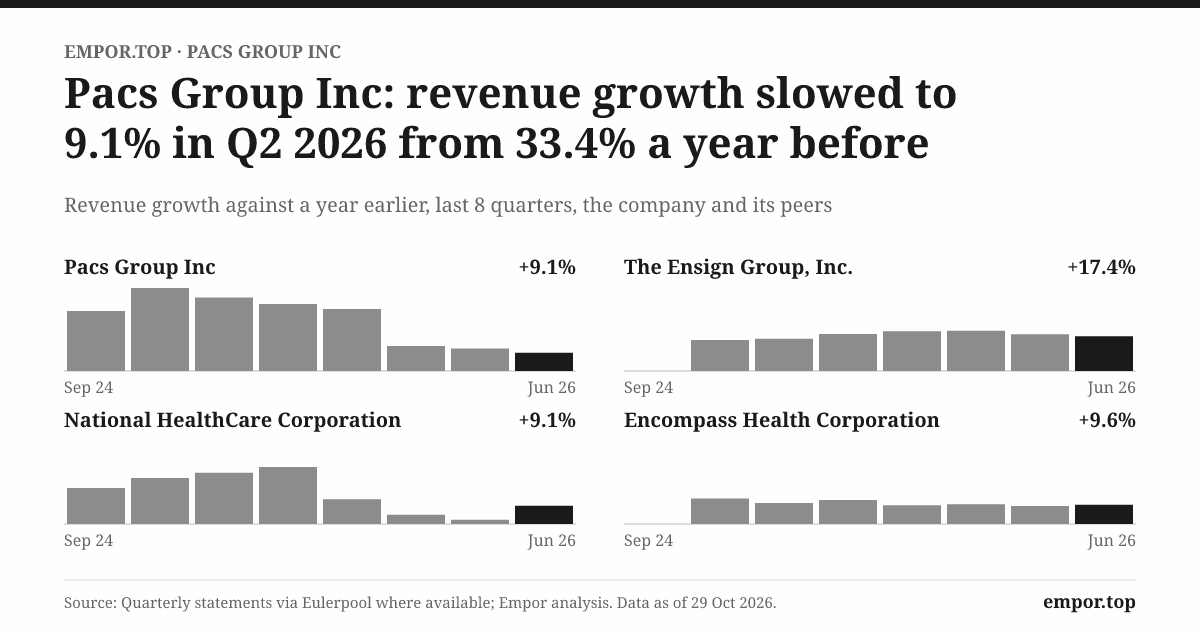
The gap that animates the investment case is visible in a single comparison. Over the three years to 2025, revenue grew about 30% a year.4 In the quarter ended June 2026, it grew 9.1%.10 Part of that slowdown is mechanical, because 2024 was a year in which PACS absorbed more than a hundred facilities and 2025 was a year of digestion. But it also means the story is shifting from one powered by acquisitions to one that must be powered by existing buildings getting fuller, sicker in the clinical sense that pays better, and more profitable.
Management argues that shift is already happening. Same-store revenue in skilled nursing rose 6.9% in the first half of 2026, and same-store occupancy climbed from 89.3% to 90.8%.5 Those are genuinely encouraging numbers. They are also a short record: PACS began publishing same-store figures only in the first quarter of 2026.11 The cleanest public-company history is barely two and a half years long, and much of it was spent restating, refiling and repairing.
So the $5.3 billion question is not whether PACS is big. It plainly is. The question is whether a fast-assembled network of care facilities can be turned into dependable earnings and cash, and whether the numbers describing that network deserve the same confidence as the beds themselves. To answer it, the story has to go back to the kind of buildings PACS chose to buy in the first place.
 Subscribe on LinkedIn
II. A Business Built by Taking Over the Hard Places
Long before PACS had a ticker, its two founders had both done one of the least glamorous jobs in American healthcare: running a nursing home. Jason Murray, who holds a bachelor's degree and a master's in healthcare administration from Weber State University, worked as a nursing home administrator at Plum Healthcare Group from 2009 to 2011.9 Mark Hancock took a more circuitous road. He studied civil engineering at Brigham Young University, earned an MBA there, spent seven years as a finance manager at Ford Motor Company and two more in corporate finance at Steel Technologies, and then, in 2009, became administrator of a facility affiliated with Plum.9
Their paths diverged briefly before they converged for good. Murray moved to Intermountain Healthcare, the large Utah hospital system, as an operations officer, and in 2012 served as interim chief executive of Park City Medical Center.9 Hancock went to Farm Credit Mid-America as vice president of finance and treasurer.9 Then, in January 2013, they started their own company with two facilities.12 Murray became chief executive. Hancock, the engineer-turned-finance-man, became chief financial officer, a job he held for more than a decade.9
The company they built was first incorporated in California as Providence Group, and its strategy was visible from the start.3 PACS would buy facilities other operators were struggling with, typically older skilled-nursing homes filled mostly with long-term custodial residents, and try to convert them into higher-acuity, short-stay rehabilitation centers that hospitals would trust with sicker patients.3 The bet was that a distressed facility is often not a bad building so much as a badly run one. Fix the leadership, rebuild the clinical routines, earn back the trust of the local hospital discharge planners, and the occupancy, the patient mix and the reimbursement can follow.
That bet rests on a particular organizational idea, which PACS calls "locally led, centrally supported." Each facility runs independently under its own administrator, whom the company describes as effectively the facility's chief executive.3 Above the administrators sit regional teams and PACS Services, which handle the back office and provide the systems, compliance framework and clinical resources.3 The model echoes a playbook that other post-acute operators have used, and it has an obvious appeal: healthcare referrals are intensely local, and a hospital case manager in Phoenix cares about whether a particular building will take a complex patient tonight, not about a corporate logo.
The model also needs a supply of administrators who think like owners. PACS built one through an administrator-in-training program. Since its founding, the company says, it has hired 261 trainees, of whom 203 remain in licensed administrator or other leadership roles, and it had 36 more in the pipeline in late 2025.12 Josh Jergensen, now President and Chief Operating Officer, embodies the path: he ran an affiliated facility, Balboa Nursing and Rehabilitation Center, from 2009 to 2014 before joining the operations leadership.9
PACS describes what happens after an acquisition as a three-stage life cycle. A newly acquired facility is "new" for its first 18 months, "ramping" from 18 to 36 months, and "mature" after that, and the company says it can take up to three years for a new facility to reach mature-level performance.3 The pre-IPO record showed why investors found this compelling. In 2023, PACS's mature facilities averaged 93% occupancy, against an industry average the company put at 76%.3 If you could buy a building at 70% occupancy and turn it into a 93% building over three years, the arithmetic of a fixed-cost business would do the rest.
Management's favorite illustration of the playbook comes from Colorado. In the third quarter of 2023, PACS acquired a facility that sat on the federal government's Special Focus Facility list, a designation reserved for nursing homes with persistent, serious quality problems, and which members of the local community described as possibly the worst skilled-nursing facility in the state.12 By the third quarter of 2024, the building had passed two consecutive health inspections, the threshold for graduating from the program; it formally left the list in March 2025 and later earned a four-star overall federal rating.12 PACS says five more facilities acquired while on the program's candidate list graduated during the first nine months of 2025.12 These are the company's chosen examples, and an operator will always tell its best stories. But they show the specific skill the founders set out to build: walking into a building other operators avoid and rebuilding it from the inspection report up.
The growth that followed was rapid. PACS ran 138 facilities at the end of 2021, 150 a year later and 203 at the end of 2023, with nearly 23,000 operational beds across nine states.3 Revenue climbed from about $1.2 billion in 2021 to about $3.1 billion in 2023.3 The jump in 2022 was especially sharp, more than doubling revenue, and that year produced the company's best operating margin in the public record, about 9.5%.3
How PACS controlled those buildings mattered as much as how many it had. At the end of 2023, it leased 165 of its facilities, owned 29 outright and held partial interests in 14 more through joint ventures.3 Leasing let a young company grow without raising the capital to buy real estate, which is a large part of why the network could expand so quickly. It also meant that nearly every acquisition came bundled with a long-term rent commitment, a trade-off that would become one of the defining features of the public company.
That 2022 peak deserves a pause, because it matters to everything that came later. In 2022, skilled patients made up about 41% of PACS's nursing patient days. In 2023 that share fell to about 32%, and skilled mix measured by revenue dropped from 64% to 55%.3 Skilled patients, typically covered by Medicare after a qualifying hospital stay, pay far more per day than long-term Medicaid residents. Pandemic-era federal rules had loosened the conditions under which patients could qualify for skilled coverage, and the short seller who later targeted PACS alleged that its use of those rules was central to its profits.2 PACS called the allegations misleading.2 What the record shows without any allegation is that the company's most profitable year coincided with an unusually rich patient mix that did not last.
The IPO arrived just as that mix had normalized. PACS received about $423 million in net proceeds in April 2024 and another $96.4 million from a follow-on offering that September, and it used most of the money to pay down its credit facility.4 In other words, the public market's first act was not to fund new buildings directly. It was to repair a balance sheet that had funded rapid expansion with borrowed money, which is why shareholders' equity jumped from under $100 million at the end of 2023 to about $710 million a year later.4
Which brings the story to the honest comparison of growth engines. Acquisitions built the footprint. The evidence that PACS can grow inside existing buildings is newer: the 6.9% first-half 2026 same-store revenue growth and the rise in same-store occupancy to 90.8% are real, but they arrive after the largest acquisition wave in the company's history and at a moment when many facilities bought in 2024 are moving from "new" to "ramping."5 Some of that improvement is the life cycle doing exactly what PACS says it does. Some of it may simply be the easy part of a turnaround.
The founders' playbook, and the local leaders it produced, are clearly central to how PACS grew. What the record supports so far is a demonstrated capability to acquire and stabilize difficult facilities, at scale, faster than most operators would dare. It does not yet support the stronger claim of a durable moat. To see why, the story has to step inside a single building and follow one occupied bed.
III. What One Occupied Bed Is Worth
Picture an 82-year-old woman discharged from a hospital in Sacramento three days after hip surgery. She cannot yet walk to the bathroom alone, she needs wound care and physical therapy twice a day, and her daughter lives two hours away. The hospital's case manager has a short list of skilled-nursing facilities that will take her today. One of them is a PACS building. From the moment she arrives, the economics of that bed begin to run, and almost none of the price is set by PACS.
Skilled-nursing revenue is generally earned per patient day.4 If she qualifies for Medicare's skilled-nursing benefit, the daily rate is set by a federal formula that reflects her diagnosis and care needs.4 If she stays on as a long-term resident after her rehabilitation ends and runs through her savings, Medicaid will likely pay, at a daily rate set by the state and subject to cost-report settlements and audits.4 If she is covered by a Medicare Advantage or other managed-care plan, the rate is whatever PACS negotiated with the insurer, and private payers pay contracted rates or discounted charges.4 In 2025, Medicare accounted for about 34% of PACS's routine revenue and Medicaid for about 41%, so roughly three of every four routine-revenue dollars came from government programs.4
It is tempting to call this recurring revenue, and in an operational sense it is: hospitals keep discharging patients, payers keep paying, and the same building fills the same beds year after year. But the contracts are short, a year or less, and patients have no obligation to stay.4 What recurs is the demand, not a contractual stream. Revenue in any period depends on how many people are admitted, how long they stay, how sick they are, and who pays for them. That makes a nursing home less like a subscription business and more like a hotel whose room rates are set by the government and whose guests need round-the-clock medical staff.
The economic chain runs in a straight line. Higher occupancy fills beds that are already staffed and already paying rent, so each additional patient carries a high incremental margin. A higher share of skilled patients raises revenue per day, because Medicare and managed-care rates for rehabilitation patients are well above Medicaid custodial rates. Against that, labor is the largest cost of providing services.4 PACS employed about 47,500 people at the end of 2025, roughly 27,700 of them clinicians.4 Wages, benefits, overtime and expensive agency nurses determine whether the extra revenue reaches operating profit, and PACS warns that reimbursement may not adjust quickly enough to keep pace with wage inflation.4
The company's own cohort data show the chain working. At the end of June 2026, PACS's 184 mature facilities ran at about 94% occupancy with a skilled mix near 32%, its 100 ramping facilities at about 88%, and its six new facilities at about 79%.6 On the call announcing third-quarter 2025 results, Jergensen gave the margin translation: new facilities typically earn around 2% to 3%, ramping facilities 6% to 8%, and mature facilities low double digits, sometimes reaching the low teens.12 Those are management's figures, given verbally, and PACS does not publish facility-level labor costs or margins in its filings. But they explain why the company is so focused on moving buildings along the curve: the same bed can be worth four or five times as much in operating profit once a facility is stable.
That curve also explains why reported growth slowed without anything breaking. Revenue grew more than 30% year over year through most of 2024 and 2025, because PACS was layering newly acquired facilities on top of the existing base.4 Once those deals were in the comparison period, growth fell back to about 12% in the December 2025 quarter and 9.1% by June 2026.10 The latest quarterly rate is less than a third of the three-year average. That is not a mystery or, by itself, a warning sign. It is the arithmetic of an acquirer that paused acquiring.
The question is what is left once the acquisitions are stripped out, and here the evidence is better than it was a year ago. Same-store growth and occupancy improved in the first half of 2026.5 One wrinkle matters. The first-quarter number was flattered by a supplemental payment under a California quality-incentive program that the state discontinued at the end of 2025; excluding it, same-store revenue grew about 6.1% in the first quarter, and it grew 5.8% in the second.116 So the underlying organic rate looks closer to 6% than 7%. That is a healthy number for a nursing-home portfolio, but it is a few quarters of data, not a cycle.
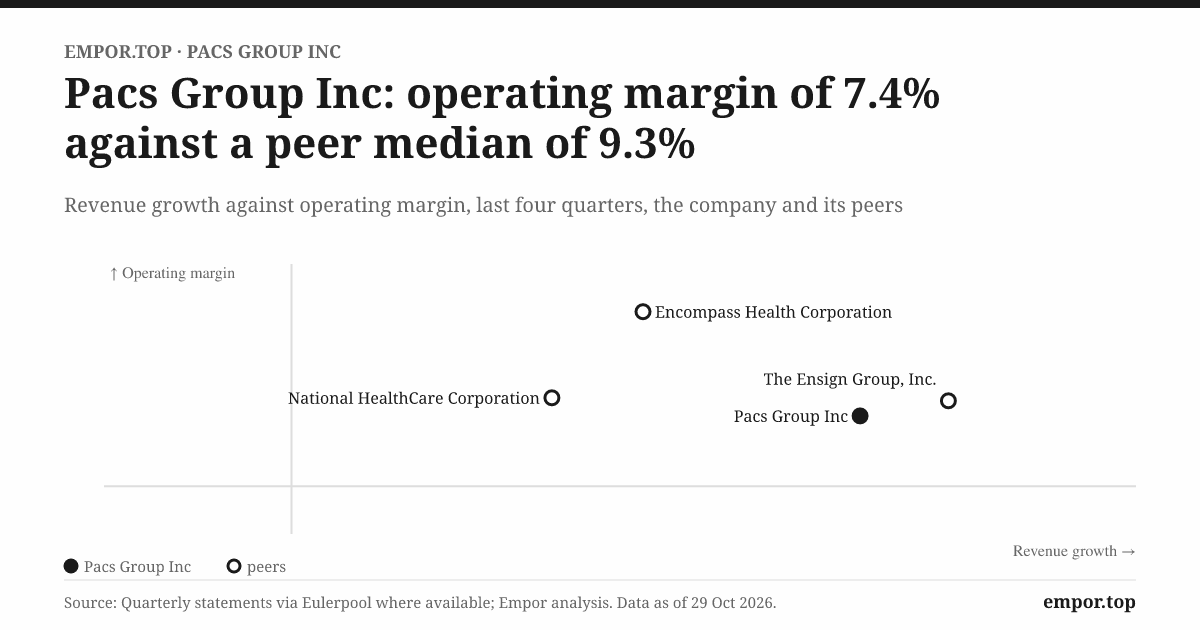
Meanwhile margins moved in the right direction. Operating margin, which had collapsed to about 3% in 2024 under the weight of integration costs and the restatement, recovered to about 6% for 2025 and reached about 7.7% in the June 2026 quarter.410 In that quarter, cost of services grew 6.7% while revenue grew 9.1%, which is exactly what operating leverage should look like in a fixed-cost building getting fuller.6 Jergensen added that contract labor as a share of revenue had fallen to its lowest level in two years.6 Some of the margin repair therefore comes from the labor market easing after the pandemic, a tailwind the whole industry has enjoyed and which PACS does not control.
To judge whether PACS is unusually good at this, it helps to place it in its industry. Skilled nursing in America is fragmented, with thousands of small operators. The most relevant public comparison is The Ensign Group, which operated 373 skilled-nursing and senior-living facilities at the end of 2025, against PACS's 321 at that date.134 Ensign is the operator whose decentralized, administrator-as-CEO model PACS most resembles, and it has a far longer public record of running it. Encompass Health and Select Medical, which PACS itself has used in its peer group, are useful post-acute reference points but run inpatient rehabilitation hospitals and specialty hospitals with very different care and payer mixes; they are not like-for-like comparisons.4
The structure of the industry explains why margins are thin for nearly everyone. The most powerful party in the room is the payer. Medicare and the states set most of PACS's prices, revise them on their own timetables and audit after the fact, and PACS has no ability to walk away from three-quarters of its revenue. Patients and the hospital discharge planners who steer them can choose among several local providers, so a building that slips on quality loses admissions. Nurses and aides can work for the facility across the street or for a hospital, which makes labor a second powerful supplier. New entrants face real barriers, including state licensing, certificate-of-need rules in some markets, and the operational know-how to survive inspections, but those barriers protect incumbents as a group rather than any single operator. The substitute threat is growing too, as insurers push some recovering patients toward home health instead of institutional care.
Against that backdrop, PACS points to quality as its edge. At the end of June 2026, 239 of its skilled-nursing facilities with reported ratings, about 84%, held four or five stars on the federal government's quality-measure ratings, and its mature facilities averaged 4.5 stars against an industry average of 3.7.6 Murray argued on the second-quarter call that quality thresholds determine which operators managed-care plans will contract with, and that density in a market strengthens the negotiating hand.6 It is a coherent mechanism. But the quality-measure rating is only one component of the federal star system, which also weighs inspection results and staffing, and quality that is self-reported through clinical assessments is precisely the kind of data that depends on strong controls.
State policy is the other lever PACS pulls, and it cuts both ways. On the third-quarter 2025 call, Jergensen explained that the company deliberately targets states whose Medicaid programs reward quality or pay more for sicker patients through case-mix adjustments, naming programs in states such as Oregon, Washington, California, Texas, Kentucky and Ohio.12 On the second-quarter 2026 call he said Medicaid rates had risen about 3% in the quarter and that PACS lobbies state officials on the argument that nursing homes are the lowest-cost institutional setting for care.6 That is a rational way to find rate growth in a government-priced business. It also means PACS's revenue depends on the budgets and political choices of a handful of states. California's quality-incentive program, which helped first-quarter 2026 revenue, was discontinued at the end of 2025, and PACS and other operators are lobbying for a successor.11 When a business model is built around state reward programs, the end of one program is not a footnote; it is a reminder of who sets the terms.
So the moat verdict, stated once and carried forward: PACS's scale, operating know-how and willingness to take on troubled facilities may help it compete for deals and for referrals. But the filings do not establish switching costs, superior labor economics, pricing power or a durable margin advantage over peers. Patients do not stay because leaving is expensive. Payers do not pay PACS more because it is PACS. The operating scorecard that would turn a plausible edge into a proven one is short: same-store occupancy and revenue growth sustained over several years, facility-level labor cost and margin if PACS ever discloses them, and a clear split between growth from new facilities and growth from mature ones.
And that last item points to the other half of the model. If mature buildings are where the profit lives, the company has to keep buying new ones to feed the curve. The largest purchase it ever made came with a remarkable price tag: almost nothing.
IV. The Facilities That Came With a Price Tag and a Lease
In the late summer of 2024, while PACS's shares were still rising from their IPO price, the company was quietly finishing the biggest transaction in its history. Prestige Care was handing over the operations of 53 facilities: 32 skilled-nursing homes and 21 assisted-living and independent-living communities.14 The deal added 2,511 skilled-nursing beds and 1,334 assisted-living beds, and when PACS finalized the operations transfer in September 2024, it did so for nominal consideration.14
Nominal consideration sounds like a steal. More than 3,800 beds for essentially nothing is the kind of headline that makes an acquirer look like a genius. But in this business, the purchase price of an operation is often the least important number. What PACS took on was not primarily a set of assets but a set of obligations: long-term leases on buildings owned by someone else, thousands of employees, regulatory histories at each site, and the hard work of bringing facilities in new states up to the standards the company claimed for its mature portfolio.14 The Prestige deal alone took PACS into five new markets.12
Prestige was the centerpiece of a year unlike any other. PACS completed 106 facility acquisitions in 2024, 94 of them in the second half.12 On the third-quarter 2025 call, Hancock called that more than four times the company's historical annual average, which management had long framed as roughly 20 facilities a year.12 The second-half deals alone added more than 7,400 skilled-nursing beds and more than 1,300 assisted-living units.12 For context, that is a third of the portfolio arriving in about six months.
What did all that buying actually deliver in its first year? The filings give one clean answer. Facilities acquired in 2024 contributed $180.9 million of revenue and $5.7 million of pretax income for the portion of the year PACS owned them.4 That is a pretax margin of about 3%, which lines up almost exactly with what management says new facilities earn. It is evidence that the life cycle starts where PACS says it starts. It is not evidence of a stabilized return, because the filing gives no full-year, mature-state figure for those buildings, and many of them were still in the "new" or "ramping" stage well into 2026.
Cash tells a similar story. PACS spent about $284 million on expansion in 2024, including real-estate purchases, and about $144 million in 2025, a year that included the operations of eight facilities and seven property acquisitions.4 Capital expenditure on existing buildings rose from about $67 million in 2024 to about $105 million in 2025.4 Over the five years through 2025, operating cash flow less capital expenditure added up to about $621 million, and the company paid no dividends at all.4 Every spare dollar went back into the network or toward reducing debt.
Is that good capital allocation? The honest answer is that the company does not publish what an outside investor would need to know. PACS does not disclose a consistent purchase-price-to-earnings multiple for its deals, and its transactions mix three very different things: buying the operations of a facility, buying the real estate under a facility, and signing or assuming a long-term lease. A deal for nominal consideration with a heavy lease can be more expensive, in economic terms, than a deal with a large check and no rent. Public deal data in skilled nursing do not establish a reliable comparable multiple either. So any claim that PACS bought cheaply, or that it overpaid, would be guesswork.
Returns on capital offer a partial scorecard. Return on invested capital, as calculated from reported operating profit, was about 8.7% in 2022, fell to about 1.7% in 2024 as integration and restatement costs piled up, recovered to about 5.0% in 2025, and stood near 6.9% over the twelve months to June 2026.4 The trend is improving. The level is not yet high for a business that also carries billions in lease obligations not fully reflected in that invested capital.
Two strategic shifts since 2025 change the shape of the bet. The first is real estate. PACS has been exercising purchase options to buy the buildings it operates, spending about $191 million on real estate in the first half of 2026 alone, and by the second-quarter call it owned the property under 64 of its operated facilities.6 Owning the building eliminates the landlord's margin and the risk of a hostile lease renewal, but it consumes cash that could have bought more operations, and it turns PACS partly into a property company.
The second shift is the return to large-scale buying. In mid-2026 PACS agreed to acquire the operations of 34 skilled-nursing facilities from Eduro Healthcare, with 3,633 beds across Texas, Montana, South Dakota, North Dakota, New Mexico and Utah, and it closed on the first 20 Texas facilities on August 1, with the remainder then expected to close in the third and fourth quarters.6 Jergensen's description of the Texas buildings was telling: they ran at roughly mid-60s occupancy with a skilled mix of about 10% to 11%, well below PACS's portfolio averages.6 They are, in other words, classic PACS targets, which means classic PACS risk: they will dilute margins first and, if the model works, improve them later.
There is an uncomfortable symmetry in this. The pause in acquisitions during 2025 is part of why same-store numbers look good in 2026, since management attention went to integrating the 2024 wave. The Eduro deal and the promise on the second-quarter call to announce and close more facilities before year-end mean that pause is ending.6 The new cohort will pull down consolidated margins and occupancy just as investors were learning to read the business through a cleaner lens.
The acquisition thesis therefore remains conditional. Prestige showed that PACS can absorb an enormous amount of capacity quickly; its first-year contribution showed that absorbing it is not the same as earning on it. What would confirm the thesis is visible over the next two years: whether the 2024 cohort reaches mature-level occupancy and margins, whether returns on capital climb meaningfully above the mid-single digits, and whether the Eduro buildings follow the same curve. And all of that depends on being able to trust the numbers PACS reports about those facilities, which, in November 2024, suddenly became the central question.
V. The 2024 Numbers That Had to Be Restated
On Friday, November 1, 2024, PACS shares closed at a record $42.94, more than double their IPO price.2 Days later, Hindenburg Research published a short report alleging, among other things, that the company had misused a pandemic-era Medicare waiver to inflate skilled-nursing revenue, and claiming the practice accounted for more than all of PACS's operating and net income from 2020 to 2023.2 By midday Wednesday the stock had fallen to $17.18.2 That day, PACS delayed its third-quarter earnings release, published only preliminary results, disclosed that it had received requests from the federal government and said its independent Audit Committee, assisted by outside counsel, was investigating.2 Murray called the allegations misleading.2
It is worth being precise about what happened next, because the record and the allegations are not the same thing. The short seller's claims were allegations. What the company later confirmed through its own filings was narrower, but still serious. On June 16, 2025, PACS announced that its financial statements for the first and second quarters of 2024 should no longer be relied upon.7 Revenue from respiratory services and certain other therapies billed under Medicare Part B, the outpatient side of Medicare, should not have been recognized when it was.714 The company's preliminary estimate was that revenue had been overstated by about $15 million to $17 million in the first quarter and $46 million to $48 million in the second, roughly $61 million to $65 million in total.7
The mechanics matter for understanding what kind of problem this was. PACS said it received information after filing its second-quarter 2024 report that certain ancillary therapies, including respiratory services, might not be eligible for Part B reimbursement.14 Under the revenue accounting standard, a company may only book revenue it expects to keep. If there is meaningful doubt that Medicare will ultimately pay for a service, the expected amount, which accountants call variable consideration, has to be reduced. PACS had booked the revenue; on reconsideration it concluded it should not have. That is an accounting judgment about uncertain government payment, not, on the company's account, fabricated activity.
The process of getting there was long and costly. PACS missed its filing deadlines for the third quarter of 2024, the full year 2024 and the first quarter of 2025, and the New York Stock Exchange granted it an extension to September 2, 2025, to become current.7 In June 2025 the company said the Audit Committee had found no basis to question the integrity of the CEO, the Executive Vice Chairman, the CFO or the chief accounting officer.7 Less than three months later, the CFO was gone, after the same committee concluded he had accepted high-value items from people associated with entities the company did business with.814 The investigation, when it ended, reported that it had not identified additional material financial misstatements or irregularities beyond the restatement, while finding other conduct inconsistent with the company's code of ethics, for which the board took remedial action.14
On November 19, 2025, PACS filed its long-delayed 2024 annual report and became current with the SEC.12 On the call that day, Murray told investors that with the restatement completed, "our internal controls" had been "strengthened in the process," and that PACS was operating "from a position of strength, transparency and discipline."12 The 2024 annual report itself identified two material weaknesses: a control environment that failed to identify, assess and escalate risks, including compliance concerns raised through the company's hotline, and a revenue process without adequate controls for recognizing revenue on new services.14
Three months later came the test of that confidence. The 2025 annual report, filed in February 2026, carried an unqualified opinion from EY on the financial statements, meaning the auditor concluded they were fairly presented in all material respects.4 But EY's separate audit of internal control reached the opposite verdict: PACS had not maintained effective internal control over financial reporting at December 31, 2025.4 The weaknesses now included controls over revenue recognition and over the completeness and accuracy of the data used to calculate routine revenue and variable consideration.4 In plain terms, the systems that count patient days, apply the right rates and estimate how much the government will finally pay were still not reliable enough to prevent or detect a material error.
That distinction is easy to miss and important to grasp. A clean opinion on the statements says the numbers, after the auditor's own extensive testing, were right this time. An adverse opinion on controls says the company's own machinery for producing those numbers could not be relied upon to get them right on its own. For a company whose revenue arrives as millions of individual patient days billed to dozens of payers under shifting rules, the second opinion matters a great deal.
None of this means PACS's growth was illusory. After the restatement the company still reported about $4.1 billion of revenue for 2024, up about 31%, and about $5.3 billion for 2025.4 The overstatement, at roughly $60 million across two quarters, was material to profit but small relative to the revenue base. The more durable lesson is that the business grew faster than the systems built to measure it.
Cash offers a partial cross-check, and it is broadly reassuring, with caveats. Over 2021 through 2025, PACS generated about $983 million of operating cash flow against about $555 million of net profit, so cash came in at roughly 1.8 times reported earnings.4 Revenue that is real tends to turn into cash eventually. But the annual pattern shows how much the result depends on accruals. In 2024, a $94 million build-up in receivables was offset by a roughly $146 million increase in refund liabilities, money PACS expected it might have to pay back; in 2025, large movements in refund liabilities and a rise of about $81 million in accrued self-insurance liabilities again shaped the result.4 Non-cash charges such as depreciation, stock compensation and non-cash lease expense also widen the gap.4 Cash conversion has been strong over five years, but it is not a clean bill of health for any single year.
Collections tell a cleaner story. Receivables equaled about 70 days of revenue at the end of 2023 and about 48 days at the end of 2025, a substantial improvement.4 PACS does not publish an ageing schedule or a quantified history of overdue balances, but it does say who owes it money: Medicare and Medicaid were the only significant receivable concentrations, accounting for about 23% and 28% of receivables at June 2026.5 The allowance for credit losses was immaterial.4 That tells you where the real collection risk sits. The danger is not that a customer goes bankrupt. It is that a government payer audits, disputes or recoups money PACS has already booked, which is exactly the kind of risk the refund liability and the restatement were about.
The live calls trace the arc of management's narrative. In November 2025, the message was that controls had been strengthened. By the first-quarter 2026 call in May, after the adverse control opinion, the new CFO's remarks described remediation as "ongoing," with "substantial progress" expected during the year.11 By the second-quarter call in August, Carey Hendrickson said PACS expected to have the weaknesses remediated by the end of 2026.6 The direction is consistent; the timeline has moved from implied to explicit.
There is one useful test of management's promises that does not depend on the controls. On the November 2025 call, PACS guided to 2025 revenue of $5.25 billion to $5.35 billion and adjusted EBITDA of $480 million to $490 million.12 Revenue came in at about $5.3 billion, near the midpoint.4 The 2026 adjusted EBITDA guidance, which management described as a 29% increase over 2025 at its midpoint, implies that 2025 adjusted EBITDA landed a little above $500 million, ahead of the range.6 For a team that had just spent a year restating, delivering on its first guidance after refiling was a meaningful, if early, credibility deposit. At the same time, PACS introduced two new non-GAAP measures in August 2026, adjusted net income and adjusted earnings per share, describing them as widely used by peers.6 Each new adjusted metric widens the distance between the numbers management emphasizes and the audited figures, which is exactly the gap a company with ineffective revenue controls should be trying to close. On the August call, analysts spent their questions on guidance, Medicaid and managed-care rates, labor, the Eduro deal, cohort trends and artificial intelligence; none of them asked about the control remediation.6
The confirming evidence is therefore specific and checkable. It is an auditor's conclusion, not management's, that the revenue controls are effective; filings that arrive on time; no further restatements; and stable trends in receivables and refund liabilities. The 2026 annual report, due in early 2027, will be the first chance to see all four together. Until then, investors are pricing the numbers as if the repairs are already done.
And while the accounting questions dominated the headlines, a different kind of pressure was building in the background: the lenders, and the rent.
VI. The Rent Behind the Revenue
Read PACS's income statement and you see an operating company: patient revenue at the top, nurses and supplies and administration in the middle, a modest interest line near the bottom. Read its balance sheet and a different creature appears. At the end of 2025, alongside about $350 million of funded debt, PACS carried about $3.25 billion of lease liabilities, the present value of the rent it had promised to pay on buildings it does not own.4 For every dollar the company had borrowed from banks, it owed roughly nine dollars to landlords.
The financing stack is simple to describe. At December 31, 2025, PACS had $100 million drawn on a $600 million secured revolving credit facility and about $249 million of long-term debt and current maturities.4 Cash was about $197 million.4 The lease liabilities split into about $3.09 billion of operating leases and about $156 million of finance leases.4 By June 30, 2026, the revolver had been repaid in full, cash stood at about $165 million, and available liquidity, counting the undrawn line, was about $757 million.56 Management describes its net leverage as 0.1 times adjusted EBITDA.6 That measure leaves the leases out.
Those leases are mostly triple-net, which is real-estate shorthand for an arrangement in which the tenant pays not just the rent but also the property taxes, insurance, repairs, utilities and upkeep.4 A triple-net lease is close to ownership in its burdens without being ownership in its rewards. If a roof fails or a boiler dies, PACS pays. If the facility's earnings fall, the rent does not. PACS's remaining operating leases averaged about 13 years, and its finance leases about 19.12 Contractual lease payments for 2026 alone came to about $381 million.4 The credit facility, by comparison, does not mature until December 2028.5
One way to feel the weight of that rent is to compare two of management's own profit measures. In the June 2026 quarter, adjusted EBITDAR, earnings before rent, was about $262 million; adjusted EBITDA, after rent, was about $167 million.6 Rent consumed roughly $95 million in a single quarter, more than a third of the facilities' pre-rent earnings. A lender looking only at funded debt sees a nearly unlevered company. A landlord sees a tenant whose rent bill is roughly equal to its entire annual operating cash flow. Put the lease liabilities and the debt together against annualized pre-rent earnings and the obligations come to a little over three years of EBITDAR, a meaningful burden in a business where profit margins are measured in single digits.
There is a further subtlety in how the rent is counted. Under lease accounting, PACS records rent on a straight-line basis, averaging escalating payments over the life of each lease. In the June 2026 quarter, that accrual was about $10 million higher than the cash actually paid.6 So the adjusted EBITDA figure management highlights is, in that respect, conservative relative to current cash rent. But it also means today's cash rent is lower than the average PACS will pay later as escalators kick in.
The lender episode of 2025 showed how quickly reporting problems can travel through a capital structure. While PACS was delinquent with its filings, it entered into multiple forbearance agreements with its lenders over technical defaults involving the accuracy of representations, defaults under leases, the designation of subsidiaries, requirements for subsidiaries to join the credit agreement, and cash-management provisions.4 Forbearance means the lenders agreed, temporarily, not to exercise remedies they had the right to use. A waiver in November 2025 resolved the listed defaults, and by June 2026 PACS reported that it was in compliance with its covenants and had nothing drawn on its line.45 None of the defaults was about running out of money. They were about paperwork and structure. But that is exactly the point: in a company whose credit agreements are tied to hundreds of facility leases and subsidiaries, a control failure in one corner can become a lender problem in another.
Free cash flow needs to be read with the same care. The roughly $621 million that PACS generated from 2021 through 2025, after capital expenditure, is a real number.4 Because operating leases run through operating expenses, ordinary rent is already deducted before operating cash flow is counted. But that figure does not include the cost of buying new operations, purchasing real estate, or, crucially, the fact that the rent obligation continues regardless of performance. In 2025, PACS generated about $404 million of operating cash, spent about $105 million on capital expenditure and about $144 million on acquisitions.4 What was left after growth was positive, but not by a wide margin.
And the quality of that operating cash flow depends partly on accruals. In 2025, the cash result was shaped by large movements in refund liabilities and an increase of about $81 million in accrued self-insurance liabilities.4 Self-insurance accruals are the money PACS sets aside for future malpractice and workers' compensation claims; when they rise faster than claims are paid, cash flow looks better today and the bill arrives later. PACS also held about $135 million in an insurance subsidiary at June 2026, mostly in investment-grade bond funds, to back those liabilities.5 Sustainable cash earnings are what remains after these timing effects wash out, and it will take more years of data to know exactly how large they are.
PACS's capital allocation has started to reflect its stronger liquidity. In early 2026 the board approved a $250 million share repurchase authorization.11 The company has continued buying real estate and returned to large acquisitions. Each of those uses of cash makes sense on its own. Together they test whether a company that was in forbearance less than a year ago is moving too fast to spend the cushion it just rebuilt.
The right monitoring lens for PACS's financial strength is therefore not the one management emphasizes. Net leverage excluding leases is low, but the more revealing measures are operating cash flow after rent, maintenance capital expenditure and acquisitions; leverage adjusted for leases; continued covenant compliance; and the maturity profile of both the credit line and the lease book. On those measures PACS looks adequately financed, not overwhelmingly so. And the people who decide how that cushion gets spent are, overwhelmingly, the two men who started the company.
VII. The Founders Still Own the Room
The 2026 proxy statement, filed in April, lays out a picture of control that would be unusual at most large American companies. As of April 15, 2026, Jason Murray beneficially owned about 34.8% of PACS and Mark Hancock about 34.6%.9 The only other holder above 5% was a group of funds affiliated with Cohen & Steers, at about 6.1%.9 Together the founders owned roughly 69.4%, modestly below the 70.4% of voting power they held a year earlier.914 In practice, no shareholder vote at PACS can succeed without them.
That control is formalized. PACS is a "controlled company" under New York Stock Exchange rules and has chosen to use the exemptions from certain governance requirements that status allows, while still meeting the exchange's audit committee rules.9 Under a stockholders agreement, each founder can designate up to two director nominees while he owns at least 20% of the shares.9 The board has six members; four are classified as independent, including Patrick Conway, Evelyn Dilsaver, Taylor Leavitt and Jacqueline Millard.9 Murray serves as Chairman and CEO. Hancock, who stepped back from the CFO role in January 2024 to become Executive Vice Chairman, returned as interim CFO from September 2025 until April 2026, when the company hired Carey Hendrickson, previously CFO of U.S. Physical Therapy and, before that, of Capital Senior Living.9
The bull reading of this structure is straightforward. The founders built the company from two facilities, own more than two-thirds of it, and stand to gain or lose more from its long-term value than any outside investor. On the call in November 2025, Hancock called PACS "our life's work."12 Founders with that much skin in the game tend to resist short-term financial engineering and to think in decades. Nursing-home turnarounds take years; owners who will not be fired over a bad quarter can afford to wait.
The bear reading starts with pay. Murray's total reported compensation was about $5.1 million in 2023 and $4.4 million in 2024, then jumped to about $17.1 million in 2025; Hancock's rose to about $15.3 million.9 Each founder's 2025 package included a $7.3 million performance bonus, stock awards and a one-time continuity and retention bonus of about $0.9 million.9 The bonus program tied payments to adjusted EBITDA and quality measures.9 The year before, Jergensen's total compensation had been about $68.9 million, almost entirely from $63.1 million of stock awards.9
The timing is what draws attention. The 2025 increase coincided with the recovery from the 2024 profit trough, a trough deepened by the restatement and the investigation. Adjusted EBITDA is a natural metric for a company that buys facilities and wants to reward operating progress, but it excludes several of the costs that matter most to PACS shareholders: the investigation and restatement expenses, stock compensation itself, and, in EBITDAR's case, rent. A skeptical investor would want to know what evidence shows these bonuses rewarded durable, audited facility economics rather than the mechanical rebound of an acquisition-heavy portfolio moving along its maturity curve. The proxy describes the metrics; it does not answer that question. Retention bonuses paid to founders who own a third of the company each are also hard to explain on retention grounds.
The CFO episode belongs in this frame, kept in proportion. Derick Apt's resignation followed a personal policy breach, not a finding of financial fraud; the investigation reported no further material misstatements.814 But it came three months after the company had publicly said the committee had found no basis to question the CFO's integrity, and it left the founders' long-time partner in finance back in the chair during the most sensitive stretch of the company's public life.7
Shareholders voiced measured dissent. At the June 2026 annual meeting, say-on-pay passed with about 132 million votes for and 14 million against.15 Roughly 9.6% of the votes cast opposed the pay package. Given that the founders' own shares make up the majority of any vote, that against-tally represents a much larger share of the outside vote: on rough arithmetic, and assuming the founders voted their shares in favor, more than a third of the votes cast by other shareholders. It is a visible signal, though not a revolt.
Related-party dealings, by contrast, are small in dollars. The one quantified service arrangement, a consulting agreement with Helios Consulting, a firm owned by Murray and Hancock, cost PACS $4,000 in 2023 and nothing in 2024 or 2025, and it was terminated at the end of 2024.4 That is immaterial. The more consequential relationships run through real estate: PACS holds a 50% interest in a partnership called BRFS that owns the buildings housing three facilities PACS leases, and the founders have personally guaranteed certain leases.54 PACS does not quantify the rent paid to such partnerships or provide a broader analysis of how related-party terms compare with market rates. In a company where rent is the largest fixed commitment and the founders control the board, that is the disclosure a minority shareholder would most like to see expanded.
The management record, weighed honestly, cuts both ways. The founders' ownership and their record of building a 300-plus facility network from two buildings are real evidence of commitment and operating skill. The restatement, the ineffective controls, the CFO's misconduct and the voting dissent are real evidence that oversight lagged the ambition. The founders' control means the board's four independent directors carry an outsized burden: they are the main check on decisions about pay, related-party leases and acquisitions in a company where the controlling shareholders also run it. Until remediation is confirmed by the auditor, confidence in that check rests more on promise than on proof. Which is precisely why the stock's price on October 29, 2026, deserves a hard look.
VIII. Analysis & Bear vs. Bull Case
On October 29, 2026, PACS shares closed at about $49, within 1% of their 52-week high and almost five times their 52-week low of about $10.58. A year earlier, the company was still delinquent on its filings, operating under lender forbearance and without a permanent CFO. Since then, it has refiled its past results, posted margin improvement, published same-store numbers and raised its 2026 guidance to revenue of $5.75 billion to $5.85 billion and adjusted EBITDA of $640 million to $660 million.6 The market has rewarded all of it.
At that price, PACS traded at about 28.8 times trailing earnings, against a reported five-year median of about 25.1 times. Treat that median as a clue, not a benchmark. PACS has been public only since April 2024, so a five-year history necessarily reaches into pre-listing periods or provider estimates, and the "median" includes the collapse that followed the short report. Other measures fill in the picture: enterprise value of about $10.8 billion, about 22 times EBITDA and about 2 times sales, and a free-cash-flow yield of about 4.1%. One caution on the enterprise-value figures: the roughly $3 billion gap between market value and enterprise value is consistent with the lease liabilities being counted as debt, while the EBITDA used in the ratio is struck after rent, which makes the multiple look higher than a like-for-like comparison would. On earnings, the market is paying a premium to the company's own short history for growth that has slowed to single digits at the top line, which only makes sense if investors believe margins and same-store growth will keep doing the heavy lifting.
The bull case has genuine operating evidence behind it. Same-store occupancy rose 150 basis points in the first half of 2026 and same-store revenue grew about 6% to 7% depending on whether one includes California's final quality payments.56 The cohort curve appears to be working: ramping facilities improved notably in the second quarter, and 106 facilities remained in the new and ramping stages, implying further margin upside if they mature as earlier cohorts did.6 PACS has shown it can absorb and operate a very large network, adding a third of its portfolio in six months and keeping occupancy high through the turmoil.12 Cash generation has exceeded reported profit over five years. The balance sheet, excluding leases, is nearly debt-free, and the company now owns the real estate under 64 facilities.6 Demographics help: management cites projections that nearly a fifth of Americans will be 65 or older by 2030.12
The most vivid bull evidence came on the second-quarter 2026 call. Murray described a large California facility, dedicated to behavioral-health patients and including a secured unit, that PACS had acquired while it was already a Special Focus Facility.6 In March 2025 the facility received written notice of potential termination of its Medicare and Medi-Cal agreements, and federal regulators at one point stated in writing their intent to decertify it, which would have displaced more than 250 residents and put more than 500 jobs at risk.6 On June 29, 2026, it graduated from the program.6 A bull would say no operator without a real turnaround capability pulls that off. A skeptic would note that a facility under threat of decertification more than a year after PACS took it over is also evidence of how long and uncertain these turnarounds can be, and of the regulatory risk that comes with buying the hardest buildings.
The bear case is rooted in the same economics. About 74% of routine revenue comes from Medicare and Medicaid, payers that set prices unilaterally, audit after the fact and can claw money back.4 Labor is the largest cost, and PACS itself warns that reimbursement may not adjust promptly to wage inflation.4 The leases make the network's fixed commitments large and long-dated; a reimbursement cut or labor shock would hit a business with rent of roughly $380 million a year that does not flex.4 Growth from here leans on acquisitions again, and new cohorts start at margins of 2% to 3%.12 And the controls that measure revenue have been formally judged ineffective, at a company whose revenue is the sum of millions of government-billed patient days.
Run the strategic frameworks through those facts and the picture sharpens. Of the seven sources of durable advantage Hamilton Helmer describes, PACS can credibly claim at most two in partial form. Scale economies exist in back-office services, compliance and purchasing, but they are modest in a business where nearly all costs sit at the facility level and Ensign operates at comparable scale.13 Process power, the embedded organizational know-how that is hard to copy, is PACS's strongest claim: its turnaround routines, administrator training and cohort discipline. But the evidence for it is management's own cohort data over a short period, and Ensign has run a similar decentralized model for far longer. Network effects are absent. Switching costs are weak, since patients and referral sources choose case by case. There is no counter-positioning against an incumbent, no cornered resource such as a patent or exclusive license, and brand matters locally, building by building, more than nationally. A local density effect, in which multiple facilities in a market strengthen payer negotiations, is plausible and management cites it, but PACS publishes no data that proves it.6
Porter's forces, already sketched in the walk through a single bed, point the same way: powerful government buyers, a scarce labor supply, low patient switching costs, regulatory barriers that protect the industry rather than any one firm, and a slow-growing substitute in home health. That is a structure in which operators earn thin margins and the best ones earn modestly less thin margins. PACS's claimed edge, operating excellence in difficult facilities, is the right kind of edge for this structure. The question is whether it is durable, and the honest answer is that occupancy near 91% and growing same-store revenue support operational momentum, while the absence of peer-relative unit economics, multi-year same-store history and facility-level labor data leaves superiority unproven. The history neither rejects nor confirms the claim. It narrows it to this: PACS is very good at filling and stabilizing troubled buildings, and has yet to prove it can earn superior returns on them after rent.
The legal and regulatory overhangs belong in this ledger at their actual size. PACS disclosed two Department of Justice investigations: one into alleged improper referral inducements and possible False Claims Act violations at its Providence and Paradise Valley facilities, and another into Medicare billing at California skilled-nursing facilities under the patient-driven payment model.4 As of its 2025 annual report, the government had not asserted claims and the company was cooperating.4 Separately, securities class actions and derivative suits relate to the company's past financial statements and disclosures.5 On the second-quarter call, Murray said the investigations were progressing "through the normal course" and that he could not estimate the timing of resolution.6 These matters could produce repayments, penalties or settlement costs; none has been quantified.
An activist looking at PACS would likely push on four points. First, disclosure: publish facility-level or cohort-level margins and labor costs in filings, not just on calls, so that the turnaround thesis can be tested. Second, governance: tie executive bonuses to GAAP or cash-based measures after rent, and explain related-party real-estate terms. Third, capital allocation: justify the simultaneous pursuit of buybacks, real-estate purchases and large acquisitions with return targets. Fourth, accountability: link remediation of the material weaknesses to compensation.
Three measures matter most for tracking whether the bull or bear case is winning. The first is same-store occupancy and revenue growth, which most recently stood at about 90.6% occupancy, up 150 basis points, and 5.8% revenue growth in the June 2026 quarter.6 The second is operating margin and cash flow after rent and maintenance capital expenditure, with GAAP operating margin at about 7.7% in the latest quarter and rising.10 The third is the contribution of acquired facilities as they mature, which began at about 3% pretax for the 2024 cohort.4
The events that would change the thesis are equally clear. Auditor-confirmed remediation of the revenue controls would remove the single largest discount on the reported numbers. A multiyear same-store record would turn a promising trend into evidence. Stable collections and refund liabilities would show that booked revenue is the revenue PACS keeps. Continued covenant compliance without renewed forbearance would close the 2025 chapter. At 29 times earnings, investors are paying for continued growth and better execution, not for a proven moat. What PACS has built so far suggests some lessons that reach well beyond nursing homes.
IX. Playbook: Business & Investing Lessons
Go back to September 2024, when PACS took over the Prestige facilities for nominal consideration.14 The deal showed how a low purchase price could bring substantial operating commitments and a thin first-year return.124 The first lesson PACS teaches is the one its biggest deal embodies: a low purchase price is only the first line of the turnaround. In businesses where operations are acquired rather than assets, the real price is paid over the following three years in staffing, systems and rent, and the investor's question is not what the acquirer paid but what it committed to.
The second lesson comes from the cohort curve: management says more mature facilities earn several times the operating margin of new ones.612 The difference is leadership, clinical routines, hospital trust and labor stability. An occupied bed is revenue; a staffed, well-run bed is a business. That is the essence of operating-heavy services companies everywhere. Capacity is a commodity. Execution inside the capacity is the product.
The third lesson is the one PACS learned most painfully. Its 2024 restatement showed how quickly fast growth can overwhelm controls, bringing delayed filings, lender forbearance, a lost CFO, legal exposure and a sharp share-price fall.7142 Fast growth makes measurement more valuable, not less. A company that doubles its footprint needs its controls to grow faster than its revenue, because every new state, payer and service multiplies the ways the numbers can drift.
The fourth lesson is about who watches the watchers. Murray and Hancock's nearly 70% ownership aligns them powerfully with long-term equity value.9 But the control failures and CFO's policy breach show that ownership cannot substitute for independent oversight.148 For investors in founder-controlled companies, the quality of the independent directors and the audit function matters more, not less, when the founders hold the votes.
The fifth lesson sits on the balance sheet. PACS shows how little funded debt can coexist with a substantial lease burden.4 Rent turns a facility footprint into a long-term promise. Every building PACS adds without buying is a commitment that outlasts the management team that signed it, and the right measure of financial strength is what is left after that promise is kept, every month, for the next decade or two.
X. Epilogue
Tonight, PACS stands at a strange kind of peak. Its shares are near their high. Its operating results have improved for several consecutive quarters. Its liquidity is ample, its revolver is undrawn, and its guidance was raised in August.6 It has a new CFO with long public-company experience, a fresh cohort of Texas facilities from Eduro, and more acquisitions promised before year-end.6 It also still carries the material weaknesses its auditor identified at the end of 2025, two federal investigations without resolution, and securities litigation over its past disclosures.45
The next moments that will decide the story arrive on a predictable calendar. The next quarterly report will show whether same-store growth held near 6% without California's discontinued quality payments, and how much the first Eduro facilities diluted margins. Then comes the 2026 annual report in early 2027, which will carry the verdict that matters most: whether EY concludes that PACS's internal control over financial reporting is effective. Management has said it expects remediation by year-end.6 If the auditor agrees, the largest asterisk on PACS's numbers disappears. If it does not, the company will enter its third consecutive year with a formal finding that its revenue controls cannot be relied upon, at a moment when it is once again adding dozens of facilities.
Beyond the audit, the test is the cohort curve. More than a hundred facilities were in the new and ramping stages at mid-2026, and the Eduro buildings, running in the mid-60s on occupancy, are joining them.6 If those facilities mature the way management says earlier cohorts did, consolidated margins should keep rising and returns on capital should climb well above the mid-single digits. If they stall, the market will discover that much of the 2026 improvement was the easy part of the turnaround.
Investors should also watch the quieter numbers: labor cost and contract-labor use, the share of revenue from Medicare and Medicaid, the trend in receivables and refund liabilities, and cash flow after rent, maintenance capital expenditure and acquisitions. A government audit, a Medicaid budget fight in a large state or a wage spike would show up there first.
The tension that remains is the one the story began with. PACS has shown that it can take on more beds, faster, than almost anyone in its industry. It still has to show that the numbers describing those beds can be trusted, and that they add up to returns worth the rent.
XI. Outro
In April 2024, the public market bought a fast-growing nursing-home operator at $21 a share.2 It was not buying a finished proof. It was buying a founders' bet that troubled buildings, run by empowered local leaders and supported by a central machine, could be turned into reliable profits at national scale. Two and a half years later, the buildings are fuller, the margins are wider and the shares are worth more than twice the offering price. The machine that counts the money is still being rebuilt.
Somewhere tonight, in one of 324 facilities, a nurse is charting a patient's care, and that note will become a billing record, a revenue estimate and, eventually, a line in an audited report. The whole PACS wager lives in that chain. At PACS, growth is measured in beds; trust is measured in what those beds ultimately earn.
References
-
PACS Group, Inc. IPO Prospectus (Form 424B4) — U.S. Securities and Exchange Commission, 2024-04-12 ↩↩
-
PACS delays Q3 earnings release amid internal audit and federal investigation — Skilled Nursing News, 2024-11 ↩↩↩↩↩↩↩↩↩↩
-
PACS Group, Inc. Form S-1/A (Amendment No. 2) — U.S. Securities and Exchange Commission, 2024-04-01 ↩↩↩↩↩↩↩↩↩↩↩↩↩↩
-
PACS Group, Inc. Form 10-K for FY2025 — U.S. Securities and Exchange Commission, 2026-02-27 ↩↩↩↩↩↩↩↩↩↩↩↩↩↩↩↩↩↩↩↩↩↩↩↩↩↩↩↩↩↩↩↩↩↩↩↩↩↩↩↩↩↩↩↩↩↩↩↩↩↩↩↩↩↩↩↩
-
PACS Group, Inc. Form 10-Q for the quarter ended June 30, 2026 — U.S. Securities and Exchange Commission, 2026-08 ↩↩↩↩↩↩↩↩↩↩↩↩↩
-
PACS Group Second Quarter 2026 Earnings Call and Materials — PACS Investor Relations, 2026-08-05 ↩↩↩↩↩↩↩↩↩↩↩↩↩↩↩↩↩↩↩↩↩↩↩↩↩↩↩↩↩↩↩↩↩↩↩
-
Nursing home giant PACS acknowledges overstating revenue by more than $60M over two quarters — Skilled Nursing News, 2025-06-16 ↩↩↩↩↩↩↩↩
-
PACS Group, Inc. Form 8-K on CFO Resignation and Audit Committee Findings — U.S. Securities and Exchange Commission, 2025-09-03 ↩↩↩↩
-
PACS Group, Inc. 2026 Proxy Statement — U.S. Securities and Exchange Commission, 2026-04-28 ↩↩↩↩↩↩↩↩↩↩↩↩↩↩↩↩↩↩↩
-
PACS Group, Inc. Reports Second Quarter 2026 Results — PACS Group, 2026-08-04 ↩↩↩↩
-
PACS Group First Quarter 2026 Earnings Call and Materials — PACS Investor Relations, 2026-05-12 ↩↩↩↩↩
-
PACS Group Third Quarter 2025 Earnings Call Transcript and Materials — PACS Investor Relations, 2025-11-19 ↩↩↩↩↩↩↩↩↩↩↩↩↩↩↩↩↩↩↩↩↩
-
The Ensign Group, Inc. Form 10-K for FY2025 — U.S. Securities and Exchange Commission, 2026 ↩↩
-
PACS Group, Inc. Form 10-K for FY2024 — U.S. Securities and Exchange Commission, 2025-11-19 ↩↩↩↩↩↩↩↩↩↩↩↩↩
-
PACS Group, Inc. 2026 Annual Meeting Voting Results (Form 8-K) — U.S. Securities and Exchange Commission, 2026-06-15 ↩
 LinkedIn
 WhatsApp
 Reddit
 Hacker News
 Email
 Kindle
 RSS Feed
 Spotify
 Apple Podcasts
 Amazon Music
 Audible
 YouTube