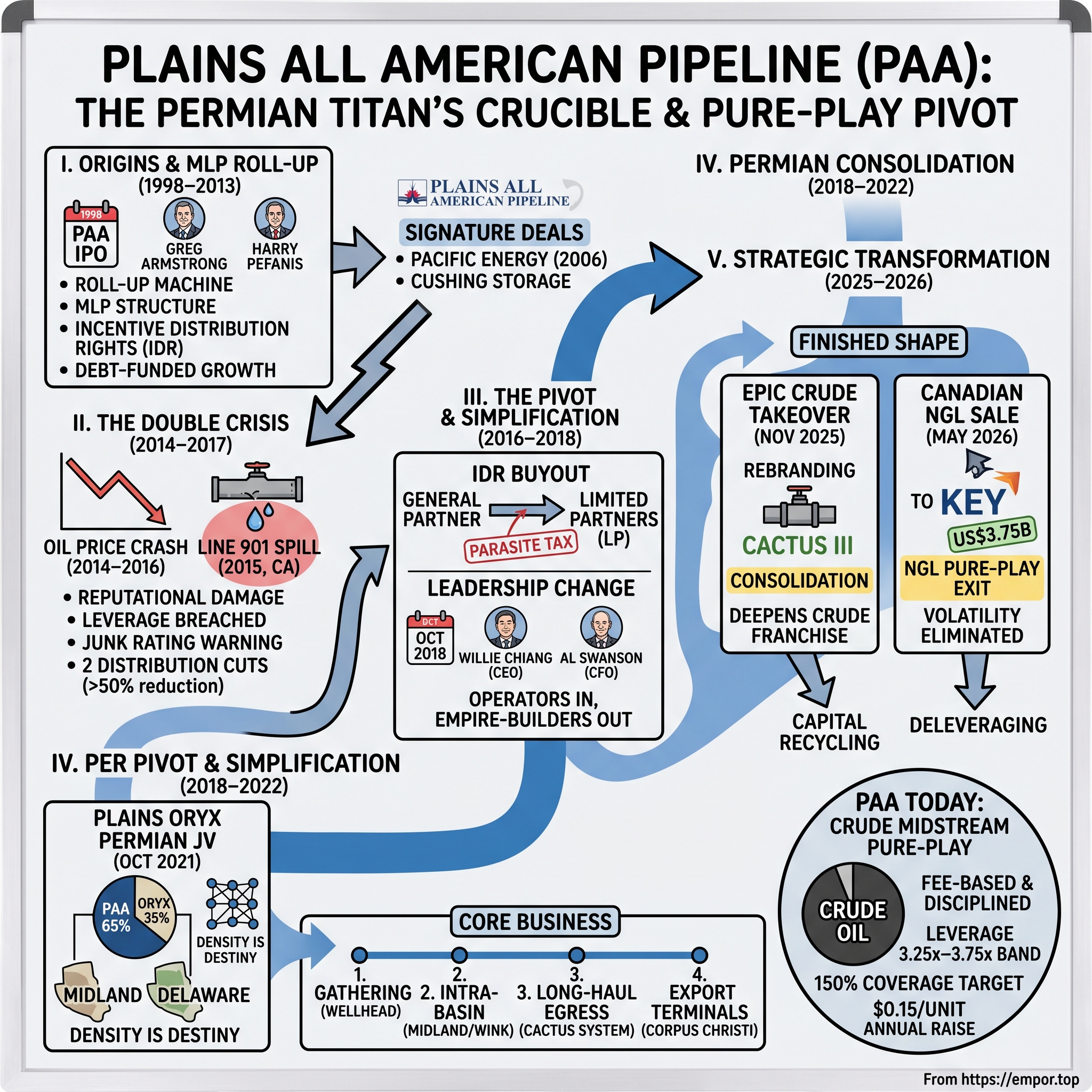
Plains All American Pipeline: The Permian Titan's Crucible & Pure-Play Pivot
I. Introduction & Episode Roadmap
Somewhere in the Permian Basin right now, in a patch of West Texas scrubland where the only landmarks are pumpjacks and the occasional caliche road, crude oil is seeping out of shale rock that geologists once wrote off as worthless. It travels a few hundred feet through a small-diameter steel line into a tank battery, then into a gathering pipe no wider than a dinner plate, then into a larger trunk line, then into a 24-inch long-haul artery that runs 500-odd miles southeast to the Gulf of Mexico, where it is pumped into the belly of a tanker bound for a refinery in South Korea or the Netherlands. At almost every step of that journey, there is a decent chance the molecule is riding on steel owned or operated by Plains All American Pipeline, L.P.
Plains moves crude and natural gas liquids at a scale that is difficult to picture: management describes a footprint capable of handling more than 8 million barrels per day of crude oil and NGL across North America.1 To put that in perspective, the United States produces roughly 13 million barrels of crude a day. Plains touches a startling share of it — the company positions itself as gathering something on the order of one in every few barrels of American crude, and a commanding slice of everything that comes out of the Permian. It is, in the most literal sense, a tollbooth on the busiest hydrocarbon highway on earth.
And yet for a company this systemically important, Plains is almost invisible to the investing public. It does not sell anything you can buy. It has no brand you would recognize at a gas station. It trades not as a corporation but as a Master Limited Partnership — a PAA unit, not a share — a structure that once made fortunes and then nearly destroyed the people who owned it.
That is the real story here, and it is not a triumphant one. The story of Plains All American is the definitive case study in how the MLP model rose, seduced a generation of income investors, and then broke. It is the story of a company that grew through the 2000s on a diet of cheap equity, escalating leverage, and a financial contraption called Incentive Distribution Rights — and then, in 2015 and 2016 and 2017, got hit by three trucks at once: an oil-price collapse, a catastrophic pipeline rupture on the California coast, and a balance sheet that could no longer support the promises it had made. Retail unitholders who had been sold "safe income" watched their distributions get cut in half, then cut again.
The second half of the story is the rebuild. Under CEO Willie Chiang, who took the top job in October 2018, Plains stopped trying to be an empire and started trying to be a machine — a disciplined, deleveraged, free-cash-flow harvesting machine focused on the one thing it does better than anyone: gathering Permian crude. That pivot culminated in three transactions that bracket this episode: the 2021 Plains Oryx Permian Basin joint venture, the late-2025 takeover of the EPIC crude pipeline (now being rebranded Cactus III), and the roughly US$3.75 billion sale of its Canadian NGL business to KEY Keyera Corp, which closed in May 2026 and turned Plains into a near-pure-play crude oil midstream company.
There is a particular flavor of irony to Plains that makes it worth studying. Most business disasters happen to companies with bad assets — buggy-whip makers, mall retailers, over-leveraged fads. Plains had, and has, extraordinary assets. The pipelines it owns sit on rights-of-way that could not be re-permitted today at any price, feeding the most prolific oil basin on the planet, connected to export docks that global refiners depend on. What went wrong at Plains had almost nothing to do with the quality of its steel and almost everything to do with the financial machine bolted on top of it. That is precisely what makes it such a clean teaching case: it isolates the variable of capital structure from the variable of asset quality, and shows what happens when a great business is run through a fragile balance sheet at exactly the wrong point in the cycle.
Three questions frame everything that follows. First: why did the classic MLP model fail, and what does its unwinding teach us about financial engineering? Second: is "wellhead-to-water" grid density in the Permian a genuine, durable moat — or a story management tells to justify a cyclical, terminal-value-challenged asset base? Third: can a management team actually rebuild investor trust after cutting the distribution more than 50% in back-to-back years, and has this one earned it? We will resist the temptation to answer any of them from the company's own slide deck. Plains, like every midstream operator, is fluent in the language of moats and discipline and shareholder alignment. Our job is to test those claims against behavior, filings, and the cold arithmetic of the cycle. Let's start where the money — and the mistakes — began.
 Subscribe on LinkedIn
II. Origins & The MLP Roll-Up Playbook (1998–2013)
Greg Armstrong did not set out to build a pipeline empire. In the mid-1990s he was running Plains Resources, a scrappy California oil-and-gas producer, and the logistics assets — the pipes and tanks that moved the crude the company drilled — were an afterthought bolted onto the drilling business. But Armstrong, an accountant by training with a deep respect for the boring predictability of fee-based cash flow, saw something the market did not. The molecules were volatile. The tollbooth was not. In 1998, Plains carved those midstream assets out into a new, separately traded entity — Plains All American Pipeline, L.P. — and took it public.[^2]
The vehicle he chose was the Master Limited Partnership, and understanding it is essential to everything that came after. An MLP is a pass-through structure: it pays no corporate income tax, instead distributing the bulk of its cash flow directly to unitholders, who are technically partners in the business. For an income-hungry investor, this was intoxicating — high, tax-advantaged yields that grew year after year. For the company, it meant an extraordinarily low cost of equity capital, because investors would happily buy new units to fund the next acquisition as long as the distribution kept rising. It was a growth flywheel: issue units, buy assets, raise the distribution, watch the unit price climb, issue more units. As long as music was playing, everyone danced.
But the MLP structure carried a parasite in its DNA: the Incentive Distribution Right. In the standard MLP setup, the General Partner — the entity that actually controlled and managed the partnership — held IDRs that entitled it to an escalating cut of every incremental dollar distributed. As distributions per unit climbed past defined thresholds, the GP's take ratcheted up, in the top tier capturing as much as 50 cents of every marginal dollar. This was designed as an incentive to grow. In practice, it became a tax on the limited partners — the ordinary unitholders — and a powerful, self-reinforcing pressure on management to grow distributions by any means necessary, because the GP got richer with every hike.
It is worth dwelling on why this structure was so seductive, because the seduction is the whole story. In the low-interest-rate world of the 2000s and early 2010s, a security that paid a 6% or 7% yield and raised that payout every single year was a magnet for a specific and enormous pool of capital: retirees, income funds, and financial advisors building portfolios for people who needed to live off their investments. MLPs became a distinct asset class, tracked by dedicated indices and sold by brokers as the safe, tax-advantaged way to own American energy infrastructure. The demand for the units was, for years, almost bottomless — and bottomless demand for your equity is the single most dangerous thing that can happen to a management team, because it removes the discipline that a skeptical market normally imposes. When investors will buy every unit you print, you never have to ask whether the next acquisition is actually worth it. You just have to keep the distribution rising.
Alongside Armstrong stood Harry Pefanis, president from the 1998 formation, an operator's operator who knew the physical business — the pumps, the tanks, the batching schedules — as intimately as Armstrong knew the balance sheet.[^2] Together they ran one of the most aggressive roll-up machines in the history of American energy. Over roughly fifteen years, Plains executed on the order of ninety acquisitions and deployed well over ten billion dollars of capital assembling a continental logistics network out of other people's orphaned pipelines and terminals. The playbook was consistent: find a midstream asset that threw off steady fees, buy it with a mix of cheap units and cheap debt, fold it into the growing network, and let the incremental cash flow justify the next distribution hike. Repeat. Each deal on its own looked reasonable. It was the aggregate — the compounding leverage, the compounding unit count, the compounding dependence on open capital markets — that quietly built the fragility.
The signature deal came in 2006, when Plains agreed to acquire Pacific Energy Partners for approximately $2.4 billion including assumed debt, a transaction that closed that November and dramatically expanded its West Coast and Rocky Mountain footprint.2 It was, in retrospect, a fateful acquisition — because bundled into Pacific Energy's asset base were the offshore California pipelines, including the coastal lines running through Santa Barbara County that would one day rupture and nearly break the company. Plains kept buying: crude systems, the sprawling storage complex at the Cushing, Oklahoma hub, and a Canadian natural gas liquids business anchored by fractionation and storage at Fort Saskatchewan and Empress in Alberta.
The name on the door — All American Pipeline — was itself a legacy of this assembling instinct, a system that had roots stretching back to the ambition of moving crude across the country, and the partnership spent its early years knitting together disparate crude systems, terminals, and storage into something that could plausibly be called a network rather than a collection. Each bolt-on made the whole slightly more interconnected and slightly more indispensable to the producers and refiners at either end. That was the genuine industrial logic beneath the financial engineering, and it is why the assets themselves held up even when the balance sheet did not.
Here is where the analytical eye has to sharpen, because the roll-up era looked like genius and was, in significant part, a trap. During the peak of the midstream "land grab" from roughly 2010 to 2014, Plains and its peers were paying rich multiples — often double-digit multiples of EBITDA — for gathering and processing assets, on the shared assumption that American shale production would grow essentially forever.3 The math only worked if volumes kept climbing. Pay fifteen times EBITDA for a gathering system and you are implicitly betting that the wells feeding it will keep flowing at high rates for a very long time; if the basin rolls over or the producers pull back, that same asset might be worth half what you paid. The industry as a whole was making a giant, leveraged, correlated bet on the permanence of the shale boom — and correlated bets have a way of unwinding all at once.
And the IDR made the trap tighter. Because the GP was skimming an escalating share of every incremental distribution, Plains' effective cost of equity capital was structurally elevated versus a plain-vanilla corporation. Think of it this way: if the top-tier IDR split took 50 cents of every new dollar of distribution, then to deliver a dollar of value to a common unitholder, Plains effectively had to generate two dollars of distributable cash flow. That doubled the hurdle rate on every project and every acquisition. A deal that would have created value for a normal company could destroy value for Plains' limited partners once the GP's cut was accounted for — and yet the incentive to keep doing deals was overwhelming, because the GP got paid on volume of distributions, not on returns.
To keep the flywheel spinning — to keep raising the distribution enough to satisfy investors and enrich the GP — management had to reach for more debt and chase lower-returning projects. Leverage crept toward the high 4x-to-5x range. The company was, in effect, running up a down escalator, and it needed the escalator (shale growth, high oil prices, open equity markets) to keep moving up. What made this so hard to see in real time was that the reported metrics all looked healthy. EBITDA was growing. Distributions were growing. The unit price was, for a long stretch, climbing. The fragility never showed up in a single quarter's numbers; it accumulated silently in the gap between the distribution and the free cash flow actually available to pay it. In 2014, the escalator reversed — and the gap became a chasm.
III. The Double Crisis: Oil Crash, Line 901 Spill, and the Dividend Reckoning (2014–2017)
The first blow came from the macro. In June 2014, West Texas Intermediate crude was trading around $105 a barrel, and the shale boom felt unstoppable.4 Then Saudi Arabia decided to defend market share rather than price, OPEC declined to cut production, and the bottom fell out. WTI slid through the second half of 2014, cratered through 2015, and on February 11, 2016 touched an intraday low of $26.19 a barrel — a roughly 75% collapse from the peak.5 For a midstream company, low prices are not directly fatal; Plains earned fees, not the oil price. But the second-order effects were brutal. Producers slashed drilling budgets, throughput growth stalled, tariff spreads compressed, and the merchant/marketing arm of the business — which profited from moving and blending barrels — saw its margins evaporate.
The second blow was worse, because it was self-inflicted and it killed the story of Plains as a safe, boring utility. On May 19, 2015, an underground segment of Line 901 — one of those coastal pipelines acquired years earlier through Pacific Energy — corroded through and ruptured near Refugio State Beach in Santa Barbara County, California. Crude oil released totaled roughly 142,000 gallons, with more than 2,400 barrels reaching the environment, some of it flowing down a culvert and into the Pacific, blackening one of the most photographed coastlines in America.6 The images — oiled beaches, dead sea lions, cleanup crews in white suits — were a public-relations catastrophe. Lines 901 and 903 were shut down, stranding the offshore California production they served, and they would stay dark for the better part of a decade.
The legal reckoning was severe and slow. In May 2016, the California Attorney General announced a criminal indictment against Plains.6 In September 2018, a Santa Barbara jury convicted the company of one felony count and multiple misdemeanors related to the spill, and Plains ultimately paid millions in fines on top of a far larger tab for cleanup, civil settlements, and litigation.7 The reputational damage was harder to quantify but arguably more expensive: Plains had spent fifteen years telling investors it was a low-risk toll collector, and Line 901 exposed the tail risk buried in every mile of aging steel it owned.
The deeper lesson of Line 901 is one that midstream investors are prone to forget in placid markets. A pipeline company's earnings look like an annuity — a steady stream of tolls, quarter after quarter, with a smooth line on the chart. But the risk profile is not annuity-like at all. It is a long series of small, positive cash flows punctuated by the rare, enormous, negative tail event: the rupture, the spill, the criminal liability, the multi-year shutdown of an entire production region. Corrosion does not care about your distribution coverage ratio. The Refugio spill was, in that sense, not a freak accident but the manifestation of a risk that was always embedded in the business model and simply not priced by investors who had been lulled by years of smooth results. When we later evaluate why management now spends so much airtime on safety metrics that seem tangential to the financial story, this is the reason: the single most expensive line item in Plains' history was not a bad acquisition or a mistimed hedge. It was a corroded pipe.
Then came the financial reckoning, and this is where the MLP structure's flaws stopped being theoretical. As EBITDA fell and debt stayed put, leverage breached 5x and the ratings agencies began circling with downgrade warnings toward junk. Management faced the choice every over-levered, over-distributing MLP eventually faces: protect the distribution and risk the balance sheet, or protect the balance sheet and break the distribution. Plains had raised its payout for twelve consecutive years. That streak was the whole investment thesis for its retail base.
They broke it — twice. In 2016, alongside a broader restructuring, Plains cut the quarterly distribution from $0.70 to $0.55 per unit, roughly a 21% reduction that took the annualized rate from $2.80 to $2.20.8 It was not enough. On November 6, 2017, management announced a second, deeper cut, slashing the quarterly payout from $0.55 to $0.30 — a 45% reduction that dropped the annualized distribution to $1.20, less than half of where it had stood two years earlier.9 The stated logic was sound: reset the baseline to a sustainable level, retain cash, and fund the capital program internally rather than depending on fickle equity markets. But for the retail unitholder who had bought Plains as a bond substitute, the logic was cold comfort. The "safe income" was gone.
It is worth sitting with the human dimension of that betrayal, because it explains the psychology of everything management has done since. The typical MLP investor was not a hedge fund running a sophisticated hedge; it was a retiree or a conservative income fund that had been told, implicitly and sometimes explicitly, that this was a bond-like security with a growing coupon. When the coupon was cut in half over two years, the unit price collapsed alongside it, so these investors suffered the double indignity of losing both their income and their capital at the same moment. Trust, once broken that way, does not come back with a press release. It comes back only through years of behavior — which is why the modern Plains has organized its entire capital-allocation framework around never having to make that phone call again.
What the double cut really exposed was that the distribution had never been as safe as the yield implied — it had been financed, in part, by the flywheel itself, by continuously tapping capital markets. When the markets closed and the oil price collapsed, the machine seized. The lesson, which management would spend the next decade internalizing and which sits at the heart of the modern Plains story, is that a distribution is only as safe as the free cash flow underneath it. Everything that follows — the deleveraging, the coverage targets, the obsessive capital discipline — is an answer to the trauma of 2015 through 2017. But before Plains could rebuild, it had to dismantle the very structure that got it here.
IV. IDR Simplification & The Structural Unwind (2016–2018)
If the distribution cuts were the amputation, the IDR buyout was the surgery that had to happen first. By 2016, it was clear to management and to an increasingly hostile investor base that the General Partner's incentive rights had become an anchor. Every dollar of new EBITDA that Plains generated was being taxed on its way to unitholders, siphoned into the top-tier IDR split, which meant Plains needed higher-returning projects than a normal company just to break even on value creation. In a world of $30 oil and closed equity markets, that math was unsurvivable.
So on July 11, 2016, Plains announced a comprehensive simplification. The partnership agreed to eliminate the IDRs and the economic rights of the 2% general partner interest, in exchange for issuing approximately 245.5 million newly created common units to the GP holders and assuming the associated debt — a package that implied a total value on the order of $7.2 billion.10 In plain English: Plains bought out the parasite. Going forward, every incremental dollar of distributable cash flow would accrue to the common unitholders rather than being split with the GP. The company's marginal cost of equity capital fell structurally, and its incentives realigned around per-unit value instead of gross distribution growth.
The transaction was dilutive and painful in the moment — issuing a quarter-billion new units is not a gift — but it was the necessary precondition for everything that came after. It is worth pausing on the timing, because timing is the whole indictment. Plains was late. Enterprise Products Partners, the industry's blue-chip operator, had eliminated its IDRs back in 2010, well before the storm, and entered the downturn with a lower cost of capital and a fortress balance sheet.3 Energy Transfer and Kinder Morgan navigated their own, messier corporate roll-ups. Plains, by contrast, carried its IDR drag straight into the teeth of the 2014–2016 crash, which meant it was fighting the downturn with one hand tied behind its back. Unitholders paid for that delay in the currency of dilution and distribution cuts. The simplification was the right move executed years too late — an important data point when we later assess management credibility across eras.
The structural unwind coincided with a generational leadership change. Greg Armstrong — the accountant who had conceived the whole enterprise, run it for a quarter century, and presided over both its ascent and its near-death — stepped down as CEO effective October 1, 2018, remaining as non-executive chairman before eventually leaving the board entirely.11 It was, in a sense, the end of the founder-operator era: the roll-up architect handing the keys to someone whose entire mandate was to stop rolling up.
That someone was Willie Chiang. He had joined Plains in 2015 as executive vice president and chief operating officer — arriving, notably, just as the crisis was breaking — after a career spent inside the large, disciplined, process-driven cultures of Occidental Petroleum and ConocoPhillips, where he had held senior operating and refining leadership roles.11 That pedigree matters more than it might seem. The supermajors and large integrated players Chiang came from run on a culture of process safety, engineering rigor, and unsentimental capital allocation — worlds away from the entrepreneurial, deal-a-month energy of an MLP roll-up. A ConocoPhillips or an Occidental does not raise its dividend to feed a financial sponsor's incentive rights; it allocates capital to the highest-returning barrels and lets the balance sheet breathe through the cycle. Chiang brought that operating-company sensibility into a partnership that had spent fifteen years thinking like a capital-markets machine.
Chiang was not a deal junkie. He was an operator and a systems thinker, and his brief when he took the CEO chair on October 1, 2018 was explicit and almost anti-heroic: stop chasing empire-building volume growth, cut debt, generate free cash flow, impose capital discipline, and execute safely. Alongside him, Al Swanson — the long-serving executive VP and CFO who had lived through the balance-sheet near-death firsthand — would architect the deleveraging. Swanson's continuity is its own kind of signal. Rather than importing a new CFO to symbolically break with the past, Plains kept the person who had watched the leverage nearly kill the company, on the theory that nobody would guard the balance sheet more zealously than someone who had seen what happens when it fails. The empire-builders were out. The engineers were in. The question was whether engineers could build something worth owning.
V. The Permian Consolidation Gambit & The Willie Chiang Era (2018–2022)
Willie Chiang inherited a company that had been humbled, and his first act was to change what Plains rewarded itself for. Under the old regime, the scoreboard was gross EBITDA and distribution growth — grow the empire, feed the IDR. Chiang and Swanson began reorienting the entire apparatus around a different set of metrics: return on invested capital, free cash flow per unit, leverage inside a defined target band, and operational safety. Executive compensation was steered away from raw growth and toward returns and balance-sheet discipline, and management's own unit ownership was meant to tie their fortunes to the long-term LP equity rather than to next quarter's headline. The rhetoric was humble, almost boring. After the drama of the prior three years, boring was the point.
But Chiang was not merely a caretaker cutting costs. The strategic insight that defined his early tenure was geographic focus: get out of everything that wasn't the best asset, and pour everything into the best asset. And the best asset was the Permian Basin, which by 2018 had become the most productive oil region on the planet — and, critically, a region choking on its own success. So much crude was coming out of the Midland and Delaware basins that there was nowhere to put it. Pipelines out of the basin — "egress," in the industry's term — were full, and the price of Midland crude blew out to a punishing discount versus the Gulf Coast because producers physically could not get their barrels to market.
To appreciate the opportunity, picture the physical bottleneck. A producer in the Delaware Basin could pull a barrel out of the ground for a few dollars, but if there was no pipe to carry that barrel to a buyer, it was effectively stranded — or it had to be trucked, expensively and dangerously, or sold at a steep discount to whoever could move it. At the peak of the 2018 egress crunch, Midland-priced crude traded at a discount of well over $10 a barrel to Gulf Coast crude, purely because of the transportation bottleneck. That spread was, in effect, a giant pile of money sitting on the table for whoever could build the pipe to capture it. Egress was the single most valuable problem in North American energy, and Plains was positioned to solve it.
Plains had the corridors to fix it. Leveraging its existing rights-of-way and its dense gathering position, the company built the Cactus pipeline system — long-haul arteries carrying crude from the Permian down to the export complex at Corpus Christi on the Texas coast. Cactus II, the marquee project, entered service in the third quarter of 2019, with its first shipments moving in August 2019; the line was initially sized in the mid-500,000-barrel-per-day range with the ability to expand toward roughly 670,000 barrels a day as demand filled it in.12 The strategic logic was elegant: Plains already gathered the crude at the wellhead, so building the long-haul pipe let it capture the entire journey — from the tank battery to the tanker — on its own steel. Instead of handing a gathered barrel off to a competitor's long-haul line and collecting a single toll, Plains could now collect tolls at every stage of the barrel's trip to the coast. This is the "wellhead-to-water" concept, and it is the spine of the modern bull case. It is also, notably, a concept every major midstream player understood and raced to build — which is why the egress market that was starved in 2018 would be over-supplied by the mid-2020s, a reversal that hangs over the bear case we will come to.
The masterstroke, though, was not a pipeline. It was a joint venture. On October 5, 2021, Plains completed the formation of the Plains Oryx Permian Basin JV, combining its Permian crude gathering assets with those of Oryx Midstream, a company backed by the infrastructure investor Stonepeak.[^14] Plains owned 65% and operated the combined system; Oryx held 35%. The merged entity stitched together on the order of 5,500 miles of pipeline into a single, unified gathering grid spanning both the Delaware and Midland basins.[^14]
Why did this matter so much? Because in gathering, density is destiny. When two overlapping grids combine, the operator can connect a new well pad to the nearest existing line rather than building a redundant parallel pipe — capturing incremental volume at a tiny fraction of the capital that a standalone build would require. The JV instantly rationalized redundant infrastructure, eliminated the wasteful practice of two companies laying competing lines to the same acreage, and let Plains connect new production to processing hubs with minimal incremental capex. It was, in effect, a way to grow volumes and cash flow while spending less, not more — the precise inversion of the old roll-up logic, where growth always demanded fresh capital. The combination created the most interconnected crude gathering footprint in the basin, and it did so at a moment when producers had nowhere else that dense to go. Which raises the natural question: what, exactly, does the business that emerged from all this actually look like, and how much of the "insurmountable moat" story survives contact with the numbers?
VI. Anatomy of the Core Business: Segment Economics & Moats
Strip away the corporate history and Plains, as of 2026, is a strikingly focused enterprise built around two reporting segments — Crude Oil and Natural Gas Liquids — that are wildly unequal in importance. The Crude Oil segment is the company. In the third quarter of 2025, it generated roughly $593 million of segment adjusted EBITDA, a pace that annualizes toward $2.3–2.4 billion and represents the overwhelming majority of the company's earnings power.[^15] The NGL segment — the Canadian fractionation and storage business — was the smaller, more volatile cousin, and by mid-2026 it was gone entirely, sold to Keyera in the transaction we will come to shortly.
Understanding why the Crude Oil segment is such a good business requires understanding what it actually does, because "pipeline company" flattens a lot of nuance. The value chain has four physical links. It starts at the wellhead, where producers tie their tank batteries into Plains' gathering lines — the capillaries of the system. Those gathering lines feed intra-basin transport through the hubs at Midland and around Wink, Texas, where crude is aggregated, batched, and quality-graded. From there it moves onto long-haul egress — the Cactus system and the Wink-to-Webster line — running to the coast. And finally it reaches water: the deepwater export terminals at Corpus Christi (including the Ingleside complex) and Houston, where barrels are loaded onto ships bound for global refiners.
The economics of that chain are what make it attractive to a long-term investor, and also what should give a skeptic pause. The revenue is overwhelmingly fee-based — Plains earns a tariff for moving a barrel a given distance, largely insulated from the absolute price of oil. Much of the long-haul capacity is underpinned by minimum volume commitments and take-or-pay contracts, meaning shippers pay whether or not they actually move the barrels. This is why Plains can throw off relatively stable cash flow even when WTI is gyrating. The sensitivity is not to price but to volume — and volume, in turn, is a function of how much crude the Permian produces and how much of it flows across Plains' specific steel.
There is a subtlety worth flagging for the diligent investor, because it is where the old Plains and the new Plains most differ. Historically, a meaningful slice of Plains' crude segment earnings came not from tolls but from what the industry calls "supply and logistics" or merchant activity — buying, blending, storing, and reselling barrels to capture location and quality spreads. That business can be lucrative when markets are volatile and dislocated, but it is inherently unpredictable, it consumes working capital, and it is the opposite of the smooth, annuity-like cash flow that the fee-based tariff business promises. Part of the post-2017 rehabilitation has been a deliberate de-emphasis of the merchant swagger in favor of the boring tariff toll. The clearer and more fee-based the earnings mix, the higher the quality of the cash flow that backs the distribution — and the more defensible the "utility-like" framing management uses. An investor tracking Plains should always ask how much of a given quarter's beat came from the durable toll business versus the episodic merchant spreads, because the two deserve very different valuation multiples.
That last point is the crux of the moat, and it deserves an honest examination rather than a management-deck recitation. Plains and its peers describe grid density as an "insurmountable" competitive advantage, and there is real substance to the claim. Once a lease operator physically ties its tank battery into a Plains gathering trunk line, switching to a competitor requires new capital, new construction, and operational downtime — so there is genuine stickiness at the wellhead. And the combined Plains Oryx grid is denser than anything a new entrant could economically replicate, because the right-of-way corridors and the interconnections were assembled over decades and, in many cases, could not be permitted or built again today at any reasonable cost.
This is the right place for a myth-versus-reality check, because three consensus narratives about Plains deserve interrogation. The first myth is that a midstream toll road is immune to the oil price. Reality: it is insulated, not immune. Plains does not sell oil, but its customers do, and when crude prices sit low enough for long enough, producers stop drilling, wells decline, and the tolls shrink. The 2015–2016 experience is the proof — a company that supposedly did not care about the oil price nearly did not survive the oil price. The second myth is that long-lived infrastructure equals low risk. Reality: as Line 901 demonstrated, long-lived infrastructure carries long-tailed liability, and the older the steel, the larger the integrity-management burden and the fatter the tail. The third myth, and the most seductive, is that the Permian moat is permanent. Reality: the gathering grid is genuinely hard to replicate, but its value is entirely derivative of the basin's production trajectory. A perfect moat around a shrinking castle is still a shrinking asset. The honest framing is that Plains has built an excellent position in a business whose long-run volume path is not within its control.
But "insurmountable" is a management word, and the honest version is more conditional. The moat is strong at the gathering layer, where density and switching costs are real. It is weaker at the long-haul layer, where Plains competes head-to-head against formidable rivals for uncommitted barrels, and where tariffs can compress when contracts roll over into an over-supplied egress market. The competitive set is a murderer's row of scale. Enterprise Products Partners is the industry's gold-standard operator — broader diversification across NGLs, petrochemicals, and crude, lower leverage, and a premium valuation that reflects a cost of capital Plains can only envy. Energy Transfer runs enormous scale across every hydrocarbon with a higher tolerance for both leverage and drama. MPLX, sponsored by Marathon Petroleum, brings a rich yield and Permian crude JV rights. Targa Resources and ONEOK dominate Permian NGL gathering and fractionation. Against that field, Plains' genuine, defensible claim is narrower but real: it holds a number-one-or-two position specifically in Permian crude gathering throughput — the one lane where its grid density is the deepest. The bull case lives or dies on whether that specific lane stays defensible as the basin matures. To see how management is betting on that question, look at the two transactions that reshaped the company in 2025 and 2026.
VII. Strategic Transformation: EPIC Crude Consolidation & The Canadian NGL Monetization (2023–2026)
By 2025, Willie Chiang had spent the better part of seven years shrinking Plains toward a thesis: be the best crude gathering and long-haul operator in the Permian, and stop being everything else. Two transactions in the space of a single year turned that thesis into a finished shape. The first was an acquisition that deepened the crude franchise. The second was a divestiture that severed the last major piece of everything else.
Start with EPIC. The EPIC Crude Oil Pipeline was a roughly 600,000-barrel-per-day long-haul system running from the Orla and Wink areas of the Permian — and drawing barrels from the Eagle Ford as well — down to Corpus Christi.[^16] It ran, in other words, directly parallel to Plains' own Cactus corridor, serving the exact same export market. When it came available, Plains moved to swallow it whole. The company acquired 100% of EPIC Crude Holdings in two tranches for total consideration of roughly $2.9 billion: a 55% stake purchased from subsidiaries of Diamondback and Kinetik that closed on October 31, 2025, and the remaining 45% acquired from an Ares-backed portfolio company that closed the next day, November 1, 2025, structured with an earnout of up to $157 million running through 2028.[^16]
Plains announced it would rebrand the system as Cactus III and integrate it into the existing Cactus I and II network. The strategic logic is straightforward and, unlike some synergy stories, physically real: three parallel long-haul lines feeding the same Corpus Christi export hub can be operated as one system, letting Plains optimize batching, balance loads across the pipes, and maximize utilization of its coastal docks. Consolidating a direct competitor's egress line also removes a source of tariff competition on the route. The skeptic's counterpoint, aired by analysts on the earnings calls, was about price and timing: Plains paid a mid-teens-percent premium to acquire an asset into an egress market that many believe is structurally over-built, at a reported multiple around ten times forward EBITDA, and funded it with debt that pushed leverage temporarily above the target range.[^16] Whether Cactus III proves a shrewd consolidation or an over-paid vanity purchase depends entirely on whether Permian volumes keep growing enough to fill three pipes. That is the central bet.
The second transaction resolved a different question — what to do with the Canadian NGL business, the volatile, commodity-sensitive appendage that had never fit cleanly into the crude story. On June 17, 2025, Plains announced it had signed definitive agreements to sell its Canadian NGL business to Keyera Corp for total cash consideration of approximately C$5.15 billion, or about US$3.75 billion.[^17] The deal closed on May 12, 2026.13 For Plains, the rationale was clean. The NGL segment carried exposure to frac spreads — the volatile margin between what you pay for raw NGL and what you get for the separated products — the exact kind of commodity-price sensitivity that had made the old Plains cash flows unpredictable. Selling it eliminated that volatility at a stroke and completed the metamorphosis into a focused, largely fee-based, pure-play crude oil midstream company.
There is a neat symmetry to the Keyera deal that is easy to miss. The Canadian NGL business — the fractionation and storage assets around Fort Saskatchewan and Empress — was, in a sense, the last major relic of the acquisitive roll-up era, a business Plains had assembled when it still believed diversification across hydrocarbons was a virtue. For Keyera, a Canadian midstream company for which NGL fractionation is the core competency and the assets sit squarely within its home-market footprint, the same business was a strategically central, natural fit. This is the textbook logic of divestiture: an asset is worth more in the hands of an owner for whom it is core than in the hands of one for whom it is peripheral. Plains was almost certainly a structurally disadvantaged owner of Canadian NGL infrastructure, and recognizing that — rather than clinging to the business out of sunk-cost sentiment — is exactly the kind of unglamorous portfolio honesty that the roll-up-era Plains lacked. The willingness to sell a perfectly functional, cash-generating business simply because it did not fit is arguably a stronger signal of the cultural change than any of the deleveraging metrics.
Just as important was what Plains did with the money. On the first-quarter 2026 earnings call in May, management put the realized net proceeds at roughly US$3.3 billion — modestly above the original estimate — and stated plainly that the cash would go primarily to debt reduction, retiring a term loan, commercial paper, and a $750 million note maturing later in 2026.[^19] The EPIC purchase had temporarily pushed pro-forma leverage up to around 4.1x by the first quarter of 2026; the Keyera proceeds were the deleveraging catalyst that management said would bring leverage back toward roughly 3.5x and, by year-end 2026, toward the low end of its 3.25x–3.75x target band.[^19]
That sequencing — lever up to buy the crude asset, then sell the non-core asset to lever back down — is the whole capital-allocation philosophy in miniature. It is worth appreciating how different this is from the old model. In the roll-up era, an acquisition was funded by issuing fresh equity, which grew the unit count, which required ever more cash to cover the distribution, which drove the next equity raise. Growth ate itself. In the 2025–2026 sequence, by contrast, Plains funded a large acquisition partly with debt and then paid that debt down with the proceeds of selling something it no longer wanted — recycling capital out of a lower-conviction asset and into a higher-conviction one, without permanently diluting its owners. That is capital allocation in the classic sense: not just growing, but choosing what to own and what to shed.
On top of it sits the return-of-capital framework: a multi-year plan to raise the common distribution by roughly $0.15 per unit each year, which took the annualized rate to $1.67 per unit for 2026 (a quarterly $0.4175), governed by a coverage target the company reset to around 150%.[^19] The coverage target itself is a tell. A 150% coverage ratio means the company intends to generate distributable cash flow equal to one and a half times what it pays out — retaining a full third of its distributable cash rather than paying it all away. Compare that to the pre-2015 model, where coverage often hovered barely above 1.0x, leaving no cushion and forcing the company to fund any shortfall or growth from external markets. The wide coverage buffer is the structural scar tissue from the distribution cuts: management has essentially promised never again to run the payout so close to the bone. Beyond the distribution, it has framed buybacks as strictly opportunistic — preferred redemptions and conditional common unit repurchases funded by excess free cash flow, but only once leverage sits at or below the bottom of the range.[^19] It is a deliberately unglamorous model. Whether it is also a credible one is the question the market is really asking.
VIII. Management Credibility & Governance Stress Test
Here is the uncomfortable truth an honest analyst has to hold in mind: this is the same corporate entity that promised twelve years of safe, growing income and then cut the distribution by more than half in two years. Credibility, in a company with that history, cannot be granted on the strength of a good slide deck. It has to be reconstructed from behavior over time — from whether management set targets, hit them, explained the misses, and kept its story consistent across years of filings and calls. So let's actually run that test.
The past sins are not in dispute, and to their credit, the current team does not pretend otherwise. The pre-2015 regime over-promised distribution sustainability, carried too much leverage, and was demonstrably too slow to address the IDR drag that peers had dismantled years earlier. Those are not framing choices; they are documented facts, and they are the baseline against which the Chiang-era record has to be judged.
That record, measured against its own prior promises, is where the credibility argument gets its strongest evidence. Management said it would deleverage, and leverage has moved from crisis-era highs above 5x into a disciplined 3.25x–3.75x band. It said it would self-fund its capital program rather than depend on serial equity issuance, and it has largely done so. It said it would raise the distribution by a predictable $0.15 per unit annually, and it has delivered that cadence to the $1.67 rate for 2026.[^19] It said it would exit non-core assets to concentrate on Permian crude, and it did — shedding the California pipeline liabilities and, decisively, the Canadian NGL business. When a management team lays out specific, falsifiable targets and then hits them across multiple years, that is the raw material of credibility, and Plains has more of it now than at any point in its history.
But an independent stress test has to probe the softer spots too. The EPIC acquisition is a legitimate governance question: after years of preaching capital discipline and free-cash-flow harvesting, management levered up to buy a competing pipeline at a full multiple in an arguably over-supplied egress market. That is exactly the kind of growth-for-growth's-sake move the post-2018 Plains was supposed to have sworn off, and the fact that it was quickly offset by the Keyera deleveraging does not fully answer the question of whether the underlying instinct to consolidate has really been tamed. A skeptical investor is entitled to watch closely for whether Cactus III is the last such deal or the first of a new cycle.
The California legacy deserves a note as a lingering reputational and second-order risk. Plains no longer owns the ruptured lines — ExxonMobil acquired the broader Santa Ynez Unit, and in 2024 sold it on to Sable Offshore Corp, which won PHMSA approval in December 2025 to move toward restarting the system.14 Plains has largely extracted itself from the operational liability, but the episode remains the permanent asterisk on any claim that pipeline transport is "low risk," and it is why the safety metrics management now emphasizes are not mere box-ticking.
An activist or short-seller looking for the soft underbelly would probe a few additional places. Governance is the obvious one: even after the IDR buyout, the partnership structure and the Plains GP Holdings overlay leave the ownership and control architecture more complex than a plain C-corp, and MLP governance historically offers limited-partner unitholders fewer rights than common shareholders enjoy — no annual director elections in the ordinary sense, and a general partner that retains meaningful control. A skeptic would also press on the tension between the buyback rhetoric and the reality: management talks about opportunistic repurchases but, as of the first quarter of 2026, had executed none, prioritizing debt paydown instead — which is defensible, but means the "return of capital" story is still mostly a distribution story, not yet a buyback story. And a bear would note that the EPIC purchase, however well-timed operationally, is precisely the kind of debt-funded expansion that a truly discipline-first management would have been expected to forgo. None of these is a smoking gun. Together they are a reminder that "disciplined" is a direction of travel, not a destination reached.
The most useful way to judge tone is to compare the calls across eras. The primary evidence a diligent listener should weigh: the July 2016 simplification call, where Greg Armstrong sold the IDR buyout as a turning point; the late-2025 EPIC acquisition disclosures, where analysts pushed back on the multiple and the debt; and the Q4 2025 and Q1 2026 calls, where the focus was the Keyera proceeds, leverage calibration, and a conspicuously cautious posture on buybacks.[^19] On the Q1 2026 call specifically, management's language around the roughly $3.3 billion of net proceeds was notably unromantic — the money was earmarked for retiring specific maturities and pulling leverage back inside the band, not for a splashy special distribution or an aggressive buyback authorization.[^19] That restraint, at the exact moment a less disciplined team would have been tempted to reward unitholders theatrically, is the kind of behavioral evidence that carries more weight than any mission statement. The throughline in the Chiang-era calls is a consistent, almost repetitive conservatism — the same leverage band, the same coverage target, the same self-funding language, quarter after quarter. Consistency of narrative is itself a credibility signal, precisely because the prior regime's narrative shifted right up until it broke. The team has earned a hearing. It has not earned blind faith. Which brings us to the framework question: strip away the tone and the track record, and how strong is the underlying business, really?
IX. Competitive Strategy, Frameworks & Bull vs. Bear Case
Let's war-game this properly, because the investment case for Plains rests entirely on one contested proposition: that its Permian crude franchise is a durable moat rather than a cyclical toll road with a good story. Run it through the two frameworks investors reach for, and then test the bull and bear cases against each other.
Start with Hamilton Helmer's 7 Powers. The strongest claim is Cornered Resource: the pipeline rights-of-way threaded across West Texas and New Mexico. These corridors were assembled over decades, and in the current permitting, environmental, and political climate, building a competing long-haul crude pipeline across the same geography would face regulatory friction, landowner opposition, and capital costs so severe as to be, in practice, prohibitive. This is a genuine power — the corridors themselves are irreplaceable, and Plains owns a prime set of them. The second power is Scale Economies, expressed as grid density: the Plains Oryx combination created a gathering network whose per-barrel cost advantage compounds with every incremental well pad connected to existing steel. The third, Switching Costs, is real but should be rated moderate rather than absolute — sticky at the wellhead once a tank battery is tied in, but weaker on long-haul, where a producer with volume can and does play pipelines against each other. Notably absent from Plains' arsenal are Network Economies in the software sense, Branding power, and Counter-Positioning; this is an infrastructure business, and its powers are the powers of physical assets and geography, not of intangibles.
Now Porter's Five Forces. The Threat of New Entrants is very low, for all the reasons the Cornered Resource analysis implies — capital intensity, permitting, and an already over-built egress market deter anyone from laying fresh competing pipe. Supplier bargaining power — here the suppliers are the producers whose barrels fill the pipes — is moderate: the supermajors and large independents like ExxonMobil, Chevron, Occidental, and Diamondback have real leverage and can self-build or contract elsewhere, but they depend on Plains' grid density and its Corpus Christi export connectivity. Buyer power (refiners and exporters) is likewise moderate, disciplined by the fact that global markets index to WTI and Brent and Plains' deepwater dock access provides optionality on both sides. The Threat of Substitutes is the genuinely two-faced force: negligible in the medium term, because global crude demand remains robust and there is no substitute for a pipeline to move a barrel, but material in the long term, where the energy transition and the specter of peak oil demand hang over the terminal value of every crude-dedicated asset. And Competitive Rivalry is high — the fight for uncommitted Permian barrels against Enterprise, Energy Transfer, and Enbridge-linked systems is real and ongoing.
That framework analysis maps cleanly onto the bull-and-bear spine. The bull case: Plains holds a leading, hard-to-replicate position in Permian crude gathering; it offers a substantial cash yield — in the high-6% to 7%-plus range depending on the unit price, backed by a coverage target around 150% and conservative leverage; it has simplified into a clean pure-play after the roughly $3.3 billion net Canadian NGL exit; and it runs a disciplined growth-capex budget that maximizes free cash flow available for distributions and buybacks.[^19] The whole edifice is a bet that the Permian keeps producing and that Plains keeps gathering a leading share of it.
The bear case attacks that bet at three points. First, the Permian production plateau: if U.S. shale growth decelerates as E&Ps prioritize capital returns over drilling, Plains' volume-driven growth stalls, and a tollbooth with flat traffic is worth less than one with rising traffic. This is not a hypothetical worry — the consolidation wave that put most premium Permian acreage into the hands of a few disciplined supermajors and large independents has structurally changed producer behavior. The old shale model was growth at almost any cost, financed by outside capital; the current model is moderate growth, high returns, and shareholder payouts. That is healthier for the producers and less exciting for the pipelines that were built on the assumption of relentless volume expansion. It also, incidentally, shifts negotiating power: a basin dominated by a handful of enormous, sophisticated counterparties is a tougher place to raise tariffs than one populated by hundreds of small operators.
Second, recontracting risk: the long-haul lines — Cactus I, II, and now III — were contracted in a tighter egress market, and as those multi-year commitments roll off into an over-supplied environment, tariffs could compress, hitting exactly the segment where the moat was already weakest. Take-or-pay contracts protect cash flow only until they expire; what happens at renewal depends entirely on whether there is more pipe than crude. Third, terminal value: a crude-dedicated midstream franchise carries genuine long-run demand risk from the energy transition, and that risk pressures the valuation multiple the market is willing to assign regardless of near-term cash flow. It is entirely possible for Plains to keep generating strong cash flow for a decade while the market steadily de-rates it, on the reasoning that a pipeline's value ultimately depends on how many decades of barrels remain. Long-term investors in this sector are, whether they acknowledge it or not, making a call on the shape of global oil demand in the 2040s. The EPIC deal sharpens the bear case rather than softening it, because it concentrated even more capital into long-haul egress just as the recontracting and over-build concerns were loudest.
There is one more risk worth naming because it sits outside the usual midstream checklist: the regulatory and political dimension. Plains' business runs on federal tariff regulation through the Federal Energy Regulatory Commission, on state and federal permitting for any expansion, and — as the California experience showed — on the goodwill of the communities its pipelines cross.15 A single high-profile incident can shut down an entire corridor for years, convert an operating asset into a stranded liability, and invite criminal exposure. That is a genuinely asymmetric risk profile, and it is why operational safety performance belongs alongside the financial metrics in any serious assessment of this company rather than being filed under corporate-responsibility boilerplate.
Which is why the diligent investor should ignore the noise and track a small number of signals. Three KPIs matter above the rest. First, Permian pipeline throughput volumes in barrels per day — the truest, least-manipulable barometer of whether the core asset is actually being used and whether the volume thesis is intact. Second, free cash flow after distributions — the number that reveals how much genuine self-funding capacity and buyback firepower exists after the payout and maintenance capital are covered. And third, the paired distribution coverage ratio and leverage ratio — the twin discipline gauges that show whether management is holding the line inside its 3.25x–3.75x band while funding the promised $0.15-per-unit annual raise. Watch those three, and the story tells itself in real time — no slide deck required.
X. Epilogue & Key Takeaways
The arc of Plains All American is, in the end, a story about what financial structures do to good assets. The gathering grid was always excellent. The corridors across West Texas were always close to irreplaceable. What nearly killed the company was not the rock or the steel but the scaffolding built around them — the Incentive Distribution Rights that misaligned incentives, the leverage that turned a cyclical downturn into an existential one, and the serial equity issuance that made the distribution look safe until the moment it wasn't. Layer a coastal pipeline rupture on top of that, and you get the crucible of 2015 through 2017, when a company that had told investors it was a bond substitute cut its payout in half, twice, and watched a twelve-year streak of trust evaporate.
The rebuild is the more instructive half of the story, and it is genuinely impressive without being finished. Willie Chiang and Al Swanson took a humbled, over-levered roll-up and turned it into something narrower and sturdier: a deleveraged, pure-play crude franchise that self-funds its capital program, hits its own targets, and concentrates relentlessly on the one basin where its advantages are deepest. The 2021 Oryx joint venture, the 2025 EPIC consolidation, and the 2026 Keyera divestiture are the three moves that finished the transformation from empire to machine. But the same discipline that defines the modern Plains was tested by the very act of buying EPIC, and the durability of the whole thesis still rests on an unresolved question about the Permian's long-run trajectory and the energy transition beyond it.
Where does that leave a long-term investor sizing up Plains in mid-2026? With a company that is genuinely better run than at any point in its history, trading with a substantial cash yield, wrapped around an asset base whose durability is real at the gathering layer and contested at the long-haul layer, and whose ultimate terminal value hinges on a macro question — the trajectory of oil demand — that no management team can control or credibly forecast. The near-term story is one of execution and discipline, and on that score the evidence is encouraging. The long-term story is one of secular exposure, and on that score the honest answer is that it is unknowable and belongs in the price. The interesting tension in the investment case is precisely that the near-term operator quality and the long-term structural risk point in opposite directions, and reasonable investors will weigh them differently depending on their time horizon and their view of the energy transition.
Three durable lessons survive the saga, and they generalize well past this one partnership. First: capital structure matters as much as asset quality. Financial engineering — IDRs, excess leverage, capital-markets dependence — can mask the quality of the underlying business in good times and will always expose a fragile balance sheet when the cycle turns. Second: in logistics, grid density is the closest thing to a real moat, but it is strongest at the gathering layer and weakest at the long-haul layer, and an investor should never let a management team blur that distinction with the word "insurmountable." And third: management credibility is earned slowly and priced skeptically. After a distribution cut, a company does not get to reclaim trust with a strategy slide; it reclaims trust one hit target and one consistent earnings call at a time — which is exactly the unglamorous, multi-year discipline that will determine whether the Permian titan's second act ends better than its first.
References
-
Plains All American Reports First Quarter 2025 Results — Plains All American / Investor Relations, 2025-05 ↩
-
Plains All American to buy Pacific Energy — Oil & Gas Journal, 2006-06-19 ↩
-
Plains All American L.P. EDGAR Regulatory Profile — U.S. Securities and Exchange Commission, 2026-02-15 ↩↩
-
U.S. Permian Basin Crude Oil Egress and Logistics Analysis — U.S. Energy Information Administration, 2025-10-10 ↩
-
Cushing, OK WTI Spot Price historical data — U.S. Energy Information Administration, 2016-02 ↩
-
Attorney General Announces Indictment of Plains All American — California Office of the Attorney General, 2016-05-17 ↩↩
-
Plains Pipeline Verdict: Clear It Spilled Oil — Santa Barbara Independent, 2018-09-07 ↩
-
Plains All American Simplification and Related Actions — Business Wire, 2016-07-11 ↩
-
Plains All American distribution reset analysis — The Motley Fool, 2018-02-07 ↩
-
Plains GP Holdings and Plains All American Announce Simplification — Business Wire / SEC 8-K, 2016-07-11 ↩
-
Chiang named Plains All American Pipeline CEO — Oil & Gas Journal, 2018-08-21 ↩↩
-
Keyera Announces Closing of Acquisition of Plains Canadian NGL Business — Keyera Corp, 2026-05-12 ↩
-
Sable Offshore Gets Green Light to Restart Pipeline from Feds — Santa Barbara Independent, 2025-12-23 ↩
-
FERC Pipeline Tariffs and Filings — Federal Energy Regulatory Commission, 2026-01-15 ↩
 LinkedIn
 WhatsApp
 Reddit
 Hacker News
 Email
Email Kindle
 RSS Feed
 Spotify
 Apple Podcasts
 Amazon Music
 Audible
 YouTube