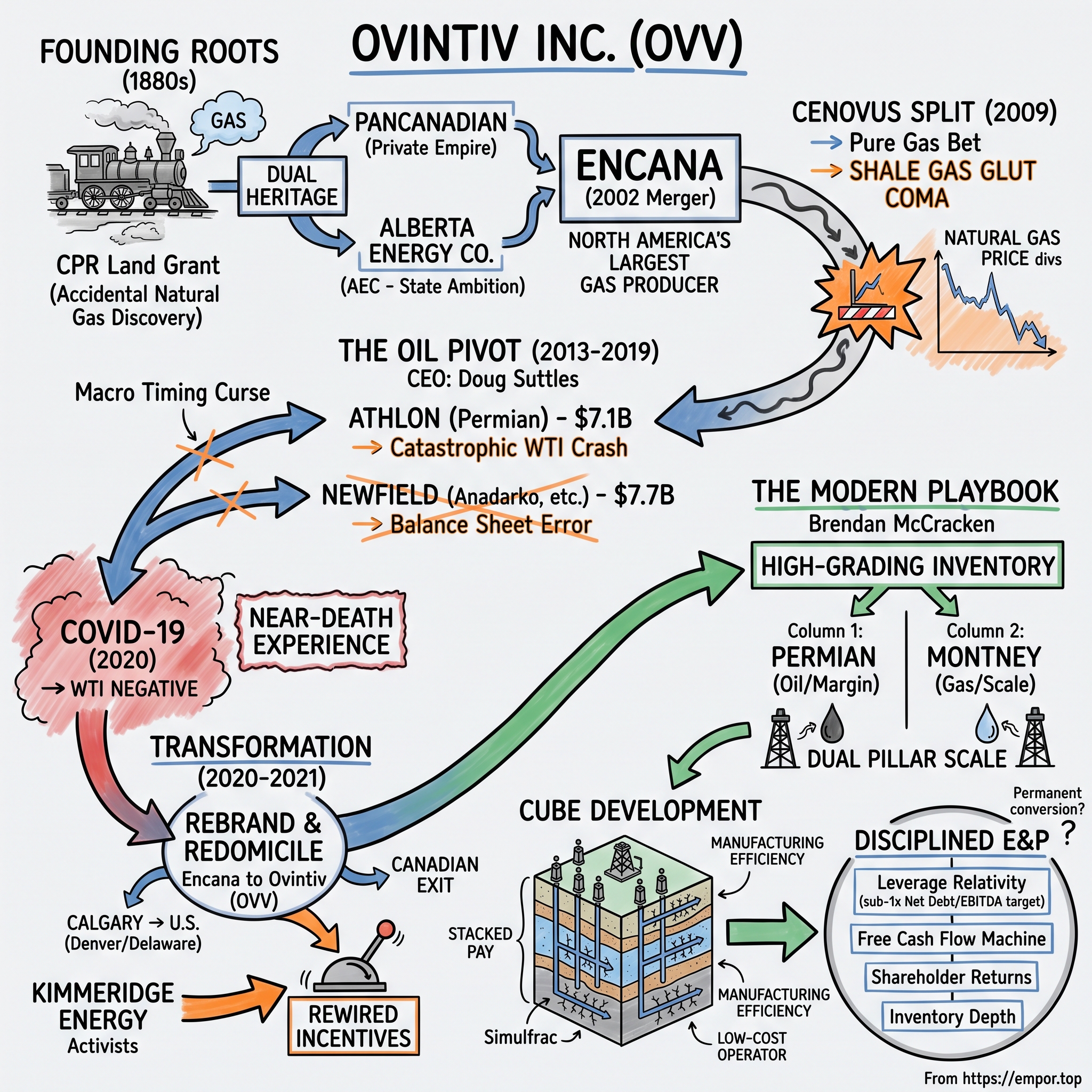
Ovintiv: The Story of Shale's Most Dramatic Transformation
I. Introduction & Episode Roadmap
Picture a company that began as a byproduct of a railway. In the 1880s, a crew laying the transcontinental line of the Canadian Pacific Railway across the empty grasslands of what would become Alberta was drilling for water. Instead, they struck natural gas.1 For most of the next century that accident stayed a curiosity. But buried inside it was the corporate DNA of an entity that would one day become North America's largest independent natural gas producer, torch billions of dollars of shareholder capital across two commodity cycles, flee Canada for the United States under a new name, survive a near-death experience when oil traded below zero, get dragged to the woodshed by an activist, and re-emerge as a disciplined, free-cash-flow machine straddling the two best shale basins on the continent.
That company is Ovintiv Inc., listed on the NYSE and TSX under the ticker OVV. As of mid-2026 it carried an enterprise value in the low-$20-billion range and a market capitalization of roughly $17 billion, and in 2025 it produced about 615,000 barrels of oil equivalent per day.2729 Those are the vital signs of a large, mature exploration-and-production (E&P) company. What makes the story worth telling is not the size — it is the distance travelled to get there.
The central tension of this episode is a culture war fought inside one balance sheet. For its first two decades, the company that became Ovintiv was run by engineers who worshipped volume: more wells, more acreage, more production growth, financed with more debt, regardless of what commodity prices were doing. That worldview built an empire and destroyed a fortune. The modern chapter is the story of the opposite religion taking over — capital discipline, free cash flow, shareholder returns, and the ruthless "high-grading" of drilling inventory down to only the most economic rock. Whether that conversion is permanent or merely the mood of a cycle is the question every long-term investor has to answer.
A few themes will recur. The curse of macro timing: this is a company that has a documented talent for buying oil assets at the top and taking on debt right before a crash. The Canadian exit: the psychologically loaded decision to abandon Calgary for Denver and Delaware, shedding a national identity to reach American capital. The activist catalyst: how a comparatively small fund, Kimmeridge Energy, applied enough pressure to rewire the company's incentives. And operational scale: the manufacturing-style drilling technique Ovintiv calls "cube development," which is the engine that makes its low breakevens possible.
A caution before we begin. Ovintiv sells commodities into markets it does not control. It has no pricing power, no network effects, no switching costs. Its entire competitive case rests on being a low-cost operator on top of good rock — an advantage that is real but narrow, cyclical, and forever contestable. We will champion nothing here. We will test the claims. Let's start where the rock came from.
 Subscribe on LinkedIn
II. Deep Roots: From Canadian Pacific Railway to Encana (1881–2002)
The founding myth of most oil companies involves a wildcatter, a hunch, and a gusher. Ovintiv's begins with a land grant and a mistake. When the Canadian government contracted the Canadian Pacific Railway to bind the young nation together with steel in the 1880s, it paid partly in land — enormous tracts of prairie flanking the tracks. In December 1883, near a whistle-stop called Langevin (later renamed Alderson), a CPR crew boring for water to feed its steam locomotives instead tapped a pocket of natural gas — one of the first such discoveries in Alberta, and arguably in Canada.1
A quick myth-correction, because the folklore is sticky: the romantic "Little Chicago" nickname that sometimes gets pinned to this spot actually belonged to a very different Alberta boomtown — Royalties, in the Turner Valley field, decades later. The Langevin strike was more prosaic and more consequential: it seeded the idea that the railway sat on top of a hydrocarbon province, and it left Canadian Pacific holding both the mineral rights and the ambition to exploit them.
Two corporate bloodlines flow from that era into Ovintiv. The first is PanCanadian, the oil-and-gas arm that Canadian Pacific eventually spun out of its sprawling conglomerate — the direct heir to those railway land grants. The second is the Alberta Energy Company (AEC), a very different creature. AEC was created in 1973 by the provincial government of Premier Peter Lougheed as a vehicle for ordinary Albertans to own a piece of their own resource boom, with the province and the public each initially holding half.2 One company was a legacy of private empire; the other was a child of resource nationalism. That dual parentage — private capital and state ambition — is worth holding onto, because the tension between them echoes through everything that follows.
The two came together in 2002. In a merger completed that April, PanCanadian and AEC combined to form EnCana Corporation, with AEC's chief executive Gwyn Morgan installed as the inaugural CEO.3 The scale was instantly staggering: on the day it was born, EnCana was described as the largest independent oil-and-gas company in the world by production, reserves, and value, and the largest independent natural gas producer in North America.3 It held an almost unrivaled land position across the Western Canadian Sedimentary Basin and the U.S. Rockies.
Here the culture calcified. EnCana's mandate was gas, and lots of it. The engineering organization was built to grow volumes — to turn its immense acreage into producing wells as fast as capital allowed. In a rising gas market, that looked like genius. The problem, invisible in 2002, was that the company had bet its identity on a single commodity at the precise moment a technological revolution was about to bury that commodity in its own abundance. To understand how a "largest in the world" boast curdled into a decade of value destruction, we have to follow EnCana as it doubled down on the very thing that was about to break.
III. The 2009 Cenovus Split & The Natural Gas Trap (2009–2013)
By the late 2000s, EnCana's leadership faced a strategic fork, and in November 2009 they chose the road that would nearly define the company by its consequences. The company split itself in two. On December 1, 2009, its oil sands, heavy-oil, and refining assets were hived off into a brand-new entity called Cenovus Energy, while EnCana kept the natural gas business and became, deliberately, a nearly pure-play gas producer.4
On paper, the logic was clean. Conglomerate discounts are real; investors often pay more for two focused companies than one blurry one. Oil-sands investors wanted long-life, capital-intensive oil exposure; gas investors wanted a nimble driller levered to Henry Hub. Give each its own stock, the theory went, and the market would reward the clarity. It was the kind of value-unlocking financial engineering that looks brilliant in a banker's pitch book.
It was also, in hindsight, one of the worst-timed portfolio decisions in modern North American energy. Because at the very moment EnCana was purifying itself into a gas company, American engineers in Texas, Louisiana, and Pennsylvania were perfecting the marriage of two techniques — horizontal drilling and hydraulic fracturing — that would crack open the Marcellus, the Haynesville, and the Barnett shales. The United States went from worrying about importing liquefied natural gas to drowning in domestically produced gas in the span of a few years.
The price told the story with brutal clarity. Henry Hub natural gas, which had spiked well above $13 per million British thermal units in the mid-2000s, collapsed toward $2 as the shale gas glut hit. For a company whose entire cash flow now depended on the price of gas, this was not a dip; it was a structural repricing of its core product. EnCana had just voluntarily surrendered the oil-linked cash flows of Cenovus — the very ballast that would have carried it through — right before the gas market fell out of bed.
This is the first and most important lesson the company handed its future shareholders, and it is a lesson about diversification versus focus. Focus is a virtue when your one thing is winning. When your one thing is a commodity in structural oversupply, focus is a trap. Every incremental well EnCana drilled added supply to a market that was already choking on it, converting capital into production that sold for less than it cost to develop. The company's engineering culture — its instinct to grow volumes — was now actively destroying value, and doing so faster the harder it worked. Something had to give. The board's answer was to bring in an outsider and pivot the entire ship from gas to oil, as fast as physically possible. That pivot would prove that being late and being wrong can be the same expensive thing.
IV. The Oil Pivot & Capital Allocation Sins: Athlon & Newfield (2013–2019)
In June 2013, EnCana's board reached outside the Calgary gas fraternity and hired a man who had spent his career in oil — and in crisis. Doug Suttles had been chief operating officer of BP's exploration and production division; more memorably, he had been one of the public faces of BP's response to the 2010 Deepwater Horizon disaster in the Gulf of Mexico, the executive standing in front of cameras during the worst offshore spill in U.S. history.5 A 22-year BP veteran, he arrived at EnCana with a single overriding mandate: get the company out of the gas trap and into oil and natural gas liquids, quickly.
Quickly is the operative word, and it is where the trouble started. Suttles moved fast to buy oil. In September 2014, EnCana announced it would acquire Athlon Energy, a pure-play producer in the Permian Basin's Midland sub-basin, for $58.50 per share in cash — roughly $5.93 billion of equity, and about $7.1 billion including assumed debt.67 Athlon gave EnCana an instant, high-quality oil position: around 140,000 net acres and a running start in what would become the most important oil basin on Earth.
The asset was excellent. The timing was catastrophic. The deal was struck in late September 2014, with West Texas Intermediate crude trading near $100 a barrel. Within weeks, OPEC — led by Saudi Arabia — chose to defend market share rather than price, declining to cut production and effectively opening the taps on a world already swimming in U.S. shale oil. WTI began a slide that would carry it below $30 by early 2016. EnCana had paid a peak-of-cycle price for oil assets and then watched the commodity underlying them lose two-thirds of its value almost immediately. The predictable result was a cascade of non-cash impairments as the carrying value of assets bought at $100 oil was written down to reflect $30 oil. The company had escaped the gas trap by walking straight into the oil trap.
If Athlon was a timing error, the 2018 sequel was a balance-sheet error. On November 1, 2018, EnCana announced an all-stock acquisition of Newfield Exploration valued at roughly $5.5 billion, with an enterprise value near $7.7 billion once about $2.2 billion of Newfield's net debt was assumed.89 Existing EnCana holders would own roughly 64 percent of the combined company, Newfield holders the rest, at an exchange ratio of 2.6719 EnCana shares per Newfield share.9 The deal, which closed on February 15, 2019, added the STACK and SCOOP plays of Oklahoma's Anadarko Basin, the Uinta Basin in Utah, and Bakken acreage in North Dakota.9
Management's pitch was scale and diversification across multiple oil basins. What shareholders heard was: more debt, more complexity, and another large acquisition late in a cycle. The stock fell sharply on the announcement — a rare and unambiguous verdict from the market that it did not want its E&P companies getting bigger by borrowing. The strategic critique writes itself. In the space of four years, a company that had just been mauled by one badly timed, debt-laden acquisition had gone out and done a second one. The pattern — reaching for scale at the wrong point in the cycle, funded by the balance sheet — was becoming a signature. It set the stage for a reckoning that would arrive from two directions at once: a global pandemic, and an activist with a spreadsheet full of the company's own sins.
V. Rebrand, Redomicile, & The Kimmeridge Proxy Battle (2019–2021)
The first act of the reckoning was a name change loaded with national symbolism. On January 14, 2020, shareholders voted — by roughly 90 percent — to approve one of the more provocative corporate reinventions in Canadian business history.[^10] EnCana would rename itself Ovintiv Inc., move its corporate domicile from Alberta to the United States (Denver operationally, Delaware legally), execute a one-for-five reverse stock split, and trade under the new ticker OVV. The reorganization became effective on January 24, 2020, with consolidated shares beginning to trade at the end of that month.10
The rationale management offered was capital, not patriotism. By becoming a U.S.-domiciled corporation, Ovintiv would become eligible for inclusion in U.S. equity indices, opening the door to the vast pools of American passive and index money that never buy foreign-listed names. In theory, a deeper, cheaper investor base would lift the valuation. The reaction in Canada was not gratitude. The move landed as an abandonment — a marquee Calgary company, heir to the Canadian Pacific land grants and the Lougheed-era Alberta Energy Company, decamping to the United States. Canadian commentators were scathing, and some Canada-only institutional mandates were forced to sell simply because the stock was no longer domiciled at home, creating exactly the kind of technical selling pressure a rebrand is supposed to avoid.
Then the world ended, briefly. In the spring of 2020, COVID-19 shut down global travel and industry, and oil demand fell off a cliff faster than producers could turn off the taps. On April 20, 2020, the front-month WTI futures contract did something no one had ever seen: it went negative, settling at minus $37.63 a barrel as traders paid to avoid taking physical delivery into overflowing storage.11 For a company still digesting the Newfield debt, this was an existential moment. Default fears were real.
Here it is worth correcting a piece of the received narrative, because how a company behaves in a crisis is a genuine test of management. Ovintiv's response was severe but specific: on April 2, 2020, it announced roughly $500 million of capital-spending cuts and restructured its oil hedges, locking in protection on a large slice of production.12 What it did not do — contrary to a common retelling — was slash its dividend. The quarterly payout was held at $0.09375 per share throughout 2020 and was actually raised the following year.13 The company chose to protect the dividend and cut drilling instead. Whether that was prudence or stubbornness is debatable, but the factual record is that survival came through capex discipline and hedging, not a payout cut.
Survival, however, was not the same as absolution — and watching from the wings was an activist who had been building a case. Kimmeridge Energy Management, a specialist energy fund led by founder Ben Dell, launched a proxy campaign around January 26, 2021.14 Kimmeridge owned only about 2.5 percent of Ovintiv, but its argument was devastating precisely because it was built from the company's own numbers. Its public filings charged management with being, in effect, addicted to debt-financed, badly timed acquisitions, and pointed to a total shareholder return of roughly negative 85 percent over the tenure of the CEO who had joined in 2013, against more than $75 million of cumulative CEO compensation over the same stretch.14 The fund nominated three directors — Dell himself, Katherine "Kate" Minyard, and Erin Blanton — and demanded absolute debt reduction and a compensation scheme actually tied to performance.14
The fight did not go the full distance. On March 4, 2021, Ovintiv settled: it appointed Katherine L. Minyard to its board and nominated her for election, and in exchange Kimmeridge withdrew its slate and agreed to a standstill.15 One board seat, no shareholder vote. On the surface, a modest outcome; in substance, a turning point. In the months around the settlement, Ovintiv formally overhauled its executive compensation — adding a return-on-invested-capital metric to long-term incentives and debt reduction to the short-term scorecard, alongside a methane-intensity target17 — and committed to a hard net-debt target of $3.0 billion with a formal shareholder-return framework.16 The empire-building era was over on paper. Whether it was over in spirit would depend on the engineer about to take the corner office.
VI. The Modern Playbook: Brendan McCracken & Dual-Pillar Scale (2021–Today)
On June 8, 2021, Ovintiv announced that Doug Suttles would retire and that Brendan McCracken would become president and CEO effective August 1, 2021.19 The choice was telling. Rather than import another outsider to clean up the mess, the board promoted from within — McCracken was an engineer who had spent more than two decades inside EnCana and Ovintiv, rising through strategy, corporate development, and operations. He knew where the bodies were buried because he had been in the building while they were being interred.
McCracken's public posture from day one was capital discipline as identity, not slogan. On his first full earnings call as CEO, the Q3 2021 call on November 3, 2021, he laid out the arithmetic in plain terms: "We set a new debt target of $3 billion, which at mid-cycle prices, would equate to a leverage ratio of about 1 times net debt to EBITDA."18 He described a phased shareholder-return framework — return 25 percent of the prior quarter's post-dividend free cash flow to shareholders until the debt target was hit, then step up to at least 50 percent thereafter — and pointedly added that "$3 billion does not represent a stopping point."18 The tonal break from the Athlon-and-Newfield years was total: no talk of transformational M&A, only leverage caps, free cash flow, and returns.
The proof, of course, is in the behavior over time, not the language on one call. And here the modern chapter gets genuinely interesting, because McCracken did not stop transacting — he simply changed what the transactions were for. The new deals were portfolio surgery, funded so as to keep leverage roughly neutral, rather than debt-funded expansions.
Consider the 2023 Permian move. In April 2023, Ovintiv agreed to acquire a package of core Midland Basin assets from three EnCap-backed private operators — Black Swan Oil & Gas, PetroLegacy Energy, and Piedra Resources — for about $4.275 billion, paid with roughly $3.125 billion of cash and about 32.6 million Ovintiv shares.20 The prize was inventory: roughly 1,050 net well locations and about 65,000 net acres in the heart of the Midland Basin.20 Crucially, Ovintiv paid for part of it by selling: it simultaneously offloaded its Bakken assets in the Williston Basin to Grayson Mill for about $825 million in cash, closing both transactions on June 12, 2023.2021 This was addition and subtraction in the same breath — buy tier-one oil inventory, sell a non-core basin to help fund it.
Then came the 2024–2025 Montney-for-Uinta swap, the move that reshaped the company's geographic soul. On November 14, 2024, Ovintiv announced it would acquire core, oil-rich Alberta Montney assets from Paramount Resources for about C$3.325 billion (roughly US$2.377 billion), while simultaneously selling its Uinta Basin position in Utah to FourPoint Resources for about $2.0 billion.24 The Paramount package added roughly 70,000 barrels of oil equivalent per day, about 900 net well locations, and around 109,000 net acres — most of it undeveloped — in the liquids-rich Montney.24 On the Q4 2024 call in February 2025, McCracken framed the logic bluntly: the company was "making up the gap from selling twenty-nine thousand barrels a day in the Uinta and buying twenty-five thousand barrels a day in the Montney," while targeting more than $1.5 million of cost savings per acquired Montney well.25 In plain English: swap a smaller, higher-cost, niche oil position for a vast, low-cost, multi-decade inventory runway in a basin Ovintiv already understood cold.
The portfolio that resulted was a dual-pillar company. FY2024 production totaled about 585,000 BOE/d; FY2025 climbed to roughly 614,500 BOE/d, split almost evenly between liquids and gas.2627 The Permian, at roughly 210–215,000 BOE/d and nearly 80 percent liquids, drives oil volumes and top-tier margins.27 The Montney, ramped to roughly 300,000 BOE/d after the Paramount deal, supplies enormous, cheap, liquids-rich gas volumes.27
And then, in February 2026, McCracken finished the job the 2018 Newfield deal had started — by unwinding a big piece of it. Ovintiv agreed to sell its Anadarko Basin (Oklahoma) assets for approximately $3.0 billion, the cash-cow acreage that had come in with Newfield.27 The move sharpens Ovintiv into essentially a two-basin operator — Permian and Montney — and management guided that, once the sale closes, net debt would sit around $3.6 billion.27 It is hard to miss the symmetry: the modern Ovintiv is being built by selling the very assets the old Encana overpaid to acquire. What that discipline is actually made of — the drilling machine underneath it — is where we go next.
VII. Core Business Mechanics: Economics & "Cube Development"
Strip away the corporate drama and Ovintiv is, at bottom, a manufacturing company. Its product is molecules; its factory is a drilling rig and a frac spread; its cost of goods is measured in dollars per lateral foot. The single most important thing to understand about how it competes is a technique Ovintiv brands, in its own regulatory filings, as "cube development."26
Here is the analogy. Imagine the shale isn't a single layer of pay but a multi-story parking garage — several stacked reservoir intervals sitting one above another, each holding oil and gas trapped in rock with the porosity of a kitchen counter. The old way to produce it was to drill one well into one level, drain it, and move on. The problem is that shale reservoirs are pressure-sensitive; producing one well first can steal pressure from its neighbors and cause "frac hits" and "parent-child" interference that permanently damage the wells drilled later. Cube development attacks that problem head-on. As Ovintiv describes it, the model "utilizes multi-well pads and frac spreads running in parallel to simultaneously access multiple layers of stacked pay to maximize product recovery."26 Instead of one well at a time, the company drills and fracs a whole three-dimensional block — the "cube" — of many wells across multiple horizons at once, so the reservoir is drained evenly and the rock's pressure is used, not wasted.
Bolted onto that are the completion techniques the filings call "simulfrac" and "trimulfrac" — fracturing two or three wells simultaneously with parallel frac crews — combined with long horizontal laterals that in the best cases stretch 15,000 to 20,000 feet.26 The economic logic is manufacturing logic: the more feet of rock you complete per crew per day, and the longer each lateral, the more the fixed costs of mobilizing rigs, sand, water, and people get spread across more producing reservoir. Efficiency isn't a virtue here; it is the moat, such as it is.
What does that buy in hard numbers? Management points to breakevens that sit low on the North American cost curve — Midland Basin oil economics that work below roughly $40 WTI, and Montney gas that remains economic at very low AECO prices — with the Montney's liquids content and diversified market access (including routes toward U.S. Gulf Coast LNG demand) sweetening the realized economics. Those figures are management's, and a skeptic should treat "sub-$40 breakeven" claims as directional rather than gospel — breakevens are sensitive to service-cost inflation, well spacing, and how much overhead you choose to include. But the broad point survives scrutiny: Ovintiv operates near the low end of the cost curve in both of its basins, which is the only durable form of advantage a price-taker can have.
The segment division of labor is worth stating plainly, because it explains the portfolio's design. The Montney is the reliable base — huge, low-cost, liquids-rich volumes that generate steady cash regardless of the oil cycle. The Permian is the margin and free-cash-flow engine — higher-value oil that converts a barrel into the most operating cash. Together, in management's framing, they give Ovintiv "commodity flexibility": the ability to steer capital toward oil or gas depending on which is paying better. That flexibility is genuine, but it is also the flexibility of a company that lives and dies by prices it cannot set. To judge how much of an edge that really is, we need to run the business through the frameworks investors use to separate real moats from wishful thinking.
VIII. Strategic Frameworks: Porter's 5 Forces & Hamilton Helmer's 7 Powers
Let's war-game the business. If you handed Ovintiv to a strategist and asked, "Where is the durable advantage, and where is the company simply exposed?" — the honest answer is that a commodity producer's moat is thin by construction, and the interesting work is figuring out which thin advantages are nonetheless real.
Start with Hamilton Helmer's 7 Powers, the framework that asks what specifically stops a competitor from erasing your returns. Ovintiv's best claim is Process Power — the accumulated, hard-to-copy operational know-how of drilling those long laterals, steering the bit through thin reservoir intervals, and executing simulfrac and cube development at scale. Decades of repetition have plausibly given Ovintiv lower finding-and-development costs per foot than smaller, less experienced operators. But process power in shale is a leaky moat: techniques diffuse across the industry through the same handful of service companies, and a technique Ovintiv pioneers this year is a service-company sales pitch to a rival next year. Call it a real but decaying edge that must be continuously re-earned.
The second claim is Scale Economies, and it is moderate-to-strong. Large, contiguous acreage blocks in the Midland Basin and the Alberta Montney let Ovintiv share the fixed costs of gathering systems, water recycling, and sand logistics across an enormous production base — the kind of infrastructure density a fragmented small-cap can't replicate. This is a genuine cost advantage, though it is basin-specific rather than company-wide.
Now the uncomfortable part. On the classic moat sources — Counter-Positioning, Network Economies, Switching Costs, Branding — Ovintiv scores essentially zero. A barrel of Ovintiv oil is indistinguishable from a barrel of Diamondback's oil. There is no customer lock-in, no ecosystem, no brand premium. This is the defining reality: whatever advantage exists lives entirely in cost-curve position, and the moment Ovintiv slips up the cost curve, the advantage evaporates. Investors should be deeply suspicious of any narrative that dresses this business up as something more defensible than a well-run commodity operation.
Running Porter's Five Forces confirms the picture from the other direction. Bargaining power of buyers is effectively zero-to-total, depending on how you frame it — Ovintiv sells into anonymous index markets (WTI, Brent, Henry Hub, AECO) and takes whatever price the world sets; there are no buyers to negotiate with, and no way to charge a premium. Bargaining power of suppliers is moderate-to-high: the company depends on oilfield service providers — the Halliburtons, SLBs, and Patterson-UTIs of the world — for rigs and pressure pumping, and in tight service markets those costs inflate quickly, squeezing the very breakevens the whole thesis rests on. Threat of new entrants is low, and here Ovintiv actually benefits: consolidation has locked up the best acreage, and the elevated cost of capital for private start-ups makes greenfield entry into the Permian or Montney prohibitively expensive. Threat of substitutes is the long-shadow risk — the energy transition, electrification, and renewables — mitigated over the medium term by stubborn global hydrocarbon demand and the LNG export build-out, but unambiguously a structural headwind on a multi-decade horizon. And competitive rivalry is intense: Ovintiv fights a pack of highly capable peers — Diamondback, Devon, EOG, Coterra — all racing down the same cost curve, which means efficiency gains get competed away rather than banked as durable profit.
The synthesis is bracing but fair: Ovintiv is a well-run company in a structurally unattractive industry. Its advantages are real but modest and perishable; its exposures are large and permanent. That is not a reason to dismiss it — plenty of money is made in cyclical commodity businesses — but it is a reason to insist that the entire investment case rest on execution, cost position, and capital discipline rather than on any fantasy of a wide moat. Which brings us to the actual argument for and against owning it.
IX. Investment Spine: Bull vs. Bear Case & Activist Stress Test
So, why does Ovintiv win from here — and what would break the case? Let's put both sides on the table and then stress-test them.
The bull case rests on three legs. First, premier dual-basin scale: Ovintiv sits in the two lowest-cost oil and gas plays in North America — the Permian and the Montney — which gives it genuine commodity flexibility and a cost position near the bottom of the curve. Second, capital allocation that has, so far, matched the rhetoric. The company hit its deleveraging goals, funded its acquisitions largely with asset sales rather than pure debt, and has been returning a large share of free cash flow to shareholders; the framework for 2026 escalated to returning at least 75 percent of free cash flow, atop a base dividend of $0.30 per share per quarter.27 Third, inventory depth: the market's single biggest fear about any shale producer is running out of tier-one rock, and Ovintiv's Midland and Montney acquisitions were explicitly aimed at extending the runway of high-return locations well into the next decade.
The bear case is the mirror image, and it is not subtle. First, commodity price vulnerability — full stop. FY2025 generated about $1.64 billion of free cash flow on roughly $2.1 billion of capital,27 but those numbers are hostage to WTI and North American gas prices that can halve in a quarter, as 2014, 2020, and every other cycle have demonstrated. Second, M&A overpayment risk — the original sin. This is a management team and a board sitting atop a company with a documented history of buying scale at the top; the market's willingness to trust that the Athlon-and-Newfield instinct is truly dead is a matter of faith that only years of restraint can confirm. Once inventory eventually depletes, the pressure to do another large deal will return, and the track record on timing is poor. Third, dual-jurisdiction regulatory friction — operating across U.S. federal and state lands and Canadian provincial frameworks doubles the political, environmental, and permitting surface area, from methane rules to future carbon policy on both sides of the border.
Now the activist stress test — what would a skeptical long/short investor still challenge, even after Kimmeridge's win? Three things. Leverage relativity: net debt to EBITDA drifted up toward the mid-1x range in 2025 as prices softened and the Montney deal was digested,27 which is fine at strip prices but thinner cushion than the pristine "sub-1x at mid-cycle" story implies. Capital-return credibility through a downturn: it is easy to return 75 percent of free cash flow when free cash flow is large; the real test is whether the framework survives a genuine price collapse, or whether buybacks get quietly suspended the way they always do across the sector. And portfolio churn: buy Bakken, sell Bakken; buy Uinta via Newfield, sell Uinta; buy Anadarko via Newfield, sell Anadarko — the constant reshuffling has arguably created value lately, but it also reflects a company that keeps paying transaction costs and dilution to correct earlier mistakes, and a skeptic is entitled to ask when the portfolio finally sits still.
Which leaves the question of what to actually watch. Ignore the noise and track three KPIs. First, free cash flow per share — not aggregate free cash flow, but per share, because it captures whether buybacks and acquisitions are actually accreting value to owners or merely growing the enterprise. Second, capital efficiency, measured as cost per lateral foot drilled and completed — the cleanest read on whether the process-power advantage is holding up against service-cost inflation and against peers. Third, net debt to EBITDA — the single number that tells you whether the post-Kimmeridge discipline is real across the cycle or only in good weather. Those three, watched over several years and across at least one downturn, will answer the entire bull-bear debate more honestly than any single quarter's headline.
X. Playbook: Business & Investing Lessons
Step back from the ticker and Ovintiv's forty-year arc offers a set of lessons that generalize far beyond the oil patch.
Lesson one: beware the pure-play macro trap. The 2009 Cenovus split looked like textbook value creation — separate the businesses, let each attract its natural shareholder. But it stripped Encana of the oil-linked cash flows that would have carried it through the shale-gas glut, leaving a naked bet on a collapsing commodity. The lesson is not that focus is bad; it is that focus concentrates your fate in one variable, and if that variable is a commodity in structural oversupply, focus is how you go broke efficiently. Diversification is worth paying for precisely when it feels like dead weight.
Lesson two: never buy scale at cycle peaks with debt. The Athlon deal at roughly $100 oil and the Newfield deal near the top of the next cycle loaded the balance sheet at exactly the wrong moments, and together they help explain the years of impairments and negative shareholder returns that followed. Good assets bought at bad prices with borrowed money are a wealth-destruction machine. The quality of an acquisition is inseparable from its price and its financing — a truth every acquisitive company forgets at the top of every cycle.
Lesson three: activism can be an operational catalyst, not just a trade. Kimmeridge owned a small slice of Ovintiv and won a single board seat, yet the campaign helped rewire compensation toward returns on capital and cemented a hard deleveraging target. The lesson for boards is that entrenched underperformance invites accountability; the lesson for investors is that a credible activist with the company's own numbers can change behavior far out of proportion to its ownership stake.
Lesson four: operational scale without capital discipline is waste; scale with discipline is a compounding engine. The old Encana had world-class scale and torched capital; the modern Ovintiv pairs the same cube-development efficiency with strict payout and leverage rules. The difference between the two isn't the drilling technique — it's the governor on the capital-allocation engine. Efficiency tells you how well you turn dollars into barrels; discipline tells you whether you should have spent the dollars at all. Only the combination compounds.
Whether Ovintiv has truly internalized all four lessons or is merely enjoying a disciplined phase of a cyclical business is the open question — and the honest answer is that it cannot be known yet, only observed over the next cycle. The best way to observe it is to go to the primary record.
XI. Primary Evidence & Earnings Call Guide
For an investor who wants to follow this story in the raw rather than through anyone's summary, a handful of primary documents and calls carry most of the signal. Reading them in sequence is the closest thing to watching the transformation happen in real time.
The 2020 crisis filings. Start with the April 2, 2020 disclosure of the $500 million capital cut and hedge restructuring, and the subsequent quarterly dividend declarations that held the payout steady.1213 Read against the negative-price shock of April 20, 2020,11 they reveal how management actually behaved under maximum stress — the tell that separates prudence from bravado.
The Kimmeridge documents (early 2021). The activist's own proxy filing is a masterclass in building a case from a target's public numbers, and the March 2021 settlement that seated Katherine Minyard shows how the fight resolved.1415 Read them together to see both the indictment and the negotiated peace.
The Q3 2021 call (November 3, 2021). Brendan McCracken's first full quarter as CEO is where the modern framework was articulated out loud — the $3 billion debt target, the phased return of free cash flow, the explicit rejection of a "stopping point."18 It is the tonal Rosetta Stone for everything the company has said since; every later call should be graded against the promises made here.
The Q2 2023 call (July 28, 2023). This is the call to study for how management defends a large acquisition. With the $4.275 billion Midland Basin deal freshly closed, analysts from JPMorgan and UBS pressed on completion productivity, inventory quality, and the tension between deleveraging and shareholder returns.22 The prepared remarks sell the deal; the Q&A is where you find out whether the numbers hold up.
The Q4 2024 / early-2025 calls. Here the Paramount Montney acquisition and Uinta divestiture get explained as a deliberate high-grading swap, with McCracken quantifying the barrel-for-barrel exchange and the targeted well-cost savings.25 Pair the calls with the FY2024 and FY2025 results and the underlying 10-K disclosures on production, segments, and cube development.262728
Read in order, these documents let you judge the one thing that matters most for a company with this history: whether the language of discipline is consistent across years and across the cycle, or whether it drifts the moment prices — or the temptation to build another empire — return. That consistency, tested against behavior, is the real story of Ovintiv, and it is still being written.
References
-
Langevin Siding / discovery of natural gas in Alberta — Canada's Historic Places (Historic Places Register) ↩↩
-
Encana — corporate history, 2002 PanCanadian/AEC merger and Gwyn Morgan ↩↩
-
Former BP executive and Gulf of Mexico spill point man to lead Encana — BOE Report, 2013-06-11 ↩
-
Encana to buy Athlon Energy for $5.9 billion plus debt — Reuters, 2014-09-29 ↩
-
Encana to acquire Athlon Energy in $7.1 billion deal — Oil & Gas Journal, 2014-09-29 ↩
-
Encana to buy Newfield Exploration for $5.5 billion in all-stock deal — Reuters, 2018-11-01 ↩
-
Encana acquires Newfield Exploration — NS Energy (deal terms, close Feb 15 2019) ↩↩↩
-
Encana to rebrand, change name and relocate to the United States (ticker OVV, 1-for-5 split) — Oil & Gas Innovation ↩
-
CFTC Staff Interim Report on the April 2020 negative WTI price (−$37.63/bbl on April 20, 2020) — U.S. CFTC ↩↩
-
Ovintiv 8-K exhibit — April 2, 2020 capital reduction (~$500M) and hedge restructuring — SEC EDGAR ↩↩
-
Ovintiv 8-K — October 28, 2020 dividend declaration held at $0.09375/share — SEC EDGAR ↩↩
-
Kimmeridge Energy DFAN14A proxy solicitation materials — SEC EDGAR, 2021 ↩↩↩↩
-
Ovintiv appoints Katherine L. Minyard to board of directors (Kimmeridge settlement) — PR Newswire, 2021-03-04 ↩↩
-
Ovintiv 8-K exhibit — September 9, 2021 $3.0B net-debt target and shareholder-return framework — SEC EDGAR ↩
-
Ovintiv 8-K exhibit — February 2021 compensation changes (ROIC metric, debt reduction, methane target) — SEC EDGAR ↩
-
Ovintiv (OVV) Q3 2021 earnings call transcript — The Motley Fool, 2021-11-03 ↩↩↩
-
Doug Suttles to retire in August 2021; Brendan McCracken named President & CEO — PR Newswire, 2021-06-08 ↩
-
Ovintiv to acquire core Midland Basin assets ($4.275B) and sell Bakken — PR Newswire, 2023-04-03 ↩↩↩
-
Ovintiv announces closing of Midland and Bakken transactions and inclusion in S&P 400 — PR Newswire, 2023-06-12 ↩
-
Ovintiv (OVV) Q2 2023 earnings call transcript — Insider Monkey, 2023-07-28 ↩
-
Ovintiv reports second quarter 2023 financial and operating results — PR Newswire, 2023-07-27 ↩
-
Ovintiv strengthens portfolio with core oil-rich Montney asset acquisition (Paramount) and Uinta divestiture — PR Newswire, 2024-11-14 ↩↩
-
Ovintiv (OVV) Q4 2024 earnings call transcript — Insider Monkey, 2025-02-27 ↩↩
-
Ovintiv Inc. FY2024 Form 10-K (production, segments, cube development / simulfrac / trimulfrac) — SEC EDGAR, 2025-02-26 ↩↩↩↩↩
-
Ovintiv reports fourth quarter and year-end 2025 financial and operating results (FY2025, Anadarko sale, ≥75% framework) — PR Newswire, 2026-02-23 ↩↩↩↩↩↩↩↩↩↩
-
Ovintiv Inc. (OVV) statistics — market cap and enterprise value (as of mid-2026) — StockAnalysis.com ↩
 LinkedIn
 WhatsApp
 Reddit
 Hacker News
 Email
Email Kindle
 RSS Feed
 Spotify
 Apple Podcasts
 Amazon Music
 Audible
 YouTube