Outfront Media: The Roadside Real Estate Engine and the Transit Reckoning
I. Introduction & Episode Roadmap
There is a particular category of asset that few consider real estate until they attempt to build one. Stand at the intersection of Sunset and Vine in Los Angeles, on the platform at Grand Central, or along the shoulder of the Cross Bronx Expressway, and look up. The steel structure holding a fourteen-by-forty-eight-foot vinyl sign over eight lanes of traffic is, legally and economically, a piece of land with an attached permit. It generates rent. It cannot easily be replicated, because the permit allowing its existence was issued decades ago and will likely never be granted to a competitor in that spot again. In the United States, roughly 38,240 of those billboard displays belong to OUTFRONT Media.1
Outfront also controls another footprint: approximately 514,637 transit advertising displays, a vast inventory of posters, panels, and screens inside subway cars, on bus exteriors, along commuter rail platforms, and above turnstiles across North America's largest transit systems.1 Of that total portfolio, 31,421 displays in the United States are digital—comprising 1,928 digital billboards and 29,493 digital transit screens, several thousand of which are reserved for public transit agency communications rather than commercial advertising.1
Those two asset classes—billboards and transit—appear superficially similar. Both monetize human attention in physical transit corridors, and both are sold by the same sales force to the same advertising clients. Yet for nearly a decade, they functioned as two distinct businesses joined together: one a high-margin annuity, the other a capital-intensive municipal obligation that severely stretched the company's balance sheet.
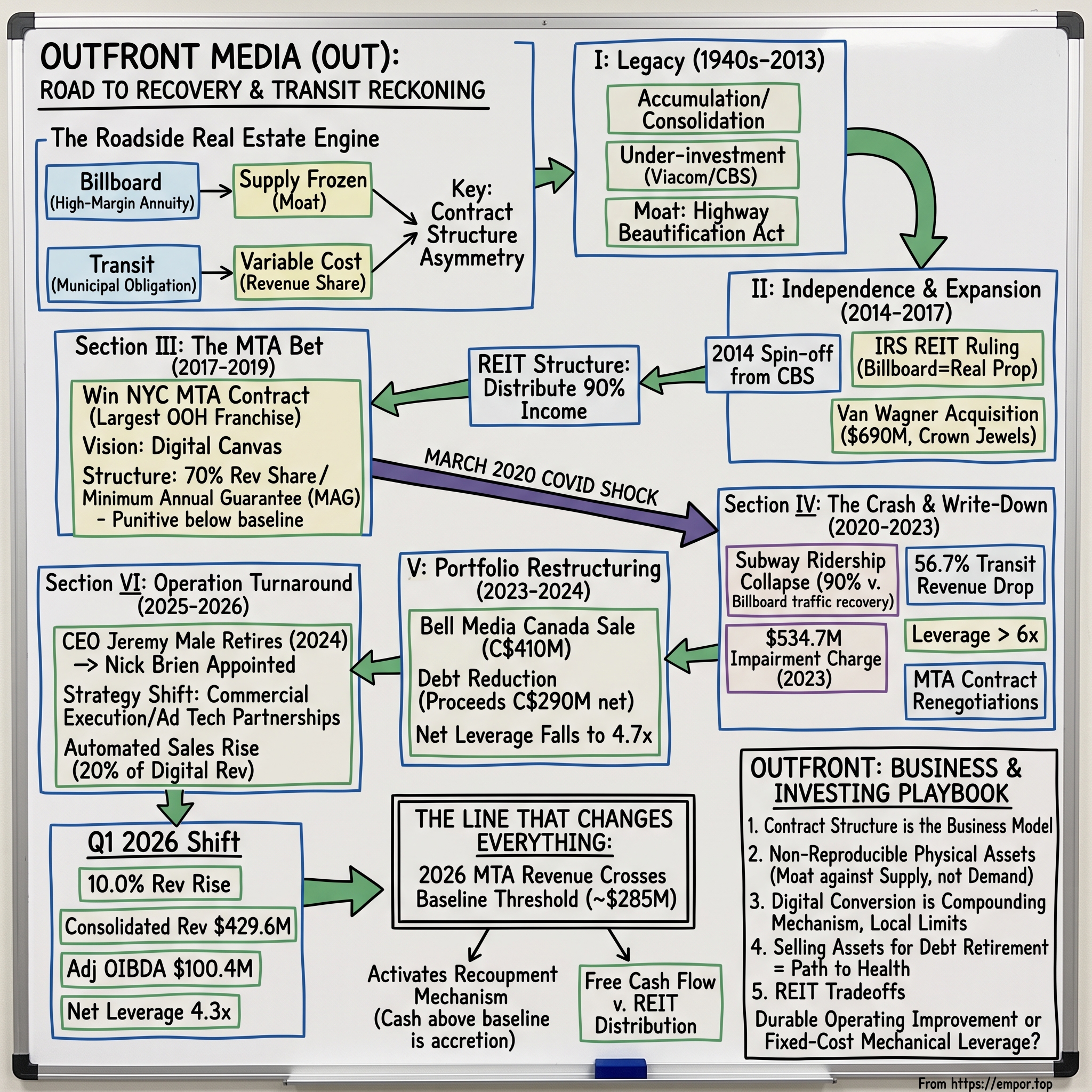
The core cause lies in contract structure, the single most critical variable in evaluating the business. A billboard rests on leased ground. When advertising demand declines, a significant portion of that lease expense automatically drops because ground leases are frequently structured as a percentage of generated ad revenue. A transit concession operates in reverse. Outfront pays transit authorities a Minimum Annual Guarantee—a fixed contractual floor that escalates annually with inflation regardless of rider volume. In 2026, Outfront's minimum payment obligation to New York's Metropolitan Transportation Authority steps up roughly 3% to approximately $161 million.2 That fixed cost remains constant regardless of hybrid work trends.
For the four years following March 2020, that contractual asymmetry dominated the company's financial performance. It generated $534.7 million in impairment charges in 2023 alone, driving a $430.4 million net loss for the year, pushing leverage above six times net debt to EBITDA, and keeping the share price in the teens throughout most of 2023 and 2024.34
A shift occurred in early 2026. In the first quarter of 2026, reported on May 7, consolidated revenue rose 10.0% to $429.6 million, Adjusted OIBDA increased 56.4% to $100.4 million, and AFFO more than doubled to $61.0 million.5 Revenue from the New York MTA contract grew over 26%. Net leverage fell to 4.3 times, returning within management's target band of 4 to 5 times.6 The stock, which had hit a 52-week low of $16.64, traded around $31.87 in late July 2026, bringing Outfront's market capitalization near $5.6 billion.7
Consequently, the central analytical question facing the company differs from the crisis narrative of 2023: how much of Outfront's turnaround reflects durable operating improvement, and how much stems from the mechanical leverage of a fixed-cost contract crossing its breakeven threshold during a favorable period? A 56% surge in consolidated OIBDA off a base where transit contributed minimal earnings does not automatically equal 56% better operational execution. Furthermore, the leadership navigating this phase has changed. Jeremy Male, who led Outfront from before its 2014 spin-off from CBS until his retirement at the end of 2024, has departed.8 The company is now led by Nick Brien, a career advertising-agency executive with no prior operating history in out-of-home real estate, who was named interim CEO on February 4, 2025, and appointed permanent CEO in August 2025.89 Chief Financial Officer Matthew Siegel provides institutional continuity and memory regarding every structural promise made about the transit portfolio since 2017.
The company's evolution spans six distinct phases: the conglomerate inheritance that left assets under-capitalized; the 2014 spin-off and IRS private letter ruling that converted billboard structures and permits into a tax-advantaged real estate investment trust; the Van Wagner acquisition that secured premier billboard locations; the MTA contract that promised digital expansion but became a financial drag; the post-2020 disruption, impairments, and Canadian asset divestiture that funded the recovery; and the current operational profile—its unit economics, digital conversion metrics, ad-tech integration, and the specific drivers that will determine whether the investment thesis compounds or deteriorates.
 Subscribe on LinkedIn
II. Corporate Origins & The Legacy of Outdoor Advertising (1940s–2013)
The American billboard business was not built so much as accumulated—sign by sign, family firm by family firm, over roughly seven decades. It was then consolidated in a burst of leveraged dealmaking at the turn of the millennium that had little to do with advertising and everything to do with radio.
The lineage that produced Outfront runs through 3M's National Advertising Company, a corporate afterthought inside a Minnesota industrial conglomerate; through Outdoor Systems Inc., the Phoenix-based roll-up that bought National Advertising and briefly became the largest outdoor advertising company in America; and into Infinity Broadcasting, which acquired Outdoor Systems in 1999 for approximately $8.3 billion in stock. Infinity was Mel Karmazin's radio empire, and Karmazin's logic was straightforward: he sold local advertising, billboards were local advertising, and the same salesperson calling on a car dealership could sell both. Infinity folded into Viacom, the outdoor unit became Viacom Outdoor, and when Viacom split in 2006, the billboards landed at CBS Corporation as CBS Outdoor.
This lineage explains the physical condition of the assets Outfront eventually inherited.
Inside a media conglomerate, out-of-home advertising occupies a peculiar position. It generates highly predictable cash flow—the boards are already built, the leases signed, and maintenance costs minimal—yet requires capital reinvestment to grow. Conglomerate capital allocation is an internal competition, and out-of-home consistently lost. At CBS, the marginal dollar of capital had two higher priorities: content, where a hit franchise could return a high multiple, and share repurchases. A digital billboard conversion, which required immediate capital and paid back over several years, could rarely compete for attention in a boardroom evaluating the next NFL broadcasting rights package.
The result was systematic underinvestment during the precise decade when technology mattered most. LED display costs fell sharply through the 2000s. Competitors—particularly Lamar Advertising, a pure-play operator with no content business competing for capital—began converting their best static faces to digital displays, realizing they could sell six to eight rotating advertising slots on a single structure. CBS Outdoor converted far more slowly. When it was finally set loose, it carried a portfolio of premium locations burdened by a technology deficit.
What CBS Outdoor did inherit, however, was an unassailable regulatory moat. The Highway Beautification Act of 1965 restricted new billboard construction along federally funded highways, and over subsequent decades, hundreds of municipalities—with Los Angeles and San Francisco among the most restrictive—imposed bans or strict caps on new outdoor advertising structures. The effect was to freeze supply. A billboard standing in a restricted zone became legally non-conforming yet grandfathered: it could remain and be maintained, but if taken down, it could not be rebuilt.
That regulatory dynamic forms the foundation of the roadside real estate thesis. In most industries, high returns attract new capacity that competes away profits. In roadside outdoor advertising, high returns cannot induce new supply because permit authorities have stopped issuing permits. Supply is not merely inelastic; in prime metropolitan markets, it actively shrinks. Consequently, the central long-term question for the business is not whether competitors will build adjacent boards, but whether advertisers will continue choosing the medium over time—a question that shapes the company's ongoing evolution.
The final element of this pre-history was leadership. In 2013, CBS recruited Jeremy Male to run the outdoor unit and prepare it for independence. Male's background was not in traditional American billboards, but in European out-of-home advertising, most recently at JCDecaux, the Paris-based street furniture and transit giant. That distinction proved critical. The European model relies on municipal concessions—bus shelters, subway systems, and airport contracts—won through competitive tenders against sophisticated rivals, where operators install and maintain public infrastructure in exchange for commercial advertising rights. It is a discipline defined by competitive bidding, heavy capital deployment, and fixed contractual commitments. By contrast, the traditional American billboard model relies on owning scarce permits and collecting ground rent.
Male brought deep expertise in that higher-cost, concession-driven environment. He would soon apply that playbook in New York—and the consequences of applying concession logic to an American corporate balance sheet designed for steady annuity economics would define Outfront's next decade.
III. The 2014 Spin-off, IRS REIT Ruling, & Van Wagner Expansion
The pitch to institutional investors in early 2014 had an elegant simplicity to it: we are not a media company, we are a landlord.
CBS Corporation separated its outdoor unit in stages. An initial public offering of roughly 19% of CBS Outdoor Americas priced in late March 2014, followed by a split-off exchange offer through which CBS shareholders could trade CBS stock for shares of the outdoor company, allowing CBS to divest its remaining stake without a taxable distribution.10 For CBS, this was portfolio pruning at a favorable moment — shedding a capital-intensive, slow-growth asset and recycling proceeds into content and buybacks. For the newly independent company, it was liberation and exposure in equal measure: no more competing internally for capital, and no more parent balance sheet to lean on.
The financial engineering that made the separation compelling arrived on April 16, 2014, when CBS received a favorable private letter ruling from the Internal Revenue Service on the issues central to the outdoor company's ability to qualify as a real estate investment trust.11 The question the IRS had to answer was genuinely novel: is a billboard real property?
The reasoning matters more than the label. A REIT must derive the bulk of its income from real property rents. A billboard is a steel structure bolted to a piece of land the company usually does not own, displaying vinyl the company also does not own, sold to advertisers for periods measured in weeks. Calling that "rent" requires the IRS to accept that the permanently affixed structure and the land interest beneath it are the income-producing property, and the advertising contract is the lease. The ruling accepted the structure. Outfront's peers followed the same path — Lamar converted to REIT status in 2014, and American Tower had already established the template for treating specialized infrastructure as real estate.
The consequence is worth stating plainly, because it defines the shareholder's entire relationship with this company. As a REIT, Outfront pays essentially no corporate-level income tax on distributed earnings, but must distribute at least 90% of REIT taxable income to shareholders annually.1 Cash that would otherwise fund growth walks out the door as dividends. Growth therefore has to come from debt, from equity issuance, or from the slice of cash flow that survives after distributions. This is the fundamental tension in every REIT and the reason leverage discipline is not a nice-to-have here but the central discipline of the job. It also means that when a REIT's operating cash flow deteriorates, the company faces a genuinely awful choice: cut the dividend and destroy the shareholder base that bought it for yield, or maintain it and let the balance sheet absorb the damage. Outfront would face exactly that choice in 2020.
In November 2014 the company completed its rebranding from CBS Outdoor Americas to OUTFRONT Media — a name chosen to signal distance from legacy broadcast and proximity to technology and urban culture. Rebranding is cheap. What happened one month earlier was not.
Buying the Crown Jewels
In October 2014, the company closed the acquisition of outdoor assets from Van Wagner Communications, LLC for $690 million in cash, funded with cash on hand and new borrowings.12 What it bought was not scale. It was density in the exact places where supply is most constrained: approximately 1,094 large-format billboard displays across eleven top U.S. markets, plus roughly 8,386 other displays, with the marquee inventory including digital billboards in Times Square, on Sunset Boulevard, along the Las Vegas Strip, and in prime positions in Miami, Boston and Chicago.12 Van Wagner's acquired portfolio had generated total revenue of roughly $206 million in 2013.12
Was $690 million too much? The honest answer requires separating two questions.
On multiple, the deal was expensive by the standards of the day. Billboard portfolios in that era transacted in a broad band, and a purchase price implying roughly ten-and-a-half times Adjusted OIBDA sat at the upper end — a premium to where Lamar was acquiring rural and suburban inventory. A skeptic would note that Outfront paid the top of the market within months of gaining access to public capital, which is a pattern worth watching in any newly independent company.
On asset quality, the premium is defensible on a specific mechanism rather than on general enthusiasm. Times Square and Sunset Boulevard spectaculars are not billboards in the ordinary sense; they are irreplaceable brand-prestige positions where a small number of advertisers compete for a fixed number of faces, and where pricing is set by scarcity rather than by cost-per-thousand impressions. They are also, critically, in jurisdictions where new construction is effectively prohibited. Buying them was the only way to own them.
The evidence over the following decade broadly supports the asset-quality case: the U.S. billboard segment has consistently thrown off Adjusted OIBDA margins in the high thirties to low forties, and reached 41.5% in the fourth quarter of 2025.2 But the transaction also set a template that would prove far more dangerous when applied to a different asset class — the willingness to commit large, irreversible capital up front against a projection of long-term revenue. In billboards, where the asset is a permit that appreciates and the cost structure is partly variable, that bet is well-protected. In a municipal transit concession, where the asset is a contractual right and the cost is a fixed guarantee, it is not.
Three years later, Outfront made exactly that bet, at ten times the scale.
IV. The Digital Transit Bet: Winning the NYC MTA Franchise (2017–2019)
On September 29, 2017, the board of the Metropolitan Transportation Authority awarded OUTFRONT Media the advertising and communications concession for the New York subway system, the Long Island Rail Road, Metro-North Railroad, city buses, and MTA billboards.13 It was the single most valuable out-of-home franchise in North America, and Outfront had held the predecessor contract. Losing it would have been catastrophic to the company's urban footprint; winning it, as the market initially read the announcement, served as a prime growth catalyst.
The vision, as articulated at the time, was genuinely ambitious. MTA Chairman Joseph Lhota framed it as "an entirely new approach for the MTA, offering dramatically improved customer communications, and an upside potential for more advertising revenues."13 Outfront's Chief Commercial Officer Andy Sriubas described it as accelerating "the transformation of out-of-home advertising from paper-and-paste to dynamic, data-driven digital canvases," while Chief Executive Officer Jeremy Male called it "a visionary new media network we will build together."13
In physical terms, the proposal marked a fundamental technological overhaul. The New York subway had, for a century, sold advertising primarily on printed paper—pasted onto station walls and slotted into card frames above seats, replaced manually on a monthly cycle, and sold at a fixed price for a fixed duration without daypart targeting or dynamic metrics. Outfront proposed replacing those paper static faces with screens: roughly 14,000 digital displays across stations and platforms, alongside more than 35,000 smaller displays inside subway, Metro-North, and Long Island Rail Road cars. That represented over 50,000 digital displays in total, carrying an estimated capital investment exceeding $800 million over the fifteen-year contract term, funded up front by Outfront and recovered out of generated advertising revenues.1413
In business terms, the project converted static wall space into a dynamic video network. A paper poster presents a single message to passersby for a month. A digital screen rotates six to eight advertisers per hour, adjusts messaging by time of day, accepts programmatic purchases in real time, and commands ad rates tied directly to audience impressions rather than physical display dimensions. Had the model executed as designed, Outfront would not merely rent physical subway surfaces; it would operate the largest captive-audience video network in the United States.
The Structure Nobody Priced Properly
The financial mechanics of the contract explain every balance-sheet strain that followed.
The MTA agreement features a 70% revenue-share baseline, entitling the transit authority to 70 cents of every advertising dollar generated across the system. Crucially, the contract also imposes a Minimum Annual Guarantee (MAG)—a contractual payment floor Outfront owes regardless of realized ad sales, escalating annually with the New York City Consumer Price Index. Layered on top was a capital recoupment mechanism. The gap between the 70% headline revenue share and a 55% baseline was structured so that once revenue crossed the defined MAG baseline threshold, that 15-percentage-point spread would be retained by Outfront to repay the capital cost of the installed digital screens.6
Above that baseline threshold, the economics were exceptionally high-margin, allowing capital recovery directly out of incremental ad dollars without additional cash outlay. Below the baseline, the structure proved severely punitive: Outfront remained obligated to pay an inflating, fixed annual guarantee against depressed revenue, with no mechanism to recoup its deployed capital.
In 2017, equity markets priced the potential upside while underestimating the operating leverage inherent in a fifteen-year fixed obligation to a single city's public transit system. The MAG converted a variable-cost business model into a fixed-cost liability. In a cyclical media sector where ad spending fluctuates, financial prudence favors keeping concession costs flexible; Outfront committed to massive fixed obligations instead.
To be sure, management faced strong commercial imperatives. Relinquishing the MTA franchise would have surrendered North America's dense transit audience to a competitor, eroded Outfront's flagship sales proposition, and stranded its existing sales infrastructure. Furthermore, when the tender was submitted in 2017, New York subway ridership was near multi-decade highs.
However, bidding for a critical contract differs from accepting unhedged fixed payment obligations. A critical structural weakness was accepting a payment floor indexed strictly to consumer inflation rather than transit ridership volume. An inflation-indexed floor transfers full demand risk to the operator, whereas a ridership-indexed floor shares volume risk with the transit authority. Outfront's leadership accepted terms that assigned the entire structural risk of a severe demand shock to equity holders.
Deployment proceeded rapidly, screens entered major hubs, and by late 2019 transit revenue was expanding as expected.
Then, in March 2020, subway ridership collapsed.
V. The COVID Shock, Transit Collapse, & The $535M Reckoning (2020–2023)
The collapse was swift. Within weeks, transit ridership across major American municipal systems dropped between 70% and 90%, dragging down the advertising market, which reprices faster than almost any other commercial sector. For full-year 2020, Outfront's total revenue fell 30.6% to $1,236.3 million. Billboard revenue declined 16.9% to $926.5 million, while transit and other revenues fell 56.7% to $222.4 million.15 Adjusted OIBDA dropped 46.4% to $268.9 million, adjusted funds from operations (AFFO) tumbled from $334.1 million to $96.3 million, and the company swung from $140.1 million in net income to a $61.0 million net loss.15
Comparing those two segment outcomes illustrates the underlying financial mechanics. Billboards, exposed to highway traffic that recovered within months and supported by partly variable ground-lease costs, lost roughly a sixth of their revenue. Transit displays, exposed to commuters who stopped commuting and weighed down by an escalating fixed minimum guarantee, lost more than half. Served by the same company, sales force, and advertiser base, the two segments yielded starkly different results solely because of contract structure.
Outfront moved quickly to preserve liquidity, though at a steep cost. The company drew down nearly all remaining availability under its revolving credit facility, issued $400.0 million in Series A preferred stock, sold $400.0 million in new senior notes, amended its credit agreement, suspended common dividend payments, and paused the deployment of digital transit displays.16 The preferred stock issuance was an expensive defensive measure executed when the company lacked negotiating leverage. The quarterly common dividend, previously $0.38 per share, was cut to zero in early 2020 before resuming at $0.10 per share in the second half of 2021.15
Outfront also renegotiated terms with the MTA. A pandemic-era amendment deferred a portion of the minimum annual payments to address the MAG shortfall, leaving a final $11.7 million deferral installment still being paid down in 2026, six years later.2 A subsequent amendment extended the contract's initial term from ten to thirteen years, pushed back time-based milestones by three years, and scaled back digital deployment obligations to a defined schedule: 5,433 digital advertising screens on station platforms and entrances, 15,896 smaller screens on rolling stock, and 9,283 MTA communications displays.17 The MTA agreed to directly cover up to $50.7 million in deployment costs authorized before the end of 2020, while Outfront retained an option to extend for a further five years subject to conditions.17
While these concessions provided needed relief and reflected Outfront's operational leverage—given that the MTA required a viable operator rather than an insolvent partner—they also highlighted a fundamental design flaw. Reopening the contract twice within four years of execution demonstrated that the original agreement had not been adequately stress-tested against demand shocks.
The Write-Down
Billboard advertising recovered alongside highway traffic, but transit advertising lagged far behind management's underwriting assumptions. While road traffic normalized, office attendance did not. Hybrid work reshaped urban commuting permanently, and in a fixed-cost concession, the gap between ridership returning to 2019 levels versus plateauing at roughly 80% marked the distinction between a profitable contract and a structural drag.
Accounting rules eventually required recognition of this reality. When projected cash flows for an asset group turn negative, its carrying value must be written down. In 2023, Outfront recorded $534.7 million in aggregate impairment charges tied to its U.S. Transit and Other reporting unit.3 The majority came in the second quarter, comprising a $443.1 million impairment of the MTA asset group and a $47.6 million write-off of the entire goodwill balance associated with the reporting unit.3 Two subsequent charges—$12.1 million in the third quarter and $11.0 million in the fourth—reflected incremental MTA deployment spending that was written off essentially as it was incurred.3
This immediate write-off of ongoing capital expenditures signaled the severity of the contractual drag. Because the asset group was impaired, each additional dollar spent installing screens in the subway was charged directly to earnings, as the company could no longer project full cost recovery. On the third-quarter 2023 earnings call, Chief Financial Officer Matthew Siegel explained that the company spent approximately $12 million on MTA deployment costs during the quarter and, "as a result of our continued expectation of negative aggregate cash flows," recorded an impairment charge for that amount.4 Deploying capital that management acknowledges cannot be recovered transitions the expenditure from an asset-building investment to a contractual compliance expense.
For full-year 2023, the financial results reflected the full impact of these write-downs: total revenue stood at $1,820.6 million, net loss attributable to Outfront reached $430.4 million, AFFO was $270.6 million, total debt reached $2.8 billion, and leverage above six times.18
The third-quarter 2023 earnings call highlighted management's constrained options under mounting pressure. In prepared remarks, Chief Executive Officer Jeremy Male noted that the company remained "engaged in conversations with some of our transit partners, including the MTA," hoping "to find mutually agreeable approaches that reflect today's transit environment."4 During the question-and-answer session, Oppenheimer analyst Ian Zaffino questioned whether maintaining REIT status remained viable, observing that equity markets were granting Outfront little credit for either its dividend or its balance sheet, and asking whether revoking the REIT election to retain cash flow for debt reduction made strategic sense. Siegel defended the structure on tax grounds and pointed to the Canadian sale as the deleveraging path.4
That divestiture strategy proved pivotal—and it was already underway, as Outfront had agreed to sell its Canadian operations just two weeks prior to the call.
VI. Portfolio Restructuring: The Bell Media Canada Divestiture (2023–2024)
Every highly leveraged company in distress eventually confronts the same question: what assets does it hold that another operator values more highly?
For Outfront, the answer was Canada. On October 23, 2023, the company entered into a share purchase agreement to sell its entire Canadian out-of-home business to Bell Media, the media arm of BCE Inc., for 410 million Canadian dollars subject to adjustments.4 On an earnings call ten days later, Siegel translated that figure into the numbers that mattered to a leveraged balance sheet: approximately $300 million at then-prevailing exchange rates, yielding expected after-tax proceeds of roughly $290 million, all earmarked for debt reduction.4
The tax leakage detail generated a revealing exchange. Barrington analyst Jim Goss expressed surprise that tax leakage was so modest given how long Outfront had owned the Canadian assets. Siegel's answer tied the result directly back to the corporate structure Zaffino had questioned earlier on the call: favorable capital gains treatment within a REIT was precisely one of the tax advantages of the structure.4 The exchange highlighted how a corporate structure's tradeoffs emerge over different time horizons: the REIT requirement to distribute cash constrained flexibility every quarter, yet its tax efficiency delivered substantial value in a single divestiture.
The deal closed on June 7, 2024, transferring roughly 9,325 displays across Canadian billboard and transit markets to Bell Media, which rebranded the operating business as OUTEDGE.19 Canada's competition regulator required a partial divestiture as a condition of approval, leading Bell to agree to sell 669 advertising displays in Québec and Ontario and reaching an agreement in October 2024 for estimated proceeds of roughly $14 million.19
Was It a Good Price?
The Canadian operations generated roughly $90 million in annual revenue, placing the headline transaction price at approximately ten to eleven times segment Adjusted OIBDA—broadly in line with prevailing multiples for quality out-of-home portfolios, and a reasonable valuation for a business carrying slower digital conversion rates and cross-border tax friction.
Yet judging the transaction strictly on valuation multiples misses the core capital allocation decision. The relevant analytical question was not whether the asset fetched a fair multiple, but what alternative uses existed for that capital. In late 2023, with net leverage above six times, approaching debt maturities, and prevailing interest rates on new debt far higher than the coupons on legacy borrowings, debt retirement offered a guaranteed, immediate return equal to the avoided interest expense without execution risk. By contrast, retaining the Canadian unit offered uncertain returns on assets where Outfront was not deploying aggressive growth capital, in a foreign currency, and in markets lacking the physical density of its core U.S. metropolitan footprint.
Selling a secondary asset at a fair price to pay down high-cost debt during a tight monetary environment represents one of the most reliable methods for a leveraged enterprise to restore balance-sheet health. Male told investors the proceeds would reduce leverage by roughly a third of a turn.4 That estimate understated the compounding operational benefits: lower leverage reduced refinancing risk, lowered future borrowing costs, freed up cash flow, and accelerated further deleveraging.
The strategic argument for the sale was cleaner, if slightly less compelling. Exiting Canada established Outfront as a pure-play U.S. media REIT, eliminating currency risk and a tax structure that operated outside the primary REIT umbrella. While strategic focus is a common corporate justification, skeptics noted that selling assets to repair balance-sheet damage caused by municipal transit commitments elsewhere reflected debt remediation rather than proactive strategy. A more accurate framing is that the divestiture represented effective execution of a necessary course correction.
By the end of 2025, the balance sheet Siegel had defended for three years showed tangible improvement: net leverage stood at 4.7 times at December 31, backed by committed liquidity of nearly $750 million and no debt maturities until late 2027.2 By March 31, 2026, net leverage had declined further to 4.3 times.6
Which brings the analysis back to core operations—and to the fundamental question of where the company's cash flow is generated.
VII. Segment Economics & The Digital Technology Engine
Stripping away the corporate history leaves two distinct operating units governed by fundamentally different economic mechanics.
The Billboard Engine
In 2025, the Billboard segment generated $1,391.4 million in revenue and $528.9 million in Adjusted OIBDA—yielding a full-year margin of just over 38%, which expanded to 41.5% in the fourth quarter.202 Reported revenue fell 1.3% for the year, but that top-line contraction reflected Outfront's deliberate exit from two large, low-margin billboard contracts in New York and Los Angeles. Excluding those cancellations, fourth-quarter billboard revenue grew 3.7% instead of 0.5%, while the margin expanded 120 basis points year over year.2
That decision reflected an emphasis on cash flow per share over headline revenue growth, generating approximately $9 million in lease-expense savings in the fourth quarter alone.2
The segment's underlying structure explains its high profitability. Outfront held approximately 19,100 lease agreements across roughly 17,500 individual landlords at year-end 2025.1 This fragmented landlord base prevents any single property owner from exercising significant pricing leverage during renewals. Furthermore, many ground leases feature revenue-sharing arrangements, allowing land costs to adjust downward during ad market slowdowns. On the demand side, a broad mix of national brands and local businesses provides both volume and pricing stability.
To gauge organic performance across fixed display capacity, management tracks billboard yield—defined as average monthly revenue per display. Yield reached nearly $3,300 in the fourth quarter of 2025, up approximately 4%, and exceeded $2,900 in the seasonally slower first quarter of 2026, an 11% increase year over year.26
The Transit Machine
In 2025, the Transit segment generated $431.2 million in revenue, up 12.4%, and $43.1 million in Adjusted OIBDA—an improvement of $34.8 million over 2024.20 The segment's trajectory underscores the extent of its operational recovery: transit Adjusted OIBDA registered a loss of $16.0 million in 2023,18 turned positive to $8.3 million in 2024,21 and reached $43.1 million in 2025.20
The Metropolitan Transportation Authority contract accounts for more than half of total transit revenue, representing a franchise that CFO Matthew Siegel noted is roughly seven to eight times larger than the company's next-largest transit agreement.6 MTA revenue expanded nearly 20% in 2025 and over 26% in the first quarter of 2026.26 Digital transit revenue climbed to $214.8 million in 2025,1 up from approximately $165 million in 2024.21
The Line That Changes Everything
During the first-quarter 2026 earnings call, Siegel outlined a milestone that alters transit segment cash flows. Based on early-year performance and an upgraded forecast, management expects 2026 MTA revenue to cross the baseline threshold—the Minimum Annual Guarantee level previously pegged at approximately $285 million.62
Surpassing that baseline triggers two distinct financial effects. First, Outfront records the full 70% contractual revenue share as an expense rather than straight-lining the lower minimum guarantee. This accounting shift will result in a notable year-over-year increase in fourth-quarter 2026 transit franchise expense—an optical adjustment management disclosed in advance. Second, crossing the threshold enables Outfront to begin recouping its historical digital capital deployment in the subway system. Incremental payments above the guarantee are credited against Outfront's unrecouped capital balance rather than disbursed in cash. As Siegel highlighted, each dollar above the baseline is "extremely accretive on a cash basis," enhancing working capital and cash balances without flowing through Adjusted OIBDA, AFFO, or net income.6 Because these recouped funds do not enter net income, they are also exempt from REIT distribution requirements.
This cash recovery represents the retention of capital that would otherwise be remitted to the MTA, helping extinguish an asset balance previously written down for financial reporting purposes. While this mechanism generates free cash flow to service debt without incurring new earnings charges, it does not appear in headline AFFO metrics and must be tracked directly on the statement of cash flows.
Crucially, this mechanism operates symmetrically: the same contract structure that created severe downside below the baseline threshold provides operating leverage above it. It does not prove the contract was well-designed, but rather that it is highly sensitive to demand. A cyclical downturn or recession that pulls MTA revenue back below $285 million would reinstate the earlier fixed-cost penalty.
The Digital Conversion Math
Evaluating digital billboard conversion requires separating industry assumptions from operational reality.
Myth: Converting a static billboard to digital costs $100,000 to $150,000 and instantly triples revenue, creating an automatic high-return deployment.
Reality: Outfront's disclosures reveal an average capital investment of approximately $260,000 per digital billboard display.1 The company converted 103 billboard faces to digital in 2025,2 with roughly 125 conversions planned for 2026,6 out of a total portfolio of 38,240 billboard displays.1 Total capital expenditures for 2026 are projected at approximately $90 million, with $30 million to $35 million designated for routine maintenance.2
While rotating six to eight digital messages per face generates significantly higher revenue than a single static vinyl display with minimal incremental operating costs, conversion speed is governed by strict local constraints. Conversion economics depend on site-specific traffic volume, local advertising demand, municipal zoning permits for illuminated displays, and the pre-existing revenue of the static board being replaced. Because premier locations are converted first, remaining opportunities require selective underwriting rather than rapid, portfolio-wide deployment.
The Ad-Tech Layer
The key technological shift in out-of-home advertising centers on sales automation rather than physical display hardware.
Historically, out-of-home inventory was purchased through traditional real estate negotiations—planned weeks in advance with limited impression tracking. By contrast, digital media is traded programmatically in real time, with automated channels allocating budgets based on direct performance metrics. Programmatic out-of-home bridges this gap by making physical displays accessible to digital media-buying platforms.
Outfront's automated sales reflect this integration. Programmatic and digital direct automated sales grew 11.3% in the fourth quarter of 2025, representing 16.9% of total digital revenue.2 By the first quarter of 2026, automated sales increased nearly 40% year over year to reach 20% of digital revenue, up from 16% in the prior-year period.6 Total digital revenue reached $649.1 million in 2025—accounting for roughly one-third of consolidated revenue—1 and grew over 11% in the first quarter of 2026.6
Under CEO Nick Brien, Outfront has pursued targeted commercial partnerships rather than internal software development. These include a commercial agreement with Amazon Web Services to link Outfront's inventory into agency planning systems and an exclusive agreement with AdQuick to capture small and mid-market buyers.2 In the first quarter of 2026, the company hired senior digital sales executive Jeff Hackett to drive programmatic revenue.6
While reducing friction and expanding the buyer pool are sound strategic goals, these partnerships remain early-stage initiatives without disclosed standalone revenue contributions. Furthermore, Siegel acknowledged ongoing industry measurement challenges during the first-quarter call, noting that out-of-home "has been shying behind on" measurement standards and stating that Outfront would "see how it works for us first."6
VIII. Current Management, Governance, & Capital Allocation Audit
In February 2025, Outfront took an uncommon step for an out-of-home real estate operator: it appointed a chief executive with no background in physical infrastructure.
Nick Brien built his career inside advertising agencies and ad technology rather than billboard permitting. He served as U.S. chief executive at McCann Worldgroup, held senior executive roles across Dentsu, iCrossing, IPG Mediabrands, and Publicis, and most recently led the advertising technology platform Amobee.89 Brien was named interim CEO on February 4, 2025, following Jeremy Male's retirement at the end of 2024, and was confirmed as permanent CEO in August 2025.89 Michael Dominguez, named chairman during the same transition, framed Brien as offering "a perfect balance of marketing strategy, business acumen, and expertise in ad tech and digital innovation."8 CFO Matthew Siegel was assigned expanded operational responsibilities during the interim period.8
The appointment reflected a clear strategic diagnosis. The board determined that Outfront's primary challenge was not asset ownership—the billboard portfolio had delivered steady high-margin cash flow—but commercial execution in an evolving digital advertising landscape. Installing an agency executive to lead a media seller represented a targeted effort to bridge that gap.
However, the transition introduces distinct governance considerations. Agency leadership emphasizes brand development and top-line expansion, whereas REIT executives are evaluated on cash flow per share, capital discipline, and cost of capital. Brien's public vocabulary reflects his agency background—the first-quarter 2026 earnings call featured a new brand platform positioning Outfront as "a leader in IRL media," a declaration that "the sky is the limit," and commentary regarding an "Agentic advertising world."6 While such framing aims to reprice a medium historically undervalued relative to its attention share, REIT investors prioritize rigorous capital allocation over marketing terminology.
Judging Management by Behavior
Evaluating leadership requires measuring execution against stated commitments.
At the start of 2025, Brien established four strategic priorities: optimize sales strategy, modernize workflow, generate new demand, and demand operational excellence. On the fourth-quarter 2025 earnings call, he reviewed each priority against concrete operational milestones—reorganizing the sales force into enterprise and commercial go-to-market teams, centralizing back-office operations with investments in Salesforce and Amazon Web Services, driving MTA revenue growth near 20%, and delivering accelerating fourth-quarter operational results.2 Publicly reviewing performance against previously established benchmarks provides a transparent accounting of management execution.
Near-term guidance discipline has remained similarly rigorous. In February 2026, management projected full-year AFFO growth "comfortably in the double-digit range." In May 2026, following a first quarter that exceeded expectations across revenue, Adjusted OIBDA, and AFFO, management raised its forecast to "mid-teens" growth off a reported 2025 base of $338 million.26 Full-year 2025 AFFO had already surpassed prior guidance.20 Management has also explicitly separated non-recurring items: $13.5 million in one-time billboard condemnation revenue during the first quarter of 2026 was disclosed before realization, quantified upon receipt, and excluded from core growth metrics—yielding reported billboard revenue growth of 7.1%, or "over 4%" when excluding the condemnation and the exited Los Angeles contract.26
Isolating non-operational income rather than embedding it within core growth metrics reflects sound reporting discipline.
The longer-term record presents a more complex picture. The transit contract structure that resulted in substantial write-downs was established and maintained under prior leadership, with Siegel serving as CFO throughout. On the third-quarter 2023 earnings call—following the majority of the MTA impairment—Male assured analysts that the adjusted MTA forecast was "absolutely achievable" and that headwinds "could become a tailwind" the following year.4 While revenue eventually recovered, the structural risk realized between 2020 and 2023 demonstrated that initial underwriting had failed to adequately insulate the balance sheet against demand shocks.
Capital Allocation Scorecard
Van Wagner (2014, $690 million): A premium valuation for high-density, irreplaceable urban billboard faces that established a foundation for high-thirties to low-forties Adjusted OIBDA margins. Defensible execution.
MTA Franchise (2017 onward): A primary capital allocation failure. The deficit stemmed not from securing the transit footprint, but from accepting an inflation-indexed fixed payment guarantee funded by upfront capital investments without ridership volume protections. The contractual drag generated $534.7 million in impairments, required two contract renegotiations, forced a temporary dividend suspension, and suppressed segment earnings for five years.
Canadian Operations (2024, C$410 million): A well-timed divestiture that generated approximately $290 million in net proceeds to fund direct debt retirement during an elevated interest rate environment.
Current Capital Posture: Disciplined and conservative. Acquisition spending totaled just over $13 million in 2025 and approximately $8 million in the first quarter of 2026, with management guiding to continued low-volume tuck-in acquisitions within existing markets.26 Capital expenditures are maintained near or below 5% of revenue.2 The quarterly dividend has been kept steady at $0.30 per share throughout the financial recovery.5
Maintaining capital restraint is essential following a multi-year balance-sheet restoration. That discipline will face evaluation as leverage metrics normalize. Asked during the first-quarter 2026 call whether industry consolidation might yield acquisition opportunities, Siegel noted that Outfront's balance sheet was "in a much better place than it's been in the last few years" and indicated that the company "would expect to participate in something that's interesting."6 Long-term capital allocation discipline is proven not when leverage is constrained, but when expanding financial flexibility coincides with market opportunities.
On insider alignment: executive share ownership remains modest in absolute terms—Siegel directly held 289,925 shares following a March 2026 sale under a Rule 10b5-1 trading plan adopted in December 2025—a structure common among externally recruited REIT executives that places primary reliance on executive compensation design rather than equity ownership concentration to align interests with shareholders.22 Detailed compensation metric weightings require direct examination of the annual proxy statement.
IX. Playbook: Business & Investing Lessons
Stripping Outfront's twelve years as a public company down to its transferable lessons yields five core takeaways.
1. Contract structure is the business model. This central lesson applies far beyond outdoor advertising. Outfront's billboards and transit displays sell the same core product to the same advertising clients through the same sales force. In 2020, one segment lost roughly 17% of its revenue while the other lost nearly 57%.15 That divergence stemmed from contract mechanics rather than market quality or operational execution: billboard ground leases frequently feature revenue-sharing provisions that decline when sales drop, whereas the MTA's Minimum Annual Guarantee escalates with inflation regardless of transit ridership. When evaluating any enterprise with long-term supplier or landlord commitments—whether in transport, retail, or real estate—the crucial question is not merely the headline cost, but how that expense behaves during a sharp volume decline.
2. Non-reproducible physical assets provide a moat against supply, not demand. The regulatory freeze on new billboard permits ensures that competitive success in roadside advertising does not trigger incoming capacity. That supply barrier explains why the billboard segment maintained high-thirties Adjusted OIBDA margins through a pandemic, an advertising downturn, and rising interest rates. However, a permit defends against physical rivals, not competing media channels. Federal beautification laws do not obligate an advertiser to select a billboard over a digital ad campaign. Investors who conflate supply constraints with demand protection risk overpaying for physical infrastructure in cyclical end markets.
3. Digital conversion is a compounding mechanism constrained by local limits. Converting a static display face to digital multiplies revenue at high incremental margins. Yet at approximately $260,000 per display and roughly 100 to 125 conversions annually against a portfolio of 38,240 displays, deployment speed is governed by site quality and municipal permitting rather than capital availability.16 Investment theses premised on rapid, full-portfolio conversions overlook these physical and regulatory boundaries.
4. Selling a quality asset to retire high-cost debt offers a reliable path to balance-sheet health. Divesting the Canadian operations created no standalone strategic advantage and generated no top-line growth. Instead, it converted an uncertain future return into an immediate, guaranteed saving on high-cost debt during an elevated interest rate environment. Reducing leverage mitigates refinancing risk and lowers interest costs, expanding financial flexibility over time.
5. The REIT structure presents distinct full-cycle tradeoffs. Eliminating corporate-level income tax on distributed earnings offers a permanent benefit, but the requirement to distribute at least 90% of REIT taxable income limits cash retention. In 2020, that distribution rule forced a dividend suspension and an expensive preferred stock issuance when cash flow contracted. In 2024, the same tax structure minimized capital gains tax leakage during the Canadian asset divestiture. Evaluating a media REIT requires assessing its capital obligations across an entire economic cycle rather than focusing solely on dividend yield.
X. Competitive Landscape, Helmer's 7 Powers, Porter's 5 Forces, & Risk Radar
A. Competitive Benchmarking
The North American out-of-home advertising industry operates as a three-player oligopoly that shifted toward a two-and-a-half-player market in 2026.
Lamar Advertising (NASDAQ: LAMR) serves as the operational benchmark against which Outfront is routinely measured. Lamar generated $2.27 billion in revenue in 2025 with Adjusted EBITDA of roughly $1.06 billion—a margin near 47%, well above Outfront's consolidated level—and diluted AFFO per share of $8.26, up 3.4%.23 Lamar's advantage is primarily structural: it operates predominantly suburban and rural highway displays, frequently on owned land, with virtually no transit concession exposure or Minimum Annual Guarantees. Its target net leverage of 3.5 to 4.0 times sits below Outfront's 4.0 to 5.0 times target.23 With a market capitalization of roughly $16.2 billion compared to Outfront's $5.6 billion, equity markets price Lamar as a lower-risk compounder.7 This valuation premium reflects the stability of highway inventory relative to the volatility of transit concessions and dense urban assets, where operating leverage cuts sharply in both directions.
Clear Channel Outdoor (NYSE: CCO) is transitioning out of the public market. On February 9, 2026, Clear Channel agreed to be acquired by an investor group led by Mubadala Capital in partnership with TWG Global in a $6.2 billion take-private transaction at $2.43 per common share—a premium of roughly 71%—with Apollo-managed funds committing preferred equity and JPMorgan and Apollo funds leading the debt financing.24 The transaction is expected to close by the end of the third quarter of 2026.24
This acquisition presents two distinct implications for Outfront. On one hand, it establishes a private-market valuation for out-of-home infrastructure derived from institutional capital. On the other, a recapitalized Clear Channel backed by patient sovereign wealth and private capital can invest through economic cycles without public market pressure on quarterly AFFO metrics. On Outfront's first-quarter 2026 earnings call, CFO Matthew Siegel noted diplomatically that a capital infusion "will likely make them healthier, which I think is great for the industry," adding that while no asset sales were expected, Outfront remained open to evaluating any that materialized.6 A financially healthier competitor can reinforce disciplined ad pricing across the industry, though it also competes more aggressively for market share.
JCDecaux (Euronext: DEC) remains the global leader in street furniture and transit advertising. Family-controlled and largely absent from the U.S. billboard market, its primary relevance to Outfront was serving as the training ground for former CEO Jeremy Male.
B. Hamilton Helmer's 7 Powers
Cornered Resource — Strong. Grandfathered permits along interstate corridors and in restrictive metropolitan markets, alongside irreplaceable positions in Times Square and along Sunset Boulevard, form an asset footprint that cannot be legally replicated. This regulatory moat represents Outfront's primary competitive advantage, enabling its billboard segment to maintain high-thirties to low-forties margins through economic disruptions.
Scale Economies — Moderate. A national footprint allows Outfront to secure multi-market campaigns that regional operators cannot capture and to amortize software and technology investments across a broader revenue base. However, Lamar's higher operating margin demonstrates that scale alone does not deliver a structural cost advantage; Outfront's urban and transit portfolio carries higher operational overhead than highway inventory. In this market, scale secures advertiser access rather than lower unit costs.
Process Power — Weak. Arguments for process power typically point to municipal bidding capabilities and complex transit display deployment. However, historical execution undermines this classification. Outfront's largest municipal concession required two contract renegotiations and resulted in over half a billion dollars in impairment charges. Operational proficiency in physical hardware installation has not translated into superior risk management or contract structuring.
Switching Costs — Weak. Advertisers can reallocate marketing budgets from physical billboards to digital search or social channels quickly. While premier landmark displays command brand-prestige commitments and multi-year contracts provide temporary revenue inertia, advertisers face negligible technical or workflow switching costs. Programmatic integration further lowers friction by making out-of-home media directly comparable to digital channels on performance metrics—offering sales growth potential while simultaneously exposing inventory to immediate budget reallocation.
Branding, Counter-Positioning, and Network Economies — Absent. Outfront's category positioning around "IRL media" seeks to raise broader advertiser appreciation for physical display attention rather than establish pricing power for its specific inventory. It does not satisfy Helmer's criterion of enabling premium pricing for an otherwise identical product.
C. Porter's 5 Forces
Threat of New Entrants — Very Low. Strict municipal restrictions and federal regulations on new billboard construction in major metropolitan markets create near-insurmountable barriers to entry. New market participants can acquire physical capacity only by purchasing existing operators or winning competitive municipal concession tenders.
Bargaining Power of Suppliers — Moderate. Landlords maintain leverage during lease renewals, and ground expenses rise contractually over time. However, because Outfront's billboard portfolio relies on approximately 19,100 leases distributed across roughly 17,500 individual landowners, supplier power among real estate owners is highly fragmented.1 The notable exception involves municipal transit authorities: contract terms with large public bodies like the MTA represent concentrated supplier power that directly influences consolidated earnings.
Bargaining Power of Buyers — Moderate. Major advertising agency holding companies exercise pricing leverage when buying bulk volume. However, while enterprise sales remained flat to slightly down in recent periods, commercial local and mid-market sales expanded 19% in the first quarter of 2026.6 Shifting sales toward a broader, localized buyer base helps dilute customer concentration and supports pricing discipline.
Threat of Substitutes — High. Substitution represents the primary competitive threat facing out-of-home media. Outfront competes directly for advertising dollars against digital giants like Google, Meta, Amazon, TikTok, and emerging retail media networks that offer precise audience targeting and attribution metrics. Management's strategic thesis—built around the premise that physical out-of-home media remains unblocked by ad-skipping software, unaffected by cookie deprecation, and resistant to brand safety concerns surrounding digital content—aims to defend advertising market share.2 However, translating that thesis into durable market share expansion remains an ongoing operational test.
Competitive Rivalry — Moderate. The market operates with rational pricing and limited capacity expansion given physical constraints. The primary variable to monitor is whether Clear Channel's private recapitalization alters competitive behavior or bidding aggressiveness for municipal tenders.
D. Material Risk Radar
Advertising Cyclicality and Contract Operating Leverage. A national advertising slowdown poses an immediate threat to Outfront's high-margin urban displays. Because the MTA contract features fixed payment obligations, dropping below the approximately $285 million baseline threshold would halt capital recoupment, re-establish fixed minimum cost drags, and shift the transit segment back toward the loss-making environment seen in 2023.2 This non-linear downside risk remains the central vulnerability in Outfront's financial model.
Cost of Capital and Refinancing Structure. Outfront closed 2025 with total debt of approximately $2.6 billion, consisting of a $500.0 million term loan maturing in 2032 and roughly $2.1 billion in senior notes maturing between 2027 and 2031, supported by an undrawn revolving credit facility and a $150.0 million accounts receivable facility.1 Management guided 2026 cash interest expenses to approximately $145 million.6 While having no debt maturities until late 2027 provides temporary flexibility, refinancing lower-coupon legacy notes in a higher interest rate environment between 2027 and 2031 will likely elevate long-term interest expense.2
Structural Commuter Shift. Subway ridership remains below historical baselines. CFO Matthew Siegel estimated subway ridership at 80% to low-80s percent of 2019 levels, while CEO Nick Brien highlighted that the system logged over 1.3 billion trips in 2025, up 30% from 2022.2 Consequently, recent revenue growth has depended on higher ad rates, digital screen expansion, and experiential marketing rather than total audience volume recovery—a strategy that requires ongoing sales execution to compensate for lower physical foot traffic.
Contract Concentration. Over half of transit segment revenue and the entire digital capital recoupment framework rely on a single contract with the New York MTA.6 Policy shifts, budget reallocations, or operational changes at a single public agency represent an unhedged operational exposure.
Municipal Digital Conversion Constraints. Municipal zoning restrictions, illuminated display caps, and local light-pollution ordinances limit where static billboards can be converted to digital displays. These regulatory boundaries dictate the pace of digital conversion regardless of capital availability.
Operational Transformation Execution. Navigating a multi-faceted organizational update creates execution risks. Management is concurrently integrating a chief executive from outside the real estate asset class, reorganizing sales operations, implementing new CRM systems, establishing AWS and AdQuick sales channels, and re-engaging advisors on performance-linked contracts.6 While each initiative aims to modernize operations, managing widespread organizational change alongside fixed municipal commitments presents operational friction.
XI. The Investment Thesis: Bull vs. Bear Case & Key KPIs
The Bull Case
The bullish investment thesis rests on a clear operational premise: for the first time since 2019, Outfront's two primary revenue engines are advancing in tandem.
The billboard division operates as a supply-constrained annuity, producing Adjusted OIBDA margins in the high thirties to low forties while expanding monthly display yield by mid-single-digit to low double-digit rates, driven by portfolio pruning rather than revenue chasing.26 That core engine requires no dramatic acceleration to support the thesis; it simply needs to sustain the steady performance demonstrated through a pandemic, an advertising downturn, and a sharp interest rate cycle.
Concurrently, the transit division has transitioned from a structural drag into a cash contributor. Segment Adjusted OIBDA moved from a $16.0 million loss in 2023 to positive $43.1 million in 2025, while management expects 2026 MTA revenue to cross the baseline threshold—activating the recoupment mechanism that converts incremental revenue into cash flow exempt from REIT distribution requirements.18206 This recovery is supported by balance-sheet progress, with net leverage down to 4.3 times, committed liquidity exceeding $700 million, and no debt maturities until late 2027.62
Layered onto these core segments is programmatic sales optionality. Automated selling channels expanded nearly 40% year over year in the first quarter of 2026, reaching 20% of total digital revenue.6 Integrating physical inventory directly into automated ad-buying platforms broadens the advertiser base, allowing out-of-home media to capture performance-marketing budgets while benefiting from its resistance to ad-blocking software, cookie deprecation, and digital privacy restrictions.
Near-term results also benefit from visible event-driven tailwinds in 2026, including the FIFA World Cup—where Outfront holds direct agreements across six host cities and commercial relationships with over 40% of sponsors—alongside second-half midterm election ad spending.26
The Bear Case
Skeptics argue that while the reported numbers are accurate, they reflect temporary comparison advantages and non-operational income rather than an accelerating core business.
First-quarter 2026 headline results—10.0% revenue growth, a 56.4% surge in Adjusted OIBDA, and a 125.1% increase in AFFO—were flattered by non-operational and comparison factors.5 Approximately $13.5 million of reported revenue stemmed from a one-time billboard condemnation payment under eminent domain rather than recurring ad sales.6 Excluding that condemnation and the cancellation of an unprofitable Los Angeles contract, billboard revenue grew "over 4%" rather than 7.1%, while billboard OIBDA grew roughly 4% instead of 18%.6 Furthermore, the sharp doubling in AFFO benefited from comparison against a weak first-quarter 2025 base that included executive severance costs and a loss-making transit division.6 Once these non-recurring items and event-driven boosts recede, core top-line expansion reverts to a mid-single-digit rate.
Second, the transit turnaround relies heavily on a single agreement subject to extreme operating leverage. Below that baseline, the cost drag is substantial—and the threshold sits at roughly $285 million of MTA revenue against a system whose commuter audience remains around 80% of 2019 levels.2 The margin of safety preserving cash recovery remains vulnerable to any standard advertising downturn.
Third, Outfront's persistent valuation discount relative to industry peers reflects underlying differences in asset quality. Peer Lamar Advertising generates Adjusted EBITDA margins near 47% with lower leverage and virtually no municipal concession exposure, whereas Outfront carries higher debt and relies on a public transit counterparty.23 Closing this valuation gap requires demonstrating sustained operational stability through a full economic cycle rather than during a temporary cyclical recovery.
Fourth, governance and strategic focus present additional considerations. Chief Executive Officer Nick Brien, confirmed in August 2025 after entering from the ad-agency sector, leads the company using advertising agency concepts such as "IRL media" and an "Agentic advertising world."69 While commercial reorganization has delivered operational progress, infrastructure REIT investors typically demand equal focus on capital discipline, return on digital conversion expenditures, and free cash flow generation.
Fifth, debt refinancing presents a medium-term cash flow hurdle. Outfront faces approximately $2.1 billion in senior note maturities between 2027 and 2031.1 Current cash interest guidance of approximately $145 million reflects borrowing rates established in a lower-yield environment.6 Refinancing those obligations at higher prevailing yields will increase interest expenses, directly reducing AFFO and narrowing dividend coverage.
The Three KPIs That Actually Matter
Evaluating Outfront's ongoing execution requires monitoring three primary operational metrics each quarter:
1. New York MTA revenue relative to the baseline (roughly $285 million annually). This threshold determines whether the transit segment operates as an accretive, cash-recovering network or a fixed-cost financial drag. Investors should monitor transit segment revenue disclosures and management commentary regarding whether contract accounting relies on straight-line minimum guarantees or active revenue sharing, as the chosen accounting treatment signals whether revenue sits above or below the contractual floor.
2. Billboard yield (average monthly revenue per display). Given that total display inventory is largely constrained by municipal regulation, yield serves as the purest measure of organic pricing power, advertising sales execution, and digital conversion efficiency. Tracking yield excluding non-operational condemnation payments isolates organic revenue growth across fixed physical real estate.
3. Net leverage ratio (net debt to Adjusted OIBDA). For a REIT required to distribute at least 90% of taxable income while managing $2.1 billion in debt maturities through 2031, balance-sheet leverage governs refinancing terms, dividend sustainability, and strategic flexibility. Monitoring progress within management's target band of 4.0 to 5.0 times will test whether capital allocation discipline persists as financial flexibility expands.
XII. Epilogue & Final Verdict
There is a version of this story that ends in 2023—a leveraged REIT, a half-billion-dollar write-down, a segment losing money, a contract that could not be exited, and a stock trading in the teens. That narrative was widely circulated, and at the time, it was accurate.
What actually unfolded is more complex and considerably less tidy. Outfront did not fix its transit business by renegotiating its way out of trouble, though it renegotiated twice. Nor did it recover by waiting for commuters to return, as subway ridership remains below pre-pandemic levels. Instead, management repaired the balance sheet by selling its Canadian operations and directing the proceeds toward debt reduction, while turning around transit economics through aggressive sales execution against an audience that remains roughly one-fifth smaller than in 2019. That effort drove Metropolitan Transportation Authority contract revenue up nearly 20% in 2025 and over 26% in the first quarter of 2026, bringing revenue across a baseline contractual threshold that had remained out of reach for six years.26
Crossing that threshold is significant because it transforms the economics of the company's most demanding contract. Yet crossing a threshold establishes a baseline rather than an irrevocable floor. The same operating leverage that currently works in Outfront's favor penalized the balance sheet four years earlier, and the distance between profitability and a fixed-cost drag remains narrower than recent growth rates imply.
Underneath that transit volatility lies the core foundation that existed when 3M's sign division was an industrial afterthought: roughly 38,240 billboard displays occupying locations where regulatory barriers prevent new construction, leased from approximately 17,500 property owners without individual pricing leverage, and generating Adjusted OIBDA margins in the high thirties through a pandemic, an advertising recession, and a sharp interest rate cycle.120 That billboard portfolio is not a dynamic growth story, nor has it ever been. It functions as a recurring toll on physical attention, insulated by six decades of zoning regulations.
The central analytical question—which will determine whether the recent recovery represents a temporary repair or a lasting valuation re-rating—is whether an advertising agency veteran leading a real estate investment trust can direct ad dollars from handheld screens back toward physical displays, all while maintaining the capital discipline required to keep leverage within target bands. The core billboard engine does not depend on that digital transformation to generate stable cash flow; closing the valuation gap against peers does.
References
-
OUTFRONT Media Inc. Form 10-K for Fiscal Year Ended December 31, 2025 — US Securities and Exchange Commission, 2026-02-26 ↩↩↩↩↩↩↩↩↩↩↩↩↩↩
-
OUTFRONT Media Fourth Quarter 2025 Earnings Conference Call — OUTFRONT Media Inc. Investor Relations, 2026-02-25 ↩↩↩↩↩↩↩↩↩↩↩↩↩↩↩↩↩↩↩↩↩↩↩↩↩↩↩↩
-
OUTFRONT Media Inc. Form 10-K for Fiscal Year Ended December 31, 2023 — US Securities and Exchange Commission, 2024-02-23 ↩↩↩↩
-
OUTFRONT Media Third Quarter 2023 Earnings Conference Call — OUTFRONT Media Inc. Investor Relations, 2023-11-02 ↩↩↩↩↩↩↩↩↩
-
OUTFRONT Media Reports First Quarter 2026 Results — PR Newswire, 2026-05-07 ↩↩↩
-
OUTFRONT Media First Quarter 2026 Earnings Conference Call — OUTFRONT Media Inc. Investor Relations, 2026-05-07 ↩↩↩↩↩↩↩↩↩↩↩↩↩↩↩↩↩↩↩↩↩↩↩↩↩↩↩↩↩↩↩↩↩↩↩
-
Reuters Company Profile & Overview: OUTFRONT Media Inc. — Reuters ↩↩
-
OUTFRONT Media Names Industry Veteran Nick Brien Interim CEO to Guide the Company's Next Chapter of Strategic Growth and Innovation — PR Newswire, 2025-02-04 ↩↩↩↩↩↩
-
Outfront Media Names Nick Brien Permanent CEO — Adweek, 2025 ↩↩↩↩
-
CBS Outdoor Americas Inc. Form 424B3 — US Securities and Exchange Commission, 2014 ↩
-
CBS Outdoor Americas Inc. Form 10-Q for the Quarter Ended September 30, 2014 — US Securities and Exchange Commission, 2014 ↩
-
CBS Outdoor Americas Closes Acquisition of Outdoor Assets from Van Wagner Communications, LLC — MarketScreener, 2014-10 ↩↩↩
-
OUTFRONT Media Awarded Long-Term Contract By The New York Metropolitan Transportation Authority For Advertising And Digital Communications Platform — Mass Transit, 2017-09-29 ↩↩↩↩
-
MTA bringing 40,000+ digital video ad screens to subway cars and stations — 6sqft, 2017 ↩
-
OUTFRONT Media Reports Fourth Quarter And Full Year 2020 Results — PR Newswire, 2021-02-24 ↩↩↩↩
-
OUTFRONT Media Reports Second Quarter 2020 Results — PR Newswire, 2020-08-06 ↩
-
OUTFRONT Media Inc. Form 10-K for Fiscal Year Ended December 31, 2024 — US Securities and Exchange Commission, 2025-02-21 ↩↩
-
OUTFRONT Media Reports Fourth Quarter And Full Year 2023 Results — PR Newswire, 2024-02-22 ↩↩↩
-
Bell closes acquisition of Outfront Media's Canadian business — Media in Canada, 2024-06-10 ↩↩
-
OUTFRONT Media Reports Fourth Quarter And Full Year 2025 Results — PR Newswire, 2026-02-25 ↩↩↩↩↩↩
-
OUTFRONT Media Reports Fourth Quarter And Full Year 2024 Results — OUTFRONT Media Inc., 2025-02-20 ↩↩
-
OUTFRONT Media Inc. Form 4 insider trading activity — StockTitan, 2026-03-31 ↩
-
Lamar Advertising Company Announces Fourth Quarter and Year Ended December 31, 2025 Operating Results — Lamar Advertising Company, 2026-02 ↩↩↩
-
Clear Channel Outdoor Holdings, Inc. Agrees to be Acquired by Mubadala Capital, in Partnership with TWG Global, for $6.2 Billion — PR Newswire, 2026-02-09 ↩↩
 LinkedIn
 WhatsApp
 Reddit
 Hacker News
 Email
Email Kindle
 RSS Feed
 Spotify
 Apple Podcasts
 Amazon Music
 Audible
 YouTube