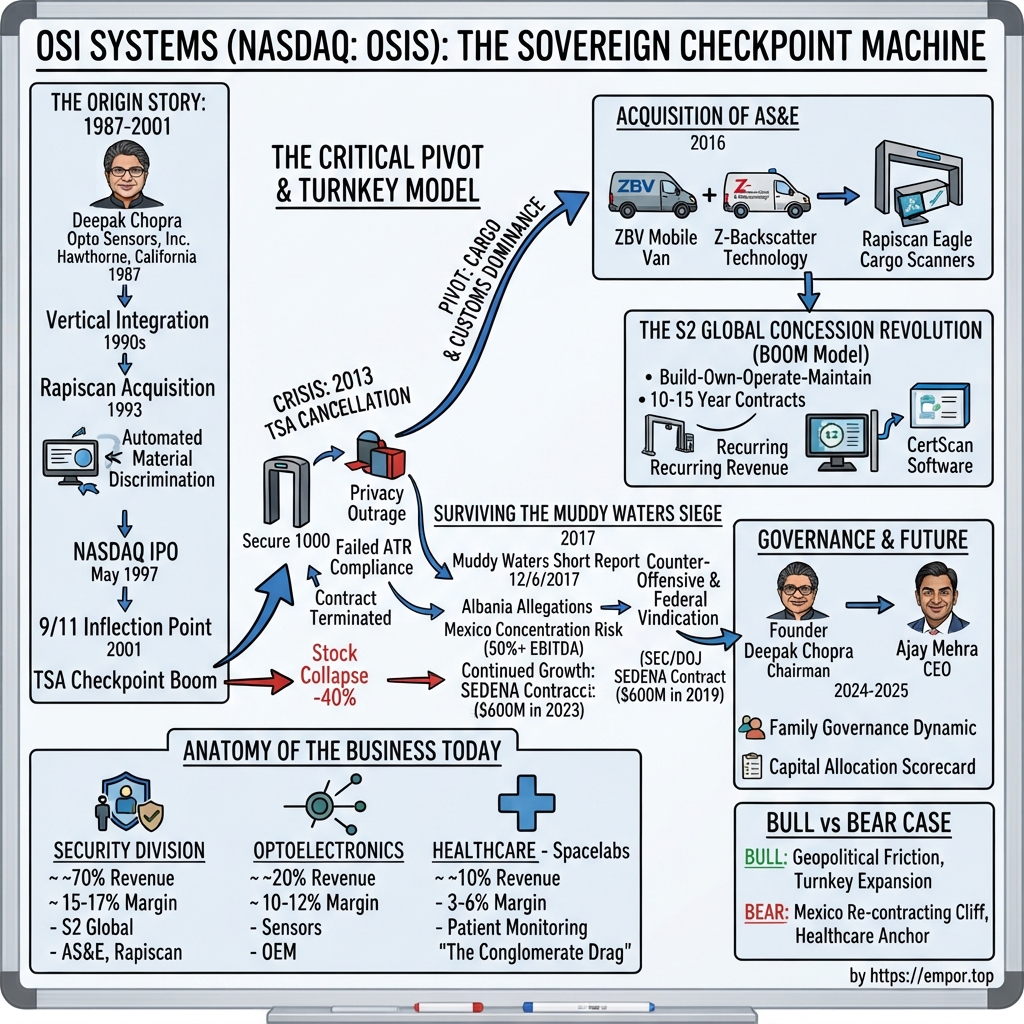
OSI Systems, Inc. (NASDAQ: OSIS): The Sovereign Checkpoint Machine
I. Prologue & Thesis Spine: The Invisible Infrastructure of Global Paranoia (00:00 – 00:15 | 15 min)
At the Colombia Solidarity Bridge outside Laredo, Texas, a tractor-trailer rolls at walking speed into a steel gantry roughly the size of an automated car wash. Inside, a linear accelerator fires high-energy X-rays through forty-five feet of steel and cargo. Eight seconds later, a customs officer sitting in an air-conditioned room—potentially hundreds of miles away—reviews a composite radiographic scan of the trailer's contents, digitally synchronized with the truck's license plate, container identification number, and electronic customs manifest. If the manifest declares automotive parts but the imaging detects dense, uniform blocks packed into the chassis wells, an automated alert flags the vehicle for physical inspection.
That integrated screening architecture—the linear accelerator, the detector arrays capturing the high-energy photons, the software stitching raw radiographic data to customs documentation, and in several jurisdictions the civilian personnel operating the checkpoint—is frequently engineered and maintained by a single vendor. It is not Lockheed Martin or Honeywell, but OSI Systems: a mid-cap contractor based in an industrial corridor of Hawthorne, California, that institutional investors rarely track closely and equity analysts have struggled for three decades to categorize.
OSI Systems concluded fiscal 2026 with $1.79 billion in revenue, up roughly 4% year over year, non-GAAP earnings per share of $10.35, record operating cash flow of $276 million, and an order backlog of approximately $1.9 billion.12 The Security division generated roughly 70% of that top line, while an optoelectronics and contract manufacturing division accounted for about 25%. The remainder—under 10%—came from a patient-monitoring business that has been a subject of strategic internal debate for two decades.1
The thesis, stated plainly, and then stress-tested. The bull case for OSI Systems rests on the premise that it is not merely a cyclical manufacturer of inspection hardware, but an operator of sovereign border infrastructure. Operating primarily through its Rapiscan Systems and S2 Global subsidiaries, the company does not simply sell scanning gantries to state agencies. Instead, it finances, constructs, staffs, and operates turnkey national inspection programs under long-term concessions spanning ten to fifteen years, standardizing operations on its proprietary CertScan software integration platform.2 In January 2012, Mexico's tax authority awarded the company a six-year turnkey inspection contract valued at roughly $400 million.4 In August 2013, the Republic of Albania signed a fifteen-year concession that OSI projected could generate $150 million to $250 million in gross revenue over its lifecycle.5 In March 2023, Mexico's Secretaría de la Defensa Nacional awarded an estimated $600 million contract for cargo and vehicle inspection systems and support services along the country's northern and southern borders.6
The economic distinction is structural: an equipment vendor books a one-off capital sale, whereas an infrastructure concessionaire collects recurring, toll-like fees for every freight container or passenger vehicle crossing a sovereign border.
Yet the operational vulnerability of this turnkey model lies in customer concentration, as its largest single deployment recently wound down. Mexico accounted for $423 million of OSI's external revenue in fiscal 2024, falling to $276 million in fiscal 2025, and dropping to $99 million in fiscal 2026—a two-year decline exceeding 75% in what had been the company's most profitable geographic market.2 On the company's August 2026 earnings call, executive management reported that the revenue contraction from the Mexican border contracts approached $150 million in fiscal 2026 alone, though the headwind was projected to narrow to "less than $25 million" in fiscal 2027.3 Despite that structural cliff, consolidated corporate revenue still managed modest growth. That divergence represents the central paradox of the business, framing the broader debate around the durability of its cash flows.
Viewed favorably, absorbing the runoff of a cornerstone international program while expanding overall revenue suggests expanding commercial breadth across domestic security and optoelectronic accounts. Viewed critically, the company has yet to demonstrate that it can secure replacement contracts offering comparable scale, margin profile, and sovereign commitment. Both interpretations find support in the company's financial disclosures, explaining why the equity has historically traded with heightened volatility.
The bear case highlights risks unique to sovereign counterparty exposure. National governments act as monopsonists possessing regulatory discretion and the authority to alter procurement mandates unilaterally. OSI experienced that exposure directly in 2013, when the Transportation Security Administration abruptly canceled and removed all of Rapiscan's backscatter passenger screening systems from major U.S. airports following operational and privacy controversies.14 The company has weathered two short-seller campaigns eight years apart, two separate securities class actions resulting in court-approved settlements, and two Department of Justice subpoenas examining its procurement activities in Mexico.23 Meanwhile, its Healthcare division generated $163 million in fiscal 2026 revenue while producing essentially zero operating income.1 Corporate governance also displays atypical concentration: the founder led the company as chief executive for thirty-seven years before handing executive leadership to his first cousin.11
Underpinning these dynamics is an essential industry reality: security contractors monetize the prevention of negative events—the weapon undetected, the narcotics undiscovered, the border breach unmade. Such preventative outcomes are difficult to value during prolonged lulls and vulnerable to budget reallocations as administrative priorities shift. Consequently, procurement demand in high-energy cargo inspection tends to be driven by geopolitical friction and legislative mandates rather than predictable corporate capital cycles.
Why Wall Street cannot categorize it. Much of the valuation discount historically applied to OSI stems from taxonomy. The company files under the Standard Industrial Classification code for semiconductors and related devices—a legacy of the optoelectronic diode business established at its founding in 1987.2 Screened against semiconductor peers, OSI appears entirely misclassified. Evaluated alongside major defense primes, it lacks aerospace scale and program diversity. Measured against medical technology peers, its healthcare unit represents a negligible, dilutive fraction of earnings. Operationally, OSI employed 7,806 people as of June 30, 2026, with 4,708 deployed in manufacturing and 1,423 in field service—a labor distribution characteristic of an industrial systems contractor rather than a software or semiconductor firm.2 In the absence of a clean peer group, valuation multiples remain unanchored, creating persistent opportunities for structural mispricing.
The corporate trajectory spans several distinct chapters: a niche optoelectronic component maker that acquired a distressed British X-ray manufacturer; the post-9/11 domestic security spending surge; the 2004 expansion into hospital patient monitors that failed to generate compounding returns; the 2013 checkpoint expulsion that forced a strategic pivot toward border logistics; the 2016 acquisition of American Science and Engineering to consolidate backscatter intellectual property; Carson Block's 2017 short thesis questioning international concession accounting; and the 2025 executive succession from Deepak Chopra to Ajay Mehra, occurring precisely as the defining Mexican concessions reached their scheduled roll-off.
Across every division, the central analytical question remains straightforward: does OSI Systems control proprietary operational assets, manufacturing know-how, or software lock-in that a well-capitalized industrial peer could not replicate over a five-year horizon? The answer varies significantly across its business lines, making the operational history essential context for evaluating the franchise today.
 Subscribe on LinkedIn
II. Origins & The Component Foundation: From Sensors to Systems (1987–2001) (00:15 – 00:35 | 20 min)
The founding story of OSI Systems contains, improbably, a Taco Bell.
Deepak Chopra—the engineer, not the author of Ageless Body, Timeless Mind—arrived in the United States from India in 1971 for graduate studies, earned a master's degree in engineering at the University of Massachusetts Amherst, and began his career at RCA Semiconductors in New Jersey. A business trip to Southern California in 1973 persuaded him to relocate permanently: first to TRW Semiconductor in Redondo Beach, then to Santa Monica-based United Detector Technology, a maker of light-sensing photodiodes, and eventually into executive leadership at its parent company, ILC Technology.12 When ILC's business contracted sharply in the aftermath of the Challenger disaster, Chopra evaluated purchasing a Taco Bell franchise. His wife's question—what, exactly, did he know about running a fast-food restaurant—steered him back to engineering.12
The company that became OSI Systems was incorporated on May 1, 1987, as Opto Sensors, Inc., adopting its current name shortly before its 1997 initial public offering.2 The founding product was utilitarian: silicon photodiodes, the semiconductor chips that convert light into an electrical current. Every X-ray scanner, pulse oximeter, and laser rangefinder requires a solid-state detector to translate optical signals into digital values. Chopra recognized that specialized photodiodes represented a high-mix, low-volume niche where reliability took precedence over commodity pricing—insulating the business from major semiconductor foundries—and that customers purchasing discrete components rarely possessed the packaging know-how to build integrated detection systems around them.
The move up the stack. Selling discrete photodiodes is a low-barrier component business constrained by gross-margin ceilings. Selling integrated subsystems—detector arrays, readout electronics, mechanical housings, and calibration software—shifts the economic model, establishing an ongoing engineering relationship rather than a commoditized part delivery. Throughout the early 1990s, OSI systematically climbed the value chain: from semiconductor chips to detector arrays, modular subassemblies, and ultimately complete instruments. That vertical integration remains central to the enterprise, explaining why an X-ray inspection provider also operates contract electronics manufacturing facilities across Malaysia, Indonesia, India, and Mexico.2
Rapiscan, 1993. The pivotal strategic turn came in 1993 with the acquisition of Rapiscan Security Products, a small British-rooted manufacturer of security X-ray systems. At the time, aviation checkpoint screening remained a low-technology sector: single-energy X-ray machines projected flat, monochrome shadowgraphs that required human screeners to visually parse silhouettes. The technical unlock OSI introduced was dual-energy radiography. The underlying physics is straightforward: transmitting X-rays at two distinct energy levels through baggage enables material discrimination. High-density metals absorb both energy beams in similar proportions, whereas low-atomic-number organic compounds—such as plastics, agricultural products, and most chemical explosives—absorb lower-energy photons far more aggressively. By comparing the two absorption profiles at the pixel level, the system determines not only an object's spatial contours but its effective atomic composition, rendering metals in blue and organic substances in orange.
Executing dual-energy imaging reliably requires detector arrays that are fast, stable, and precisely matched—the exact optoelectronic subsystems Chopra's component business manufactured.
This dynamic established the defining operational pattern in OSI's history: the company rarely invents baseline physics from scratch. Instead, it acquires an established systems vendor and supplies it with proprietary internal components, compounding the resulting cost and integration advantages. Rapiscan provided the core platform for OSI's eventual scale, acquired when the market was small and unheralded.
A subtler structural advantage emerged over subsequent decades. Because OSI manufactured its own detector arrays, its engineering teams could optimize the entire imaging chain—radiation source, detector array, readout electronics, and reconstruction algorithms—as an integrated system, avoiding the friction and margin stacking of negotiating sensor specifications with external component vendors. In an inspection industry where customers contract for detection performance and operational throughput, controlling the primary sensor array is closer to controlling an automotive powertrain than purchasing off-the-shelf hardware.
The 1997 listing. OSI completed an initial public offering on Nasdaq under the ticker OSIS in 1997. It has never paid a cash dividend since—a capital-allocation stance management restates in each annual report—directing free cash flow toward internal reinvestment, strategic acquisitions, and share repurchases.2 The offshore manufacturing infrastructure established across Southeast Asia following the IPO provided a durable cost advantage, allowing the California-headquartered contractor to price competitively against diversified industrial peers while retaining proprietary design and engineering in-house.
The stewardship of the finance function during that formative era holds direct relevance today. Ajay Mehra—who became chief executive in 2025—joined OSI as corporate controller in 1989 and served as vice president and chief financial officer from November 1992 to November 2002.11 The company's chief executive was thus a primary architect of the financial structure, international subsidiaries, and balance-sheet discipline that govern the business, concentrating three decades of institutional memory in the executive suite.
Then September 11, 2001. The passage of the Aviation and Transportation Security Act in November 2001 created the Transportation Security Administration and established an unprecedented domestic market for checkpoint screening equipment virtually overnight. For a contractor possessing qualified dual-energy X-ray systems and domestic assembly infrastructure, the regulatory mandate represented an extraordinary procurement surge. Rapiscan emerged as one of a small cadre of qualified prime vendors alongside Smiths Detection and InVision Technologies.
The immediate financial impact proved transformative, accelerating revenue and expanding operating cash flows. Yet public markets largely misconstrued the structural nature of that demand. The post-9/11 checkpoint buildout did not represent an open-ended secular growth market; it was a front-loaded, federally financed national retrofit. Once initial airport deployments concluded, procurement settled into an extended maintenance plateau punctuated by periodic technology refreshes. Equipment providers that built fixed operating overhead on the assumption that peak installation rates would endure faced severe margin compression when procurement normalized.
The windfall established scale, operating liquidity, and prime-contractor credentials across federal procurement agencies. What it failed to confer, however, was an unassailable economic moat. The primary counterparty remained a sovereign monopsonist with the unilateral authority to dictate technical standards, award follow-on tranches to competitors, or decommission installed equipment entirely—a structural vulnerability that would manifest dramatically eleven years later.
III. Conglomerate Building & The Spacelabs Quagmire (2004–2012) (00:35 – 00:55 | 20 min)
By late 2003, OSI faced a dilemma common to cash-rich defense contractors: surplus capital paired with a single dominant end-market whose procurement budget was dictated by congressional appropriations.
Management sought diversification through medical technology. In January 2004, OSI agreed to acquire Spacelabs Medical—an Issaquah, Washington-based manufacturer of patient monitors, telemetry, and cardiology equipment—for approximately $57 million in cash. The transaction closed on March 19, 2004, at roughly $48.5 million net of cash acquired.13 The seller was Instrumentarium, which GE Medical Systems had just absorbed; antitrust regulators had required GE to divest Spacelabs globally as a condition of clearance.13 OSI was, in effect, purchasing a regulatory orphan—an asset a well-capitalized strategic acquirer was legally barred from retaining.
That distinction matters. Acquiring a business forced onto the auction block by regulators can yield an undervalued asset, but it can also saddle the buyer with an operation the seller did not value enough to preserve. Distinguishing between those two realities is the central test of such acquisitions, and the answer is revealed only in the operational aftermath.
The synergy thesis. On paper, the industrial logic appeared compelling. Patient monitors are fundamentally sensor and signal-processing instruments. OSI already manufactured optical sensors and operated low-cost electronics manufacturing facilities across Asia. Shifting Spacelabs' assembly into OSI's Asian plants while cross-pollinating optical and analog engineering teams held the promise of lowering production costs while differentiating products. Hospitals were transitioning to digital systems, and buying the business at roughly half of annual revenue looked like an asymmetric bargain.
The disconfirming record, in full. More than two decades later, the operational results are unequivocal. In fiscal 2026, the Healthcare division produced $162.7 million in revenue—down from roughly $211 million in fiscal 2016 and substantially below the $256 million posted in fiscal 2015—while generating essentially zero in GAAP operating income, compared with $2.5 million in fiscal 2025.1
Over the past decade, the division has undergone repeated restructurings; fiscal 2026 alone included $4.2 million in non-recurring charges allocated to Healthcare out of $16.6 million in company-wide impairment and restructuring expenses.2 Segment revenue declined again in fiscal 2026, driven by a $9.6 million drop in patient-monitoring sales alongside lower service and supply volumes, which were only partially offset by modest gains in cardiology.2
By contrast, the Security division expanded over that same decade from roughly $411 million in fiscal 2016 to $1.25 billion in fiscal 2026, delivering a 16.1% GAAP operating margin.1 The managerial attention and capital absorbed by Healthcare sustained an enterprise that is smaller today than when OSI's core security business was one-third its current size.
The root cause of that underperformance is structural rather than execution-driven. Patient monitoring is not primarily a sensor-hardware business; it is a clinical-workflow and enterprise-IT discipline. Hospitals procure monitoring fleets based on how seamlessly they integrate with electronic health records, nurse-call architectures, enterprise alarm-management protocols, and existing bedside equipment. Scaled incumbents prevail because they offer deep software integration and the organizational stability of decade-long institutional support agreements. OSI's manufacturing advantage—producing reliable sensor assemblies at low cost—addressed perhaps fifteen percent of the procurement decision.
The mitigating factor is that Spacelabs never endangered corporate solvency. The purchase price represented roughly a tenth of what OSI would eventually allocate to acquire American Science and Engineering, and the division has avoided catastrophic goodwill write-downs. The drag was chronic rather than acute—the primary reason the asset remained within the portfolio for twenty-two years without forcing a strategic divestiture.
The falsification verdict. The historical record refutes the original operating-synergy thesis. Asian manufacturing footprint and sensor-level engineering failed to create a structural edge in medical devices. Instead, OSI acquired a sub-scale participant exposed to hospital capital expenditure cycles, competing against GE HealthCare and Philips at the high end and Mindray Medical on cost. Two decades is sufficient duration to evaluate a synergy hypothesis.
A nuanced counterpoint emerged in the fourth quarter of fiscal 2026, when Healthcare revenue increased approximately 5% year over year and the division's operating margin rose to 10% from 1% in the prior-year period.1 Chief Financial Officer Alan Edrick framed the result with appropriate discipline on the earnings call, observing that while management would not extrapolate a single quarter, the print demonstrated the division's margin sensitivity as volumes expand.3 That assessment highlights the unit's latent operational leverage, yet the segment has never established durable top-line expansion. The decisive benchmark going forward is not single-quarter margin volatility, but whether Healthcare revenue can sustainably surpass its prior-decade highs.
Beyond the segment financials lies a subtle corporate cost. For two decades, senior management, the board of directors, and corporate research-and-development budgets routinely allocated resources to an operating unit generating negligible operating income. Conglomerate discounts are typically analyzed as valuation multiples, but they originate as dilution of executive focus that eventually manifests on the income statement.
That dynamic reveals the central paradox of the conglomerate structure. Assembled to buffer the cyclical volatility of sovereign defense procurement, the medical business instead imposed a continuous margin drag just as OSI approached the most precarious juncture in its corporate history: the moment its cornerstone sovereign customer abruptly withdrew its business.
IV. The TSA Checkpoint Disaster: The Day Rapiscan Was Expelled (2012–2014) (00:55 – 01:20 | 25 min)
On Christmas Day 2009, a passenger aboard Northwest Airlines Flight 253 attempted to detonate explosives concealed in his underwear. Standard metal detectors failed to identify the threat because the explosive assembly contained no metallic components. Within months, the Transportation Security Administration committed to deploying Advanced Imaging Technology across domestic commercial airports—full-body scanning systems capable of identifying non-metallic contraband concealed against the passenger's body.
Two competing technical architectures divided the procurement program. L-3's ProVision relied on millimeter-wave radio frequencies, which reflect off the surface of human skin. Rapiscan's Secure 1000 utilized backscatter X-ray technology, which projects a low-dose X-ray pencil beam and records the photons that scatter backward rather than penetrate through the subject. Backscatter yielded a significantly sharper, high-contrast radiographic image. That optical clarity was its primary commercial selling point—and, ultimately, the root of its downfall.
The privacy revolt. The anatomical fidelity of backscatter imaging produced scans that closely resembled photographic nudes. By 2011, passenger backlash had escalated into an organized civil-liberties dispute, prompting Congress to intervene. Lawmakers mandated a statutory deadline: every body scanner deployed across federal checkpoints had to incorporate Automated Target Recognition software—an algorithmic filter that suppresses anatomical imagery entirely, displaying only a generic stylized mannequin with highlighted boxes indicating anomaly locations—or be removed from service.
Developing automated recognition algorithms proved far more complex on backscatter systems than on millimeter-wave platforms. Because a backscatter scan captures intricate textural detail with substantial informational density, the algorithm must reliably distinguish innocuous anatomical variations from genuine security threats, such as a ceramic blade. L-3 developed an approved algorithm that satisfied federal standards; Rapiscan was unable to deliver an algorithm that passed TSA qualification within the statutory window.
That impasse illustrates a fundamental procurement reality: OSI did not falter because of deficient baseline engineering, but because it pursued an imaging architecture that required solving an intractable algorithmic challenge under an inflexible legislative deadline. Selling to a sovereign regulator entails a persistent structural risk: technical specifications can be altered mid-program, converting a product's primary competitive advantage into an operational disqualifier. A rival system offering lower-resolution imagery provided a simpler path to regulatory compliance, and consequently captured the market.
January 2013. In January 2013, the TSA terminated the deployment contract and initiated the removal of Rapiscan's installed equipment. Approximately 250 units were decommissioned—174 actively operating across roughly thirty commercial airports and another 76 held in reserve inventory—and replaced with millimeter-wave scanners.1415 The federal agency stipulated that Rapiscan would absorb the decommissioning and transport expenses.15 The domestic airport passenger-screening market shifted entirely to a competitor, and Rapiscan was unable to recover its checkpoint footprint.
The second strike. Eleven months later, in December 2013, congressional scrutiny intensified. The House Committee on Homeland Security questioned the TSA regarding allegations that approximately 250 of Rapiscan's Advanced Technology carry-on baggage scanners contained Chinese-manufactured subassemblies that had not undergone formal federal qualification and security clearance.16 In response, the TSA halted a pending delivery order for approximately 550 additional carry-on screening systems valued at roughly $60 million.16 Rapiscan's aviation president, Brad Buswell, publicly challenged the characterization, maintaining that the company had notified the TSA of its intention to incorporate Chinese-produced X-ray generators and describing the component as "a simple electrical item with no moving parts or software"—analogous to an industrial X-ray light bulb.17
Regardless of the component-level technical merits, the strategic outcome was decisive: within a twelve-month period, an administrative decision by a single sovereign customer had twice eliminated OSI from major domestic security programs.
The shareholder consequences. The administrative disruptions triggered immediate legal action. On December 12, 2013, shareholders initiated a securities class action in the U.S. District Court for the Central District of California, Roberti v. OSI Systems, Inc. Following court-ordered mediation, OSI settled the litigation for $15.0 million—funded through corporate insurance policies—and the district court approved the final settlement on December 21, 2015, without any admission of corporate liability or wrongdoing.18 Related shareholder derivative lawsuits against the board of directors followed.18
The financial impact was evident in the company's operating performance. Corporate revenue, which had reached $958 million in fiscal 2015, contracted 13% to $830 million in fiscal 2016, with Security division revenue falling from $481 million to $411 million and consolidated operating income declining by more than half.32 For an enterprise that had compounded capital on post-9/11 domestic airport security spending, the cancellations demonstrated that federal procurement growth rested on a concentrated, revocable counterparty. This balance-sheet contraction provided the immediate financial backdrop for the corporate strategy that followed: OSI pursued cargo inspection acquisitions not from an expansionary footing, but to offset shrinking domestic screening revenue.
Falsification: is government certification a moat? Prior to 2013, the prevailing bull thesis assumed that technical qualification on the TSA's qualified products list constituted a durable competitive barrier. Testing that assumption against the historical record reveals the structural mechanism capable of breaching it: the unilateral authority of the sovereign customer.
The empirical record reframes the nature of regulatory approval. Certification was not lost because a competitor introduced superior imaging hardware; it evaporated because procurement mandates shifted, OSI could not satisfy the revised software criteria on schedule, and administrative questions emerged regarding its offshore supply chain. In both instances, the government exercised its authority immediately and without an open competitive reprocurement. Regulatory qualification functions not as a proprietary moat, but as an administrative license to bid—essential and valuable, yet subject to unilateral revocation.
A narrower version of the thesis remains defensible: regulatory qualification combined with an installed operational base and specialized field-service infrastructure creates meaningful switching friction, given the capital expense and logistical complexity of replacing deployed industrial screening gantries. Yet even that installed base failed to protect OSI in 2013, as the agency absorbed the disruption of physically extracting the equipment. What preserved the enterprise was revenue diversification outside passenger checkpoints.
This historical episode remains directly applicable to current operations. In fiscal 2026, OSI's Security division recorded approximately $207.3 million in direct sales to the U.S. government, and executive leadership highlighted anticipated funding allocations from the Department of Homeland Security as a prospective growth catalyst.23 Investors evaluating that outlook must balance management's optimism against the operational lessons of 2013: federal agencies represent both OSI's most lucrative customer channel and a counterparty with an established history of decommissioning installed programs by administrative directive.
Navigating that vulnerability governed the company's strategic acquisitions over the following decade.
V. The Turning Point: The AS&E Acquisition & Cargo Dominance (2014–2016) (01:20 – 01:45 | 25 min)
Losing a core market clarifies strategic priorities. In the aftermath of the TSA expulsion, OSI's executive leadership made a decision that appears logical in retrospect but carried significant execution risk in 2014: halt efforts to regain the domestic passenger checkpoint and pivot decisively toward scanning the freight crossing sovereign borders in trucks, shipping containers, and rail cars.
The commercial rationale diverged fundamentally from aviation. Domestic airport screening operates as a mature, standardized, single-buyer market dominated by regulatory monopsonists. Cargo and vehicle inspection presents the opposite dynamic: a fragmented international landscape of customs authorities, port operators, defense ministries, and border agencies. Most of these entities inspect only a low single-digit percentage of inbound freight, yet face persistent political and security pressures—stemming from narcotics interdiction, contraband smuggling, tariff evasion, and weapons proliferation—to expand inspection coverage.
Critically, the economic incentive for the buyer differs as well. An airport checkpoint functions purely as an operational overhead cost. A customs scanner, by contrast, operates as a revenue-generating instrument: detecting misclassified or undervalued commercial cargo directly increases customs duties and tariff receipts. Providing hardware and software that can fund itself through sovereign tax collections offers a far more resilient commercial model than selling equipment designed exclusively to prevent low-probability security incidents.
High-energy cargo screening also presented technical barriers that protected margins. Detecting contraband or shielded threats inside a dense, forty-foot steel shipping container requires high-energy linear accelerators and complex imaging reconstruction—engineering challenges that limit the field to a handful of credible global prime contractors. Passenger checkpoints, conversely, had largely commoditized into a standards-compliance exercise, where prescriptive government specifications dictated system architecture and low-cost manufacturing often determined contract awards.
Consolidating backscatter: AS&E. The enterprise that defined the complementary half of the non-intrusive cargo inspection market was American Science and Engineering (AS&E), based in Billerica, Massachusetts. Originating from researchers associated with the Massachusetts Institute of Technology, AS&E commercialized backscatter X-ray technology into two signature platforms: the Z Backscatter Van, a mobile screening vehicle engineered to scan adjacent passenger cars and cargo vans while driving past, and the MINI Z handheld screening device.9 AS&E's technical architecture resolved an operational limitation inherent in high-energy transmission radiography: identifying low-density organic contraband concealed within thin structural voids—such as automobile doors, fuel tanks, or spare tires—where high-energy beams pass straight through with minimal attenuation. Because backscatter detectors capture Compton-scattered photons reflected back toward the radiation source, organic compounds concealed against dense metallic backgrounds register with high contrast.
Yet by 2016, AS&E was struggling as an independent public company. For its fiscal year ended March 31, 2016, net sales and contract revenues declined 19% to $103.0 million from $126.8 million, and the business swung to a net loss of $3.2 million from a modest net income in the prior year, as cargo system deliveries dropped and an expeditionary military support contract in the Middle East expired.19 The company illustrated a structural vulnerability common to sub-scale defense contractors: proprietary technology paired with an unpredictable, project-driven order pipeline and insufficient operating revenue to comfortably support the overhead of a stand-alone public listing.
For a strategic acquirer, that dynamic presented an attractive entry valuation. Rather than underwriting speculative top-line expansion, OSI could acquire an established technology franchise and a blue-chip sovereign client roster when public equity markets had discounted the target's cyclical trough. The operational risk lay in evaluating whether that revenue volatility was cyclical or secular—specifically, whether expeditionary military demand had disappeared permanently without a commercial replacement. OSI's thesis presumed that demand was not evaporating, but migrating: shifting away from temporary military deployments toward permanent civilian border checkpoints and sovereign customs infrastructure.
The transaction. On June 20, 2016, OSI and AS&E entered into a definitive merger agreement under which OSI agreed to acquire AS&E for $37.00 per share in cash.20 The transaction closed on September 12, 2016, for an aggregate purchase price of approximately $269 million, including the assumption of unvested equity awards.9 The acquisition cleared U.S. antitrust review and concluded in under three months without required divestitures. The regulatory clearance was notable: the merger united the market's primary high-energy transmission cargo inspection portfolio with its dominant backscatter provider. Antitrust authorities implicitly defined the relevant product market broadly, acknowledging competitive pressure from global rivals including Smiths Detection, L-3 Communications, and state-backed international suppliers such as China's Nuctech.
Evaluating the integration against the financial record. OSI did not break out post-merger cost synergies in subsequent periodic reports, rendering third-party synergy estimates unverifiable. The corporate disclosures, however, provide clear empirical evidence of the transaction's financial trajectory. Revenue in the Security division expanded from approximately $411 million in fiscal 2016 to $555 million in fiscal 2017, climbed to $690 million in fiscal 2018, and ultimately reached $1.25 billion by fiscal 2026.1 Consolidated gross margin told a different story: after printing at 33.3% in fiscal 2016 on $830 million in total corporate revenue, it stood at 33.2% in fiscal 2026 on $1.79 billion in top-line revenue.1 The acquisition delivered substantial scale and volume expansion, but it did not fundamentally alter corporate gross margins.
Operating leverage manifested instead through administrative overhead. Selling, general, and administrative expenses combined with research and development costs as a percentage of revenue declined in eight consecutive fiscal years, according to management statements on quarterly earnings calls.3 That multi-year operational efficiency indicates that management absorbed AS&E's corporate overhead and scaled international cargo operations without inflating central corporate expenses.
The strategic consequence proved even more consequential than the operating efficiencies. Prior to 2016, a sovereign customs authority negotiating with OSI could acquire high-energy transmission systems, but had to contract with a separate vendor for backscatter inspection. Post-acquisition, OSI could address the complete spectrum of sovereign border screening requirements—from high-density shipping containers and occupied passenger vehicles to thin structural voids, mobile drive-by sweeps, and handheld inspection—under a single prime-contractor umbrella. In government procurement, where agencies increasingly favor single-vendor accountability to eliminate operational disputes among competing contractors, portfolio breadth functioned as an effective competitive barrier. That integrated capability, rather than manufacturing cost synergies, represented the core strategic asset OSI acquired.
The period also contained an accounting anomaly that warrants clarification. OSI reported a GAAP net loss in fiscal 2018—its only unprofitable fiscal year in modern operating history. The shortfall was non-operational, driven by the enactment of the Tax Cuts and Jobs Act of 2017. The legislation triggered an estimated $56 million discrete tax expense, or $2.96 per diluted share, in the quarter ended December 31, 2017, reflecting the mandatory transition tax on accumulated unremitted foreign earnings and the revaluation of net deferred tax assets.31 Excluding that statutory tax charge, underlying operational profitability remained intact.
By 2017, OSI had assembled the broadest non-intrusive inspection hardware portfolio in the security industry. Yet the most profitable and fastest-growing component of its corporate architecture was not an imaging instrument at all—a distinction that soon attracted the scrutiny of an activist short seller in San Francisco.
VI. The Short-Seller Siege: Muddy Waters, S2 Global & The Turnkey Model (2017–2020) (01:45 – 02:15 | 30 min)
Start with the business model, because the attack only makes sense once you understand it.
The concession insight. A high-energy cargo inspection portal is a capital asset that can cost a few million dollars, and a national program needs dozens of them plus civil works, power, connectivity, staffing and maintenance. For a mid-income customs authority, that is a nine-figure capital request competing against schools and roads inside a constrained budget. OSI's answer, marketed under the S2 name, inverted the transaction: the company would fund and build the infrastructure, install its CertScan integration platform, hire and train the operators, run the sites, and be paid over ten or fifteen years out of operating budget or per-scan fees.2
For the customer, capital expenditure becomes an operating line item and the vendor absorbs the execution risk.
For OSI, a one-time equipment sale becomes a decade of contracted revenue at higher margins than hardware. In the security world this is closer to a toll road than to a manufacturing business — and it is the reason the company's service revenues, $441 million in fiscal 2026 and growing 13% year over year, matter more to the margin story than product revenues do.13
CertScan, in plain terms. The software is the thing that makes the model defensible. A customs officer looking at a raw X-ray image has an interpretation problem. CertScan fuses the image with optical character recognition of the license plate and container number, the electronic manifest, radiation-portal readings, and the site's own case history, and presents them on one screen — which in turn allows centralized remote review, so a national program can concentrate its best image analysts in one room instead of stationing them at forty crossings. Once that platform is wired into a country's customs and revenue IT systems, replacing it is not a procurement decision; it is an IT migration that risks stopping trucks at the border.
Where the model has been replicated. The Mexico and Albania programs get the attention, but the pattern extends further. In January 2019, OSI announced a ten-year turnkey cargo screening contract in Guatemala, covering the Port of Santo Tomás de Castilla.26 A comparable ten-year turnkey award followed in Uruguay.27 The company's own description of its turnkey business in the fiscal 2026 annual report now spans "the construction, staffing and long-term operation of security screening locations."2 So the model is repeatable — but note the size distribution. These are ports and small national programs, materially smaller than the Mexican border build. Replication has been real and incremental; it has not yet produced a second contract of Mexican scale.
December 6, 2017. Muddy Waters Research, run by Carson Block, published a short thesis on OSI Systems.7 The allegations were specific. On Albania: that OSI had transferred 49% of the project company holding the fifteen-year concession to a holding company owned by an Albanian doctor for consideration of less than $5.00 — which Block characterized publicly as evidence of a kickback.7 On Mexico: that a single turnkey contract generated 50–55% of OSI's EBITDA on roughly 15% of revenue, implying an EBITDA margin near 55% on that contract against roughly 7.5% for everything else, and that it had been won and priced irregularly.7
The stock fell 29.2% that day, closing at $59.52.8 OSI publicly rejected the report as misleading, stating that its programs in both Mexico and Albania resulted from public tenders and had produced increased contraband seizures and improved customs transparency.8
How it resolved. On June 5, 2019, OSI announced that the Department of Justice and the Securities and Exchange Commission had each informed the company they had closed their respective FCPA investigations.21 No enforcement action followed from either agency. The parallel securities class action, led by the Arkansas Teacher Retirement System on behalf of purchasers between August 21, 2013 and February 2018, was resolved for $12.5 million in cash without any admission of wrongdoing.22
Now the falsification test, done properly. The interesting question is not whether Block was right about the Albanian share transfer — federal regulators looked and declined to act, which is meaningful but is not the same as an affirmative finding of clean conduct. The interesting question is the structural one Block raised, which is whether a turnkey concession is a durable annuity or a fragile political arrangement.
Run that test through the mechanism that would actually break it: political regime change in the host country.
Mexico is the ideal laboratory, because the customer literally changed identity. The original program sat with the civilian tax and customs authority. Under the Andrés Manuel López Obrador administration, border customs was militarized, and the contracting counterparty became the defense ministry. A concession that depended on relationships with a particular civilian agency should have died. Instead, in March 2023, SEDENA awarded OSI approximately $600 million — inclusive of 16% value-added tax — for Eagle high- and low-energy cargo portals, Carview vehicle inspection systems, CertScan integration, civil works, training and follow-on maintenance at Mexican customs checkpoints on both borders.6 The turnkey franchise survived a change of government and a change of ministry.
That is genuine evidence for resilience. But here is the disconfirming evidence that must sit in the same paragraph, because it is decisive: the Mexico program is not an annuity. It behaved like a large, finite construction project. Mexico revenue peaked at $423 million in fiscal 2024 and fell to $99 million by fiscal 2026.2 Gross margin fell in fiscal 2026 specifically because Mexico revenue, which "generated margins above the division average," declined by $148.8 million and was replaced by lower-margin business.2 And the receivable was enormous and slow: OSI's Mexican customer balance stood at $345 million at the end of the March 2026 quarter — 40% of the entire company's accounts receivable — before a $159 million collection in the June quarter brought it to $190 million, or 25%.3
There is also an unresolved disclosure overhang from this same theatre. OSI's fiscal 2025 annual report disclosed that a subsidiary received a DOJ subpoena in February 2023 as part of a case against a former employee for conduct predating his hire, seeking records relating to "the Company's business dealings in Mexico since 2020," followed by a second subpoena in February 2024 extending the period.23 In March 2025, Culper Research published a short report arguing that OSI's Mexico growth was "largely an illusion" and that the company had downplayed the DOJ investigations through vague disclosure, also asserting a September 2024 subpoena concerning entities in Honduras; the stock fell 3.5% that day.24
Notably, the fiscal 2026 annual report's legal proceedings note contains only ordinary-course language and no longer describes those subpoenas, and no public announcement of a formal closure appears in the company's fiscal 2026 filings.2 Investors should treat that as a disclosure change of unknown significance rather than as evidence the matter concluded favorably.
Myth vs. reality, on the three narratives that dominate this name.
Myth: OSI is a recurring-revenue services business dressed as a hardware company. Reality: it is becoming one, unevenly. Service revenue reached $441 million in fiscal 2026 against product revenue of $1.34 billion — roughly a quarter of the total, up from about 22% two years earlier.1 Directionally right, but three-quarters of revenue still turns over with each order cycle.
Myth: the short sellers were proven wrong. Reality: the corruption allegations produced no enforcement action from either federal agency after multi-year investigations, which is a meaningful outcome.21 The concentration allegation — that one contract carried a disproportionate share of profit and would not last — has been substantially borne out by the subsequent geographic revenue disclosures.2
Myth: the Mexico decline is a temporary trough before the next big award. Reality: management has neither guided to nor announced a replacement of comparable size, and its fiscal 2027 framing rests on U.S. federal orders, RF defense work and service growth — not on a new sovereign concession.3 Any thesis that assumes a Mexico-scale award recurs on a schedule is assuming something the company itself has not said.
Verdict. The history confirms a narrowed version of the moat claim. Turnkey concessions are more resilient to political change than a skeptic would predict, because customs inspection is revenue-generating infrastructure a state cannot easily switch off. But they are programs, not annuities: they ramp, peak, and decline, they concentrate receivable risk in a single sovereign counterparty, and they carry compliance exposure that has twice drawn federal scrutiny. The KPI that adjudicates this going forward is whether Security service revenue keeps compounding at double digits as the Mexico installed base rolls off warranty — management guided to exactly that for fiscal 2027 — because that, and not the next big project award, is what would convert a project business into a recurring one.3
VII. Anatomy of the Business: Sizing the Engine by Segment (02:15 – 02:40 | 25 min)
Strip away the narrative, and OSI Systems operates as three distinct businesses with sharply divergent investor profiles joined on a single balance sheet.
Security: the engine. In fiscal 2026, the Security division generated $1,247.9 million in revenue, up $51.8 million year over year, delivering a 16.1% GAAP operating margin—down from 17.1% the prior year primarily because high-margin Mexican product deliveries rolled off.1 On a non-GAAP basis, however, the division's fourth-quarter operating margin expanded to 20.8% from 20.4%, indicating that underlying mix improved even as its most lucrative sovereign deployment contracted.3
The operational shift within Security centers on revenue composition. Growth in fiscal 2026 was driven entirely by service revenue generated across an expanding installed base of cargo, vehicle, aviation, and checkpoint systems. Product revenue remained flat, as expanding radio-frequency system deliveries offset the contraction in Mexico.2 Consolidated service revenue reached $441 million, and executive leadership projected "strong double digit growth" in fiscal 2027 as equipment deployed under the Mexican buildout exits warranty and converts into billable maintenance.13
The radio-frequency unit represents one of the fastest-evolving components of the portfolio. Operating out of manufacturing facilities in Texas, OSI's RF business engineers high-power transmission subsystems for defense applications. In fiscal 2026, the unit secured an undefinitized contract action with a not-to-exceed value of approximately $235 million for the production and integration of homeland-defense over-the-horizon radar transmit subsystems—the largest RF award in corporate history—roughly 80% of which was booked into backlog during the third quarter.3 The company was also selected for the Missile Defense Agency's SHIELD indefinite-delivery/indefinite-quantity (IDIQ) vehicle supporting the Golden Dome missile-defense initiative, a contract carrying a headline ceiling of $151 billion over ten years across roughly 2,400 awardees.25 That program ceiling carries no guaranteed funding on its own, as selection merely confers the right to bid on future task orders. The commercially substantive figure remains the $235 million radar contract already largely committed to backlog.
Following the close of the fiscal year, U.S. Customs and Border Protection awarded OSI two sole-source, five-year IDIQ contracts funded under 2025 reconciliation legislation: one carrying a ceiling of roughly $200 million for relocatable passenger-vehicle inspection systems, and another at approximately $85 million for van-mounted mobile X-ray systems. Initial task orders have commenced, including an award of roughly $21 million.3 Management maintained conservative disclosure discipline regarding contract mechanics, emphasizing that only funded delivery orders enter backlog rather than nominal program ceilings, with the preponderance of revenue anticipated in fiscal 2028 and beyond.3
The major-events franchise. Large-venue and global event security represents a specialized niche within the division. OSI has provided screening infrastructure for the FIFA World Cup, the Paris Olympic Games, and the Milan Winter Games; on August 19, 2026, Rapiscan was designated the official physical screening and security technology hardware and software solutions provider of the LA28 Olympic and Paralympic Games, as well as an official supporter of Team USA.330
Direct revenue from an individual athletic tournament is seldom large enough to materially influence a $1.8 billion enterprise. The commercial value is reputational and infrastructural: these deployments serve as high-visibility operational benchmarks cited in subsequent sovereign procurement tenders, while frequently leaving behind an installed base of screening equipment that persists in the host city long after the closing ceremony. While Mehra's assertion on the August earnings call that "few companies have a comparable track record at this scale" reflects executive positioning, it is supported by documented prime-contractor deployments at premier international events.3
Optoelectronics: the quiet compounder. The Optoelectronics and Manufacturing division delivered the company's strongest operational consistency in fiscal 2026, expanding revenue 9% to $450.8 million with a 12.7% GAAP operating margin, while its non-GAAP fourth-quarter margin reached 14.7%, compared with 13.6% in the prior-year period.13 The segment fulfills two distinct operational functions. Internally, it manufactures the photodiode detector arrays and readout electronics incorporated into Rapiscan and AS&E scanners—providing vertical integration that compresses engineering lead times and retains component-level margins within the consolidated entity. Externally, it supplies custom engineered subassemblies and contract manufacturing services to aerospace, defense, medical, semiconductor, and industrial clients from production facilities across the United States, the United Kingdom, Canada, India, Indonesia, Malaysia, and Mexico.2
The external business has benefited from structural supply-chain realignments as original equipment manufacturers diversify manufacturing outside of China. Management reported that new commercial customers have relocated production into OSI's Southeast Asian, Indian, North American, and expanded Mexican plants, with Edrick attributing margin expansion to "a stronger customer profile."325 The analytical caveat rests on industry structure: contract electronics manufacturing is historically characterized by thin margins, modest switching costs, and customer concentration. An operating margin between 12% and 15% represents upper-quartile performance for contract assembly, suggesting that margins are more likely to encounter mean reversion than sustain continuous expansion.
Healthcare: the unresolved question. Generating $162.7 million in fiscal 2026 revenue with negligible GAAP operating income, the Healthcare division represents under 10% of corporate top-line sales and generates no net operating profit.1 Management defends the segment on grounds of revenue diversification and shared electronics manufacturing. For institutional investors, however, the division presents an ongoing capital allocation puzzle: it absorbs research-and-development expenditures, consumes managerial bandwidth, incurs recurring restructuring charges, and dilutes consolidated operating margins. With OSI continuing to invest in a next-generation patient monitoring platform,3 an investor is entitled to ask why an enterprise holding a $1.9 billion security backlog continues to finance product refreshes against entrenched medtech giants like GE HealthCare and Philips.
The balance sheet, which changed materially. In November 2025, OSI completed an offering of $575.0 million of 0.5% convertible senior notes due February 2031, featuring an initial conversion rate of 2.8263 shares per $1,000 principal amount, representing a maximum potential issuance of approximately 1.63 million common shares.2 Management deployed the net proceeds to retire revolving credit borrowings and lower corporate interest expense. The company concluded fiscal 2026 with $360 million in cash and equivalents—compared with $106 million twelve months prior—zero revolving credit borrowings, and net debt leverage of approximately 2.1 times under its bank facility covenants.3 OSI deployed that balance-sheet liquidity aggressively toward capital returns, repurchasing 1.1 million common shares across the fiscal year, including roughly 565,000 shares in the fourth quarter at an average purchase price of about $219 per share, while the board authorized an additional one million shares for future repurchase.13 Common shares outstanding fell to 15.94 million by August 17, 2026, down from a weighted-average diluted count of 17.3 million during fiscal 2026—a meaningful reduction in total equity capitalization.2
The convertible note offering warrants objective evaluation. While a 0.5% coupon provides inexpensive debt service, convertible debt represents an implicit forward equity sale at a defined strike price. Pairing a convertible offering with concurrent share repurchases constitutes a leveraged bet by management that the common equity was undervalued at the time of execution. That valuation assessment has faced immediate market headwinds: the aggregate market value of common stock held by non-affiliates was approximately $4.02 billion at December 31, 2025—the measurement date disclosed in the fiscal 2026 annual report—and the shares have traded materially lower since.2 Executing share repurchases alongside a convertible issuance concentrates capital outcomes on management's assessment of intrinsic value versus market pricing—a judgment that will ultimately be tested over the five-year duration of the notes.
A note on accounting judgment. For equity analysts, the most sensitive accounting estimate across OSI's financial statements involves percentage-of-completion revenue recognition on multi-year turnkey concessions, where complex performance obligations extend across a decade and counterparty risk is concentrated in a single sovereign agency. The company's independent auditor is Grant Thornton LLP, whose reappointment was submitted to shareholders at the December 2025 annual meeting.11 In its fiscal 2026 commitments disclosure, OSI reported maximum potential exposure of approximately $102 million on outstanding performance bonds—the financial guarantees required by sovereign customs authorities to secure project execution and operational availability—with no pending claims and no recorded liability.2 While customary for turnkey infrastructure contracting, these bonding commitments illustrate where institutional investors should scrutinize financial notes rather than headline releases.
VIII. Strategic Moat Analysis: 7 Powers & Porter's Five Forces (02:40 – 03:00 | 20 min)
If an industrial competitor set out to design an alternative to OSI Systems from scratch, what barriers would impede it?
The initial answer is straightforward: not baseline physics. Dual-energy transmission imaging is well-understood technology practiced by several credible global manufacturers. Linear accelerators can be procured on the open market, and photodiode detector arrays can be sourced from merchant foundries. A well-capitalized industrial entrant with patient capital could assemble a technically competitive cargo scanner within several years.
What an entrant cannot easily replicate is the remainder of the operating stack: the decades of sovereign qualification credentials, an expansive field-service network, proprietary software deeply integrated into customs clearance workflows, and the balance-sheet tolerance required to underwrite a foreign state's border infrastructure across decade-long concessions. That operational layer is where durable competitive differentiation resides, making it essential to evaluate each component separately rather than treating the company's moat as a monolithic barrier.
Process Power—the strongest operational claim. Operating a sovereign border inspection lane is fundamentally a logistical challenge disguised as a physics problem. A commercial port of entry that experiences bottlenecks imposes severe economic costs on the host country by the hour. Consequently, an operator must sustain continuous freight throughput at an exacting cycle time while maintaining rigorous threat-detection standards across rotating shifts, in extreme environmental conditions, utilizing locally hired personnel over many years.
Standard equipment manufacturers rarely possess this operational capability, while general systems integrators lack proprietary imaging technology. OSI spent more than a decade integrating both functions. The empirical evidence supporting this operational capability is that host governments have repeatedly renewed and extended turnkey programs rather than re-tendering deployments to lower-cost hardware vendors. The disconfirming counter-evidence is that this capability remains concentrated across a small portfolio of sovereign programs, and revenue from its largest deployment contracted by more than three-quarters in just two years.
Cornered Resource—the weakest structural claim. Backscatter patents inherited from the AS&E acquisition remain commercially valuable, and the mobile Z Backscatter Van platform occupies a genuinely differentiated niche in vehicle screening. Yet patents inevitably expire, and the more decisive operational lesson occurred in 2013: superior backscatter physics provided zero protection when the regulator abruptly revised its passenger-screening software criteria. The historical record indicates that OSI's intellectual property represents an advantageous product line rather than an impenetrable cornered resource.
Switching Costs—substantial, but concentrated in software integration. The distinction between hardware delivery and workflow integration is critical. Supplying a customs administration with twenty Eagle gantries establishes a straightforward maintenance relationship. In contrast, embedding the CertScan platform directly into that authority's automated risk-targeting, manifest verification, and tax-assessment infrastructure creates deep operational dependency. Only the latter establishes an enduring switching cost. For this reason, management's strategic focus on expanding software-as-a-service delivery for CertScan—which Chief Financial Officer Alan Edrick characterized as carrying attractive margins alongside long-term expansion potential—is far more consequential to the company's valuation than cyclical equipment sales, underscoring why investors should monitor for distinct segment disclosures that are not currently provided.3
Scale Economies—moderate and demonstrable. Maintaining an active field-service infrastructure spanning more than one hundred countries requires substantial fixed capital, representing a primary reason national procurement agencies favor incumbent prime contractors. The eight consecutive fiscal years of declining selling, general, administrative, and research expenses as a percentage of corporate revenue reflect this scale advantage converting directly into operational leverage.3
Network effects, counter-positioning, and absent advantages. Two pillars of Hamilton Helmer's 7 Powers framework do not apply to OSI in any meaningful respect. The business exhibits no organic network effects: an additional customs agency deploying CertScan does not intrinsically enhance the platform's utility for existing clients, unless OSI ultimately implements cross-border intelligence-sharing protocols—a prospective long-term opportunity that is not described as a commercial product in current regulatory filings. Similarly, counter-positioning is absent; competitors like Leidos and Smiths Detection face no structural impediments preventing them from offering turnkey concessions. They have simply elected not to assume sovereign concession risk, reflecting corporate strategy rather than an insurmountable structural barrier.
Branding warrants qualified credit. Within government procurement, brand equity equates to verifiable past performance, and OSI maintains extensive credentials across international aviation checkpoints, national land borders, commercial seaports, and premier athletic competitions. That track record materially lowers perceived execution risk for civil procurement directors accountable for multi-million-dollar public programs. It represents a tangible bidding asset, even if it lacks the structural durability of proprietary IP.
Evaluating competitive dynamics through Porter's Five Forces.
Buyer power represents the dominant competitive force, and it is formidable. Virtually every cornerstone customer is a sovereign entity: the Department of Homeland Security and Customs and Border Protection, foreign customs directorates, international defense ministries, the U.S. Department of Defense, and the State Department.2 Direct sales to the U.S. government accounted for approximately $207.3 million in fiscal 2026—representing roughly 17% of Security division revenue, which reflects meaningful geographic diversification outside domestic accounts.2 Nevertheless, federal procurement contracts remain terminable for convenience at the discretion of the government, and numerous international agreements include analogous sovereign escape clauses.2
This counterparty leverage manifests primarily through procurement timing rather than negotiated pricing pressure. For example, the U.S. federal government shutdown suppressed Security division contract bookings below internal targets during the quarter ended December 31, 2025, and DHS procurement activity normalized only after funding authorizations cleared in April 2026.253
The threat of new entrants is low. Stringent radiological safety certifications, extended multi-year testing regimes, substantial performance bonding requirements—exemplified by OSI's $102 million in outstanding performance bond exposure as of June 30, 2026—and the necessity of demonstrating operational performance on nationwide programs collectively render de novo competitive entry impractical.2
Competitive rivalry is intense and undergoing structural realignment. Smiths Detection maintains the broadest global portfolio. Leidos significantly expanded its footprint in May 2020 by acquiring the security detection and automation units of L3Harris for approximately $1 billion in cash, absorbing roughly $500 million in annual revenue and amassing an installed base exceeding 24,000 systems across more than 120 countries.28 Meanwhile, China's state-backed Nuctech (同方威视), controlled by Tsinghua Tongfang (清华同方), competes aggressively on pricing across emerging markets. However, Nuctech's access to Western procurement channels has contracted under regulatory scrutiny: the European Commission conducted unannounced inspections at Nuctech's facilities in Poland and the Netherlands in April 2024, followed by the initiation of an in-depth foreign-subsidies inquiry into its security-screening operations in December 2025.29
This geopolitical bifurcation cuts both ways. Regulatory restrictions targeting Nuctech generate commercial tailwinds for OSI across European and allied Western jurisdictions. Conversely, they do little to alter competitive dynamics across non-aligned developing economies where procurement awards are determined primarily by capital cost, and where OSI's turnkey model must compete directly against subsidized Chinese hardware. Geopolitical fragmentation secures OSI's position across allied markets while ceding non-aligned territories to low-cost rivals.
Supplier power is subdued and operationally advantageous. Because OSI manufactures its own detector arrays and optoelectronic assemblies, it remains far less vulnerable to component shortages or supplier margin pressure than pure-play systems integrators. The primary offsetting risk stems from international trade tariffs and import duties. In its fiscal 2026 annual report, management noted that while the company is pursuing commercial price increases and duty drawbacks, the ultimate net financial impact of evolving trade policies remains uncertain and could prove material.2
Threat of substitutes reflects an evolving technological frontier. The ultimate structural substitute for physical cargo scanning is risk-based pre-screening: leveraging data analytics, electronic documentation, and trusted-trader certification to reduce the volume of containers requiring physical inspection. Every customs agency seeks to minimize transit friction. OSI's strategic response—positioning CertScan directly within sovereign risk-targeting workflows—addresses this transition, but it also reflects a recognition that physical scanning hardware alone cannot sustain long-term terminal value.
A related technological development centers on automated threat recognition. Machine learning algorithms that reliably suppress false-alarm rates will ultimately dictate market share at capacity-constrained checkpoints. OSI highlights ongoing investments in proprietary software and algorithms within its financial disclosures and markets artificial-intelligence screening capabilities across its event-security contracts.230 However, the company has not published verified, independent third-party performance benchmarks evaluating its algorithmic accuracy against systems from Smiths or Leidos. Until verified by comparative testing, algorithmic superiority remains an executive assertion rather than a validated competitive moat.
The strategic synthesis. An objective appraisal reveals an enterprise anchored by a formidable operational capability concentrated within a small cadre of sovereign concessions, a solid hardware portfolio that does not constitute a cornered resource, meaningful yet bounded software switching costs, and moderate scale efficiencies—operating in a sector where sovereign counterparties exercise decisive administrative authority. It represents a durable, highly specialized business rather than an unassailable monopoly. Consequently, the discipline of executive leadership and corporate capital allocation matters far more to long-term equity returns than it would in a structurally protected franchise.
IX. Governance, Succession & Capital Allocation: The Chopra-to-Mehra Era (03:00 – 03:20 | 20 min)
On December 5, 2024, OSI announced that Ajay Mehra would become President and Chief Executive Officer effective January 1, 2025, succeeding Deepak Chopra, who transitioned to Executive Chairman.10 The transition concluded a thirty-seven-year founder tenure that built the enterprise from a niche photodiode shop into a $1.8 billion security contractor. It also raised a fundamental question for public shareholders: whether the handover represented a meritocratic executive appointment or a family succession.
The operational record demonstrates elements of both.
Chopra's tenure spanned nearly four decades of regulatory crises, short-seller campaigns, and corporate pivots. Founders who navigate that history inevitably accumulate authority that outlasts formal titles, making the operational mechanics of the transition far more revealing than the initial press release.
The case that it is meritocratic. Mehra joined OSI as controller in 1989, served as chief financial officer from November 1992 to November 2002—running corporate finance through the 1997 public offering and the post-9/11 spending surge—and subsequently served as executive vice president while leading the Security division.11 Under his direction, Security expanded from a modest hardware acquisition into an operating unit generating more than $1 billion in annual revenue and virtually all of the company's consolidated operating income.101 Judged purely by operational scale and divisional performance, his credentials were established over decades.
The case that it is a family arrangement. In its annual proxy filing, OSI discloses that Mehra is the first cousin of Deepak Chopra.11 The two executives also hold personal equity alongside the public company in a related-party joint venture, ECIL-Rapiscan Security Products Limited in India. Formed in 1994, the entity is owned 36% by OSI, 10.5% by Chopra, and 4.5% by Mehra.2 While the financial impact is minimal—equity earnings were negligible across the past three fiscal years, and net sales to the joint venture fell to $1.8 million in fiscal 2026—the cross-ownership represents the type of related-party arrangement that institutional governance analysts routinely flag on principle.2
The compensation record is where the friction shows. Shareholder discontent surfaced clearly at the 2024 annual meeting, where only approximately 64% of votes cast supported the advisory resolution on executive compensation.11 For institutional boards, shareholder support in the low-60% range typically triggers an immediate governance overhaul. In its subsequent proxy statement, OSI explained that the vote was heavily influenced by total compensation figures reported for Chopra in 2024, which included a $13.5 million stay bonus, and noted that given the majority outcome, the compensation committee determined to continue applying the same approach.11
While the stay bonus fulfilled a contractual commitment established in a 2012 employment agreement requiring service through January 1, 2024, the board's decision to maintain its framework despite a 36% dissenting vote underscored the insularity of corporate oversight.11 The executive transition incurred additional costs: the quarter ended December 31, 2025, included a $4.4 million non-recurring charge to amend the former chief executive's retirement plan, alongside an ongoing nonqualified defined benefit plan in which the chief executive serves as the sole participant.2511
Board structure. Chopra's term as Executive Chairman concluded on December 31, 2025, supported by $300,000 in compensation for that six-month period, before he transitioned to non-executive Chairman of the Board—the capacity in which he signed the fiscal 2026 annual report.112 The board determined that neither Chopra nor Mehra meets independence standards, balancing that concentration by designating William Ballhaus as Lead Independent Director and maintaining independent committees.11 Transitioning Chopra from an executive to a non-executive chairmanship followed the pre-announced schedule, delivering an incremental governance improvement.
The activist stress test. Evaluated through the framework of an activist investor, the corporate restructuring blueprint appears straightforward: divest or wind down the Healthcare division to immediately lift consolidated operating margins and free research capital for security software; disclose CertScan platform and turnkey services as separate reporting lines so the market can value recurring software and service revenue at an appropriate software multiple; revamp executive compensation following substantial shareholder dissent; fully separate the chairman role; and publish a transparent return-on-capital framework for sovereign turnkey concessions.
None of these adjustments require altering core manufacturing or engineering operations, and several would likely prove multiple-accretive. That an activist campaign has never materialized reflects both mid-cap obscurity and substantial insider alignment. Executive officers and directors maintain significant equity ownership, while ongoing share repurchases blunt external pressure. That insularity presents an analytical trade-off: the concentrated governance structure criticized by proxy advisory firms is precisely what gave management the operational patience to execute the multi-year pivot from airport checkpoints into international border logistics without bowing to quarterly market sentiment. Founder control has insulated leadership from external discipline, but it has also provided strategic stability.
Capital allocation, scored against the record rather than the narrative. Rapiscan in 1993 established the corporate platform. AS&E in 2016 delivered a decade of growth and a comprehensive cargo inspection portfolio at a cyclical trough valuation. Share repurchases have been executed at scale, meaningfully reducing the diluted share count. Against those achievements, Spacelabs, twenty-two years after acquisition, has generated negligible operating income; the promised manufacturing synergies never materialized in Healthcare's operating margins; and the external optoelectronics business—one of the highest-quality compounders in the portfolio—remains under-marketed relative to its performance.
Management's guidance discipline presents a credible, if imperfect, record. Fiscal 2026 revenue of $1.79 billion finished below the company's guidance range, with management attributing the shortfall to roughly $50 million of Security deliveries delayed past June 30 by regional conflict and site-access constraints in the Middle East.3 Chief Financial Officer Alan Edrick addressed the shortfall directly in the opening remarks of the earnings call, and when pressed by Roth analyst Jeff Martin on whether prior guidance had relied on those shipments, Edrick conceded that a significant portion had been assumed.3 Conceding a forecasting assumption under direct questioning provided a better credibility signal than deflection, though the result remained a guidance miss.
Broader forecasting consistency across fiscal 2026 remained intact. In January 2026, management projected that revenue headwinds from Mexican border contract roll-offs would bottom in the March quarter before strengthening significantly in June; both milestones materialized as guided.251 Leadership also diagnosed a December-quarter booking shortfall as the temporary result of a federal government shutdown, predicting that Department of Homeland Security procurement would rebound after April, which occurred.253 When asked in January whether full-year cash flow could approach or exceed net income, Edrick responded that it was entirely possible—an outcome realized when operating cash flow reached a record $276 million.251
The initial verdict on Mehra's leadership confirms operational competence and candor in public disclosures. What remains untested is the more demanding question: whether a chief executive who spent thirty-six years inside the organization will make the portfolio decisions the founder avoided—on Healthcare, on segment transparency, and on the ultimate composition of the enterprise.
X. Playbook: Business & Investing Lessons (03:20 – 03:40 | 20 min)
1. The infrastructure arbitrage—and its expiry date. When a customer's primary operational constraint is upfront capital rather than willingness to pay, a vendor can often capture superior returns by absorbing the capital expenditure directly. OSI converted high-energy inspection machines that mid-income customs authorities could not afford to purchase into decade-long service concessions, generating operating margins well above standalone hardware deliveries.
Yet that concession model carries an operational expiration date that standard analyses overlook: a concession acts as an annuity only if it renews. OSI's experience in Mexico demonstrates that a sovereign program can be secured, expanded, transferred to military oversight, and re-awarded, while still producing an operational revenue profile that peaks and collapses by more than three-quarters within twenty-four months. Turnkey programs must be evaluated like construction contracts with an extended service tail, rather than predictable software subscriptions. The decisive test of whether that tail generates durable cash flow is the compounding rate of service revenue once the primary buildout concludes—a metric where investors require far greater reporting granularity.
The strategic corollary centers on who ultimately bears infrastructure risk. OSI's turnkey framework functions because the contractor can manage construction and operational risk more efficiently than a developing state: it possesses prior deployment experience, maintains a lower cost of capital, and amortizes operational overhead across multiple jurisdictions. Once those conditions erode, the arrangement ceases to be an infrastructure arbitrage and transforms into an unsecured loan to a foreign sovereign.
2. Surviving the sovereign hammer. When an enterprise's largest customer possesses the unilateral authority to eliminate an entire product line by administrative directive, the only durable defense is ensuring that no single agency defines the franchise. OSI's strategic response to its 2013 expulsion from domestic passenger checkpoints was not protracted litigation or lobbying; it redeployed its core imaging physics—dual-energy transmission and backscatter radiography—into international cargo and border security, where the addressable customer base spans hundreds of independent customs authorities rather than a single domestic monopsonist. Paradoxically, the contractor later re-entered the domestic aviation checkpoint market through a service model: operating under the S2 brand, it provides turnkey screening workforce operations at select domestic airports participating in the TSA's privatized screening partnership program.2
The broader strategic principle generalizes: when a sovereign regulator closes the door on a specific hardware product, an agile contractor pivots to monetize its underlying operational capability through alternative regulatory channels.
3. The unresolved conglomerate discount. A diversified corporate structure shields an enterprise from cyclical downturns only if each operating division covers its cost of capital across full economic cycles. Two of OSI's business lines clear that hurdle comfortably. The third has undergone serial restructurings, product refreshes, and management reorganizations for more than twenty years without generating sustained operating profit. The analytical takeaway is not that industrial diversification is inherently flawed, but that divisional capital allocation requires rigorous, time-bound return hurdles. Twenty-two years without compounding returns ceases to be an ongoing turnaround; it becomes entrenched corporate policy.
A complementary dynamic applies to vertically integrated component-and-systems manufacturers. OSI's optoelectronics unit quietly generates superior economic value than segment disclosures convey, because a substantial portion of its advanced detector output is consumed internally at transfer pricing and never registers as external commercial revenue. Internal vertical integration strengthens the parent company's consolidated bidding competitiveness while masking the true economic productivity of the underlying component division. In integrated industrial contractors, analysts must continuously determine which operating unit is subsidizing the other.
4. Short attacks are information, not verdicts. The Muddy Waters confrontation is frequently framed as a clear corporate vindication: an activist short seller published an aggressive dossier, federal enforcement agencies closed their inquiries without action, and the equity recovered. That narrative is overly simplistic. Both activist campaigns highlighted a structural vulnerability that proved directionally accurate: a single sovereign contract was generating an outsized share of corporate operating profits, and its peak economics were unsustainable over a multi-year horizon. Investors who dismissed the concentration warnings simply because federal corruption inquiries failed to yield enforcement actions overlooked the fundamental financial dynamic that ultimately dictated future earnings power. The productive response to an activist short thesis is separating sensational allegations from underlying financial arithmetic—and stress-testing the numbers independently.
The analytical discipline requires distinguishing between claims an outside analyst cannot independently verify and disclosures that can be audited directly. Complex allegations surrounding offshore share transfers or local agency arrangements are exceptionally difficult for external investors to adjudicate. Conversely, segment margins, geographic concentrations, and accounts-receivable aging tables are publicly disclosed. When an activist report presents both, an analyst's time is most productively allocated to the balance sheet and revenue concentration tables.
5. Buy the orphan, not the auction. Two of OSI's defining acquisitions shared an essential characteristic: the seller faced structural constraints. Spacelabs was an orphaned divestiture that General Electric was legally required by antitrust authorities to shed, while American Science and Engineering was a sub-scale public contractor grappling with a contracting order book and an impatient shareholder base. Yet only one transaction compounded value. The governing difference was not the purchase multiple—both assets traded at deep discounts—but whether the buyer's core engineering capability proved decisive to the target's customer base. In cargo screening, OSI's proprietary detector manufacturing and turnkey operating experience were decisive advantages. In bedside patient monitoring, low-cost sensor manufacturing was commercially peripheral. Acquiring a discounted asset in an adjacent market is not an industrial strategy; acquiring an asset where internal manufacturing capabilities dictate customer adoption is.
A similar filter applies to evaluating corporate backlog claims. Disclosed figures like a record funded backlog are auditable and reported in periodic SEC filings. Prime-contractor selections on dedicated federal vehicles represent verifiable credentials. In contrast, headline program ceilings—such as the $151 billion authorization for the SHIELD missile-defense vehicle—are technically accurate yet economically inconsequential when shared across roughly 2,400 participating contractors without committed funding. Categorizing disclosures into funded commitments, qualified bidding opportunities, and nominal headline ceilings represents essential diligence when evaluating defense and security contractors.
6. Watch what a company measures itself on. Executive leadership has consistently emphasized a specific efficiency metric across quarterly investor presentations: corporate selling, general, administrative, and research expenses as a percentage of revenue, which contracted across eight consecutive fiscal years.3 Management teams deliberately curate the benchmarks they emphasize in public calls, and sustaining that overhead discipline over nearly a decade serves as a credible operational commitment.
The essential corollary is identifying what corporate leadership omits from quarterly disclosures. OSI publishes no distinct return-on-invested-capital figures for its sovereign turnkey concessions, breaks out no separate recurring software revenue line for the CertScan platform, and provides no multi-year margin targets for the Healthcare division. In institutional investor communications, corporate omissions are frequently as revealing as managerial emphases.
7. Read the geographic revenue table. The most revealing disclosure in OSI's annual reports is often not the divisional segment breakdown, but the geographic revenue footnote. That geographic disclosure signaled the trajectory and subsequent roll-off of the Mexican border program quarters before contract expiration dominated quarterly earnings discussions.
That same footnote currently highlights another critical development warranting analytical scrutiny: external revenue attributed to the United Kingdom expanded from $235 million in fiscal 2024 to $373 million in fiscal 2025, reaching $503 million in fiscal 2026—positioning the country as OSI's second-largest geographic market.2 Deconstructing the underlying components of that British revenue line—disentangling regional cargo screening deployments and aviation security upgrades from third-party contract electronics manufacturing—represents an essential diligence priority for institutional investors evaluating the durability of corporate earnings.
XI. Bull vs. Bear Case & The 3 Critical KPIs (03:40 – 04:00 | 20 min)
For fiscal 2027, OSI guided to revenue of $1.875 billion to $1.930 billion, implying 5% to 8% growth, and adjusted earnings per share of $11.13 to $11.49, representing growth of 7.5% to 11%—with executive management explicitly stating that expansion will be weighted toward the second half, reflecting a conservative posture on both Middle East deliveries and the timing of new CBP awards.3 Chief Financial Officer Alan Edrick characterized the initial earnings outlook as "a little bit modest and conservative, coming out of the gate."3 That guidance structure carries an important operational implication: projected earnings growth barely outpaces top-line gains despite a roughly 3% reduction in share count, signaling that management expects negligible operating margin expansion in fiscal 2027 while absorbing internal investments in new product platforms and operational infrastructure.
The three KPIs that actually adjudicate this story.
First: book-to-bill and the conversion of backlog into revenue. Backlog stood at approximately $1.9 billion as of June 30, 2026, compared with $1.8 billion twelve months earlier.2 Full-year book-to-bill finished "a little bit north of 1," with the fourth quarter coming in "just shy of 1"—a steady cadence, but well short of the operational acceleration implied by management's pipeline commentary.3
The critical variable is not the headline backlog figure itself, but the velocity at which it converts into recognized revenue. Turnkey and high-energy inspection contracts face substantial fulfillment friction: civil engineering at border crossings, factory acceptance testing, export licensing, and customer site readiness all stand between an order commitment and final billing, with corporate filings explicitly identifying seven distinct causes of shipment delay.2 Institutional investors should track whether CBP delivery orders under the $200 million and $85 million IDIQ ceilings translate into funded backlog at a pace matching management's "fiscal 2028 and beyond" schedule, or slip further to the right.
Second: Security service revenue growth, and the division operating margin it drives. This metric represents the single best proxy for whether OSI is genuinely transitioning into a recurring-revenue franchise or remains a cyclical project business. Management committed to strong double-digit service growth in fiscal 2027, explicitly linking its multi-year margin expansion thesis to service mix. Edrick projected that as service expands as a proportion of total revenue through fiscal 2028 to 2030, it "can really drive some nice operating margin expansion in security."3 That represents a clear, testable benchmark: if service growth decelerates to single digits while product deliveries rebound, the structural margin expansion thesis is invalidated, regardless of headline backlog levels.
Third: free cash flow conversion relative to net income. Fiscal 2026's record $276 million in operating cash flow provided tangible proof that the massive Mexican receivable was collectible rather than accounting fiction.1 For fiscal 2027, management stated it "fully expects" free cash flow to exceed 100% of net income as the remaining $190 million balance from Mexico is collected.3 Cash conversion is where a sovereign turnkey model either authenticates its underlying economics or breaks down. A sustained shortfall in cash collection would damage the investment case far more severely than a quarterly revenue miss.
A fourth indicator warrants monitoring, though it does not rise to a primary benchmark: whether Healthcare's fourth-quarter margin rebound persists, or whether the division slips back toward break-even, reviving pressure for a strategic divestiture.
The analytical rationale for prioritizing these three indicators over others is straightforward. Headline revenue growth cannot distinguish an enterprise transitioning to high-margin recurring economics from one simply executing another lumpy, capital-intensive project. Backlog demonstrates that sovereign demand exists; service growth proves that the installed base compounds; and cash conversion verifies that sovereign counterparties actually pay. Evaluated together, they address the foundational question facing OSI's turnkey infrastructure model.
The bull case, stated at its strongest. The optimistic thesis rests on the premise that global demand for non-intrusive inspection remains in an early secular expansion. As Mehra observed on the January 2026 earnings call, the international border screening market sits "in the second, third inning" rather than a mature replacement cycle.25 Substantial domestic federal funding is materializing: OSI secured sole-awardee status on two multi-year CBP procurement vehicles positioned against what leadership characterized as approximately $1 billion in qualified agency funding, with further legislative appropriations under discussion.3 Meanwhile, the radio-frequency unit has evolved from an obscure component maker into a strategic defense supplier holding its largest-ever radar contract in backlog alongside qualification on the SHIELD missile-defense program.
Concurrently, Optoelectronics continues compounding at high single digits with expanding operating margins, capitalizing on the secular diversification of Western electronics supply chains away from China. Within Security, service revenue is outpacing equipment deliveries while carrying superior profitability. Supported by a strengthened balance sheet, management is retiring shares at valuations well below historical peaks. If service mix expands as guided and CBP task orders convert on schedule, the corporate earnings algorithm should accelerate meaningfully into fiscal 2028.
The bear case, stated at its strongest. The skeptical counter-thesis emphasizes that three pillars of the optimistic case represent speculative timing bets on sovereign procurement behavior—the exact variable that has repeatedly disrupted financial forecasts. A federal government shutdown deferred contract bookings in fiscal 2026, Middle East regional conflict delayed $50 million of scheduled shipments past fiscal year-end, and management has already pushed the financial payoff from new CBP awards into fiscal 2028 and beyond.253 An investment thesis that repeatedly defers operational acceleration to the subsequent fiscal year warrants skepticism.
Furthermore, the roll-off in Mexico demonstrated that OSI's most profitable revenue is project-driven and finite, with no disclosed international concession poised to replace that volume at comparable margins. The Healthcare division has absorbed research capital and executive bandwidth for twenty-two years without generating economic profit. Corporate governance exhibits entrenched insularity: an unaddressed 36% shareholder dissent on executive compensation, board oversight concentrated between first cousins, and an ongoing related-party joint venture in India. Disclosures regarding DOJ subpoenas in Mexico were removed between the fiscal 2025 and 2026 annual reports without explanation. Finally, the company's central accounting estimate—percentage-of-completion revenue recognized across multi-year sovereign concessions carrying nine-figure receivables—demands continuous scrutiny of audit notes rather than uncritical acceptance of adjusted operating metrics.
The risk radar that actually applies. Three operational exposures are structural and mechanical rather than generic macro risks. First is geopolitical disruption: the fiscal 2026 revenue shortfall stemmed directly from active regional hostilities obstructing site access, and fiscal 2027 guidance assumes a cautious Middle East recovery—making armed conflict an operational delivery variable for OSI in a manner few industrial manufacturers confront.3 Second is international trade policy, where tariffs and import duties threaten margin pressure across a globally distributed manufacturing network spanning Asia and North America—a financial exposure corporate disclosures acknowledge but decline to quantify.2 Third is sovereign compliance risk across developing markets, where the very attributes that make turnkey concessions lucrative—extended duration, direct government counterparties, and extensive local staffing—generate persistent anti-corruption scrutiny. Facing two federal agency reviews within a single decade reflects an inherent structural condition of the business model rather than an isolated anomaly.
Equally revealing are the conventional risks that do not threaten the franchise in the near term: baseline technological obsolescence appears remote, refinancing risk is minimal given a 0.5% convertible coupon and net leverage hovering around two times EBITDA, and traditional industrial recession vulnerability is muted. OSI is rarely impaired by standard commercial business cycles; its operations are delayed by congressional funding gridlock and renegotiated by sovereign customs ministries.
What would change the picture. The bull thesis would gain decisive credibility if two milestones occur in tandem during fiscal 2027: Security service revenue compounds at a mid-teens rate or better while expanding divisional operating margins, and free cash flow comfortably exceeds net income as the Mexican receivable is substantially liquidated. Conversely, the bear thesis would be reinforced if the consolidated book-to-bill ratio drops below one for consecutive quarters, if funded CBP task orders materialize at only a nominal fraction of program ceilings, or if the company announces another outsized turnkey award carrying the same sovereign customer concentration that recently drove a $324 million, two-year revenue contraction in Mexico.
The enterprise that Deepak Chopra founded in Hawthorne in 1987 to assemble silicon photodiodes now manages mission-critical physical checkpoints across sovereign frontiers. That evolution represents an impressive four-decade industrial journey. Whether it proves to be an enduring compounding engine depends on the question that has confronted OSI Systems since its 2013 checkpoint expulsion: can it permanently transform the physical infrastructure it constructs for governments into long-term services that those governments must continuously fund after the construction crews depart?
References
-
OSI Systems Reports Fiscal 2026 Fourth Quarter and Fiscal Year Financial Results (Form 8-K, Exhibit 99.1) — U.S. Securities and Exchange Commission, 2026-08-20 ↩↩↩↩↩↩↩↩↩↩↩↩↩↩↩↩↩↩↩
-
OSI Systems, Inc. Form 10-K for Fiscal Year Ended June 30, 2026 — U.S. Securities and Exchange Commission, 2026-08-21 ↩↩↩↩↩↩↩↩↩↩↩↩↩↩↩↩↩↩↩↩↩↩↩↩↩↩↩↩↩↩↩↩↩↩↩↩↩
-
OSI Systems (OSIS) Q4 2026 Earnings Call Transcript — The Motley Fool, 2026-08-21 ↩↩↩↩↩↩↩↩↩↩↩↩↩↩↩↩↩↩↩↩↩↩↩↩↩↩↩↩↩↩↩↩↩↩↩
-
OSI Systems Receives Six-Year Agreement for Approximately $400 Million to Provide Turnkey Screening Services to Mexico's Tax Collection Authority — OSI Systems, Inc., 2012-01-18 ↩
-
OSI Systems Receives Fifteen-Year Agreement to Provide Turnkey Screening Services in Albania — Business Wire, 2013-08-21 ↩
-
OSI Systems Receives $600 Million Award for Cargo and Vehicle Inspection Systems — Business Wire, 2023-03-20 ↩↩
-
MW is Short OSI Systems (NASDAQ: OSIS) — Muddy Waters Research, 2017-12-06 ↩↩↩
-
OSI Systems shares tank after Carson Block calls it 'rotten' — CNBC, 2017-12-06 ↩↩
-
OSI Systems Completes Acquisition of American Science and Engineering — OSI Systems, Inc., 2016-09-12 ↩↩
-
OSI Systems Names Ajay Mehra to Succeed Deepak Chopra as President and CEO — Business Wire, 2024-12-05 ↩↩
-
OSI Systems, Inc. Definitive Proxy Statement (Form DEF 14A) — U.S. Securities and Exchange Commission, 2025-10-22 ↩↩↩↩↩↩↩↩↩↩↩
-
Deepak Chopra: No Blueprint — Los Angeles Business Journal ↩↩
-
OSI Systems, Inc. Form 8-K reporting completion of the Spacelabs Medical acquisition — U.S. Securities and Exchange Commission, 2004-03 ↩↩
-
TSA removing 'virtual strip search' body scanners — CNN, 2013-01-18 ↩↩
-
TSA Abandons Rapiscan's Nude Body Scanners — Forbes, 2013-01-18 ↩↩
-
Congress Grills TSA on Chinese-Made Luggage Scanner Parts — Nextgov/FCW, 2013-12 ↩↩
-
OSI Systems Says X-Ray Generator Made in China at Root of TSA Contract Termination — Defense Daily, 2013-12 ↩
-
OSI Systems, Inc. Form 10-Q for the quarterly period ended December 31, 2015 — U.S. Securities and Exchange Commission, 2016-01 ↩↩
-
American Science & Engineering, Inc. Form 10-K for fiscal year 2016 — U.S. Securities and Exchange Commission, 2016 ↩
-
OSI Systems Enters into Definitive Agreement to Acquire American Science and Engineering — OSI Systems, Inc., 2016-06-21 ↩
-
OSI Systems Notified That U.S. DOJ and SEC FCPA Inquiries Have Been Closed — OSI Systems, Inc., 2019-06-05 ↩↩
-
Kessler Topaz Meltzer & Check, LLP Announces Pendency of Class Action and Proposed Settlement Involving Purchasers of OSI Systems, Inc. Securities — PR Newswire, 2022-01 ↩
-
OSI Systems, Inc. Form 10-K for Fiscal Year Ended June 30, 2025 — U.S. Securities and Exchange Commission, 2025-08-25 ↩↩
-
OSI Systems (OSIS): SEDENA Unwinds, DoJ Subpoenas Fly, Execs Wave Goodbye — Culper Research, 2025-03-13 ↩
-
OSI Systems (OSIS) Q2 2026 Earnings Call Transcript — The Motley Fool, 2026-01-29 ↩↩↩↩↩↩↩↩↩
-
OSI Systems Awarded 10-Year Contract for Cargo Turnkey Screening in Guatemala — OSI Systems, Inc., 2019-01-23 ↩
-
OSI Systems Awarded 10-Year Contract for Cargo Turnkey Screening in Uruguay — OSI Systems, Inc. ↩
-
Leidos Completes Acquisition of L3Harris Technologies' Security Detection and Automation Businesses — PR Newswire, 2020-05-04 ↩
-
Commission opens in-depth foreign subsidies investigation into Nuctech's activities in the threat detection systems sector — European Commission, 2025-12-11 ↩
-
Rapiscan Named Official Physical Screening and Security Technology Hardware/Software Solutions Provider of the LA28 Olympic and Paralympic Games and Supporter of Team USA — OSI Systems, Inc., 2026-08-19 ↩↩
-
OSI Systems Reports Second Quarter Fiscal 2018 Financial Results (Form 8-K, Exhibit 99.1) — U.S. Securities and Exchange Commission, 2018-01 ↩
-
OSI Systems, Inc. Form 10-K for Fiscal Year Ended June 30, 2016 — U.S. Securities and Exchange Commission, 2016-08-19 ↩
 LinkedIn
 WhatsApp
 Reddit
 Hacker News
 Email
Email Kindle
 RSS Feed
 Spotify
 Apple Podcasts
 Amazon Music
 Audible
 YouTube