Oscar Health, Inc.: Adulthood, Underwriting, and the Re-Engineering of American Health Insurance
I. Introduction & Episode Roadmap
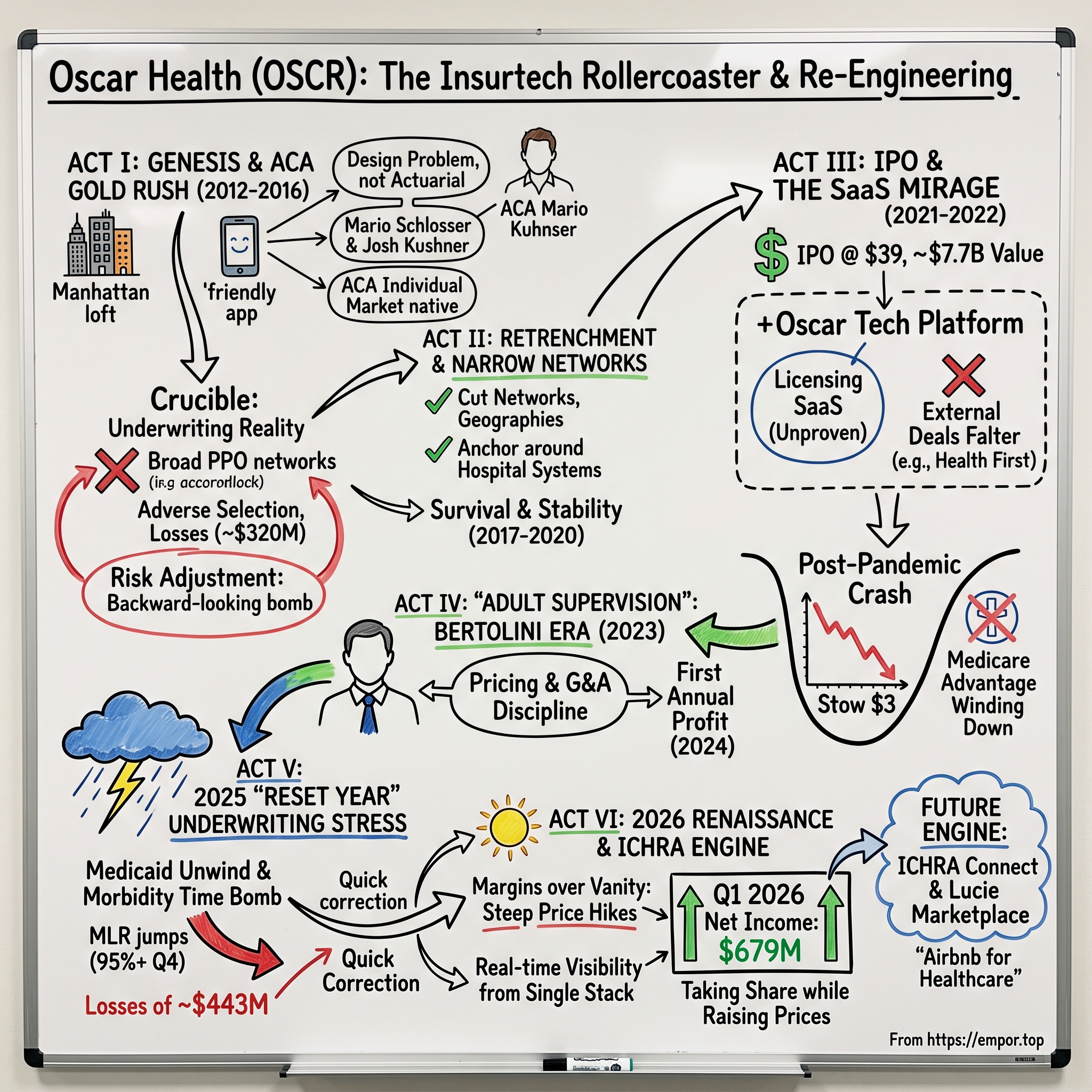
Picture a room full of twenty-somethings in a Manhattan loft in 2012, arguing that the reason Americans hate their health insurer is a design problem. Not an actuarial problem, not a regulatory problem — a design problem, the same kind that made bank apps ugly before Simple and Chime, the same kind that made taxis miserable before Uber. Fix the interface, humanize the experience, and you could build the first insurance company people actually loved. That was the founding conceit of Oscar Health, and for the better part of a decade it was simultaneously the company's greatest marketing asset and its most expensive delusion.
The story that follows is one of the great rollercoasters in modern financial markets, and it is worth understanding why insurance in particular produces rides this violent. A health insurer collects premiums today against claims it cannot yet see. It sets those prices once a year, months in advance, using models built on last year's data — and then it lives with the consequences for twelve months regardless of what actually walks through the door. There is no mid-year price adjustment, no dynamic pricing, no way to un-sell a policy to someone who turns out to need a transplant. Every year is a bet placed blind and settled slowly. Technology can make that bet smarter. It cannot make it disappear.
Oscar rode the Affordable Care Act into existence, promised to be the "Instagram of health insurance," and raised more than $1.6 billion of venture capital before ever proving it could underwrite risk profitably.1 It went public in March 2021 at $39 per share, minting a valuation near $7.7 billion, then watched that market capitalization collapse by more than 90% into penny-stock territory within eighteen months as investors realized the "tech company" was, underneath the app, a capital-intensive insurer bleeding hundreds of millions of dollars.23
Then came the twist that makes the story worth telling. In 2023, Oscar handed the keys to Mark Bertolini — the man who ran Aetna and sold it to CVS Health for $69 billion.4 Under what the founders' critics called "adult supervision," Oscar posted its first-ever annual profit in 2024, stumbled badly through a brutal 2025 "reset year," and then delivered a single-quarter net income of $679 million in the first quarter of 2026 — a number larger than the company's entire market value at its 2022 low.56
The financial arc is staggering in scale. Revenue climbed to roughly $11.7 billion in 2025 and management guides to $18.7 billion to $19.0 billion for 2026 — a near-doubling in a single year.65 But scale and profit are not the same thing, and the individual health insurance market has an unusually long history of punishing companies that confuse the two. Just ask Bright Health and Friday Health Plans, two venture- and private-equity-backed insurtechs that grew even faster than Oscar and collapsed entirely in 2023, stranding over a million members between them.7 Oscar's survival is itself a data point; the graveyard around it is a bigger one.
So the central question of this episode is not whether Oscar is growing. It plainly is. The question is whether it has genuinely learned to out-underwrite legacy giants like UnitedHealthcare and Centene — whether there is a durable structural edge here — or whether Oscar is simply the best-dressed passenger on a rollercoaster the individual insurance market has been running for a century, currently enjoying the part where the car goes up.
Here is the roadmap. Act I covers the genesis and the Obamacare gold rush of 2012–2016. Act II tracks the retrenchment and the pivot to narrow networks that saved the company. Act III dissects the IPO illusion, the SaaS mirage, and the Medicare Advantage trap. Act IV introduces the Bertolini era and the arrival of operational discipline. Act V pits the 2025 underwriting disaster against the 2026 recovery. And Act VI — the analytical heart — runs the capital-allocation comparison against the industry's serial acquirers, the Porter and Helmer frameworks, the current risk radar, and the bull-versus-bear thesis. Keep one tension in mind throughout: every single time Oscar has looked like a technology company, the underwriting has arrived to remind everyone it is an insurance company. Whether those two identities have finally reconciled is what we are here to test.
 Subscribe on LinkedIn
II. The Genesis: The "Obamacare-Native" Challenger
The origin myth begins, as so many do, with a bad customer experience. Mario Schlosser and Josh Kushner, classmates at Harvard Business School, were separately baffled by American medical billing — Schlosser navigating the paperwork of his wife's pregnancy, Kushner staring at an incomprehensible explanation-of-benefits statement. The specific documents differ depending on which retelling you read, but the emotional core is consistent: two highly educated, numerate men, both perfectly capable of reading a balance sheet, could not understand what their own insurance actually covered. If they couldn't, who could? Together with a third partner, Kevin Nazemi, they incorporated Oscar Health in October 2012.8
The three founders were an unusual blend, and the blend explains a great deal about what followed. Schlosser was the technologist and the quant — a German-born data scientist who had co-founded Vostu, a Latin American social-gaming company, and who genuinely believed that algorithms fed with enough data could price and manage medical risk better than actuaries working from spreadsheets and precedent.8 Kushner was the capital and the network: founder of Thrive Capital, a venture firm on its way to becoming one of the most influential in New York, and a man whose Rolodex could summon blue-chip money on a phone call. Nazemi brought product and strategy instincts from Microsoft. What none of the three brought was a single day of experience running a regulated health plan — a gap that would prove enormously, memorably expensive.
The product narrative was seductive, and to be fair to the founders, much of it was genuinely delivered. Oscar built a clean digital-first interface at a time when most insurers' member portals looked like 1990s intranets. It offered free 24/7 telemedicine when virtual care was still a novelty, years before the pandemic normalized it. It assigned members dedicated "concierge teams" — a named nurse and a named set of care guides — rather than routing every question into an anonymous call-center queue. And it advertised. Oscar plastered the New York City subway with friendly, plain-English ads that looked more like a consumer app campaign than anything the insurance industry had produced, deliberately positioning itself as the anti-insurer.
The strategic logic underneath the charm was a bet on loyalty economics. In most consumer businesses, delighted customers stay longer, cost less to serve, and cost less to reacquire. Oscar's founders assumed health insurance would work the same way: a high Net Promoter Score — in an industry where the average sits near zero — would translate into retention, retention into lower acquisition costs, and lower costs into a structural margin advantage. It was a coherent thesis. It was also, as later years would test severely, a thesis that had never actually been proven in a market where consumers re-shop their plan every single January on a government website that sorts by price.
The timing, though, was genuine genius, and it deserves to be understood properly. Before the ACA, if you didn't get insurance through your employer, you faced a hostile individual market where insurers could reject you for pre-existing conditions and where there was no standardized way to compare products. The ACA's exchanges, launched in 2013–2014, changed that completely: they banned medical underwriting, standardized plans into metal tiers — bronze, silver, gold, platinum — so that products became genuinely comparable, and subsidized premiums for lower-income buyers. In one stroke, the law created a brand-new retail channel where millions of Americans would shop for coverage side by side, like products on a shelf.
This was precisely the greenfield a consumer-tech challenger dreams about. Legacy insurers had spent decades optimizing for the employer group market, where the buyer is a corporate benefits manager and the sales motion runs through brokers. None of them were built to win a beauty contest against a slick startup on Healthcare.gov, where the buyer is a 34-year-old freelancer comparing logos and monthly prices on a phone. Oscar was designed, from its first line of code, for exactly that shopper.
The capital followed the narrative with enthusiasm. Oscar raised a $40 million Series A led by General Catalyst in 2012, then a round led by Peter Thiel's Founders Fund in 2014, and progressively larger checks from a who's-who of technology investors — CapitalG, Khosla Ventures, Fidelity, and eventually Alphabet, which alone put in $375 million in 2018.8[^9]1 By the time it went public, Oscar had absorbed more than $1.6 billion across roughly ten rounds.1
Read that sentence again with an investor's eye, because it contains the whole tension of the first decade. This was software-startup money — capital raised at multiples that only make sense if a business scales without proportionally consuming cash — poured into an enterprise that would live or die on the oldest and least software-like question in commerce: can you collect more in premiums than you pay out in claims? Oscar was about to get that question answered, market by market, in the most expensive way possible.
III. The ACA Crucible: Hard Lessons in Underwriting Risk
Every insurance company eventually meets the number that humbles it. For Oscar, the reckoning arrived market by market between 2014 and 2016, and it arrived with a particular cruelty: the very decisions that made the product most attractive to consumers were the ones destroying the economics.
The company expanded fast — New York first, then New Jersey, Texas, and California. To win members in each new geography, it did the intuitive consumer thing and offered broad, open, PPO-style networks that let people see almost any doctor they liked. In a retail land grab, wide access is an excellent sales pitch. In insurance underwriting, it is frequently a trap, for two compounding reasons. First, a broad network means Oscar had little leverage over any individual hospital and therefore paid closer to list price. Second, and worse, broad networks disproportionately attract the sick, because people managing a serious condition are the ones who care most about keeping a specific specialist.
That second effect has a name: adverse selection, the oldest hazard in the business. The people most eager to buy generous individual coverage on a brand-new exchange skew heavily toward the chronically ill and the high-utilizers — the people who had been locked out of the market entirely before the ACA banned discrimination on pre-existing conditions and who now had years of deferred care to catch up on. Oscar's models, trained on assumptions and public data rather than a decade of proprietary claims history, systematically underestimated how sick and how volatile this population would be.
Oscar was in respectable company in getting this wrong. UnitedHealth and Humana, with actuarial departments older than Oscar's founders, misjudged the same population and began fleeing the exchanges in the same window, concluding the individual market was structurally unprofitable at the prices regulators would approve. That industry-wide exodus is important context: the losses of this era were not purely a startup's naivety. They were the entire market discovering that a newly created risk pool behaves nothing like the actuarial tables suggest.
But respectable company does not pay claims. Oscar lost roughly $120 million in 2015 and more than $200 million in 2016, with over $100 million of the 2016 damage concentrated in its home New York and New Jersey markets alone.9 The elegant app changed none of this arithmetic. A member who adores your interface and then requires $200,000 of chemotherapy is still a $200,000 claim. This was the first and most durable lesson of Oscar's corporate life, and it is worth stating in the bluntest possible terms because the company would need to relearn it a decade later: technology can dramatically improve the experience of insurance, but it cannot by itself insulate the balance sheet from clinical reality.
Compounding the pain was a piece of ACA machinery that non-specialists rarely appreciate but that has shaped Oscar's entire financial history: risk adjustment. The concept is sensible. Because insurers can no longer screen out sick applicants, the law needed some way to stop plans from profiting simply by attracting the healthy. So each year, the government scores every plan's members for medical complexity based on documented diagnoses, and then transfers money from plans with healthier-than-average populations to plans with sicker-than-average ones. In theory, a stabilizer that lets insurers compete on efficiency rather than on cherry-picking.
In practice, for a young plan, it behaved like unexploded ordnance. Risk adjustment is settled retroactively, months after the plan year, based on how your members' documented risk scores compare to everyone else's in the same state. That means your bill depends not only on your own population but on how aggressively your competitors documented their members' diagnoses — a variable entirely outside your control. Incumbents had spent years building the coding infrastructure to capture every qualifying diagnosis; Oscar had not. The result was repeated large, hard-to-forecast payables landing on the income statement long after the premiums had been spent. Hold onto this mechanism. It detonates again, spectacularly, in 2025.
By 2016 the founders faced the choice that determines whether a startup grows up. They could keep chasing membership with broad networks and hope scale eventually fixed the economics — the path Bright Health and Friday Health Plans would later take to their destruction — or they could concede the model was wrong and rebuild it.
They rebuilt. Oscar retreated from unprofitable geographies, abandoning Dallas and, most symbolically, its New Jersey exchanges. Then it took the knife to its networks, cutting roughly half its New York physician roster and anchoring the remainder around a handful of hospital systems led by Mount Sinai, Montefiore, and the Long Island Health Network.109 The economic logic of a narrow network is a straightforward trade: an insurer promises a hospital system a concentrated flow of patients, and in exchange the system accepts materially lower reimbursement rates. Fewer choices for the member, but a cheaper and more manageable book for the insurer — and, crucially, the ability to actually steer patients toward high-value providers rather than watching them wander. Oscar reinforced the strategy physically, opening the Oscar Center in Brooklyn Heights with Mount Sinai in late 2016, a primary-care practice available only to Oscar members.8
It was the first time Oscar behaved less like a technology company and more like an insurance company. It was also the moment the company became survivable — and it set up an uneasy, capital-hungry stabilization that would require a much bigger story to finance.
IV. The SaaS Pivot & The +Oscar Illusion
If the crucible years were Oscar learning to survive as an insurer, the years that followed were Oscar trying very hard not to be valued as one.
Between 2018 and 2020 the individual market matured and Oscar's core business steadied. The narrow-network discipline held, the exchange risk pool became somewhat more predictable as the healthy gradually enrolled alongside the sick, and Oscar re-expanded into markets it had fled — returning to New Jersey and pushing into Ohio and Tennessee in 2017.11 It deepened its provider alliances, most notably through a partnership with the Cleveland Clinic announced in June 2017 to sell co-branded individual plans across five counties in northeast Ohio — a genuine coup, given the Clinic's reputation and the credibility it lent a startup insurer.12 And it pushed beyond the individual market for the first time, launching Cigna+Oscar, a joint venture aimed at small-business employer coverage that paired Cigna's national provider network with Oscar's technology and member experience.
These were sensible, incremental, unglamorous moves. They were also nowhere near exciting enough for a company that had raised money at software valuations and now needed to raise more.
So Oscar reached for a bigger story, and it was a genuinely clever one. Management began pitching "+Oscar," the proprietary full-stack technology platform the company had built to run its own insurance operations — claims processing, member engagement, care routing, billing, clinical dashboards, all on one integrated system — and proposed to license it to other health plans and provider groups as software-as-a-service.
The financial logic behind the pitch was pure valuation arbitrage, and it is worth spelling out because it explains almost everything about the next three years. Insurance underwriting is capital-intensive, cyclical, and heavily regulated: every dollar of premium requires reserves held against it, earnings swing violently, and public markets accordingly assign the sector low multiples — often high single digits on earnings. Software-as-a-service is the inverse: gross margins near 80%, revenue that recurs without new capital, and multiples that in 2020 routinely ran to ten or twenty times revenue. If Oscar could reframe itself as a technology platform that happened to own an insurer, rather than an insurer that happened to own good technology, the same underlying business could be worth several times more.
The narrative carried a second promise that spoke directly to investors nervous about insurance volatility: high-margin recurring software revenue would dilute the underwriting swings, converting the rollercoaster into something closer to a compounding growth curve. Diversification through software. It was intellectually tidy and emotionally reassuring.
Here is where the neutral lens matters most, because the distinction Oscar blurred is the distinction that decides the case. There is an enormous difference between a company that builds excellent software to run itself, and a company that sells that software profitably to third parties. Oscar could credibly claim the former — the unified stack was real, and as later events would demonstrate, operationally valuable in ways rivals struggled to match. What Oscar could not support with evidence was the latter: that outside health plans would pay enough, integrate quickly enough, and stay long enough to make +Oscar a standalone software franchise. Enterprise health-IT is notoriously among the hardest sales in software, with multi-year implementations, brutal data-migration problems, and buyers who cannot tolerate a single day of claims downtime.
The valuation being sought, in other words, rested entirely on the unproven half of the story. And the market — the private market, at least — bought it. Fueled by the promise of capital-light, software-like economics, Oscar raised the rounds that pushed cumulative funding past $1.6 billion, including Alphabet's landmark 2018 investment.1[^9]
Then 2020 arrived and briefly flattered everyone's numbers. The pandemic caused Americans to defer enormous volumes of elective care — surgeries postponed, screenings skipped, physical therapy cancelled — which meant claims came in far below what insurers had priced for. Across the industry, medical loss ratios fell and profits rose for reasons that had nothing whatsoever to do with management skill. It was, for a company preparing to sell shares to the public, exquisite timing: Oscar would take its story to market with its underwriting numbers looking better than the underlying business had earned.
The public markets were about to render a very different verdict from the private ones.
V. The IPO Spectacle & The Post-Pandemic Crash
March 2021 was, in retrospect, close to the final month of the pandemic-era listing mania — the moment when growth-at-any-price still commanded reverence and profitability was treated as a rounding error for a later date. Oscar Health rode it to the New York Stock Exchange in style.
The company priced its shares at $39, a dollar above an already-raised $32–$34 range, selling roughly 36.4 million shares and raising approximately $1.2 to $1.3 billion in net proceeds against underwriting fees of some $71 million, at an initial valuation near $7.7 billion.213 For a business that had never turned an annual profit in nine years of operation, it was a triumph of narrative over arithmetic — the "Instagram of health insurance" thesis cashed in almost precisely at the top of the market.
The reckoning came fast, and the first signal arrived within hours. The stock fell nearly 11% on its very first day of trading — a rare and ominous debut for a hot listing in a euphoric market, and a sign that public investors, unlike the private ones who had preceded them, were doing the math in real time.14 What they saw beneath the app was not a software company. It was an insurer with continuing net losses, a volatile medical loss ratio, and a capital structure requiring regulatory reserves against every dollar of premium — the precise opposite of capital-light. The IPO prospectus made the underwriting history impossible to romanticize.
Two specific structural flaws then hollowed out the technology narrative within the first year of public life, and they hollowed it out in public.
The first was the technology-monetization deficit. The flagship external +Oscar deal — a full-service arrangement with Florida's Health First, an integrated payer-provider, expected to generate $55 million to $60 million in revenue — collapsed under the sheer complexity of running another organization's health plan on Oscar's systems.15 The deal went live on January 1, 2022 and immediately hit what Schlosser described as "post-launch challenges due to the complexity of integrations at this scale." Oscar announced it would pause all external +Oscar deals for roughly eighteen months, and Health First moved to terminate the arrangement entirely.1516 The SaaS story — the entire intellectual justification for a premium multiple — went dark, and it never came back on.
The second flaw was the Medicare Advantage flop. Oscar had expanded into MA, the government-subsidized private-plan market for seniors, hoping to build scale in the industry's most profitable segment. But MA is a business of decades-long provider relationships, sophisticated star-ratings management, and enormous fixed costs that only amortize at scale, and Oscar's sub-scale entry never came close to threatening UnitedHealth or Humana. It remained unprofitable and was quietly wound down in 2022, leaving essentially all of Oscar's revenue tied to the individual market it had started in.17
Pause on the significance. Of the three growth legs the IPO story stood on — individual insurance, external SaaS, and Medicare Advantage — two had been amputated within roughly eighteen months of listing. Investors who had paid for a diversified technology-enabled healthcare platform now owned a single-line individual health insurer. Oscar also retreated from California in 2023, further concentrating the footprint.18
The market's verdict was brutal and, in hindsight, entirely rational. As interest rates spiked through 2022 and the whole complex of unprofitable growth-technology valuations compressed, investors stopped paying for the app wrapper and started pricing the insurer underneath it — a loss-making insurer, with a net loss of roughly $610 million in 2022 followed by $271 million in 2023.5 The shares cratered more than 90% from the IPO price, bottoming under $3 in late 2022 and dragging the company's market value below $300 million — a fraction of the capital its investors had put in, and a rounding error against the $7.7 billion peak.3
The judgment could not have been clearer if the market had written it on the wall: prove you can underwrite, or nothing else you build matters. Oscar's board was listening.
VI. "Adult Supervision" arrives: The Mark Bertolini Era
In late March 2023, Oscar's board did something founder-led venture darlings rarely do willingly, and almost never do gracefully: it replaced the visionary with an operator.
Mario Schlosser stepped aside as chief executive — moving first into a President of Technology role and then, by mid-2024, into a purely advisory board seat — and Mark Bertolini took the chief-executive chair on April 3, 2023.419 The symbolism was impossible to miss and, for the founders, presumably impossible to enjoy. The man who had spent eleven years selling healthcare as a design problem was handing his company to a man who had spent forty years treating it as an underwriting and scale problem.
Bertolini's résumé was the near-perfect antithesis of the Oscar origin story. Born in Detroit in 1956, he did not arrive via Harvard Business School and a venture fund; he worked his way up through Cigna, NYLCare Health Plans, and SelectCare before joining Aetna in 2003, becoming its chief executive in 2010 and chairman in 2011. He then engineered Aetna's $69 billion sale to CVS Health, completed in November 2018 — among the largest transactions in the history of American healthcare, and a deal that fundamentally reshaped how insurers think about owning care delivery.4 He later served as co-chief executive of Bridgewater Associates, the hedge fund, which gave him an unusual second education in how capital markets actually think about risk.
His personal history is a genuine part of his management style rather than a public-relations flourish. A catastrophic ski accident left him with severe chronic pain and years of rehabilitation; his son's battle with a rare cancer turned him into an obsessive, credentialed patient advocate who learned the healthcare system from the inside as a caregiver.4 Out of that came a consistent, decades-long public argument for consumer-centric, value-based, community-integrated care — which is to say Bertolini and Oscar's founders wanted broadly similar things. What separated them was that Bertolini had spent a career learning what it costs to get there, and had the relationships with the hospital systems that ultimately dictate those costs.
His strategy was less a pivot than a subtraction, and subtraction was exactly the discipline Oscar needed. He put the speculative external-SaaS narrative permanently to rest rather than leaving it as a perpetual "paused" asterisk in the story. He kept the unprofitable segments shut rather than reviving them for optical growth. And he refocused the whole organization on the single thing Oscar had, through more than a billion dollars of tuition, actually learned to do: price, underwrite, and build regional density in Individual and Family Plans. The implicit message to investors was a downgrade in ambition and an upgrade in honesty — Oscar would stop demanding to be valued as a software company and start earning the right to be valued as a good insurer.
The alignment question deserves scrutiny, because "adult supervision" only means something if the adult's incentives are real. Bertolini's are substantial. As of the 2026 proxy, he held roughly 8.6 million Class A shares directly, plus about 392,000 shares underlying near-term exercisable options and a further 2.9 million shares held by the Anahata Foundation, where he serves as co-trustee.20 He also bought roughly $11.9 million of stock in the open market in April 2026 — insider purchases being one of the few management signals that is expensive to fake.20 A meaningful portion of his personal wealth is tied to the equity rather than to a smoothing salary.
A skeptic should immediately note the flip side, and it is a real governance overhang. Oscar operates a dual-class structure in which Class B shares carry twenty votes each. Entities affiliated with Thrive Capital — Kushner's firm — held roughly 92% of the Class B stock and approximately 68% of the company's combined voting power as of the 2026 proxy.20 Public Class A holders own the economics and the volatility; the founders retained control of the votes. Oscar sold operational control to Bertolini. It did not sell voting control to anyone.
The proof of concept arrived in 2024, and it was modest in absolute terms but enormous in symbolic terms. Applying conventional managed-care pricing discipline and hard general-and-administrative cost controls, Oscar reported net income of $25.4 million on revenue of $9.2 billion, up 56% year over year, with membership reaching a then-record 1.68 million and adjusted EBITDA of $199.2 million.5 After twelve years and cumulative losses well north of a billion dollars, the company had finally made money.
The bulls declared the model vindicated. That declaration was, as the very next year would demonstrate with considerable violence, roughly one year premature.
VII. The 2025 "Reset Year" Underwriting Stress Test
The shock of 2025 did not originate inside Oscar. It originated in a policy unwind hundreds of miles away, in Washington and in fifty state Medicaid offices — and it is a useful reminder that in this industry, the largest variables on an insurer's income statement are frequently decided by people who have never heard of the company.
During the pandemic, the federal government had barred states from disenrolling anyone from Medicaid, a "continuous coverage" protection that swelled the program's rolls to historic highs. When that protection expired, states began redetermining eligibility at scale, and millions of Americans were removed from Medicaid. Many of them landed on the ACA individual exchanges — the market where Oscar had concentrated everything. On paper, this was a demand windfall of a kind insurers rarely get handed: a policy-driven wave of new customers arriving through the front door.
In practice, it was a morbidity time bomb. Populations moving off Medicaid skew sicker and poorer than the exchange population insurers had been pricing for, and they arrived mid-cycle, after 2025 premiums were already locked. This was the same adverse-selection dynamic that had bloodied Oscar a decade earlier, now supercharged by a demographic shift no model had properly anticipated. Membership swelled toward a record of roughly 3.4 million during the year, and for several months the growth read as triumph.21
Then the claims arrived, and the numbers are worth stating plainly because they are the necessary counterweight to every bullish 2026 headline. The full-year 2025 medical loss ratio jumped to 87.4%, from 81.7% in 2024 — meaning nearly 88 cents of every premium dollar went straight back out as medical claims, leaving almost nothing to cover administration, let alone profit.6 The fourth quarter was materially worse: a 95.4% MLR, a level at which an insurer is effectively paying its members' medical bills out of shareholders' capital.22 Oscar swung to a loss from operations of $396.4 million and a full-year net loss of $443.2 million on revenue of $11.7 billion, erasing the previous year's hard-won profit roughly seventeen times over.6 The SG&A ratio deteriorated to 17.5%.22
Layered on top was the mechanism introduced earlier: risk adjustment. As the exchange population's overall risk profile shifted, Oscar's risk-adjustment payable ballooned, retroactively clawing back gains and demonstrating once again that a single line item, settled after the fact and driven partly by competitors' behavior, can convert a good year into a bad one without warning. It is the structural feature of this market that no amount of proprietary software has ever eliminated.
Now the part that matters analytically, because management behavior under stress is more informative than management rhetoric in good times. On the February 2026 earnings call, Bertolini framed the year as a deliberate "reset year for the individual market" and said Oscar had taken "decisive actions to return to profitability in 2026."6 CFO Scott Blackley emphasized balance-sheet work, noting the company "took opportunistic steps to strengthen our balance sheet and optimize capital structure."6
The neutral reading of "reset year" sits between two poles. It is partly an honest diagnosis: the entire individual market repriced in response to the morbidity wave, and Oscar was not remotely alone in absorbing it. It is also partly a euphemism for a large and substantially unforecast miss by a management team that had spent 2024 telling investors the model was proven. Both things are true. What distinguishes a credible operator from a storyteller is not whether they miss — everyone in insurance misses — but whether they diagnose the miss specifically, and whether they have a mechanism to respond faster than the competition.
On that test, Oscar's response was its most genuinely differentiated moment. Because the company runs on a single unified data system rather than the patchwork of acquired legacy platforms typical of large insurers, management could observe utilization and morbidity trends in something close to real time, rather than waiting on quarterly reconciliations across incompatible systems. It used that visibility to reprice aggressively for the 2026 open-enrollment cycle rather than hoping the trend would revert on its own.
Whether that was genuine architectural advantage or simply the reflex any competent insurer applies after a $443 million loss is the question the following year had to answer. The stress test had exposed the fragility of the model. The recovery would test whether there was anything underneath it.
VIII. The 2026 Renaissance & The ICHRA Engine
The 2026 open enrollment was the moment Oscar chose margins over vanity, and it is the single clearest piece of evidence that the culture had actually changed.
Rather than defending its swollen 2025 membership base, management pushed through steep premium increases designed to fully absorb the elevated risk pool — explicitly accepting that price-sensitive members would walk, in exchange for underwriting the ones who stayed at rates that actually covered their claims. That is the textbook post-loss insurance move, and it is the move Bright Health and Friday Health Plans conspicuously failed to make before their collapses.7 Oscar also cleared the decks: the Cigna+Oscar small-group partnership formally wound down at the end of 2024, after Oscar notified Cigna in March 2024 that it would not renew, letting the company pour its administrative capacity entirely into the individual retail market.23
The results, reported on May 6, 2026, were spectacular enough to demand careful scrutiny rather than applause. First-quarter total revenue reached $4.647 billion, up 53% year over year on premium revenue of $4.581 billion. Net income came in at $678.996 million, or $2.07 per diluted share, against $275.3 million and $0.92 a year earlier — and against a consensus expectation nearer $1.11.524 The medical loss ratio dropped to 70.5%, a 490-basis-point year-over-year improvement, while the SG&A expense ratio fell to 15.2% from 15.8%.524 Membership settled at 3.174 million, up 56%, and earnings from operations reached $704 million.5 Management reaffirmed full-year 2026 guidance across every metric: $18.7 to $19.0 billion of revenue, an MLR of 82.4% to 83.4%, an SG&A ratio of 15.8% to 16.3%, and earnings from operations of $250 to $450 million.625
Here is the essential interpretive point, and it is one a casual reader of the headline will miss entirely. A 70.5% first-quarter MLR paired with a full-year target above 82% tells you that the first quarter is emphatically not representative of the year. Individual-market claims are strongly seasonal: members have not yet met their deductibles in January and February, so the insurer pays a smaller share of costs early and a much larger share later. The roughly twelve-point gap between the quarter printed and the full year guided is management's own acknowledgment that the bulk of 2026's claims and risk-adjustment costs are still ahead. The quarter proves Oscar repriced hard and that the repricing stuck through open enrollment. It does not yet prove the full year lands where promised.
The competitive evidence is more persuasive than the quarter itself. Oscar's market share across its footprint rose from roughly 17% in 2025 to 30% in 2026, and it expanded broker partnerships by about 60% — meaning it took share while raising prices, in a market of famously price-sensitive shoppers.21 That combination is the strongest single data point in the bull case, because gaining share on a price increase is what pricing power actually looks like in practice. Oscar's footprint now spans 573 counties across 20 states.26
Risk adjustment remains the live wildcard, and management was appropriately explicit about it. On the Q1 call, Bertolini noted the risk-adjustment payable had jumped to roughly 24.5% of direct premiums from 11% a year earlier, while Blackley pointed to early Wakely industry data suggesting "signals are pointing towards favorable market morbidity development versus where we entered the year."2724 Blackley guided to roughly 20% for the full year as new members' utilization matures.27 That is management flagging the risk and a tentative reason for optimism in the same breath — which, given how many times this specific line has surprised them, is the appropriate posture.
Which brings us to the forward-looking engine of the entire equity story: ICHRA, the Individual Coverage Health Reimbursement Arrangement. The concept is simple and potentially transformative. Instead of a company selecting one or two group plans that every employee must accept, the employer hands each worker a fixed, tax-free sum and lets them shop for their own individual plan on the exchange. Think of it as the shift from a defined-benefit pension to a 401(k), applied to health insurance: the employer's obligation becomes a predictable budget line rather than an unpredictable claims exposure, and the employee gets choice.
If ICHRA takes hold, it dissolves the wall between the employer market and the individual market — and Bertolini has framed the prize vividly, arguing that adoption among employers with fewer than 1,000 workers could expand Oscar's targetable market from roughly 21 million to 96 million lives.28
Oscar's play is to be the market-maker rather than merely a product on the shelf, and this is the most strategically interesting thing the company has done since narrowing its networks. In late 2024 it launched ICHRA Connect, an open-source, carrier-agnostic integration specification released under a permissive Apache 2.0 license, explicitly designed so that any ICHRA administrator can plug into any carrier — standardizing shopping, enrollment, billing, and eligibility reconciliation across the industry.28 It backed administrators including StretchDollar and Take Command to grease the funnel.29 Then in April 2026 it launched Lucie, a consumer marketplace that sells not only Oscar plans but competitors' — UnitedHealthcare, Cigna, Centene's Ambetter, Blue Cross plans, and supplemental carriers like Aflac — with an AI recommendation engine sitting on top.30 Bertolini has described the ambition as building an "Airbnb for healthcare," and the company also deployed Oswell, an OpenAI-powered member assistant, alongside real-time drug-pricing tools and bilingual voice agents.3027
The strategic logic is genuinely clever: by open-sourcing the plumbing and selling rivals' products, Oscar lowers friction for the entire individual market to grow, betting that as the largest and most digitally native player it captures a disproportionate share — plus marketplace fee income carrying higher margins than insured members.27 The honest caveats are equally real. ICHRA remains small relative to the 150-million-plus employer-sponsored market, its adoption has been predicted for years without inflecting, and the same open standard that helps Oscar helps Centene and every Blue Cross plan equally. Lucie is optionality with a plausible path, not yet an earnings driver — and keeping that distinction straight is exactly the discipline the competitive analysis requires.
IX. Playbook: Organic Tech Build vs. M&A Capital Deployment
Step back from the quarterly drama and a genuinely distinctive capital-allocation story emerges — one defined as much by what Oscar refused to do as by what it did.
The American managed-care industry is, at its core, a consolidation machine. Centene built itself into an ACA and Medicaid behemoth by stacking debt-financed acquisitions of regional health plans one atop another, buying membership rather than building it. Molina followed a comparable playbook, acquiring distressed Medicaid books at attractive multiples. UnitedHealth assembled Optum through hundreds of transactions spanning physician groups, pharmacy benefit management, and data analytics. Even Bertolini's own Aetna was a serial acquirer that ended its independent life as the target in the largest deal of them all.
Oscar, alone among insurers of meaningful scale, has essentially no history of major corporate acquisitions. It grew a single company organically and spent its capital building software rather than buying subscribers.
That choice carried a brutal cost and a real payoff, and intellectual honesty requires accounting for both. The cost was the more than a billion dollars of cumulative underwriting losses Oscar absorbed while scaling a proprietary full-stack platform from scratch — years of red ink that a roll-up strategy might have partly avoided by purchasing already-profitable books of business with established provider contracts and mature risk-coding infrastructure. An activist reviewing Oscar's twelve-year history could argue, with a straight face, that the founders selected the most capital-destructive path available: build everything, prove nothing, and fund the shortfall with successive rounds of equity dilution. The counter-argument that "we were investing in the platform" is exactly the sort of claim that requires evidence rather than assertion.
The payoff is architectural, and it is the single most credible pillar of the bull case. Because Oscar never had to bolt together the incompatible claims engines, member databases, provider directories, and billing platforms that inevitably accumulate in a company assembled through acquisition, it runs on what amounts to a single instance of software over a unified data structure.
The practical consequences are worth making concrete, because "unified data structure" is the kind of phrase that sounds impressive and means nothing without examples. At a roll-up insurer, answering a question like "how is utilization trending among members who joined in the last ninety days in this specific metro?" can require pulling from three separate systems, reconciling inconsistent member identifiers, and waiting weeks. At Oscar, it is a query. That difference is why management could detect the 2025 morbidity trend early enough to reprice decisively for 2026, why the company can adjust claims routing and clinical steering quickly, and why its SG&A ratio has been trending toward the mid-15s while it processes an enormous surge in volume — arguably the cleanest available evidence that the technology delivers genuine operating leverage rather than merely a pleasant user interface.5
There is a second-order benefit that Oscar's peers cannot easily replicate: the absence of acquisition-related complexity on the balance sheet. Oscar carries no meaningful goodwill from overpaid deals awaiting impairment, no purchase-accounting adjustments obscuring underlying trends, and no integration-cost add-backs cluttering adjusted earnings. Its financial statements are, by industry standards, unusually clean — which is a modest but real governance positive for investors who have watched managed-care roll-ups write down billions.
The necessary skepticism is about durability. Is a clean single-stack architecture a moat, or merely a nice operating feature that erodes as rivals modernize? The evidence cuts both ways. It is genuinely hard for a large insurer to replace systems that process billions of dollars of claims daily — technology replacements at that scale routinely take a decade and sometimes fail outright — so the advantage will persist for a meaningful period. But it has never been demonstrated to produce a cost advantage large enough to win a price war against Centene's purchasing scale, and Oscar's own history shows the platform did not prevent either the 2016 or the 2025 underwriting blowups. Oscar's technology is a legitimate operational asset and a speed advantage. The evidence that it constitutes a pricing moat remains thin.
That tension — real capability, unproven durability — is precisely what the strategic frameworks exist to adjudicate.
X. Strategic Playbook: Porter's 5 Forces & Helmer's 7 Powers
graph TD
    A[Oscar's Strategic Moat] --> B[7 Powers]
    A --> C[Porter's 5 Forces]

    B --> B1["Counter-Positioning: ICHRA Connect"]
    B --> B2["Process Power: Full-Stack +Oscar Stack"]
    B --> B3["Brand Power: High NPS vs. Industry Average"]

    C --> C1["Supplier Power: High Consolidation of Hospital Systems"]
    C --> C2["Rivalry: High Centene, UnitedHealth, local BCBS"]
    C --> C3["Buyer Power: High Price Sensitivity of ACA Retail Shoppers"]
Frameworks are only useful if applied honestly, so let us war-game Oscar's position rather than flatter it. Begin with Michael Porter's five forces, which describe the structural attractiveness of the industry itself — and by this analysis, individual health insurance is a genuinely difficult place to make money.
Supplier Power (High). In healthcare, the suppliers are hospital systems and physician groups, and thirty years of consolidation have handed them formidable leverage. In many metropolitan areas a single dominant system controls enough of the market that no insurer can credibly sell a product excluding it, which means the system largely sets its own reimbursement rates. Oscar's counter is the narrow-network trade described earlier — exclusivity and steered volume in exchange for lower prices. That mitigates supplier power; it does not neutralize it. A three-million-member insurer negotiating against a dominant regional health system is usually the weaker party in the room, and the strategy also caps Oscar's ability to expand into markets where no system will deal.
Buyer Power (High). ACA shoppers are famously price-sensitive and structurally disloyal. They re-shop every open enrollment on a government website that sorts by monthly premium, and a ten-dollar difference routinely triggers a switch. There is no contract lock-in, no bundled product, no switching cost beyond the mild inconvenience of changing doctors. This is the force that makes the expiring enhanced subsidies especially dangerous: it amplifies churn precisely when out-of-pocket premiums are rising fastest.
Threat of New Entrants (Low). This is the one force working decisively in Oscar's favor, and it has strengthened considerably in recent years. Launching a health plan requires substantial regulatory capital reserves, state-by-state licensing, and the painstaking assembly of local provider networks — barriers that cost Oscar itself years and hundreds of millions to clear. More importantly, the failures of Bright Health and Friday Health Plans, which between them left $1.1 billion of unpaid risk-adjustment obligations to other carriers, have made regulators and capital providers markedly more cautious about funding the next insurtech.7 Oscar's own bruising history is the best evidence of how high this wall stands.
Threat of Substitutes (Moderate). Traditional employer group coverage remains how most insured Americans get coverage, and it functions as a large substitute for the individual market. But the ICHRA strategy aims to invert this force entirely, converting the biggest substitute into a feeder channel. If it works, Oscar will have turned a structural threat into a growth engine — an elegant piece of strategy, and one whose success is far from assured.
Competitive Rivalry (Intense). Oscar competes against Centene, the low-cost high-volume ACA leader with vastly greater purchasing scale; UnitedHealthcare, with unmatched scale and deep vertical integration through Optum; and entrenched regional Blue Cross Blue Shield plans with generations of local brand loyalty and the deepest provider discounts in their home states. This is not a market offering comfortable margins to anyone.
Now Hamilton Helmer's 7 Powers, which asks a harder and more specific question: does Oscar possess an advantage a competitor cannot cheaply replicate?
Counter-Positioning (Strong, but unproven). This is the most intriguing claim. By championing ICHRA Connect and Lucie, Oscar is attempting to route employees around the traditional group-broker channel that incumbents depend on for distribution. The power works only if rivals are structurally reluctant to follow — and there is a plausible case that a carrier earning most of its revenue from group plans will hesitate to cannibalize it. The falsification test is straightforward: watch whether Centene, UnitedHealthcare, or the Blues embrace ICHRA aggressively. If they do, the counter-positioning evaporates.
Process Power (Significant, contested durability). The integrated single-stack platform discussed at length above. Real, operationally valuable, and slow to copy — but not demonstrated to be a cost moat.
Brand (Moderate). Oscar's oldest claim, and the one requiring the most skepticism. Management has long cited member Net Promoter Scores in the 60s against a managed-care industry average in the low single digits.8 The scores are plausible and the member experience is genuinely superior. But in a market where buyers demonstrably switch for ten dollars a month, brand affection has never been shown to beat price — and NPS is a self-reported metric that no insurer discloses on a comparable, audited basis. Treat it as directional evidence, not proof.
Scale Economies (Emerging, and the critical gap). This is bluntly the power Oscar most lacks. At roughly three million members it has meaningful negotiating leverage in the dense regional markets it prioritizes, but it remains a fraction of UnitedHealth's size. Scale is the currency that matters most in negotiating with suppliers and in absorbing the volatility that periodically flattens sub-scale insurers.
The honest synthesis: Oscar operates in a structurally unattractive industry and possesses two or three emerging powers rather than one entrenched moat. The bull case requires counter-positioning and process power to mature into something durable before the scale players close the gap — a race, not a fortress.
XI. The Investment Thesis: Bull vs. Bear
Current Risk Radar
The dominant overhang is regulatory and political, and it is not hypothetical. The enhanced premium tax credits created by the American Rescue Plan in 2021 and extended by the Inflation Reduction Act — the subsidies that turbocharged ACA enrollment for four years — expired on December 31, 2025, and as of mid-2026 Congress had not restored them, with the issue stalled between a House-passed extension and Senate inaction.31
The transmission mechanism into Oscar's business is direct. KFF analysis indicates that without those enhancements, average marketplace premium payments would more than double for many enrollees, and the Congressional Budget Office projected total average effectuated enrollment could fall from roughly 22.3 million in 2025 toward 16.5 to 17.5 million in 2026, with 2.2 million more uninsured in 2026 and 3.7 million more in 2027.31 For an insurer whose entire revenue base sits on the individual exchange, that is an existential demand variable that no amount of technology addresses.
Two mitigating observations matter. First, Bertolini stated on the Q1 2026 call that Oscar built its 2026 plan assuming "there would never be any enhanced subsidy extension," and designed bronze and gold products specifically to cushion members losing credits.27 If genuine — and the market-share gain from 17% to 30% while raising prices is consistent with it — that discipline insulates the near term.21 Second, a shrinking market is not uniformly bad for a share-gainer; Oscar has been taking share as weaker competitors retreat. But the multi-year enrollment trajectory is unambiguously a headwind, and management does not control it.
The second material risk is the one recurring in every act of this story: risk-adjustment volatility. It remains effectively a black box in which a competitor's more aggressive diagnosis coding can generate an unexpected payable on Oscar's books, settled long after the premiums are spent. 2025 demonstrated it can erase a year of profit without warning, and the payable running at 24.5% of premium in Q1 2026 versus 11% a year prior shows the exposure has grown rather than shrunk with scale.27
Third, and briefly: execution and concentration risk. Oscar is a single-product company in a single regulated market with no diversification whatsoever — the very diversification the +Oscar and Medicare Advantage strategies were meant to provide, both abandoned. Every dollar of revenue depends on one political settlement holding.
Key KPIs to Track
For a business this exposed to underwriting swings, three numbers carry most of the signal.
First, the full-year medical loss ratio — specifically whether it lands inside the guided 82.4%–83.4% range. Not the flattering first-quarter print, which seasonality inflates in Oscar's favor, but the completed year. This is the single cleanest test of whether the repricing was accurate rather than merely aggressive, and whether Oscar can hold underwriting discipline through a full cycle rather than a recovery quarter.
Second, the SG&A expense ratio, and whether it grinds down toward the 15.8%–16.3% target and beyond as revenue nearly doubles. This is the most direct evidence available that the unified technology platform produces genuine operating leverage. If revenue doubles and the SG&A ratio does not fall, the technology thesis is decorative.
Third, Individual & Family Plans membership and its composition — organic retention through subsidy-driven churn, and any measurable, separately identifiable ICHRA contribution. Growth alone means little in this market; Bright Health grew spectacularly on its way to liquidation. What matters is retained, profitably priced membership and whether the ICHRA optionality converts into disclosed enrollment.
The Bear Case
The bear's argument is that the technology was always a premium wrapper on a commodity business, and 2025 settled it: no app, no dashboard, no AI agent prevented morbidity from blowing a $443 million hole in the year.6 The company is a hostage to Washington, its revenue base threatened by expiring subsidies it neither controls nor can hedge. External software monetization is dead and Medicare Advantage abandoned, leaving a single undiversified line of business. Legacy carriers can copy narrow networks — many already have — and at three million members Oscar simply lacks the scale to win a price war against Centene or UnitedHealthcare in any market they choose to contest. ICHRA has been the industry's perpetual next-big-thing for years without inflecting, and the open-source standard Oscar built helps its competitors as much as itself. Governance concentrates roughly 68% of voting power in founder-aligned Class B shares while public holders absorb the volatility.20 Strip away the narrative, the bear concludes, and you own a sub-scale, single-product individual insurer near the favorable end of a policy-driven cycle — and this market has repeatedly proven what it does to sub-scale insurers when the cycle turns.
The Bull Case
The bull's counter is that Bertolini has done precisely what he was hired to do. He inherited a cash-burning technology experiment with a broken story and converted it into a disciplined underwriter that absorbed the worst morbidity shock in the individual market's history, repriced through it with unusual speed, and emerged with a $679 million quarter and reaffirmed guidance.5 Crucially, it took share while raising prices — market share nearly doubling from 17% to 30% across its footprint — which is what pricing power looks like when it is real rather than asserted.21 The single-stack platform gives Oscar reflexes no legacy rival can match, and the SG&A trajectory suggests that advantage is showing up in the cost structure rather than only in the pitch deck. Management's incentives are aligned through substantial personal ownership and open-market buying.20 And ICHRA, plus the Lucie marketplace, gives the company a credible option on the largest addressable expansion in its history — one where Oscar has deliberately positioned itself as the infrastructure layer rather than merely a competitor.2830
The tie-breaker is not rhetoric but behavior over time, and the record is genuinely mixed rather than conveniently clean. Management delivered a first profit in 2024, missed badly in 2025, and diagnosed the miss with more candor than most managed-care teams manage — then repriced with a speed its architecture uniquely enabled and gained share doing it. Those are real credits. The debits are equally real: this is a team that declared the model proven a year before it broke, that abandoned two of the three growth legs it sold at IPO, and that has never yet demonstrated it can hold underwriting discipline across a full cycle rather than a single favorable quarter.
The 2026 full-year medical loss ratio, printed against the seasonality trap and the risk-adjustment black box, will say more about which case is correct than any slide Oscar has ever shown an investor. Until that number lands, this remains what it has been since 2012: a company whose story keeps outrunning its proof, currently in a stretch where the proof is finally, at last, catching up a little.
References
-
What to know about Oscar Health's 2021 IPO — Public.com ↩↩↩↩
-
Oscar Health prices IPO at $39 and secures a $9.5B valuation — TechCrunch, 2021-03-03 ↩↩
-
Oscar Health, Inc. SEC Filings & Regulatory Disclosures — SEC EDGAR ↩↩
-
Oscar Health Announces Appointment of Healthcare Veteran Mark Bertolini to CEO — Oscar Health, 2023-03-27 ↩↩↩↩
-
Oscar Health Announces Strong Financial Results for First Quarter 2026 And Reaffirms 2026 Guidance — Businesswire / Oscar Health IR, 2026-05-06 ↩↩↩↩↩↩↩↩↩
-
Oscar Health Announces Financial Results for Fourth Quarter and Full-Year 2025 — Oscar Health IR, 2026-02-10 ↩↩↩↩↩↩↩↩
-
Payers shortchanged $1.1B in ACA risk adjustment payments as Bright, Friday fail to meet obligations: CMS — Fierce Healthcare ↩↩↩
-
Oscar Health — Wikipedia (founding, funding and company history) ↩↩↩↩↩
-
Insurer Oscar Health to Slash Hospital Network, Hike Premiums in 2017 — Fortune, 2016-07-27 ↩↩
-
Health Insurance Startup Oscar Narrows Hospital Networks to Compete — Insurance Journal, 2016-02-24 ↩
-
Oscar Health is headed back to New Jersey and branching out to Ohio and Tennessee — TechCrunch, 2017-06-21 ↩
-
Cleveland Clinic jumps into insurance biz with Oscar Health — Modern Healthcare, 2017-06-15 ↩
-
Oscar Health, Inc. Form 424B4 (IPO Prospectus) — SEC EDGAR, 2021-03 ↩
-
Shares of Oscar Health close down 10.7% after first day of trading — CNBC, 2021-03-03 ↩
-
Oscar Health pauses full-service tech deals amid implementation woes — Healthcare Dive ↩↩
-
Oscar, Health First Health Plans terminate $60M partnership — Becker's Payer ↩
-
Oscar bullish on individual market as it largely ditches Medicare Advantage — Fierce Healthcare ↩
-
Mario Schlosser to step down from full-time role at Oscar — Becker's Payer, 2024-05-15 ↩
-
Oscar Health, Inc. Form DEF 14A (2026 Proxy Statement) — SEC EDGAR, 2026 ↩↩↩↩↩
-
Oscar posts $443M loss in 2025, but CEO says company is poised for 2026 profitability — Fierce Healthcare, 2026-02-10 ↩↩↩↩
-
Oscar Health, Inc. Form 8-K — Fourth Quarter and Full-Year 2025 Results, SEC EDGAR, 2026-02-10 ↩↩
-
Cigna and Oscar to wind down co-branded small group partnership — Healthcare Dive, 2024 ↩
-
Earnings call transcript: Oscar Health Q1 2026 surges past earnings forecasts — Investing.com, 2026-05-06 ↩↩↩
-
Oscar Health First Quarter 2026 Financial Results — Oscar Health IR, 2026-05-06 ↩
-
Oscar Unveils New Choices and AI Tools Shaping the Future of Individual Healthcare — Businesswire, 2025-10-20 ↩
-
Oscar Health OSCR Q1 2026 Earnings Call Transcript — The Motley Fool, 2026-05-06 ↩↩↩↩↩↩
-
Oscar Health launches ICHRA-oriented data exchange — Becker's Payer Issues ↩↩↩
-
ICHRA-focused StretchDollar raises $6M with help from Oscar Health — Fierce Healthcare ↩
-
Oscar Health Seeks to Build 'Airbnb for Healthcare' with New Marketplace, CEO Says — MedCity News, 2026-04 ↩↩↩
-
What We Know So Far About 2026 ACA Marketplace Enrollment, Premiums, and Deductibles — KFF ↩↩
 LinkedIn
 WhatsApp
 Reddit
 Hacker News
 Email
Email Kindle
 RSS Feed
 Spotify
 Apple Podcasts
 Amazon Music
 Audible
 YouTube