Oruka Therapeutics: The Bio-Platform Playbook and the Race to Disrupt the $30B Psoriasis Market
I. Introduction & The Bio-Platform Secret
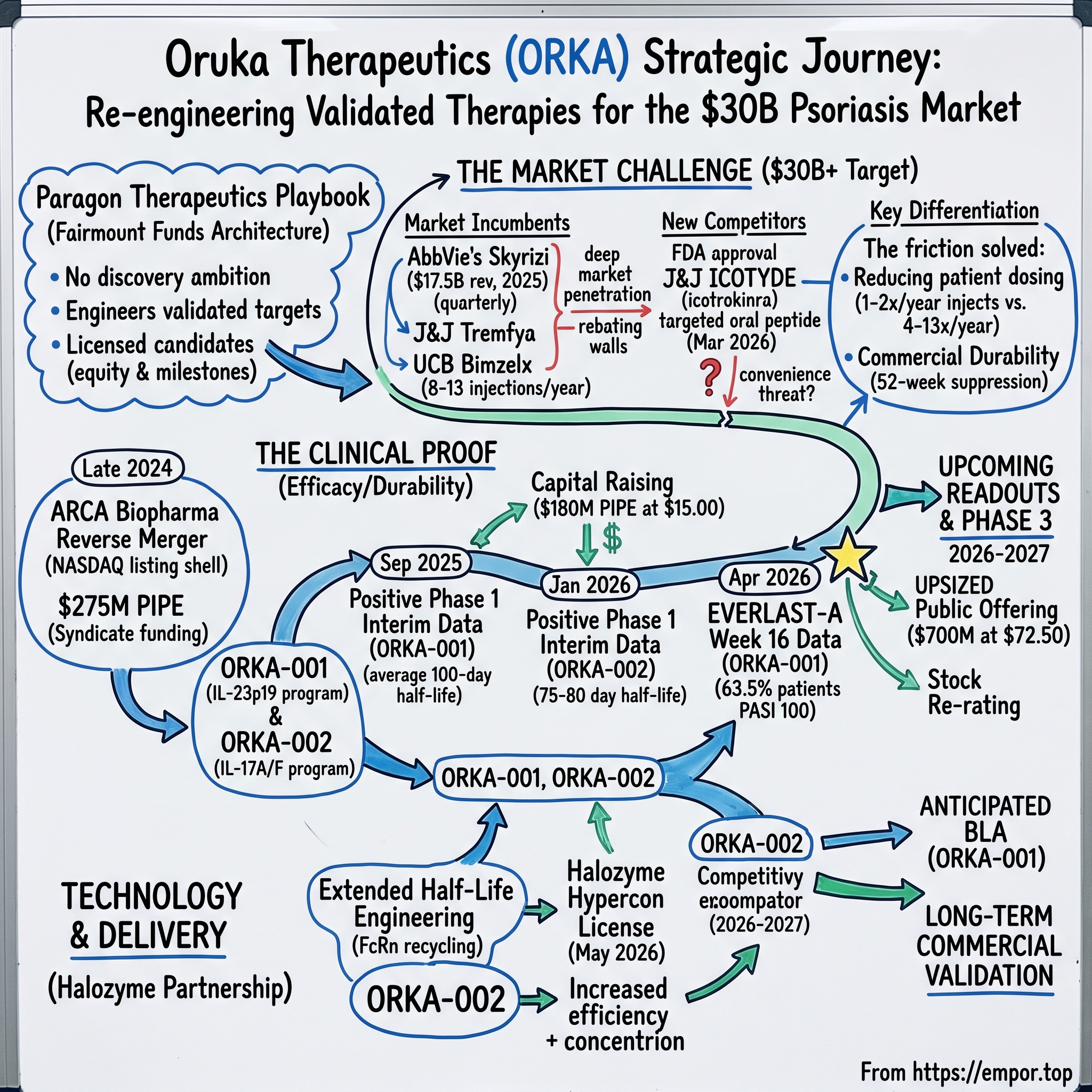
On April 27, 2026, Oruka Therapeutics reported clinical data rare for an early-stage biotech: 40 out of 63 patients—63.5%—with moderate-to-severe plaque psoriasis achieved completely clear skin at week 16 following treatment with its lead antibody candidate, ORKA-001. The result represented PASI 100, the strictest efficacy benchmark in clinical dermatology, measuring complete skin clearance rather than partial improvement.[^1]
The following morning, Oruka capitalized on the results by pricing an upsized public offering of 9.66 million shares at $72.50 each, raising approximately $700 million in gross proceeds through an underwriting syndicate led by Leerink, TD Cowen, Goldman Sachs, Stifel, and Guggenheim.[^2] Just seven months prior, the company had issued stock to insiders at $15.00 per share.[^3] By late July 2026, Oruka traded near $96.51, up from a 52-week low of $12.84.1
This sequence—clinical validation followed immediately by major capital raising and stock re-rating—captures the core execution strategy of the modern platform biotech. It also highlights a central strategic question: whether Oruka represents a fundamental advancement in chronic skin disease therapy or an unusually efficient financial structure designed to rapidly package and monetize validated drug targets.
The core premise. Oruka Therapeutics, Inc., headquartered in Menlo Park, California, trades on the NASDAQ Global Market under the ticker ORKA. The clinical-stage biopharmaceutical company employs 68 full-time staff, generates no revenue, and has no commercial products or manufacturing operations.1 Rather than discovering novel biological mechanisms, Oruka's core strategy centers on re-engineering established, commercially validated therapies to extend their dosing intervals in the human body.
Specifically, Oruka aims to convert the biweekly or quarterly injection regimens that dominate current psoriasis treatment into once- or twice-yearly doses. The strategy focuses not on discovering new targets or biological mechanisms, but on extending drug duration.
The $30 billion target. Plaque psoriasis and psoriatic arthritis anchor one of the highest-revenue therapeutic categories in global pharmaceuticals. Market incumbents generate substantial revenue: AbbVie's Skyrizi (risankizumab) posted $17.56 billion in global net revenue in 2025, representing nearly 50% year-over-year growth.2 Johnson & Johnson's Tremfya (guselkumab) stands as that company's third-largest pharmaceutical product.3 Meanwhile, UCB's Bimzelx (bimekizumab) generated over €2.2 billion in 2025 net sales—more than tripling its previous year's total—and reached over 116,000 patients across more than 50 countries.4
These established franchises represent some of the industry's fastest-growing commercial assets, backed by major commercial pharmaceutical organizations. Oruka's strategy is to compete against these incumbents by offering biologically comparable molecules that reduce patient dosing frequency from four to thirteen injections per year down to once or twice annually.
The Paragon engine. Oruka did not discover its drug candidates internally. Pre-merger Oruka was founded by Fairmount Funds Management in February 2024, and its lead assets were engineered by Paragon Therapeutics, a specialized antibody discovery firm that licenses candidate molecules to dedicated corporate entities in exchange for equity, milestone payments, and royalties.5 Oruka was the fourth company created through this Paragon framework, following Apogee Therapeutics and Spyre Therapeutics.
This approach defines the company's operating model. The platform is less a novel scientific discovery engine than an organizational design: it decouples the unpredictable, capital-intensive search for new biological mechanisms from the more predictable engineering of half-life-extended versions of validated molecules. Paragon handles candidate engineering, Fairmount provides initial funding, a public shell vehicle absorbs the entity, and public capital markets fund clinical development.
The roadmap. This analysis traces Oruka's structure from its founding architecture and half-life extension engineering through the ARCA Biopharma reverse merger and $275 million private investment in public equity (PIPE) that brought it to public markets. It evaluates the clinical evidence accumulated through 2025 and 2026, the executive leadership driving execution, and the commercial and financial challenges that will dictate whether its initial efficacy data translates into a commercial product.
However, the initial clinical results leave key strategic challenges unresolved. Notably, five weeks before Oruka released its April data, the FDA approved a competing oral therapy.
 Subscribe on LinkedIn
II. The Paragon Therapeutics Playbook & Fairmount's Architecture
In December 2022, Paragon Therapeutics announced its first spinout: Apogee Therapeutics. Apogee launched with $169 million in capital despite having no drug candidates in human testing.6 Seven months later, Apogee raised approximately $300 million in an initial public offering—at the time the largest biotech IPO in nearly three years for a company that had never dosed a human patient.7 Its stock subsequently tripled.5
That successful debut established the operational blueprint—not merely for a single drug candidate, but for a repeatable corporate structure.
The origin: a discovery engine with no ambition to be a drug company
Paragon was founded in 2021 by Fairmount Funds Management as a joint venture with FairJourney Biologics, a Portuguese antibody discovery specialist.8 Its mandate was explicitly constrained. Paragon does not conduct clinical trials, build commercial infrastructure, or aim to operate as an integrated pharmaceutical company. Instead, it focuses exclusively on identifying validated biological targets and using high-throughput screening and protein optimization to generate antibody candidates designed with improved properties compared to existing therapies.
Once engineered, candidate assets are spun out into dedicated corporate entities.
This structural model reallocates traditional biotech risk. A conventional startup requires investors to fund two concurrent uncertainties: whether the underlying biological target is clinically sound, and whether a molecule can be successfully engineered against it. Historically, target failure accounts for the vast majority of clinical dropouts. Paragon's model bypasses primary biological discovery risk by focusing entirely on targets already validated in human trials.
De-risking biology rather than discovering it
An examination of the pathways Paragon has targeted across its spinouts reveals a clear strategic focus: IL-13 and IL-4 for atopic dermatitis, TL1A and α4β7 for inflammatory bowel disease, and IL-23 and IL-17 for psoriasis. Each target is already validated by approved multi-billion-dollar commercial therapies with established safety profiles spanning hundreds of thousands of patient-years, known efficacy benchmarks, and established regulatory pathways.
Paragon concentrates its efforts on molecular engineering: improving potency, optimizing manufacturability, and extending pharmacokinetics to prolong how long a drug circulates in the body before clearance.
Peter Harwin, a founding partner at Fairmount Funds Management who co-founded the firm in April 2016, serves as a director of Paragon and chairs Oruka's board while holding similar positions across the broader spinout network.9 Oruka's board has also included Spyre Chief Executive Cameron Turtle, Apogee Chief Medical Officer Carl Dambkowski, and CRISPR Therapeutics Chairman and Chief Executive Samarth Kulkarni.5 Consequently, leadership across these entities displays significant overlap.
For investors, this interconnected governance structure presents trade-offs. The primary benefit is shared operational experience, as leadership has executed the spinout playbook multiple times and can navigate development milestones efficiently. The drawback is limited governance independence, as a board dominated by ecosystem insiders may be less inclined to scrutinize the framework's internal economics or deal terms.
The economic architecture — and what it actually costs
An examination of Oruka's licensing terms indicates an economic structure that is relatively favorable to public shareholders.
Oruka acquired its core pipeline through option-and-license agreements rather than upfront asset purchases. In September 2024, Oruka exercised its exclusive option on the IL-23 program, securing a worldwide exclusive license outside inflammatory bowel disease in December 2024. It exercised its option on the IL-17A/F program in December 2024 and executed the formal license in February 2025.10
Financial commitments per program are structured conservatively relative to industry averages: up to $12.0 million in development milestones and up to $10.0 million in regulatory milestones, along with a low single-digit royalty on net sales.10 Initial payment triggers are modest, including $1.5 million upon development candidate nomination and $2.5 million upon initial Phase 1 dosing.
By comparison, acquiring comparable clinical-stage assets through competitive auctions typically requires nine-figure upfront payments and double-digit royalty rates. Oruka also holds a non-exclusive cell line license with WuXi Biologics that carries a sub-1% royalty on third-party manufacturing.10 As a result, the aggregate royalty burden on potential commercial sales of ORKA-001 remains in the low single digits, posing minimal drag on future operating margins.
Rather than extracting value through high royalty rates, Paragon and Fairmount receive their primary compensation through equity ownership. The critical question for investors is whether housing assets within affiliated, sponsor-controlled vehicles creates an engine optimized primarily for capital creation or long-term therapeutic approval. While Oruka's corporate filings show no evidence of compromised asset selection, the model's ultimate validation depends not on private investments or public offerings, but on achieving positive Phase 3 clinical trial readouts—a milestone no Paragon spinout has yet reached.
Evaluating that clinical potential requires analyzing the competitive and financial value of Oruka's target markets.
III. The Psoriasis Gold Mine & The Biologic Arms Race
To understand why major pharmaceutical companies compete so aggressively over inflammatory skin conditions, consider the clinical profile of the patient.
Plaque psoriasis is a chronic autoimmune disease in which the immune system causes skin cells to regenerate roughly ten times faster than normal. This rapid turnover produces thick, scaly, and painful plaques across the elbows, knees, scalp, and torso. The condition is lifelong and highly visible, and approximately one-third of patients eventually develop psoriatic arthritis, which causes irreversible joint damage if untreated. Because symptoms return within months if therapy stops, patients require continuous treatment.
This combination of chronic duration, high visibility, and immediate relapse upon treatment cessation creates a highly lucrative commercial environment. A patient who responds well to a biologic therapy often remains on the drug for a decade or longer.
From sledgehammers to scalpels
For much of the twentieth century, psoriasis treatment relied on broad immunosuppressants such as methotrexate, cyclosporine, and phototherapy—options that offered limited efficacy while carrying significant toxicity risks. The introduction of anti-TNF agents in the 2000s brought targeted biologics to dermatology, followed by the anti-IL-12/23 antibody ustekinumab.
Subsequent research identified the specific biological pathway driving the disease: interleukin-23 signals naive T cells to differentiate into pathogenic Th17 cells, which then secrete interleukin-17 to drive skin-cell proliferation. This discovery enabled two distinct therapeutic approaches. Blocking IL-23 upstream halts disease progression at its source, yielding slower initial response times but exceptional durability. Blocking IL-17 downstream shuts off the primary effector signal, producing significantly faster onset and deeper skin clearance but requiring more frequent redosing.
Both mechanisms yielded major commercial drugs, splitting the market into distinct treatment approaches.
The incumbents
On the IL-23 side, AbbVie's Skyrizi serves as the market benchmark. Its 2025 revenue of $17.56 billion, growing at nearly 50%, makes it one of the most successful drug launches in pharmaceutical history.2 Skyrizi's clinical appeal centers on durability, offering quarterly maintenance injections with sustained response rates and a safety profile favorable enough to make it a first-line default for many dermatologists. J&J's Tremfya occupies the same mechanistic class on a more frequent schedule and has become a core pillar of the company's immunology franchise as Stelara faces biosimilar erosion.3
On the IL-17 side, UCB's Bimzelx shifted efficacy expectations. By inhibiting both IL-17A and IL-17F—whereas earlier therapies targeted only IL-17A—it achieved complete skin clearance rates that the IL-23 class historically struggled to match. Commercial adoption expanded rapidly, with sales rising from €607 million in 2024 to over €2.2 billion in 2025 as UCB targets at least €4 billion in peak annual sales.4
However, Bimzelx requires maintenance dosing every four to eight weeks, translating to eight to thirteen injections per year to maintain disease control.
A word on how success is measured
In clinical trials, market performance is evaluated using a standardized metric: the Psoriasis Area and Severity Index, or PASI. The index combines the proportion of affected body surface area with the redness, thickness, and scaliness of the plaques to generate a single composite score.
Trial results report efficacy as a percentage improvement from baseline. A PASI 75 score indicates a 75% reduction in symptoms, once considered the benchmark for clinical success. PASI 90 represents near-complete skin clearance, while PASI 100 signifies complete clearance with no visible disease.
The competitive baseline has risen steadily over time. Two decades ago, PASI 75 represented the standard regulatory endpoint. Today, PASI 75 is a baseline expectation, and head-to-head competition between IL-17 and IL-23 inhibitors has established PASI 100 as the primary benchmark for differentiation. With multiple therapies delivering near-total skin clearance, complete skin clearance has become the key standard of efficacy.
This shift means new entrants can no longer succeed on efficacy alone, as incumbents already deliver near-maximal skin clearance. Consequently, competitive opportunities lie primarily outside the efficacy axis—the core strategic premise behind Oruka's development model.
The friction nobody solved
This structural dynamic creates the specific commercial opportunity Oruka seeks to address.
In chronic disease management, treatment adherence declines as dosing frequency increases. A patient whose skin remains clear for eighteen months may begin skipping doses, leading to disease recurrence. When plaques return, patients often perceive the therapy as failing, prompting dermatologists to switch them to an alternative medication. In a market where individual patient lifetime value reaches six figures, treatment non-adherence represents a major source of customer churn for pharmaceutical companies.
Simultaneously, prescribers and patients evaluate therapies based on treatment burden, even as payers reimburse based on PASI 90 and PASI 100 response rates. A once- or twice-yearly injection administered in a clinical setting eliminates common compliance barriers, including home refrigeration requirements, self-injection anxiety, and missed doses, while providing physicians with certainty regarding treatment administration.
How Oruka wins — or doesn't
To succeed, Oruka must deliver PASI 90 and PASI 100 response rates comparable to Skyrizi and Bimzelx using once- or twice-yearly dosing, while maintaining a clean safety profile and low immunogenicity. Achieving these metrics would allow Oruka to capture market share from established biologics and potentially expand the treated market by attracting patients who currently avoid injectable therapies.
However, Oruka faces significant competitive headwinds. While daily oral therapies such as Bristol Myers Squibb's Sotyktu (deucravacitinib) demonstrated moderate efficacy, oral peptide technology has advanced rapidly. On March 18, 2026, the FDA approved J&J's ICOTYDE (icotrokinra), the first targeted oral peptide that blocks the IL-23 receptor, for moderate-to-severe plaque psoriasis in adults and pediatric patients.11
This regulatory approval occurred five weeks prior to Oruka's April 2026 clinical readout, introducing a direct challenge to Oruka's convenience proposition. While Oruka aims to reduce injection frequency, oral peptides seek to eliminate injections entirely—offering an alternative solution to patient burden without requiring subcutaneous administration.
This competitive environment sets the stage for evaluating Oruka's molecular engineering and determining whether its extended half-life approach offers a sufficient operational advantage.
IV. The Science of Half-Life Extension: ORKA-001, ORKA-002, & Combination Regimens
The fundamental challenge of therapeutic antibodies stems from human biology. A standard human immunoglobulin G (IgG) antibody has a half-life of roughly 20 to 25 days, as the body systematically clears the injected protein. To maintain drug concentrations above the threshold required to suppress disease, patients must receive regular injections—biweekly, monthly, or quarterly.
Tripling or quadrupling that half-life changes the therapeutic experience. A single injection that maintains effective drug levels for 52 weeks instead of 12 delivers identical underlying biology while transforming patient convenience.
The engineering: teaching the body to recycle the drug
The recycling mechanism relies on a natural cellular pathway. Human cells contain a salvage receptor called FcRn, which functions as an antibody recycling system. When antibodies are internalized by cells, those that bind tightly to FcRn are shuttled back into the bloodstream rather than degraded.
Protein engineers can introduce specific mutations into the antibody's tail, or Fc region, increasing its affinity for FcRn at the acidic pH inside cells while preserving normal release at blood pH. This modification enables the molecule to be recycled far more efficiently, returning cleared drug back into active circulation.
This is an established approach rather than speculative technology, as Fc-engineered antibodies with extended half-lives are already approved in other therapeutic areas. Paragon and Oruka applied this approach to dermatology's two most lucrative commercial pathways, combining half-life extension with potency optimization to ensure the required annual dose remains within a tolerable injection volume.
Why "trough concentration" is the whole ballgame
A second critical concept explains why half-life extension produces a non-linear commercial benefit rather than a simple proportional gain.
Every biologic operates with a threshold concentration—the trough—below which disease symptoms re-emerge. Dosing schedules are designed to prevent drug levels from falling below this minimum. Because antibody clearance follows an exponential decay curve, doubling the half-life does not merely double the dosing interval; it can quadruple the time drug levels remain above the threshold, particularly when paired with a higher initial or more potent dose.
Consequently, shifting from quarterly to annual dosing requires a three- to four-fold half-life improvement rather than a four-fold increase combined with a proportional dose escalation. Potency engineering and half-life extension must work in tandem: a molecule that binds its target more tightly functions effectively at a lower trough concentration, adding weeks to the tail end of the dosing window.
Oruka's core proposition is not merely that its antibodies last longer, but that combining extended persistence with enhanced potency lowers the effective trough concentration and extends the decay curve far enough to cover a full year with a single administration.
ORKA-001: the IL-23p19 program
ORKA-001 targets the p19 subunit of interleukin-23—the same biological target inhibited by Skyrizi and Tremfya—suppressing the pathogenic Th17 cell population at its source.12
Oruka reported its first human clinical data on September 17, 2025, from a randomized, double-blind, placebo-controlled Phase 1 trial evaluating 24 healthy volunteers across single ascending subcutaneous dose cohorts of 300, 600, and 1,200 milligrams.13 The trial demonstrated an average half-life of approximately 100 days, more than triple that of risankizumab. In pharmacodynamic evaluations, single doses achieved complete and sustained inhibition of STAT3 signaling through 24 weeks in an ex vivo assay, confirming that the IL-23 pathway remained actively suppressed rather than temporarily occupied.13
The candidate was well tolerated, with no severe or serious treatment-emergent adverse events. The only adverse events reported in more than two subjects were headache, upper respiratory tract infections, and mild, transient injection-site redness.13
Chief Executive Officer Lawrence Klein noted that the 100-day half-life exceeded internal expectations and opened potential upside scenarios for the development program.13 The result indicated that the molecule's pharmacokinetic profile exceeded initial design parameters, offering broader dosing flexibility.
The efficacy proof. While the Phase 1 trial established drug persistence, the Phase 2a EVERLAST-A trial evaluated whether that duration translated into clinical skin clearance. The study enrolled approximately 80 patients with moderate-to-severe plaque psoriasis, randomized three-to-one to receive 600 milligrams of ORKA-001 at weeks 0 and 4 versus placebo, evaluating PASI 100 complete skin clearance at week 16 as its primary endpoint.13 Trial enrollment completed in December 2025.14
The April 2026 readout showed that 63.5% of treated patients achieved PASI 100 complete skin clearance, 83% reached PASI 90, and 84% achieved clear or almost clear skin on the Investigator's Global Assessment (IGA 0/1), with a safety profile comparable to placebo and consistent with the IL-23 inhibitor class.[^1] Updated Phase 1 pharmacokinetic data demonstrated that a single 600-milligram dose maintained drug concentrations well above the effective trough level for a full year, accompanied by sustained pathway inhibition.
These early results carry two important qualifications. First, EVERLAST-A was a placebo-controlled trial rather than a head-to-head comparison against Skyrizi, and cross-trial comparisons remain subject to variation in patient cohorts and baseline severity. Second, the 63-patient evaluation cohort represents a small sample size with a wide confidence interval. Although the initial efficacy signal is strong, broader clinical validation remains required.
The delivery problem. Delivering an annual antibody dose within an acceptable injection volume presents significant formulation challenges. On May 6, 2026, Oruka licensed Halozyme's Hypercon microparticle technology to hyperconcentrate the biologic and reduce injection volume while maintaining efficacy. The global exclusive agreement covers ORKA-001 and includes an option for one additional undisclosed target, with Halozyme receiving an undisclosed upfront payment, development milestones, and mid-single-digit royalties on net sales.15
This agreement highlights the economics of drug delivery: Oruka committed mid-single-digit royalties for Halozyme's formulation technology, compared to the low single-digit royalty structure agreed upon with Paragon for the underlying antibody asset.
ORKA-002: the dual IL-17A/F program
ORKA-002 targets both IL-17A and IL-17F simultaneously—mirroring Bimzelx's dual-inhibition mechanism—while incorporating the same half-life extension engineering.12 Initial clinical dosing began in May 2025, and interim Phase 1 data were presented on January 12, 2026.16
The Phase 1 trial structure mirrored the ORKA-001 study, evaluating 24 healthy volunteers across single ascending subcutaneous dose cohorts of 160, 320, and 640 milligrams. ORKA-002 demonstrated a half-life of 75 to 80 days—more than triple that of bimekizumab—with peak blood concentrations comparable to bimekizumab at equivalent doses.16 The candidate potently inhibited IL-17 signaling across all dose levels through 24 weeks of follow-up, recording no severe or serious adverse events and no patient discontinuations. The most common adverse events were contusion, headache, skin abrasion, and upper respiratory infection.16
Pharmacokinetic modeling supported twice-yearly maintenance dosing in plaque psoriasis and quarterly dosing in hidradenitis suppurativa, a painful chronic inflammatory condition with significant unmet need where IL-17 inhibition has proven clinical utility.
In February 2026, Oruka initiated ORCA-SURGE, a Phase 2 trial enrolling approximately 160 psoriasis patients evaluating PASI 100 at week 16 as the primary endpoint, with data expected in 2027.14 A second Phase 2 trial in hidradenitis suppurativa, ORCA-SPLASH, is scheduled to initiate in the second half of 2026.17
ORKA-021 and the pipeline behind it
ORKA-021 represents Oruka's most novel pipeline concept, proposing a sequential combination regimen: initial induction with ORKA-002 to capture the rapid, deep skin clearance characteristic of IL-17 inhibition, followed by maintenance therapy with ORKA-001 to leverage the durable disease control of IL-23 inhibition.12
This approach aims to combine the primary clinical advantages of both mechanistic classes. However, as of August 2026, no clinical trials evaluating the combination have initiated, and no timeline for development has been announced. ORKA-021 remains a theoretical development option rather than an active clinical asset. A third candidate, ORKA-003, targets an undisclosed pathway and remains in earlier pre-clinical development.10
What the evidence actually establishes
In human trials, Oruka has demonstrated that both lead molecules achieve the extended pharmacokinetic profiles central to its corporate strategy, substantially reducing first-order technical risk. Furthermore, early Phase 2a data indicate that its IL-23 candidate can produce complete skin clearance rates competitive with established market leaders.
The primary remaining question is commercial duration: whether a single annual dose can maintain disease suppression across a full year in broader patient populations. Follow-up data at 28 and 52 weeks from EVERLAST-A expected in late 2026, alongside readouts from EVERLAST-B in 2027, will determine whether extended half-life engineering translates into a viable once-yearly commercial therapy.
That transition from early pharmacokinetic proof to long-term commercial validation forms the central focus of the company's financial narrative.
V. The Reverse Merger & Financial Engineering: ARCA, $275M PIPE, and Capital Deployment
By early 2024, ARCA biopharma was a clinical-stage biotech running out of viable commercial options. The Colorado-based cardiovascular specialist had spent years pursuing genetically targeted heart therapies without commercial success, leaving it with a familiar corporate profile: a strategic review, a remaining cash balance, and a NASDAQ listing whose market shell held more value than its pipeline.
For Fairmount, this asset represented a corporate chassis for a public listing.
The transaction
On April 3, 2024, ARCA biopharma and Oruka Therapeutics announced a definitive merger agreement.[^21] Under the terms of the all-stock reverse merger, pre-merger Oruka shareholders—including participants in a concurrent pre-closing financing—would own approximately 97.6% of the combined company on a fully diluted basis, while legacy ARCA shareholders retained roughly 2.4%.[^22]
This ownership division highlighted the transaction's primary objective. ARCA contributed a net cash balance of approximately $5.0 million at closing alongside its existing public listing, while Oruka provided the operational pipeline.[^22]
The transaction closed on August 29, 2024, following a reverse stock split, and the combined entity began trading on the NASDAQ Global Market under the ticker ORKA on September 3, 2024.18
The $275 million PIPE
Concurrent with closing, Oruka completed a $275 million private placement in public equity (PIPE). The investor syndicate included Fairmount, Venrock Healthcare Capital Partners, RTW Investments, Access Biotechnology, Commodore Capital, Deep Track Capital, Perceptive Advisors, Blackstone Multi-Asset Investing, Avidity Partners, Great Point Partners, Paradigm BioCapital, Braidwell LP, and Redmile Group.[^22]
While institutional backing from specialized healthcare funds does not guarantee clinical success, the crossover syndicate provided significant financial backing. The transaction established a launch balance of roughly $400 million for a company that had not yet entered human trials, with management projecting that the capital would fund operations through 2027 and carry both lead programs through initial clinical proof of concept.[^22]
Why the structure mattered
The traditional path for an early-stage biotech involves filing a registration statement, completing regulatory reviews, conducting an investor roadshow, and pricing an initial public offering into an uncertain market window. In the constrained biotech financing environment of 2024, that process often required twelve to eighteen months without guaranteeing execution.
A reverse merger replaces that market-dependent timeline with a negotiated transaction structure. Although regulatory filings remain necessary—as with Oruka's Form S-4 filed in May 2024—the accompanying financing is secured before listing rather than contingent upon public market conditions.19 This structure carries costs, including equity dilution for shell shareholders and historical reputational discounts associated with reverse mergers. However, for a sponsor operating a repeatable pipeline strategy, the primary advantages are execution speed and capital certainty.
The capital escalator
Following its public market entry, Oruka executed a structured capital strategy tied directly to clinical milestones.
On September 17, 2025—coinciding with the release of ORKA-001's Phase 1 pharmacokinetic data—the company announced a $180 million private placement consisting of roughly 10.93 million shares at $15.00 each alongside pre-funded warrants for 1.07 million shares, with Jefferies, TD Cowen, Guggenheim Securities, and LifeSci Capital acting as placement agents.[^3]
On April 28, 2026—one day after announcing its EVERLAST-A Week 16 trial results—Oruka capitalized on the market re-rating by executing an upsized $700.4 million public offering at $72.50 per share, including a 30-day option for underwriters to purchase an additional 1.45 million shares, closing later that month.[^2]
This sequence demonstrated a disciplined approach to capital allocation: raising equity immediately following positive clinical readouts at progressively higher valuations. Between September 2025 and April 2026, Oruka's equity issuance price advanced from $15.00 to $72.50 per share, significantly reducing its cost of capital as clinical data de-risked the pipeline.
These transactions substantially strengthened the balance sheet. Oruka reported $479.6 million in cash, cash equivalents, and marketable securities at the end of 2025,17 expanding to $496.0 million as of March 31, 2026, prior to settling the $700 million April offering.20 Consequently, management updated its operational runway guidance from funding through 2027 to supporting operations through the anticipated Biologics License Application (BLA) filing for ORKA-001.20
Extending runway projections through a BLA submission before initiating Phase 3 trials is a notable commitment for a clinical-stage biotech. If realized, this capital cushion mitigates dilution risk—historically a primary driver of value loss in clinical development. However, equity raised at $72.50 per share reflects a valuation that already incorporates early Phase 2a efficacy. Investors acquiring shares after the April offering are effectively underwriting 52-week durability and Phase 3 execution at a valuation that assumes sustained clinical success.
Benchmarking the model against its siblings
Comparing Oruka's trajectory with earlier Paragon spinouts illustrates how the sponsor's capital strategy evolved.
Apogee Therapeutics, the initial Paragon spinout, followed a traditional venture-backed path: launching in December 20226 and completing an initial public offering seven months later.7 While successful, that route depended on a favorable market window. Paragon's second spinout, Spyre Therapeutics, utilized a reverse merger, combining with Aeglea BioTherapeutics in December 2023 alongside approximately $210 million in Fairmount-led financing.5 Oruka adopted the same framework nine months later.
This progression indicates a strategic pivot toward negotiated shell transactions to bypass unpredictable IPO markets. During 2023 and 2024, when public biotech offerings were constrained—particularly for assets lacking human clinical data—the reverse merger structure offered timeline efficiency. Oruka progressed from its founding in February 20245 to a NASDAQ listing on September 3, 2024,18 in roughly seven months—a turnaround rarely achievable through a conventional IPO process.
However, the reverse merger provided market access rather than long-term valuation support. Oruka required initial Phase 1 data before securing capital at $15.00 per share and Phase 2a proof-of-concept results before pricing its offering at $72.50. While corporate engineering accelerated its entry into public markets, fundamental clinical evidence drove subsequent valuation gains. This reliance on data places ultimate execution responsibility on the management team navigating upcoming development decisions.
VI. Leadership, Incentives, and Capital Allocation Discipline
The Paragon model requires a specific type of biotech executive—one whose primary skills lie not in early-stage discovery, but in capital allocation, trial design, and execution. Because the assets arrive pre-engineered, the chief executive's role centers on determining trial designs, managing burn rates, and timing capital raises—tasks that align more closely with portfolio management than laboratory science.
Lawrence Klein's background fits that specific operational profile.
The CEO
Klein earned a B.S. in biochemistry and physics from the University of Wisconsin–Madison and a Ph.D. in biophysics from Stanford.21 Rather than remaining in academia, he joined McKinsey & Company, serving roughly eighteen months as an associate partner through early 2016.
From McKinsey, he joined CRISPR Therapeutics, advancing from vice president of strategy to senior vice president of business development, chief business officer in January 2019, and chief operating officer from January 2020 through October 2022.21 That tenure coincided with CRISPR's transition from an early platform entity to a clinical-stage company with a partnered late-stage asset, giving Klein direct experience structuring partnerships, managing a public balance sheet through market volatility, and aligning financing with scientific milestones.
He subsequently joined Versant Venture Management as a partner from January 2023 to February 2024, focusing on early-stage biotech investments,21 while also serving on the boards of Dyne Therapeutics and Jasper Therapeutics.
Klein assumed the chief executive role at Oruka in February 2024, the same month Fairmount founded the company.521
That progression from scientist to consultant, operator, and venture investor shapes Klein's analytical communication style. Throughout public updates in 2025 and 2026, management consistently framed performance against pre-stated benchmarks. Reporting Phase 1 data in September 2025, Klein noted that the candidate's half-life "exceeded our expectations."13 Announcing Week 16 interim results in April 2026, he stated that performance "hit the upper end of our expectations on all aspects," linking the clinical outcome to the decision to expand the balance sheet.20 Similarly, discussing ORKA-002 data in January 2026, he pointed to "potentially best-in-class product profiles"—qualifying the claim with "potentially."16
This practice of measuring progress against explicit prior guidance provides a clear benchmark for accountability. However, neither Klein nor Oruka has yet taken a drug candidate through Phase 3 trials or regulatory approval. Consequently, evaluation of executive execution rests on roughly two years of clinical development—a brief track record in an industry where clinical failures historically concentrate in late-stage trials.
The team and the board
Oruka's executive team includes drug developers with experience in immunology trial design, regulatory strategy, and biologics manufacturing. The company does not own or operate production facilities, relying entirely on third-party contract manufacturers.10 Employing 68 full-time staff, Oruka maintains a lean operating model with roughly $1.5 million in annualized R&D spending per employee—a structure enabled by outsourcing discovery, manufacturing, and clinical site management.1
Board governance centers on chair Peter Harwin, reflecting the broader structural overlap across Fairmount spinouts. Fairmount's substantial equity position aligns sponsor returns with shareholder value through share appreciation rather than management fees. However, that shared governance structure limits independent board oversight, leaving open the question of internal checks on sponsor-led decisions.
Details regarding executive compensation benchmarks tied to specific clinical milestones or relative total shareholder return were not disclosed in available filings; proxy statements remain the primary source for that analysis.
Capital allocation behavior
Management's capital allocation record, while short, demonstrates consistent discipline.
Operating expenses have expanded in tandem with clinical development rather than ahead of it. Research and development expenses grew from $75.1 million during the February-to-December 2024 stub period to $100.6 million in full-year 2025. Over the same timeframe, general and administrative expenses increased from $13.1 million to $21.4 million, moving the annual net loss from $83.7 million to $105.4 million.17 In the first quarter of 2026, R&D expenses reached $29.1 million compared to $19.9 million in the prior-year period, while G&A expenses rose from $5.2 million to $7.3 million, resulting in a quarterly net loss of $31.8 million versus $21.0 million a year earlier.20
Two structural trends characterize this spending. First, R&D expenses consistently run at approximately four times G&A costs, indicating that capital deployment remains concentrated on clinical development rather than corporate overhead. Second, spending increases correspond directly with major trial starts, including EVERLAST-B in December 2025 and ORCA-SURGE in February 2026.
Simultaneously, management has avoided early pipeline diversification. ORKA-003 remains in preclinical development, and ORKA-021 remains a conceptual combination regimen. Capital deployment has remained focused on the two lead programs with human clinical data.
Whether this operational restraint persists following the $700 million public offering—which built a cash position near $1.1 billion—remains a key test for management, as substantial cash balances historically create pressure for pipeline expansion.
Narrative consistency as a diagnostic
A key test for pre-revenue biotechnology companies is whether strategic positioning remains consistent as clinical data matures.
From the merger announcement through mid-2026, Oruka's corporate strategy has remained stable. The core objective outlined in April 2024—developing extended half-life antibodies against validated dermatology targets to reduce dosing frequency—matches the goals detailed in the 2025 annual report and the first-quarter 2026 operational update.10[^21]20 Clinical trial timelines, endpoints, and readout schedules have been disclosed in advance and executed accordingly: EVERLAST-A completed enrollment in December 2025 as planned,14 Week 16 data were delivered in the second quarter of 2026 as scheduled,[^1] and the ORCA-SURGE trial initiated in the first half of 2026 as projected.20
To date, the company has avoided unexpected strategy shifts, endpoint modifications, or indication changes. Guidance regarding data readouts has remained specific and verifiable.
However, this execution record occurred during a period marked by positive initial trial results. The ultimate test of management transparency will depend on how leadership addresses potential clinical setbacks—specifically whether future delays or adverse findings are met with detailed mechanistic explanations and revised operational plans.
VII. Hamilton Helmer's 7 Powers & Porter's 5 Forces Analysis
Beyond the clinical data, a fundamental strategic question remains: if ORKA-001 succeeds, what stops AbbVie from developing its own once-yearly risankizumab?
That question—rather than initial trial efficacy—determines whether Oruka can build a durable commercial business or remains a temporary beneficiary of market momentum.
Helmer's 7 Powers
Counter-positioning (the primary claimed power). This represents the strongest strategic argument in Oruka's favor. AbbVie generates $17.56 billion annually from Skyrizi, a drug dosed quarterly, while Johnson & Johnson and UCB have built commercial organizations, pricing structures, and rebate arrangements around similarly frequent administration. For any incumbent, launching a once-yearly version of an existing franchise requires voluntarily reducing the number of annual billable administrations per patient and renegotiating payer contracts built on established dosing cadences.
Under Helmer's framework, counter-positioning requires that an incumbent, acting rationally in its own self-interest, declines to copy the entrant. That condition appears plausible here.
However, the defense is weaker than it initially appears, for three reasons. First, incumbents facing patent expiration have strong incentives to cannibalize their existing franchises rather than cede market share to competitors; Skyrizi's exclusivity will eventually end, making a once-yearly successor a natural lifecycle management asset for large pharma. Second, counter-positioning protects Oruka from established incumbents, not from other well-capitalized entrants pursuing similar antibody engineering. Third, Johnson & Johnson has already demonstrated a willingness to disrupt its own injectable franchise by launching icotrokinra, an oral IL-23 blocker developed by the maker of Tremfya.11 An incumbent willing to launch an oral alternative is unlikely to be deterred by counter-positioning.
Process power (secondary). Paragon's antibody engineering capabilities, combined with high-concentration formulation expertise accessed through Halozyme, represent specialized organizational knowledge that cannot be easily purchased off the shelf. However, this advantage remains bounded. Fc engineering for half-life extension relies on published, widely understood science, and enabling technologies—including Halozyme's—are available for license across the industry. Halozyme's chief executive highlighted the non-exclusive nature of the technology by noting that the Oruka agreement represented the company's "second Hypercon collaboration this year," confirming that rival developers can access similar formulation platforms.15
Cornered resource. Oruka holds exclusive worldwide licenses to specific long-acting antibody constructs targeting IL-23p19 and IL-17A/F, backed by composition-of-matter patents.10 This represents the company's most legally concrete strategic power, as a specific molecule protected by a distinct patent estate provides enforceable exclusivity. Yet it is also the narrowest power: it protects these specific antibody sequences, not the broader concept of a long-acting IL-23 inhibitor.
Scale economies, switching costs, network economies, branding. Oruka currently possesses none of these traditional powers. Scale economies in biologics manufacturing accrue to facility operators, whereas Oruka relies entirely on contract manufacturers. Switching costs in dermatology are minimal, as physicians routinely transition patients between biologic therapies. No network effects exist in antibody therapeutics, and building brand equity requires a decade or more of commercial presence.
In sum, Oruka's strategic positioning rests on one strong but potentially erodible power—counter-positioning—and one narrow but defensible asset—composition-of-matter patents. That combination supports a valuable clinical asset, but falls short of an unassailable commercial franchise, an essential distinction for a pre-Phase 3 company trading at a multi-billion-dollar valuation.
Porter's 5 Forces
Threat of new entrants—moderate and rising. Traditional entry barriers in biologics remain formidable, including hundreds of millions of dollars in clinical trial costs, extensive patent thickets around target epitopes, and multi-year development timelines. Yet Oruka's own trajectory demonstrates how those barriers have shifted. The company progressed from its founding to two clinical-stage assets in under two years by leveraging outsourced discovery and a reverse merger. The historical barrier of capital and time has partially transitioned into access to specialized discovery engines—and Paragon is not the only discovery platform operating in the sector.
Bargaining power of buyers—high. In the United States, pharmacy benefit managers and commercial insurers exert strict control over formulary placement, and the psoriasis category is heavily rebated due to the availability of multiple clinically effective options. A new entrant lacking rebate leverage or an established prescriber base enters at a structural disadvantage. Oruka contends that a once-yearly regimen shifts payer negotiations from per-syringe costs to total cost of care, factoring in administration burden, adherence rates, and the expense of disease flares. While logical, this argument remains untested, as payers have not previously priced an annual biologic in dermatology.
Threat of substitutes—high, and materially higher than in prior years. This competitive force has intensified significantly. Oral therapies are no longer restricted to less effective options for mild disease. Following the approval of icotrokinra as a first-line targeted oral peptide for moderate-to-severe plaque psoriasis in adult and pediatric patients, oral substitutes compete directly for Oruka's target population backed by Johnson & Johnson's commercial organization.11 Patients offered a daily oral tablet may find little incentive to choose an injectable therapy, even one administered once annually.
Rivalry—very high. Oruka enters a crowded market dominated by three multi-billion-dollar franchises with extensive commercial budgets, alongside Novartis and Eli Lilly in adjacent IL-17 indications, plus biosimilar entrants eroding price points across the category as mature biologics lose exclusivity.
Bargaining power of suppliers—moderate. Oruka depends on third-party contract manufacturers for drug substance, WuXi Biologics for cell-line technology, Paragon for core intellectual property, and Halozyme for high-concentration formulation.1015 While each relationship is defined by contract and none appears individually punitive, the overall structure leaves Oruka owning its target molecules while outsourcing key operational capabilities. This model enhances capital efficiency during clinical development but risks compressing operating margins upon commercialization. Additionally, reliance on WuXi Biologics introduces ongoing geopolitical and regulatory exposure given heightened Congressional scrutiny of Chinese biomanufacturing in U.S. pharmaceutical supply chains.
Strategic conclusion. Oruka's competitive advantages are real but narrower than a structural "paradigm shift" implies. The company is best understood not as a business protected by an impenetrable moat, but as the owner of two differentiated clinical molecules in a market where superior therapeutic profiles have historically commanded premium valuations—frequently through acquisition by a commercial pharmaceutical leader.
VIII. The Investment Spine: Bull vs. Bear Case & Activist Stress Test
Why this wins from here
The bull case rests on demonstrated human evidence rather than early projections.
The first pillar is that core technical risk has been substantially mitigated in humans. Both lead candidates demonstrated the extended half-lives central to Oruka's value proposition—approximately 100 days for ORKA-001 and 75 to 80 days for ORKA-002—alongside sustained pathway inhibition and favorable tolerability through 24 weeks.1316 While many biotechnology programs fail when translation from animal models to clinical trials falters, Oruka's pharmacokinetic profile crossed that threshold in human subjects.
The second pillar centers on competitive efficacy. In early clinical evaluation, 63.5% of patients treated with ORKA-001 achieved complete skin clearance at week 16, while 83% reached near-complete clearance (PASI 90) with a safety profile comparable to placebo.[^1] If these results replicate in the larger EVERLAST-B study, Oruka could deliver a therapy that matches benchmark IL-23 efficacy while substantially reducing annual injection frequency.
The third pillar is balance sheet strength. Following its April 2026 public offering, Oruka accumulated more than $1 billion in liquidity, with management forecasting sufficient capital to fund operations through its anticipated Biologics License Application submission for ORKA-001.[^2]20 Early-stage biotechnology ventures routinely fail due to cash exhaustion before generating definitive clinical proof; Oruka's capital balance mitigates that near-term insolvency risk.
The fourth pillar is portfolio optionality and acquisition appeal. ORKA-002 expands the pipeline into hidradenitis suppurativa, an underserved inflammatory market with limited targeted options. ORKA-021 provides a potential induction-maintenance regimen if combination clinical trials validate the concept. Furthermore, two clinically validated assets in a high-revenue immunology space make Oruka a logical acquisition target for pharmaceutical incumbents seeking to replace maturing revenues as key patent exclusivity windows close.
What breaks the case
Immunogenicity risks. Any therapeutic antibody can trigger anti-drug antibodies (ADAs), which accelerate drug clearance and neutralize efficacy. For a drug engineered specifically for long-term persistence, immunogenicity directly threatens the molecule's core advantage. Notably, Oruka's Phase 1 data release for ORKA-001 in September 2025 omitted anti-drug antibody findings.13 Furthermore, evaluating 24 healthy volunteers over 24 weeks provides an insufficient sample to establish true immunogenicity rates. Establishing definitive immunogenicity profiles requires larger, longer-term Phase 2 and Phase 3 patient cohorts.
Safety consequences of extended persistence. Prolonged half-life creates an irreversible commitment. If a patient experiences a serious adverse reaction or severe infection, the therapeutic antibody cannot be rapidly cleared or withdrawn; it remains active in circulation for months. Regulatory agencies recognize this risk, which may translate into higher safety thresholds, expanded safety databases, and extended follow-up periods compared to standard biologics—adding development time and costs that early efficacy readouts do not reflect.
Commercial substitution from oral peptides. The regulatory approval of Johnson & Johnson's oral IL-23 blocker icotrokinra in March 2026 transformed oral competition from a future threat into a present market reality.11 If approved, Oruka's candidates will enter a market where convenience is defined not only by injection frequency, but by non-injectable oral alternatives. Although management contends that injectable biologics offer deeper, more durable skin clearance than oral peptides, real-world comparative adoption will determine the remaining addressable market for long-acting injectables.
Rebate walls and formulary access. Market incumbents protect commercial market share through multi-product rebate bundling with pharmacy benefit managers. As a single-product company, Oruka lacks portfolio leverage to negotiate preferred formulary placement. Securing broad coverage against three established commercial franchises on clinical differentiation alone represents an unproven commercial hurdle for an organization without built-in commercial infrastructure.
Valuation expectations. Trading near $96.51 against a 52-week low of $12.84, Oruka's equity valuation already reflects significant market optimism surrounding its early clinical performance.1 Current market pricing assumes sustained 52-week disease suppression. Any shortfall in long-term durability data would challenge the core premise driving the stock's re-rating.
Myth versus reality
Three common market assumptions surrounding Oruka warrant critical re-examination.
Myth: "Oruka's economic returns will be severely eroded by royalty obligations to Paragon." Reality: Oruka's commitments to Paragon are capped at $22.0 million in total development and regulatory milestones per program alongside a low single-digit royalty on net sales—a lighter royalty burden than the mid-single-digit rate negotiated with Halozyme for high-concentration formulation technology.1015 The primary governance consideration with Paragon lies in sponsor alignment and board overlap rather than direct royalty drag.
Myth: "Skyrizi represents a mature $10 billion quarterly asset with capped growth potential." Reality: Skyrizi generated $17.56 billion in global net revenue in 2025, reflecting nearly 50% year-over-year expansion.2 The addressable market is significantly larger than conventional baseline figures suggest, intensifying AbbVie's commercial incentive to defend its dominant position through internal lifecycle extensions.
Myth: "Competition between injectable biologics and oral therapies remains a distant concern." Reality: The competitive landscape shifted on March 18, 2026, with the FDA approval of J&J's icotrokinra.11 Framing oral substitution as a future pipeline risk overlooks the reality that targeted oral IL-23 therapy is already entering commercial deployment.
The activist stress test
The most rigorous challenge from skeptical investors asks whether Oruka functions as an independent biopharmaceutical enterprise or primarily as a specialized vehicle engineered to monetize Paragon candidates and generate public liquidity for Fairmount.
The critical argument highlights a tightly interconnected creation process: a financial sponsor establishes a corporate entity in February 2024, fills executive and board roles from its affiliated network, licenses candidates from its internal discovery engine, executes a reverse merger with a distressed shell, and completes rapid equity offerings at escalating share prices—from $15.00 per share in September 2025 to $72.50 per share in April 2026 immediately following clinical data announcements.[^3][^2]
However, empirical evidence offers a counter-narrative to claims of capital extraction.
First, the licensing economics do not reflect a siphon of value. Paragon's financial terms are capped at $22.0 million in total milestones per program plus low single-digit royalties, an economic burden far lower than typical asset transfers of similar potential.10 Sponsor alignment depends primarily on equity appreciation, meaning financial returns materialize only if public equity value increases. Furthermore, Fairmount acted as a capital provider rather than a seller by committing funds directly to the $275 million PIPE.[^22]
Second, clinical strategy reflects rigorous development standards rather than financial engineering. A sponsor seeking superficial market validation would typically select lenient regulatory endpoints. Instead, Oruka selected PASI 100—complete skin clearance, the most stringent clinical benchmark in plaque psoriasis—as the primary endpoint in its Phase 2 trials.1314
Third, sequential equity raises executed immediately after data readouts align with disciplined corporate financial management. Securing growth capital at higher share prices following positive clinical updates minimizes equity dilution for existing shareholders relative to pre-data financing.
What remains unproven is operational longevity. Board independence remains limited, governance power is concentrated among ecosystem insiders, and no Paragon-derived spinout has yet guided a candidate through Phase 3 registration trials to FDA approval. The framework has demonstrated a capacity to generate public market valuation efficiently. Whether it produces approved, commercially viable therapeutics will be determined in Phase 3 trials through 2027 and beyond.
IX. Critical KPIs, Risk Radar, & What to Watch
For a clinical-stage company generating no revenue and operating without commercial products, conventional financial metrics offer limited utility. Cash burn matters primarily relative to operational runway—and Oruka's capital cushion remains substantial. Consequently, commercial and clinical outcomes depend on a small set of critical metrics.
The three metrics that matter
1. Durability of response at extended dosing intervals. Maintaining disease clearance over extended intervals represents the central thesis of the company's development model. Demonstrating Week 16 efficacy following initial loading doses represents a baseline expectation that established IL-23 inhibitors already satisfy. Oruka must demonstrate that clinical response persists when administration is reduced to once or twice annually. The EVERLAST-A trial design evaluates this directly: at Week 28, patients achieving complete skin clearance (PASI 100) are re-randomized two-to-one to receive either no further treatment until disease recurrence or 300 milligrams every six months.13 The EVERLAST-B trial expands this framework, re-randomizing Week 28 responders one-to-one to 600 milligrams once yearly versus placebo, while non-responders receive 300 milligrams every six months.16 Data covering Week 28 and 52-week outcomes are expected in the second half of 2026, followed by EVERLAST-B results in 2027.20 These long-term readouts will determine whether extended half-life translates into durable annual efficacy.
2. Anti-drug antibody incidence and its functional consequence. Beyond overall anti-drug antibody rates, critical evaluation requires tracking neutralizing antibody incidence and determining whether antibody-positive patients display accelerated drug clearance or diminished efficacy. High immunogenicity rates would directly undermine the therapeutic rationale for half-life extension. Because detailed immunogenicity data have not been disclosed in early filings, initial Phase 2 readouts represent a key binary milestone rather than a routine operational check.
3. Reported half-life in patient populations. Phase 1 trials evaluated pharmacokinetics in 24 healthy adults. However, systemic inflammation and target-mediated drug disposition can accelerate biologic clearance in patients with active disease. Confirming that the approximate 100-day half-life for ORKA-001 and 75- to 80-day half-life for ORKA-002 persist in patient populations is necessary to validate early pharmacokinetic models in real-world clinical conditions.
Other operational factors—including cash reserves, expense trajectory, and trial enrollment rates—remain secondary to these clinical metrics.
Risk radar
Clinical execution. The ORCA-SPLASH Phase 2 trial in hidradenitis suppurativa was scheduled for initiation in the second half of 2026; operational delays in trial startup or patient recruitment would defer clinical readouts and narrow Oruka's timeline relative to competing programs.20
Competitive technology. Targeted oral peptides present an immediate competitive challenge following the approval of icotrokinra. Monitoring real-world commercial adoption of oral therapies in moderate-to-severe plaque psoriasis provides a critical indicator of the remaining market addressable by injectable biologics.
Supply chain and geopolitics. Oruka relies entirely on third-party contract manufacturers and utilizes WuXi Biologics cell-line technology, exposing operations to ongoing legislative scrutiny regarding Chinese biomanufacturing capabilities in U.S. supply chains.10 While royalty obligations under the licensing agreement are modest, supply continuity risks require ongoing monitoring.
Milestone and royalty obligations. Financial obligations stack across development partners: Paragon milestones trigger upon clinical and regulatory milestones, while Halozyme receives mid-single-digit royalties on commercial net sales.1015 Although manageable within current financial modeling, commercialized assets will face cumulative royalty burdens across multiple licensors before generating net revenue.
Disclosure quality. Oruka discloses clinical updates through press releases with reasonable technical detail, but the company lacks coverage in standard earnings-transcript databases, limiting formal analyst inquiry during quarterly updates. Relying solely on management disclosures without independent evaluation of trial protocols increases analytical risk.
Portfolio concentration. Oruka's pipeline centers on two lead clinical candidates targeting single biological pathways, primarily within dermatology. The absence of broader therapeutic diversification leaves the valuation highly sensitive to individual trial outcomes.
X. Epilogue & Lessons for Bio-Investors
There is a version of this story that is genuinely important, and a version that is merely impressive. As of August 2026, it remains too early to tell which version will endure.
The impressive version is already written. In roughly 29 months, a venture-backed startup founded in February 2024 advanced two engineered antibodies into human trials, produced encouraging Phase 1 pharmacokinetic data and a strong Phase 2a efficacy signal, raised more than $1.1 billion across three private and public financings at escalating valuations, and watched its stock surge from a 52-week low of $12.84 to near $96.51.[^3][^2]1 Regardless of how one views the underlying financial architecture, the model functions as a remarkably fast mechanism for converting scientific concepts into public market capitalization.
The important version remains unwritten. No Paragon spinout has yet guided a candidate through Phase 3 trials to regulatory approval. Oruka's long-term durability data—the crucial evidence required to justify calling its approach a therapeutic paradigm shift rather than a well-timed capital raise—will arrive in the second half of 2026 and through 2027.
What the model teaches
Innovating how a drug behaves can rival the value of discovering what it targets. The pharmaceutical industry has historically prioritized novel target discovery as primary innovation, treating pharmacokinetic optimization as secondary engineering. Oruka deliberately inverts that hierarchy: accepting established target biology as proven and focusing its intellectual capital on extending therapeutic duration. That approach offers compelling risk-adjusted logic, given that target failure drives most clinical dropouts—a risk this corporate model explicitly avoids.
The limitation, however, is symmetrical. Avoiding target risk also forfeits target-level market exclusivity. Defense rests on specific molecular structures and composition-of-matter patents rather than proprietary biological insights. While valuable, patent protection for a single engineered construct is inherently narrower than owning an entire target class, and valuation models should reflect that distinction.
Capital efficiency reflects deliberate organizational design, not spontaneous operational discipline. Operating two Phase 2 clinical programs with just 68 employees is possible only because early discovery, manufacturing, and site management are outsourced to corporate partners.110 The structural trade-off is clear: if a candidate receives regulatory approval, the company must either construct commercial and manufacturing capabilities from scratch or pursue an acquisition by an established pharmaceutical leader.
Financial engineering can compress corporate timelines, but it cannot accelerate human biology. A reverse merger can save a year of public listing preparations, and licensing pre-engineered assets can eliminate years of preclinical discovery. Yet no structural shortcut can bypass the 52-week clinical observation window required to prove that a single injection maintains skin clearance for a full year. That calendar moves at the same pace for every developer.
The final assessment
Oruka Therapeutics represents a well-funded, tightly executed experiment testing a specific thesis: that in a therapeutic category where existing biologics already deliver high response rates, the primary remaining competitive frontier is reducing treatment burden. The company has generated human data showing that its candidates persist long enough in circulation to test that thesis, along with early Phase 2a evidence that its lead antibody can achieve complete skin clearance.
What remains unproven is whether extended systemic half-life yields durable disease control under once- or twice-yearly dosing—and whether a commercial market that now includes an approved oral IL-23 inhibitor will value extended injection intervals as highly as Oruka's current market valuation implies.
The initial clinical evidence supporting the thesis is concrete, recent, and superior to the early data generated by most clinical-stage biotechs. However, the definitive evidence needed to validate or refute the model—52-week durability, broad-population immunogenicity, and real-world payer coverage—has yet to be established. That remaining uncertainty defines the core investment thesis, and it will not resolve until 2027.
References
-
Oruka Therapeutics Company Profile & Stock Overview — NASDAQ ↩↩↩↩↩↩
-
AbbVie Reports Full-Year and Fourth-Quarter 2025 Financial Results — AbbVie, 2026-02-04 ↩↩↩
-
Johnson & Johnson Reports Q4 and Full-Year 2025 Results — Johnson & Johnson ↩↩
-
Paragon's hub-and-spoke biotech model yields another reverse merger — BioPharma Dive, 2024-04-03 ↩↩↩↩↩↩
-
Paragon Therapeutics Launches First Spinout, Apogee Therapeutics — PR Newswire, 2022-12 ↩↩
-
Apogee Therapeutics IPO Prospectus (Form S-1) — U.S. Securities and Exchange Commission, 2023-07-14 ↩↩
-
Paragon Therapeutics Asset Discovery Platform Overview — Paragon Therapeutics ↩
-
Oruka Therapeutics, Inc. Annual Report on Form 10-K (FY2025) — U.S. Securities and Exchange Commission, 2026-03 ↩↩↩↩↩↩↩↩↩↩↩↩↩
-
FDA approval of ICOTYDE (icotrokinra) ushers in new era for first-line systemic treatment of plaque psoriasis with a targeted oral peptide — Johnson & Johnson, 2026-03-18 ↩↩↩↩↩
-
Oruka Therapeutics Announces Positive Interim Phase 1 Results for ORKA-001 — BioSpace, 2025-09-17 ↩↩↩↩↩↩↩↩↩↩
-
Oruka Therapeutics Reports Fourth Quarter and Full Year 2025 Financial Results and Provides Corporate Update — BioSpace, 2026-03-12 ↩↩↩↩
-
Halozyme and Oruka Announce Global Collaboration and License Agreement to Develop ORKA-001 with Hypercon Technology — PR Newswire, 2026-05-06 ↩↩↩↩↩
-
Oruka Therapeutics Announces Positive Interim Phase 1 Data for ORKA-002 and Initiation of EVERLAST-B Trial of ORKA-001 — BioSpace, 2026-01-12 ↩↩↩↩↩↩
-
Oruka Therapeutics Reports Fourth Quarter and Full Year 2025 Financial Results — Oruka Therapeutics Investor Relations, 2026-03-12 ↩↩↩
-
Form 8-K: Oruka Therapeutics Completion of Business Combination — U.S. Securities and Exchange Commission, 2024-09-03 ↩↩
-
Form S-4 Registration Statement for ARCA biopharma / Oruka Merger — U.S. Securities and Exchange Commission, 2024-05-13 ↩
-
Oruka Therapeutics Reports First Quarter 2026 Financial Results and Provides Corporate Update — BioSpace, 2026-05-13 ↩↩↩↩↩↩↩↩↩
 LinkedIn
 WhatsApp
 Reddit
 Hacker News
 Email
Email Kindle
 RSS Feed
 Spotify
 Apple Podcasts
 Amazon Music
 Audible
 YouTube