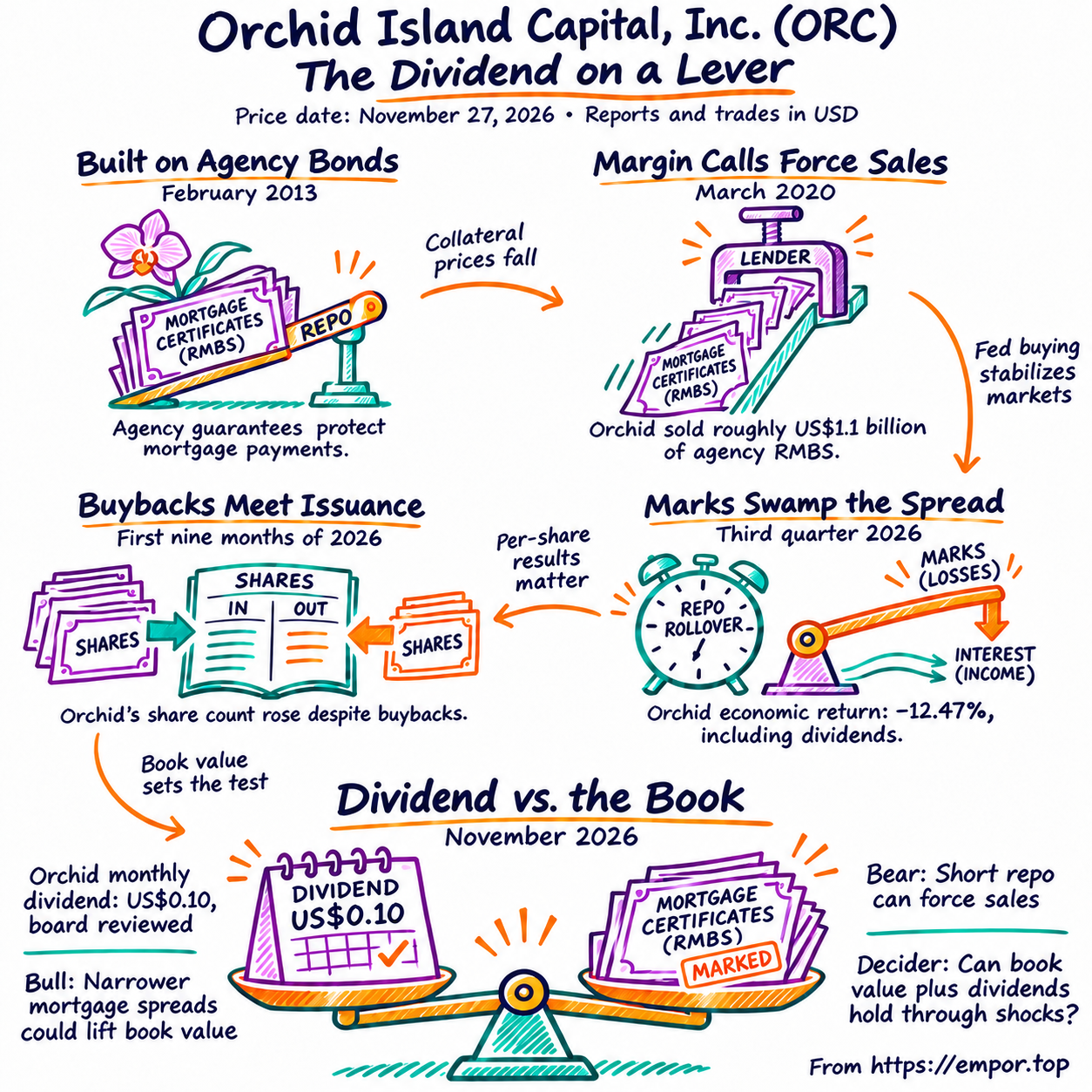
Orchid Island Capital: The Dividend on a Lever
I. A 24% Yield and a $6 Book Value
On the Friday after Thanksgiving, November 27, 2026, in a half-day session when most of Wall Street was elsewhere, shares of Orchid Island Capital closed at $4.91.[^1] It was an unremarkable print for a small mortgage REIT from Vero Beach, Florida. Nothing happened that day. And yet that one number, set beside two others the company had published a month earlier, describes one of the stranger propositions on the New York Stock Exchange.
The first of those other numbers is $6.02. That was Orchid's book value per share at September 30, 2026: the company's assets minus its liabilities, divided by its shares.[^2] A buyer at $4.91 was paying about 82 cents for each dollar of net assets on Orchid's own balance sheet. The second number is ten cents. That is the dividend Orchid has been declaring every month.[^2] Multiply it by twelve and you get $1.20 a year, which is about 24% of the share price. In a world where a ten-year Treasury yields a fraction of that, a stock that appears to pay you a quarter of your purchase price every year, while trading below the value of its assets, looks either like the bargain of the decade or like a trap with very good lighting.
Neither of those numbers, on its own, tells you which. A discount to book value is only a discount if the book is real and stays real. A 24% yield is only a yield if it continues, and if the capital that produces it is not quietly shrinking underneath. Here is the uncomfortable clue that sets up this whole story: in the quarter that produced that $6.02 book value, Orchid lost $178.9 million.[^2] Its economic return for the three months, which adds the dividends back to the change in book value, was negative 12.47%.[^2] The dividend arrived on schedule every month. The book value it came from fell by roughly a sixth.
So this is a story with two scorecards. One is visible, monthly and reassuring. The other is quarterly, volatile and decisive. The aim here is to figure out which one tells the truth about Orchid, and four questions will carry us there. Can Orchid earn money through hostile markets, not just friendly ones? Does the leverage it uses pay shareholders enough to compensate them for the risk of borrowing short-term against long-term bonds? Do its share buybacks actually create value per share when the company also sells new shares into the market? And does the external manager that runs Orchid, and gets paid on the size of Orchid's equity, want the same things Orchid's shareholders want?
Before going any further, it is worth drawing a careful line around what "Orchid" means. Orchid Island Capital is the listed company. It owns the bonds, carries the debt and pays the dividends. It is managed by Bimini Advisors, a wholly owned subsidiary of Bimini Capital Management, under a management agreement.[^3] Orchid itself reports no employees.[^3] Its chief executive and chief financial officer are Bimini people.1 Bimini has its own small balance sheet, its own results and its own staff, and none of those belong to Orchid. When this story talks about Orchid's portfolio, leverage or losses, it means the listed company's numbers only.
There is one more thing to understand before the history begins, and it is the key to almost everything that follows. Orchid's book value is not the depreciated cost of factories or the accumulated profit of a software company. It is, overwhelmingly, the market value of a pile of mortgage bonds, net of the money borrowed to buy them. Every quarter, those bonds are marked to whatever price the market would pay. That means the book can move violently before Orchid sells a single security, before any homeowner misses a payment, and before anything you would recognise as an operating event takes place. Orchid's auditor flagged precisely this judgment as the most demanding part of its audit, a point that will matter later.[^3]
That is the paradox in one sentence: the dividend looks like a salary, but the business behaves like a trading book. To see how a company ends up in that position on purpose, you have to go back to a small offering in February 2013 and to the people who designed it.
 Subscribe on LinkedIn
II. The REIT Built to Own Mortgage Paper
In February 2013, a newly public company with a botanical name and a very narrow mandate sold its shares to the public for the first time. Orchid Island Capital priced its initial public offering at $15.00 a share and raised about $35.4 million.23 By the standards of the IPO market that was tiny, roughly the size of a regional bank's branch-expansion budget. When the quarter closed at the end of March 2013, Orchid's book value per share was $14.98, almost exactly what investors had paid.3 It was a clean start: no legacy business, no operating history to speak of, just cash waiting to be turned into a portfolio.
Orchid was not born from nothing. Before the IPO it was privately held by Bimini Capital Management, itself a mortgage REIT that had been through the worst of the 2007–2008 housing collapse.24 Bimini had learned, at real cost, what happens when a mortgage investor takes on the risk that borrowers will not pay. Orchid's design reads like a reaction to that lesson. It would buy only agency residential mortgage-backed securities, and nothing else.2
That phrase, agency RMBS, needs translating, because the whole business sits on it. When an American homeowner takes out a conforming mortgage, the loan is often pooled with thousands of others into a security. If that pool is guaranteed by Fannie Mae, Freddie Mac or Ginnie Mae, the investor who owns the security is promised that principal and interest will be paid even if the homeowners default.[^3] Ginnie Mae carries the explicit backing of the U.S. government; Fannie and Freddie have operated under federal conservatorship since 2008. For practical purposes, the credit risk is gone. If a family in Ohio stops paying, the guarantor makes the investor whole.
What the guarantee does not do is fix the price of the bond. A mortgage security pays a fixed coupon on a balance that shrinks over time as homeowners pay down or refinance their loans. When interest rates rise, new bonds pay more, so old bonds with lower coupons are worth less. When rates fall sharply, homeowners refinance, and the investor gets its money back early, just when it can only reinvest at lower yields. And when investors in general get nervous about mortgages, the extra yield they demand over Treasuries, the "spread," widens, pushing prices down even if Treasury yields have not moved at all. None of this is a credit loss. All of it can cost a holder of agency bonds real money.
The business model built on top of those bonds is simple to state. Orchid earns interest on its mortgage securities. It does not buy them with its own equity alone; it borrows most of the purchase price through repurchase agreements, or repo, which are short-term loans in which the bonds themselves are the collateral.[^3] It then hedges part of its interest-rate exposure with instruments such as interest-rate swaps and Treasury futures. And it tries to keep the difference between what the bonds pay and what the borrowing and hedging cost. If the bonds yield 6% and the borrowing costs 4%, every dollar of borrowed money earns two cents a year, and borrowing many dollars per dollar of equity turns a thin spread into a fat return on equity.
There is a reason this kind of company pays such a conspicuous dividend. Orchid elected to be taxed as a real estate investment trust, and REITs must distribute at least 90% of their taxable income to shareholders to keep that status and avoid corporate-level tax.[^3] Orchid chose to make those distributions monthly, which gives the stock the rhythm of an income product. That rhythm is part of its appeal to retail investors. But a REIT dividend is a statement about taxable income, not about economic return. Taxable income can differ substantially from the change in the value of the portfolio, and the dividend says nothing about whether the shareholder's capital grew or shrank. The only honest scorecard for a mortgage REIT is total return: the dividends received plus the change in book value per share.
From the very beginning, Orchid was structured as an externally managed vehicle. Bimini Advisors would select the bonds, arrange the financing, run the hedges and handle the administration, in exchange for a management fee and reimbursement of costs.2 That arrangement shapes the company's identity. Orchid is not an operating company with factories, a sales force or customers who come back. It is a small public balance sheet with a manager attached. The people who make every decision draw their salaries from someone else.
The face of that manager has been the same for the whole of Orchid's public life. Robert Cauley has been chief executive since Orchid's inception, and he also leads Bimini Capital.1[^3] He is the steady voice on Orchid's quarterly calls, a long-time mortgage-market practitioner whose explanations tend to run through the mechanics of rates, prepayments and the Federal Reserve rather than through slogans. Alongside him, G. Hunter Haas serves as chief financial officer and chief investment officer, the person who runs the portfolio day to day.1 Neither is an Orchid employee. Bimini sets their base salaries and cash bonuses; Orchid's proxy reports only the Orchid-related stock awards.1
The strategy, remarkably, has not drifted. More than a decade after the IPO, Orchid still describes itself as an investor in agency RMBS, financed principally with repo, and still reports a single line of business.[^3] There has been no pivot into credit, no acquisition of a mortgage originator, no detour into commercial real estate. That consistency is a real virtue in a sector where some peers have reinvented themselves after each crisis. But it also means the risks Orchid carried in 2013 are, in shape, the risks it carries today.
One consequence of that consistency is easy to miss. If you compare the $14.98 book value at the end of March 2013 with today's $6.02, you are comparing two different kinds of share. In August 2022, Orchid carried out a one-for-five reverse stock split, consolidating about 176 million shares into about 35 million.5 Adjusted for that split, the IPO-era book value was roughly $75 per share. Today's book is about $6. Dividends paid along the way were large, and they belong in any honest total-return tally. But the arithmetic of the book itself is brutal: per-share book value has fallen by more than 90% since the company went public.
That decline did not happen in a straight line, and it did not happen because homeowners defaulted. It happened in a series of shocks, each one a lesson about the difference between a guaranteed bond and a guaranteed price. The most dramatic of those lessons arrived in the spring of 2020, when the question built into Orchid's design was answered in public: what happens when the market price of your collateral falls faster than your lenders are willing to wait?
III. When a Safe Mortgage Bond Became a Liquidity Crisis
The second week of March 2020 was supposed to be a good time to own agency mortgage bonds. The pandemic was spreading, stock markets were crashing, and Treasury yields were plunging as investors ran for safety. Agency RMBS are about as close to Treasuries as a non-Treasury bond gets. If anything was going to hold its value in a panic, surely it was a mortgage bond guaranteed by Fannie Mae or Ginnie Mae.
Instead, the market for those bonds seized up. Investors everywhere were scrambling for cash at the same moment, and many of them held the same kinds of securities, financed the same way. When everyone with a repo loan needs to raise money at once, the bonds they all own become the thing they all sell. Prices of agency mortgage securities fell while Treasury prices rose, which is exactly the move that a hedge built on Treasuries and swaps does not protect against. Mortgage spreads blew out.
For Orchid, the consequences arrived in the form of margin calls. On Thursday and Friday, March 19 and 20, 2020, the company sold roughly $1.1 billion of agency RMBS and realized about $31.4 million of losses on those sales.6 Ten days later, Orchid published an update to its shareholders.7 It said that falling asset prices and the resulting margin calls from repo lenders had driven its sales, that its portfolio had shrunk by about 18% since the end of 2019 to roughly $2.94 billion, and that its estimated book value per share had fallen by approximately 27% to 28% from year-end.7 In less than three months, more than a quarter of shareholders' equity had evaporated, and the borrowers on the underlying mortgages had, for the most part, done nothing wrong.
To understand how that happens, picture a homeowner with a small down payment and a lender that revalues the house every morning. Repo works roughly like that. When Orchid borrows against a bond, the lender advances somewhat less than the bond's market value; the gap is called the haircut, and it is Orchid's equity in that particular trade. If the bond's price falls, the lender's cushion shrinks, and the lender can demand more cash or more securities, immediately. The loans are short, often a month or so, so a nervous lender can also simply raise the haircut or decline to roll the loan when it matures. A business financed this way must have cash on hand to meet those calls, or it must sell assets. In a falling market, selling assets pushes prices down further, which triggers more calls on everyone else. That is the spiral.
What makes the 2020 episode especially instructive is that the hedges did not save the day. Hedges are designed for a specific risk: that interest rates rise and bond prices fall. In March 2020, rates fell. Orchid's swaps, which pay off when rates rise, lost value, and losses on derivatives can generate their own collateral demands. Over the course of the year, as Orchid repositioned, it terminated interest-rate swaps and recognized roughly $45 million in fair-value losses on them.6 The hedging program was not a mistake in concept. It simply covered a different storm from the one that arrived. The danger in March 2020 was not the level of rates but the basis, the gap between mortgage prices and the instruments used to hedge them, and the liquidity of the whole market.
What stopped the spiral was, in the end, not Orchid. It was the Federal Reserve. In March 2020, the Fed announced purchases of agency mortgage-backed securities on a scale and at a pace that effectively made it the buyer of last resort, and the market began to stabilize.6 Orchid's 2020 annual report describes that support as central to the recovery in agency RMBS prices later in the year.6 Orchid survived. But its survival depended on a policy intervention that no shareholder could have counted on in advance, and that no company can schedule.
There is a claim that management made in the middle of the crisis that deserves careful handling. In its March 30 update, Orchid said it had met every margin call it received during the turmoil and, indeed, every margin call since its inception about eight years earlier.7 That is true, and it matters: a REIT that misses a margin call can lose control of its collateral, and some leveraged mortgage investors in 2020 did fail or had to negotiate forbearance with their lenders. But meeting margin calls is not the same as avoiding damage. Orchid met its calls by selling a large slice of its portfolio at depressed prices and by absorbing the losses on its hedges. The record of never missing a call is a record of liquidity management, not proof that the business is immune to the risk.
The same update is revealing in what it did not promise. Orchid had paid its February 2020 dividend of eight cents a share, on a pre-split basis, and had already declared the next one. But it said its board would reevaluate the dividend level at an April meeting and stated plainly that the company "has not established a minimum distribution payment level."7 That sentence is worth remembering whenever the current dividend is described as though it were a coupon. It is a board decision, revisited regularly, and it bends when the book bends.
By the end of 2020, the year looked better than the March headlines. Prices recovered with the Fed's buying, Orchid rebuilt its portfolio, and the company finished the year with net income of about $2.1 million.6 That small positive figure is a useful reminder of how misleading annual numbers can be for a business like this. A shareholder who held on through March and December ended the year with modest accounting profit; a shareholder whose life forced a sale in late March locked in a disaster. The same securities, the same company, the same year, two completely different outcomes, separated only by timing.
So what did March 2020 settle? It settled the question of whether a government guarantee makes a leveraged agency portfolio safe in the way most people use that word. It does not. The guarantee protects against borrowers' failure to pay. It does nothing about the price at which you can sell, the willingness of your lenders to keep lending, or the possibility that your hedge and your asset move in opposite directions on the worst day of the decade. Orchid came out the other side, smaller and poorer, with its strategy unchanged.
That leaves the deeper question unresolved. If the business survives crises only by selling into them and waiting for help, the economics in calm periods must be strong enough to pay for those episodes. The calm-period engine is the spread between what the bonds earn and what the money costs. The next chapter looks at that engine in its most recent quarter, when it was running better than it had in years and still lost.
IV. The Spread Looks Better—Until the Marks Turn
By the summer of 2026, Orchid's engine was humming. The portfolio had grown into a genuinely large book: in the third quarter, Orchid held an average of about $11.1 billion of agency mortgage securities, up from an average of about $9.5 billion in the last quarter of 2025.[^2][^11] Those securities yielded an average of 5.91%. Orchid's average cost of funding them, after the effect of its hedges, was 3.92%. The difference, 1.99 percentage points, was wider than it had been a year earlier.[^2] Net interest income for the quarter came to about $59.1 million.[^2]
Then look at the other line. In the same three months, Orchid recorded about $231.7 million of net realized and unrealized losses on its mortgage securities and its hedges.[^2]8 The quarter's net loss was $178.9 million.[^2] For every dollar the spread earned, the marks took away almost four. This is the central mechanic of the business, and it is worth slowing down to see why.
It helps to translate the quarter into what a single share experienced. Orchid paid thirty cents of dividends over the three months and still produced an economic return of negative 12.47%, ending at a book value of $6.02.[^2] Working that arithmetic backward implies the quarter began with book value of roughly $7.20 a share. So each share received thirty cents in cash and watched about $1.20 of book value disappear. A shareholder who saw only the monthly deposits would have felt nothing unusual. A shareholder who checked the balance sheet would have seen four months of dividends' worth of capital lost for every month of dividends received.
Think of the spread as rent collected on a building, and the marks as changes in the building's appraised value. In most businesses, the rent is the main event and the appraisal is a footnote. In a leveraged mortgage REIT, it is closer to the reverse. The rent comes in steadily; the appraisal can swing by many times a quarter's rent, because Orchid owns roughly eight or nine dollars of bonds for each dollar of shareholders' equity. A small percentage move in an $11 billion portfolio is a very large percentage move in a $1.2 billion equity base.
Three forces drive those appraisals, and they do not always move together. The first is the general level of interest rates: when yields rise, existing fixed-coupon bonds lose value. Orchid hedges much of that exposure, so a pure rate move is partly offset. The second is the mortgage spread, the extra yield investors demand to hold mortgage bonds rather than Treasuries. That can widen even when Treasury yields are moving in Orchid's favor, and it is much harder to hedge, because the hedges are mostly tied to Treasury or swap rates. The third is prepayment speed. When homeowners refinance or sell, they pay off their loans at face value. For a bond bought above face value, that returns capital sooner than expected and erases the premium; for a bond bought at a discount, it is a windfall. Prepayments also force the question of what to buy next, at what yield.
The earnings history shows what these forces do to annual numbers. Orchid lost about $39.2 million in 2023, when the rapid rise in rates was still working through mortgage valuations and Orchid's funding costs actually exceeded its interest income, leaving it with net interest expense of about $24.3 million.[^3] In 2024 it earned about $37.7 million, and in 2025 net income jumped to about $159.0 million, helped by a much larger portfolio and cheaper funding that drove net interest income from about $5 million to about $108 million in a single year.[^3] Then the first nine months of 2026 returned a net loss of about $109.7 million, despite nine-month net interest income of about $176.2 million.8 These are not the numbers of a company growing its earnings. They are the numbers of a portfolio whose results depend on what rates and spreads did that year.
The rebound in net interest income is a real improvement. In 2023, Orchid was effectively paying to hold its bonds, because the hedges and repo cost more than the coupons earned. Three years later, it was earning a positive spread on a much larger book. That turnaround came partly from the market and partly from decisions: buying higher-coupon securities as rates rose, extending hedges, and growing the portfolio when spreads were attractive. But the third quarter of 2026 demonstrated the limit of that improvement. A better spread does not insulate the equity from marks. It only gives the equity more income with which to absorb them.
There is a tempting alternative scorecard that deserves to be set aside. In the first nine months of 2026, Orchid's cash flow from operations was positive $195.3 million, at the same time as it reported a $109.7 million loss.8 A casual reader might conclude that the "real" business was generating cash while accounting noise produced the loss. The reconciliation tells a different story. The cash-flow statement adds back about $710.4 million of unrealized losses on mortgage securities, because they were not paid in cash, and subtracts about $389.8 million of gains on derivatives for the same reason.8 Those unrealized losses are not imaginary. They are reductions in the value of assets that Orchid owns and has borrowed against. Operating cash flow here is mostly interest collected minus interest paid; it tells you nothing about whether the collateral beneath the repo loans is worth more or less. For this kind of company, it is not a measure of distributable earnings.
Orchid does not compete for customers the way a retailer or software company does. It competes for assets and for capital. The closest peers are other agency-focused mortgage REITs: Annaly Capital Management and AGNC Investment, which operate at far greater scale, and smaller names such as ARMOUR Residential and Dynex Capital.910 All of them buy from the same pool of agency securities, borrow from many of the same dealer banks in the repo market, and hedge with the same instruments. Annaly also runs residential credit and mortgage-servicing-rights businesses alongside its agency book, which gives it more than one engine.10 AGNC is an agency specialist but at a size that gives it a broad bench of financing relationships and a lower expense burden per dollar of equity.9 Orchid reports one business, an agency RMBS portfolio, and nothing else.
That makes the moat question straightforward, and it should be answered once and clearly. The agency guarantee is a feature of the securities, not of Orchid. Any investor with access to repo can buy the same bonds at the same prices. There is no customer lock-in, no proprietary distribution, no brand that lets Orchid earn a higher yield than the next buyer. The plausible differentiators are the ones that show up in execution: the cost and breadth of funding, the skill and timing of hedges, the choice of coupons and prepayment profiles, and the cost of running the vehicle. Those are real, but they are not durable advantages in the way a network effect or a patent is. And the available evidence does not establish Orchid as a leader on any of them. Its scale is smaller than the giants', its expense ratio is shaped by an external management fee, and its long-run total return, as later chapters show, trails the sector index.
The most recent live test of all this came on October 23, 2026, the morning after the third-quarter results, when management walked analysts through the quarter.[^15] The prepared remarks centered on the turbulence in mortgage markets during the quarter and on the steps taken in response, notably raising hedge coverage, which the call materials put at about 99% of repo funding at quarter-end.[^11] The questions from analysts went where a skeptical investor would go: how much leverage the company intended to run after the loss, how quickly book value had recovered since quarter-end, when Orchid would resume reinvesting the cash coming back from prepayments, and whether the dividend level was secure.[^15] Management's answer on the recovery was concrete, a book value up roughly 4.5% month-to-date through October 22.[^11] On the dividend, the posture was the same as in 2020: a board decision, reviewed against the outlook for earnings, not a promise.
The spread, in short, is the engine, and the engine was running well. But the engine sits on top of a funding structure that turns every movement in the bond market into a much larger movement in equity. To understand why a good spread can still produce a bad quarter, and why a quarter like that can turn into something worse, you have to look at the loans underneath the portfolio and how long they last.
V. The 26-Day Loan Behind the Monthly Dividend
At the close of business on September 30, 2026, Orchid owed its repo lenders $10.36 billion.8 The average remaining term of that borrowing was 26 days.8 Sit with that for a moment. A company with roughly $1.2 billion of shareholders' equity had borrowed more than eight times that amount, and, on average, every dollar of the debt had to be repaid or rolled over before the next month's dividend was paid. The monthly dividend and the monthly loan run on the same calendar.
This is the balance sheet in its simplest form. On one side, Orchid owns agency mortgage securities, plus some cash and Treasury bills. Nearly all the mortgage securities are pledged to repo lenders as collateral. On the other side are those repo loans, a few other liabilities, and a thin slice of equity. Every few weeks, each loan matures, and Orchid asks the lender to renew. Usually the lender says yes, at a rate tied to short-term interest rates and with a haircut that reflects how nervous the lender is about the collateral. The business works as long as those conversations keep going well.
Orchid's preferred measure of how much it borrows is economic leverage, which at quarter-end stood at 8.6 times.[^2] That figure folds in some adjustments, but the arithmetic of what it means is simple. If you own about $9 of bonds for every $1 of equity, then a 1% fall in the value of the bonds, not hedged away, removes about 9% of the equity. A 3% fall removes more than a quarter. That is the leverage multiplier, and it works in both directions, which is why a good year can be spectacular and a bad quarter can erase a year of dividends. In the third quarter of 2026, the multiplier worked against shareholders.
Put that against the third quarter itself. Orchid entered the quarter with common equity in the region of $1.3 to $1.4 billion, judging by the implied opening book value and a share count in the low 190 millions, and the $231.7 million of portfolio and hedge losses consumed about a sixth of it in three months.[^2] The company's net interest income for the same period replaced only about a quarter of that damage. That is leverage made visible: a portfolio move of around 2% in value, against an equity base about one-ninth the size of the assets, becomes a double-digit loss for shareholders.
The worse danger is not the mark itself but what it can force. When collateral values fall, lenders call for more margin. When they get nervous, they raise haircuts, which shrinks how much they will lend against the same bonds. Either change can force Orchid to shrink its portfolio, and a company forced to shrink usually does so at the worst possible prices, because the same conditions are pressing on every other leveraged holder at once. That is what happened in March 2020. It is the risk that does not show up in a spread calculation.
Against that, Orchid has built genuine defenses. At quarter-end, the company reported $515.7 million of cash and unpledged securities, a liquidity reserve that could meet margin calls without selling bonds.[^2] Its cash was spread across banks, overnight sweep arrangements and clearing members, and it also held about $208 million of U.S. Treasury securities.8 It reported borrowing capacity across 33 active repo lenders, which means no single dealer bank's change of heart would cut off its funding.[^2] And the company's disclosure of counterparty exposure, the amount it would lose if a lender failed and did not return excess collateral, totaled about $413.7 million in aggregate, with no single counterparty exceeding 10% of equity.8 Compared with the roughly $131 million of cash and unencumbered securities Orchid had on hand during the March 2020 squeeze, the cushion is about four times larger in absolute terms.7 That sounds like a transformation until you set each reserve against the portfolio it protected.
In late March 2020, Orchid's portfolio was worth about $2.94 billion, so its liquidity amounted to roughly four and a half cents for every dollar of bonds.7 In the third quarter of 2026, the average portfolio was about $11.1 billion, and $515.7 million of liquidity works out to roughly four and a half cents again.[^2] The company has grown nearly fourfold, and its reserve has grown with it, but the proportion is essentially unchanged. Orchid is better prepared than it was in 2020 only in the sense that it is bigger. Measured against the collateral that lenders can call on, the fuel tank is the same size relative to the engine. A shock as sharp as March 2020, relative to the portfolio, would test it in much the same way.
Those facts narrow the risk; they do not remove it. Thirty-three lenders reduce the chance that one lender's decision becomes Orchid's crisis. They do nothing about the scenario where all lenders tighten together, which is what happens in a genuine market-wide stress. A liquidity reserve of about half a billion dollars is meaningful against a $10 billion repo book, but it is roughly equal to a 5% decline in the value of the collateral. Short repo maturities mean Orchid can reprice its funding quickly when rates fall, which helps; they also mean the funding can disappear quickly when conditions sour. No issuer credit rating sits in the middle of this; Orchid does not disclose one, and the practical constraints on its borrowing are the terms its counterparties set, the collateral they accept, and the speed at which those terms can change.[^3]
That brings the $6.02 book value back into focus, from a different angle. When Orchid's auditor, BDO, audited the 2025 financial statements, it identified the valuation of about $10.6 billion of mortgage-backed securities as a critical audit matter.[^3] That is the auditor's way of saying that this was the part of the audit requiring the most challenging judgment. The fair values come from third-party pricing services and broker quotes, and selecting among them involves judgment. BDO used valuation specialists and independent pricing inputs to test them. A critical audit matter is not a qualified opinion; the audit opinion itself was clean.[^3] Agency mortgage bonds are also among the most actively traded securities in the world, so the marks are far less subjective than, say, a private-credit book. But the designation is a useful reminder that book value is a reference point, an estimate of what the portfolio would fetch in an orderly sale on a particular day. It is not a guaranteed exit price, and in March 2020 the price at which Orchid could actually sell was meaningfully worse than the price a few weeks earlier.
The company's 2025 annual report also states that management was not aware of any reported or unreported contingencies at year-end, and no material litigation or tax dispute hangs over the balance sheet.[^3] For Orchid, the significant contingent risks are not in the legal notes. They are in the price of the bonds and the patience of the lenders.
If a long-term investor wanted to reduce Orchid to a few dials, three would do most of the work. The first is the economic net interest spread after hedges, which last read 1.99 percentage points in the third quarter, improved from a year earlier.[^2] It is the engine. The second is economic leverage together with liquidity: 8.6 times at quarter-end, with $515.7 million of cash and unpledged securities.[^2] It is the throttle and the fuel reserve. The third is book value per share including dividends, the economic return, which was negative 12.47% for the quarter.[^2] It is the odometer that tells you where you actually went.
What would change the risk assessment? Evidence of two kinds. The first is leverage and funding pressure easing without forced sales: economic leverage drifting lower because equity grew or the portfolio was trimmed calmly, not because lenders demanded it. The second, more demanding, is book value holding up through a period of spread volatility rather than merely bouncing after one. Orchid's history contains many rebounds. What it has not yet shown is a long stretch in which the spread consistently reached shareholders as rising book value plus dividends.
There is one more lever that affects how leverage translates into per-share outcomes, and it is entirely within management's control. Orchid can change the denominator. It can buy back its own shares, and it can sell new ones. In 2026 it did both.
VI. Buybacks Below Book, Issuance Above the Same Balance Sheet
In the first nine months of 2026, Orchid repurchased about 6.05 million of its own shares, spending about $38.5 million at a weighted-average price of $6.36.[^2] In June it added 25 million shares to its repurchase authorization, and by October 22 nearly 20 million shares remained available to buy.[^2] Management's case for the buybacks is a familiar one: the company was buying its stock at a discount to book value. If you can buy a dollar of net assets for 85 cents, the remaining shareholders end up owning more net assets per share.
The logic has force, and it is worth spelling out. Suppose Orchid's book value is genuinely $7.00 and the stock trades at $6.00. Every share repurchased removes $6.00 of assets and one share's claim on $7.00. The leftover $1.00 is distributed, in effect, across all remaining shareholders. For a company whose only real asset is a portfolio of liquid securities, this is one of the cleanest forms of value creation available. It requires no acquisition, no new product, no forecast. It requires only two conditions: that the book value is real, and that the company does not undo the benefit by issuing shares on worse terms.
Orchid has no meaningful acquisition history to weigh against this. Its filings describe no operating acquisitions; capital deployment means making the securities portfolio bigger or smaller, choosing hedges, issuing equity and buying it back.[^3] So the capital allocation question for this company is narrower and in some ways sharper than for an operating business: does management change the share count in ways that add or subtract value per share?
Here the record becomes complicated. At the end of 2025, Orchid had about 182.0 million common shares outstanding. At September 30, 2026, after buying back more than 6 million shares, it had about 194.7 million.8 Run that arithmetic backward and Orchid must have issued, in round numbers, something like 18 to 19 million new shares over those nine months, three times as many as it repurchased. The tool for that issuance is an equity distribution agreement signed in October 2025, which allows Orchid to sell up to $500 million of common stock through at-the-market offerings or privately negotiated transactions.8[^3] At-the-market issuance means Orchid sells shares directly into the trading market, a few at a time, at prevailing prices.
None of that is automatically bad. When Orchid's stock trades above book value, issuing shares brings in more than a dollar of net assets for each dollar of book handed to the new shareholders, which adds value per share for the existing owners. New equity also lets the portfolio grow without increasing leverage, which in a good spread environment means more income. The problem comes when the same company issues near or below book and then buys back below book, or when the issuance funds portfolio growth just before the marks turn. The price of the shares sold in 2026 is the variable that determines whether the year's capital activity was accretive in total, and the reconciliation that matters is net share count against book value per share over a full cycle, not gross repurchases in isolation.
The longer view makes the point vividly. After the reverse split in August 2022, Orchid had about 35.3 million shares outstanding.5 Four years later, it had about 194.7 million.8 The company has, in effect, been rebuilt from new capital more than once. That expansion is why the portfolio could grow to $11 billion, and why net interest income could rise as dramatically as it did. It is also why a single quarter's mark can now remove more than $200 million of value, and why per-share outcomes, not aggregate ones, are the only ones that matter to a shareholder. A bigger Orchid is not necessarily a better Orchid for anyone who already owned it.
How should management be judged on this? Robert Cauley has led Orchid since inception, a span of more than thirteen years in which the company has kept to its agency-only mandate and has met every margin call, including those of March 2020.17 Continuity and discipline about scope deserve credit; many mortgage REITs of Orchid's 2013 vintage no longer exist. But continuity is not the same as outcome. Under the same leadership, per-share book value has fallen more than 90% from its split-adjusted IPO level, and the company has gone through repeated book-value shocks, in 2020, in the rate surge of 2022 and 2023, and again in the third quarter of 2026. A long tenure that includes those results is evidence of persistence and survival. It is not, on its own, evidence of an edge.
The incentive structure is where a skeptical investor would push hardest. Bimini Advisors is paid a management fee based on Orchid's equity, and that fee is payable regardless of how the portfolio performs.[^3] Orchid also reimburses Bimini for allocated overhead and certain trading, clearing and administrative costs. In 2025, those related-party fees and reimbursements came to about $16.6 million, roughly 81% of Orchid's total expenses of about $20.5 million.[^3] Measured against the size of the portfolio, the expense is modest, about 4% of the year's interest income.[^3] The concern is less the amount than the direction of the incentive. A rough illustration makes it concrete. With about 194.7 million shares and a book value of $6.02, Orchid's common equity at the end of September was a little under $1.2 billion.8[^2] At the end of 2022, after the reverse split, there were only about 35 million shares.5 Because the fee is calculated on equity, the manager's base compensation from Orchid has grown roughly in line with the capital raised, while book value per share, the measure shareholders actually live on, has not followed. A fee based on equity rises when Orchid issues shares, whether or not those shares are issued at a price that helps existing holders. It does not fall when book value per share declines because of share-count growth. And if Orchid's board ever wanted to end the arrangement without cause, the manager would be entitled to a termination fee equal to three times the average annual management fee, a cost that makes changing managers expensive.[^3]
What ties management to shareholders? Ownership, first. Bimini owned about 569,000 Orchid shares at the end of 2025, about 0.3% of the company.1 That is a small stake against a fee stream calculated on the whole equity base. The largest outside holder is BlackRock, whose institutional trust held about 18.85 million shares, or 10%, at September 30, 2026, according to Orchid's ownership profile, up from about 5.6% reported in the 2026 proxy.[^16]1 There is no controlling shareholder; influence sits with the manager and its shared executives.
Then compensation. Orchid's 2026 proxy reported no Orchid stock awards to Cauley or Haas for 2025, then disclosed 2026 performance awards worth about $1.76 million for Cauley and about $1.31 million for Haas.1 Their salaries and cash bonuses are set by Bimini. Four of the six director nominees were independent, and at the 2025 annual meeting about 91% of votes cast supported the advisory say-on-pay resolution.1 A strong say-on-pay vote shows that shareholders did not object to the stock-award program presented to them. It does not settle the larger question, because the bigger economic lever, the management fee, is not what shareholders vote on in that resolution. The fee's formula is set in the management agreement, and its incentive is to grow equity.
So the capital story ends in a balanced but pointed place. Buybacks below a credible book value add value per share. Issuance above book can, too. But a manager paid on the size of the equity has a structural reason to prefer growth, and in 2026 the share count grew even while the company was advertising its buybacks. The test is the one a shareholder can actually measure: net share count and book value per share, together, over a full year and then a full cycle. What happens when you apply that test across Orchid's whole record is where the lessons of this story come from.
VII. Playbook: Business & Investing Lessons
Go back to March 2020 one last time. The dividend was still being paid, and the next one had already been declared. On the screen, Orchid still looked like an income stock. Underneath, the company was selling more than a billion dollars of bonds in two days to meet its lenders' calls, locking in losses it would never recover from those particular positions, while the Federal Reserve prepared to step into the market. The visible scorecard said nothing had changed. The real scorecard said a quarter of the equity was gone.
The first lesson is the one the whole story turns on. A government guarantee can protect the mortgage payment; it cannot guarantee your exit price. Agency securities remove the risk that most people associate with mortgage investing, the risk that homeowners stop paying. They do not remove the risk that matters most to a leveraged holder: that prices fall, lenders demand cash, and the holder has to sell at the worst moment. For investors, the broader point is to ask, of any "safe" asset, exactly what is guaranteed and to whom. Safety for the bond's eventual cash flows is not safety for a borrower who must mark it every day.
The second lesson comes from the third quarter of 2026, when Orchid earned about $59 million of net interest income and then lost about $232 million on the value of its bonds and hedges.[^2] A spread is an engine, not a destination: count the hedges, funding and marks that determine what reaches equity. Mortgage REITs, and many other leveraged income vehicles, invite investors to focus on the spread because it is stable and easy to explain. But the spread is the smallest number in the equation in any turbulent quarter. For founders and operators, the parallel is any business whose gross margin looks excellent while the balance sheet carries a much larger, unhedged exposure. The margin is not the business. The balance sheet is.
The third lesson belongs to 2026's twin share programs. A buyback is only as accretive as the book value you trust, and the shares you issue afterward. Orchid bought back over six million shares at a weighted average of $6.36, and reported a book value of $6.02 a few weeks later.[^2] Those repurchases were made below the book value that prevailed at the time, but above the book value that followed. Meanwhile, the share count rose by about 12.7 million. Buybacks are judged on net, not gross, and at the moment of execution, not on the hope that the mark will hold.
The fourth lesson is about structure and incentive. A manager paid on the size of the equity will always find growth more appealing than shrinkage. Orchid's management fee rewards a larger Orchid; Orchid's shareholders are rewarded only by a richer one. Those can coincide, and in good years they do. But when they diverge, the formula tells you which way the pull runs. Any investor considering an externally managed vehicle, a mortgage REIT, a business development company or a closed-end fund should read the fee formula before the dividend history.
Behind all four lessons is the long record, which Orchid itself publishes. In its 2025 annual report, the company's performance chart showed $100 invested in Orchid at the end of 2020 growing, with dividends reinvested, to about $67 by the end of 2025.[^3] The same $100 in a mortgage-REIT index would have grown to roughly $114, and in the S&P 500 total-return index to about $196.[^3] That five-year window included one of the most hostile rate environments in modern history for mortgage investors, so part of Orchid's shortfall is the sector's misfortune, not management's. The comparison against the S&P 500 is not a fair test of a bond-based vehicle. But the comparison against other mortgage REITs is, and on that measure Orchid lagged by a wide margin even after counting every monthly dividend. The record does not show a company that converts its high distribution into a durable total return better than its peers.
That leaves the present to be judged: a stock below book, a dividend that implies a 24% yield, and a market apparently unwilling to believe either at face value. Is the market wrong?
VIII. Analysis & Bear vs. Bull Case
Picture a shareholder at the end of November 2026, looking at two numbers. The quote on the screen says $4.91.[^1] The latest reported book value says $6.02.[^2] The difference is about 18%, the stock trading at about 0.82 times book. The dividend is ten cents a month. The last full quarter delivered an economic return of negative 12.47%.[^2] The question this shareholder faces is not whether Orchid is cheap on a screen. It is whether the market's discount reflects a mistake or a fair estimate of what is likely to happen to that $6.02.
Start with the industry, because Orchid's prospects are mostly the industry's. Through Michael Porter's five forces, the agency mortgage REIT business looks structurally hard. Rivalry is intense: Annaly, AGNC, ARMOUR, Dynex and many banks, insurers, money managers and, at times, the Federal Reserve all buy the same agency securities, and nobody can charge a premium for them.910 Supplier power, here the power of those who supply funding, is high in the short term. Repo lenders reset terms every few weeks, can raise haircuts in a crisis, and in March 2020 effectively determined which REITs had to sell. There are no buyers in the conventional sense, because Orchid has no customers; the closest analogue is the equity market, which can supply capital when the stock trades above book and withdraws it when it trades below. The threat of substitutes is real from the shareholder's side: an investor seeking agency mortgage exposure can buy a mortgage ETF or the bonds directly, without the leverage or the fee. Barriers to entry are modest for anyone with capital and dealer relationships, though scale helps. The agency guarantee lowers credit risk for every player equally; it is not a protected supply of anything.
Hamilton Helmer's seven powers produce a similarly sparse map. There are no network effects, no switching costs, no brand that commands a higher yield, no counter-positioning against incumbents, and no cornered resource. The one candidate is scale economies: a larger portfolio spreads fixed costs and, in principle, attracts better financing terms. But Orchid is not the scale player in its own sector; Annaly and AGNC are.910 That leaves process power, the possibility that Orchid's team is simply better at picking coupons, timing hedges and managing funding. Process power is the hardest advantage to prove, because it should show up in long-run relative total returns. Orchid's own five-year chart, trailing the mortgage-REIT index by a wide margin, does not support it.[^3] The honest verdict is that Orchid has no demonstrated durable competitive advantage. It is a well-run vehicle for a particular kind of market exposure, and its returns will mostly be the market's returns, levered.
From that baseline, the case for why Orchid could do well from here is narrow, but it is not empty. The engine is in better shape than it was in 2023: the spread on the portfolio was close to two percentage points in the third quarter, and net interest income has risen dramatically with the portfolio's size.[^2] If mortgage spreads, which widened in the third quarter, narrow again, Orchid's book recovers mechanically, and the early-October rebound suggested how quickly that can happen.[^11] Management raised hedge coverage to about 99%, reducing exposure to further rate moves.[^11] The portfolio is made of liquid, credit-guaranteed securities; the funding is spread across 33 lenders; liquidity is about half a billion dollars.[^2] And if the book is credible, buying back stock at 82 cents on the dollar adds value for the remaining shareholders with every share retired. A buyer at a discount to book gets a margin of safety against moderate further marks and a large income stream while waiting.
The case for why not is just as concrete. The spread and funding conditions that would drive a recovery are set by the market, not by Orchid; the company can position for them, but it cannot cause them. The record of the same business under the same management shows repeated book-value shocks, a more than 90% decline in split-adjusted book value per share since the IPO, and a five-year total return well below the sector index.35[^3] Larger peers have scale and diversification advantages. The capital structure, more than eight times levered on 26-day money, means a second bad quarter can turn a mark into a forced sale. And the manager's fee grows with equity, which makes share issuance attractive to the manager even when its benefit to shareholders is uncertain. On this reading, a discount to book is not a mispricing; it is the market's estimate of the expected cost of the next shock, plus a discount for the fee drag and the share-count history.
The dividend deserves its own stress test, because it is the number that draws most retail investors in. At $4.91, $1.20 a year looks like 24%. But that yield is a fraction whose denominator is the share price, and the share price falls when book value falls. The yield, in other words, rises when things get worse. The better comparison is the dividend against book value: $1.20 against $6.02 is about 20% of book a year. For that payout to be sustainable without eroding capital, the portfolio would need to earn something like 20% on equity, after fees, on average, through cycles. In its best recent year, 2025, Orchid came closer to that bar; in the first nine months of 2026, it fell far below it.[^3]8 As a REIT, Orchid must distribute most of its taxable income, and taxable income can run quite differently from GAAP results because unrealized marks generally do not count. That is why a REIT can keep paying a stable dividend while its book value declines. The board has said before that it has not set a minimum distribution, and it adjusted the dividend in the past when economics changed.7 The question to watch is whether the payout continues to be maintained through periods when total return is negative, because a dividend paid out of shrinking capital is a return of capital dressed as income.
An activist looking at Orchid would focus on the fee. A management fee based on equity, payable regardless of results, rewards asset growth, and asset growth in this business comes from issuing shares. When per-share outcomes lag, the fee keeps growing. The rational activist demand would be a fee tied, at least in part, to per-share total return over several years, or a commitment to issue shares only above book value. Neither is in place. The answer to whether the manager's incentives align with shareholders therefore depends on what shareholders actually experience: net total return, net share count, leverage, and fee terms, not the size of the dividend.
Three measures will carry this story after it ends. The economic spread after hedges, last at 1.99 percentage points and improving, is the engine.[^2] Book value per share plus dividends, last at negative 12.47% for the quarter, is the scorecard.[^2] And net share-count change alongside leverage, from 182.0 million to 194.7 million shares in nine months with leverage at 8.6 times, reveals how management is using the balance sheet.8[^2] If all three move the right way at once, the bull case gains real evidence. If the spread improves while book value and share count tell another story, the market's discount will look justified.
The available evidence supports a clear but bounded conclusion. Orchid is a cyclical income vehicle that magnifies the economics of agency mortgage bonds and repo funding. Its spread is real, its liquidity is meaningful, and its management has kept it alive through severe stress. But the record rejects the claim that its high distribution amounts to a durable compounding return, and it leaves the claim of a management edge unproven at best. The discount to book is consistent with that record. Whether the record is about to change is what the next few quarters will reveal.
IX. Epilogue
By the time Orchid reported its third quarter, the worst of the damage had already partly reversed. Management told analysts that book value had recovered about 4.5% in the first three weeks of October, through October 22.[^11] Hedge coverage stood at about 99% of repo funding at quarter-end.[^11] And management said it would resume reinvesting the cash flowing back from paydowns as conditions allowed, a signal that it was ready to rebuild the portfolio rather than continue shrinking it.[^15] On November 10, Orchid published its regular portfolio snapshot as of October 31, showing the coupon mix and prepayment profile it was carrying into the year's final months.[^17]
That October bounce is evidence of how quickly marks can reverse in a market dominated by spread moves. It is not proof that the underlying problem is solved. A rebound that recovers part of a 12% quarterly loss leaves the shareholder poorer than before the quarter began, and economic leverage of 8.6 times at quarter-end means the next move in spreads, in either direction, will again be magnified.[^2]
The calendar ahead is the shape of Orchid's life: twelve dividend declarations a year, four quarterly results, monthly portfolio snapshots, and around every 26 days, the full roll of its repo book. The next decisive moment is the fourth-quarter report early in 2027, which will show whether the October recovery held through November and December, what leverage Orchid chose to run, and how many shares it issued or retired. Then comes the 2026 annual report, with its updated five-year total-return chart, and the 2027 proxy season, with another advisory vote on pay.
Each of those moments maps onto one of the questions that began this story. If the economic spread holds near two percentage points and book value per share plus dividends turns positive for several consecutive quarters, including a quarter in which rates rise or mortgage spreads widen, the case that Orchid can earn through hostile markets gains its first real evidence. If leverage drifts down because equity grew rather than because lenders forced it, and if the portfolio comes through another volatile period without forced sales, the funding question looks more manageable. If buybacks exceed issuance on a net basis over a full year, and book value per share rises alongside, the capital-allocation story becomes accretive in fact, not just in press releases.
The incentive question will take longest to answer. The management fee formula will not change unless the board and manager agree to change it. Until Orchid shows sustained per-share returns, and until shareholders reveal through future proxy votes whether they accept the fee structure alongside those returns, the question of alignment remains open. A 91% say-on-pay vote in 2025 tells you that shareholders tolerated the stock-award program. It does not tell you what they will think if the share count keeps rising while book value per share does not.
So the tension remains exactly where it was on the day of the third-quarter release. A business that earns its spread reliably, monthly, quarter after quarter, is also a business that can lose more than a year of that spread in a single quarter, through no failure of the mortgages it owns. Every month that passes without a shock makes the dividend look more like a salary. Every shock reminds shareholders that it was always a payout from a leveraged trading book.
X. Outro
Return to that quiet half-day session on November 27, 2026, and the two numbers that frame Orchid Island Capital: $4.91 on the screen, $6.02 on the September balance sheet.[^1][^2] Between them sits everything this story has been about. The gap could be a bargain, the market underpricing a liquid, government-guaranteed portfolio run by a team that has never missed a margin call. Or it could be the market's estimate of the next March 2020, the next quarter like the third quarter of 2026, the next tranche of shares issued, the next turn of a fee that grows with equity. The discount looks like a bargain only if the book survives the next shock.
What makes Orchid unlike almost any other company on the exchange is how little of its fate it controls. It does not invent products or win customers. It holds about eight and a half dollars of mortgage bonds for every dollar its shareholders own, funded with loans that come due before the next dividend.[^2] When spreads, rates and funding line up, that structure turns a two-point spread into a striking return. When they do not, the same lever turns a small move in bond prices into a large loss of shareholders' capital. The defining tension of the business is that one lever does both.
At Orchid, the dividend arrives monthly; the real verdict comes from the book.
References
-
2026 DEF 14A Proxy Statement — Orchid Island Capital, 2026-04-27 ↩↩↩↩↩↩↩↩↩
-
Final IPO Prospectus, Form 424B1 — Orchid Island Capital, 2013-02-14 ↩↩↩↩
-
Amendment No. 3 to Form S-11 — Orchid Island Capital, 2013-01-16 ↩
-
Orchid Island Capital Announces Effectiveness of Reverse Stock Split, Form 8-K Exhibit 99.1 — Orchid Island Capital, 2022-08-30 ↩↩↩↩
-
March 2020 Market Update, Form 8-K Exhibit 99.1 — Orchid Island Capital, 2020-03-30 ↩↩↩↩↩↩↩↩
-
Q3 2026 Form 10-Q — Orchid Island Capital, 2026-10-23 ↩↩↩↩↩↩↩↩↩↩↩↩↩↩
-
Q3 2026 Results and Investor Materials — AGNC Investment ↩↩↩↩
 LinkedIn
 WhatsApp
 Reddit
 Hacker News
 Email
 Kindle
 RSS Feed
 Spotify
 Apple Podcasts
 Amazon Music
 Audible
 YouTube