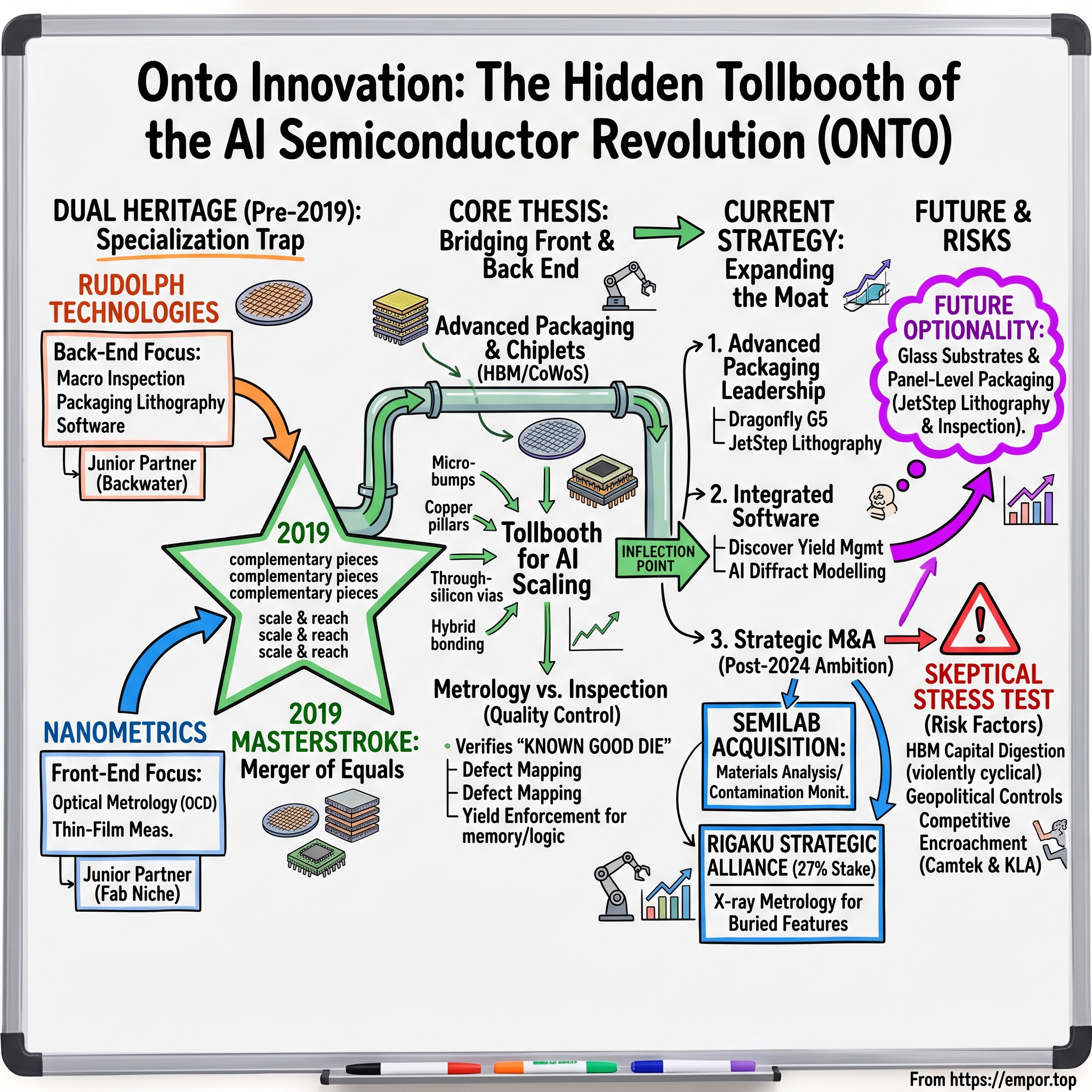
Onto Innovation: The Hidden Tollbooth of the AI Semiconductor Revolution
I. Introduction & The AI Tollbooth You've Never Heard Of
Picture the inside of an advanced packaging facility somewhere in Taiwan or South Korea, sometime in the small hours of the morning. A robotic arm lifts a silicon wafer the size of a dinner plate, on which sit dozens of stacks of memory, each stack a skyscraper of a dozen razor-thin dies bonded together by thousands of copper connections finer than a strand of spider silk. In a few weeks, some of these stacks will sit millimeters away from a NVIDIA GPU inside a data center training the next frontier AI model. Each finished module is worth thousands of dollars. And before that arm sets the wafer down, a machine has to answer one deceptively simple question: is every one of those microscopic connections good?
That question — asked billions of times a year, at resolutions measured in nanometers — is the business of Onto Innovation. It is not a household name. It does not design chips, and it does not make them. It makes the machines that decide whether the chips other people made are worth keeping. And in the AI hardware supply chain, that turns out to be a remarkably valuable place to stand.
The microscopic barrier to AI scaling
The popular story of the AI boom is a story about NVIDIA's GPUs, 台灣積體電路製造 TSMC's manufacturing prowess, and the high-bandwidth memory (HBM) that SK하이닉스 SK Hynix, 삼성전자 Samsung Electronics, and Micron stack next to the logic. What that story leaves out is that none of these components can be assembled at acceptable yields without an invisible layer of quality control sitting underneath. TSMC's celebrated CoWoS — Chip-on-Wafer-on-Substrate — packaging crams a GPU and its memory onto a single silicon interposer with interconnect densities that were science fiction a decade ago. HBM stacks eight to sixteen memory dies vertically. At those densities, a single missed defect — a particle, a cracked bump, a void in a bond — does not degrade performance. It scraps a module worth more than a laptop.
So the tools that measure and inspect these structures have quietly migrated from a cost-of-doing-business afterthought to a gating item on the entire AI buildout. That is the tollbooth. You cannot get onto the AI highway without paying it.
Company snapshot
Onto Innovation Inc. trades on the NYSE under the ticker ONTO. In its fiscal 2024 (ended December 28, 2024) it reported revenue of $987.3 million, and in fiscal 2025 (ended January 3, 2026) it crossed the symbolic billion-dollar line at $1.005 billion.36 Gross margins run in the low-50s on a GAAP basis and mid-50s on the non-GAAP basis management prefers.35 The balance sheet carries no bank or bond debt — only modest finance leases — against hundreds of millions in cash and short-term investments.4 For a semiconductor capital-equipment company, that is an unusually clean, unlevered profile.
The core thesis
Here is the puzzle this article exists to unpack. Onto Innovation is barely seven years old as a corporate entity, yet it occupies a genuinely hard-to-replicate position in advanced packaging and specialty-device process control. It got there not by out-inventing giants but by a piece of corporate arithmetic: in October 2019, two mid-tier, chronically overlooked semiconductor-equipment vendors — Rudolph Technologies and Nanometrics — combined in an all-stock "merger of equals" and renamed the result Onto Innovation.1 The bet was that two companies which had each spent decades in the shadow of front-end colossus KLA could, bolted together, own the fast-growing back-end where the AI era was heading.
Whether that bet has actually produced a durable monopoly-like moat — or merely a well-positioned cyclical rider on an HBM spending wave — is the question a serious investor has to answer. This article takes both possibilities seriously.
It is worth being explicit about posture here, because the temptation with a company riding a hot theme is to write a cheerleading brief. Onto has a genuinely attractive position and a management team with a real track record, and both deserve credit. But the semiconductor-equipment industry has humbled better-positioned companies than this one, and the same concentration that makes Onto's growth so vivid on the way up makes it fragile on the way down. The interesting analytical work is not to declare the company great or doomed, but to identify precisely which of its advantages are structural and durable, which are contingent on a boom that will eventually digest, and which are simply management's assertions not yet tested by adversity. That triage is what the sections ahead attempt.
Episode roadmap and key themes
Four threads run through what follows. The first is a physics shift: the semiconductor industry's center of gravity has been sliding from front-end node-shrinking toward back-end advanced packaging, and that migration is Onto's entire tailwind. The second is M&A mechanics — how a zero-premium, all-stock deal dodged the post-merger integration curse that wrecks most equipment-company tie-ups. The third is the competitive battlefield: KLA above, Camtek beside, Nova across the metrology aisle. The fourth is the investment spine itself — the moats, the capital allocation, and the bull-versus-bear stress test that decides whether the tollbooth is a fortress or a tollgate someone else can build next to.
To understand why this particular combination worked, you have to go back to two companies that spent most of their lives as also-rans.
 Subscribe on LinkedIn
II. Dual Heritage: Rudolph Technologies & Nanometrics (1940s–2018)
In 1975, in the orchards-turning-to-office-parks of Silicon Valley, a physicist named Vincent Coates started a company to sell an instrument that could measure something no ruler could touch: the thickness of a film of material a few hundred atoms deep.2 That company was Nanometrics, and its founding problem — how do you measure what you cannot see, at a scale where light itself becomes a clumsy tool — is, in essence, the same problem Onto Innovation solves at a thousand times the sophistication today.
The Nanometrics origin
Coates built Nanometrics around optics. When you shine light onto a thin film on a wafer, the light that bounces off the top surface interferes with the light that bounces off the layer beneath, and the resulting pattern of colors encodes the film's exact thickness. Nanometrics turned that physics into a product line — the NanoSpec reflectometers introduced in the late 1970s — and rode it for four decades.2 As Moore's Law drove transistor features smaller, the company's instruments grew more sophisticated, moving from simple thickness measurement into spectroscopic ellipsometry and, crucially, Optical Critical Dimension (OCD) metrology — a technique that infers the three-dimensional shape of tiny, repeating structures from the way light scatters off them.
Think of OCD as measuring the height, width, and sidewall angle of a picket fence too small to see, by studying only the shimmer it throws back. As transistor "pickets" shrank toward the atomic scale, this became the indispensable ruler of the front-end fab — the place where the raw circuitry of a chip is patterned. Nanometrics was good at it. It was also, for most of its life, a modest business, its fortunes lashed to the brutal boom-bust cycle of front-end capital spending and forever a junior partner to the industry's dominant inspection franchise.
The Rudolph Technologies origin
Rudolph's roots reach back further, to O.C. Rudolph & Sons, a firm founded around 1940 that commercialized ellipsometry — another optical technique for measuring thin films, born out of early twentieth-century physics. Over the decades the Rudolph name passed through corporate incarnations, and the modern Rudolph Technologies that emerged in the late-1990s public-markets era evolved in a different direction from Nanometrics. Rather than chasing the front-end's atomic-scale metrology, Rudolph leaned into the back-end: macro-defect inspection (spotting scratches, residue, and cracks across a whole wafer), lithography for packaging, and — through its 2006 combination with August Technology — automated inspection and yield-management software for wafer-level packaging and micro-bump structures.
This distinction matters enormously to the rest of the story. Rudolph learned to live in the packaging world — the "back end," where finished dies are bumped, stacked, and connected — back when that world was an industrial backwater. It built inspection tools and, just as important, the software that classified defects and fed the results back into a factory's yield decisions.
The pre-merger dilemma
By the mid-2010s, both companies were stuck in the same trap, from opposite corners. Nanometrics had elegant front-end optical metrology but almost no presence in the back end. Rudolph had a strong back-end inspection and software franchise but lacked the high-end optical diffraction and thin-film metrology capabilities that the leading edge demanded. Each was a specialist with a hole in its portfolio, and each was small enough that customers — the TSMCs and Samsungs and Intels of the world, who prefer to qualify a handful of large, financially durable suppliers — treated them as niche vendors rather than strategic partners.
Above both of them loomed KLA Corporation, the undisputed heavyweight of process control, whose front-end inspection tools were so dominant that Nanometrics and Rudolph competed mostly for the scraps KLA found too small or too unglamorous to pursue. A standalone Nanometrics or a standalone Rudolph could survive. Neither could credibly claim to be essential.
The turning point in semiconductor physics
And then the physics changed underneath them — in their favor. For fifty years, the industry made chips better by making transistors smaller, a discipline governed by Dennard scaling, the happy relationship whereby shrinking a transistor also made it faster and more power-efficient. Around the middle of the 2010s, that relationship broke down. Shrinking further stopped delivering proportionate gains, and the cost of the extreme-ultraviolet (EUV) lithography needed to keep shrinking exploded into hundreds of millions of dollars per machine.
So the industry pivoted. If you can no longer make a single chip meaningfully better by shrinking it, you instead break the design into smaller specialized pieces — chiplets — and stitch them together in the same package, stacking them in 2.5D and 3D configurations. This is heterogeneous integration, and it moved the action from the front end to the back end. Packaging stopped being a cheap commodity step of encasing a finished die in plastic. It became an ultra-precise, high-value assembly process where defect density directly determines whether a multi-thousand-dollar AI module lives or dies.
In one stroke, the backwater Rudolph had patiently occupied became beachfront property — and the front-end metrology Nanometrics had perfected became newly relevant to inspecting the interposers and stacks of that same back end. The two companies had complementary pieces of a puzzle the industry was suddenly desperate to solve. All they had to do was combine them without destroying each other in the process.
What the pre-merger struggle teaches
There is an investor lesson buried in these two histories, and it is worth naming before moving on. Both Nanometrics and Rudolph spent decades as good businesses trapped in bad positions — not because they lacked engineering talent, but because they were sub-scale specialists selling into an industry that rewards scale and financial durability above almost everything else. Semiconductor customers qualify suppliers for the long haul, and a small vendor that might not survive the next downturn is a risky bet for a fab betting billions on a process flow. This is the structural reason so many capable equipment companies stay perpetually small: the market's preference for large, bankable suppliers is itself a moat that keeps the incumbents large and the specialists niche. The insight the two management teams eventually reached was that the fastest way out of the sub-scale trap was not to out-invent KLA — an impossible task — but to combine with a complementary peer and cross the threshold of scale in a single step. That the underlying market was simultaneously shifting toward their combined strength was the piece of luck that turned a sensible defensive merger into an offensive one.
III. The 2019 Masterstroke: The Rudolph-Nanometrics Merger of Equals
Most transformative mergers announce themselves with a premium — one company paying a fat cash markup to buy another, its executives promising synergies that rarely arrive. The deal that created Onto Innovation announced itself with almost nothing. No acquirer, no acquiree, no cash changing hands, no premium paid. On October 25, 2019, Nanometrics and Rudolph Technologies simply closed their doors as separate public companies and reopened the next morning as a single one.1
Deal dynamics and structuring
The mechanics were deliberately, almost austerely, simple. It was an all-stock combination. Rudolph shareholders received 0.8042 shares of the new company for each Rudolph share they held; Nanometrics shareholders' stock converted one-for-one and moved to the NYSE under the new ticker ONTO.1 The exchange ratio was engineered to produce a roughly 50/50 split of ownership between the two shareholder bases — hence "merger of equals." No one drained a cash reserve. No one loaded the balance sheet with acquisition debt. The combined entity was worth on the order of $1.5 billion in equity at the time, though it is worth noting that this figure is an approximation derived from the two companies' market values rather than a number the company itself certified in its closing announcement.1
The elegance of an all-stock, zero-premium structure is that it sidesteps the single most common way acquisitions destroy value: overpaying. When you pay no premium, you cannot overpay. The risk migrates entirely to a different question — can you actually integrate the two organizations and realize the promised benefits? — which is precisely where most equipment-company mergers come apart.
Why most semi-cap mergers fail
The graveyard of semiconductor capital-equipment M&A is well populated. These deals fail for a recognizable set of reasons: cultures clash when two proud engineering organizations are forced together; product lines overlap, forcing painful discontinuations and orphaning customers; and — uniquely brutal in this industry — every tool has to be re-qualified by customers whose own yields depend on it, a process that can take a year or more and that a botched merger can throw into chaos. Add executive power struggles over who runs the combined entity, and you have a reliable recipe for value destruction.
Why Onto succeeded
The reason the Rudolph-Nanometrics combination avoided most of these traps comes down to a single structural fact: the two companies barely overlapped. Rudolph brought macro inspection, packaging lithography, and enterprise yield software. Nanometrics brought optical CD, thin-film metrology, and scatterometry. There were very few redundant products to rationalize, very few customer qualifications thrown into doubt, and correspondingly little of the internal knife-fighting that accompanies deals where two sales forces sell the same box. Instead of subtracting overlap, the merger added reach — a Rudolph inspection customer could now be sold Nanometrics metrology, and vice versa, into the same global roster of top-tier foundries and integrated device manufacturers.
There is a subtler benefit hiding in that complementarity, one that only became obvious as advanced packaging matured. A modern packaging line does not want to buy inspection from one vendor and metrology from another and yield software from a third; the more the tools speak a common data language and feed a single analytics platform, the faster engineers can trace a defect back to its root cause. By combining a strong inspection franchise, a strong metrology franchise, and an enterprise software layer under one roof, the merger created the raw material for exactly that kind of integrated offering — a portfolio no standalone specialist could match. It is the difference between selling a customer three instruments and selling them a system. Whether Onto has fully realized that vision is debatable, but the merger at least made it structurally possible, which is more than most equipment tie-ups can claim.
Management targeted north of $20 million in annualized cost synergies, largely from consolidating overhead and combining the sales organization. That is a modest number by the standards of megadeals, and deliberately so: the thesis was never that cost-cutting would create value. It was that a broader, complementary product line sold through one combined channel would let a formerly niche pair of vendors finally punch at strategic weight. The subsequent years, in which the combined company roughly doubled its revenue and expanded gross margins, are the evidence that the complementarity thesis had teeth. The counterpoint — which a skeptic should hold onto — is that Onto also happened to be standing in the exact spot the AI packaging boom would later flood with money, and separating merger execution from market luck is genuinely hard.
Post-merger capital allocation and tuck-in strategy
If the founding merger was the masterstroke, the years since have been a test of whether management could allocate capital with the same discipline when it had cash to spend and a hot stock as currency. The record is a sequence of increasingly ambitious deals.
The first was small and surgical. In January 2021, Onto acquired Inspectrology, LLC — a maker of overlay metrology tuned for compound-semiconductor manufacturing, the world of silicon carbide and gallium nitride power devices and 5G RF chips.9 Overlay metrology answers whether successive patterned layers line up correctly, and compound-semiconductor fabs had been an underserved niche. The price was roughly 1.4 times Inspectrology's approximately $20 million in 2020 revenue — a genuine tuck-in, plugging a specific portfolio gap rather than betting the company.9
The deals grew from there, and two of them are recent enough to define Onto's current strategic posture. In June 2025, Onto agreed to acquire key product lines from 塞米拉伯 Semilab International's materials-analysis business — actually, Semilab is a Hungarian company with a Latin-script name, so it simply reads Semilab International — for roughly $545 million, a transaction that closed in November 2025 at approximately $495 million.1011 These lines — sold under names like FAaST, CnCV, and MBIR — perform inline monitoring of wafer contamination and materials characterization, pushing Onto deeper into front-end analytics.11 Management guided the acquired portfolio at roughly $130 million in expected 2025 revenue, growing around 20% annually, and framed it as immediately accretive to both margins and non-GAAP earnings per share.10 For a company that had built its reputation on optical inspection and metrology, buying its way into electrical and materials characterization was a meaningful widening of the aperture — and, at nearly half a billion dollars, the largest capital commitment in its history to that point.
That record lasted about five months. In April 2026, Onto announced its boldest move yet: a roughly 27% equity stake in Japan's リガク Rigaku Holdings for approximately $710 million, paired with a strategic alliance to co-develop X-ray-based process control.12 The industrial logic is that as 3D structures and hybrid bonding create buried features that optical light cannot reach, X-ray techniques — Rigaku's specialty, including CD-SAXS small-angle X-ray scattering — become the only way to measure them. Marrying Rigaku's X-ray hardware to Onto's AI Diffract modeling software is a bet that hybrid optical-plus-X-ray metrology is the next battleground.12 It is also, at $710 million for a minority stake in a company Onto does not control, the most aggressive capital-allocation decision management has made — and a fair place for a skeptical investor to ask whether a disciplined tuck-in acquirer is starting to swing for bigger, harder-to-integrate fences. We will return to that tension when we get to governance.
Before judging the strategy, though, it helps to understand what these machines actually do — because the moat, if it exists, lives in the technology.
IV. Inside the Technology: Metrology, Inspection, & Lithography Demystified
Walk up to an Onto Dragonfly tool on a factory floor and it looks unremarkable: a beige-and-black box the size of a small car, humming, with a load port where cassettes of wafers slide in. What happens inside is where the value lives, and it divides into two fundamentally different jobs that the industry constantly conflates and that an investor should keep straight.
Metrology versus inspection
Metrology is measurement. It answers dimensional questions with numbers: how tall is this copper bump? How thick is this dielectric layer, to the angstrom? Is this layer aligned with the one beneath it, and if so, by how many nanometers? Metrology produces a value, and that value tells the fab whether its process is drifting.
Inspection is detection. It answers a yes-or-no question: is there something wrong here? A crack, a stray particle, a bridge of metal shorting two lines that should be separate, a void hiding inside a bond. Inspection produces a defect map — a picture of where the flaws are — and, increasingly, a classification of what kind of flaw each one is.
A useful analogy: metrology is the tailor measuring your inseam to the millimeter; inspection is the quality inspector at the end of the line checking whether the finished suit has a torn seam or a missing button. A modern fab needs both, constantly, and Onto sells tools for each.
The flagship product arsenal
The workhorse is the Dragonfly platform, now in its G3 and G5 generations, with the first commercial G5 shipments occurring in early 2026.513 Dragonfly performs high-throughput 2D and 3D inspection and metrology of exactly the structures advanced packaging depends on: micro-bumps, copper pillars, and the redistribution layers (RDL) that fan a chip's connections out to where they need to go. It does this at sub-micron resolution while moving fast enough to keep up with a production line — and that combination of speed and resolution is the crux of why a packaging-optimized tool beats a repurposed front-end one, a point we will sharpen against KLA shortly.13
For the front end, Onto fields the Atlas and Impulse families. Atlas is an optical CD and thin-film metrology system — the descendant of Nanometrics' scatterometry heritage — used to measure the fantastically complex 3D transistor structures of gate-all-around (GAA) logic and the deep vertical stacks of 3D NAND memory, with newer generations like Atlas G6 pushing into leading-edge DRAM.5 Impulse is an integrated version, meaning it bolts onto a process tool such as a chemical-mechanical planarization system to measure films in-line rather than in a separate step. The intellectual property here is less the hardware than the algorithms: turning a scattered-light signature back into a precise 3D geometry is a hard inverse problem, and decades of proprietary optical modeling — branded AI Diffract — is what makes it work.5
Then there is JetStep, which is not a measurement tool at all but a lithography stepper: a machine that projects circuit patterns onto a substrate. JetStep is purpose-built for panel-level packaging and large-format substrates — the oversized rectangular panels, rather than round wafers, that some advanced packaging schemes use.[^14] It is a small business today, but it is the seed of an option we will examine in Section VII.
Tying it all together is Discover, the enterprise yield-management software suite.[^15] This is the piece that outsiders most often miss. Discover aggregates data from Onto's tools — and others — across an entire fab, and turns the torrent into actionable analytics that engineers use to hunt down the root cause of yield loss. Software like this is sticky in a way hardware alone is not: once a customer's engineers build their daily workflow around your dashboards and your machine-learning models, ripping them out means retraining an organization, not just swapping a box.
The HBM yield imperative
To see why all this matters commercially, follow the money into high-bandwidth memory. An HBM3e stack consists of eight to twelve DRAM dies stacked vertically over a logic base die, connected by thousands of through-silicon vias — vertical copper wires drilled straight through each die — and micro-bumps. HBM4 pushes toward twelve and sixteen dies and, at the leading edge, toward hybrid copper-to-copper bonding with no bump at all.
Now consider the arithmetic of stacking, which is unforgiving. Suppose each individual die is 95% likely to be good. Stack twelve of them and bond them together blind, and the probability that the entire stack is good is 0.95 raised to the twelfth power — about 54%. Nearly half of your finished stacks, each worth hundreds of dollars, would be scrap. That is a catastrophe no memory maker can absorb at scale.
The way out is to inspect and test each die before it goes into the stack — to verify "known good die" so that only dies that pass get bonded together. This is precisely what Dragonfly inspection enables, and it is why Onto describes its advanced-packaging tools as yield enforcers for SK Hynix, Samsung, and Micron. The mathematics of destructive yield converts inspection from a nice-to-have into a hard requirement, and that conversion is the single most important reason Onto's advanced-packaging revenue has been growing so fast. Management guided advanced-packaging revenue to grow more than 50% in 2026, driven principally by HBM and 2.5D logic.5
Myth versus reality: is this just a camera?
It is worth pausing to dispatch a common misconception, because it goes to the heart of the moat. To an outsider, an inspection tool can sound like an expensive camera — point it at a wafer, take a picture, look for flaws. If that were all it was, the business would be commoditized and margins would be thin. The reality is that the hard part is not capturing the image; it is deciding, in milliseconds and at production speed, which of the thousands of anomalies in that image are killer defects and which are harmless cosmetic variation. Flag too much and you scrap good product and choke the line with false alarms; flag too little and you ship defective stacks. The value lives in the defect-classification software — the accumulated library of what a real defect looks like versus noise, refined across years of processed wafers and increasingly powered by machine learning. That is why two inspection tools with similar optics can perform very differently in a customer's hands, and why a new entrant with a good camera and no defect library is not remotely competitive. The camera is the cost of entry; the classification intelligence is the product.
The same logic explains the strategic weight Onto places on the Discover software layer and the AI-Diffract modeling engine. A tool that merely measures is replaceable; a tool whose measurements flow into a fab-wide analytics platform that the customer's engineers depend on daily is embedded. This is the mechanism behind the switching costs we will formalize later — but it is worth seeing here, in the technology, that the lock-in is manufactured by software as much as by hardware.
That said, an investor should hold one caveat in mind: the yield math makes inspection essential, but it does not by itself make Onto essential. The question of whether Onto specifically — versus Camtek or an in-house alternative — captures that essential spending is a competitive question, not a physics question. Which brings us to the battlefield.
V. Market Structure, Competitors, & Segment Economics
Every semiconductor upcycle produces a chart that circulates among investors: wafer fab equipment (WFE) spending, the total the industry lays out each year on the machines that make chips. It is a large, cyclical number, and within it sits a smaller slice that behaves differently.
The process-control TAM
Process control — the metrology and inspection tools that measure and check, rather than build — represents roughly 10% to 12% of total WFE spending. It is a slice worth wanting, because process control tends to be higher-margin and, over time, to grow share of WFE as chips get harder to make and the cost of a defect rises. Within process control, the advanced-packaging sub-segment is the fastest-growing piece of all, expanding at a mid-teens or higher annual rate as AI infrastructure spending pours into the back end. That sub-segment is Onto's home turf, and its growth is the reason a company that did roughly a billion dollars in 2024 revenue could credibly guide to more than $1.3 billion for 2026.5
Segment-level economics
Onto reports as a single operating segment but discloses revenue by type, and the shape is revealing. In fiscal 2024, Systems & Software accounted for $850.4 million — about 86% of the total — while Parts contributed roughly $77 million (around 8%) and Service about $60 million (around 6%).4 The fiscal 2025 mix was similar.6 The dominance of the systems line tells you this is fundamentally a capital-equipment business whose fortunes rise and fall with customers' spending decisions, not a razor-and-blades business cushioned by recurring consumables. The parts and service tail provides some ballast — a growing installed base generates upgrade and support revenue regardless of the new-tool cycle — but it is a minority of the whole. An investor should not mistake Onto for a subscription business; the software is strategically sticky but financially bundled into systems, not a large standalone recurring line.
By end market, the systems revenue splits roughly three ways: advanced packaging and AI applications (the Dragonfly and JetStep franchise) as the largest and fastest-growing bucket; specialty devices and compound semiconductors (power, RF, MEMS, image sensors) as a substantial and more stable middle; and front-end logic and memory (the Atlas and Impulse metrology franchise) as the remainder. That mix is the company's answer to its single biggest bear argument — that it is merely an HBM play — because the specialty and front-end buckets march to partly different drums than the memory cycle. Whether that diversification is genuinely decoupling or merely lagging the same macro wave is one of the things a careful reader should test against future results.
The competitive landscape
Onto does not compete in a vacuum, and its rivals are instructive precisely because they are so different in scale.
At the top sits KLA Corporation, the giant of process control, with a market capitalization on the order of several hundred billion dollars — vastly larger than Onto — and a commanding share of front-end optical wafer inspection.16 KLA is not primarily an advanced-packaging company, and that is the crux of why Onto coexists with it rather than being crushed. KLA's front-end inspection tools are engineering marvels built to find the tiniest defects on the most critical layers, and they are priced accordingly — often too slow and too expensive for the high-throughput, cost-sensitive economics of a packaging or OSAT line. Onto's tools are purpose-built for that back-end regime: fast, cost-optimized, tuned to the defects that matter in packaging. The counter-positioning is real, but it is not permanent; nothing stops KLA from building down-market, and its sheer R&D budget means Onto can never treat the détente as guaranteed.
The more direct threat is Camtek Ltd., an Israeli company with a market capitalization in the several-billion range whose 2D/3D advanced-packaging inspection tools compete head-to-head with Dragonfly for the same foundry and OSAT packaging lines.[^19] This is the rivalry that keeps Onto's product managers up at night — two focused specialists fighting over the same fast-growing pie, where share can shift on pricing, throughput, local field support, and the timing of a customer's capacity ramp. Camtek is smaller than Onto in revenue but formidable and fast-moving, and any evidence that it is winning incremental 3D bump-inspection share is a genuine warning sign for the Onto thesis.
On the metrology side, Nova Ltd. — another Israeli specialist, with a market capitalization in the low-teens of billions — competes primarily against Atlas in front-end OCD and thin-film measurement.17 And ASML, the lithography behemoth, embeds its own optical metrology (branded YieldStar) inside its scanners' feedback loops, a reminder that some metrology gets absorbed into the process tools themselves rather than bought separately.
One more competitive nuance deserves attention, because it is the sort of thing that decides deals but rarely appears in the headline numbers: field support. Semiconductor tools are not sold and forgotten. A metrology or inspection system runs around the clock in a fab where every hour of downtime costs a fortune, and customers weigh a vendor's ability to install, tune, and service a tool locally — often within hours — as heavily as they weigh the tool's raw specifications. Camtek's proximity and responsiveness in the Asian packaging heartland is a genuine competitive asset, and part of why the head-to-head fight in advanced-packaging inspection is closer than the two companies' relative sizes suggest. An investor watching for early signs of share shift should listen for customer commentary about service and localization, not just tool wins.
The strategic takeaway is that Onto is neither the biggest nor the smallest player, but it is unusually concentrated in the one sub-segment growing fastest. That focus is its greatest asset and its greatest vulnerability: it means the company is exquisitely leveraged to advanced packaging, for better in an upcycle and for worse in a digestion. Managing that leverage falls to the people running the company.
VI. Current Management, Capital Allocation, & Governance
When the merger closed in 2019, the two companies faced the delicate question every merger of equals must answer: who runs it? The answer was Michael Plisinski, and the fact that the combined company did not spend its first two years consumed by an executive turf war is itself a data point about how carefully the deal was constructed.
Michael Plisinski — the steady architect
Plisinski is not a flamboyant chief executive. He is an engineer by training — a computer-science degree from the University of Massachusetts — who came up through the operational ranks rather than finance or sales. His path to the top ran through August Technology, the inspection-and-software company he joined in the early 2000s and that merged into Rudolph in 2006; he rose to chief operating officer and then, in 2015, to chief executive of Rudolph Technologies, before taking the helm of Onto Innovation at the 2019 merger.1 That lineage matters: the man running Onto learned his trade in the back-end inspection and yield-software world that turned out to be the company's growth engine, not in the front-end metrology that was the junior partner's heritage.
His tenure's central operational claim is margin expansion. The combined company entered life with gross margins in the high-40s and has pushed them into the low-50s on a GAAP basis and the mid-50s non-GAAP, reaching 55.7% non-GAAP gross margin in the first quarter of fiscal 2026.5 Some of that is favorable mix — more high-value advanced-packaging and software revenue — and some is genuine cost discipline, and it is worth keeping the two apart, because mix-driven margin gains can reverse when the cycle turns while structural cost gains tend to stick.
On the earnings calls, Plisinski's style is notably un-promotional. Analysts probe him repeatedly on the pace of HBM capacity expansion, on China export-control exposure, and on the commercial timing of panel-level packaging, and his answers tend toward specific lead times and tool-shipment data rather than sweeping talk of the AI opportunity.515 For an investor trying to gauge management credibility, that concreteness is a positive signal — it is easier to hold a CEO accountable to a shipment forecast than to a TAM slide — though it is worth remembering that a measured tone is a communication style, not a guarantee of good judgment.
The best way to test a management team is to compare what it promised in past years against what it delivered, and on that score Onto's record is reasonably clean. The margin-expansion story management laid out in the early post-merger calls did materialize; the diversification into specialty devices it described has produced a real, if cyclical, revenue stream; and the company has not been forced into the embarrassing guidance walk-backs or strategy reversals that flag a team overselling its hand. The one area where the historical narrative and the recent behavior have visibly diverged is capital allocation, where a company that spent years describing itself in terms of balance-sheet conservatism and surgical tuck-ins has, since mid-2025, deployed more than a billion dollars in two of the largest moves in its history. That is not necessarily a broken promise — circumstances and opportunity sets change — but it is exactly the kind of narrative shift a diligent investor should press management to explain rather than wave through.
The CFO transition
On incentives, the structure reads as reasonably well-aligned with shareholders. Plisinski's compensation is weighted toward long-term equity rather than cash, and the performance share units that make up the bulk of it are tied in part to relative total shareholder return benchmarked against the semiconductor index — meaning management is rewarded for beating peers, not merely for riding the same sector wave everyone else rides.8 The annual cash bonus keys off revenue and non-GAAP operating-income targets, and gross margin sits among the performance metrics, which is consistent with the margin-expansion emphasis of the public story.8 A relative-TSR structure is generally a healthy design because it filters out the beta of a cyclical industry and pays for genuine outperformance; the caveat, as always, is that in a roaring bull market for the whole sector even a relative benchmark can pay out richly. The proxy also indicates the CEO holds a meaningful personal equity stake, though an investor wanting a precise ownership figure should read it directly from the latest proxy's beneficial-ownership table rather than rely on a rounded characterization.8
The finance seat changed hands in 2025. Long-time chief financial officer Mark Slicer was succeeded by Brian Roberts, whose appointment was announced on June 12, 2025 and took effect on June 16.7 Roberts arrived from Sensata Technologies with deep experience in technology finance. A CFO transition is always a moment of elevated risk — it is when accounting policies get revisited and guidance sometimes gets quietly reset — and the relevant observation here is that the handoff occurred without a restatement, an accounting change, or a guidance reset, immediately before a period of large capital deployment (the Semilab close and the Rigaku stake). That the balance sheet absorbed roughly $1.2 billion of acquisitions and investments across late 2025 and early 2026 without resorting to debt is the clearest test the new finance leadership has faced so far.
The capital-allocation record
Onto's capital allocation follows a recognizable pattern. Research and development runs at roughly 12% to 14% of revenue — well over $100 million a year — funneled into next-generation optics, the AI-diffraction algorithms that underpin the metrology franchise, and panel-packaging lithography.4 That is a serious reinvestment rate for a company of this size, and it is the price of staying ahead of Camtek and Nova in a business where a generation-behind tool simply does not get qualified.
The company has historically bought back stock opportunistically, leaning in during cyclical semiconductor pullbacks rather than chasing shares at peak-cycle valuations — a discipline that reads well but is easier to praise than to verify, since the true test is the average price paid across a full cycle. And it has run the balance sheet with essentially no long-term debt against a large cash and short-term investment position, a posture that provides both defensive runway through the industry's brutal downturns and the optionality to strike when assets like Semilab or Rigaku come available.4
The activist lens on capital allocation
Here is where a skeptical investor should lean in. Through 2024, Onto's story was one of disciplined tuck-ins and a fortress balance sheet. In the span of about ten months, that story acquired a new chapter: roughly $495 million spent to close Semilab and roughly $710 million committed to a minority, non-controlling stake in Rigaku.1112 Neither is reckless on its face — Semilab is an operating business folded directly into the portfolio, and the Rigaku alliance has a coherent technological rationale in buried-structure metrology. But the pace and scale represent a genuine shift from the company's earlier, more surgical M&A. A $710 million check for 27% of a company Onto does not control is a different animal from a $28 million bolt-on, and it introduces integration risk, cross-border complexity, and the possibility that management's capital-allocation ambition is expanding faster than its proven ability to execute at that scale. The bull reading is that Onto is using a strong balance sheet and a rich currency to build the next decade's moat; the bear reading is that discipline promised in calm years has a way of loosening when the cash pile is large and the stock is hot. Both readings are legitimate, and the evidence to adjudicate them will arrive over the next several years in the form of margins, returns, and whether these assets earn their cost of capital.
That tension — between a proven, focused core and increasingly ambitious bets on the edges — runs straight into the company's most-discussed piece of optionality.
VII. Hidden & Future Optionality: Glass Substrates & Panel-Level Packaging
Every good growth story keeps a wild card in reserve — a business too small to matter today that could matter enormously if a particular future arrives. For Onto, that wild card is a piece of glass.
The glass substrate shift
The substrates that AI chips sit on today are made of organic materials — essentially sophisticated printed-circuit-board resin. As AI accelerators grow larger and more power-hungry, those organic substrates run into a physical wall: at large panel sizes they warp, and warping wrecks the fine-pitch interconnects that stitch chiplets together. The industry's proposed answer is to switch to glass. Glass stays flat at large panel dimensions — 510 by 515 millimeters and beyond — which in principle enables far higher interconnect density for the enormous accelerators the AI roadmap envisions. Intel, TSMC, Samsung, and the major substrate makers have all signaled that glass substrates sit somewhere on their 2026-to-2028 roadmaps.
If glass substrates become the standard for high-end AI packaging, two things follow. First, those large glass panels have to be patterned with circuitry — a lithography problem. Second, they have to be inspected for defects at panel scale — an inspection problem. And Onto happens to own tools aimed at both.
A word of caution is warranted, because glass-substrate enthusiasm has a way of running ahead of glass-substrate reality. The industry has been talking about glass for years, and the roadmaps have repeatedly slipped, for good engineering reasons: glass is brittle, it cracks and chips in ways organic substrates do not, and building an entire manufacturing ecosystem around a new substrate material is a multi-year, multi-company undertaking that no single supplier controls. The transition could arrive on schedule, arrive late, arrive only for a niche of the highest-end accelerators, or be leapfrogged by an improvement in organic substrates that removes the warping problem more cheaply. This is precisely why treating glass as an option rather than a forecast is the intellectually honest stance. Onto benefits enormously if glass arrives and arrives soon; it loses very little if glass stalls, because it never bet the company on it.
Onto's asymmetric bet — JetStep panel lithography
Recall JetStep, the panel-level packaging stepper from Section IV. It was originally built to expose patterns on large, non-standard panel substrates — exactly the format glass would take.[^14] Its large-field optical exposure engine was designed for a world that, when the tool was conceived, barely existed. Pair it with panel-format Dragonfly inspection, and Onto holds one of the few commercially validated exposure-and-inspection combinations aimed at panel-level packaging.
This is what makes the bet asymmetric rather than merely speculative. Onto is not proposing to build glass-substrate tools from scratch on a hope; it has shipping products in an adjacent panel-packaging market that would map onto a glass-substrate future with real, if imperfect, continuity. The optionality is that if the glass transition happens and happens fast, Onto is unusually well-positioned to supply the picks and shovels — and few competitors have equivalent panel-scale lithography credentials.
The proportionality and materiality test
Now the discipline. Panel-level packaging and lithography together represent a small fraction of Onto's revenue today — on the order of a single-digit percentage. That smallness is a feature, not a bug, for two reasons. It means the option is cheap: Onto is not betting the company on glass, and if the glass transition stalls or takes a decade, the downside is contained. And it means the core inspection business — the part that actually pays the bills — is not being crowded out by a moonshot. The upside case is a multi-hundred-million-dollar expansion of Onto's addressable market if glass adoption accelerates; the base case is a modest business that quietly compounds. An honest investor should treat glass as a call option with real but unquantifiable value, not as a line in the model — and should watch for the first hard evidence of glass-substrate tool orders as the signal that the option is moving into the money.
Optionality is worth what the underlying moat is worth. So it is time to interrogate the moat directly.
VIII. Strategic Moats: Helmer's 7 Powers & Porter's 5 Forces
Is Onto Innovation a fortress or a well-located tollgate that a determined rival could route around? To answer that, it helps to run the business through two frameworks that strip strategy down to its load-bearing elements: Hamilton Helmer's 7 Powers and Michael Porter's Five Forces.
Hamilton Helmer's 7 Powers
Of Helmer's seven sources of durable advantage, three plausibly apply to Onto, and it is worth being precise about which are strong and which are aspirational.
The primary power is switching costs, and here the case is genuinely strong. A fab or packaging house does not simply buy a metrology or inspection tool and plug it in. It spends twelve to eighteen months qualifying the tool — building the measurement recipes, training the defect-classification algorithms, and weaving the tool's output into its yield-management workflow. Once that integration is done, once TSMC's or SK Hynix's process flow depends on a particular Onto tool's recipes and a particular set of Discover dashboards, switching to a competitor means re-qualifying from scratch and courting yield risk on a production line where yield risk costs millions. That is a deep switching cost, and it is the single most credible pillar of the Onto moat. The Discover software layer deepens it, because software workflows embed into an organization's daily habits in a way hardware alone does not.
The secondary power is process power — the accumulated, hard-to-copy know-how in Onto's optical modeling algorithms, custom lens assemblies, and defect libraries built across many years and millions of processed wafers. Turning scattered light into a precise 3D measurement is not a problem a well-funded newcomer solves in a year; it is the fruit of iterative refinement that compounds with every wafer measured. This power is real but harder to prove from the outside, and it is shared to some degree with Camtek and Nova, who have their own accumulated know-how.
The tertiary power is counter-positioning against KLA — the argument that KLA cannot aggressively chase the packaging market without cannibalizing the high-cost, high-margin front-end franchise that makes it so profitable. This is the weakest of the three, because it depends on a competitor's choice rather than a structural barrier. KLA could decide the packaging prize is worth the margin dilution, and its resources dwarf Onto's. Counter-positioning is a comfort, not a fortress.
Notably absent from Onto's power roster are scale economies (KLA has far more scale) and network effects (there is no meaningful network effect in selling inspection tools). An honest 7 Powers reading gives Onto one strong power, one moderate one, and one contingent one — a real moat, but not an impregnable one.
Porter's Five Forces
Porter's lens sharpens the picture from the industry-structure side.
The bargaining power of buyers is high. Onto's customer base is intensely concentrated — TSMC, SK Hynix, Samsung, Intel, and Micron collectively drive a large majority of demand — and concentrated buyers with deep pockets and their own engineering muscle can push hard on price and terms. This is the structural counterweight to Onto's switching-cost moat: the same customers who are locked in once qualified wield enormous leverage during the qualification decision.
The bargaining power of suppliers is moderate-to-high, because Onto depends on specialized optics, lasers, and precision mechanical components that come from a limited set of vendors — a supply-chain concentration that the Rigaku alliance implicitly acknowledges by bringing more capability in-house.
The threat of new entrants is very low. The combination of deep IP, the enormous R&D commitment required to reach the leading edge, and the eighteen-month customer-qualification gauntlet makes greenfield entry nearly impossible. This is one of the most attractive features of the business.
The threat of substitutes is low in the deepest sense: you cannot manufacture advanced semiconductors without measuring and inspecting them. Physics mandates process control. The only "substitute" risk is a customer choosing to do inspection in-house or a rival technology (say, X-ray displacing optical for certain measurements) shifting which vendor captures the spend — which is less a substitute threat than a competitive one.
Competitive rivalry, finally, is high — the Camtek fight in advanced-packaging inspection and the Nova contest in metrology are live, ongoing, and capable of moving share quarter to quarter.
The net picture: an industry structurally hostile to new entrants and substitutes, with a company that has built real switching-cost defenses, but that faces powerful concentrated buyers and a couple of capable, hungry rivals. That is a good business, not a perfect one.
The skeptical investor's stress test
The sharpest bear case cuts straight through all of this. A skeptic argues: Onto is riding a temporary HBM capital-expenditure boom, and when memory spending digests — as it always eventually does in this violently cyclical industry — advanced-packaging tool orders will fall off a cliff and revenue could drop 30% or more. There is real force to this. Onto's greatest strength, its concentration in the fastest-growing sub-segment, is also its greatest exposure.
Management's counter is diversification: specialty devices in power, RF, and automotive; the parts-and-service tail; software; and node-independent packaging-density upgrades that, they argue, decouple Onto from the pure memory cycle. That counter is partly proven and partly promissory. The specialty and front-end businesses are real and do march to different drummers. But whether they are large and stable enough to cushion a genuine HBM downturn has not yet been tested by an actual HBM downturn — the AI era has so far only known the upswing. The honest verdict is that the diversification argument is plausible but unproven, and the next memory digestion cycle will be its examination.
That unresolved tension — genuine moat versus genuine cyclicality — is exactly what makes the investment case a live debate rather than a settled conclusion.
IX. The Investment Playbook: Bull vs. Bear Case & Key KPIs
Strip away the narrative and an investment in Onto Innovation comes down to a wager on which of two forces dominates over a full cycle: the secular rise of advanced packaging, or the brutal cyclicality of the equipment industry. Both cases deserve a fair hearing.
The bull case
The bull starts with intensity. Every generation of AI hardware — HBM3e giving way to HBM4, CoWoS scaling up, chiplet counts rising — increases the amount of inspection and metrology required per wafer, by an estimated factor of two to three versus legacy packaging. This is the crucial point that separates Onto from a simple volume play: even if the number of wafers grew not at all, the inspection content per wafer is rising structurally, because more complex packages have more things that can go wrong and more layers that must be checked. Onto sells into that rising intensity.
The second leg is the glass-substrate option — the possibility, examined earlier, that JetStep and panel inspection become a second growth engine alongside Dragonfly if the industry's glass roadmap arrives on schedule.
The third leg is margin. As the mix tilts further toward software and proprietary AI-diffraction modules, the bull expects non-GAAP gross margins to grind toward and past 55%, with the Semilab materials-analysis lines adding accretive, higher-value revenue.510 Onto's guidance to exceed $1.3 billion in 2026 revenue with more than 50% growth in advanced packaging is the near-term expression of this case.5
The bear case
The bear has three sharp arrows. The first is geopolitics. The U.S. Bureau of Industry and Security has tightened export controls on advanced semiconductor equipment repeatedly, and the sweeping rule package of December 2, 2024 — which added new controls on manufacturing equipment and, for the first time, on high-bandwidth memory itself — sits directly in Onto's path.14 Any escalation that restricts shipments of advanced metrology and inspection tools to mainland Chinese fabs would remove a slice of demand, and China has historically been a meaningful market for equipment vendors. The precise exposure is disclosed in Onto's risk factors and should be read there rather than assumed.4
The second arrow is the HBM digestion already discussed — a multi-quarter pause in memory capital spending by SK Hynix, Samsung, or Micron would fall disproportionately on Dragonfly orders, and Onto's concentration would amplify the pain.
The third is competitive encroachment: Camtek capturing incremental 3D bump-inspection share through aggressive pricing or superior local field support in Asia, steadily eroding the growth Onto is counting on. None of these three is hypothetical; each has a plausible path to reality, and together they define the downside.
There is also a valuation dimension that sits underneath both cases, and it deserves a neutral mention without straying into any price judgment. A company growing revenue north of 30% with mid-50s gross margins and a fortress balance sheet does not trade cheaply, and Onto's market value has expanded alongside the AI-packaging enthusiasm. That means the stock carries embedded expectations of continued rapid growth, and the mechanical consequence is that the bull and bear cases are not symmetric in their market impact: if the secular thesis keeps delivering, the outcome is good, but if a digestion arrives sooner or deeper than expected, a highly-rated cyclical can de-rate on both falling estimates and a falling multiple at once. This is not a prediction; it is simply the structural reason cyclical-growth equipment names tend to move violently in both directions, and an investor should size the position and the time horizon with that volatility in mind rather than being surprised by it.
The three KPIs every investor must watch
Amid all this, three metrics carry most of the signal, and an investor is better served tracking these closely than chasing every data point.
First, advanced-packaging systems revenue growth. This is the engine. Year-over-year momentum in Dragonfly and JetStep shipments is the single clearest read on whether the secular thesis is intact or whether digestion has arrived. Management's practice of guiding this line specifically makes it trackable.5
Second, non-GAAP gross margin and operating margin. Margin is where mix, pricing power, and cost discipline all show up. Watching whether gross margin holds in the mid-50s and whether operating margin sustains in the high-20s to low-30s tells you whether the business is genuinely improving structurally or merely riding favorable volume that will reverse.
Third, customer concentration. Because a handful of customers drive the majority of demand, the revenue share of the top three customers is both a risk gauge and a diversification scorecard. A healthy trend is broadening across foundry, memory, and OSAT customers; a worsening one — ever more revenue from ever fewer buyers — would sharpen every bear argument at once.
Track those three, and you are tracking the thesis. Which leaves one last question: what does this whole story teach?
X. Epilogue & Business Lessons
Step back from the nanometers and the exchange ratios, and Onto Innovation's arc carries a few lessons that outlast any single quarter's shipments.
The great business lesson
The oldest wisdom in a gold rush is to sell picks and shovels, but Onto refines it. In a technology boom, the most durable position is often not the shovel-maker but the assayer — the one who controls the quality-control tollbooth that every participant must pass through regardless of who wins the underlying race. Onto does not need to know whether NVIDIA or a rival designs the winning accelerator, whether HBM or some future memory prevails, or whether TSMC or Samsung packages the most chips. As long as advanced semiconductors must be measured and inspected — and physics guarantees they must — the tollbooth collects. That position tends to generate high returns on invested capital with less technological-obsolescence risk than the end-product makers who must repeatedly bet the company on the next node. The caveat, which this article has pressed throughout, is that a tollbooth is only as good as its exclusivity, and Onto's is contested by Camtek, watched by KLA, and exposed to the cycle it rides.
The M&A blueprint
The second lesson is about deal-making. The 2019 merger of equals is close to a textbook case of how to combine two companies without destroying value: zero premium, so no overpayment; all stock, so no balance-sheet damage; and near-total product complementarity, so integration added reach instead of subtracting overlap. That template — highly complementary combinations struck without a premium, followed by disciplined tuck-ins — is the gold standard of capital allocation in mid-cap industrial technology. The live question, unresolved as of mid-2026, is whether Onto's more recent and far larger commitments to Semilab and Rigaku honor that blueprint or begin to depart from it. The answer will be one of the more revealing things to watch about this management team.
Final reflections
Onto Innovation began as two overlooked mid-cap vendors living in KLA's shadow, each with a hole in its portfolio and no claim to being essential. Seven years after they combined, the merged company had become something neither could have been alone: an indispensable referee of the AI hardware revolution, standing at the exact point where the industry's center of gravity shifted from shrinking transistors to stacking them. Whether that position proves to be a durable monopoly-like franchise or a superbly-timed ride on a cyclical wave is the question its next decade will answer. The evidence so far supports a real moat built on switching costs and a genuine secular tailwind in packaging intensity — tempered by concentrated customers, capable rivals, geopolitical exposure, and the industry's unbroken habit of following every boom with a digestion. For the long-term investor, that is not a verdict. It is a well-defined debate, with three KPIs to score it by and a management team whose past discipline has earned attention but whose recent ambition has yet to be judged.
References
-
Onto Innovation Merger Successfully Completed, Combining Nanometrics and Rudolph Technologies — Onto Innovation Inc., 2019-10-28 ↩↩↩↩↩
-
Nanometrics Celebrates 40 Years of Technology Innovation in the Semiconductor Industry — GlobeNewswire / Nanometrics, 2015-07-14 ↩↩
-
Onto Innovation Reports 2024 Fourth Quarter and Full Year Results — Onto Innovation Inc. / Businesswire, 2025-02-06 ↩↩
-
Onto Innovation Inc. Form 10-K for Fiscal Year Ended December 28, 2024 — U.S. Securities and Exchange Commission (EDGAR CIK 0000704532), 2025-02-25 ↩↩↩↩↩
-
Onto Innovation First Quarter 2026 Earnings Call Transcript — Investing.com, 2026-05-05 ↩↩↩↩↩↩↩↩↩↩↩
-
Onto Innovation Inc. Form 10-K for Fiscal Year Ended January 3, 2026 — U.S. Securities and Exchange Commission (EDGAR CIK 0000704532), 2026-02-24 ↩↩
-
Onto Innovation Enhances Leadership Team with Two Senior Executive Appointments — Onto Innovation Inc., 2025-06-12 ↩
-
Onto Innovation Inc. Definitive Proxy Statement (DEF 14A) — U.S. Securities and Exchange Commission (EDGAR CIK 0000704532), 2025 ↩↩↩
-
Onto Innovation Adds Overlay Metrology Capability with the Acquisition of Inspectrology, LLC — Onto Innovation Inc., 2021-01 ↩↩
-
Onto Innovation Announces Agreement to Acquire Semilab International's Materials Analysis Business — Onto Innovation Inc., 2025-06-30 ↩↩↩
-
Onto Innovation Completes Acquisition of Materials Composition and Electrical Analysis Product Lines from Semilab International — Onto Innovation Inc., 2025-11-17 ↩↩↩
-
Rigaku Enters Strategic Alliance with Onto Innovation through 27% Equity Investment — Businesswire / Rigaku Holdings, 2026-04-20 ↩↩↩
-
Dragonfly G5 Inspection System Product Overview — Onto Innovation Inc. ↩↩
-
Commerce Strengthens Export Controls to Restrict China's Capability to Produce Advanced Semiconductors — U.S. Bureau of Industry and Security, 2024-12-02 ↩
-
Onto Innovation Inc. (ONTO) Earnings Call Transcripts — Seeking Alpha ↩
-
KLA Corporation Investor Relations Portal — KLA Corporation ↩
 LinkedIn
 WhatsApp
 Reddit
 Hacker News
 Email
Email Kindle
 RSS Feed
 Spotify
 Apple Podcasts
 Amazon Music
 Audible
 YouTube