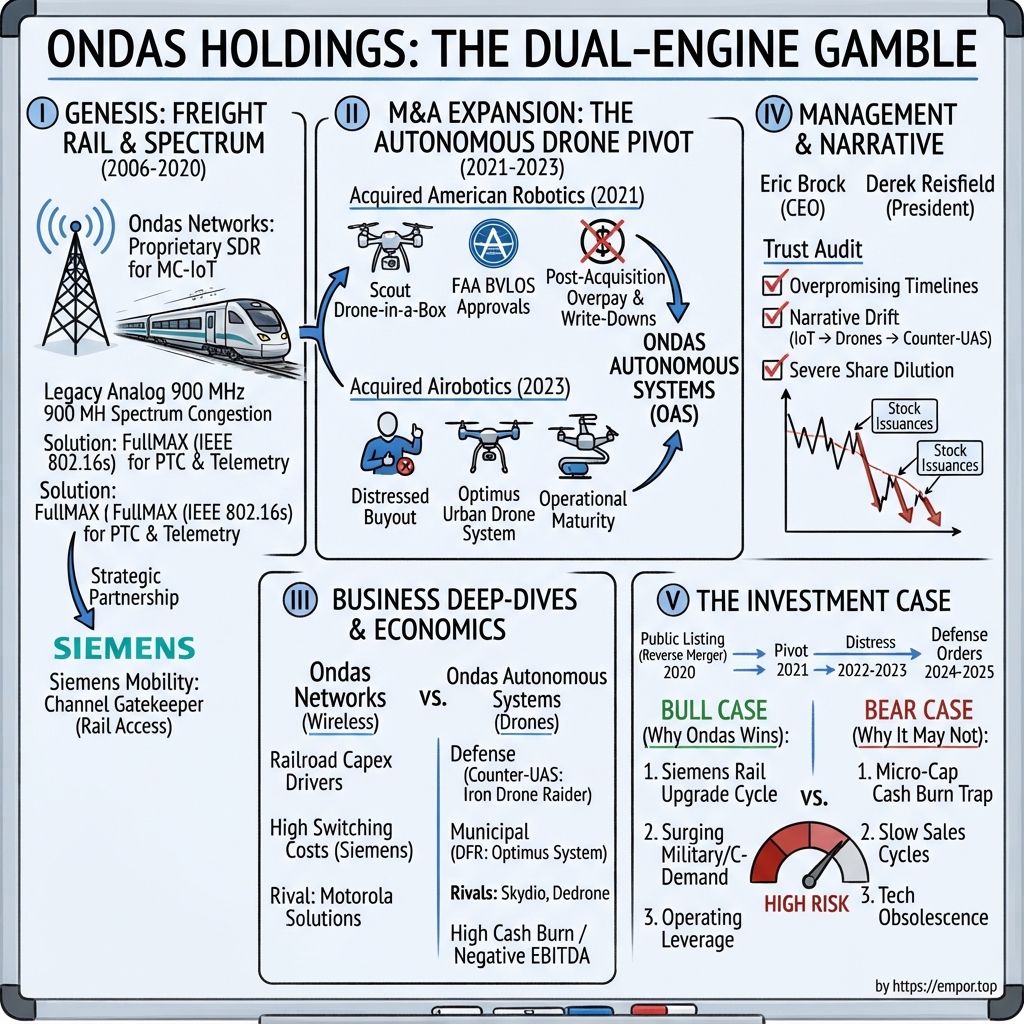
Ondas Holdings: The Mission-Critical Wireless & Autonomous Drone Gamble
I. Introduction & Episode Roadmap (~10 min)
On the morning of August 13, 2026, a company that eighteen months earlier had reported quarterly revenue of $4.2 million with roughly $30 million in cash against $60 million in debt told investors it had booked $83.8 million in a single quarter. It reported $757 million in backlog, held about $1.4 billion in cash and short-term investments, and projected an annualized revenue run rate of $1 billion by year-end.12
Yet on the same day, roughly 40% of the company's free float was sold short — making it one of the most heavily shorted stocks on any American exchange.3
That gap between management's reported performance and market skepticism is the core story. Ondas Inc. — renamed from Ondas Holdings Inc. in January 2026 and trading on the Nasdaq Capital Market under the ticker ONDS — is simultaneously one of the fastest-growing defense technology companies in the world by reported revenue and one of the most aggressively contested equities in the market.4
The company's historical pitch no longer describes its current operations. For most of its public life, Ondas operated as a dual-engine micro-cap: a private wireless infrastructure business, Ondas Networks, selling software-defined radios to North American freight railroads through Siemens Mobility; and an autonomous aerial robotics business, Ondas Autonomous Systems, assembled from a pair of drone acquisitions. That framing became obsolete in January 2026 when Ondas deconsolidated Ondas Networks entirely. The rail wireless business that gave the company its name and original listing thesis is no longer on the consolidated balance sheet, and its removal generated a one-time non-cash accounting gain of $51.5 million.5
In its place emerged a rapid serial acquirer of defense and security technology companies, funded primarily through equity issuance during a rising share price. Its portfolio spans counter-drone interception, stratospheric surveillance balloons, loitering munitions, demining robots, military bulldozers, airborne missile defense, and drone-based infrastructure inspection. Over approximately twelve months, Ondas expanded from about 1,000 employees to 1,700, grew from a handful of offices to 25 locations across 60 countries, and saw its share count rise from about 70 million to nearly 570 million.16
The core paradox this episode examines. Ondas has reported operating results that appear extraordinary on the surface: revenue grew more than thirteenfold year over year, adjusted gross margins reached above 50%, backlog expanded elevenfold in a single year, and management now estimates its two-year strategic pipeline at over $11 billion.1 Conversely, the company's capital-market indicators raise substantial concerns for institutional investors: its share count expanded nearly tenfold in eighteen months, almost 200 million warrants remain outstanding at strike prices well above the current share price, goodwill and intangibles account for $1.24 billion of a $2.99 billion balance sheet, adjusted EBITDA losses widened to $50.6 million in the most recent quarter, and operating cash outflow reached $86 million over the same period.1[^7][^8]
Both sets of facts exist simultaneously. The central investment question is which set serves as the true leading indicator.
Key questions to test:
- Was the aggressive pivot into autonomous systems — beginning with the $70.6 million purchase of a pre-revenue drone startup at peak-2021 valuations, and culminating in a 2025–26 acquisition spree that consumed well over a billion dollars of capital — strategic foresight or narrative-chasing that coincided with a genuine war-driven demand shock?
- Is the "One Ondas" operating platform a genuine source of operational synergy, or a holding-company label applied to a collection of businesses benefiting from a synchronized spike in defense spending across Europe, Israel, and the United States?
- Does the accounting reflect core performance? When more than half of quarterly operating expenses are non-cash or acquisition-related, and reported net income swings from positive $362 million to negative $90 million due to warrant revaluations, what is the underlying economic engine actually earning?
- Can operating leverage materialize before capital markets lose their appetite for funding the expansion model?
Three consensus narratives worth re-evaluating.
Myth: Ondas is primarily a rail wireless company that also operates drones. Reality: the rail business was deconsolidated in January 2026 and is excluded from reported performance. Every dollar of the $83.8 million in second-quarter revenue was generated by defense, security, and industrial autonomy operations.51
Myth: the revenue growth is entirely acquired. Reality: on a pro forma basis holding the current portfolio constant, second-quarter revenue grew approximately 85% year over year. Individual units — including Sentrycs, 4M, and Rotron — posted organic growth rates that purchase accounting alone cannot generate.1 While acquisitions provided the operational foundation, organic expansion on that base is real.
Myth: a $1.4 billion cash balance indicates that equity dilution has ended. Reality: operating activities consumed $86 million in cash during the second quarter alone, $325 million was deployed for two acquisitions in the third quarter, and nearly 200 million warrants remain outstanding above the current share price.[^8]12223 The financing story remains active; it has merely evolved.
The roadmap. Analysis begins with spectrum engineering for freight railroads — the original business, now deconsolidated — because it explains both the company's technical foundation and the strategic frustration that drove its pivot. The narrative proceeds through the initial drone acquisitions and subsequent write-downs, followed by a detailed examination of current segment economics. Management's performance is audited against past commitments, evaluated through Helmer's 7 Powers and Porter's Five Forces frameworks, and framed within distinct bull and bear investment cases. The evaluation concludes by isolating the key operational metrics that will ultimately determine the company's long-term valuation.
 Subscribe on LinkedIn
II. The Genesis: Spectrum Scarcity & The Freight Rail Problem (2006–2020) (~15 min)
There is a stretch of track outside Chicago where roughly a quarter of all American freight rail traffic converges. It is the most congested, heavily instrumented, and operationally unforgiving railroad environment in North America. Until recently, much of the wireless signaling across it ran on radio technology whose architectural assumptions were established when a fast modem operated at 9,600 baud.
That operational friction is what Ondas was created to solve. Understanding this origin is essential—not because freight rail generates the company's primary revenue today, but because it established Ondas' engineering foundation and created the strategic impatience that drove its subsequent transformation.
The problem, in plain English. North America's Class I freight railroads—including CSX, BNSF, Union Pacific, and Norfolk Southern—operate tens of thousands of route-miles of track. Distributed along those routes is an array of critical infrastructure that requires continuous data transmission: signals, switches, grade-crossing warnings, trackside sensors, end-of-train devices, and mandated Positive Train Control systems. Historically, all of this equipment communicated over a narrow band of licensed 900 MHz spectrum owned collectively by the railroads.
That spectrum functioned like a narrow private road granted decades ago. Initial traffic consisted of short, low-bandwidth telemetry bursts. Problems emerged when railroads attempted to run modern digital applications over the same band: continuous locomotive diagnostics, video feeds, high-resolution wayside sensing, and real-time train control. Legacy analog protocols could not support the increased traffic, and acquiring additional spectrum was impractical due to high costs and finite availability.
The only viable solution was to significantly increase the data efficiency of the existing spectrum band.
FullMAX and the standards play. Ondas Networks developed a software-defined radio platform called FullMAX. The core engineering insight was designing a wide-area broadband wireless system capable of transmitting significantly more data through narrow licensed channels while maintaining the long range and reliability required by mission-critical infrastructure. Crucially, the system remained backwards-compatible with legacy equipment already installed across thousands of miles of track.
That backward compatibility was central to the commercial value proposition. Railroads cannot take operational networks offline for decade-long equipment overhauls; they require radios capable of servicing legacy bands and modern digital protocols simultaneously so migration can occur incrementally. The Siemens-branded Airlink base station, which incorporates Ondas' technology, was engineered as a dual-mode unit operating on both legacy bands and the new 900 MHz "A Block" at the same time.7
Rather than commercializing a purely proprietary system, Ondas pursued industry standardization through the IEEE, establishing the 802.16s and later 802.16t specifications. Selling proprietary hardware to conservative, consortium-governed rail operators presents high commercial hurdles; embedding technology into an official standard positions it as an industry baseline. That standardization strategy materialized gradually: in 2025, the Association of American Railroads formally adopted .16 technology as the communications protocol for next-generation Head of Train and End of Train systems, while signaling intent to evaluate adoption across its broader communications network.8
Going public, and the Siemens bargain. Ondas entered the public markets through a reverse merger in September 2018, when Nevada shell company Zev Ventures Incorporated—previously a ticket reseller—acquired privately held Ondas Networks and renamed the entity Ondas Holdings. The company subsequently uplisted to Nasdaq in December 2020 through a traditional public offering that raised approximately $31.2 million net.9
Around the same period, Ondas established its primary commercial distribution channel: a partnership with Siemens Mobility covering the North American rail market. Under the agreement, Siemens integrated Ondas' radio technology into its Airlink product line and sold it under the Siemens name.9
This arrangement created a recurring structural tradeoff for Ondas. While the company developed the core technology, its partner maintained the direct customer relationship. Renting the distribution scale and market credibility of an established industrial partner was a logical entry strategy for a small supplier selling into multi-year procurement cycles. However, it also capped Ondas' share of end-market economic value and left the pace of commercial rollout largely dependent on a partner's corporate priorities.
What actually happened. Commercial adoption proceeded slowly. Ondas generated $320,000 in revenue in 2019, $2.2 million in 2020, and $2.9 million in 2021. Although the underlying technology was validated and standards progressed, volume purchase orders materialized at a measured pace. The first initial deployment of 802.16 technology on the 900 MHz A Block with a major Class I railroad in Chicago was completed in July 2025—roughly seven years after Ondas became a public company.7
Sustaining an ongoing engineering organization on less than three million dollars of annual revenue over several years created persistent financial pressure.
So what this means. The rail business established a defensible technology position characterized by high switching costs once installed. However, it also illustrated that technical defensibility provides limited near-term protection if customer deployment cycles outpace corporate cash runways. By 2021, Chief Executive Officer Eric Brock and the board faced a straightforward financial reality: the rail opportunity remained viable but long-dated, while capital markets were placing premium valuations on autonomous technologies.
In response, management initiated the pivot toward its second operational engine.
III. The M&A Expansion: The Autonomous Drone Pivot (2021–2023) (~25 min)
In the spring of 2021, the most valuable asset Ondas owned was not its patent portfolio. It was its stock price.
Money was cheap, SPACs were minting drone and eVTOL companies at valuations detached from underlying revenue, and a Nasdaq-listed shell with a credible technology story could issue stock at prices that made almost any acquisition look accretive on a slide deck. Chief Executive Officer Eric Brock — a former hedge fund portfolio manager rather than a career hardware operator — understood precisely what that currency was worth and how quickly it could evaporate.
The American Robotics deal. In 2021, Ondas acquired American Robotics, a Massachusetts startup that had built what the industry called a "drone-in-a-box" system: the Scout, an automated drone that lived in a weatherproof enclosure, launched on a schedule, flew an inspection route, and returned without an on-site human pilot. Ondas paid a headline announced value of roughly $70.6 million in cash and stock, with the fair value of total consideration transferred coming to $69.3 million. The transaction generated $19.7 million of goodwill on its own, pushing Ondas' total goodwill balance to $45.0 million entering 2022.[^12]10
The strategic logic was compelling on paper. American Robotics held landmark Federal Aviation Administration approvals for automated beyond-visual-line-of-sight operations without on-site human observers. In a regulatory environment that effectively required a human to watch every active drone, being the sole company permitted to remove that observer created a significant theoretical cost advantage. Ondas was buying regulatory optionality.
The problem with regulatory optionality is that it holds value only if regulations evolve, unit economics work, and customers actually buy.
The post-acquisition reality. None of those three conditions materialized on schedule. FAA rulemaking on routine beyond-visual-line-of-sight operations moved at a regulatory crawl. The Scout's unit costs remained high relative to the labor it displaced. Meanwhile, corporate customers ran prolonged pilot programs that showed little sign of converting into full commercial deployments. Revenue for 2022 reached just $2.1 million across the entire consolidated company — down from 2021 — despite acquiring a business intended to drive growth.
Accounting realities quickly followed. In 2022, Ondas recorded a $19.4 million goodwill impairment, writing down its goodwill balance from $45.0 million to $25.6 million.10 Operating expenses that year surged to $70.5 million against the $2.1 million in revenue, driving the net loss to $73.2 million.
Within eighteen months of closing, Ondas had written off an amount roughly equal to the entire goodwill generated by the American Robotics purchase. Far from a routine accounting adjustment, the write-down was a direct recognition that the purchase price far exceeded the asset's true economic value. For investors evaluating management's capital allocation track record, it remains a clear example of capital destruction: issuing high-priced stock at the peak of a valuation cycle for a pre-revenue asset.
The Airobotics reboot. Having overpaid at the top of the market, Ondas subsequently executed a very different transaction at the bottom.
Airobotics Ltd. was an Israeli firm that had spent years and substantial venture capital developing the Optimus System, an automated drone platform with demonstrated operational maturity in complex, regulated urban airspace. By late 2022, the company was publicly listed in Tel Aviv and facing financial distress. Ondas completed the acquisition on January 23, 2023, exchanging 0.16806 Ondas shares for each Airobotics share and issuing roughly 2.8 million shares in total. The transaction was valued at approximately $15.2 million and resulted in Ondas dual-listing its shares on the Tel Aviv Stock Exchange.1112
The contrast between the two transactions was striking. American Robotics cost roughly $70 million for regulatory paperwork and an unproven product. Airobotics cost about $15 million for a field-tested system, an established Israeli engineering team, and a strategic foothold in what would soon become a critical testing ground for autonomous defense technology.
The second deal proved to be one of the more astute micro-cap acquisitions of that year. That outcome reflected less an accurate forecast of the geopolitical environment than disciplined opportunistic buying: a distressed seller in a tight funding market will accept terms a solvent company would reject. Acquiring quality assets from forced sellers represents a repeatable edge; buying narrative-driven assets during a market frenzy does not. Ondas tried both, and the outcomes followed that textbook divide.
Iron Drone: the accidental core business. Also in 2023, Airobotics acquired the assets of Iron Drone, a small Israeli counter-drone company that developed an autonomous interceptor capable of launching, tracking, and physically capturing or disabling hostile drones without missile payloads.13
Initial expectations framed Iron Drone as a modest bolt-on capability. That changed permanently in October 2023. By November 2023, Ondas announced it was accelerating development of the Iron Drone Raider to meet Israel Defense Forces requirements during the Gaza conflict.14 What began as a speculative product line rapidly transformed into a combat-tested system operating under daily feedback cycles.
This pivot marks a key turning point in the company's trajectory. The autonomous drone strategy Ondas unveiled in 2021 was rooted in a commercial thesis focused on industrial infrastructure inspection. The business that ultimately gained traction was built on military defense. Rather than executing a pre-planned master strategy, management maintained operational continuity long enough for market demand to intersect with one of its acquired product lines.
The narrative ledger. The evolution of the company's core pitch highlights this shifting focus: freight rail wireless in 2020, commercial drone-in-a-box in 2021, municipal drone-as-first-responder in 2022 and 2023, military counter-drone systems in 2024, and a multi-domain autonomous defense platform by 2025 and 2026. Each strategic shift was individually defensible, yet collectively they describe a firm whose primary value proposition shifted roughly every eighteen months toward prevailing market trends.
Investors can view this sequence in two ways: as strategic agility from a firm leveraging adaptable technology, or as continuous repositioning to support ongoing equity raises. Prior to 2025, the financial record favored the second view, as none of the initial pivots produced meaningful revenue. What changed after 2025 was that defense demand materialized at a scale that transformed the financial model.
IV. Segment Economics & Core Business Deep-Dive (~25 min)
To understand what Ondas represents today, analysis must begin with a figure easily lost amidst high-growth headlines: at the end of the second quarter of 2026, goodwill and intangible assets totaled $1.24 billion out of $2.99 billion in total assets.[^7] Forty-two cents of every dollar on the balance sheet is the accounting residue of acquisitions rather than internal development.
While common for an acquisition-led platform, this balance sheet structure requires examining the business segment by segment to assess true economic value.
Segment 1: Ondas Networks — the engine that left the building
Examining the original business first is instructive, because its accounting treatment highlights management's portfolio strategy.
Effective January 16, 2026, Ondas deconsolidated Ondas Networks following a capital restructuring of the subsidiary. The unit no longer appears on consolidated financial statements, and its removal generated a one-time non-cash gain of $51.5 million.5 Specific transaction terms — including third-party investor identities, Ondas' retained equity stake, and the implied valuation — were not disclosed in detail.
Three months earlier, on the fourth-quarter 2025 earnings call, Chief Executive Officer Eric Brock described 2025 as "an important year for Ondas Networks," citing adoption of the IEEE 802.16 standard by the Association of American Railroads, engagement with all North American Class I railroads, and multiple active field trials. He added that Amtrak ACSES radios were in production for delivery in early 2026, while offering a notable concession: "we are disappointed in the time lines with respect to driving network deployments with our rail customers."8
The sequence reveals a sharp strategic shift: publicly reaffirming the long-term potential of the rail asset in late March 2026, having deconsolidated the unit in January 2026 while booking a $51.5 million accounting gain.
A plausible operational case exists for the move. A capital-constrained rail technology business with a decade-long procurement cycle is ill-suited to a holding company prioritizing rapid defense scaling; funding the unit independently could unlock fair value. However, the disclosure asymmetry warrants investor scrutiny: the accounting gain is substantial, non-cash, and flatters reported earnings, while the underlying economics remain opaque.
The rail division also faced formidable competitive barriers. Land mobile radio in North American transportation is dominated by Motorola Solutions, whose long-standing customer relationships and service revenues fund sales capabilities far beyond Ondas' reach. Below Motorola sit specialized industrial radio providers like XetaWave and CalAmp, alongside incumbent analog equipment suppliers. Ondas' strategy — seeking industry standardization rather than competing in head-to-head procurement trials — was logical for a small firm, but tied commercial traction to the slow pace of standards committees.
Ultimately, the rail technology thesis is no longer part of Ondas' consolidated financial story. It persists as an off-balance-sheet option of undisclosed value, meaning current equity investors are purchasing a defense platform with residual rail exposure.
Segment 2: Ondas Autonomous Systems and the four-vertical build
Current operating results driven by Ondas Autonomous Systems and a secondary operating unit, Ondas Sentinel, are organized across four market verticals with distinct economics.
Aerial security and counter-UAS. This vertical represents the deepest segment of the portfolio and responds directly to immediate military demand. It integrates Sentrycs' "Cyber-over-RF" protocol manipulation — which passively detects incoming drones, decodes command signals, and redirects or lands aircraft without jamming — with the Iron Drone Raider kinetic interceptor and DZYNE's IonStrike, a low-cost interceptor engineered to destroy Shahed-class attack drones.[^18]
This layered design mirrors evolving battlefront threats. Small commercial drones can be neutralized through signal takeover, whereas larger GPS-guided strike drones require kinetic destruction at a cost well below that of the incoming target. Ondas has assembled a defensive stack covering detection, tracking, and interdiction across these cost tiers.
Commercial adoption extends beyond wartime defense. Ondas acquired Sentrycs in a transaction announced November 4, 2025, valued at approximately $225 million.1516 By the first quarter of 2026, Sentrycs secured $36 million in new orders through April 1 — surpassing its entire 2025 revenue of approximately $30 million — while second-quarter pro forma revenue expanded roughly 298% year over year.171 The platform was selected for counter-drone security at the 2026 FIFA World Cup and for Jacksonville Jaguars NFL games.6 The venue security contract signals expansion into civilian commercial infrastructure, offering a broader and potentially more stable customer base.
ISR and persistent intelligence. This segment involves Ondas' largest financial commitments and higher technology risks. World View Enterprises, acquired in April 2026 for approximately $275 million, produces "Stratollites" — steerable high-altitude balloons operating in the stratosphere for 30 days or more.[^18]
The platform relies on altitude management to navigate distinct wind currents, enabling horizontal loitering over targeted areas for extended durations. Stratollites address an operational gap between tactical drones, which offer high resolution but limited flight times, and orbital satellites, which provide global reach but fixed revisit cycles. Geopolitical interest in stratospheric surveillance grew significantly following the high-altitude balloon incident over North America in early 2023.8
Ondas expanded the vertical through its largest transaction, purchasing DZYNE Technologies for $875.8 million in a deal closed July 2, 2026.[^18]1 DZYNE added the ULTRA long-endurance reconnaissance aircraft — capable of remaining airborne for roughly three days at 25,000 feet — alongside the LEAP, Blitz, IonStrike, and Sawtooth counter-drone systems.[^18]
Precision strike. Mistral Inc., announced March 9, 2026, for approximately $175 million in stock — comprising $122.5 million upfront and in installments plus $52.5 million in three-year deferred escrow — provided strategic defense access.18 Mistral granted Ondas prime contractor status with the U.S. Department of Defense, bringing a $982 million multi-year Army Indefinite Delivery, Indefinite Quantity (IDIQ) contract for the Lethal Unmanned System program alongside a $73.6 million Special Operations Command agreement.18 By August 2026, cumulative orders under the Army contract exceeded $240 million, including a single order above $50 million booked August 5 for third-quarter delivery.19
Complementing this unit, UK-based Rotron Aerospace contributed long-range UAV platforms and propulsion systems, capturing $34.2 million in second-quarter 2026 orders against approximately $25 million in full-year revenue underwritten at acquisition.1
Autonomous ground systems. Roboteam, acquired under a November 25, 2025 agreement for $80 million, manufactures tactical unmanned ground vehicles deployed across more than 30 countries.15 4M Defense added AI-driven landmine detection and terrain intelligence; after generating $8 million in 2025 revenue, 4M secured $80 million in total tender awards with $25.8 million in initial orders, delivering approximately 258% pro forma revenue growth in the second quarter of 2026.171 Heavy military engineering provider INDO Earth is scheduled to begin initial product deliveries in the fourth quarter of 2026 under a program with total potential value of approximately $140 million.1
The software and industrial layer. Software integration and commercial inspection capabilities round out the segment. Omnisys provides battlefield command-and-control software connecting sensors, unmanned hardware, and operational workflows.15 Cyberhawk, acquired August 10, 2026, supplies AI-driven drone inspection software for utilities, pipelines, and power grids.6
Cyberhawk represents a strategic return to industrial infrastructure markets following the earlier write-down of American Robotics. Asked whether Ondas planned further industrial expansion, Brock called Cyberhawk "a platform company that we can build around," noting that "the industrial segment for us has been important to build."1 Segment President Oshri Lugassy listed industrial customers including PG&E, Southern California Edison, Shell, Chevron, National Grid, and Reliance alongside military and government clients like the U.S. Armed Forces, DHS, NASA, Israel Defense Forces, Australian Defence Force, Japan Self-Defense Forces, Royal Thai Army, and Dubai Police.1
While the customer roster is extensive, company disclosures do not differentiate between major multi-year deployment programs and initial low-volume pilot projects.
The financial shape of it
The consolidated financial performance reflects rapid scale paired with heavy cash burn.
Annual revenue grew from $7.2 million in 2024 to $50.7 million in 2025, followed by $50.1 million in the first quarter of 2026 and $83.8 million in the second quarter.[^24]21 Management projected full-year 2026 revenue of $525 million to $550 million, with third-quarter guidance of $140 million to $155 million.1
Adjusted gross margins remained elevated for hardware-centric defense manufacturing, coming in at 51.5% in the first quarter of 2026 and 50.4% in the second quarter, aligning with management's long-term target of remaining above 50%.1 However, management cautioned that product mix shifts will create quarterly margin volatility.
Operating expenses expanded sharply alongside revenue. In the second quarter of 2026, GAAP operating expenses reached $199.1 million against $83.8 million in revenue. More than half of GAAP operating expenses reflected non-cash or acquisition-related charges, including stock-based compensation, earn-out adjustments, intangible asset amortization, and $4.4 million in transaction fees. On an adjusted cash basis, operating expenses rose to $93.2 million from $36.9 million in the prior quarter.1 Adjusted EBITDA losses widened to $50.6 million from $10.9 million, while operating cash outflow reached $86.1 million.[^8]
Management attributed approximately $29 million of the operating expense increase to discretionary corporate growth investments — including corporate development, the Ondas Capital initiative, partner integrations, and Palantir deployment software — alongside $6 million in operating platform spending, describing both as front-loaded investments preceding second-half revenue delivery.1
These financial results present two contrasting investment interpretations.
First, demand for the company's autonomous systems is expanding organically rather than purely through consolidation. On a pro forma basis assuming current holdings were owned in both periods, second-quarter revenue grew approximately 85% year over year, while backlog expanded roughly 33% sequentially on an organic basis.1 Individual units — including Sentrycs, Airobotics, 4M, and Rotron — generated strong organic growth rates that reflect genuine defense market demand.
Second, operational leverage has yet to translate into positive cash flow. During the second quarter of 2026, a 67% sequential increase in revenue coincided with a fivefold widening of adjusted EBITDA losses and a doubling of cash burn. Management maintains that second-quarter losses represented the operational trough ahead of revenue acceleration. That claim remains to be tested in subsequent reporting periods; until operating leverage is demonstrated in cash generation, growth remains dependent on external financing.
V. Management, Governance, & Trust-Damaging Patterns (~20 min)
On the first-quarter 2026 earnings call, before a single financial figure was discussed, Chief Executive Officer Eric Brock thanked a retail investor by their X handle for a "systems of systems" fan music video played to attendees ahead of the formal program.17
While a minor moment on an earnings call, it illustrates the corporate dynamic: management actively cultivating a retail shareholder base that trades on narrative enthusiasm at a time when roughly 40% of the float is sold short. Neither behavior is inherently improper, but together they highlight a deeply polarized equity.
The people
Eric Brock, Founder, Chairman, and CEO. Brock’s background is rooted in capital markets rather than engineering. From 2000 to 2017, he served as a founding partner and portfolio manager at Clough Capital Partners, a Boston-based long/short equity firm, following earlier roles as an investment banker at Bear, Stearns & Co. and a Certified Public Accountant at Ernst & Young. He holds an MBA from the University of Chicago.20
This background is central to understanding Ondas’ operational strategy, which functions largely as a capital-markets engine. The company's "Core + Strategic Growth" blueprint relies on a structural arbitrage: utilizing a highly valued stock currency to acquire capital-constrained private targets at roughly 2.5 to 4 times forward revenue, then arguing that the consolidated entity merits the acquirer's premium valuation multiple. On the fourth-quarter 2025 earnings call, Brock described this mechanics directly, noting that target acquisitions are "capital constrained," that "Ondas benefits from a premium valuation," and asserting that the model delivers "day one value creation."8
The architecture reflects a hedge fund perspective: the primary binding constraint on growth is not technology development, but the market valuation of the stock currency.
Derek Reisfield and Neil Laird. Reisfield served as President, Chief Financial Officer, Treasurer, and Secretary starting in December 2021, bringing experience as a McKinsey consultant, a CBS business development executive, and a co-founder of MarketWatch.20 He served as CFO through the initial drone acquisition and write-down phase. In June 2024, Neil Laird assumed the CFO role, bringing traditional operating-finance experience from CFO positions at ADAC Laboratories, SumTotal Systems, and Mobileum, alongside a UK chartered accountancy qualification and an economics degree from Cambridge.20 Laird arrived roughly six months before Ondas accelerated its equity-financed acquisition strategy.
The 2026 hiring wave. Executive recruiting in 2026 signals a strategic push for defense credibility. In April 2026, Ryan Hartman—a Raytheon and Insitu veteran who served on the FAA's NextGen Advisory Committee and Drone Advisory Committee—joined through the World View transaction and by August assumed leadership of Ondas Sentinel.8 Oshri Lugassy and Meir Kliner lead Ondas Autonomous Systems. In August 2026, Ondas announced that David Barnea, former Director of Mossad, joined as President and Chairman of Ondas Defense Limited, while retired four-star General Charlie Flynn, former commander of U.S. Army Pacific, joined the advisory board.61
Recruiting high-ranking defense and intelligence leaders provides notable institutional credibility. At the same time, high-profile advisory appointments are common across defense technology startups, and historical precedents show that executive prestige does not automatically guarantee government contract wins.
Incentive alignment: follow the equity
Corporate priorities are often revealed more clearly in equity compensation disclosures than in presentation slides.
In the second quarter of 2026, Ondas recorded $69.1 million in stock-based compensation against $83.8 million in quarterly revenue, compared to $19.7 million in the first quarter of 2026.[^7][^8] By comparison, stock compensation for the entire fourth quarter of 2025 totaled $6.8 million.[^8]
Part of this sharp expansion reflects structural mechanics: stock-funded acquisitions require equity retention grants, and expanding headcount from 1,000 to 1,700 employees while recruiting senior defense executives requires competitive equity packages. Competing for specialized defense talent against venture-backed firms like Anduril and established defense primes typically demands significant stock incentives.
However, the financial implications present a core accounting tension. Stock-based compensation is excluded from adjusted EBITDA—the primary metric management uses for its corporate profitability milestones. Consequently, Ondas could achieve reported "adjusted EBITDA profitability" while shifting substantial enterprise value from existing shareholders to employees and acquired business owners. Management's target of corporate profitability by the fourth quarter of 2027 measures a metric that explicitly excludes the company's largest single operational expense.
Regarding ownership structure, management reported institutional ownership of approximately 33% based on Capital IQ data as of March 2026, noting that the lead institutional investor in the January 2026 financing had fully exercised its pre-funded warrants while keeping its position under 5%.8 An institutional base of one-third is relatively low for a multi-billion-dollar market capitalization, reflecting a shareholder register heavily weighted toward retail investors. Management stated it is actively seeking to expand institutional ownership and expects future eligibility for major market indexes to drive automated institutional inflows.8
Auditing the promises
Evaluating management performance requires auditing past guidance against actual outcomes.
Profitability timing targets have shifted repeatedly. In March 2026, Brock projected product-company EBITDA positivity by the third quarter of 2026, Ondas Autonomous Systems (OAS) positivity by the third quarter of 2027, and consolidated Ondas Inc. positivity by the first quarter of 2028.8 In May 2026, after achieving product-level EBITDA positivity two quarters ahead of schedule, management accelerated the OAS timeline to the first quarter of 2027.17 By August 2026, management revised the framework again, targeting operating platform profitability by the fourth quarter of 2026 and consolidated adjusted EBITDA profitability by the fourth quarter of 2027.1
While management described the August revision as pulling forward the timeline by one quarter with upside to previously announced objectives,1 the specific underlying entities measured shifted across earnings updates—from individual product units, to OAS, to the combined operating platform of OAS and Ondas Sentinel. Shifting segment definitions alongside target dates complicates tracking line-item progress. Nevertheless, the consolidated corporate timeline was moved forward from the first quarter of 2028 to the fourth quarter of 2027, establishing a concrete benchmark for future accountability.
On revenue targets, execution has consistently surpassed guidance. At a January 2026 investor conference, full-year revenue guidance was set at $175 million. Management raised that target to at least $375 million in late March, at least $390 million in May, and $525 million to $550 million in August.8171 Supported by expanding backlog and firm orders, management has repeatedly set conservative benchmarks and outperformed them.
On share dilution, management rejects market criticism. On the May 2026 call, Brock addressed dilution concerns directly: "I also want to address a narrative we occasionally see suggesting Ondas is simply buying revenue and the acquisitions are financially oriented and dilutive without creating economic value. We fundamentally disagree with that narrative, which we think demonstrates highly superficial analysis."17
While management maintains that acquisitions build long-term value, the central financial test—whether acquired operating units generate more cash flow per share than the equity issued to acquire them—remains unproven while consolidated adjusted EBITDA losses run at an annualized rate above $200 million.
The activist stress test
The bear case against Ondas was outlined in detail when activist firm J Capital Research published a critical report in early February 2026, challenging the acquisition model, equity dilution, and financial sustainability. The stock experienced a sharp pullback following the report.3
The primary elements of the activist critique include:
Dilution. Total shares outstanding expanded from approximately 40 million in 2022 to 569.8 million by August 2026.321 In addition, substantial warrant tranches remain outstanding: 73.92 million warrants at a $20.00 strike price from the October 2025 offering, and 121.58 million warrants at a $28.00 strike price from the January 2026 offering—representing nearly 200 million potential additional shares and approximately $3.4 billion in prospective gross proceeds from the January tranche alone.2223 Fully diluted, the share count exceeds 750 million.
Accounting complexity. Non-operational items heavily distort reported net income, including an $82.2 million warrant charge in Q4 2025, a $389.5 million warrant gain in Q1 2026, a $51.5 million non-cash deconsolidation gain, and a $46.2 million adjustment for an acquired variable interest entity.817 Consequently, net income swung from positive $362.9 million in the first quarter of 2026 to a net loss of $89.7 million in the second quarter, even as revenue grew 67% sequentially.171 While management notes these adjustments are non-cash, the underlying noise obscures core operating performance.
Goodwill exposure. Goodwill and intangible assets total $1.24 billion—comprising $661 million in goodwill and $583 million in intangibles.[^7]10 Given the complete write-down of the American Robotics acquisition in 2022, impairment risk on recently acquired assets remains a material consideration.
Structural complexity. Ondas operates a 51%-controlled European joint venture with Heidelberg, holds $70 million in non-consolidated public and private investments, maintains an internal investment division called Ondas Capital, and co-led an investment in a counter-UAS startup with RSE Ventures.816 These entities create an intricate holding-company structure that complicates financial modeling.
Short interest. Approximately 40% of the public float was sold short as of mid-August 2026.3 While high short interest can trigger short squeezes, it also underscores significant institutional skepticism regarding the sustainability of the equity valuation.
The takeaway. Ondas presents two concurrent realities. Management has executed aggressively, securing real defense technology assets and consistently outperforming elevated revenue guidance. Simultaneously, it has adjusted profitability definitions across reporting periods, issued equity at an unprecedented rate, and created a complex capital structure vulnerable to shifts in share price. Whether the model represents sustainable platform consolidation or an overextended financial roll-up remains the central question facing investors.
VI. Strategic Frameworks: 7 Powers & Porter's 5 Forces (~15 min)
Stripping away the market narrative reveals the core question determining long-term equity returns: when Ondas wins a contract, what prevents a competitor from winning the next one at a lower price?
Hamilton Helmer's 7 Powers
Cornered Resource — moderate, and shifting. The company's original cornered resource was its 802.16 standard position in North American freight rail, an asset now removed from the consolidated balance sheet. Replacing it is a portfolio of specialized technical capabilities: Sentrycs' protocol-level drone takeover, World View's stratospheric station-keeping, DZYNE's ULTRA endurance airframe, and Rotron's propulsion systems. While these represent proprietary engineering assets built on years of accumulated expertise, a cornered resource is typically singular and defensible. A collection of distinct technologies resembles a well-stocked catalog more than a structural moat.
A more compelling candidate lies in human capital: an assembled roster of combat-proven Israeli engineering teams, a former Mossad director, and a retired four-star general. Access to that specific combination of operational insight and institutional relationships is genuinely scarce, though its durability remains subject to executive retention and earnout schedules.
Switching Costs — high in theory, unproven in practice. In freight rail, switching costs were high: replacing embedded radios across thousands of miles of track required multi-year capital commitments and extensive recertification. In defense, that lock-in is significantly weaker. Loitering munitions and kinetic interceptors are consumable hardware. A defense ministry purchasing a thousand IonStrike units in one cycle can transition to a rival supplier in the next with minimal operational friction.
The primary area where switching costs could materialize is software. On the first-quarter 2026 call, Ryan Hartman argued that once a customer's operational architecture is built around Palantir Foundry with SkyWeaver coordinating Ondas platforms, "this is not a program, this is an operational dependency."17 While the strategic thesis is logical, empirical evidence remains limited: initial SkyWeaver integrations across the portfolio were targeted for the fourth quarter of 2026, with ground and flight testing completing in August.1 It represents a plausible future moat rather than an established current one.
Network Effects — weak. Hartman also argued that each additional platform acts as "a new node in the intelligence network" that increases overall network value.17 That mechanism describes economies of scope rather than a true network effect. A network effect requires that additional users make a platform more valuable to other users. Ondas benefits from cross-selling opportunities and data fusion across its portfolio, but those advantages do not constitute Metcalfe's law.
Scale Economics — emerging, real, and central to the thesis. This power provides the clearest operational rationale for the rapid acquisition strategy. Chief Executive Officer Eric Brock detailed the underlying economics on the fourth-quarter 2025 call, noting that consolidating aerial and ground platforms under single manufacturing and supply partners increases vendor leverage: "you become more important to your component vendor... and in the scale you provide to them, they can turn back to you with better pricing."8 To support this scale, Ondas expanded its physical manufacturing footprint more than twenty-fold, from roughly 10,000 to 230,000 square feet, while expanding its sales force from about 10 to 171 representatives.2
In defense procurement, scale also provides a critical institutional advantage: reassuring risk-averse government buyers that a supplier possesses the longevity to maintain systems over multi-year lifecycles. Brock has repeatedly framed balance-sheet scale as a competitive differentiator, noting that military customers "are also very excited about the financial strength, the ability to energize supply chains and ability to deliver in the field."1 In this context, a $1.4 billion cash and investment balance functions directly as a commercial sales asset.
Counter-Positioning — present, and potentially the strongest power in the portfolio. Incumbent defense primes are structured around expensive, long-cycle systems with high gross margins. Conversely, modern autonomous warfare demands low-cost, attritable mass produced on fast iteration cycles. A traditional prime cannot easily pivot to selling $20,000 interceptors without cannibalizing legacy programs built on $2 million missiles. Lacking legacy revenue to protect, Ondas can aggressively price low-cost autonomous hardware—a structural advantage shared with competitors like Anduril, AeroVironment, and specialized defense startups.
Branding and Process Power — not yet applicable at this stage of corporate maturity.
Porter's Five Forces
Bargaining power of buyers — extremely high, but temporarily suppressed. Defense ministries and procurement agencies exercise immense buyer power, dictating technical specifications, pricing structures, delivery schedules, and testing protocols. What temporarily mitigates this power is operational urgency: defense buyers facing active drone threats negotiate less aggressively on price than those conducting routine peacetime procurements. This dynamic is cyclical, and buyer power will likely reassert itself as geopolitical urgency normalizes.
Threat of new entrants — moderate and rising. Manufacturing basic uncrewed aerial vehicles involves relatively low technological barriers. However, engineering platforms that resist electronic warfare, achieve defense qualification, secure facility clearances, and scale within audited supply chains presents high barriers to entry. Ondas' CMMC Level 2 compliance and facility clearance licenses represent meaningful operational entry barriers.1 Nevertheless, global capital inflows into defense technology remain high, and allied nations are prioritizing domestic defense-industrial policies—prompting Ondas to establish the ONBERG joint venture with Heidelberg to access the German market rather than relying solely on direct exports.
Rivalry — high and intensifying. Competition across every target vertical is dense. In counter-UAS, Ondas competes against DroneShield, Axon's Dedrone division, and Anduril. In loitering munitions, it faces AeroVironment, Elbit Systems, and emerging defense tech firms. In ISR, it contends with established defense primes alongside venture-backed startups. In commercial drone inspection—following the Cyberhawk acquisition on August 10, 2026—it competes against Percepto, Skydio, and specialized service providers.6 Ondas faces established, well-capitalized rivals in all operational segments.
Threat of substitutes — material and evolving. Counter-drone interceptor systems priced near $500,000 face potential substitution from lower-cost electronic warfare emitters, directed-energy weapons, or proximity-fuzed gun systems. Rapid cost curve shifts in counter-UAS could render current interception architectures economically uncompetitive over a multi-year horizon. Similarly, proliferated low-Earth-orbit satellite constellations and persistent long-endurance UAVs offer partial functional substitutes for stratospheric surveillance platforms.
Supplier power — a persistent operational constraint. Addressing supply chain risks on the second-quarter 2026 call, Brock acknowledged ongoing industry-wide friction: "we've got challenges. There's no question. They're not unique to Ondas."1 Autonomous systems manufacturers compete globally for key components, including specialized electric motors, optical sensors, batteries, rare earth magnets, and advanced semiconductors—inputs heavily concentrated in global supply chains subject to geopolitical restrictions.
Framework verdict. Ondas has established clear counter-positioning and emerging scale economics within a rapidly expanding market. However, it has not yet demonstrated the structural switching costs or cornered resources required to sustain long-term pricing power. If SkyWeaver becomes an essential mission-planning software layer for defense customers, the company's competitive moat will strengthen significantly. Without that software integration, Ondas remains a fast-growing, well-capitalized defense manufacturer competing on product performance within an intensely competitive market—an operating profile that may not sustain a persistent premium valuation multiple.
VII. The Investment-Story Spine: Bull vs. Bear & Risk Radar (~20 min)
The bull case: why Ondas wins from here
1. The demand shock is structural, not cyclical, and Ondas is positioned across the whole kill chain. The defining military lesson of the 2020s is that low-cost autonomous systems have inverted the economic equation of offense and defense. On the fourth-quarter 2025 earnings call, OAS President Meir Kliner summarized the industry consensus, arguing that even if active regional conflicts subside, defense planners broadly recognize that autonomous aerial threats will remain permanent features of warfare.8 Chief Executive Officer Eric Brock reinforced that perspective during the second-quarter 2026 call, noting that defense procurement has not established sufficient reserve inventories for long-term deterrence.1 Consequently, allied defense ministries across NATO, the Persian Gulf, and the Indo-Pacific are creating multi-year budget lines specifically for autonomous counter-drone and reconnaissance systems. Proponents view this structural shift in global defense spending as the core driver of Ondas' market opportunity—a macro tailwind operating independently of internal execution.
2. The organic growth is verifiable and independent of acquisition accounting. On a pro forma basis assuming current holdings were owned in both periods, second-quarter 2026 revenue grew approximately 85% year over year, while organic backlog expanded 33% sequentially across multiple operating units.1 Individual subsidiaries demonstrated expansion independent of purchase accounting: Sentrycs generated more new orders in the first four months of 2026 than its total 2025 revenue; 4M Defense expanded from $8 million in 2025 revenue to $80 million in tender awards; and Rotron Aerospace captured $34.2 million in second-quarter orders compared to $25 million in full-year revenue underwritten at its acquisition. Bullish investors cite this broad-based expansion to support management's claim that consolidating these businesses onto a shared platform accelerates their commercial trajectory.
3. The balance sheet is a competitive weapon in a capital-starved sector. Holding $1.4 billion in cash and short-term investments against negligible debt provides a liquidity buffer in a sector where many competitors are venture-backed startups rationing limited runways.1[^7] Capital depth allows Ondas to finance working capital for major defense programs, secure supply chain capacity through component prepayments, and assure risk-averse government buyers that it possesses the financial stability to support multi-year procurement contracts. Furthermore, substantial cash reserves allow the company to acquire high-quality assets from distressed sellers during market downturns, mirroring the strategy executed with Airobotics.
4. Backlog and program conversion are becoming visible. Reported backlog expanded from $68 million at year-end 2025 to $757 million on a pro forma basis at the close of the second quarter of 2026—an elevenfold increase driven by $175 million in new second-quarter orders and approximately $105 million booked in the first six weeks of the third quarter.1 While backlog does not guarantee near-term revenue, its conversion rate supported four consecutive upward revisions to full-year 2026 revenue guidance.
5. Prime contractor status is a step-change in addressable market. Prior to acquiring Mistral Inc., Ondas operated primarily as a subsystem supplier. The acquisition granted the company prime contractor status on a $982 million multi-year U.S. Army IDIQ contract for lethal uncrewed systems.18 It also established the prime contractor relationships required to bid directly on major defense procurements that segment leadership described as exceeding $1 billion in potential scope.1 Securing prime contractor status typically requires years of past-performance credentials; Ondas acquired that structural access through a $175 million transaction structured largely in stock.
The bear case: what breaks it
1. The model is reflexive — it requires the share price to keep working. Skeptics argue that the company's growth strategy relies heavily on reflexive capital-market dynamics. The roll-up model uses highly valued equity to acquire private targets. If the stock's valuation multiple compresses, the financial logic reverses: acquiring targets requires issuing significantly more shares, reducing per-share accretion and shrinking the company's estimated $4.2 billion in additional acquisition capacity.17 With the stock trading between $3.20 and $15.28 over the preceding 52 weeks and closing at $9.24 on August 14, 2026—giving a market capitalization of approximately $5.3 billion—the company trades at roughly ten times the midpoint of 2026 revenue guidance despite generating substantial cash losses.21
2. The warrants are a real overhang, in both directions. Nearly 200 million warrants with exercise prices of $20.00 and $28.00 remain outstanding.2223 Because these exercise prices sit well above current trading levels, Ondas cannot access the associated cash proceeds unless the stock appreciates substantially. Conversely, if the share price rises toward those strike prices, the potential issuance of nearly 200 million shares creates a supply overhang that could limit upside gains. Additionally, fair-value revaluations of warrant liabilities—which stood at approximately $1.04 billion at the end of the second quarter of 2026—introduce substantial non-cash volatility into reported quarterly net income.2
3. Integration risk on this scale is genuinely hard, and history is not kind to serial acquirers. Ondas announced or completed more than a dozen transactions across 2025 and 2026, combining operations across Israel, the United Kingdom, the United States, and Continental Europe. Integrating defense contractors involves complex challenges, including classified program compliance, International Traffic in Arms Regulations (ITAR) controls, and cross-border facility clearances. Management points to automated integration through Palantir Foundry as its primary mitigation tool; Ryan Hartman stated that custom AI agents reading and writing across enterprise resource planning and financial systems enabled core tool deployment within one week of closing the World View transaction.1 While management asserts this technology significantly compresses integration timelines, institutional investors view third-party verification of post-merger synergies as essential before accepting rapid integration claims.
4. Cash burn is accelerating, not decelerating. Consolidated operating cash outflow rose to $86.1 million in the second quarter of 2026 from $51.3 million in the first quarter, alongside $325 million deployed for third-quarter acquisitions.[^8]1 At current consumption rates, the $1.4 billion cash and investment balance provides approximately two to three years of operational runway. While management stated that second-quarter adjusted EBITDA losses represented the trough of operational cash burn, failure to demonstrate narrowing losses in subsequent quarters would challenge the company's operating-leverage thesis.
5. Geographic and geopolitical concentration. A substantial portion of the company's intellectual property, engineering headcount, and production infrastructure is located in Israel. Chief Executive Officer Eric Brock acknowledged the operational exposure, noting that military reserve call-ups periodically affect staffing levels during active regional conflicts.17 Beyond operational disruptions from military service, geopolitical concentration exposes the firm to export licensing constraints, regulatory shifts across international jurisdictions, and sensitivity to regional security conditions that influence both supply capabilities and end-market demand.
6. The revenue quality question. Near-term revenue growth relies heavily on executing a concentrated group of major defense programs, including the Army Lethal Unmanned System IDIQ contract, the INDO Earth combat engineering vehicle program, and production ramps for the ULTRA reconnaissance aircraft and IonStrike interceptor. Asked on the second-quarter call to provide specific quarterly delivery schedules for the Army contract, Brock declined to provide exact timing, stating that establishing precise quarterly delivery dates remains difficult.1 Government defense procurement programs frequently experience scheduling shifts; in a business guiding to 73% sequential revenue growth in the third quarter, small shipment delays can create significant quarterly revenue shortfalls.
Material risk radar
Refinancing and cost-of-capital risk. This represents the primary vulnerability underlying the corporate strategy. Ondas faces minimal debt service risk, but relies heavily on equity markets to fund acquisitions and offset operating cash burn. Any development that restricts equity market access—such as sustained valuation compression, adverse regulatory findings, or broader market contraction—would curtail the acquisition strategy.
Customer concentration and procurement risk. Defense spending remains subject to legislative appropriations and geopolitical priorities. Government budget shifts, policy changes, or peace negotiations can alter procurement timelines or result in canceled program lines.
Supply chain risk. As detailed in segment operations, sourcing specialized optical sensors, electric motors, batteries, and semiconductors remains subject to global supply constraints and trade regulations.
Accounting and disclosure complexity. Significant non-cash accounting adjustments, the deconsolidation of Ondas Networks, goodwill and intangibles comprising 42% of total assets, and rapid multi-entity consolidation increase financial reporting complexity and elevate audit oversight risks.
Technology substitution risk. Kinetic counter-drone interceptors face potential cost competition from directed-energy weapons, high-power microwave systems, and advanced electronic warfare. In stratospheric surveillance, expanding low-Earth-orbit satellite constellations present functional alternatives.
Key-person reliance. The company's M&A strategy, capital structure, and investor messaging are closely tied to Founder and CEO Eric Brock. Operational continuity depends heavily on his leadership and capital allocation strategy.
Synthesizing the spine. The bull case assumes sustained geopolitical defense demand over a multi-year horizon alongside successful conversion of backlog into cash-generative revenue. Conversely, the bear case highlights the risk of delayed operating leverage while equity dilution limits per-share earnings growth. Performance results in the second half of 2026 will provide critical empirical evidence on whether operational leverage materializes as guided.
VIII. Playbook: Business & Investing Lessons (~15 min)
Lesson 1: Cheap paper is the most expensive form of capital, and the bill arrives later.
The American Robotics transaction serves as a clear case study in capital allocation. In 2021, Ondas issued stock at peak market valuations to acquire a pre-revenue company whose principal asset was a regulatory approval. Within eighteen months, essentially all of the goodwill created had been written off.10 The shares issued remained outstanding.
The generalizable insight is that acquisitions funded with overvalued equity appear cost-free at signing but carry long-term economic expense. Management teams systematically underweight this dynamic because the cost never appears directly on the income statement—dilution manifests quietly in per-share metrics years after the initial announcement. The core discipline separating effective acquirers from destructive ones is evaluating whether a transaction expands free cash flow per share based on the total shares actually issued, rather than merely adding top-line revenue.
Ondas is applying the same acquisition framework today at a far greater scale. The distinction is that current target assets bring contracted backlog and commercial shipments rather than regulatory optionality—a fundamentally higher-quality asset class. Whether the valuations paid—$875.8 million for DZYNE, $275 million for World View, and $225 million for Sentrycs—deliver better per-share returns than the $70 million deployed for American Robotics remains the critical test for the next three years.
Lesson 2: In slow-moving industries, distribution beats technology — and both can lose to time.
The Siemens partnership was a logical commercial decision. Ondas could not sell radios directly to Class I railroads, where procurement organizations routinely decline unproven vendors. Renting the distribution scale and operational credibility of an established industrial partner was the only viable market-entry route.
The broader lesson concerns institutional clock speed. Ondas developed proprietary technology, established its platform as the IEEE standard, secured an industry-leading channel partner, and still required seven years from its public listing to achieve its first Class I deployment on the 900 MHz A Block.7 The bottleneck was never technical capability; it was the customer's institutional metabolism.
For investors, this translates into a specific diligence requirement: determining the shortest plausible timeline from product validation to revenue-generating purchase orders, and comparing that timeline against corporate cash runway. When customer deployment cycles exceed cash runway, technical superiority provides little protection—a company must either dilute repeatedly, pivot into faster-moving markets, or face operational failure. Ondas executed the first two.
Lesson 3: Distinguishing genuine optionality from survival tactics requires watching the base business, not the announcements.
Ondas' corporate narrative shifted across five distinct operational identities in six years. In real time, each strategic pivot was framed with logical rationales and strong investor communication. In retrospect, four of those pivots generated minimal sustained revenue, while the fifth succeeded largely due to an exogenous defense demand shock.
The indicator distinguishing strategic optionality from narrative drift lies in the performance of the core business. A company pivoting while its core compounds is expanding; a company pivoting while its core stagnates is escaping. Between 2020 and 2024, Ondas' consolidated revenue grew from $2.2 million to $7.2 million while annual operating losses ranged between $8 million and $70 million.[^24] That financial trajectory represents operational escape rather than core expansion.
The corollary is that survival tactics can occasionally succeed. The 2023 acquisition of Airobotics—executed from financial weakness at a distressed valuation—proved to be one of the most value-accretive transactions the company completed. Survival maneuvers and effective strategy are not mutually exclusive, but they carry fundamentally different risk profiles that investors must price accordingly.
Lesson 4: When management changes the definition alongside the target, slow down.
The shift in guidance metrics—from "product companies profitable in Q3 2026" to "OAS profitable in Q1 2027" to "the operating platform, consisting of Ondas Autonomous Systems and Ondas Sentinel, profitable in Q4 2026"—does not necessarily signal evasion, as the company genuinely reorganized its operating structure while accelerating its overall corporate timeline.8171 However, redefining measured entities alongside target dates requires careful analytical scrutiny. The most effective discipline for investors tracking high-growth platforms is maintaining a written ledger of specific commitments—recording what was promised, by whom, for when, and against which reporting entity—and auditing that ledger every quarter.
Lesson 5: A fortress balance sheet is a strategy, not just a safety margin.
A central insight from Ondas' transformation is the commercial leverage a large cash balance provides in defense technology markets. Government buyers select hardware vendors based partly on the likelihood that the supplier will remain solvent over multi-year equipment lifecycles. Component suppliers prioritize buyers capable of upfront payments, acquisition targets accept lower valuations from acquirers with immediate execution capacity, and specialized defense talent gravitates toward well-capitalized firms. Brock highlighted this operational advantage directly, noting that the balance sheet "is highly valued by customers, employees and strategic partners."17
That mechanism provides a clear commercial rationale for pre-emptive capital raises. However, it also creates an inherently reflexive capital structure: the balance sheet exists because market valuations enabled equity issuance, while market valuations are sustained in part by the balance sheet itself.
IX. Epilogue & Key KPIs to Watch (~10 min)
In January 2026, Ondas Holdings renamed itself Ondas Inc. and moved its headquarters from Massachusetts to West Palm Beach, Florida — a relocation management framed around access to talent, capital formation, and Florida's expanding defense ecosystem.4 Six months later, it co-led an investment in a counter-UAS startup explicitly positioned around anchoring West Palm Beach as an emerging defense-technology hub.6
That sequence clarifies the company's trajectory. A business that began as a radio engineering shop trying to modernize freight rail signaling now describes itself as building a global operating platform for unmanned and autonomous systems, has recruited a former Mossad director and a retired four-star general, is deploying Palantir's software stack as its internal operating system, and is attempting to seed a regional defense-technology cluster around its new headquarters.
Whether that trajectory represents one of the decade's remarkable corporate transformations or one of its more elaborate capital-market constructions remains genuinely undetermined. What is clear, however, is that the ultimate outcome will turn on a small set of observable metrics.
The three KPIs that settle the argument
1. Adjusted cash operating expenses versus gross profit — the operating leverage test.
This comparison is the central operational metric. Management's thesis rests on the claim that the second quarter of 2026 represented the trough for adjusted EBITDA losses, that adjusted cash operating expenses of $93.2 million will flatten, and that gross profit will scale into those costs as revenue moves toward guided third-quarter levels of $140 million to $155 million.1 Investors should track these two line items side by side each quarter. If gross profit expands faster than cash operating expenses over three consecutive quarters, the operating leverage thesis gains validation and the equity narrative changes fundamentally. Conversely, if cash operating expenses continue rising alongside revenue, the operating platform risks operating as structural overhead under a defense holding-company label, pushing profitability further into the future.
2. Backlog conversion rate and order intake — the demand-durability test.
A reported backlog of $757 million against full-year 2026 revenue guidance of $525 million to $550 million provides near-term commercial visibility, but it does not guarantee timely conversion or ongoing replenishment.1 Two dynamics require joint monitoring: the rate at which opening backlog converts into quarterly revenue, and whether new order intake matches or exceeds recognized revenue. Order intake falling below revenue indicates backlog depletion rather than expansion — the earliest signal of normalizing market demand. Meanwhile, management's $11 billion strategic pipeline figure represents an unweighted pipeline rather than a contracted forecast, as management has declined to attach win-rate probabilities to that estimate.
3. Share count and warrant activity — the dilution test.
The fully diluted share count—including approximately 195 million warrants with exercise prices of $20.00 and $28.00—forms the denominator governing all per-share financial metrics.2223 Two elements warrant close observation: the pace of ongoing equity issuance for acquisitions, and any migration toward warrant exercise. Continued stock issuance indicates ongoing reliance on paper to fund expansion. Conversely, warrant exercises would signal substantial share price appreciation, bringing in significant cash proceeds while simultaneously expanding the share base against which future per-share earnings are calculated. If fully diluted share count expands faster than revenue growth in any given quarter, per-share economic value diminishes regardless of top-line performance.
The synthesis
Ondas today presents a corporate profile where operating momentum and capital-structure mechanics tell contrasting stories, and the market—with roughly 40% of the public float sold short against a $5.3 billion market capitalization—remains sharply divided on the outcome.321
The operating business reflects genuine defense demand, verifiable organic growth across independent product lines, gross margins above 50%, prime contractor access to major U.S. defense programs, and a high-profile leadership team. Conversely, the capital structure reveals a tenfold expansion in share count over eighteen months, nearly 200 million outstanding warrants, $1.24 billion in goodwill and intangibles, elevated cash burn, and reported net income heavily impacted by non-operating accounting adjustments.
Both perspectives are supported by empirical data, yet neither tells the complete story. The company's immediate financial survival is no longer the central vulnerability, given its expanded cash balance. What remains unproven is whether the assembled defense platform can generate cash returns per share commensurate with the extensive equity issued to build it. That outcome will not be settled by strategic presentations; it will be determined over subsequent quarters as operating cost discipline is tested against executive revenue targets.
North America's freight railroads, meanwhile, continue upgrading their 900 MHz wireless networks at a measured pace, using an industry standard that Ondas spent over a decade establishing. That legacy business now operates off the consolidated balance sheet, carrying an undisclosed valuation and moving to an operational timeline far removed from the rapid defense expansion driving Ondas today.
References
-
Ondas Inc. Second Quarter 2026 Earnings and Business Update Conference Call — Ondas Inc., 2026-08-13 ↩↩↩↩↩↩↩↩↩↩↩↩↩↩↩↩↩↩↩↩↩↩↩↩↩↩↩↩↩↩↩↩↩↩↩↩↩↩↩↩↩
-
Ondas Q2 2026 slides: revenue soars 13x as defense platform scales — Investing.com, 2026-08-13 ↩↩↩↩
-
Ondas (ONDS) Faces Short-Seller Scrutiny: Sustainable Strategy or Fragile Acquisition-Driven Growth Story? — Sahm Capital, 2026-02-06 ↩↩↩↩↩
-
Ondas Holdings Announces Plan to Change Name to Ondas Inc., Establishes West Palm Beach as Corporate Headquarters — Ondas Inc., 2026-01-02 ↩↩
-
Ondas Reports Record First Quarter 2026 Financial Results: Raises Full Year 2026 Revenue Forecast to $390 Million — Ondas Inc., 2026-05-14 ↩↩↩
-
Ondas Inc. Press Releases — Ondas Inc. Investor Relations, 2026 ↩↩↩↩↩↩↩
-
Ondas Networks Completes First Buildout of its 802.16 Technology to Power the Latest Class I Railroad's Migration to New 900 MHz Network in Chicago — Ondas Inc., 2025-07-24 ↩↩↩
-
Ondas Inc. Fourth Quarter and Fiscal Year 2025 Conference Call — Ondas Inc., 2026-03-25 ↩↩↩↩↩↩↩↩↩↩↩↩↩↩
-
Ondas Holdings Reports Full Year 2020 Financial Results — Ondas Inc., 2021 ↩↩
-
Ondas Holdings Inc. Annual Report (Form ARS), Fiscal Year 2022 — U.S. Securities and Exchange Commission, 2023 ↩↩↩↩
-
Ondas completes $15.2m acquisition of Israeli drone company Airobotics — RCR Wireless News, 2023-01-24 ↩
-
Ondas acquires Roboteam for $80 million as U.S. group deepens Israeli buying spree — Calcalist (Ctech), 2025-11-25 ↩
-
Ondas Holdings' Airobotics Accelerates Development of its Defensive Counter-UAS System, the Iron Drone Raider, to Meet Israel Defense Forces Requirements — Ondas Inc., 2023-11-13 ↩
-
Drone Maker Ondas Is On a Spending Spree. Here Are All 6 Companies It Has Acquired in 2026 — 24/7 Wall St., 2026-05-18 ↩↩↩
-
Ondas Holdings to Acquire Sentrycs and its International Subsidiaries — PR Newswire, 2025-11-04 ↩
-
Earnings call transcript: Ondas Q1 2026 earnings soar, stock jumps — Investing.com, 2026-05 ↩↩↩↩↩↩↩↩↩↩↩↩↩↩
-
Ondas Transforms into Defense Powerhouse with $175 Million Acquisition of Mistral Inc. — FinancialContent, 2026-03-09 ↩↩↩
-
Ondas Secures U.S. Army Order for Lethal Unmanned Systems for Over $50 Million — Ondas Inc., 2026-08-05 ↩
-
Ondas Holdings Inc. Successfully Prices a $425 Million Stock and Warrant Sale Above Market Price — Ondas Inc., 2025-10-06 ↩↩↩↩
-
Ondas Holdings Inc. Announces Closing of $1 Billion Offering — Ondas Inc., 2026-01-12 ↩↩↩↩
 LinkedIn
 WhatsApp
 Reddit
 Hacker News
 Email
Email Kindle
 RSS Feed
 Spotify
 Apple Podcasts
 Amazon Music
 Audible
 YouTube