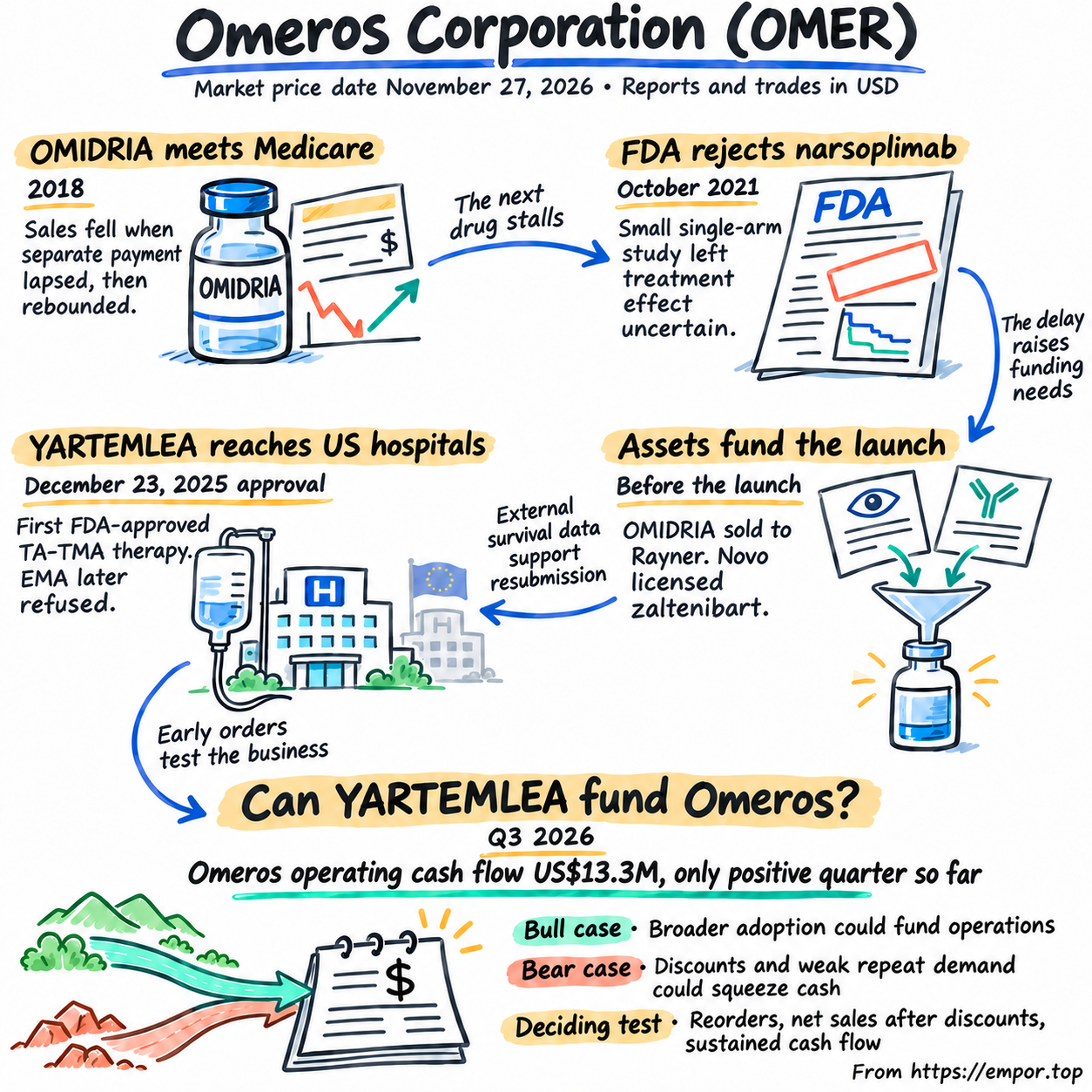
Omeros Corporation: One Drug, Thirty Years in the Making
I. The Approval That Took Five Years
Two days before Christmas 2025, a letter left the Food and Drug Administration addressed to a Seattle company that had been waiting for it, in one form or another, for most of its existence. The letter approved narsoplimab, a monoclonal antibody Omeros would sell under the name YARTEMLEA, for transplant-associated thrombotic microangiopathy, a rare and frequently lethal complication of stem-cell transplantation.1 It was the first therapy the FDA had ever approved for that condition.1 It also arrived more than four years after the same agency had looked at the same drug and said no.
For most companies, an FDA approval is the climax of the story. For Omeros, it was closer to the end of the first act. The company had been founded in 1994, had gone public in 2009, had built and then sold a commercial product, had licensed away another promising antibody to raise money, and had spent years arguing with regulators about how to read a small, uncontrolled clinical study.23 By the time YARTEMLEA reached hospital pharmacies in January 2026, the question was no longer whether the drug worked well enough for the FDA. It was whether a company that had lived for three decades on the promise of its next medicine could finally live on the sales of one.
The early answer looked better than many skeptics expected. In the first nine months on the market, YARTEMLEA generated $74.4 million of net sales.4 That is a meaningful number for a drug aimed at a condition most people have never heard of, sold to a few dozen transplant centers that had to learn to diagnose it first. But a second number sat beside it in the same filing, and it tells a more sober story. Over those same nine months, Omeros generated only $2.9 million of cash from operations.4 The company had sold tens of millions of dollars of medicine and kept almost none of it as cash.
The reason is visible in the shape of the year rather than its total. In the third quarter, YARTEMLEA's net sales reached $35.9 million, and operating cash flow for that quarter alone was $13.3 million.45 Subtract the quarter from the nine-month figure and the arithmetic says the first half of 2026 consumed roughly $10 million of operating cash, as Omeros paid for a sales force, medical education, inventory and the rest of a commercial machine before the revenue caught up. So the launch has a turning point inside it. The first six months burned cash. The most recent three months produced it.
That contrast is the first clue in this story, and it is worth sitting with before reaching for a conclusion. One positive quarter in the third full quarter of a launch is genuinely encouraging, because it suggests the drug can pay for its own commercial infrastructure at a fairly modest scale of sales. It is also exactly the kind of evidence that has misled investors in rare-disease launches before, because early quarters capture the easiest patients, the most enthusiastic centers and the first stocking orders from wholesalers. A single quarter cannot tell anyone whether the curve will keep bending upward or flatten once the obvious patients have been treated.
So the stakes are simple to state and hard to resolve. Omeros has to prove three things at once. It has to find the patients, which means persuading transplant physicians to recognize a condition that hides behind the ordinary chaos of a post-transplant recovery. It has to get paid, which means navigating hospital budgets, Medicare rules and the discounts that come with selling into safety-net hospitals. And it has to fund the company around the launch, because Omeros arrived at its approval carrying convertible debt, a history of equity raises and a pipeline that still costs money.
Each of those tasks raises a question this story will follow. Is YARTEMLEA's early adoption repeatable, or is it the first wave of pent-up demand? Can a single approved product carry the cost of a research organization that has historically struggled to turn science into sales? And has the financing pressure eased enough to give the launch the time it needs, or is the company still one bad quarter away from another round of dilution?
The market's answer, so far, has been nervous. When Omeros reported its third quarter in mid-November 2026, beating analyst expectations on both revenue and earnings, the stock fell 16.5% the following day, leaving the company valued at roughly $1 billion.6 Investors had seen the good quarter. They were not yet sure what it proved.
To understand why the market hesitates, it helps to go back to the beginning, to a company that spent its first two decades building a portfolio of next drugs and learning, painfully, how few of them would ever become a business.
 Subscribe on LinkedIn
II. A Company Built Around the Next Drug
Omeros began in Seattle in 1994 as a bet by a physician-founder that the body's inflammatory machinery could be targeted more precisely than medicine had managed so far.3 Gregory Demopulos, a surgeon by training, co-founded the company and has run it ever since as chief executive, adding the title of board chairman along the way.7 Few biotech founders stay at the helm of their companies for three decades, through an IPO, a commercial launch, a divestiture, a regulatory rejection and a second launch. Demopulos has. That continuity is the first thing to understand about Omeros, because it cuts both ways. It means the company's strategy has been unusually consistent, built around complement biology and a handful of proprietary platforms. It also means the record of promises and outcomes over thirty years belongs, largely, to one leadership regime.
The early company was a collector of scientific options. In 2009, Omeros had a pipeline spanning surgical drugs, addiction and compulsive disorders, and the complement system, the cascade of blood proteins that helps the immune system tag and destroy invaders but can also turn on the body's own tissues.3 In 2006, Omeros had acquired nura, a private company that brought additional discovery programs, which helped widen the portfolio but offers little useful insight into what the current business is worth.3 What mattered more was the shape of the bet. Omeros was not a single-drug company. It was a platform company asking investors to believe that, among many shots, enough would land.
The IPO came in October 2009, at an inauspicious moment for biotech, with credit markets still recovering from the financial crisis.3 At the time, Omeros's most advanced product was a surgical drug for eye surgery, still years from approval. The company that listed that autumn was, in other words, almost entirely a research organization with a public stock price attached.
The first commercial proof point took five more years. OMIDRIA, a combination of two familiar drugs, phenylephrine and ketorolac, added to the irrigation solution surgeons use during cataract and lens replacement surgery, won FDA approval in 2014 and launched in 2015.8 The idea was elegant in its practicality. During cataract surgery, the pupil tends to constrict, which makes the surgeon's job harder and riskier, and patients often experience pain afterward. OMIDRIA kept the pupil dilated and reduced post-operative pain by delivering both drugs directly where they were needed.8 It was not a molecular breakthrough. It was a clever product that fit into a procedure performed millions of times a year.
For a while, it looked like Omeros had found its engine. OMIDRIA sales rose from $13.3 million in its first year to $110.7 million in 2021, an eightfold climb over six years.89 But the line between those two endpoints was anything but smooth, and the bumps reveal the most important lesson in Omeros's commercial history.
OMIDRIA's economics depended on how Medicare paid hospitals and surgery centers for using it. Under a mechanism called transitional pass-through status, new drugs used during outpatient procedures can be paid for separately for a limited period, rather than being folded into the single bundled payment the facility receives for the operation. Separate payment meant surgery centers could use OMIDRIA without eating its cost. When pass-through status expired at the start of 2018, OMIDRIA's cost was suddenly bundled into the procedure fee, and many facilities simply stopped buying it.10 Quarterly sales collapsed from $17.2 million in the third quarter of 2017 to $4.6 million a year later.10 Then Congress restored separate payment, and the product rebounded almost instantly to a record $22.0 million in the fourth quarter of 2018.10
Think about what that sequence means. The molecule did not change. The surgeons did not change. The patients did not change. What changed was who paid for the drug, and demand swung by roughly three quarters in a matter of months. Omeros spent much of the following years in Washington defending OMIDRIA's reimbursement, and Omeros's sales fell again in 2020 as COVID-19 halted elective surgeries and reimbursement uncertainty lingered.11 The recurring question that OMIDRIA left behind is one YARTEMLEA now inherits: how much of a product's demand belongs to the medicine, and how much depends on payment rules a company does not control?
Meanwhile, the complement platform was where Omeros invested the bulk of its ambition. Narsoplimab, the antibody that would become YARTEMLEA, targets an enzyme called MASP-2, which sits at the top of the lectin pathway, one of three routes by which the complement system activates.12 The analogy is a building's alarm system with three separate tripwires. Older complement drugs, such as eculizumab, cut the wiring near the end of the system, shutting down the alarm regardless of which wire was tripped. Narsoplimab disconnects one specific tripwire, the lectin pathway, which Omeros believes is the principal driver of damage in certain conditions where blood vessels are injured, while leaving the other defenses intact.12 That precision is the scientific promise. Whether it translates into a better commercial product is a different question.
Omeros pursued narsoplimab in several diseases at once. Transplant-associated thrombotic microangiopathy was one. IgA nephropathy, a common kidney disease with a far larger patient population, was another, and for years it represented the bigger commercial prize. A second complement antibody, zaltenibart, targeting a related enzyme called MASP-3, aimed at diseases such as paroxysmal nocturnal hemoglobinuria.2 The portfolio looked like a complement franchise in the making.
The record of what happened to those bets is the necessary counterweight to the approval story. Omeros closed its IgA nephropathy program, wound down other studies and transferred zaltenibart's development to Novo Nordisk.2 Research and development spending, a rough proxy for how much science the company could afford, fell from $119.5 million in 2024 to $81.3 million in 2025, and management attributed the drop largely to those closures and transfers.2 By the end of 2025, Omeros employed 175 people, 116 of them in research and development and only 15 in sales and marketing, the workforce of a company that had spent its life in the lab and was only beginning to build a commercial arm.2
Across three decades, the platform produced one surgical product that the company eventually sold, one antibody now licensed to a larger partner, a large-indication program that was closed, and one approved rare-disease drug. That is not nothing. Many biotech companies founded in the 1990s produced less. But it does not support the idea that Omeros's platform reliably turns science into durable, company-owned sales. YARTEMLEA is a major change in the business. It is not, on its own, proof that the next program will follow.
And the way Omeros financed its way to that approval tells a story of its own, because the company kept the lights on in part by selling the very assets that once defined it.
III. Two Assets Sold to Buy Time
In December 2021, two months after the FDA rejected narsoplimab for the first time, Omeros announced that it would sell OMIDRIA to Rayner, a British maker of intraocular lenses and ophthalmic products. The headline called it a transaction "valued in excess of $1 billion."13 The cash at closing was considerably smaller. Rayner paid $125 million upfront, promised a $200 million milestone if OMIDRIA's separate Medicare payment survived for a defined period, and agreed to pay royalties on future sales.13
The timing is impossible to ignore. Omeros had just lost its expected path to a second product, its only commercial asset was exposed to the reimbursement politics it had spent years fighting, and the company needed money to keep its complement programs alive. Selling OMIDRIA converted a commercial business, with all its sales-force costs and policy risks, into a cash payment and a stream of contingent receipts. It was, in effect, a risk transfer. Rayner took the product, the salespeople's job of selling it and the exposure to future Medicare decisions. Omeros kept a slice of the upside without the operating burden.
Judged on what Omeros actually received, the deal held up better than skeptics might have expected. The $200 million milestone was the piece most dependent on Washington, and it arrived in February 2023 after separate payment had been established for the required stretch.14 Combined with the upfront payment, that is $325 million of realized cash from a product that had never earned more than about $111 million in a year. Whatever one thinks of the decision to sell, the contingent part of the price was not an empty promise.
What the deal could not do was supply a valuation benchmark. OMIDRIA was a mature, reimbursement-dependent surgical product; YARTEMLEA is a first-in-class rare-disease biologic. The prices Rayner paid, and the larger headline value tied to royalties that may or may not materialize, say very little about what a buyer would pay for Omeros today.
The second financing move went one step further. Omeros sold part of its future OMIDRIA royalty stream to DRI Healthcare, a royalty investor, bringing cash forward in exchange for a reduced share of future receipts. A second such monetization in 2024 delivered $115.5 million.2 This is a familiar biotech maneuver: a company with a long-dated stream of income sells it to an investor who has a lower cost of capital and a longer time horizon. The company gets cash now and the buyer gets a predictable return. The cost is that every dollar received upfront is a dollar of future royalties that will now flow to someone else. By 2026, the OMIDRIA royalties that remained with Omeros showed up in its accounts as discontinued operations, a modest receivable rather than a business.4
Then came the third and largest transaction. In October 2025, Omeros transferred global rights to zaltenibart to Novo Nordisk, the Danish drugmaker. Headlines described the agreement as worth up to $2.1 billion.15 The cash that actually changed hands was $240 million upfront, with up to $1.81 billion more in development, regulatory and sales milestones, plus royalties on future sales.16
This is where the difference between headline value and cash in hand becomes the whole story. The $240 million was real and was received. The $1.81 billion depends on Novo successfully developing zaltenibart, winning approvals in multiple indications and then selling enough of it to trigger sales-based payments. For context, Omeros itself had just spent years fighting to get a single complement antibody approved for one rare indication. A milestone ceiling of that size is a statement of possibility, not a forecast. Investors who mentally add it to Omeros's value are counting money that Novo has agreed to pay only if things go right.
What did Omeros do with the money it did receive? The trail runs through the balance sheet. The zaltenibart proceeds helped repay a $67.1 million secured term loan in November 2025, which released the lenders' liens on Omeros's assets and freed the company from a liquidity covenant that had required it to keep a minimum cash balance.42 Because the loan was retired at a discount, Omeros booked a $17.0 million gain on extinguishing it.2 The rest helped fund the YARTEMLEA launch that began a few weeks later.
The accounting around the Novo deal is worth one careful sentence, because it explains why Omeros's 2025 income statement looked far healthier than its business was. Omeros recorded a $237.6 million gain on the zaltenibart sale, which pulled the company's 2025 loss from continuing operations down to just $4.8 million.2 Without that one-time gain, the year would have looked like the years before it, when continuing operations lost about $175 million in 2023 and $183 million in 2024.2 A near-break-even year built on the sale of an asset is not evidence of a business that can support itself.
Asset sales were not the only financing tool. Omeros continued to tap the equity markets throughout this period. In 2025 alone it raised $20.3 million in a registered direct offering and $19.0 million through its at-the-market program, which lets a company sell shares gradually into the market, and it issued shares to retire part of a convertible note that was due in 2026.2 The pattern is clear in hindsight. When the company needed cash, it sold or monetized assets when it could and sold stock when it had to.
So was this disciplined capital allocation or a slow liquidation of future value? The honest answer is that it was both, in proportions that depend on what YARTEMLEA turns out to be worth. The OMIDRIA sale captured real cash before the product's reimbursement could be threatened again, and the milestone was paid. The royalty monetizations brought forward income at the cost of later receipts. The zaltenibart transfer converted a mid-stage program, which Omeros could not afford to develop alone, into upfront cash and a lottery ticket held by a far larger company. Each choice was defensible on its own terms. Together, they describe a company that funded its central bet by giving away pieces of its other ones.
That raises the capital-allocation question that hangs over everything that follows. If past assets had to be sold to fund this launch, will YARTEMLEA generate enough cash to finance the next set of bets? To answer that, it helps to understand just how hard the road to approval was, and what the FDA's hesitation says about the evidence behind the drug.
IV. The Rejection That Rewrote the Timeline
In October 2021, the FDA sent Omeros a Complete Response Letter. In the polite vocabulary of drug regulation, a Complete Response Letter is the document that tells a company its application cannot be approved in its current form. This one said the agency had found it difficult to establish narsoplimab's treatment effect, and that the application did not provide substantial evidence of effectiveness.9 For a company that had been preparing to launch, it was a gut punch. Omeros had built its near-term plans around approval. Instead it faced a timeline with no end date.
To understand why the FDA balked, start with the disease. Thrombotic microangiopathy, often shortened to TMA, is damage to the body's smallest blood vessels, in which tiny clots form, red blood cells are shredded and organs such as the kidneys, lungs and gut are starved of blood.12 When it follows a hematopoietic stem-cell transplant, the procedure used to treat leukemias and other blood disorders, it is called transplant-associated TMA, or TA-TMA. Patients who develop the severe form are already fragile, recovering from chemotherapy, conditioning regimens and often graft-versus-host disease, and many of them die.12 It is a rare complication of an already specialized procedure, which is precisely why it had no approved treatment.
That rarity also made the evidence hard to build. Omeros's pivotal study enrolled 28 patients.12 It had no randomized control group, meaning there was no comparable set of patients receiving a placebo or standard care against whom the narsoplimab group could be measured. Instead, the study was single-arm: every patient received the drug, and investigators measured how many responded according to a composite definition that combined improvements in laboratory markers with signs of organ recovery or freedom from transfusions.
Here is where the numbers diverged. Omeros reported a response rate of 61%. When FDA reviewers applied their own analysis to the same patients, they found 43%.12 The gap was not about fraud or error. It was about definitions, about which patients counted as responders when their lab values and clinical course were ambiguous, and about how much improvement in a critically ill person could be attributed to the drug rather than to the natural course of the disease, supportive care, or changes in other medications. In a single-arm study of 28 people, a handful of judgment calls can swing the headline result by eighteen percentage points. And without a control arm, there was no clean way to tell what would have happened to those patients without narsoplimab.
Imagine trying to judge whether a new umbrella keeps people dry by handing it to 28 people walking through intermittent drizzle, with no one walking alongside them without one. Some of them would have stayed dry anyway. Some of them got wet despite the umbrella. The FDA's job is to decide whether the umbrella is doing the work, and in 2021 it concluded that the evidence did not let it make that call.
Omeros did not accept the verdict quietly. It pursued a formal dispute resolution, the FDA's internal appeal process, arguing that the agency had misjudged the data.9 The appeal did not succeed. What followed was a long period of further discussions with the FDA about what additional evidence would satisfy it, a period in which Omeros had to keep funding the company, sell assets and convince investors that the drug was still alive.
The path that eventually worked ran through survival. Rather than relying solely on response rates, Omeros assembled data from patients treated through an expanded-access program, which allows doctors to request experimental drugs for seriously ill patients outside of clinical trials, and compared survival among narsoplimab-treated patients with outcomes from an external registry of TA-TMA patients who had not received the drug.12 An external comparison is not a randomized trial; the registry patients were treated at different times, in different places, by different doctors. But it gave the FDA something the original application lacked: a reference point for what happens to these patients without the drug. Omeros resubmitted in 2025, and approval came on December 23 of that year.112
The approval genuinely validates YARTEMLEA as a treatment option. The FDA does not approve drugs it believes are ineffective, and its reviewers ultimately judged that the totality of evidence, including the pivotal study and the expanded-access experience, was sufficient for this serious condition with no approved alternative.12 That is a meaningful scientific and regulatory achievement for a small company.
But it is important to be precise about what the approval proved. It proved that the FDA was willing to accept a small, single-arm evidence base supplemented by external comparisons for a rare, life-threatening disease. It did not prove how often physicians will diagnose TA-TMA, how many of those patients will receive narsoplimab, or what price Omeros will ultimately realize after discounts. Regulatory success opens a market. It does not fill it.
Investors who listened to Omeros's conference calls between the 2021 rejection and the 2025 approval heard a management team consistently confident that approval was coming, and a timeline that slipped repeatedly. The company's narrative shifted from contesting the FDA's analysis, to working within the agency's requests for more data, to emphasizing survival and the external registry. That evolution was rational; it followed the FDA's feedback. But it means management's earlier projections of timing were, in hindsight, too optimistic by years. For a company whose leadership has been continuous since 1994, that record of timing promises belongs in the credibility ledger alongside the eventual approval.
There is a fair way to read that record and an unfair one. The unfair reading says management misled investors. The record does not support that; the company disclosed the rejection, the failed appeal and each change in strategy as it happened.92 The fair reading is narrower and more useful. Omeros's leadership has a demonstrated tendency to forecast regulatory and commercial timelines on the optimistic edge of the plausible range, and investors should apply that adjustment to the company's current statements about launch trajectory, cash generation and pipeline timing. When management says the launch is building, the claim has two quarters of evidence behind it. When management describes what the pipeline will deliver, the claim has a thirty-year base rate to contend with.
It is also worth noticing what the long delay cost. Every year between the rejection and the approval was a year in which Omeros paid for a research organization, a regulatory team and a company infrastructure without a product to sell. Those years are a large part of why OMIDRIA was sold, why royalties were monetized and why zaltenibart went to Novo. The rejection did not just push back a launch date. It forced the asset sales that shaped the company that eventually launched.
Then came the European branch of the story, which tested the evidence in a second regulatory system. Omeros sought marketing authorization from the European Medicines Agency, and in June 2026 the agency's scientific committee issued a negative opinion. Omeros requested a re-examination, and in October 2026 the committee confirmed its refusal.17 The European regulators, looking at the same small, uncontrolled dataset and the same external comparison, reached the opposite conclusion from their American counterparts.17
That split is revealing. It does not mean the FDA was wrong or the EMA was right. Different regulators weigh uncertain evidence differently, especially for rare diseases where large randomized trials are impractical. But it does confirm that the evidence behind YARTEMLEA sits close to the line of what regulators will accept. It also changes the commercial picture. Without a near-term European approval, the United States carries essentially the entire commercial case for the foreseeable future.
So the approval came, the European door closed, and Omeros found itself with one product, one market and a disease that doctors first had to learn to recognize. The next question was whether the transplant centers of America would actually use it.
V. The First 175 Centers
There are about 175 transplant centers in the United States performing the kind of stem-cell transplants that can lead to TA-TMA, and by the autumn of 2026 Omeros said it was engaging all of them.18 By September 30, 109 accounts had ordered YARTEMLEA, up from 73 just three months earlier.418 Picture a map of the country with pins appearing one by one at academic medical centers and cancer hospitals: a pharmacy approving the drug for its formulary, a transplant physician ordering the first vials for a patient whose kidneys were failing for reasons that took days to diagnose. That is what a rare-disease launch looks like from the inside. It is slow, center by center, and it depends on whether doctors recognize the disease in time.
Recognition is the first hurdle, and it is a high one. TA-TMA does not announce itself. Its signs, anemia, low platelets, kidney injury, high blood pressure, overlap with the ordinary complications of a stem-cell transplant, including infection, drug toxicity and graft-versus-host disease.12 A transplant team managing a sick patient has many explanations for those symptoms, and TA-TMA is often diagnosed late or not at all. That is why the launch depends so heavily on clinical education: Omeros is not only selling a drug, it is teaching physicians to look for the condition the drug treats.
The product's form reinforces that dependence. YARTEMLEA is given by intravenous infusion, which ties treatment to the hospital or infusion center and to the transplant team's workflow.1 Adoption requires the transplant center to diagnose, the pharmacy to stock, the hospital to bill and the payer to reimburse. Every link in that chain is a place where a patient can fall out of the funnel.
Now consider the competitive field, which is unusual. YARTEMLEA was the first FDA-approved treatment for TA-TMA.1 Before its approval, doctors treated the condition with supportive care, adjusted immunosuppressive drugs, and in some cases used eculizumab, the complement inhibitor that blocks the system near its end, off-label.12 Other complement-targeting approaches are being studied, but none has been approved for this indication. So Omeros has the only labeled product in a market that has, until now, been served by improvisation.
That position is real, but it is easy to overstate. Being first is not the same as being dominant, and there is no published market-share figure to establish how many TA-TMA patients receive YARTEMLEA versus off-label alternatives or supportive care alone. Eculizumab and its longer-acting successor, ravulizumab, are well known to hematologists, and their makers have the resources to study them in TA-TMA if they choose. The label gives Omeros an advantage in reimbursement and physician confidence. It does not prevent a doctor from reaching for a familiar drug.
The sales trajectory shows real momentum. Net sales rose from about $10 million in the first quarter, when the drug was still being stocked and added to formularies, to $28.5 million in the second and $35.9 million in the third.419 Quarter-on-quarter growth slowed from nearly tripling to about a quarter, which is normal as a launch moves from initial stocking to genuine patient demand, but it also means the steepest part of the curve may already be behind it. Account growth, from 73 to 109 in a single quarter, suggests the breadth of adoption is still expanding.4
Now look underneath the sales line, because that is where the economics live. Omeros sells YARTEMLEA to wholesalers, the large drug distributors that supply hospitals, and recognizes revenue when the product is delivered and title passes to them.4 The reported net sales figure is what remains after deducting distribution fees, chargebacks, returns and copay assistance. Chargebacks are the key mechanism here. When a hospital that qualifies for a government-mandated discount buys the drug through a wholesaler, the wholesaler pays Omeros's list price but sells to the hospital at the discounted price, then charges the difference back to Omeros.
The most important of those discounts comes from the 340B program, a federal scheme that requires drugmakers to sell outpatient drugs at steep discounts to hospitals that serve large numbers of low-income patients. Many of the academic medical centers that perform stem-cell transplants qualify. In the third quarter, YARTEMLEA's gross-to-net deductions, the gap between list price and what Omeros actually keeps, rose to 14.0% from 11.5% in the second quarter, and the company attributed the increase mainly to higher 340B sales.518
That shift tells a story about the launch's direction. Omeros has been pushing for outpatient use of YARTEMLEA, because treating patients after they leave the hospital extends treatment and avoids the problem of an expensive drug being absorbed into a fixed inpatient payment. Outpatient settings also carry favorable reimbursement and, for new drugs used during inpatient stays, Medicare offers a new technology add-on payment, known as NTAP, which reimburses hospitals for part of the cost of qualifying new treatments.18 Those mechanisms help hospitals adopt the drug without losing money. But outpatient sales to 340B hospitals come with deeper discounts. In other words, the access strategy that is broadening use is also eroding the price Omeros realizes per vial.
A gross-to-net of 14% is still modest by the standards of many specialty drugs, where deductions of 30% or more are common. So this is not a crisis. It is a direction. If outpatient use keeps growing and more of it flows through 340B hospitals, the gap between list and net price will keep widening, and Omeros will need volume growth to outrun price erosion. The filings do not disclose a realized price per course of treatment, the typical duration of therapy, or how much revenue comes from repeat orders versus first-time patients.4 Those omissions matter, because they are exactly the data an investor would need to tell durable demand from early enthusiasm.
On the Q3 call, analysts pressed management on precisely these points: how much of the gross-to-net increase came from 340B, how outpatient use was evolving, and how to interpret account growth.18 Management framed the 340B shift as a natural consequence of reaching the patients and centers that need the drug, and pointed to growing outpatient use as evidence that the access strategy was working.18 That framing is reasonable, but it is also incomplete. An account that orders once is not the same as an account that orders every month, and the company's headline metric counts the former. The reported 14% gross-to-net figure is a harder number than any narrative about access.
Weigh, too, the power of the parties on either side of Omeros. On the customer side, a growing number of ordering accounts broadens clinical reach, but billing remains concentrated among a limited number of wholesale customers, which is typical for specialty pharmaceuticals but means a small number of distributors hold most of Omeros's receivables.4 When OMIDRIA was still an Omeros product, four distributors, AmerisourceBergen, Cardinal Health, McKesson and FFF Enterprises, accounted for nearly all its revenue.9 At the end of September 2026, Omeros carried $16.1 million of trade receivables, recorded no meaningful allowance for credit losses, and disclosed no overdue balances.4 There is no sign of a collection problem. There is simply concentration.
On the supply side, Omeros relies on a limited number of manufacturers and suppliers for the drug's ingredients, production and packaging.2 For a biologic, which is manufactured in living cells and cannot easily be switched to a new factory, that concentration is a continuity risk. A single manufacturing disruption could interrupt supply at exactly the moment the launch needs reliability.
So where does that leave the advantage question? The evidence supports a narrower claim than "first-in-class moat." YARTEMLEA has the only FDA label in its indication, a growing base of ordering centers and a sales curve that is still rising. Those are tangible. What the record does not yet show is physician retention, consistent patient identification across centers, or the ability to hold realized price as the mix shifts toward discounted channels. The moat, in other words, is a plausible hypothesis with two quarters of supporting data. The KPI that will test it most directly is quarterly net sales alongside gross-to-net, because it captures both volume and price in one view.
The question of whether those sales can sustain the company brings the story to its balance sheet, where Omeros made one of its most consequential decisions of the launch year.
VI. The Launch Meets the Balance Sheet
In July 2026, in the middle of its first launch year, Omeros spent $60.2 million in cash to repurchase $30.5 million of principal on its convertible notes due in 2029.4 Read that again. The company paid nearly two dollars for every dollar of debt it retired, at a time when it was still building a commercial organization and had only just stopped burning cash on a quarterly basis.
To understand why a company would pay so far above face value, you have to understand what a convertible note is. A convertible note is a loan that the lender can convert into shares of the company's stock at a preset price. If the stock rises well above that price, the note behaves less like a loan and more like a call option on the shares, and its value rises accordingly. Omeros's 2029 notes carry 9.5% cash interest, a high rate that reflects how risky lenders judged the company to be when the notes were issued.4 After YARTEMLEA's approval, Omeros's stock rose enough that the conversion feature was worth considerably more than the principal. Buying back the notes meant paying for that option value, which is why $30.5 million of principal cost $60.2 million.
The trade had real benefits. It reduced the principal outstanding to $40.3 million, eliminated the shares that would have been issued if those notes converted, and cut the 9.5% interest bill.4 Omeros also repaid $17.1 million of notes due in 2026 at maturity, and it bought back just over 843,000 of its own shares at an average price of $11.70 through September.4 Taken together, those transactions shrank the company's potential dilution and its cash interest obligations.
But they consumed significant cash at a sensitive moment. At September 30, 2026, Omeros held $95.3 million in cash and short-term investments.4 The company said that was enough, together with expected YARTEMLEA sales, to fund more than twelve months of operations.4 That is a statement about a horizon of one year, not a declaration of permanent self-sufficiency. A skeptical investor would ask whether paying $60 million to retire $30 million of debt was the right use of cash when the business had only one quarter of positive operating cash flow behind it. If commercial growth continues, the buyback will look like a smart move to clear the capital structure early. If growth slows, it will look like a company spending scarce cash to defend its share count.
The confusion around Omeros's earnings deserves a careful explanation, because the reported profit and the real business are telling different stories. The convertible notes contain an embedded derivative, essentially the conversion option, which accountants must measure at fair value every quarter. When Omeros's stock rises, the derivative liability grows and the company books a loss. When the stock falls, it books a gain. None of this involves cash. In the third quarter of 2026, that remeasurement produced a $62.0 million non-cash loss.4 At quarter-end, the derivative liability stood at $101.1 million, separate from the $31.9 million carrying value of the notes themselves.4
The result is that Omeros's GAAP earnings swing wildly with its stock price, in the opposite direction from what intuition suggests. A successful quarter that lifts the stock can produce a large reported loss. For the first nine months of 2026, the company reported net income of $11.9 million, but that figure includes these derivative swings and $8.0 million of interest and other income.4 The same distortion ran through 2025, when the near-break-even result included the gain on the zaltenibart sale, the debt extinguishment gain, and a $136.7 million non-cash loss on financial instruments.2 The derivative noise makes net income nearly useless as a measure of the business.
A simple way to hold this in mind is to treat the derivative as a mirror held up to the share price. When the market grows more confident in YARTEMLEA, the mirror shows a bigger loss, because the noteholders' right to convert into stock becomes more valuable and Omeros, on paper, owes them more. When confidence fades, the mirror shows a gain. That is why the company's best commercial quarter coincided with a $62 million reported loss, and why a lower share price at the end of a quarter, painful as it would be for shareholders, would mechanically flatter that quarter's reported earnings. Investors who read Omeros's income statement without stripping out that mirror will reach exactly the wrong conclusion in both directions. The more honest tests are the two that cannot be remeasured: cash collected from customers, and cash spent running the company.
The receivables line deserves a brief aside for the same reason. Omeros's older business offered a cautionary episode: in 2021, a large drag on OMIDRIA's operating cash flow came from the timing of Medicare Part B reimbursement rather than from any change in demand.9 There is no sign of a comparable problem with YARTEMLEA today. But launches tend to inflate receivables as wholesalers stock up, and the $12.2 million absorbed by receivables in the first nine months of 2026 is the kind of line that should shrink relative to sales as the launch matures.4 If it keeps growing faster than sales, that would be an early signal worth investigating.
Cash flow is the cleaner signal, which is why the comparison between nine-month and quarterly cash flow is the most important number pair in the story. Over the first nine months of 2026, operating cash flow was $2.9 million; the third quarter alone contributed $13.3 million.4 The nine-month figure includes $12.2 million of cash tied up in receivables as wholesalers built inventory and billing caught up with sales.4 For context, Omeros burned $116.1 million of operating cash in 2025 and $148.8 million in 2024.2 The swing from that level of burn to a positive quarter is dramatic, and it is the strongest piece of evidence that the launch is working.
It is not, however, proof of sustained cash generation. One quarter does not establish a run rate, and management has said it plans to increase commercial hiring and continue investing in the pipeline.18 Research and development consumed $43.2 million in the first nine months of 2026, equivalent to about 58% of YARTEMLEA net sales.4 If that spending rises as Omeros funds new programs, the operating cash flow line will have to absorb it. And the 9.5% interest on the remaining notes, while smaller after the buyback, is still a cash obligation.
There is history here, too, worth weighing. Omeros has a long record of telling investors that its cash would last, and then returning to the equity markets. In 2025 alone, it raised money through a registered direct offering and its ATM program.2 The 2025 annual report renewed an ATM facility for up to $150 million, though the company reported no sales under it in the first nine months of 2026.24 An unused ATM is a good sign. A renewed ATM is a reminder that the option remains available.
Management behavior also bears on how much weight to place on the company's assurances. Demopulos owned about 7.7% of Omeros according to the 2026 proxy, a figure that includes options he could exercise.7 That is a meaningful stake, which aligns his interests with shareholders to a degree. His summary compensation was $4.18 million in 2025, including $2.21 million in option awards.7 The proxy also reported "compensation actually paid" of $17.58 million for 2025, but that figure is an SEC-defined calculation that remeasures the value of options as the stock price changes, not cash he received.7 The rise in that number reflects the stock's recovery more than a pay decision.
Shareholders have expressed some discontent, though in proportion. At the June 2026 annual meeting, about 22% of votes cast opposed the company's executive pay, and roughly 34% opposed the re-election of director Thomas Cable, the largest opposition among the nominees.20 An amended incentive plan, which authorized more shares for equity compensation, drew opposition from close to 39% of votes cast.20 None of those votes failed, but they suggest a meaningful minority of investors is uneasy with pay and governance. On the accounting side, the auditor's report on the 2025 financial statements was unqualified and identified no material weakness in internal controls.2
Three numbers will tell investors whether the launch is becoming self-funding. The first is YARTEMLEA net sales alongside gross-to-net deductions, which shows whether volume growth outpaces discounting. The second is the breadth of ordering centers relative to the 175 that matter, and whether those centers reorder. The third is operating cash flow after the costs of commercial expansion and pipeline investment, the only measure that can answer whether Omeros has stopped needing outside capital.
Those numbers point toward the central debate about Omeros's future, a debate the market prices every day.
VII. Analysis & Bear vs. Bull Case
On November 27, 2026, the market valued Omeros at about $1.07 billion.21 Set that against the company's first nine months of YARTEMLEA sales, annualized in the simplest possible way, and the market was paying roughly eleven times a year's worth of sales for a company with one approved product, about $95 million of cash and $40 million of convertible note principal.4 Annualize only the third quarter instead, and the figure falls closer to seven and a half times. Neither number is a peer multiple or a forecast. They are a scale check, a way of asking what the price appears to assume. And what it appears to assume is that YARTEMLEA keeps growing for years, that its cash flow covers both the company and some of its pipeline, and that the financing scares of the past are over.
That is the bull case in a sentence. It deserves to be built properly, from evidence, before it is tested.
The bull case starts with the label. YARTEMLEA is the only FDA-approved treatment for TA-TMA, a disease that kills a large share of the patients who develop its severe form.112 Transplant physicians who previously improvised now have an approved option with a defined dosing regimen and established reimbursement pathways. Ordering accounts rose by half in a single quarter, from 73 to 109, while the company engages all 175 relevant transplant centers.418 Sales grew from about $10 million in the first quarter to almost $36 million in the third.4 Growing outpatient use, supported by favorable reimbursement and add-on payments, could extend the duration of treatment and expand the number of patients treated per center.18 And the third quarter produced $13.3 million of operating cash flow, which suggests the commercial organization can be funded from sales at a modest scale.4 If those trends continue, Omeros becomes something it has never been: a self-funding commercial biotech, with the freedom to choose which pipeline bets to pursue rather than which assets to sell.
The bear case starts with the history. The FDA rejected narsoplimab in 2021, and the approval came only after years of further discussion and an evidence package built partly on external comparisons.912 The pivotal study enrolled 28 patients, and the FDA's own analysis found a response rate well below the company's.12 European regulators examined the same evidence twice in 2026 and refused approval both times.17 The company's long record of development programs includes a closed IgA nephropathy program and a transferred zaltenibart program, and its only previous commercial product was sold.2 Omeros now depends on one approved product in one country, whose realized price is already being trimmed by 340B discounts.5 Its GAAP earnings are dominated by derivative swings, its cash balance fell sharply during the launch year as it repurchased notes, and it has a history of returning to the equity markets.42 And the market's reaction to its best quarter ever, a 16.5% one-day fall, suggests investors are far from convinced the trajectory will hold.6
Both cases are built on real evidence. The task is to weigh them rather than leave them side by side.
Start with the competitive forces that shape the business, because they explain where profits in this market will settle. The most powerful buyers are not patients but the transplant physicians and centers who decide whether to diagnose and treat TA-TMA. Their adoption determines demand, and their ability to choose supportive care or off-label alternatives keeps Omeros honest. Payers and the 340B program are a second set of buyers with real power, because they determine how much of the list price Omeros actually keeps; the rise in gross-to-net deductions to 14% shows that power at work.5 Wholesalers concentrate receivables, though their role is mostly logistical rather than a source of pricing pressure. Suppliers hold meaningful power, because a biologic depends on a limited number of specialized manufacturers who cannot easily be replaced.2 The threat of substitutes comes from off-label complement inhibitors, especially eculizumab and its successors, which hematologists already know well.12 And the threat of new entrants depends on whether other companies decide to pursue TA-TMA, which, as a small, specialized market, may attract fewer competitors than larger complement indications but is hardly closed.
Now apply the lens of Hamilton Helmer's seven powers, which asks which durable advantages allow a company to earn returns above its cost of capital. Omeros's strongest claim is a version of what Helmer calls a cornered resource, here the only FDA label in an indication, combined with the clinical data and reimbursement codes that come with it. That advantage is real but limited, because a label prevents competitors from marketing for TA-TMA without their own approval, not doctors from using their drugs off-label. Switching costs could develop if transplant centers build protocols, order sets and staff training around YARTEMLEA, making it the default choice when a patient develops TA-TMA. But the record does not yet show retention or reorder rates, so switching costs remain a hypothesis. Scale economies, network effects, brand power and process power are largely absent at this stage; Omeros is too small and too new in this market for any of them to apply. Counter-positioning, the advantage of a business model incumbents cannot copy without harming themselves, does not clearly apply either, since large complement makers could study their drugs in TA-TMA without cannibalizing their own businesses.
So the moat question resolves to a narrower answer than the bull case implies. The first-approved position is meaningful, because it gives Omeros the clearest reimbursement path and the strongest claim on physician attention. But the record does not yet establish switching costs or pricing power, and the one price signal available, gross-to-net deductions, is moving in the wrong direction.
The pipeline deserves equally careful treatment, because it is where optionality arguments tend to run ahead of evidence. Omeros continues to develop OMS1029, a longer-acting antibody against the same MASP-2 target as narsoplimab, along with other programs.5 If YARTEMLEA generates enough cash, these programs could matter. But the company's historical rate of converting clinical programs into durable sales is low. Over three decades, the platform has produced OMIDRIA, which was sold, and YARTEMLEA, which took five years longer than planned to reach the market. The IgA nephropathy program, once the largest commercial opportunity for narsoplimab, was closed.2 Zaltenibart's transfer to Novo turned it into a cash event and a possible stream of milestones, not a product Omeros controls.16 A reasonable investor should treat the pipeline as an option with a low historical exercise rate, not as a second engine.
The zaltenibart milestones belong in the same category. Up to $1.81 billion of potential payments sounds like a hidden asset, but it depends entirely on Novo's development decisions, regulatory success and commercial results.16 Omeros has no control over the timing or outcome. A milestone payment may arrive one day; it may not. Treating it as near-certain value would repeat the error of reading the Rayner deal's billion-dollar headline as the price Omeros received.
An activist with a skeptical eye would focus on three questions. First, capital allocation: why spend $60.2 million to retire $30.5 million of notes in the first launch year, rather than preserve cash until the business proved itself? Second, governance: why does the company combine the chief executive and chairman roles under a founder who has led it for three decades, when a third of votes opposed one director and close to two-fifths opposed the expanded equity plan?720 Third, disclosure: why does Omeros report ordering accounts but not reorder rates, realized price per course or the share of revenue from repeat patients, the metrics that would let investors judge whether demand is durable?4 None of these questions implies wrongdoing. All of them are fair.
The valuation boundary is the final piece. The comparison of market value to annualized sales is a rough check of scale, not a comps-based multiple. It ignores the remaining convertible notes, the $101.1 million derivative liability that reflects the conversion value owed to noteholders, the cost of the pipeline, and the uncertainty around milestone payments.4 It also ignores the fact that rare-disease launches often grow for several years before plateauing, which can make early multiples look either cheap or expensive depending on where the curve ends. The market is not pricing Omeros on what it earns today. It is pricing a guess about what YARTEMLEA becomes.
For investors trying to test that guess, the conference calls provide the most useful evidence. On the Q3 2026 call, analysts pressed management on cash flow and the durability of launch growth; management's answers emphasized account expansion and outpatient use more than reorder data.18 On the Q2 call, the conversation centered on the note repurchase and the early 340B shift.22 And comparing the financing narrative before and after the Novo transaction and FDA approval reveals how quickly the company's language moved from survival to strategy.1822 What management says next about cash flow, and whether the numbers match, will tell investors more than any valuation framework.
The bull case says Omeros has finally built a business. The bear case says it has built a launch. The difference between the two will be measured not in pipeline announcements but in the next four quarters of sales and cash, which brings the story to the lessons its history offers.
VIII. Playbook: Business & Investing Lessons
In the autumn of 2018, a cataract surgeon at an outpatient surgery center somewhere in America faced a simple decision. OMIDRIA's separate Medicare payment had lapsed at the start of the year, which meant every vial the surgeon used came out of the center's fixed procedure fee. The drug had not changed. The patients had not changed. But the economics had, and Omeros's quarterly sales had collapsed from $17.2 million to $4.6 million in a year.10 Then Congress restored separate payment, and almost overnight the surgeon could use the drug again without losing money. Sales jumped to a record $22.0 million in the following quarter.10 Eight years later, a transplant physician deciding whether to order YARTEMLEA for a patient faces a different version of the same calculus: whether the hospital will be paid, whether the outpatient setting will be reimbursed, whether the 340B discount applies. Omeros's history keeps returning to that moment of decision, and it offers several lessons that belong to this company and no other.
The first lesson is that a reimbursement code can move a product faster than a new molecule. OMIDRIA's 2018 collapse and recovery showed that a drug's demand can be governed less by its clinical value than by who pays for it and how. Omeros learned this the hard way, spending years in Washington defending pass-through status, and it is now applying the lesson to YARTEMLEA through NTAP and outpatient reimbursement strategies.18 For founders, the implication is that reimbursement design is not an afterthought to drug development; it is part of the product. For investors, it means that any rare-disease launch should be analyzed through the eyes of the hospital pharmacy director as much as through the eyes of the physician.
The second lesson is that an approval opens the door; it does not fill the clinic. The FDA's December 2025 approval ended a regulatory saga, but the commercial work began afterward: diagnosing patients, educating physicians, securing formulary access and building outpatient pathways. YARTEMLEA's growth from 73 to 109 ordering accounts in one quarter is promising, but a launch only becomes a business when those accounts order repeatedly and the net price holds.4 Every biotech investor has seen an approval rally that faded when the commercial ramp disappointed. Omeros's own history, from OMIDRIA's reimbursement swings to YARTEMLEA's rising gross-to-net deductions, shows why approval is the starting line, not the finish.
The third lesson is that a milestone headline is not cash in hand. The OMIDRIA sale was announced as a transaction worth more than $1 billion; Omeros received $325 million in upfront and milestone payments, plus royalties it partly sold to fund operations.1314 The Novo deal was reported as worth up to $2.1 billion; the cash received was $240 million, with the rest contingent on outcomes Omeros does not control.1615 The lesson is not that these deals were bad. It is that the headline number is a ceiling, and the floor is what arrives. Investors who learn to discount biotech deal headlines to the cash actually received will avoid one of the most common errors in the sector.
The fourth lesson is that a pipeline is only as valuable as its path to patients. Omeros's history includes a closed IgA nephropathy program, a sold commercial product, a licensed antibody and one approved rare-disease drug. Technical progress, regulatory designations and positive early data appeared many times over three decades. Durable, company-owned sales appeared rarely. That record should temper how any investor values the company's remaining programs, including OMS1029. A platform that has delivered one approval in thirty years may deliver another; but the base rate argues for patience over excitement.
There is a final lesson, wider than Omeros, about the relationship between a company and its financing. For most of its history, Omeros used its assets to fund its science. It sold OMIDRIA to keep narsoplimab alive, monetized royalties to fund operations and licensed zaltenibart to repay its secured debt and launch YARTEMLEA. Each step was rational. Together, they show how a research-driven company can spend decades converting future value into present survival. The investment question now is whether that pattern has finally reversed. Omeros has spent decades financing the next medicine. The question is whether, this time, the medicine can finance what comes next.
IX. Epilogue
Tonight, at the end of November 2026, Omeros stands at a hinge. It has one approved drug, nearly a year of sales, a single quarter of positive operating cash flow, a lighter debt load than a year ago and a stock price that fell after its best quarter. The next quarterly report, due in early 2027, will cover YARTEMLEA's first full year on the market. It will be the first time investors can see a complete annual picture of the launch: four quarters of sales, gross-to-net trends across a full year, and operating cash flow through a period that includes both the expensive early months and the more productive later ones.
The first thing to watch in that report is whether account growth continues and turns into repeat ordering. The Q3 account jump was impressive, but the more important question is what those accounts do next.4 If a center orders once for a single patient and never again, its pin on the map means little. If it orders every month, the launch is building a base of recurring demand. Omeros does not disclose reorder rates, so investors will have to infer them from the relationship between account growth and sales growth. If sales grow faster than accounts, existing centers are using more. If accounts grow faster than sales, the new centers are ordering less.
The second thing to watch is gross-to-net after the 340B shift and any changes to Medicare reimbursement. The recent rise in gross-to-net was modest, but its direction matters.5 If deductions keep climbing as outpatient use expands, Omeros will need faster volume growth to maintain revenue. If they stabilize, the access strategy will have broadened the market without eroding its economics.
The third thing to watch is operating cash flow after the company adds commercial staff and increases pipeline spending. The third quarter's positive operating cash flow showed what the business can generate when sales outpace costs.4 But management has said it plans to keep investing, and the remaining notes still carry a cash interest obligation.418 Compare quarterly operating cash flow with the cash balance and the company's debt and interest obligations, and the runway question becomes concrete. A few more quarters of positive cash flow would mean the ATM can stay unused. A return to cash burn would reopen the financing question.
The fourth thing to watch is Europe. After the EMA confirmed its refusal in October 2026, there is no clear near-term path to European approval.17 Omeros could seek a new pathway, perhaps with additional data, but until then the commercial case rests almost entirely on the United States. That concentration is not fatal, since the US is the largest pharmaceutical market and the one where rare-disease drugs command the highest prices. But it removes a source of diversification that a single-product company would otherwise welcome.
Each outcome has a clear meaning. If sales keep rising, gross-to-net holds steady and cash flow stays positive, Omeros will have proved that YARTEMLEA can carry the company, and the pipeline becomes a choice rather than a necessity. If sales plateau, deductions widen and cash flow turns negative, the company will face the same financing questions that have shadowed it for three decades, with fewer assets left to sell. The most likely outcome is somewhere between, and the precise position on that spectrum will determine whether Omeros's market value is anticipating a durable business or a temporary peak. The next proof point is not a new pipeline announcement. It is whether broader access produces sustained sales and cash after reimbursement deductions and commercial spending.
X. Outro
In October 2021, a letter from the FDA told Omeros that its evidence was not enough. Five years later, a transplant physician somewhere in America, facing a patient whose small blood vessels were failing after a stem-cell transplant, could order the first approved therapy for that condition. The distance between those two scenes took Omeros through years of regulatory and financial strain.
Now the distance that matters is much shorter. Only a few quarters separate the approval from the first real test of repeat demand, the moment when the early adopters have been served and the launch must sustain itself. Omeros has crossed the regulatory finish line; the commercial one is still ahead. Omeros spent thirty years searching for the drug that could carry the company; now the company has to show the drug can carry its weight.
References
-
FDA approval letter for YARTEMLEA (narsoplimab) — U.S. Food and Drug Administration, 2025-12-23 ↩↩↩↩↩↩
-
Form 10-K for fiscal year 2025 — Omeros Corporation / SEC, 2026-03-31 ↩↩↩↩↩↩↩↩↩↩↩↩↩↩↩↩↩↩↩↩↩↩
-
Form S-1/A registration statement — Omeros Corporation / SEC, 2009-09-16 ↩↩↩↩↩
-
Form 10-Q for the quarter ended September 30, 2026 — Omeros Corporation / SEC, 2026-11-16 ↩↩↩↩↩↩↩↩↩↩↩↩↩↩↩↩↩↩↩↩↩↩↩↩↩↩↩↩↩↩↩↩↩↩↩↩↩
-
Omeros Corporation Reports Third Quarter 2026 Financial Results — Omeros Corporation, 2026-11-16 ↩↩↩↩↩↩
-
Omeros (OMER) stock data and price moves — Trefis, 2026-11-18 ↩↩
-
2026 Proxy Statement — Omeros Corporation / SEC, 2026-04-30 ↩↩↩↩↩
-
Form 10-K for fiscal year 2017 — Omeros Corporation / SEC, 2018 ↩↩↩
-
Form 10-K for fiscal year 2021 — Omeros Corporation / SEC, 2022-03-01 ↩↩↩↩↩↩↩
-
Omeros Q4 2018 earnings call transcript — ROIC AI, 2019-03-01 ↩↩↩↩↩
-
Form 10-K for fiscal year 2020 — Omeros Corporation / SEC, 2021-03-01 ↩
-
Multidisciplinary review of narsoplimab, BLA 761152 — U.S. Food and Drug Administration, 2026 ↩↩↩↩↩↩↩↩↩↩↩↩↩↩↩
-
Omeros Announces Agreement to Sell OMIDRIA Franchise to Rayner Surgical in a Transaction Valued in Excess of $1 Billion — Omeros Corporation, 2021-12-02 ↩↩↩
-
Omeros Corporation Receives $200 Million Milestone Payment from Rayner Surgical — Omeros Corporation, 2023-02-06 ↩↩
-
Novo Nordisk signs up to $2.1 billion licensing deal with Omeros in rare disease push — Reuters via Investing.com, 2025-10-15 ↩↩
-
Zaltenibart asset purchase and license transaction, Form 8-K — Omeros Corporation / SEC, 2025-10-24 ↩↩↩↩
-
Questions and answers: refusal of marketing authorisation for Yartemlea, re-examination confirms refusal — European Medicines Agency, 2026-10-16 ↩↩↩↩
-
Omeros Q3 2026 earnings call transcript — Stock Analysis, 2026-11-16 ↩↩↩↩↩↩↩↩↩↩↩↩↩
-
Omeros Corporation Reports Second Quarter 2026 Financial Results — Omeros Corporation, 2026-08-12 ↩
-
2026 Annual Meeting voting results, Form 8-K — Omeros Corporation / SEC, 2026-06-25 ↩↩↩
-
Omeros (OMER) statistics and market capitalization — Stock Analysis, 2026-11 ↩
-
Omeros Q2 2026 earnings call transcript — Stock Analysis, 2026-08-12 ↩↩
 LinkedIn
 WhatsApp
 Reddit
 Hacker News
 Email
 Kindle
 RSS Feed
 Spotify
 Apple Podcasts
 Amazon Music
 Audible
 YouTube