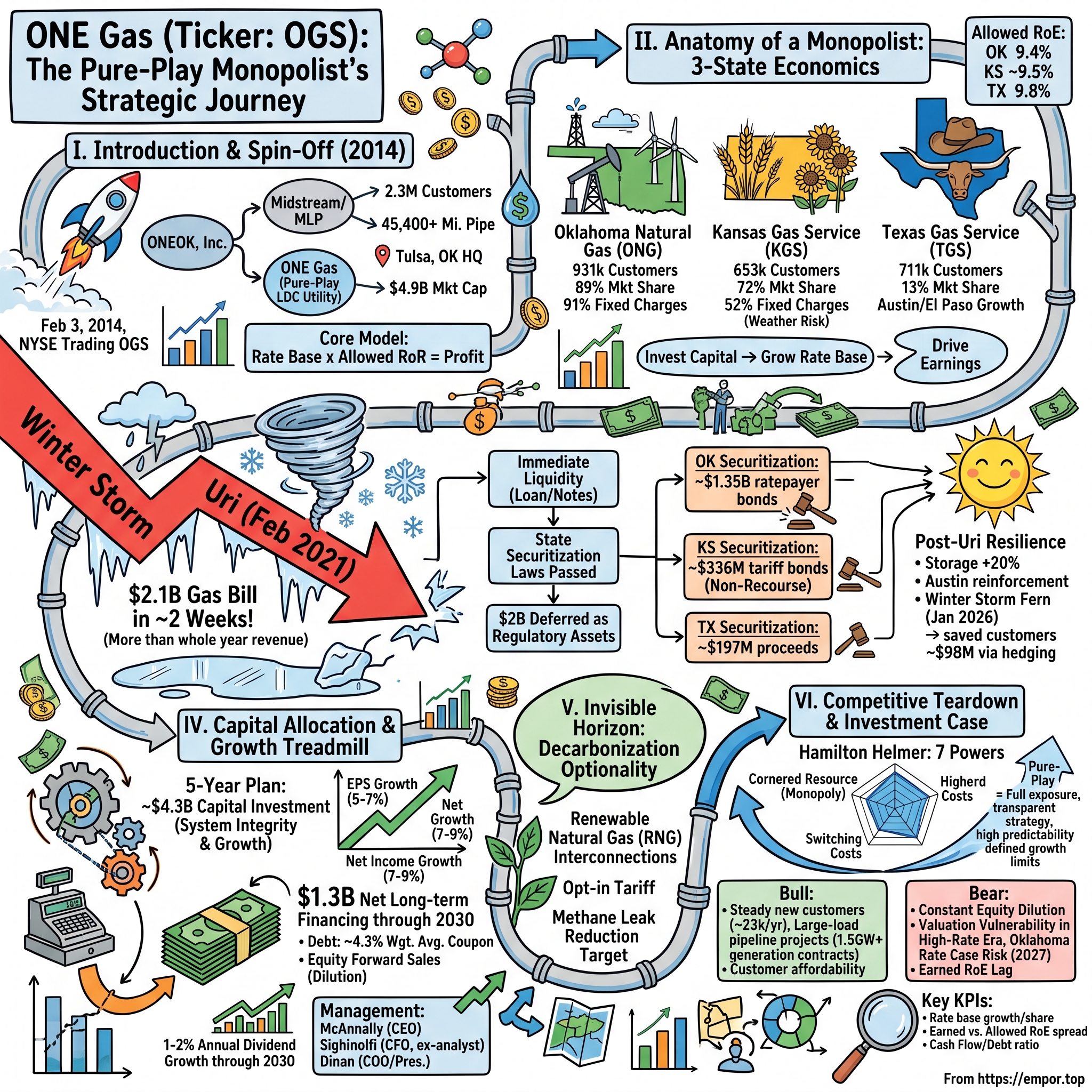
ONE Gas: The Monopolist Next Door and the High-Yield Utility Treadmill
I. Introduction & Episode Roadmap
On the evening of Friday, January 31, 2014, a Tulsa utility that had operated inside ONEOK, Inc. for over a century was set free. ONEOK distributed one share of ONE Gas, Inc. for every four ONEOK shares held, and on Monday, February 3, 2014, the ticker OGS began regular-way trading on the New York Stock Exchange.1 Without roadshow drama or high-profile bell-ringing, a gas distribution network operating under Oklahoma streets since 1907 transitioned to an independent, publicly traded entity.
Twelve years later, ONE Gas serves roughly 2.3 million customers across Kansas, Oklahoma, and Texas through approximately 45,400 miles of distribution and transmission pipe, supporting a market capitalization near $4.9 billion.23 It delivered $2.43 billion of revenue and $264.2 million of net income in 2025.4 The company has never made a significant acquisition, entered a new state, drilled wells, traded commodities, or earned a margin on the gas molecule itself.
Instead, ONE Gas operates as a pure-play natural gas distribution utility. Its core business model relies on securing regulatory permission from three state commissions to earn a set return on the depreciated book value of its installed pipe, and then investing capital to expand that network.
The economics rest on a standard regulatory formula: a utility's authorized profit equals its rate base—the net accumulated capital invested and approved by regulators—multiplied by an allowed rate of return. Expanding the rate base drives earnings growth. ONE Gas expects its average rate base to reach roughly $6.4 billion in 2026 and to compound at 7–9% annually through 2030.3 Assuming allowed returns remain constant, net earnings track rate base expansion.
Funding that capital expansion requires continuous external financing. In 2025, ONE Gas generated $578.8 million of cash from operations, spent $707.2 million on capital expenditures, and paid out $160.7 million in dividends.2 To bridge the resulting funding deficit, the company raised $212.2 million in new equity alongside a net increase in borrowings.2 Each year, the company must access capital markets to fund capital expenditures that outpace internal cash generation—a standard operational treadmill for regulated network utilities that investors must price carefully.
Credit metrics and dividend dynamics clarify the company's financial position. Moody's rates ONE Gas at A3 and S&P rates it at A-, both with stable outlooks, while management targets an adjusted cash-flow-to-debt ratio of 19–20%—well above typical levels for Baa-rated local gas distribution companies.3 In mid-2026, at a share price of $77.65 against an annualized dividend of $2.72, the stock yields roughly 3.5%. Management has guided to dividend growth of 1–2% per year through 2030, lagging its 5–7% adjusted EPS growth target.34 This divergence indicates that internal cash flow is being prioritized for capital deployment rather than rapid dividend expansion.
While day-to-day operations are predictable, executive decisions govern long-term performance through capital allocation: determining capital deployment scale, pursuing regulatory cost recovery, funding the gap between operating cash flow and expenditures, and balancing shareholder payouts against reinvestment. In a higher-interest-rate environment, capital allocation discipline determines whether rate base growth translates into durable equity returns.
The analysis proceeds as follows: 1. The historical 2014 spin-off from ONEOK and the corporate rationale for the separation. 2. The operational mechanics of the regulatory frameworks across Oklahoma, Kansas, and Texas. 3. The impact of Winter Storm Uri in February 2021, which generated gas procurement costs roughly equal to an entire year of revenue and strained the balance sheet. 4. Capital allocation strategy under higher interest rates. 5. The strategic role of renewable natural gas. 6. A competitive teardown applying Hamilton Helmer's 7 Powers and Michael Porter's competitive framework. 7. A critical examination of the bear case. 8. Bull and bear investment arguments alongside the core metrics driving long-term outcomes.
The story begins with the spin-off.
 Subscribe on LinkedIn
II. The Spin-Off Split: Unbundling ONEOK and the Pure-Play Thesis
The foundation of ONE Gas traces back more than a century before its spin-off, originating in the early infrastructure of the Mid-Continent oil and gas boom.
Oklahoma Natural Gas Company was founded in 1906, the year before Oklahoma achieved statehood, and completed a roughly 100-mile pipeline from Tulsa to Oklahoma City in December 1907—a major infrastructure commitment during the Mid-Continent energy boom.5 Beyond its engineering feat, the line established enduring legal consequences: the franchises, easements, and rights-of-way secured in those early decades created a permanent distribution network that remains essential to the modern utility's operations.
The entity that became ONEOK spent most of the twentieth century as an Oklahoma gas utility before expanding through acquisitions in the late 1990s and early 2000s. In 1997, it acquired natural gas distribution assets from Western Resources, creating Kansas Gas Service from a system whose predecessors, including Gas Service Company and KPL Gas Service, had served customers for a century.5 In 2003, it acquired the Texas assets of Southern Union Gas—a company that originated in West Texas in the 1920s before expanding into El Paso, Austin, and the Rio Grande Valley—rebranding those operations as Texas Gas Service.5
By the late 2000s, ONEOK combined three distinct business models under one corporate structure: a regulated natural gas distributor, a midstream gathering-and-processing business, and a general partner interest in a master limited partnership. These segments operated under fundamentally different economic drivers. Midstream earnings fluctuated with commodity prices, regional drilling activity, and natural gas liquids processing spreads, whereas utility earnings depended on regulatory rate case approvals and seasonal weather demand.
This combination resulted in a classic conglomerate discount. Investors seeking direct commodity leverage found the stable utility returns diluted overall growth, while income-focused investors viewed midstream earnings volatility as a risk to cash flow consistency. To eliminate this structural conflict, ONEOK executed a corporate separation: on January 31, 2014, it distributed all shares of ONE Gas to shareholders on a tax-free, one-for-four basis, while retaining a 41.2% interest in ONEOK Partners and repositioning itself as a pure-play general partner.1 ONEOK noted to shareholders that the separation enabled a 53% dividend increase in 2014, reflecting the extent to which the regulated utility's capital requirements had constrained the parent company's cash distribution growth.1
The resulting entity, ONE Gas, commenced trading on February 3, 2014, as a fully regulated distribution utility headquartered in Tulsa, operating with no debt at the holding-company level and serving slightly more than two million customers.
In April 2014, ONE Gas declared its initial dividend of $0.28 per quarter, or $1.12 annualized, targeting a payout ratio of 55% to 65% of net income and projecting approximately 5% annual dividend growth through 2018.2 For full-year 2014, the company generated adjusted earnings of $2.11 per share.3
The core rationale for the separation was that an independent regulated utility would earn a higher valuation multiple than when embedded within a diversified energy corporation. Over the subsequent twelve years, operational results supported the underlying operational thesis, even if valuation gains remained mixed. ONE Gas compounded adjusted earnings per share at approximately 6.5% annually from 2014 through 2024, and roughly 7.0% from 2015 through 2025, reaching $4.48 per share in 2025.3 This steady earnings expansion occurred without major acquisitions or geographic expansion. Over the same period, the dividend grew at a compound annual rate of nearly 7.7%—more than doubling from its initial level and exceeding the original 5% growth target.34
However, the anticipated valuation re-rating relative to top-tier peers failed to materialize. ONE Gas began trading at a valuation discount to premier local distribution company Atmos Energy and maintains that discount today. At a share price of $77.65 against the midpoint of its 2026 adjusted earnings guidance of $4.89 per share, ONE Gas trades at approximately 15.9 times earnings.3 By comparison, Atmos trades near 20 times earnings at $172.78, based on its fiscal 2026 guidance midpoint of $8.45 per share.6 This persistent valuation gap reflects structural differences in operational scale and growth velocity rather than simple market mispricing.
Atmos plans approximately $4.2 billion in capital expenditures for fiscal 2026—more than five times the roughly $800 million planned by ONE Gas—and increased its annual dividend by 14.9% to $4.00 per share in the same year ONE Gas raised its payout by $0.01 per quarter.64 The market premium for Atmos reflects this higher reinvestment rate and faster dividend growth.
Ultimately, the spin-off established a focused, predictable distribution utility that delivered steady earnings and dividend compounding, while highlighting the operational limits of pure-play status when compared to higher-growth peers. Understanding how ONE Gas maintains its underlying returns requires examining the regulatory mechanisms across its three state jurisdictions.
III. Anatomy of a Monopolist: Oklahoma, Kansas, & Texas Utility Economics
Picture a service technician in a Kansas Gas Service truck on a February morning outside Wichita, locating an underground line before a contractor digs. Nothing about that scene looks like a financial instrument. Yet every foot of pipe that crew marks or maintains is, in accounting terms, an asset earning a regulated return. The entire investment thesis for ONE Gas hinges on a single operational equation: how quickly, efficiently, and reliably that capital converts into approved rate base.
The three state franchises are not uniform operations. They represent three distinct regulatory and commercial environments under a single corporate parent.
Oklahoma Natural Gas serves as the anchor. In 2025, it served an average of 931,000 customers across roughly 20,400 miles of distribution and transmission pipe centered in Oklahoma City and Tulsa, holding an 89% share of the state's natural gas distribution market.3 Its authorized rate base reached $2.45 billion at year-end 2025, making it the largest of the three systems.3 Crucially, 91% of what Oklahoma sales customers pay is fixed charges, not volumetric.3 Consequently, Oklahoma earnings remain largely insulated from seasonal weather fluctuations. While regulation by the elected Oklahoma Corporation Commission carries political exposure, it provides the most weather-insulated revenue line in the portfolio.
Texas Gas Service represents the growth engine and strategic core. It served 711,000 customers across 11,600 miles of pipeline, concentrated in Austin, El Paso, and the Rio Grande Valley, with an authorized rate base of $1.89 billion.3 In Texas, ONE Gas holds only a 13% share of the Texas gas distribution market — third largest in the state.3 While ONE Gas is the dominant incumbent in Oklahoma and Kansas, in Texas it operates as a regional player inside another provider's primary market. Texas is also the warmest territory in the footprint, averaging normal annual heating degree days of just 1,646, compared to 3,356 in Oklahoma and 4,728 in Kansas.3 Demand in Texas is driven less by space heating and more by ongoing customer connections in rapidly growing urban corridors.
Kansas Gas Service provides stable baseline performance: 653,000 customers, 13,400 miles of pipe, a 72% market share, and a $1.47 billion authorized rate base.3 Operating in the coldest territory, Kansas is the least hedged against weather risk, as only 52% of sales-customer revenue comes from fixed charges — making Kansas the jurisdiction where a warm winter impacts earnings most sharply.3
At the center of utility economics is the regulatory revenue requirement. A regulated utility does not set market prices; instead, it negotiates a revenue requirement — the total revenue regulators agree the utility needs to collect to cover operating costs, depreciation, taxes, and a fair return on invested capital. Profit is generated through the authorized return on equity. In Oklahoma, current filings assume a 9.40% return on equity with a 58.5% equity layer. In Texas, following a rate case order in early 2026, the allowed return on equity was set at 9.80% on a 59.9% equity ratio. In Kansas — where the October 2024 settlement omitted an explicit return on equity — the return embedded in the surcharge carrying charge works out to roughly 9.50% on a 60.2% equity ratio.3
To illustrate this mechanic: imagine a municipality granting an operator the right to run a parking garage under rules that allow charges covering operating expenses plus an authorized 9.5% annual return on invested capital. The operator cannot raise prices during peak demand, nor can it retain long-term savings from operational cost cuts, as those efficiency gains are returned to drivers at the next rate review. However, building an approved second garage permanently increases total allowed profit. This framework creates a structural incentive for continuous capital deployment, explaining why ONE Gas consistently reinvests nearly three times its annual depreciation into capital projects and why management continually emphasizes customer affordability. Affordability acts as the regulatory constraint that determines how many capital additions commissions will approve.
These regulatory equity ratios carry significant financial implications. Regulators permit ONE Gas to finance nearly 60% of its rate base with equity — a rich capital structure by utility standards. To maintain this authorized capital structure and earn the approved returns, ONE Gas must continually issue new equity. The allowed return on equity and share dilution are two ends of the same rope.
Quarter-to-quarter financial volatility is further governed by state weather normalization mechanisms, which adjust billed margins toward normal seasonal temperatures.3 While these mechanisms buffer earnings, they do not fully eliminate weather impacts, as demonstrated in the first quarter of 2026. Texas and Oklahoma recorded their warmest winters since regional temperature tracking began in 1895; Kansas had its second-warmest in that span.7 Weather normalization tempered the earnings hit, but did nothing to alter the cash-flow consequences: ONE Gas monetized far less gas out of storage than planned and therefore entered the spring refill season with unusually full inventories.7 Consequently, single-quarter results for a gas utility cannot be properly evaluated without accounting for temperature deviations against historical norms.
Converting capital into rate base forms the core of ONE Gas's operating strategy. The company plans about $800 million of capital investment in 2026 — allocating roughly $525 million to system integrity and replacement, $228 million to customer growth, and the balance to technology.3 Total capital spending represents approximately 2.7 times its annual depreciation, driving rate base growth by installing far more assets than it writes off. Regional spending allocations reveal strategy clearly: 2026 capital investment runs about 3.5 times depreciation in Texas, 2.8 times in Oklahoma, and 1.9 times in Kansas.3 Capital flows directly to where population and industry are expanding, while the Kansas system is maintained rather than aggressively expanded.
To combat regulatory lag — the delay between spending capital and receiving rate recovery — ONE Gas utilizes annual interim mechanisms across all three states: Texas's Gas Reliability Infrastructure Program (GRIP), Kansas's Gas System Reliability Surcharge (GSRS), and Oklahoma's Performance-Based Rate Change (PBRC). Approximately 90% of the company's capital expenditures are recovered through these annual filings rather than through full rate cases.3 Furthermore, general rate case obligations are staggered over several years: Oklahoma by June 2027, Kansas by 2030, and Texas by 2031.3
Legislative changes in 2025 and 2026 materially widened these recovery channels. Texas House Bill 4384, signed June 20, 2025, extended a 2011 Railroad Commission rule — which had allowed utilities to defer depreciation and ad valorem taxes and accrue carrying costs on safety-related capital between in-service dates and rate recognition — to all capital spending in the state.89 Before the change, only about a quarter of ONE Gas's Texas capital qualified, worth roughly $4–5 million of annual pretax earnings; after it, the whole program qualifies.9 Kansas HB 2435, effective July 1, 2026, similarly expanded GSRS eligibility from safety and cybersecurity spending to essentially all Kansas-specific plant investment, and lifted the monthly residential surcharge cap from $0.80 to $1.35.3
This mechanism explains the Atmos Energy valuation premium better than general arguments about regulatory climate. Texas's framework recovers capital faster and with less earnings drag than most state jurisdictions in America, and Atmos operates primarily as a Texas utility. ONE Gas captures that benefit on roughly a third of its business, while the remainder operates in Oklahoma and Kansas, where capital recovery moves more slowly and realized returns on equity have lagged authorized levels.
This regulatory lag is evident in historical returns: ONE Gas's trailing return on equity has been running near 8.2%, against authorized returns of 9.4–9.8%.23 That roughly 120–160 basis point shortfall represents regulatory lag rendered as a number, and closing it is the single highest-leverage opportunity for management. The key test over the next three years is whether the 2025–26 legislative wins actually close this gap or merely prevent it from widening.
This regulatory framework faced its most severe test when extreme weather forced the company to defend its balance sheet and test the limits of its state recovery mechanisms.
IV. The Stress Test: Winter Storm Uri and the $2.2 Billion Survival Battle
In the second week of February 2021, a polar vortex collapsed southward and parked over the southern Great Plains. Wellheads froze across Texas and Oklahoma, and gas processing plants tripped offline. Electric generators burning natural gas competed for the same shrinking supply as utilities attempting to keep 2.3 million furnaces lit. Spot natural gas, which had traded near $3 per MMBtu, surged through every historical benchmark to trade in the hundreds and, in isolated transactions, above $1,000.
ONE Gas faced an operational imperative. A gas distribution system cannot be partially depressurized and casually restarted; losing pipeline pressure requires technicians to manually purge and relight every pilot light in a service territory, building by building, in subfreezing weather. Consequently, the utility purchased natural gas at prevailing market rates. Its distribution networks held: fewer than 900 customers lost service, and for less than 24 hours.10
Then the invoices arrived. Management initially estimated February gas purchases could approach $2.2 billion; the final figure totaled near $2.1 billion, of which only about $107 million represented normal, budgeted gas costs flowing through standard pass-through mechanisms.10 For context, ONE Gas's entire revenue for full-year 2020 was $1.53 billion.2 In approximately two weeks, the company had incurred a gas bill exceeding its total annual sales.
A fundamental economic mechanism enabled the company's survival: ONE Gas earns no margin on the gas commodity. Fuel purchases represent a direct pass-through to customers. While this structure caps upside in normal market conditions, it proved decisive in February 2021. Because the utility derives no profit from the molecule itself, management, regulators, consumers, and lawmakers were aligned on a single objective: how to spread the extraordinary outlay over an extended horizon at the lowest possible borrowing cost. Equity write-downs were never placed on the table. As Curtis Dinan, then chief commercial officer, noted on a May 2021 earnings call, the pass-through framework "allows the company, our customers, regulators and legislators to be aligned in finding the best solution."10
Immediate liquidity was secured rapidly. In February 2021, ONE Gas arranged a $2.5 billion two-year unsecured term loan.
On March 11, the company issued $2.5 billion of senior notes — comprising $1.7 billion of two- and three-year fixed-rate paper alongside $800 million of two-year floating-rate notes — and terminated the initial term loan.10 Crucially, management structured these notes to be redeemable starting September 11, 2021, preserving the flexibility to refinance the debt with lower-cost, ratepayer-backed bonds once state legislatures established the requisite legal frameworks.10 The resulting 2021 cash flow statement reflected the crisis: operating cash flow dropped to negative $1.54 billion, offset by $2.17 billion in net debt issuance.2
State regulatory commissions acted promptly. Emergency orders across all three jurisdictions permitted ONE Gas to defer the extraordinary gas costs as regulatory assets, totaling roughly $2 billion by March 31, 2021 — allocated as $1.3 billion in Oklahoma, $381 million in Kansas, and $295 million in Texas.10 State legislatures then enacted permanent statutory remedies. Kansas and Oklahoma passed dedicated securitization laws in April 2021, while Texas enacted House Bill 1520.10
Refinancing execution spanned two years, producing three distinct state structures:
- Oklahoma routed the financing through a state conduit. The Oklahoma Development Finance Authority issued $1.3542 billion of ratepayer-backed bonds in August 2022, serviced via a dedicated winter event charge on Oklahoma Natural Gas customer bills over 25 years, following an Oklahoma Supreme Court decision upholding the bonds' constitutionality on May 24, 2022.11
- Kansas permitted the utility to establish a special-purpose issuing entity. Kansas Gas Service Securitization I issued $336 million of AAA-rated utility tariff bonds in November 2022 with a 10-year expected maturity — debt that is explicitly non-recourse to ONE Gas and had approximately $243 million outstanding as of March 31, 2026.123
- Texas utilized a centralized state financing corporation. Texas Gas Service received approximately $197 million in net proceeds in March 2023 from bonds issued by the Texas Natural Gas Securitization Finance Corporation.13
Through securitization, a $2 billion balance-sheet emergency was converted into a manageable line item on customer bills — averaging roughly $6 per month — amortized over decades at investment-grade interest rates without equity dilution, dividend reductions, or restructuring.3 The outcome demonstrated how constructive regulatory relationships in energy-friendly states function as an economic buffer during extreme weather events.
The strategic value of this resolution becomes evident when considering the alternative. Without securitization, ONE Gas would have absorbed nearly $2 billion in corporate debt against an equity base of less than $2.4 billion, recovering costs through traditional rate riders over several years. That leverage burden would have triggered credit rating downgrades, elevating capital costs across future rate cases, increasing customer bills, and constraining political support for ongoing capital expenditures. Instead, the debt was placed into ratepayer-backed special purpose vehicles at AAA-level yields, insulating the parent company's credit profile.
However, two caveats temper this outcome.
First, the deal is not fully closed. In March 2026, Oklahoma state representatives Tom Gann and Kevin West filed a brief with the Oklahoma Supreme Court challenging approximately $1.77 billion in ratepayer-backed bonds and $98 million in approved rate increases for Oklahoma Natural Gas, asserting that the Corporation Commission omitted statutorily mandated independent CPA audits.14 The filing represents one of three active appeals contesting roughly $3.2 billion in Oklahoma winter storm securitizations across multiple utilities, with responses due in mid-2026.14 While the bonds are active and being serviced by customers, the ongoing litigation represents an unresolved legal question in the company's largest operating market.
Second, the company invested heavily to enhance system resilience. ONE Gas expanded its storage capacity by 20% to over 60 billion cubic feet, added pipeline interconnections, and completed the Austin system reinforcement — its largest capital project since spinning off from ONEOK — which expanded winter peak delivery capacity in Austin by roughly 25%.89
This expanded infrastructure faced a major operational test during Winter Storm Fern in January 2026, the region's first multi-day severe freeze since 2021. On peak demand day, ONE Gas delivered over 3 billion cubic feet without supply disruptions. Moreover, pre-arranged hedging and storage assets shielded over 80% of required gas volumes from spot market price spikes, saving customers approximately $98 million compared to spot purchases.87 The post-Uri capital investments provided measurable physical and financial protection during subsequent winter conditions.
The leadership team directing this operational response remains largely intact from the 2021 storm — including an executive team member with an unconventional path to the utility CFO role.
V. Capital Allocation & Modern Management: McAnnally, Sighinolfi, and the High-Rate Era
In May 2021, three months after Uri and before the securitization statutes had produced a single bond, ONE Gas announced that its chief executive was leaving — to run the company that had spun it off. Pierce H. Norton II retired from ONE Gas effective June 27, 2021 and became president and CEO of ONEOK the following day.15 Read that sequence again: the head of the spun-off subsidiary was recruited back to lead the parent. It is a small, telling detail about how the 2014 separation actually functioned — less an ejection of an unwanted business than a structural reorganization of the same corporate family.
Robert "Sid" McAnnally stepped up on June 28, 2021.16 His background is atypical for a gas utility CEO in a useful way: he is a lawyer by training, holding a J.D. from the University of Alabama and a B.A. from Auburn, who practiced representing utility, financial and corporate clients before moving inside the industry.16 He joined Energen, serving as vice president of external affairs and strategic planning and then as senior vice president of customer service and marketing at its Alabama utility subsidiary, Alagasco. He arrived at ONE Gas in 2015 as senior vice president of operations, became COO in 2020 — adding human resources, cybersecurity and IT to his remit — and took the top job a year later.16 He has also lectured in Harvard Business School's crisis management executive education program, which, for a man who ran operations through Uri, is not an entirely academic credential.
The McAnnally style, as it shows up in transcripts, is patient and structural. When an analyst in May 2026 pressed him on whether the historically warm winter had put the company "in a hole," McAnnally's answer was not a defense of the quarter but an argument about program continuity: the company would keep investing in in-sourcing initiatives that "may feel counterintuitive" in a weak weather year, because "they're investments that have a meaningful return."7 That is either admirable long-termism or a convenient way to avoid discussing a shortfall, and the only way to distinguish them is to check whether the guidance holds. So far it has.
Christopher P. Sighinolfi is the more unusual hire. Announced November 16, 2023 and effective January 1, 2024, he succeeded the retiring Caron A. Lawhorn as senior vice president and CFO.17 Before joining ONE Gas in 2021 as vice president of corporate development, investor relations and sustainability, he was a managing director in U.S. equity research at Jefferies, covering natural gas utilities, midstream companies, refiners and energy MLPs.17 He is a CFA charterholder with a degree in philosophy, politics and economics from Penn.17
Hiring your sell-side analyst as CFO is a specific bet: that the most valuable skill in a capital-intensive regulated business is not accounting but understanding how the buy side will price what you tell them.
The evidence in the transcripts supports the bet. Sighinolfi's disclosure habits are unusually granular — he volunteers the mechanics behind accounting choices, quantifies things analysts have not yet asked about, and pre-empts objections. When he introduced a material non-GAAP change in February 2026, he spent several minutes explaining the 2011 rule, the 2025 legislation, the procedural rulemaking timeline and precisely why the company acted then rather than earlier.8 That is analyst-brain behavior.
It is not uniformly forthcoming. On the May 2026 call, Jefferies analyst Paul Zimbardo asked him to quantify the combined earnings impact of the warm winter, excess storage and House Bill 4384 in the quarter. Sighinolfi's answer: "I don't. I'd have to follow up with you."7 For a CFO who volunteers second-order accounting detail unprompted, not having the headline weather variance at hand on an earnings call is a conspicuous gap — and it landed on the one number that would have made the quarter's underlying performance easy to assess.
Curtis L. Dinan rounds out the trio and is arguably the most interesting for capital allocation. He was ONE Gas's first CFO after the separation, later ran commercial, became COO in 2021, and in February 2026 was promoted to president and chief operating officer.8 McAnnally's stated rationale — combining operational and financial experience "at an exciting time" — is a fair description of the job: Dinan is the person deciding which large-load opportunities the company chases.
On incentives and ownership, this is a conventional utility — which is itself the analytically relevant fact. ONE Gas's short-term incentive program uses one financial metric and four operational metrics focused on safety, and one of those operational metrics is explicitly tied to the company's emissions reduction goal, which is in turn driven by the pipeline replacement program.3 Longer-dated awards take the form of performance units that vest on total shareholder return measured against a comparison group.2 The structure is defensible and unremarkable: it rewards safe execution and relative stock performance rather than absolute growth heroics, which is appropriate for a business whose returns are set by regulators.
What it does not do is create founder-style alignment. Insider ownership at ONE Gas is modest, as at essentially every regulated utility — roughly 89% of shares outstanding were held by the 429 institutions filing 13Fs as of March 31, 2026.2 This is an index-and-income-fund shareholder base, not a concentrated one.
The practical implication for anyone assessing management is that you cannot read alignment off a share register here. You have to read it off behavior: whether guidance is set conservatively and hit, whether misses are explained specifically, whether equity is issued opportunistically or desperately, and whether the narrative stays consistent across calls. Those are the tests applied below.
One governance note worth logging: in July 2026 the board expanded from eight to nine members with the addition of Nickolas Stavropoulos, the retired chief operating officer of both PG&E and National Grid and former CFO of Colonial Gas, who led multi-billion-dollar recovery efforts at PG&E.18 Boards do not usually recruit someone with that particular résumé — deep gas operations plus large-scale utility crisis remediation — by accident. Reading it charitably, it is a company that has already been through one catastrophic weather event deciding it wants somebody in the room who has been through worse.
Now, the treadmill in the high-rate era. ONE Gas's five-year plan calls for roughly $4.3 billion of capital investment — about $2.5 billion on system integrity and replacement, $1.2 billion on growth — supporting 7–9% average annual rate base growth.3 The funding math is disclosed with unusual clarity: 2026 operations should generate $650–700 million before working capital changes, against ~$800 million of capital investment and a dividend, producing a net financing need of $250–300 million for the year and roughly $1.3 billion of net long-term financing through 2030, of which about 30% is expected to be equity.3
The debt side has been managed well, and the numbers show it. ONE Gas's long-term maturity ladder is genuinely comfortable: a $250 million term loan due in 2026, then nothing until $550 million in 2029, $300 million in 2030, $300 million in 2032, and long paper of $600 million in 2044 and $400 million in 2048 — a weighted average coupon of roughly 4.3%.3 That is a legacy of borrowing in a cheaper era and a genuine competitive asset today, and it means the feared refinancing wall is not a 2026 problem.
Interest expense actually declined year-over-year in each of the last several quarters — down 9% in the first quarter of 2026, and by roughly $3 million excluding the securitization entity — helped by Federal Reserve cuts in 2024 and 2025 that arrived faster than the company had assumed.78 Management has consistently modeled no rate cuts into guidance, which converts monetary easing into an upside surprise rather than a plan dependency. That is conservative planning, and it has been consistent across multiple years of calls.
The equity side is where the treadmill shows. ONE Gas raises stock through forward sale agreements — contracts to sell shares at a locked price on a future date — which lets it fix a price today and take the cash when it needs it.
In May 2025 it executed a forward covering 2.5 million shares at a net price of about $78.50, bringing total forwards to 2.9 million shares and roughly $226 million of expected proceeds, which management described as covering all of 2025's equity needs, part of 2026's, and approximately 40% of the articulated five-year equity need.9 It settled $205 million in December 2025, added about 237,000 shares in the first quarter of 2026, and had roughly 507,000 shares remaining under forwards at an average of about $82, worth $41.5 million.473
Here is the number that matters. Weighted average diluted shares went from 57.0 million in 2024 to 60.5 million in 2025, and 2026 guidance assumes 63.35 million.23 That is roughly 5.5% annual share growth over two years — several times the ~1.6% long-run average since the spin-off. The company is not diluting recklessly; it is diluting more than it used to, because the capital program has outgrown internally generated cash. Management's own guidance encodes the consequence with admirable honesty: adjusted net income growth of 7–9%, adjusted EPS growth of 5–7%.3 The two-point gap between the two is dilution, disclosed in advance.
On credibility, the record is strong with one asterisk. ONE Gas has met or surpassed the midpoint of its initial EPS guidance for twelve consecutive years — its entire independent life.8 In August 2025 it raised full-year guidance by 2.5% on first-half strength plus HB 4384, and it landed the year squarely on that revised number.8 It also flags bad news ahead of time rather than after: the investor deck openly marks 2027 as a below-trend earnings year, because Oklahoma requires a full rate case by June 2027 and the PBRC cannot be filed in a rate case year, meaning limited incremental Oklahoma revenue that year — with a catch-up expected in 2028.3 Utilities that disclose an earnings air pocket eighteen months in advance are generally telling you the truth about the rest.
The asterisk is the February 2026 non-GAAP change, and it deserves scrutiny. ONE Gas introduced adjusted net income and adjusted EPS that add back the equity portion of the carrying cost it is permitted to accrue under HB 4384 on plant in service but not yet in rates — an amount GAAP does not let it recognize as income. The adjustment is added with no offsetting tax.3 The economics are real: the accrual is genuinely recoverable in future rates, and the delta between regulatory and GAAP books has existed since 2011, growing from about $2 million in 2024 to nearly $7 million in 2025 and an expected $12 million — roughly $0.18 per share, or about 4% of consolidated EPS — in 2026.8
But consider what happened simultaneously. The company reset its five-year growth baseline to adjusted 2025 EPS of $4.48 rather than GAAP $4.37, and raised its long-term adjusted EPS growth guidance from 4–6% to 5–7%.3 Both the starting point and the slope moved up in the same announcement that changed the measuring stick.
Gabe Moreen of Mizuho pushed directly on the timing — why not disclose this in December? — and Sighinolfi's answer, that the Railroad Commission's procedural rules had only just reached final form, is defensible and specific.8 Reasonable people can accept the explanation and still note that investors are now being asked to track growth against a metric that reports earnings GAAP does not recognize. The right response is not suspicion; it is discipline. Track both.
Which brings us to a much smaller line item that generates far more conversation than its size warrants.
VI. The Invisible Horizon: Renewable Natural Gas (RNG) & Decarbonization Optionality
In 2021, weeks after the Uri bills arrived, ONE Gas announced an alliance with Vanguard Renewables to develop farm-based renewable natural gas projects across Kansas, Oklahoma, and Texas—capturing methane from anaerobic digestion of food waste and manure—and disclosed active discussions with five municipal wastewater treatment plants and landfills about transporting captured methane on its system.10 Asked at the time how the investment would be recovered, Dinan kept options open, noting that the first phase was simply an inventory of available molecules and that "nothing is precluded in the longer term."10
Five years later, the operational scorecard remains modest. Oklahoma Natural Gas maintains an approved opt-in renewable natural gas tariff, an active project in Austin includes a renewable natural gas interconnection, and the company participates in hydrogen development and demonstration projects.3 ONE Gas does not break out renewable natural gas as a separate revenue line, indicating that the business remains financially immaterial relative to the company's $2.4 billion revenue base.
So why does the technology receive management attention? Because renewable natural gas is less a near-term revenue driver than a regulatory hedge.
The existential risk facing local natural gas distribution utilities is not direct competition—no rival is laying parallel pipelines—but policy risk. If state or municipal governments restrict gas connections in new construction or mandate appliance electrification, rate base growth slows or turns negative. A utility burdened with depreciating 45,400 miles of installed pipe under declining throughput faces structural earnings compression—a mechanism that has weighed on gas utility valuations in regions like California, New York, and Massachusetts.
ONE Gas's defense against policy-driven electrification rests on three distinct layers, with renewable natural gas serving as the least critical.
The primary and strongest barrier is price. Delivered natural gas costs significantly less than electricity on an equivalent energy basis. For the period ended December 31, 2025, on a kilowatt-hour-equivalent basis, natural gas cost 7.36 cents versus 15.47 cents for electricity in Texas, 4.69 cents versus 13.12 cents in Oklahoma, and 4.76 cents versus 14.56 cents in Kansas—giving gas a price advantage of 2.1 times, 2.8 times, and 3.1 times, respectively.3 A homeowner evaluating electrification in Wichita faces thousands of dollars in upfront costs for a heat pump, water heater, and potential electrical panel upgrades, only to triple per-unit energy expenses. High conversion costs and stark fuel-price differentials explain why residential electrification has made little headway across the company's service territories.
The second barrier is statute. All three states in the ONE Gas footprint have enacted energy choice laws protecting consumer access to natural gas service—Kansas passed Senate Bill 24 in 2021, following earlier statutory protections in Oklahoma and Texas.103 Consequently, municipal bans on natural gas connections are not merely politically improbable; they are legally prohibited.
The third layer is renewable natural gas and hydrogen—the strategic argument that pipeline infrastructure is fuel-agnostic and capable of transporting lower-carbon molecules if regulatory mandates dictate. While this offers valid long-term optionality, investors should recognize it as policy insurance against a risk already substantially mitigated by economics and legislation, rather than as an active earnings driver.
The physical constraints on renewable natural gas explain why its role remains limited.
Renewable natural gas is biogenic methane captured from organic decomposition at landfills, agricultural operations, and wastewater facilities, purified to pipeline quality, and injected into existing distribution networks. Because it is chemically identical to conventional natural gas, existing infrastructure and customer appliances accept it without modification. The fundamental constraint is supply volume. Total capturable biogenic methane in any region is strictly limited by localized organic waste production, representing a fraction of the peak volume required by 2.3 million customers during winter demand spikes. Renewable gas can decarbonize targeted segments of a distribution system, but it cannot replace conventional supply at scale under current waste availability and processing economics.
Consequently, the strategic value of renewable natural gas is narrow and tactical. When large commercial or industrial customers seek low-carbon fuel to meet corporate sustainability targets, opt-in tariffs allow ONE Gas to service that demand while earning a regulated return on interconnection infrastructure. Similarly, when municipalities seek to commercialize landfill methane, the utility provides transport access. These projects generate incremental capital deployment and align the utility with state energy discussions, but they remain supplementary to core operations. Notably, management has avoided overpromising on decarbonization economics, maintaining a disciplined focus on core network investment.
In contrast, the company's most material environmental initiative stems from routine infrastructure modernization. ONE Gas established a target to reduce Scope 1 emissions from pipeline leaks by 55% by 2035 compared to a 2005 baseline, and reported achieving a 53% reduction as of December 31, 2025—reaching near-goal performance a decade ahead of schedule.3 The mechanism is straightforward: replacing vintage pipe with modern plastic and protected steel systematically eliminates fugitive methane emissions. Pipeline replacement simultaneously drives rate base expansion and reduces emissions, aligning environmental goals with capital deployment. Reflecting this alignment, management's short-term incentive compensation explicitly incorporates performance against these emissions reduction targets.3
For investors, the analytical takeaway is clear: valuation models should not rely on renewable natural gas, nor should they price in near-term electrification mandates in Kansas, Oklahoma, or Texas. Instead, equity performance rests on the durability of the delivered-energy price differential and the stability of state statutory protections. If electricity costs decline drastically or legislative frameworks shift, the investment thesis changes fundamentally, and renewable gas optionality will not offset the shortfall.
That framing sets up the broader strategic question: how durable is the company's competitive moat, and where are its structural vulnerabilities?
VII. Competitive Benchmarking & 7 Powers Analysis
Utility investors are often told that regulated monopolies possess the ultimate economic moat. That assessment is both accurate and oversimplified. A moat that blocks competitors while capping authorized returns near 9.5% differs fundamentally from one that confers pricing power. Evaluating ONE Gas through Hamilton Helmer's 7 Powers framework distinguishes its structural protections from conventional competitive advantages.
Cornered Resource / Regulated Monopoly — Very High, and structurally so. ONE Gas holds exclusive franchise rights granted by municipal and state authorities. Its 89% market share in Oklahoma and 72% share in Kansas do not stem from market competition; they reflect legal exclusivity paired with more than a century of installed infrastructure.3
A prospective challenger would face prohibitive hurdles: securing municipal franchise approvals to excavate public streets, constructing parallel distribution mains alongside a fully depreciated incumbent network, and competing on price against an asset base built at historical costs. Rational capital allocators do not attempt this. Even where ONE Gas holds a smaller footprint—its 13% market share in Texas—the constraint is geographic rather than competitive, reflecting historical franchise boundaries rather than lost market share.3
The corresponding limitation is that the same regulatory commissions that grant exclusive franchises also cap overall returns. This structure acts as a governor on earning power. ONE Gas cannot raise prices during demand spikes, expand margins through operating leverage without returning the efficiency gains at subsequent rate reviews, or earn outsized returns on major capital investments. Authorized returns on equity remain contractually capped near 9.5%. Investors who equate monopoly status with pricing power mischaracterize the business model; the truer analogue is a long-duration, inflation-linked bond paired with an equity option on volume growth.
Switching Costs — High, and quantifiable. A residential customer evaluating a conversion from natural gas to all-electric appliances faces substantial upfront equipment costs for a heat pump, electric water heater, and potential electrical panel upgrades. Once converted, the customer pays per-unit energy costs roughly two to three times higher on an equivalent basis.3 Switching costs in this context stem from physics and household economics rather than contractual lock-in. Operating data confirms this retention: ONE Gas added approximately 23,000 net new residential customers annually and installed more than 6,300 new meters through April 2026 despite broader headwinds in regional housing starts.87 Customers continue to select natural gas at the margin.
Scale Economies — Medium, representing a relative disadvantage. Fixed corporate overhead—including regulatory affairs, legal compliance, safety monitoring, information technology, and enterprise software—is distributed across 2.3 million customers. This scale yields operational efficiency but falls short of industry leadership. Peer utility Atmos Energy serves a substantially larger customer base and deploys roughly five times as much annual capital.6 This subscale posture prevents ONE Gas from matching Atmos's reinvestment scale, functioning as a permanent structural feature rather than an operational failure.
Process Power — Emerging, and strategically relevant. Process power represents the single framework dimension ONE Gas is actively developing rather than inheriting.
The company processed 1.3 million line-locate requests in 2025, bringing approximately 40% of that workload in-house from third-party contractors. Consequently, excavation damages per 1,000 locate requests fell more than 14% year-over-year despite an 8% increase in overall ticket volume.8 In the first quarter of 2026, locate activity rose 8.5% while excavation damages declined another 2%.7 Management is expanding this approach through its "Watch and Protect" initiative in Oklahoma, deploying dedicated utility personnel to monitor excavation sites near high-pressure transmission lines.7 Concurrently, artificial-intelligence process automation has generated over 12,000 hours of annualized labor savings, with additional applications deployed in invoice reconciliation and administrative decision support.37
In a regulated framework where cost savings are eventually returned to ratepayers, operational efficiency matters because of customer affordability limits. Every dollar saved in operating and maintenance expenses creates regulatory capacity for rate base expansion without increasing customer bills. The customer bill represents the primary political boundary governing capital deployment. ONE Gas has maintained its average monthly residential bill compound annual growth rate at approximately 1.9% since its 2014 spin-off—below general inflation—with the average monthly bill rising from roughly $60 in 2014 to $74 in 2025.38 This bill discipline secures ongoing regulatory approvals for capital expenditure programs. Process efficiency in a regulated utility functions less as a driver of profit margins and more as a mechanism for growth permission.
Counter-Positioning, Network Economies, Branding — None. As an incumbent distribution utility, ONE Gas employs standard operational models that peers can replicate. Density yields modest scale advantages—connecting an additional customer along an existing distribution main carries low incremental cost—but this reflects scale economics rather than network effects. Furthermore, residential customers do not choose distribution providers based on brand identity, as service boundaries are legally defined.
Peer Comparisons and Valuation Context. The peer group exhibits significant operational diversity that accounts for valuation dispersion across natural gas utilities. Atmos Energy leads the sector in scale and operates primarily in Texas, securing a premium valuation multiple through rapid regulatory capital recovery, an expansive reinvestment program relative to rate base, and a nearly 15% dividend increase in fiscal 2026 compared to ONE Gas's 1.5% increase.64 Spire Inc. matches ONE Gas most closely in market capitalization but operates across Missouri and Alabama alongside non-regulated gas marketing and midstream businesses, introducing earnings volatility absent from pure distribution utilities. NiSource and CenterPoint Energy operate combination gas and electric utilities, with current market interest driven heavily by electric-side data center demand. Southwest Gas Holdings illustrates the execution challenges of utility diversification, having spent recent periods unwinding its infrastructure services division.
Relative to peers, ONE Gas offers operational purity: a fully regulated business model with no non-regulated marketing divisions, electric assets, or service subsidiaries, alongside a clean debt structure issued directly at the parent company level with division capital structures matching the corporate parent.3 This simplicity eliminates sum-of-the-parts discounts, asset write-downs, and earnings quality ambiguities. Conversely, pure-play status leaves the company fully exposed during slow operational years, lacking secondary growth drivers. Investors accept a clear trade-off: high operational transparency paired with defined growth limits.
Porter's Five Forces Analysis
Buyer Power functions as a barbell. Individual retail customers possess virtually no bargaining power, facing high switching costs and fixed service territories. Collectively, however, state regulators at the Oklahoma Corporation Commission, the Kansas Corporation Commission, and the Texas Railroad Commission exercise ultimate authority over authorized returns on equity. The governance structure of these bodies introduces political exposure: commissioners in Oklahoma and Texas are publicly elected to six-year staggered terms, whereas Kansas commissioners are gubernatorial appointees.3 Electing regulatory authorities creates direct risk in jurisdictions where utility rates become politically sensitive—a relevant dynamic given ongoing winter storm bond litigation in Oklahoma.
Supplier Power remains structurally low regarding unit margins, as ONE Gas passes natural gas commodity costs directly to customers without markup. However, suppliers retain significant liquidity impact; as demonstrated during Winter Storm Uri in February 2021, extreme price surges create short-term cash flow pressures. Supplier power manifests as balance-sheet risk rather than margin compression. Management mitigates this exposure through structural hedging, maintaining over 60 billion cubic feet of storage capacity, sourcing gas across diversified locations including the Waha Hub, and utilizing physical and financial hedges.8
Threat of Substitutes presents a long-term risk operating over a multi-decade horizon. Advancements in heat pump efficiency, declining solar-and-storage costs, and adoption of induction cooking do not threaten rate base expansion through 2030, but they weigh on terminal value expectations beyond 2040.
Threat of New Entrants is negligible due to franchise exclusivity and capital requirements, while Rivalry Among Existing Competitors is nonexistent within designated distribution territories—with one notable exception.
In competing for large industrial loads and power-generation facilities, ONE Gas encounters direct competition from midstream pipeline operators capable of constructing direct lateral connections. Management evaluates these large-load opportunities by prioritizing projects where existing pipeline proximity provides a geographic advantage, withdrawing when that edge is absent. Where geography is neutral, management relies on published tariff transparency as a competitive differentiator, providing commercial customers with clear rate structures.8 This segment represents the primary area of direct commercial competition facing the utility.
Which is the natural pivot to what a skeptic would say about all of this.
VIII. The Skeptical Investor & Activist Stress Test: Equity Dilution vs. Rate Base Growth
Consider an institutional analyst stress-testing the consensus narrative for ONE Gas. Before writing an investment memo, a rigorous assessment requires separating long-held market assumptions from the financial realities disclosed in recent filings.
Myth: ONE Gas is a high-yield utility. Reality: At its current valuation, the stock yields roughly 3.5%, and management has guided annual dividend growth down to 1–2% through 2030 — slower than the roughly 7.7% compound annual growth delivered in its first twelve years, and below the 5% target announced at separation.32 The equity's income profile has quietly shifted from a high-growth dividend vehicle into a modest-yield, earnings-growth utility.
Myth: Winter Storm Uri left ONE Gas with a compromised, low-investment-grade balance sheet. Reality: Moody's rates the company at A3 and S&P rates it at A-, both with stable outlooks, while management targets a cash-flow-to-debt ratio of 19–20% — a credit profile stronger than many peer gas distribution utilities.38 The securitization framework did not merely resolve the emergency; it left the corporate balance sheet cleaner than traditional multi-year rate recovery would have.
Myth: The persistent valuation discount relative to Atmos Energy represents a temporary mispricing. Reality: The two utilities operate with fundamentally different reinvestment scales and capital deployment speeds, and the valuation gap has persisted for twelve years.6 A discount that endures across an entire economic cycle reflects a structural market distinction rather than a temporary market error.
Myth: Gas utilities in this footprint face immediate electrification risks. Reality: Delivered natural gas costs roughly one-third to one-half as much as electricity on an equivalent energy basis across Kansas, Oklahoma, and Texas, and all three states maintain energy choice statutes.3 Substitution risk remains a multi-decade terminal value consideration rather than a threat to the current five-year capital plan.
Myth: A 7–9% rate base growth rate translates directly into 7–9% growth in shareholder value. Reality: Management guides to 5–7% adjusted EPS growth off that expanding rate base, with the gap reflecting necessary equity issuance.3 Headline rate base growth represents gross asset expansion; per-share metrics reflect net equity value creation.
With these assumptions clarified, an internal activist stress test highlights several key pressure points.
"The company is disclosing its own growth limit." ONE Gas guides to adjusted net income growth of 7–9% but adjusted EPS growth of 5–7%.3 Equity issuance accounts for the difference. Concurrently, management projects 1–2% annual dividend growth through 2030 — down from the roughly 7.7% compound annual growth delivered since 2014, and well below the 5% target established at the spin-off.32 Investors at current prices receive a 3.5% dividend yield growing near inflation alongside mid-single-digit earnings expansion that relies on continuous equity sales, yielding a modest total return expectation before accounting for potential multiple contraction.
"Free cash flow remains structurally negative." In 2025, operating cash flow of $578.8 million was insufficient to cover $707.2 million in capital expenditures and $160.7 million in dividend payouts.2 In 2024, the cash deficit was wider: $368.4 million in operating cash flow against $703.2 million in capital spending and $149.5 million in dividends, requiring $252.4 million in new equity and $278.6 million in net debt.2 This shortfall represents a structural feature of regulated utility economics rather than a temporary cyclical drag.
"Rate base per share grows much more slowly than total rate base." Average rate base is projected to grow from $4.69 billion in 2022 to $6.4 billion in 2026 — an annual increase of roughly 8%.3 Over the same period, diluted shares outstanding are guided to increase from 54.3 million to 63.35 million.23 Consequently, rate base per share compounds at approximately half the headline rate, diluting the per-share impact of capital deployment.
"Earned returns consistently lag authorized levels." Trailing return on equity has hovered around 8.2%, falling short of authorized returns between 9.4% and 9.8%.23 Although recent legislative reforms in Texas and Kansas were designed to reduce regulatory lag, failure to achieve earned ROE convergence toward authorized levels by 2028 would signal persistent cost pressures or capital inefficiency.
"Management revised reporting metrics while raising guidance targets." In February 2026, ONE Gas introduced a non-GAAP adjusted EPS metric that includes regulatory carrying costs not recognized under GAAP, reset its baseline earnings from $4.37 to $4.48 per share, and raised its long-term adjusted EPS growth target from 4–6% to 5–7%.38 While the regulatory asset accrual under Texas House Bill 4384 is legally enforceable, investors must track GAAP performance alongside adjusted metrics, noting that the guided 2026 GAAP midpoint of $4.71 sits 18 cents below the adjusted midpoint of $4.89.3
"Near-term earnings face a known pause in 2027." Oklahoma requires a full rate case by June 2027, which pauses interim Performance-Based Rate Change filings for that year and limits incremental revenue expansion until 2028.3 While five-year compound targets may remain intact, non-linear earnings trajectories create near-term volatility.
"Securitization bonds face ongoing legal challenges." Litigation before the Oklahoma Supreme Court continues to contest $1.77 billion in ratepayer-backed winter storm bonds.14
Management's Counter-Arguments
On balance sheet strength: ONE Gas operates from a solid credit foundation rather than a position of financial distress. Adjusted cash flow to debt reached 19.1% in 2025 — well above rating agency downgrade thresholds — with management targeting 19–20% and reaching roughly 20% by 2030.73 S&P affirmed its A- rating in December 2025 and Moody's affirmed A3 in February 2026, both maintaining stable outlooks.8 Liquidity is supported by a $1.5 billion revolving credit facility expiring in October 2030 and a $1.5 billion commercial paper program.3 Additionally, Uri-related debt within the Kansas securitization structure remains non-recourse to the parent company.3 Issuing equity to fund rate base expansion while maintaining an A-grade credit profile reflects prudent capital management rather than defensive balance-sheet repair.
On equity dilution management: Equity issues represent roughly 30% of the $1.3 billion in net long-term financing required through 2030, but executed forward sales reduce net new equity requirements for 2026–30 to approximately 26% of total funding need.3 Management pre-funded nearly 40% of its five-year equity requirement through forward sales executed in 2025 at average prices near $78.50, before market prices declined into the low $70s.9 Locking in capital at favorable valuations demonstrates disciplined financial management.
On demand drivers and growth opportunities: Organic customer expansion remains steady at approximately 23,000 residential meters annually, supported by population growth and job creation in Oklahoma City, Tulsa, Austin, and El Paso.98
Furthermore, commercial growth initiatives are expanding. The capital plan incorporates approximately 1.5 GW of new gas-fired generation capacity backed by executed contracts, alongside roughly 3.0 GW of additional capacity in late-stage discussions.3 Six projects under active negotiation could add up to 1 Bcf per day of pipeline demand across the footprint.7 The anchor project — a $120 million, 43-mile, 24-inch pipeline for Western Farmers Electric Cooperative in southeastern Oklahoma — will deliver over 100 Bcf annually to a new generation facility starting in 2028.87 Additionally, a signed transportation contract will supply 20 million cubic feet per day to an Oklahoma data center.7
Crucially, these large-load opportunities represent volume transportation agreements rather than commodity sales. ONE Gas earns tariffed transmission fees without taking commodity risk or impacting residential ratepayer affordability. As Dinan noted regarding the data center agreement, smaller transportation contracts can be "very immediate-accretive because it's not a large project to put into service."7 Converting late-stage generation and data center opportunities increases capital deployment without straining consumer bill limits.
On operational execution: Management points to a twelve-year record of meeting or beating initial EPS guidance midpoints every year since separation, transparently disclosing the 2027 Oklahoma rate case schedule, modeling zero Federal Reserve rate cuts, and building operational flexibility deliberately.83 When historic warm weather created first-quarter headwinds in 2026, management mitigated the impact through structural capacity release revenues in Kansas, accelerated maintenance completed in 2025, and deferral of non-critical capital projects.7
Conclusion: The bear case against ONE Gas does not rest on operational failure or structural decay. Rather, it highlights the inherent trade-offs of a pure-play regulated utility: capital allocation economics require sharing rate base expansion with new equity holders, while authorized returns cap potential equity upside. These parameters define the asset class, leaving total return performance dependent on purchase valuation and disciplined execution.
IX. The Playbook: Essential Business & Utility Investing Lessons
Consider what ONE Gas actually represents at street level. In Oklahoma City, a utility crew opens a trench, replaces a length of bare steel pipe installed during the Eisenhower administration, and lays modern coated plastic in its place. Nothing about that physical task is technologically novel. There is no proprietary software, no defensible patent portfolio, and no consumer brand that commands a pricing premium. Yet that basic operational routine has generated twelve years of steady mid-single-digit compounding through a global pandemic, a severe arctic freeze, a historic inflation spike, and the sharpest monetary tightening cycle in four decades. The analytical value of ONE Gas lies in understanding how such ordinary physical operations produce durable financial compounding.
Five strategic principles extend well beyond this single utility.
1. In regulated industries, geography defines the business model. Identical buried pipe, operational crews, and safety protocols yield starkly different financial returns depending on state boundaries. ONE Gas operates across three state jurisdictions characterized by energy choice legislation, annual interim recovery mechanisms covering roughly 90% of capital expenditures, weather normalization riders, zero-margin commodity pass-through provisions, and pension trackers.3 By contrast, a structurally identical gas distribution utility in a state mandating building electrification faces rate base contraction, extended rate cases, and stranded-asset risk on equivalent physical infrastructure. Underwriting a regulated network utility requires underwriting the underlying state regulatory climate. That regulatory environment presents two-sided political exposure: Oklahoma's elected commissioners granted emergency relief during Winter Storm Uri in weeks, yet Oklahoma state representatives are now litigating the resulting securitization bonds.1014
2. Rate base growth does not equal earnings-per-share growth, and earnings growth does not equal total return. Three distinct friction points sit between headline asset expansion and realized equity returns. Rate base expansion translates into net income growth only if the utility earns its full authorized return on equity — and ONE Gas's trailing earned returns have consistently lagged authorized levels.23 Net income growth translates into earnings-per-share expansion only after accounting for equity dilution — and management explicitly projects a two-percentage-point gap between net income growth and adjusted EPS growth.3 Finally, EPS growth yields positive total returns only if valuation multiples remain stable. When evaluating capital-intensive utilities, analysts must look beyond headline rate base growth to examine three core variables: realized returns on capital, equity dilution, and rate base growth per share.
3. During extreme operational crises, financing architecture functions as core infrastructure. The physical distribution system of ONE Gas maintained operational integrity during Winter Storm Uri, with fewer than 900 customers losing service, for under a day.10 Yet physical reliability alone could not prevent a balance-sheet crisis when commodity purchases surged to $2.1 billion. The utility survived because management arranged a $2.5 billion term loan within days, issued senior notes three weeks later structured with early redemption flexibility, and worked alongside three state legislatures to establish securitization authority within two months.10 Each action converted institutional relationships and regulatory goodwill into immediate liquidity. For capital-intensive network utilities, credit facilities, maturity ladders, and state regulatory access are primary operational assets. Furthermore, the zero-margin pass-through framework — which caps profitability during normal operations — proved essential during a crisis by aligning the incentives of management, consumers, regulators, and lawmakers around cost recovery.
4. Operational efficiency in a regulated business accrues as regulatory permission rather than expanded profit margins. Keeping customer bill growth below general inflation is what makes an annual $800 million capital expenditure program politically viable.3 This dynamic inverts conventional corporate economics, where operational cost reductions flow directly to net profit margins. In a rate-regulated utility, efficiency gains are eventually returned to ratepayers through rate adjustments. However, the regulatory goodwill generated by bill discipline determines whether commissions approve future capital tranches, whether legislatures expand interim recovery mechanisms, and whether elected officials support cost-recovery filings. Operational automation and in-sourcing initiatives at ONE Gas function less as near-term margin expansion tools and more as strategic investments in regulatory permission.
5. Monopoly status must not be confused with pricing power. Conflating exclusive franchises with pricing power represents a frequent analytical error in utility and infrastructure investing. A true pricing-power business — such as a luxury brand, a dominant software vendor, or an unregulated toll road — captures the economic surplus its position creates. Conversely, a rate-regulated monopoly is structurally designed to transfer operational surplus to consumers in exchange for geographic exclusivity and an authorized, capped return on equity. The appropriate analytical framework for ONE Gas is not an unconstrained monopolist extracting economic rents, but rather a service contractor operating under a permanent, exclusive, cost-plus agreement that is periodically renegotiated by regulatory bodies accountable to voters. This framework clarifies both the primary operational risks — rate case renegotiations, commission election shifts, equity funding dilution, and long-term fuel substitution — and the utility's core structural advantage: its exclusive distribution franchise remains virtually impossible for a competitor to displace.
X. Bull vs. Bear Case & Key KPIs to Watch
On a January morning in 2026, ONE Gas delivered more than three billion cubic feet of natural gas across its system in a single day without a supply interruption, and the stock barely reacted. Two weeks later, management announced a shift in how the company reports earnings, and Wall Street analysts spent most of the conference call dissecting the accounting change. This reflects the peculiar reality of utility investing: routine operational successes remain invisible to the market, while accounting adjustments drive trading sentiment. Consequently, the bull and bear arguments surrounding ONE Gas are less about physical network operations than about capital allocation and financing efficiency.
The bull case rests on four distinct pillars, in descending order of certainty.
The first is the enduring franchise, which offers structural permanence rare in public equities: exclusive territorial franchises, an 89% market share in Oklahoma, 72% in Kansas, a two- to three-fold delivered energy cost advantage over electricity, and statutory energy-choice protections across all three states.3 Barring unprecedented technological disruption, this distribution network will remain vital for decades.
The second is favorable demographics. Operating across net in-migration states in the Mid-Continent and Sunbelt, ONE Gas attaches roughly 23,000 net new residential customers annually with minimal marketing expense.8 Connecting new meters to existing distribution mains represents high-margin organic growth that dilutes fixed system costs across an expanding ratepayer base, enhancing overall customer affordability.
The third is regulatory momentum. Texas House Bill 4384 and Kansas House Bill 2435 recently broadened the scope of capital eligible for accelerated annual recovery.3 Paired with Texas jurisdictional consolidation—which collapsed 18 separate service areas into a single statewide division—these statutory reforms reduce regulatory lag relative to historical levels.89 If earned returns on equity close even 75 basis points of the gap toward authorized levels, the resulting earnings lift would rival multiple years of capital expansion.
The fourth pillar, and the most speculative, is large-load expansion. The company's pipeline capacity plan includes approximately 1.5 gigawatts of contracted power generation capacity alongside roughly 3.0 gigawatts of late-stage potential additions.3 These capital-efficient volume transportation contracts carry no commodity risk and add no burden to residential bills. If fully realized, large-load agreements expand capital deployment without hitting the customer affordability limits that constrain standard utility rate cases.
The bear case is equally structured across six key vulnerabilities.
The most immediate risk centers on the cost of capital. This is not a refinancing crisis—the maturity schedule is well-spaced with a manageable weighted average coupon near 4.3%.3 Rather, it is a valuation vulnerability. Offering a 3.5% dividend yield with 1–2% projected annual payout growth, the equity trades against long-duration fixed-income alternatives. If long-term interest rates remain elevated, the stock's valuation multiple will stay compressed, rendering its historical discount to Atmos Energy permanent. Reflecting broader macroeconomic pressures on duration-sensitive assets, ONE Gas trades roughly 15% below its 52-week high of $90.78 and beneath both its 50-day and 200-day moving averages.2
The second vulnerability is the dilution treadmill. Management's five-year financial roadmap explicitly relies on ongoing equity sales through 2030.3 Each year that requires external equity financing caps per-share earnings growth roughly two percentage points below net income expansion.
The third risk is jurisdictional concentration. Oklahoma accounts for 38% of total rate base, faces a mandatory general rate case by June 2027, features an elected regulatory commission,3 and remains subject to Oklahoma Supreme Court litigation challenging $1.77 billion in ratepayer-backed securitization bonds.14 An unfavorable regulatory ruling in Oklahoma would outweigh positive operational developments across the rest of the footprint.
The fourth concern involves long-term terminal value. Over a multi-decade horizon, energy substitution dynamics evolve as heat pump efficiency improves and renewable technology costs decline. While near-term operations through 2030 remain protected, shifting long-term energy economics influence the discount rate applied to post-2040 cash flows.
The fifth structural drag is that ONE Gas remains subscale relative to industry leaders, with no organic pathway to narrow the gap.6 In a capital-intensive sector where cost of capital serves as a primary competitive differentiator, persistent subscale operates as a quiet, long-term disadvantage—one reason medium-sized gas utilities regularly become consolidation targets.
The sixth risk involves operational tail risks from safety or cybersecurity incidents. A catastrophic gas distribution incident can permanently impair regulatory relationships, elevate operating costs, and reduce authorized returns. ONE Gas maintains an exceptional safety record: the American Gas Association presented the utility with its Safety Achievement Award for 2025—marking the ninth consecutive year the company achieved top-tier safety marks among industry peers—while its in-sourced line-locating initiative reduced excavation damages per thousand locate tickets.78 Concurrently, cybersecurity investments are incorporated into recoverable rate bases across Kansas and other jurisdictions.8 While these measures lower event probability, they cannot eliminate tail risk. For a stock priced as a fixed-income proxy, low-probability operational disruptions carry disproportionate valuation consequences.
Notably, traditional commercial risks are absent from this profile. ONE Gas faces no near-term demand collapse, no supply-chain vulnerability capable of stranding assets, and no competitive threat to its service boundaries. The risk profile is narrow, concentrated in financial policy and regulatory mechanics—a stability that reassures risk-averse investors while capping total return potential.
The KPIs that will determine the outcome. Investors should monitor three primary metrics.
1. Rate base growth per share. Headline rate base expansion can obscure dilution. Dividing average rate base—projected at $6.4 billion for 2026—by diluted shares outstanding reveals the net capital compounding per share, which should be benchmarked against the 7–9% annual rate base expansion target.3 This derived metric captures capital deployment, equity issuance, and dilution in a single figure. Continued mid-single-digit compounding indicates effective value creation; a flattening trend signals that capital is being deployed without generating per-share shareholder value.
2. Earned return on equity versus authorized return on equity. ONE Gas maintains authorized returns of 9.40% in Oklahoma, approximately 9.50% in Kansas, and 9.80% in Texas,3 yet trailing earned returns have hovered near 8.2%.2 The trajectory of this spread will confirm whether recent legislative reforms in Texas and Kansas effectively reduce regulatory lag. Investors must track this gap across each jurisdiction annually, keeping in mind that the June 2027 Oklahoma rate case will reset allowed returns in the company's largest market for the first time since 2021.
3. Adjusted cash flow from operations to debt. Management targets an adjusted cash-flow-to-debt ratio of 19–20% and achieved 19.1% in 2025,73 comfortably above credit rating downgrade thresholds. This solvency metric determines whether future equity issuances remain structured and opportunistic or turn forced and defensive. A sustained drop toward the low teens would signal balance-sheet stress, forcing dilution to protect investment-grade credit ratings.
Additionally, analysts must evaluate these metrics alongside GAAP results. The company's 2026 guidance features a notable gap between GAAP earnings of $4.71 per share and adjusted earnings of $4.89 per share.3 If this non-GAAP adjustment widens faster than the expansion of underlying Texas capital investment, the variance will require close scrutiny.
The next operational test arrives shortly: second-quarter 2026 financial results are scheduled for release after market close on August 4, 2026, followed by a conference call the next morning—providing the first clear measure of whether management's operational mitigations offset the impact of an unseasonably warm winter.19
XI. Epilogue & Final Verdict
The Tulsa skyline carries a ONE Gas sign today that was absent in 2013, when the business operated as a segment inside a diversified energy company and its pipelines earned regulated returns with little public attention.
That contrast captures the company's central narrative. Nothing about the underlying physical assets changed on January 31, 2014. The spin-off altered disclosure, managerial accountability, and a capital structure dedicated to a single corporate purpose. Twelve years later, the operating record is clear: adjusted earnings compounded from $2.11 to $4.48 per share, the average rate base grew to roughly $6.4 billion, the dividend more than doubled, credit ratings settled at A3 and A-, and management achieved twelve consecutive years of meeting or exceeding initial guidance midpoints—including 2021, when the utility absorbed a $2.1 billion natural gas bill in two weeks without cutting its payout.3810
The record is equally clear in what did not occur. The valuation multiple never caught Atmos Energy. Free cash flow remained negative in most years, and diluted shares increased by roughly twenty percent. Meanwhile, annual dividend growth—initially targeted at five percent—was guided down to 1–2 percent through 2030. This shift reflected a hungry capital expenditure program rather than business deterioration, as management prioritized rate base expansion over rapid payout growth.32
The most instructive aspect of ONE Gas's twelve-year history is how little required headline-grabbing strategic shifts. The utility executed no transformative acquisitions, entered no new states, pivoted into no unregulated adjacencies, and attempted no corporate reinvention. ONE Gas operates the same distribution network in the same three states as it did in 2014, serving roughly 200,000 additional customers with a rate base that has more than doubled. In a corporate environment often focused on disruptive transformation, ONE Gas demonstrates that steady value creation can stem from executing a legible strategy repeatedly without operational failure.
The trade-off is that this operational discipline establishes a low ceiling on growth. A utility that avoids diversification, leverage, and adjacent commercial ventures rarely delivers upside surprises. Large-load pipeline projects represent the first initiative in the company's independent history that could meaningfully accelerate growth. Yet even there, management remains explicit about declining projects that fall outside its core network footprint—a prudent choice operationally, but one that caps financial upside.
An investment in ONE Gas represents a transparent trade-off. Shareholders acquire a legally protected essential-service monopoly across three energy-friendly states, managed by an executive team with a proven record of navigating extreme weather events and transparent financial disclosures. In exchange, investors accept authorized equity returns capped near 9.5 percent by regulators who are elected in two of three jurisdictions, an ongoing need for equity financing to support capital expansion, and a valuation tied as much to prevailing interest rates as to operational execution.
Ultimately, bull and bear arguments surrounding ONE Gas do not diverge on factual underlying conditions; they differ on valuation. For a regulated utility, the strategic narrative remains fixed while financial arithmetic determines investment returns.
References
-
ONEOK Completes Separation of its Natural Gas Distribution Business — ONEOK, Inc. / PR Newswire, 2014-02-03 ↩↩↩
-
SEC EDGAR Profile & Filings for ONE Gas, Inc. (CIK 0001587732) — U.S. Securities and Exchange Commission ↩↩↩↩↩↩↩↩↩↩↩↩↩↩↩↩↩↩↩↩
-
ONE Gas May 2026 Investor Update Presentation — ONE Gas, Inc., 2026-05-12 ↩↩↩↩↩↩↩↩↩↩↩↩↩↩↩↩↩↩↩↩↩↩↩↩↩↩↩↩↩↩↩↩↩↩↩↩↩↩↩↩↩↩↩↩↩↩↩↩↩↩↩↩↩↩↩↩↩↩↩↩↩↩↩↩↩↩↩↩↩↩↩↩↩↩↩↩↩↩↩↩↩↩
-
ONE Gas Announces Fourth Quarter and Full Year 2025 Financial Results; Releases Non-GAAP Adjusted Financial Guidance — ONE Gas, Inc. / PR Newswire, 2026-02-19 ↩↩↩↩↩↩
-
Our Companies: Oklahoma Natural Gas, Kansas Gas Service, Texas Gas Service — ONE Gas, Inc. ↩↩↩
-
Atmos Energy Corporation Reports Earnings for Fiscal 2026 Second Quarter; Raises Fiscal 2026 Guidance — Atmos Energy Corporation, 2026-05-06 ↩↩↩↩↩↩
-
ONE Gas First Quarter 2026 Earnings Call Transcript — Seeking Alpha, 2026-05-05 ↩↩↩↩↩↩↩↩↩↩↩↩↩↩↩↩↩↩↩
-
ONE Gas Fourth Quarter and Year-End 2025 Earnings Call Transcript — Seeking Alpha, 2026-02-19 ↩↩↩↩↩↩↩↩↩↩↩↩↩↩↩↩↩↩↩↩↩↩↩↩↩↩
-
ONE Gas Second Quarter 2025 Earnings Call Transcript — Seeking Alpha, 2025-08-07 ↩↩↩↩↩↩↩
-
ONE Gas First Quarter 2021 Earnings Call Transcript — Seeking Alpha, 2021-05-04 ↩↩↩↩↩↩↩↩↩↩↩↩↩↩
-
$1.3 billion in winter securitization bonds sold for Oklahoma Natural Gas — Oklahoma Energy Today, 2022-08 ↩
-
Kansas Gas Service Securitization to issue $336 million in utility tariff bonds — Asset Securitization Report, 2022-11-07 ↩
-
ONE Gas receives proceeds from sale of Winter Storm Uri bonds in Texas — Oklahoma Energy Today, 2023-03-30 ↩
-
$1.77B ONG Storm Bonds, $98M Rate Increases Challenged at OK Supreme Court — Oklahoma House of Representatives, 2026-03-12 ↩↩↩↩↩
-
ONE Gas, Inc. President and Chief Executive Officer announces Retirement — ONE Gas, Inc. / PR Newswire, 2021-05-27 ↩
-
ONE Gas, Inc. Announces Robert S. McAnnally as Next President and Chief Executive Officer — ONE Gas, Inc., 2021-06-02 ↩↩↩
-
ONE Gas Announces the Retirement of Chief Financial Officer and Names Successor — ONE Gas, Inc., 2023-11-16 ↩↩↩
-
ONE Gas Adds New Member to Board of Directors — ONE Gas, Inc. / PR Newswire, 2026-07-13 ↩
 LinkedIn
 WhatsApp
 Reddit
 Hacker News
 Email
Email Kindle
 RSS Feed
 Spotify
 Apple Podcasts
 Amazon Music
 Audible
 YouTube