News Corporation: The B2B SaaS and Digital Monopoly Disguised as a Newspaper Empire
I. Introduction: The $15 Billion Conglomerate with a $22 Billion SOTP Spine
Say the words "News Corp" out loud and a particular picture forms: ink-stained tabloids, a snarling New York Post front page, Rupert Murdoch behind a Senate microphone, the ghost of a phone-hacking scandal in London. It is one of the most recognizable brands in global media, and almost everything the picture implies about the business is now wrong.
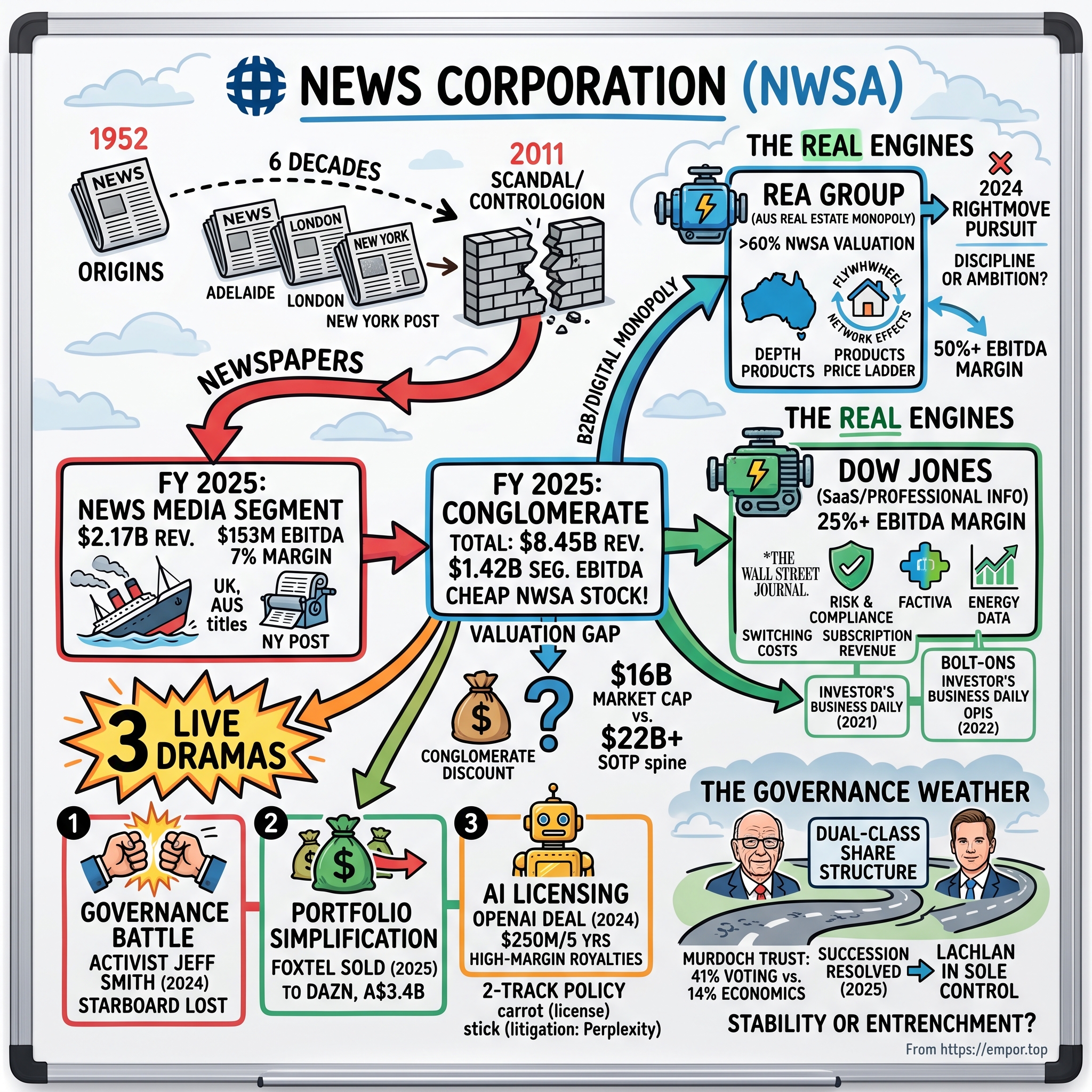
Here is the paradox that should stop a serious investor in their tracks. On the morning of July 16, 2026, News Corporation trades on the NASDAQ under the ticker NWSA at a market capitalization of roughly $16 billion. Yet if you take a scalpel to the company and value each of its pieces the way the market values comparable stand-alone businesses — the Australian real estate portal at portal multiples, the financial-data engine at data multiples, the book publisher at publisher multiples — the sum of the parts comes out north of $22 billion. There is, in other words, something on the order of a quarter of the company's value that the public market simply refuses to pay for. This is the "conglomerate discount," and at News Corp it is unusually wide and unusually persistent.
Why? The short answer is that a company is not worth the sum of its parts unless someone can actually separate those parts, and at News Corp the person who decides is a member of the Murdoch family. That single fact — a dual-class share structure that hands the family outsize control while it owns a minority of the economics — hangs over everything in this story like weather.
But before we get to the governance weather, sit with the businesses themselves, because the popular picture has them exactly backwards. In fiscal 2025 (the year ended June 30, 2025), News Corp generated $8.45 billion in total revenue and $1.42 billion in Total Segment EBITDA — the company's preferred measure of segment-level operating cash earnings.1 Newspapers and books, the assets everyone associates with the name, are no longer the economic engine. Two high-margin, thoroughly digital businesses now throw off the majority of the profit: the Dow Jones professional-information machine, and REA Group, the Australian online-real-estate near-monopoly. Together with the wider digital real estate segment, those crown jewels generate the overwhelming share of segment profit, while the legacy mastheads contribute a thin sliver.
So the real News Corp is a strange chimera: a B2B data-and-software company and a real estate advertising monopoly, wearing the costume of a dying newspaper empire. The costume matters, because it is part of why the stock is cheap — generalist investors see "newspapers" and move on.
Three live dramas frame the rest of this story. The first is a governance battle: activist Jeff Smith of Starboard Value spent 2024 trying to blow up the dual-class structure, and lost. The second is portfolio simplification reaching its climax: on April 2, 2025, News Corp closed the sale of Foxtel, its capital-hungry Australian pay-TV business, to the streaming group DAZN.5 The third is the emergence of an entirely new revenue stream — paid content licensing to artificial-intelligence companies — that could either be a rounding error or the most important thing to happen to legacy media in a decade.
Behind all three sat a fourth drama, the most human of them, and by mid-2026 it had resolved in a way that changed the terms of the entire investment case. For years the open question hanging over both Murdoch companies was succession: who, after 95-year-old Rupert, would control the family's votes? In 2024 that question exploded into a Nevada courtroom, and in September 2025 it ended in a settlement that handed Rupert's elder son Lachlan sole control of the family trust — an outcome that removed a decade of uncertainty while simultaneously cementing the very control structure activists had spent 2024 trying to break. It was, fittingly for a family that reportedly inspired HBO's Succession, a resolution that was both a truce and a coronation.
The journey to understand all of it runs from a single Adelaide newspaper in 1952, through the historic 2013 corporate split, into the money-printing mechanics of Australian real estate, the quiet software transformation of The Wall Street Journal, a brutal three-way street fight in American real estate, and a landmark deal with OpenAI. Throughout, the posture here is neutral: management's claim that it is on the cusp of unlocking enormous hidden value is a hypothesis to be tested against evidence, not a slogan to repeat. Let's begin where the modern company was born — not in 1952, but in the wreckage of a scandal.
 Subscribe on LinkedIn
II. Founding Context: The 2013 Split and the Legacy Ghost
Every empire has an origin myth, and Rupert Murdoch's is a small one: a 21-year-old inheriting a single struggling afternoon newspaper, The News, in Adelaide, South Australia, in 1952, after the sudden death of his father, Sir Keith Murdoch — himself a famous journalist, the reporter whose dispatch from Gallipoli in 1915 helped end a catastrophic First World War campaign. Rupert had been at Oxford, dabbling in left-wing politics, when the telegram came. He came home to a modest regional paper and a mountain of estate taxes, and set about a lifetime of proving he was more than his father's son.
What he did over the following six decades is one of the great compounding stories in media history — but for our purposes the early chapters can be brisk, because almost none of those assets sit inside NWSA today. Murdoch's formula was consistent and, to critics, cynical: buy a distressed newspaper, inject sensational, high-circulation, populist journalism and aggressive cost discipline, then use the cash flow and rising influence to buy the next one, each acquisition larger than the last. It carried him from Adelaide to Sydney, then to Fleet Street, where he bought the down-market News of the World and The Sun in the late 1960s and turned them into circulation monsters, and later added the prestige Times and Sunday Times. He crossed the Atlantic for the New York Post, became a naturalized American citizen in 1985 to satisfy US broadcast-ownership rules, built the Fox network from nothing, and eventually reached for the crown jewel of American business journalism. Appetite, not caution, was always the defining trait — a fact that matters enormously when you are assessing how this company allocates capital today.
That crown jewel is where the modern story truly starts. In 2007, Murdoch paid $5.6 billion for Dow Jones & Company — parent of The Wall Street Journal — offering $60 a share, a stunning premium of roughly 65% to the pre-bid price, and grinding down the reluctant Bancroft family that had controlled the company for a century.11 At the time the deal was near-universally mocked as vanity: an aging mogul overpaying wildly for a trophy newspaper in a dying industry, letting ego trump arithmetic. Hold that judgment. Buried inside Dow Jones was not just a famous newspaper but a business-to-business financial-information operation — the seed of what is today News Corp's single most valuable and highest-quality asset. Murdoch may have bought the Journal for the front page; what he got that mattered was the plumbing behind it.
Four years later, the empire nearly came apart. In 2011, the News of the World phone-hacking scandal detonated in Britain. It had simmered for years as a story about celebrities and royals, but the revelation that lit the fuse was uglier: that Murdoch's journalists had hacked the voicemail of Milly Dowler, a murdered 13-year-old schoolgirl, while she was still missing. Public revulsion was instant and total. Advertisers fled, criminal investigations multiplied, a judge-led public inquiry convened, and Murdoch flew to London to shut down the 168-year-old paper within days and to sit, humbled, before a parliamentary committee — where a protester pushed a foam pie into his face. The reputational and legal contagion threatened everything Murdoch owned. And critically, it threatened the valuable things — the film studio, the broadcast networks, the cable channels — with open-ended liabilities generated by the troublesome things, the newspapers. A scandal in a single London tabloid was suddenly a solvency question for a global media conglomerate.
The solution, executed in June 2013, was corporate surgery. Murdoch split his empire in two. On one side went the crown-jewel entertainment and broadcast assets — the film and television business that would become 21st Century Fox (and later, in part, be sold to Disney). On the other side went the publishing and Australian assets, incorporated as a "new" News Corporation. The logic was defensive as much as strategic: quarantine the scandal-prone, structurally-challenged publishing operations away from the high-margin screens.
This is the pivotal, under-appreciated fact about NWSA: it entered the world in 2013 branded as the runt of the litter — the "bad bank" of the Murdoch empire. Wall Street looked at the spinco and saw a grab-bag of decline: aging print newspapers in the UK, US, and Australia; a book publisher, HarperCollins; a capital-intensive Australian pay-TV business, Foxtel; and a controlling stake in an Australian real estate website almost nobody in New York had heard of. The entertainment assets got the love and the premium multiple. Publishing got the pity.
Into the CEO chair at the split stepped Robert Thomson, and the choice told you what kind of company this would try to be. Thomson is a lean, gravel-voiced Australian from a small town in rural Victoria, a career newsman who left school young and worked his way up from a copy boy in Melbourne to the Financial Times, then to the editorship of The Times of London, then to managing editor of The Wall Street Journal after Murdoch bought it. He and Murdoch had grown genuinely close — Thomson is godfather to one of Murdoch's younger daughters — and he arrived as perhaps the mogul's most trusted lieutenant. But he was a journalist by trade, not a financier, which made his central strategic insight all the more striking.
Thomson's thesis, pursued with remarkable consistency over the following decade, was that "publishing" did not have to mean "print," and that the word could instead describe high-margin digital businesses — subscription data, software, real estate advertising — hiding inside a legacy shell. He spoke, in his idiosyncratic and alliterative way, of transforming News Corp from a company defined by "mastheads and mangers" into one defined by data and digital platforms. On earnings calls he would return again and again to the same vocabulary of recurring revenue and professional information, quarter after quarter, year after year. Whatever one thinks of the family that controls the company, the operating strategy has been unusually legible and unusually persistent. The rest of this story is, in effect, the test of that thesis — and the first and best evidence for it was that little Australian website. So let's go to Australia.
III. Engine Room 1: REA Group & The Australian Digital Real Estate Monopoly
Picture a garage in suburban Melbourne in 1995. A handful of Australians, watching the early web flicker to life, build a website that does something almost quaint by today's standards: it puts property-for-sale listings online so buyers don't have to wait for the Saturday newspaper. The company is realestate.com.au, operated by REA Group. It is a minnow, burning cash, one of a dozen dot-com hopefuls.
In 2001, News Corp acquired a controlling interest in this minnow. The genius of the deal was in the currency. Rather than pay much cash, News Corp largely handed REA something it had in abundance and REA desperately needed: advertising space in its newspapers to promote the fledgling website. It was, in effect, a swap of soon-to-be-declining print inventory for equity in a soon-to-be-dominant digital platform. Measured by return on capital, it may be the single greatest venture investment in the history of media. News Corp's stake — today roughly 61% of REA Group — is worth well over US$10 billion, comfortably more than half of the entire parent company's market capitalization.1 An asset acquired for a rounding error grew into the load-bearing wall of the whole enterprise.
Why did realestate.com.au win so completely, and why does its dominance look so durable? The answer is the textbook two-sided network effect, and it is worth explaining in plain terms because it is the entire investment case. A property portal is a marketplace connecting two groups: home buyers who browse, and home sellers (and their agents) who list. Each group wants to be where the other group is. Buyers go to the portal with the most listings, because they don't want to miss a house. Sellers list on the portal with the most buyers, because they don't want to miss an offer. Once one platform pulls ahead, the flywheel becomes self-reinforcing and nearly impossible to reverse: more listings attract more buyers, which attracts more listings. In Hamilton Helmer's 7 Powers framework this is Network Economies, and in Australian residential real estate, REA has it in a degree that competitors can only envy.
The proof is in the competitive scoreboard. REA's chief rival, Domain — majority-owned by Nine Entertainment — has spent years and enormous marketing budgets as a permanent, structurally sub-scale number two. It exists, it has real traffic, but it has never come close to dislodging the leader, precisely because network effects punish the runner-up. Being second in a winner-take-most market is not half as good as being first; it is a fraction as good.
That structural dominance converts into economics that are almost embarrassing. REA Group runs core operating EBITDA margins in the high 50s — profit per dollar of revenue that most industrial companies can only dream about. But the real magic is pricing power, and it is worth understanding exactly how REA extracts it, because the mechanism is elegant. REA does not simply charge a flat fee to list a home. It sells a ladder of ever-more-prominent "depth" products — a standard listing, then a "Feature" upgrade, then "Premiere," then "Premiere+" — each one pushing a property higher and more visibly in search results. Every year REA both raises the price of each rung and nudges more sellers up the ladder, and the combination lifts the average revenue it earns per listing, its "yield," often by double digits annually.
Sellers pay because the cost of a premium listing is trivial next to the value of the home being sold. If a prominent listing costs a few thousand dollars against a million-dollar sale, and a better position on the page plausibly gets the house sold faster and for more, no rational seller balks — and in Australia the seller, not the buyer, pays for advertising, a cultural norm that hands REA a customer who is spending someone else's largest asset to sell it. This is the crucial mechanism: REA monetizes a non-discretionary, low-cost, high-emotion moment in one of the largest financial transactions of a person's life. That is why it can raise prices year after year without meaningful pushback. The one genuine cap on this machine is transaction volume — REA's revenue swings with how many Australians actually list their homes, which rises and falls with interest rates and housing sentiment. In a frozen market, even a monopoly's yield increases can be partly offset by fewer listings, and that cyclicality is the honest asterisk on the "money machine" label.
But pricing power breeds temptation, and in 2024 that temptation had a name: Rightmove. In September 2024, REA Group turned its gaze to the United Kingdom's dominant property portal and launched an audacious pursuit, tabling four escalating, non-binding proposals in the space of a single month, the last of which valued Rightmove at roughly £6.2 billion.[^6] Rightmove's board rejected every one, arguing that the offers "materially undervalued" the company and its prospects.6 On September 30, 2024, REA walked away.[^6]
How an investor reads that walk-away is a genuine test of the management-credibility thesis. The bullish reading: REA looked at a debt-fueled, potentially dilutive megadeal to buy a foreign asset at a rich multiple, ran the numbers, refused to overpay, and disciplined itself out of the deal — exactly the behavior long-term owners want to see, and a reassuring signal after years of watching acquirers destroy value by chasing scale. The skeptical reading: REA was willing to bid up to £6.2 billion and only stopped because it was rebuffed, which reveals an appetite to deploy the balance sheet aggressively far from its home turf, into a market where its Australian network effects do not travel. Both readings are defensible, and the truth is that the episode showed both discipline and ambition. What it did not show is any weakness in the core Australian machine — which is exactly why the market keeps paying up for REA even as it discounts the parent.
Rightmove was not REA's only attempt to deploy its formidable cash flows beyond its home market, and the other bets are worth watching precisely because they test whether the magic travels. REA has pushed into India — building a business around Housing.com and PropTiger and, in 2024, taking control of the property portal it operates there — betting that a fast-growing, under-penetrated market could become a second Australia. It is a plausible bet and an unproven one: India's real estate market is fragmented, its online-listings culture immature, and the network-effect dominance that makes Australia a fortress has to be built from scratch against local rivals. REA has also diversified adjacent to the core, into mortgage broking and financial services, aiming to earn a second fee from the same home-buying moment. None of these has yet reproduced the Australian economics, and a skeptic would note that a company sitting on a near-perfect domestic monopoly is, by expanding abroad and into adjacencies, taking on execution risk in exchange for growth it may not need. The core keeps compounding; the question is whether the extensions add value or merely absorb capital. The larger question that follows naturally is whether News Corp has a second engine of comparable quality. It does, and it hides in an even less likely place: a 130-year-old newspaper company.
IV. Engine Room 2: The Dow Jones SaaS Transformation
To most of the world, "Dow Jones" means The Wall Street Journal landing on a doorstep, or the number that anchors and pundits recite at the closing bell. Consumers see a newspaper. Sophisticated investors should see something closer to a software-and-data utility with a newspaper attached to the front of it.
Start with the financial reality, because it reframes everything. In fiscal 2025, the Dow Jones segment generated $2,331 million in revenue and $588 million in Segment EBITDA — a margin above 25%, and, more importantly, an 8% year-over-year jump in that profit.1 Now set that next to the News Media segment — the actual newspapers, the UK and Australian titles and the New York Post — which produced comparable revenue of $2,170 million but only $153 million of EBITDA, a margin of roughly 7%.1 Same rough top line; the "software" business earns nearly four times the operating profit of the "newspaper" business. That single comparison is the entire Thomson thesis rendered in numbers: the future of publishing at News Corp is not the printing press, it is the database.
There is a consumer story here too, and it is a genuinely good one, even if it is not the crown jewel. Under Dow Jones chief executive Almar Latour, the company spent the past decade converting The Wall Street Journal, Barron's, and MarketWatch from advertising-dependent print products into digital subscription businesses with several million paying digital subscribers between them. The strategy borrowed from the streaming playbook: bundle the titles, use data to reduce churn, push readers from cheap introductory offers toward full-price renewals, and lean on subscription revenue — stable, recurring, and paid in advance — rather than the volatile advertising dollars that gutted the newspaper industry. It worked well enough that the consumer side of Dow Jones is now a growing digital business rather than a melting print one. But it is still, fundamentally, media. The part of Dow Jones that makes it special is the part consumers never see.
What actually drives the segment's premium economics is the Professional Information Business (PIB) — the part of the company that sells not journalism to readers but structured data and workflow tools to institutions. And the jewel within the jewel is Dow Jones Risk & Compliance.
Here is what it does, in plain language. Every global bank, insurer, and large multinational is legally required to know who it is doing business with — to screen customers and transactions against sanctions lists, to detect money laundering, to avoid paying bribes to corrupt foreign officials, to identify "politically exposed persons." Getting this wrong means catastrophic fines and, occasionally, executives in handcuffs. Doing it manually across millions of transactions is impossible. So institutions buy structured, continuously-updated databases of bad actors, sanctioned entities, and adverse news, and they wire those feeds directly into their automated transaction-monitoring systems. Dow Jones Risk & Compliance is one of the premier suppliers of exactly that data.
The moat here is Switching Costs, and it is ferocious. Once a Dow Jones compliance feed is hard-coded into a global bank's anti-money-laundering plumbing — validated, audited, signed off by regulators — ripping it out to save money is nearly unthinkable. The savings on the subscription would be dwarfed by the cost and, worse, the regulatory risk of re-plumbing a mission-critical control system and re-validating it with authorities who do not like surprises. The product is cheap relative to the disaster it prevents. That is the same economic logic that makes REA's listings un-cancellable and, not coincidentally, the same logic that makes enterprise software so sticky. Churn is minimal; the revenue is recurring and contractual; it grows with the relentless expansion of global compliance regulation rather than with the advertising cycle. This is the opposite of the consumer-media business in every way that matters to an investor.
Risk & Compliance is the flagship, but the professional information business is a small fleet of these vessels. Factiva is a vast licensed archive of global news and business content that corporations and libraries pay to search. Dow Jones Newswires pipes machine-readable market news to trading desks. And the energy and chemicals data assets acquired in 2022 feed price benchmarks to commodity traders and industrial buyers who need an authoritative number to write into their contracts. What ties them together is a single trait investors should prize: each sells a subscription to information that its customers cannot easily reproduce and cannot afford to be without. On its earnings calls, management has consistently pointed to the professional-information lines — and Risk & Compliance in particular — as the fastest-growing, highest-retention part of the whole segment, and the fiscal 2025 results, with Dow Jones profit up 8% on 4% revenue growth, are consistent with a business mix tilting steadily toward these recurring, high-margin data products.1 The right thing for an investor to track is not any single quarter's revenue but the disclosed growth rate of these professional-information and recurring-revenue lines, because that is the true tell of whether the compounding engine is still humming.
Thomson's team has spent real money extending this engine, and the pattern of the deals reveals the strategy. In 2021, News Corp bought Investor's Business Daily for $275 million, folding its retail-investor subscribers and premium stock-research tools into the Dow Jones ecosystem — a clean, high-margin bolt-on.12 The more revealing moves came in 2022. News Corp acquired OPIS — a leading provider of energy-price data — for about $1.15 billion, and a Base Chemicals price-reporting business for roughly $295 million.13[^15] What made these deals shrewd was why the assets were for sale. Their owners, S&P Global and IHS Markit, were merging in one of the decade's largest data-industry mergers, and antitrust regulators forced them to divest these units to clear the deal. In other words, the sellers were motivated not by choice but by regulatory compulsion — a classic forced-seller situation in which a prepared, cash-ready buyer can acquire high-recurring-revenue data assets on attractive terms. Thomson recognized that energy and chemical price benchmarks are the same kind of business as compliance data: essential, subscription-based, embedded in customer workflows, and priced far below the value they protect.
Whether this justifies the price paid is the fair question a skeptic would press. OPIS at over a billion dollars was not cheap in absolute terms, and the true test is whether PIB's organic growth and margins keep climbing as the integration matures — something an investor should watch in the segment's disclosed recurring-revenue trends rather than take on faith. But the strategic logic is coherent and consistent, executed over years, and it has visibly reshaped the profit mix of the whole company. If Dow Jones is the quiet compounding machine, the next asset is its noisy, bleeding opposite — and a cautionary tale about assuming a great business model travels across oceans.
V. The American Front: Move, Realtor.com, and the Low-Margin Street Fight
If the Australian real estate business is the crown jewel, its American cousin is the cautionary tale — the same idea, dropped into a hostile ecosystem, where it has struggled to breathe. In 2014, flush with the conviction that it had cracked the code of digital real estate, News Corp paid roughly $950 million to acquire Move, Inc., operator of Realtor.com, at $21 a share, structured as 80% owned by News Corp and 20% by REA Group.9 The ambition was explicit: replicate the Australian money machine in the largest housing market on earth.
It has not worked, and the reasons are structural rather than a simple failure of effort — which makes them instructive. The United States real estate portal market is nothing like Australia's. Where Australia consolidated around one dominant platform, America fractured into a brutal, expensive, three-way war for eyeballs and agent dollars.
At the top sits Zillow, the household name, the site consumers reflexively open when they want to gawk at a neighbor's home value or dream about a move. Zillow won the consumer-mindshare battle years ago with a single brilliant product, the "Zestimate" — an instant, algorithmic estimate of any home's value that turned property-browsing into a national pastime — and mindshare in this market is oxygen. (Zillow's one great stumble, a multibillion-dollar bet on buying and flipping homes itself, collapsed in 2021 and taught the whole industry that the durable money is in the advertising layer, not in taking property risk.) Realtor.com sits second, leaning on lead generation — selling home-buyer inquiries to agents — and on its historic branding tied to the National Association of Realtors, whose trademark it licenses. And charging hard in third is CoStar Group, the deep-pocketed commercial-real-estate-data giant run by the relentless Andy Florance, which has poured well over a billion dollars into its residential portal Homes.com, blanketed the Super Bowl with advertising, and marketed itself around a pointed pitch: "your listing, your lead," a direct shot at the lead-diversion model that Realtor.com and Zillow rely on to make money. When a rival with CoStar's balance sheet decides to buy its way into your market, second place becomes an expensive place to stand.
Why does the American structure produce such inferior economics? Because in a three-way fight where no one has decisive network dominance, everyone must spend enormous sums on marketing simply to hold position, and that spending grinds margins toward the floor. The very network effect that makes REA a fortress in Australia is, in America, split three ways and therefore protects no one. This is the single most important lesson of the Move saga: a business model is not portable. The moat is not the brand or the software; it is the market structure, and market structure is local.
Layer onto this a genuine regulatory earthquake. After a Missouri jury in the Sitzer/Burnett case found in 2023 that the industry had conspired to inflate commissions, the National Association of Realtors agreed in 2024 to a roughly $418 million settlement and, more importantly, to sweeping rule changes — effective in August 2024 — that decoupled buyer-agent commissions from the seller's side of the deal and forced buyers to negotiate and often pay their own agents directly. The whole American model in which a home seller reflexively funds a 5-to-6% commission split between two agents is now under pressure. This matters to Realtor.com because its lead-generation economics ultimately rest on buyer's agents having fat commission budgets to spend chasing leads. If that commission pool shrinks or the buy-side agent's role thins out, so does the appetite to pay for leads — and Realtor.com's monetization model is far more exposed to that squeeze than REA's seller-pays-to-advertise model ever was. It is a reminder that the American asset carries not just competitive risk but structural, policy-driven risk to the very mechanism by which it makes money.
Management has flirted with the exit. In early 2023, News Corp reportedly held talks to sell Move to CoStar for around $3 billion — roughly three times what it paid — before the discussions collapsed and News Corp walked away.10 With hindsight, that decision deserves the skeptic's scrutiny: Realtor.com has continued to grapple with traffic and share pressure against Zillow and a spending Homes.com, and $3 billion in hand for an asset that drags on company-wide margins would have simplified the story and funded the higher-quality engines. The counter-argument is that Realtor.com is real optionality on the single largest asset class in America, and that selling at the bottom of a cyclical, transition-heavy moment would have been its own mistake. Which view is right will not be settled for years, and honest analysis holds both. Either way, Move is the exception that proves the company's rule — a low-margin brawl bolted onto a portfolio otherwise defined by high-margin dominance. From the noisy front line, we turn to the quiet legacy assets that everyone assumes define the company and that, financially, barely move the needle.
VI. The Legacy Pillars: Book Publishing & News Media
Walk into the London or New York offices of HarperCollins and you are standing inside a business that would be unrecognizable to a Silicon Valley product manager and utterly familiar to a Victorian printer — and yet it is one of the more dependable cash machines in the whole News Corp portfolio. In fiscal 2025, the Book Publishing segment produced $2,149 million in revenue and $296 million in Segment EBITDA, a margin near 14% and a 10% increase in that profit over the prior year.1
The source of HarperCollins's durability is a concept every investor should appreciate: the backlist. A publisher's "frontlist" is this year's new releases — glamorous, risky, hit-driven, expensive to acquire and market. The "backlist" is the catalog of books published in prior years that simply keep selling, year after year, with essentially zero new marketing spend. HarperCollins owns one of the most valuable backlists in the English language, anchored by the estates and franchises it controls: J.R.R. Tolkien, C.S. Lewis, Agatha Christie. These are not books; they are annuities. A copy of The Hobbit or a Christie mystery sells every single day somewhere on earth, and the cost of selling it — a copyright long since paid for — rounds to nothing. That is what produces a respectable margin from an old-economy business: a library of intellectual property with no customer-acquisition cost, now translating cleanly into high-margin audiobook and e-book formats.
Under chief executive Brian Murray, HarperCollins has also become an early mover in monetizing that backlist for the AI age — and in doing so exposed the industry's central tension. In late 2024 the publisher struck a licensing arrangement, reportedly with Microsoft, to make selected nonfiction backlist titles available for training AI models: a three-year, opt-in deal offering roughly $5,000 per book, split evenly between author and publisher, with guardrails capping how much of any book an AI could reproduce.21 The reaction from authors and literary agents was sharply divided — some took the check, others recoiled at feeding the machine that might one day replace them — which captures the whole ambivalence of legacy content owners toward AI in a single episode. For News Corp, though, the logic was the same as everywhere else in the portfolio: an already-paid-for archive generating pure-margin licensing dollars.
The strategic role of HarperCollins is not growth; its top line barely moves organically, and audiobooks and e-books are the only meaningfully expanding formats. Its role is to be a reliable, low-capital-intensity generator of cash that helps fund the digital investments elsewhere. It is the steady bass line under the melody, and management is right not to expect fireworks from it.
The News Media segment is a harder, sadder story, and the numbers say it plainly. Against $2,170 million of revenue, the collection of newspapers generated just $153 million of Segment EBITDA, that meager 7% margin noted earlier.1 A clarifying note matters here: The Wall Street Journal does not live in this segment — it sits inside Dow Jones. News Media is the rest of the empire's mastheads: News UK's The Sun and The Times and Sunday Times; the Australian titles led by The Australian, The Daily Telegraph, and the Herald Sun; and the New York Post in America, a paper that lost money for decades as a Murdoch trophy before its digital reinvention finally nudged it toward profitability. The forces crushing the segment are the familiar secular ones: print circulation and print advertising in structural, probably terminal decline, while the physical costs of paper, ink, printing plants, trucks, and labor remain stubbornly high. Ancillary bets to escape print — most visibly the loss-making British opinion channel TalkTV, which News UK pulled off linear television in 2024 — have mostly underwhelmed. On a coldly financial basis, an activist could reasonably ask why these assets are not sold or shut.
Management's refusal to sell them is where analysis has to separate stated rationale from real motive. The stated rationale used to be mostly about influence — political power, cultural weight, the ability to shape elections and set agendas, which is real and which the Murdoch family has never pretended not to value. But a newer, more investor-relevant rationale has emerged, and it reframes the mastheads as something other than a sentimental liability. These newsrooms produce an enormous, continuous, high-quality stream of original, timely, professionally-written text — and in the age of large language models, that stream has suddenly become a scarce and valuable raw material. The newspapers, in other words, may be worth more as a data source feeding the next chapter of the company's growth than as a standalone print operation. Whether that reframing is a genuine strategic insight or a convenient after-the-fact justification for holding onto trophies the family will never part with is a fair open question. But it leads directly to the most intriguing new line item in the entire story.
VII. The AI Licensing Goldmine & Foxtel Divestment
On May 22, 2024, News Corp and OpenAI announced a partnership that, for all the hype around generative artificial intelligence, represented one of the first serious attempts to answer a trillion-dollar question: when an AI model is trained on the world's journalism and then repackages it for users, does the journalist get paid? News Corp's answer was yes, and it put a number on it. The multi-year global agreement was reported to be worth more than $250 million over five years — better than $50 million a year — in exchange for OpenAI's right to train on and display content from the company's mastheads, with attribution, including The Wall Street Journal, Barron's, MarketWatch, the New York Post, and the UK and Australian titles.23
Understand why this is such an attractive line of revenue, and why management is right to be enthusiastic even as an investor should be cautious about extrapolating it. Licensing content that already exists carries almost no incremental cost. The journalism was going to be produced anyway; the archive already sits on servers. So a licensing dollar is very nearly a pure-margin dollar — the economics approach 100% EBITDA. This is the same insight as the HarperCollins backlist, applied to news: monetizing a library you have already paid to create.
The genuine bull case is that News Corp is setting a pricing precedent for an entire industry at a critical moment. If the OpenAI deal becomes a template — if Google, Anthropic, Apple, and the next wave of AI platforms all sign structured, paid licensing agreements rather than scraping content for free — then News Corp's archives and live news feeds transform from a declining print asset into a recurring royalty stream on the AI revolution, an un-cannibalizable toll on machines that need trustworthy text. That is a real and exciting possibility, and News Corp deserves credit for being early and aggressive in forcing Big Tech to the negotiating table.
The bear case is equally real and must be stated in the same breath. $50 million a year, against $8.45 billion of revenue, is a rounding error today.1 The deals may never scale to material size; AI platforms may find ways to summarize the day's news without licensing any single publisher; and the same technology that pays News Corp on the licensing line may simultaneously disintermediate its consumer news business, as users get their answers from a chatbot and never click through to subscribe. The licensing goldmine and the traffic threat are two faces of the same coin, and it is far too early to know which face lands up. Honesty requires holding both.
The OpenAI deal is only half of News Corp's AI strategy, and the other half reveals how the company intends to make the strategy stick. Where OpenAI got the carrot of a license, the AI companies that scrape without paying get the stick of litigation. On October 21, 2024, News Corp's Dow Jones and New York Post sued the AI search startup Perplexity in federal court in New York, alleging a "massive amount of illegal copying" of their journalism — accusing Perplexity of ingesting their articles into a database and regurgitating them to users, sometimes with fabricated "hallucinated" content falsely attributed to the mastheads.17 The suit asked the court to halt the practice and destroy the offending databases. Read together, the OpenAI license and the Perplexity lawsuit are a coherent two-track policy: pay us and we will partner; take our work for free and we will litigate. It is the same playbook the music industry eventually used to force streaming into paid licensing, and News Corp — with the deep legal resources of a Murdoch enterprise and a genuine appetite for a fight — is positioning itself as one of the aggressors setting the terms. Whether courts ultimately agree that training and retrieval-augmented generation infringe copyright is unresolved and enormously consequential, not just for News Corp but for the entire information economy.
Now to the other event of this period, the one that actually reshaped the balance sheet. To appreciate why exiting Foxtel mattered, understand what Foxtel was: Australia's dominant pay-television provider, a satellite-and-cable bundle that for years functioned as the country's answer to a premium cable package, jointly owned by News Corp and the telecom Telstra. It had spent the streaming era scrambling to reinvent itself — launching the sports service Kayo, the entertainment service Binge, and an aggregation platform called Hubbl — but it was fighting the same brutal war every legacy pay-TV operator faces: cord-cutting on one side, and on the other, the spiraling cost of the live sports rights that were the only thing keeping subscribers from canceling. Sports rights are the classic bad-business trap: prices ratchet up every renewal because they are the one product streaming cannot easily replicate, yet the audience keeps shrinking. Foxtel was capital-intensive, subscriber-shrinking, and a persistent drag on the group.
On April 2, 2025, News Corp completed the sale of the Foxtel Group to DAZN, the London-based global sports-streaming company backed by the billionaire Len Blavatnik, at an enterprise value of A$3.4 billion — roughly US$2.3 billion.45 For DAZN, a loss-making but ambitious platform trying to become the "Netflix of sports," acquiring Foxtel's Australian subscriber base and sports rights was a bid for scale and profitability. For News Corp, it was strategic hygiene: shedding everything the rest of the portfolio is trying to stop being.
The structure of the deal was as revealing as the exit itself. Rather than a clean all-cash sale, News Corp took a roughly 6% minority equity stake in the enlarged DAZN, a seat on its board, and repayment of A$592 million in outstanding shareholder loans in cash.45 The equity stake preserves a sliver of upside if DAZN's global streaming ambitions succeed, while the loan repayment and the removal of Foxtel's capital demands materially cleaned up News Corp's financial profile. With Foxtel gone, the company completed a multi-year simplification and, for the first time, could credibly describe itself as a focused digital publishing, B2B data, and real estate business rather than a sprawling media conglomerate. Which raises the obvious question: if the assets are now clean, high-quality, and undervalued, why won't the market pay for them? For that answer, we have to talk about who is really in charge.
VIII. The Governance Stranglehold: Activist Stress-Testing and the Starboard Battle
Every valuation gap eventually attracts someone with a spreadsheet and a grievance, and by 2024 News Corp had attracted one of the most feared activists on Wall Street. But to understand the fight, first meet the people defending the castle.
At the top sits Lachlan Murdoch, Rupert's elder son and chosen successor, who became sole chairman of News Corp in November 2023 when his 92-year-old father stepped back to the ceremonial role of Chairman Emeritus.18 Running the company day to day is Robert Thomson, CEO since the 2013 split and, on the evidence of this story, a genuinely disciplined operator who executed a coherent pivot from print to software and digital real estate over more than a decade — a rare feat of strategic consistency in an industry not known for it.
But management credibility is assessed through behavior over time, and the record is not uniformly flattering. Thomson is exceptionally well paid: his total compensation for fiscal 2025 was $20.6 million, including a $3 million salary, roughly $10 million in stock awards, and $6.8 million in incentive pay.1415 There is nothing unusual about a large-cap CEO earning that sum. What is worth noticing is that Thomson is a hired executive rather than a founder-owner: his personal wealth in News Corp is built overwhelmingly through those annual equity grants rather than a large pre-existing stake, so the alignment between his fortune and long-term shareholders' runs through the compensation committee's decisions each year rather than through skin he put in himself. That is true of most professional CEOs; it simply matters more at a company where the controlling owners — the Murdochs — are a different party entirely from the operator.
The credibility question got sharper in late 2022, in an episode that still shadows the stock. Rupert Murdoch proposed reuniting the two halves of his empire — folding Fox Corporation back together with News Corp. Institutional shareholders revolted. Investors including Irenic Capital argued that dragging News Corp's clean, undervalued publishing and data assets back into the volatile world of cable news and linear television served family consolidation, not shareholder value, and that News Corp was already undervalued on its own.16 The pressure worked: in January 2023, the Murdochs abandoned the proposal.16 The retreat was a win for outside shareholders, but the mere fact that the controlling family could float such a self-serving structural change — and force the company to spend months entertaining it — told the market everything about who holds the whip.
Which brings us to Jeff Smith and Starboard Value. In 2024, Starboard mounted a campaign aimed squarely at the root of the conglomerate discount: the dual-class share structure. Here is the mechanism that enrages outside investors. News Corp has two classes of stock. The Class B voting shares are concentrated in the Murdoch family trust, giving the family roughly 41% of the voting power while owning only around 14% of the company's actual economics.7 The family, in effect, controls the company with a minority of the money at risk. Starboard's thesis was blunt: collapse the two classes into one share-one-vote, eliminate the family's outsize control, and let the market pursue the obvious value-unlocking move — a spin-off of REA Group, whose value is buried and discounted inside the parent.7
The battle came to a head at the annual meeting on November 20, 2024. It was not close. Shareholders rejected the proposal to dismantle the dual-class structure, with only about 35% of votes cast in favor.8 Because the Murdoch trust's votes are effectively immovable and count toward the denominator, the math was close to hopeless from the start — a non-binding proposal against an entrenched controlling block rarely ends any other way.
And yet even the family's iron grip contained a hidden fracture, one that erupted into the open in the most dramatic corporate-family drama of the decade. The Murdoch votes do not belong to Rupert outright; they sit in the Murdoch Family Trust, an irrevocable instrument set up in 1999 that, on Rupert's death, was to divide control equally among four of his children — Prudence, Elisabeth, Lachlan, and James. The problem, from Rupert and Lachlan's point of view, was that the four are not politically aligned: James in particular had broken publicly with the conservative editorial direction of Fox News and the family papers. So in 2024, Rupert launched a secret bid — reportedly code-named "Project Family Harmony" — to amend the supposedly unamendable trust and hand Lachlan sole, permanent control, arguing it was necessary to protect the commercial value of the businesses.
The maneuver landed in a probate court in Reno, Nevada, and in December 2024 the probate commissioner ruled emphatically against Rupert and Lachlan, finding they had acted in "bad faith" and calling the plan a "carefully crafted charade" to cement Lachlan's control regardless of the consequences for the other beneficiaries.19 It was a stunning rebuke — and, briefly, it suggested the family's monolithic voting bloc might one day splinter into four competing heirs, precisely the kind of instability that could, in theory, crack the structure open. That possibility died in September 2025. The family reached a settlement that bought out Prudence, Elisabeth, and James for roughly $3.3 billion in total, ceding their stakes and placing Lachlan in sole control of a new family trust structured to run for decades.20 To help fund the payments, the Murdoch entities sold shares, and in the process the family trust's voting stake in News Corp was diluted from roughly 40% toward about one-third.20
For an investor, the settlement is double-edged and worth thinking through carefully. On one hand, it removes a genuine source of uncertainty — the succession question that had hung over the company for years is now definitively answered, with Lachlan installed as the long-term controlling figure and the risk of a messy four-way family war extinguished. On the other hand, it forecloses the single most plausible path by which the dual-class structure might ever have loosened: a post-Rupert scramble among heirs with divergent interests. The controlling grip is now more durable, not less. The one modest consolation for outside shareholders is arithmetic — the share sales that funded the buyout genuinely diluted the family's voting percentage, marginally narrowing the gap between control and economics that Starboard had railed against. But the direction of travel is clear: control has been consolidated and locked in, likely for a generation.
The defeat of Starboard and the resolution of the succession together crystallize the central, unavoidable investment reality of NWSA. The hidden value is real; the arithmetic that says the parts are worth more than the whole is defensible; and none of it can be forced into the open by outside shareholders, no matter how large or how clever, because the family holds a structural veto over its own breakup — a veto that the events of 2024 and 2025 have, if anything, reinforced. Activism can win arguments here without winning votes. That structural fact is the bridge from the specifics of News Corp to the general lessons its story teaches.
IX. Playbook: Durable Business & Investing Lessons
Step back from the Murdoch drama and News Corp becomes a case study — a set of transferable lessons about where durable value comes from and where it gets trapped.
The first lesson is the power of the B2B compliance moat, and the broader art of business-model migration. Consumer media is one of the worst businesses in the modern economy: low retention, brutal competition for attention, revenue at the mercy of advertising cycles and platform algorithms. B2B compliance and pricing data is one of the best: non-discretionary, contractually recurring, embedded so deeply in customer workflows that leaving is riskier than staying. News Corp's most important act of value creation was recognizing that a news brand could be migrated into a workflow-software-and-data utility — that the same reporting apparatus could feed a database that banks must buy rather than a newspaper that readers might buy. The lesson for investors is to look past what a company is called and ask what its revenue actually behaves like.
The second lesson is regulatory divestiture arbitrage. When regulators force the world's largest companies to shed valuable subsidiaries as the price of approving a mega-merger, the sellers are not optimizing for price — they are clearing a bureaucratic hurdle against a deadline. A prepared, well-capitalized strategic buyer who understands the divested asset better than a generalist can acquire high-moat, high-recurring-revenue businesses on unusually favorable terms. News Corp's capture of OPIS and Base Chemicals out of the S&P–IHS Markit merger is the template. The broader point: pay attention to the forced-seller dynamics created by antitrust enforcement, because that is where quality assets change hands at motivated-seller prices.
The third lesson is the danger of the dual-class conglomerate discount, and it is the darker counterweight to the first two. It does not matter how obvious the sum-of-the-parts value is on paper if the person who controls whether the parts can ever be separated has no incentive to separate them. A dual-class structure that concentrates voting power in a founding family acts as a structural ceiling on the valuation. Hostile takeovers are impossible. Activist-driven breakups can be unilaterally blocked, as Starboard learned. For an investor, the hidden value in such a company is not a coiled spring waiting to release — it is a permanent feature of the landscape that may never be monetized, and it must be underwritten as such rather than assumed away.
The fourth lesson is how to capitalize on a technological land grab. Content archives that looked like static historical records — old newspapers, backlist books — turned out to be premium training fuel for artificial intelligence exactly when AI platforms needed trustworthy text and had the cash to pay for it. The companies that move early to structure paid licensing deals set the pricing precedents that govern the entire market before the technology matures enough to route around them. News Corp's OpenAI deal is an early, unproven, but strategically sharp example of turning a depreciating asset into an option on someone else's revolution. The generalizable insight: in a platform shift, the owners of scarce, high-quality inputs have a narrow window to establish that their inputs are not free — and that window closes fast.
These lessons converge on a single, unresolved question: given genuinely excellent underlying businesses and a genuinely broken ownership structure, what is a share of News Corp actually worth?
X. Episode Epilogue: Bull vs. Bear Analysis & Crucial KPIs
The two sides of the News Corp argument are unusually clean, because they rarely dispute the facts — they dispute what the facts are worth given who is in control.
The bull case rests on quality and simplification. With Foxtel sold, the company is a cleaner, more focused digital compounder than at any point since the 2013 split. Its two best businesses are structurally advantaged: Dow Jones's Professional Information Business is a subscription-and-data machine largely insulated from advertising cycles and protected by switching costs, and REA Group's Australian near-monopoly is protected by network effects that the Rightmove walk-away suggests management will not squander on undisciplined empire-building. On top of that sits genuine optionality — the AI licensing stream and the deep discount itself, which means an investor is arguably paying for the two engines and getting the newspapers, HarperCollins, Move, and the AI upside close to free.
The bear case rests on the ceiling and the erosion. The Murdoch discount may simply be permanent: as long as the dual-class structure stands, the value-unlocking spin-off of REA or Dow Jones that everyone can see is a move only the family can authorize, and the family has shown no interest. Meanwhile Move/Realtor.com continues to fight a losing-or-at-best-stalemated battle against Zillow and a free-spending Homes.com in a market whose economics are structurally worse than Australia's and now clouded by the NAR settlement. And the deepest bear worry is that generative AI search disintermediates news consumption itself — that as users get answers from chatbots and AI overviews, the direct traffic, subscription conversion, and advertising that sustain the mastheads erode structurally, and the licensing checks never grow large enough to replace what is lost.
Run the story through the standard analytical frameworks and the shape becomes clear — but only if you apply the frameworks to each business separately, because News Corp is really a portfolio of businesses with wildly different competitive positions wearing one ticker. That is itself the central analytical insight: there is no single "News Corp" moat to assess.
Take Porter's five forces first. For the crown jewels, the forces line up beautifully. Barriers to entry are formidable — a would-be REA competitor must somehow attract both buyers and sellers simultaneously from a standing start, and a would-be Dow Jones Risk & Compliance rival must persuade banks to rip out an audited control system. Buyer power is weak: an Australian home-seller and a bank's compliance officer both face a near-monopoly supplier whose product is cheap relative to its stakes. Supplier power is minimal, and the threat of substitutes is limited for a compliance database that regulators effectively expect. Rivalry is muted because each dominates its niche. Now run the same analysis on the legacy and American assets and every force flips: in US real estate portals, rivalry is ferocious and buyer power (agents who can advertise anywhere) is high; in newspapers, substitutes — free digital news, social feeds, AI summaries — are overwhelming, and buyer loyalty erodes yearly. Same company, opposite ends of the spectrum.
Now Hamilton Helmer's 7 Powers. News Corp genuinely holds three of the seven in concentrated form: Network Economies at REA, Switching Costs at Dow Jones Risk & Compliance, and Branding in the Journal masthead and the HarperCollins backlist, where the name itself commands trust and price. Arguably it touches a fourth — Cornered Resource — in the exclusive, hard-to-replicate content archives now being licensed to AI. That is a rare density of durable advantages for one enterprise. The instructive contrast is CoStar's assault on Realtor.com, which is a textbook attempt at Counter-Positioning: CoStar's "your listing, your lead" pitch is a business model the incumbents cannot copy without cannibalizing the lead-selling revenue that sustains them — the precise trap Helmer describes. So the powers are real where they exist and absent where they don't, and the corporate wrapper trades at a discount not because the powers are weak but because governance — which no framework of business quality captures — overrides all of it.
The peer comparison sharpens the point. A stand-alone REA already trades on the ASX at the rich multiple the market assigns to a dominant portal; a stand-alone Dow Jones would invite comparison with pure-play data compounders like S&P Global, Moody's, or the London Stock Exchange Group's data division, all of which command premium valuations for exactly the recurring, high-retention economics Dow Jones is building. Bundled inside News Corp, under Murdoch control, those same cash flows are valued more cheaply. That gap — between what the pieces would fetch apart and what the whole fetches together — is the investment debate, and after 2025 it comes with a hard new fact: the person who could close it has just spent $3.3 billion making sure he never has to.
For an investor tracking whether the thesis is playing out, three key performance indicators matter more than the rest, and they map directly onto the three things that could make or break the story:
First, Dow Jones Professional Information Business recurring-revenue growth — the velocity at which Risk & Compliance and the energy-and-chemicals data assets add subscription revenue. This is the single clearest gauge of whether the highest-quality engine is still compounding.
Second, REA Group's average yield per listing — the definitive measure of Australian real estate pricing power. As long as REA can keep raising the price of a listing faster than inflation without losing sellers, the monopoly thesis holds; the day yield growth stalls is the day to worry.
Third, Realtor.com's monthly unique users — the vital sign of the American front. Traffic trajectory against the aggressive marketing of CoStar's Homes.com and the dominance of Zillow will reveal whether Move is a slowly recovering option or a permanently impaired one.
Watch those three numbers and you are watching the real News Corp — not the newspaper empire of the popular imagination, but a data-and-real-estate business wearing a newspaper's clothes, trapped inside a family's voting shares, waiting to see whether the value everyone can measure will ever be the value the market is allowed to pay for.
References
-
News Corporation Reports Fourth Quarter and Full Year Results for Fiscal 2025 (Form 8-K, Exhibit 99.1) — News Corporation / SEC EDGAR, 2025-08-05 ↩↩↩↩↩↩↩↩
-
A landmark multi-year global partnership with News Corp — OpenAI, 2024-05-22 ↩
-
News Corp Inks OpenAI Licensing Deal Potentially Worth More Than $250 Million — Variety, 2024-05-22 ↩
-
News Corp Announces Agreement to Sell Foxtel to DAZN for Enterprise Value of A$3.4 Billion — Business Wire / News Corporation, 2024-12-23 ↩↩
-
DAZN completes $3.4bn Foxtel acquisition — Mi3, 2025-04-03 ↩↩↩
-
Rupert Murdoch's property group REA ends chase to buy Rightmove after multiple rejected offers — CNBC, 2024-09-30 ↩
-
Starboard Value Issues Letter to News Corp Shareholders Regarding a Proposal to Eliminate the Company's Dual-Class Share Structure — Business Wire / Starboard Value, 2024-09-09 ↩↩
-
News Corp Says Investors Reject Proposal to End Dual Class Voting Structure — U.S. News / Reuters, 2024-11-20 ↩
-
Rupert Murdoch's News Corp Acquires Move, Inc. for $950 Million Cash Deal — RISMedia, 2014-09-30 ↩
-
News Corp. Ends Sale Talks With CoStar Group for Real Estate Business — The Hollywood Reporter, 2023-04-06 ↩
-
News Corp Completes Acquisition of Investor's Business Daily — News Corporation, 2021-05-05 ↩
-
News Corp Completes Acquisition of OPIS — News Corporation, 2022-02-28 ↩
-
News Corporation Proxy Statement and Notice of 2025 Annual Meeting (Form DEF 14A) — News Corporation / SEC EDGAR, 2025 ↩
-
News Corp CEO Thomson's pay totals $20.6 million — Talking Biz News, 2025 ↩
-
Rupert Murdoch calls off proposed Fox-News Corp merger — CNBC, 2023-01-24 ↩↩
-
Murdoch's Dow Jones, New York Post sue Perplexity AI for 'illegal' copying of content — CNBC, 2024-10-21 ↩
-
Rupert Murdoch steps down as chairman of Fox and News Corp. — CNBC, 2023-09-21 ↩
-
Rupert Murdoch loses courtroom attempt to change the family trust — NPR, 2024-12-10 ↩
-
Rupert Murdoch settles family succession battle with payout — NPR, 2025-09-08 ↩↩
-
Agents, Authors Question HarperCollins AI Deal — Publishers Weekly, 2024-11-18 ↩
 LinkedIn
 WhatsApp
 Reddit
 Hacker News
 Email
Email Kindle
 RSS Feed
 Spotify
 Apple Podcasts
 Amazon Music
 Audible
 YouTube