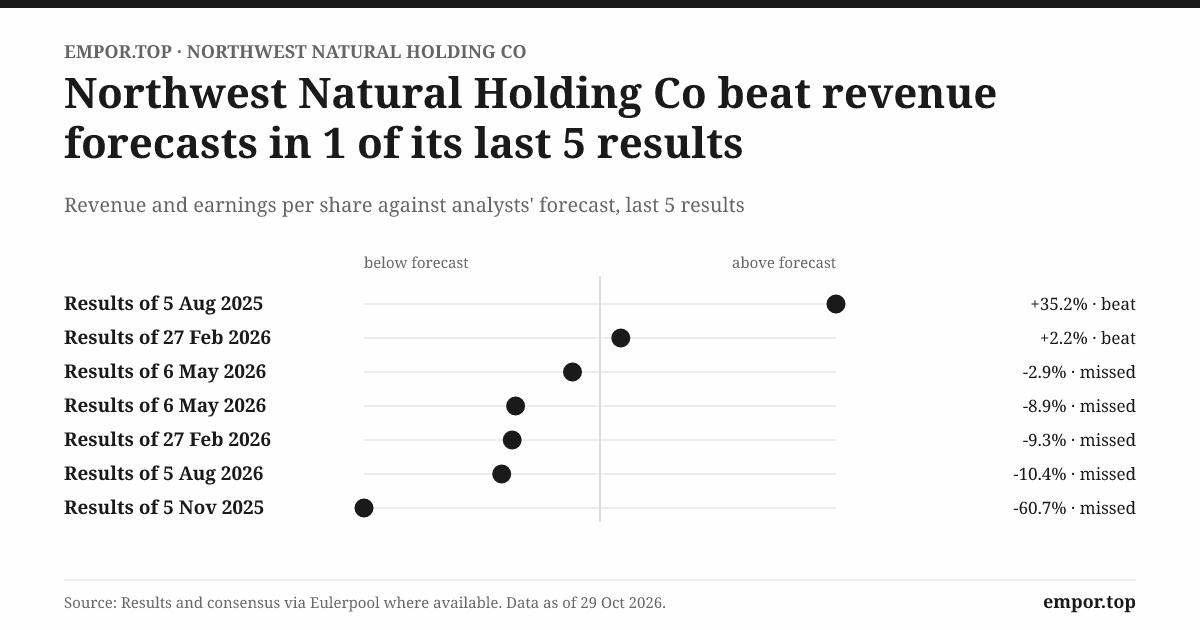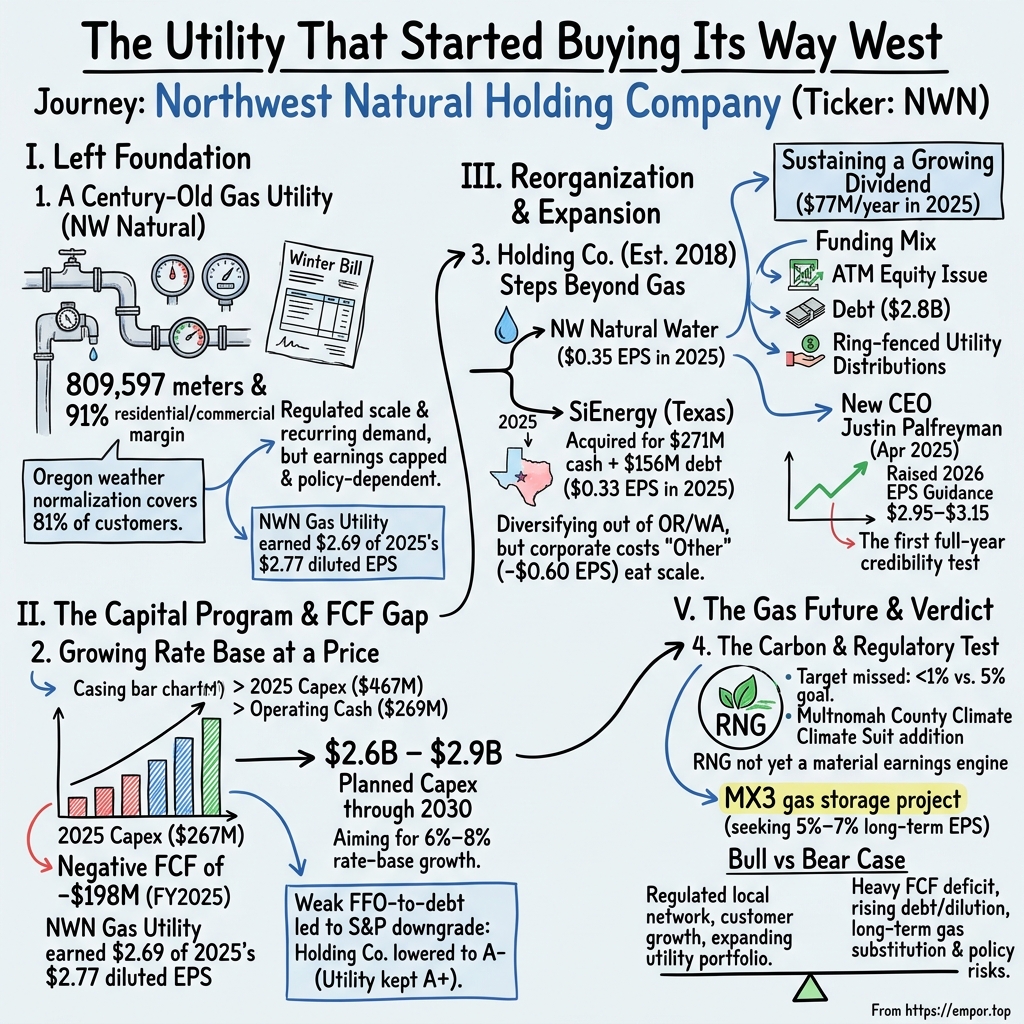
Northwest Natural Holding Company: The Utility That Started Buying Its Way West
I. The Winter Bill and the $2.9 Billion Plan
Somewhere in a Portland suburb, on the first properly cold morning of the year, a furnace clicks on. Nobody in the house thinks about where the heat comes from. It arrives through a steel or plastic pipe buried under the street, fed by a network that has been extended, patched, replaced and extended again for more than a century and a half. A few weeks later the bill arrives with the Northwest Natural name on it, and the homeowner grumbles about the number and pays it, the way people in the Pacific Northwest have been paying it since long before anyone alive was born.
That bill is the visible end of a much larger machine. Behind it now sits a holding company that owns not just the Oregon and southwest Washington gas utility the homeowner knows, but a fast-growing gas utility in the suburbs of Houston, Dallas and Austin, and a scattered collection of water and wastewater systems across five western and southern states.1 The parent is listed on the New York Stock Exchange under the same three letters the old utility always used, NWN, and it is trying to do something that sounds contradictory: run a sleepy, regulated, century-old business as a growth company.
On August 5, 2026, Justin Palfreyman, the company's chief executive for a little over a year, told investors that the first half had gone better than planned and that 2026 earnings per share should land in the upper half of the range the company had set, $2.95 to $3.15.2 It was a modest piece of good news delivered in the calm cadence of a utility call.
The bigger number sat in the background of every slide: between 2026 and 2030, the company expects to spend $2.6 billion to $2.9 billion on its networks.3 For a company whose entire stock-market value was about $1.9 billion in late October 2026, that is a plan to invest more than the business is worth on the stock exchange in five years.
Here is the puzzle that makes Northwest Natural interesting. The business is consistently profitable. It earned $2.77 a share in 2025 on a reported basis.3 It generated $269 million of cash from operations that year.1 And yet, after paying for new pipes, meters, storage and water plants, it was $198 million short.1 Free cash flow, the cash left after capital spending, was negative in every year from 2017 through 2025. The dividend, which the company has paid for decades, is therefore funded in part by money the company borrows or raises by selling new shares.
None of this is unusual for a utility in a heavy building phase. A regulated utility makes money by investing capital that regulators then allow it to recover, with a return, from customers over decades. Spending more than you generate is how the rate base, the pool of invested capital on which regulators let the utility earn, gets bigger. The real question is not whether the company is profitable. It is whether each new dollar of capital earns a return high enough to cover the cost of the debt and the new shares used to fund it, and quickly enough that per-share earnings actually rise.
Four questions run through this story. The first is whether the core utility, Northwest Natural Gas, can earn a fair return on a growing rate base, given that regulators decide what that return is and how fast it arrives. The second is whether the acquisitions, in Texas gas and in water, add durable earnings per share or mostly add reported scale.
The third is whether the parent company can finance its plan, given that its biggest cash generator is deliberately fenced off from it by regulators and rating agencies. The fourth sits under everything else: whether a natural gas network remains a sound asset to keep pouring money into, while customers, building codes and state climate policy push toward electric heat.
Start with where the earnings actually come from today, because the holding company's ambition can blur it. In 2025, the Oregon and Washington gas utility produced $2.69 of the $2.77 per share. The Texas gas business, SiEnergy, added $0.33. The water business added $0.35. And the parent and its other activities subtracted $0.60.3 Put plainly, the old gas utility still earns almost everything, the two growth businesses together earn about a quarter as much again, and the corporate layer above them eats most of what they add.
That last number deserves a pause. A holding company's costs are mostly interest on its own debt and the expense of running and buying things. When "Other" costs about as much as the two growth businesses earn combined, the strategic case for the structure rests on what those businesses will earn later, not on what they earn now.
So the story is about the price of regulated growth. Northwest Natural has a protected local network, a long record of dividends and a regulator that, most of the time, lets it recover what it spends. Against that it has a building program larger than its cash flow, a parent with a weaker credit rating than its utility, a share count that keeps rising, and a product that a growing share of policymakers would like customers to stop using. Whether the pieces add up depends on something the homeowner never sees: the rate order that decides what that winter bill is allowed to recover.
 Subscribe on LinkedIn
II. A Pipe Network with a Regulator at the Other End
Every autumn, before the first frost, a version of the same ritual plays out in Salem and in Olympia. Lawyers and analysts for Northwest Natural, for the state's consumer advocates and for industrial customers sit across from one another, sometimes literally and often through hundreds of pages of testimony, to argue about what the company is allowed to charge. A few weeks later the weather takes over. A cold December lifts gas use; a mild one depresses it. The utility's year is shaped by those two forces, the regulator and the thermometer, and only one of them can be argued with.
What does a gas utility actually sell? Not, mostly, the gas. Northwest Natural buys natural gas on wholesale markets from multiple suppliers and passes the commodity cost through to customers, adjusted each year through what Oregon calls the Purchased Gas Adjustment.1 If wholesale gas doubles, customers' bills rise, but the utility's profit, in principle, does not.
What the company earns on is the delivery: the pipes under the street, the meters on the houses, the storage fields that hold gas for cold snaps, the crews who answer gas-leak calls at two in the morning. Regulators approve a revenue requirement that covers the operating cost of all that, plus depreciation, plus a return on the capital invested. Rates, customer connections, weather and the timely recovery of capital costs matter more to earnings than how many therms flow through the system.1
That is why a gas utility is less like a shop and more like a toll road whose toll is set by a public commission. The company builds the road; the commission decides how much each car pays and how much profit the owner may make on the asphalt. If the owner spends too much, or spends imprudently, the commission can refuse to let the cost into tolls.
If costs rise between toll reviews, the owner absorbs them until the next review. That gap between spending and recovery is called regulatory lag, and it is the single most important reason utilities rarely earn the return regulators say they may earn.
At the end of 2025, Northwest Natural's gas utility had 809,597 meters, about 88% of them in Oregon and the rest in southwest Washington.31 Residential customers delivered about two-thirds of the segment's margin and commercial customers about a quarter, so together they accounted for roughly 91%, while industrial customers used about 40% of the gas but produced only about 5% of the margin.1 No single customer accounted for more than 10% of consolidated revenue.1 This is a business built on hundreds of thousands of furnaces and water heaters, which is both its strength and its exposure.
The strength is obvious. A family in Beaverton cannot call a rival gas company and ask it to run a second pipe down the street. Building a duplicate distribution network would be absurdly expensive, and regulators would not allow it anyway. In the language of competitive strategy, the network is a natural local monopoly: high fixed costs, near-zero marginal cost of serving one more house on an existing main, and a public franchise that keeps rivals out.
The other gas utilities in the region, Avista with about 386,000 retail gas customers across its territory and Cascade Natural Gas in smaller communities of Washington and Oregon, run their own pipes in their own towns.4 They are peers to be compared with, not competitors fighting for the same homes.
The limit is just as real. The family cannot choose another pipe, but it can choose another fuel. Heat pumps, electric water heaters, propane and fuel oil all compete with gas for the same job, and the company itself names electrification, building codes and energy policy as risks to future demand.1 A new subdivision built all-electric is a subdivision the pipe never reaches. So the moat protects the network that exists; it does not guarantee that the network keeps growing. In Oregon and Washington, the real competition is not another gas company. It is the electric utility, backed by state climate goals.
The regulator also caps the upside. Northwest Natural cannot raise prices because demand is strong or because customers love the service. It earns what the commission allows, and only if its costs stay in line. That makes the business stable but bounded. There is little evidence of brand-driven lock-in: customers stay because switching their furnace is expensive and inconvenient, not because they prefer the company.
Two mechanisms soften the weather risk, and they deserve explanation because they explain why this utility's earnings are steadier than a commodity seller's. In Oregon, a weather-normalization mechanism adjusts residential and commercial bills when temperatures stray from normal, so a warm winter does not gut the company's margin and a frigid one does not hand it a windfall.
About 81% of Northwest Natural's customers were covered by it.1 Washington has no equivalent mechanism, so the southwest Washington slice of the business still rises and falls with the thermometer.1 Purchased-gas adjustments, decoupling balances and other trackers shift some further costs onto customers, but not all operating and investment risk.
The test of the whole model is what happens in the rate case. On October 24, 2025, the Oregon Public Utility Commission approved settlements in Northwest Natural's general rate case, raising its revenue requirement by $20.7 million, or about 2%, with new rates from October 31, 2025.3 The order set the authorized return on equity at 9.5% on a capital structure of half equity and half debt.1
Then, on July 29, 2026, Washington's Utilities and Transportation Commission approved a three-year rate plan; the average residential bill in that state rose about $12.81 a month from August 1, 2026, with smaller steps in 2027 and 2028.5 Management said the Washington outcome delivered more than 80% of the revenue increase requested, again at a 9.5% return on equity.6
Read the Washington order closely and it shows exactly where the regulator's hand falls. The commission stripped a geothermal heating and cooling project in Vancouver out of rates after expected grant funding dropped sharply, excluded charitable contributions from customer bills, raised the past-due threshold before disconnection and barred collection agencies from reporting late gas payments to credit bureaus.5 None of those decisions is large. Together they are a reminder that the commission is not a rubber stamp; it is a counterparty with its own constituency.
So the local network is genuinely protected, and the recent orders show regulators willing to let costs into rates at a return near 9.5%. But an authorized return is a ceiling, not a promise. The company's consolidated return on equity was 7.7% in 2025 and 7.6% in 2014, and outside the 2017 loss year it has stayed between roughly 5.5% and 8.6% for the whole of the past decade.1
The gap between the 9.5% on paper and the high single digits in practice is regulatory lag, holding-company costs and expenses the commission would not allow. Closing that gap matters more to shareholders than winning the next headline rate increase. And the pressure on it is about to grow, because the bill for building the network has been climbing faster than anything else on the books.
III. The Rate Base Keeps Growing; So Does the Bill to Build It
In 2025, Northwest Natural Holdings spent about $467 million on its utility systems, a record.3 Revenue that year was about $1.29 billion, so for every dollar customers paid, the company put roughly 36 cents straight back into the ground.1 Management described much of the work in the language every utility uses, safety and reliability: replacing aging pipe, reinforcing the system, extending service to new customers.
Look at the trajectory and the step-up is plain. Capital spending rose from about $291 million in 2023 to about $467 million in 2025.1 Part of the last jump came from owning SiEnergy for a full year; the core Oregon and Washington utility alone spent about $355 million in 2025.1 For 2026, management plans $500 million to $550 million, funded by operating cash flow, about $150 million of net new long-term debt and $40 million to $50 million of new shares sold through its at-the-market program.6
Against that, cash from operations was $269 million in 2025.1 Total debt reached about $2.8 billion at year-end, up from about $2.0 billion a year earlier.1 Over the five years to 2030, the company's plan calls for rate base to grow 6% to 8% a year.3
How much of this spending is maintenance and how much is growth? The question matters because maintenance capex keeps the existing earnings stream alive, while growth capex is supposed to create new earnings. The company does not publish a clean multi-year split between the two. Its filings describe safety, reliability and customer-growth projects, but leave investors to infer the mix. That is a material gap. A utility that must spend $300 million a year just to stand still is a very different investment from one that spends $300 million to grow.
There is a second way to see the pattern, over a longer span. Across the twelve years from 2014 through 2025, the company reported about $763 million of net profit. Its operating cash flow over the same period was about $2.4 billion, more than three times as much.1 On the surface, that looks like a business that converts profit to cash exceptionally well. But after capital spending, cumulative free cash flow over those twelve years was negative by about $739 million, while dividends paid totaled about $696 million.
Why does operating cash flow run so far above profit? Mostly because of two accounting items. Depreciation, the annual charge for wearing out pipes and plants, reduces profit but costs no cash in the year it is recorded; in 2025 it added back about $190 million. Deferred taxes added another $35 million or so.1 Working capital swings too: management attributed a $32.4 million cash-flow benefit at Northwest Natural in 2025 to lower receivables at year-end, partly offset by lower deferred gas costs, lower decoupling balances and higher inventory.1
So high cash conversion does not settle the question. Depreciation is a non-cash charge only in the accounting sense. In the real world, the pipes it describes eventually need replacing, and the company is replacing them now. For a utility in this phase, the honest reading is that every dollar of depreciation added back to operating cash flow is a dollar already spoken for by the next capital budget, and then some.
Put the investment and the promise side by side. Management targets rate-base growth of 6% to 8% a year and earnings-per-share growth of 4% to 6% a year through 2030.3 The gap between those two ranges is the cost of funding: new debt carries interest, and new shares divide the earnings among more owners. If the MX3 gas-storage expansion reaches a final go-ahead, management says EPS growth could rise to 5% to 7%.6 That higher range is contingent on a project that does not yet have its final notice to proceed, and should be treated as an option rather than a plan.
What does the company's own record say about converting capital into per-share growth? Diluted EPS was $2.14 in 2014 and $2.77 in 2025.1 That is growth of a little under 2.5% a year over eleven years, well below the 4% to 6% now promised. Net profit grew faster, at roughly 6% a year, because the share count rose by about half over the same period.
The history does not reject the current target; the 2025 jump shows earnings can step up when rates reset and new territories are added. But it narrows it. The company has spent a decade investing heavily and growing per-share earnings at roughly half the pace it now says it will deliver. The test is whether the next five years break that pattern.
Returns on capital tell a similar, more nuanced story. One standard measure, return on invested capital, rose from about 4% in 2024 to about 7% in 2025 on a computed basis. That jump flatters the business. Measured on the company's own reported operating income of about $281 million in 2025, taxed at the year's rate and divided by debt plus equity, the return comes out closer to 5%.1
Better than 2024, but not a transformation. And the business still turns over its assets only about once every five years, because a utility's assets are pipes that last half a century. Low turnover is not a flaw; it is the nature of the model. It does mean small changes in allowed returns or lag swing the value of the whole enterprise.
The conclusion is not that Northwest Natural is in trouble. The negative free cash flow is the expected signature of this investment cycle.
The proof points are return on equity moving toward the authorized 9.5%, rate base growing inside the 6% to 8% range, and EPS growth that finally keeps pace with net profit growth instead of being diluted away. The company's structure since 2018 was designed to make that growth possible beyond the gas utility. Whether it has is the next part of the story.
IV. The Holding Company That Moved Beyond Oregon
Northwest Natural traces its roots to 1859, the year Oregon became a state, when gas lamps were still a novelty on Portland's streets.1 That history matters here for one reason only: it explains why the company owns a dense, entrenched local network in one of the West's fastest-growing metros. It does not mean the listed company has existed in its current form for 167 years. The parent investors own today is much younger.
On October 1, 2018, Northwest Natural completed a reorganization that put a new parent, Northwest Natural Holding Company, on top of the utility.7 Shareholders of the old utility automatically became shareholders of the new holding company, one share for one, and the stock kept trading as NWN.7 The utility kept operating as before, the gas kept flowing, and the change required approval from the Oregon, Washington and California commissions and the utility's shareholders.7 To a casual observer nothing happened. In practice, the company had built itself a vehicle.
The stated purpose was explicit. The structure, the company said, provided further separation between the gas utility, the water utility and other businesses, and let the holding company respond to growth opportunities such as its regulated water strategy in a more agile and efficient way.7 Translated: the gas utility would be walled off from riskier ventures, and the parent would be free to buy things without dragging the utility's balance sheet and regulators into every deal.
There was a recent lesson behind the caution. In the fourth quarter of 2017, Northwest Natural wrote down its stake in the Gill Ranch gas-storage facility in California by $192.5 million before tax, about $141.5 million after tax, after a strategic review and storage contracts signed at lower values than expected.8 It was the reason 2017 ended in a full-year loss.
The company agreed to sell its interest in Gill Ranch in June 2018.8 Gill Ranch had been the company's big move outside the regulated core; it was unregulated, merchant storage, and it failed. The holding-company structure and the pivot to regulated water and regulated gas acquisitions can be read as the response: grow, but grow in businesses where a regulator sets the return, not the market.
The water strategy started small and stayed patient. Through NW Natural Water, the company bought local water and wastewater systems one by one, many of them small, family-run or community-owned utilities that needed capital to meet modern standards. By the end of 2025, the water business operated in Oregon, Washington, Idaho, Arizona and Texas, and had 80,703 meters, up from 76,401 a year earlier.31 Recent additions included the Pines and Avion Water systems.1
It is tempting to treat water as a sideline. The numbers say otherwise. In 2025, NWN Water contributed $0.35 of earnings per share, slightly more than the newly acquired Texas gas utility.3 Water utilities are, if anything, more insulated from the energy-transition debate than gas: nobody is electrifying their tap. Regulators across the US have generally welcomed well-capitalized buyers for small systems. Still, water is much smaller than the core gas business, roughly a tenth of its meters, and its growth has come substantially through acquisition. Its organic customer growth was about 3.4% in the twelve months to June 2026.6
The man who ran water became the man who runs the company. Justin Palfreyman joined Northwest Natural in 2016 after a career in investment banking covering power, energy and infrastructure, and led NW Natural Water before becoming president in 2023.9 When the board named him successor to the retiring CEO David Anderson in May 2024, the chair, Malia Wasson, said the choice reflected his strong performance as president of NW Natural Water.9 The person most identified with the diversification strategy now sets the whole company's capital priorities. That is a coherent choice. It also means the CEO is judged, in part, on a strategy he helped design.
Now put the segment economics ahead of the headline growth. Consolidated revenue rose about 12% in 2025.1 Combined gas and water connections grew about 11%, which management described as mainly driven by the SiEnergy acquisition.3 The Oregon and Washington gas utility itself grew from 805,529 meters to 809,597, about half a percent.3 Management called 2025 its strongest organic customer growth in nearly two decades, a phrase that captures both truths at once: the core is growing faster than it has in years, and still growing slowly.3
The reporting changed too. In 2025, the company began showing SiEnergy and NWN Water as separate segments, and SiEnergy was excluded from that year's internal-control audit because it had been acquired during the year; it represented about 9.6% of consolidated assets and 5.1% of revenue.1 Anyone comparing 2025 with earlier years is comparing a different company. The three-year growth rates in revenue and profit, which run above the ten-year rates, are partly the effect of buying businesses rather than growing them.
And then there is "Other." The parent and its non-utility activities cost $0.60 a share in 2025 on a reported basis, or $0.44 after excluding items management treats as one-time.3 Much of that is interest on the debt the holding company has raised to buy and build. The structure that opened the door to acquisitions also created a cost center that the operating businesses must outrun.
The holding company, in short, did what it was designed to do. It created a second and third earnings stream and moved the company beyond the Pacific Northwest. It also left one structural question unanswered: if the parent is the growth engine, but the utility below it is fenced off, how does the parent pay for growth without weakening either? The answer starts in Texas.
V. Texas Added Growth—and a Price That Needs Testing
On November 18, 2024, Northwest Natural Holdings announced that it would buy SiEnergy, a gas utility most of its Oregon customers had never heard of, serving new subdivisions on the edges of Houston, Dallas and Austin.10 The pitch was growth of a kind the Pacific Northwest could no longer offer.
SiEnergy served about 70,000 residential and commercial customers, but it had a contracted backlog of more than 180,000 future connections, and over the previous five years its rate base had compounded at about 26% a year and its customer count at about 22%.10 In Oregon, Northwest Natural was adding customers at well under 1% a year. In the Texas Triangle, developers were laying out whole towns, and SiEnergy was the company putting gas mains into them before the houses went up.
The announced price was $273 million in cash plus the assumption of $152 million of debt, paid to an affiliate of the private-equity firm Ridgewood Infrastructure.10 The deal closed on January 7, 2025.113 By the company's closing accounting, the final figures were about $271 million of cash and $156 million of assumed debt, subject to customary adjustments.1 Alongside the deal, management raised its rate-base growth target from 5%–7% to 6%–8% a year and said SiEnergy would need $450 million to $650 million of capital over the following five years.10
That last figure is the real price. A buyer of a fast-growing utility pays twice: once for the business, and again, every year, for the pipes needed to keep up with the growth that justified the purchase. In SiEnergy's case, the second bill could be larger than the first.
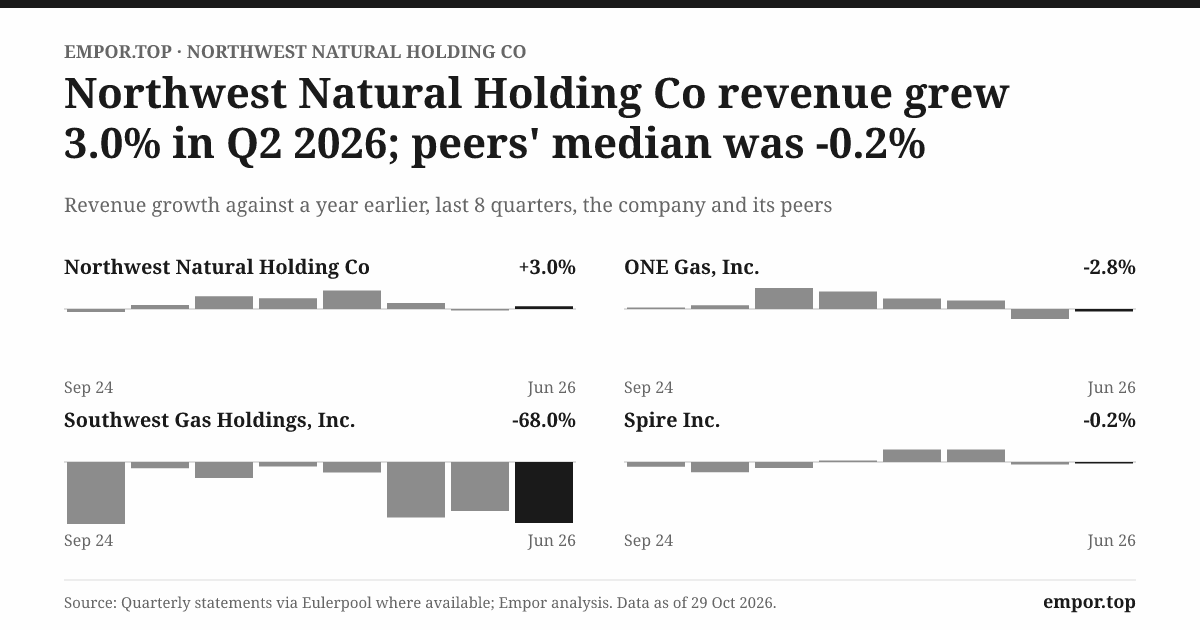
Size the result honestly. In its first year under new ownership, SiEnergy contributed $0.33 of earnings per share.3 By the end of 2025 it had 89,676 meters, and management said its organic customer growth was running above 15% in mid-2026.36 Its contribution grew in the second quarter of 2026, to $0.05 a share from $0.03 a year earlier.6 That is genuine momentum. But it is also acquired growth, and it should not be confused with what the Oregon and Washington utility is doing on its own. When the holding company reports combined customer growth of about 11%, almost all of that came from buying SiEnergy.3
Was the price right? The honest answer is that the disclosures do not let an outsider say. The company does not publish a standalone EBITDA figure for SiEnergy that would allow a clean purchase multiple, and it does not provide a set of comparable transactions. What can be computed is the price against the rate base. SiEnergy's rate base was about $247 million at the end of 2024.10 The combined cash and assumed debt of roughly $427 million was therefore about 1.7 times the capital on which Texas regulators allow a return.
Paying a premium to rate base is how buyers pay for growth that has not yet been built; it means a portion of the price can only be earned back if the backlog turns into connected, earning customers on schedule. Goodwill on the balance sheet reflects that premium, but goodwill alone is not evidence of overpayment. The verdict on SiEnergy will be written by its earned returns over the next five years, not by the size of the check.
The financing reveals the trade-off. The company said at announcement that it intended to fund the cash portion with junior subordinated notes in the first half of 2025, and that it did not plan to issue common stock to directly fund the deal.10 Holdings' debt today includes 7.0% junior subordinated debentures due 2055.12
A 7% coupon is expensive for a company whose regulated businesses are allowed returns on equity of about 9.5% and whose borrowing costs on senior notes run in the mid-5% range.12 Junior subordinated debt also sits uncomfortably between debt and equity: rating agencies give it partial equity credit, which is why companies use it, but it still pays a fixed coupon every year whether the acquired utility earns its return or not.
And the shares kept coming anyway, if not directly for SiEnergy. Northwest Natural Holdings had about 35.5 million shares outstanding at the end of 2022, and 41.6 million at the end of 2025.131 In 2025 alone it sold about 1.18 million shares through its at-the-market program for roughly $47 million of net proceeds.1 Here is what that dilution does to the per-share story.
Between 2022 and 2025, net profit rose from about $86 million to about $113 million, a gain of nearly a third.1 Diluted earnings per share rose from $2.43 to $2.77, a gain of about 14%.1 More than half the profit growth was absorbed by the larger share count. That is not a scandal; utilities routinely issue equity to fund rate base. It is the central arithmetic every shareholder in this story has to watch.
SiEnergy also belongs to a longer acquisition program. Over the years since 2018, the water business bought system after system, building the second earnings stream that is now as large as Texas gas. But rating agencies counted the cost of that program too. When S&P Global Ratings downgraded the holding company in 2024, it named acquisitions alongside higher capital spending, inflation and interest rates among the reasons its credit metrics had weakened.14 The company's growth by acquisition is real, but it has not been free; part of the price has been paid in credit quality.
What about the Texas growth itself? The expanding customer base is a potential advantage: in a market where new homes still connect to gas, a utility that builds into master-planned communities wins customers no rival can easily take. But SiEnergy is still a regulated utility. Its customers' rates are set by Texas regulators, and every new subdivision needs pipe before it pays a return. The right measure is not how many meters SiEnergy connects, but how much the segment earns per dollar invested in it, net of the financing the parent raised to buy it.
The Texas deal gave Northwest Natural growth it could not find at home. It also made the parent company more dependent on capital markets and more exposed to whether that growth earns its keep. That brings the story to the money itself, and to a dividend that has been a promise for decades.
VI. A Dividend Paid with Borrowed and Newly Issued Capital
Rating agencies rarely produce drama, but S&P Global Ratings' treatment of Northwest Natural in 2024 came close. In April that year it lowered the holding company's rating from A+ to A.15 In November it lowered it again, to A−.14 The operating utility, Northwest Natural Gas, kept its A+ rating with a stable outlook.14 Same family, same headquarters, same management team, two notches apart. The gap is the clearest picture available of how the outside world sees the structure Northwest Natural built in 2018: a sturdy utility below, and a more stretched parent above.
S&P's reasoning was precise. It pointed to the holding company's ratio of funds from operations to debt, a measure of how many years of cash flow it would take to pay off the debt, and found it had weakened to 13.8% in 2022 and 11.8% in 2023.14 Think of it like a household's debt relative to its annual take-home pay: at 12%, it would take roughly eight years of every dollar of operating cash flow to retire the debt. S&P cited elevated capital spending, inflation, higher interest rates, higher cash taxes and acquisitions, and said it expected the ratio to recover to 13% to 15% from 2025, supported by effective regulation, the Oregon rate increase and customer growth.14
The more important point in S&P's analysis was structural. The utility is ring-fenced: regulatory and legal protections restrict how much cash the parent can pull out of it, so that a stumble at the holding company cannot drain the utility customers depend on. S&P estimated that the utility generated about 95% of the parent's cash flow, and said those restrictions materially limit the parent's access to it.14 In plain terms, the holding company's best asset is a bank account it cannot freely withdraw from.
Now follow the money. In 2025, the holding company paid about $77 million in dividends.1 That was about 68% of net profit, the lowest payout ratio in more than a decade; over the previous twelve years the ratio had ranged between about 68% and 92%, with a median near 81%.1 The indicated annual dividend stands at $1.97 a share.3 By accounting earnings, the dividend is covered comfortably, and better covered than it has been in years.
By free cash flow, it is not covered at all. With free cash flow negative by about $198 million in 2025, every dollar of dividend was in effect financed by the combination of new debt, new shares and the cash-flow cushion from depreciation that the capital budget had already claimed. That is the pattern of the past decade: across 2014 to 2025, cumulative dividends of roughly $700 million were paid while free cash flow ran negative by a similar amount.
Management's own target gives a further clue. On the August 2026 call, the CFO, Raymond Kaszuba, set out a dividend payout target of 55% to 65%.6 The 2025 payout of net profit sat just above that range. The message is that management wants earnings to grow faster than the dividend for a while, building more retained earnings into the equity base and leaning less on new shares. That is a sensible direction for a company in a capital cycle. It also implies dividend growth slower than earnings growth for some time.
The funding sources line up like this. Operating cash flow covers a large part of the capital budget. Debt fills much of the rest: the holding company issued $125 million of long-term debt in the first half of 2026 and another $70 million of parent notes in August.12
The water business raised its own debt for the first time, a $75 million inaugural bond in June 2026, rated A−.6 Shares fill the gap: about 1.01 million were issued through the at-the-market program in the first half of 2026, and management said it expected equity needs through 2030 to be met through what it called disciplined use of the ATM program.126
Separate the entities, because that is how creditors do it. At June 30, 2026, the holding company had about $2.50 billion of long-term debt on a consolidated basis; the utility alone had about $1.54 billion.12 Roughly $1 billion therefore sits at the parent, at SiEnergy and at the water business. The parent's senior notes mature between 2028 and 2034 at coupons of roughly 5.35% to 5.86%, and its junior subordinated debentures run to 2055 at 7%.12
About $125.7 million of long-term debt was scheduled to mature within twelve months.12 The utility, for its part, was well inside its covenant at the end of 2025: its debt was about 50.6% of capitalization against a 70% limit.1 Management cited about $628 million of available liquidity at the end of June 2026.6
None of this describes a company in distress. There is no covenant breach and no refinancing wall. What it describes is a company whose growth plan depends on continuous access to capital markets, on terms that are only as good as its credit metrics.
A skeptical investor would put three questions to the board. First, what return is each project and acquisition expected to earn, and does it clear the cost of the specific capital that funds it, including 7% junior debt and shares sold at a 15-times earnings multiple? Second, how much dilution is acceptable, and is there a ceiling on annual ATM issuance? Third, if FFO-to-debt does not recover into the range S&P expects, what gets deferred first, new acquisitions, discretionary capital or dividend growth? The company has offered targets and funding mix; it has not published that hierarchy.
The dividend, then, is safe in the sense that earnings cover it and the company has the liquidity to keep paying it. It is not self-funding. Its future growth depends on the parent's credit, which depends on whether the capital program lifts cash flow faster than debt. And those judgments fall, in the end, on the people running the company.
VII. The New CEO's First Full Year Is the Credibility Test
David Anderson had run Northwest Natural since August 2016, after joining the company in 2004.9 He guided it through the Gill Ranch write-down, the creation of the holding company, the first water deals and the decision to buy SiEnergy. In May 2024 he announced he would retire on April 1, 2025, and the board named his successor more than ten months in advance.9 That kind of long, orderly handoff is typical of utilities. It is also a signal: the board wanted continuity, not a change of direction.
The successor, Justin Palfreyman, is a different type of utility CEO. Most gas-utility chiefs come up through operations, engineering, regulatory affairs or law. Palfreyman came from investment banking, where he advised power, energy and infrastructure companies, before joining Northwest Natural in 2016.9 He holds a business degree from Pacific Lutheran University, an MBA from the University of Chicago's Booth School and a public-policy master's from its Harris School.9
He ran business development and strategy and led the water business before becoming president of both the holding company and the utility in May 2023.9 In other words, the company is now led by the person whose career inside it has been about doing deals, and who personally argued for the strategy of growing beyond Oregon gas.
That background cuts both ways. A banker's instincts suit a company whose central challenge is financing: matching capital sources to projects, reading rating-agency signals, pricing acquisitions. They also carry a familiar risk, that deal flow becomes its own justification. The best test of which way it is cutting is not a biography but a record.
So far, the record is short and mostly favorable. Palfreyman's first full calendar year in the top job is 2026. The company set 2026 earnings guidance of $2.95 to $3.15 per share in February.3 In August it said it expected to land in the upper half, after first-half earnings of $2.33 a share, compared with $2.28 on an adjusted basis a year earlier.6
Inside the second quarter the picture was more mixed: SiEnergy grew, but the core gas utility and water both earned less than a year earlier, at $0.09 and $0.05 a share against $0.12 and $0.07.6 Second quarters are small for a heating utility, so a few cents can come from timing. Still, the growth in the quarter came from Texas, not from the core.
The regulatory scorecard during his tenure is solid. Oregon's 2025 rate order came through at a 9.5% return on equity. Washington's multi-year plan was approved in July 2026 with more than 80% of the requested increase, by management's account.6 An Oregon alternative rate mechanism filing, designed to recover specific capital investments between full rate cases, reached a multiparty settlement of $13 million against an original request of $15.6 million.6 These are not spectacular wins, but they are the kind of steady outcomes a regulated utility needs.
Pay tells you what the board is rewarding. In 2025, Palfreyman's reported total compensation was about $3.70 million, of which about $2.37 million was realized.16 The named executives' annual incentive plan paid out at an average of 138.8% of target, in a year when reported EPS rose by more than a third, to $2.77.163 That jump owed a good deal to new Oregon rates, the first year of SiEnergy and a weak 2024, when the dividend absorbed more than 90% of earnings.
An incentive that pays well above target on a rebound year is not unusual. What investors should watch is whether the measures reward per-share outcomes after dilution, or totals that acquisitions and equity issuance can inflate. On that point, the proxy's annual measures are anchored on earnings and operating goals, and the long-term awards are granted in shares, which means executive pay itself adds a little to the share count each year.
Shareholders did not object. At the May 2026 annual meeting, the say-on-pay vote passed with about 30.96 million votes for and 0.91 million against.17 Director support was broad; the highest withhold count, for Nathan Partain, was under a million votes.17 The register is institutional rather than controlled: at the end of 2025, BlackRock held about 16% of the shares, Vanguard about 10% and State Street about 5%, and no controlling shareholder appears in the proxy.16 With index funds as the largest owners, the board answers mostly to the patient, passive end of the market.
There is one more detail worth noticing, because it says something about how the story is being tested. On the August 2026 earnings call, after the prepared remarks, the operator introduced a single analyst, from Wells Fargo. The line did not work; Palfreyman said the company could not hear him, promised a follow-up offline, and the call ended.6 It is a small, technical accident, not evasion. But it meant that the company's raised outlook, its MX3 timetable, its funding plan and its parent-liquidity position received no live public questioning that day. Investors who want to test the plan must do it themselves, against the filings.
The audit trail is clean. The company received an unqualified audit opinion for 2025, with effective internal controls, and with SiEnergy excluded from the controls audit because it was acquired that year.1 The auditor's critical audit matter was regulatory assets and liabilities, the accounting judgment about which costs will be recovered from customers.1 That is the natural pressure point for any utility, and it is exactly where the next chapter of this story lies: what customers, and regulators, will be willing to pay for in a world trying to use less gas.
VIII. What the Gas Future Can—and Cannot—Promise
In 2019, Oregon passed a law that let gas utilities pursue renewable natural gas, methane captured from landfills, dairies and wastewater plants and cleaned up to pipeline quality. Northwest Natural embraced it. The voluntary goals under that law were to procure renewable gas equal to 5% of deliveries to retail customers by 2024, 10% by 2029 and 30% by 2050.18 Renewable natural gas, the company argued, could let the existing pipe network carry a lower-carbon product without forcing every household to replace its furnace.
Then 2024 arrived. By the end of 2023, renewable gas accounted for less than 1% of what the company delivered, and the company said it did not expect to hit the 5% goal for 2024, blaming policy and regulatory uncertainty.18 In July 2024 the Oregon Capital Chronicle reported that Northwest Natural had once again missed its own targets to offset emissions with renewable gas.19
ProPublica's investigation that September carried the blunt headline that the company sold as much fossil gas as before.18 A company spokesman argued that it did not matter where a renewable molecule came from if the goal was reducing emissions, and that unsteady support from policymakers had made the path needlessly difficult.18
There is a technical distinction that matters here. By its 2025 annual report, the company said it had secured exclusive rights to purchase renewable gas equal to about 3% of its annual sales volume.1 A right to purchase is not the same as gas delivered to customers, at a cost they and regulators accept.
Contracts with project developers can be signed long before the digesters are built, and projects can slip or fail. So the 3% figure is evidence of progress in procurement, not proof of a scalable, economic product. Measured against the company's own earlier goal, the record is a miss, and it is the strongest evidence against treating renewable gas as a durable defense of the core network.
The scarcity is physical, too. A state inventory estimated that renewable gas from current technology and waste streams could amount to roughly 10 billion cubic feet a year, a small share of Oregon's gas use; critics argued it could meet less than 7% of total demand.18 Even with perfect execution, renewable gas looks like a partial blend, not a replacement.
The real risks to the core are simpler and harder to fight. Electrification is the first: heat pumps that both heat and cool, encouraged by subsidies and by state climate goals. Building codes are the second: cities and states can make gas hookups in new construction more costly or less common. Customer preference is the third, and the fourth is whether regulators will let the company recover transition-related investment through rates. Northwest Natural has fought on several of these fronts.
It sued over Oregon's Climate Protection Program, which the Oregon Court of Appeals invalidated in December 2023 on procedural grounds.18 In Eugene, as the city debated the future of gas in new homes, a political group called Eugene Residents for Energy Choice raised $1,014,300, all but $220 of it from Northwest Natural.18 The climate program has since been re-established, and the company expects its compliance costs to flow through to customers via the annual gas-cost adjustment.1 That is a cost-recovery mechanism, not a protection against demand loss.
The legal exposure deserves proportion. In October 2024, Multnomah County added Northwest Natural to its $51 billion lawsuit against fossil-fuel companies over the deadly 2021 heat dome.20 The holding company was dismissed from the case in October 2025; the utility is defending the claims and does not expect a material effect.1 Environmental remediation of old manufactured-gas sites is the more persistent cost, recovered through a regulatory mechanism that in Oregon includes an earnings test.1 Neither is the main threat. The main threat is a slow one: fewer new gas customers, then flatter use per customer, then a larger network spread across fewer paying users.
Which brings the story to the project management now holds up as its most promising growth lever. MX3 is a planned expansion of the company's Mist underground gas-storage field in Columbia County, Oregon, adding 4 to 5 billion cubic feet of capacity at a cost of about $300 million.6
It would be regulated by the Federal Energy Regulatory Commission rather than state commissions, and management said it is fully contracted under 25-year agreements, at a 12.5% return on equity with a 50% equity share.6 Columbia County unanimously approved the conditional use permit; as expected, an appeal was filed with Oregon's Land Use Board of Appeals.6 Management expects to give notice to proceed by the end of 2027 and to bring the project into service in 2029.6
Do the arithmetic and the logic of the higher growth target becomes clear. Half of $300 million is $150 million of equity; a 12.5% return on it is about $19 million of annual net income, or roughly 45 cents a share on the current share count. That is enough, in a single project, to lift five-year growth by about a percentage point, which is exactly why management says the long-term EPS target rises from 4%–6% to 5%–7% once MX3 reaches notice to proceed.6
Storage that helps electric generators and the region's grid manage peak demand may also hold value even if residential gas use declines. Precedent supports the concept: the company's earlier North Mist expansion is dedicated to Portland General Electric under a 30-year contract with options to extend.1
Precedent also warns against it. Gill Ranch was a costly failure.8 The difference is that Gill Ranch sold storage at market prices, while North Mist and MX3 are contracted and regulated. That difference is real, but it does not eliminate risk: the land-use appeal, final regulatory approvals, construction cost and the creditworthiness of counterparties management has not named on its calls all stand between the plan and the earnings. Until notice to proceed, MX3 is an option with a good-looking strike price, not a delivered result.
The story here is not about artificial intelligence or technology disruption in the usual sense. A regulated pipe network will not be undone by software. Its future depends on what customers and policymakers choose for heat and energy, and on whether the network can find new jobs, like storage for power generation, while its old job shrinks. With that settled, the investment case can finally be weighed.
IX. Analysis & Bear vs. Bull Case
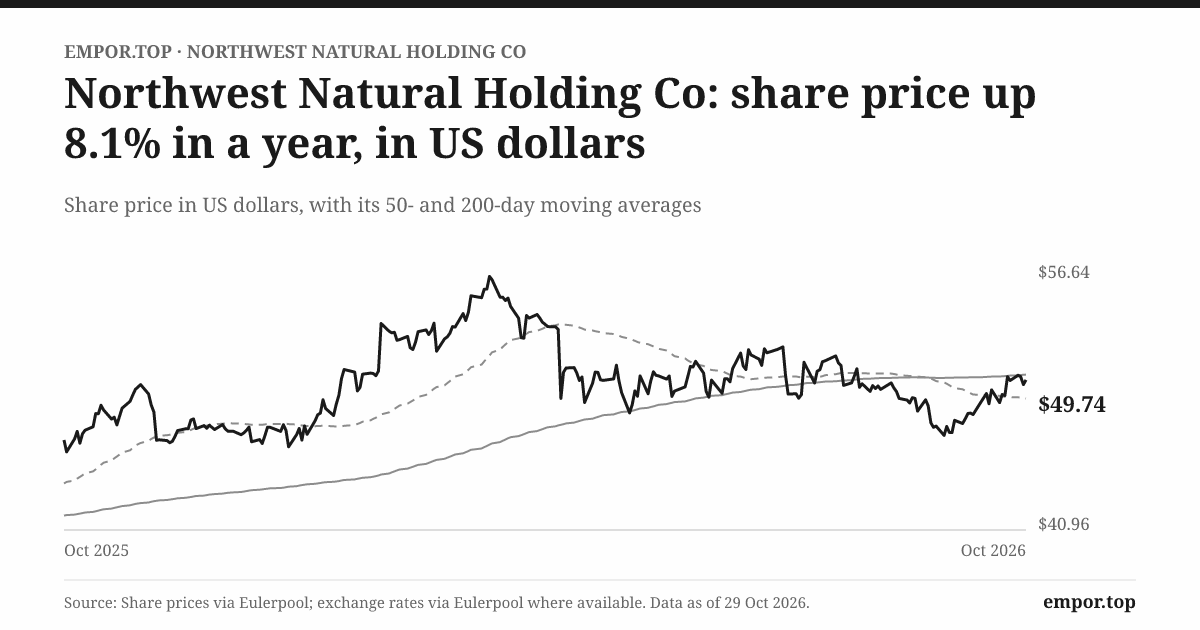
At the end of October 2026, Northwest Natural Holdings' shares traded at about $49.74, roughly 11% below their 52-week high, valuing the equity at about $1.9 billion. Add the debt and the whole enterprise was worth about $4.6 billion, which means lenders, not shareholders, have the larger claim on the business.
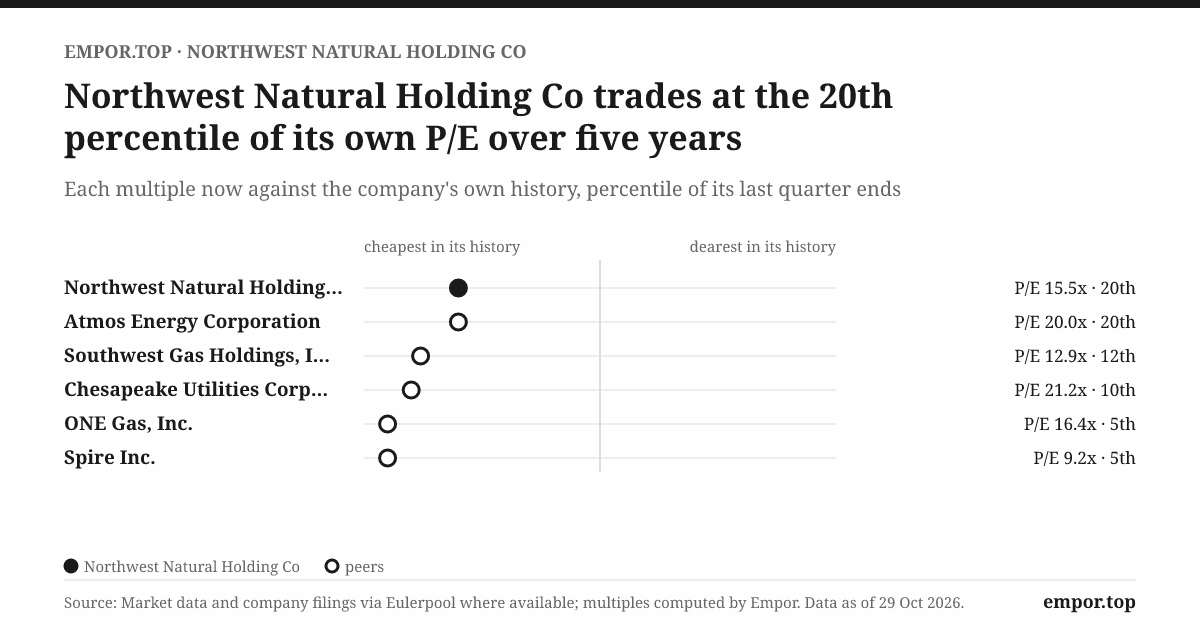
The stock traded at about 15.5 times trailing earnings, against a five-year median of about 17.1 times, offered a dividend yield of about 4%, and sat at about 1.4 times book value. Its free-cash-flow yield was about minus 14%, a number that sounds alarming until one remembers that it describes a capital program rather than a cash drain from operations.
What does that price appear to assume? An earnings yield of about 6.4% on a business whose earned return on equity has hovered around 8% suggests the market is not paying for much improvement, but not pricing in decline either. A modest discount to the stock's own recent history says investors are more cautious than they were, plausibly because of the rise in interest rates, the downgrade of the parent and the steady flow of new shares. It is a muted verdict, not a dramatic one. The question is which way the evidence should push it.
Where the edge holds, and where it thins
Start with the structure of the industry, and run the five forces one at a time, because each one points to a specific piece of this company's evidence.
The threat of new entrants is close to nil, given the existing local networks and state franchises. Supplier power is low: gas is bought from multiple suppliers at liquid market hubs, and its cost passes through to customers.1 Buyer power is the interesting force, because the buyer is not really the household. It is the state commission that sets the rate, backed by consumer advocates and, increasingly, by climate policy.
Washington's 2026 order showed that power at work, trimming the company's request, removing a project from rates and excluding charitable spending.5 Rivalry among existing firms is weak, because neighboring utilities like Avista operate their own territories. The threat of substitutes is the force that matters most: electricity can do the job gas does in the home, and policy is tilting toward it.
So the industry looks attractive on four forces and dangerous on one. That pattern is the core of the case, both bull and bear.
Hamilton Helmer's seven powers framework sharpens the point. Of the seven, Northwest Natural clearly has one: a cornered resource in its exclusive local franchise and network, reinforced by scale economies. Switching costs exist, but protect the customer relationship only partly, because the cost of switching from gas to a heat pump falls each time a furnace wears out.
There is no network effect in the modern sense, no meaningful brand power that lets the company price above its regulated return, no counter-positioning against a rival model and no process power that the record makes visible. The Mist storage field is the one asset with a claim to something more, because underground storage depends on geology that cannot be replicated at will; the long-term contracts behind North Mist and MX3 are the closest thing this company has to a commercial moat.
Those powers protect the existing network but do not make it grow. And the most important limit is the one that regulation itself imposes: whatever advantages the company has, it can only earn what the commission allows, so the moat defends a return, it does not enlarge it.
The case, argued both ways
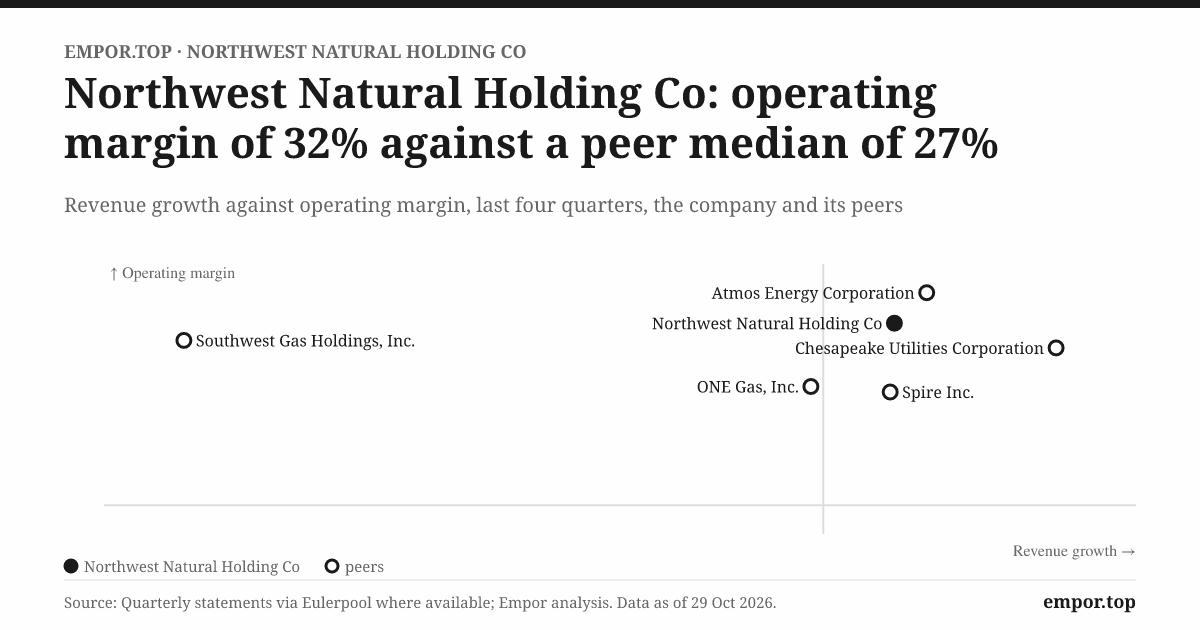
The bull case is easy to state. Northwest Natural owns a local network in a growing metro, operates under regulators who have recently approved rate increases at a 9.5% equity return in both of its home states, and has diversified into faster-growing Texas gas and steadily growing water.
The company says its plan calls for rate base to compound at 6% to 8% a year, and in August it said it expected 2026 earnings to land in the upper half of guidance. MX3, if it proceeds, adds a high-return, contracted, federally regulated project. The dividend is better covered by earnings than at any time in more than a decade. On this view, the stock's discount to its own history is an opportunity created by temporary financing noise.
The bear case is just as concrete. Regulators set the return, and the company has rarely earned what they allow; its consolidated return on equity has spent the last decade in the high single digits. Capital spending has run ahead of operating cash for nearly a decade, and the plan through 2030 keeps it that way.
The parent cannot freely tap the utility's cash, its credit rating has been cut twice, and its funding depends on debt markets and a steady drip of new shares. Per-share earnings grew at less than half the rate of net profit growth over the past decade because of dilution. And the core product faces a policy environment that wants less of it, while the company's main answer, renewable gas, missed its own first milestone badly.
Which side does the evidence favor? On the core moat, the history leaves the claim intact but narrows it: the network is protected, but the protection is of the existing customer base, not of growth, and organic customer growth in Oregon and Washington is around half a percent a year. On acquisitions, the history leaves the claim unproven: SiEnergy and water clearly add earnings, but the company has not yet shown that they add earnings per share after the cost of the debt and shares used to buy and build them.
On financing, the history narrows the bull case: the parent is not stressed, but its rating trajectory and dilution record mean the plan must work roughly as promised to avoid more of both. On the energy transition, the history rejects the strong version of the bull claim, that renewable gas protects the network, and leaves only the weaker version: that the network can be useful for storage and peak demand even as residential use flattens.
Growth deserves one more careful look. Over three years, the company's revenue grew about 7.5% a year and net profit about 9.5% a year, faster than the ten-year rates of about 6% and 8%.1 That looks like acceleration, and partly it is. But the 2025 step includes a full year of an acquired Texas utility, newly separated segments and new Oregon rates. Strip out the acquisitions and the core gas business is growing customers slowly and earnings mostly through rate cases.
A skeptical long-short investor would frame it this way. If growth is mostly acquired, if capital remains externally funded, and if the regulated gas base becomes gradually less attractive, then the plan works only as long as markets keep funding it at reasonable prices. What changes in that plan before ratings or the dividend come under pressure? The company has said equity will come through the ATM program; it has said it wants a lower payout ratio; it has not said which projects it would defer. That missing answer is the main open question in the case.
Three measures will tell investors more than any others. The first is segment earnings per share by business, especially whether the core gas and acquired businesses keep growing, and whether the parent's drag shrinks.
The second is the earned return on equity against the authorized 9.5%, alongside rate-base growth against capital spending; the consolidated return was about 8% over the twelve months to June 2026, moving in the right direction.112 The third is the parent's funds-from-operations-to-debt ratio and the share count; S&P expected the ratio to reach 13% to 15% from 2025,14 while the share count had risen to about 42.1 million by April 2026.16
Valuation should be read in that light. A 15.5 times multiple is not demanding for a regulated utility that delivers 4% to 6% per-share growth and a 4% yield. It is not cheap for one that delivers 2% to 3%, which is what the last decade produced. The price, in other words, sits between the two histories the company could have from here.
The resolution is measurable against the company's 2030 targets. If the segment returns, the debt metrics and the per-share earnings arrive on that path, the bull case will have been earned. If they do not, the bear case will have been proven by the company's own targets. That is the kind of test investors rarely get, and it is the lesson of the whole story.
X. Playbook: Business & Investing Lessons
Every story about a utility risks becoming a story about spreadsheets. This one is better than that, because Northwest Natural has spent the past decade running an experiment that every investor in capital-heavy, regulated businesses can learn from. Four lessons stand out, and each belongs to a specific moment in this company's history.
The first lesson comes from the winter bill and the commission hearing behind it. Northwest Natural's protected network has not translated into its authorized return in practice.
Regulatory lag, disallowed costs and the holding company's expense help explain the gap. For investors, the lesson is that the moat and the return are separate questions. A regulated monopoly can protect the pipe, but it cannot guarantee the return. Look at the earned ROE, not the authorized one, and ask what closes the gap.
The second lesson comes from Texas and from the share register. Acquisitions added growth and a second earnings stream, while dilution absorbed much of the profit growth before it reached shareholders.
None of that makes the deals bad. It means the way to judge them is per share, after their financing. Growth bought with debt and shares only counts when it grows earnings per share. Founders and boards of acquisitive companies should be held to that line, not to customer counts or revenue.
The third lesson comes from the cash-flow statement. It showed the gap between accounting cash generation and capital spending.
The difference is depreciation that is not really free, because the pipes it describes must be replaced and extended. Cash conversion is not free cash flow when the network must be rebuilt and expanded. In capital-heavy businesses, the right question is what the business must spend to stand still, and the honest answer is often most of what it earns.
The fourth lesson comes from the missed renewable-gas target. Northwest Natural set out a plausible, even admirable, vision: keep the pipes, change what flows through them. The gap between procurement rights and gas delivered at scale shows how far that vision remains from a working product.
Rights, pilots and announcements are not products. A climate option is only an option until customers receive it at scale and the economics work. That applies equally to MX3, to hydrogen blending and to any future project held up as the answer to a structural decline.
Taken together, these lessons describe a way of reading this company and companies like it. Follow the path from capital to rate base to allowed return to earned return to per-share earnings, and refuse to let any single step stand in for the whole chain. Northwest Natural's story rewards investors who do that work and punishes those who mistake scale, acquisitions or operating cash flow for value creation.
XI. Epilogue
Tonight, October 29, 2026, Northwest Natural stands two days from its next small test. The Oregon alternative rate mechanism settlement was slated to put new rates into effect on October 31.6 The Washington increase took effect on August 1.5 The company has told investors to expect 2026 earnings in the upper half of its range. The third-quarter report, due in the weeks ahead, will show whether the summer quarters, always the weakest for a heating utility, stayed on track.
Beyond this autumn, the calendar is crowded with moments that will decide the story. In 2027, Washington's second rate step arrives, and the company expects Oregon to finish designing its first multi-year rate plan, with a first multi-year rate case in 2028 and rates effective in 2029.6 If that process gives Northwest Natural more predictable recovery of its capital, regulatory lag shrinks, and the gap between authorized and earned returns could finally narrow. If it does not, the company keeps fighting the same lag case by case.
By the end of 2027, management expects to issue notice to proceed on MX3.6 The company says that moment will trigger the higher 5%–7% growth target. Before it, the land-use appeal must be resolved and the project must clear its remaining approvals. If MX3 proceeds on schedule, the company gains a federally regulated, contracted asset with an unusually high allowed return. If it slips, the company's growth target stays at 4% to 6%, and the most visible argument that the gas network has a future beyond furnaces weakens.
Meanwhile, the financing story will play out quarter by quarter. Every report will show how many shares were sold through the ATM program and at what price, how much debt was raised, and whether liquidity stayed above half a billion dollars. Rating agencies will decide whether the parent's credit metrics have recovered into the range S&P expected; a stable or improved rating would ease the plan, a further downgrade would raise its cost.
In Texas, the question is whether SiEnergy's growth, above 15% a year in customers, converts into earnings per share that rise faster than the debt and capital invested in it. In Oregon and Washington, it is whether customer growth that management described as its strongest in two decades can be sustained as building codes and preferences shift. In water, it is whether steady acquisition and 3% organic growth can keep adding earnings without adding risk.
And over all of it hangs the slower question of gas itself. Regulators will decide how much of the network's future costs customers should bear if fewer of them use gas, and how depreciation of long-lived pipes should be accelerated if the network's life is shorter than once assumed. No earnings call will settle that. But every rate case will add a piece of evidence.
The thesis will turn on realized returns, the parent's credit and per-share growth. The pieces are in place, and so are the risks. The next three years will show which matters more.
XII. Outro
Go back to that house in the Portland suburbs, the furnace clicking on, the bill arriving a few weeks later. The homeowner sees a delivery charge and a gas charge. They do not see the commission order that set the delivery charge, the storage field in Columbia County that kept the gas flowing on the coldest morning, the junior subordinated notes that paid for a utility in Texas, or the shares sold quietly through an at-the-market program to keep the whole structure funded. They do not see the larger structure behind the bill.
That is what makes Northwest Natural unlike most growth stories. Its growth engine is not a new product or a new market. It is an old network, being rebuilt and extended with borrowed and newly issued money, on the promise that regulators will let it earn a fair return, and that customers will still want what flows through it when the investment is paid off. The investment case turns on whether those returns arrive before the funding bill does. The pipes are local; the financing question is not.
References
-
2025 Annual Report on Form 10-K — Northwest Natural Holding Company, SEC, 2026-02-27 ↩↩↩↩↩↩↩↩↩↩↩↩↩↩↩↩↩↩↩↩↩↩↩↩↩↩↩↩↩↩↩↩↩↩↩↩↩↩↩↩↩↩↩↩↩↩
-
NW Natural Holdings Reports Second Quarter 2026 Results and Expects 2026 EPS in the Upper Half of Guidance Range — Northwest Natural Holdings, 2026-08-05 ↩
-
NW Natural Holdings Delivers Record 2025 Results Across All Businesses — Northwest Natural Holdings, 2026-02-27 ↩↩↩↩↩↩↩↩↩↩↩↩↩↩↩↩↩↩↩↩↩
-
2025 Annual Report on Form 10-K — Avista Corporation, SEC, 2026 ↩
-
State Regulators Approve NW Natural Gas Multi-Year Rate Plan with Conditions — Washington Utilities and Transportation Commission, 2026-07-29 ↩↩↩↩
-
Northwest Natural (NWN) Q2 2026 Earnings Call Transcript — The Motley Fool, 2026-08-05 ↩↩↩↩↩↩↩↩↩↩↩↩↩↩↩↩↩↩↩↩↩↩↩
-
NW Natural Completes Holding Company Formation — Northwest Natural Holdings, 2018-10-01 ↩↩↩↩
-
Fourth Quarter and Full-Year 2017 Results, Form 8-K Exhibit 99.1 — Northwest Natural Gas Company, SEC, 2018 ↩↩↩
-
NW Natural Holdings and NW Natural CEO David H. Anderson Announces Retirement, Form 8-K Exhibit 99.1 — Northwest Natural Holding Company, SEC, 2024-05-23 ↩↩↩↩↩↩↩
-
NW Natural Holdings to Acquire Rapidly Growing Gas Utility — Northwest Natural Holdings, 2024-11-18 ↩↩↩↩↩↩
-
NW Natural Holdings Completes Acquisition of SiEnergy — Northwest Natural Holdings, 2025-01-08 ↩
-
Quarterly Report on Form 10-Q for the Period Ended June 30, 2026 — Northwest Natural Holding Company, SEC, 2026-08-05 ↩↩↩↩↩↩↩↩
-
2022 Annual Report on Form 10-K — Northwest Natural Holding Company, SEC, 2023 ↩
-
Northwest Natural Holding Co. Downgraded to 'A-' — S&P Global Ratings, 2024-11-21 ↩↩↩↩↩↩↩
-
Northwest Natural Holding Co. Downgraded to 'A' — S&P Global Ratings, 2024-04-19 ↩
-
2026 Proxy Statement — Northwest Natural Holding Company, SEC, 2026-04-17 ↩↩↩↩
-
2026 Annual Meeting Voting Results, Form 8-K — Northwest Natural Holding Company, SEC, 2026-06-01 ↩↩
-
Oregon's Largest Natural Gas Company Said It Was Going Green. It Sells as Much Fossil Fuel as Before. — ProPublica, 2024-09-13 ↩↩↩↩↩↩↩
-
NW Natural Once Again Misses Its Own Targets to Offset Emissions with Renewable Natural Gas — Oregon Capital Chronicle, 2024-07-11 ↩
-
Oregon's Most Populous County Adds Gas Utility to $51B Climate Suit — Associated Press, 2024-10-11 ↩
 LinkedIn
 WhatsApp
 Reddit
 Hacker News
 Email
 Kindle
 RSS Feed
 Spotify
 Apple Podcasts
 Amazon Music
 Audible
 YouTube