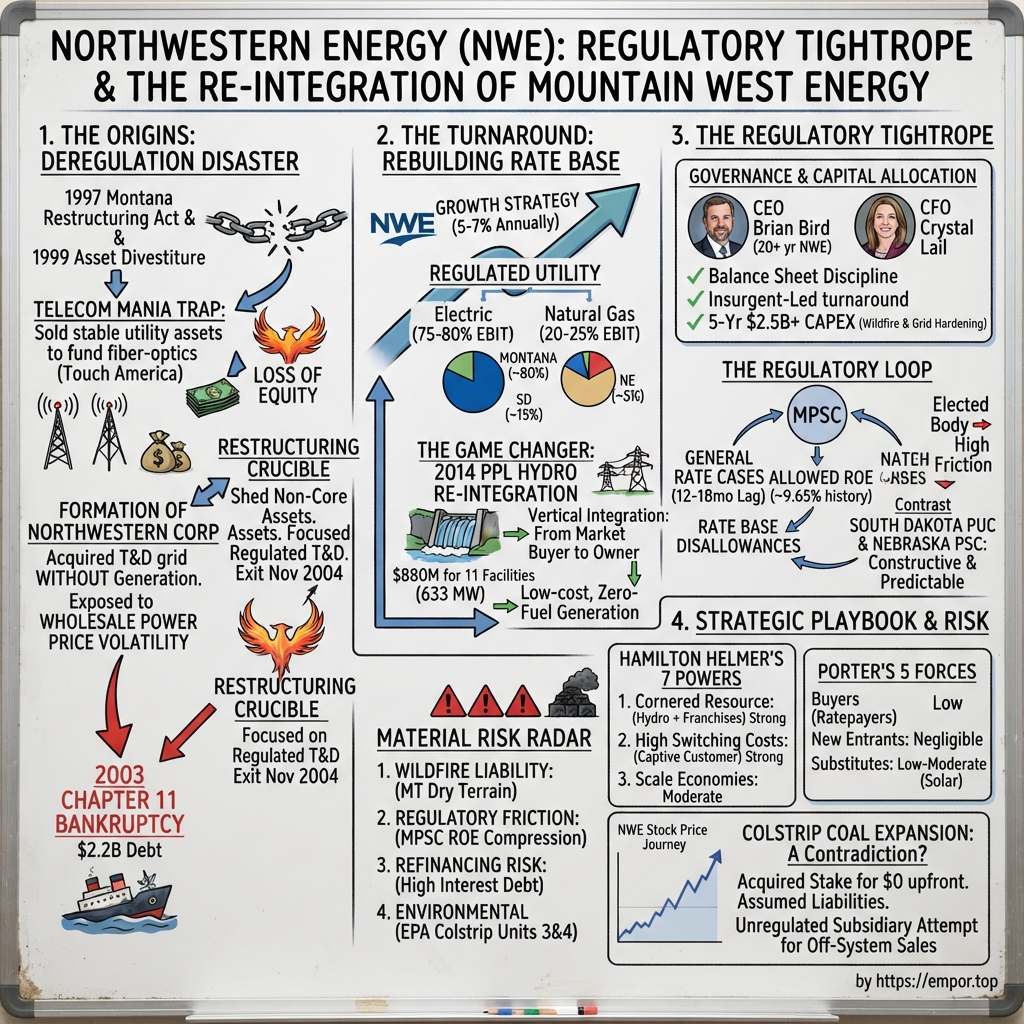
NorthWestern Energy Group, Inc.: The Regulatory Tightrope and the Re-Integration of Mountain West Energy
I. Introduction & Episode Roadmap
On the afternoon of July 30, 2026, Chief Executive Officer Brian Bird told investors on a webcast that NorthWestern Energy Group was not large enough to navigate the coming decade.
"We need to be bigger," he said during his closing remarks. "It's more of a competitive environment that we sit in today than utilities have seen in certainly their first 100 years of existence."[^1]
That statement stands out coming from the leader of a state-sanctioned monopoly. Electric and gas utilities are traditionally viewed as predictable equity investments: state-granted franchises that earn regulated returns on capital investments in poles, wires, pipes, and power plants while distributing most of their profits as dividends. NorthWestern Energy Group serves roughly 850,300 electric and natural gas customers across Montana, South Dakota, Nebraska, and Yellowstone National Park, employing 1,667 people, including 1,353 in Montana.1 It is a business built for stability. Yet Bird's warning signaled that scale has become critical for regional utilities.
Equity markets reflect that sentiment by pricing NorthWestern primarily as an acquisition target. By mid-August 2026, the company's shares traded near $70, representing a market capitalization of roughly $4.3 billion. Factoring in about $3.4 billion of total debt at year-end 2025, NorthWestern carried an enterprise value in the high-$7 billion range.2[^4] Today, the stock trades largely in tandem with Black Hills Corporation based on an exchange ratio of 0.98 Black Hills shares for every NorthWestern share—the terms set in their all-stock merger of equals announced on August 19, 2025.3 With Black Hills trading near $72.77, the ratio implies an acquisition value of roughly $71 per NorthWestern share, leaving a modest spread that reflects regulatory risk.2
That final regulatory hurdle dictates the outcome. The Federal Energy Regulatory Commission approved the combination in May 2026, and regulators in Nebraska and South Dakota signed off in the second quarter. The remaining arbiter is the Montana Public Service Commission—a panel of five elected commissioners, one of whom has been suspended and is suing the state governor. The commission is evaluating the $15.4 billion combined entity while simultaneously considering a motion to reconsider NorthWestern's prior rate filing, which the company submitted in July 2024 and remains without a final resolution more than two years later.[^1]3
The central paradox. NorthWestern previously collapsed not from physical disaster or market disruption, but from managerial diversification. In September 2003, NorthWestern Corporation filed for Chapter 11 bankruptcy under roughly $2.2 billion in debt, built up by acquiring plumbing and heating contractors alongside telecommunications providers.4 Two decades later, the company has assembled majority ownership of Montana's largest power plant, ten hydroelectric dams, and a rate base of approximately $5.57 billion.5 While management successfully re-established an asset base, the central analytical question is whether those assets can consistently earn their expected returns given Montana's complex regulatory climate.
The core tension. Every dollar of capital NorthWestern deploys requires regulatory approval. In Montana, those decisions rest with elected officials subject to political pressure. In November 2025, the Montana commission authorized $246 million in rate base for the company's new natural gas plant near Laurel—below the $289 million NorthWestern requested. That $43 million disallowance forced a fourth-quarter charge of $0.38 per share.67 The single decision accounted for the gap between the company's reported 2025 GAAP earnings of $2.94 per share and management's adjusted figure of $3.58 per share.5 Balancing customer affordability, grid reliability, emission goals, wildfire liability, and investor returns remains challenging when regulators face voters at the ballot box.
The roadmap. What follows traces the 1997 deregulation law that dismantled Montana Power Company and the telecom mania that finished it; the 2003 bankruptcy and the CFO hired into the wreckage; the 2014 purchase of PPL Montana's dams that turned a wires company back into a utility; the mechanics of how a rate-base business actually earns money, and why Montana's version of that machine grinds so slowly; the decision to accept 592 megawatts of coal-fired capacity for zero dollars; the AI data-center pipeline that could either transform the growth rate or become the next affordability scandal; a 7 Powers and Porter's Five Forces analysis against IDACORP, Otter Tail, ALLETE, and Black Hills itself; a stress test of wildfire, regulatory, and credit risk; and finally the bull and bear cases with the core metrics that dictate long-term returns.
Start where the damage was done.
 Subscribe on LinkedIn
II. The Deregulation Disaster & 2003 Bankruptcy Turnaround
In December 1997, executives at Montana Power Company stood before the Montana legislature to advocate for the company's own restructuring.
Montana Power had been assembled starting in 1912 around the copper economy of Butte and the hydroelectric potential of the Missouri and Clark Fork rivers. It owned 13 hydroelectric dams and four coal-fired power plants, forming the physical foundation of low-cost electricity in a sparsely populated state. Yet its leadership lobbied to divest those generation assets on the theory that competitive wholesale markets would supply power more efficiently than a vertically integrated monopoly.
The Montana Electric Utility Industry Restructuring Act passed in 1997. In December 1999, Montana Power completed the sale of its generating fleet to PPL Resources of Allentown, Pennsylvania, which operated the assets as PPL Montana.8 The utility retained its poles, wires, and pipes—becoming a transmission and distribution (T&D) company that operated as a toll road for electricity it no longer generated.
The telecom mania trap. What the company did with the proceeds remains a classic case study in corporate asset reallocation. In March 2000, near the peak of the telecommunications bubble, Montana Power announced it was exiting the energy business entirely to transform into a telecommunications firm called Touch America.8 Management's rationale focused on valuation multiples: regulated utility earnings grew in single digits and traded at low multiples, whereas telecom infrastructure commanded high market valuations.
The outcome followed a familiar pattern. Touch America filed for bankruptcy in 2003, converting eight decades of accumulated utility franchise value—including perpetual hydroelectric assets—into dark fiber optic capacity and substantial shareholder losses.8 Montana Power's board had mistaken a low-cost, regulated monopoly asset for a low-return asset, selling long-term hydroelectric capacity to compete in the volatile telecommunications sector.
Enter NorthWestern. The buyer of Montana Power's transmission and distribution grid was an unexpected suitor. Originally incorporated in 1923 from four small electric companies in Nebraska and South Dakota, NorthWestern Public Service spent 75 years acquiring small regional utilities before renaming itself NorthWestern Corporation in 1998.1 In 2002, it acquired Montana Power's transmission and distribution system, tripling its size overnight and establishing the three-state footprint that exists today.1
This acquisition introduced an immediate structural risk. NorthWestern assumed an obligation to serve Montana retail customers without owning power generation assets. It had to buy electricity on the open wholesale market and pass the cost through to ratepayers. While that structure functioned when market prices were low, it exposed the utility to severe price spikes in the wake of the early 2000s Western energy crisis.
The roll-up that broke it. Compounding this structural vulnerability, NorthWestern's management pursued its own non-utility acquisition strategy. Rather than telecommunications fiber, NorthWestern acquired non-regulated service businesses: Expanets, a reseller of business communications equipment, and Blue Dot Services, a consolidation of residential heating, ventilation, air conditioning, and plumbing contractors. Neither business complemented grid operations, and both consumed capital while generating operational losses.
On September 14, 2003, NorthWestern Corporation filed for Chapter 11 protection in the U.S. Bankruptcy Court for the District of Delaware.4 At the time of the filing, the company served more than 598,000 customers and carried approximately $2.2 billion of debt.4[^11] It entered bankruptcy with about $20 million in unrestricted cash and secured a $100 million debtor-in-possession credit facility from Bank One.4 Expanets and Blue Dot were excluded from the filing and liquidated—Expanets was sold to Cerberus Capital Management and TenX Capital for $107.5 million in cash plus a contingent note of up to $27.5 million, while Blue Dot's operations were disposed of piecemeal.4[^11]
Analytically, the core utility operations were not the source of insolvency. Regulated distribution in Montana, South Dakota, and Nebraska continued to generate steady cash flows throughout the period. The bankruptcy was a holding-company event caused by unregulated diversification.
The crucible. In 2003, NorthWestern hired Brian Bird as chief financial officer to oversee the financial reorganization. The restructuring plan focused on core operations: divesting non-utility subsidiaries, converting unsecured debt to equity, and aligning holding-company capital allocation with utility cash flows. NorthWestern emerged from Chapter 11 in November 2004, reducing its total debt to approximately $850 million from the $2.2 billion peak.[^11]
The reorganization highlighted a notable operational divide within the company. Throughout the bankruptcy, NorthWestern's South Dakota and Nebraska operations—the original 1923 franchise—continued to operate with predictable earnings under stable state regulatory commissions. That contrast between stable Midwestern jurisdictions and the more volatile Montana regulatory climate shaped management's long-term strategy, establishing a foundation for the geographical diversification rationale later used for the proposed Black Hills merger.
The post-bankruptcy company re-emerged as a pure-play regulated utility focused on rate-base investment. However, in 2005, NorthWestern still operated under its primary structural handicap: it sold electricity it did not generate. Resolving that exposure required nearly a decade of strategic acquisitions.
III. Rebuilding the Rate Base: The 2014 Hydro Re-Integration
The drawback of operating solely as a transmission and distribution toll road is that a utility only earns on the physical grid it owns.
A regulated utility generates returns on capital invested in approved infrastructure—its rate base. Fuel and purchased power, by contrast, pass through to retail customers without a profit markup. While that mechanism shields the utility from direct commodity price risk, it creates problematic operational incentives. A wires-only utility in Montana could spend a decade replacing transformers and upgrading substations to grow its earning asset base at a modest pace. Yet every winter cold snap that spiked wholesale electricity prices produced severe customer bill shock, exposing the company to regulatory friction over costs it could neither control, hedge perfectly, nor earn a return on.
The solution was clear but initially out of reach: repurchase the generating assets. PPL Montana owned the fleet, and PPL had no immediate incentive to sell.
The nine-hundred-million-dollar handshake. Chief Financial Officer Brian Bird and then-CEO Bob Rowe pursued the hydroelectric assets for more than a year before reaching terms. In September 2013, NorthWestern announced an agreement to acquire PPL Montana's hydroelectric system. Following approval from the Federal Energy Regulatory Commission in October 2014, the transaction closed that November: eleven hydroelectric facilities plus one storage reservoir, representing 633 megawatts of nameplate capacity, for $900 million.9 The portfolio stretched across key state waterways—Thompson Falls on the Clark Fork, Madison Dam on the Madison, Mystic Lake on West Rosebud Creek, and a chain of Missouri River facilities near Great Falls, including Hauser, Holter, Black Eagle, Rainbow, Cochrane, Ryan, and Morony.9
One key asset carried a pre-existing obligation. Kerr Dam on the Flathead River, generating 194 megawatts, included a federal licensing provision that granted a purchase option to the Confederated Salish and Kootenai Tribes. The tribes exercised that option, and the facility transferred in 2015.9 For that reason, NorthWestern's historical timeline notes the long-term acquisition as twelve facilities totaling 439 megawatts rather than the headline eleven facilities and 633 megawatts—reflecting the fleet retained after the Kerr Dam transfer.1 Today, NorthWestern's hydroelectric fleet comprises roughly 470 megawatts across ten Montana facilities, supplying approximately 30% of the company's state generation.10
Was $900 million a good price? The economic logic depended on the returns regulators allowed NorthWestern to earn on the investment. The rate increase required to integrate the dams into Montana retail rates amounted to roughly 5.12%, adding about $4.20 per month to a typical residential bill.9 Critics contended that NorthWestern overpaid for assets Montana Power had sold fifteen years earlier. Proponents countered that constructing 439 megawatts of dispatchable, zero-fuel-cost hydro capacity was impossible near that price tag, making replacement cost—rather than the 1999 divestment valuation—the appropriate financial benchmark.
Operating history has favored the buyer's perspective. Hydroelectric generation carries no fuel costs, no carbon exposure, and no coal-ash liabilities, operating on maintenance cycles measured in decades. In utility economics, hydroelectricity functions similarly to a long-duration asset tied to rate-base growth. Its primary limitation is volume: a facility built in 1918 produces the same water-constrained output in 2026 as it did decades ago, with dry years reducing available power.
What actually changed. The strategic value lay in transforming NorthWestern's structural position. By acquiring owned generation inside its rate base, NorthWestern shifted from a wholesale market price-taker to an integrated utility. By 2025, roughly 52% of the company's total electric generation originated from carbon-free resources—including 55% in Montana, where hydroelectricity anchors the grid alongside wind and solar. That compares with approximately 41% for the broader U.S. power sector in 2024.10 In South Dakota, wind power supplies more than a third of customer electricity.10
This generation profile carries an important corporate distinction: NorthWestern does not retain all renewable energy certificates associated with its contracted power and periodically sells them to offset costs. As a result, the company cannot claim that 100% of its carbon-free generation is delivered directly to retail customers as environmental attributes.10 This reflects standard utility accounting, distinguishing generation mix from formal environmental claims.
The unglamorous downside of dams. Hydroelectric infrastructure carries two main operational constraints.
The first constraint is hydrology. Annual generation depends on snowpack and river runoff. Low-water years reduce low-cost generation and force market power purchases—reintroducing, in milder form, the exact market exposure the acquisition sought to limit.
The second constraint involves long-term regulatory obligations. Federal hydroelectric licenses span decades and require costly periodic renewals with strict environmental and public mandate conditions, including fish passage, minimum flow requirements, recreational access, and tribal consultations. The Kerr Dam option illustrates this exposure: a 194-megawatt asset included in the initial purchase was subsequently transferred under mandatory federal license provisions.9 While relicensing investments are generally added to the earning rate base once approved, license compliance represents an ongoing operational and capital commitment.
The compounding machine. Integrating generation into the rate base established a long-term capital deployment framework. Operational upgrades, relicensing programs, and turbine refurbishments transition from pass-through expenses into earning assets. NorthWestern's rate base reached approximately $5.57 billion by year-end 2025, with management targeting 4% to 6% annual growth in rate base and earnings per share from a 2024 adjusted base of $3.40 per share.5
This 4% to 6% target represents NorthWestern's standalone outlook. Management projects that the combined entity following the proposed Black Hills merger could achieve 5% to 7% annual growth, a distinction Bird has emphasized during investor presentations.[^1][^14]
Expanding rate base, however, represents only part of the business model. The remaining requirement is securing regulatory approval to earn returns on that capital—a process that presents ongoing challenges in Montana.
IV. Core Business Structure & Segment-Level Economics
Picture the machine in its simplest form. A utility spends a dollar building infrastructure customers need. A regulator decides whether the dollar was prudently spent, adds it to the rate base, and sets customer rates so the utility can recover that dollar over the asset's useful life while earning a return on the unrecovered balance. Net income is, approximately, rate base multiplied by the allowed return on equity, adjusted for how the company financed the capital and how much of that authorized return it actually collects. Everything else is detail.
The detail is where the money is.
Two segments, one economic engine. NorthWestern operates through two reported segments: an electric utility and a natural gas utility. Electric is by far the larger driver. In the second quarter of 2026, electric operations generated $324.3 million of the company's $392.6 million in total revenue, while natural gas contributed $68.3 million.11 Gas revenue is also highly seasonal, making single-quarter figures misleading because winter heating demand drives the bulk of volume.
Geographically, the concentration is even sharper than the segment split suggests. In Montana alone, the company serves roughly 414,000 electric and 247,000 natural gas customers.12 Its South Dakota and Nebraska gas operations serve approximately 51,200 customers across 82 South Dakota communities and about 43,400 across four Nebraska communities.12 Adding South Dakota electric customers and the Yellowstone National Park franchise brings the total customer count to 850,300—a figure expanded in July 2025 when NorthWestern absorbed the Energy West and Cut Bank Gas distribution systems in Montana, adding roughly 33,000 gas customers.5
The practical consequence is clear: Montana is not merely one of NorthWestern's markets; Montana is NorthWestern, with South Dakota and Nebraska operating as smaller, more predictable secondary jurisdictions. That geographic concentration drives most of the fundamental risk in the stock.
Three regulators, two very different experiences. The South Dakota Public Utilities Commission and the Nebraska Public Service Commission operate in what management consistently describes as a constructive regulatory environment. South Dakota in particular offers mechanisms NorthWestern values: an infrastructure rider that accelerates generation cost recovery, an established large-load tariff process for industrial customers, and—critically for the company's newest capacity—a phase-in rate plan allowing cash recovery during construction rather than waiting for a plant to enter service. Chief Financial Officer Crystal Lail has noted that this cash-timing feature makes incremental South Dakota generation attractive, since accruing an allowance for funds used during construction boosts reported earnings without generating immediate cash, whereas South Dakota's rider delivers both.[^14]
Montana presents the opposite dynamic. It relies on a historic test-year framework—setting rates based on prior-period costs—and governs through five elected commissioners. That combination erodes returns during inflationary capital cycles. Lail described the drag on an April 2026 conference call, noting that the company filed a rate review using a 2023 test period with 2024 known-and-measurable adjustments, yet remained without a final outcome by April 2026.[^14] Her conclusion was direct: regardless of commission composition, "we need to recover our costs," making frequent rate filings inevitable.[^14]
The tracker, explained simply. One piece of regulatory mechanics requires a plain-language detour because it drives significant quarterly earnings volatility: the Power Cost and Credit Adjustment Mechanism, or PCCAM.
The tracker functions like a running tab. Because fuel and market power prices fluctuate with weather and commodity markets, regulators use a tracker to avoid opening full rate cases for routine cost shifts. The commission establishes a baseline supply cost inside base rates, and the tracker reconciles variances—if actual power costs run higher, the utility eventually recovers the difference from customers; if lower, it refunds the surplus.
Two structural details complicate this mechanism. The first is timing lag: because the tab settles retrospectively, a severe winter leaves the utility spending cash long before recovering it. That lag surfaced in 2025, when Montana supply-cost under-collections reached roughly $80 million, placing pressure on credit metrics.[^14] The second was a sharing provision in Montana that forced the company to absorb a portion of cost variances rather than passing them through fully. That sharing mechanism reduced NorthWestern's earnings by approximately $0.09 per share in 2025—though the commission's November 2025 rate order suspended the sharing requirement going forward, creating an important structural improvement within a decision largely remembered for cost disallowances.[^14]
The same mechanism now serves as the temporary recovery channel for operating costs at the Avista Colstrip unit via a tariff waiver. Understanding the tracker is essential: it was the primary cause of the 2025 cash shortfall, the mechanism for recent regulatory relief, and the underlying structure supporting part of the company's coal fleet economics.
Anatomy of a rate case gone sideways. The 2024–2025 Montana general rate review provides a clear look at how regulatory friction impacts financial results.
NorthWestern's initial application requested an electric base rate revenue increase of $156.5 million—representing about $69.4 million net of property tax and power-cost tracker adjustments—alongside a $28.6 million increase for natural gas.13 Leveraging Montana's interim rate provisions, the company began collecting higher rates in May 2025 while the case underwent review.6 A public hearing took place in June 2025, following partial settlements in April 2025 that established an authorized return on equity of 9.65% for electric operations and a 47.8% equity capital structure—meaning regulators assumed capital funding split slightly under half equity and the remainder lower-cost debt.13
On November 19, 2025, the commission issued its decision. It approved $246 million in rate base for the 175-megawatt Yellowstone County Generating Station against the $289 million requested—a $43 million disallowance for costs the commission determined were "not supported by sufficient data, documentation, or technical justification."6 Commission President Jeffrey Welborn summarized the rationale as balancing utility service requirements against ensuring customers do not pay more than just and reasonable rates.6 Because interim rates had been collected since May, the company was required to refund the excess collections to customers with interest.6 The final written order was delivered in December 2025.13
The financial impact was immediate: a $0.38 per share fourth-quarter charge, which stood as the primary driver behind 2025 GAAP earnings falling to $2.94 per share from $3.65 in 2024, even as adjusted earnings expanded.5[^14] A motion for reconsideration remained pending well into 2026, with management acknowledging no definitive resolution schedule and noting that any potential financial adjustment would occur in 2026 at the earliest.[^14]
Regulatory lag, made concrete. Lail has detailed the financial drag caused by regulatory lag, noting an 18-to-24-month delay between deploying capital and reflecting those assets in customer rates.[^14] In an environment of elevated equipment costs and higher interest rates, that delay acts as a persistent drag on realized returns. NorthWestern's interest expense rose to $150.4 million in 2025, up from $131.7 million in 2024 and $114.6 million in 2023—a $36 million increase over two years for a company generating $180 million to $225 million in annual net income.[^4] Rising property taxes further narrow margins, as the utility collects substantial tax revenue through rates but recovers intermediate tax increases only through formal rate cases.[^14]
The operational and financial evidence points to a clear structural reality. NorthWestern's Montana utility franchise remains insulated from physical competition—no competitor will construct duplicate distribution infrastructure across its service territory—yet its realized returns remain consistently below authorized levels. That gap stems from structural regulatory features, including historic test years, elected commissions, and limited forward-looking rate adjustments. Management cannot reshape the regulatory structure unilaterally; it can only increase filing frequency, refine evidentiary submissions, and pursue geographic diversification. While the company has pursued the first two strategies directly, the third provides the core strategic rationale for the proposed Black Hills merger.
Before that combination, however, management made a strategic choice that illustrates its operational approach even more clearly than rate litigation: accepting a major coal-fired power plant for no upfront purchase price.
V. The Colstrip Coal Expansion & Natural Gas Pivots
Washington State handed NorthWestern Energy an unexpected opportunity—one whose long-term financial consequences remain contested across multiple regulatory forums.
Under Washington's Clean Energy Transformation Act, utilities in that state were prohibited from recovering costs for coal-fired generation from retail customers after 2025. Consequently, two of Colstrip’s six co-owners—Puget Sound Energy, holding 370 megawatts, and Spokane-based Avista, holding 222 megawatts across surviving Units 3 and 4—faced balance sheets encumbered by assets slated for regulatory phaseout.14 Facing a firm statutory deadline to exit an illiquid asset, both sellers held minimal negotiating leverage.
Zero dollars. NorthWestern agreed to acquire both stakes for no upfront purchase price. The Avista agreement was structured in late 2022 and announced in early 2023, while the Puget Sound Energy transaction was disclosed on July 31, 2024. Both transactions closed effective January 1, 2026, transferring a combined 592 megawatts and increasing NorthWestern’s Colstrip ownership from 15% to 55%—giving the company approximately 814 megawatts of total plant capacity.1415
Chief Executive Officer Brian Bird framed the two acquisitions as fulfilling distinct strategic objectives. During an analyst call in February 2026, Bird explained that acquiring Avista’s stake raised NorthWestern’s ownership from 15% to 30%, satisfying baseline resource adequacy in Montana by securing sufficient dispatchable capacity to cover peak demand without relying on expensive spot-market purchases during regional supply crunches. Acquiring Puget’s stake pushed ownership from 30% to 55%, securing operational control to direct the plant's long-term future.[^14]
"I sleep much sounder when cold weather does come to us in Montana," Bird told investors.[^14]
What "resource adequacy" actually means. In utility operations, resource adequacy represents the core rationale supporting the Avista acquisition.
A utility's peak stress point occurs during extreme demand events—such as a sub-zero January morning in Montana when heating load surges while wind and solar output remain minimal. Serving grid demand during those hours requires firm capacity: dispatchable generation under the utility's direct control, rather than third-party power market contracts subject to extreme price spikes when regional supply is constrained.
Prior to acquiring the additional Colstrip capacity, NorthWestern lacked adequate firm generation, forcing it to purchase wholesale power during peak demand periods and pass fluctuating costs through to customers. Securing 814 megawatts of dispatchable capacity mitigates that market exposure for existing Montana customer load, improving system reliability while reducing customer bill volatility and shareholder regulatory risk. Consequently, the Avista acquisition has drawn considerably less criticism from consumer advocates and analysts than the Puget Sound Energy transaction.
The trade-off, precisely. Acquiring generation without an upfront purchase price creates distinct financial friction. The combined Colstrip transactions introduced approximately $48 million in incremental annual operating costs—roughly $18 million for the Avista stake and $30 million for the Puget stake—without generating immediate rate base additions.[^14]11 Adding operating expenses without expanding the rate base depresses utility profitability unless those costs are fully recovered through customer rates.
Securing regulatory cost recovery has proven challenging. For the Avista share, NorthWestern petitioned for a temporary waiver of its Montana power cost adjustment tariff in August 2025, which state regulators granted on an interim basis in January 2026.[^14] However, in its second-quarter 2026 Form 10-Q filing, the company disclosed that the waiver was failing to fully cover Avista's operating and maintenance expenses. Mild winter weather had depressed Western wholesale power prices, reducing revenue from off-system sales below initial projections.[^1] Chief Financial Officer Crystal Lail stated during a July 2026 conference call that management intends to address the shortfall by incorporating the asset into base rates in a future rate review, though the utility remains awaiting a final resolution on its prior filing.[^1]
One important correction to the conventional telling. Initial market assumptions suggested NorthWestern absorbed the sellers' environmental remediation and decommissioning liabilities in exchange for the zero-cost capacity. Corporate filings clarify that Avista and Puget Sound Energy retained their proportionate financial obligations for environmental cleanup and future plant closure costs despite transferring ownership.15 NorthWestern assumed ongoing operating expenses, coal supply commitments, maintenance capital, and operational risk, but avoided the sellers' legacy cleanup liabilities—a distinction that improves the net transaction economics.
Nevertheless, ongoing capital commitments remain substantial. Anne Hedges of the Montana Environmental Information Center criticized the Puget transaction as an unfavorable deal involving an aging coal facility vulnerable to operational outages during weather extremes. Hedges cited plant disruptions during cold snaps and heat waves while estimating that long-term compliance and operations could demand up to $2 billion in facility upgrades, including approximately $600 million for emissions controls and over $1.3 billion for carbon capture systems if operated past 2032.14 NorthWestern maintains that it will operate Colstrip until comparable, cost-effective carbon-free resources become commercially available, targeting a useful depreciable life extending into the early 2040s.[^14]15
The affiliate structure and its critics. The corporate placement of the Puget acquisition represents one of the transaction's most debated elements. NorthWestern assigned the 370-megawatt interest to a separate affiliate regulated by the Federal Energy Regulatory Commission (FERC) rather than housing it within the Montana state-regulated utility. The company filed for cost-based rates with FERC in October 2025 and executed a contract that same month to sell the output to third parties through late 2027.[^14] Management framed the structure as a customer protection measure, arguing that Montana retail customers did not require the additional power until roughly 2027, making third-party sales preferable to imposing $30 million in annual operating costs on existing ratepayers.[^14] Management intends to transition the capacity into Montana state regulation once a large-load tariff is established to serve expanding industrial customer demand.[^14]
Critics view the arrangement as exposing shareholders to merchant coal market dynamics while retaining the option to transfer costs to retail ratepayers later. Operating results through mid-2026 highlighted this vulnerability: depressed wholesale market prices left unrecovered Colstrip operating expenses dragging earnings down by approximately $0.05 per share in both the first and second quarters, alongside $0.12 per share in incremental Colstrip operating costs during the second quarter alone.[^1][^14] Lail noted to analysts in July 2026 that power demand and pricing had recovered somewhat entering the third quarter, offering potential margin recovery, but refrained from issuing specific financial guidance.[^1] In practice, the affiliate structure creates unhedged commodity price exposure within a traditionally regulated utility holding company.
Yellowstone County, and what it cost. Complementing the coal fleet expansion is the gas-fired Yellowstone County Generating Station near Laurel—a 175-megawatt fast-ramping facility engineered to balance intermittent renewable generation and handle extreme weather events. The plant was completed at a capital cost of approximately $283 million, below its original $320 million estimate.716 However, environmental groups including the Montana Environmental Information Center and the Sierra Club challenged the facility's air permit in a 2021 lawsuit, creating legal hurdles that persisted into commercial operations.16
While the facility achieved operational status, its capital recovery ran into severe regulatory resistance. The resulting $43 million rate-base disallowance demonstrated how capital execution risks in Montana can translate directly into shareholder write-offs.
VI. Current Management, Incentives & Capital Allocation Record
Brian Bird has been in the room for every important decision NorthWestern has made in twenty-three years, which is both the strongest and the most awkward thing you can say about him.
He arrived in 2003 as chief financial officer with the company in Chapter 11 and its two non-utility subsidiaries on the block. He held the CFO seat through the emergence, through the long grind of rebuilding investment-grade credit, and through the nine-year pursuit of PPL Montana's dams. He was named chief executive in 2023. There is no version of NorthWestern's turnaround that he was not central to, and no version of its regulatory problems that he can fully disclaim either.
His public manner is distinctive for a utility CEO: concrete, occasionally self-critical, and allergic to the passive voice. Asked in February 2026 why energy service agreements with data center developers kept slipping, he did not blame the counterparties. "I'll take a bit of a mea culpa here myself," he said. "I think we at times were the holdup to getting these ESAs done."[^14] Five months later, asked about a specific developer's 7.2-gigawatt interconnection request that had excited the analyst community, he declined to take credit for a number he could not stand behind: "I don't want to speak for Quantica here. As we sit here today, we're focused on the 1.1 gigawatts."[^1] Twice on that call he volunteered "no guarantees" about deals he was trying to sell investors on.[^1]
That is the behavior of a manager who intends to be believed later. It is worth weighing against the counter-evidence, which is substantial and comes from the regulatory record rather than from the calls.
The Lail file. Crystal Lail, who succeeded Bird as CFO, is the architect of the corporate plumbing. Her signature project was the holding company reorganization that separated the Montana utility from the South Dakota and Nebraska businesses: Montana operations under NorthWestern Corporation, the Dakota and Nebraska assets under a separate entity, both beneath a new parent named NorthWestern Energy Group, Inc.17 The stated purpose was to "isolate and insulate the Montana public utility" from the rest of the enterprise.17
The Montana commission approved it unanimously on February 21, 2023, and the structure took effect in October 2023, but only after extracting real conditions: the Montana utility cannot pay dividends upward if its equity falls below 40% of total capital; any merger, sale or transfer of Montana operations requires commission approval; the commission gains access to the utility's books and credit ratings; and restructuring costs cannot be passed to customers.1718 The Montana Consumer Counsel had pushed for more — restrictions on asset transfers above $5 million, tighter dividend limits, and an independent director able to veto a bankruptcy filing — explicitly citing the memory of Montana Power's collapse.17
Read that list carefully and the sequence becomes clear. Ring-fencing a jurisdiction is exactly what you do before you attempt a large corporate transaction in it. Two and a half years later, that commission approval right over any transfer of Montana operations is the single gate standing between NorthWestern and its merger.
The capital plan, and what changed in it. On the February 2026 call the company raised its five-year capital program to $3.21 billion for 2026 through 2030, a 17% increase over the prior plan.5[^14] The increase came from two specific additions: the incremental Colstrip ownership, and a new $300 million, 131-megawatt natural gas project in South Dakota submitted to the Southwest Power Pool's expedited resource adequacy study, expected to complete in 2030 with roughly a third of the spend occurring in 2026 to secure turbines.[^14]
Two features of this plan are more revealing than its size. First, it is deliberately unexciting — split roughly evenly across transmission, distribution and supply, and described by Bird as "bread-and-butter utility investment."[^14] Second, and more important, it contains none of the growth investors are actually excited about. No data center capital. No regional transmission projects. No generation beyond the South Dakota plant already named. Management has been consistent across at least three consecutive calls that the 4%-to-6% growth target rests entirely on this base plan, and that anything above 6% requires delivering opportunities not yet in the numbers.[^1][^14]
That is unusually clean disclosure. It also means the headline growth rate is not a bet on artificial intelligence.
Financing discipline, and where it frayed. NorthWestern's stated commitment is a self-funded base capital plan, issuing equity only when it is accretive. Lail confirmed no equity needs in 2026, with issuance beginning in 2027 tied specifically to the South Dakota generation build, funded on roughly a 50-50 debt-to-equity basis.[^1][^14] The dividend rose 1.5% to $0.67 per share quarterly, payable at the end of March 2026, supporting a yield the company now describes as approximately 4%.5
That yield description is itself a small piece of evidence. On earlier calls the value-proposition slide said 4% to 5%; by February 2026 Bird explicitly flagged that it had been changed to "approximately 4%" because the share price had risen.[^14] Management calling out the downgrade of its own yield claim, rather than quietly editing the slide, is the kind of small honesty that tends to correlate with larger ones.
The frayed edge is credit. NorthWestern targets funds from operations to debt above 14% and a debt-to-total-capitalization ratio of 50% to 55%. It closed 2025 below the FFO threshold, at roughly 13%.[^14] Lail attributed the miss to two cash items rather than earnings quality: the exceptionally mild back half of 2025 stripping out margin, and roughly $80 million of under-collection in the Montana supply cost tracker that she expected to reverse in 2026.[^14] Both explanations are plausible and specific. Both are also the kind of thing a company says once credibly and cannot say twice.
Incentives, and the fight over them. Bird's total compensation was $5,016,745 for 2025 per the proxy filed in March 2026, up 4.1% from the prior year, in a year when NorthWestern's total shareholder return reached 26.4% — driven substantially by the merger announcement.19 The pay structure is heavily at-risk and tied to relative shareholder return, earnings, reliability and safety, and say-on-pay support has run at 94% or better every year since 2011.19
Montana's consumer advocates see a different picture. The Montana Environmental Information Center published a September 2025 analysis noting Bird's compensation had grown from $1.2 million in 2010 to $4.8 million in 2024, a 55% increase since 2023 alone, set against a 28% residential rate increase approved in October 2023 and a further 26% increase requested in July 2024, and against Montana median household incomes that barely kept pace with inflation.20 The piece called NorthWestern "a greedy monopoly utility taking as much as it can from cash-strapped Montanans and giving it to a CEO based in South Dakota."20
Whatever one makes of the rhetoric, the political mechanism is the thing investors should register. In a state with elected regulators, executive pay is not a governance footnote — it is campaign material. And that is a genuine, quantifiable transmission channel from compensation design to allowed return on equity.
The merger as capital allocation. Which brings us to the biggest allocation decision of Bird's career, and the one that will define his legacy. Under the agreement entered on August 18, 2025 and announced the following day, each NorthWestern share converts into 0.98 Black Hills shares — roughly a 4% premium — leaving Black Hills holders with about 56% and NorthWestern holders about 44% of a company with a pro forma market capitalization near $7.8 billion and enterprise value of $15.4 billion.3 The combined business will serve approximately 2.1 million customers across eight states — Arkansas, Colorado, Iowa, Kansas, Montana, Nebraska, South Dakota and Wyoming — split roughly 700,000 electric and 1.4 million gas, on a combined rate base near $11.4 billion, with more than $7 billion of combined capital plans.3
Governance tells you who won what. Bird becomes chief executive and Lail chief financial officer of the combined company; Black Hills contributes chief operating officer Marne Jones, chief integration officer Kimberly Nooney, board chair Steven Mills, and six of eleven directors; and the headquarters moves to Rapid City, South Dakota, under the new corporate name Bright Horizon Energy.321 NorthWestern's management team runs the company. Black Hills' shareholders own more of it and control the board. That is a defensible trade for a smaller partner seeking scale, and it is also precisely why Montana intervenors object.
Shareholders were emphatic: about 86% of NorthWestern shares voted at the April 2, 2026 meeting, and 99.7% of those voted in favor.[^14]21 Regulators have been slower. FERC approved on May 29, 2026; Nebraska and South Dakota cleared during the second quarter; Hart-Scott-Rodino waiting periods expired.[^1]22 Montana held its hearing on May 12, 2026, final briefing was submitted in mid-July, and Bird told investors the commission had 90 to 120 days from that filing — implying a decision between mid-October and mid-November 2026, with closing targeted by year-end.[^1]22
He described himself as "cautiously optimistic."[^1] The commission has given him reason for both halves of that phrase.
VII. Strategic Playbook: 7 Powers & Porter's 5 Forces Analysis
Setting aside immediate regulatory friction, a fundamental analytical question remains: what structural factors protect NorthWestern's long-term economics from erosion? Electric and gas utilities offer a classic case study in competitive moats, illustrating both the strength of traditional utility protections and the points where theoretical advantages meet operational limits.
Cornered resource and legal monopoly: strong, and genuinely irreplaceable. NorthWestern holds exclusive, state-sanctioned franchises to distribute electricity and natural gas across its service territories. Competitors cannot construct parallel distribution networks in markets like Billings, as duplicate infrastructure is both economically unfeasible and legally prohibited. This structure represents a classic cornered resource under Hamilton Helmer's framework of business strategy, anchoring the company's long-term terminal value.
The hydroelectric fleet reinforces this advantage. The company's ten Montana dams occupy key natural sites along state waterways. Federal regulatory approval for new large-scale hydroelectric developments in the United States is virtually nonexistent, making competing dams on rivers like the Missouri impossible to replicate. These hydroelectric facilities represent irreplaceable generation capacity that cannot be duplicated at any cost.
High switching costs: strong, but the mechanism is worth stating precisely. Utility switching costs stem from physical infrastructure and statutory rights rather than software lock-in or brand loyalty. Customers connect to a single distribution grid that they do not own. In NorthWestern's northern service territory, harsh winter conditions deepen this reliance. Severe January cold snaps bring short daylight hours, snow-covered solar panels, and heavy heating demand during morning and evening peaks, making off-grid options like rooftop solar and battery storage insufficient. For retail customers in this climate, grid connectivity is a physical necessity.
Scale economics: moderate, and this is the honest weak point management is trying to fix. NorthWestern distributes fixed overhead—including grid dispatch, transmission management, customer billing, and regulatory compliance—across approximately 850,000 customers dispersed over low-density regions. Meanwhile, modern utilities face rising baseline fixed costs regardless of customer size, driven by wildfire mitigation, cybersecurity compliance, integrated resource planning, and the legal resources required for rate cases or large-scale data center negotiations.
Chief Executive Officer Brian Bird has cited scale as the central rationale for combining with Black Hills Corporation, arguing that a larger enterprise can better absorb wildfire liabilities, secure lower capital costs, and deploy "the right amount of resources at these opportunities."[^14] Conversely, the emphasis on scale highlights how NorthWestern's standalone footprint has constrained its operational efficiency. Both perspectives accurately reflect the company's strategic position.
Counter-positioning: weak, verging on absent. NorthWestern maintains substantial capital in traditional thermal and hydroelectric assets while operating within a rigid regulatory framework that demands integrated resource plans, formal requests for proposals, and prior regulatory approvals before constructing new capacity. Bird acknowledged these structural constraints when explaining why the utility might only supply the later phases of a data center's power requirements, noting that Montana procurement rules mean "it's a long process, and our data center partners would like to move faster."[^14] Independent power producers, unencumbered by utility commission oversight, can execute projects far more rapidly. NorthWestern's strategy to participate through build-own-transfer arrangements highlights that the utility may capture only a portion of the generation growth within its service territory.[^14]
Process power and branding: not material here. The company demonstrates no proprietary operational process that yields a sustainable cost advantage over peer utilities, while brand equity carries little commercial weight in a captive monopoly market. Neither factor provides a material competitive advantage.
Turning from internal competitive advantages to broader industry dynamics highlights five structural forces shaping the utility's operating environment.
Buyers: low individual power, rising collective power. Individual residential and commercial customers possess virtually no bargaining leverage. However, organized consumer advocacy and environmental groups exert significant influence through state regulatory proceedings. Organizations such as the Montana Consumer Counsel, the Montana Environmental Information Center, 350 Montana, and the Montana Farmers Union regularly intervene in rate cases and merger filings. In the merger proceedings, the Consumer Counsel reached a settlement after securing commitments that pre-merger transaction costs would not be passed to Montana ratepayers, whereas 350 Montana declined to settle and continued its opposition.22
Concurrently, the emergence of large-scale artificial intelligence and hyperscale data centers has introduced a buyer segment with substantial negotiating power. These industrial customers can select alternative geographic locations or develop behind-the-meter generation if utility terms prove uncompetitive. NorthWestern's proposed large-load tariff, filed with Montana regulators in March 2026, seeks to establish a structured rate framework before finalizing large customer agreements. Chief Financial Officer Crystal Lail outlined the tariff design, explaining that large customers would pay established base rates as a price floor, supplemented by targeted surcharges for dedicated transmission or generation infrastructure.[^14]
New entrants: negligible in distribution, real in generation. Threat of entry remains virtually zero in electric and gas distribution due to exclusive franchise rights and high capital barriers. In power generation, however, independent power developers present a credible threat. Large commercial customers seeking rapid interconnection may contract directly with merchant power producers, bypassing utility-owned generation during early project phases. This competitive dynamic underpins management's concerns regarding potential lost market share during initial customer expansion ramps.
Suppliers: moderate and tightening. Supply chain constraints present ongoing operational hurdles, particularly for natural gas turbines. When asked by Ladenburg analyst Paul Fremont in February 2026 if NorthWestern had secured turbine orders for its planned 2030 South Dakota facility, Bird replied, "we're buying turbines."[^14] The utility is allocating approximately $100 million of its 2026 capital program to reserve generation equipment four years before its planned operational date. Similar supply constraints affect procurement for electrical transformers, conductors, Colstrip coal deliveries, and specialized utility line crews.
Substitutes: low to moderate. Rooftop solar installations and battery storage displace grid sales modestly during shoulder seasons and in South Dakota markets, while energy efficiency standards gradually slow overall demand growth. Neither factor poses an immediate threat to the utility's core distribution franchise.
Rivalry: low operationally, intense for capital. NorthWestern faces no direct operational competition from regional peers such as Black Hills, IDACORP, ALLETE, or Otter Tail, as service territories remain geographically distinct. However, these utilities compete vigorously for equity and debt capital. In scale, NorthWestern's market capitalization of approximately $4.3 billion trails regional peers like Black Hills at $5.5 billion and IDACORP at $8.2 billion, while placing it slightly above Otter Tail's $3.9 billion. Meanwhile, ALLETE exited the public market following its $6.2 billion acquisition—at $67 per share—by CPP Investments and Global Infrastructure Partners on December 15, 2025.227 IDACORP, benefiting from rapid population growth in Idaho and a favorable regulatory environment, serves as the primary valuation benchmark for regional mid-cap utilities. NorthWestern's lower valuation multiple reflects regulatory friction and scale limitations rather than asset quality.
This valuation gap encapsulates the core strategic rationale for combining with Black Hills, setting up the need to rigorously evaluate the transaction's risks.
VIII. The Skeptical Investor Stress Test & Material Risk Radar
Now the adversarial pass. Assume a skeptical long-short investor has one hour with management and no interest in the growth story. Where does the case actually break?
1. Wildfire: the tail risk that has already destroyed peer equity. Two utilities have shown what an ignition event can do to shareholders. PG&E entered bankruptcy over California wildfire liabilities; Hawaiian Electric's equity was devastated after Lahaina. NorthWestern operates thousands of miles of line through dry, forested, high-wind terrain, and Montana fire seasons are lengthening.
The mitigation record here is more substantive than at most peers, and it is worth being precise about why. NorthWestern helped draft Montana House Bill 490, signed by Governor Greg Gianforte on May 13, 2025, which blocks a strict liability standard for utilities and establishes that a utility performing substantially in accordance with an approved wildfire mitigation plan has met the legal standard for fire prevention adequacy.23 The bill required electric utilities to have plans in place by the end of 2025, with investor-owned utility plans approved by the commission, updated every three years, and annual progress reports each June.24 NorthWestern obtained commission approval of its Montana plan in 2025.[^14] South Dakota then passed Senate Bill 36 in the 2026 session with similar protections, which Bird characterized as giving the company "some of the best wildfire protection in the United States at the state level," with a South Dakota plan to be filed for approval in 2026.[^14]
The skeptic's response is straightforward. First, the protection is a rebuttable presumption, not immunity: plaintiffs can still present evidence to the contrary, and common-law negligence claims remain live.24 Second, the legislation drew opposition from the insurance industry over subrogation rights, from 2021 West Wind Fire victims, and — notably — from the Montana Public Service Commission itself.23 A safe harbor written with the utility's participation and opposed by the utility's regulator is a durable legal shield of uncertain political durability. Third, the presumption only helps if the company actually followed the plan at the ignition point, which becomes a discovery fight in every case. Fourth, insurance costs are already rising and were cited among 2025's operating expense increases.[^14]
The fair conclusion: NorthWestern has meaningfully reduced the probability-weighted severity of wildfire liability relative to a California-style regime, and this is real, legislated, and verifiable rather than a management assertion. It has not eliminated a tail that can still exceed the company's equity value. This is also, candidly, one of the better arguments for the merger — Bird's point that a larger company "can sustain those" risks is the correct structural observation.[^14]
2. Regulatory friction: the sharpest available criticism, and it is not about politics. The Yellowstone County disallowance is usually framed as a hostile commission punishing a utility. The actual record does not support that framing, and investors who adopt it will mis-forecast.
Commission staff analysis released in November 2025 concluded that NorthWestern could likely have avoided roughly $45 million of cost overruns on the Laurel plant, and that there were "significant deficiencies in the planning and procurement processes that raise serious doubts about whether NorthWestern minimized total costs."7 The specific findings are worse than the headline number. Staff found the company eliminated viable resource options without justification; that the plant was never demonstrated to achieve the lowest long-term total cost; that its portfolio modeling included the Yellowstone plant in 27 of 36 portfolios while identifying it as the lowest-cost resource in only one; that requests for proposals were structured in a way that prevented battery-plus-engine pairings from being evaluated; that alternative resource offers existed which would have "entirely avoided" the risks incurred; that the company withheld alternative cost information for nine months and produced it only on the day of the hearing, depriving regulators of essential information; that no explanation was given for cost increases upon switching contractors; and that the company attempted to earn a return on assets that should have been depreciated, which staff characterized as violating regulatory accounting fundamentals.7 Staff recommended a rate base of $227.7 million; the commission landed at $246 million.7
That is a procurement and disclosure critique, not an ideological one. And it is the most important thing in this article for a long-term investor to internalize, because it goes to the heart of the utility investment case. The entire equity story rests on the company converting capital into rate base at close to full value. A regulator finding, on the record, that the company's process could not demonstrate least-cost outcomes is a direct challenge to that conversion rate — and it happened on the largest single generation project management had undertaken in a decade.
Management's framing on the February 2026 call was that 2025 was "a really, really good" year in which "we ran into some issues in terms of the rate review," with Bird pivoting to the revenue requirement the case did deliver.[^14] That is a defensible emphasis, but it is emphasis. Neither call transcript contains a detailed public account of what changed in the capital project governance process as a result. An activist would ask for exactly that, and would be right to.
The gap between allowed and earned returns is the quantitative expression of all this. Against a 9.65% allowed electric return on equity, NorthWestern's 2025 GAAP return on average book equity came in around 6.3%.[^4]13 Some of that gap is the one-time charge, some is weather, and some is structural lag — but a company that persistently earns several hundred basis points below its allowance is not being valued unfairly by the market.
3. Credit and refinancing: the constraint that governs everything else. NorthWestern ended 2025 with roughly $3.44 billion of total debt against $2.89 billion of book equity, having grown long-term debt from about $2.68 billion two years earlier.[^4] Interest expense has risen accordingly, and the FFO-to-debt shortfall against the 14% target has already been discussed. Senior unsecured ratings have historically sat at Baa2 from Moody's and BBB from S&P.25
The mechanism a skeptic should trace: a downgrade raises the cost of debt, which raises the revenue requirement the company must request, which increases political friction in Montana, which raises the risk of disallowance, which reduces cash flow. It is a genuine feedback loop, not a hypothetical. Note also the balance sheet carries approximately $368 million of goodwill — a legacy item that would face impairment scrutiny in a severe downside case, though nothing in current disclosure suggests that risk is live.[^4]
The merger cuts directly against this risk. A combined company with roughly double the rate base and eight-state diversification, where no single jurisdiction exceeds about 31% of the whole, should carry a structurally stronger credit profile than a company deriving the overwhelming majority of its earnings from one elected commission.[^14] This is the most concrete, least rhetorical benefit on offer.
4. Environmental regulation and the Colstrip clock. The bear framing is that federal emissions rules force early retirement or heavy environmental capital spending before the plant's rate base is recovered. Two facts complicate it. First, the current federal posture is more favorable to coal than it was, and Bird has said the administration's direction is "helpful for our long-term plans for Colstrip."[^14] Second — and this matters for modelling — Lail has clarified that the five-year capital plan contains Colstrip maintenance capital only, with no material environmental spending, and never included figures for the prior federal rules.[^14] So the risk is genuinely off-balance-sheet rather than embedded in guidance, and management's stated fallback if forced to act early is to build gas instead.[^14]
5. The risks the outline does not name. Three more belong on the radar.
Data center concentration and political backlash. NorthWestern's above-plan growth depends on a small number of counterparties in a sector facing local resistance. County moratorium discussions and ballot petitions surfaced in the second quarter of 2026, and Bird's response was that the industry needs "to do a better job in terms of communicating and working with communities."[^1] Hedges cited a 2025 East Coast analysis attributing 70%, or $9.3 billion, of increased electricity costs to data center demand, and pointed to potential 79% price increases in Texas.22 Whether or not those figures transfer to Montana, they are now the frame in which any large-load tariff will be judged. And NorthWestern's redaction of data center developer information in the merger docket drew a pointed objection — Hedges called it "hiding of the ball" that "should be of concern to every person in Montana."22 Disclosure practice is itself becoming a regulatory risk factor.
Merger execution and governance. The commission rejected motions to pause or dismiss the merger docket on a 3-2 vote — a two-vote margin on a five-member body, one of whose members has since been suspended.22 Commissioner Brad Molnar, a merger critic, was removed from the office by the commission in May 2026 following an investigation into sexual harassment and retaliation allegations, and Governor Gianforte issued a one-year suspension without pay on July 9, 2026.26 Molnar denies the allegations, argues the removal is politically timed, and is challenging it in Lewis and Clark District Court; separately, attorney Monica Tranel filed suit on behalf of 350 Montana and the Montana Farmers Union arguing the merger cannot be lawfully decided without him.26 Bird's position is that a quorum can vote and the timeline holds.[^1] He is probably right on the procedure. But a contested-composition commission deciding a $15.4 billion transaction is litigation risk with a long tail, and 350 Montana also flagged approximately $36 million of labor "savings" in the merger analysis as a harm requiring more scrutiny.22
Weather as an earnings variable. Montana experienced its warmest winter in more than a century in the first quarter of 2026, costing $0.17 per share against normal volumes, following an unusually mild second half of 2025 that cost $0.18 for the full year.[^14] Weather normalization is not available in these jurisdictions the way it is elsewhere, which means reported quarterly results carry meteorological noise investors must look through — and which is why the adjusted-versus-GAAP gap deserves scrutiny rather than automatic acceptance.
A note on accounting judgment and the adjusted number. One second-layer item belongs on the list. NorthWestern's headline growth is measured on a non-GAAP basis, and in 2025 the adjustments were unusually large: a regulatory disallowance charge, merger transaction costs, weather variance against a normal baseline, and Colstrip operating costs deemed unrecovered.5[^14] Excluding merger costs is standard practice. Excluding weather is defensible in a jurisdiction without weather normalization but requires trusting the company's model of what "normal" is. Excluding a regulatory disallowance is the one that warrants the most scrutiny — a disallowance is not a one-time accident like a hurricane; it is the outcome of a process the company controls, and treating it as non-recurring implicitly asserts it will not recur. Investors should form their own view rather than adopt the adjusted series by default, particularly because the size of the gap between $2.94 and $3.58 is roughly the difference between a disappointing year and an on-plan one.
Two further items round out the radar without needing much space. Cybersecurity is a genuine operational risk for any grid operator and is disclosed as such in the annual filings, though nothing in the public record indicates a material incident at NorthWestern.[^4] And the company's disclosure posture around large-load negotiations — necessary for commercial confidentiality, damaging for public trust — is likely to become a recurring friction point rather than a one-off complaint.
None of this makes the equity un-investable. All of it makes the phrase "defensive utility" do less work than it appears to.
IX. Bull vs. Bear Case & Critical KPIs
Myth versus reality, first. Three consensus beliefs regarding NorthWestern Energy Group do not withstand empirical scrutiny.
Myth: NorthWestern is a 5% to 7% grower. Reality: On a standalone basis, management's long-term target is 4% to 6% annual earnings growth from a 2024 adjusted base of $3.40 per share—a distinction reiterated across consecutive investor calls. The 5% to 7% growth target applies solely to the combined enterprise with Black Hills Corporation, contingent upon transaction closing.[^1]5[^14]
Myth: The company assumed Colstrip's environmental cleanup liabilities in exchange for zero-cost capacity. Reality: Sellers Avista and Puget Sound Energy retained their respective shares of decommissioning and environmental remediation obligations tied to the plant's eventual retirement. NorthWestern assumed ongoing operating expenses, fuel commitments, and strategic operational control.15
Myth: Montana's regulatory commission is simply hostile to the utility. Reality: The November 2025 rate disallowance resulted from a documented, specific procurement and disclosure critique of the Laurel generation project. In that same order, the commission approved $246 million in rate base for the facility and suspended a power-cost-sharing mechanism that had penalized the utility by roughly $0.09 per share annually.67[^14] The regulatory environment is slow and adversarial, but it operates on documented evidence—meaning management retains agency over case outcomes.
The bull case. The investment case for NorthWestern rests on four core pillars, ordered by structural strength.
First, and strongest, is the structural quality of the generation fleet. Combining zero-fuel-cost hydroelectricity, majority control of the region's largest baseload coal facility, and a fast-ramping natural gas plant provides NorthWestern with firm resource adequacy without heavy reliance on volatile spot market purchases. That physical generation asset base carries elevated strategic value in 2026 as the broader Western Interconnection faces regional capacity shortfalls.
Second, capital growth remains highly visible and low-risk. The utility's $3.21 billion five-year capital plan—allocated across transmission, distribution, and supply—contains no speculative projects. Chief Executive Officer Brian Bird's core investment thesis of an approximate 4% dividend yield combined with 4% to 6% annual earnings growth offers an 8% to 10% baseline total return without relying on uncommitted expansion.[^1][^14]
Third, significant upside optionality remains excluded from baseline guidance. The core capital plan excludes several major potential catalysts: the Quantica data center agreement covering a ramp from 25 megawatts in early 2029 to 1.1 gigawatts by 2031; preliminary agreements with Atlas Power and Sabey; an interconnection queue expanding to eight high-level assessments by mid-2026; a 10% interest—representing roughly 300 megawatts—in the North Plains Connector transmission project; capacity upgrades on the Colstrip line; a proposed Montana-to-Idaho transmission link; and regional Path 8 and Path 80 upgrades that the combined Black Hills footprint could accelerate.[^1][^14] Bird has noted that executing on these growth vectors could push total annual shareholder returns above 10%.[^1]
Fourth, statutory wildfire liability frameworks enacted in Montana and South Dakota establish clear legal safe harbors for utilities operating under approved mitigation plans, reducing tail risk relative to peer utilities in higher-risk legal environments.
The bear case. The counter-thesis similarly centers on four operational and structural risks.
First, geographic and regulatory concentration remains high. With approximately 414,000 electric and 247,000 natural gas customers in Montana alongside smaller operations in South Dakota and Nebraska, decisions by Montana regulators dominate consolidated financial results. Notably, the company's July 2024 rate review remained without a final resolution more than two years after its initial filing.[^14]12
Second, a persistent gap separates realized returns from authorized levels. When a utility consistently underperforms its authorized return on equity, capital deployment yields diminished shareholder value. In Montana, structural features—including historic test years, regulatory lag, and property tax timing—perpetuate this return drag.
Third, expanded Colstrip ownership introduces unhedged merchant market exposure. Operating the acquired coal capacity adds approximately $48 million in annual operating expenses without adding immediate rate base. A portion of these costs sits within a FERC-regulated affiliate relying on wholesale market power sales, depressing earnings during periods of soft market pricing prior to establishing a state tariff.[^1][^14]11 Furthermore, the aging coal facility remains vulnerable to operational outages during extreme weather events.14
Fourth, equity valuation remains tied to merger completion. NorthWestern's stock trades primarily as a spread against the Black Hills exchange ratio. Should Montana regulators reject or severely condition the merger, the market would re-evaluate a standalone utility constrained by a 4% to 6% growth target, credit metrics trailing management's 14% FFO-to-debt target, unresolved Colstrip cost recovery, and recent rate-base disallowances.
The peer lens. Examining regional peers illustrates how equity markets value different regulatory environments and operational structures. IDACORP, Otter Tail, and ALLETE each operated regulated utility models, yet achieved divergent market valuations. IDACORP commands roughly double NorthWestern's market capitalization despite operating a comparable asset scale, driven by rapid population growth in Idaho and a constructive regulatory relationship. Otter Tail represents a hybrid structure, combining regional utility operations with high-margin manufacturing and plastics businesses that historically boosted total returns above pure-play utility benchmarks.
ALLETE's privatization highlights broader sector dynamics. Minnesota's Duluth-based utility was acquired by private infrastructure investors at a valuation public markets had not awarded it, with the buyers committing to fund a five-year transmission plan while delivering roughly $200 million in customer benefits, including a one-year base rate freeze and $50 million in rate credits.27 Mid-cap utilities with heavy capital expenditure requirements and single-state concentration have increasingly consolidated, as public equity markets penalize regulatory friction and execution lag.
Black Hills provides the most direct benchmark as NorthWestern's merger partner. While both companies share Midwestern origins, Black Hills operates across a more geographically diversified eight-state footprint with a higher proportion of natural gas distribution. NorthWestern contributes Montana electric rate base, hydroelectric assets, operational control of Colstrip, and an industrial data center pipeline. In return, NorthWestern gains jurisdictional diversification and balance sheet scale. The transaction's ultimate value for shareholders hinges on whether Montana's regulatory discount is permanent—a premise implicit in management's strategic pivot.
The activist's question. A skeptical institutional investor would focus on execution governance: management is seeking to double enterprise scale immediately after regulators determined that procurement for its largest recent capital project suffered from structural deficiencies, without detailing explicit procedural reforms. The counter-argument emphasizes Bird's long-standing financial discipline over more than two decades, transparent communication regarding project timelines, and conservative capital forecasting that excludes uncommitted growth. However, management transparency alone does not resolve operational friction. The pending commission ruling on the 2024 rate case will serve as the primary indicator of whether regulatory relations in Montana are stabilizing or deteriorating.
The three KPIs that matter. Evaluating NorthWestern's long-term trajectory requires tracking three critical operational metrics.
One: The spread between earned and allowed return on equity, by jurisdiction. This master metric integrates regulatory lag, cost discipline, disallowance risk, and regulatory relationship quality into a single measure. A narrowing spread indicates structural recovery, whereas a persistent gap signifies that rate-base expansion is failing to translate into proportional shareholder returns.
Two: Rate base conversion relative to capital expenditures. The financial impact of capital deployment depends on regulatory approval. The Yellowstone County disallowance demonstrated that capital spent does not automatically equal rate base allowed. Conversion rates on the planned South Dakota natural gas project and prospective data center infrastructure will determine whether capital deployment yields expected returns.
Three: Funds from operations (FFO) to debt against the 14% target. This credit metric governs dividend sustainability, credit ratings, and equity issuance requirements. Management attributed 2025's FFO-to-debt shortfall to mild weather and tracker timing lag. Execution through 2026 will test that explanation, as consecutive annual shortfalls would force adjustments to the utility's capital structure and financing strategy.
X. Epilogue & Key Investing Lessons
There is a version of this story that is simply about dams.
Montana Power sold them in 1999 because a spreadsheet suggested competitive wholesale markets would be cheaper and a stock chart promised higher valuations in telecommunications. NorthWestern bought them back in 2014 for $900 million because a new management team understood that a regulated utility's primary asset is invested capital that regulators allow it to earn on. Between those two decisions sits a bankruptcy, a lost decade for Montana ratepayers, and the dismantling of one of the state's foundational institutions.
The core lesson. Regulated utilities are not bond substitutes with stock tickers. They are state-granted franchises whose returns are negotiated repeatedly, in public, by elected officials accountable to ratepayers. While physical assets are durable, the earning power attached to them is renegotiated every few years. Consequently, long-term equity returns in this sector depend less on engineering or high finance than on procurement discipline, disclosure transparency, legislative relationships, and political judgment. NorthWestern's 2025 performance offered a case study in both sides of that equation: the utility secured two key pieces of legislation in Montana—a statutory wildfire liability framework and Senate Bill 301 on transmission investment—while simultaneously losing $43 million of rate base when commission staff concluded the company failed to demonstrate least-cost procurement.67[^14]
The turnaround legacy, assessed honestly. Chief Executive Officer Brian Bird and his executive team rebuilt a hollowed-out enterprise. They divested non-core acquisitions, reduced debt by more than half, reintegrated generation, secured resource adequacy in Montana without upfront purchase prices, and expanded adjusted earnings by 5.3% in a year impacted by mild weather, tracker under-collections, and a major rate disallowance.[^14] That performance reflected operational discipline against substantial headwinds, and the market's 26.4% total return in 2025 acknowledged that progress.19
Yet the legacy remains incomplete. Management concluded that the enterprise rebuilt over twenty-three years remains subscale for the decade ahead. That is not a triumphant conclusion, but a clear-eyed recognition of an industry where a single data center request can exceed a utility's peak load and a single ignition event can erase its equity value.
Future outlook. Three critical factors will shape the coming decade. First is whether Montana regulators approve the Black Hills combination and on what terms, with a decision expected between mid-October and mid-November 2026.[^1] Second is whether the projected data center load materializes through binding energy service agreements—the key operational threshold—where management targets executing two of three contracts by year-end 2026 while explicitly disclaiming guarantees.[^1] Third is whether Montana's political climate will permit utility capital deployment at the scale reliability demands, in an environment where residential rates have climbed and executive compensation has become a political talking point.20
Population and economic expansion across Montana and South Dakota provide genuine tailwinds; NorthWestern operates in one of the few utility territories experiencing steady population and industrial load growth. Decarbonization requirements, wildfire mitigation, and grid reliability all demand accelerated capital deployment. The primary constraint facing NorthWestern is not a shortage of investment opportunities, but the regulatory permission required to earn on them.
XI. Outro
NorthWestern Energy Group enters late 2026 suspended between two identities. As a standalone business, it remains a $4.3 billion utility serving roughly 850,000 customers, with a $5.57 billion rate base expanding at a mid-single-digit pace, an approximately 4% dividend yield, 52% carbon-free generation, majority control of the region's largest coal plant, an unresolved rate case, credit metrics trailing management's target, and one of the nation's strongest state-level wildfire liability frameworks.2510[^14] If the merger with Black Hills closes, NorthWestern's executive team will lead a combined entity with an $11.4 billion rate base spanning eight states, targeting faster growth supported by a broader balance sheet, operating from Rapid City under the name Bright Horizon Energy.3
Which of those identities investors actually own will be decided by four commissioners in Helena over the coming months, in a proceeding where the fifth seat remains vacant and entangled in litigation.
The broader lesson for capital allocation in the Mountain West extends beyond any single regulatory ruling. Regional utilities face a daunting task: financing a generational expansion of firm capacity and transmission for load growth that did not exist five years ago, in sparsely populated states with elected regulators and acute affordability politics, while managing wildfire risks that can threaten corporate solvency. Scale offers resilience. Constructive regulation offers stability. And the discipline to exclude speculative projects from baseline guidance—while quietly reserving turbines four years early—reflects the unglamorous operational execution that separates long-term compounders from utilities that merely persist.
Montana Power's board once traded hydroelectric dams for telecommunications valuation multiples. Two decades later, its successor's most consequential strategic choices have moved in the opposite direction: securing durable, hard-to-replicate infrastructure while building the scale necessary to withstand operational and regulatory uncertainty.
References
-
Market Activity and SEC Filings: NorthWestern Energy Group Inc (NWE) — Nasdaq ↩↩↩↩
-
Black Hills Corp. and NorthWestern Energy to Combine in All-Stock Merger to Create a Premier Regional Regulated Electric and Natural Gas Utility Company — NorthWestern Energy, 2025-08-19 ↩↩↩↩↩↩
-
NorthWestern Corp. files for Chapter 11 reorganization — Power Engineering, 2003-09 ↩↩↩↩↩
-
NorthWestern Energy Reports 2025 Financial Results — NorthWestern Energy, 2026-02-11 ↩↩↩↩↩↩↩↩↩↩
-
PSC Denies $43 Million In NorthWestern Energy Rate Case, Approves Yellowstone County Generating Station — Montana Public Service Commission, 2025-11-19 ↩↩↩↩↩↩↩
-
NorthWestern Energy built Laurel plant without evaluating more affordable options, PSC analysts say — Daily Montanan, 2025-11-18 ↩↩↩↩↩↩↩
-
Chronology of Montana Power Co. and its high-tech successor — Billings Gazette ↩↩↩
-
NorthWestern Energy Acquisition of PPL Montana Hydroelectric Assets — Form 8-K, U.S. Securities and Exchange Commission, 2014 ↩↩↩↩↩
-
Where Does Your Energy Come From? — NorthWestern Energy ↩↩↩↩↩
-
NorthWestern Energy Reports Second Quarter 2026 Financial Results — StockTitan, 2026-07-30 ↩↩↩
-
NorthWestern Energy Group, Inc. Form 10-K for fiscal year 2025 — U.S. Securities and Exchange Commission / EDGAR ↩↩↩
-
NorthWestern Energy announces deal to acquire larger share of Colstrip power plant — Montana Free Press, 2024-07-31 ↩↩↩↩
-
Judge Rules Montana Gas-Fired Plant Can Move Forward, While Landmark Climate Case Begins — POWER Magazine ↩↩
-
PSC greenlights NorthWestern Energy's corporate restructuring plan — Montana Free Press, 2023-03-22 ↩↩↩↩
-
NorthWestern Energy Holding Company Reorganization — Form 8-K, U.S. Securities and Exchange Commission, 2023-10-02 ↩
-
NorthWestern Energy Group, Inc. CEO 2025 Pay Revealed (DEF 14A filed 2026-03-12) — Quiver Quantitative ↩↩↩
-
As Utility Rates Skyrocket, So Do NorthWestern CEO Paychecks — Montana Environmental Information Center, 2025-09-11 ↩↩↩
-
Black Hills Corp. and NorthWestern Energy Shareholders Approve Merger Proposals — Black Hills Corporation Investor Relations, 2026-04-02 ↩↩
-
NorthWestern, Black Hills merger raising concerns — Daily Montanan, 2026-04-15 ↩↩↩↩↩↩↩
-
Major Montana wildfire liability bill signed into law — Montana Free Press, 2025-05-19 ↩↩
-
Montana Legislature Passes Wildfire Liability Bill (House Bill 490) — Flathead Electric Cooperative, 2025 ↩↩
-
Montana Public Service Commission — Dockets and Filings Portal ↩
-
NorthWestern merger shouldn't be decided without Brad Molnar, new lawsuit argues — Daily Montanan, 2026-08-15 ↩↩
-
ALLETE Announces Completion of Acquisition by CPP Investments and Global Infrastructure Partners — ALLETE, Inc., 2025-12-15 ↩↩
 LinkedIn
 WhatsApp
 Reddit
 Hacker News
 Email
Email Kindle
 RSS Feed
 Spotify
 Apple Podcasts
 Amazon Music
 Audible
 YouTube