Northwest Bancshares, Inc.: The Deposit Franchise That Bought Its Way East
I. The Record Year With a Credit Question
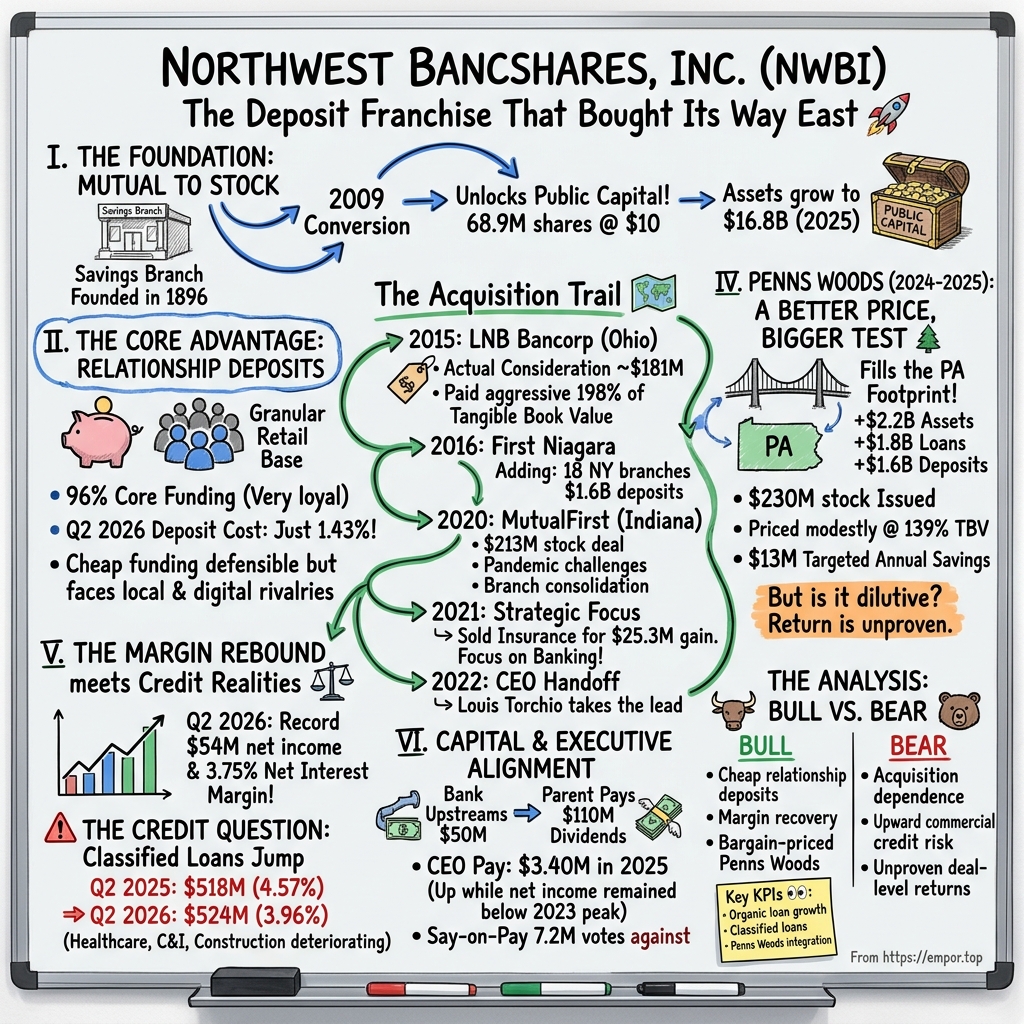
On the morning of July 28, 2026, Lou Torchio opened Northwest Bancshares' second-quarter call with the kind of line every bank chief executive wants to read aloud. The quarter had produced about $54 million of net income, the largest in the company's 130-year history, up almost 60% from the same quarter a year earlier.1 Diluted earnings per share of 36 cents were also a record, he noted, setting aside one quarter in 2021 that had been inflated by the gain on selling the insurance agency.1 The net interest margin, the spread between what the bank earns on its loans and securities and what it pays for its money, had risen for a fourth straight quarter to 3.75%.2 The next day, Northwest was holding a grand opening for its first newly built branch in Columbus, Ohio, the city where the holding company now keeps its headquarters.1
Read the same press release a few pages further on, and the mood changes. Loans that the bank's own examiners had graded "classified," meaning a borrower showed well-defined weaknesses that put repayment at risk, totalled $524 million, or 3.96% of all loans.2 That was higher than the quarter before. A year earlier the figure had been $518 million, and back then it had been the headline problem.3 When KBRA, the rating agency, affirmed Northwest's ratings a few weeks later, it praised the deposit franchise in nearly the same breath as it described classified loans as elevated relative to peers.4
So here is the contradiction this story has to resolve. A regional bank posts the best profits in its history, with a stronger margin, and at the same moment carries a long and slowly shifting list of loans its own credit officers are worried about. Is the earnings step-up durable? Or is Northwest still digesting the cost and risk of buying its growth?
The short version of the answer is that the earnings rebound is real, but it rests on three legs that all have to hold at once. The enlarged bank has to earn its way through the integration of Penns Woods Bancorp, the Pennsylvania lender it bought in 2025. Its deposit base has to stay cheap while rivals bid for the same savers. And credit costs have to stay contained while the loan book shifts toward riskier commercial lending. Any one of those legs can wobble without collapsing the stool. Two at once would be a different story.
That framing raises four questions that run through everything that follows. The first is what makes Northwest's funding advantage durable, and whether it is a real moat or just a good run of pricing. The second is how much of its growth is organic, because a bank that grows mainly by buying other banks has to keep finding sellers and keep paying for them. The third is whether those acquisitions have earned their price, measured not by whether the computer systems were merged on time but by what happened to earnings and book value per share. The fourth is whether credit losses stay manageable as the bank changes the kind of lending it does.
One piece of housekeeping keeps the numbers honest. Northwest Bancshares, Inc. is the listed holding company, traded on Nasdaq under the ticker NWBI. Almost all of its economic life happens inside its principal subsidiary, Northwest Bank, and the company reports a single banking segment.5 There is no conglomerate to untangle, no outside parent taking fees and no promoter group. When this story talks about Northwest, it means one bank and the public company that owns it.
That simplicity is also why the record quarter deserves skepticism rather than celebration. In a single-segment bank, there is nowhere for a problem to hide: if acquired loans go bad or deposit costs climb, the damage lands in the same income statement that just printed a record. To understand which way that statement is likely to move, it helps to go back to what Northwest was before it learned to buy things, a small savings institution in the hills of northwestern Pennsylvania that had to decide what to do with public money once it had some.
 Subscribe on LinkedIn
II. A Mutual Bank Learns to Use Public Capital
Warren, Pennsylvania, sits on the Allegheny River a few miles south of the New York line, a timber-and-oil town whose prosperity peaked long before anyone in it had heard of a net interest margin. Northwest traces its founding there to 1896.5 For most of the twentieth century it was the kind of institution that small American towns built for themselves: a savings association owned, in effect, by its depositors. A mutual has no shareholders. Its customers' deposits fund its loans, its profits accumulate as capital, and the people who run it answer to a board rather than a stock price.
The business model was beautifully plain. Families brought in savings, and the bank lent those savings back out as home mortgages to other families in the same towns. The mortgage would sit on the books for decades, earning a fixed rate. If the bank kept its costs low and lent carefully, the gap between what it paid savers and what it collected from borrowers built up, slowly, into the capital that made the next round of lending possible. It is worth remembering this DNA, because a version of it still shapes Northwest's balance sheet today, from its heavy load of fixed-rate residential mortgages to its unusually loyal depositors.
The constraint on a mutual is capital. It can grow only as fast as it can retain profits, which in a low-margin business is not very fast. That is why so many American thrifts converted from mutual ownership to stock ownership in the late twentieth century. Northwest did it in stages, first selling a minority stake to the public under a mutual holding company and then, in 2009, completing what bankers call a "second-step" conversion, in which the mutual holding company disappears and the whole institution becomes publicly owned. In that offering, Northwest sold 68.9 million shares at $10 apiece.5 Hundreds of millions of dollars of fresh equity arrived in the aftermath of the financial crisis, just when many competitors were short of it.
Public capital changes the question a bank's managers have to answer. A mutual asks how to serve its depositors safely. A public company also has to ask how to earn a return on its equity, because shareholders can sell, activists can call and the stock price keeps score every day. A savings bank flush with conversion capital has two broad options. It can grow its loan book slowly in its existing markets, or it can use its capital and its shares as currency to buy other banks and branches. Northwest, over the next fifteen years, chose the second path repeatedly.
By the end of 2025, the bank that began in Warren had about $16.8 billion of assets.5 Its footprint stretched across Pennsylvania, into western New York, across Ohio and as far as Indiana. In February 2021, the company announced that the holding company was moving its headquarters to Columbus, Ohio, describing the city as central to its operating footprint, while Northwest Bank itself remains headquartered in Warren.6 That split address captures the institution's double identity: a Pennsylvania savings bank at the root, and a multi-state regional bank in its ambitions.
The older history can stay brief, because the turning points that matter to today's investor are few and recent. The first was the 2015 purchase of LNB Bancorp, which took Northwest into northeastern Ohio. The second was the 2020 acquisition of MutualFirst Financial, which put it in Indiana. The third was a leadership change in 2022, when Lou Torchio became chief executive after the sudden death of his predecessor, Ronald Seiffert.7 The fourth was the 2025 Penns Woods deal, which pulled the franchise east again into central and northeastern Pennsylvania.
The conversion gave Northwest a durable funding base and the means to expand. But it did not settle whether expansion would create value. That is the central tension of the whole story. Public capital can buy scale and new markets, yet each purchase adds integration work, inherited credit risk and a higher bar for per-share returns, since every new share issued to a seller is another claim on future profits. The rest of the Northwest story is less about a single breakthrough than about the choices made with that capital, and every one of those choices depended on the same underlying asset: the deposits.
III. What a Northwest Deposit Is Worth
Picture a hardware store in a small Pennsylvania town. Its owner opened a business checking account at the local Northwest branch years ago, maybe because his father banked there, maybe because the branch manager coached his kid's Little League team. Every week, cash and card receipts pour into that account and payroll and supplier payments drain out. The balance never sits very high, and it earns almost nothing. The owner does not think about it much. That is precisely the point.
Multiply that account by hundreds of thousands and you have Northwest's core economic engine. On the second-quarter call, chief financial officer Doug Schosser described a deposit book of more than 716,000 customer accounts with an average balance of about $19,800 and an average tenure of more than twelve and a half years.1 Those three numbers say more about the franchise than any slogan. The average balance is small, which means the money is spread across many ordinary customers rather than a few large ones. The tenure is long, which means those customers have stayed through several interest-rate cycles. And because the accounts are ordinary operating accounts, many pay little or no interest.
To see why that matters, it helps to think of a bank as a shop that sells money. Its inventory is the deposits and borrowings it takes in, and its product is the loans and securities it buys with them. The bank's gross margin is the net interest income: interest earned minus interest paid. On top of that sits a second, smaller revenue stream of fees from payment services, trust and wealth management, mortgage banking and lending through the Small Business Administration. KBRA estimates that noninterest income makes up about a fifth of Northwest's revenue, supported especially by investment-management and trust fees.4 Then come the operating costs of branches, staff and technology, and finally the losses on loans that go bad.
In that equation, the cost of inventory is decisive. In the second quarter of 2026, Northwest's total cost of deposits, including the accounts that pay nothing, was 1.43%.4 Management called it the fourth consecutive quarterly decline, and KBRA described it as among the lowest of the banks it rates.14 A year earlier, KBRA had calculated that core deposits, the stable retail and business accounts rather than brokered or wholesale money, made up 96% of Northwest's funding.8 A bank that funds itself almost entirely with sticky, cheap local deposits can lend at the same rates as a rival and keep more of the spread. Or it can price a little more aggressively and still earn a decent return. Either way, the deposit base is the advantage.
That is the strongest evidence for a durable edge, and it deserves a hard test. Michael Porter's five forces offer a useful way to run it. Rivalry among existing competitors is intense: Northwest competes in every market with national giants, super-regionals, other community banks and credit unions, all fishing for the same borrowers and savers. Buyers, meaning depositors and borrowers, have real power, because a customer can move money with a few taps or split accounts across banks.
Substitutes are abundant: online savings accounts and money-market funds offer higher yields on idle cash, and private credit funds compete for commercial loans. Barriers to new entry are high, because regulation, capital requirements and technology make starting a bank costly, which protects incumbents against new banks but not against existing ones. And the suppliers of funding are the depositors themselves, which loops back to buyer power. Northwest's branches and local relationships give it reach in its towns, but nothing in that structure eliminates price competition.
The scale comparison makes the point sharper. Northwest is a mid-sized regional bank. Its stock market value is about $2.3 billion in October 2026, while F.N.B., the Pittsburgh-based bank that competes across much of the same Pennsylvania and Ohio territory, is worth almost three times as much.910 Much larger banks such as PNC operate at a different order of magnitude altogether, with technology and marketing budgets Northwest cannot match. Size is not destiny in banking, but it buys better mobile apps, more advertising and the ability to absorb compliance costs. Northwest's answer to scale cannot be to outspend; it has to be to out-relate.
There is local evidence that the answer works in places. When Northwest pitched the Penns Woods deal, its merger materials pointed to strong deposit-market positions in parts of Pennsylvania, including the Scranton area, where Penns Woods' Luzerne Bank subsidiary operated.[^11] And the bank's deposit costs have fallen through 2026 without the outflows that would signal customers leaving for better yields. On the second-quarter call, Schosser said average deposits grew modestly in the quarter, and that the small decline in period-end balances came from a deliberate reduction in brokered certificates of deposit rather than from customers.1
Still, the moat claim needs to stay narrow. What the record shows is low-cost, granular funding that has held up across rate cycles. What it does not show is a proprietary network effect, high switching costs or pricing power in the usual sense. Northwest does not disclose customer attrition rates, account-switching data or a market-share series that would prove customers cannot leave; it discloses that, so far, they have not. Schosser himself was candid that the cheapest part of the repricing was over.
Certificates of deposit rolling over in 2026 had mostly already been repriced lower, he said, and he expected a more competitive deposit market across the industry.1 Even the Columbus expansion cuts both ways. A new branch in a fast-growing city brings new customers, but as Schosser acknowledged, a new entrant attracts them at relatively higher rates than an existing book.1 Cheap deposits are an inheritance. New deposits cost market prices.
The other side of the spread is the asset book, and here Northwest's mutual DNA works against it. A thrift's natural asset is the long fixed-rate home mortgage, and Northwest still carries a relatively large book of them. KBRA notes that this concentration has historically held Northwest's loan yields below those of peers and made the balance sheet more sensitive to interest rates.4 When rates rose sharply in 2022 and 2023, deposit costs rose faster than the yield on those old mortgages could catch up. That is why the margin hit a trough in the second quarter of 2024 before climbing 55 basis points to its current level.4
Management's plan is to remix the loan book away from those low-yielding mortgages and toward commercial and industrial lending, which floats with rates and earns more. Average C&I loans grew by about a third in the year to June 2026, and the bank's nationwide specialty lending verticals, in areas such as franchise, sports and sponsor finance, now account for roughly a quarter of the commercial portfolio by management's count.1 Meanwhile residential mortgages and older commercial real estate loans are running off. It is a sensible plan for a bank whose funding is cheap and whose loan yields have lagged. It also changes what kind of risk the bank is taking, a point that will matter a great deal when the story reaches the loan book.
The verdict on the deposit franchise is that the advantage is credible but bounded. Low-cost funding is evidenced by the bank's pricing, the granularity of its accounts and an outside rating agency's peer comparison. It is not protected by anything that stops a determined rival or a high-yield app from bidding customers away. A deposit franchise is a garden that has to be tended. And Northwest, for the past decade, has preferred to grow its garden by buying other people's. The return on that strategy depends entirely on what it paid.
IV. The Ohio Deal That Tested the Price of Expansion
Lorain, Ohio, sits on Lake Erie about half an hour west of Cleveland, a steel and shipbuilding town that had spent decades losing its industrial base. Lorain National Bank had been founded there in 1905, and by 2014 its holding company, LNB Bancorp, ran about twenty offices across Lorain, Cuyahoga and Summit counties, with about $1.2 billion in assets and just over $1 billion in deposits.11 Its chief executive was Daniel Klimas. On December 15, 2014, LNB agreed to sell itself to Northwest.11
For Northwest, it was the first bank purchase in several years and a step across the state line into a new metropolitan area. The pitch was straightforward. LNB brought roughly twenty branches, more than $1 billion of deposits and a foothold in greater Cleveland, a market far larger than any Northwest had served from Warren.11 Combined with Northwest's existing branches in eastern Ohio, the deal promised a contiguous footprint and the expense savings that come from running two banks' back offices as one.
The price was the interesting part. LNB shareholders could elect $18.70 in cash or 1.461 Northwest shares for each LNB share, with the overall consideration split roughly half and half.11 Northwest's merger filing put the purchase price at about $181 million.11 Against LNB's tangible equity of roughly $94 million, that worked out to almost twice tangible book value, around 198% in the deal analysis, and against LNB's 2014 profit of about $7 million it was something like 25 times trailing earnings.11 The filing's own fairness analysis acknowledged that the transaction's valuation multiples sat significantly above the medians of comparable bank deals of the period.11
Those multiples need a word of translation. When one bank buys another, tangible book value is roughly what would be left for shareholders if every asset were sold at its carrying value and every debt paid. Paying twice tangible book means paying a dollar of goodwill for every dollar of hard equity acquired. The buyer is betting that the target's deposit relationships and earnings power are worth far more than its accounting equity. Sometimes they are. But goodwill does not earn interest, and the buyer's existing shareholders bear the dilution until the acquired earnings fill the hole.
Management put its promises on the record. Management said the deal was expected to deliver expense savings and to earn back the dilution to Northwest's tangible book value in about 4.9 years.11 That is a long earn-back by the standards bank investors usually apply; deals of that era were often expected to pay back in three to five years, and anything near five years usually signals a full price. The filing was also careful to say that there could be no assurance that the projected cost savings would be realized, and its pro forma figures showed only a sliver of earnings-per-share accretion before savings.11
Did it work? The deal closed in 2015, and LNB became part of Northwest's Ohio franchise.12 Northwest's 2015 net income was about $60.5 million, and in 2016, the year it absorbed a second wave of acquired branches, it fell to about $49.7 million.13 What the company never published was a clean, deal-level accounting of LNB's returns: no statement of what the acquired branches earned after costs, what the deposits cost over time, or whether the 4.9-year earn-back was achieved. In later years, LNB blended into the broader Ohio operation. So the original projection should be treated as exactly that, a projection, rather than a verified outcome.
The branch playbook did not stop in Ohio. In 2016, Northwest bought 18 First Niagara offices in western New York, which became available as First Niagara was absorbed by KeyCorp and regulators required branch sales.13 That deal added about $1.6 billion of deposits and about $450 million of wealth-management assets.13 Branch purchases are a different animal from bank purchases. The buyer takes deposits and some loans, but not the seller's whole credit history, and it usually pays a deposit premium rather than a multiple of book value. For a deposit-hungry savings bank, it was a natural fit: it bought more cheap deposits from a seller who had to sell.
The pattern that emerges from 2015 and 2016 is a bank that had learned to integrate. It could take over branches, convert systems, retain enough customers and fold the result into its footprint. That operational competence is real and it compounds; the people who ran those conversions were still in the building when later deals came along. But operational competence is not the same as value creation. A bank can integrate an acquisition flawlessly and still have paid too much for it. On the evidence the company published, LNB expanded Northwest's footprint and deposits at an aggressive price, and the return on that price is not documented. It is a useful calibration point for everything that came after. Experience integrating deals proves the bank can do deals. It does not prove that every deal earned its cost. The next one would test that distinction in the worst possible conditions.
V. The Indiana Bet, Then a Change in Direction
On October 29, 2019, Ron Seiffert announced the largest acquisition in Northwest's history. MutualFirst Financial, based in Muncie, Indiana, was a former thrift itself, with 39 banking locations, about $2.1 billion of assets and $1.6 billion of deposits.14 Seiffert called it "a unique and sizable opportunity that is highly accretive," and said Indiana was "an attractive market with a business friendly environment."14 MutualFirst's chief executive, David Heeter, would become Northwest's regional chief executive and Indiana market leader.14
The thesis was the familiar one, scaled up. Northwest would pay entirely in stock, 2.4 of its shares for each MutualFirst share, valuing the deal at about $346 million, or roughly 172% of MutualFirst's tangible book value.14 Management projected cost savings of about 30% of MutualFirst's expense base, and said the dilution to tangible book value, about 3.5%, would be earned back in under three years.14 It was a cheaper deal than LNB on the book-value measure, and the combined bank would have more than 200 locations across four states.14
Then the world changed. The deal closed and the systems were converted on April 24, 2020, about six weeks into a pandemic that had shut down much of ordinary American commerce.15 Northwest was integrating a new bank in a new state while its branches were operating under restrictions, its borrowers were requesting payment deferrals and its loan officers were processing government Paycheck Protection Program loans.
The fixed exchange ratio also did something important to the price. Because MutualFirst shareholders received a set number of Northwest shares rather than a set dollar amount, the value of what they received depended on Northwest's stock price at closing. Bank stocks had collapsed in the spring of 2020, and Northwest's was no exception. By closing, the consideration was worth about $213 million, paid with about 20.7 million new Northwest shares.15 The headline price had fallen by more than a third. That sounded like a bargain for Northwest, and in dollar terms it was. But the number of shares issued did not change, so Northwest's existing owners gave up the same fraction of their company for MutualFirst as they had agreed to in 2019. A fixed exchange ratio shares the market's pain between buyer and seller; it does not make the buyer's dilution any smaller.
The pandemic also hit earnings directly. Northwest's 2020 net income fell to about $75 million from about $110 million in 2019, a decline of nearly a third, as provisions for credit losses rose and merger costs and other expenses climbed.15 In September 2020, the company raised $125 million of subordinated debt at a 4% rate, strengthening its regulatory capital through the uncertainty.15 That debt would resurface six years later as a capital question.
What Northwest did next is the more revealing chapter. In December 2020, it consolidated 43 offices in a single branch-optimization program, cutting its count of banking offices from 213 at the end of September to 170 at year-end.15 That was a big move for a bank whose identity was built on local branches. It suggested management understood that acquisition-driven growth had left the network overlapping and expensive, and that the digital shift accelerated by the pandemic made some branches redundant. Expansion had stopped being an answer by itself; now it had to be paired with pruning.
The insurance business tells a similar story. In April 2021, Northwest agreed to sell its insurance agency, Northwest Insurance Services, to USI Insurance Services.16 The sale closed in the second quarter of 2021 and produced what Torchio later called a large gain.1 For a bank that had once tried to be a financial supermarket in its towns, it was a decision to focus on banking. It also showed a management team willing to exit a business rather than defend every activity it had accumulated. 2021 turned out to be the profit peak of the decade, with net income of about $154 million, a figure flattered by the insurance gain.5
The next chapter began with a tragedy. On May 24, 2022, Ron Seiffert died.7 Chief financial officer William Harvey served as interim chief executive, and on August 17, 2022, the board appointed Lou Torchio, then 60, as president and chief executive of both the holding company and the bank.7 Torchio had joined Northwest in 2018 after three decades in banking and was running retail lending and business banking.7 Before Northwest he had spent two years as head of residential and consumer lending at Delaware County Bank, and his résumé was that of a lender who had built consumer businesses rather than a treasurer or a dealmaker.7 The board set his base salary at $800,000.7
Torchio's background shaped what came next. A retail and lending executive tends to see a bank through its customers and its loan production rather than through its branch map. Under his leadership, Northwest built specialty commercial lending verticals with national reach, opened a regional office in Fishers, Indiana, to anchor the Indiana franchise, and began planning new branches in Columbus rather than only buying old ones.171 Those choices marked a change in direction: from a bank that grew mainly by acquiring geography to one that, at least in its stated strategy, also tries to grow by building.
MutualFirst, then, added a new market and real scale, but its headline value fell by more than a third before closing, its integration coincided with a pandemic earnings collapse, and the company never published a deal-level return calculation that would prove the projected earn-back. What the record does show is a management team that consolidated aggressively, sold a non-core business and handed the reins to a new leader with a different instinct. It is fair to ask whether Northwest had learned to build a better-sized bank or whether expansion was simply its default answer. Torchio's own first big deal would provide the clearest test, because it came with a lower price and a set of promises he would personally have to deliver.
VI. Penns Woods: A Better Price, a Bigger Test
Williamsport, Pennsylvania, is best known to most Americans as the home of the Little League World Series. To bankers, it was also the headquarters of Penns Woods Bancorp, the holding company for Jersey Shore State Bank and Luzerne Bank, which served north-central and northeastern Pennsylvania from towns along the West Branch of the Susquehanna and the valleys around Wilkes-Barre.18 On December 17, 2024, Northwest announced that it would buy Penns Woods in an all-stock deal.18 Penns Woods' chief executive, Richard Grafmyre, described it as "bringing together two like-minded institutions," and agreed to join Northwest's board after closing.18
The geography explains the logic, and the title of this story. Northwest's Pennsylvania franchise had grown up in the state's northwest corner and spread across its western and central counties in a dispersed pattern, a branch here, a cluster there. Penns Woods filled in territory to the east, in Lycoming, Clinton, Centre, Union, Montour, Blair and Luzerne counties.18 After two decades of expanding west into Ohio and Indiana, the bank that started in Warren was now buying its way east, connecting its home base with the central and northeastern parts of its home state. On closing, Penns Woods added 21 financial centers, about $2.2 billion of assets, roughly $1.8 billion of loans and $1.6 billion of deposits after purchase accounting.5
The price was where Torchio's deal differed most from its predecessors. Northwest offered 2.385 of its shares for each Penns Woods share, worth $34.44 at Northwest's closing price of $14.44 the day before the announcement, or about $270 million in total.18 That was 139% of Penns Woods' tangible book value and 12.8 times its last twelve months of core earnings.18 Set beside Northwest's own history, those numbers are notably more modest: well below the roughly twice-book premium paid for LNB and below the 172% cited for MutualFirst.1114 The core deposit premium, which measures what Northwest paid above tangible book as a share of the deposits it was acquiring, was 5.2%.18 For a deposit-focused buyer, paying a five-cent premium for each dollar of a rural Pennsylvania bank's deposits is not an obviously rich price.
As with MutualFirst, the fixed exchange ratio meant the announced price and the realized price diverged. Northwest's stock fell between announcement and closing, so the 18.3 million shares it issued to Penns Woods shareholders were worth about $230 million when the deal closed in July 2025.5 The headline price came down by roughly $40 million. Penns Woods holders ended up with about 12% of the combined bank.18
Management put specific promises on the table. It projected that the deal would add about 23% to Northwest's 2026 earnings per share, excluding one-time costs, and it targeted about $13 million of annual cost savings.18[^11] Against that, it disclosed about 9% dilution to tangible book value per share at closing, to be earned back in under three years, 2.9 years in the merger presentation's calculation.18[^11] Penns Woods shareholders were also offered a sweetener: Northwest's dividend, translated through the exchange ratio, worked out to about 49% more per share than Penns Woods had been paying.18 For a shareholder base that tends to own small Pennsylvania banks for income, that was a persuasive argument.
The integration itself was quick. The deal closed and the systems were converted in late July 2025, a little over seven months after announcement.19 Customer accounts moved onto Northwest's platforms, and by the middle of 2026 the combined bank carried more than $17 billion of assets.192
A year later, Torchio was ready to declare victory. On the July 2026 call, he described Penns Woods as "a very successful accretive transaction" and said Northwest had achieved the full tangible book value earn-back within a year on what he called a static basis, and expected to complete the earn-back on a crossover basis by the end of 2026.1 Schosser added the evidence: tangible book value per share was $9.88 at the end of June, against $9.85 before the deal was announced.1 Both measures, he noted, would be reached in about a year, against the 2.9 years promised up front.1
That claim deserves careful handling, because it is both genuinely good news and less than it appears. The good news is that Northwest's tangible book value per share is back to where it was before it issued 18 million new shares, and that happened faster than management had projected. The caveat is in what moved it. Tangible book value per share in a bank is pushed around by many things besides an acquisition: retained earnings, the value of the securities portfolio as interest rates change, and the amortization of acquired intangibles.
A "static" earn-back simply measures when the number returns to its pre-deal level, without asking what it would have been if the deal had never happened. Over the same period, Northwest earned profits and kept part of them, and bond prices moved. The more demanding "crossover" measure, which compares the actual path to a hypothetical standalone path, has not yet been met by management's own account.1 The faster earn-back is evidence that the dilution was manageable. It is not, by itself, evidence of a return above the cost of the shares.
The analyst questions on that call were revealing. When Manuel Navas of Piper Sandler asked what lessons Northwest had learned, Schosser cited disciplined pricing, cultural fit and keeping cost removal from alienating the acquired customers.1 Torchio added that the one thing to remember in a deal is "not to destroy value that you just paid for," and said the team had spent time in the acquired markets with employees and customers.1 Those are thoughtful answers. They are also the answers any acquiring bank would give. What would turn them into proof is a set of numbers Northwest has not published: how many Penns Woods customers stayed, how many of the projected $13 million of savings were realized and at what cost, and what the acquired loans and deposits are earning after purchase-accounting effects.
Purchase accounting is the hidden lever in any bank merger, and it merits a plain explanation. When Northwest bought Penns Woods, it had to mark Penns Woods' loans to their fair value. Loans made at low rates in earlier years were worth less than their face value in a higher-rate world, so they were written down. That discount is then accreted back into interest income over the life of the loans, as if the loans were earning a higher rate than their coupon. The effect is real cash over time, but it flatters the margin in the years immediately after a deal. Northwest's own release acknowledges that purchase-accounting accretion contributed to the year-over-year margin improvement.2 Some of the record quarter, in other words, is accounting for a deal rather than the earning power of the franchise.
Then there is credit. Penns Woods brought its own loans, underwritten to its own standards, and as those loans were moved onto Northwest's credit-grading system, some were downgraded. Northwest's second-quarter release said the year-over-year rise in classified loans was primarily from acquired Penns Woods loans.2 On the call, Schosser explained that as the new customers got used to Northwest's documentation and credit expectations, there tended to be more pressure on their credit grades.1 That is a familiar pattern in bank mergers, and it does not necessarily mean losses. But it is a cost the merger presentation did not emphasize, and it adds to a classification problem Northwest already had before Penns Woods arrived.
The verdict on Penns Woods is cautiously favorable on price and unproven on returns. By Northwest's own acquisition history, it was the most reasonably priced bank purchase of the past decade, and it is not an obvious overpayment on the announced multiples. The faster-than-promised tangible book recovery is a genuine point in its favor. But the return on the investment depends on per-share earnings and tangible book growth after the purchase-accounting accretion fades, the integration costs are fully behind it and the acquired loans have seasoned.
Northwest does not report a standalone return on the capital it spent on Penns Woods. The next evidence will be the trend in per-share results, expenses and acquired-loan performance over the coming quarters. A seamless conversion is an operating milestone. It is not a return on capital. And the loan book, where acquired credits meet Northwest's own, is where that return will be won or lost.
VII. The Margin Rebound Meets the Loan Book
In July 2025, a few weeks before Penns Woods closed, Northwest released its second-quarter results with a slide that investors had not expected. Classified loans had jumped to $518 million, or 4.57% of loans.3 The bank's explanation came in three parts. A group of healthcare loans had been reclassified. Several construction projects were leasing up more slowly than their borrowers had planned. And a number of commercial and industrial borrowers had weakened.3 None of those were Penns Woods loans. This was Northwest's own book.
It helps to translate what a bank means when it talks about troubled loans, because the vocabulary is unhelpfully similar. In a manufacturing company, an investor worries about receivables, the money customers owe. In a bank, the receivables are the loans themselves, and there is a ladder of warning signs. A loan can be past due, which means a payment is late. It can be nonperforming, which means the bank has stopped counting interest as income because it doubts it will be paid.
Or it can be criticized or classified, which means the bank's credit officers see weaknesses even if the borrower is still paying. Against all of this sits the allowance for credit losses, the reserve set aside for expected losses. Classified loans are the widest net, the place where trouble shows up first. Most classified loans do not end in losses. But losses almost always pass through the classified category on the way.
The three-part breakdown matters because it is more specific than blaming the cycle. Healthcare lending, particularly to nursing homes and senior-care facilities, has been a problem across the industry since the pandemic, as occupancy fell, labor costs rose and government reimbursement lagged. Construction projects leasing up slowly is the classic symptom of commercial real estate stress in a higher-rate world, when tenants are harder to find and refinancing costs more. And deteriorating C&I borrowers are exactly the kind of risk that rises when a bank pushes into commercial lending. KBRA had already identified healthcare credit deterioration as a constraint on Northwest's rating and noted that the bank's nonperforming assets had historically run above peers.8
A year later, the headline ratio had improved. Classified loans were 3.96% of loans in June 2026, down from 4.57%.23 But this is where a good investor looks at the dollars as well as the percentages. In absolute terms, classified loans rose from $518 million to $524 million.32 The ratio fell mainly because the denominator grew: Penns Woods added almost $2 billion of loans, many of them unclassified. In other words, the improvement in the ratio is largely an artifact of the acquisition. Northwest worked out some of its existing problem credits and inherited some new ones, and the net effect was a slightly larger pile of worrying loans spread over a bigger bank. KBRA, reviewing the same figures in August 2026, still described the classified level as elevated relative to peers.4
The quarterly flow tells the same story. On the second-quarter call, David Bishop of Hovde Group asked what had driven the latest increase. Schosser pointed to about $146 million of downgrades during the quarter, attributed partly to the continued migration of acquired loans onto Northwest's credit standards and partly to downgrades in the healthcare book.1 He also said Northwest had no expectation that the increase would lead to higher overall charge-offs.1
Other indicators sit somewhere between reassuring and concerning. Net charge-offs, the losses actually written off, ran at an annualized 0.15% of loans in the second quarter, below the low end of management's full-year guidance.21 The allowance stood at 1.13% of loans, enough to cover nonperforming loans about 1.6 times.2 Those are cushions. But the longer trend points the other way. At the end of 2025, loans more than 90 days past due were about $66 million, roughly two and a half times the year before, and nonperforming loans had risen to about $108 million from about $62 million.5 Some of that increase came with Penns Woods, but not all of it. In the second quarter of 2026, 90-day delinquencies rose again, from 34 to 49 basis points of loans, even as total delinquency fell.1
Management's own guidance implies the low charge-offs will not last. Brian Foran of Truist pointed out that reaching the low-to-middle part of Northwest's full-year charge-off range would require roughly $10 million a quarter in the second half, about double the recent run rate.1 Schosser answered that it was mostly reversion to the mean, but also partly visibility into resolving some known problem loans.1 It was a candid answer. It also told listeners that the bank's own forecast embeds higher losses than the current quarter shows.
There is a strong historical argument on Northwest's side. KBRA notes that the bank's peak net charge-off ratio was 0.7%, in 2011, and that it largely outperformed peers through the financial crisis.4 For a bank that lived through the worst credit cycle in eighty years, that is a meaningful record. It reflects the thrift's conservative roots: residential mortgages to local borrowers, carefully underwritten, rarely produce large losses.
But that is exactly why the historical record is an incomplete guide today. The 2011 loss record was earned by a bank that was mostly a residential lender. The Northwest of 2026 is deliberately becoming something else. Its fast-growing C&I and specialty lending businesses are changing that profile.1
When a bank's loan mix changes, its old loss history stops describing it. Commercial loans default more often than home mortgages in downturns, and loans made through national specialty platforms are to borrowers the bank does not see at the local diner. Torchio was emphatic on the call that the verticals are run by experienced leaders and that the growth is measured and disciplined.1 That may be true. It is also an assertion that has not yet been tested by a recession.
The healthcare book shows both sides of the problem. KBRA calculated that healthcare had fallen to about 8% of commercial real estate loans by the second quarter of 2026, from about 11% a year earlier, as payoffs and resolutions shrank it.4 That is progress. But KBRA continued to cite post-pandemic deterioration in the sector, and Schosser said healthcare downgrades contributed to the latest classified increase.41 The exposure is shrinking but not yet healthy.
Funding fragility belongs in the same risk picture, because credit stress and deposit flight tend to arrive together. At the end of June 2026, Northwest's largest depositor held about $185 million, or 1.3% of deposits, and the ten largest together held about 2.9%.2 Uninsured deposits, after excluding intercompany and collateralized balances, were about 14.6% of the total.2 By the standards of the banks that failed in 2023, whose uninsured deposits ran far higher, those are modest numbers. No single depositor dominates. But the granularity that keeps funding cheap also depends on customers staying, and Northwest's cost advantage would erode quickly if a credit scare encouraged its larger business depositors to diversify their banking relationships.
The verdict on credit is that current losses and reserves are manageable, but the warning signal predates Penns Woods and is not yet resolved. Acquired credits add to an existing healthcare and commercial-credit challenge, while the shift toward C&I changes the risk profile the 2011 record describes. The test is concrete. Over the next several quarters, classified-loan migration, charge-offs and nonperforming assets broken down by sector and by acquired-loan vintage will show whether the normalization is real. If classified loans fall in dollars, not just as a percentage, and charge-offs stay near management's range, the bull case is strengthened. If downgrades continue to outrun resolutions, the record quarter will look more like a peak than a plateau. Either way, the losses the bank takes will flow through to the one number that matters most to its shareholders: the cash that can be paid out to them.
VIII. A Bank's Cash, Its Dividends and Its Promises
For many shareholders, Northwest's story comes down to a single check. The company has paid a cash dividend for 127 consecutive quarters, and in mid-2026 it paid 20 cents a share each quarter, an annualized yield of more than 5% at the October 2026 share price.29 In 2025, those dividends consumed about $110 million, against net income of about $126 million.5 That is a payout of almost 90% of earnings. Torchio described it on the call as "returning more than half of our profits" in the second quarter of 2026, which was true for that record quarter but understates how much of the bank's profit the dividend absorbed in leaner years.1
A dividend that large raises the obvious question: is the cash really there? In most companies, the answer comes from comparing net income with operating cash flow. In a bank, that comparison is far less useful. Northwest's operating cash flow was about $153 million in 2025 against net income of $126 million, and about $128 million against $100 million in 2024.5 In 2023, though, operating cash flow was only about $93 million against $135 million of net income.5
The swings come from items such as the provision for credit losses, which is an expense but not a cash outflow, and from movements in other assets and liabilities that have little to do with earning power. Cash flow from operations is simply too volatile to serve as a bank's earnings-quality scorecard. The better test is capital: does the bank generate enough to fund its growth, satisfy regulators and still pay its shareholders?
That test runs through the holding company, which depends on Northwest Bank to send dividends up to it; regulators watch those upstream payments closely. Northwest Bank paid the holding company about $50 million in 2025, down from about $215 million in 2023.5 The holding company had other sources, including cash it had accumulated, but the decline in upstream dividends is a reminder that the bank's capacity to fund the parent's payout is not unlimited. KBRA noted a common equity tier 1 capital ratio of 12.2% in the second quarter of 2026, down from 12.8% a year earlier, as Penns Woods added assets.48 That is comfortably strong. KBRA's rating sensitivities state plainly that aggressive capital management that pushes capital below peer levels would be a downgrade trigger.4
Where else did the capital go? Investment in premises and equipment was about $11.6 million in 2025, up from an unusually low $2.3 million in 2024 and about $8.6 million in 2023.5 Full-time staff rose from about 1,956 at the end of 2024 to about 2,169 a year later, mostly because of Penns Woods.5 And the largest capital outlay of the decade, Penns Woods, was paid entirely in stock rather than cash, which is why it barely shows in the cash-flow statement and shows instead in the share count.5 No shares were repurchased in 2025.5 The board authorized up to $50 million of buybacks in 2026, but on the second-quarter call Schosser confirmed that Northwest had not yet used any of it, saying the first priority was dealing with subordinated debt.1
That subordinated debt consists of the 4% notes raised during the pandemic in 2020. As subordinated debt approaches maturity, regulators phase out how much of it can count as capital: Schosser said the notes had already lost 20% of their capital treatment in September 2025 and were due to lose another 20% in September 2026.1 Debt that costs interest but no longer counts fully as capital becomes expensive, so management discussed extinguishing it in the following quarter, which Schosser estimated would add about 2 basis points to the margin.1
At the end of June 2026, the company carried about $115 million of subordinated debt and about $130 million of junior subordinated debentures, the latter a legacy of trust-preferred structures, alongside about $612 million of borrowed funds, mostly from the Federal Home Loan Bank.2 Operating leases, about $50 million at year-end 2025, are a separate obligation.5 None of this is alarming for a bank of Northwest's size. But every dollar spent retiring debt is a dollar not spent on buybacks, and the order of priorities is a choice.
That brings the story to the people making the choices, and to how they are paid. Torchio's total compensation rose from about $1.9 million in 2023 to about $3.4 million in 2025.20 The 2025 increase was driven mostly by his annual cash incentive, about $1.37 million, roughly double the year before, alongside about $1 million of stock awards.20 The incentive plan is built on three measures weighted equally: adjusted return on average assets, adjusted return on average equity and the efficiency ratio.20 In 2025, all three exceeded their maximum targets, at an adjusted return on assets of 1.12%, return on equity of 9.9% and an efficiency ratio of 59.3%, so the plan initially funded at 200% of target; the compensation committee trimmed it to 190%.20
The problem is not that the measures are unreasonable. Return on assets, return on equity and efficiency are exactly the right ratios for a bank. The problem is what they omit and what they were set against. They are adjusted measures, which typically exclude merger expenses, so a year dominated by an acquisition can produce maximum payouts on a cleaned-up basis. They are not per-share measures, so they do not directly penalize dilution. And the maximum was reached in a year when net income remained below its 2023 level, and well below the 2021 peak.5 Over the proxy's measurement period, $100 invested in Northwest shares grew to about $129, compared with about $167 in the Nasdaq Bank Index.20 Pay rose sharply in a year when shareholders' long-run returns trailed the peer index.
Shareholders noticed, though not loudly. At the May 2026 annual meeting, say-on-pay passed with about 89 million votes in favor, but about 7.2 million votes went against it, and Torchio himself received about 2.9 million withheld votes in his director election.21 That is a clear majority of support with a visible minority of dissent. Torchio's personal stake is modest relative to the company: he beneficially owned about 162,000 shares in March 2026, including options, which is far less than 1% of the shares outstanding.20 The largest owners are index and institutional funds: BlackRock and Vanguard each held more than 10%, and State Street reported about 7.4% in August 2026.2022 There is no controlling shareholder or founding family to discipline management. Alignment depends on the board and the compensation committee.
The governance checks are otherwise clean. The board has an independent chair, and the proxy reports no pledged shares by directors or officers.20 There is no outside corporate parent extracting royalties or fees. Ordinary-course loans to insiders are disclosed, as banking rules require, and two branch leases from a company half-owned by director Charles Kranich carry combined rent of about $159,000 a year, roughly 0.02% of revenue.20 That is small enough to be immaterial and visible enough to monitor. KPMG's 2025 audit opinions were unmodified, with internal controls judged effective, and the company says ordinary-course litigation is not expected to be material.5 Currency is peripheral: operations are domestic, and the few foreign-exchange contracts it writes for customers are offset with third parties.5
The cash story, then, is reassuring on capital and less reassuring on alignment. The bank generates enough capital to pay a large dividend and remain well capitalized, and its disclosures show no accounting or related-party red flags. But management's incentives reward profitability ratios that a growing, acquisitive bank can hit without delivering per-share value, and the compensation committee paid near-maximum in a year when shareholders' long-term returns trailed peers. A skeptical shareholder would want the next pay cycle tied more tightly to earnings and tangible book value per share. That skeptic would also want to know what the market is paying for all of this.
IX. Analysis & Bear vs. Bull Case
Imagine a shareholder sitting at a kitchen table in Erie in October 2026, a brokerage statement in one hand and Northwest's latest dividend notice in the other. The stock closed at about $15.48 on October 23, 2026, which put it at roughly 14.7 times trailing earnings and about 1.56 times tangible book value.9 The bank produced its best half-year ever, with about $104 million of net income in the first six months of 2026 against about $77 million a year earlier.2 Yet its 2025 earnings were still below 2023 and well below 2021.5 Is she holding a durable community-bank compounder, or a cyclical lender whose recent results flatter the underlying business?
Start with the bull case, because it has real evidence behind it. The first pillar is Northwest's low-cost, long-tenured deposit base.4 The second is the margin's 55-basis-point recovery from its 2024 trough.4 The third is fee diversification.
Noninterest income rose about 11% year over year in the second quarter, led by trust and wealth management, and management guided to the high end of its fee range for the year.1 The fourth is the Penns Woods price. Northwest bought a Pennsylvania franchise at a lower book premium than its previous bank deals and recovered its tangible book value per share faster than promised.181 And there is operating leverage: the adjusted efficiency ratio improved to about 56% in the second quarter, the fourth straight quarterly improvement.1 Put together, the bull says, Northwest is finally earning what its deposit base should allow.
The bear case is equally concrete. The first problem is comparability. A large part of the 2025 and 2026 growth in revenue and net interest income came from acquired balances, not from organic customer gains. Net interest income plus fees rose from about $523 million in 2024 to about $655 million in 2025, and Penns Woods closed in the middle of that year.5 The second problem is that purchase-accounting accretion has helped the margin, and that support will fade as the acquired loans pay down.2 The third is the share count.
The roughly 146 million shares outstanding in mid-2026 compare with roughly 128 million before the 18.3 million deal shares were issued, so per-share growth is meaningfully lower than the headline profit growth.2 The fourth is unresolved credit migration, compounded by acquired loans and the bank's shift toward commercial lending. And the fifth is the gap between what management promised on past deals and what it has proven. LNB and MutualFirst each came with earn-back projections, and Northwest never published a deal-level return for either.
Hamilton Helmer's seven powers offer a cleaner way to weigh those cases than a simple pro-and-con list, because they ask what, precisely, would let Northwest earn above-normal returns over time. Most of the powers do not apply. Northwest has no network economics, since one depositor gains nothing when another joins. It has no proprietary technology or patents to call a cornered resource. Its brand is a regional reputation for safety and service, valuable but not something customers pay a premium for. Counter-positioning, in which an incumbent cannot copy a newcomer's model without damaging its own, does not describe a community bank competing with other community banks.
Two powers have some bite. The first is a modest form of switching costs. Moving an operating account means re-pointing direct deposits, payroll and automatic payments, and most small businesses and households do not bother unless provoked, which is part of why Northwest's accounts have an average tenure of more than twelve years.1 The second is scale economies at the local level. In towns where Northwest has a dense cluster of branches, its fixed costs are spread over more deposits than a rival with one branch can manage.
But those switching costs are low compared with true lock-in, and the local scale advantage is bounded by the national scale of competitors like PNC and by F.N.B., which competes in many of the same markets and is worth almost three times as much.109 Northwest's power is real, but it is a power of habit and density, not of exclusivity.
That leaves the activist's question, the one a skeptical investor would put to the board. Given that dividends took almost 90% of 2025 earnings and that the last bank deal was paid for in new shares, would retained capital do more for shareholders through organic lending and buybacks than through another acquisition? The company has authorized up to $50 million of repurchases, but authorization is not execution, and as of the second-quarter call none had been used.1 When Navas asked about capital priorities, Schosser listed organic growth first, then the dividend, then a mix of acquisitions and buybacks depending on conditions; Torchio added that Northwest was open to deals that were "highly accretive."1 That language has been used by every Northwest chief executive who has announced an acquisition. A skeptic would want to see buybacks executed at a sensible price before believing that the bank weighs them seriously against deals.
Valuation adds context rather than a verdict. Northwest's trailing P/E of about 14.7 sits within its own year-end range of roughly 11.7 to 16.8 over 2021 to 2025, but its price-to-book ratio of about 1.17 is near the top of its five-year range of about 0.93 to 1.19.923 The market's forward multiple, based on analyst estimates, is about 11 times, which implies those analysts expect earnings to keep climbing.9
Against peers, Northwest looks more expensive on earnings and comparable on tangible book: F.N.B. traded at about 10.7 times earnings and 1.48 times tangible book, and WSFS at about 12.5 times earnings but about 2.4 times tangible book.1024 Those comparisons are imperfect, since each bank has a different mix of loans, a different return on equity and a different credit history. What they suggest is that the market is already giving Northwest some credit for the record quarters. The price assumes that the earnings rebound mostly sticks.
Three numbers can settle the argument, and the shareholder at the kitchen table should watch them above all others. The first is organic growth: net interest income and fee income excluding acquired balances and purchase-accounting accretion. In the second quarter of 2026, management reported period-end loan growth of about $174 million from organic activity, but average loans grew only about $10 million, and residential and legacy commercial real estate continued to run off.1 The second is credit: classified and nonperforming loans and charge-offs, by sector and by acquired-loan vintage. The latest reading is $524 million of classified loans, up in dollars from both a quarter and a year earlier.2 The third is per-share value: tangible book value and earnings per share, measured after Penns Woods' integration costs and accounting effects have rolled off. Tangible book value per share was $9.88 in June 2026, just above its pre-announcement level.2
The bull case has evidence in cheap funding, an improving margin and a more reasonable purchase price. The bear case has equally concrete support in acquisition dependence, per-share dilution, higher commercial-credit exposure and the gap between deal promises and disclosed outcomes. Neither is settled by the multiple. They will be settled by whether those three numbers move together in the right direction, and that makes Northwest's history less a source of comfort than a set of lessons.
X. Playbook: Business & Investing Lessons
Go back to the hardware-store owner and his checking account in a small Pennsylvania town. He has never thought of himself as the foundation of a $17 billion bank. But every lesson Northwest teaches begins with him, and with what happens to his money when his bank decides to grow.
The first lesson is the one the hardware-store owner illustrates: Northwest's cheap deposits depend on customer habit, not contract.48 A bank whose moat is customer inertia has to be careful not to give customers a reason to wake up, whether that reason is a credit scare, a botched integration or a rival's teaser rate. Every investor in a deposit franchise should ask not how cheap the money is, but how much it would cost to replace.
The second lesson is that a deal price is the first credit decision. Northwest's LNB and Penns Woods deals show how much the price sets the burden on future returns.1118 Goodwill is a loan with no collateral, and the borrower is the future. For a regional bank, the question is never just whether a target is strategically attractive. It is how much dilution and goodwill the buyer can afford before the deal itself becomes the riskiest asset on the balance sheet.
The third lesson is that a smooth conversion is an operating milestone, not a return on capital. Penns Woods' quick systems conversion and tangible book earn-back were achievements.191 But the bank that converts systems quickly has proven that it can operate. It has not proven that the earnings it bought exceed the value of the shares it gave away. Founders and investors in every industry confuse execution with value creation, and banking, where the accounting rewards speed, makes the confusion easier.
The fourth lesson is that when the loan book changes, the old loss record changes with it. Northwest's history of low charge-offs was earned by a thrift that lent mostly to homeowners.4 The bank that now lends to franchise operators, sports businesses and private-equity-backed companies across the country is drawing on the same reputation for a different set of risks. A track record is a property of a portfolio, not of a brand. When the portfolio is rebuilt, the track record has to be earned again.
XI. Epilogue
Tonight, Northwest Bancshares is two days away from its next moment of truth. The company will release its third-quarter results after the market closes on Monday, October 26, and Torchio, Schosser and chief credit officer T.K. Creal will take questions the following morning.251 It will be the first public update since the September date when the 2020 subordinated notes lost another slice of their regulatory capital value, and since management signalled that it might retire them.1
The record headline will probably get the attention, but it is not the thing to judge. The more telling question is whether the organic engine is turning. Management has guided to a full-year margin of about 3.73% to 3.75% and fee income at the high end of its range, while warning that expenses will rise as new Columbus branches open and investment continues.1 If the margin holds while purchase-accounting support fades, it will be evidence that the deposit franchise and the loan remix are doing the work. If it slips, the record quarters will look more like an acquisition's afterglow.
Listen, too, for what management quantifies. Northwest has not published a tally of how much of the promised $13 million of Penns Woods savings it has captured, or of what the integration cost in total.[^11] Analysts may press on acquired-loan migration and on the healthcare downgrades that pushed classified loans up in the second quarter. A falling dollar total of classified loans, not just a falling ratio, would be the clearest sign the credit cycle is turning in the bank's favor. Rising downgrades, or charge-offs climbing toward the top of the guided range, would strengthen the bear case at exactly the moment the market has begun to price the bull.
Deposit costs are the quieter test. Northwest has cut them for four straight quarters, but its CFO has already said the easiest repricing is behind it and that competition for deposits is stiffening across the industry.1 If deposit costs keep falling without balances leaving, the funding advantage is as strong as KBRA describes. If the bank has to pay up to keep or grow deposits, especially in new markets like Columbus, the cheapest leg of the stool will start to cost more.
Then there is the subordinated debt, and with it the order of capital priorities. Retiring the notes would add a couple of basis points to the margin and remove a capital headache, but it would also absorb cash that could otherwise fund buybacks.1 What management does after that, whether it starts using its $50 million buyback authorization or returns to the acquisition market, will reveal how it weighs per-share value against size.
None of these will settle the story in a single quarter. The acquisition thesis will be tested over the next several quarters of tangible book value and earnings per share, as the accounting tailwinds fade and the acquired loans season. Northwest has built a bank that earns records. It now has to prove that the records belong to the franchise, not to the deal.
XII. Outro
Somewhere in Williamsport or Warren or Columbus, a customer is leaving a few thousand dollars in a checking account that pays almost nothing, because it is easier than moving it. She will never read a merger presentation. But her balance, multiplied across hundreds of thousands of accounts, is part of the deposit base that has helped Northwest fund its expansion.45
That is the defining tension in Northwest's story. It is a deposit franchise trying to turn local trust into regional scale, and its whole story turns on one exchange rate: can the bank keep that trust cheaper than the growth it buys with it? If it can prove that the loans and acquisitions it has bought are worth more than the shares it issued, the hardware-store owner's quiet account will have financed something remarkable. If it cannot, the low-cost money in the region will have paid for the most expensive lesson.
References
-
Q2 2026 Earnings Call Transcript — ROIC AI, 2026-07-28 ↩↩↩↩↩↩↩↩↩↩↩↩↩↩↩↩↩↩↩↩↩↩↩↩↩↩↩↩↩↩↩↩↩↩↩↩↩↩↩↩↩↩↩↩
-
Q2 2026 Earnings Release, Form 8-K — Northwest Bancshares, Inc. via SEC, 2026-07-27 ↩↩↩↩↩↩↩↩↩↩↩↩↩↩↩↩↩↩
-
Q2 2025 Earnings Presentation — Northwest Bancshares, Inc., 2025 ↩↩↩↩↩
-
KBRA Affirms Ratings for Northwest Bancshares, Inc. — KBRA, 2026-08-21 ↩↩↩↩↩↩↩↩↩↩↩↩↩↩↩↩↩
-
Northwest Bancshares 2025 Form 10-K — SEC, 2026-02-25 ↩↩↩↩↩↩↩↩↩↩↩↩↩↩↩↩↩↩↩↩↩↩↩
-
Northwest Bank Relocates Holding Company to Columbus, Ohio — Area Development, 2021-02-11 ↩
-
Form 8-K: Appointment of Louis J. Torchio as President and CEO — SEC, 2022-08-18 ↩↩↩↩↩↩
-
KBRA Affirms Ratings for Northwest Bancshares, Inc. — KBRA, 2025-08-22 ↩↩↩↩
-
NWBI Statistics — Stock Analysis, accessed 2026-10-24 ↩↩↩↩↩↩
-
LNB Bancorp Merger Registration Statement, Form S-4 — SEC, 2015 ↩↩↩↩↩↩↩↩↩↩↩
-
Northwest Bancshares and MutualFirst Financial Merger Announcement — SEC, 2019-10-29 ↩↩↩↩↩↩↩
-
Fourth Quarter and Full Year 2020 Earnings Release — Northwest Bancshares, Inc. via SEC, 2021-01-26 ↩↩↩↩↩
-
Northwest Bank Announces Agreement to Sell Its Insurance Business to USI, Form 8-K — SEC, 2021-04-01 ↩
-
Northwest Bank Opens a Regional Office in Fishers — Indianapolis Business Journal, 2023-01-12 ↩
-
Northwest Bancshares Announces Agreement to Acquire Penns Woods Bancorp — Northwest Bank, 2024-12-17 ↩↩↩↩↩↩↩↩↩↩↩↩↩
-
Northwest Bank Completes Penns Woods Deal — Pittsburgh Business Times, 2025-07-28 ↩↩↩
-
Schedule 13G — State Street Corporation via SEC, 2026-08-07 ↩
-
NWBI Historical Ratios — Stock Analysis, accessed 2026-10-24 ↩
-
Northwest Bancshares, Inc. Announces Third Quarter 2026 Earnings Call Details — Finviz, 2026-10-05 ↩
 LinkedIn
 WhatsApp
 Reddit
 Hacker News
 Email
 Kindle
 RSS Feed
 Spotify
 Apple Podcasts
 Amazon Music
 Audible
 YouTube