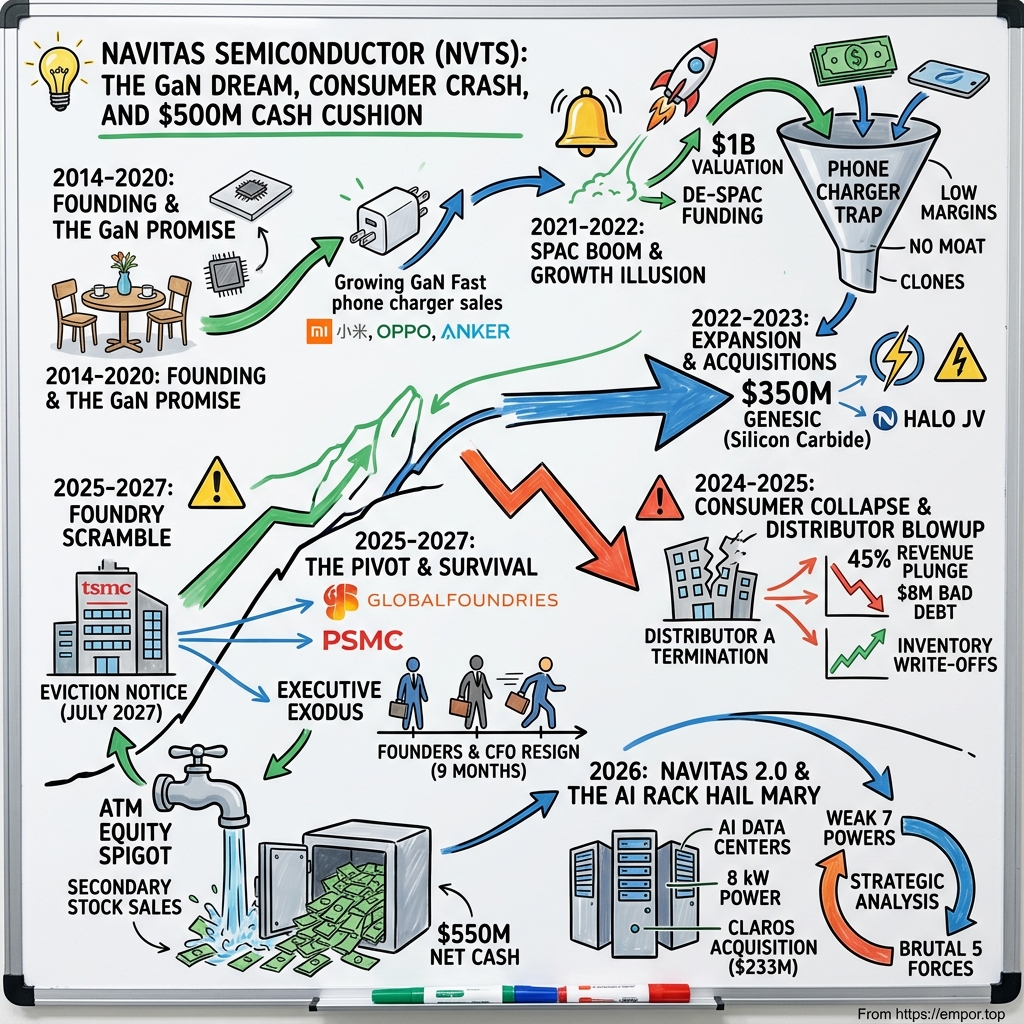
Navitas Semiconductor: The Gallium Nitride Dream, the Consumer Crash, and the $500M Cash Cushion
I. Introduction & Episode Roadmap
In the first days of June 2026, something odd happened to a small power-chip company from Southern California. Its stock went vertical. Shares of Navitas Semiconductor climbed above $30, high enough to trip price triggers written into a SPAC merger agreement nearly five years earlier and to release millions of dormant earnout shares to the company's pre-merger owners.2 At the peak, the market valued Navitas at more than $7 billion. Ignore the market cap for a moment and look at the business underneath it. In the first half of 2026, Navitas booked about $19 million of revenue, down a third from a year earlier, and lost about $55 million at the operating line.1
That is the paradox at the center of this story. Navitas is, by most operating measures, a company that has just been through a near-death experience. Its core business of selling gallium nitride chips for phone and laptop fast chargers shrank by almost half in 2025.3 The foundry that had made every one of its GaN wafers since the beginning, 台灣積體電路製造 Taiwan Semiconductor Manufacturing Company (TSMC), told the world in July 2025 that it would stop making gallium nitride altogether by July 2027.3 Its largest distributor, which had carried more than half of its sales, was terminated and left a hole of roughly $7.5 million in uncollectible receivables.3 Within about nine months, the two co-founders who had run the company since 2014 and the chief financial officer were all gone.4
And yet Navitas sits tonight on one of the cleanest balance sheets in small-cap semiconductors: about $557 million in cash and equivalents at the end of June 2026, and no debt.1 It got there by doing the one thing a struggling public company with a hot stock can do. It sold shares into the rally, raising roughly $381 million of gross proceeds through an at-the-market program in the first half of 2026 alone.1
So the company has two stories running side by side. One is an engineering story about a genuinely better material for moving electricity. The other is a capital-markets story about a company that learned to fund its losses by selling stock whenever the market was willing to pay up. This episode follows both:
- The physics promise. Why gallium nitride and silicon carbide were supposed to replace silicon in power electronics, and why the phone charger looked like the perfect first market and turned out to be a trap.
- The boom years. The 2021 de-SPAC, the GeneSiC acquisition, and three years when the revenue line looked like a hockey stick.
- The unwind. Distributor concentration, write-offs, TSMC's exit from GaN, and a complete change of leadership.
- "Navitas 2.0." The pivot toward AI data center power, the $232.8 million Claros acquisition, and a balance sheet built from secondary stock sales.
- The verdict. Competitive structure, 7 Powers, bull and bear cases, and the lessons this company teaches better than almost any other.
Start at the beginning, with two engineers and a bet on a material that most of the industry still considered exotic.
 Subscribe on LinkedIn
II. The Gallium Nitride Revolution and the El Segundo Kitchen Table (2014–2020)
Two power-chip veterans and a crystal
Navitas began in 2014 as a small private company, later organized as the Irish entity Navitas Semiconductor Limited, built around a very specific idea.5 Its founders, Gene Sheridan and Dan Kinzer, were not first-time entrepreneurs chasing a fashionable material. They came out of the old world of power semiconductors, the unglamorous business of chips that switch electricity on and off millions of times a second inside power supplies, motor drives and chargers.5 They knew where silicon was hitting its limits. They also knew why the obvious replacement kept disappointing people.
That replacement was gallium nitride. To see why it mattered, picture what a power adapter actually does. Electricity from the wall arrives as high-voltage alternating current. Your phone needs low-voltage direct current. In between sit transistors that chop the current into pulses and transformers that step the voltage down. The faster those transistors switch, the smaller the transformers and capacitors can be. Think of a bucket brigade: if every handoff is faster, you need fewer buckets in the line.
Silicon transistors switch well, but every switch wastes a little energy as heat, and the waste rises as you push the frequency up. Past a point you are building a small space heater with a USB port. Gallium nitride is a "wide-bandgap" semiconductor. Its crystal holds electrons more tightly, so it can withstand higher voltages in a thinner layer and switch far faster with less loss. In practice, that means a charger that does the same job at a fraction of the size and runs cooler.
The catch was that GaN transistors were finicky. Their gates, the control terminals that turn them on and off, were sensitive to voltage spikes, and the stray inductance between a separate driver chip and the GaN transistor could make them ring or fail. Sheridan and Kinzer's bet was integration: put the GaN power transistor, its gate driver and protection logic on one monolithic chip, which Navitas branded GaNFast.3 If the delicate parts lived on the same piece of material, close enough that the parasitics mostly disappeared, a power-supply designer could use GaN without becoming a GaN specialist.
The fabless decision
The second founding decision was about manufacturing, and it would shape everything that followed. Navitas chose not to build a fab. It designed chips and outsourced wafer production, with TSMC making its GaN-on-silicon wafers.3 For a startup, this was the only sane choice. A power fab costs hundreds of millions of dollars, and Navitas had a few engineers and venture money. Partnering with the world's best foundry also gave it a quality badge that a tiny company could not have earned alone.
But the choice had a hidden clause. In digital chips, foundry processes are standardized enough that a design can, with effort, move between foundries. In GaN, the crystal growth (the epitaxy) and the device structure are bound tightly to one fab's recipe. Navitas did not just rent capacity. It built its whole product line on one landlord's foundation. That clause would come due in 2025.
The phone charger wedge
Where do you sell a new power device first? Not into cars, where qualification takes years, and not into data centers, where a failed power supply can take down a rack. You sell it where the customer is impatient, the volumes are large, and a failure costs a few dollars: the aftermarket fast charger. Chinese phone makers such as 小米 Xiaomi and OPPO, along with accessory brands such as Anker, were racing to ship smaller, more powerful chargers, and a 65-watt GaN brick that fit in a pocket was a visible selling point.5
The numbers show how early this all was. In 2019, Navitas booked about $1.7 million of revenue at a gross margin of about 31%, and lost about $17 million at the operating line.5 Research and development alone was about $11 million, more than six times revenue.5 Then the charger market caught. Revenue jumped to about $11.9 million in 2020, roughly seven times the prior year, while the operating loss barely moved, to about $19 million.5
What the founding years tell an investor
The early record gives a two-part verdict. On the engineering, Navitas was early and right: monolithic GaN worked, shipped in volume, and made the products customers wanted. On the economics, the company was built to spend first and earn later. An R&D budget at six times revenue cannot be funded from operations, only from outside capital. The 2019–2020 years set a pattern that would last: Navitas's ambitions always ran ahead of its revenue, and the gap was always filled by someone else's money. In 2021, the someone else became the public market.
III. The $1 Billion SPAC Euphoria and the Phone Charger Trap (2020–2022)
Ringing the bell at the top of the cycle
October 2021 was close to the peak of the SPAC era. Blank-check companies had raised record sums and were hunting for anything with a growth story and a technology narrative. Navitas had both. On October 19, 2021, it closed its merger with Live Oak Acquisition Corp. II and began trading on NASDAQ as NVTS.6 The deal valued the combined company at roughly $1 billion and delivered about $298 million of net cash.6
For a company that had lost money every year and spent more on R&D than it earned, $298 million was a lifeline. But the SPAC structure brought baggage. The merger created 10 million contingent "earnout" shares that would be released to legacy holders only if the stock hit certain price thresholds.6 Because these contingent shares had to be marked to fair value on every balance sheet date, they turned the income statement into a seismograph for the share price. When the stock fell, Navitas booked large non-cash gains. When it rose, it booked large non-cash losses. That quirk would distort reported earnings for the next five years.
A growth story that looked good on the slide
In the year of the listing, revenue doubled to about $23.7 million, and gross margin rose to about 45%.6 In 2022 it climbed another 60% to about $37.9 million.7 To a growth investor, that was the shape of a breakout.
Look one line lower and the picture changes. Operating losses grew faster than revenue: about $69 million in 2021 and about $124 million in 2022.67 Stock-based compensation, which had been negligible as a private company, jumped to about $19 million in 2021 and $32 million in 2022.3 The company was buying growth at a price of several dollars of operating loss for every dollar of revenue.
Then came a strange result. In 2022, despite that $124 million operating loss, Navitas reported net income of about $73 million.7 Where did the profit come from? Almost entirely from falling share prices. As the stock slumped through 2022, the fair value of the earnout and warrant liabilities fell, producing about $173 million of non-cash gains, plus a tax benefit.7 The company had its first "profitable" year because the market had marked down its stock. Investors who read only the bottom line learned the wrong lesson.
Myth vs reality: the "killer app"
The myth of these years was that the phone charger was Navitas's beachhead, the first territory in a campaign that would move outward into laptops, data centers and cars. The reality was that the charger was a beachhead with no fortifications.
Consider the economics. A power IC in a charger sells for a dollar or two. The charger maker buys through short-term purchase orders, with no long-term volume commitment, and can cancel or reschedule without major penalty.3 Once a design is proven, the brand owner has every incentive to find a cheaper chip that does the same job, and in China a growing crowd of domestic GaN designers was happy to offer one. There is no installed base, no software and no service contract. Navitas's revenue was, and still is, 0% recurring.3
Then there was the channel. Navitas did not usually sell directly to Xiaomi or Anker. It sold through Asian distributors who handled logistics and credit. In 2020, five distributors accounted for 99% of revenue.6 By 2022, four distributors still made up 63%.7 That is not a sign of weakness by itself; many chip companies sell through distribution. But it meant Navitas saw demand at one remove. The distributor knew the end customer's inventory. Navitas saw purchase orders.
What the SPAC years mean
Was the SPAC real value creation or a liquidity window? Both, in sequence. The cash was real, and it funded the R&D that kept Navitas's GaN technology competitive. But the listing also locked the company into a promise of hypergrowth, at a moment when that growth came almost entirely from a market with no switching costs, low unit prices and a crowded field of local rivals. With its organic engine running on chargers, management reached for something bigger. In 2022, it went shopping.
IV. Buying Silicon Carbide: The $350 Million GeneSiC Wager (2022–2023)
The chess move
In August 2022, Navitas announced it was buying GeneSiC Semiconductor, a Virginia-based maker of silicon carbide power devices founded by Dr. Ranbir Singh. Navitas paid $100 million in cash and issued about 24.9 million shares to the seller.7 With the stock consideration and earnouts, total value was roughly $350 million. The share issuance alone made Singh the company's largest individual shareholder, holding about 13.6% by 2024.9
The strategic logic was clean on a whiteboard. GaN and silicon carbide are cousins, both wide-bandgap materials, but they own different neighborhoods. GaN shines at lower voltages, up to roughly 650 volts, where switching speed matters most: chargers, laptop adapters, and server power supplies. Silicon carbide handles higher voltages and heat, at 1,200 volts and above, which is where electric vehicle inverters, solar inverters, industrial motor drives and grid equipment live. Owning both meant Navitas could walk into a customer and say it had a wide-bandgap answer for any voltage.
There was also a narrative motive. By 2022, it was clear to the market that the real money in power semiconductors was in electric vehicles and energy infrastructure, not phone chargers. GeneSiC gave Navitas a ticket to that story and, importantly, a business that was already shipping.
What did Navitas pay, and what did it get?
Revenue in 2023 more than doubled to about $79.5 million.7 Part of that was GeneSiC's first full year inside Navitas, so the jump was not organic growth. Gross margin, excluding amortization, improved to about 39%.7
The bill showed up in other places. The $100 million cash payment came from a company that was already burning tens of millions a year. The purchase also loaded the balance sheet with intangible assets that had to be amortized, adding about $19 million a year of non-cash expense from 2023 onward.3 And the operating loss did not shrink. It stayed around $118 million in 2023.7
A few months later, in January 2023, Navitas bought out the minority stake in its silicon controller joint venture with Halo Microelectronics, paying $22.4 million in stock.7 The rationale was the same "full system" pitch: a power stage needs a controller to tell it when to switch, and owning both sold better. The company also had earlier related-party ties to the Halo circle, including a small preferred-equity investment in an affiliated entity that was still carried at about $7.8 million at the end of 2025.3 None of this is large, but it shows a management team that liked to build its platform through deals priced in its own shares.
Peak footprint and accounting friction
Headcount told the story of ambition. Navitas had about 162 employees in 2021 and about 230 in 2022, and peaked at about 314 in 2023.73 Management talked up cross-selling: the charger customers and the EV customers would discover they needed both materials.
The accounting function struggled to keep up. Navitas filed late-filing notices for both its 2022 and 2023 annual reports, and later amended its 10-Ks for every fiscal year from 2020 through 2025.3 Its own disclosures described material weaknesses across the internal-control framework, including risk assessment, accounting staff for complex transactions, and how cash flows were classified between operating, investing and financing activities.3 The company reported those weaknesses remediated as of the end of 2025.3 Still, a company that needed repeated amendments to its basic financial statements was a company where investors had to read the numbers twice.
The verdict on GeneSiC
GeneSiC did what it was bought to do on the top line: it doubled reported revenue and gave Navitas a real high-voltage product family. What it did not do was change the economics. Losses stayed near $120 million, cash went out the door, and the amortization drag is still on the income statement. The epilogue to the deal came in June 2026, when Singh resigned from the board.11 By then his stake had fallen to about 8%.4 When the founder of the business you bought leaves your board four years later, it does not prove the deal failed. It does make it hard to argue that the integration created a lasting partnership.
And under the surface, while GeneSiC grabbed the headlines, the old GaN business was developing a dangerous dependency.
V. The Distributor Blowup and the 45% Revenue Collapse (2024–2025)
One distributor, more than half the business
Picture the audit committee room at the end of 2024. On paper, Navitas had just had its best year ever, with revenue of about $83.3 million.3 But the 2023 financial statements already contained a warning sign in Note 2. A single intermediary, identified only as Distributor A, had generated 45% of revenue in 2023 and accounted for 77% of year-end receivables.7 By 2024, Distributor A had grown to 56% of revenue.38
Navitas does not name Distributor A. It does say what happened next: at the end of 2024, it terminated the agreement.3 The financial fallout landed in three places at once. Navitas booked a credit-loss provision of about $7.6 million and wrote off about $7.5 million of receivables, essentially its entire exposure to the distributor.3 It wrote down $5.0 million of inventory that had been built for that channel.3 And it wrote off $1.7 million of an R&D project dedicated to it.3
Myth vs reality: "rapidly scaling global distribution"
The myth was that Navitas had built a global distribution network that was carrying GaN into ever more products. Test it against the record. A healthy channel is diversified, pays on time, and holds inventory roughly in line with end demand. Navitas's channel had become a single counterparty that owed it most of its receivables, and when the relationship ended, the company had to write off both what was owed and what had been built for it.
What does that tell an investor about the 2023–2024 revenue? The filings do not say the distributor stuffed the channel, and the company has not disclosed why it terminated the contract. But the shape of what followed is telling. In 2025, with Distributor A gone, revenue fell almost 45%, from about $83 million to about $46 million.3 If much of the 2024 revenue had been genuine end-demand, some of it should have flowed through other channels. Very little did. The most reasonable reading is that a meaningful share of peak revenue depended on one intermediary's buying, and that revenue was not durable. The "global distribution" thesis is rejected by the company's own record.
The other headwind: China caught up
The distributor problem collided with a market problem. Consumer GaN chargers had become a commodity in China. Domestic GaN makers such as 英诺赛科 Innoscience, which runs its own GaN fabs, and integrated compound-semiconductor groups such as 三安光电 Sanan Optoelectronics were pushing GaN prices down toward silicon. For a fabless Western supplier paying TSMC margins on every wafer, that is a fight with no good ending. Navitas's response, eventually, was to walk away from the fight. But first it had to cut.
Cutting the body to fit the revenue
Navitas restructured in October 2024 and again in January 2025.3 Headcount went from about 314 at the peak to about 280 at the end of 2024 and about 190 by the end of 2025, a cut of about 40%.3 The 2025 restructuring and impairment charge was about $18 million.3 R&D spending fell from about $76 million in 2024 to about $50 million in 2025.3
Even after the surgery, the operating loss was about $108 million in 2025, and net loss widened to about $117 million.3 Gross margin, excluding amortization, slipped to about 31%, roughly where it had been in 2019.3 That is the most sobering number in this section. After six years, the GaN business was earning the same gross margin per dollar of sales as when it was shipping its first chargers. Scale had not brought pricing power. It had brought competition.
What it means
The Distributor A episode is not just an accounting footnote. It is evidence about three things investors care about: demand quality (weaker than reported growth suggested), customer power (high), and management's risk controls (late to act on a concentration that was visible in its own filings a year earlier). In 2025, concentration simply moved. Distributor B became 46% of revenue.3 The single-customer exposure was smaller, but it was not gone.
And just as the company was digesting this collapse, its supplier delivered a much bigger shock.
VI. The TSMC Eviction Notice and the Foundry Scramble (2025–2027)
A letter from the landlord
On July 1, 2025, TSMC said it would end all gallium nitride production by July 2027.3 For most of the semiconductor world, it was a footnote. For Navitas, it was close to an eviction notice. TSMC had been the sole foundry for Navitas's GaN power ICs throughout the company's history.3 Every GaNFast chip ever shipped had come off its lines. Navitas now had roughly 24 months to move its entire flagship catalog somewhere else.
Why would TSMC walk away? Look at it from Hsinchu. TSMC's best cleanroom space is being consumed by AI accelerators and smartphone processors for customers such as Nvidia, Apple and AMD, where a single advanced wafer can command tens of thousands of dollars. Power GaN is made on older, smaller wafers, sold to a handful of niche customers, at a fraction of the revenue per square foot. For TSMC, closing GaN is a rounding-error decision about capacity allocation. For Navitas, it is existential. That asymmetry is the core risk of the fabless model when your product depends on specialty materials: your supplier's business priorities can override your survival.
The mitigation race
Navitas responded on three fronts.3 First, it committed to buy buffer inventory from TSMC before the line shuts, essentially stockpiling wafers to cover customers through the transition. Second, it expanded production with 力積電 Powerchip Semiconductor Manufacturing Corp (PSMC) in Taiwan. Third, in November 2025, it signed a strategic partnership with GlobalFoundries to produce GaN in the United States.[^10]3
On paper, that turns a single-source company into a dual-source one, which is arguably a better position than before TSMC's exit. In practice, the move is hard.
Why GaN does not just "port"
Moving a digital design from one foundry to another is like translating a novel: the meaning survives, but every sentence needs work. Moving a GaN power process is closer to re-growing a crop in different soil. The epitaxial layers, the doping profiles, and the way the transistor gate is formed are specific to each fab's equipment and chemistry. Navitas's monolithic design, the integration that made GaNFast special, makes it more fab-dependent, not less, because the driver and protection circuits are built in the same GaN layers as the power switch.
Then each customer has to requalify. A charger maker might accept a new source in a few months. A server power-supply maker or an automotive supplier will run long reliability tests, thermal cycling and lifetime stress before approving a new wafer source. Those are exactly the markets Navitas is now pivoting toward.
The cost of moving
Navitas has not disclosed the total cost of the transition or the size of its buffer-inventory commitments in a way that lets investors measure the exposure precisely. But the mechanics point in one direction. Buffer inventory ties up cash and creates obsolescence risk; KPMG already flagged excess and obsolete inventory, carried at about $13 million, as a critical audit matter for 2025.3 New foundries start with lower yields. Running two processes at once means duplicate engineering. It would be surprising if gross margins did not stay under pressure through 2026 and 2027, and the company's 31% gross margin offers little cushion.
What it means
TSMC's exit narrows the bull case in a specific way. Navitas's original counter-position was that it could be a nimble GaN designer while slower giants owned fabs. The exit shows the flip side: the giants with their own fabs control their roadmap; Navitas does not. The deciding event is concrete. Before TSMC's line goes dark, Navitas must show qualified, volume shipments from GlobalFoundries or PSMC wafers. Until then, every design win depends on a supply chain that is still being rebuilt.
In the middle of this scramble, the people who had built the company started leaving.
VII. The Founders Walk: Executive Exodus and the $380M ATM Spigot (2025–2026)
The roll call
In May 2025, Dan Kinzer, the co-founder who had served as chief technology officer and chief operating officer, resigned from those roles and the board.4 In August 2025, Gene Sheridan, the co-founder and CEO who had been the public face of Navitas since 2014, stepped down.4 The board appointed Chris Allexandre as president and CEO.4 In February 2026, CFO Todd Glickman departed, with transition arrangements disclosed in an 8-K.10 Tonya Stevens was signing the company's quarterly report as CFO by July 2026.1 And in June 2026, Ranbir Singh, the GeneSiC founder and the largest individual insider shareholder, resigned from the board.11
In roughly 13 months, the CEO, the CTO, the CFO and the founder of the biggest acquisition were all gone. The company's public filings describe the departures without detailed reasons, which is normal. But the sequence matters. They came after the distributor collapse and the TSMC notice, and alongside the start of a new strategy.
How the exits were paid
The departing leaders did not leave empty-handed. Sheridan's reported 2025 compensation of about $1.4 million included about $800,000 of severance and consulting pay, and on top of that the company agreed to pay him $2.4 million in cash installments over the twelve months after August 31, 2025.4 Glickman's 2025 compensation was about $1.9 million, most of it in stock awards.4 Allexandre's first-year package was about $5.0 million, almost entirely an initial stock grant.4
These are not extreme numbers for a semiconductor company. What makes them notable is context. They were paid in a year when revenue fell by almost half and the company lost more than $100 million. Ownership also tells a story: Sheridan's reported stake fell from about 4.9 million shares in 2024 to about 362,000 by the 2026 proxy, and Kinzer's reported holding fell to zero.94 Sheridan had also pledged 1.4 million shares as collateral for a personal line of credit back in 2024.9 Combined officer and director ownership fell from about 32% in 2024 to about 12% in 2026.94 The people who knew the most about the company were no longer meaningful owners.
The spigot
Here is the other half of the story. In 2025, Navitas raised $100 million in a private placement and another $100 million through an at-the-market offering, netting about $192 million.3 Then, in the first half of 2026, as AI power became a market obsession and the stock rallied, the company leaned on its ATM program much harder. It sold about $381 million of stock, netting about $373 million.1
An ATM program lets a company drip shares into the market at prevailing prices, without a marketed offering. When a stock is rising on enthusiasm, it is the cheapest equity a company will ever raise. Management read the moment correctly. Cash went from about $239 million at the end of 2025 to about $557 million by June 30, 2026.31
The rally also triggered the old SPAC earnout. With the stock above the thresholds, about 6.6 million earnout shares were issued by June 4, 2026.2 And because the earnout liability was marked to the higher share price before settlement, the first half of 2026 showed a non-cash charge of about $211 million, pushing reported net loss to about $262 million.1 That loss is mostly accounting, not cash, but it is a reminder of how the SPAC's design kept moving through the income statement years later.
The dilution bill
Shares outstanding went from about 179 million at the end of 2023 to about 261 million at the end of June 2026, an increase of about 46% in two and a half years.71 The Claros deal will add up to about 8.2 million more.14 Each existing shareholder now owns a much smaller slice of a company that, operationally, is smaller than it was in 2024.
Was this good capital allocation? The honest verdict is mixed. Selling stock at high prices to fund a long transition is exactly what a disciplined board should do when the market offers it. The alternative, waiting until the cash ran low and raising at a depressed price, would have been worse. But it also means the balance sheet's strength came from the market's mood, not from the business. The cash cushion was bought, not earned.
The shareholders push back
At the annual meeting on June 25, 2026, shareholders signaled their discontent. About 38% of votes cast were withheld on the re-election of lead independent director Brian Long, a figure that would alarm most boards.12 On say-on-pay, about 38% of shares voting were against or abstained.12 And a proposal to declassify the board, so all directors face election every year, drew about 97 million votes in favor against fewer than 2 million against, yet failed because the charter requires a supermajority of all outstanding shares.12
That last result is worth pausing on. Shareholders who showed up voted almost unanimously for more accountability, and the corporate structure still blocked it. For a company asking investors to trust a new team with a half-billion-dollar war chest, that is a governance tension that will not go away until the charter changes.
The new team now had a strategy, cash, and something to prove. In August 2026, it made its biggest move.
VIII. The $232 Million Claros Hail Mary: Pivot to the AI Rack (2026)
"Navitas 2.0"
Chris Allexandre's strategy has a name, "Navitas 2.0," and a clear direction: move away from consumer chargers and toward high-power markets, especially AI data center power supplies, energy and grid infrastructure, and industrial electrification.3 Management had begun the shift in late 2025 and described it in the 2025 annual report.3
The logic starts with physics again. A modern AI server rack can draw an enormous amount of power, far more than a traditional rack of web servers, and racks are heading toward 100 kilowatts and beyond. Each power-supply unit in that rack has to convert AC power to the DC voltages the GPUs need, at very high efficiency, because every percentage point of loss becomes heat that the data center has to remove. Navitas targets power-supply units in the range of 3.3 kilowatts to more than 8 kilowatts.3 At that scale, GaN's fast switching and silicon carbide's high-voltage tolerance stop being a nice-to-have and start being a way to hit efficiency standards in a smaller box.
That is a real opportunity. It is also a crowded one. Infineon, STMicroelectronics, onsemi, Texas Instruments and Power Integrations all sell GaN or SiC devices into the same power-supply makers, and the power-supply makers themselves, such as 台達電 Delta Electronics and 光寶科技 Lite-On, are sophisticated buyers who qualify multiple vendors. Design cycles in this world take a year or two, and the customer decides who wins.
The deal
On August 25, 2026, Navitas announced a merger agreement to acquire Claros, Inc.13 The total consideration was about $232.8 million: about $126.4 million in cash, about 6.9 million Navitas shares valued at about $89.7 million, and up to about 1.3 million earnout shares valued at about $16.7 million, plus about $28.9 million in performance stock units for Claros employees.14 The company filed a registration statement for the share issuance on September 8, 2026.14
Management presents Claros as adding capabilities in power for high-performance computing and industrial systems.14 What investors cannot see is how much revenue Claros brings. Navitas states that Claros does not meet the SEC's "significant subsidiary" test, which means it does not have to provide full historical financial statements.14 That disclosure tells you something on its own: a business big enough to move Navitas's numbers would very likely cross that threshold. Claros appears to be a technology and team acquisition, priced like a growth platform.
Testing the pivot against the record
This is the place to apply the company's own history. Navitas has spent heavily on R&D for years, often more than its total revenue, and has a list of technical firsts. It has a weaker record of turning those firsts into durable, profitable revenue. GeneSiC was supposed to open high-voltage markets; it doubled revenue but did not change the loss profile, and its founder has left. The data center pivot is plausible, but so far it is a strategy, not a revenue line. Navitas does not break out data center revenue in a way that would let investors measure progress, and the most recent half-year revenue was the lowest in years.1
The other test is customer concentration. Even after Distributor A, Navitas's business remains heavily intermediated through Asian distributors.3 AI data center power runs through a few large power-supply makers and, behind them, a handful of hyperscalers. That is a market where buyer power is even more concentrated than in consumer chargers. A design win is valuable, but it does not come with pricing power.
What it means
The balance sheet makes the bet survivable. After paying the cash portion of the Claros deal, Navitas would still have roughly $430 million in cash, which covers about six years of operating cash burn at the first-half 2026 pace.114 That is a real advantage, and it was earned by the ATM decisions in the previous section. But cash buys time, not proof. The Claros deal is the clearest test yet of whether the new management will spend the war chest with more discipline than the old one spent the SPAC money. To judge that, investors need to see where Navitas stands against the giants it now faces head-on.
IX. Strategic Moat & Competitive Analysis: 7 Powers & 5 Forces
War-gaming the battlefield
Imagine a strategy session at one of Navitas's competitors. Infineon runs its own fabs, including GaN lines, and sells power chips, microcontrollers and gate drivers in one bundle to every major power-supply maker. onsemi and STMicroelectronics have built silicon carbide capacity for electric vehicles. Texas Instruments makes GaN in-house. Power Integrations has its own GaN technology and decades of relationships in chargers and adapters. And in China, Innoscience has scaled GaN wafer production with domestic backing. Navitas, by contrast, has annualized revenue under $40 million, a pending foundry move, and a balance sheet of cash. The question for a competitor is not whether Navitas has good engineers. It is whether there is anything Navitas has that they cannot match.
Hamilton Helmer's 7 Powers
Cornered resource: weak. Navitas holds patents on monolithic GaN integration, and the GaNFast brand had early recognition. But GaN physics is being developed in parallel by several well-funded players, including Innoscience, Efficient Power Conversion and Power Integrations. Patents in this field slow competitors; they rarely stop them. The departure of both technical co-founders also weakens the continuity of the know-how that patents do not capture.
Counter-positioning: lost. In the late 2010s, a fabless GaN specialist had a real counter-position against fab-heavy silicon incumbents, which were slow to cannibalize their own silicon products. That window has closed. The incumbents now offer GaN and SiC themselves, and TSMC's exit has turned the fabless model from an advantage into an exposure. The IDMs that own their fabs control cost, capacity and roadmap. Navitas does not.
Switching costs: low, maybe rising. In consumer chargers, switching costs were close to zero, as Navitas learned. In data center and automotive power, qualification makes switching slower and more expensive, which could create stickiness. But that cuts both ways: it also makes it harder for Navitas to break in, and harder to keep customers through its own foundry transition. Switching costs are a potential future power, not a proven present one.
Scale economies: negative. Navitas's revenue is a rounding error compared with Infineon, onsemi or STMicroelectronics, each of which sells many billions of dollars a year. Scale drives wafer costs, sales coverage and the ability to bundle. On every one, Navitas is at a disadvantage.
Network effects, brand, process power: not meaningful. Power semiconductors are bought on specifications, price and reliability. There is no network that makes a GaN switch more valuable because more people use it. Brand matters at the margin with engineers. Process power, the kind of embedded operational excellence that takes years to copy, belongs mainly to companies that run their own fabs.
The 7 Powers verdict: Navitas's advantage today is a technology lead in integrated GaN that is narrowing, plus cash. Neither is a durable power on its own.
Porter's Five Forces
Buyer power: very high. The history is the evidence. A single distributor carried 56% of revenue, and its termination cut revenue nearly in half. Customers sign no long-term volume commitments.3 In the data center world, buyers are a few large power-supply makers and hyperscalers who multi-source by policy.
Supplier power: severe. TSMC decided to exit GaN on its own timeline, and Navitas had to adapt by buying buffer inventory and qualifying new fabs. Silicon carbide wafers also come from a single external partner.3 For a fabless company, suppliers are effectively partners with veto power.
Threat of substitutes: high. Silicon superjunction MOSFETs remain cheaper and good enough for many applications, and silicon carbide competes with GaN in the overlapping 650–900 volt range. Navitas sells both, which helps, but its customers can also pick a silicon design and skip wide-bandgap entirely if the cost is wrong.
Threat of new entrants: high in Asia. Chinese GaN designers and foundries, often supported by domestic industrial policy, have entered the consumer market and are moving up the power range.
Rivalry: intense. Navitas competes with diversified power giants who can bundle and subsidize, and with focused rivals who have their own fabs.
What this means
The moat case has to be stated honestly: Navitas does not currently have a durable competitive advantage that its financial results can confirm. Its best path to one is a reputation for high-performance GaN and SiC designs that become embedded in qualified data center and energy systems. That outcome is possible. It is also unproven, and the evidence that would confirm it, rising high-power revenue at improving margins, has not yet appeared in the numbers. That sets up the real investment debate.
X. Bear vs. Bull Case & Investment Spine
The analyst's desk
Picture a skeptical analyst in early October 2026 with the second-quarter report open. The stock trades around $12.25, about a third of its June peak, valuing the company at roughly $3.2 billion.1 Cash is about $557 million and there is no debt, so the enterprise value is about $2.6 billion.1 Trailing twelve-month revenue is about $36.5 million.31 That works out to an enterprise value of about 72 times trailing sales.
Put that in context. Power Integrations, a profitable GaN and silicon power company, has generally traded around five to seven times sales. Large diversified peers like onsemi, Infineon and STMicroelectronics are lower still. Navitas's multiple implies that the market expects revenue many times today's level within a few years. The price is not paying for the business that exists. It is paying for the one management says it will build.
The bull case
- Power is the bottleneck of AI. If data centers move to multi-kilowatt power supplies that must hit very high efficiency, GaN and SiC become close to necessary components. Navitas sells both and has been doing GaN longer than most.
- The runway is long. Even after paying cash for Claros, Navitas would have roughly $430 million, enough to fund years of current operating burn without returning to the market.114 Interest and dividend income on the cash, about $4 million in the first half of 2026, also helps at the margin.1
- A cleaner slate. New management has cut headcount, dropped low-margin consumer work and focused on enterprise markets. The cost base is much smaller than at the 2023 peak.
- A dual-sourced supply chain, if it works. Once GlobalFoundries and PSMC are qualified, Navitas could be less dependent on any one foundry than it ever was with TSMC.
The bear case
- The multiple assumes a pipeline that is not visible. At about 72 times sales, the stock needs a multi-fold revenue increase. Navitas has not disclosed a data center backlog or revenue split that would let investors size that pipeline.
- The foundry cliff. If qualification at the new fabs slips past July 2027 and the buffer inventory runs out, customers could face shortages just when Navitas is trying to win them.
- A record of converting milestones poorly. Since 2019, cumulative operating cash burn has been about $298 million, and cumulative net losses about $464 million.3 Technical milestones have been frequent; durable profits have not.
- Dilution as habit. Shares are up about 46% in two and a half years. Management sold stock opportunistically and well, but there is no guarantee it will not do so again, and the classified board limits shareholders' ability to push back.
Weighing it
The balance sheet claim survives testing: the company has the cash to make several more years of attempts. The moat claim is narrowed: Navitas has technology but no proven power. The management claim is unproven: the new team has been in place for about a year, and its first major capital decision, Claros, came without public financials for the target. The verdict is that bankruptcy risk is low for the medium term, but the valuation leaves almost no room for execution mistakes.
The few KPIs that matter
- Quarterly revenue, and its high-power share. The latest reading is about $19 million for the first half of 2026, down about a third from a year earlier.1 The direction is still down. A clear turn, driven by data center and industrial products, is the first proof the pivot is real.
- Operating cash burn. Operating cash outflow was about $34 million in the first half of 2026, compared with about $43 million for all of 2025.13 The direction is up, not down, on an annualized basis. The question is whether the smaller cost base brings it toward breakeven.
- Foundry qualification. The binary event: confirmed volume shipments on non-TSMC GaN wafers before the July 2027 shutdown.
The lessons from this story are not about any one quarter, though. They are about the choices that made Navitas what it is.
XI. Playbook: Business & Investing Lessons
1. The consumer wedge can become a coffin
From 2020 to 2024, Navitas rode the GaN fast-charger boom in China, then watched revenue nearly halve when its main distributor went away and local rivals undercut it. The charger was supposed to be a beachhead. It turned out to be a market where Navitas did the expensive work of proving GaN, and then cheaper suppliers took the volume. The lesson for founders: a consumer wedge only leads somewhere if it creates switching costs, data or relationships that carry into the next market.
"A consumer wedge without switching costs is just unpaid R&D for your customers' next supplier."
2. The fabless trap in specialty physics
TSMC's decision to exit GaN by 2027 was rational for TSMC and nearly fatal for Navitas. Fabless works beautifully in digital logic, where processes are standardized and foundries compete for designs. In novel materials, where the product is the process, a fabless company has outsourced its most important asset to someone else.
"In specialty materials, fabless does not remove the fab from your business. It just makes someone else the landlord, and landlords can rezone."
3. Capital structure can decouple from operating reality
In the first half of 2026, revenue fell about a third while Navitas raised about $381 million by selling stock into an AI-power rally. The decision was smart. It also shows how far a balance sheet can drift from the business that supports it.
"A mountain of cash does not prove product-market fit. It buys the time to look for it."
4. Channel concentration is credit risk in disguise
Distributor A grew to more than half of revenue and most of receivables, and its termination brought write-offs across receivables, inventory and R&D. The concentration was visible in the 2023 filings a year before it broke.
"When one middleman is half your sales, you do not have a distribution network. You have one customer with a different name on the invoice."
5. Watch the founder exit doors
The CTO, the CEO, the CFO and the GeneSiC founder all left within about 13 months, with millions in transition pay, while insider ownership fell from about a third of the company to about a tenth. Then shareholders withheld nearly 40% of their votes on the lead director. None of that proves the new strategy will fail. It does mean the people who knew the most chose not to own the next chapter.
"When the founders sell before the pivot, the pivot has to prove itself without their conviction behind it."
XII. Epilogue
Tonight, Navitas is a company of about 190 employees in Torrance, California, with a new CEO, a new CFO, a revenue run-rate under $40 million, and roughly half a billion dollars in the bank.31 It is smaller in operations than it was three years ago and larger in cash than it has ever been. It is, in a sense, a well-funded startup wearing the jersey of a public company with a long history.
Three events over the next year will decide which story it becomes.
The first is the Claros closing and what Navitas reveals afterward. If Claros brings real customers in AI power and those customers show up in Navitas's revenue lines, the $232.8 million will look like a fair price for a shortcut. If Claros stays invisible in the numbers, it will look like the GeneSiC story again: a strategic narrative that added cost faster than revenue.
The second is the first volume shipments of high-power data center products. Navitas talks about 8-kilowatt-class power supplies; investors need to see design wins become purchase orders, then recurring quarterly revenue. A turn in the high-power line would answer the central question of this story. Another flat or falling half-year would answer it too.
The third is the foundry transition. Before July 2027, Navitas needs qualified GaN supply from GlobalFoundries or PSMC. Success makes the company more resilient than it has ever been. A delay would test customers' patience at the worst possible moment.
The tension is simple. Navitas turned market enthusiasm into hard cash with real skill. Now it has to turn that cash into a business, against competitors who own their fabs and buyers who owe it nothing.
XIII. Outro
In 2014, two power-chip engineers set out to shrink the hot, heavy bricks that tethered phones and laptops to the wall. They were right about the physics. GaN was faster, smaller and cooler, and today millions of pocket-sized chargers prove it.
But semiconductors are a brutal teacher: solving the physics is the price of entry, not the prize. The prize goes to whoever controls the fab, the customer, or the cost curve, and Navitas has never owned any of the three. Its founders are gone, its landlord is leaving, and its cash came from the stock market rather than from customers. Navitas survived the collapse of its first business by selling stock at the peak of the AI boom. Now it has to prove it can build the chips that power the machines that made the stock so valuable.
References
-
Navitas Semiconductor Corp Form 10-Q for the Quarterly Period Ended June 30, 2026 — U.S. Securities and Exchange Commission, 2026-07-27 ↩↩↩↩↩↩↩↩↩↩↩↩↩↩↩↩↩↩
-
Navitas Semiconductor Corp Form 8-K Issuance of Shares for Triggering Event II Earnout — U.S. Securities and Exchange Commission, 2026-06-04 ↩↩
-
Navitas Semiconductor Corp Form 10-K for the Fiscal Year Ended December 31, 2025 — U.S. Securities and Exchange Commission, 2026-02-27 ↩↩↩↩↩↩↩↩↩↩↩↩↩↩↩↩↩↩↩↩↩↩↩↩↩↩↩↩↩↩↩↩↩↩↩↩↩↩↩↩↩↩↩↩↩
-
Navitas Semiconductor Corp Definitive Proxy Statement Form DEF 14A for 2026 Annual Meeting — U.S. Securities and Exchange Commission, 2026-05-11 ↩↩↩↩↩↩↩↩↩↩
-
Live Oak Acquisition Corp. II / Navitas Semiconductor Limited Form S-4/A Registration Statement — U.S. Securities and Exchange Commission, 2021-09-16 ↩↩↩↩↩↩
-
Navitas Semiconductor Corp Form 10-K for the Fiscal Year Ended December 31, 2021 — U.S. Securities and Exchange Commission, 2022-03-31 ↩↩↩↩↩↩
-
Navitas Semiconductor Corp Form 10-K for the Fiscal Year Ended December 31, 2023 — U.S. Securities and Exchange Commission, 2024-03-06 ↩↩↩↩↩↩↩↩↩↩↩↩↩
-
Navitas Semiconductor Corp Form 10-K for the Fiscal Year Ended December 31, 2024 — U.S. Securities and Exchange Commission, 2025-03-19 ↩
-
Navitas Semiconductor Corp Definitive Proxy Statement Form DEF 14A for 2024 Annual Meeting — U.S. Securities and Exchange Commission, 2024-04-26 ↩↩↩↩
-
Navitas Semiconductor Corp Form 8-K CFO Transition Arrangements — U.S. Securities and Exchange Commission, 2026-02-24 ↩
-
Navitas Semiconductor Corp Form 8-K Resignation of Dr. Ranbir Singh from Board of Directors — U.S. Securities and Exchange Commission, 2026-06-09 ↩↩
-
Navitas Semiconductor Corp Form 8-K Voting Results of 2026 Annual Meeting of Stockholders — U.S. Securities and Exchange Commission, 2026-06-26 ↩↩↩
-
Navitas Semiconductor Corp Form 8-K Entry into Merger Agreement with Claros, Inc. — U.S. Securities and Exchange Commission, 2026-08-25 ↩
-
Navitas Semiconductor Corp Form S-4 Registration Statement for Claros Acquisition — U.S. Securities and Exchange Commission, 2026-09-08 ↩↩↩↩↩↩↩
 LinkedIn
 WhatsApp
 Reddit
 Hacker News
 Email
Email Kindle
 RSS Feed
 Spotify
 Apple Podcasts
 Amazon Music
 Audible
 YouTube